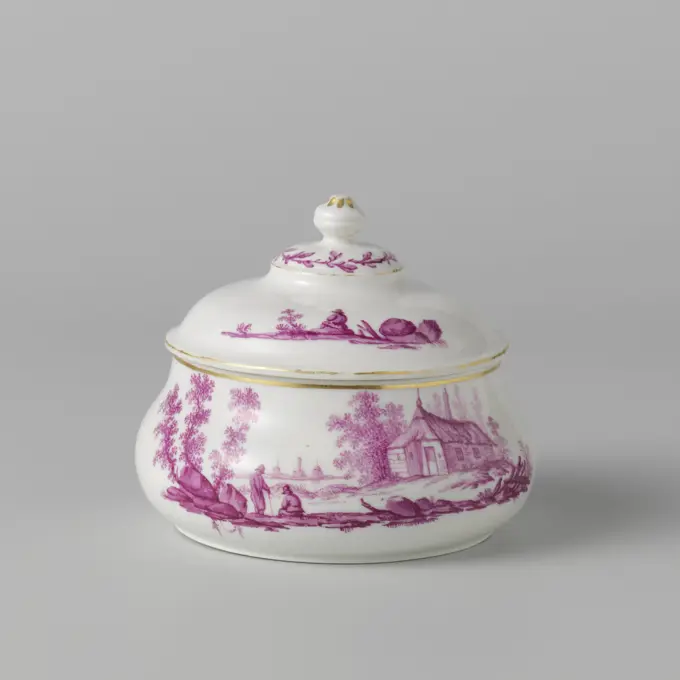
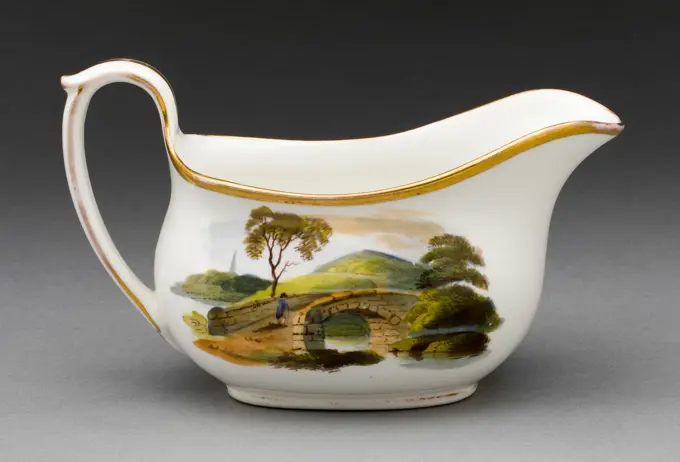
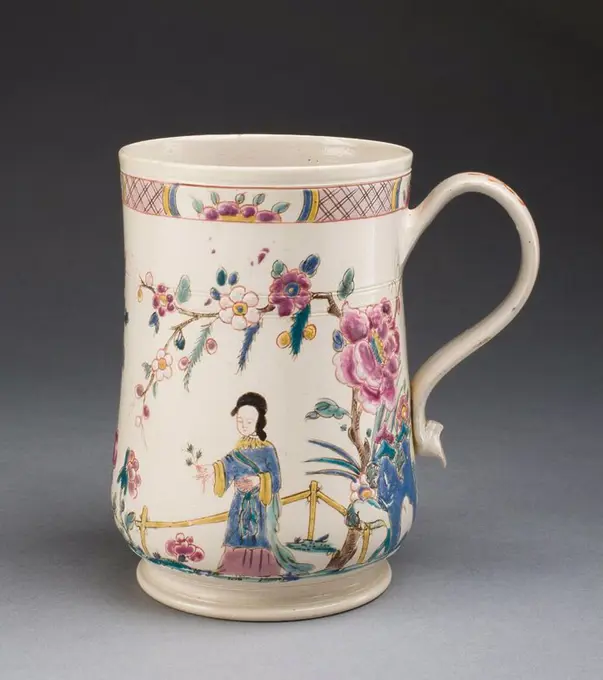
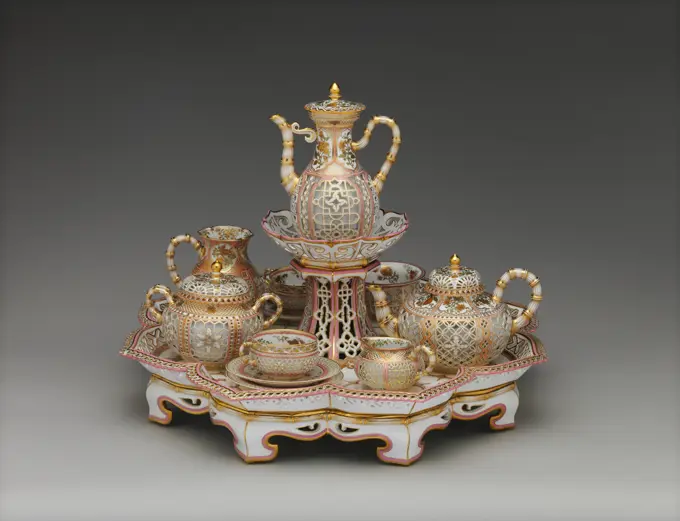
Decorative Porcelain Items

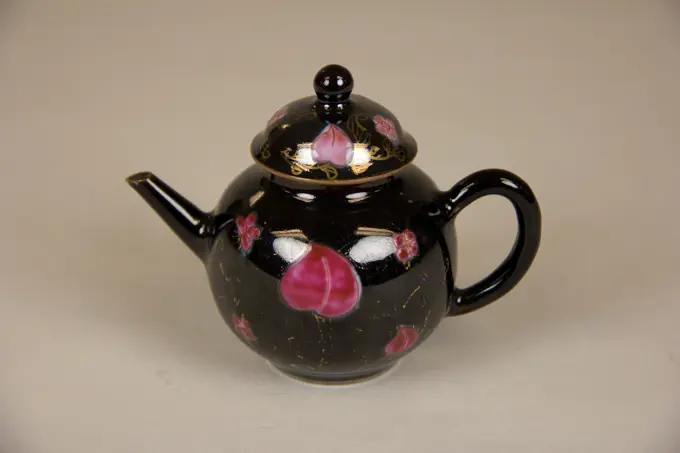
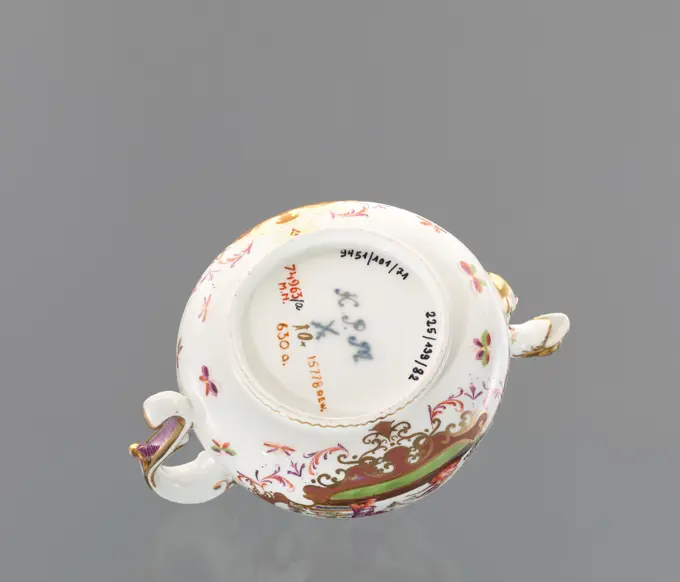
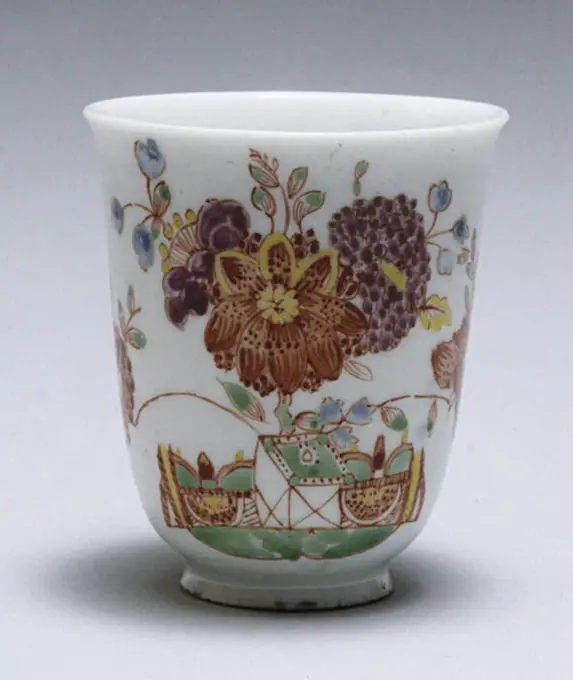
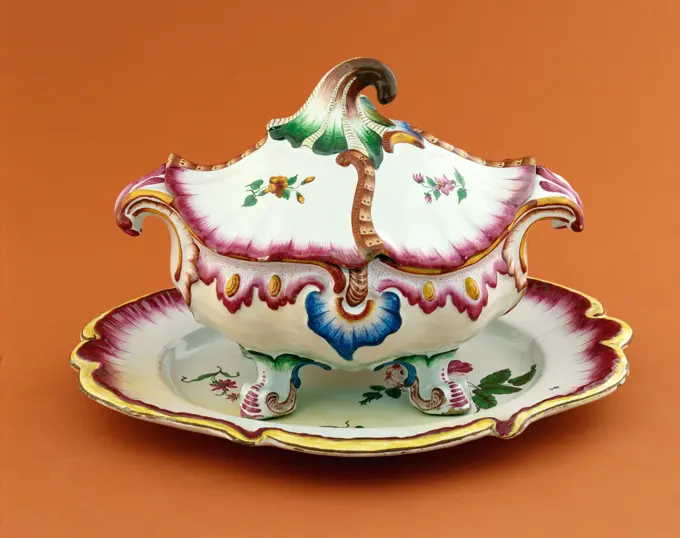
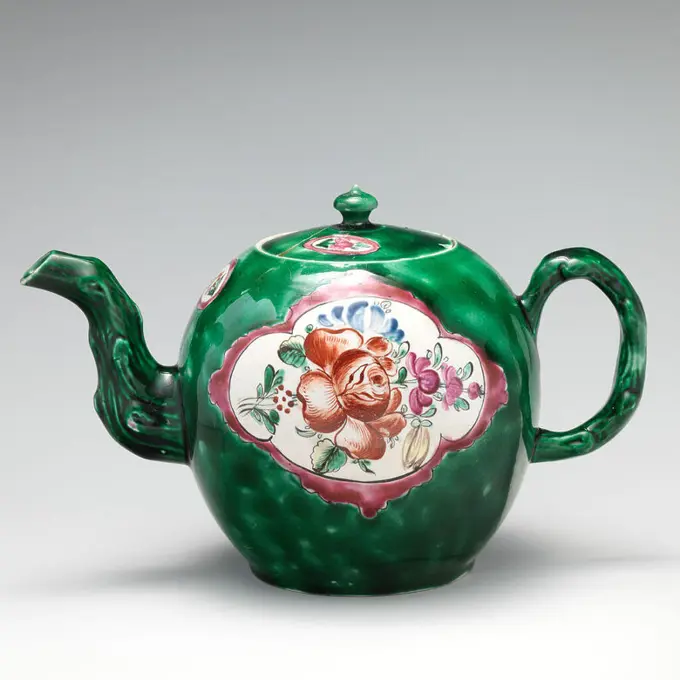
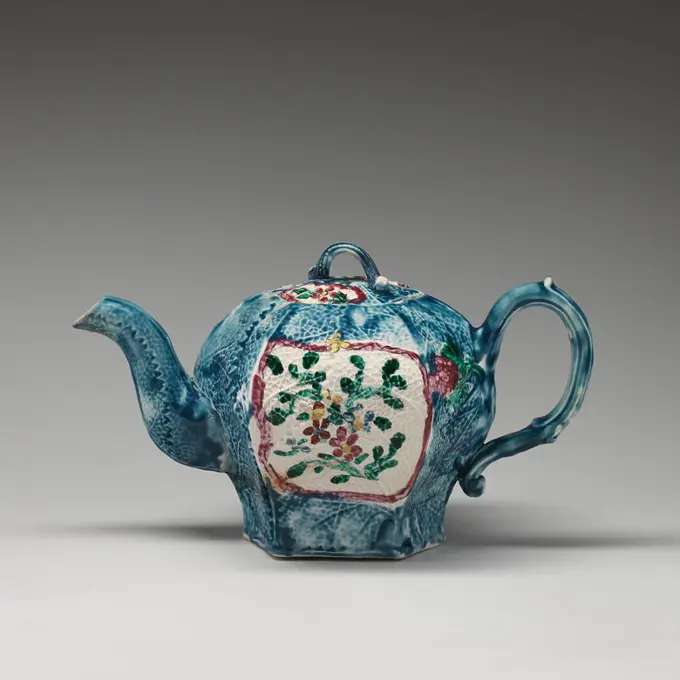
Elegant porcelain pieces such as teapots and milk jugs, adorned with floral patterns and decorative gold accents, displayed gracefully.

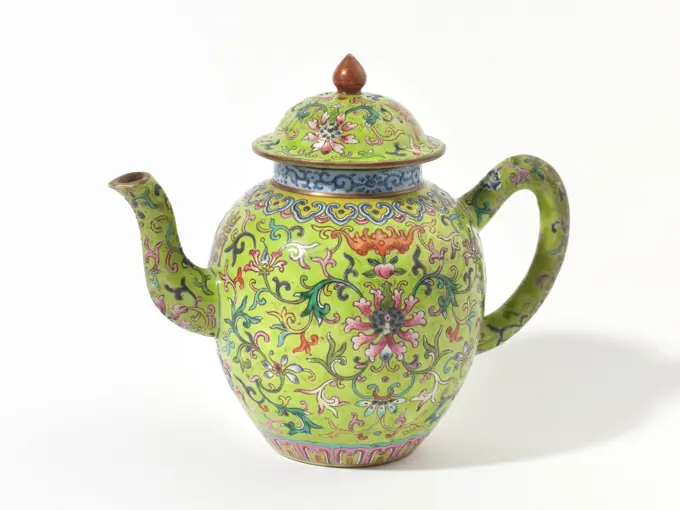
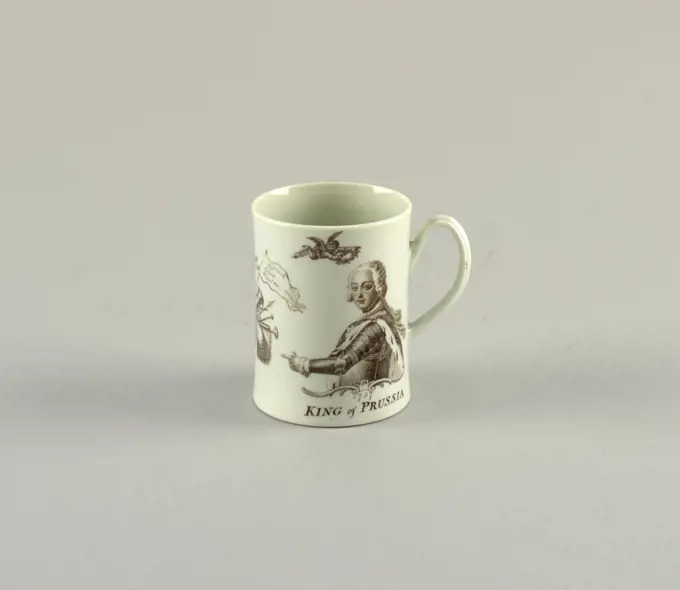
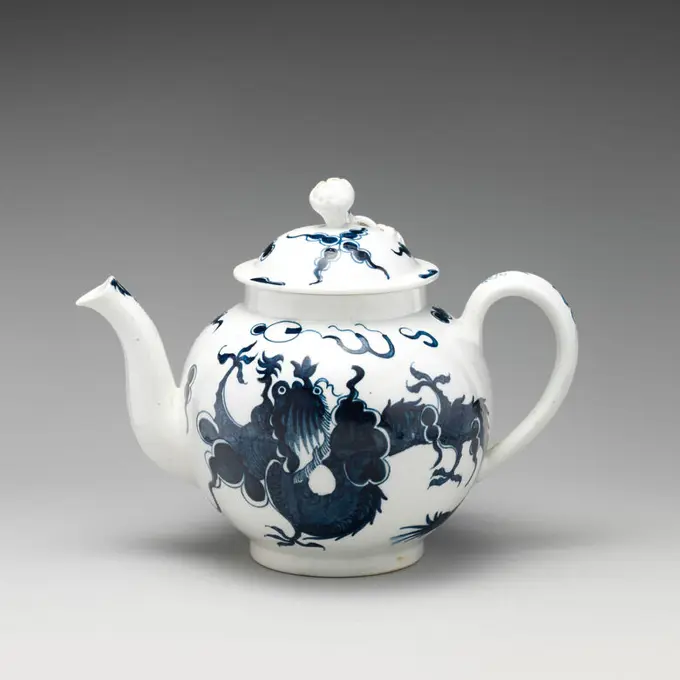
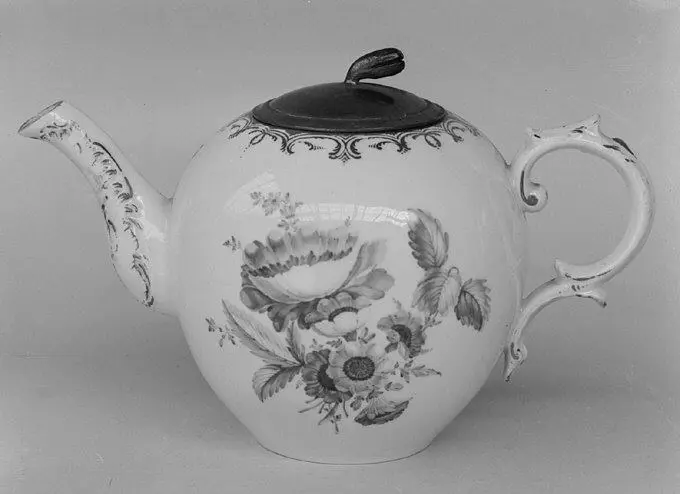
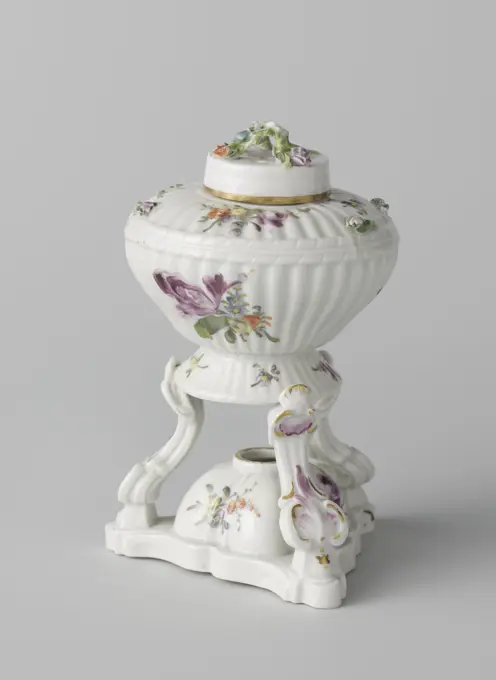
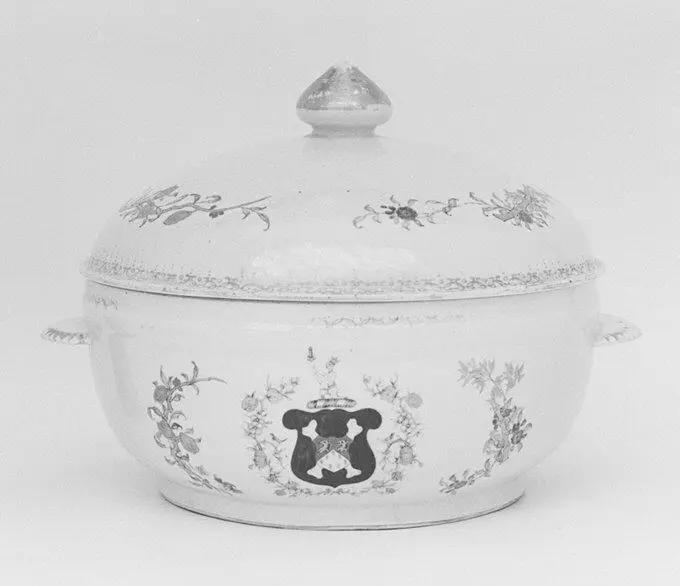
Teapot with flowering plants en ornamental borders, anonymous, c. 1736 - c. 1795 Porcelain teapot with a spherical body, C-shaped ear and S-shaped spout, painted on the glaze in blue, red, green, black and gold. Three flowering plants on the wall (Lotus, Chrysanthemum, Prunus). The shoulder with a decorative band; The edge with a band curl. On the ear and the spout flower vessels. The lid is modeled in the form of a flower with a painted, stylized flower on it. Decorated in Europe in the Chinese Imari style. China porcelain. glaze. gold (metal) painting / gilding / vitrification Porcelain teapot with a spherical body, C-shaped ear and S-shaped spout, painted on the glaze in blue, red, green, black and gold. Three flowering plants on the wall (Lotus, Chrysanthemum, Prunus). The shoulder with a decorative band; The edge with a band curl. On the ear and the spout flower vessels. The lid is modeled in the form of a flower with a painted, stylized flower on it. Decorated in Europe in the Ch
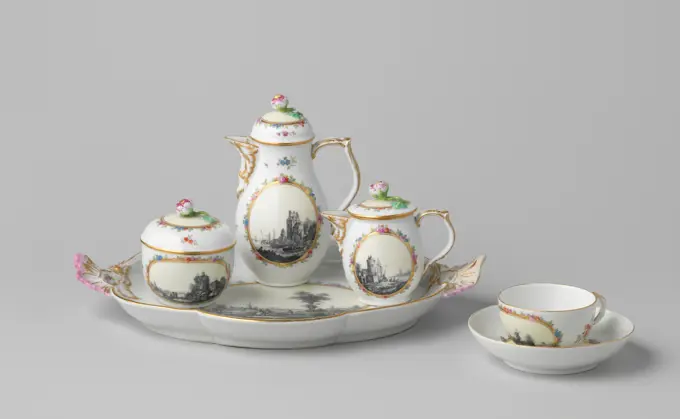
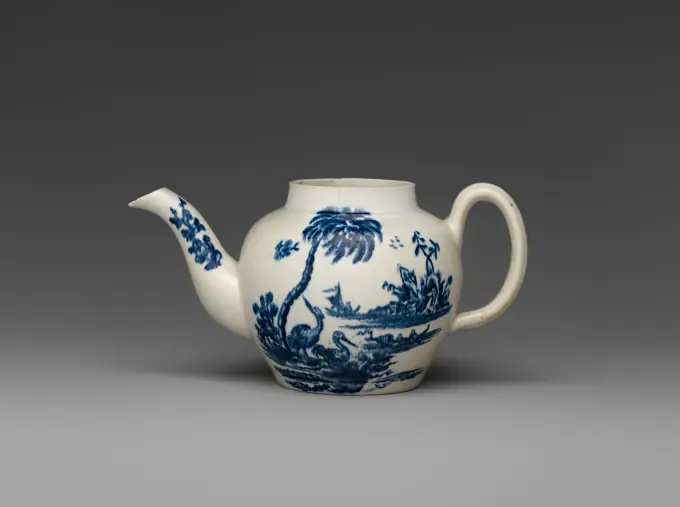
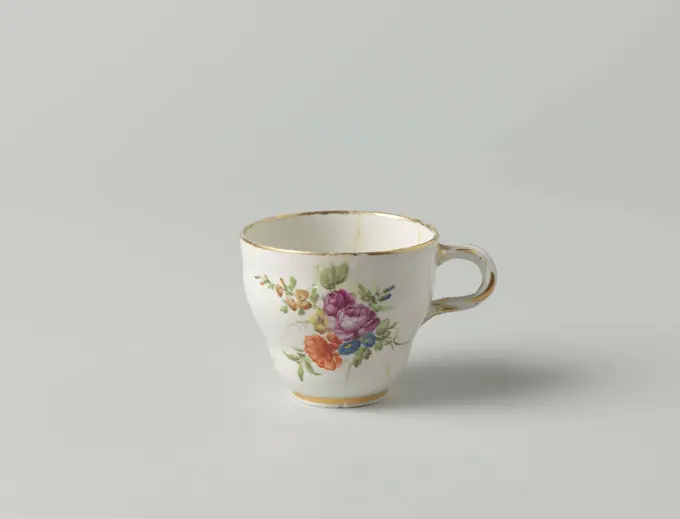
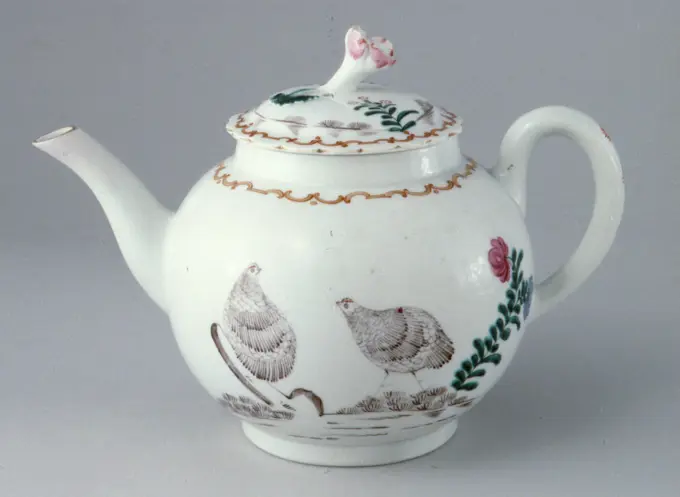
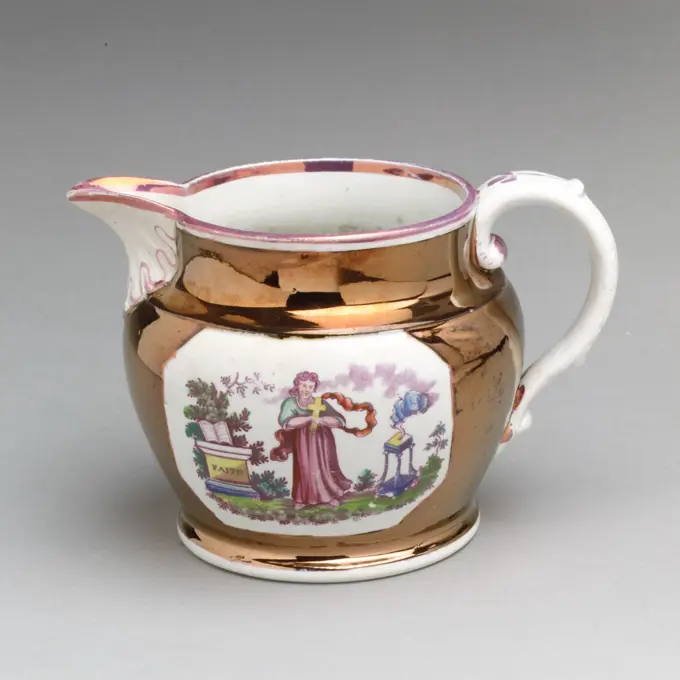
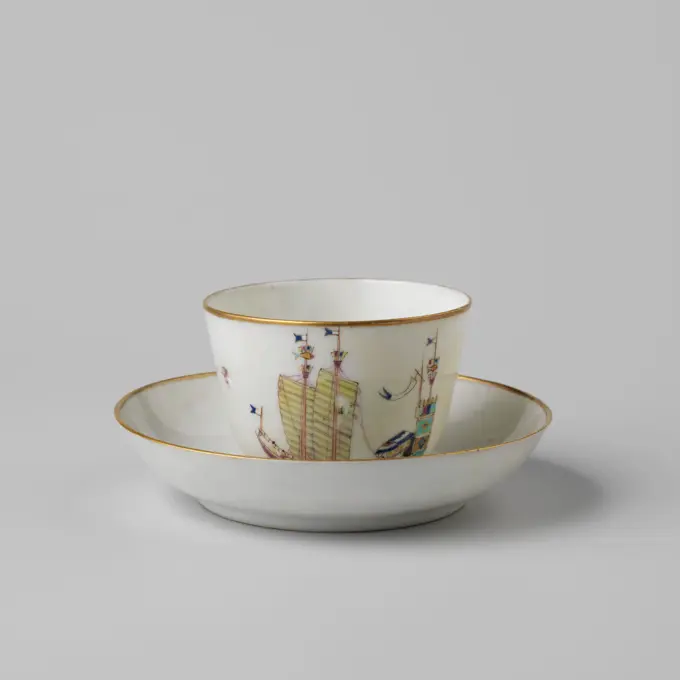
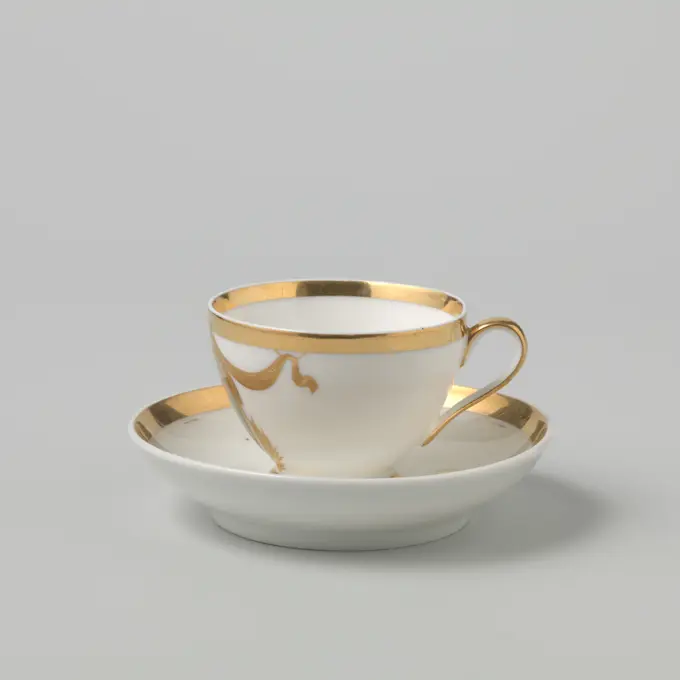
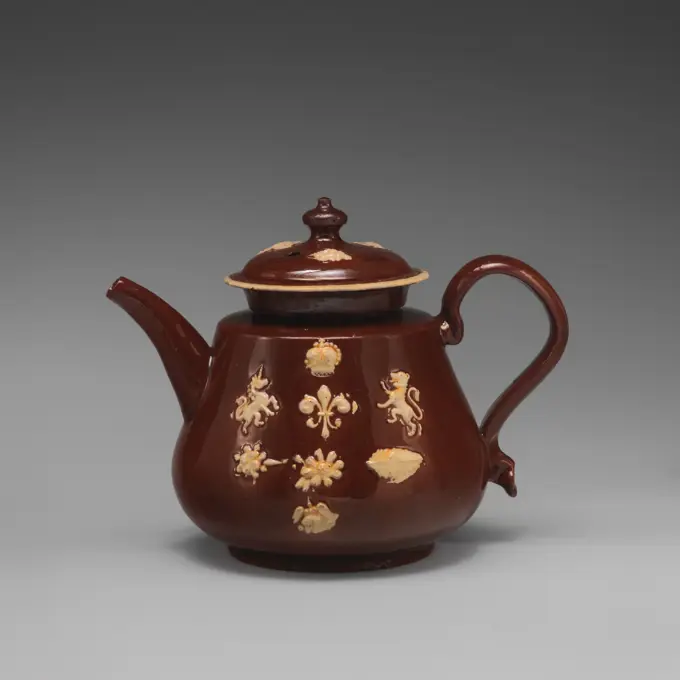
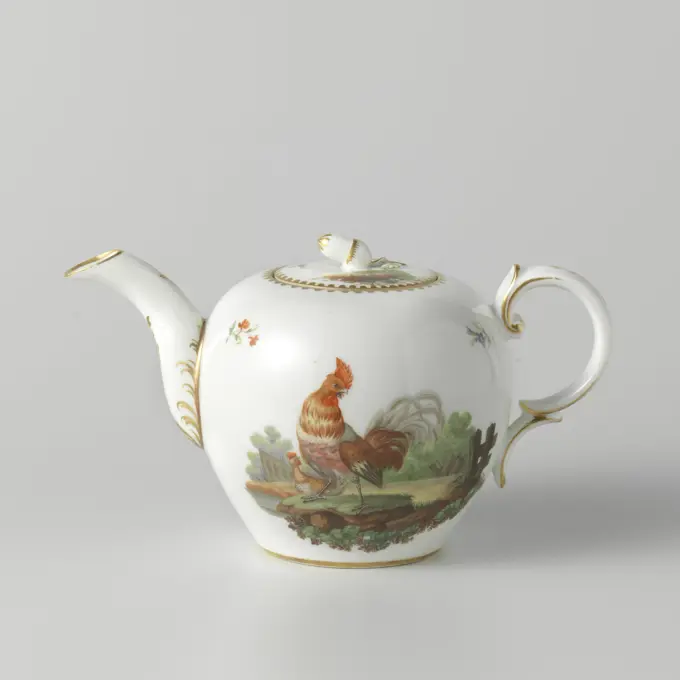
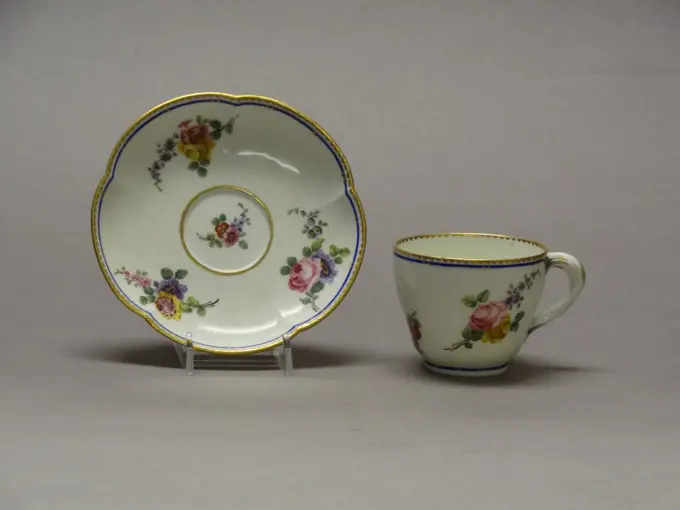
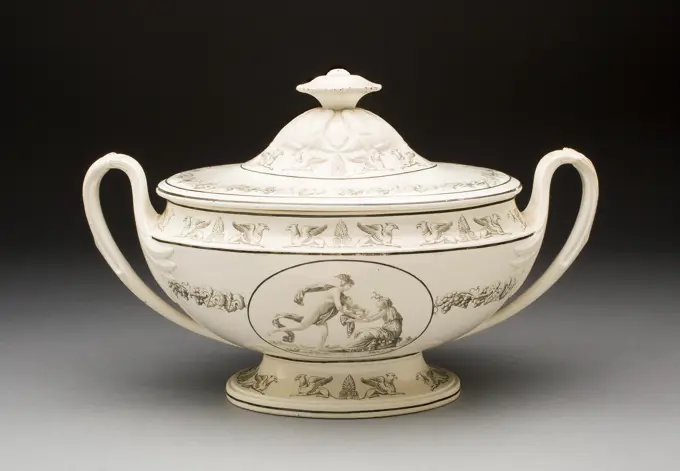
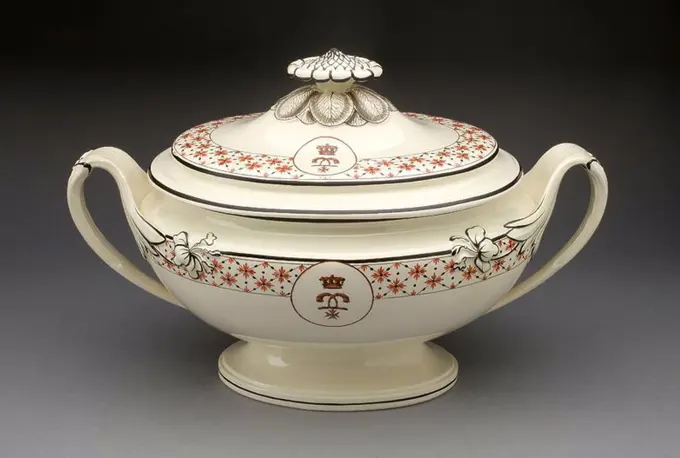
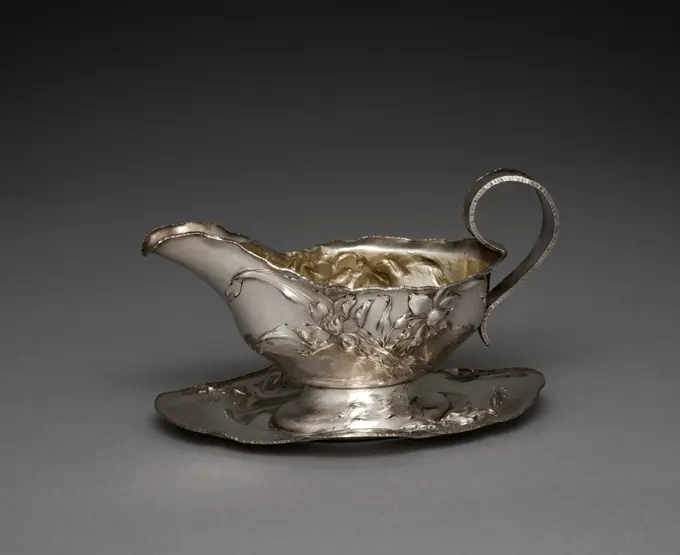
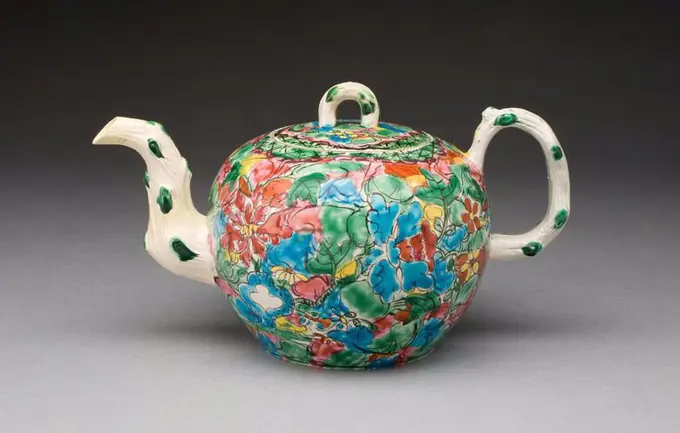
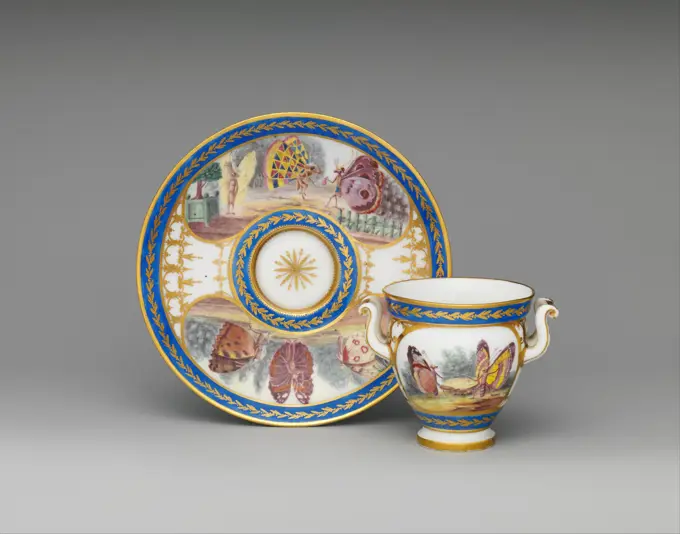
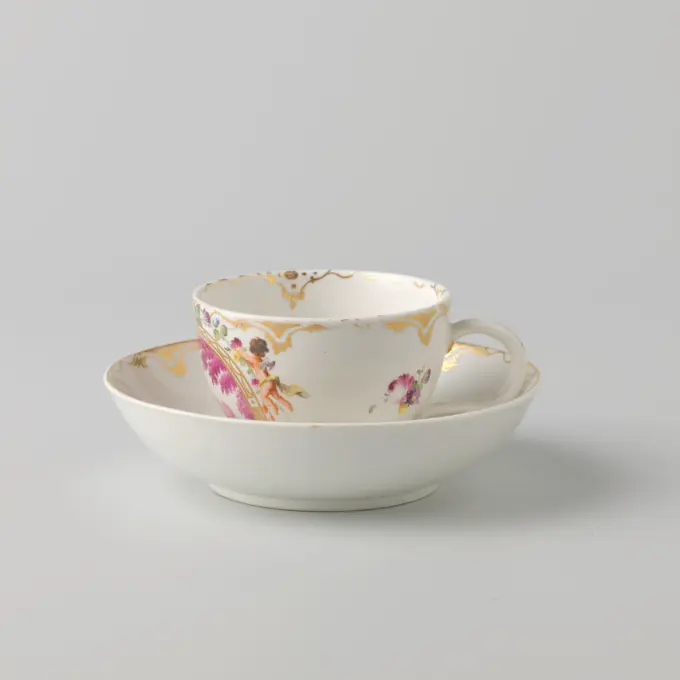
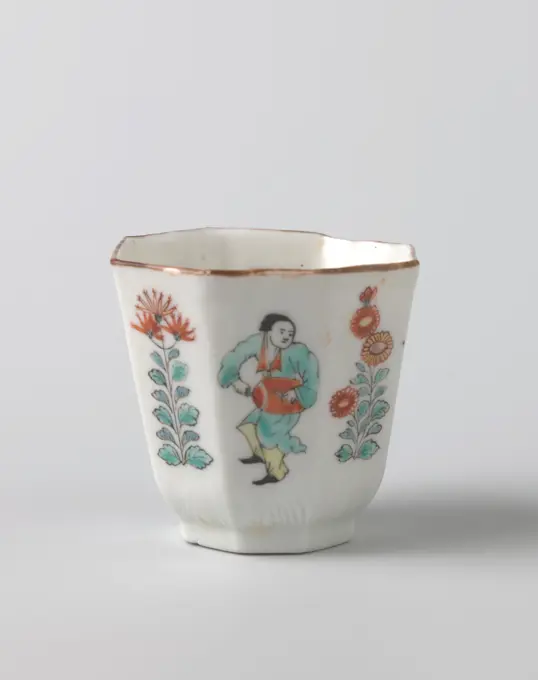
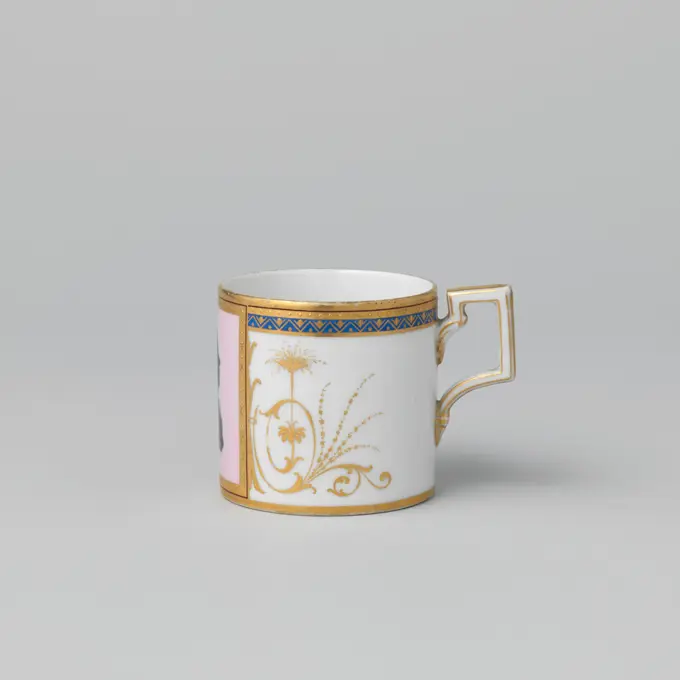
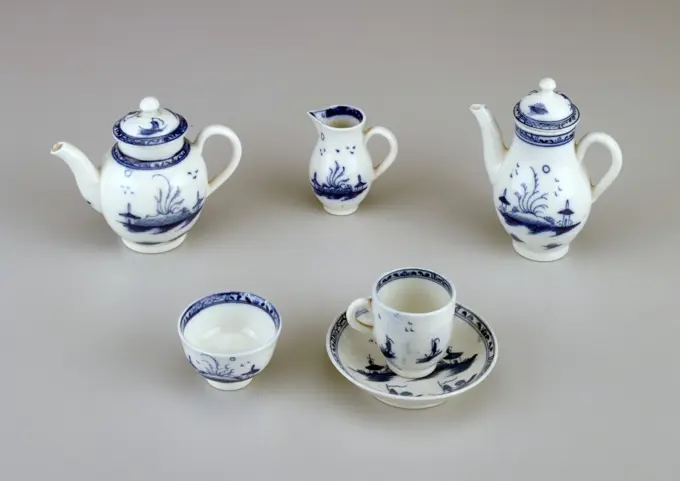
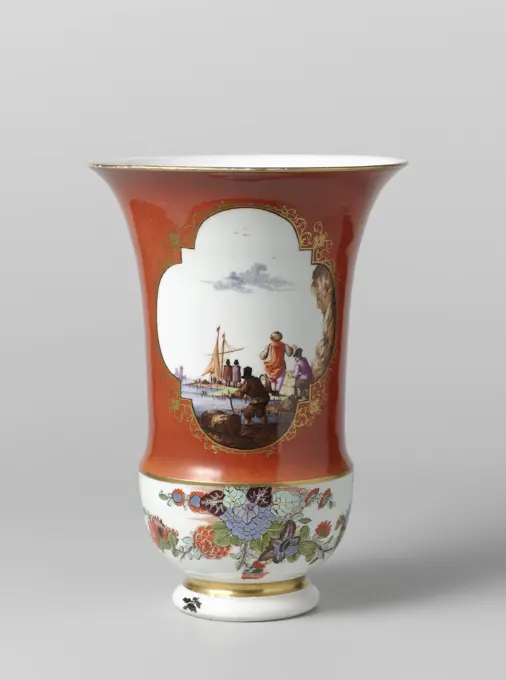
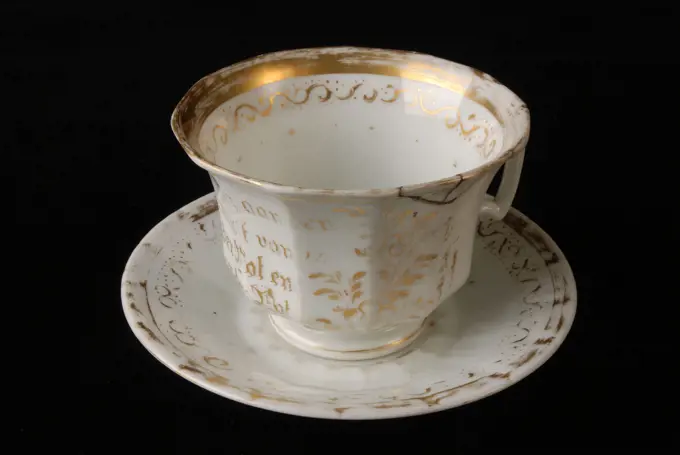
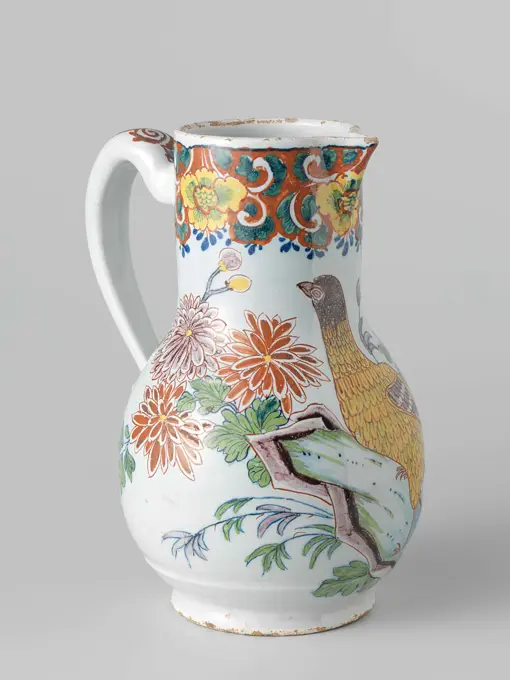
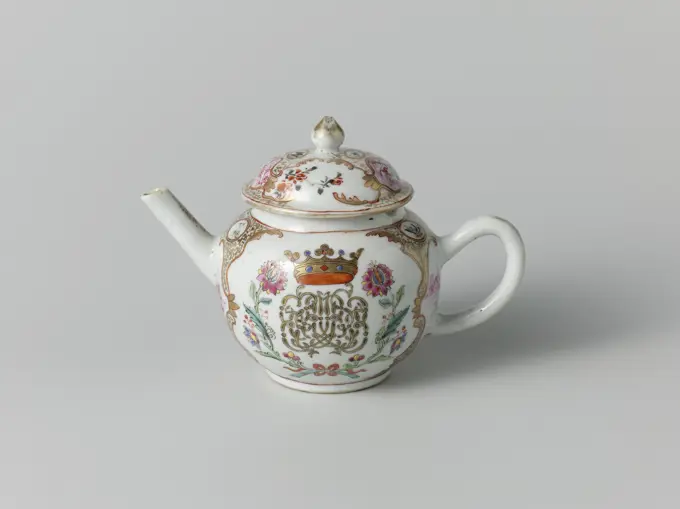
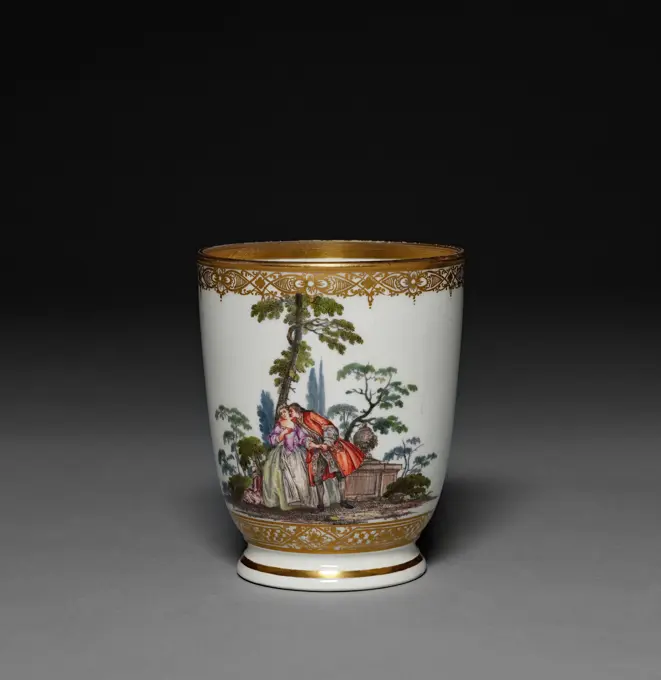
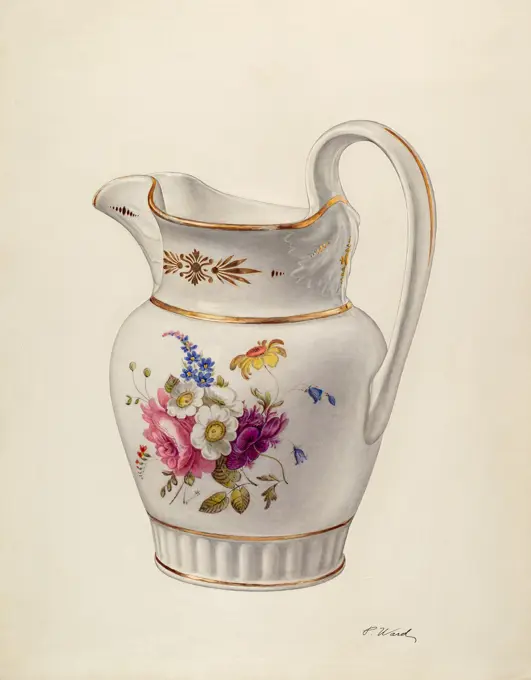
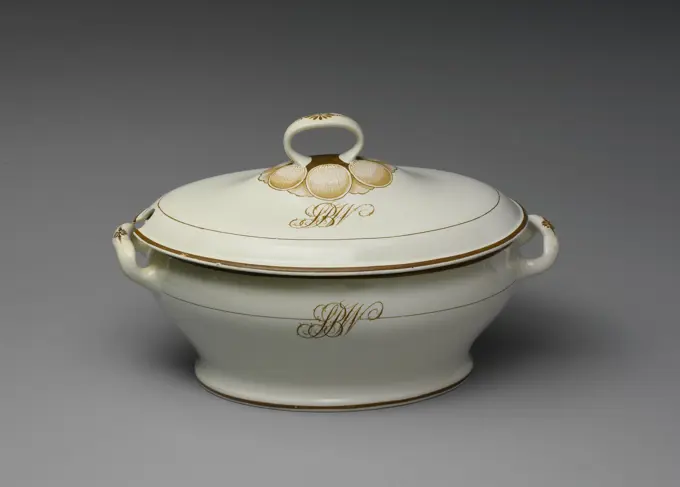
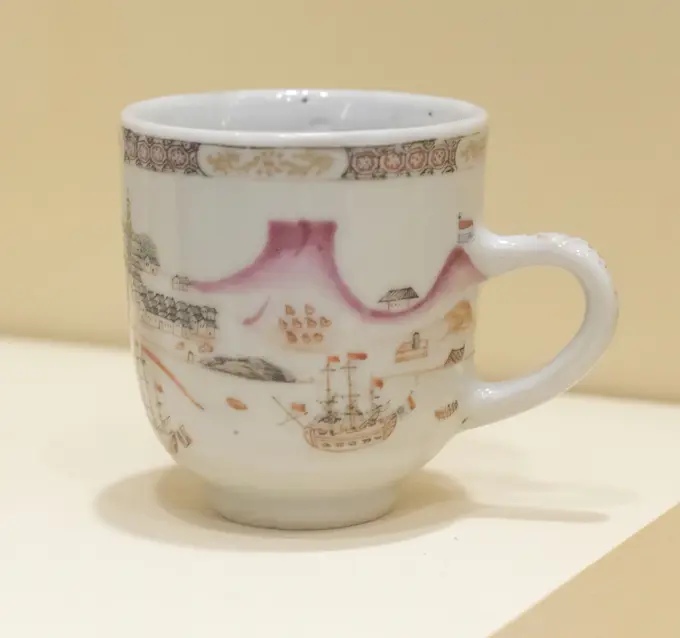
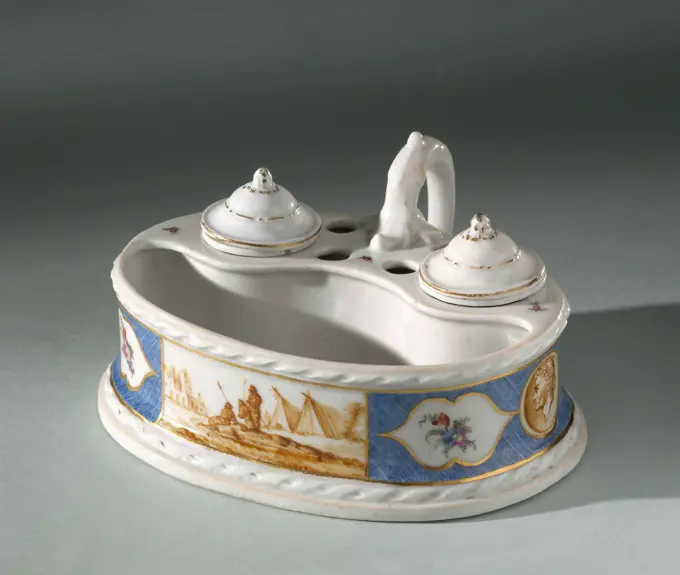
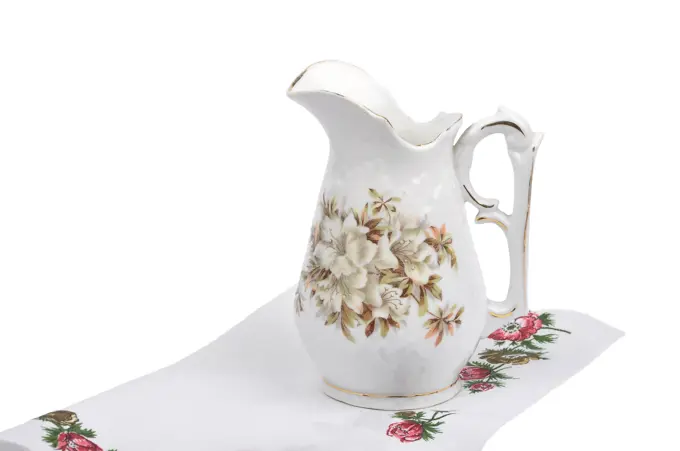
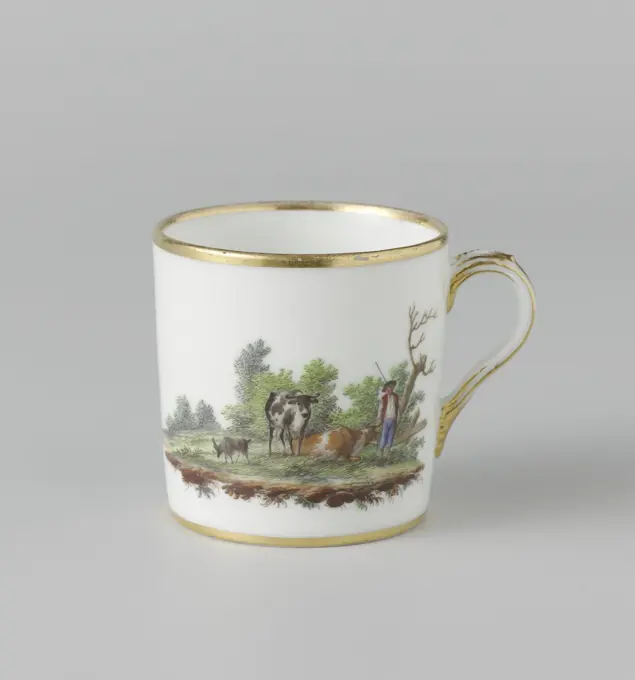
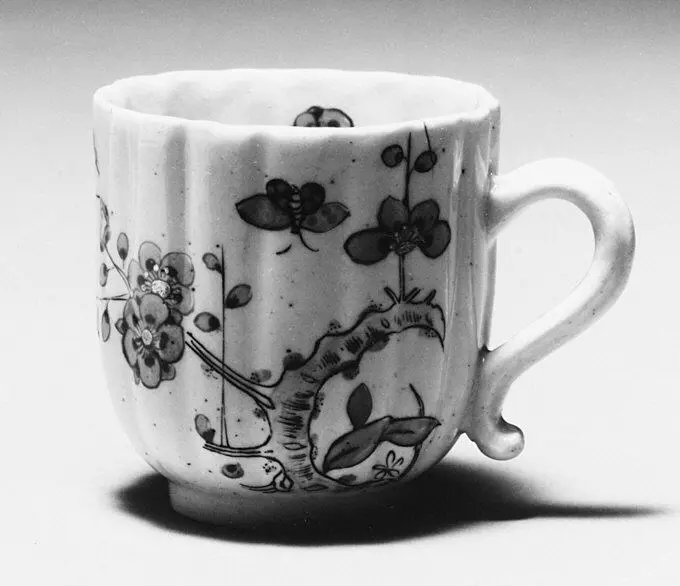
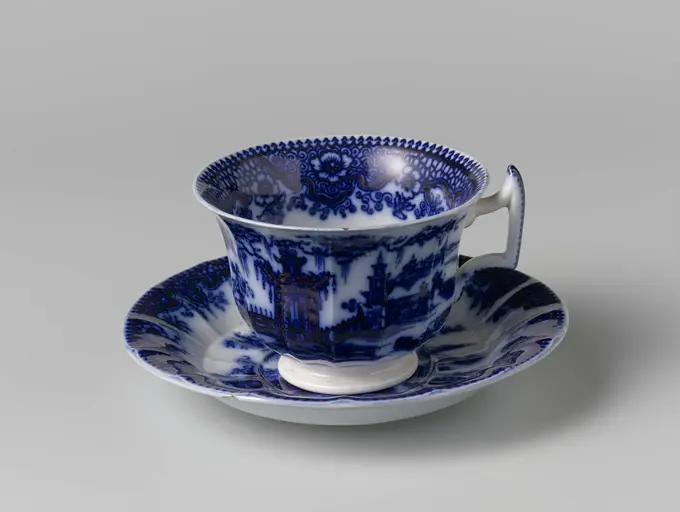
Cup, slight, with oriental landscape. Cup of earthenware with liquefy transfer decor. On the outside of the wall and on the bottom an oriental landscape with buildings. The head has a striker early ear.Tete-a-tete, painted with landscapes within oval. Tête-à-tête consisting of a leaf, a coffee pot, a teapot, a milk jug, a sugar bowl and one cup and saucer. Painted within oval fields with landscapes in encre-chine surrounded by a flower garland on a yellow soil. Marked with a skewer in underglazing blue.Teapot ca. 1765-69 John Bartlam This teapot represents the entrepreneurial and intrepid spirit of eighteenth-century America. Made at the pottery established by John Bartlam in Cain Hoy, South Carolina, outside of Charleston, it was intended to compete with the popular luxury porcelains with underglaze blue decoration that were produced in England and imported to the colonies. Porcelain required specialized clays, deposits of which had only recently been discovered in the Carolinas, and were being mined and shipped to England from Charleston. Josiah Wedgwood feared that the success of the Cain Hoy enterprise would become serious competition to his stronghold in the American market, writing in a letter to Thomas Bentley in 1767, of a "Pottwork in Charles Town" that used Cherokee clay" from the Carolinas to make porcelain. This is one of only seven examples that can be associated with the Bartlam factory, all teawares, and all which feature the Palmetto, a motif not found in English porcClose-up of a cup on a saucer, Paris, FranceCup. .Fili Anka with a saucer; ChurfuerStliche Porcellain Fabrique, Meissen (1763/74-1814); 1774-1814 (1774-00-00-1814-00-00);Flower decorations, classicism (style), "German" flowers, Marcolini period (1774-1814), purchase (provenance)Fili Anka with lid and saucer; Koenigliche Porzellan Manufaktur (KPM; Berlin; 1763-1918); 1780-85 (1775-00-00-1780-00-00);Cup with a border of grapevines and flowers, La Courtille Parijs, c. 1800 - c. 1824 Porcelain head with a cylindrical wall and C-shaped ear, painted on the glaze in green, black and gold. On the outer wall a band with vines on one side and flowers and leaves on the other. Golden edge, foot and ear. Marked on the underside with the crossed arrows. Paris porcelain. glaze. gold (metal) painting / gilding / vitrification Porcelain head with a cylindrical wall and C-shaped ear, painted on the glaze in green, black and gold. On the outer wall a band with vines on one side and flowers and leaves on the other. Golden edge, foot and ear. Marked on the underside with the crossed arrows. Paris porcelain. glaze. gold (metal) painting / gilding / vitrificationLobed Melon-Shaped Ewer. China. Date: 960 AD-1279. Dimensions: H. 7.7 cm (3 1/16 in.); diam. (3 7/8 in.). Qingbai ware; porcelain with underglaze molded decoration. Origin: China. Museum: The Chicago Art Institute, Chicago, USA.Milk jug, the ribs alternately blue and white, separated by golden piping. Milk jug, ribbed, the edges serrated. The ribs separated by vertical golden piping. Dark blue caves (Blue du ROI), the ribs white, on which a decoration of leafwork and braid band. The ear in rococo form. The edges gilt, gilt inside serrated. Marked in underglaze blue.Pitcher (England); stoneware; 13.5 x 16 x 9.1 cm (5 5/16 x 6 5/16 x 3 9/16 in.); Bequest of Jane M. Epstine; 2006-20-44Worcester Porcelain Manufactory, Teapot and Cover, c. 1765-70, soft-paste porcelain.Pitcher British 19th centuryCup and saucer with a Chinese junk and the arms of Amsterdam, anonymous, c. 1800 - c. 1899 Porcelain cup and saucer, painted on the glaze in blue, red, pink, green, yellow, black and gold. On the front of the dish a Chinese junction with a crew on the waves, above the weapon of Amsterdam. The head with the same decoration. A crack in the wall of the dish. Weapon porcelain. China porcelain. glaze. gold (metal) painting / gilding / vitrification Porcelain cup and saucer, painted on the glaze in blue, red, pink, green, yellow, black and gold. On the front of the dish a Chinese junction with a crew on the waves, above the weapon of Amsterdam. The head with the same decoration. A crack in the wall of the dish. Weapon porcelain. China porcelain. glaze. gold (metal) painting / gilding / vitrificationCup with portrait King Willem I. cup and saucer, painted multi-colored with a portrait of King Willem I in an oval crowned medallion. Left and right of the crown The weapon of orange and the Dutch state arm and two spell belts on which the first sovereign / prince of the Netherlands.. Lampet dish of porcelain with raised ring in the center, painted in underglaze blue. In the raised ring of blooming plants; Around the ring four cartouches separated by napkin. In two cartouches a river landscape with pavilions, trees and people; In the other two cartouches flowering plants, birds and insects at a rock. European shapes in blue and white.Teapot ca. 1740 Style of John Astbury Listen to experts illuminate this artwork's story Listen Play or pause #407. Teapots Supported by Bloomberg Philanthropies We're sorry, the transcript for this audio track is not available at this time. We are working to make it available as soon as possible.. Teapot. British, Staffordshire. ca. 1740. Lead-glazed earthenware. Ceramics-PotteryPart of a Tea Service, Manufactuur Oud-Loosdrecht, c. 1782 - c. 1784 Porcelain teapot. Multicolored painted with poultry on a landscape ground and with sprinkles. Along the foot edge a golden trim, along the mouth and lid edge a golden trim with hanging leaf work. Tuit and ear decorated with gold, including with a branch with leaves. The button of the lid, in the shape of a glans on a branch with leaves, is partly gilded. Loosdrecht porcelain Porcelain teapot. Multicolored painted with poultry on a landscape ground and with sprinkles. Along the foot edge a golden trim, along the mouth and lid edge a golden trim with hanging leaf work. Tuit and ear decorated with gold, including with a branch with leaves. The button of the lid, in the shape of a glans on a branch with leaves, is partly gilded. Loosdrecht porcelainCup and saucer painted with butterflies and dragonflies. Cup without ear on saucer and multi-colored painted with butterflies and dragonflies. Signature: Amstel.Cup and Saucer with a Chinese Junk and the Arms of Amsterdam. Cup and saucer of porcelain, painted on the glaze in blue, red, pink, green, yellow, black and gold. On the front of the dish a Chinese jonk with crew on the waves, above the arms of Amsterdam. The head with the same decoration. A crack in the wall of the dish. Weapon porcelain.Sèvres Porcelain Manufactory, Cup and Saucer, 1765, soft-paste porcelain.Tureen 1810-1820 Creil. Earthenware with transfer-printed decoration (creamware) . Creil Pottery (Manufacturer)Terrine with a solid painted with exotic birds. Terrine with underfaith, from porcelain. Oval underfaith with scalloped edge. Terrine rests on four legs, made up of volutes and seed beads. The vaulted, lobed body with two ears. It also vaulted, lobbed lid is awarded by a button in the form of a half lemon. The whole is painted multily with exotic birds on a branch or on a hedge. Along the edges of Godrewers.Tureen. Wedgwood Manufactory; England, founded 1759. Date: 1780-1790. Dimensions: 25.1 × 38.1 × 22.2 cm (9 7/8 × 15 × 8 3/4 in.). Earthenware (creamware) with polychrome enamel decoration. Origin: Burslem. Museum: The Chicago Art Institute, Chicago, USA.Mug, Royal Worcester, English, established 1751, porcelain, vitreous enamel, Mug decorated with scattered flowers., England, late 18th century, ceramics, Decorative Arts, mug, mugSugarbowl (Russia); Manufactured by Kuznetsoff Pottery (Russia); porcelain, enamel, gildingJug with lid; Koenigliche Porzellan Manufaktur (KPM; Berlin; 1763-1918); XVIII/19th century (1790-00-00-1815-00-00);Butter Dish. Weesper Porcelainfabriekweesp, c. 1759-1771Hard-Paste PorcelainTea-pot. Porcelain with enamels decor "pink family", Qing dynasty (1644-1912). Provenance: China. Paris, Cernuschi museum. 78836-10 Asian art, Chinese art, art of living, Ceramic Fine, Decor Emaille, Ching Dynasty, Qing dynasty, Tsing dynasty, porcelain, Emaillee porcelain, service to the, theiere, dishesThis teapot features the Japanese theme of a blossoming cherry tree in the Gion area of Kyoto in underglaze blue and brown. Teapot with Cherry at Night in Gion, 1893-1914. Seifū Yohei III (Japanese, 1851-1914). Porcelain with underglaze blue and iron oxide; height with lid: 9 cm (3 9/16 in.); width with handle: 11 cm (4 5/16 in.); diameter: 8.5 cm (3 3/8 in.).Sauce Boats and Trays, c. 1890. Barbour Silver Company (American), attributed to William Christmas Codman (British, 1839-1921). Silver; overall: 11.4 x 19.7 x 9.8 cm (4 1/2 x 7 3/4 x 3 7/8 in.).Anonymous. "Service of the India Company". Porcelain. Paris, Museum of Romantic Life. PORCELAINFooted teapot ca. 1750 British, Staffordshire Listen to experts illuminate this artwork's story Listen Play or pause #407. Teapots Supported by Bloomberg Philanthropies We're sorry, the transcript for this audio track is not available at this time. We are working to make it available as soon as possible.. Footed teapot. British, Staffordshire. ca. 1750. Salt-glazed stoneware with underglaze blue. Ceramics-PotteryTeapot. England, Staffordshire. Date: 1755-1765. Dimensions: 11.1 x 10.8 cm (4 3/8 x 4 1/4 in.). Salt-glazed stoneware, polychrome enamels. Origin: Staffordshire. Museum: The Chicago Art Institute, Chicago, USA. Author: Staffordshire Potteries.Cup and Saucer 1788 Sèvres. Soft-paste porcelain with polychrome enamels and gilding . Manufacture nationale de Sèvres (Manufacturer)Cup with pheasant. Cup of porcelain, decorated with a pheasant in colors and with the inscription: Faisan de chine. Mounted: the letter "I" urges in a head. Note: The dish with the B number does not belong.tea pot of red stoneware with gold rims, anonymous, c. 1800 - c. 1899 Teapot of brown-red stoneware with a straight spout, C-shaped ear and gilded edges, lid button and out of the spout. The walls of the pot are polished. Marked on the underside and under the ear with unidentified brands. This type of pot was produced especially for the Thai court. Yixing. China Stoneware. frame: Gold (Metal) polishing Teapot of brown-red stoneware with a straight spout, C-shaped ear and gilded edges, lid button and out of the spout. The walls of the pot are polished. Marked on the underside and under the ear with unidentified brands. This type of pot was produced especially for the Thai court. Yixing. China Stoneware. frame: Gold (Metal) polishingTankard 18th century British. Tankard. British. 18th century. Soft-paste porcelain. Ceramics-PorcelainTobacco spot, painted with figures in a landscape with farm, manufacture Oud-Loosdrecht, c. 1774 - c. 1778 Porcelain tobacco spot, painted in beet red with figures in a landscape with farm. Loosdrecht porcelain Porcelain tobacco spot, painted in beet red with figures in a landscape with farm. Loosdrecht porcelainTeapot (part of a service) 1750-70 Chinese, for Continental European market. Teapot (part of a service) 201229Creamer 1810-1820 Burslem. Porcelain with polychrome enamels and gilding . Wedgwood Manufactory (Manufacturer)Cover of teapot, anonymous, c. 1750 - c. 1800 Overhanging lid with round button. Glassblower: Japanmaker: Europe glass glassblowing Overhanging lid with round button. Glassblower: Japanmaker: Europe glass glassblowing. Vine of porcelain with lid, covered with a translucent white glaze. Cylindrical can with flat lid with knob in the form of a cured dragon; on the body a slightly absorbed rectangle and modeled belt; The spout and the ear in the form of a chilong (corneless dragon). Unglazed underside. Blanc De Chine.Dekschal, round, with green edge and golden Greek band. Cover dish of pottery, round, scalloped, with green edge and golden Greek band.Cup with insects, flower sprays and grapevines, Rue Thiroux Parijs, c. 1797 - c. 1798 service (set) Porcelain head with a cylindrical wall and C-shaped ear, painted on the glaze in enamel colors and gold. The outer wall is covered with colored insects (butterflies, beetles, dragonflies, etc.) and in gold flower branches and grape vines. Golden edge and ear. Paris porcelain. glaze. gold (metal) painting / gilding / vitrificationSeventally coffee and tea sets, painted with birds in a landscape. Coffee and tea set consisting of a coffee pot, a teapot, a milk jug, a tea bus, a rinsing bowl and six cups and saucers, multi-colored painted with birds in a landscape. Along the edges of napkin. Signature a in underglaze blue and rebel 4.Tankard. Staffordshire, England. Date: 1755-1765. Dimensions: 9.8 x 12.1 x 8.9 cm (4 7/8 x 4 3/4 x 3 1/2 in.). Salt-glazed stoneware, polychrome enamels. Origin: Staffordshire. Museum: The Chicago Art Institute, Chicago, USA.Cup (tasse à l'étrusque) and saucer 1794 Sèvres Manufactory French The lighthearted whimsy of the painted decoration of this cup and saucer is surprising considering the date at which it was executed, for in 1794 the period of repression and mass executions known as the Terror, which followed the French Revolution, was just ending. The decorative scheme is composed of four reserves (panels) of butterflies masquerading as humans. Their gestures and costumes reflect a decidedly playful spirit, despite the dueling depicted in one scene, and several of their poses and the portrayal of one as Harlequin are references to the popular theatrical tradition of the Italian Comedy. Three of the four scenes are copied, with some variations, from a set of six etchings entitled Essai de papilloneries humaines by Charles-Germain de Saint-Aubin (1721-1786) that were published shortly after 1756.The painter of the cup and saucer, Louis-Gabriel Chulot, has skillfully captured the spirit of Saint-Aubins Cream jug ca. 1730 Chinese, for British market. Cream jug 204098Mug Depicting Frederick the Great, Royal Worcester, English, established 1751, soft paste porcelain, vitreous enamel, Mug with concave sides and ribbed strap handle. Decorated with a dated portrait of Frederick the Great, King of Prussia (1712-1786), after a painting by Antoine Pesne (1683 - 1757). Trophy of arms and flags, and the figure of fame. All decorations are black on white transfer prints., England, ca. 1757, ceramics, Decorative Arts, mug, mugCup and Saucer 1876-92 Ott and Brewer. Cup and Saucer 2860Kettle with lid Copeland & GarrettTeapot. Culture: British, Lowestoft. Dimensions: Height: 5 1/2 in. (14 cm). Factory: Lowestoft (British, 1757-1802). Date: ca. 1770. Museum: Metropolitan Museum of Art, New York, USA.Dish with medallion with pasture, porcelain factory The Hague, 1777 - 1790 Dish painted with multicolored pasture with figures and cows within a medallion decorated with flowerguirles and putti. Along the edge, rocaille ornament. Marked with a stork in blue on the glaze. N.B. German porcelain painted in The Hague. The Hail Hairs Company: Germany porcelain Dish painted with multicolored pasture with figures and cows within a medallion decorated with flowerguirles and putti. Along the edge, rocaille ornament. Marked with a stork in blue on the glaze. N.B. German porcelain painted in The Hague. The Hail Hairs Company: Germany porcelainOctagonal cup with dancing boys and flowering plants, c. 1700 - c. 1720 Octagonal head of porcelain, covered with a translucent glaze and painted on the glaze in blue, red, green, yellow, black and gold. Above the foot a tire with entered, pointed leaf motifs. In Europe painted with a dancing boy with an instrument and flowering plants. A flower drink on the bottom. Marked on the underside with an unidentified seal brand. Baking sand on the foot ring. Brown edge. Blanc de Chine in Europe decorated in the Japanese Kakiemon style. Dehuapainter: Europe porcelain. glaze. gold (metal) painting / gilding / engraving / vitrification Octagonal head of porcelain, covered with a translucent glaze and painted on the glaze in blue, red, green, yellow, black and gold. Above the foot a tire with entered, pointed leaf motifs. In Europe painted with a dancing boy with an instrument and flowering plants. A flower drink on the bottom. Marked on the underside with an unidentified seal brand. Baking sand Cup and saucer with lid, multi -colored painted with performances and the monograms AJK and EPK in medallions, Meissener Porzellan Manufaktur, c. 1775 - c. 1780 Head with lid of painted porcelain. On one side of the head, a horizontal Venus with amor is painted in a landscape and on the other hand the monogram Ajk, both in an oval medallion, which is saved in a royal blue stock. The lid shows two winged hearts on one side, the monogram EPK on the other. The head is marked. Float porcelain Head with lid of painted porcelain. On one side of the head, a horizontal Venus with amor is painted in a landscape and on the other hand the monogram Ajk, both in an oval medallion, which is saved in a royal blue stock. The lid shows two winged hearts on one side, the monogram EPK on the other. The head is marked. Float porcelainTeapot China. Teapot 52889Cup with a flower spray, Clignancourt, c. 1775 - c. 1790  Porcelain head with a cylindrical wall and ear, painted on the glaze with pink, green, yellow, black and gold. On the outside wall a flower branch (rose). Dots and leaf motifs on the ear. Golden Rand. Marked on the bottom with the monogram 'LSX'. Clignancourt porcelain. glaze. gold (metal) painting / gilding / vitrificationTeapot with lid with Hoeroldtmalerei miniatures; Koenigliche Porcellain Fabrique, Meissen (1710-1763), Hoeroldt, Johann Gregorius (1696-1775); 1724-1730 (1724-00-00-1730-00-00);Basin, c. 1902, Josef Maria Olbrich; Manufacturer: Villeroy & Boch, Audun-le-Tiche, Germany, est. 1748, 16 in. (40.64 cm), Glazed earthenware with transfer printed decoration, Germany, Art NouveauBeaker ca. 1765 Doccia Porcelain Manufactory Italian The gift of the Hans Syz Collection in 1995 endowed the Museum with nearly three hundred examples of European and Asian ceramics meticulously acquired by Swiss-born collector Dr. Syz (1894-1991) to chart the migration of models and patterns from East to West. Documenting a continuous process of influence and adaptation, these pieces provide a discriminating review of the nuances of stylistic change resulting from three centuries of trade.. Beaker 208351Soup tureen and stand, c. 1755, Paul Antoine Hannong, French (Strasbourg), French, c.1700-1760, 9 x 15 x 13 in. (22.86 x 38.1 x 33.02 cm), Faience (tin-glazed earthenware), France, 18th centuryCup with golden tendrils and colorful flower clusters. Cup of porcelain, decorated with golden tendrils and colorful flower clusters. Vignet with woman's figure with stick in the right hand and bird in left hand.Cup with portrait en profiles, royal porcelain manufactory, c. 1800 - c. 1810  Porcelain head with an angular ear, painted on the glaze in blue, red, pink, black and gold. On the outside wall a square compartment with a portrait and profil (silhouette) in black against a pink background. On either side of the flower ranks course. A decorative band on the edge. Marked on the underside with the scepter, number 33 and IIII. Berlin porcelain. glaze. gold (metal) painting / gilding / vitrificationTeapot ca. 1770 Fürstenberg Porcelain Manufactory. Teapot 199269Jug British 19th century View more. Jug. British. 19th century. Lustreware. Ceramics-PotterySimple colorful metallic watering cans on blue backgroundCup and saucer, from a child's tea set, in blue and white, c. 1780-1790, Caughley (Salopian) Works, 1 3/4 x 2 7/8 in. (4.4 x 7.3 cm), Pottery, England, 18th centuryThree Vases, Meissener Porcelain Manufaktur, c. 1735 Vase of painted porcelain. Apart from the lower part, the vase is covered with an Oranjerode Fond, in which two accolade -shaped four passes are always saved with European merchants at Balen on the banks of a bay with ships. The bowl -shaped lower part of the vase, which is slightly wider, is painted with Indianian blums. The vase is marked. Float porcelain Vase of painted porcelain. Apart from the lower part, the vase is covered with an Oranjerode Fond, in which two accolade -shaped four passes are always saved with European merchants at Balen on the banks of a bay with ships. The bowl -shaped lower part of the vase, which is slightly wider, is painted with Indianian blums. The vase is marked. Float porcelainPair of Incense Burners, Porcelain Factory The Hague, c. 1777 - c. 1790 Incense burner, a ribbed jar on three legs in the form of rocaille volutes and leaves in relief resting on a triangular base. The painting consists of a spray pattern of small flowers. Marked with a stork in blue under the glaze. N.B. Ansbach's hard porcelain painted in The Hague. The Hail Hate Company: Ansbach porcelain Incense burner, a ribbed jar on three legs in the form of rocaille volutes and leaves in relief resting on a triangular base. The painting consists of a spray pattern of small flowers. Marked with a stork in blue under the glaze. N.B. Ansbach's hard porcelain painted in The Hague. The Hail Hate Company: Ansbach porcelainWhite cup and saucer with gold-colored decoration, on the occasion of the golden wedding of Debora Petronella Burger and Gerrit van der Pot, 5 May 1849, cup and saucer drinking utensils tableware holder ceramics pottery glaze, wedding marriage jubilee celebration coupleChina, Macau. Macau was both the first and last European colony in China. Historic Center of Macau, UNESCO. Museum of Macau (aka Museu de Macau). Canton enamel with gold trim, 19th century.Can be painted from faience, multi-colored with a bird and flowers. With a loose silver lid. Can of faience. Painted multi-colored with a bird and flowers.. Chocolate canned cylindrical of shape with a wooden handle and a flat lid with a hole in front of a rudder. The decoration consists of a multi-colored river face with ships. Mounted: Amstel in blue under the glaze and rubbing L1 with star.Teapot with a crowned, illegible monogram surrounded by two flower sprays, anonymous, c. 1750 - c. 1774 Teapot of porcelain with spherical body, C-shaped ear and straight spout, painted on the glaze in blue, red, pink, green, yellow, black and gold. On the abdomen twice a crowned, unreadable monogram surrounded by two flower branches; around the ear and the spout a cartouche with a river landscape; For the cartouches flower ranks with four medallions with plants. On the lid of flower vines and cartouches with landscapes or flower branches. European performance in email colors. China porcelain. glaze. gold (metal) painting / gilding / vitrification Teapot of porcelain with spherical body, C-shaped ear and straight spout, painted on the glaze in blue, red, pink, green, yellow, black and gold. On the abdomen twice a crowned, unreadable monogram surrounded by two flower branches; around the ear and the spout a cartouche with a river landscape; For the cartouches flower ranks with four medaPreview, Frederik van Strant (I) (Attributeed to), after 1706 - before 1727 Round migratory jar with a wide base and upwards sloping. The wall is sea lobby due to incentives. The handle is S-shaped and processed. The lid is decorated with leaf motifs and the button of the lid has the shape of a flower bud. The boiler is marked: stk. = Amsterdam, size = attributed to Frederik van Strant I and an ax. See also invnr. BK-1977-56 and BK-NM-11177-123. Amsterdam silver (metal) Round migratory jar with a wide base and upwards sloping. The wall is sea lobby due to incentives. The handle is S-shaped and processed. The lid is decorated with leaf motifs and the button of the lid has the shape of a flower bud. The boiler is marked: stk. = Amsterdam, size = attributed to Frederik van Strant I and an ax. See also invnr. BK-1977-56 and BK-NM-11177-123. Amsterdam silver (metal)Two-handled Cup and Saucer. Meissen Porcelain Manufactory; German, founded 1710. Date: 1720-1725. Dimensions: Cup: H. 7 cm ( 2 3/4 in.) diam. 10.2 cm (4 in.); Saucer: H. 2.5 cm (1 in.); diam. 12.9 cm (5 1/16 in.). Hard-paste porcelain and gilding. Origin: Meissen. Museum: The Chicago Art Institute, Chicago, USA.Dish ca. 1725-30 Vienna. Dish 199350Teapot. Culture: British, Staffordshire. Dimensions: 5 × 7 7/8 in. (12.7 × 20 cm). Date: ca. 1765. Museum: Metropolitan Museum of Art, New York, USA.Teapot. Culture: British, Staffordshire. Dimensions: Overall: 4 3/8 × 7 1/2 in. (11.1 × 19.1 cm). Date: ca. 1760. Museum: Metropolitan Museum of Art, New York, USA.Beaker, c. 1745-1750. Meissen Porcelain Factory (German). Porcelain; diameter: 11 x 8 cm (4 5/16 x 3 1/8 in.). In an effort to rejuvenate its style of decoration, the Meissen factory acquired a large group of French engravings about 1740. During the next decade, figural decorations in the style of Antoine Watteau and his followers became a typical mode of decoration on Meissen pporcelain.Paul Ward, White Glazed Porcelain Pitcher, c 1940 White Glazed Porcelain PitcherTureen with cover (part of a service) 1740-50 Chinese, for British market. Tureen with cover (part of a service). Chinese, for British market. 1740-50. Hard-paste porcelain. Ceramics-Porcelain-ExportRoompot, painted with flower branches, manufacture Oud-Loosdrecht, c. 1774 - c. 1778 Roompot made of porcelain. Triangular with question mark -shaped ear and incorporated wall. Along the foot edge Rocaille ornament in relief. Painted in beet red with flower branches. The mouth and foot edge are decorated in beet red and gold. On the ear a flower branch in gold. The lid button is also decorated in beet red and gold. Gold pisses along ear and mouth and lid edge. Loosdrecht porcelain Roompot made of porcelain. Triangular with question mark -shaped ear and incorporated wall. Along the foot edge Rocaille ornament in relief. Painted in beet red with flower branches. The mouth and foot edge are decorated in beet red and gold. On the ear a flower branch in gold. The lid button is also decorated in beet red and gold. Gold pisses along ear and mouth and lid edge. Loosdrecht porcelainSimple colorful metallic watering cans on blue backgroundCovered Tureen 1750-75 British Creamware, so-called for its cream-colored body, is a refined earthenware with a lead-based glaze that was developed in Staffordshire, England around 1750. Due to its light color and glossy glaze, it was ideal for dinnerware. Economically affordable to produce, creamware was imported to America in large quantities. Although much creamware was used in America, it is rare to find pieces associated with a particular family. This dinner service (36.22.1 -.38) bears the initials SBW” for Samuel Blachley Webb. The set was imported from England in 1774 by Webb, who was an aide-de-camp and military secretary to General George Washington.. Covered Tureen 2547Cup with bouquets, imperial porcelain factory, c. 1798  Porcelain head with a cylindrical body and angular ear, painted on the glaze in blue, red, pink, green, yellow, purple, black and gold. The outside of the head is covered with gold, containing a bouquet and a loose flower branch twice. The outer edge with a bond of flower ranks in Goudreliëf. Marked on the underside with the shield, number 39 and year number 98. Vienna porcelain. glaze. gold (metal) painting / gilding / vitrificationCup from a coffee set with scene of Capetown Harbor, c. 1760, 2 5/8 x 3 3/16 x 2 5/16 in. (6.67 x 8.1 x 5.87 cm), Porcelain, China, 18th century, This set is decorated with a scene of Dutch ships in Capetown Harbor, with Dutch buildings, flags and a view of Table Mountain in the background. Capetown Harbor was a significant stop for ships en route to China or returning home, especially for water and provisions.Ewer with lid from a sake set, 20th century, Unknown Japanese, 4 1/2 x 5 3/4 in. (11.43 x 14.61 cm), Imari ware; porcelain, enamels, Japan, 20th century, Each of the pieces is signed by the artist who is regarded as the finest contemporary Japanese potter working in the Imari tradition.Manner of Meissen Porcelain Manufactory, Cup and Saucer, 19th century, hard-paste porcelain.Tea set, Leeds pottery, silver resist, creamer, England, 18th-mid-19th century, ceramics, Decorative Arts, Tea set. Porcelain ink set. Oval with ear on one side. In the portion closed at the top two large round openings for an inkwell and a sand spreader, both with lid and four holes for pens. A braided ribbon motif in relief along the top and bottom edge. Painted to the front with a landscape with figures at tents in sepia in a rectangular field, which interrupts a fries from light blue grille. In this railing, three cartouches are saved on the sides, the middle of a medallion with scrunch men's head in sepia, contain the other two peak and a multicolored flower branch. At the rear, an oval with spreading gangs is saved, in the middle of which the earring of the ear is located. On the wall and lids golden piping.Alte Blumenvase auf Tuch - Old flower vase on cloth Alte Blumenvase auf Tuch - Old flower vase on cloth Copyright: xZoonar.com/lantapixx 5667867Multiculously painted basket of Faïence, Anonymous, c. 1755 - c. 1780 Basket of Faïence. Multicolored painted with a landscape on the bottom. Delft . Basket of Faïence. Multicolored painted with a landscape on the bottom. Delft .Head, painted with a landscape with cattle, c. 1809 - c. 1814 Head, painted with landscape with cattle. Marked: Amstel in blue. Nieuwer-Amstel porcelain Head, painted with landscape with cattle. Marked: Amstel in blue. Nieuwer-Amstel porcelainSimple colorful metallic watering cans on blue backgroundCup ca. 1755 Derby Porcelain Manufactory The gift of the Hans Syz Collection in 1995 endowed the Museum with nearly three hundred examples of European and Asian ceramics meticulously acquired by Swiss-born collector Dr. Syz (1894-1991) to chart the migration of models and patterns from East to West. Documenting a continuous process of influence and adaptation, these pieces provide a discriminating review of the nuances of stylistic change resulting from three centuries of trade.. Cup. British, Derby. ca. 1755. Soft-paste porcelain. Derby Porcelain Manufactory (British, 1751-1785). Ceramics-PorcelainRoompot, painted with flower and leafy branches. Roompot from porcelain. Triangular with question mark-like ear and rubbed wall. Painted in underglazing blue and purple with flower and leaf branches and ornament along the edges (only on the foot edge in light relief).Coffee and tea service (déjeuner chinois réticulé) 1855-61 Sèvres Manufactory French The various shapes employed for this exuberant service evoke both China and the Near East-the origins of tea and coffee, respectively. The Sèvres factory described the service as a déjeuner chinois reticulé, or a Chinese service with openwork decoration, but its fidelity to Chinese models is slight. The shape of the tray, with its scrolling feet, is based on Chinese lacquerware, and the double-walled forms with openwork exteriors appear to have been inspired by Chinese porcelains sold in Paris in 1826. Additional Chinese-inspired elements include the simulated bamboo handles and the painted Chinese emblems, but the profusion of decorative motifs and the color scheme of white, pink, and gold are entirely European in character. This blending of Asian forms with European decoration reflected the taste for exoticism in mid-nineteenth-century France. It is not clear if services of this design were intended Cup and saucer 18th century () Possibly Tournai. Cup and saucer 200857