Historic Military Activities in France

Photographs showcasing American military presence in post-World War I France, including inspections of destruction and interactions with local soldiers.

This image depicts a home in the Latin Quarter near Blvd. Saint Germain, which was regularly visited by famous musicians in old Paris, France. The photo was taken on October 29, 1918, at 20:40:18 by an ARF photographer with the reco number of 3-28-19. It is listed as subject number 45809 in the collection "Photographs of American Military Activities during World War One."
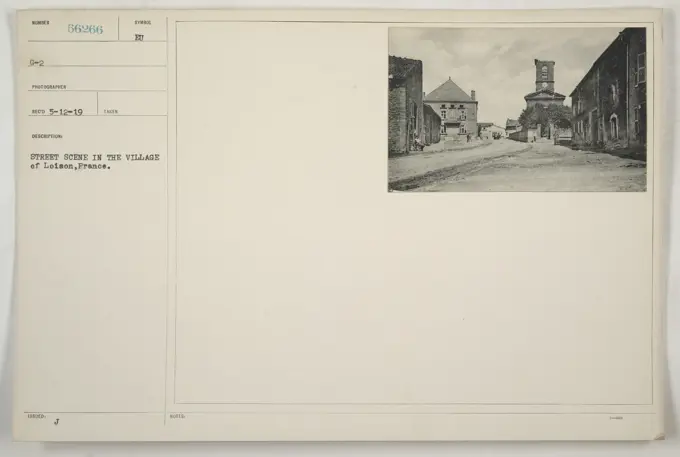
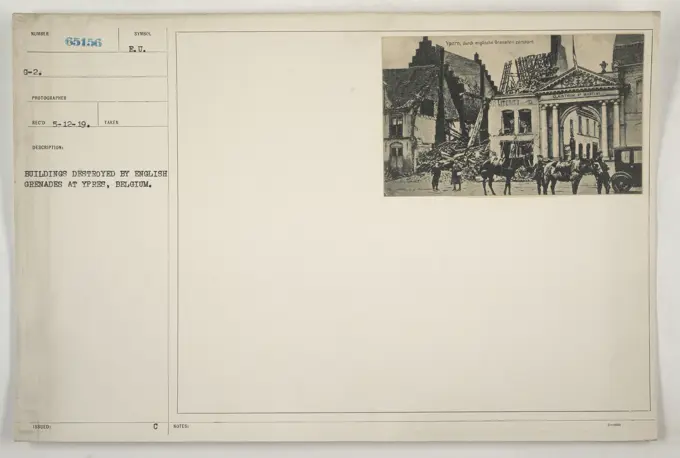
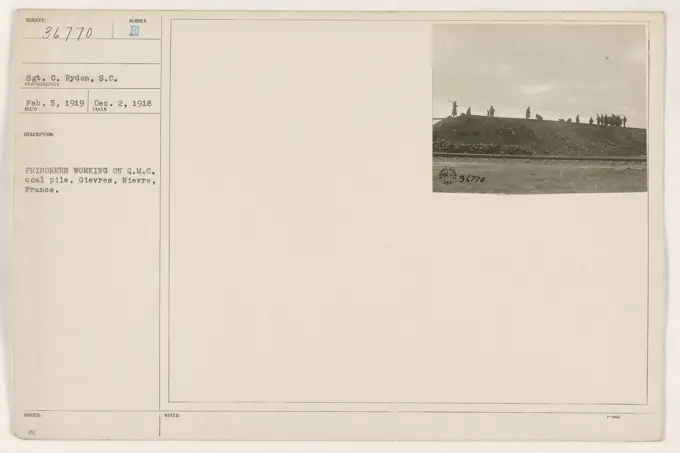
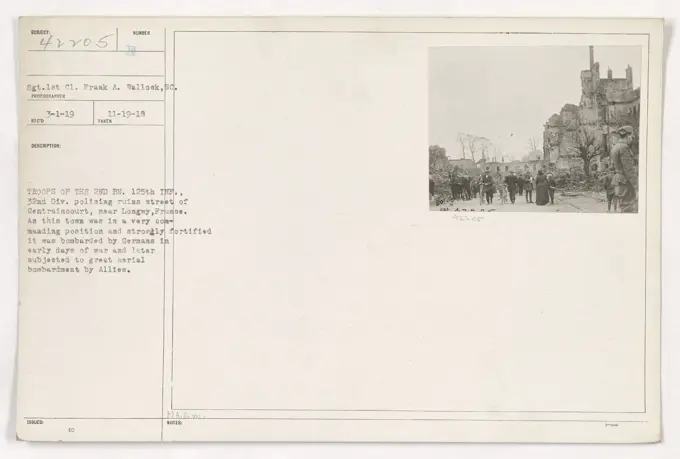
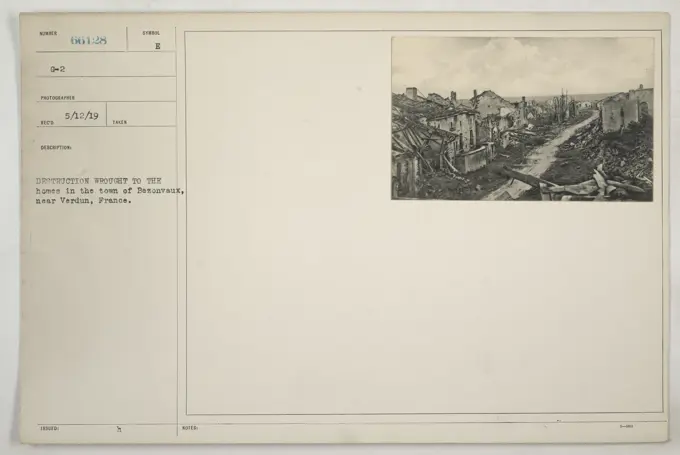
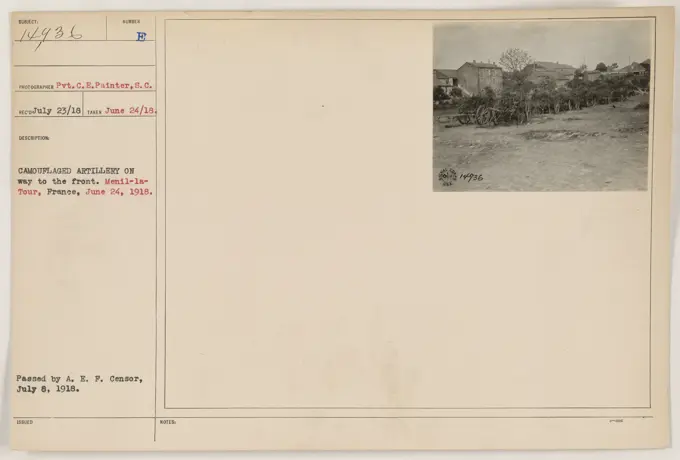
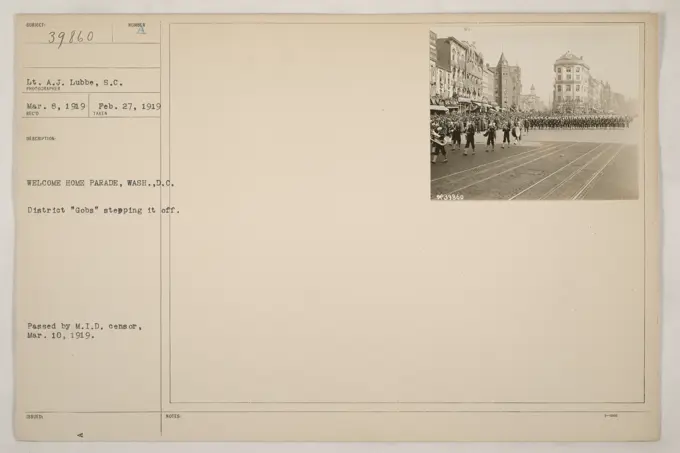
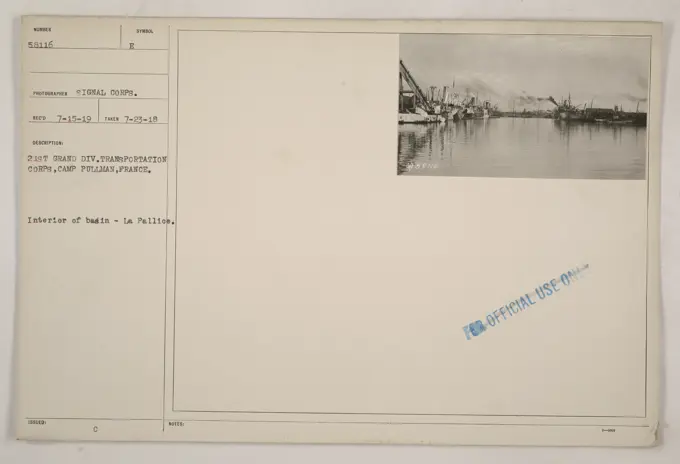
Lieutenant Carl T. Thoner of the Signal Corps takes a photograph of the French and English Cable House. The image shows the view towards the ocean from Cape D'Antifin, France. The photograph was taken on March 1, 1919.Soldiers and civilians in the village of Loison, France during World War One. Date taken: 5-12-19. Image description number: 66266. The photograph captures a street scene with a symbol indicating "street scene in the village of Loison, France." Notes: EJ and AXA.President Wilson onboard the U.S.S. George Washington as it docks at Pier No. 4. The image captures the presence of President Wilson during World War I. Photographer Capt. Jackson took the photo on July 9, 1944. It showcases Wilson's involvement in the war effort and transport service.Buildings in Ypres, Belgium, destroyed by English grenades during World War One. This photograph is part of the collection cataloged under number G-2, taken by photographer 65156 and received on May 12, 1919. The description of the image was issued with the symbol E.U. Notes indicate that the destruction in Ypres was caused by English grenades.American soldiers participating in a rush towards "Little Germany" in Ardennes, France during World War I. The photograph, labeled 111-SC-33750, was taken by Lt. Betep on November 4, 1918. It shows soldiers converging at the corner of 42nd and Broadway, near Bar, Ardennes. The image was released by the A.E.P. Censor on January 16, 1919.Fifteen military planes are seen on a beach in Key West Barracks, Florida. The photograph shows the planes arriving and departing from the beach. This image is documented as number 6633, taken by an unknown photographer, and is part of a collection depicting American military activities during World War One.Caption: Mechanic Ellis of 1st Company, C.A.C., winning the 2nd Heat Dash during a field meet at Fort Washington, Maryland. This photograph was taken on April 1, 1920, by Private F.W. King, S.C. Photo number: 68033. Official description: Symbol A.Cpl. A. Q. Smith captured this photograph on December 2nd, 1918. The image features a sun air compressor being used by Company D, 106th engineers for drills. The location is Brest, Pinistere, France, within Base section No.5. The American Expeditionary Force censor passed the image, although the exact date is unknown.French tank car numbered 58190 at Camp Pullman in France, used by the 21st Grand Div. Transportation Corps. The photo, taken on December 11, 1918, shows the tank car used for military logistics. It was captured by the Signal Corps and symbolically depicts the transportation activities during World War One.Marines disembarking from a transport vessel upon arrival in France during World War One. This image, captured by a photographer from the Signal Corps of the U.S.A., was issued under identification number 4164. The exact date of the photograph is unclear, but it is between February 5, 1918, and 1917. There are no further details provided.Pvt. Clyde L. Eddy, serving as a photographer for the Signal Corps, captured this image on 16th November 1918 in Romorantin, France. The photograph shows damaged planes being unloaded for transportation to the Salvage Department.Erection Shed #2 at Camp Pullman in France, belonging to the 21st Grand Division Transportation Corps. The photo shows the under frames in fitting position numbered as 5.7513. The photograph was taken on August 7th, 1918 by the Signal Corps. It is described as symbol E Reco 7-15-19 and was issued by Erection Unit #2. Notes indicate the classification as 3-000.Sgt. C. Rydon took this photograph (#36770) on December 2, 1918, at Gievres, Nievre, France. The image shows prisoners working on a Quartermaster Corps (Q.M.C) coal pile. This documentation was taken as part of American military activities during World War One, as noted on February 5, 1919."Image showing Lt. Carl T. Thonor of the Signal Corps at Base Hospital No. 21, also referred to as British General Hospital No. 12, in Rouen, France during World War I. The hospital was previously a race track called 'Champs de Courses'. In the background, a grandstand can be seen."Description: In this photograph, Major C.A. Davis and another officer are seen standing with a group of captured German soldiers, along with a number of cannons and horses. The officers captured these prisoners and equipment as they became the first to enter Vigneuilles-les-Hattonchatel, France, on September 13, 1918.Gassed patients being transported to Evacuation Hospital No. 2, 42nd Division, Baccaret, France. The photo was taken by Sgt. C.H. White on May 27, 1918, and was issued by the U.S. Army on July 22, 1918. It is labeled as passed by the A.E.F. censorship on July 2, 1918.Soldiers stationed at Ground Gonio Station No. 92, established on June 14, 1918. This station belonged to the Radio Section of the Signal Corps and was located in Royaumeix, France. This photograph captures military activities during World War One.Cpl. Carnochan in front of the former French foundry, now used as a Salvage Depot for Americans in St. Nazaire, France. The photograph was taken on June 28, 1918 and approved by the A.E.P. censor on July 23, 1918. Caption issued to MA.Dey mr.o. House photo.American soldiers standing on a hill overlooking the town of Zilhart, near Markerch, France. The photograph was taken on May 12, 1919, by photographer 59658 RECO. The town appears peaceful, with no signs of military activity.A birds-eye view of Tali Aferra Field, located in Fort Worth, Texas. The photograph was taken on October 8, 1918 by a photographer from the Signal Corps. It was received and processed on December 7, 1918. The image shows the layout of the field during World War One."Pvt. W. H. Eels of the Signal Corps captured a photo of a steam shovel and train on an embankment in Nevers, France. This construction project, carried out by the 16th Regiment Engineers, aimed to connect the canal and Loire River. The date of this photograph remains unknown."Troops of the 2nd Battalion, 125th Infantry, 32nd Division, can be seen policing the ruined streets of Gentraincourt, near Longwy, France. This town, being in a commanding position and strongly fortified, was bombarded by the Germans early in the war and later subjected to heavy aerial bombardment by the Allies. The photograph features Sergeant 1st Class Frank A. Wallook.Image: American soldiers marching in formation at an army base in Porto Rico during World War One. The soldiers are wearing uniforms and carrying rifles, and are lined up in perfect order. The scene reflects the military discipline and readiness during the war.Several aircraft used for training at the Naval Aviation Training Station in Warrington Beach, Pensacola, Florida. Photo taken by the Signal Corps, U.S.A. on January 26, 1918. The image shows a collection of aircraft on the training station beach.A footbridge constructed across the Marne River near Mesy, France during World War One by Co. F, 6th Engineers, 3rd Division, using empty gasoline drums. The image was taken on July 24, 1918, by Pvt. J. E. Gibbon. This caption is based on information found in the description of the photograph.Town of Cerny-en-Laonnois, France, shows extensive damage caused by enemy artillery fire during World War One. The buildings have been reduced to rubble, with only remnants of their structures remaining. This image highlights the destruction and devastating impact of war on civilian areas.French soldiers carrying wounded soldiers off the front line in Haecken, Alsace, Germany during World War One. This photograph, taken on May 29, 1918, was captured by Sgt. A. C. Duff and received on July 6, 1918. The image is part of the 32nd Division's activities and was approved by the A. E. F. Censor on June 24, 1918.Sgt. S. McAuley of the 19th Infantry, 3rd Battalion, 1st Division, enters Coblenz, Germany on February 26, 1919. This photograph was taken on December 12, 1918. It is part of the record number 111-SC-40919. Issued notes can be found under number 40819.President Wilson and General Pershing are seen standing at the entrance to a reviewing stand in Langres, Haute Marne, France. The photograph was taken on December 25, 1918, and was issued by the Signal Corps.Soldier W.J. Beach takes a photo of a symbol, "H," on cement columns in Beaune, France. The columns are positioned to be attached, showcasing cement forms. This image was received and issued with the description on November 8, 1918.Sergeant Tyrell participating in a welcome home parade in Washington, D.C. on February 27, 1919. The parade featured big tractors used for hauling large guns. The photograph was taken by an unknown photographer and received on March 12, 1919. It was approved by the M.I.D. censor and assigned the description number 39910.Caption: Private W.H. Eele from the Signal Corps captured this photograph on July 31, 1918, in Gievres, France. The image shows an eastward view over locomotive repair shops and E.B. Classification yards, which served as a general storage for the Intermediate Section. This picture was released by the A.E.F. censor, but the specific date is unknown. (Photograph by Pvt. W.H. Eele, Signal Corps. Image courtesy of the M.A.O.Trine collection)American soldiers in Rednance, Luxembourg, are surrounded by children asking for souvenirs. This photograph was taken on March 1, 1919, and features Lieutenant M.S. Lentz of the Signal Corps (SC). Case number 42113. The image was released on November 30, 1918.This photograph (ID: 16342) taken by Sgt. A. C. Duff, S.C. on July 21, 1918, shows a bridge over the Marne River in Chateau Thierry, France, destroyed by the French to impede the German advancement during World War One. American Machine Gunners from the 3rd Division occupied the nearby buildings and successfully delayed the German advance in June. The image was approved by the A. E. F Censor on August 6, 1918.Soldiers from the 1st Division Supply Train are seen cleaning up at a farmhouse between Baltimore and Washington, D.C. during a halt while enroute from New York City to Washington, D.C. on September 14th, 1919. This photograph has the identification number 63,668 and was taken by Sgt. Warer, S.C. on September 15th, 1919."View of Hotel de Ville in St. Quentin, Aisne, France. The image shows taped lines surrounding and marking the spot where the street is mined during World War One. Photograph taken on October 14, 1918, by Lt. E.0. Harrs, S.C. and received on December 2, 1918. Approved by A.E.F. censor. (Photographs of American Military Activities during World War One, 111-SC-28240)"Aerial lead construction in Chatillon sur Seine, France. This photograph, taken on November 5th, 1918, shows the type of construction and location of an aerial lead. The image was received by Sgt. Bernard Levey and taken by an unknown photographer on March 1st, 1919. For official use only.Soldiers loading disinfected clothes into a truck at Camp de Gerard Sas on June 6, 1918. This photograph was taken by Pvt. C. E. Painter, S.C. on July 22, 1918. It was approved by the A. E. F. Censor on July 2, 1918.Cpl. W.H.Ellis, S.c. in a reception tent partially filled with stretchers at American Base Hospital No.12, British Hospital Hospital Gen. No.18 in Camiers, Pas de Calais, France during World War One. Photograph taken on 3-1-19 by an unidentified photographer. Notes indicate the image's reference number as 111-SC-44210 with a description issued on 12-30-18.A street scene captured in Passel, France during World War I. The photograph shows an average day in the town, with people going about their daily activities. The exact date of the photograph is May 12, 1919, as identified by the photographer. The image is part of a collection of American military activities during the war.Soldier R.M. Winger and an unidentified Red Cross worker pose in front of a Red Cross canteen in Issoudin, France. The photo was taken on March 10, 1919. The canteen provided food and support to American soldiers during World War I.West Point Class of 1921 posing for a photograph while on a tour through France, Belgium and Germany during World War I. The soldiers are en route to the Pantheon de la Guerre in Paris, France. The photograph was taken by Lt. Col. G.R. Harrison on December 13, 1919.A soldier operating a 12-inch mortar at the Coast Artillery School in Fort Monroe, VA. The projectile is seen emerging from the muzzle, with gas just beginning to appear. The photograph is dated November 1918.COAST ARTILLERY SCHOOL, FORT MONROE, VA: An image depicting the firing of a U.S. 12-inch mortar. The projectile used in the firing is concealed by gas. Enlisted Spec. Dept. EA Monroe, Va. Nov. RECO DESCRIPTION 1918 TAKEN ISSUED NUMBER AUSoldier preparing to load a 155 mm howitzer at the Artillery School in Sur Tille, Cote D'Or, France during World War One. The photograph was taken on February 1, 1919 by Sgt. Abbott. This image is not intended for publication and is for official use only.A military parade and review conducted in New York City for Marshal Joffre, organized by the French War Commission. The photograph showcases the 7th Regiment of the New York National Guard marching up Riverside Drive, heading towards Grant's Tomb where Marshal Joffre reviewed them. It was taken in April 1917.Lt. J.J. Holliday, chaplain of the 166th Regiment Infantry, is seen in the photograph rendering last rites over the body of Pvt. Dyer J. Byrd. Byrd, a soldier in Company D, was the first American soldier from the 42nd Division to be killed in the St. Clement sector in Domjevin, France. He was shot by a German raiding party while serving at a listening post.Brig. Gen. W.W. Harts and his aide leaving Chateau la Madalaine in Mont Treuil, France. The photo was taken on June 20, 1918, during the American Mission at British G.H.Q. The image was captured by Sgt. L.J. Rode, S.C. Notes indicate that the photo was lent and has a description number of 13789.American soldiers landing in Porto Rico during World War I.President Woodrow Wilson's automobile arrives at the grounds of Queen Margerita of Italy. The photograph, taken by Signal Corps Lieutenant E.N. Jackson, was captured on March 10, 1921, and assigned the code RECO3-10-1921 TAKE-3-1919. The image is from the collection "Photographs of American Military Activities during World War I," with the identification number 63099.s photograph depicts soldiers from the 27th Division arriving at the Corbie rest camp near Amiens, France during World War I. The image was taken on December 13, 1918 by Lt. E.N. Jackson of the U.S. Signal Corps, and it shows soldiers gathering at the New York Soldiers Club in the rest camp. The photograph was approved by the A.E.P. censor, but the exact censorship date is unavailable.Columbia University, New York, N.Y. - S.A.T.C. Induction Day on October 1, 1918. A photograph depicting a group of individuals being inducted into the S.A.T.C. (Student Army Training Corps) at Columbia University in New York City.Sgt. Harrs of the U.S Signal Corps is seen in this photograph taken on July 22, 1918. He is shown handing off official mail to couriers at the 2nd Army Headquarters in Pruges, France. The image looks to have been taken by an A.E.P censor and was issued with the notes 25-17236.Soldier Sgt. Abbott is seen working on the fourth stage of building a field hut at Camp Babcock, located in Chaumont, Hte Marne, France during World War One. The photograph was taken on November 12, 1918, and was released by the A.E.F. Censor on December 23, 1918. (50 words)Sgt. C.D. Donnelly, S.C. photographed a camp wash house at Winnall Down Rest Camp in Winchester, England on September 26, 1918. This facility was used by U.S. soldiers to wash their clothes during World War One. The photograph was later classified by the A.E.P. censor and has the ID number 111-SC-25189.Sgt. 1el. Morris Fineberg is shown in the photograph carrying shells on his shoulders. This method of carrying shells was used to transport them to a flat car at an ammunition depot in Romagne-sur-Montfaucon, Meuse, France. The photo was taken on March 12, 1919. The Field Ammunition office belongs to the Ordnance Dept. of the 1st Army.President Woodrow Wilson aboard the King of Italy's royal train passing through the Italian Alps during World War I. This photograph was taken on January 3, 1919, and is part of the collection of American Military Activities during the war.American soldiers herding goats in Lucy, France during World War One. Photo taken by Lt. Cloud, S.C., U.S.R. on October 18, 1918. Image released by A.E.F. Censor. Caption lacks specific date and additional notes."Soldiers and civilians gather in the streets of Hallville, France during World War One. The photo, number G-2 65744, was taken on May 12, 1919 by photographer Reco. This street scene captures the aftermath of the war, showing the natural surroundings and the presence of military activities in the village."Variscourt, France, shows extensive damage caused by enemy artillery during World War One. The photograph, taken by G-2 Photographer 66001 on May 12, 1919, displays scenes of devastation in the town. This image, labeled with the symbol B, provides a visual documentation of the destruction caused by the war.Members of the 117th Field Signal Battalion of the American military lend a hand to French women with their load of prunes in Chatanois, France. The photograph was taken on August 30, 1918 and received on October 14, 1918. It passed the A.E.F. censor, but the exact date is unknown.Pvt. D. W. Kelly of the 140th and 92nd Aero Squadron, S.C., is seen with his colleagues standing in line for food outside the Regimental Mess at Ford Junction Aerodrome in Sussex, England. Photo was taken on October 22, 1918. (Note: Image ID 111-SC-32260, received under number 1575-V8)Private Clyde L. Eddy is seen in this photograph, taken on November 11, 1918, near Verdun, France. The image shows Eddy attaching a parachute to a balloon as part of aviation activities. This information is part of the StillPixFindingAid SUBJECT 39318.Image shows a unique band stand in Bois de Recicourt, camp of 112th Engineers, 37th Division. The 112th Engineers were previously composed of 1st Ohio Engineers and Detachments, as well as 7th Ohio Infantry. Location: Cierges, Meuse, France. Photographer: Sgt. W. W. Bell, US Army. Date taken: April 8, 1919. Received: 1995-F9.Cpl. R. H. Ingleston standing outside a captured German concrete dugout which is currently being used as headquarters for the 314th Ammunition Train of the 89th Division. The location is St. Baussant in Meurthe et Moselle, France. This photograph was taken on October 17, 1918, by photographer B. It was passed by the A.E.F. censor, but the specific date is unknown.Homes in Bezonvaux, France, near Verdun, destroyed during World War I. Image captures the significant damage caused to residential areas by military activities. Date: May 12, 1919. Photographer: Sunber Reed. Photo ID: 66128.German and Austrian prisoners of war at the Souilly prison stockade in France, awaiting assignment to huts. They were captured by the 5th Army Corps on September 13, 1918, north of St. Mihiel. The photograph was taken by Sgt. C.B. Dunn on September 14, 1918."Sgt. 1c1. H.D. Lothers (S.C.) at 3rd Army Headquarters in Coblenz, Germany. The photo shows the former Königliche Regierun's gebaude taken from a pontoon bridge. This image was taken on March 1, 1919 and issued on December 20, 1918. Additional notes are available under description number 42390."A concert being held by the 305th Engineers, 80th Division, for Allied troops and village civilians in Beauval, France. The photo was taken by Sgt. 1st Cl. G. L. Morper and is labeled as "Subject 17390". It belongs to the collection "Photographs of American Military Activities during World War One". It has been issued by the C. Band Op and is held by the A.B.F Censor for official use only.Private J. A. Schlick of the Signal Corps is seen posing with Judge Ben Lindsey from Denver, Colorado, and several French girls in Chaumont, France, on April 30, 1918. The photograph was taken on June 11, 1918, and was censored and released by the M.I.B. censor on June 14, 1918.Storeroom for officers' baggage in France. The photo was taken by a photographer from the Signal Corps and was received on March 10th, 1921. The description symbol used is "E ISED," indicating the function of the room. The image is numbered 961725 in the photographer's notes.Interior and exterior views of the Toloul plant during World War I. The photo shows 11 tanks on display. The image was taken by N.A. Combs on February 15, 1919 and issued with the number 37146. It was passed by the M.I.D. censor on February 19, 1919.Stable and farmhouse located in Montmorillon, Vienne, France. The area was heavily involved in military activities during World War One. The photograph, taken by Photographer Number Eco 4-14-19 on October 4, 1918, captures this scene. The presence of North-South R.R. and C. Service Engineers S.O.S. is noteworthy. Photo reference number is 51610.A photograph taken on June 24, 1918, by Pvt. C.E. Painter of the 8th Division shows camouflaged artillery making its way to the front in Menil-la-Tour, France. This image was taken during World War One and was passed by the A.E.F. Censor on July 8, 1918. Issued notes: 4936.A photograph of a pigeon section in the Signal Corps of the U.S. Army during World War One. The image shows a pigeon carrier with the number 45521. The photo was taken by the Signal Corps and the description states that it was part of the Pigeon Section in the U.S. Army. This photo is featured on Plate 9, page 3.Lt. Strohmeyer captured an image of Camp Hunt showing the concrete reservoir in the foreground. Originally built by the French, it was later reinforced and increased in height by the Americans. The photograph also illustrates the camp's drainage system, which was improved by the Americans using labor from Italian troops and the 302nd Infantry Detachment. The image shows the latrine system running back from the reservoir, with buildings located between each row of Adrian barracks in Lecourneau, France."A photograph taken on March 10, 1919, shows the assistant instructors billet at the 2nd Corps Signal School in Chatillon sur Seine, Cote d'Or, France. The photograph features Sergeant Bernard Levey, S.C. The image was received on 850-F9 and issued on January 15, 1919.""Photograph of a destroyed cemetery in Badonvillers, France, caused by a fire set by the Germans during World War One. The image shows a ruined monument within the cemetery. This particular cemetery was previously used by the 168th Infantry, formerly the 3rd Regt. Inf. Ia. N.G., Battalion Headquarters, 42nd Division. The photograph was censored and issued by the A.E.F. on July 2, 1918."Caption: Lt. Drucker from the SCUSR photographed a side view of the Herman 280mm Railroad Gun captured by Australians during the latest British success on the Sougne. The image also shows ammunition cars. This photograph was taken on August 25th, 1918, at Champs de Mars in Paris, France. The date of passing by A.E.P. censor is not provided. 18BUEDFT notes.Front view of the Kaiser Wilhelm Barricade, located just 25 meters from the front lines during World War One. The photograph was taken by Photographer Reco on May 12, 1919. The barricade is identified by the symbol EU and is named Kaiser Wilhelm Barricade."Birdseye view of the 21st Grand Div. Transportation Corps at Camp Pullman, France. Taken on August 12, 1918, as shown in the photograph with registration number B 218T. The view is from station tower NUMBER 5.7536 towards the south east. This photograph is marked as "FOR OFFICIAL USE ONLY"."Artilleryman's bunk in the forest. Battery A, 101st Artillery, 26th Division, near Beaumont, France. Taken by Sgt. A.C. Duff. The photo was taken on April 12, 1918, and released on May 25, 1918, by the Historical Branch, W.P.D. Captioned as Description Number E.American soldiers taking cover in trenches during World War One.Hon. Robert L. Lansing, Secretary of State and member of the American Commission to Negotiate Peace, is seen aboard the U.S.S. George Washington. This photograph was taken in December 1918 and is part of the collection of American military activities during World War One.This photograph shows Sergeant J.T. Seabrook, a photographer stationed in South Carolina during World War One. The image depicts the Palace of King Albert in Brussels, Belgium, and the crowds gathered in front of it on the day of his return. The photo was taken on November 22, 1918.Motor Transport Corps School convoy leaving Westminster, MD and heading to Gettysburg, PA on September 28, 1919. This photograph was taken by Sgt. Warner at Camp Holabird, MD. The convoy is numbered 64,275 and is part of the activities of the Motor Transport Corps School.View of power houses from the French Water Tower at Camp Beneau, Souge, Bordeaux, France, taken on August 19, 1918. The photograph features Pvt. J.W. Beach, S.C. and was captured by Photographer No. 23168. The image was approved by the A.E.P. censor and is part of the 18th Engineers.Lt. A.J. Lubbe captured a photo on February 27, 1919, during the welcome home parade in Washington D.C. The image shows District "Gobs" marching in the parade. The photograph was officially released after approval from the M.I.D. censor on March 10, 1919.Interior view of Basin at La Pallice, located in Camp Pullman, France. This photograph shows the 21st Grand Division of the Transportation Corps in action. Date of capture is July 23, 1918, and the image was taken by a photographer from the Signal Corps. It is labeled as photo number 58116 E. This photograph is marked "For Official Use Only."Sgt. C. H. White, a member of the 166th Infantry and formerly the 4th Regt. Inf. in the O.N.G., is seen picking cooties out of his shirt at the door of a dugout near the 2nd Line trenches west of Suippes, France. The photograph was taken on August 24, 1918, and has been issued after being passed by the A.E.F. censor on July 29, 1918.American soldiers unloading gravel ballast on the Absinville-Sorcy Line, part of the Department of Light Railways and Roads in Abainville, France. The photograph was taken on July 2, 1918 by Sgt. L. Rode and received on August 27, 1918. The image was cleared by the A. E. F. Censor on August 13, 1918.Automobiles from the 77th Division parade pass by the New York Public Library during a parade on 5th Avenue in New York City. The photograph was taken by Sot. Bonner.S.C. on September 12, 1919, and the negative was created on May 9, 1919. This image is cataloged as Number 53204.A photograph of the old mill in the village of Moulin-Schuler, Guewenheim, Alsace, Germany. The mill, constructed in 1839, is partially destroyed due to German shell fire. It currently serves as Headquarters for American troops occupying this portion of the sector. The photograph was taken on June 15, 1918, and received on July 23, 1918. It is part of the collection of photographs of American Military Activities during World War One. Censored as Passed by the A.E.F. on July 8, 1918. The photograph features Cpl. Allen H. Henson, S.C. from the 3rd Bn., 125th Infantry, 32nd Division.American soldiers and French officials visiting the ancient site at Carcassonne during World War One. Sgt. Lucien Rode, S.C., is seen in the photograph. Image taken by a photographer identified as RECO on October 15th or 18th. Released by A.E.P Censor, date of release unknown.Members of the Red Cross in Challerange, France, leaving the city to search for wounded soldiers and bring them back for medical treatment. This photograph, taken on May 12, 1919, shows their dedication to helping those injured during World War One.Camp kitchens being prepared for transportation to the frontlines in St. Nazaire, France. This photograph was taken on April 6, 1918, and contains detailed notes.American soldiers evacuating wounded comrades from the front lines during World War One.Baldwin locomotive NUMBER 57927 S.C. at Camp Pullman, France, during World War One. This locomotive was used by the 21st Grand Div. Transportation Corps. The photograph description lists the photographer, date received (7-15-19), and the date taken (10-29-18). The locomotive was issued to the 21st Grand Div. Transportation Corps at Camp Pullman, France.A view of Cramp's Shipbuilding Yards during World War One. The image shows multiple vessels on the ways, indicating the active manufacturing of naval ships. This photograph was taken in December 1917 and received by the photographer, Captain A. K. Dawson, in January 1919. It was later released by W.C. D. to the Photo Division.A photograph showing Pvt. A.B. Cobb of the S.C. division in France, drying lines for washed clothing at the disciplinary detachment of the 26th Division in Troyon-Sur-Meuse. The photograph was received on November 12, 1918 with no attributed date, passed by A.E.P. Censor, and issued with W.P.C. Notes indicate reference number 6134 M01 11.