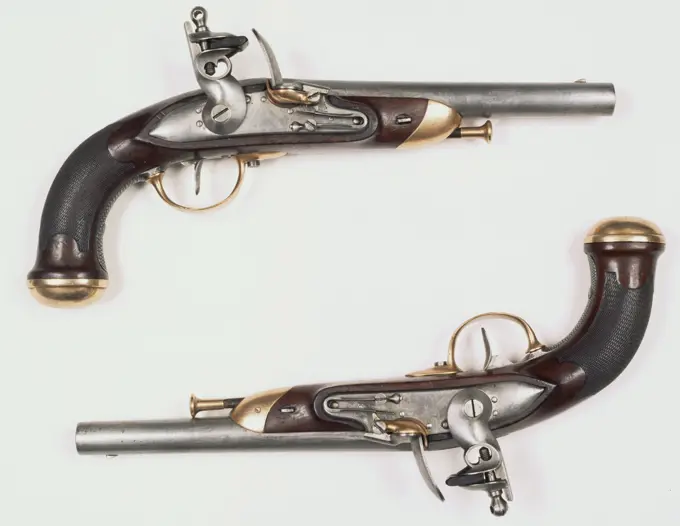
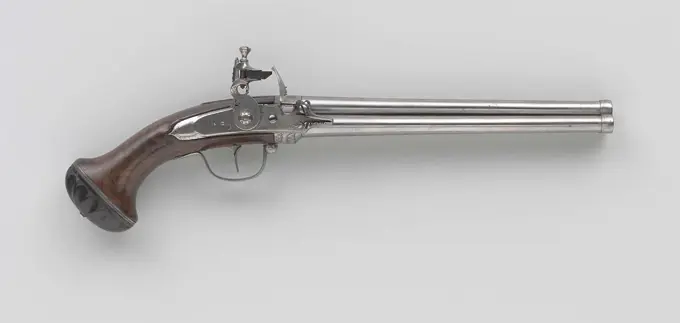
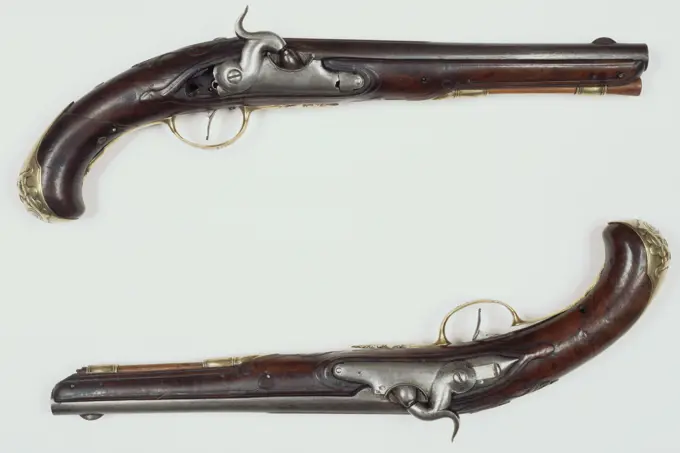
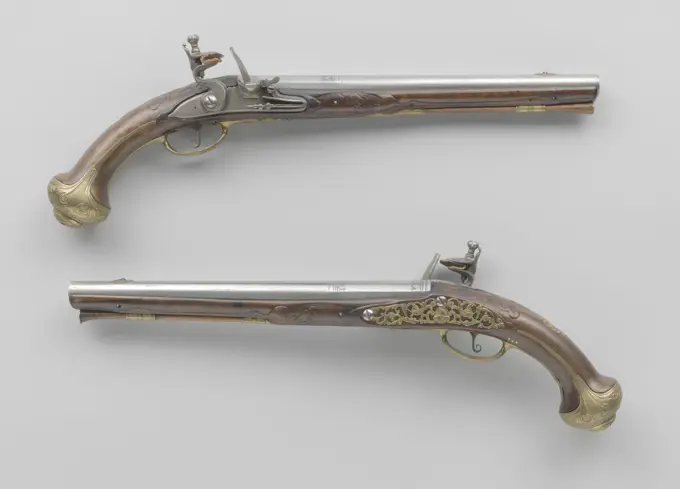
Historical Flintlock Pistols

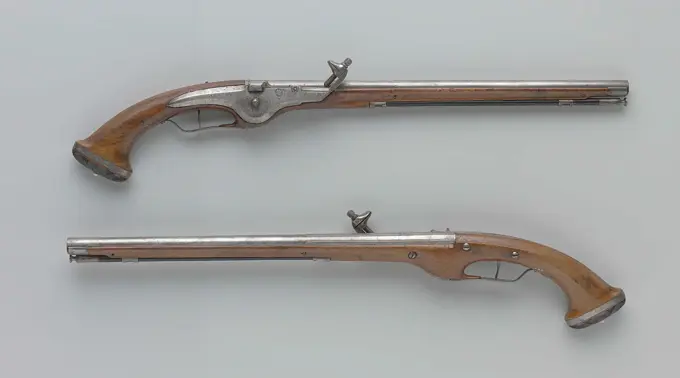
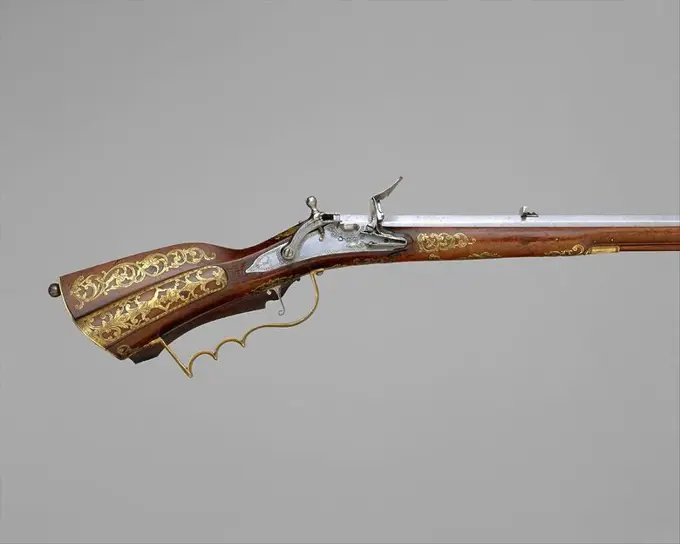
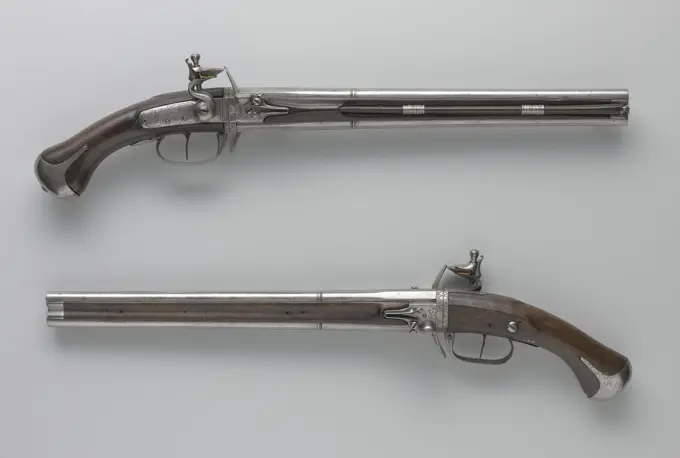
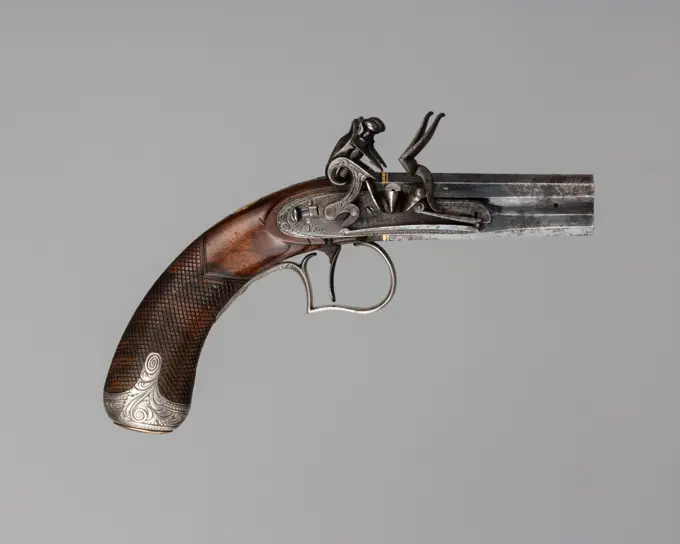
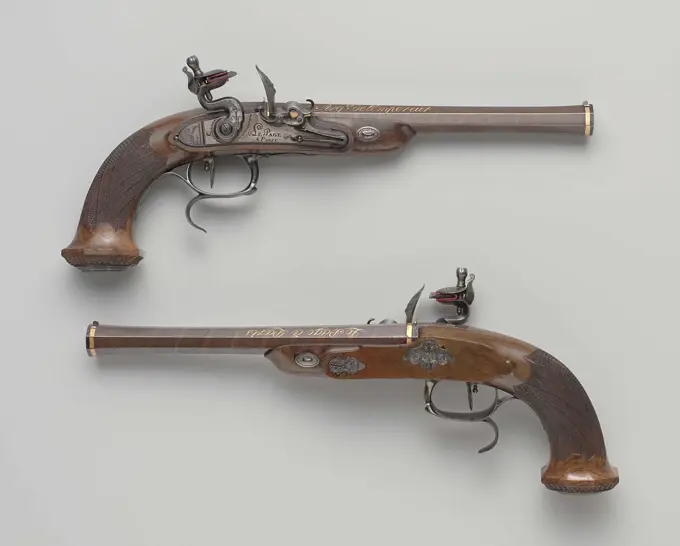
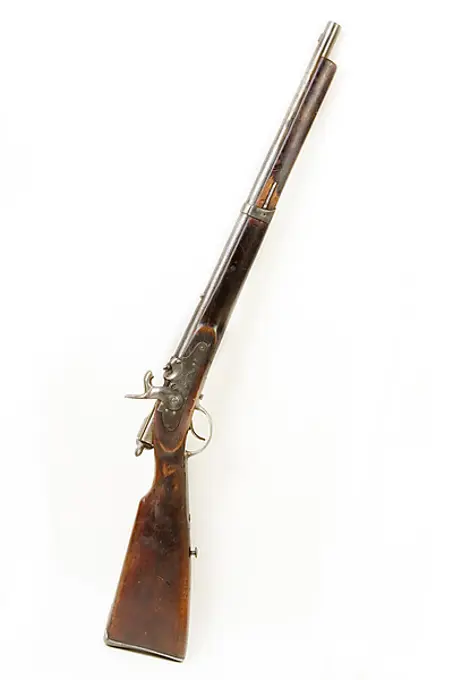
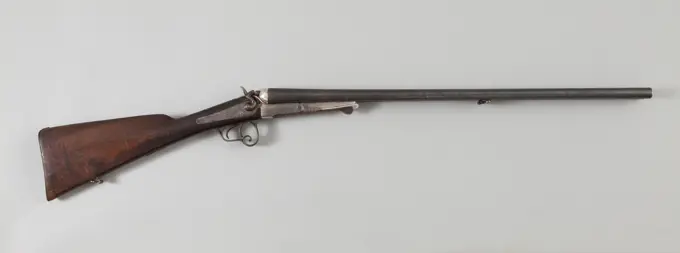
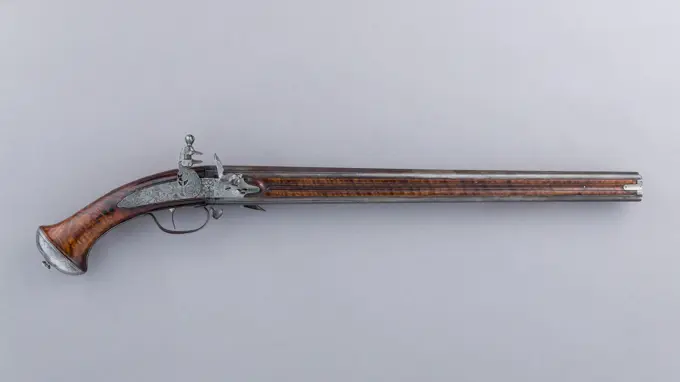
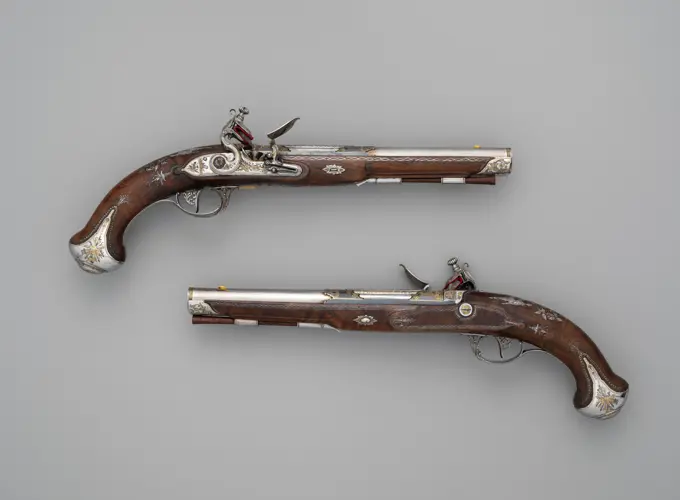
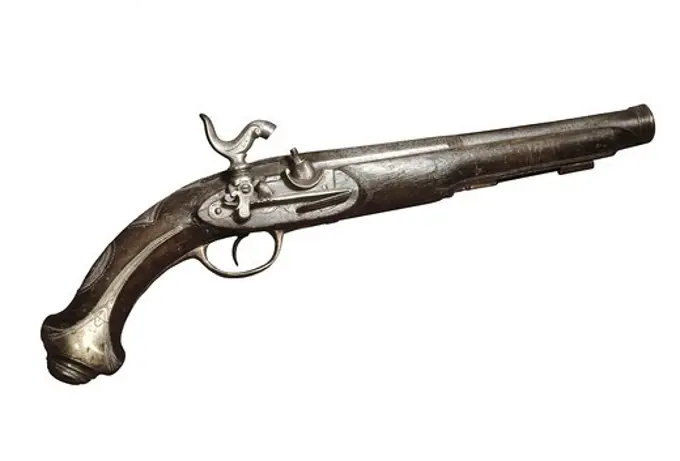
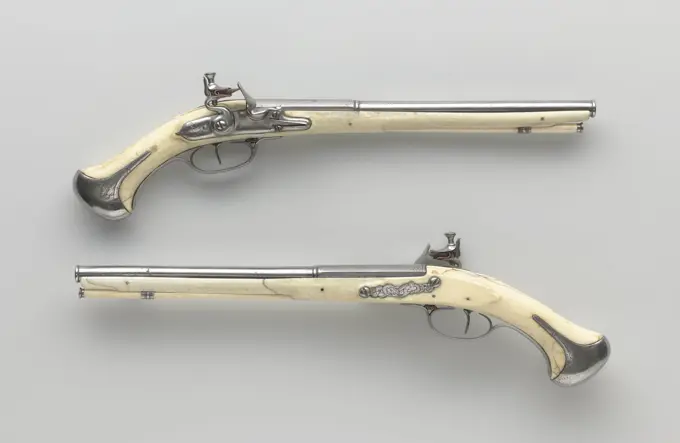
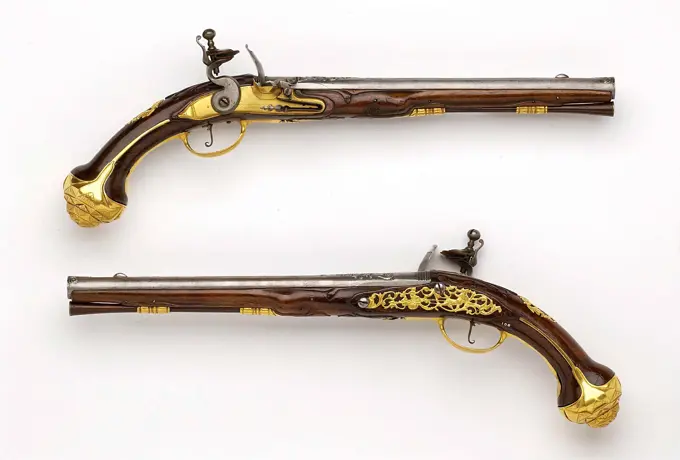
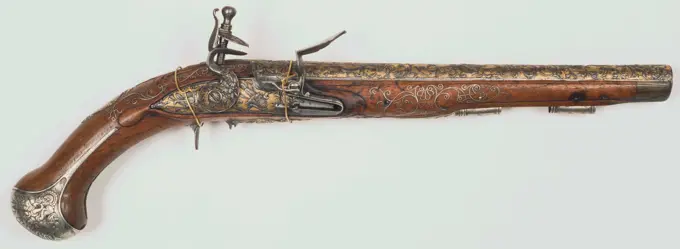
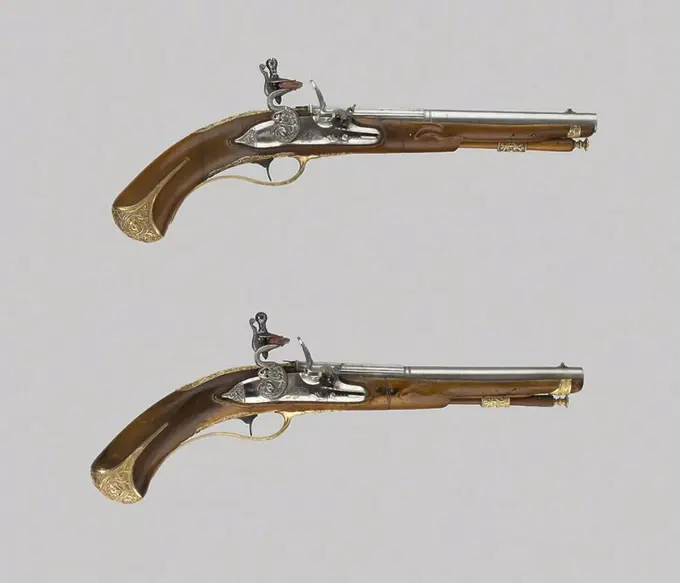
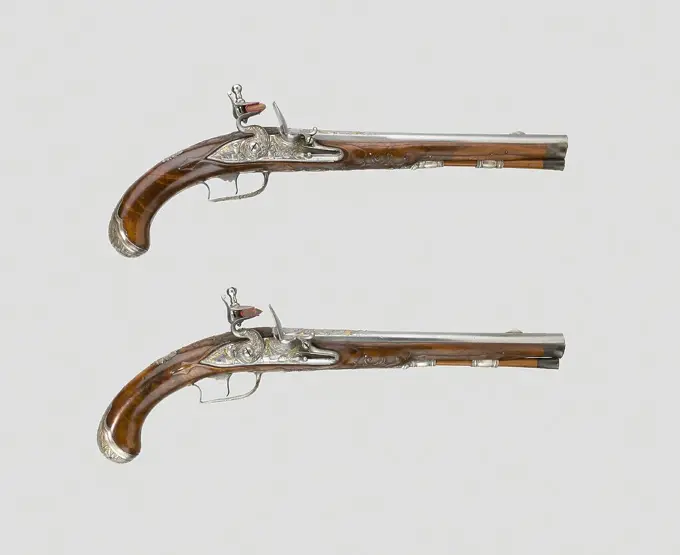
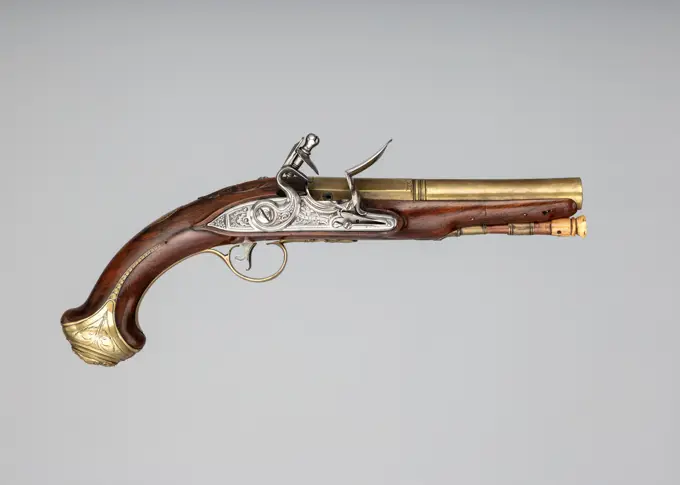
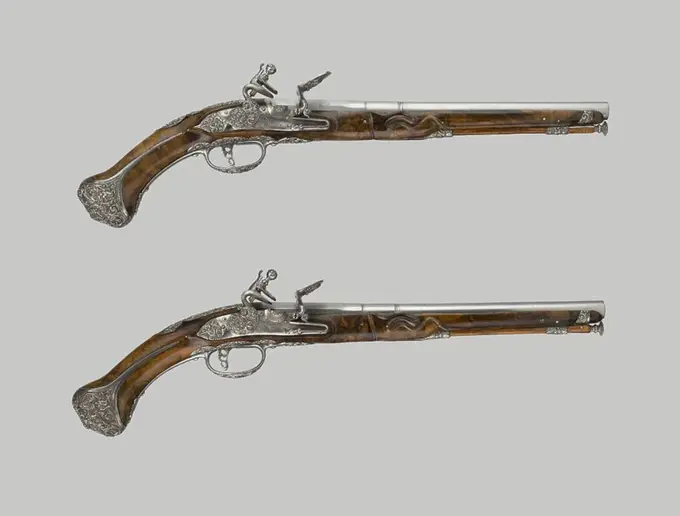
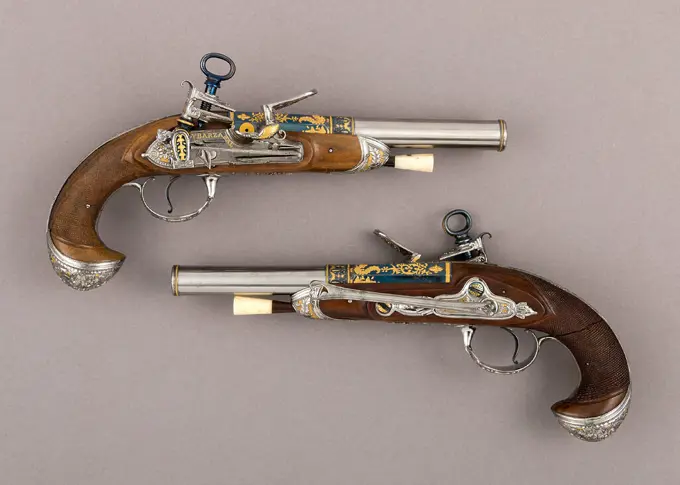
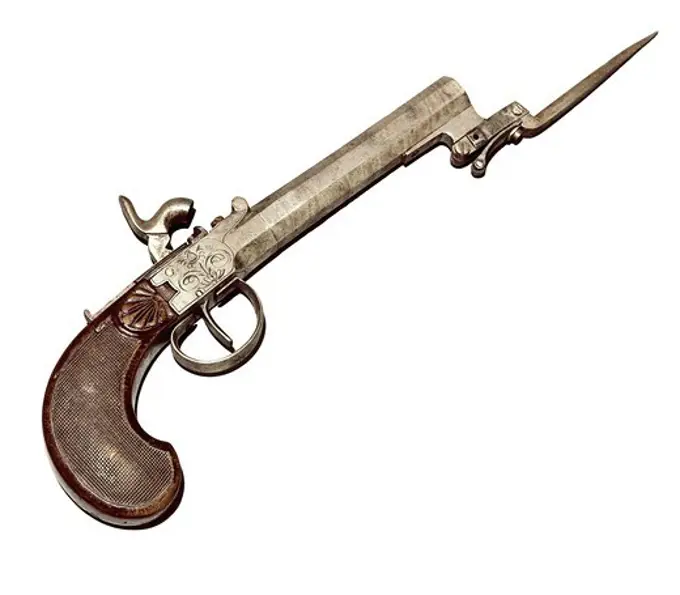
A selection of intricately designed flintlock pistols featuring ornate engravings and various metals, showcasing craftsmanship from the 17th to 18th century.

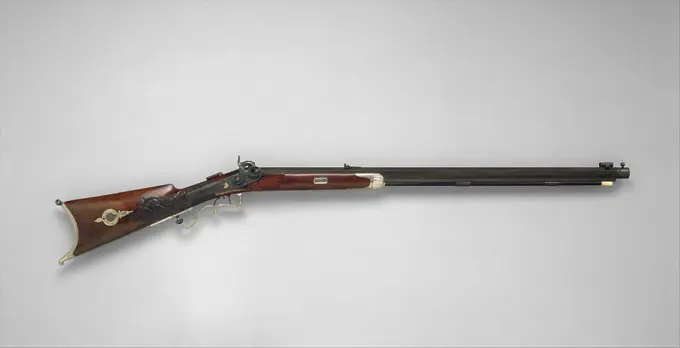
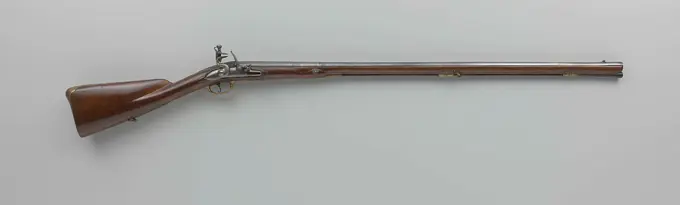
Flint gun, Fokkenberg, 1790 - 1795 flintlock pistol Frans Millitian flint gun, model 1777; The lock plate is engraved on the outside with the name of the maker and marked on the inside with G.S. The run is stamped on top with a crowned coat of arms marked y Rusta. The flask of Wortelnotenhout has a curved handle that flows into a flat, octagonal flask button. The brass batter consists of a loading sticker, a forked tractor bracket and the float button faceted on the bottom; no screw plate; The loading stick is made of wood. Utrecht brass (alloy). wood (plant material). iron (metal). engraving / faceting
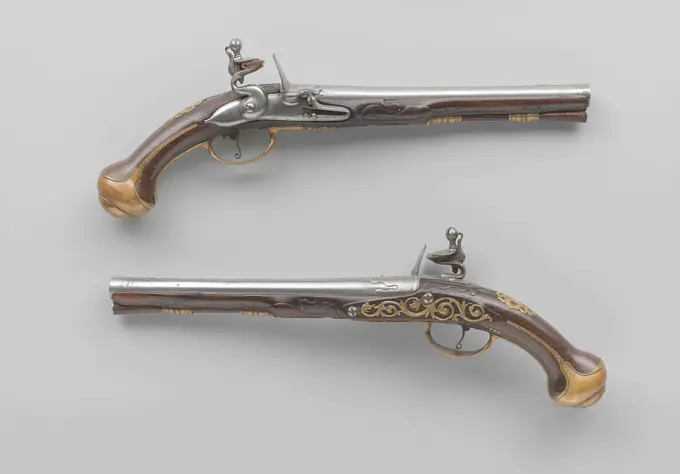
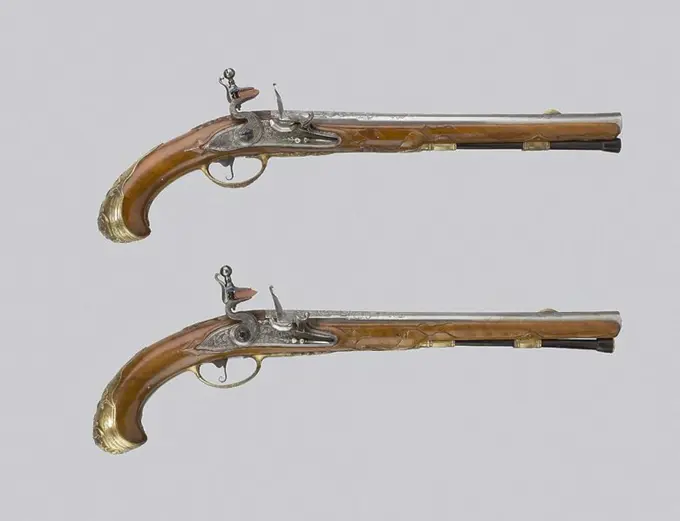
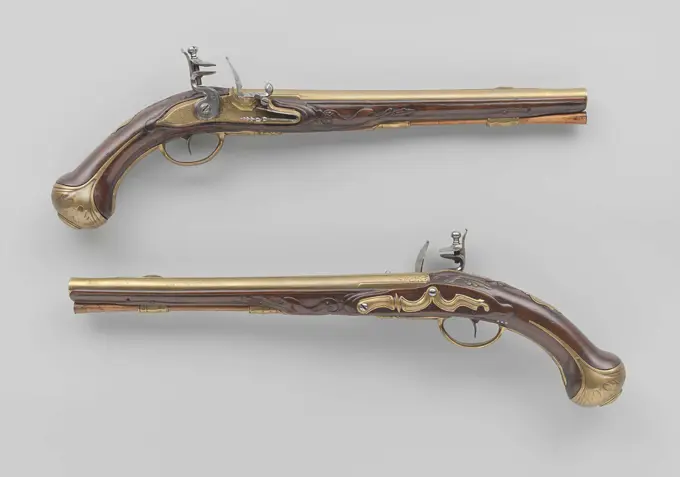
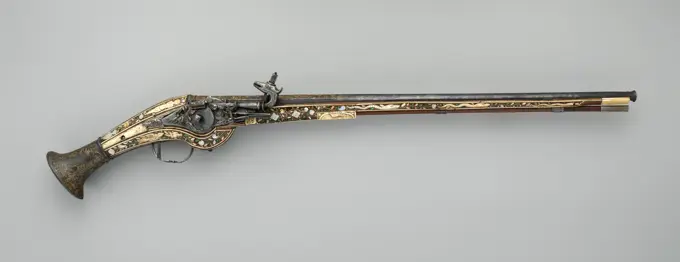
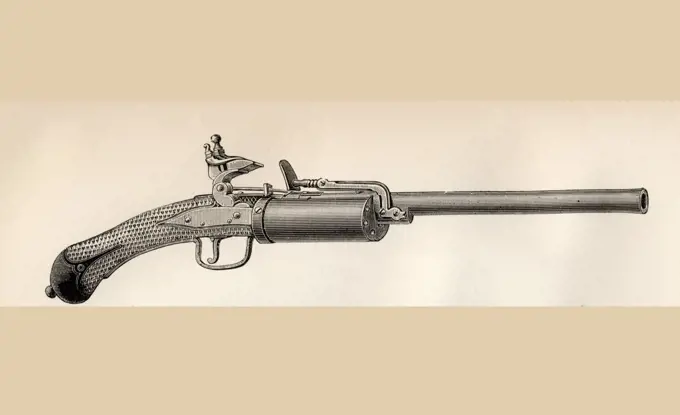
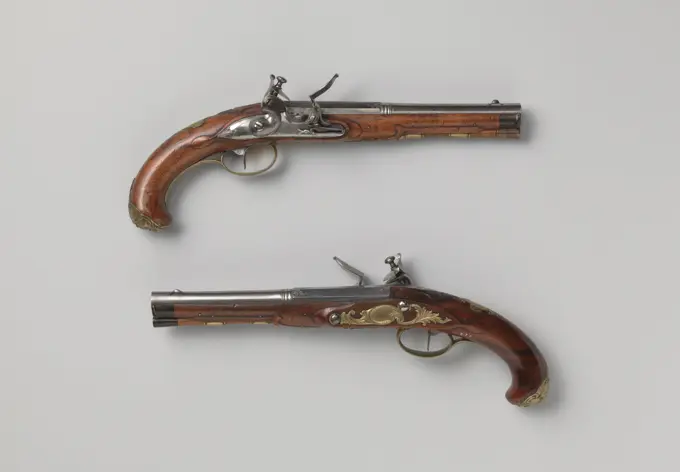
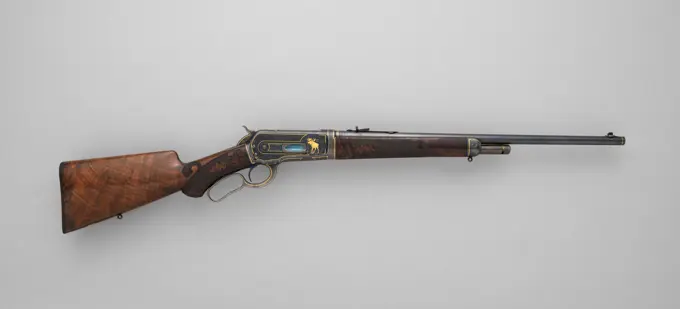
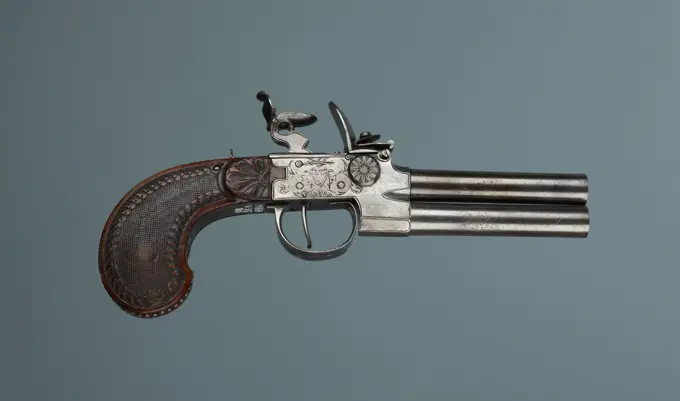
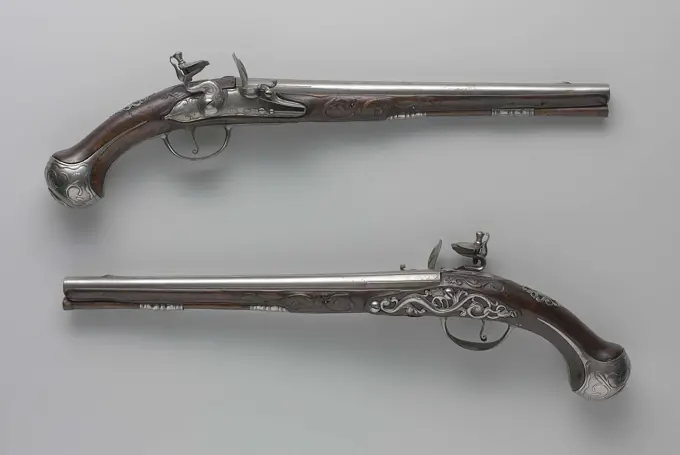
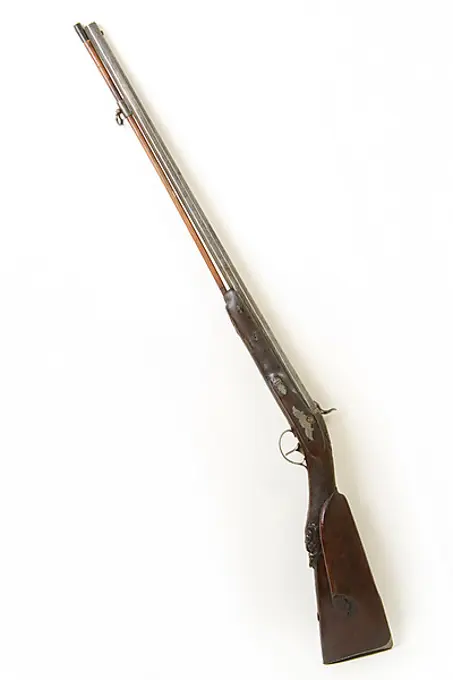
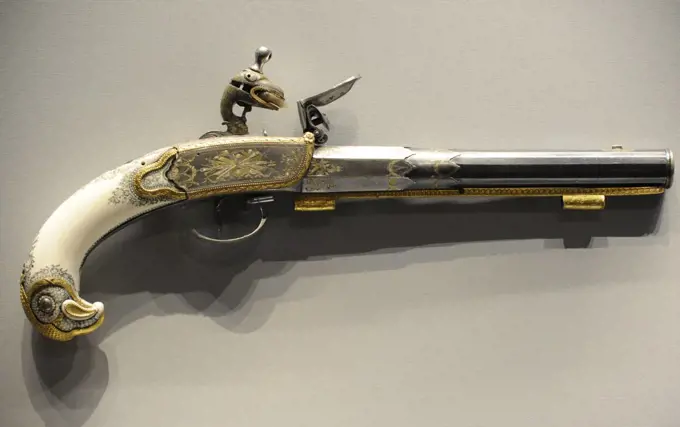
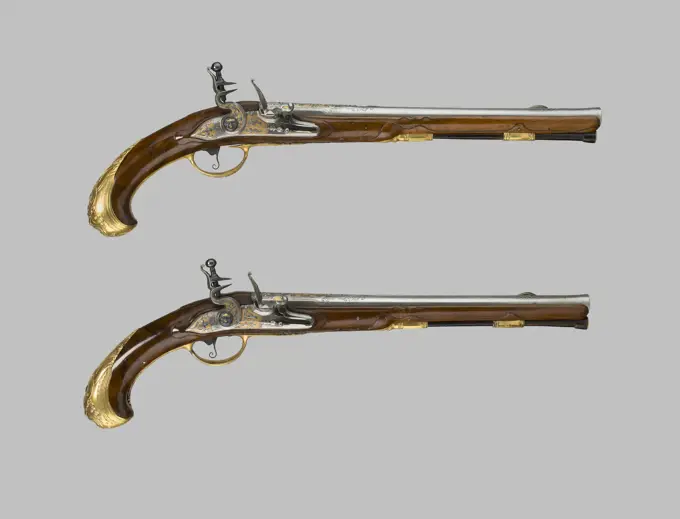
Pair of flintlock pistols, Leonardus Graeff, c. 1680 flintlock pistol Part of a couple. The tail of the final plate is chiseled in relief with acanthus leaves; The lock plate is signed. The blazed barrel is decorated with gold -stimulated arabesks, classic warriors and a sitting man (emperor) In gown under a rammed head, flanked by putti and surrounded by leaf vines; The barrel is stamped on the bottom with a brand that looks like a globe with a cross or three -leaf. The flask button is separated from the solid ivory flask by means of a tire of gilded silver in the form of a knotted festoon; The flask is cut into relief, with a grotesque mask, a curly acanthus leaf and beaded edges; The flask button is cut all around as the head of a classic, mustache warrior with a gilded silver helmet with chin tires, decorated with separately applied silver leafs, a grotesque mask at the back and on top a three -dimensional, silver lizard. The batter is made of gilded silver and consists of a chest Musketoon.Flint, front loader, incomplete. The brass runs are not held with brackets to the tray, but have small eyes down, through which pins are inserted, which also go through the tray. Similar to NG-MC-1334-b. The running of a slightly different fashion with small differences in ornaments, and one of them has a tail piece from iron instead of brass. One bus has an English lock, signed tower and marked with a crowned monogram VR; The rooster is missing from this slot. The other slot is unnoticed and the Pandekel and Upper jaw of the rooster are missing. One bus has an iron loading stick. The thin buses are risens from Borneo's creation.Flint gun, Nicolas Tomson, c. 1775 flintlock pistol Part of a couple. The lock plate carries a signature and is marked on the inside with the letters ND. The barrel is made of damaged steel and has a silver grain; An unclear sign is stamped on the bottom; The tail of the loop is engraved with praise. The flask has simple cutting work. The batter shows traces of the past gilding and has a driven and after -frown decoration, except the charging room, and consists of: the tractor bracket with the letters BF in a rococo medaljon, a screw plate with rococo curl work and flowers, and a flask hood with shells driven and driven and driven in and a martial trophy on the central pumping plate; The loading stick has a hood of cow horn. Rotterdam steel (alloy). wood (plant material). brass (alloy). gilding (material). silver (metal). horn (animal material) cutting / striking (metalworking) / engraving / gildingPercussion army pistool Model M 1815, Anonymous, c. 1815 - c. 1816  Percussion army pistool Model M 1815. Smooth, round loop, which turns into the room in a five -sided part. A percussion was taken into the top of the room. On the tail of the loop: m 1815. marked on the loop: 1816, pb. Slot: percussion lock. At the top of the rooster a large ring for the thumb. Marked on the final plate: s (crown above). Wood: walnut. Batter: brass: at the front of the drawer is an openwork sleeve, which serves to confirm the loop; Tegenlotplaat; tractor bracket; Kolf hood. Netherlands Lads, bat: Walnut (Hardwood). Leadband, batting hood: brass (alloy). Tractor Breeding: Brass (Alloy). Walk, lock: Iron (Metal)Flight gun. Part of a couple. The slot is easily engraved with edges, a row buttons and a signature. The loop is on top of a rib; The visor grain is made of iron; Under top stamped with a brand in the shape of a chair () With a crown above it. The flask is relieved with curls, among other things. The glass, previously gold-plated attachment consists of an asymmetrical screw plate consisting of brords, a thumb plate of Ajour processed leaflets, branches and dolphins, and a flask with a mask below; The loading stick has a hood of Koehoorn.piston gun, Eibar, Castle of San Carlos, seventeenth century, Palma, Mallorca, Spain.Pair of Flintlock Pistols. Barrels: Johann Jacob Behr; Locks: Johann Jacob Behr; Flemish, Liège, active 1690s-about 1745. Date: 1720-1735. Dimensions: L. 49 cm (19 1/4 in.)Barrel L. 33 cm (13 in.)Caliber .66Wt. 2 lb. 9 oz. each. Walnut, steel, and cast and chased brass. Origin: Germany. Museum: The Chicago Art Institute, Chicago, USA.Flight gun. Probably military gun. Part of a couple. The lock is the same as that of NG-2002-23-158; The Geelkoperen lock plate is engraved with praise and the signature of the maker; The rooster with a curled dragon or snake. The course of previously gilt Geelkoper is on the back of praise and stamped at the bottom with an i; Above over runs a rib; The visor grain is from Geelkoper. The flask has been cut with, among other things, praise. The previously gold-plated, selector seizure consists of an interrupted braco-shaped screw plate, a thumb plate with an acanthus leaf on top and bottom, and a lobed kolf cap embossed with the same lobes in a cross at the bottom. The palm wood loading stick is equipped with a glass cap.Vuursteenpistool.Part of a couple. The slot is engraved with blossom branches and a bird; The lock plate runs out in a point and carries an inscription. The loop is equipped with a ring and a trombes; Mim and the initials I and R stamped on either side of a rosette under a crown. The palm wood flask is easily cut; The handle runs out in a solid ivory flask, sliced around like a flower; The palm wood and ivory are separated by an ebony tire; The preloading is equipped with a hood of dark cow; The left side of the handle is branded with a brand in the form of two curved fish above the stamped number 13 to 113-a and 14 to 113-b. The iron fittings consists of a short loading cooker, a front-facing trigger bracket with a panel and at 113-α with a round, selector plate stamped with the number 503; The loading stick has a hood of Koehoorn, matching that of the vain.Wheellock Pistol ca. 1580-1600 French With their elegant form, innovative use of materials, and imaginative ornament, French firearms were trend-setters throughout Europe from the early seventeenth to mid-nineteenth century. French influence in firearms design was spread in several ways: by the lavish gifting of firearms as part of French diplomatic practice; the publication in Paris of numerous engraved pattern books of firearms ornament; and the wide dispersal of Huguenot (Protestant) gunmakers after the revocation of the Edict of Nantes in 1683. The rise of French gunmaking to its pre-eminent position did not happen overnight, however, but had its origins in the sixteenth century. This whellock pistol, a rare example of high quality French gunmaking before 1600, epitomizes this early, innovative stage.The pistols long, slender lines, small-caliber barrel, and distinctive wheellock mechanism are characteristic French features. So too is the elegant and sophisticated decoration. The Holster gun with flint slot from Jonkheer H.D. Hooft van Woudenberg and Geerestein. Holster gun with flint slot, part of torque. Octagonal loop. Vizier grain and hood of iron. Flat lock plate. Two bronze side plates. Bronze fittings with processed handle. Iron loading stick. Finely drawn. Jonkheer H.D pistol Hooft van Woudenberg and Geerestein, Old Lieutenant of the Amsterdam militia, 1831.Pistol with a rock castle MountainCaliber gun from G.H. van Nouhuis, c. 1820 pistol Caliber gun, part of Koppel, damaged, octagonal loop that ends around it a small vizier grain, on the loop in gold -colored letters the brand 'Tourry à liege'. Wooden drawer with a pickled gold -colored oval. Flat iron lock plate with engraved shell and floral motifs. The Iron Haan is fully equipped with the notched of acanthus ornaments. The flask is made of wood and has a notched handle of rocaille work with vertical grooves, iron flask with an engraved shell surrounded by wavy motifs, an iron ring hangs on the flask. Under the drawer an iron chest of drawers. Liège Walk, lock, chest of drawers: Iron (metal). Drawer, Kolf: Wood (Plant Material) engraving / inlay (process)  NetherlandsFlint gun, c. 1700 - c. 1800 flintlock pistol Flint gun, part of torque, with a smooth round loop with a small silver visor grain at the end, is marked with 'ELG'. Wooden drawer with a copper end, continuously in the flask whose handle is ribbed and the Kolfplaat is made of copper. Iron lock plate with copper pan. A wooden chop with a copper head is located in the drawer. Copper tractor bracket with iron tractor. Liège Vizier grain: German Silver. Kolf hood, pan, drawer: copper (metal). Drawer, Kolf: Wood (Plant Material). Loop, Slotplaat, Haan: Iron (Metal)   NetherlandsVuursteendraailooppistool met drie lopen.The lock has an Ajour processed rooster; The lock plate is engraved with flowers and praise and a signature. The loop is formed by a three-running cluster, held together by a ring in the form of a three-leaf; The edges are trimmed with acanthus leaves. The grip of the flask is made of ebony and runs into a flask in the form of a flower with an ivory button in the middle and separated from the handle by a strip inserted with iron. The batter consists of two charging bokeers, solid to two of the walk, a flat trigger bracket and the loading stick.Pistool with percussieslot of C.L. Pelerin, Before 1793  The drawer is 18th century and the lock was transformed into percussion before 1830. West-Europa Slot: Iron (Metal). Kolfplaat, side plate: copper (metal). Kolf hood, side plate: Brass (Alloy). Drawer, Kolf, Laadstok: Wood (Plant Material) engraving / gilding  NetherlandsOld wooden gun isolated on white backgroundFlight gun. Part of a couple. The lock plate is engraved with a jumping lion and a signature. The loop is engraved and embossed with a goose, among other things; Above over runs a rib; Below labeled with the coat of arms of Utrecht. The flask has been cut with, among other things, praise. The iron batter includes an ajour processed thumb plate, a symmetrical screw plate of curls in the shape of a hose on either side of a mask, and a flask with a grotesk mask at the bottom with a small mask on the chin; The loading stick is equipped with an iron hood.Wheel-Lock Rifle, 1618. Germany, Bavaria (), 17th century. Steel, brass, walnut stock inlaid with bone, horn and ivory; overall: 77.5 cm (30 1/2 in.); butt: 7 cm (2 3/4 in.); barrel: 49.8 cm (19 5/8 in.); bore: 1.5 cm (9/16 in.). Made originally as a petronel pistol, this firearm seems to have been refitted with a new stock sometime during the 17th century to convert it into a rifle, most likely for a child's use.Flint gun, Barend Penterman, c. 1690 flintlock pistol Part of a couple. The lock plate is engraved with a jumping lion, a galloping horse and a signature; The rooster and the fire steel are chiseled in relief with blossom branches. The round run is provided with a ring and chiseled in relief with arabesk-like leaf vines around a grotesque mask that acts as the rearvizier; A flat rib runs with a signature between the decoration on the back and the tromp; The sight grain is made of iron; Stamped on the back with the Wapen van Utrecht. The flask is cut into relief with, among other things, large leaf vines. The iron fittings consists of two spy -shaped loading stokkokers, a hose -shaped screw plate with floors of curly praise and with a running dog, the tractor bracket with ajour edited end in the form of a leaf and engraved with a classic warrior, a white, heart -shaped thumb plate framed by ajour Processed leaf vines and crowned with a small, white blazon, and the flask hood with long tWheellock Rifle 1580 Germany. Walnut stock with horn inlay .Flint gun, Hendrik Sleur, 1740 - 1750 flintlock pistol Part of a couple. The lock is unadversely except for a signature; The inside of the lock plate is marked in under one heart. The barrel is equipped with two tires with rings and here and there engraved with praise; Achtervizier in an acanthus leaf in relief on the tail of the loop, a silver mask in relief as a pellet of sight; Stamped at the bottom with the Wapen van Amsterdam, the crowned heart of 167-A is missing. The flask is easily cut with, among other things, praise. The gilt, brass batter with after -fringed relief decoration, except for the two octagonal loading stokkers, consists of a tractor bracket with decoration against a granulated background including a medallion with a honored head, a symmetrical, ajour processed screw plate consisting of a two -headed bust with praise and praise and praise and praise and praise and praise and praise and praise and praise and praise praise and praise and praise and praise and praiseFlight gun. Part of a couple. The lock is unfinished on a signature and a brand after. The loop is etched at the top with arabians in relief; Equipped with an inscription and left behind stamped with the coat of arms of Utrecht; The visor grain has silver relief decoration in the form of a grotesk mask. The flask has been cut with, among other things, praise. The batter is from Geelkoper, formerly gold-plated, with the two charging bokekers except the two charging bokeers on a granular surface, and consists of: on the screw plate on either side of a human figure, one of which is running into a dragon head; a angular trigger bracket with acanthus decoration; A thumb plate framed by praise with a mask at the bottom; The roughly decorated with a lion's head with a lion's head as a central flask plate; The loading stick is equipped with a gold-plated glass cap.Flight gun. Part of a couple. Made in Liège, but very Dutch. The lock is engraved with brords, a branch and a signature. A rib runs over the course; The rear part is engraved with leaf drinks and a hunter in a justaucorps to 17th century fashion and armed with a straight heart catcher; Mounted with three buttons in a triangle; No visor device. The root nutshell flask is easily cut. The iron attachment consists of two loading bokekokers, a trigger bracket with edges, a special screw plate in the form of a sea hose with the twists in guilloche, an incredible thumb plate in the form of a heart; a kolf hood engraved with branched praise and a stepped flask plate; The loading stick of carrot nut wood is equipped with an iron hood.Flight gun. Part of a couple. The lock is engraved with Faunen, flower and leaf drinks and a signature. The loop is divided by two pairs of rings; Lesser at the back with the coat of arms of Amsterdam, at the bottom with an eight-pointed star. The flask is easily cut with edges and praise. The previously gold-plated, selector batter consists of two loading bokekers, a round tractor bracket, a symmetrical screw plate consisting of two winding sea hoses, a white, oval thumb plate with a grotesk mask above and framed by leaves, and a unprocessed kolf cap with long tracks; The loading stick is equipped with a glass cap.Radslotpistool.Part of a couple. The lock is equipped with a rooster in accordance with the shape of the lock plate; Inner rad; The lock plate is engraved with two grotesque men's figures with cellars and a blossom branch; The Pandekel is opened with a printing pin engraved as a flower celk, just like the head of the spindle where the rooster turns around. The round loop has been flattened on the top and sides and marked with TP or TR. The flask has a protrusion under the lock as support for the tractor bracket; The handle runs out in a black painted underside in relief sliced like a cross flower with a small ivory button in the middle. The iron attachment consists of a drawer cap, two loading bokekers, the almost straight trigger bracket and the tire around the kolf cap; The black painted loading stick is equipped with an iron hood.Flight gun. Not noticed, but very Dutch of form and implementation. On the lock plate a dragon is engraved with praise. The loop has two rings and be stamped at the bottom with a brand not to be identified. The flask is easily cut. The iron attachment consists of a loading cooker and a loop-shaped, fronted forked trigger bracket and a boot-shaped flask with an ajour editors and birds and prainmesh engraved; The loading stick is equipped with an iron hood.Flint gun with battery lock, A. Streignard, c. 1770 - c. 1780 flintlock pistol Pistool belongs to a couple. Loop: steel loop, which is covered with a cloak of brass. The front, round, part of the loop, turns to the room into a five -sided part. Elongated bran of brass. Over the entire length of the loop there is a band that gradually expanded backwards at the top. On the left side of the room a broken brand (G). Engraved line and geometric motifs around the visor grain, on the tire at the top of the loop, in the room and the tailpiece. Slot: battery lock: the flat lock plate of brass, has been flattened at the top and bottom diagonally. The pan is made of brass and has facets. The rooster is flattened on the outside. The top from the pandode and the front of the assessment surface have facets. The signature: A. Streignard engraved on the lock and saw tooth motifs. The lock is attached with two bolts. Wood: walnut: cut with stylized leafwork motifs at the rear chest -stick carrier and bSnaphaunce Hunting Rifle. Culture: Swedish, Stockholm. Dimensions: L. 43 3/8 in. (117.8 cm). Stock maker: Signed by Jonas Schertiger the Younger (Swedish, active 1715-died 1748). Date: dated 1722.This rifle exemplifies the diverse influences shaping firearms design in eighteenth-century Sweden. Its slender proportions and small-caliber barrel are modeled after the Silesian Tschinke rifle; the prominent cheek stock is typically German, as is the use of inset brass decoration, yet the flat-faced lock copies French models. The lock mechanism, however, is unmistakably Swedish, as the snaphaunce lock was favored in Scandinavia over the wheellock and flintlock commonly used on the Continent. A gunstocker by trade, Jonas Schertiger the Younger was a member of the Stockholm cabinetmakers' guild. His name and the date of manufacture are prominently engraved on the brass inlay on the cheek stock. A blank escutcheon surmounted by a royal crown on the sideplate suggests that this gun was intendedDubbelloops flint turning gun, Egbert Tencinck, 1660 - 1665 flintlock pistol Part of a couple. The lock is decorated with tendrils and half-human and half-die characters that wear a curly banderole with a signature on it and a tulip. The two runs are mounted one above the other and provided with an inscription. The flask has two grooves, one of which offers a place on the seam. The batter includes two loading stokkers, a tractor bracket, a flask hood engraved with tendrils with leaves and dragons and a cargo with iron roof. Utrecht iron (metal) striking (metalworking) / engravingCrossbow Made 1440-1510 Europe. Strong enough to pierce through mail or plate armor at close ranges, the crossbow was a formidable weapon on the late medieval battlefield. In the fifteenth century, most bows like this example were made of joined pieces of horn, bone, and sinew bound by animal-skin glue and covered in a layer of painted birch bark to make them waterproof. The worn condition of this bow has made its layers visible. The added steel plate at the front of the bow to hold the bolt (arrow) is a later repair, suggesting this crossbow had a long working life in an Austrian or German arsenal or armoryópossibly well into the end of the fifteenth century.. Steel, iron, horn, bone, staghorn, birch bark, cherrywood, and hemp fiber .Snaphaunce Revolver circa 1640 From The National Encyclopaedia published by William Mackenzie London late 19th centuryRadslotpistool.Part of a couple. The lock is unfromed; The wheel has a hook on the bottom. The loop is embossed with praise, flowers and animals that belong to hunting; On top of stamped with a crowned moror head and further on the adjacent surfaces with the letters A and B; Iron awning and visor grain. The flask has an ivory button below; The handle is pierced for a carrying strap, circled by a cross-flower marked with dots; The round screw plates for the three lock bolts are from Koehoorn. The iron batter consists of a drawer cap, a loading cooker, a band around the flask, and a fold-out straight trigger bracket formed for the fingers; The beech loading stick is equipped with an iron hood.Over-and-Under Flintlock Pocket Pistol of the Hughes of Gwerclas Family with Case and Accessories ca. 1815-20 Joseph Egg Diminutive in size and elegant in form, small side-lock pistols like this one were one of Joseph Eggs specialties, prized for their precision craftsmanship and jewel-like quality, as well as their convenience as pocketable weapons. Its novel single-trigger mechanism, designed by Egg, allowed for the barrels to be fired in succession with two pulls of the trigger. Egg made similar pocket pistols for the Prince of Wales after he became Prince Regent and his younger brother, Prince Frederick Augustus, Duke of York and Albany (1763-1827). This particular pistol belonged to a member of a Welsh royal family, Hughes of Gwerclas, whose arms are engraved on the gold pommel cap.The finest London firearms made in the classic British style of the early nineteenth century rank among the most stately and innovative in the history of gunmaking. They are immediately recognizable byFlight gun with battery lock. Flint gun with battery lock, belonging to torque. An octagonal loop of blued steel, a little widening at the mouth. A skewers of steel is on the front part of the loop. The loop is decorated with bands of gold leaf with the mouth and at the tail piece; The section at the Zundgat, is completely plated. The top of the loop is noticed with gold. Number has been taken at the top of the loop. The soul has so-called "hair straits". The tail piece consists of a separate block with square hole in which the hook-shaped lock of the loop fits. On the tail piece part is a visor kick. Slot: flint battery lock; Blued steel. The rear portion of the lock plate is at a lower level and is engraved with an eagle on a tree branch; The rooster is decorated with engraved leaf and pine apple motifs. The slot plate of gun carries inscription. The locks are marked on the inside. Wood: (polited) Nut wood; Plated flask which closed straight at the bottom, diamond-shaped neck. BatterHunting rifle with a rock castle Kuchenreuter, Johann Christoph, I (1670 1743)Percussion cap muzzle loader used in the 19. th centuryFlint gun, Gerrit Lasonder (II), 1710 - 1720 flintlock pistol Part of a couple. The gilt, yellow -cut lock plate is engraved with a signature; The rooster is made of iron, the steel spring blew. The loop has a round cross -section and a series of octagonal rings on the back; There is a rib between the Kulas and the iron visor grain; Hand marked on the back with the coat of arms of Utrecht and on the bottom with a crowned coat of arms. The flask is cut with, among other things, praise. The gold -plated yellow -leaking batter includes a screw plate with ajour -edited leaf vines, one of which ending in a dragon, and a female figure with a short axle on a car drawn by a fabel figure, an unadorned thumb plate framed by praise and a masker on the octagonal flask cover; The loading stick has a yellow cap. Utrecht brass (alloy). gilding (material). wood (plant material). iron (metal) gilding / engraving / cuttingDubeltówka KurkowaA pair of pistols with a special construction with two rock castlesPercussion Target Rifle. Culture: American, New Bedford, Massachusetts. Dimensions: L. 49 1/4 in. (125.1 cm). Gunsmith: Julius Grudchos (American, active ca. 1856-1860); Selmar Eggers (American, active ca. 1856-1860). Date: ca. 1855-60. Museum: Metropolitan Museum of Art, New York, USA.Flint gun, Johan George Erel, c. 1760 flintlock pistol Part of a couple; English style. The polished lock is chiseled on the tail of the final plate in relief with praise; Engraved with a signature in a banderole. The loop is polished and equipped with a silver sight grain; slightly engraved with praise; Stamped at the bottom with a large brand with the letters E and L. The flask has a curled hold; The frontade has a hood of Koehoorn; Cut in rococo style. The previously gilt, broneloper batter with driven and fed decoration, except for the tractor bracket with a martial trophy, consists of a screw plate with an unprocessed shield flanked by Rococo curls and a flask with a large mask; The cargo is equipped with a hood of cow horn matches the frontade. Amsterdam silver (metal). horn (animal material). brass (alloy). gilding (material). iron (metal). wood (plant material) polishing / engraving / cutting / gildingFlight gun. Part of a couple. The lock plate is engraved with a jumping lion, a Gallopering horse and a signature; The rooster and the fire are embossed with blossom branches. The round loop is on the back of a ring and embossed with Arabesk-like leafs around a grotesk mask that acts as the back forizing; A flat rib with a signature runs between the trim behind and the trump; The visor grain is made of iron; Stamped on the back of the coat of arms of Utrecht. The flask is relieved with large leaflets. The iron attachment consists of two bar-shaped loading boomers, a snake-shaped screw plate with foothills of curly prainse and with a running dog, the trigger bracket with ajour edited end in the shape of a leaf and engraved with a classic warrior, a white, heart-shaped thumb plate framed by Ajour Processed leaflets and crowned with a small, blaze blazon, and the kolf hood with long traces engraved with a classic warrior and an embossed chartened grotesque mask below; The loading stick isStone Crossbow with Spanner for a Child. German. Date: 1690-1710. Dimensions: 8.3 x 47 x 31.1 cm (3 1/4 x 18 1/2 x 12 1/4 in.). Wood, bone, and fiber. Origin: Germany. Museum: The Chicago Art Institute, Chicago, USA.Winchester Model 1886 Takedown Rifle (serial no. 125176) 1901 Winchester Repeating Arms Company This factory engraved and gold- and platinum-inlaid Model 1886 rifle fitted with a complement of special-order features exemplifies the upper tier of Winchesters embellished and customized firearms at the turn of the century. Though the Model 1886 remained in production until 1935 few deluxe Model 1886 rifles were made after 1900. This rifle, made in 1901, years after Winchester released the more advanced Model 1894 and almost two decades after the Model 1886 was introduced, nevertheless testifies to the enduring popularity of Winchesters products, and to wealthy customers willingness to spare little expense on their decoration.As the production of firearms became increasingly industrialized in the United States in the 1850s, customers seeking to personalize their machine-made guns could hire an independent gunsmith to add original embellishments, or, alternatively, choose from a variety Double flint gun. Double flint gun or boxing gun. The gun has two locks mounted on the left and right direction that are operated by the same tractor: the left for the bottom and the right before the upper loop; Both locks are engraved with brords; The lock on the right is a signature Starbus, the left lock Amsterdam. The two runs are attached above each other. The flask has easy carving and the loading stick on the left. The iron attachment consists of a kolf hood, among other things, engraved with arabesken and a cap with a ball on it.Two barrel fIIntlock pistolPercussions cap muzzle loader of the 19. th century 16mmWheellock Pistol ca. 1650 Swiss. Wheellock Pistol. Swiss. ca. 1650. Wood (stained beechwood), steel, brass. Firearms-Pistols-WheellockRock pistolFlintlock Wender Pistol ca. 1650 Claude Cunet This pistol is a rare and well-preserved example of the turn-over, or Wender, construction, a new form of revolving, multi-shot firearm that appeared in France and Holland in the mid-seventeenth century. It was made by Claude Cunet of Lyon, one of the most distinguished French gunmakers of the period working outside of Paris. It is noteworthy for its elegant proportions, crisp workmanship, and superior quality of engraving.. Flintlock Wender Pistol. French, Lyon. ca. 1650. Wood, steel, iron. Lyon. Firearms-Pistols-FlintlockPistol for steam from No. 2. Kuchenreuter, Johan Adam, I (1794 1869)Caliber gun from G.H. van Nouhuis, c. 1820 pistol Caliber gun, part of Koppel, damaged, octagonal loop that ends around it a small vizier grain, on the loop in gold -colored letters the brand 'Tourry à liege'. Wooden drawer with a pickled gold -colored oval. Flat iron lock plate with engraved shell and floral motifs. The Iron Haan is fully equipped with the decorative decoration of flower arrangements and curly motifs. The flask is made of wood and has a notched handle of rocaille work with vertical grooves, iron flask with an engraved shell surrounded by wavy motifs, an iron ring hangs on the flask. Under the drawer an iron chest of drawers. Liège Loop, lock, bracket, chest of drawers: Iron (metal). Kolf, drawer: Wood (Plant Material) engraving  NetherlandsPair of Flintlock Holster Pistols Made 1735-1745 Paris. Steel, gold, walnut, and flint .Pair of Flintlock Pistols Made for Grand Duke Constantine Pavlovich of Russia (1779-1831) ca. 1801 Tula Arms Factory These pistols form part of a series of specially designed deluxe firearms made by the Tula Arms Factory for presentation to Emperor (Tsar) Alexander I and his three brothers on the occasion for Alexanders coronation in 1801. Each of the four siblings received a garniture, or set, of five elaborately embellished hunting arms comprising a smoothbore fowling piece, rifled carbine, blunderbuss, and pair of pistols. These firearms are unique among Tula arms with regard to their neoclassical design, technical sophistication, and complex and distinctive embellishment. With this gift the Tula factory not only paid homage to its imperial patrons, but also showcased the technical expertise and virtuoso craftsmanship for which it was famous. The coat-of-arms of the Tula factory is prominently displayed on each weapon.Made for Grand Duke Constantine, these pistols epitomize the mosPair of flintlock pistols. Jan Knoop of Utrecht was one of the leading late 17th-century Dutch gunmakers. Written on the signboard of his house in Utrecht was De gecroonde franse pistolen’ (The Crowned French Pistols’), indicating that he followed the French style. The man in a chariot on the lockplate is a motif that often appears on firearms by Utrecht gunmakers, as does the mask on the barrel.Percussion cap handgun (beginning 19th c.). SPAIN. CATALONIA. GERONA. Ripoll. Ripoll Ethnographic Museum.Flint gun with flattened drumblon, c. 1782 - c. 1810 flintlock pistol Flint gun with flattened drumblon, round loop that is interrupted by a profile band, after which the loop ends octagonally. Wooden drawer with three iron pins. The lock cabinet is completely made of iron, fire steel is mounted separately. The flask is made of wood and has an iron flask hood. The tractor bracket entirely of iron and has the shape of a jerk at the end. Under the drawer a wooden chest of drawers in an iron loading sticker Liège Loop, lock plate, Kolfkap, Haan: Iron (Metal). Drawer, Kolf, Laadstok: Wood (Plant Material)   North Sea CanalPair of flintlock pistols, Michel de la Pierre, c. 1660 - c. 1665 flintlock pistol Part of a couple. The lock is signed and decorated with praise and a snake that bites itself in the tail. The loop is partially engraved with praise; Equipped with a ring and a trumping edge in the same shape; Marked at the bottom with MLMA and a crowned rosette flanked by the letters I and R. The flask of solid ivory, presumably walrunrising, is simply cut. The iron batter consists of a loading sticker, a screw plate engraved with a lying feminine nude and two hoses with dragon heads wrinkled around her, the tractor bracket fork, filled with chisel work on two sides, and a pump hood engraved with a branch with acanthus leaves and leaves and a flower chalice around the screw in the middle on the bottom; The chest of drawers has an iron roof. Maastricht ivory. iron (metal) engraving / cutting  NetherlandsFlight gun. Part of a couple. The gold-plated, selector lock plate is engraved with a signature; The rooster is made of iron, the steel spring. The loop has a round diameter and a series of octagonal rings on the back; A ridge is running between the kulas and the iron sight grain; Below behind with the coat of arms of Utrecht and at the bottom with a crowned coat of arms. The flask has been cut with, among other things, praise. The gold-plated glass batter includes a screw plate with ajour processed leaflets, one ending in a dragon, and a women's figure with a short shaft drawn on a carriage by a fabric figure, an incredible thumb plate framed by praise and a kolf cap with facets and a mask on the octagonal flask plate; The loading stick is equipped with a glass cap.Vuursteenpistool.Part of a couple. The rooster of the lock is engraved with a snake head, the lock plate with a dog and a yacht bird, including the signature accompanied by a logo with a jumping deer. The loop is stamped on top of * Lazarino * Cominazzo * and down with ZC under a star. The flask from burned walnut is easy to cut. The iron attachment includes a screw plate in the form of a sea hose with a curled tail, a crowned, heart-shaped thumb plate with an unidentified heraldic weapon and an unmedged kollabar with long kolf traces and a concentrically stepped flask plate; The loading stick is equipped with an iron hood.Flint gun, anonymous, c. 1599 - c. 1699 flintlock pistol Pistool with flint lock, part of couple. Walk around in part, partly octagonal, internally smooth. Iron visor grain. No keep. Round lock plate. Iron side plate. Drawer with any silver thread inlaid. Iron batter. Side plate with belt hook. Wooden chest. Haan probably renewed. West-Europa Walk, pump hood, lock plate: Iron (metal). Drawer: Silver thread. drawer, flask, chest of drawers: Wood (plant material). Charging stake: Iron (Metal) inlay (process)  NetherlandsEquestrian gun with rich ornamented loop. Ruiter guns of which the loop is criminated with ornaments on golden ground in the genre of Bérain, between which a monogram and the E.P. (Crown above) (cityhold prince crown, perhaps inheritance). The flask is inlaid with silver and partially caught in silver. The simple wooden loading stick is movable between silver rings. The drawbrush is missing.Pair of Flintlock Holster Pistols 1670-1700 Italy. Steel and wood . Vicenzo CominazzoPistol with a rock castle Hadley (fl. ca 1750 1789)Flint gun, Johann Jacob Behr, c. 1720 - c. 1740 flintlock pistol Flint gun with iron round -stapled loop whose rear part is engraved with a decorative pattern, with a silver sight grain at the end. The drawer is made of wood and has patterns in the bottom. The lock cabinet is made of copper in which leaf and floral motifs are engraved, the name "Il. Behr" on the underside of the lock cupboard. Iron rooster whose edge is decorated, end of the steel spring is a round head with a point on it. The flask is completely made of wood, the head of the flask is of bronze in which the head of a monster is engraved. Another side of the final plate is invested with copper in the form of floral motifs. Under the drawer is a wooden chest of chest in a tube of copper. Liège Drawer: Silver (Metal). Vizier grain: Bronze (Metal). drawer, flask, chest of drawers: Wood (plant material). Kolf hood, lock plate, batter: copper (metal) engraving  NetherlandsFlint gun, Frans Delahaye, 1720 - 1730 flintlock pistol Probably military gun. Part of a couple. The lock is the same as that of NG-2002-23-158; The yellow -cut lock plate is engraved with praise and the signature of the maker; The rooster with a curly dragon or snake. The course from previously gilded yellow ignition is engraved on the back with praise and stamped with an I; A rib runs upstairs; The sight grain is made of a loader. The flask is cut with, among other things, praise. The previously gilt, brass batter consists of, among other things, a interrupted accolade screw plate, a thumb plate with an acanthus leaf on top and bottom, and a lobed flask hood in relief with the same lobes in a cross on the same lobes; The palmwood chest of the chest is equipped with a yellow cap. Maastricht brass (alloy). gilding (material). boxwood engraving / gilding / cuttingFlight gun. Part of a couple. The gold-plated, selector lock plate is engraved with a signature; The rooster is made of iron, the steel spring. The loop has a round diameter and a series of octagonal rings on the back; A ridge is running between the kulas and the iron sight grain; Below behind with the coat of arms of Utrecht and at the bottom with a crowned coat of arms. The flask has been cut with, among other things, praise. The gold-plated glass batter includes a screw plate with ajour processed leaflets, one ending in a dragon, and a women's figure with a short shaft drawn on a carriage by a fabric figure, an incredible thumb plate framed by praise and a kolf cap with facets and a mask on the octagonal flask plate; The loading stick is equipped with a glass cap.Pair of Flintlock Pistols 1640-1660 England. Steel, walnut, iron, and maple .Pair of Flintlock Pistols. Barrels signed Lazzarino Cominazzo; Italian, Brescia, act. 1685--1729; Locks signed Giovanni Botti; Italian, Brescia, act. 1685--1729. Date: 1700-1740. Dimensions: L. 35.6 cm (14 in.). Walnut and gilt brass. Origin: Brescia. Museum: The Chicago Art Institute, USA.Dubeltówka KurkowaJachtbuks, Anonymous, c. 1750 - c. 1900 rifle Jachtbuks, small model with octagonal run. The flask is cracked.  iron (metal). wood (plant material)   LombokFlintlock Holster Pistol (One of a pair). French. Date: 1715-1725. Dimensions: Overall L.: 43.2 cm (17 in.). Steel, walnut, silver, and gold. Origin: France. Museum: The Chicago Art Institute, USA.Flint gun by Van Schuylenburg, c. 1721 - c. 1731 flintlock pistol Pistool with flint lock, part of couple. Little engraved round run, marked. The loop is equipped for rear loading by means of a screw closure with great urgency . Round lock plate, marked: `bidet '. In relief decorated brass side plate. Little processed drawer. Brass batter in relief decorated and engraved. Turning bracket button, which controls the screw closure. No loading stick. On the thumb plate the engraved weapon of Van Schuylenburg. System 'la chonnette'. The pistols are from great -grandfather of Van Schuylenburg or his brother. London brass (alloy). iron (metal). wood (plant material) engraving  NetherlandsBayonet horning with a flint rifle, State army M.1815, No. 1, Imperial Rifle Factory Mabeuge, 1815 bayonet Bayonet horning with a flint rifle, State army M.1815, No. 1. Maubeuge (Possible) iron (metal). leatherFlint gun with two walking and battery lock, anonymous, c. 1750 flintlock pistol Loop: the originally rumored walking is side by side and are connected by a somewhat hollow -profit long band, on which a long -weakly weaker grain of brass. There is a wide sight slot on the tail piece of the loop. In the visor grain and in the room, decorations are of an ear -gilded geometric motifs and rocaille work. The long connection strip of the two runs the signature: Blanchar A Paris. At the bottom of the loop are the brands that have come: C, 2, and GH .... and below that Tayne. Slot: Two flint battery locks with flat locking plate and rooster. The lock plate has a floor on the rear part. The pan with facets and pan saddle. The final plates are engraved with martial trophies (flags, banners, peaks of cannons and drums, and wear the signature: blanchhar and below that a paris. Wood: walnut; cutting work in the form of acanthus leaf motifs at the tail piece of the loop and at the front of the tractPair of flintlock pistols. Jacob Kosters, originally from Germany, moved to Maastricht in 1651. He lived in the house known as Het Hangende Zwaard (The Hanging Sword) and was a member of the guild of merchants. Various craftsmen - barrel makers, stock makers and lock makers - supplied Kosters with parts that he assembled into complete weapons, which he then signed on the lockplate.Pair of flintlock pistols. Over the course of the 17th century Maastricht became an important production centre for luxury firearms, rivalling Utrecht and Amsterdam. The gunmakers shops in the Spilstraat were the best place to acquire an exclusive firearm until well into the 18th century. Oger Leblan had his premises there. The rather exuberant style of these weapons reflects the influence of nearby France, and particularly the city of Liège.Vuursteenjachtgeweer.A signature is on the lock. The loop has a silver grain and has a stamp with the city unit of Utrecht and a signature. The flask has simple carving, partly in high-relief. The Geelkoperen seizures traces of the past, among other things, exists of: three loading bokekers, an S-shaped screw plate with two opposing leaf drinks in the middle, a unprocessed thumb plate decorated with praise, a flask plate that ends in an elongated blade and a loading stick with a loading stick a cow hood; With the middle loading stick there is an iron hinged bracket, behind the trigger bracket a glass.Percussion cap muzzle loader used in the 19. th century 8mmFlint gun, Frans Delahaye, 1720 - 1730 flintlock pistol Probably military gun. Part of a couple. The lock is the same as that of NG-2002-23-158; The yellow -cut lock plate is engraved with praise and the signature of the maker; The rooster with a curly dragon or snake. The course from previously gilded yellow ignition is engraved on the back with praise and stamped with an I; A rib runs upstairs; The sight grain is made of a loader. The flask is cut with, among other things, praise. The previously gilt, brass batter consists of, among other things, a interrupted accolade screw plate, a thumb plate with an acanthus leaf on top and bottom, and a lobed flask hood in relief with the same lobes in a cross on the same lobes; The palmwood chest of the chest is equipped with a yellow cap. Maastricht brass (alloy). gilding (material). boxwood engraving / gilding / cuttingFlight gun. Part of a couple. The lock plate is decorated to the edges with wavy curls in relief; The fire steel is embossed as a three-leaf; Equipped with a signature. The round loop has flattened surfaces and a rib on top to the iron sight; provided with signature; On top of the tail of the loop is the cared back former. The flask is easily cut with edges and praise. The iron fitting consists of the kolf cap and trigger bracket decorated and suite with the lock plate, the kolf cap with a lily, an ajour processed thumb plate and screw plate as a hose with foothills in the form of praise and a dragon head, and two charging bokekers; The loading stick is equipped with an iron hood.Flint gun with copper fittings, marked with three crowns above each other and ROTTERDAM, flint pistol gun firearm weapon wood metal copper, on the lockplate under the steel ring Rotterdam Rotterdam militariaPercussion cap muzzle loader used in the 19. th century 18mmTarget rudder with tinder lock and eighteenth-century drawer, Anonymous, 1611  The final plate has a point at the ends. The barrel is of the so -called Halber box lauf type, with a yellow -copying visor and grain; The ring for the octagonal Kulas is chiseled with the year 1611; The round part of the loop is stamped twice with a brand in the shape of a leaf. The walnut flask is equipped with a large support bobbin in which acanthus leaves and a lion are cut; The number XXIIII is carved in the belly of the flask. The previously gilded, yellow -heading batter consists of a tractor plate, a tractor bracket and a flask with a pointed, wavy upper stamped with Van Goes; The loading stick is made of steel. Goes iron (metal). brass (alloy). walnut (hardwood). gilding (material). steel (alloy) cutting / gildingOld vintage firelock gun isolated on white backgroundPercussion cap muzzle loader used in the 19. th century 16mmFlintlock pistol. Steel, bone, copper alloy; forging, casting, chasing, engraving, inlay, gilding, bluing. Tula, Russia. Ca. 1790. By Ivan Lyalin. The State Hermitage Museum. Saint Petersburg. Russia.Flintlock Pistol ca. 1770 Probably James Grice This pistol features a two stage, engraved brass barrel, engraved steel lock, and brass mounts with a trophy of arms adorning the pommel. The Grice family of gunmakers was based in Birmingham but marked some of their products as having been made in London, presumably to capitalize on that citys prestige as one of the most important centers of gunmaking in Europe.. Flintlock Pistol. British, London or Birmingham. ca. 1770. Steel, wood (walnut), brass, horn. London; Birmingham. Firearms-Pistols-FlintlockRifle with rock lock pattern AN IX Mutzig Imperial ManufacturePair of Flintlock Holster Pistols. Italian, Gardone Val Trompia; Barrels by Vicenzo Cominazzo. Date: 1670-1700. Dimensions: L. 48.8 cm (19 1/4 in.)Barrel L. 32 cm (12 5/8 in.)Wt. 2 lb. 3 oz.Caliber .59. Steel and wood. Origin: Italy. Museum: The Chicago Art Institute, Chicago, USA.Pair of Pistols with Flintlocks a Las Tres Modas. Culture: Spanish, Eibar. Dimensions: L. of each 11 in. (27.9 cm); L. of each barrel 6 5/8 in. (16.8 cm); Cal. of each .61 in. (15.5 mm); Wt. of each 1 lb. 5 oz. (600 g). Gunsmith: Workshop of the Ybarzabel family (Spanish, Eibar, recorded 1784-1891). Date: late 18th century. Museum: Metropolitan Museum of Art, New York, USA.Belgian gun with folding bayonet. SPAIN. BASQUE COUNTRY. ALAVA. Vitoria. Museum of the Armera (armoury).Shaft musket with a rock lock Their. EckelundPercussion Army pistool Model M 1815. Percussion Army pistool Model M 1815. Smooth, round loop, which passes the room in a five-sided section. A percussion fireplace is closed at the top of the room. Signature on the loop: 1816, is (crown above), L and GB. Slot: Percussion slot. Original flint battery lock, later adapted for percussion. The brass Kruitpan has been sawn off. The rooster has a large ring for the thumb at the top. The sawn pan is marked: w (crown above). Wood: walnut. Batter: brass: an open-worked sleeve is at the front of the tray, which serves to confirm the loop; counterplate; trigger bracket; Kolfkap.Flintlock Holster Pistol (One of a pair) Made 1720-1730 Liège. Steel, brass, gilding, and walnut . J. J. BehrMatchlock Musket 19th century Tibetan This is a good example of a fairly plain but well-made and utilitarian Tibetan matchlock in relatively complete condition and with an old provenance. Its fittings consist of a small engraved copper cap at the tip of the fore stock; a plain brass plate on either side of the fore stock just behind the horn block, where it is pierced by a transverse hole for a loop to hold the front of the sling; and an iron lock plate on both sides of the stock. Behind the breech is the most decorative feature of the gun: a very simple pierced copper plate (the escutcheon plate) with scrollwork, lions, and a garuda motif, which is pierced by a slot for the upper arm of the serpentine (see detail). The match-cord pouch, made of leather, is unusual in having a lengthwise flap that closes over eleven copper rings, which pass through slots in the flap. The plain iron barrel flares at the muzzle and has a bead sight and a peep sight. The twist pattern of the barrel forginCarbine with Flintlock alla Fiorentina ca. 1660-70 Carlo Bottarelli Italian Bottarelli's firearms are notable for the sculptural quality of their chiseled parts.. Carbine with Flintlock alla Fiorentina. Italian, Brescia. ca. 1660-70. Steel, wood (walnut). Brescia. FirearmsFlint gun, Anonymous, Before 1880 flintlock pistol Flint gun, part of couple, with a round slippery loop, interrupted by three profile tires with a brass visor grain at the end of the loop and the name 'London' engraved at the beginning. Wooden drawer with frightened leaf motifs. Iron round lock plate with engraved representations of banners and leaves, left on the lock plate the letters 'E.L.G.' engraved in. Wooden flask with bred leaf motifs and a brass plate of brass in which leaves are engraved. Brass seizure on the left side of the drawer. Tractor bracket is made of brass whose ends have the shape of a leaf. Iron tractor. The loading stick is made of wood with a head of brass. London Vizier grain: Brass (Alloy). Batter: Bronze (Metal). Baadstok, drawer, flask: Wood (plant material). Slotplaat, Loop: Iron (Metal) engraving  NetherlandsPair or Flintlock Pistols, Jacob Kosters, c. 1670 flintlock pistol Part of a couple. The lock is engraved with leaf vines, a winged figure and a signature. The loop is engraved with leaf vines and the number 6; The trumping edge is marked with the letters S .. Mon. The solid ivory flask is cut with edges and acanthus leaves and ends after a separation of ebony and ivory in a flask button in the form of a men's head with a mustache and a laurel wreath. The iron batter consists of, among other things, a screw plate with an ajour processed extension in the form of entangled snakes. Maastricht ivory. ebony (wood). iron (metal) cutting / inlay (process) / striking (metalworking) / engraving