Aerial Military Activities of WWI

Historical photographs capturing various aspects of aerial military operations, individuals in uniform, and aircraft scenes from World War I.
This photograph showcases a view of airplanes in flight during World War One. The aircraft are seen soaring through the sky, possibly engaged in a military activity. The image was captured by photographer H. L. Motes, and its official description is marked as 111-SC-4554 with the corresponding code RECO 4554.
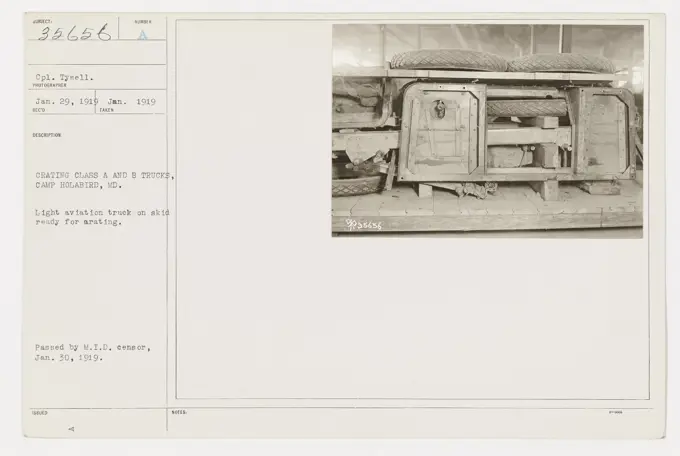
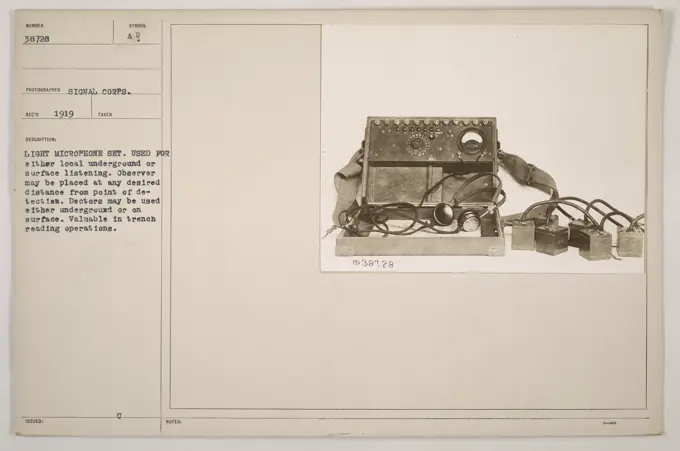
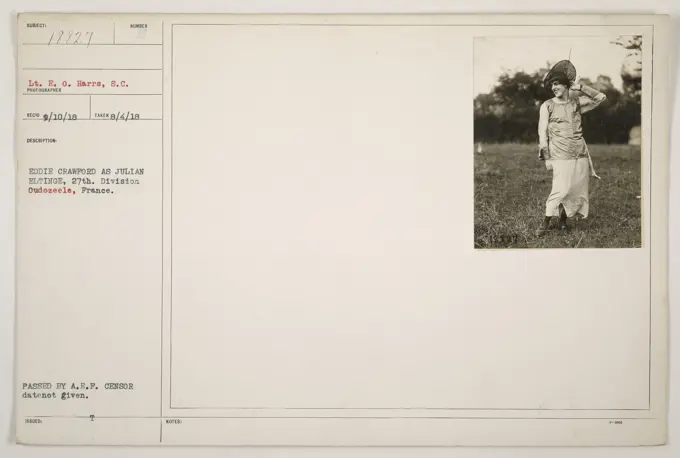
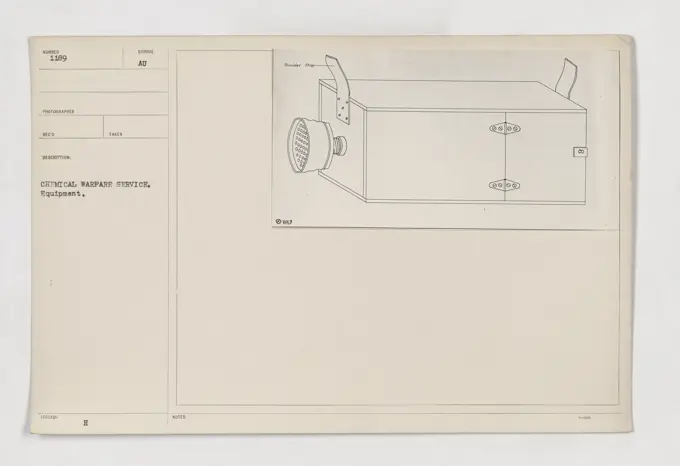
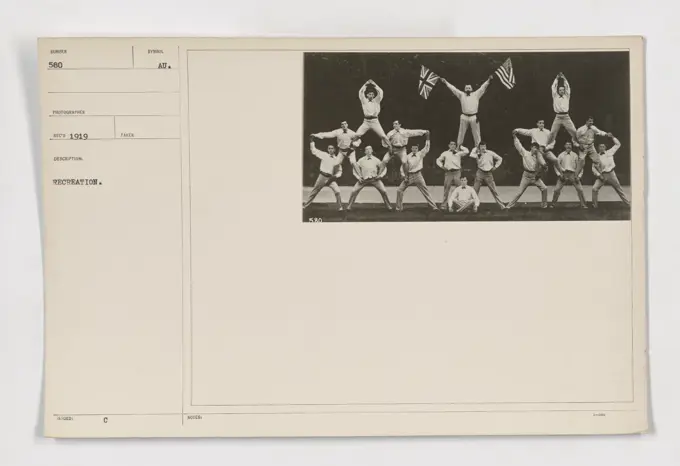
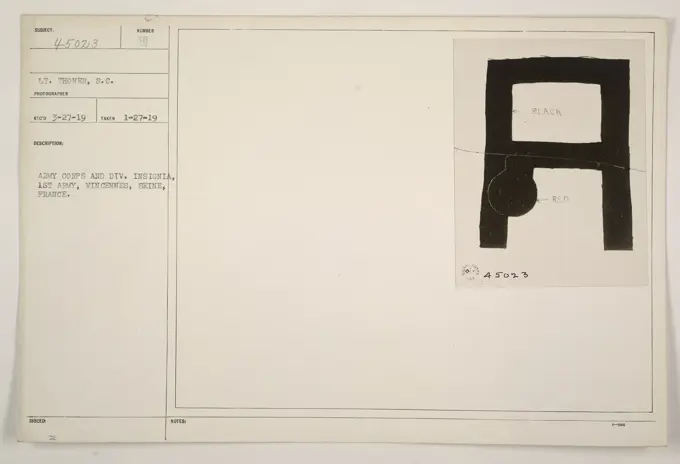
A Speedograph Camera in use during World War One. Manufactured by C.H. Clark in New York City. This camera was used by the Signal Corps for military photography purposes.Caption: "Uniforms and insignia for different branches of the US Navy are displayed in this photograph from the collection of American military activities during World War One. The image highlights the shoulder marks and badges worn by naval officers, representing their respective ranks and positions within the United States Navy."Photograph depicts a Signal Corps Radio Apparatus during World War One. The image focuses on an airplane aerial reel used for communication purposes. This equipment played a crucial role in facilitating communication between aircraft and ground stations during the war.An Army officer, whose identity is not specified, is shown in this photograph from 1919. The image was taken by photographer Munger and is labeled as 111-SC-10673. The officer appears to be posing for the photograph, possibly for official purposes. The photograph is a part of the collection of American Military Activities during World War One.Image depicting an airplane hangar during World War I. The photograph, identified as 111-SC-21969, was taken by an unknown photographer. It is part of a collection documenting American military activities during the war. No additional information or context is provided for this specific image."Photograph of an Ordnance & Instrument Division of Aircraft Production during World War I. The image shows a yoke designed to adapt a single Lewis aircraft machine gun to an airplane's flexible gun mount. The photograph was taken by the Signal Corps and received on 6-10-18. Notes: 11706."Major Paul M. Benedict, from the A.S.A.P., captured in this photograph from the collection of American Military Activities during World War One. The image was taken by a Signal Corps photographer, with the identification number 111-SC-29111. The photograph was received on December 9, 1918, and is titled "Takes Paul M. Benedict, Major, A.S.A.P. Issued Symbol A Notes: 2011 1-1000."Cpl. Tysell working on crating Class A and B trucks at Camp Holabird, MD. The photo was taken on January 29, 1919. It shows a light aviation truck on a skid, which is ready for crating. The photograph was received and approved by the M.I.D. censor on January 30, 1919. Image issued with the notes 55656.U.S. Army Transport float participating in the Victory Loan Parade in New York City on May 15, 1919. Photograph taken by Private C. Warner, S.C. Float labeled "SUBJECT 48140." Picture received on May 4, 1919, with the description stating it was taken during the Victory Loan Parade in NYC.Side view of an outpost switchboard, closed, of the monocord type. The photograph was taken on December 13, 1918, and received on August 15, 1918. It was taken by Cpl. Hillhouse, S.C. and intended for the Research and Inspection Division, S.C., Paris, France. The photograph was passed by the A.E.F. censor, but the date is unknown.Student officers of the Coast Artillery School receiving instruction in balloon observation of artillery fire at Fortress Monroe, Virginia. They are making observations from the basket of a balloon. The photograph was taken in April 1918 and Lieutenant William Fox of the Signal Corps is pictured. The image is not intended for publication and is marked for official use only. Issued notes include the photograph's identification number as 29778.Manufacturing of big shells at the Midvale Steel & Ordnance Co. Lt. N. McDonald took this photograph on March 16, 1918. The image shows workers adjusting base plugs on the shells. The photo was censored and released on May 18, 1918, by the Historical Branch, W.P. D., and issued by the War College. Laboratory notes reference 961 BR DOD.Wooden model of Liberty Motor Truck being tested by the Quartermaster Corps of the United States Army during World War I. The photo was taken in December 1917 and is part of the American Military Activities collection.In this photograph, taken on February 26, 1919, during the British American Boxing Tournament at the Royal Albert Hall in London, England, Private Kelly from the U.S. Army can be seen in the ring. He is engaged in a welterweight bout against Signalman A. Wilkinson from the Royal Navy. Jake Abel, the American boxer, emerged as the winner. This photo was issued with the above-described details and doesn't have any additional notes.Soldier using a light microphone set during World War I for local underground or surface listening. The observer can choose the distance from the point of detection, and the detectors can be used either underground or on the surface. This technology was valuable for trench reading operations.Captain Charles C. Patrick, an A.S.A.P. officer, takes a photograph during a signal corps operation. The photograph bears official number 29126 and was received on December 9, 1918. The image captures Captain Patrick in action, exercising his duties as a photographer for the Signal Corps.Aerial view of the Hydrogen plant at the Aviation Experiment Station in Hampton, Virginia during World War I. The photograph was taken by Reed on July 4, 1917, and is labeled as image number 111-SC-3545.A corporal named Palumbo photographed a heavy aviation truck being crated at Camp Holabird, Maryland on October 31, 1918. The photograph was censored and released by the M.I.D. censor on November 6, 1918.The image shows the SCR-74 Portable spark transmitting set used during World War One. This particular set is shown from the front view and was commonly used in trench warfare. The photograph was taken by RECO on March 5, 1918. Please note that this image was not meant for publication at that time.An unidentified Army officer is shown in this photograph taken in 1919. The specific details, such as location and purpose, are not provided in the description. The photo is part of a collection called "Photographs of American Military Activities during World War One.""Pvt. Behrens, S.C. posing for a reconnaissance photo taken by American artist Joseph Cummings Chase on Feb. 10, 1919. The artwork was commissioned by Brig. Gen. Geo. S. Gibbs, Ass't C.8.0. A.E. F., France. This image is numbered as 37774 and is a part of the collection taken in France during World War One."A group of American soldiers are seen gathered around a tank during World War One. They appear to be inspecting the tank, possibly checking for any damage or conducting maintenance. The soldiers are wearing their uniforms and helmets, indicating that they are actively participating in military activities.A photograph captured by Lt. E.O. Harrs shows Eddie Crawford dressed as Julian Eltinge, a performer, in Oudozeele, France during World War I. The photograph is part of the 27th Division and has been approved by the A.E.F. censor. The exact date of the image is not mentioned.Men of the 101st Field Artillery, formerly known as the 1st Regiment of the Pennsylvania National Guard, play cards during a break in fighting near Bouvardes, France. This photo was taken on July 31, 1918, and was approved by the American Expeditionary Forces censor. (Caption from "Photographs of American Military Activities during World War One", image 111-SC-18682)Airplanes in battle formation at Mineola, Long Island. The photograph was taken by a photographer from Columbia University in South Carolina. The image is numbered 48333 in the collection. This photograph captures airplanes flying in formation during a military activity, possibly during World War One.A soldier takes a moment to salute his fallen comrades in the battle area. This photograph, taken in 1919, shows the soldier standing behind the trenches with a symbol of remembrance in his hand.American soldier Pvt. Edw. R. Trabold of the S.C. is seen in this photograph holding a collar taken from a German messenger dog that was shot in American trenches. The photo was taken in Mesnil-St. Firmin, France on May 9, 1918. The image was censored and released by the M.I.B. Censor on June 28, 1918. Note that the identification number of the photograph is #13091.Lieutenant Thoner, S.C., is seen wearing an army corps and division insignia representing the 85th Division, located in Vincennes, Seine, France. The emblem features the number 27, with red lettering on a black background. This photograph was taken on January 27, 1919.Signal Corps apparatus, designated as MURDER 2523, captured in a photograph taken in 1919. The photo is credited to the photographer Wed and depicts the description of the symbol on the Signal Corps apparatus. The apparatus was issued by the AU military organization during World War One. Hotes was involved in recording the details.A photograph showing a radio apparatus, identified by the number +b581, used during World War One. The photo was taken by the photographer of the Signal Corps on March 10, 1921. The apparatus is labeled with the symbol "AU" and features the serial number 62582. Additional details mention an issuance of this equipment.Soldiers busy working at the Camp Colt butcher shop, where they are preparing meat for the U.S. government during World War One. The photograph shows an outside view of the fore, with the sign of Armour and Co., a Chicago-based company, visible in the background.A soldier, identified as Lt. Lubbe, is seen standing in front of a butchered, trimmed, and packaged large steer. The meat is prepared for government use. This image was taken in January 1919 at Armour and Co. in Chicago, Illinois. The photograph was reviewed and passed by the M.I.D. censor on January 28, 1919.Second Lieutenant Peter Abrams from the U.S. R. S.C., Training Section, Photo Branch, Air Service Division, is captured in this photograph taken on May 7, 1918. The image depicts Lieutenant Abrams engaged in military training activities.A soldier from the Chemical Warfare Service testing equipment during World War One. The soldier is wearing a uniform with the H symbol indicating their association with the service. This photograph is number 1189 in the series, taken by photographer Reco.Soldiers from an Engineering Battalion in World War One inspect an airplane's equipment in this photograph. Taken on February 15, 1919, the image shows members of the Radio Division examining the FA-7-PAN aircraft. This photograph was marked as not for public use, designated only for official purposes.Sgt. Brooke captured this photograph on Feb. 26, 1919, at St. Nazaire, Loire Inferieure, France. The image showcases the unloading of locomotives from the S.S. "Yellowstone" by a TCN Derrick. This activity was part of the military activities during World War I. The photograph was assigned reference number 111-SC-40535 and was officially issued on Nov. 22, 1918.Velse, a French war dog captured by the Germans in July 1918 near Chateau Thierry. After escaping captivity and swimming across the Velse River, he was adopted by two American War Correspondents: Raymond Carroll and Junius Wood. Velse accompanied them to various battle fronts, under shell fire, and never abandoned them. He was wounded when he joined the Americans. Velse currently resides with his benefactors at the Paris Peace Conference in Hotel Crillon, Paris, France.A photograph taken on December 27, 1918, by Cpl. L.H. McLaughlin of the S.C. unit during World War One. The image showcases a Browning Automatic Rifle with the change lever set for single shot fire. It was taken at the Ordinance Department at G.H.Q. in Chaumont, Hte. Marne, France. The photograph passed through the A.E.F. censor, but the date of this approval was not provided.A distant view of airplanes in battle formation, captured and documented by the Columbia University Signal Corps photographer. The photograph, bearing the identification number 48341, shows a group of airplanes flying in formation for combat purposes. This particular image showcases military activities during World War One.The image depicts a loyalty parade in New York City during World War I. Women of the Woman's Motor Corps are seen driving armored motor cars. The photograph was taken on July 4, 1918, as indicated by the notes. The image has the identification number 15,720 and the photographer is credited as Seco.Soldiers operating a radio apparatus, specifically the Radio Telegraph Bet Type SCR-49, in Sumice Bakan during World War One. This photograph with the identification number 111-SC-5080 was taken on February 20, 1918, and the description was issued on February 21, 1918.Pvt. W.J. Beach standing outside Les Blane Millers in Mehun-sur-Yevre, Cher, France in December 1918. Photograph taken on February 1, 1919. This is subject number 36267. The caption contains a note stating "No smoking" and that the photograph was issued.Caption: Image depicting the captured German Portable Field Wireless Outfit, taken on May 13, 1918. The apparatus arrangements are shown with the back removed. The photograph was taken by Corporal Hillhouse and is part of the Research and Inspection Division's collection.Soldiers at Fort S111, Oklahoma, observe a kite balloon in the sky. This photograph, taken by the Signal Corps on October 2, 1918, captures the military activities during World War I. The image was approved by the M.I.D. censor on December 13, 1918.Soldier looking at prime rib meat being prepared for the Army during World War One. Date: November 16, 1918. Taken by Pvt. P. Grenbeaux, a photographer. This image was passed by the M.I.D. censor and issued with the notes 28 1-6.Image of Lt. Thoner standing in front of the Army Corps and Division insignia of the 1st Army in Vincennes, Seine, France. The insignia consists of a white emblem on a blue background. The photograph was taken on January 27, 1919, and was recorded by the photographer S.C. Photo Reconnaissance on March 27, 1919. Note: The image was issued as Note B 44995.Sgt. McGarrigle testing American-made shells at Aberdeen Proving Grounds, MD on October 27, 1918. The photograph shows an explosion of a powder charge in a 6 Stokes trench mortar. This image is not intended for publication and is for official use only.Rear view of a Caproni bomb on an aviation field in Mineola, Long Island, taken on November 2, 1917. The photograph, numbered 19922, was received on June 7, 1918. It was issued for official use only.This photograph shows a Michelin parachute flare, which was used as trench warfare material by the Ordnance Department in the Ford Building in Washington, D.C. The photo was taken by Lt. M.S. Lentz, Signal Corps, on May 27, 1918. It was not intended for publication. Notes indicate the item number as 99881.Photograph 111-SC-43467 shows the S.S. George Washington entering Boston Harbor during World War I. President Wilson is on board. The photographer appears to be an official with the Reco agency. This image was taken and issued with the designated symbol of A WIG WAGEING TO S. S. George Washington.Armed guards holding back the crowd as $5,000,000 is being shipped to France. The money is packed in kegs and being loaded onto army trucks from a sub-treasury to be transported to a pier. This photograph was taken on February 15, 1919 by Lt. Geo. H. Lyon.Damaged German ship: This photograph shows a broken cylinder on the USS Agamemnon, formerly known as the Kaiser Wilhelm II, taken in December 1917. The engine room of the German ship Kaiser Wilhelm I, owned by Hamburg American Line, is seen here with its engines wrecked by the German crew before it was seized by U.S. authorities. This image was released on December 13, 1917, and is marked with the number 1008.This photograph shows an interphone unit used during World War One. The image was taken in February 1918 and photographed by a U.S. Army photographer. The interphone unit in the photo was not intended for publication and was part of the military's communication equipment.American soldiers are seen inside a meat factory owned by Armour and Co. in Chicago, Illinois, in January 1919. The soldiers were responsible for providing meat to the government during World War One. The photograph was reviewed and approved by military intelligence officers on January 28, 1919.A Position Light, Ground, Mark II is being inspected in this photograph taken on May 29, 1918. The equipment was received from the Engineering Bureau, Ordnance Department in Washington, D.C. The image shows a close-up view of the light, which was used for military activities during World War One.A photograph of the new base hospital at Camp Bragg, North Carolina. The image shows the Medical Detachment Barracks, with the number 61851 and description symbol A. The photograph was taken by photographer GT McGarrigle and was included in the RECO 88-19 collection. The photograph was taken on August 4, 1919.Photograph depicting a De Havilland DH.9 aircraft, equipped with twin Marlin machine guns mounted in the pilot's cockpit, used for reconnaissance missions during World War One. The photograph is labeled with identification number 8,481 and was taken by a photographer from the D.M.A. It is marked as "DECEPTION ISSUED" with the symbol "H" and should be considered "FOR OFFICIAL USE ONLY."Browning Machine Gun, model of 1918, water-cooled, commonly known as the "Browning heavy machine gun." This image shows the gun mounted on a tripod and is fed by a belt of 250 cartridges. The gun has proven reliability, with tests showing it can fire up to 39,500 shots without malfunctions. It is versatile, suitable for various tactical uses such as overhead, indirect, barrage, and defensive fire.Soldiers from the 32nd Division's Headquarters Troop cutting frozen American beef for meals at Chateau Letellier, near Cenaderf, Luxembourg, on the German frontier. Photograph taken by Lt. Rat. L. Dewell on February 26, 1919.A urinal at Camp Hospital No. 44, G.I.S.D. Near Gievre, Loire et Cher, France. The photograph was taken by Sgt. J. W. Crunelle on April 14, 1919. This urinal appears to be a standard issue at the camp. The photo is marked with the identification number 62251.This photograph, labeled as number 10819, was taken by an unidentified photographer in 1919. It depicts a personnel army officer whose name is not known. The officer is shown in uniform, maybe during World War I. Symbol AU is associated with the image."Fifth Division Parade at Washington, D.C. A camouflaged truck belonging to the First Division can be seen during the parade. This photograph, marked with the number 63,720, was taken by Sgt. Groat on October 21, 1919. The truck appears to be equipped for military operations, possibly used for transportation or logistics purposes."A French transmitting set from World War I. This photograph, taken by the Signal Corps in 1919, shows a portion of the set known as SUMBER 2233. It was used for military communication purposes during the war. The set was issued by the French military and documented as 02283.A photograph depicting manifold chlorine containers in the Ordnance Department's Ford Building, Washington D.C., during World War One. The photo was taken by Lt. M. S. Lentz, Sig. R. C. It is not intended for publication and was captured with the assigned number 111-SC-9886 on May 6, 1918. The containers are part of the trench warfare material used during the war.Cpl. Hillhouse holding a Peigne compass in Paris, France. Taken on September 16, 1918. This photograph is not to be published.German trench mine, cross section showing the location. This photograph from the Ordnance Department showcases German ordnance during World War I. The mine is seen along with sandbags for reinforcement and a symbol denoting its designation as HUNGER 2103. Taken on January 10, 1918, by photographer ECO.Power board in the switchboard room of a telephone installation at Fort Riley, Kansas during World War I. This photograph is part of a collection documenting American military activities during the war.A pile of uniform boxes containing bandolier cloth is seen in Sec. F of Warehouse M2. The image, taken on 4-10-19 by Sgt. Gray, S.C., shows a significant stockpile of items used for military activities during World War 1.Caption: Pvt. Berhens, S.C., sketched by official American military artist Captain George Harding. The drawing depicts a German plane taking down two Allied balloons during the Verdun drive on Sept. 26th. Image number: 111-SC-37892 #378921, received on Feb. 10, 1919, taken on Dec. 21, 1919. Notes: Image also referenced as 57020.A photograph taken by the Central Department, Signal Corps, on February 20, 1919, at Camp Custer in Battle Creek, Michigan. The image depicts a telephone installation, specifically a terminal box, on the riple range, showcasing a buzzer. The photograph is numbered 188LED and provides technical notes about fringe marks, pits, and remarks.Image Caption: Result of body armor test conducted on April 27, 1918. Lieutenant Hargan, S.C., is seen wearing the heavy 27-pound body armor (#5) after enduring constant machine gun fire from a German Heavy Maxim at a distance of 60 yards. The test took place in Fert le la Peigney, Langres, France, under the supervision of the Ordinance Department. This photograph was released by the A.E.F. Censor on January 7, 1919.Solder, Pvt. W.J. Beach is seen taking apart parts of a German Maxim machine gun. The components include the belt, reel, reel case, and swivel used to swing the gun. The photograph was taken on November 6, 1918, in Tours, France, during World War One. This image was approved by the A.E.P. censor.Soldiers enjoying a game of baseball during their recreation time in 1919. The photograph was taken by photographer Red, and is part of a collection titled "Photographs of American Military Activities during World War One".Soldiers using Signal Corps apparatus during World War One. The apparatus is labeled as BB-14 Battery Number 48,273. This photograph was taken by a photographer from the Signal Corps. The photo was issued with the description "ISSUED TAKEN H SYMBOL SIGNAL CORPS APPARATUS. BE-14 BATTERY." Additional notes state "BB-14 BATTERY 9048273 1."Observer in rear seat of Gun Mount equipped with aeroplane radio headset Type HS-1 and Transmitter Type T-1. Headset includes helmet, receiver, and transmitter. This photograph shows a wireless operator during World War I.Image of a Western Electric telephone at a central officers' training school for F.A. at Camp Taylor in Louisville, KY during World War One. The photograph is dated December 21, 1918 and was taken on November 26, 1918. The image is marked as not for publication and for official use only.A soldier is holding an Aero oxygen gas mask, manufactured by the Western Electric Company. This mask includes clasps for attaching it to helmets. The photograph was taken on Dec. 18, 1918, and the image is part of the collection of American military activities during World War One.This photograph shows a Signal Corps apparatus used during World War One. It is an Airplane Aerial Radio Reel of French type, known as WUNDER 2217. The photograph was taken by the photographer Reed in 1919. The image is a symbol of the technological advancements made in military communication during the war. The notes indicate the catalog number was 02217.American soldiers inspecting a Signal Corps apparatus during World War One. The photograph has the identification number 36,429 and was taken by a photographer from the Signal Corps. The soldiers are seen using a FA-4-B-PAN, a device likely used for communication or surveillance purposes.Soldiers using a buzzerphone for communication during World War 1. The photograph was taken on June 24, 1918, by Lt. H.S. Drucker of the U.S.R. Paris, France. The image was intended for the Research and Inspection Division and is labeled "not for publication" and "for official use only".American military personnel operating a radio telephone set aboard a reconnaissance airplane. This photo, numbered 111-SC-36375, was taken on February 15, 1919 by a photographer from the Radio Division. The equipment shown is a short-range radio telephone set, receiver SCR 93, and it was issued for official use only. It can be found indexed under number E-4548 on November 20, 1919.This photograph was taken in Paris, France, and showcases an American 1375 B and Type EE8 Telephone, which is ready for shipment. The image was taken for the Research and Inspection Division of the Signal Corps Photo Lab. The photographer was Nunder H, and the date when the photo was taken was October 22, 1918."Soldiers working on a radio apparatus, specifically designed for airplane use. The device features a streamline casing and is identified as Type 08-1 with a spring contact MM-4. Photo taken at the Radio Development Station in Washington, D.C. Image not intended for publication. May 3, 1918."This caption is adapted from the caption found in the Photographs of American Military Activities during World War One. It describes an anti-aircraft trailer mount for a 4.7" anti-aircraft gun, Model 1918. The gun is shown in an elevated position for sighting aircraft. It was manufactured by the New Britain Machine Co. for government use. The caption mentions that it is not for publication and is for official use only.Soldier Pvt. Prunelle, depicted in this image taken on August 26, 1918 by Lt. R.D. Mackie, is seen at the British Prison Camp in Vendroux, France. The photograph was later issued with reference number 24222, having passed the A.E.F. censor.American soldiers in a clearing oversee the process of "mopping up" during World War One. Pictured here is a drawing by Captain H.E. Townsend, photographer Reed. The image captures the intense activity and attention to detail required to secure and pacify an area following a military operation. Date of photo: 1917-1918.Image depicts a soldier, Pvt. P. Grenbeaux, standing in front of crates of lamb meat. The photo was taken on November 22, 1918, at Armour & Co., Central Market in Washington, D.C. The meat is intended for the Quartermaster Corps. The image was approved by the M.I.D. censor on November 30, 1918.Burned out bearing - worm thrust - on a standardized military truck of class "B." The photograph shows either small pieces or complete destruction of the bearing. Taken by L.E.M. de Berri, Signal Corps photographer in April 1918 in the Motors Division, Eng. Sec. Lab., at Union Station, Wash. Not for publication. Approved by the War College Division in 1918.Sergeant Moscioni of the U.S. Signal Corps is pictured with a buzzerphone (open) at Barracks #66 in Tours, France on December 27, 1918. The photograph was taken by S.C. Photographer EE-1 Subiect 32615. The image was technically held by the Allied Expeditionary Forces (A.E.F.) censor, and it was passed by the A.E.P. but the exact date is unknown. Specific details about the photograph include the notes "32615" and "3-4."Cpl. R.H. Ingleston took this photograph on September 12, 1918, during World War One. The image shows Sgt. E.G. Guill from the photo detachment of the 42nd Division bringing back his captured German pet near Flirey, Meurthe et Moselle, France. The photograph was assigned the number 2279-58.Sgt. Moscioni of the U.S. Signal Corps in Tours, France, is pictured holding a buzzerphone. The photograph was taken on December 27, 1918, and received on May 20, 1918. It was passed by the A.E.F. censor. The image was issued with the number 32614 and reissued with notes by Toetzee."A photograph of a submarine underway in the Gulf of Mexico. This image was taken by Lt. H.P. Kingsmore and is numbered 601. The photograph was captured on March 5, 1918, at Key West Naval Station in Key West, Florida. The submarines seen in the picture are from the Genbored and Alco companies.Lieutenant M.S. Lentz photographed on May 3, 1918, at the Willard Hotel in Washington, D.C. showcasing French legion of honor medals. The image was censored and approved for release on May 11, 1918, by the Historical Branch of the War Plans Division. Image number: 111-SC-9388.Lt. Lubbe inspecting a common cow used for providing meat to the government during World War One. The cow is of commercial trim and this photograph was taken on January 27, 1919, in Chicago, Illinois. It was approved by the military intelligence department censor on January 28, 1919.The photograph shows army corps and division insignia of the 1st Army in Vincennes, Seine, France. LT. Thoner, S.C. took the photo on January 27, 1919. The insignias are black and red in color."Image showing the insignia of the 96th Aero Squadron, Aviation Section, Amanty Field, Amanty, France. The photograph was taken on July 29, 1918, by Corp. A. Lubatty, s.c. It was officially held by the A.E.F. Censor and marked for official use only."American soldier testing a parachute during World War I. The parachute design is similar to that of a balloon. This photograph was taken on September 12, 1918, and is classified as "For Official Use Only.""Sgt. Moscioni of the U.S. Signal Corps in Barracks #66, Tours, France. The photograph shows a camp telephone model "A" used by the American military during World War I. The image was taken on December 27, 1918. It was passed by the A.E.F. censor, but the exact date is unknown."Soldiers in World War 1 receiving training in oxen handling. The image, taken on July 10, 1918, by Sgt. McGarrigle, shows Miss Hutchinson from the Committee on Public Information observing the training session.Ensign Gould performing a loop maneuver in a hydroaeroplane at an altitude of 3500 feet. The photograph was taken by TH.P.KINGSMORE and it was issued by the Key West Naval Station, Aviation School in Key West, FL. The image was censored and released on March 30, 1918 by the War College Division's laboratory.