Aerial Military Activities of WWI

Historical photographs capturing various aspects of aerial military operations, individuals in uniform, and aircraft scenes from World War I.
This photograph showcases a view of airplanes in flight during World War One. The aircraft are seen soaring through the sky, possibly engaged in a military activity. The image was captured by photographer H. L. Motes, and its official description is marked as 111-SC-4554 with the corresponding code RECO 4554.
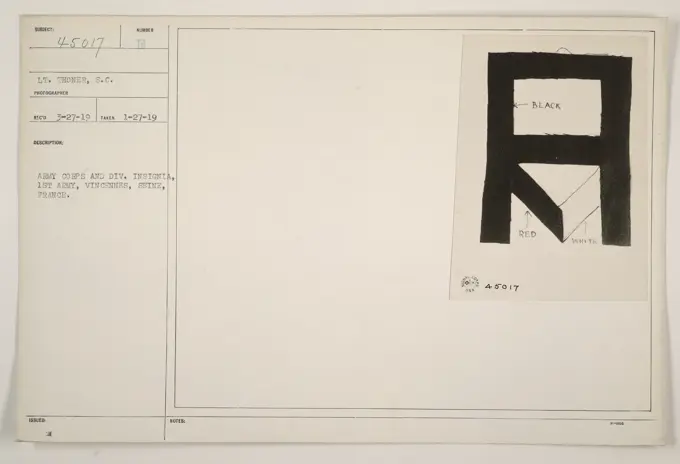
"Photograph of Army Corps and Division Insignia from the 1st Army in Vincennes, Seine, France. Taken on January 27, 1919, by Lt. Thoner, S.C. Insignia features a black, red, and white color scheme. Archive reference number: 45017."Pvt. P. Grenbeaux demonstrating different types of field glasses at Signal Corps Headquarters, Washington, D.C. The photo was taken on December 17, 1918. The image is accompanied by a issued pass from the M.I.D. censor on December 30, 1918.An aircraft wrecked on Accuracy Field at the Synsol A Air Service Flying School in Rich Field, Waco, Texas. The photograph, numbered 29,732, was received from D.M.A. Photographer in December 1918. It is labeled for official use only. This information is provided as part of the collection "Photographs of American Military Activities during World War One."Image shows a collection of blacksmith's chests from various branches of the military during World War I. These tool chests are now being replaced by standardized chests. The blacksmith's chests contain a wheelwright's kit and 70 pack train tools. This change is in line with the guidelines outlined in Note 37, Page 508 of the War Department in 1915.Sergeant Leo Morper at Cour Cheverny, Loir et Cher, France on December 3, 1918. The photograph was taken on January 7, 1919. This image was officially endorsed by the A.E.F Censor. Morper is seen near a sign for the Y.M.C.A. Corps Replacement Depot.Private P. Grenbeaux photographed on November 22, 1918, with a chart displaying major cuts of hindquarters of meat for the Army. This photograph emphasizes the importance of sourcing provisions to support the military during WWI. It was officially passed by M.I.D. for record on November 23, 1918.A German Lieutenant named Drucker is captured in this photograph taken by Lt. Jack on September 1, 1918. Drucker is shown sitting on a 28 cm mount gun on a German railroad. The image was captured in Paris, France and is part of a collection of American military activities during World War I. It is not authorized for publication.Major J. J. McGuire from the 83rd Division Headquarters is pictured in Montigney el Roi, France on June 25, 1918. The photograph was taken by Lt. E.0.Harrs, Sig. R.C. It was received on August 27, 1918, and passed by the A. E. P. Censor on August 13, 1918.A photograph taken in 1918 by the Signal Corps showcasing a symbol for meat used by the Quartermaster Corps during World War I. The image is numbered 26764 and is a part of the collection "Photographs of American Military Activities during World War One." Notes for the picture mention the code 9086764 and the date 3-2004.Rear view of kitchen trailer with serial number 67932. This photograph was taken by Sgt.Saum.S.C. on March 11, 1920, and is part of a collection documenting American military activities during World War One. The trailer was part of a fleet of kitchen trailers utilized by the military. (50 words)This photograph, labeled as 111-SC-10825, is from a collection known as Photographs of American Military Activities during World War One. It is an image of an unidentified army officer taken in 1919. The officer's name is not known.Image captured during World War One at Camp Taylor, Louisville, KY. It shows officers at a central training school learning how to operate 6500 and 8000-yard range quadrants. Not to be published and for official use only. (111-SC-30283)"Soldiers from the American military compound take part in a meat rationing activity during World War I. The image shows a close-up shot of a good quality callie or picnic ham. The ham was provided by Armour and Co. in Chicago, Illinois, and passed the M.I.D. censor on January 28, 1919."Soldier Sgt. Me Garrigle of the Salvage Division at Camp Meade performing clothing repair. Here, he can be seen steaming and blocking a garment. This photograph was taken on April 28, 1919. The photograph is cataloged under subject number 47528. No further information is available.A soldier wearing a front head canister mask, which was a type of gas mask used during World War One. The photograph was taken by a photographer from the Chemical Warfare Service on an unknown date. The mask is identified with the AU number.Lt. Sadnick And Crew Of The Boeing B-17 "Flying Fortress" Of The 390Th Bomb Group Pose By Their Plane At Their Base In England On 22 April 1944.Private Paul Grenbraux identified as a soldier of the Signal Corps. This photograph was taken on November 8, 1918. The image shows a sunset view of the Auth Provision Co. and Armour Meat Co. buildings in Washington, D.C. The photograph was censored and released by M.I.D. censor on November 15, 1918.Soldier PVT. SOPER from SC is captured in an image taken on January 2, 1919, at the Base Laboratory in Brest, Finistere, France. The photograph documentation states that this image features "Michels diverticulum" and includes issued notes numbered 48612.A photograph taken in June 1918, titled "111-SC-11809," shows a German D.F.W. Two-Seater airplane. The image is part of a collection of photographs documenting American military activities during World War I. The caption provides factual information about the photograph, including its photographer and issue date.Different types of infantry helmets used by the Engineering Division of the Ordnance Department during World War One. The photograph, labeled "SUBIECT 54412 ENG. DIV. ORD. PHOTOGRAPHER RED 12-18," shows the various designs and models of helmets issued to the infantry during that time. Several helmets can be seen in the image, but no specific details about their numbers or notes are provided."75 MM anti-aircraft auto cannon mounted on trailer with French crew from the Eng. Div., Ord. Dept. Taken on December 18, this photograph showcases different types of ordnance equipment used during World War One. Issued for official use only."The image shows various types of gas projectors used by the Chemical Warfare Service during World War One. The projectors are numbered and include 13, 15, 16, 17, 85, 22, 20, 343, 18, 22, with different fuzes numbered Z.04, 24, 25, 26, 27, 28, 30, 29, and 31. This photograph was taken in 1919.Pigeon transportation baskets used by the Pigeon Section, Land Division, S.C. during World War One. The image shows a closed eight-bird stock basket, with the back visible. This photograph was taken by Sgt. Marshall on May 13, 1918 and is not intended for publication. Additional notes are listed as 09623 TR J-14.The photograph shows an exploded view of a French Type "U" military equipment. The image was captured by photographer Recyan on January 26, 1918. The photograph was subsequently released by W.C.D to the Photo Div., S.C., subject to approval. It provides a detailed perspective of the French equipment's internal structure.Group of officers-in-training at the Central Officers Training School for Field Artillery at Camp Taylor, Louisville, KY. They can be seen examining various artillery components such as a drill cartridge, cartridge case, sectionalized shrapnel, and sectionalized shell. The photograph was taken on November 26, 1918, and received on December 21, 1918. Approved by the M.I.D. censor on December 24, 1918.Injured soldier Pvt. Harvey Lawrence of the 130th Engineers, who suffered burns on August 5th is seen in this photo. The image was taken by Lt. Stone on September 18th, 1918. Pvt. Lawrence is pictured at the American Red Cross Military Hospital #9 in Paris, France. Official use only. Not for publication.Smokejumpers: Training - Oregon. Photographs Relating to National Forests, Resource Management Practices, Personnel, and Cultural and Economic History"Cpl. MeLaughlin holding a German Parabellum, 1913 model aircraft free gun. The photograph, taken on August 26, 1918, shows the left side of the gun. Cpl. MeLaughlin belongs to the Automatic Arms Section of the Engineers Division in the Ordinance Department stationed in Tours, France. This image is not intended for publication."Cpl. MeLaughlin holding a German Parabellum, 1913 model aircraft-free gun. The photo was taken on 8-26-18 at the Automatic Arms Section of the Engineer's Division, Ordinance Department in Tours, France. The image is not meant for publication.Photograph 111-SC-34539 shows a CPI photographer capturing an Army exhibit at the State War and Navy building in Washington, D.C. The exhibit explains the Army personnel system and features a model of an automobile driver's trade test course. This test was crucial as the A.E.F needed 30,000 auto drivers. The model highlights the different skills required and provides instructions through numbered markers, shown in red.Sam-D radomes , Ordnance industry, Scientific equipment.  Records of U.S. Army OperationalAmerican soldiers wearing experimental breast and back plates designed by Hamel de Forrest for added protection during World War One. These armor plates were developed by the Ordnance Department and were issued to soldiers. Photographed in December 1918.Sgt. K. Polk captured an image (May 1920) showcasing various models of army shoes (designated as number 6856) worn during World War One. The shoes were issued to soldiers and are documented under symbol A₂. This image serves as historical evidence of the different types of army shoes used by the military.The submarine shark repro of pictures from fire damage.The shark (depicted - name)Soldiers training during World War One, wearing gas masks. June 14, 1918. Gas mask type issued to soldiers for protection against chemical warfare. Photograph taken by a photographer from the C.P.I (Committee on Public Information). Classified as official use only.Dye "Bomb" Away!. Silhouetted in the rear cargo doorway of a U.S. Coast Guard HC 130-B plane, a crew member drops a dye "bomb" on an iceberg target off the coast of Labrador. The bomb is a one gallon glass jug containing a mixture of calcium chloride pellets and rhodamine "B" dye. As the jug smashes against the iceberg, the calcium chloride melts grooves into the berg allowing the vermillion rhodamine dye to penetrate from one-half to one full inch deep into the ice. The berg is marked for future identification with a stain that lasts until the berg reaches past that depth of melting stage. This method of iceberg marking, used for the first time on the 1966 International Ice Patrol, enabled Coast Guard observers to more accurately determine rate of drift and measure rates of deterioration for long periods. Vermilion dye marked icebergs were readily identifiable even after more than two weeks of time lapse between bombing of the target and aerial tracking. The calcium chloride-rhodaminePrivate MeLaughlin captured this photograph on August 12, 1918, in Tours, France. The image illustrates two types of very pistols used during trench warfare in World War I - a 25mm and a 35mm. The photograph was taken for record-keeping purposes and was not intended for publication. Label: 111-SC-33971.Members of the U.S. Marines recruitments unit advertising their services during World War One. The image shows a recruitment poster with the text "The U.S. Marines Want You - Apply at" followed by upcoming recruitment events. The image is dated April 29, 1918.