My Boards
View Pictures
  • My Boards
← Artworks

Ancient Greek Pottery

Intricate terracotta vases from ancient Greece depicting mythological themes and warriors, showcasing beautiful craftsmanship and storytelling.

Pelye With A Swallow Greek Art Pottery State Hermitage Museum, St. Petersburg, Russia
164 assets in this story
1788-41121
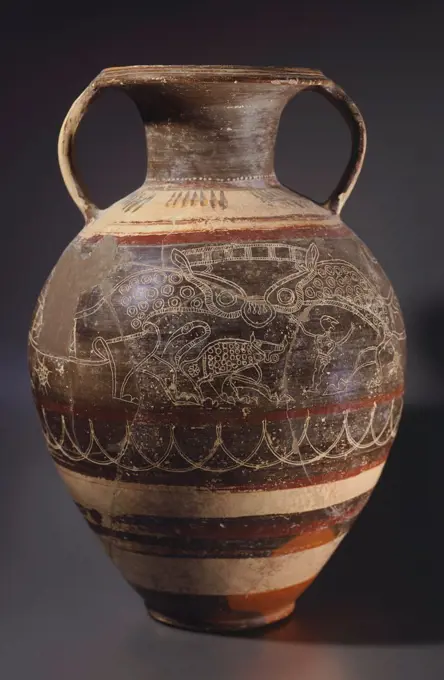
Polychrome amphora by the Painter of the Cappi, detail showing a panther. Etrusco-Corinthian pottery from Tarquinia (Lazio). Etruscan Civilisation, 630-600 Century BC.
7192-70580747
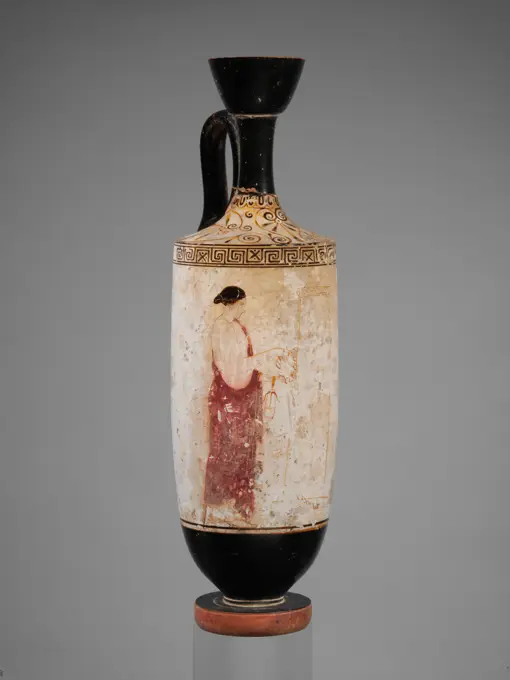
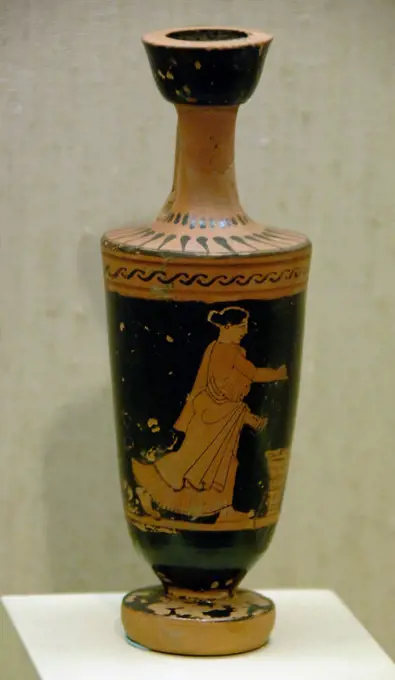
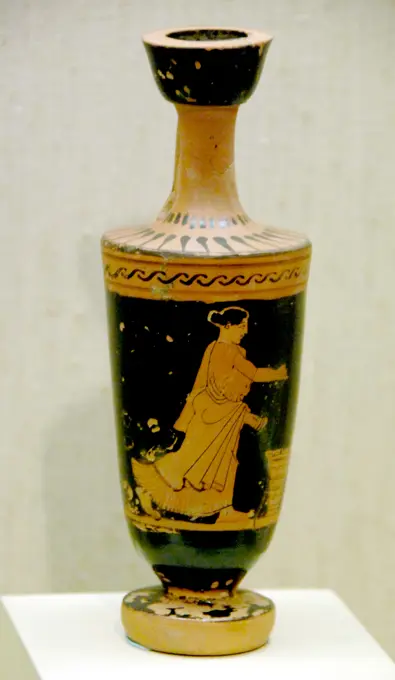
Greek Art. Greece. Lekythos red-figure with the image of a woman. Dated between the years 475-450 BC Museum of Cycladic and Ancient Greek Art. Athens, Greece.
6145-29750726
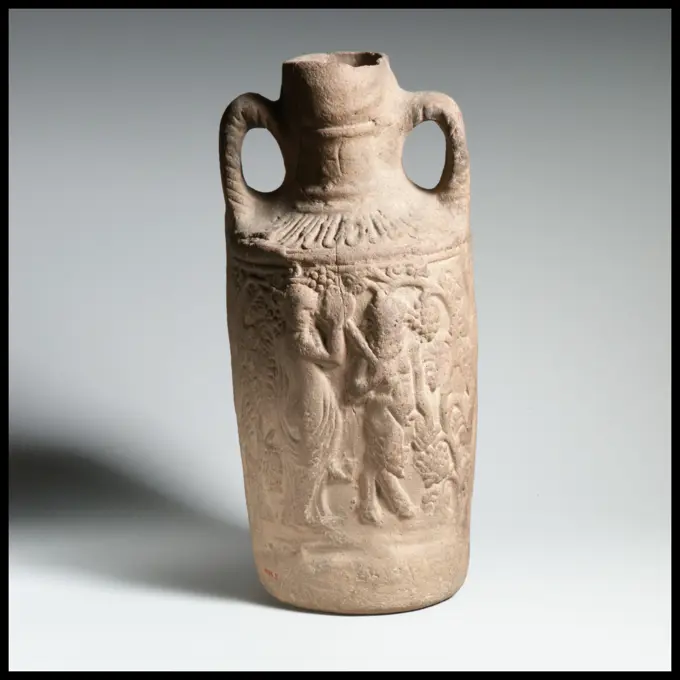
Terracotta amphora (jug) 2nd-3rd century A.D. Roman This vessel was made at Cnidus, a trading and manufacturing port in Caria (southwestern Turkey), famed for its statue of Aphrodite by the Greek sculptor Praxiteles. The relief decoration shows the god Dionysus on one side and Pan with a dancing nymph on the other. Similar scenes can also be found on much grander examples of Roman art, such as mosaics and marble sarcophagi.. Terracotta amphora (jug) 254634 Roman, Terracotta amphora (jug), 2nd3rd century A.D., Terracotta, H. 10 3/8 in. (26.4 cm). The Metropolitan Museum of Art, New York. Gift of Arthur L. Gale, 1949 (49.94.5)
4409-169059
*MENADE EN TORNO AL IDOLO DE DIONISIO -VASIJA-. Location: NATIONAL MUSEUM OF ARCHAEOLOGY, NEAPEL, ITALIA.
4443-21960100
Wine Cup with Scenes of Bacchus and His Consort, Ariadne; Roman Empire; 25 B.C. - A.D. 25; Glass; 10.5 × 17.6 × 10.6 cm (4 1,8 × 6 15,16 × 4 3,16 in.)
6145-52506778
Attic black-figure lekythos depicting Dionysus in a chariot pulled by a sileni team still image. 1883. The Miriam and Ira D. Wallach Division of Art, Prints and Photographs: Picture Collection. Pottery , Greece, Pottery, Greek, Antiquities, Mythology, Greek, Dionysus (Greek deity), Containers , To 499, Vases, Greek, Lecythi, Vases
6145-29780319
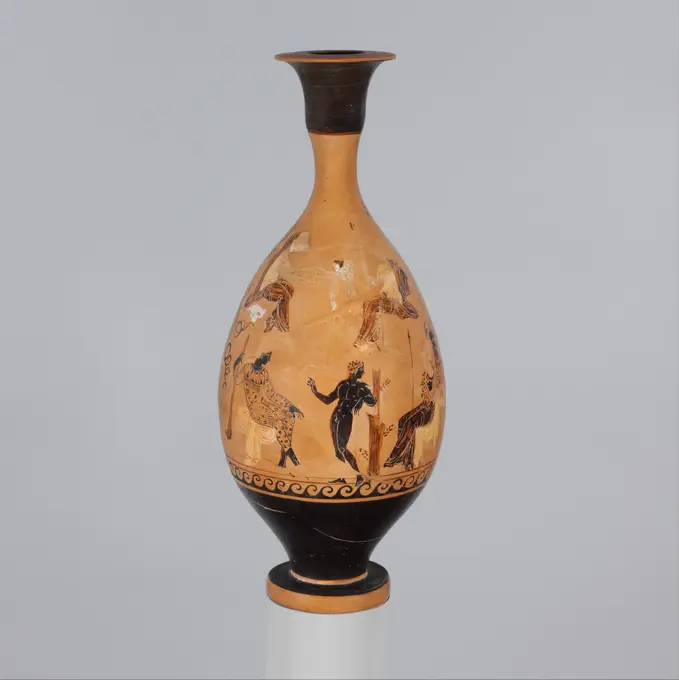
Terracotta lekythos (oil flask) mid-4th century B.C. Attributed to the Pagenstecher Class The Judgment of ParisAmong the rare black-figure works made in Southern Italy, lekythoi of this distinctive shape were produced in Paestum, Campania, and Sicily. The scene features Hermes, whose pose and articulation surely reflect a bronze sculpture. The fluent drawing and incision of the figures were heightened with details in white that has now worn off.. Terracotta lekythos (oil flask) 247386
4409-17544057
Volute Krater (Mixing Bowl). Greek; Apulia, Italy; Attributed to the White Saccos Group. Date: 330 BC-320 BC. Dimensions: 85 x 45.2 x 36.8 cm (33 1/2 x 18 x 14 1/2 in.). Terra-cotta, decorated in the red-figure technique. Origin: Apulia. Museum: The Chicago Art Institute, USA. Author: ANCIENT GREEK.
4409-63013981
Attic red-figure pottery, ceramic vase with a woman face. 6th century to 4th century BC. Greek Culture.
4409-152448
CERAMICA IBERICA - VASO DE LA DANZA - KALATHOS CON DECORACION PINTADA REPRESENTANDO UNA DANZA PROCEDENTE DE SAN MIGUEL DE LIRIA. Location: MUSEO DE PREHISTORIA Y ARQUEOLOGIA. Valencia. SPAIN.
4409-64081201
Bol romano de cerámica, procedente del yacimiento arqueológico de Torre Llauder. Can Serra Museu de Mataró.
4409-17417310
Terracotta alabastron (perfume vase). Culture: Greek, Attic. Dimensions: H. 6 1/8 in. (15.6 cm). Date: ca. 510-500 B.C..Amazon and youth leaning on a staffAlabastra decorated with an Amazon enjoyed a brief period of popularity at the end of the sixth century B.C. On this vase, there is no evident connection between the two figures. The presence of the youth may indicate that Amazon alabastra were favored by youths rather than women. Museum: Metropolitan Museum of Art, New York, USA.
4409-17386643
Terracotta alabastron (perfume vase). Culture: Greek, Attic. Dimensions: H. 5 13/16 in. (14.7 cm); diameter 13/16 in. (2 cm). Date: ca. 480 B.C..Woman and Nike at altar, each with phiale.Offering libations seems to have been an important role for women. Here a Nike (personification of victory), who looks very much like an Athenian lady with wings, and a mortal counterpart flank an altar. Each holds a phiale (libation bowl). It is likely that the sacrifice is for the successful return of a warrior or athlete. Museum: Metropolitan Museum of Art, New York, USA.
1788-18611
Geometric-style amphora depicting prothesis scene, exposure and lamentation of dead, by Dipylon Master, from Necropolis of Dipylon, Athens
6145-44286497
Attic Red-Figure Skyphos. Workshop of Penthesilea Painter (Greek (Attic))
6145-29067943
The daughter-in-law of the king of Banaras, charmed by the music of a vagabond, comes down to meet him, from a Tuti-nama (Tales of a Parrot): Sixteenth Night, c. 1560. Mughal India, court of Akbar (reigned 1556-1605). Gum tempera, ink, and gold on paper; overall: 20.3 x 14 cm (8 x 5 1/2 in.); painting only: 11.2 x 9.9 cm (4 7/16 x 3 7/8 in.).
6145-48834698
Apulian Volute Krater. Patera Painter (Greek (Apulian))
6145-59181696
Lazio Viterbo Viterbo Museo Civico76. Hutzel, Max 1960-1990 Views of paintings (Middle Ages through 18th c.), frescoes, a tabernacle, coffin, sculpture reliefs, portal fragments, busts, sculpture, tapestry found in the Pinacoteca, Second floor gallery and Second floor cloister sequences. Antiquities: Many views of Etruscan and Roman fragments, sculpture, sarcophagi, pottery, masks, jewelry and other objects found in the Storeroom sequence (inventory numbers on back of prints), and the Cloister, Second floor Cloister, Valle Giulia, Sala Romana and Sala Etrusca sequences. General Notes: There are eight separate numerical sequences for this location. The cloister as an architectural structure, rather than museum site, is documented in the record and file for S. Maria della Verita, Cloister, all views of which are stored in Medieval core collection. Five views from the Museo Civico Second floor cloister sequence are stored in Medieval. German-born photographer and scholar Max Hutzel (1911-
4409-17544028
Loutrophoros (Container for Bath Water). Greek; Apulia, Italy; Attributed to the Varrese Painter. Date: 350 BC-340 BC. Dimensions: 88 × 37.5 × 26 cm (34 3/4 × 14 3/4 × 10 1/4 in.). Terra-cotta, decorated in the red-figure technique. Origin: Puglia. Museum: The Chicago Art Institute, Chicago, USA. Author: ANCIENT GREEK.
6145-48850315
Attic Red-Figure Volute Krater Fragment. Attributed to the Kleophrades Painter (Greek (Attic), active 505 - 475 B.C.)
4443-21961373
Mixing Vessel with Adonis, Aphrodite, and Persephone; Attributed to the Meleager Painter (Greek (Attic), active 420 - 380 B.C.); Athens, Greece; 390-380 B.C; Terracotta; 78.7 × 40.6 cm (31 × 16 in.)
6145-29768711
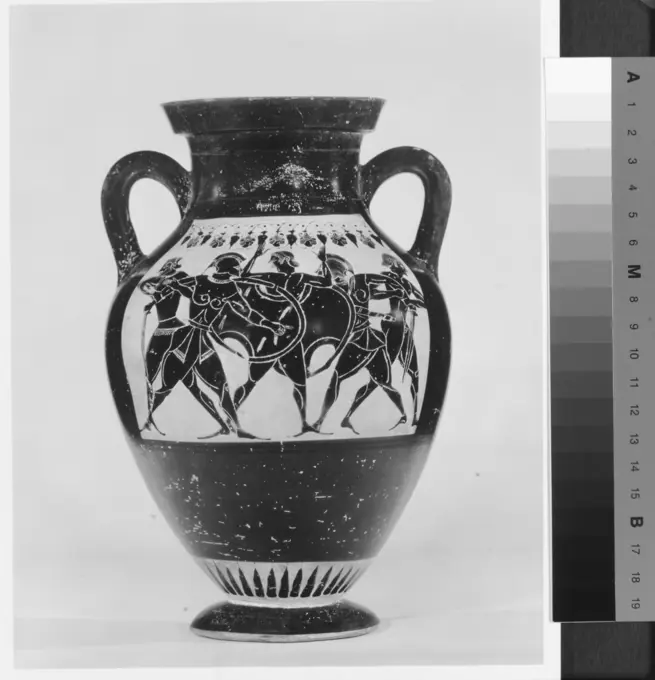
Terracotta amphora (jar) ca. 540-530 B.C. Attributed to the Swing Painter Obverse, two warriors separated by onlookersReverse, seated lyre-player flanked by dancing men. Terracotta amphora (jar) 254355
4409-20888224
Ceramic vessel, erotic art Moche culture 100 AC-800 AC Perú.
4409-39646
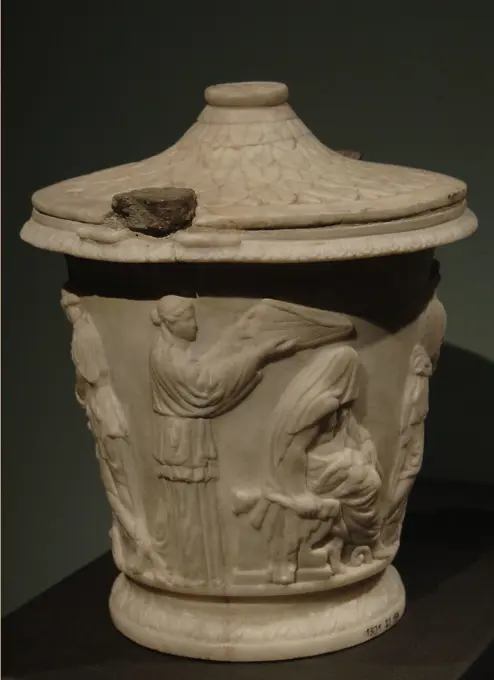
Cinerary urn with reliefs depicting Heracles (Hercules) beginning in the Eleusinian Mysteries. White marble. From the columbarium near Porta Maggiore. Dated probably early Roman Imperial period. Palazzo Massimo. National Roman Museum. Rome. Italy.
4409-63011214
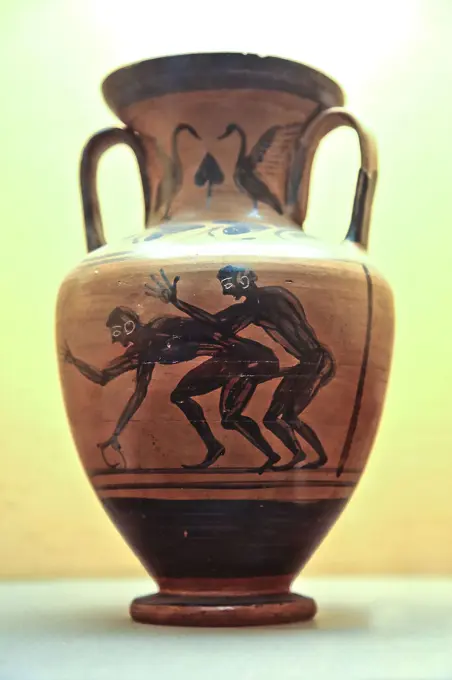
Etruscan amphora. Black figures. 5th century BC. Erotic scene, two men having sex. Pompeii. Secret cabinet, Naples Archaeology Museum. Italy.
4443-21961325
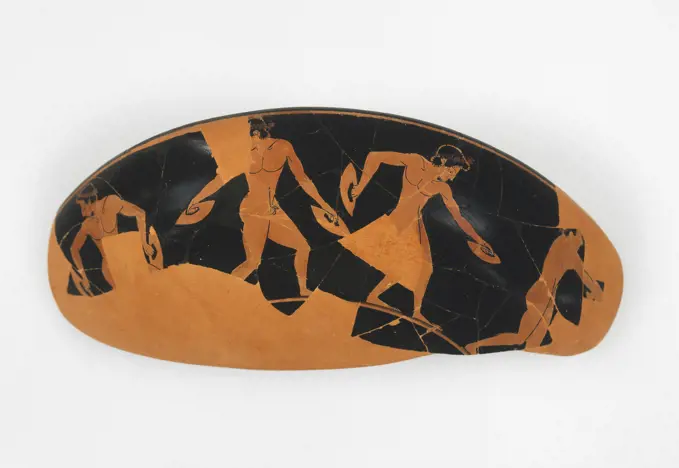
Attic Red-Figure Cup Fragment; Wider Circle of Nikosthenes Painter (Greek (Attic), active Athens, Greece 510 - 500 B.C.); Athens, Greece; about 510 - 500 B.C; Terracotta; 7.6 cm (3 in.)
6145-29192524
Terracotta lekythos (oil flask) ca. 450-440 B.C. Attributed to the Painter of Athens 1943 Two figures at a tombOnly the figure to the left of the tomb is preserved. She approaches with a wreath and alabastron (perfume vase).. Terracotta lekythos (oil flask). Greek, Attic. ca. 450-440 B.C.. Terracotta; white-ground. Classical. Vases
4409-17379492
Tumbler. Culture: American. Designer: Henry Chapman Mercer (1856-1930). Dimensions: H. 5 in. (12.7 cm). Manufacturer: Moravian Pottery and Tile Works (founded in 1899). Date: ca. 1879. Museum: Metropolitan Museum of Art, New York, USA.
4409-17337013
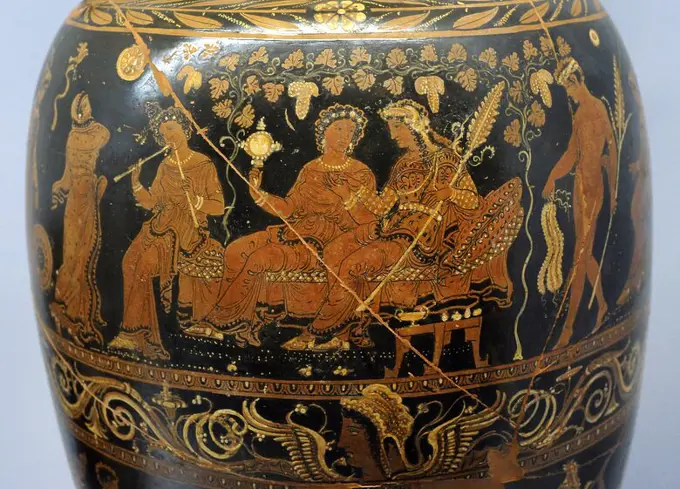
Dionysos with Ariadne on a banquet under vines. Loutrophoros (for lustral water). Detail. Varrese Painter (350-340 BC). Made in Puglia, from Ruvo di Puglia. National Archaeological Museum. Naples. Italy.
7155-70378840
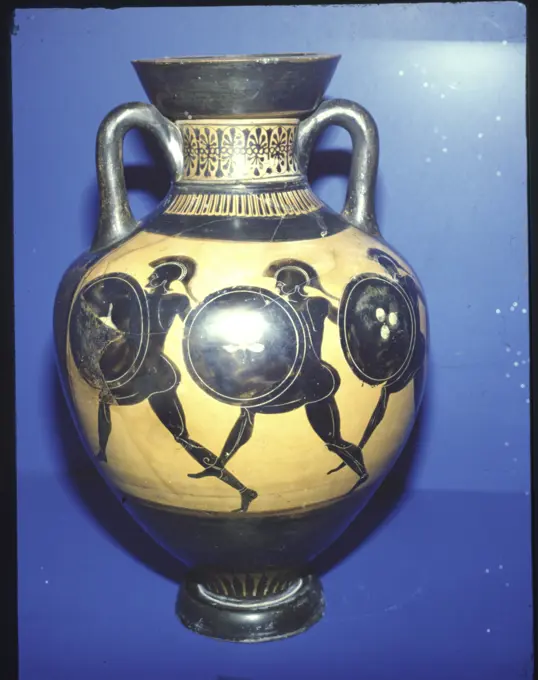
Greek Vase painting. Athletes running with shield and helmets. 500 BC.
6145-43634958
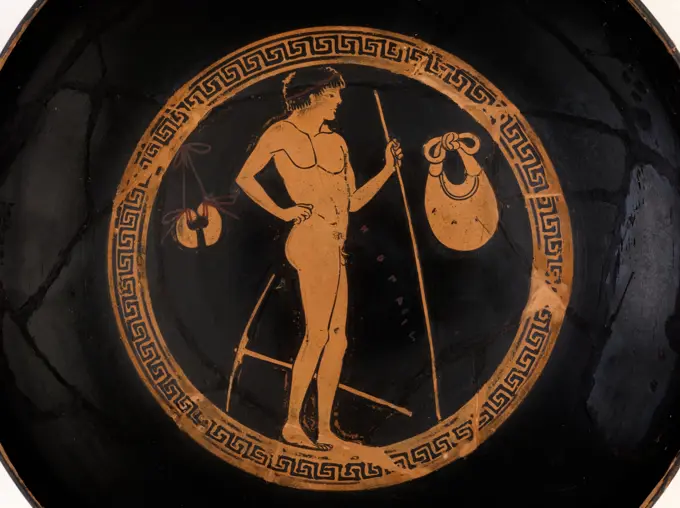
Kantaros czerwonofigurowy z przedstawieniem efeba z aryballosem i inskrypcją grecką "Piękny (chłopiec)". unknown, author
4409-45329
GREEK ART. GREECE. LEKYTHOS red-figure with the image of a woman. Dated between the years 475-450 b.C. Museum of Cycladic and Ancient Greek Art. Athens. Greece.
6145-46823975
Red-Figure Pelike; side A: two women; side B:man.  Artist: Washing Painter, Greek, Attic, active ca. 450-ca. 420 B.C.
7155-70378858
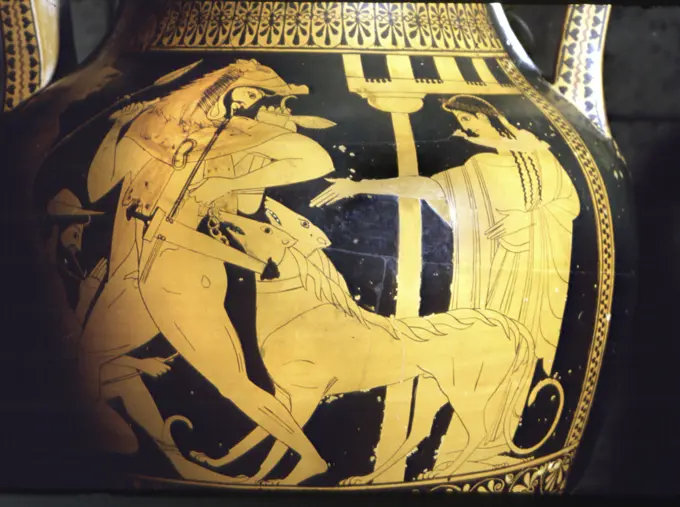
Herakles fights Cerberus, the three-headed dog. Commanded by Eurysteus. Red figure vase painting. GREECE.
4443-21961337
Fragmentary Apulian Red-Figure Pelike; Close to Suckling - Salting Group (Greek (Apulian), active about 365 - 350 B.C.); Apulia, South Italy; about 360 - 350 B.C; Terracotta; 23.3 × 28.5 cm (9 3,16 × 11 1,4 in.)
1788-15728
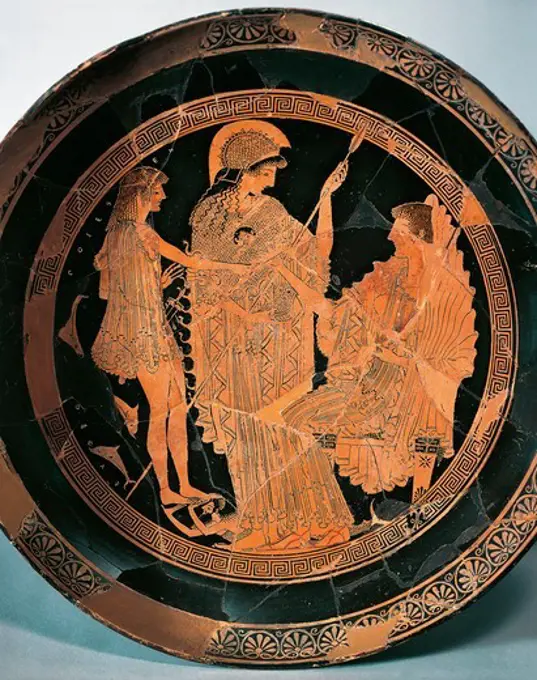
Detail of cup depicting Theseus, Athena and Amphitrite, attributed to Panaitios and molded by Euphronios, from Cerveteri, Lazio Region, Italy
4443-21957390
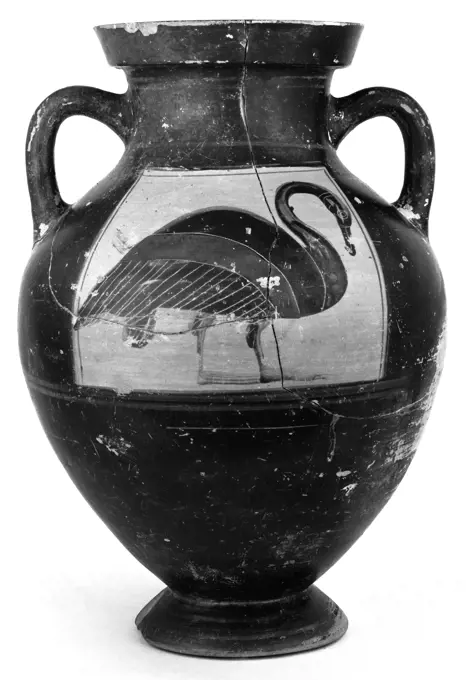
Attic Black-Figure Amphora; Athens, Greece; 550 - 550 B.C; Terracotta; 36.8 cm (14 1,2 in.)
1848-61228539
Amphora of Sicellot, 5th century BC, Museo Archeologico Regionale Antonino Salinas, collection of Etruscan, Roman, Egyptian and Greek works, Palermo, Palermo, Sicily, Italy, Europe
1788-17848
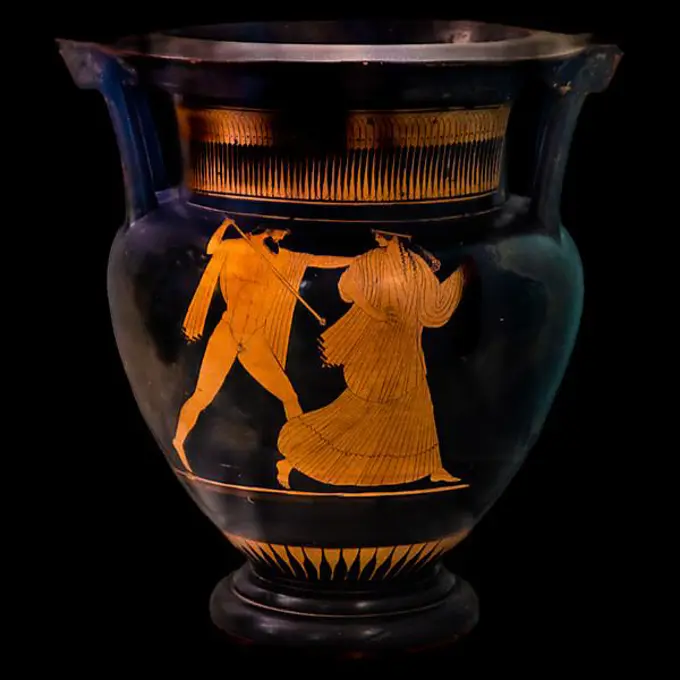
Red-figure pottery bowl representing Dionysus and Maenad, from Chiusi, Siena province, Italy
6145-59126495
Paestan Stemless Cup. Attributed to the Workshop of Asteas, painter (Greek (Paestan), active about 350 - 320 B.C.) about 350 B.C.
6145-59129443
Campania Caserta Capua Museo Campano027. Hutzel, Max 1960-1990 Medieval: Byzantine architectural fragments; parchment fragments with miniatures (12th century) from Montecassino; painted wooden crucifix (13th century); Carolingian crucifixes; Bishop's miter (11th century) of gold and silver damask; fresco (13th century). Post-medieval: Architecture (15th century). Formerly the Palazzo Antignano. Unusual Catalan/Moorish-style portal; Paintings on panel and canvas (15th-18th centuries); marble intarsia (16th century); marble sculpture: busts of Christ and Mary (17th century); sculpture of saints in marble and in wood (15th century); painted and gilded sculpture in wood; marble grave sculpture (16th century); sarcophagus with allegorical carvings; gold reliquary "Rosa d'Oro"; crucifix made of elephant tusk Specific Location: Pianterreno Antiquities: Italic sculpture (seated women holding babies); inscription. Photo campaign #1: 533 photos. Roman relief and sculpture; cinerary urns; Greek a
4409-17398448
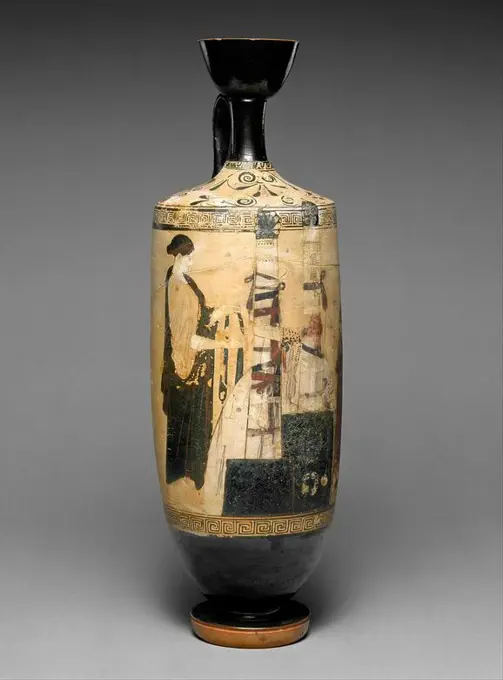
Terracotta lekythos (oil flask). Culture: Greek, Attic. Dimensions: Overall: 16 11/16 x 5 7/16in. (42.4 x 13.8cm). Date: ca. 460-450 B.C..Woman and youth at two gravesThis lekythos is impressive for the well-preserved color and quantity of detail. The setting is probably a family burial plot. Closest to the viewer are two dark blocks, the left one partly overlapping the right. Attached to the right block are a pair of jumping weights, an aryballos (oil flask), and a wreath. The two stelai (grave markers) should certainly be understood as standing on top of the blocks. Farthest from the viewer are two forms that represent one or two burial mounds. The figures at this funerary precinct are adding to the large number of fillets (bands) and wreaths. Museum: Metropolitan Museum of Art, New York, USA.
1746-29963263
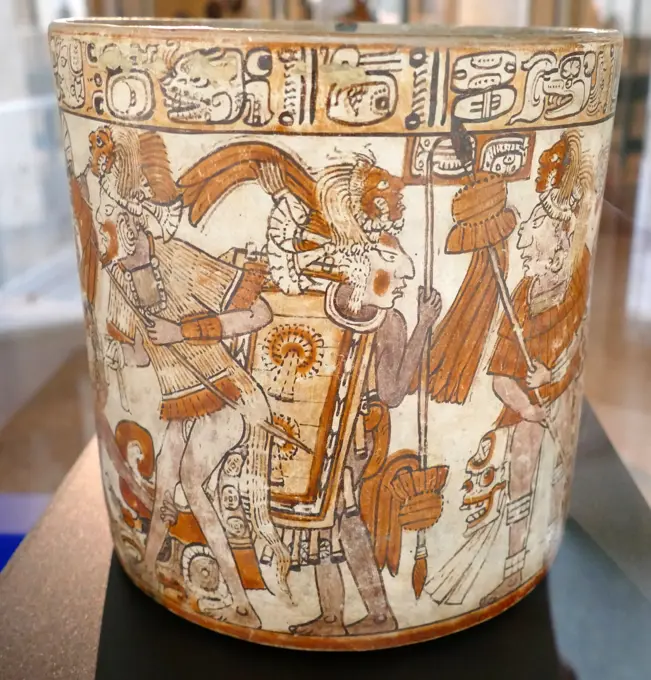
Maya pottery vessel depicting a war scene, Mayan; Guatemala, 700-900 AD
6176-67037090
Mycenaen amphora with octopus design, 16th century BC. Artist: Unknown
1788-40986
Painted clay support, from Filakopi, Greece. Greek Civilization, 17th Century BC.
6145-29281473
Achilles bandaging Patroclus's wounded arm. Ink drawing after an Attic cup by the potter Sosias, c. 500 B.C.
6145-59135727
Campania Salerno Nocera Inferiore Museo dell'Agro Nocerino4. Hutzel, Max German-born photographer and scholar Max Hutzel (1911-1988) photographed in Italy from the early 1960s until his death. The result of this project, referred to by Hutzel as Foto Arte Minore, is thorough documentation of art historical development in Italy up to the 18th century, including objects of the Etruscans and the Romans, as well as early Medieval, Romanesque, Gothic, Renaissance and Baroque monuments. Images are organized by geographic region in Italy, then by province, city, site complex and monument.
1746-111903105
Preparing for the bath. Interior of a drinking bowl. By the painter Douris. Red-figure style c. 470 - 460 BC. What makes this painting so attractive is its elegance of composition and technique. Two nude well-formed young women are seen laying their carefully folded clothes on two stools.
6145-48868585
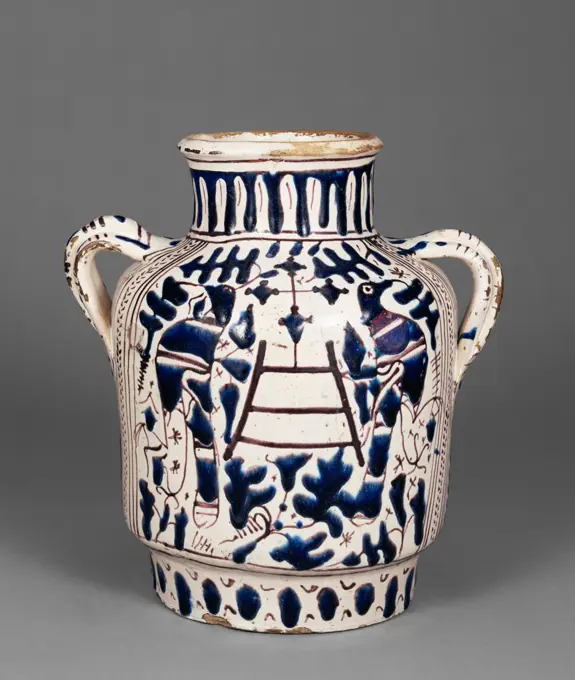
Relief-Blue Jar with Harpies and Birds. Probably the Workshop of Piero di Mazzeo (Italian, born 1377/1387)
1788-19664
Black obsidian bowl depicting Egyptian style offering scene, from Stabile, Villa San Marco
1848-56106975
Vaso de los guerreros, siglo I a.C. Procedente de Numancia, Garray, museo Numantino de Soria, Soria, Comunidad Autonoma de Castilla, Spain, Europe
6145-29781737
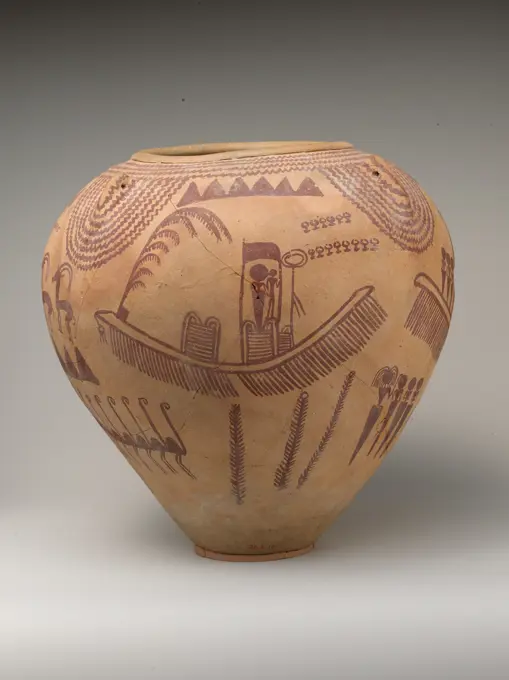
Decorated Ware Jar Depicting Ungulates and Boats with Human Figures ca. 3500-3300 B.C. Predynastic, Late Naqada II The images on this vessel represent important social or religious events, the precise significance of which is not perfectly understood. Two male and two female figures stand aboard a boat, which is depicted with oars and two cabins. In the areas surrounding the boat are mountains, birds that may represent flamingos, plants, and water. Listen to experts illuminate this artwork's story Listen Play or pause #3220. Decorated Ware Jar Depicting Ungulates and Boats with Human Figures Supported by Bloomberg Philanthropies We're sorry, the transcript for this audio track is not available at this time. We are working to make it available as soon as possible.. Decorated Ware Jar Depicting Ungulates and Boats with Human Figures. ca. 3500-3300 B.C.. Pottery, paint. Predynastic, Late Naqada II. From Egypt
6145-59136087
Campania Salerno Padula Museo Archeologico della Lucania Occidentale5. Hutzel, Max 1960-1990 Antiquities: There are views of Ardean artifacts, including artefixes. German-born photographer and scholar Max Hutzel (1911-1988) photographed in Italy from the early 1960s until his death. The result of this project, referred to by Hutzel as Foto Arte Minore, is thorough documentation of art historical development in Italy up to the 18th century, including objects of the Etruscans and the Romans, as well as early Medieval, Romanesque, Gothic, Renaissance and Baroque monuments. Images are organized by geographic region in Italy, then by province, city, site complex and monument.
6145-59181929
Lazio Viterbo Viterbo Museo Civico9. Hutzel, Max 1960-1990 Views of paintings (Middle Ages through 18th c.), frescoes, a tabernacle, coffin, sculpture reliefs, portal fragments, busts, sculpture, tapestry found in the Pinacoteca, Second floor gallery and Second floor cloister sequences. Antiquities: Many views of Etruscan and Roman fragments, sculpture, sarcophagi, pottery, masks, jewelry and other objects found in the Storeroom sequence (inventory numbers on back of prints), and the Cloister, Second floor Cloister, Valle Giulia, Sala Romana and Sala Etrusca sequences. General Notes: There are eight separate numerical sequences for this location. The cloister as an architectural structure, rather than museum site, is documented in the record and file for S. Maria della Verita, Cloister, all views of which are stored in Medieval core collection. Five views from the Museo Civico Second floor cloister sequence are stored in Medieval. German-born photographer and scholar Max Hutzel (1911-1
1746-21116119
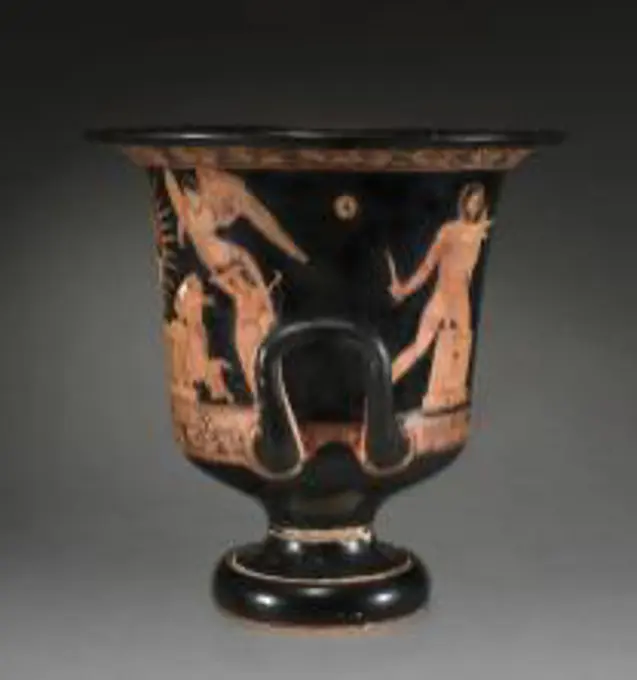
Red-figured bell-krater (wine-bowl) with an arming scene made in Lucania and attributed to the Amykos Painter. Dated 420 BC
6145-29135356
Portland Vase
6145-44300104
Attic Red-Figure Kylix Fragment. Unknown
1788-17126
Reproduction of pottery, details of decorations by Sir Arthur John Evans, The Palace of Minos at Knossos, edition 1921
1788-18172
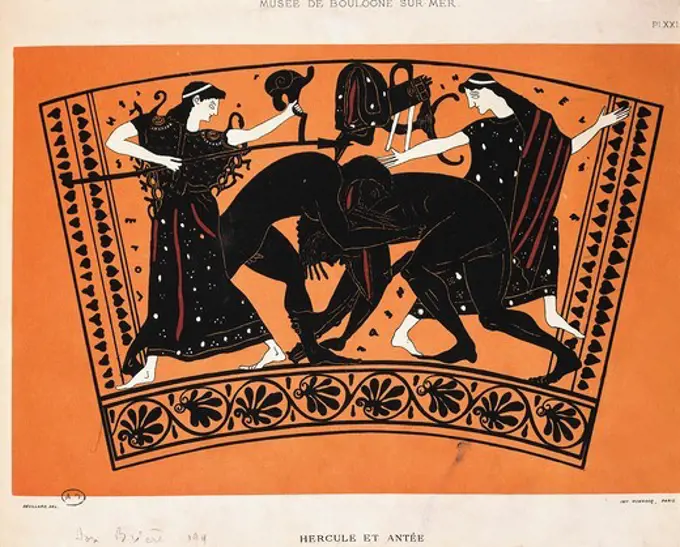
Heracles and Antaeus, drawing from vase, black-figure pottery
4430-2451
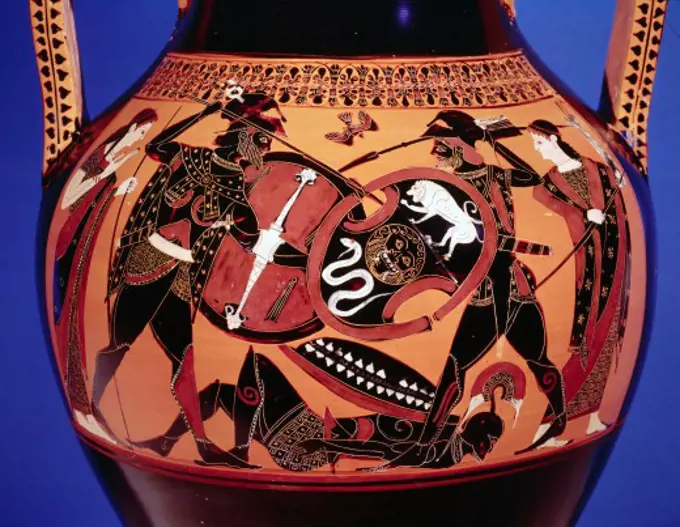
fine arts, Hellas, Archaic (800 - 500 BC), vase, Attic amphora, circa 530 BC, ""Mythical Duel"", snake, lion and Gorgon head illustrated on shield, State Collection of Antiques Munich,
1746-111525316
Greek dish depicting an erastes (lover) and an eromenos (beloved) kissing. Circa 500 BC
1788-18079
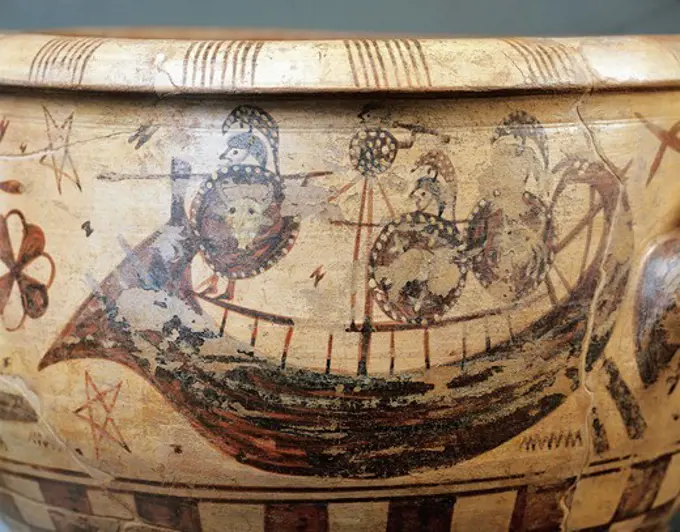
Krater Aristonothos, side depicting naval battle, detail, from Cerveteri (Rome province, Italy)
6145-59044436
Onesimos (v. 505-V.480 BC). Cup with red figures: javelin launcher (face A). Ancient Greece, between 490 and 480 before. AD ceramic. Museum of Fine Arts of the City of Paris, Petit Palais. Javelin thrower Greek antiquity, athlete, bowl, ceramic, cut, ceramic, interior decor, decoration, face a, red figure, greek antiquity, interior, javelin, javelin, young man, throwing, launcher, naked, nudite, nitith, red figure, throw , Thrower, Young Man, Ancient, Nu, Nude, Side A
6145-44298798
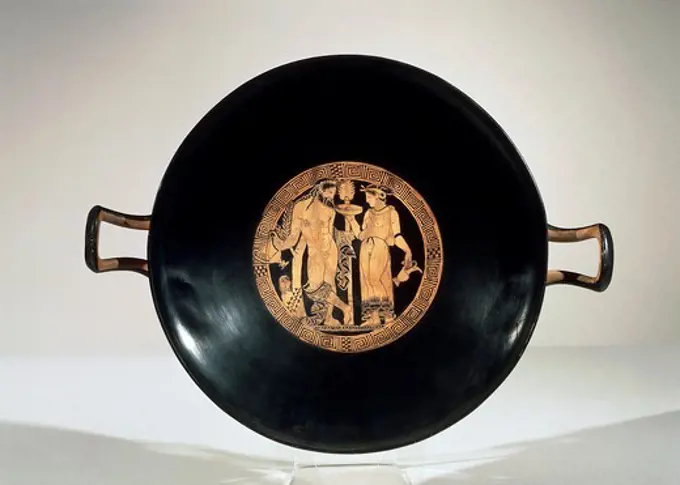
Fragmentary Attic Red-Figure Kylix. Attributed to Briseis Painter (Greek (Attic), active 510 - 470 B.C.)
PREVIOUS
of 2
NEXT
2401 S. Ervay, Suite 206
Dallas, Texas 75215
United States
Get Started
Free ResearchMy BoardsMy Cart
For Creators
How To License Your ContentContributor PortalFrame of Mind
Resources
API accessPricing
Contact
+1 866 236 0087help@viewpictures.co.uk Contact form
©2026 View Pictures. All Rights Reserved. -A
This site is protected by reCAPTCHA and Google Privacy Policy and Terms of Service apply.