My Boards
View Pictures
  • My Boards
← Artworks

Ancient Greek Vases

A variety of terracotta vases decorated with red-figure techniques, illustrating mythological scenes, rituals, and daily life in ancient Greek culture.
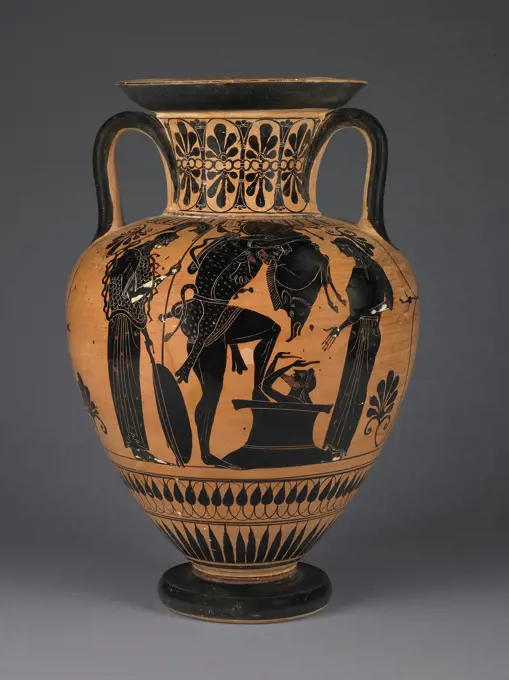
Attic Black-Figure Amphora; Attributed to Leagros Group (Greek (Attic), active 525 - 500 B.C.); Athens, Greece; about 510 B.C; Terracotta; 43 × 28.2 cm (16 15,16 × 11 1,8 in.)
172 assets in this story
4409-20987028
Amphora decorated with black figures depicting Sphinx. Chalkidiki style. Attributed to the workshop of the painter Phineus,dates from 540-530 B.C. Museum of Cycladic Art and Ancient Greek. Athens. Greece.
1746-19692460
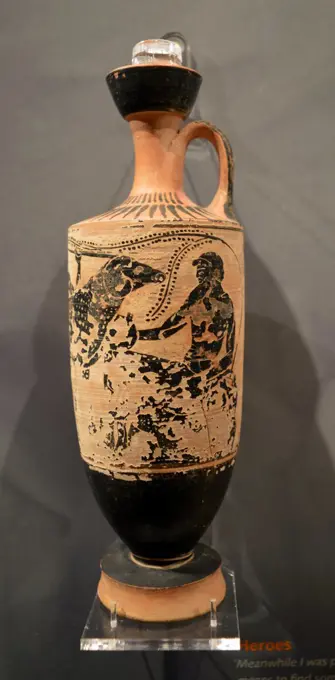
Attic black figure lekythos, showing Odysseus escaping from Polyphemus, attributed to the 'Theseus Painter', about 500 BC, clay .
4409-21350146
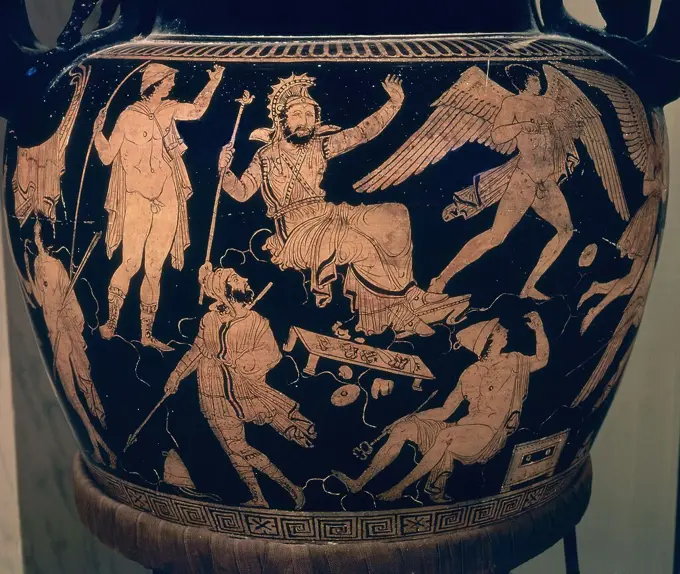
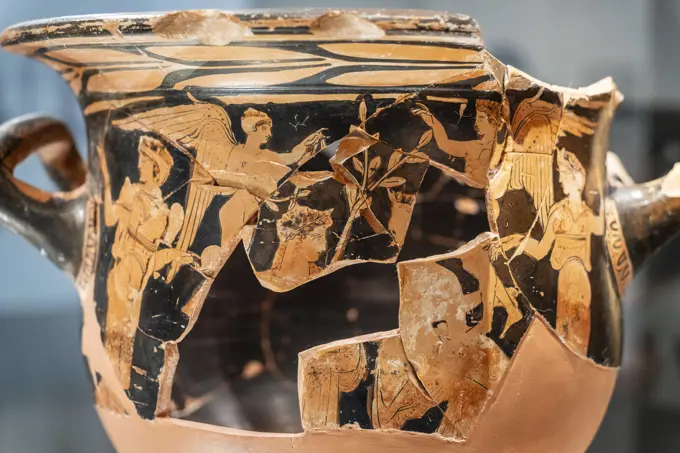
CRATERA ATICA-FINEO PERSEGUIDO POR ARPIAS QUE LE IMPEDIAN COMER. Location: PRIVATE COLLECTION. Rome. ITALIA. FINEO CIEGO.
6145-29279371
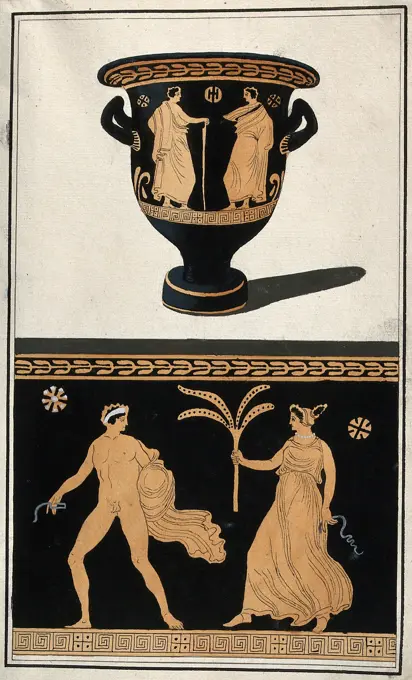
Above, a red-figured Greek wine bowl (krater); below, detail of the decoration showing a naked man and a woman holding a plant. Watercolour by A. Dahlsteen, 176- ().
6145-54680787
Terracotta kantharos (drinking cup with two vertical handles): heads of a satyr and a woman Attributed to Aison Attributed to the Class V: The Spetia Class of Head Vases ca. 420 BCE Obverse and reverse, libation scenesThe canonical kantharos was a drinking cup. This example is special because of the spout introduced into the woman's neck, a feature suggesting that the vase may have been used for offerings. The rendering of the satyr's head is impressively plastic, indeed sculptural. View more. Terracotta kantharos (drinking cup with two vertical handles): heads of a satyr and a woman. Attributed to Aison. Greek, Attic. ca. 420 BCE. Terracotta; red-figure. Classical. Vases
6145-44284676
Attic Black-Figure Lekythos.
1788-41186
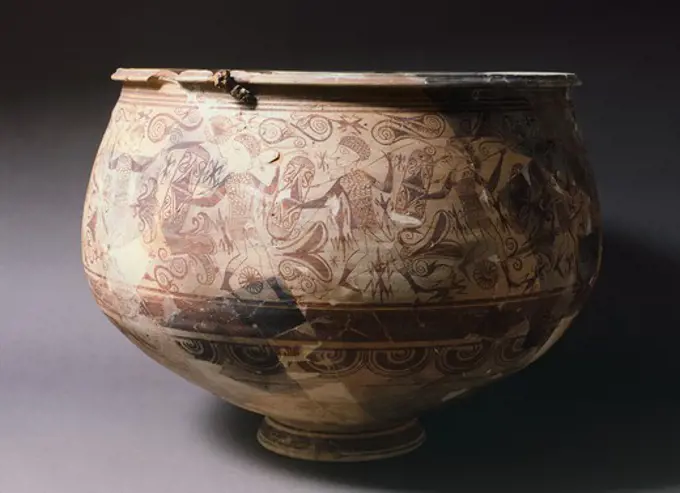
Vase depicting a procession of warriors, from Tossal de Sant Miguel, Liria, Spain. Iberian Civilization.
3804-397036
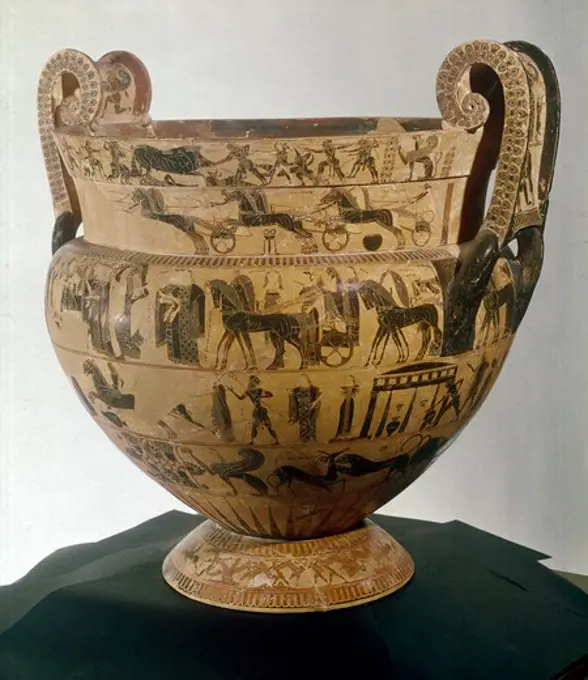
Italy, Florence, Museo Archeologico, Francois Vase by Kleitias and Ergotimos, 570 B.C
7155-70383877
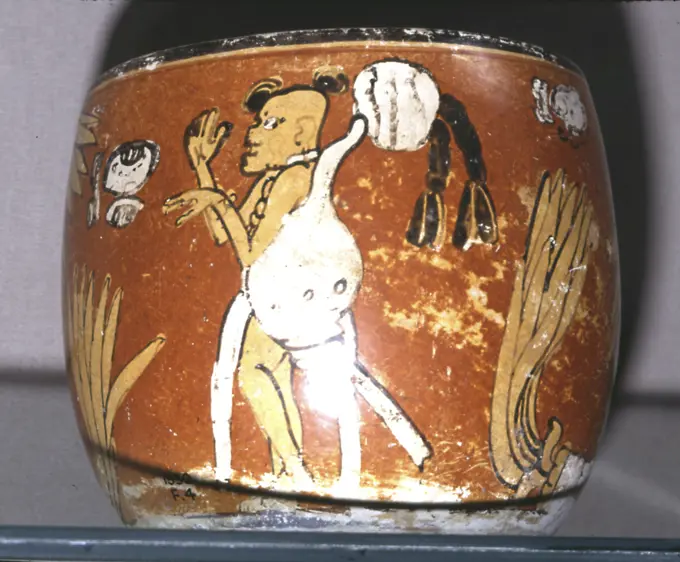
Polychrome painted bowl. Maya. 600-900 AD.
4409-62748598
Terracotta. Greek. Attic, red-figure. Hoplites. Fighting. 5th century BC. Metropolitan Museum of Art. Ny. USA.
4443-21960007
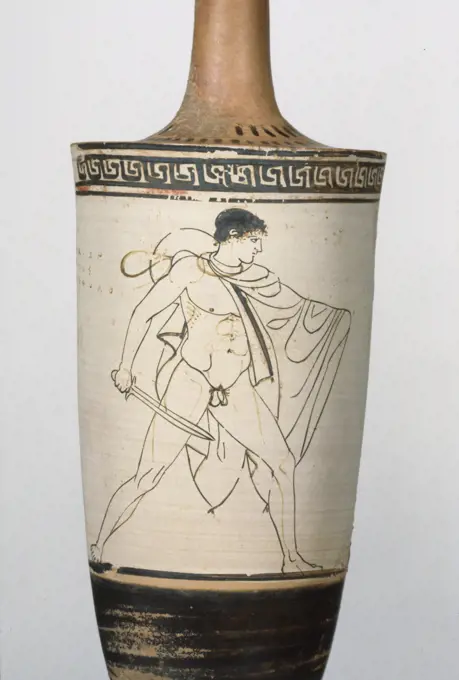
Attic White-Ground Lekythos; Possibly Tymbos Painter (Greek (Attic), active about 460 B.C.); Athens, Greece; about 460 B.C; Terracotta; 21.5 x 7 cm (8 7,16 x 2 3,4 in.)
6145-52506940
Attic kantharos with Greek warrior and Amazon, 5th century B.C. still image. 1883. The Miriam and Ira D. Wallach Division of Art, Prints and Photographs: Picture Collection. Pottery , Greece, Pottery, Greek, Antiquities, Amazons, Arms & armament , Greek , To 499, Warriors , Greece , To 499, Fighting , To 499, Drinking cups, Drinking vessels , To 499
6145-29255805
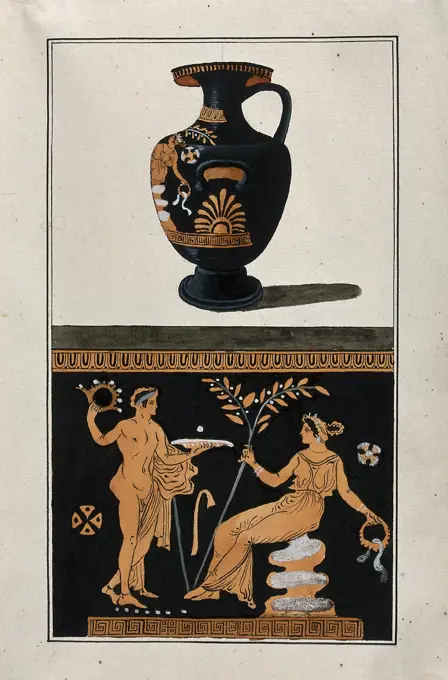
Above, red-figured Greek water jar (hydria); below, detail of decoration showing a seated woman holding a leafy branch and a naked youth holding a plate. Watercolour by A. Dahlstein, 1760/1780 ().
6145-44301459
Imitation of an Attic Red-Figure Lekythos. Unknown
6145-29162825
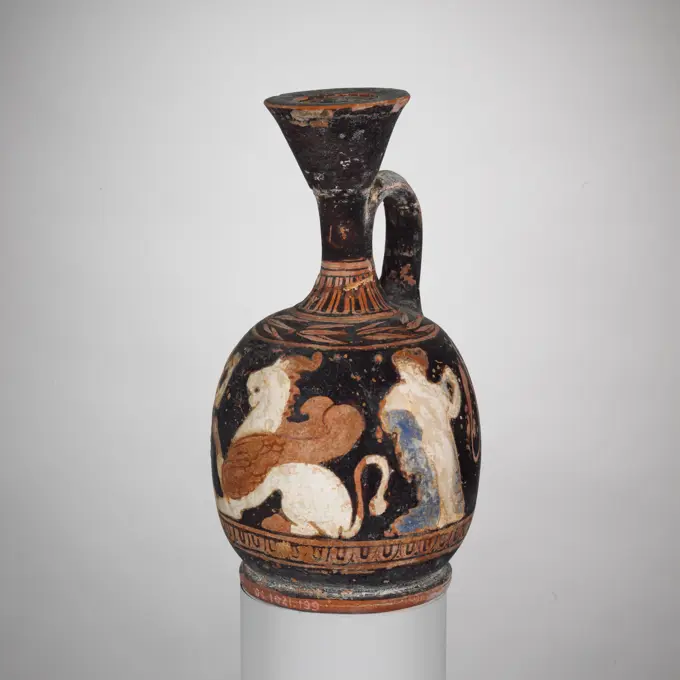
Terracotta squat lekythos (oil jar) early 4th century B.C. Greek, Attic Griffin between two women.. Terracotta squat lekythos (oil jar) 247362
4409-58752455
the hero and the goddess, bell crater from the funerary chamber of Prince Iltirtiiltir, 4th century BC, necropolis of Piquia, Arjona, Iberian culture, Iberian Museum of Jaén, Andalusia, Spain.
1746-21116143
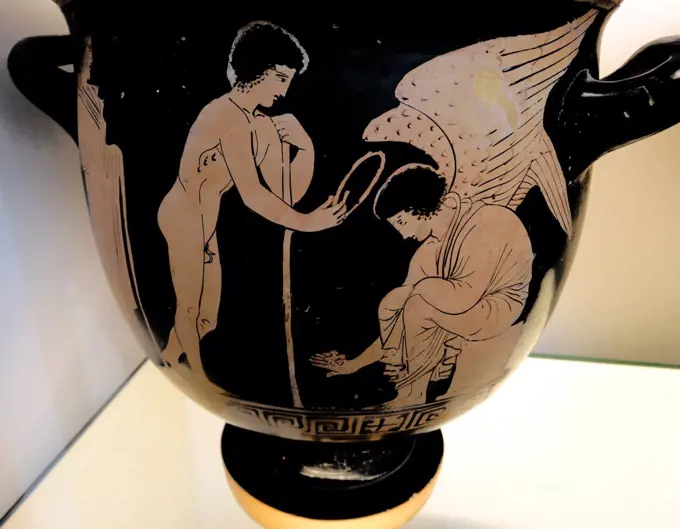
Red-figured bell-krater (wine-bowl) with two youths and Eros playing knucklebones made in Lucania and attributed to the Amykos Painter. Dated 420 BC
4409-12449
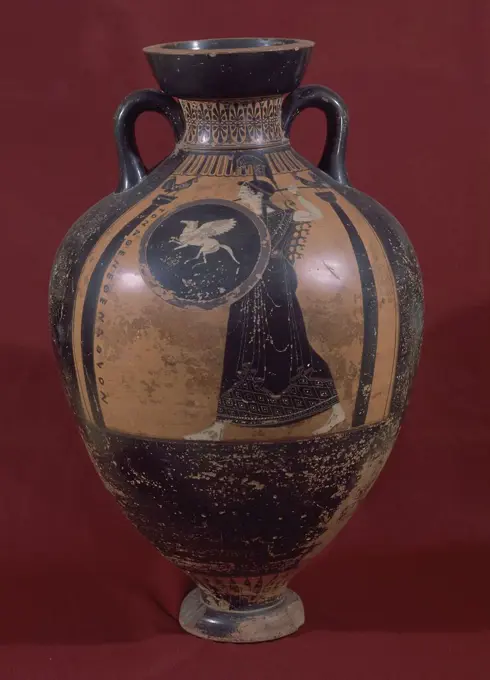
ANFORA GRIEGA PANATENAICA - ATICA - ATENEA- 480 AC- PERIODO ARCAICO. Location: MUSEO ARQUEOLOGICO NACIONAL-COLECCION. MADRID. SPAIN. PEGASO. ATENEA (DIOSA GRIEGA).
1746-28970388
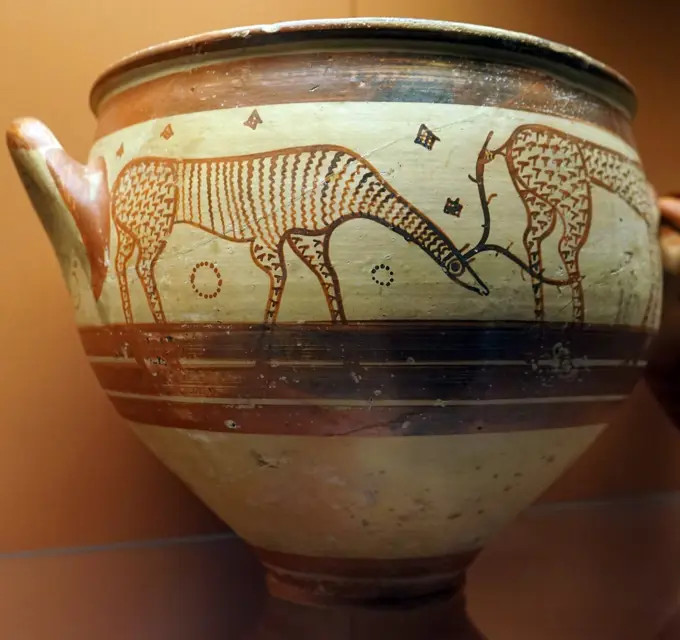
Pottery krater decorated with two stags, Mycenaean, Cyprus. Dated 12th Century BC
6145-48875706
Lakonian Black-Figure Kylix. Attributed to the Hunt Painter (Greek (Lakonian), active 565 - 530 B.C.)
6188-61002040
Apollo s wedding to Helen Apollo s wedding to Helen, bell crater from the funerary chamber of Prince Iltirtiiltir, 4th century BC, necropolis of Piquia, Arjona, Iberian culture, Iberian Museum of Jaén, Andalusia, Spain Copyright: xZoonar.com/BartomeuxBalaguerxRotgerx 21720828
6145-29816258
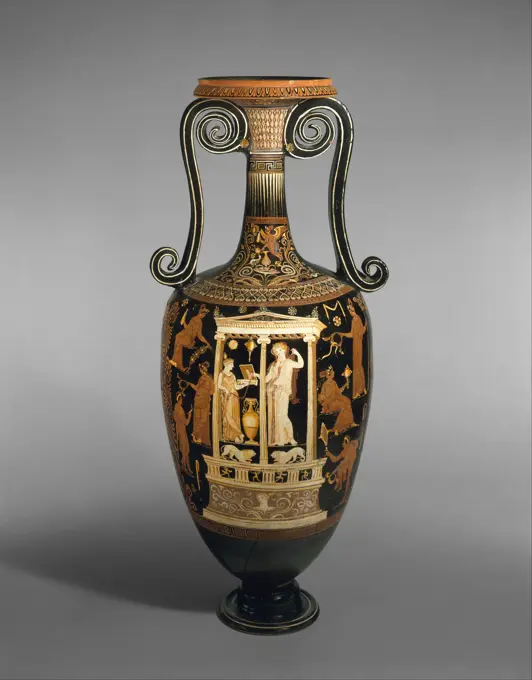
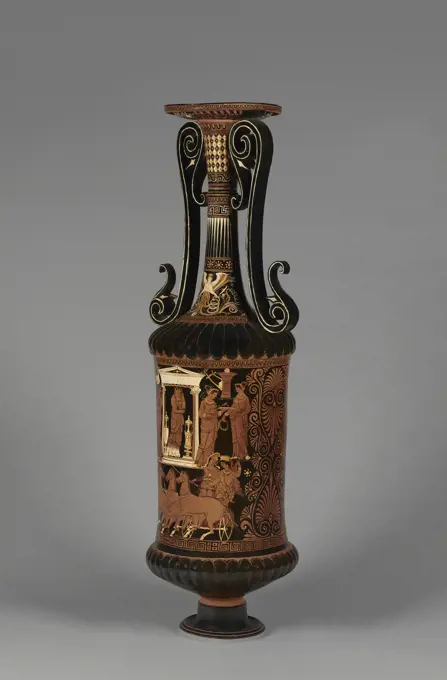
Terracotta loutrophoros (ceremonial vase for water) 3rd quarter of the 4th century B.C. Attributed to the Metope Painter On the body, obverse, woman with attendant in naiskos (shrine) flanked by youth and womenReverse, woman in naiskos flanked by youths and womenOn the shoulder, obverse, Eros with alabastron and mirror within foliageReverse, head of a woman within foliageThis imposing and beautifully executed vase, together with its counterpart exhibited here, is of exceptional interest for the architectural structure on the obverse. A small naiskos, rendered with three columns, encloses a woman, her maid who holds out a small casket, and a metal loutrophoros. Between the level on which they stand and the podium for the shrine are two panels with a pair of confronted lions. The podium itself consists of an upper frieze of triglyphs, alternating with metopes showing Greeks fighting Amazons. The lower element is covered with tendrils enclosing a female head. Although naiskoi are common o
6176-67037097
Detail of a Greek vase showing Odysseus and Circe, 5th century BC. Artist: Unknown
6145-29183925
Terracotta kylix (drinking cup) ca. 480 B.C. Attributed to the Painter of New York GR 576 Interior, youth and boyThe connection between the two figures is not clear. The context is athletic, given the sponge and strigil suspended at the left.. Terracotta kylix (drinking cup) 246124
6145-29160888
Magic wand ca. 1750-1640 B.C. Middle Kingdom. Magic wand. ca. 1750-1640 B.C.. Ivory. Middle Kingdom. From Egypt, Memphite Region, Lisht North, cemetery south of pyramid, southeast corner platform, Pit 378, MMA excavations, 1920-22. Dynasty 13
6145-48831177
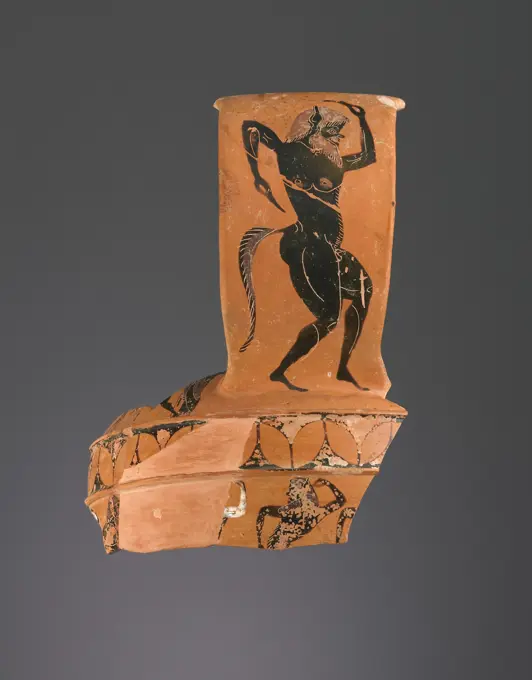
Attic Black-Figure Nikosthenic Amphora Fragment.
6145-59181715
Lazio Viterbo Viterbo Museo Civico44. Hutzel, Max 1960-1990 Views of paintings (Middle Ages through 18th c.), frescoes, a tabernacle, coffin, sculpture reliefs, portal fragments, busts, sculpture, tapestry found in the Pinacoteca, Second floor gallery and Second floor cloister sequences. Antiquities: Many views of Etruscan and Roman fragments, sculpture, sarcophagi, pottery, masks, jewelry and other objects found in the Storeroom sequence (inventory numbers on back of prints), and the Cloister, Second floor Cloister, Valle Giulia, Sala Romana and Sala Etrusca sequences. General Notes: There are eight separate numerical sequences for this location. The cloister as an architectural structure, rather than museum site, is documented in the record and file for S. Maria della Verita, Cloister, all views of which are stored in Medieval core collection. Five views from the Museo Civico Second floor cloister sequence are stored in Medieval. German-born photographer and scholar Max Hutzel (1911-
4409-63011861
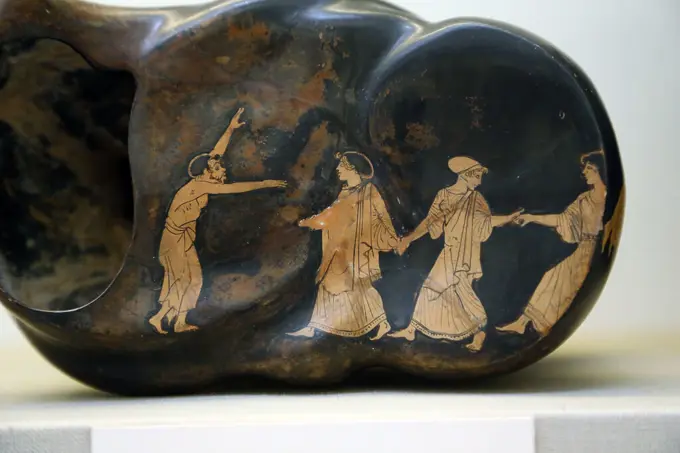
Red-figure astragalos showing dramatic dance. Greek, Athens 460-450 BC. Attributed to Sotades Painter. British Museum. London.
6145-29723297
Ewer with Horsemen Inscribed in Arabic with Good Wishes to its Owner second half 12th-early 13th century Minai production, like luster painting, was a labor-intensive process due to the multiple firings required to set its colors. In this technique, colored pigments are applied to an already glazed and fired piece that is returned to the kiln at a temperature just high enough to fix a second layer of pigments without damaging the first glazing. This squat ewer depicts a band of horsemen in procession between two rows of kufic inscription. Men engaged in equestrian sport were associated with the aristocracy in Seljuq art, and the raised arms of these riders may have signified a display of ability on horseback.. Ewer with Horsemen Inscribed in Arabic with Good Wishes to its Owner 446898
6145-59183666
Lazio Viterbo Vulci Excavation. Hutzel, Max 1960-1990 Antiquities: Views of excavated baths, villas, nymphaeum, temple. General Notes: Eleven prints stored in Antiquities, as noted on negatives. None in Hutzel section. German-born photographer and scholar Max Hutzel (1911-1988) photographed in Italy from the early 1960s until his death. The result of this project, referred to by Hutzel as Foto Arte Minore, is thorough documentation of art historical development in Italy up to the 18th century, including objects of the Etruscans and the Romans, as well as early Medieval, Romanesque, Gothic, Renaissance and Baroque monuments. Images are organized by geographic region in Italy, then by province, city, site complex and monument.
6176-67037701
Greek vase showing Memnon fighting Achilles. Artist: Unknown
6145-52500076
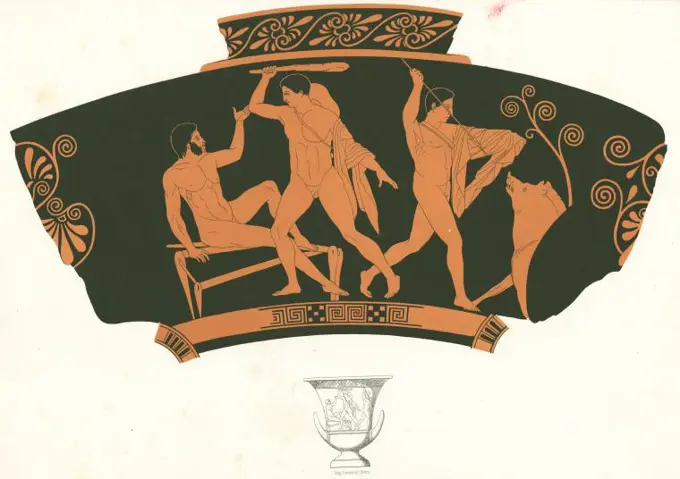
Krater depicting Theseus and Procrustes, and Theseus slaying the wild boar of Crommyon Cratère (Chiusi). Imprimerie Lemercier et cie. still image. Reproductive prints. 1862 - 1864. The Miriam and Ira D. Wallach Division of Art, Prints and Photographs: Picture Collection. Boars, Mythology, Greek, Male nude in art, Vases, Greek, Theseus (Greek mythology), Pottery, Greek, Kraters, Procrustes (Greek mythology), Nudes
4409-17414756
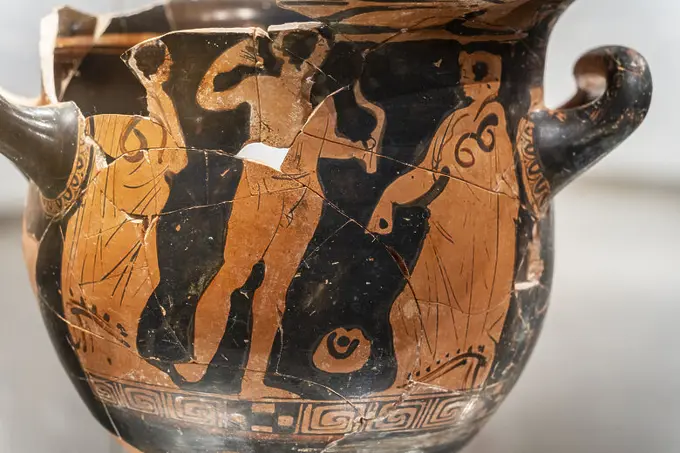
Base of a terracotta lebes gamikos (jar associated with weddings). Culture: Greek, Attic. Dimensions: H. as restored 17 3/4 in. (45.11 cm)diameter 17 1/2 in. (44.5 cm). Date: ca. 400 B.C..Athena between Herakles and Iolaos; woman or goddess in front of Zeus or PoseidonIn Attic vase-painting, large vases appear with greater frequency at the end of the fifth century B.C. than at any other time since the Geometric period. While some artists fill the space with many smaller figures, the Talos Painter is among those who work on a large scale, depicting figures of great presence and nobility. Museum: Metropolitan Museum of Art, New York, USA.
1788-41438
Chalice-shaped krater, showing the sileni squashing grapes, attributed to the painter of Leningrad, red-figure pottery. Detail of a sileno with a torch. Greek Civilization, 4th Century BC.
6145-29741772
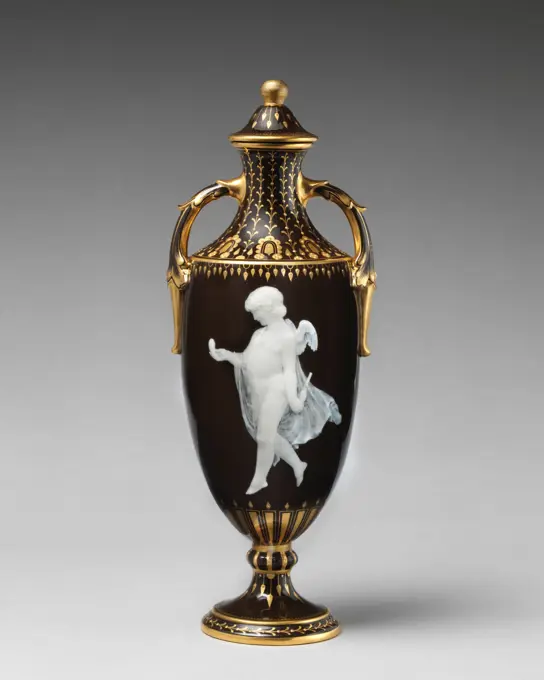
The Half and The Whole (one of a pair) 1895-1899 Minton(s) Hearts as symbols of love were not a common feature of neoclassical decoration on eighteenth-century ceramics. By contrast, Solon frequently adopted the motif alongside cupid figures. Vases such as this pair became illustrations of Victorian sentiment.. The Half and The Whole (one of a pair). British, Stoke-on-Trent, Staffordshire. 1895-1899. Bone china with pte-sur-pte decoration and gilding. Ceramics-Pottery
6145-29740313
Terracotta lekythos (oil flask) ca. 440 B.C. Attributed to the Achilles Painter Seated youth and womanSeated on a stool, the young man hands what appears to be a piece of fruit to the woman standing before him. An oinochoe (jug), a mirror, and a sakkos (snood) are suspended in the background. It is impossible to determine whether this is a vignette of daily life, as depicted by Douris, the Villa Giulia Painter, and many other artists of the mid and later fifth century B.C. It may instead be a funerary representation as depicted on grave stelai; the youth would be the deceased.. Terracotta lekythos (oil flask). Greek, Attic. ca. 440 B.C.. Terracotta; white-ground. Classical. Vases
6145-59191155
Red-figure Kylix Fragment. Workshop of the Vagnonville Group (Etruscan, active 460 - 420 B.C.) 425-400 B.C. The fragment preserves a portion of the tondo. The interior features a nude bearded satyr looking to right and raising his left hand. His hair, facial features, fingers, and pectorals are indicated in black. A leafy branch at upper left was probably held in the satyr's right hand, now missing. The tondo is framed by a reserved line. The exterior features a circular groundline, on which appear the foot and part of the heel of a female figure wearing a himation and moving to the right. The hem folds are indicated in black. To the left are portions of tendrils and volutes.
6145-59195567
Tuscany Livorno Castiglioncello Archaeological Museum. Hutzel, Max 1960-1990 Antiquities: Photos of a terracotta vase with details. General Notes: No Hutzel photo campaign notes. Negatives are missing. German-born photographer and scholar Max Hutzel (1911-1988) photographed in Italy from the early 1960s until his death. The result of this project, referred to by Hutzel as Foto Arte Minore, is thorough documentation of art historical development in Italy up to the 18th century, including objects of the Etruscans and the Romans, as well as early Medieval, Romanesque, Gothic, Renaissance and Baroque monuments. Images are organized by geographic region in Italy, then by province, city, site complex and monument.
4409-17502040
Vessel with Deity Figures. Culture: Maya. Dimensions: H. 7 11/16 x Diam. 6 1/4 in. (19.5 x 15.9 cm). Date: 7th-8th century. Museum: Metropolitan Museum of Art, New York, USA.
6145-48848915
Attic Red-Figure Cup Type C. Attributed to the Ambrosios Painter (Greek (Attic), active 510 - 500 B.C.)
6145-44284370
Campanian Red-Figure Neck Amphora. CA Painter, Orvieto Sub-Group (Greek (Campanian))
6145-45524508
Przeszo Przyszoci unknown
6145-29158358
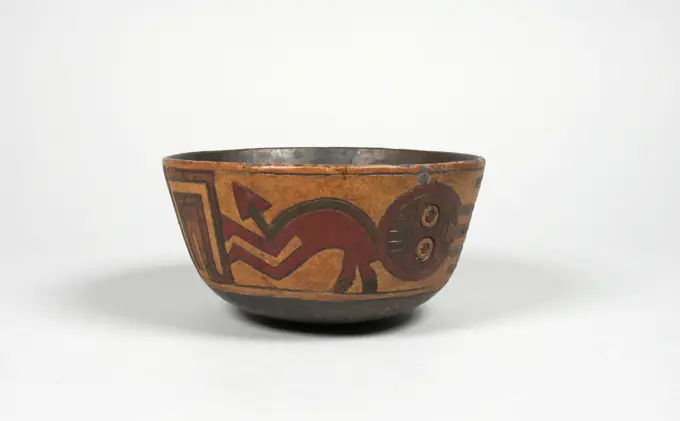
Bowl 3rd century B.C. Paracas This polychrome bowl depicts two anthropomorphic figures on their sides, alternating with a rectangular shape. Created using low-relief incised lines, an emblematic decorative technique of Paracas society, the individual is depicted on its side, suggesting that it is flying. The figures are identical, with round heads, eyes, fangs, and two insect-like antennas extending from their head. They have two legs, two arms, claws, and a tail; the use of different colors emphasizes these features. Between the two figures are incised concentric rectangles that fill the height of the wall, also highlighted through use of colored paint and incising. Pattern, color, and radiance were highly esteemed visual qualities in the Paracas culture and people exerted great effort to acquire the materials necessary for making ceramic objects. This vessel would have been created using the coil, paddle and anvil technique. It was made using a reduction-fire kiln that produced smudg
6176-67037700
Greek painting of a Scythian archer blowing a trumpet, 6th century BC. Artist: Unknown
4443-21959795
Red-Figure Loutrophoros; Attributed to the Painter of Louvre MNB 1148 (Greek (Apulian), active 350 - 330 B.C.); Apulia, South Italy; about 330 B.C; Terracotta; 98 × 37 cm (38 9,16 × 14 9,16 in.)
6145-59125611
Attic Black-Figure Siana Cup. Painter of Boston C.A., painter (Greek (Attic)) about 560 B.C. Hunters and dogs swarm around a massive boar on one side of this Athenian black-figure Siana cup. In Greek mythology, Meleager gathered a band of heroes to drive away a monstrous boar sent by the goddess Artemis to ravage the countryside of his father's kingdom of Kalydon. Although the depiction on this cup lacks the inscriptions that usually identify the mythological heroes, the size of the boar--almost as tall as a man--argues against this being an ordinary boar hunt. The other side of the cup depicts another mythological scene, the battle of the Lapiths and centaurs. While attending a wedding, the centaurs--creatures part-human and part-horse--got drunk and attacked the bride and female guests, sparking a battle. One of the wedding guests, Kaineus, was magically invulnerable. Therefore, the centaurs fought him the only way they could; they drove him into the ground. He is shown in the center
1746-29962545
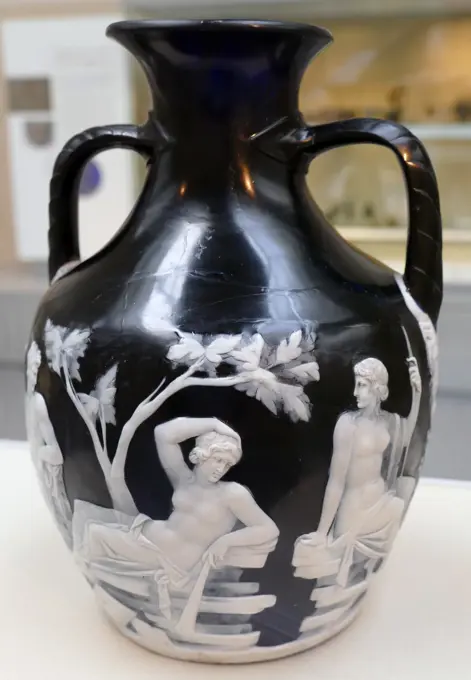
The Portland Vase, a Roman cameo glass vase, which is dated to between AD 1 and AD 25, served as an inspiration to many glass and porcelain makers from about the beginning of the 18th century onwards. It is first recorded in Rome in 1600-1601, and since 1810 has been in the British Museum in London.
1788-15731
Interior of Attic cup depicting banquet scene
6145-44298235
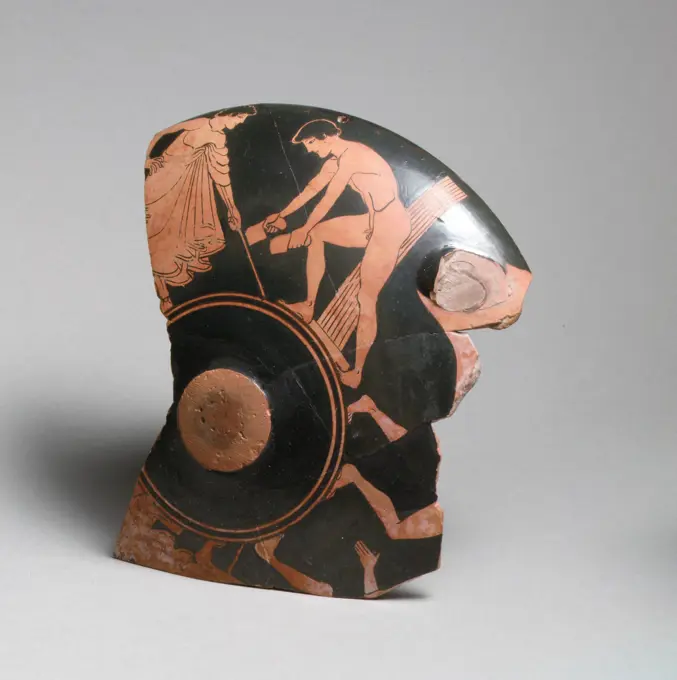
Fragmentary Attic Red-Figure Kylix. Attributed to the Boot Painter (Greek (Attic))
6145-29712299
Kylix fragments, 6 ca. 490 B.C. Attributed to the manner of the Antiphon Painter. Kylix fragments, 6 247551
4409-157536
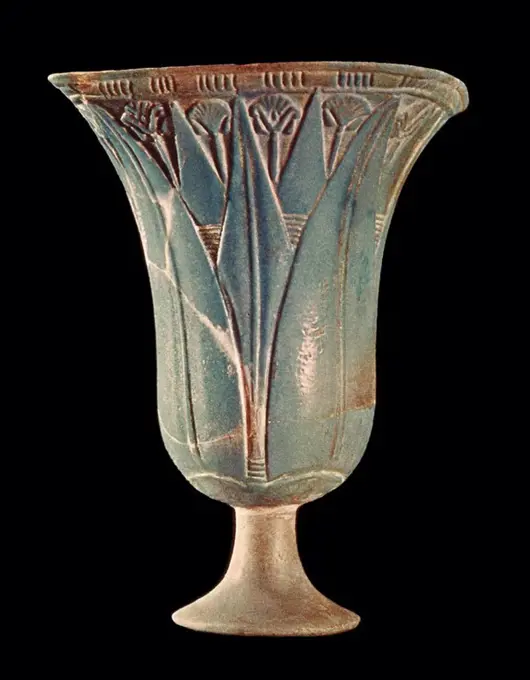
CALIZ DECORADO CON FLORES DE LIS ESTILIZADAS - TERRACOTA ESMALTADA - ARTE EGIPCIO. Location: MUSEO DEL LOUVRE-CERAMICA. France.
4409-28793589
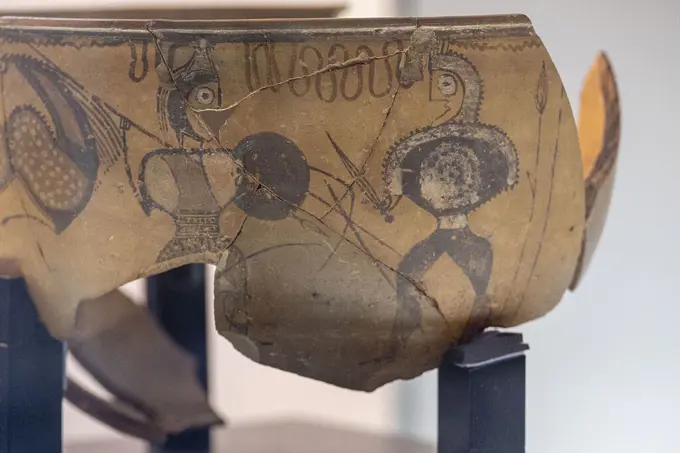
vaso de los guerreros, siglo I a.C. Procedente de Numancia, Garray, museo Numantino de Soria, Soria, Comunidad Autónoma de Castilla, Spain, Europe.
6145-44285973
Attic Red-Figure Cup Type C (Lipped) Fragment. Painter of Agora P42
4409-17438837
Fragment of a terracotta neck-amphora (jar). Culture: Greek, South Italian, Paestan. Dimensions: Overall: 3 7/8 x 4 11/16 in. (9.8 x 11.9 cm). Date: ca. 360-350 B.C..Woman with basket on her head in a finerary structureThe fragment belongs to a funerary representation. With her right hand, the woman is holding onto one of the columns supporting a funerary structure. On her head, she carries a shallow basket hung with fillets that she will probably bring to the tomb. The fragment is notable for its fine drawing and polychromy as well as for the basket that so resembles a sombrero. Museum: Metropolitan Museum of Art, New York, USA.
6145-44291871
Attic Red-Figure Skyphos Fragment (Corinthian Shape). Meidias Painter (Greek (Attic), active 420 - 390 B.C.)
6145-44301961
Attic Black-Figure Kyathos. Attributed to Group of Berlin 2095 (Greek (Attic))
6145-59157261
Lazio Roma Grottaferrata Museo62. Hutzel, Max 1960-1990 German-born photographer and scholar Max Hutzel (1911-1988) photographed in Italy from the early 1960s until his death. The result of this project, referred to by Hutzel as Foto Arte Minore, is thorough documentation of art historical development in Italy up to the 18th century, including objects of the Etruscans and the Romans, as well as early Medieval, Romanesque, Gothic, Renaissance and Baroque monuments. Images are organized by geographic region in Italy, then by province, city, site complex and monument.
6145-44302428
Attic Red-Figure Cup Fragment. Unknown
1788-15251
Krater by Dipylon Master (active 760-735 B.C.), from Kerameikos necropolis
4409-17398089
Terracotta lekythos (oil flask). Culture: Greek, Attic. Dimensions: H.: 11 5/16 in. (28.7 cm). Date: ca. 420 B.C..Woman and young warrior at a tombThe warrior is equipped with a helmet and spear. Of particular note is marvelous fluency in the rendering of the woman, caught as she sinks to her knees with her arms raised in grief over her head. Museum: Metropolitan Museum of Art, New York, USA.
6145-29247518
Two women at their toilet, a satyr looks on. Gouache painting.
4409-77944275
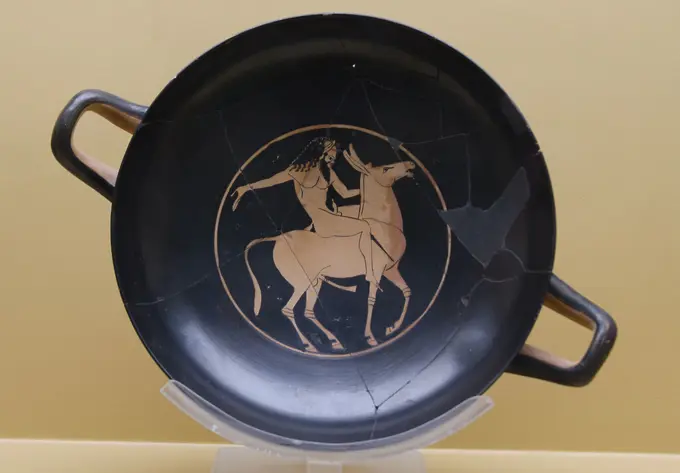
Red-figure kylix, ca. 510 BC. A satyr is depicted riding a donkey. Painted by Epiktetos, Attic vase painter active between 520 BC and 490 BC. Museum of the Ancient Agora. Athens, Greece. Author: Epiktetos (fl. 520 BC-490 BC). Attic vase painter.
6145-48871580
Attic Black-Figure Volute Krater Fragment. Unknown
4409-136549
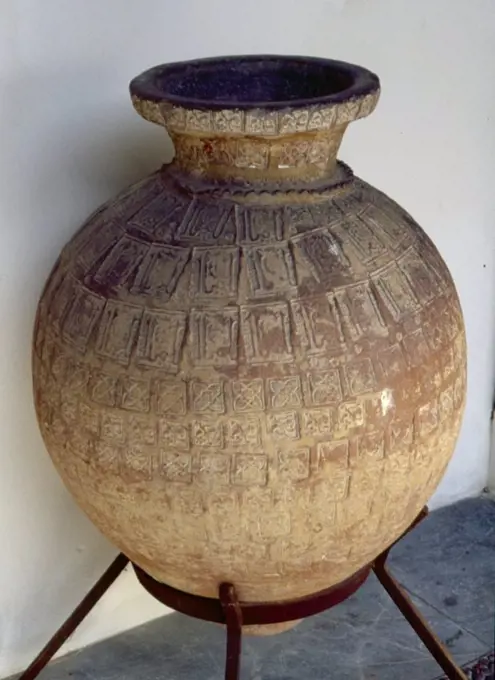
TINAJA DE BARRO COCIDO DECORADA A MOLDE CON LEONES, ROSETAS Y LA PALABRA ÁRABE "FORTUNA". MUDEJAR TOLEDANO, S. XIV (EN EL MUSEO DE SANTA CRUZ).
4409-126367
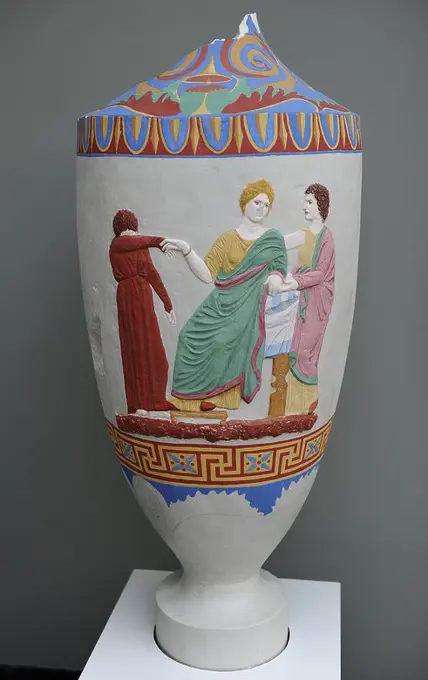
Funerary monument shaped oil bottle (lekythos) decorated with reliefs depicting a goodbye with three women. From Athens. Ca. 330 BC. Copy in synthetic marble with reconstructed polychromy. Ny Carlsberg Glyptotek Museum. Copenhagen. Denmark.
4409-18205517
Xavier Nogués i Casas / Jarrón, siglo XX. Museu de Ceràmica de Barcelona.
6145-44289449
Attic Red-Figure Cup Fragment. Attributed to the Euergides Painter (Greek (Attic))
6145-59125686
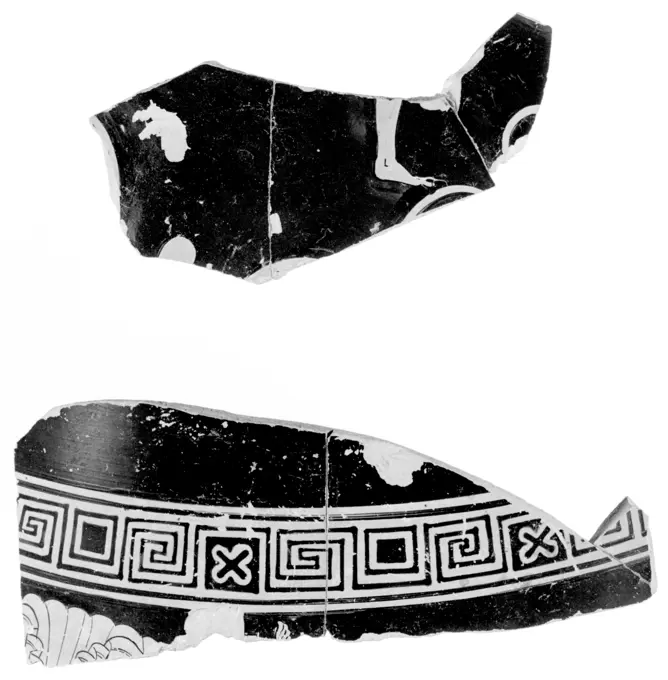
Attic Red-Figure Stamnos Fragment (comprised of 3 Joined Fragments). Kleophrades Painter, painter (Greek (Attic), active 505 - 475 B.C.) about 470 B.C. Section of lower part of body. Meander band (meander square facing right, black square, meander square facing left, cross square). Drapery of fleeing figure.
4409-65763312
Cáliz de Galcera de Vilanova, 1390. Museu Diocesà d'Urgell.
6145-45396025
Mars Ultor
1899-65661621
Artefacts in the museums that are dotted on the islands surrounding Athens. Mykonos is a beautiful place of major historical interest where a vast collection of exhibits from the Hellenistic period and prehistoric times including vessels, statues, and columns are shown. In Chora, the capital of Mykonos many museums highlight the island's rich legacy, in the history and the tradition.' Greece.
1788-15258
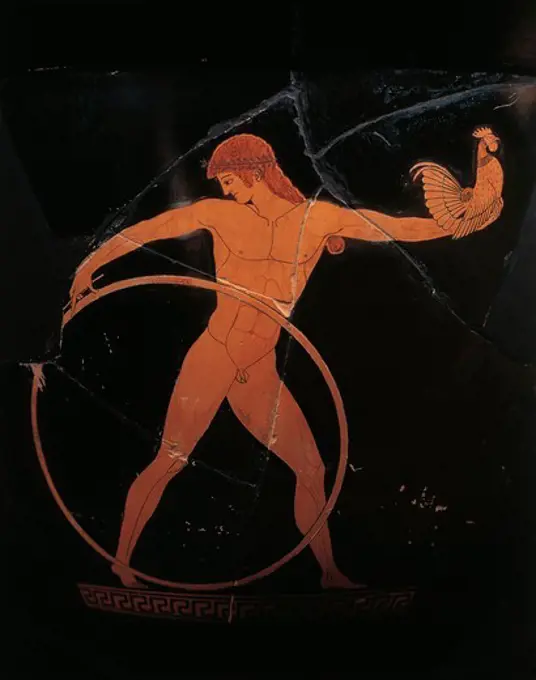
Red-figure pottery Attic krater depicting Ganymede with rooster and hoop
PREVIOUS
of 2
NEXT
2401 S. Ervay, Suite 206
Dallas, Texas 75215
United States
Get Started
Free ResearchMy BoardsMy Cart
For Creators
How To License Your ContentContributor PortalFrame of Mind
Resources
API accessPricing
Contact
+1 866 236 0087help@viewpictures.co.uk Contact form
©2026 View Pictures. All Rights Reserved. -A
This site is protected by reCAPTCHA and Google Privacy Policy and Terms of Service apply.