Antique Lace Patterns

Delicate lace strips featuring intricate floral and geometric patterns, showcasing craftsmanship from various historical periods in lace making.
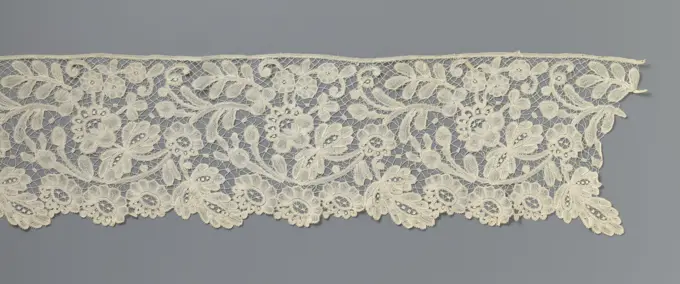
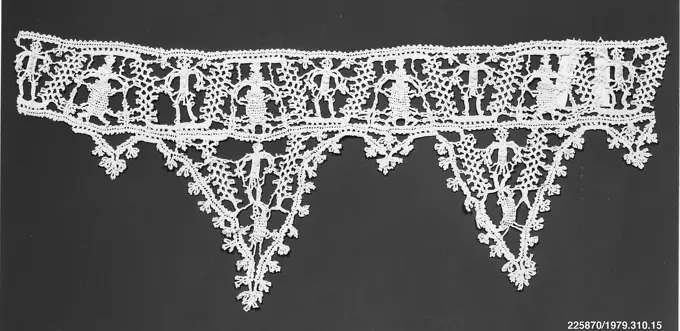
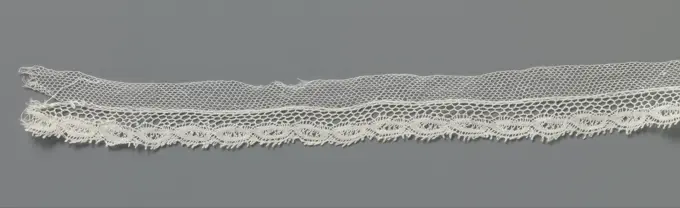
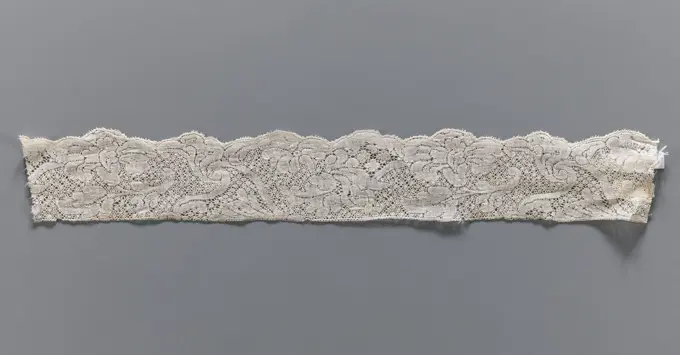
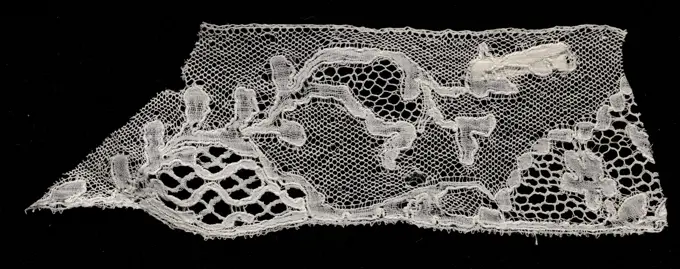
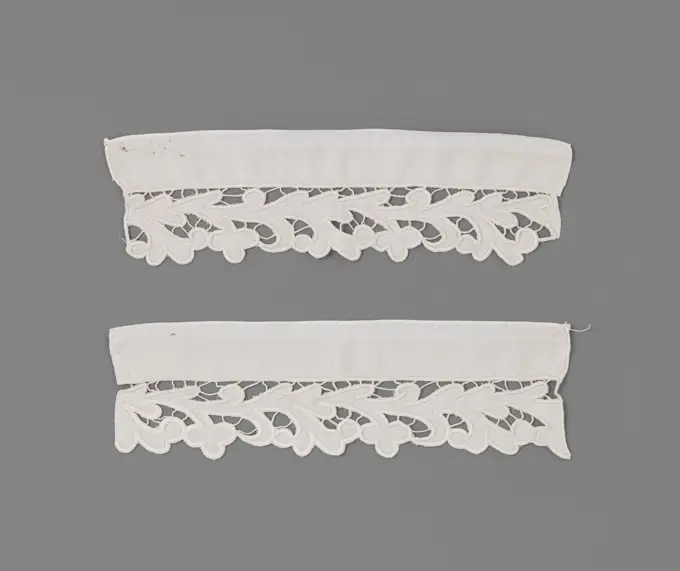
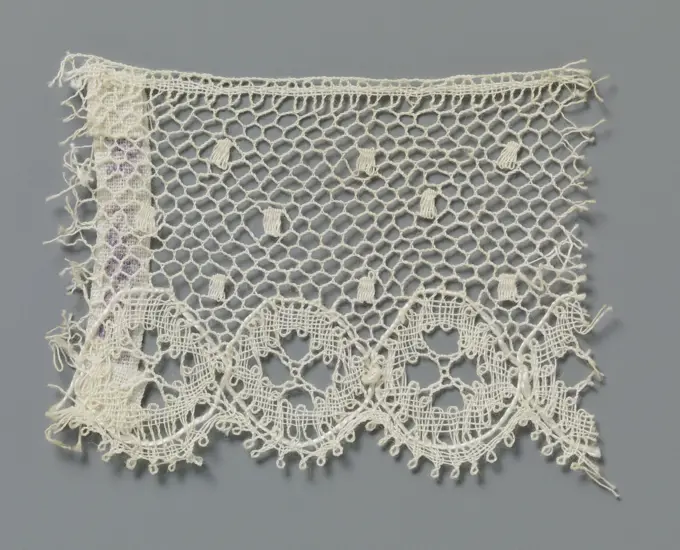
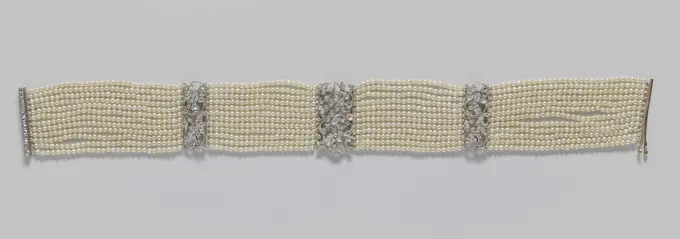
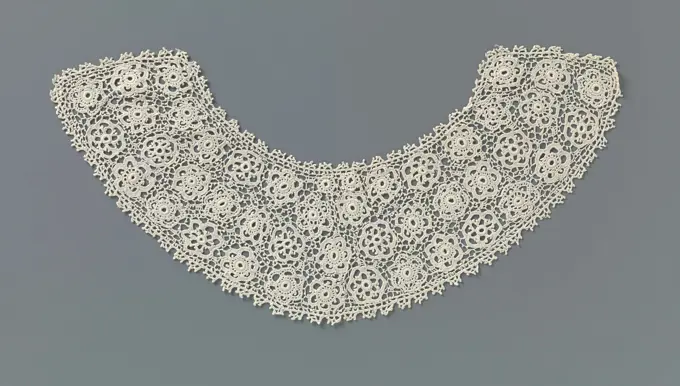
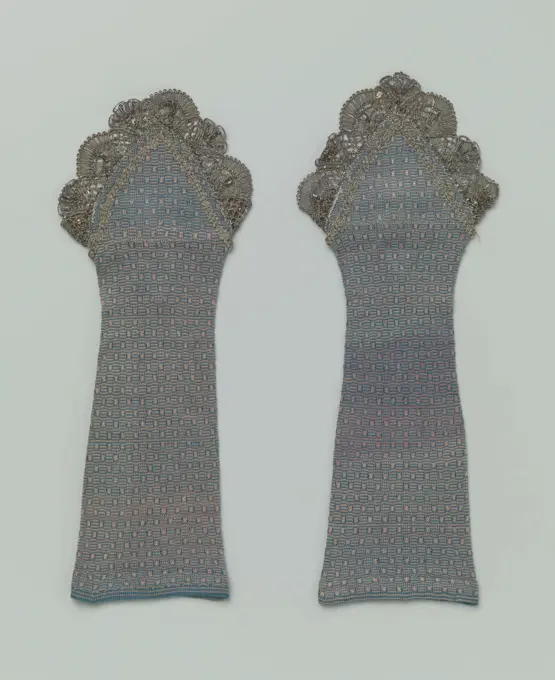
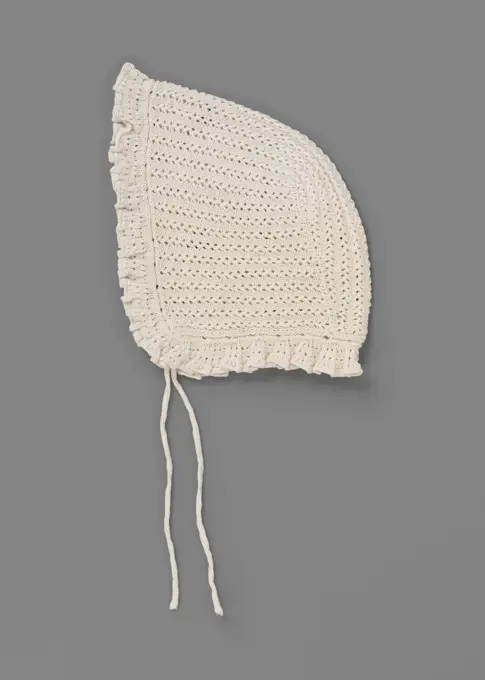
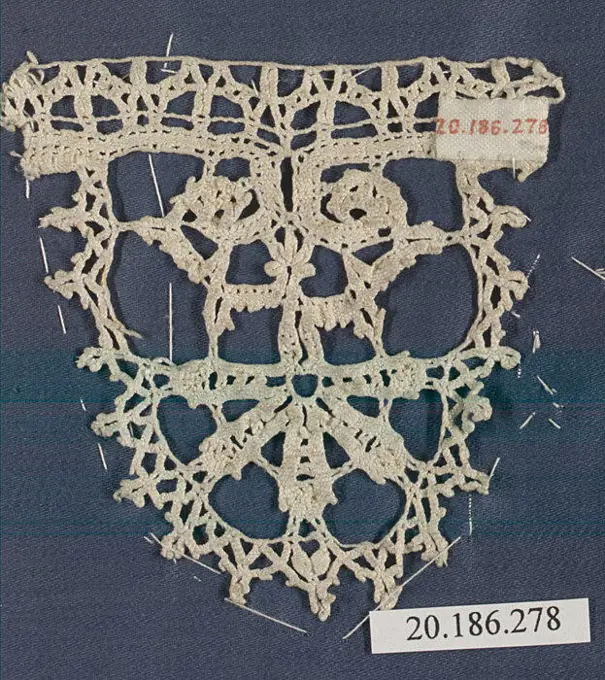
Strip of bobbin with three rosette flowers and a three -lobe leaf such as scum, anonymous, c. 1899 - c. 1900 Strip of natural -colored bobbin: fine bridge flower arrangements. The repeating pattern consists of three slanted oval rosette flowers and a large three -lobbish leaf along the lower edge. Above every three rosette flowers there is a curved stem with two rosette hips on one side and on the other hand a kink in the stem and rose hips targeted rosette flower on the end. A few leaves and smaller rosette flowers spring from this rosette flower. Above every shell that is formed by the three -lobe leaf, a rosette boom hangs down on a curved stem. The motifs are connected by a potented braid ground. The motifs are made in netslag and linen battle, with openwork edges and recesses. The motifs are equipped with thin to very thick contour threads and burst relative contours. In a part of the openwork petals or flower hearts, cubes are made in shape or in Linneslag. The top of the strip i
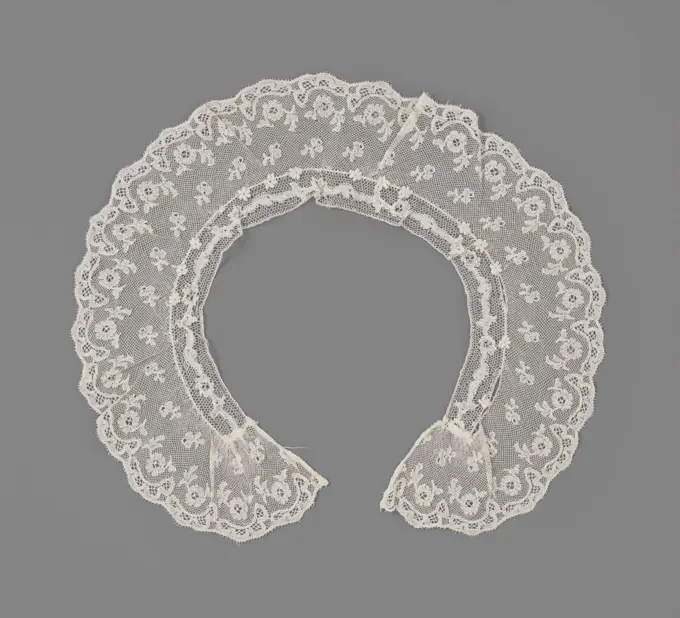
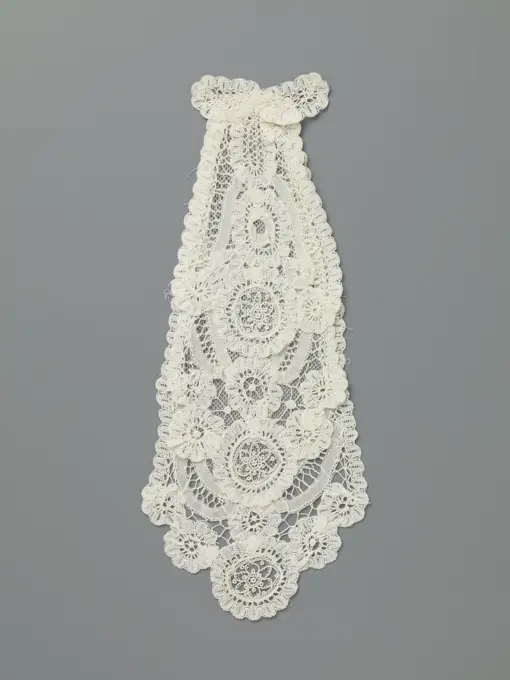
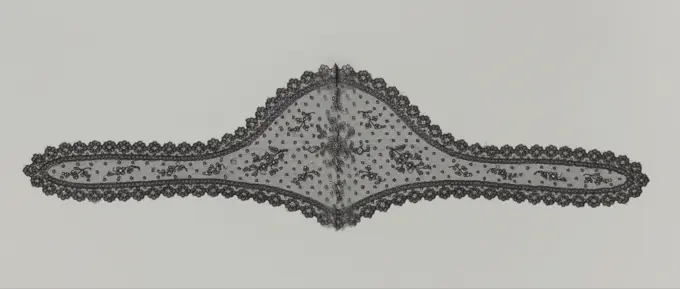
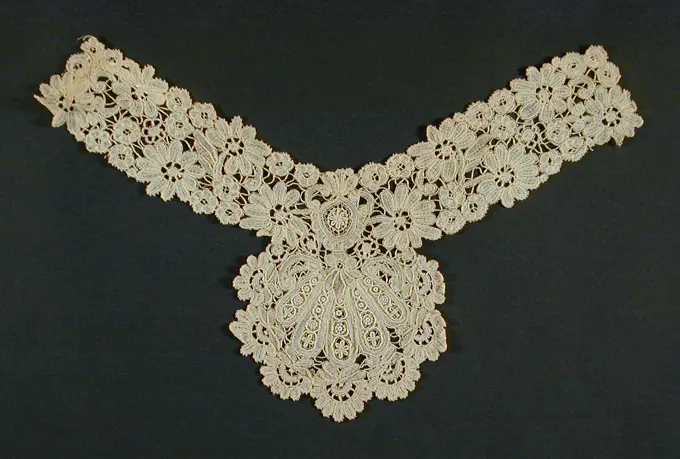
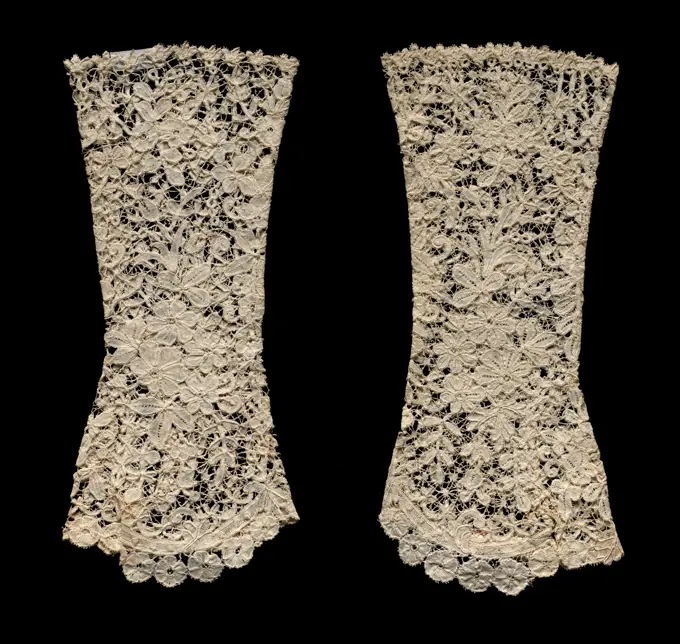
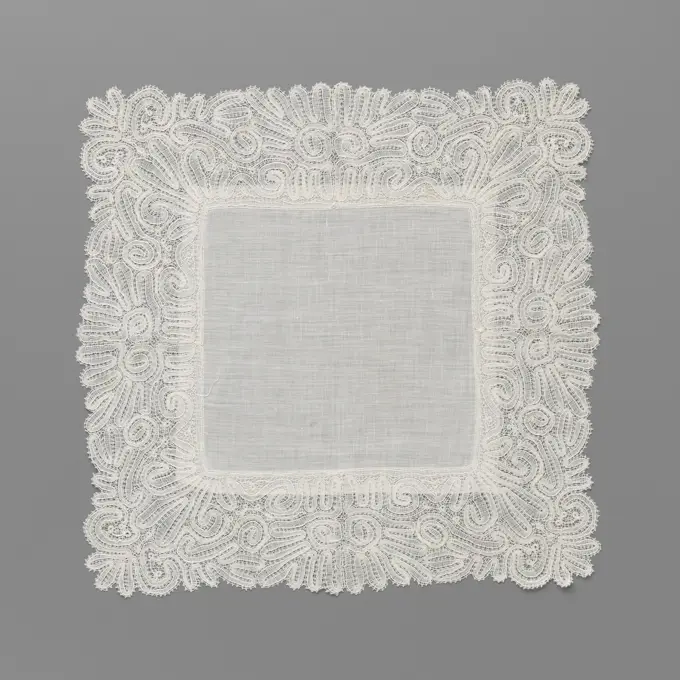
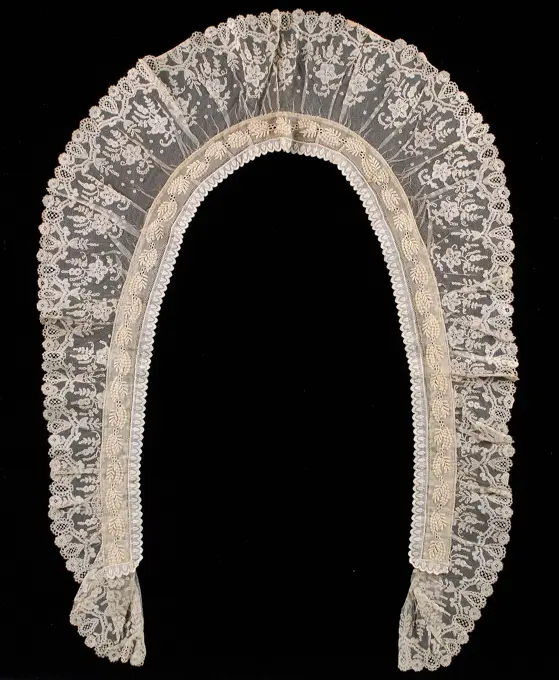
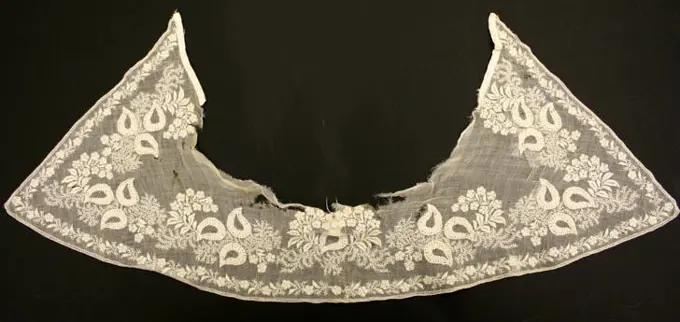
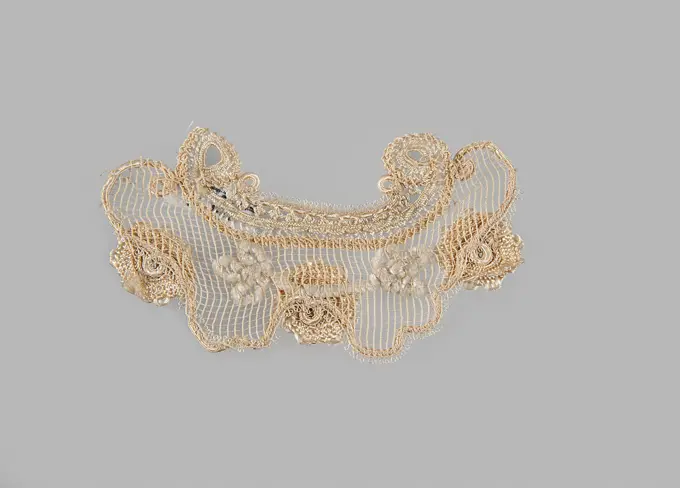
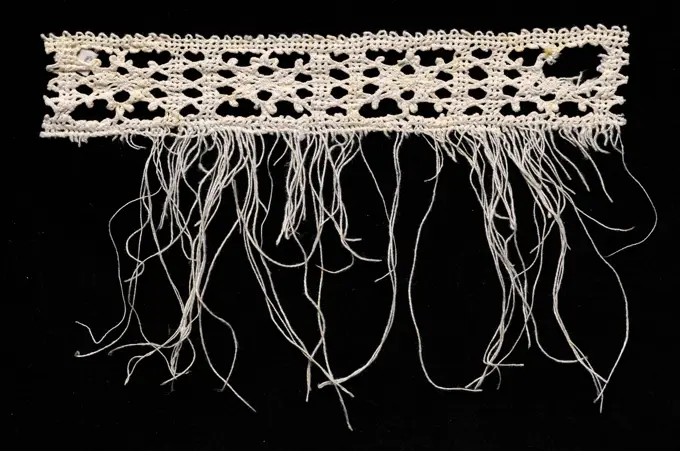
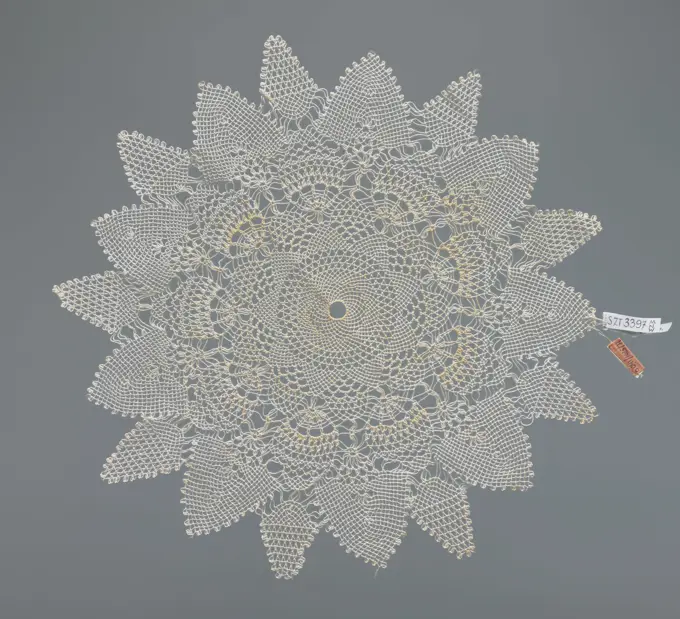
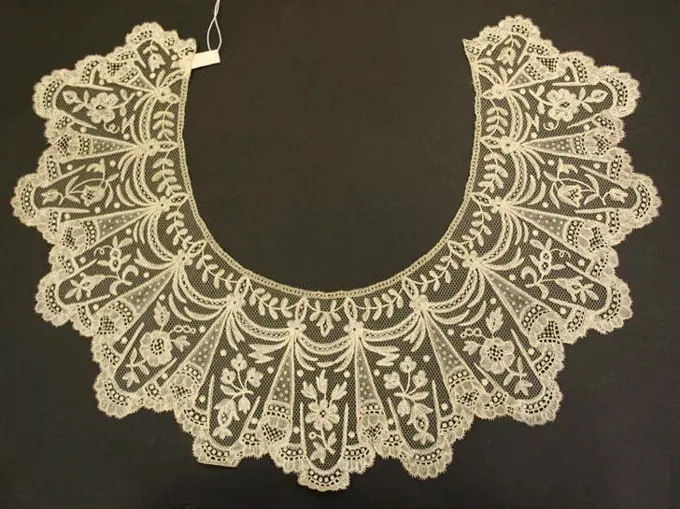
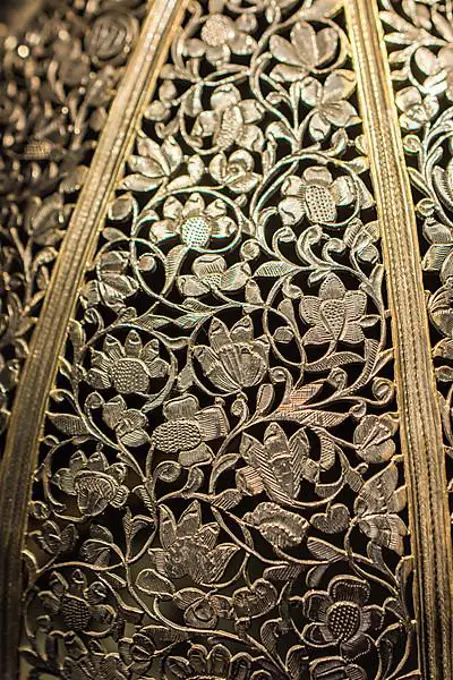
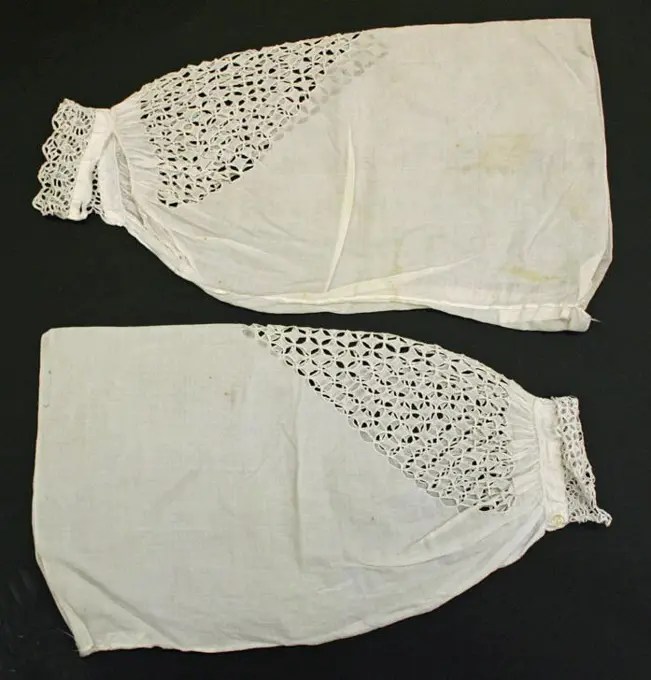
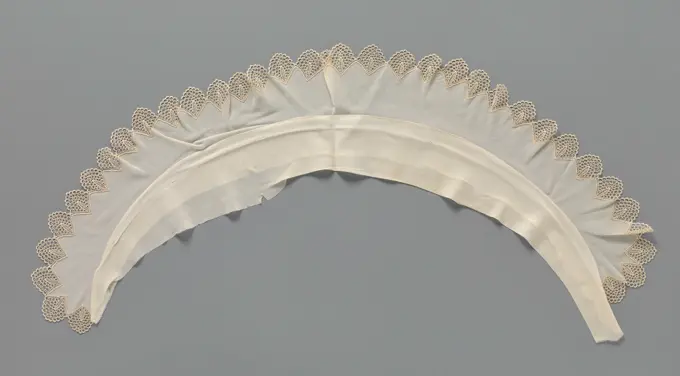
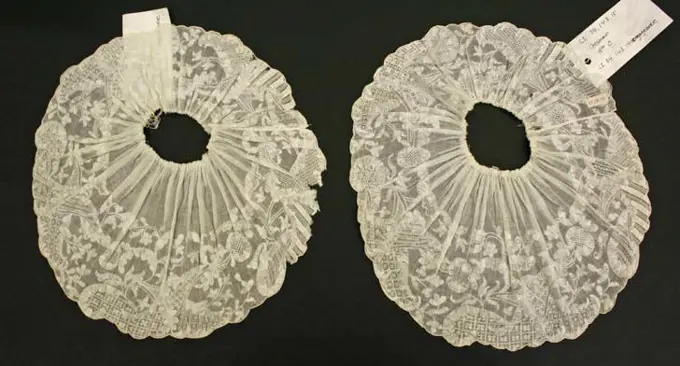
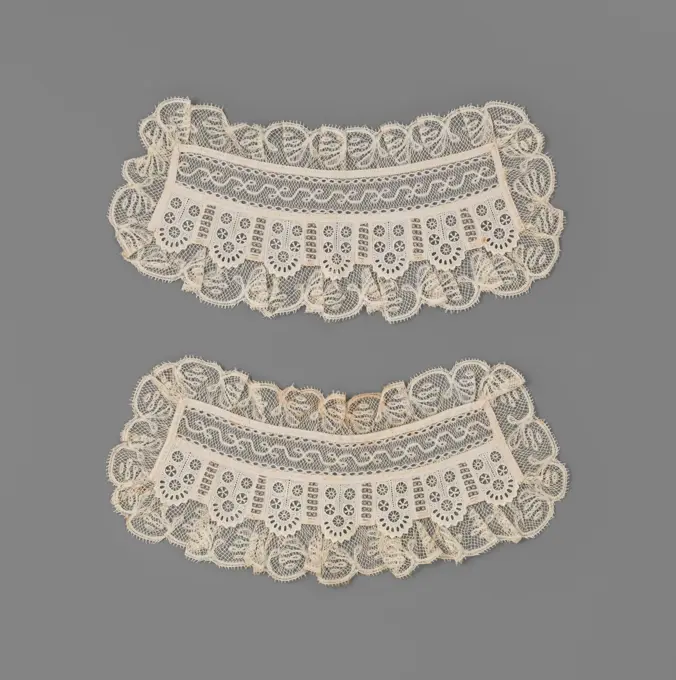
Cuff with English embroidery and a strip of Valenciennes side, anonymous, c. 1880 Curved cuff with a scalloped edge. A circle is embroidered in the sculptures between which an ornament. The cuff is trimmed with a strip of Valenciennes side. Netherlands . Embroidering / Valenciennes lace Curved cuff with a scalloped edge. A circle is embroidered in the sculptures between which an ornament. The cuff is trimmed with a strip of Valenciennes side. Netherlands . Embroidering / Valenciennes laceLace Fragments. Italy, 1650-1700. Textiles; fragments. Linen laceInsertion 16th century Italian. Insertion 214877Collar of Mechelse side, round model, c. 1850 - c. 1870 Round collar of Mechelse side, which may be worn with one or two other over each other. The outskirts of scallops contain C-motifs that include a rose. On the seam an agrement with forget-me-nots.  . Mechlin (lace) Round collar of Mechelse side, which may be worn with one or two other over each other. The outskirts of scallops contain C-motifs that include a rose. On the seam an agrement with forget-me-nots.  . Mechlin (lace)Kloskant motif in the form of a leaf with a drop and a heart, Sophia Gerardine Cenijn-Smit, c. 1914 Motif in leaf shape of natural-colored bobbin: Cluny side. The contour of the leaf is made in Linnenlag. Within this contour there is a drop shape in netslag at the top of the leaf with leaves made in relief in forming. Under the drop a heart shape in linen battle with blocks made in relief in forms. The motifs are connected by braids. Amsterdam linen (material) bobbin lace / Cluny lace Motif in leaf shape of natural-colored bobbin: Cluny side. The contour of the leaf is made in Linnenlag. Within this contour there is a drop shape in netslag at the top of the leaf with leaves made in relief in forming. Under the drop a heart shape in linen battle with blocks made in relief in forms. The motifs are connected by braids. Amsterdam linen (material) bobbin lace / Cluny laceRound rug of batist with filet rand decorated with rose branches, anonymous, c. 1900 - c. 1949 Dress of natural -colored batist with a natural -colored edge of lace border border: fillet side. Round model. Pattern with a succession of a rose branch interspersed with a three -part leaf. The motifs are embroidered with the stopping technique on filet node: a knotted network with square meshes. Scalloped edge where one shell always includes one flower or one leaf. Netherlands (possibly) whole: Cotton (textile) Dress of natural -colored batist with a natural -colored edge of lace border border: fillet side. Round model. Pattern with a succession of a rose branch interspersed with a three -part leaf. The motifs are embroidered with the stopping technique on filet node: a knotted network with square meshes. Scalloped edge where one shell always includes one flower or one leaf. Netherlands (possibly) whole: Cotton (textile)Batist handkerchief around finished with dick side with rosette flowers on a short handle and flowers with three oval flower leaves. Natural batist handkerchief around finished with natural colosside: fine brugs flower work. The side has a repeating pattern of rosette flowers on a short handle with a leaf alternated on either side by a flower with three elongated oval flower leaves, on a short handle with two leaves. The rosette flowers have a cut-away flower heart. There are four rosette flowers in every corner without stem. The motifs are made in linen stroke with thick contour lines. The veins of the elongated oval petals are depicted with recesses. The flowers are connected by a braid soil. The slip edge along the outside comes from the pattern is finished with picots.Fragment, Medium: linen Technique: bobbin made continuous tape with net added, Tape like pattern forming leaf motifs and circular floral motifs., Eastern Europe, 19th century, lace, FragmentCap Streamer (Belgium); linenBatists handkerchief with a border embroidery all around and finished all around with a strip of bobbin, anonymous, c. 1840 Batist handkerchief with embroidery - whitework - along the edges with flower and leaf vines. The handkerchief is trimmed with a strip of bobbin: Lillese side. The repeating pattern exists along the underside (outside) of the strip of a lying S-Volute crowned by whimsically shaped leaves. Lille linen (material). batiste embroidering / bobbin lace / Lille lace Batist handkerchief with embroidery - whitework - along the edges with flower and leaf vines. The handkerchief is trimmed with a strip of bobbin: Lillese side. The repeating pattern exists along the underside (outside) of the strip of a lying S-Volute crowned by whimsically shaped leaves. Lille linen (material). batiste embroidering / bobbin lace / Lille laceStrip Application side with rosette flowers in symmetrical leaf branches, anonymous, c. 1840 - c. 1850 Strip natural -colored application side: needle side applicated on mechanical tulle. Strooi pattern of four rows of leaf branches on a fine hexagonal mesh ground. Along the bottom edge a repetitive motif of a symmetrical leaf branch with one rosette flower in the center and one rosette flower in each of the two volutes underneath. The branch originates from a hanging flower with a drop -shaped heart, the petals of which are part of the scrap edge along the bottom. Different decorative grounds in the motifs and relief contours of wire bundles. The top is trimmed with a border bobbin. Brussels linen (material) Strip natural -colored application side: needle side applicated on mechanical tulle. Strooi pattern of four rows of leaf branches on a fine hexagonal mesh ground. Along the bottom edge a repetitive motif of a symmetrical leaf branch with one rosette flower in the center and one roBatist cuff decorated with English embroidery, c. 1875 - c. 1925 Batist cuff decorated with English embroidery. The cuff has a Schulprand that has been trimmed with a feston stitch. maker: West-EuropaNetherlands whole: Batiste Batist cuff decorated with English embroidery. The cuff has a Schulprand that has been trimmed with a feston stitch. maker: West-EuropaNetherlands whole: BatisteNeedlepoint (Grounded Venetian Point) Lace Barb, early 18th century. Italy, Venice, early 18th century. Lace, needlepoint; average: 16.2 x 119.4 cm (6 3/8 x 47 in.).Piece 18th century Italian. Piece 214955Lace, 1700s, maker unknown. Gift of Mrs CJ Lindsay, 1953.Cuff with a strip of spiders in wheels between plumetisbobruikwerk, c. 1850 - c. 1920  Cuff with a strip of spiders in wheels between plumetisbobruimwerk. West-Europa Linen (Material). hook: Metal sewingFragment; linen; 1933-1-94Etskant collar with star forms, anonymous, c. 1910 - c. 1915 Collar of natural -colored machine side: Etskant. The side imitates Reticella. The collar has eleven scallops and is decorated with star forms. Sankt Gallen cotton (textile) Collar of natural -colored machine side: Etskant. The side imitates Reticella. The collar has eleven scallops and is decorated with star forms. Sankt Gallen cotton (textile)Tissue;  1920 (1920-00-00-1920-00-00);Magdalena, Witwińska, Dar (provenance)Jabot of mixed side with rosette flowers, anonymous, c. 1900 Jabot of natural -colored mixed side - bobbin side in combination with needle lace pier stitches and mechanical tuler floor - luxury -lace. More or less drop -shaped model, made up of three parts on top of each other. The three parts are sewn together at the top. The upper "drop" is the shortest, then a longer one of which comes out below this short and the lower one is the longest. A piece of machine tulle has been put under the overlapping parts. The symmetrical pattern consists of one large rosette flower with a smaller rosette flower with right above it. These flowers are flanked by one or two smaller rosettes. The rosette flowers are made with a wreath of many short waves such as petals. Between the flowers, contours are made with burst ribbons (ribbon side), with folds where the contours make a turn or curl. The motifs are made in linen battle with openwork edges and recesses that form the veins of the petals. Contour tCollar of needle side with rose edge, anonymous, c. 1875 - c. 1910 Collar of natural -colored needle side: Venetian rose side. A symmetrical tibar pattern stands out against an open bar soil. Flower -sized flowers on the tibaries, with many florets. Driving -sided finish of fine and very detailed palmets and florets. BURANO linen (material) Venetian rose point Collar of natural -colored needle side: Venetian rose side. A symmetrical tibar pattern stands out against an open bar soil. Flower -sized flowers on the tibaries, with many florets. Driving -sided finish of fine and very detailed palmets and florets. BURANO linen (material) Venetian rose pointEdging late 16th century Italian The Metropolitan Museum's great lace collection was started when the Museum became the first among American museums to organize a permanent collection of lace with the acceptance of the McCallum Collection in 1879 and the bequests of Mrs. John Jacob Astor, Mrs. Robert L. Stuart, Mrs. Augustus Cleveland, and Mrs. A. W. Winters shortly thereafter. In 1893 a loan collection of antique laces shown at the World's Columbian Exposition in Chicago was assembled by a committee of New York women headed by Catharine Augusta Newbold. About 1900 Miss Newbold arranged and labeled an exhibition of laces and linenworks lent to the Metropolitan Museum by Mrs. James Boorman Johnstone and the Misses Johnstone. "Her scholarly knowledge of lace technique enabled the Museum for the first time to offer a comprehensive display of lace illustrating its historical development," wrote Miss Frances Morris, then curator of the textile department. Miss Newbold's name occurs again inPelerine. Culture: British. Date: 1775-1825. Museum: Metropolitan Museum of Art, New York, USA.Strip bastard with edge of openwork spare loves, anonymous, c. 1880 - c. 1914 Strip of natural-colored bobbin, Valenciennes side. Along the underside of the strip runs a strap of connected pointed dovals, which form regular sculpes. Above the strap the strip consists of a mesh ground, a round Valenciennes ground. The Spitsovalen are made in linen battle with openwork edges and a recess in the center, which is decorated with small snowflakes. The top of the strip is straight finished and sewn to a strip of mechanical tulle. The scums along the bottom are finished with picots. Belgium cotton (textile) Bobbi Lace / Valenciennes Lace Strip of natural-colored bobbin, Valenciennes side. Along the underside of the strip runs a strap of connected pointed dovals, which form regular sculpes. Above the strap the strip consists of a mesh ground, a round Valenciennes ground. The Spitsovalen are made in linen battle with openwork edges and a recess in the center, which is decorated with small snowflFragment of the lace;  Ok. PO. 18th century (1740-00-00-1760-00-00);Fragment of the lace;  2. PO. 19th century (1851-00-00-1900-00-00);Fragment late 18th century French. Fragment 214652Fragment; linenCROCHET EDGING, NEEDLEWORK, 19th CENTURY EMBROIDERYBobbin Lace Fragment, 18th century. Spain, 18th century. Lace, bobbin; average: 4.8 x 14.3 cm (1 7/8 x 5 5/8 in.).Border Made 1650-1700 Europe. Linen, raised needle lace, based on Italian, Venetian lace prototype .Laces, 20th century.  Point de Rose (Punto Rosa) lace with vegetal motifs, School of Burano, beginning 1900's.Cuff of linen with a richieuwerk, with a running pattern of sliding leaf shapes with volute branches, anonymous, c. 1920 Cuff of linen with a richieuwerk, with an ongoing pattern of sliding leaf shapes with volute branches. West-Europa whole: Linen (Material) Cuff of linen with a richieuwerk, with an ongoing pattern of sliding leaf shapes with volute branches. West-Europa whole: Linen (Material)Collar ca. 1890 Belgian. Collar 169639Example of lace stitch Irish 19th-20th centurySilver mesh bag with chain, 1900-1905, fashion accessories, Italy, 20th century.Kloskant fragment with flowers between C-volutes and flowers with loop-shaped leaves, anonymous, c. 1900 - c. 1915 fragment Fragment of natural-colored bobbin: Honiton side. The repeating pattern consists of C-Voluten with a flower clamped between the beginning and end with a loop-shaped flower heart and four open worked lobes such as petals. Above a few more connected flowers to narrow stems with loop -shaped leaves. The contours of the motifs are made in linen battle with openwork edges and partly in netslag, with shiny contour threads. In a few flowers, cubes have been applied in shape. The motives are connected without soil. Part of the fragment is finished with picots. Assert linen (material) bobbin lace / Honiton laceLappet (one of a pair) mid-18th century Flemish, Brussels. Lappet (one of a pair) 222798Towel. Culture: Italian. Dimensions: L. 30 x W. 32 inches (76.2 x 81.3 cm). Date: 16th century. Museum: Metropolitan Museum of Art, New York, USA.Black bobbin fan with spreading pattern, anonymous, c. 1850 - c. 1874 Black Silk Fancon Silk, Chantilly side. A rising and widened middle part ends in two short -rounded slips. A wide spreading pattern of flower branches and large moesjes is surrounded by a pearl list and connected rosettes. The motifs are connected by a Maas soil. The motifs are made in netslag with contour threads around the motives. Chantilly silk bobbin lace Black Silk Fancon Silk, Chantilly side. A rising and widened middle part ends in two short -rounded slips. A wide spreading pattern of flower branches and large moesjes is surrounded by a pearl list and connected rosettes. The motifs are connected by a Maas soil. The motifs are made in netslag with contour threads around the motives. Chantilly silk bobbin laceFragment, Cooper Union Museum Lace Study Card; Made for Cooper Union Museum; linenEdging 17th century Italian, Genoa. Edging 220977Collar 1825-50 probably European. Collar 110213Fragment; linen; 1897-8-317Woman's Collars. Belgium, Brussels or Bruges, late 19th century. Costumes; Accessories. a) Collar: Cotton Duchesse bobbin lace and cotton point de gaze needle lace; b) Collar: Cotton Duchesse bobbin laceGloves, c. 1850. Flanders, 19th century. Bobbin (Duchese) lace; overall: 25.4 x 11.1 cm (10 x 4 3/8 in.).Border; linen; Warp x Weft: 27.5 x 155 cm (10 13/16 in. x 5 ft. 1 in.); 1974-8-6Accessory set ca. 1850 American. Accessory set 170349Sleeves ca. 1770 European. Sleeves 120011Strip bobbin with connected circles along the underside, anonymous, c. 1800 - c. 1899 Strip of natural-colored bobbin, Buckingham side. Under a spreading pattern of square mousjes, the repeating pattern consists of connected circles with an open -worked center. The motifs are connected to each other at the top by a Maas soil, a tuler land. The circles are made in linen stroke with an open -worked center. Only the outside of each circle is accentuated with thick and shiny contour threads, the center is not accentuated with contour threads. A decorative land has been used in the center of each circle, you see a part of the grater of a rose soil. The top of the strip is straight finished. The scrap edge along the bottom comes from the pattern with the circles and is finished with picots. Buckingham cotton (textile) bobbin lace / Bucks point (lace) Strip of natural-colored bobbin, Buckingham side. Under a spreading pattern of square mousjes, the repeating pattern consists of connected circZakdoek van batist met een brede rand kloskant met slingerende linten.Batist handkerchief with a wide edge of the climbing: Oosteuropese side. Square model with sloping edge. Swinging ribbons form the same symmetrical pattern along each side. The pattern consists of volutes, snail housings and loops. The ribbons are made in loosened linen stroke with contour wires along both sides. The ribbons are separated from each other by short crossing pairs. The sloping edge stems from the pattern with the winding ribbons. The batters middle part may not be an original. It is unfinished with a wide overlapping edge on the back on the closch of edge.Fragment late 16th century Italian. Fragment. Italian. late 16th century. Bobbin lace. Textiles-LacesFichu van Linen Batist, triangular, all around and decorated with tambouring work and an intermediate creature of Fils Tirés, Anonymous, c. 1880 Fichu van Linen Batist, triangular, scalloped all around and decorated with tambouring work and an intermediate creature of Fils Tirés. Model: Triangular, diagonally on the wire. Decoration: In the point a symmetrical ornament composed of flowers with tamered leaves and a heart of button stitch, below a border with tamered scallops filled with button stitch, including an edge of fils tirés and above the hem a tamboured sling. The scalloped edge has been fested. The rest of the cloth is provided with a knot stitch of knot stitch. Netherlands (possibly) whole: Linen (Material). Decoration: Cotton (textile). Decoration: Cotton (textile) embroidering Fichu van Linen Batist, triangular, scalloped all around and decorated with tambouring work and an intermediate creature of Fils Tirés. Model: Triangular, diagonally on the wire. Decoration: In the poInsertion Mexican 19th centuryCapslip from Valenciennes side, Anonymous, c. 1720 - c. 1750 Cutslip from Valenciennes side with a round end. The edge is sculpted and provided with a picotrand. The barbe is decorated with a floral motif and a flower vase in the middle. West-Europa linen (material) Valenciennes lace Cutslip from Valenciennes side with a round end. The edge is sculpted and provided with a picotrand. The barbe is decorated with a floral motif and a flower vase in the middle. West-Europa linen (material) Valenciennes laceStrip black machining with dragonflies. Strip black machine side: machining chantilly-side. The repeating pattern consists of two, almost straight placed, flying dragonflies. The wings of the upper dragonfly are more upright and those of the lower dragonfly sideways. A thin, split rosary with a few flowers and leaves exprceeds at the bottom of the strip of a wavy line, which consists of a concatenation of rose branches. Under each wave top hangs a curved short decorative tire with a square grid. The motifs are equipped with contour wires and are interconnected by a machining tulet, which is strewn with mashes. As ornamental ground, machine rose soil has been applied in the curved decorative tire and in the flower hearts. The curved decorative tire forms the slip edge under the tops of the through wavy rosary branches, which is finished with picots. The top of the strip is straight finished.Cap Streamers (Belgium); linenParasol ca. 1885 American. Parasol 169187Collar Made 1850-1869 Belgium. Cotton and linen, bobbin straight lace .Edging 16th-17th century Italian, Venice. Edging 221068Border (Probably for Table Cloth). Italy. Date: 1601-1625. Dimensions: 19.8 x 256.8 cm (7 3/4 x 101 1/8 in.). Linen, plain weave; cut and drawn thread work in needle lace fillings; embroidered in bullion, buttonhole, double hem, eyelet, overcast, and satin stitches; couching; edged with macramé. Origin: Italy. Museum: The Chicago Art Institute, Chicago, USA.Collar Irish, Carrickmacross late 19th centuryRound collar of Kloskant with C-Voluten, Anonymous, c. 1885 - c. 1899 Collar of natural-colored bobbin: Duchesse side. Flat -lying round model, which almost forms a closed circle. Within an edge of triple leaves are couples of stolen C-volutes and twigs with Margrites. Netherlands (possibly) linen (material) bobbin lace Collar of natural-colored bobbin: Duchesse side. Flat -lying round model, which almost forms a closed circle. Within an edge of triple leaves are couples of stolen C-volutes and twigs with Margrites. Netherlands (possibly) linen (material) bobbin laceBobbin Lace Edging of Points without Selvage, mid 16th century. Italy, Venice, mid 16th century. Lace, bobbin; average: 2.9 x 19.8 cm (1 1/8 x 7 13/16 in.).Double strip crochet side with flowers and grape food. Two coated strips of natural-colored Irish crochet side. Pattern with flowers and grape fees and a crochet irregular maase with picots. The right finished sides of the two strips are sewn together. The opposite edges have semicircular slots that are trimmed with picoted arcs. The edges on the side are not finished or cut.Fragment, Medium: linen Technique: needle lace, Fragment of a deeply scalloped leaf pattern., Venice, Italy, 17th century, lace, FragmentScarf, Medium: linen Technique: needle lace with ground of loop and twist with twist return, Three cornered lace scarf. Probably Empire style., France, 19th century, lace, ScarfCollier de chien, composed of 12 pearls with three spacers and a lock. The spacers are busy with diamonds.Fichu ca. 1890 American. Fichu 168699Kraag van gehaakt kantwerk met drie rijen platte rozetbloemen.Curved rectangular collar of natural-colored Irish crochet side. Pattern with three rows flat rosette flowers and a crochet irregular maase with picots. Along all sides finished with three-piece arcs with picots.Brooch (England); diamonds, gold, freshwater pearlsMitaine, from blue pink silk, with silver colored metal wire and lace strip. Mitaine from blue pink silk in jacquard pattern, outlet with silver colored metal wire and silver colored metal lace strip.Strip -Hat for day or slurry of knitted cotton; With pleated and scalloped edge, anonymous, c. 1800 - c. 1900 Hat for day or slurry of knitted cotton. The bulb with cable pattern is trimmed with a pleated, scalloped edge. With kin tires made of cotton. Friesland cotton (textile) knitting Hat for day or slurry of knitted cotton. The bulb with cable pattern is trimmed with a pleated, scalloped edge. With kin tires made of cotton. Friesland cotton (textile) knittingLappet (Belgium); linenFragment 17th century Italian, Genoa. Fragment 221088Steel bobbin with tuler land, anonymous, c. 1875 - c. 1899 Steel or short piece of a strip of natural -colored bobbin: Rijsselse side. Coming from a lifted side school in Turnhout. Turnwood cotton (textile) bobbin lace / Lille lace Steel or short piece of a strip of natural -colored bobbin: Rijsselse side. Coming from a lifted side school in Turnhout. Turnwood cotton (textile) bobbin lace / Lille laceLoopSampler, Medium: linen embroidery on linen foundation Technique: embroidered in withdrawn element work with needle-made fillings on plain weave foundation, Two bands of withdrawn element work in white., England, 17th century, embroidery & stitching, SamplerCollar 1840s probably American. Collar. probably American. 1840s. cottonLinen scarf collar with contours such as tilting, decorated with thick embroidery with open C-shapes and windows, surrounded by dots and bonds, anonymous, c. 1900 - c. 1915 Linen scarf collar with contours such as tilting, decorated with thick embroidery with open C-shapes and windows, surrounded by dots and bonds. West-Europa whole: Linen (Material) Linen scarf collar with contours such as tilting, decorated with thick embroidery with open C-shapes and windows, surrounded by dots and bonds. West-Europa whole: Linen (Material)Lace application for a dress;  around 1920 (1915-00-00-1925-00-00);Magdalena, Witwińska, Dar (provenance)Cardigan of the Needle side with deep -cut petals, anonymous, c. 1800 - c. 1899 Vest or fashionsty of natural -colored needle side: Venetian relief side. A semi -round neck shape has been saved from a rectangle. Fine and highly branched tifles wear feathered leaf voltuten and palm flowers with deeply incised petals. Many reliefs are still thickened by transverse C-shaped reliefs. Tray soil. Burano (possibly) linen (material) Venetian raised work Vest or fashionsty of natural -colored needle side: Venetian relief side. A semi -round neck shape has been saved from a rectangle. Fine and highly branched tifles wear feathered leaf voltuten and palm flowers with deeply incised petals. Many reliefs are still thickened by transverse C-shaped reliefs. Tray soil. Burano (possibly) linen (material) Venetian raised workCap Back Made 1801-1900 Austria. couching .Bobbin Lace Insertion with Fringe, mid 16th century. Italy, Venice, mid 16th century. Lace, bobbin; average: 11.5 x 17.2 cm (4 1/2 x 6 3/4 in.).Sewing instruction book samples, USA, 1829, sample books, Sewing instruction book samplesCollar late 18th century Italian. Collar 168736Tatting insertion unknownSteel bobbin with coarse wire as an example of a spider with twelve legs with a fragment slace in which this technique is used, anonymous, c. 1900 - c. 1930 sample Steel Natural -colored bobbin side with coarse wire as an example of a spider with twelve legs (the SpitsOdale motif) with a fragment slace in which this technique is used. In both examples a tie -grid has been used and in the fragment the spiders are around a window in netslag. The date concerns the steel. West-Europa cotton (textile) bobbin lace / spider (bobbin lace) / torchon laceNapkin;  20th century (1901-00-00-1960-00-00);Square collar with rabat form. Collar of natural needle side: Venetian rosary. Square model with rabat form. Against an open barrier soil, symmetrically feathered leaf volutes stand to tendrils, which also means substantially three-leaf palmet flowers, which have doubled and triple bow edges. Round a bland scaled leaf edge of roses and palms.Collar mid-19th century Belgian. Collar 102565Collag-Cape of ecru-colored batist, Machine lace and ribbon, Anonymous, c. 1880 - c. 1895 Collag-Cape of ecru-colored batist, Machine lace and ribbon. Short model with three times frowned batist and a smoothly set machine lace on the underside. Standing head with scalloped wrinkled lace edge with picots. The pattern with thickened contour threads has two rows of circles with a flower in it. The cape is decorated with a beige ribbon of satin. Netherlands (possibly) cotton (textile). lint: satin Collag-Cape of ecru-colored batist, Machine lace and ribbon. Short model with three times frowned batist and a smoothly set machine lace on the underside. Standing head with scalloped wrinkled lace edge with picots. The pattern with thickened contour threads has two rows of circles with a flower in it. The cape is decorated with a beige ribbon of satin. Netherlands (possibly) cotton (textile). lint: satinSleeve strip of Kloskant with loose florets, anonymous, c. 1910 On a stock of square meshes, above small smooth shells, alternating loose florets and twigs in the form of question marks. Valenciennes side. Netherlands (possibly) linen (material) Bobbi Lace / Valenciennes Lace On a stock of square meshes, above small smooth shells, alternating loose florets and twigs in the form of question marks. Valenciennes side. Netherlands (possibly) linen (material) Bobbi Lace / Valenciennes LaceMachine cuff with bows and with piping and bows made with a light -orange ribbon, anonymous, c. 1900 Cuff made of natural -colored machine side: Machine embroidery on Machinal Tulle. Butterfly -shaped model, with piping and bows of light orange sides ribbon in the middle. The lace pattern consists of a spray pattern of moes and two rows of embroidered bows where the bows are larger in the upper row. These bows hang down from the scrap edge between two embroidered ribbons, under a rosette flower and in the row underneath his smaller bows are embroidered, connected to a longer -lined flower branch. Europe (possibly) kant:. lint: silk Cuff made of natural -colored machine side: Machine embroidery on Machinal Tulle. Butterfly -shaped model, with piping and bows of light orange sides ribbon in the middle. The lace pattern consists of a spray pattern of moes and two rows of embroidered bows where the bows are larger in the upper row. These bows hang down from the scrap edge between two embroExample of Ottoman art patterns applied on metalsBorder, Medium: linen Technique: bobbin lace, discontinuous tape, Fragment with vases of flowers forming tabs., Italy, early 17th century, lace, BorderUndersleeves 1850s British. Undersleeves 120044Sjaalkraag van beige crêpe georgette met schulpenrand van machinale kant in de vorm van pauwenstaarten.Scarf collar of beige colored crepe Georgette with a sloping edge of machining: Etcant. De Schulpen have the form of peacock tails. The collar has a lying down part and a cover along the neck. The right tranship is far covered by the left.Engageantes 18th century European. Engageantes 101626