Antique Lace Patterns

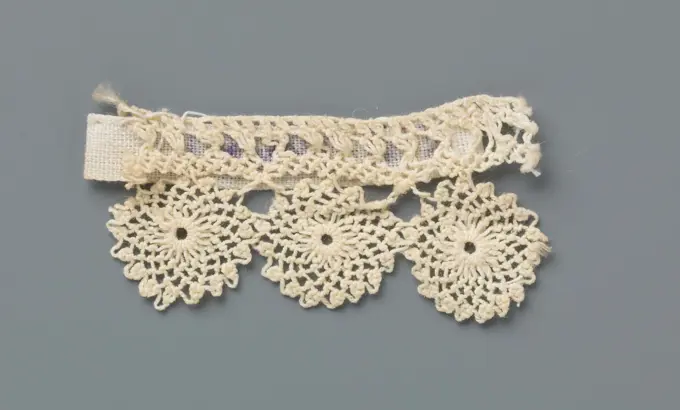
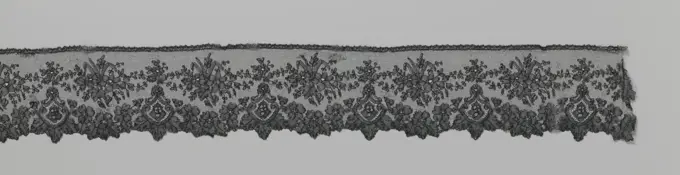
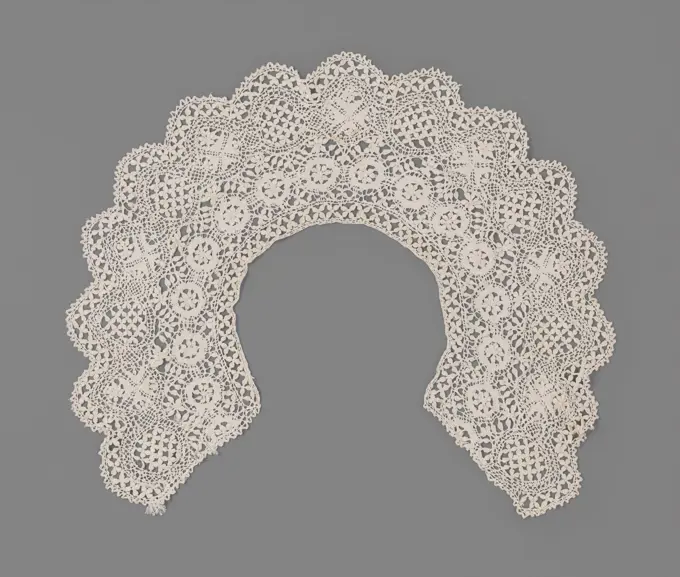
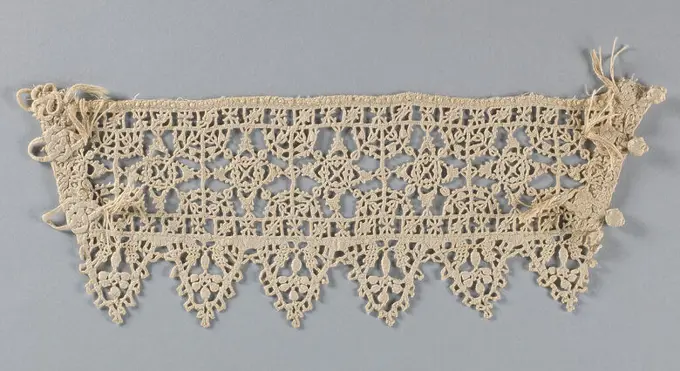
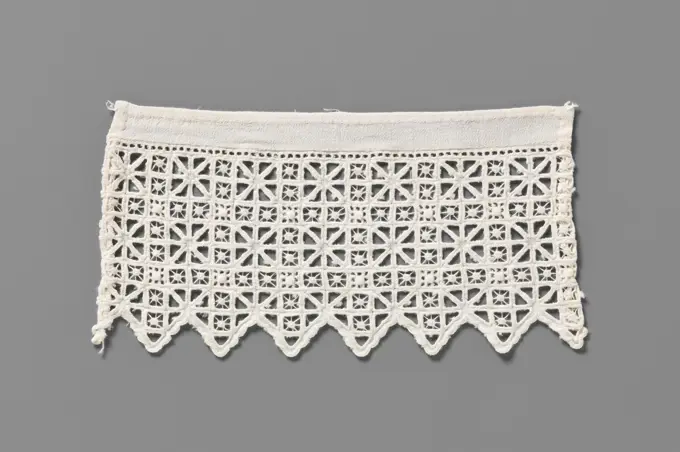
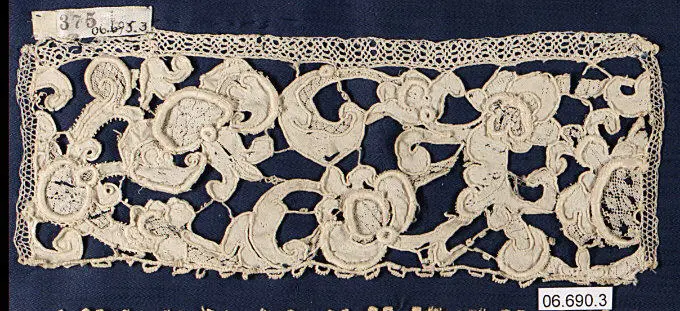
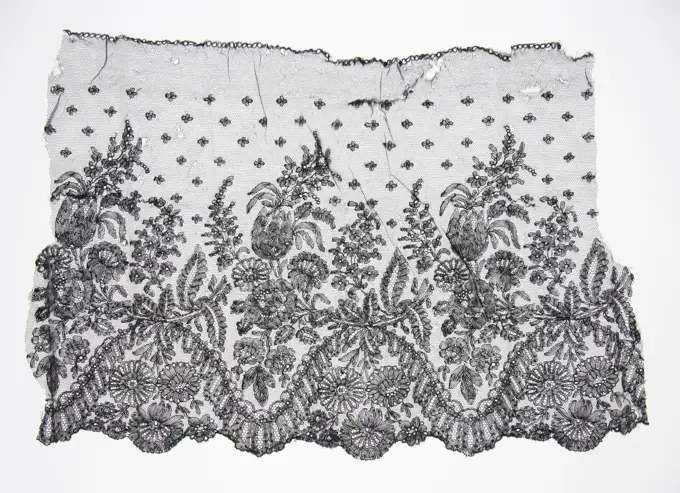
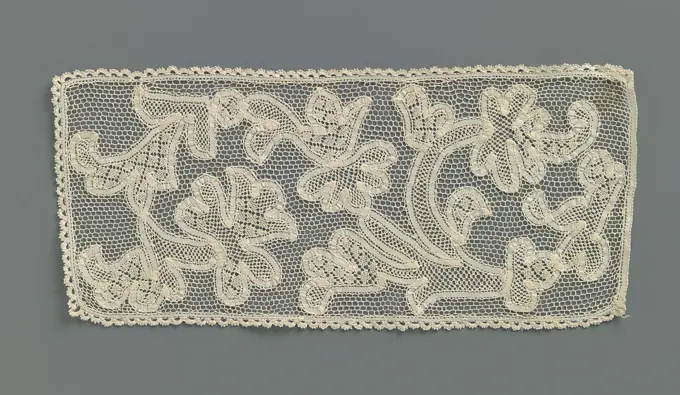
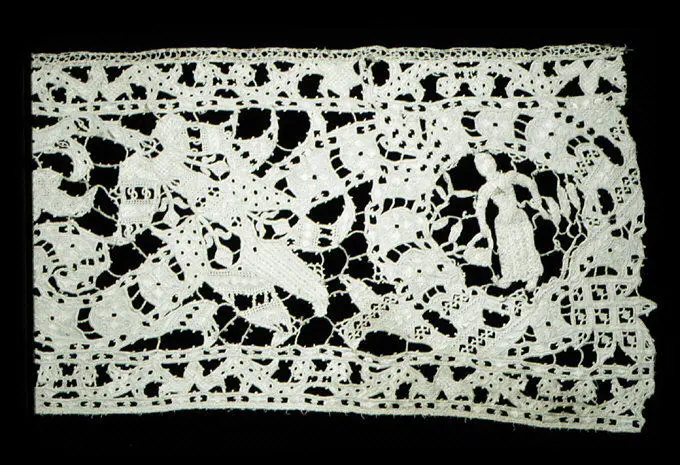
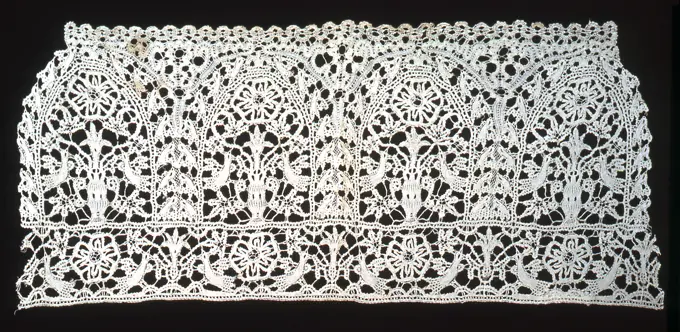
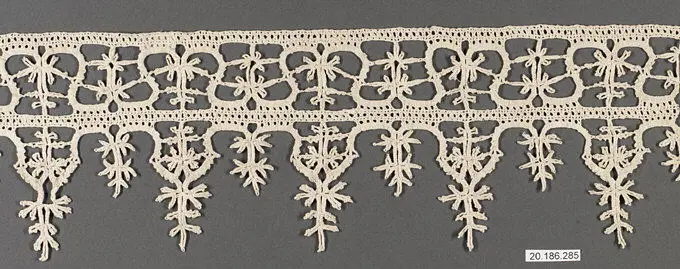
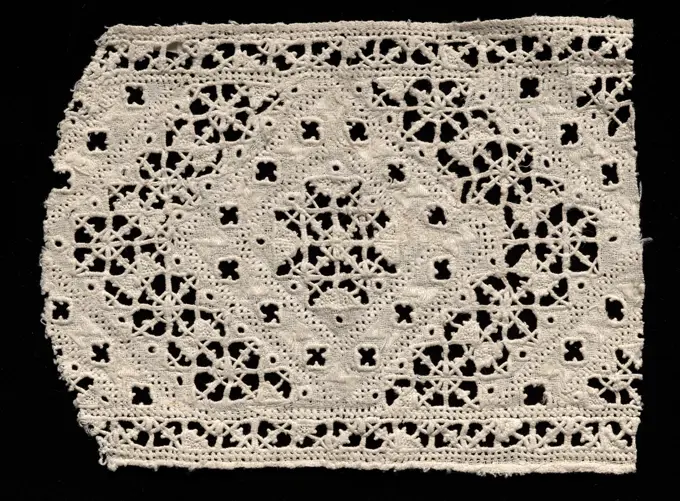
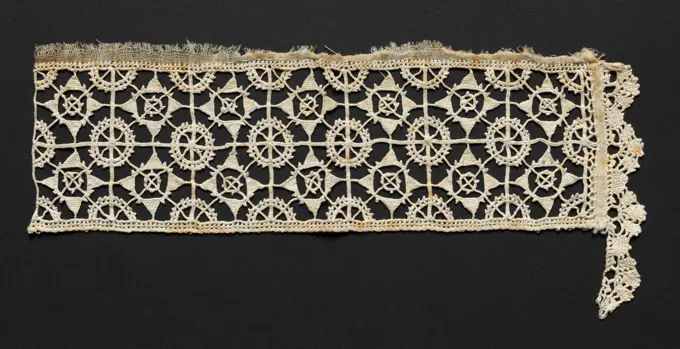
Delicate lace strips featuring intricate floral and geometric patterns, showcasing craftsmanship from various historical periods in lace making.
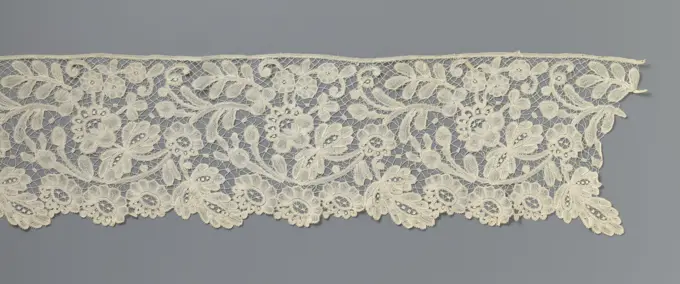
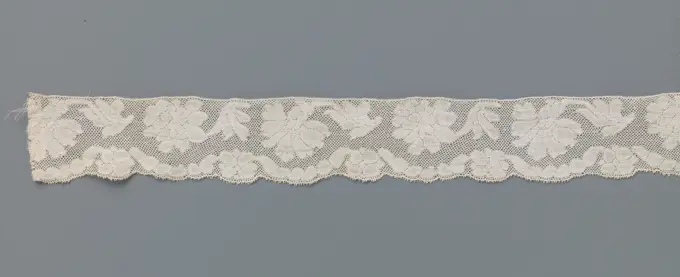
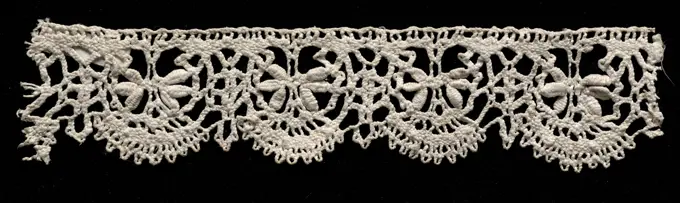
Strip of bobbin with three rosette flowers and a three -lobe leaf such as scum, anonymous, c. 1899 - c. 1900 Strip of natural -colored bobbin: fine bridge flower arrangements. The repeating pattern consists of three slanted oval rosette flowers and a large three -lobbish leaf along the lower edge. Above every three rosette flowers there is a curved stem with two rosette hips on one side and on the other hand a kink in the stem and rose hips targeted rosette flower on the end. A few leaves and smaller rosette flowers spring from this rosette flower. Above every shell that is formed by the three -lobe leaf, a rosette boom hangs down on a curved stem. The motifs are connected by a potented braid ground. The motifs are made in netslag and linen battle, with openwork edges and recesses. The motifs are equipped with thin to very thick contour threads and burst relative contours. In a part of the openwork petals or flower hearts, cubes are made in shape or in Linneslag. The top of the strip i
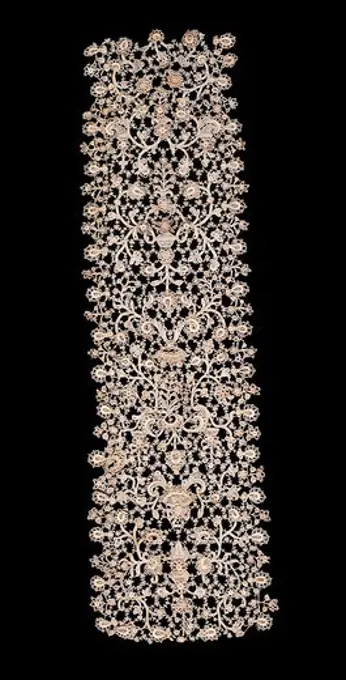
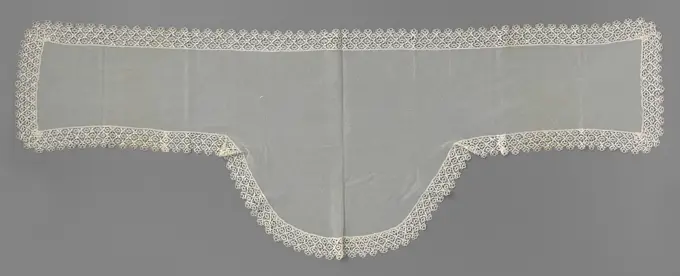
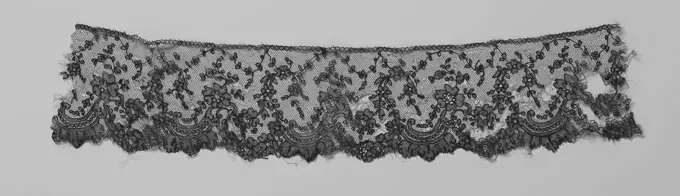
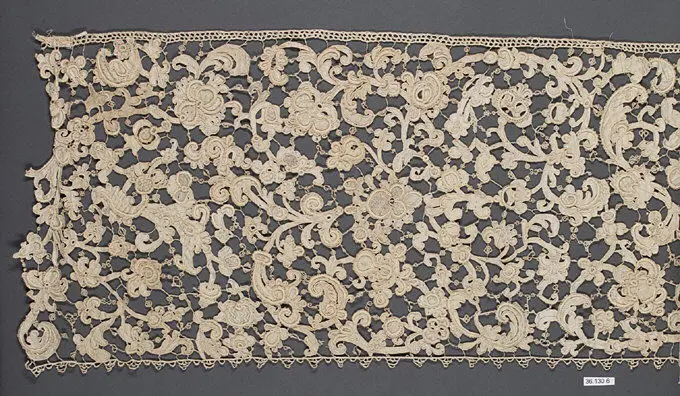
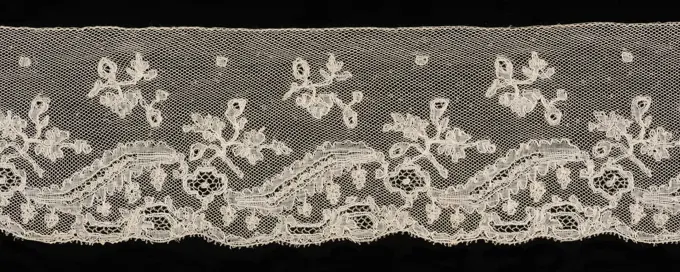
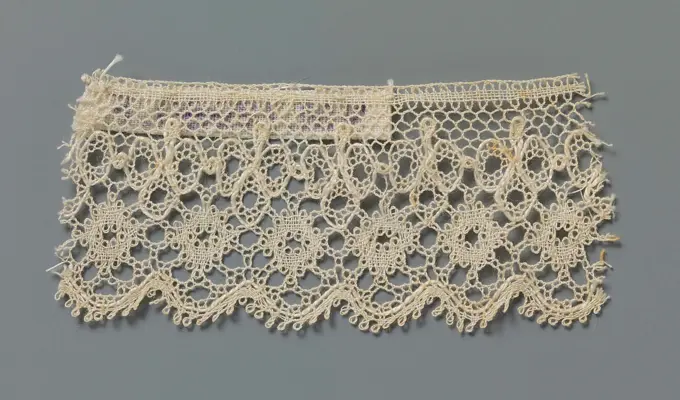
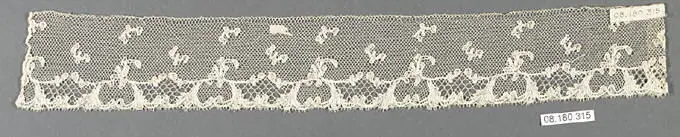
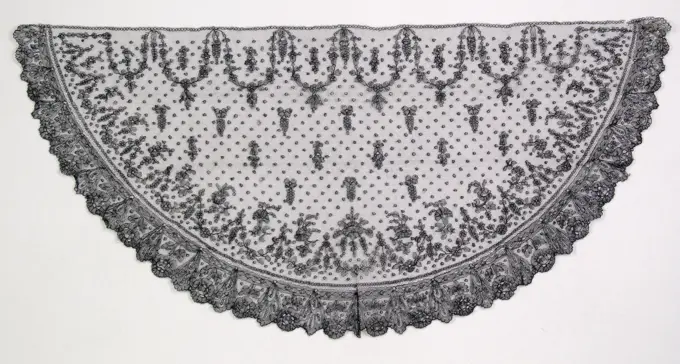
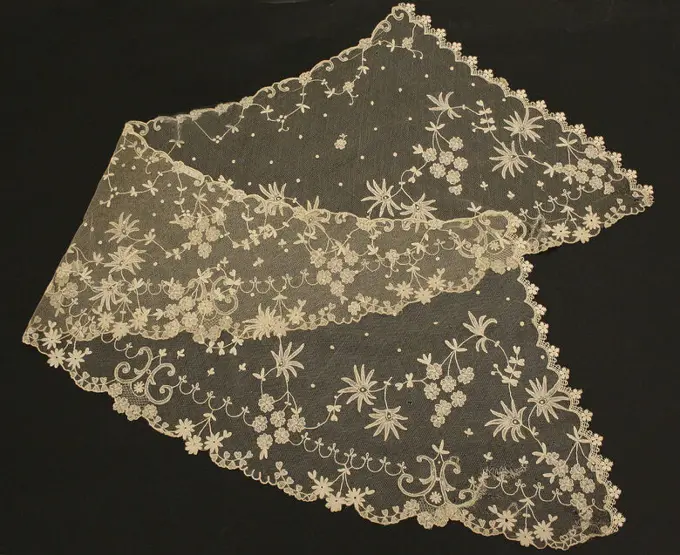
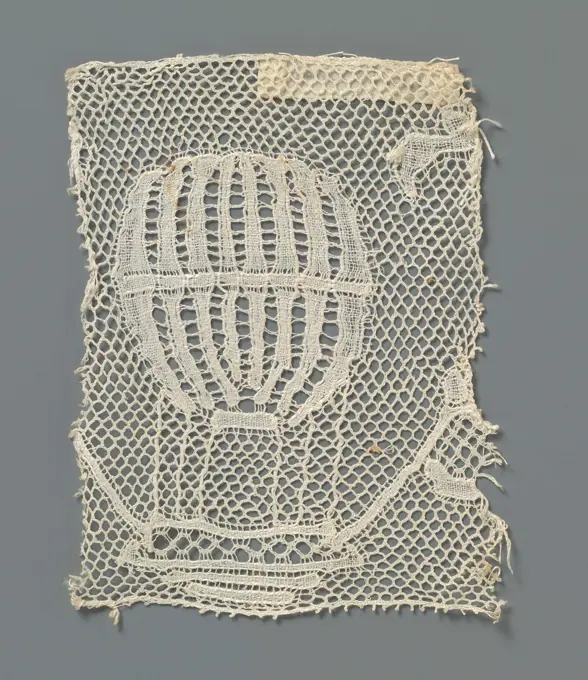
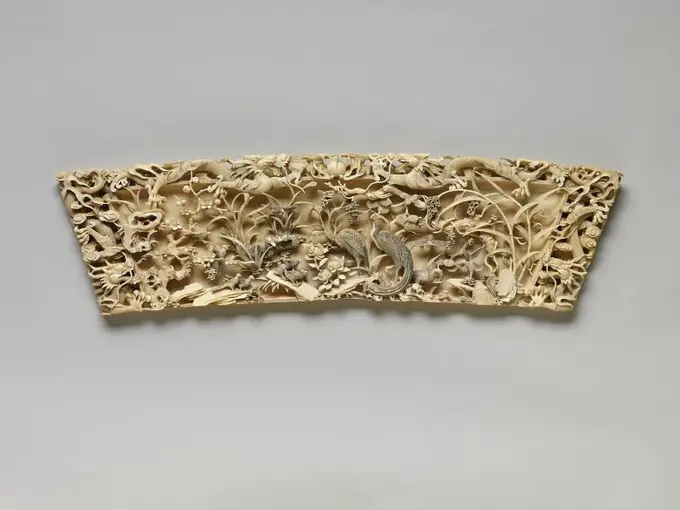
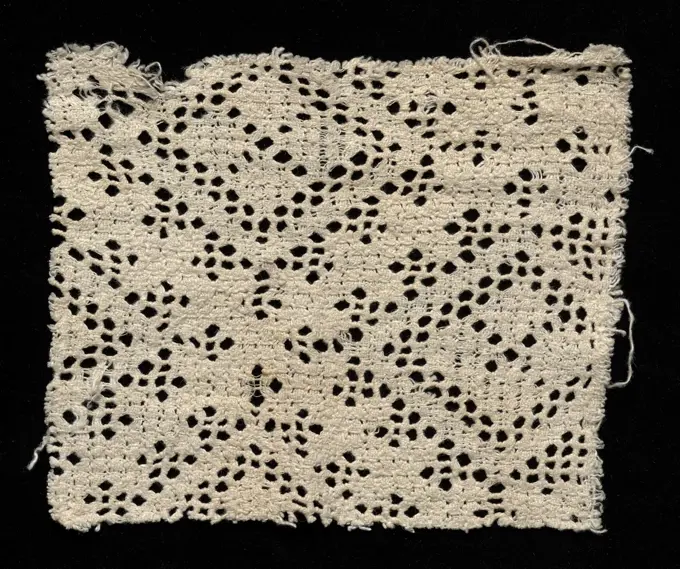
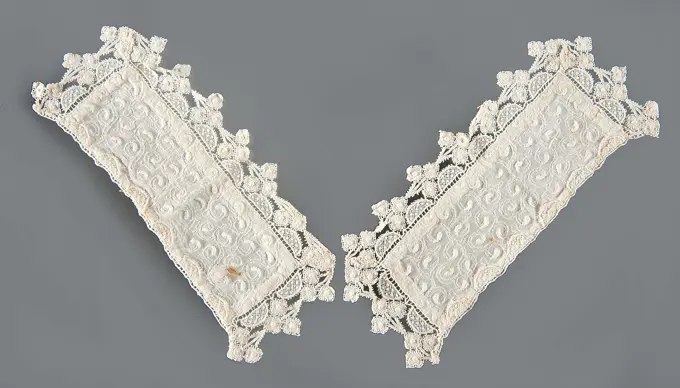
Veil: Carickmacross, 19th century. Ireland, 19th century. Machine made lace; average: 269.8 x 68.3 cm (106 1/4 x 26 7/8 in.).Strip bobbin with wavy strap, anonymous, c. 1880 - c. 1914 Strip of natural-colored bobbin, Valenciennes side. A wavy strap runs along the underside of the strip, which forms the silly regular scallops. Above the strip the strip consists of a mesh ground, a diamond-shaped Valenciennes-ground. The fullwork (the strap) is made in linen battle with openwork edges and a recess in the middle where crossing couples provide an ornamental filling. The top of the strip is straight finished. The scums along the bottom are finished with picots. Belgium cotton (textile) Bobbi Lace / Valenciennes Lace Strip of natural-colored bobbin, Valenciennes side. A wavy strap runs along the underside of the strip, which forms the silly regular scallops. Above the strip the strip consists of a mesh ground, a diamond-shaped Valenciennes-ground. The fullwork (the strap) is made in linen battle with openwork edges and a recess in the middle where crossing couples provide an ornamental filling. The top of the striCap streamers, Medium: linen Technique: bobbin lace, Mechlin ground, Cap streamers of Mechlin lace in a pattern showing a series of medallion compartments that are connected by volutes terminating in scrolls. Each medallion contains respectively: a winged cupid, prancing deer, a leaping rabbit set before a large tree and two architectural structures with a bird flying above, and a bird perched on a tree branch., Belgium, mid-18th century, lace, Cap streamersKloskant cuff with Margrietjes, Anonymous, c. 1900 - c. 1924 A coarse mesh stock (square Maas) with daisies above scoops of pearls. Valenciennes side. Sluis (Possible) linen (material) Bobbi Lace / Valenciennes Lace A coarse mesh stock (square Maas) with daisies above scoops of pearls. Valenciennes side. Sluis (Possible) linen (material) Bobbi Lace / Valenciennes LaceStrip bobbin with loose carnation and peony along the top edge, anonymous, c. 1760 - c. 1770 Strip of natural-colored bobbin, Valenciennes side. The repeating pattern along the upper edge consists of two large loose flowers, a carnation interspersed by a peony, each on a bent stem with leaf. The regularly wavy pendulum along the lower edge follows the shape of this flower pattern and always has a rosette flower as suspension points. The motifs are connected by a Maas soil, the Round Valenciennes ground. The motifs are made in linen battle with openwork edges. The scalloped underside stems from the pattern of the pendulum and is finished with picots. The top is straight. Valenciennes linen (material) Bobbi Lace / Valenciennes Lace Strip of natural-colored bobbin, Valenciennes side. The repeating pattern along the upper edge consists of two large loose flowers, a carnation interspersed by a peony, each on a bent stem with leaf. The regularly wavy pendulum along the lower edge follows theEdging 18th century Italian, Abruzzi. Edging 221133Edge, Medium: linen Technique: bobbin lace (Valenciennes ground), Band with scalloped edge and symetrical plants., Belgium, late 17th century, lace, EdgeLaces, 17th century. Point de neige (Punto Neve) needle lace barbola work, cm 98 x 34.Trimming; natural linen; Bequest of Marian Hague; 1971-50-334Fichu van machinale tule met een rand kloskant met sterretjes en kransjes.FICHU of natural machine tulle with an edge of natural colosside, cluny side. Elongated rectangular model, with a semi-circular widening on one long side. The clusted edge pattern consists of three staggered rows of stars and oval wreaths. Each star consists of four 'rays' or leaves made in shape stroke, the wreaths are made with a square grating. They are connected by a braid soil. The sloping edge along the outside consists of arcs to which three smaller arcs are always made with picoted braids.Fragment; linen; 1933-1-101Strook zwart kloskant met gebroken c-voluten.Strip of black climbing side: Chantilly side. An ongoing pattern exhibits alternately broken c-volutes with a leafscherp and a hanging flower branch, a side branch of which forms the other shell with four florets.BorderStrook naaldkant met slakkenhuis.Strip natural needle side: Venetian relief side. Despite repairs, an axis of symmetry can be recognized, on sides of which two large extending Arabesque leaves are drew towards each other. They shed with some branches on two snail-shaped small volutes, which are cut and stopped against the straight inside. Moreover, two tendrils from the same junction, which originate in two overhoeks placed irises.Length of Lace. Belgium, Mechlin, 1750-1775. Textiles; textile lengths. Linen bobbin laceFlounce ca. 1660 Italian, Venice. Flounce 226026Band; linen; 1933-1-164-bBobbin Lace 2, Medium: linen Technique: bobbin lace, Scallops of bobbin lace forming a border., Italy, 17th century, lace, Fragments, FragmentsBorder early 19th century Italian. Border 215063Border, Technique: bobbin lace, Bobbin lace border, symmetrical plant forms; early 18th century Brabant, early 18th century, lace, BorderBobbin Lace (Rose Lace) Edging of Bell Points, 17th century. Italy, Genoa, 17th century. Lace, bobbin; average: 3.5 x 17.2 cm (1 3/8 x 6 3/4 in.).Strip Application side with rosette flowers on lying leaf vine, anonymous, c. 1800 Strip natural -colored application side: Brussels bobbin lacquered on drochel soil. This type of lace is also known under the name: Point d'Angleterre. Spray pattern with open mosjes. Under the spreading pattern a horizontal leaf vank with rosette flowers. The rank is interrupted here and there. The fine sculpina along the lower edge consists of small oval medallions with zigzag. Motives with burst relief contours, so -called ribs. One kind of open decorative stitch. The top is trimmed with a border bobbin. Brussels linen (material) Brussels bobbin lace Strip natural -colored application side: Brussels bobbin lacquered on drochel soil. This type of lace is also known under the name: Point d'Angleterre. Spray pattern with open mosjes. Under the spreading pattern a horizontal leaf vank with rosette flowers. The rank is interrupted here and there. The fine sculpina along the lower edge consists of small ovaStrook kloskant met spiralen.Strip of dusk side of natural colosside, Russian or osteuropean side. On a ground of irregular braids there is an asymmetrical pattern of coarse spirals of smooth moldings, accompanied by edges of loops and winding ribbon. Straight (tree) - Ornaments form transverse dividing lines between the spirals. The strip may be intended as an intermediary.Fragment ca. 1800 Italian or French. Fragment 212435Insertion (For a Cover) Made 1610-1650 Italy. Linen, needle lace; embellished with glass beads; edged with bobbin straight lace .Strip bobbin with flour and flower bud on curved branch, anonymous, c. 1880 - c. 1910 Strip of natural-colored bobbin: Valenciennes side. The repeating pattern consists of a curved branch with a flower and a flower bud. The branch originates from the faintly scalloped edge along the bottom of the strip. Diagonally above each branch a loose leaf with pointed oval shape. The motifs are made in linen battle with openwork edges and are connected by a square Valenciennes ground. The top is finished with a straight edge. The short sides of the strip are sewn together. unknown linen (material) Bobbi Lace / Valenciennes Lace Strip of natural-colored bobbin: Valenciennes side. The repeating pattern consists of a curved branch with a flower and a flower bud. The branch originates from the faintly scalloped edge along the bottom of the strip. Diagonally above each branch a loose leaf with pointed oval shape. The motifs are made in linen battle with openwork edges and are connected by a square ValStrip knotted lace with three circles under a narrow straight job. Strip Natural-Colored Knotted Side: Chebka. Three Circles Under a Narrow Straight Job.Kloskant dress strip with the shield -shaped medallions, anonymous, c. 1850 Black bobbin jelly strip: Chantilly side. Closed motifs are grouped separately on an open mesh stock. On the junctions of the sculptes, three symmetrical shield-shaped medallions rise, which are caught in two pairs of C-volutes. Above the sculpts, a large flower feast is found above the medallions, with cracked petals as a crown. The inner edge is decorated with a chain of heart -shaped leaves. Bayeux (possibly) silk bobbin lace Black bobbin jelly strip: Chantilly side. Closed motifs are grouped separately on an open mesh stock. On the junctions of the sculptes, three symmetrical shield-shaped medallions rise, which are caught in two pairs of C-volutes. Above the sculpts, a large flower feast is found above the medallions, with cracked petals as a crown. The inner edge is decorated with a chain of heart -shaped leaves. Bayeux (possibly) silk bobbin laceSilk collar in Maltzer side decorated with seven Johanniter Kruizen, Anonymous, c. 1900 - c. 1910 Silk collar in Maltese Lace decorated with, among other things, seven Johanniter crosses and medallions with flower motifs. Lying round model with fifteen scallops. Malta silk Maltese lace Silk collar in Maltese Lace decorated with, among other things, seven Johanniter crosses and medallions with flower motifs. Lying round model with fifteen scallops. Malta silk Maltese laceEdging, Medium: linen Technique: bobbin lace, continuous braid-like, Band of six tabs with has rosettes., Italy, late 16th-early 17th century, lace, EdgingCuff (one of a pair). Culture: Italian. Dimensions: L. 11 x W. 4 inches27.9 x 10.2 cm. Date: 16th century. Museum: Metropolitan Museum of Art, New York, USA.Strip of a climbing side with coated diamonds made with braids. Strip natural colosside: sloping. Between two very narrow paths with a nozzle ground, an open network of braids form a row connected diamonds. At the bottom of the strip a slot edge is formed by arcs in a tire ride. The top of the strip is straight finished.Manchet van machinale kant met een vierkant raster en puntschulpen.Cuff from a strip crepe to which a wide edge mechanic side: machined work. Rectangular model with point shellars. The pattern consists of a grid of larger squares with a cross through diagonal and straight lines, framed by smaller squares with a circle between tension threads, like suns.Fragment of LaceFragment 17th-18th century Italian or French. Fragment 212938Lace, 1800s, France, maker unknown. Gift of Mrs G. Acland Allen, 1955.Strook gemengde kant met brede spiraalrank.Strip natural-colored mixed side: Milanese side (dick edge) with a needle lace ground. On a Maas soil (coniferous lace) is a splitting pattern that consists of wide curly stems with exotic flowers. The contours of the flowers and stems consist of closted ribbons. Different ornamental grounds have been applied within the contours. A splitting bow border serves as a finish along the outer sides, with the exception of one short side that is finished with a straight splitting strap.Piece 17th century Italian. Piece. Italian. 17th century. Needle lace. Textiles-LacesBobbin Lace Edging, 18th century. France, Valenciennes or Flanders, 18th century. Lace, bobbin: linen; average: 3.2 x 8.3 cm (1 1/4 x 3 1/4 in.).Border; linenStrook kloskant met een rij cirkeltjes onder een rij klavertjes drie.Strip natural colosside, Buckingham side. The repeating pattern consists of three-switched clovers three, which stolves down to a stalk. There is a row of cables under the clips. Above the clovers a narrow job is made with a maas soil, a tulet. This includes the strip from an ornamental ground, a rose ground in which the clovers are made with thick and shiny contour wires. The circles are made in linen stroke, with a small recess in the middle and without contour wires. Also the very narrow band that runs along the bottom of the strip is made in linen stroke and is accentuated by a shiny contour wire. The strap is already wavy, under every circle of a hemisphere shult, which is finished with picots. The top of the strip is straight finished.Fragment 17th century Italian. Fragment 212358Border (England); linen; Repeat: 3.5 in.; 1945-9-6Needlepoint (Burano Point) Lace Edging, 20th century. Italy, Burano, 20th century. Lace, needlepoint: linen; average: 15.3 x 42.6 cm (6 x 16 3/4 in.).Fragment late 18th century French, Chantilly. Fragment 214668Veil 1840-60 French. Veil 168319Medallion Insert Made 1850-1875 Belgium. Cotton, bobbin part lace .Band 16th century Italian. Band 221453Piece French 19th centuryBorder (possibly Belgium); linenTwo hat slips (barbes) of needle side, anonymous, c. 1775 Two pussy slips of needle side. The pattern consists of winding flower branches with leaves, berries, rosettes and medallions. The top and bottom edge with picots differ from each other. The ends are round. Alençon linen (material). Alençon Lace Two pussy slips of needle side. The pattern consists of winding flower branches with leaves, berries, rosettes and medallions. The top and bottom edge with picots differ from each other. The ends are round. Alençon linen (material). Alençon LaceFragment, Medium: linen Technique: withdrawn element with needlemade filling stitches, Narrow insertion in a geometric design based on the square and diagonal. Small squares separated by heavy diagonal lines., Italy, 16th century, lace, FragmentEdging 17th century Italian, Venice. Edging 221095Bobbin Lace Edging, 16th-17th century. Spain, Huelva, 16th-17th century. Lace, bobbin; average: 6.4 x 13.1 cm (2 1/2 x 5 3/16 in.).Shawl. Culture: Belgian. Date: 1860-70.Point de gaze lace produced in Belgium was highly valued in the second half of the 19th century. A signature characteristic is the two-dimensional rose motif which adds surface interest. Often lace pieces of this size combine handmade motifs with machine-made net grounds, but this is completely handmade. It would have been extremely expensive to produce, considering the sheer size of the piece, the density of the motifs and the time required to work it all by hand. It is a premier example of mid-19th century lace-making. Museum: Metropolitan Museum of Art, New York, USA.Needlepoint (Cutwork) Lace Insertion, 16th century. Italy, Venice, 16th century. Lace, needlepoint: linen; average: 14.7 x 19.4 cm (5 13/16 x 7 5/8 in.).Strip 18th century Greek, Corfu. Strip 214373Strip Application side with rosette flowers on lying leaf vine, anonymous, c. 1800 Strip natural -colored Brussels Application side: Brussels Kloskant Applicated on Drochelgrond. Spray pattern with open mosjes. Under the spreading pattern a horizontal leaf vank with rosette flowers. The rank is interrupted here and there. The fine sculpina along the lower edge consists of small oval medallions with zigzag. Motives with burst relief contours, so -called ribs. One kind of open decorative stitch. The top is trimmed with a border bobbin. Brussels linen (material) Brussels Applied Strip natural -colored Brussels Application side: Brussels Kloskant Applicated on Drochelgrond. Spray pattern with open mosjes. Under the spreading pattern a horizontal leaf vank with rosette flowers. The rank is interrupted here and there. The fine sculpina along the lower edge consists of small oval medallions with zigzag. Motives with burst relief contours, so -called ribs. One kind of open decorative stitch. TRond kleedje van achthoekig batist met rondom een brede rand kloskant met harten gevormd door omkrullende bloemranken.Natural batist dress with climbing side around a wide edge: ribbon side. Round model with a small octagonal scalloped batist interior. The lace pattern consists of curly flower drinks formed by narrow ribbons and is symmetrical relative to one center axle. The tendrils form a heart along two opposite sides of the Batist. The curls end alternately in a rosette flower or a pear-shaped flower, with a saved flower heart. The motifs are made in linen stroke and are connected by a braid soil. Part of the petals is made in a lift stroke. The sloping edge along the outer edge of the dress stems from the pattern and is finished with a narrow ribbon with picots.Strip bobbin with rush-hour dual zigzag line, anonymous, c. 1800 - c. 1899 Strip of natural -colored bobbin: tie. The repeating pattern consists of a double zigzag line between which a chain of connected diamond-shaped fields is created. In each field there is always one Spitsovaal, which is connected to the zigzag lines with crossing couples. Also in the corners under and above the lines there is always one rush -hour. These rush -hour trips are interconnected with a traly land: a coarse litter. Along the underside of the strip, a scrap edge is formed by an alternation of a heart -shaped motif and a hanging fan -shaped motif. The zigzag lines, rush-hour and fan-shaped motifs are made in linen battle. The heart -shaped motifs are made alternately in linen and in netslag. The top of the strip is straight finished. Italy linen (material) Bobbi lace / lace cloth Strip of natural -colored bobbin: tie. The repeating pattern consists of a double zigzag line between which a chain of connectedBorder mid-17th century Italian, Venice. Border 218050three scanned lace design strips Valenciennes lace handkerchief, circa 1900, Europe, maker unknown. Gift of Dr Tom Farrar, 2010.Insert of dick edge in lobed diamond shape with rosary branch. Insert of natural colosside, valenciennes side. Diamond-shaped with lobes. The pattern consists of a slightly curved branch with spitsoval leaves between which one rose. The rose is made in a maas soil, a diamond-shaped valenciennes ground, with one mesh top and bottom. The motifs are made in linen battle with openwork edges and recesses. A strap runs along the outer edge.Cuff made of glass batist, with transhipment, decorated with lace and whitework, anonymous, c. 1870 - c. 1880 Glasbatist cuff, with transhipment, with a white-decorated Entre-Deux between a border and a strip of Valenciennes side. Netherlands . Valenciennes lace Glasbatist cuff, with transhipment, with a white-decorated Entre-Deux between a border and a strip of Valenciennes side. Netherlands . Valenciennes laceCollar early 19th century American. Collar 98089Border 16th-17th century Italian. Border 218032Border Fragment 17th-18th century Italian. Border Fragment. Italian. 17th-18th century. Linen. Textiles-LacesEurope, Belgium, Bruges Kantcentrum, famous lace center; sample of handmade lace, detailBobbin Lace (Needlepoint Design) Insertion, second half of 16th century. Italy, Genoa, second half of 16th century. Lace, bobbin; average: 4.5 x 33.4 cm (1 3/4 x 13 1/8 in.).Edging 17th century Italian, Venice. Edging 221026A bunny (fich) with white lace;  19th/20th century (1890-00-00-1910-00-00);Siercraft for an evening mantle of mixed side with rose hedge, Martha Berkers, 1915 Ornamental piece for an evening mantle of natural -colored mixed side - bobbin in combination with needle side - Brussels Duchesse. There are roses on a wide -spread braid that usually support on two leaves. An intermediate ornament consists of single and double volutes and many small flowers. Lock linen (material) mixed lace / mixed Brussels Ornamental piece for an evening mantle of natural -colored mixed side - bobbin in combination with needle side - Brussels Duchesse. There are roses on a wide -spread braid that usually support on two leaves. An intermediate ornament consists of single and double volutes and many small flowers. Lock linen (material) mixed lace / mixed BrusselsCuff late 17th century Italian Punto in arialiterally, "stitches in the air"is one of the earliest styles of needle lace, which is itself developed from cutwork of primarily geometric design. When lacemakers transitioned to using a foundation of threads laid out according to a pattern drawn on parchment, they were able to incorporate more fluid lines and curves into their designs.. Cuff 212419Veil;  19th century (1801-00-00-1900-00-00);Fragment, Making Bobbin Lace; Made for Cooper Union Museum; linenBertha. Culture: American. Date: 1700-1942. Museum: Metropolitan Museum of Art, New York, USA.Strip of a climbing side with hot air balloon. Strip natural colosside: Antwerp side. On the briefly cut strip, an air balloon can be seen, which is originally part of a larger pattern that has been cut. The balloon is made in a grille, a Valenciennes ground. The motifs are made in linen stroke with openwork edges and thicker, shiny contour wires. Between the clutched stripes in the balloon, standing couples and single fat handles ensure an adorning effect in the openwork stripes. In the upper part of the basket is used as ornamental ground a snowflakes soil (with elongated and square spiders / snowflakes) in an octagonal pattern. Upper and bottom of the strip are straight finished, the underside with picots.Cap fragment, Medium: silk Technique: bobbin lace, English style, Cap fragment of black Honiton lace in a design showing the shamrock, rose and thistle for England, Ireland and Scotland., England, 19th century, lace, Cap fragmentPlaque with dragon, pheasant, quail, and other birds amidst bamboo and plum blossom. Culture: China. Dimensions: H. 6 1/8 in. (15.6 cm); W. 21 1/2 in. (54.6 cm); D. 7/8 in. (2.2 cm). Date: late 19th century.This large two-sided plaque showcases the skill of ivory carvers in the eighteenth century. Four powerful dragons crawl along the edges, and a host of plants, flowers, and birds (including pheasants and quails) are beautifully carved on one side. The depth of the carving--the flowers and birds are nearly three-dimensional--is typical of the eighteenth century, as is the use of ink to enhance select elements. A scene showing figures performing everyday activities in a landscape is incised into the other side of the plaque, which also has a six-character mark that indicates that the plaque was inspired by works produced during the reign of the Qianlong emperor. Museum: Metropolitan Museum of Art, New York, USA.Needlepoint (Drawnwork) Lace Fragment, 17th century. Spain, 17th century. Lace, needlepoint: linen; average: 10.8 x 13.4 cm (4 1/4 x 5 1/4 in.).Detail of traditional embroiders cloth. Berat upper citadel old walled city. Albania, Balkan, Europe.Flounce Fragment (Belgium); linenCurtainTwo -part collar;  1st half 20th century (1901-00-00-1950-00-00);Magdalena, Witwińska, Fashion accessories, gift (provenance), collar, clothing, women's clothesPanel of Kincob cloth, 19th century, L.33 x W.27-1/2 in., metal cloth and silk, India, 19th centuryPair of cuffs 17th century Italian. Pair of cuffs 214836Bertha 19th century Italian. Bertha 102595Edging 17th century Italian, Genoa. Edging 220984Valenciennes lace handkerchief handkerchiefs, ValenciennesFragment (Italy); linenStrip bobbin with six -sided medallions, anonymous, c. 1855 - c. 1869 Strip of natural -colored bobbin: Mechelse side. On a fine grid, a Mechelen soil (also known as ice soil), with some rows at the top of moesjes, there is a symmetrical pattern that is more closed along the scallop of the sculpin. Angly drawn arches of 'Spoorrils' are accompanied by a fine pendulum and three wingerd leaves, which form the pointed sculpts. Standing hexagonal medallions, the hollow sides of which have doubled and wearing a leaf crown form the final pieces of the arches. There is a rose above the arches. Ieper (possibly) linen (material) bobbin lace / Mechlin (lace) Strip of natural -colored bobbin: Mechelse side. On a fine grid, a Mechelen soil (also known as ice soil), with some rows at the top of moesjes, there is a symmetrical pattern that is more closed along the scallop of the sculpin. Angly drawn arches of 'Spoorrils' are accompanied by a fine pendulum and three wingerd leaves, which form the poinBorder Made 1765-1775 Valenciennes. Linen, bobbin straight lace of a type known as Valenciennes with a round Valenciennes mesh ground .Border of cutwork and needle lace late 16th-early 17th century Italian Punto in arialiterally, "stitches in the air"is one of the earliest styles of needle lace, which is itself developed from cutwork of primarily geometric design. When lacemakers transitioned to using a foundation of threads laid out according to a pattern drawn on parchment, they were able to incorporate more fluid lines and curves into their designs.. Border of cutwork and needle lace. Italian. late 16th-early 17th century. Cutwork, needle lace, punto reale, punto riccio, punto in aria, reticello, linen. Textiles-LacesRound collar with staggered spit tower motifs and edge of stylized flowers, anonymous, 1930 Round collar with staggered spit tower motifs and edge of stylized flowers. Netherlands cotton (textile) crocheting Round collar with staggered spit tower motifs and edge of stylized flowers. Netherlands cotton (textile) crochetingFragment of needle lace, maker unknown. Gift of Dr Tom Farrar, 2010.crocheted easter decoration in egg shape showing a daffodilStrook zwarte machinale kant met ruitvormige cartouches.Strip black machine side: machining chantilly-side. The repetitive and virtually symmetrical pattern exists slightly below the center line of the strip from a concatenation of diamond-shaped cartouches. Each window is crowned by a narrow veer-shaped leaf on c-volutes. Between the windows a leaf garland hangs with one rosette flower and a loose rose roof above and mates. At the bottom is behind the windows along a straight horizontal job. On this runway hang three longer-term half oven with dots between the successive windows. On every half oval a straight down hanging spring-shaped leaf or ear of corn, alternately with and without round recesses in the middle. The motifs are connected to each other by machining. The slot edge consists of narrow deep scallops and are formed by the hanging corners. A part of the underside with the spring-shaped leaves is cut and probably used to finish the short sides of associated strip with numberBand 17th-18th century possibly German. Band 217768Needlepoint (Reticella) and Bobbin Lace Insertion and Edging, 16th century. Italy, Venice, 16th century. Lace, needlepoint and bobbin: linen; overall: 10.8 x 24.1 cm (4 1/4 x 9 1/2 in.).