My Boards
View Pictures
  • My Boards

Apollo 11 Moon Mission

Historic images of the Apollo 11 moon landing, featuring astronauts conducting experiments and exploring the lunar surface.

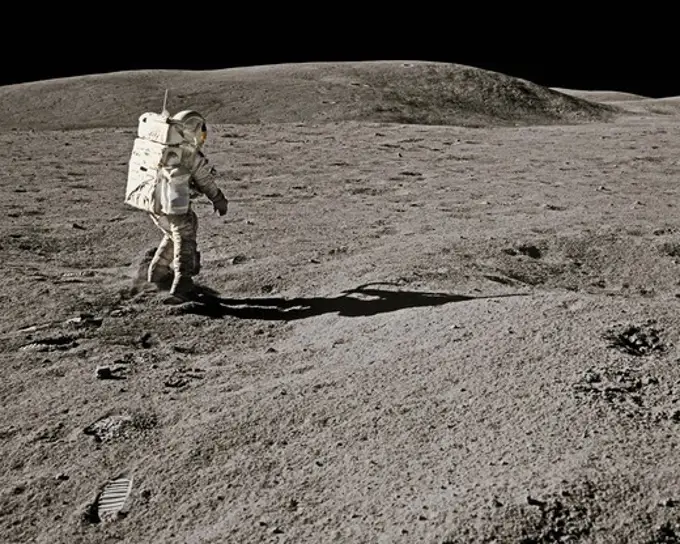
An Apollo 16 Astronaut Walks the Barren Moon
143 assets in this story
6145-45256615
b Join NASA's Google+ Hangout on Friday, December 20th 2 00 - 3 00 PM (EST) at a href= http //go.nasa.gov/18S2TbC rel= nofollow go.nasa.gov/18S2TbC /a /b It was 45 years ago, on December 24, 1968 when Apollo 8 astronauts captured 'Earthrise' - the first color photograph of Earth taken by a person in lunar orbit. NASA announces a new simulation of the events leading to the creation of 'Earthrise,' one of the iconic photographs of the 20th Century - Earth seen from the moon captured by the crew of Apollo 8. This new simulation allows anyone to virtually ride with the astronauts and experience the awe they felt at the vista in front of them. Apollo 8 Commander Frank Borman and crew members William A. Anders and James A. Lovell photographed the stunning scene as their spacecraft orbited the moon on December 24, 1968. The new computer simulation was created using data from NASA's Lunar Reconnaissance Orbiter, or LRO, spacecraft and includes details not seen in the previous visualization rel
4409-2429
Astronaut Apollo 11 walking on Lunar surface, 1969.
6145-45298492
(Left) Apollo 12 astronaut Charles Pete Conrad Jr. stands beside NASA's Surveyor 3 spacecraft; the lunar module Intrepid can be seen in the distance. Apollo 12 landed on the Moon's Ocean of Storms on Nov. 20, 1969. (Right) Mars 2020 rover, seen here in an artist's concept, will make history's most accurate landing on a planetary body when it lands at Mars' Jezero Crater on Feb. 18, 2021.
6177-V53858700
6176-67041054
Armstrong and Aldrin unfurl the US flag on the moon, 1969. Artist: Unknown
4186-70019200
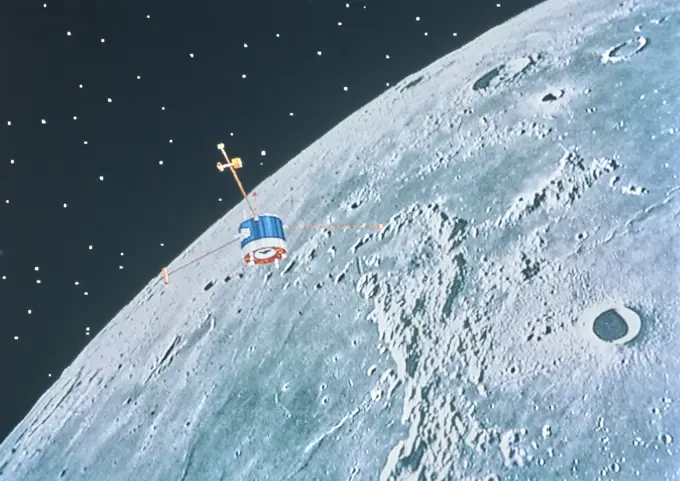
Vintage Photograph. LOCKHEED'S LUNAR PROSPECTOR A LOW-COST LUNAR PROBE. Space probe orbiting the moon's surface under a starry sky.
6145-45297219
AS16-113-18289 (16-27 April 1972) --- Earth rises over the lunar horizon, with the Apollo 16 Command and Services Modules (CSM) to the left of Earth. This photograph was taken from the Lunar Module (LM) Orion before the two Apollo 16 spacecraft re-joined following the CSM's failure to make the circularization burn on April 20, 1972. Astronaut Thomas K. Mattingly II, command module pilot, was inside the CSM Casper , while astronauts John W. Young, commander, and Charles M. Duke Jr., lunar module pilot, were manning the LM. While astronauts Young and Duke descended in the LM to explore the Descartes region of the moon, astronaut Mattingly remained with the CSM in lunar orbit.
6145-44755755
AS16-107-17442 (22 April 1972) --- A close-up view of the Apollo 16 Cosmic Ray Detector (CRD) experiment deployed at the +Y strut of the Lunar Module (LM). The crewmembers moved it to this position from near the deployment site of the Apollo Lunar Surface Experiments Package (ALSEP) because, in the words of astronaut John W. Young, commander, The panels were getting a little warm. Note that the LM did not skid upon landing, as evidenced by the landing contact probe's folded back (neatly) position and the lack of skid marks. While astronauts Young, and Charles M. Duke Jr., lunar module pilot; descended in the Apollo 16 Lunar Module (LM) Orion to explore the Descartes highlands landing site on the moon, astronaut Thomas K. Mattingly II, command module pilot, remained with the Command and Service Modules (CSM) Casper in lunar orbit.
4389-341
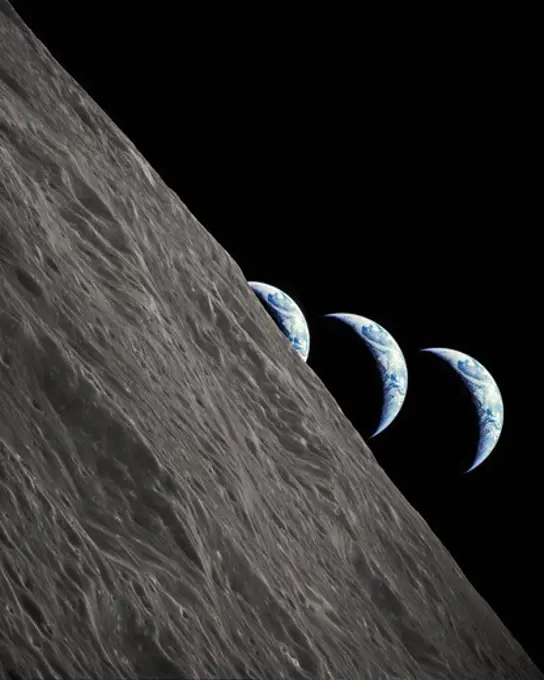
Apollo 17 - The Crescent Earth Rises
6145-44717760
S71-41501 (1 Aug. 1971) --- Astronaut David R. Scott, Apollo 15 commander, is seen carrying the Apollo Lunar Surface Drill (ALSD) during the second lunar surface extravehicular activity (EVA) in this black and white reproduction taken from a color transmission made by the RCA color television camera mounted on the Lunar Roving Vehicle (LRV). This transmission was the fourth made during the mission.
6145-44618644
The second manned lunar landing mission, Apollo 12, launched from launch pad 39-A at Kennedy Space Center in Florida on November 14, 1969 via a Saturn V launch vehicle. The Saturn V vehicle was developed by the Marshall Space Flight Center (MSFC) under the direction of Dr. Wernher von Braun. Aboard Apollo 12 was a crew of three astronauts Alan L. Bean, pilot of the Lunar Module (LM), Intrepid; Richard Gordon, pilot of the Command Module (CM), Yankee Clipper; and Spacecraft Commander Charles Conrad. The LM, Intrepid, landed astronauts Conrad and Bean on the lunar surface in whats known as the Ocean of Storms while astronaut Richard Gordon piloted the CM, Yankee Clipper, in a parking orbit around the Moon. Lunar soil activities included the deployment of the Apollo Lunar Surface Experiments Package (ALSEP), finding the unmanned Surveyor 3 that landed on the Moon on April 19, 1967, and collecting 75 pounds (34 kilograms) of rock samples. This is the twenty-fifth of 25 images captured by
4239R-531
Artist's concept of a view across the surface of the Moon towards Earth in the distance
6145-44520033
AS12-50-7431 (19 Nov 1969) --- This low oblique view, taken from the Apollo 12 spacecraft, is looking toward the southeast and it shows the highland area around the large crater Ptolemaeus (right center). Herschel is the terraced crater with central peaks in center of photo.
6145-44717665
S71-38189 (26 June 1971) --- An artist's concept showing the final steps of readying the Apollo 15 Lunar Roving Vehicle (LRV) or Rover 1 for mobility on the lunar surface. Performing the last few LRV deployment tasks here are, left to right, astronauts James B. Irwin, lunar module pilot, and David R. Scott, commander. More specifically the tasks depicted here include the setting up of the seats and the total releasing of the LRV from the LM. (This is the fourth in a series of four Grumman Aerospace Corporation artist's concepts telling the lunar surface LRV deployment story for Apollo 15).
6145-44684060
The first manned lunar landing mission, Apollo 11, launched from the Kennedy Space Center (KSC) in Florida via the Marshall Space Flight Center (MSFC) developed Saturn V launch vehicle on July 16, 1969 and safely returned to Earth on July 24, 1969. Aboard the space craft were astronauts Neil A. Armstrong, commander; Michael Collins, Command Module (CM) pilot; and Edwin E. (Buzz) Aldrin Jr., Lunar Module (LM) pilot. The CM, piloted by Michael Collins, remained in a parking orbit around the Moon while the LM, named Eagle’’, carrying astronauts Armstrong and Aldrin, landed on the Moon in the Sea of Tranquility. The LM was a two part spacecraft. Its lower or descent stage had the landing gear, engines, and fuel needed for the landing. When the LM blasted off the Moon, the descent stage served as the launching pad for its companion ascent stage, which was also home for the two astronauts on the surface of the Moon. The LM was full of gear with which to communicate, navigate, and rendezvous
4389-141
The Moon's Crater Copernicus
1838-51330357
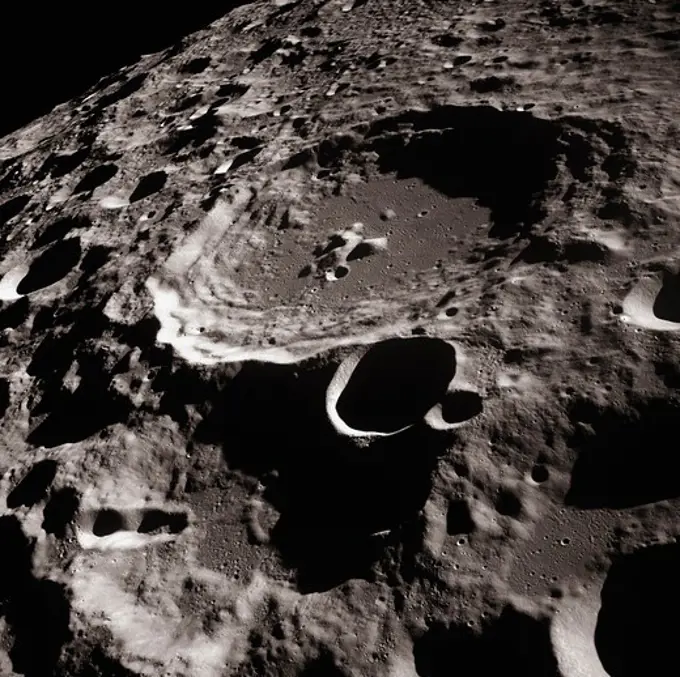
View of  back side of Moon in vicinity of Crater No. 308 taken during Apollo 11 mission, Marshall Space Flight Center, NASA, July 20, 1969
6188-58104683
lunar landing mission on the Moon lunar landing mission on the Moon Copyright: xZoonar.com/StanislavxRishnyakx 14361603
6177-V54015889
1525-57473472
cool pictures of astronauts on the moon
4239R-526
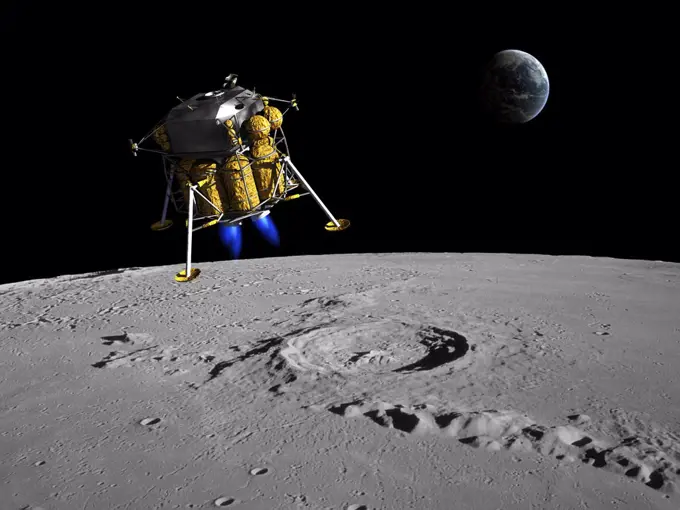
A lunar lander begins its descent to the moon's surface from an altitude of 40,000 feet
6145-44717762
S71-41511 (2 Aug. 1971) --- The Apollo 15 Lunar Module (LM) Falcon is seen only seconds before ascent stage liftoff in this color reproduction taken from a transmission made by the RCA color television camera mounted on the Lunar Roving Vehicle (LRV). The LRV was parked about 300 feet east of the LM. The LRV-mounted TV camera, remotely controlled from the Mission Control Center (MCC), made it possible for people on Earth to watch the LM's launch from the moon. The LM liftoff was at 171 37 ground elapsed time. The Falcon ascent stage, with astronauts David R. Scott, commander; and James B. Irwin, lunar module pilot, aboard, returned from the lunar surface to rejoin the Command and Service Modules (CSM) orbiting the moon. Astronaut Alfred M. Worden, command module pilot, remained with the CSM in lunar orbit while Scott and Irwin explored the moon. The LM descent stage is used as a launching platform and remains behind on the moon. This is part one of a four-part sequence.
6145-29241226
Buzz Aldrin on the Moon with Components of the Early Apollo Scientific Experiments Package 1969 Neil Armstrong. Buzz Aldrin on the Moon with Components of the Early Apollo Scientific Experiments Package. Neil Armstrong (American, Wapakoneta, Ohio 1930-2012 Cincinnati, Ohio). 1969. Chromogenic print. National Aeronautics and Space Administration (NASA). Photographs
6145-45297427
AS16-120-19273 (April 1972) --- King Crater as photographed from the Apollo 16 spacecraft in lunar orbit.
6145-44620959
In this Apollo 17 onboard photo, Mission Commander Eugene A. Cernan adjusts the U.S. flag deployed upon the Moon. The seventh and last manned lunar landing and return to Earth mission, the Apollo 17, carrying a crew of three astronauts Cernan; Lunar Module pilot Harrison H. Schmitt; and Command Module pilot Ronald E. Evans, lifted off on December 7, 1972 from the Kennedy Space Flight Center (KSC). Scientific objectives of the Apollo 17 mission included geological surveying and sampling of materials and surface features in a preselected area of the Taurus-Littrow region, deploying and activating surface experiments, and conducting in-flight experiments and photographic tasks during lunar orbit and transearth coast (TEC). These objectives included Deployed experiments such as the Apollo lunar surface experiment package (ALSEP) with a Heat Flow experiment, Lunar seismic profiling (LSP), Lunar surface gravimeter (LSG), Lunar atmospheric composition experiment (LACE) and Lunar ejecta and me
4048-8571
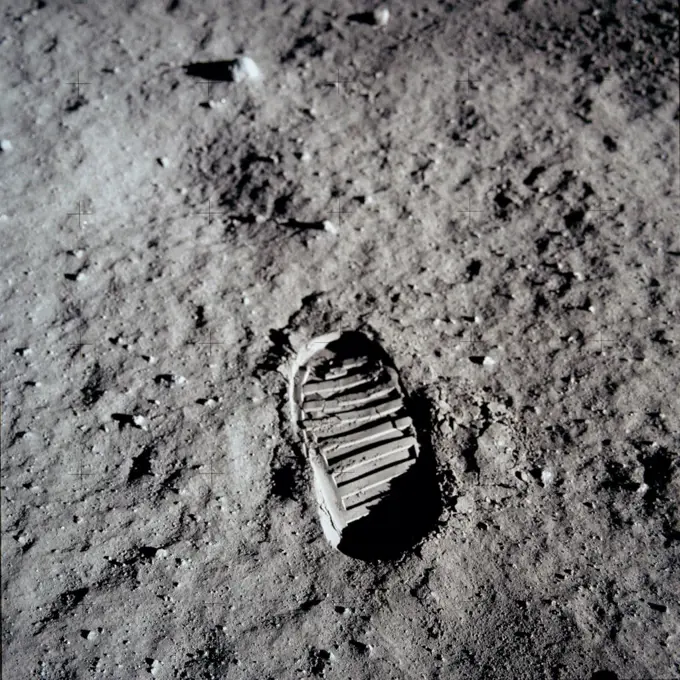
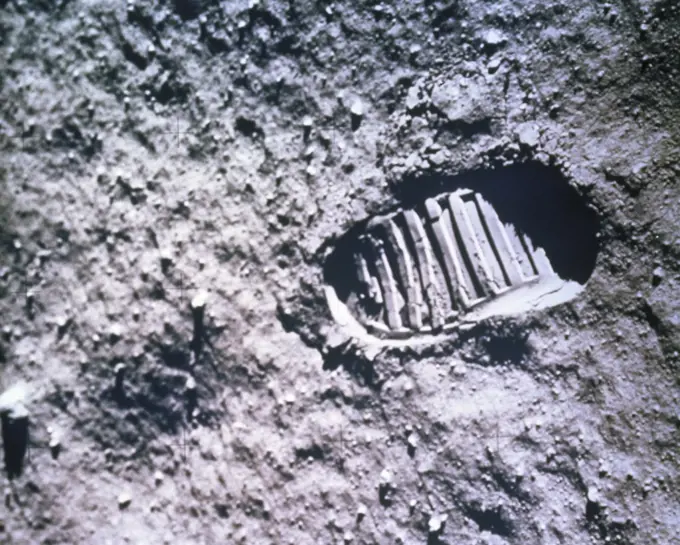
Apollo 11 boot print on the Moon. July 20, 1969.
1525-57473475
cool pictures of astronauts on the moon
6145-45234422
AS17-140-21438 (7-19 Dec. 1972) --- This 70mm frame features a close-up view of a large multi-cracked boulder discovered by astronauts Eugene A. Cernan, commander, and Harrison H. (Jack) Schmitt, lunar module pilot, during their visit to extravehicular activity (EVA) Station 6. This boulder, referred to as number two, provided several samples for the crew members' record-setting volume of rock collections. While astronauts Cernan and Schmitt descended in the Lunar Module (LM) Challenger to explore the Taurus-Littrow region of the moon, astronaut Ronald E. Evans, command module pilot, remained with the Command and Service Modules (CSM) America in lunar orbit. Cernan and Schmitt were the last crew members to explore the moon in the Apollo Program.
1525-28074884
lunar landing mission on the Moon
6145-45238981
AS11-37-5445 (20 July 1969) --- The Apollo 11 Command and Service Modules (CSM) are photographed from the Lunar Module (LM) in lunar orbit during the Apollo 11 lunar landing mission. The lunar surface below is in the north central Sea of Fertility. The coordinates of the center of the picture are 51 degrees east longitude and 1 degree north latitude. About half of the crater Taruntius G is visible in the lower left corner of the picture. Part of Taruntius H can be seen at lower right.
1570R-130664
A footprint on the moon
1574R-017997A
Astronaut Footprint on the Moon  Apollo 11 Mission July 20, 1969
4239R-20480087
This is a view of the large crater Tsiolkovsky as photographed by the astronauts during the Apollo 8 lunar orbit mission, looking East toward the lunar horizon. Tsiolkovsky is approximately 150 statute miles in diameter.
6177-V53836867
1746-28999688
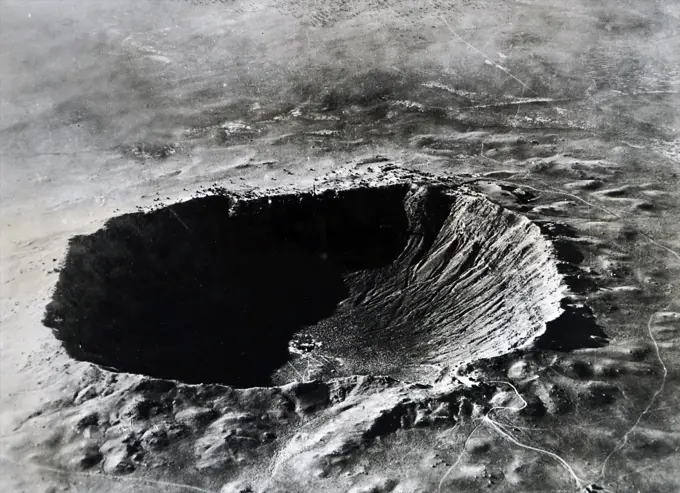
Photograph of the Arizona meteor crater. Meteor Crater is a meteorite impact crater approximately 37 miles (60 km) east of Flagstaff and 18 miles (29 km) west of Winslow in the northern Arizona desert of the United States. Dated 20th Century
6145-44755754
AS16-106-17413 (23 April 1972) --- Astronaut John W. Young, commander of the Apollo 16 lunar landing mission, looks over a large boulder at Station No.13 during the third Apollo 16 extravehicular activity (EVA) at the Descartes landing site. This was the site of the permanently shadowed soil sample which was taken from a hole extending under overhanging rock. Astronaut Charles M. Duke Jr., lunar module pilot, took this photograph. Concerning Young's reaching under the big rock, Duke remarked You do that in west Texas and you get a rattlesnake!
6145-58961180
KENNEDY SPACE CENTER, FLA. - At the Museum of Science and Industry (MOSI) in Tampa, a student from one of NASAs Explorer Schools, Stewart Middle School in Tampa, tries her hand at an interactive exhibit. The students are at MOSI to view the space exhibit Space A Journey to Our Future, an extraordinary, interactive exhibition designed to entertain, educate and inspire. Another exhibit is SPACE STATION, the first cinematic journey to the International Space Station (ISS), where audiences can experience for themselves life in zero gravity aboard the new station.
6145-44904739
Project LOLA. Test subject sitting at the controls: Project LOLA or Lunar Orbit and Landing Approach was a simulator built at Langley to study problems related to landing on the lunar surface. It was a complex project that cost nearly  2 million dollars. James Hansen wrote:  This simulator was designed to provide a pilot with a detailed visual encounter with the lunar surface  the machine consisted primarily of a cockpit, a closed-circuit TV system, and four large murals or scale models representing portions of the lunar surface as seen from various altitudes. The pilot in the cockpit moved along a track past these murals which would accustom him to the visual cues for controlling a spacecraft in the vicinity of the moon. Unfortunately, such a simulation--although great fun and quite aesthetic--was not helpful because flight in lunar orbit posed no special problems other than the rendezvous with the LEM, which the device did not simulate. Not long after the end of Apollo, the expensive
1746-21100150
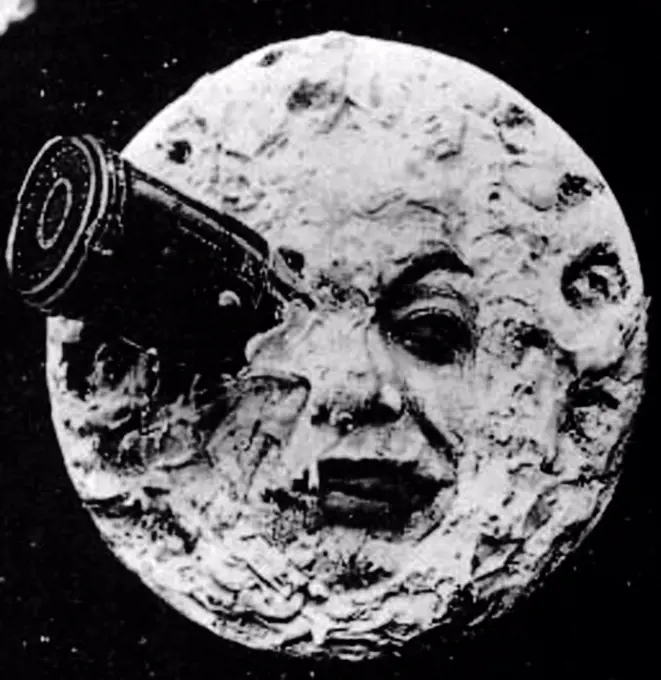
The Man in the Moon is struck by a spacecraft in the 1902 fantasy film Le Voyage dans la Lune. This frame from the film is an example of a conventionalized image bearing no relation to actual lunar features
4389-301
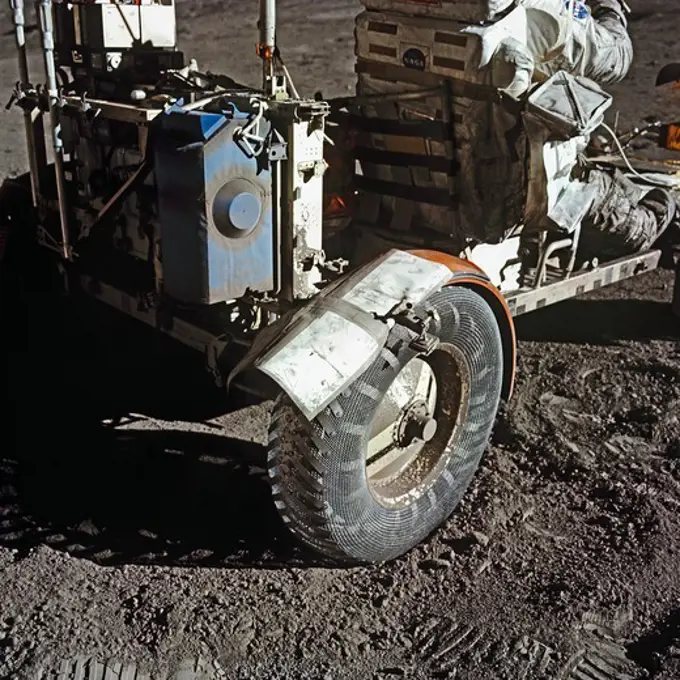
Apollo 17 - Fixing a Busted Fender on the Moon
6145-44750998
AS08-14-2400 (21-27 Dec. 1968) --- This near vertical photograph of the lunar surface taken with a telephoto lens during the Apollo 8 lunar orbit mission. The area covered by the photograph is approximately 20 miles on a side, and the photographed area is located at about 3 degrees south latitude and 160 degrees west longitude on the lunar farside. The lunar surface probably had less pronounced color than indicated by this print.
6145-45288908
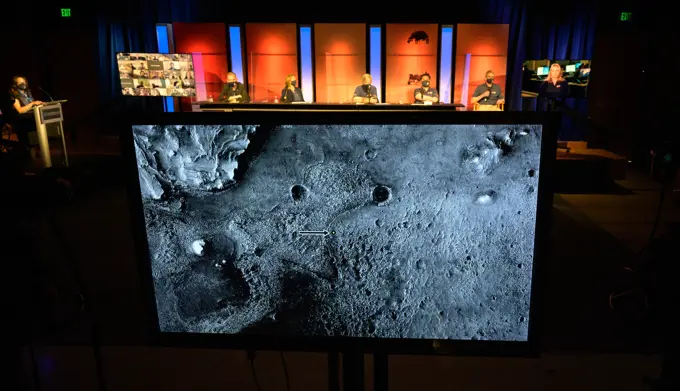
An image showing where Perseverance Mars rover landed is shown during a NASA Perseverance rover mission post-landing update, Thursday, Feb. 18, 2021, at NASA's Jet Propulsion Laboratory in Pasadena, California. A key objective for Perseverances mission on Mars is astrobiology, including the search for signs of ancient microbial life. The rover will characterize the planets geology and past climate, pave the way for human exploration of the Red Planet, and be the first mission to collect and cache Martian rock and regolith.
6177-V53845187
PREVIOUS
of 2
NEXT
2401 S. Ervay, Suite 206
Dallas, Texas 75215
United States
Get Started
Free ResearchMy BoardsMy Cart
For Creators
How To License Your ContentContributor PortalFrame of Mind
Resources
API accessPricing
Contact
+1 866 236 0087help@viewpictures.co.uk Contact form
©2026 View Pictures. All Rights Reserved. -B
This site is protected by reCAPTCHA and Google Privacy Policy and Terms of Service apply.