Asian Religious Sculptures

A collection of wooden sculptures depicting various deities and figures from Japanese and Korean Buddhism, showcasing intricate designs, vibrant colors, and cultural significance.
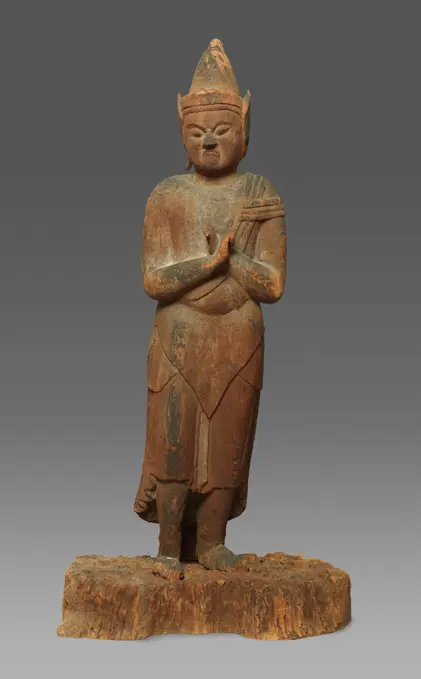
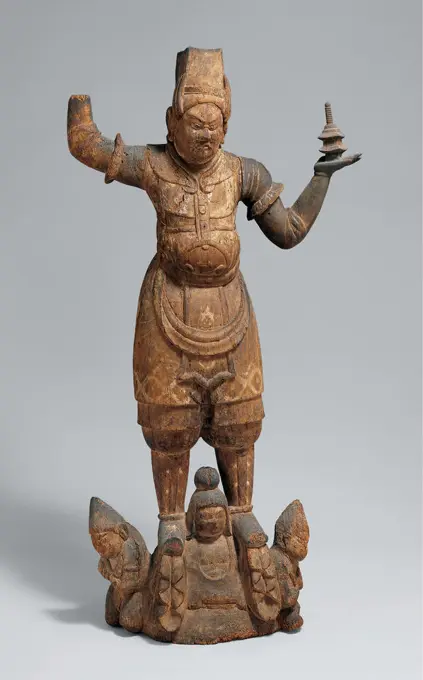
Zaō Gongen, Manifestation of Mount Kinpu, 12th century, Unknown Japanese, 48 3/4 × 12 3/4 × 8 7/8 in. (123.83 × 32.39 × 22.54 cm), Wood with polychrome, Japan, 12th century, This unhappy-looking fellow with large pointed ears and sporting a conical cap is Zaō Gongen. He is a guardian deity of the Shugendō ascetic practice, who is said to live in the Yoshino Mountains in the rugged interior of the Kii Peninsula south of the ancient capital of Nara. A rare example of a religious figure of purely Japanese origin, Zaō Gongen is believed to have originally appeared to En no Gyōja (634'-701'), the founder of Shugendō, atop Yoshinos Mount Kinpu. Mount Kinpu itself was believed to have been formed from the merging of three Buddhist deities (the historical Buddha Shaka, the Buddha of the Future Miroku, and the bodhisattva Kannon). The figure of Zaō Gongen itself is believed to be a manifestation of the spirit of Mount Kinpu.