My Boards
View Pictures
  • My Boards

Astronauts Performing Spacewalks

Images of astronauts engaged in extravehicular activities outside the International Space Station, showcasing construction, maintenance, and various tasks.
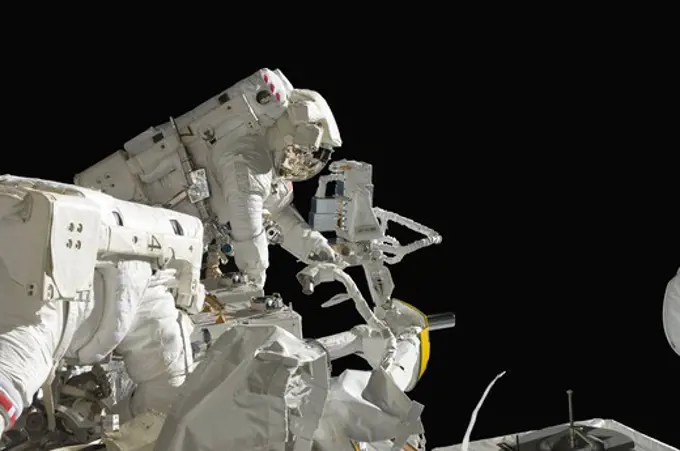
Astronaut participates in a session of extravehicular activity (EVA), International Space Station
349 assets in this story
6145-44901650
ISS032-E-021024 (20 Aug. 2012) --- Russian cosmonaut Gennady Padalka, Expedition 32 commander, participates in a session of extravehicular activity (EVA) to continue outfitting the International Space Station. During the five-hour, 51-minute spacewalk, Padalka and Russian cosmonaut Yuri Malenchenko (out of frame), flight engineer, moved the Strela-2 cargo boom from the Pirs docking compartment to the Zarya module to prepare Pirs for its eventual replacement with a new Russian multipurpose laboratory module. The two spacewalking cosmonauts also installed micrometeoroid debris shields on the exterior of the Zvezda service module and deployed a small science satellite.
6145-44607541
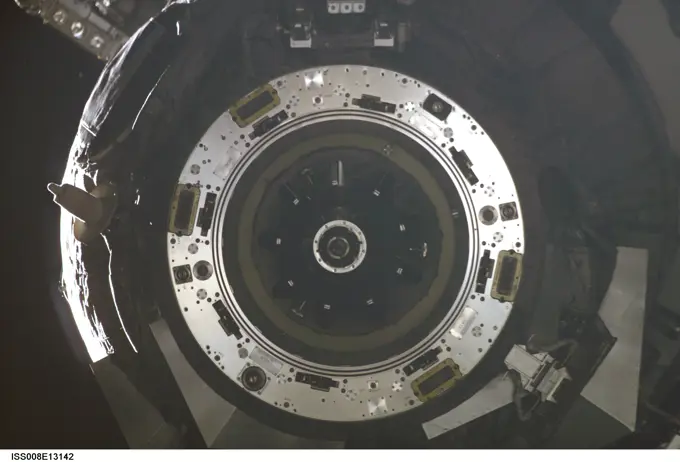
ISS008-E-13142 (28 January 2004) --- This close-up view of an unpiloted Progress supply vehicle was taken by one of the Expedition 8 crewmembers onboard the International Space Station (ISS) as it departed from the Zvezda Service Module. The Progress 12 undocked January 28, 2004 at 2:36 a.m. (CST) and was later commanded to de-orbit with its load of trash and unneeded equipment and burn in the Earth’s atmosphere.
6145-45285975
iss064e021974 (Jan. 9, 2021) --- The SpaceX Cargo Dragon resupply ship is pictured docked to the Harmony module's space-facing international docking adapter. At right, a portion of the JAXA Kibo laboratory module, the Experiment Logistics Module (Kibo's stowage facility), is pictured.
6145-45040889
ISS030-E-047156 (23 Jan. 2012) --- The unpiloted ISS Progress 45 supply vehicle departs from the International Space Station at 5:10 p.m. (EST) on Jan. 23, 2012. Filled with trash and discarded items, Progress 45 was later deorbited, subsequently burning up in Earth's atmosphere. The departure of Progress 45 clears the way for the next unpiloted supply ship, Progress 46, which is set to launch at 6:06 p.m. (EST) on Jan. 25 (5:06 a.m. Baikonur time Jan. 26) from the Baikonur Cosmodrome in Kazakhstan bringing 2.9 tons of food, fuel and supplies for the residents of the space station.
6145-45189344
iss057e122120 ( 12/10/2018) --- A view of items from the NanoRacks-Lagrange investigation floating in front of the  windows in the Cupola module aboard the International Space Station (ISS). NanoRacks-Lagrange seeks to increase interest in space. For this investigation, student photos and printed logos sheets are launched to the International Space Station (ISS) with a message card. Additionally, plant seeds are flown to the ISS. The students plant the seeds once they return to Earth and compare them to plants grown from regular seeds. Students are able to touch and feel close to space through this experiment.
6145-44743839
S126-E-008340 (20 Nov. 2008) --- Astronauts Heidemarie Stefanyshyn-Piper (left) and Shane Kimbrough, both STS-126 mission specialists, participate in the mission's second scheduled session of extravehicular activity (EVA) as construction and maintenance continue on the International Space Station. During the six-hour, 45-minute spacewalk, Piper and Kimbrough continued the process of removing debris and applying lubrication around the starboard Solar Alpha Rotary Joint (SARJ), replaced four more of the SARJ's 12 trundle bearing assemblies, relocated two equipment carts and applied lubrication to the station's robotic Canadarm2.
6145-44774041
S127-E-006678 (17 July 2009) --- The International Space Station and the Space Shuttle Endeavour approach each other on docking day.  An STS-127 crew member captured this image with a digital still camera from the aft flight deck.
6145-44537467
ISS004-E-10071 (17 April 2002) --- Moments prior to the undocking of the Space Shuttle Atlantis from the International Space Station (ISS), an Expedition Four crewmember took this digital still photograph from a window in the Pirs Docking Compartment.  The STS-110 crew spent about a week aboard the ISS and successfully installed the S0 (S-zero) truss.  Also visible in this image are the Soyuz Spacecraft, Space Station Remote Manipulator System (SSRMS) / Canadarm2 and Pressurized Mating Adapter 3 (PMA3).
6145-44861481
S134-E-007065 (18 May 2011) --- A portion of the International Space Station is featured in this image photographed by an STS-134 crew member at an aft flight deck window of space shuttle Endeavour during rendezvous and docking operations.
1457R-922
Side profile of two astronauts checking a space shuttle in space
6145-44684076
S118-E-07094 (14 Aug. 2007) --- An external stowage platform (ESP-3) is photographed in the payload bay of Space Shuttle Endeavour while docked with the International Space Station. Astronauts Tracy Caldwell and Barbara R. Morgan, both STS-118 mission specialists, were inside at Endeavour's controls as the shuttle's robotic arm (lower right) lifted the storage platform from the cargo bay to hand it over to the station's robotic arm, also known as Canadarm2. Astronauts Charlie Hobaugh, pilot, and Clay Anderson, Expedition 15 flight engineer, then used Canadarm2 to attach the 13-by-7-foot platform to the station's Port 3 truss.
6145-44828821
STS061-77-078 (7 Dec 1993) --- Astronaut Jeffrey A. Hoffman, anchored on the end of the Remote Manipulator System (RMS) arm, is pictured with the Wide Field/Planetary Camera (WF/PC I) during the third of five extravehicular activity s (EVA). Astronauts Hoffman and F. Story Musgrave, seen near the stowage area for the WF/PC, had earlier installed the new camera (note white rectangle) on lower portion of telescope.
6145-44470180
Roscosmos cosmonaut and Expedition 66 Commander Anton Shkaplerov (upper right) works at the interface between the Nauka multipurpose laboratory module and the Prichal docking module during a spacewalk that lasted seven hours and 11 minutes.
6145-44873599
ISS028-E-017457 (18 July 2011)--- Inside the International Space Station's Node 2 or Harmony, the STS-135 crew presented the Expedition 28 crew this special U.S. flag and mounted it on the hatch leading to Atlantis. The flag was flown on the first space shuttle mission, STS-1, and flew on this mission to be presented to the space station crew. It will remain onboard until the next crew launched from the U.S. will retrieve it for return to Earth. It will fly from Earth again, with the crew that launches from the U.S. on a journey of exploration beyond Earth orbit.
6145-44482387
ESA (European Space Agency) astronaut and Expedition 67 Flight Engineer Samantha Cristoforetti is pictured looking out from a window on the cupola, the International Space Station's "window to the world." The astronauts use the seven-windowed cupola to monitor the arrival of spaceships at the orbiting lab and view the Earth below.
6145-44690432
ISS016-E-009184 (3 Nov. 2007) --- While anchored to a foot restraint on the end of the Orbiter Boom Sensor System (OBSS), astronaut Scott Parazynski, STS-120 mission specialist, participates in the mission's fourth session of extravehicular activity (EVA) while Space Shuttle Discovery is docked with the International Space Station. During the 7-hour, 19-minute spacewalk, Parazynski cut a snagged wire and installed homemade stabilizers designed to strengthen the damaged solar array's structure and stability in the vicinity of the damage. Astronaut Doug Wheelock (out of frame), mission specialist, assisted from the truss by keeping an eye on the distance between Parazynski and the array. Once the repair was complete, flight controllers on the ground successfully completed the deployment of the array.
6145-44561797
KENNEDY SPACE CENTER, FLA. -- The Space Shuttle Columbia begins its rollout from the Vehicle Assembly Building to Launch Pad 39B in preparation for the STS-90 mission. The Neurolab experiments are the primary payload on this nearly 17-day space flight. Investigations during the Neurolab mission will focus on the effects of microgravity on the nervous system. Specifically, experiments will study the adaptation of the vestibular system, the central nervous system, and the pathways that control the ability to sense location in the absence of gravity, as well as the effect of microgravity on a developing nervous system. The crew of STS-90, slated for launch April 16 at 2:19 p.m. EDT, includes Commander Richard Searfoss, Pilot Scott Altman, Mission Specialists Richard Linnehan, Dafydd (Dave) Williams, M.D., and Kathryn (Kay) Hire, and Payload Specialists Jay Buckey, M.D., and James Pawelczyk, Ph.D
6177-V53551891
6145-44545826
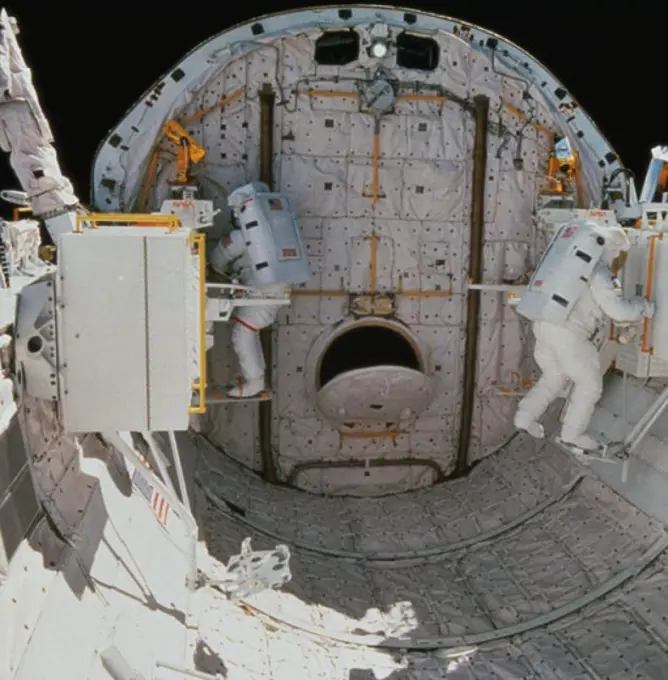
STS069-714-042 (16 September 1995) --- Astronauts James S. Voss, (red stripe on space suit) and Michael L. Gernhardt work together at the Extravehicular Activity (EVA) Assembly and Maintenance Task Board in the Space Shuttle Endeavour’s cargo bay. The EVA task board, with an approximate volume of 64 inches by 69 inches 27 inches and an Earth-bound weight of 450 pounds, helped the two space walkers evaluate work that will be done in the relatively near future on the International Space Station (ISS).
6145-44839246
ISS025-E-015066 (15 Nov. 2010) --- Russian cosmonaut Oleg Skripochka, Expedition 25 flight engineer, wearing a Russian Orlan spacesuit, participates in a session of extravehicular activity (EVA) as construction and maintenance continue on the International Space Station. During the six-hour, 27-minute spacewalk, Skripochka and Russian cosmonaut Fyodor Yurchikhin (out of frame), flight engineer, installed a multipurpose workstation on the starboard side of the Zvezda Service Modules large-diameter section and relocated a television camera from one end of the Rassvet docking compartment to the other.
6145-45204187
iss059e074538 (5/27/2019) --- Photo documentation of the DreamKit: Plants in Space investigation in the Copula module of the International Space Station (ISS).  The DreamKit: Plants in Space investigation is a student investigation that studies plant growth and direction in a microgravity environment.
6145-44698040
S122-E-009076 (15 Feb. 2008) --- Astronaut Stanley Love, mission specialist, works on the new Columbus laboratory's exterior duringthe  STS-122 Atlantis crew's final scheduled spacewalk. Astronaut Rex Walheim (out of frame), mission specialist, shared this extravehicular activity with Love.
6145-58958512
ISS026-E-024414 (3 Feb. 2011) --- While attached on the end of the Canadarm2, Dextre, the Canadian Space Agencys robotic handyman, is featured in this image photographed by an Expedition 26 crew member aboard the International Space Station. During the activities, Dextre unpacked two critical pieces of equipment delivered by Japans Kounotori2 spacecraft.
6145-45248244
JSC2001-E-27145 (16 September 2001) --- The Russian Docking Compartment, named Pirs (the Russian word for pier), docks with the International Space Station (ISS).  One of the Expedition Three crew members, using a video camera, recorded the rendezvous and docking from onboard the orbital outpost. The Pirs vehicle was launched on September 14, 2001, and docking occurred on September 16.
6145-44542238
S90-36708 (7 May 1990) ---  STS-35 Astronomy Laboratory 1 (ASTRO-1) view shows its telescopes, instrument pointing system (IPS), and support equipment installed in Columbia's, Orbiter Vehicle (OV) 102's, payload bay (PLB) at the Kennedy Space Center (KSC) Orbiter Processing Facility (OPF). In the foreground is the Spacelab Pallet System (SPS) igloo. The stowed IPS with its three ultraviolet telescopes appears in the center of the picture. In the background, the Broad Band X Ray Telescope (BBXRT) two axis pointing system (TAPS) is barely visible. View provided by KSC with alternate number KSC-90PC-423.
6145-52961103
. art001e000260 (Nov. 21, 2022) - A portion of the far side of the Moon looms large just beyond the Orion spacecraft in this image taken on the sixth day of the Artemis I mission by a camera on the tip of one of Orions solar arrays. The spacecraft entered the lunar sphere of influence Sunday, Nov. 20, making the Moon, instead of Earth, the main gravitational force acting on the spacecraft. On Monday,  Nov. 21, it came within 80 miles of the lunar surface, the closest approach of the uncrewed Artemis I mission, before moving into a distant retrograde orbit around the Moon. The darkest spot visible near the middle of the image is Mare Orientale.
6145-45061775
ISS040-E-015632 (19 June 2014) --- Russian cosmonauts Alexander Skvortsov (right) and Oleg Artemyev, both Expedition 40 flight engineers, participate in a session of extravehicular activity (EVA) as work continues on the International Space Station. During the seven-hour, 23-minute spacewalk Skvortsov and Artemyev completed installation and experiment tasks outside the stations Russian segment.
6145-44818386
ISS023-E-042396 (10 May 2010) --- Russian cosmonaut Oleg Kotov, Expedition 23 commander, is pictured in a window of the Cupola of the International Space Station.
6145-44542768
STS039-85-073 (28 April- 6 May 1991) --- This 70mm frame, taken from inside the crew cabin, shows a close-up view of the Air Force Program (AFP) 675 package.  AFP-675 consists of the Cryogenic Infrared Radiance Instrumentation for Shuttle (CIRRIS)-1A; Far Ultraviolet Camera (FAR-UV) Experiment; Horizon Ultraviolet Program (HUP); Quadruple Ion Neutral Mass Spectrometer (QINMS); and the Uniformly Redundant Array (URA).  Much of that hardware is backdropped here against the aft cargo bay bulkhead of Discovery.
6145-45229251
iss061e092274 (12/18/2019) --- A view of the Materials Science Laboratory (MSL) Sample Cartridge Assembly (SCA) in the Destiny module aboard the International Space Station (ISS). The Materials Science Laboratory (MSL) is used for basic materials research in the microgravity environment of the International Space Station (ISS). The MSL can accommodate and support diverse Experiment Modules. In this way many material types, such as metals, alloys, polymers, semiconductors, ceramics, crystals, and glasses, can be studied to discover new applications for existing materials and new or improved materials.
6145-44920336
View of Epson Printer, Barcode POC91113J. Photo was taken during Expedition 34.
6145-44516138
A GetAway Special canister (GAS can) filled with student experiments is installed in Discoverys payload bay for mission STS-102. STS-102 is the 8th construction flight to the International Space Station and will carry the Multi-Purpose Logistics Module Leonardo. STS-102 is scheduled for launch March 1, 2001. On that flight, Leonardo will be filled with equipment and supplies to outfit the U.S. laboratory module Destiny. The mission will also be carrying the Expedition Two crew to the Space Station, replacing the Expedition One crew who will return on Shuttle Discovery
6145-44828595
STS061-79-072 (4 Dec 1993) --- The Hubble Space Telescope (HST) is backdropped against the blackness of space in this 70mm frame recorded during a video survey of the spacecraft following the telescope's recent berthing in the Space Shuttle Endeavour's cargo bay. European Space Agency (ESA) scientist Claude Nicollier controlled the Remote Manipulator System (RMS) arm slowly so that mounted TV cameras could show flight controllers the various areas on the telescope.
6145-44851123
S133-E-007367 (28 Feb. 2011) --- NASA astronauts Steve Bowen and Alvin Drew, both STS-133 mission specialists, participate in the missions first session of extravehicular activity (EVA) as construction and maintenance continue on the International Space Station. During the six-hour, 34-minute spacewalk, Bowen and Drew installed the J612 power extension cable, move a failed ammonia pump module to the External Stowage Platform 2 on the Quest Airlock for return to Earth at a later date, installed a camera wedge on the right hand truss segment, installed extensions to the mobile transporter rail and exposed the Japanese Message in a Bottle experiment to space.
6145-44863760
S134-E-009592 (27 May 2011) --- NASA astronaut Michael Fincke participates in the mission's fourth session of extravehicular activity (EVA) as construction and maintenance continue on the International Space Station. During the seven-hour, 24-minute spacewalk, Fincke and astronaut Greg Chamitoff (out of frame), both STS-134 mission specialists, completed the primary objectives for the spacewalk, including stowing the 50-foot-long boom and adding a power and data grapple fixture to make it the Enhanced International Space Station Boom Assembly, available to extend the reach of the space station's robotic arm.
6145-44478665
A view of Moonikin Campos” secured in a seat inside the Artemis I Orion crew module atop the Space Launch System rocket in High Bay 3 of the Vehicle Assembly Building at NASA’s Kennedy Space Center in Florida on Aug. 3, 2022. Artemis I will provide a foundation for human deep space exploration and demonstrate NASA’s capability to extend human present to the Moon and beyond. The primary goal of Artemis I is to thoroughly test the Space Launch System rocket and Orion spacecraft’s integrated systems before crewed missions. Under Artemis, NASA aims to land the first woman and first person of color on the Moon and establish sustainable lunar exploration.
6145-44814953
ISS023-E-023535 (14 April 2010) --- Japan Aerospace Exploration Agency astronaut Naoko Yamazaki, STS-131 mission specialist, is pictured in a window of the Cupola of the International Space Station while space shuttle Discovery remains docked with the station.
6145-44524204
STS100-396-007 (19 April-1 May 2001) --- Astronaut Scott E. Parazynski, STS-100 mission specialist, works with cables associated with the Space Station Remote Manipulator System (SSRMS) or Canadarm2 during one of two days of extravehicular activity (EVA). Parazynski shared both space walks with astronaut Chris A. Hadfield of the Canadian Space Agency (CSA).
6145-44840246
ISS026-E-005318 (26 Nov. 2010) --- A fish-eye lens attached to an electronic still camera was used by an Expedition 26 crew member to capture this image of the Unity node of the International Space Station.
6145-44657641
S115-E-05305 (10 Sept. 2006) --- While working to survey the thermal protection system on the Space Shuttle Atlantis, the orbiter boom sensor system (OBSS), attached to the remote manipulator system (RMS) arm was positioned near the shuttle's aft cabin windows. This enabled one of the STS-115 crewmembers to record this digital still image of the Canadian-built system and some of the hardware stowed in the payload bay of the shuttle, as well as the vertical stabilizer and the two orbital maneuvering system (OMS) pods.
6145-45249763
iss006e46361 (4/24/2003) --- A view of NASA astronaut Donald Pettit emerging from the Quest/Airlock (A/L) to perform a variety of maintenance tasks. Bowersox is working in the background. Also in view is Materials International Space Station Experiments (MISSE) attached to A/L. Photo was taken during Expedition Six on the International Space Station (ISS). MISSE-1 and 2 are a test bed for materials and coatings attached to the outside of the ISS is being evaluated for the effects of atomic oxygen, direct sunlight, and extremes of heat and cold. This experiment allows the development and testing of new materials to better withstand the rigors of space environments. Results will provide a better understanding of the durability of various materials when they are exposed to the space environment. Many of the materials may have applications in the design of future spacecraft.
6145-44994088
Image was released by astronaut on Twitter.
1746-28998726
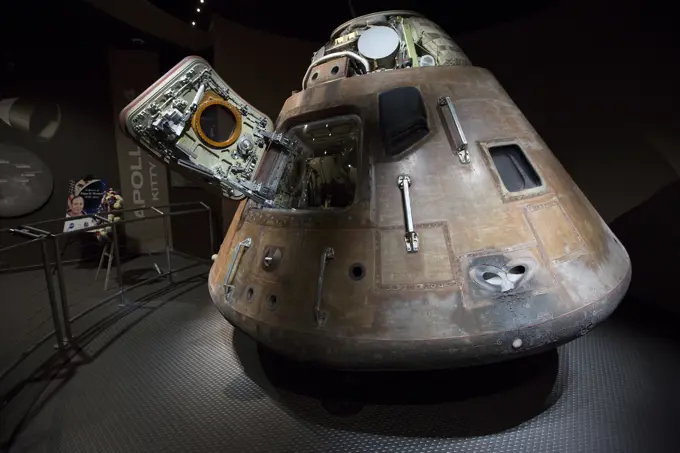
Apollo 14 command module exhibit following a ceremony to honour the memory of former NASA astronaut Edgar Mitchell. One of 12 humans to walk on the moon, Mitchell died Feb. 4, 2016. Mitchell was Apollo 14's lunar module pilot who landed in the moon's Fra Mauro highlands on Feb. 5, 1971
6145-44730601
ISS018-E-005214 (26 Oct. 2008) --- This close-up view shows three bowling-ball-sized free-flying satellites called Synchronized Position Hold, Engage, Reorient, Experimental Satellites (SPHERES) in the Destiny laboratory of the International Space Station. SPHERES were designed to test control algorithms for spacecraft by performing autonomous rendezvous and docking maneuvers inside the station. The results are important for multi-body control and in designing constellation and array spacecraft configurations.
6145-44923752
View of drink packets floating,in the U.S. Laboratory. Orange-pineapple drink,cold water,and Kona-coffee (black) are visible. Photo was taken during Expedition 34.
6145-44920163
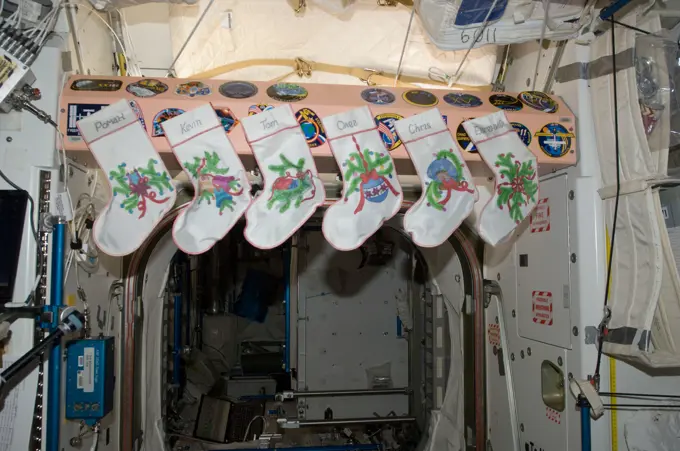
ISS034-E-009737 (25 Dec. 2012) --- Stockings were obviously hung with care on Christmas Day aboard the International Space Station, but for some reason, the fireplace stand-in on Unity couldn't support a real fire. This minor detail didn't faze the spirit of the recently reunited crew members, however. The individual names of the six Expedition 34 crew members are inscribed on their respective stockings. The scene is actually in Node 1, called Unity, which was the first U.S.-built element of the International Space Station that was launched, and it connects the U.S. and Russian segments of the orbital outpost.
6145-44621941
JSC2004-E-50470 (25 November 2002) --- The original photograph in this image was taken during the Space Shuttle Endeavour’s approach to the International Space Station for docking during the STS-113/11A assembly mission. An indentation in a micrometeoroid debris panel on the exterior of the Destiny Laboratory module is indicated by an arrow in an enhanced section of the image provided by the Image Science and Analysis Group at the Johnson Space Center. Analysis of this image and additional video indicates that the indentation is not from a debris strike, but is consistent with flat spots seen on other areas that are likely the result of significant temperature changes. The protective shield’s function is not affected by the indentations.
6145-44517683
STS98-E-5041 (9 February 2001) --- One of a series of three digital still camera's views of the station's Unity node and the docking mechanism just prior to link up between the station and the Space Shuttle Atlantis. Sailing at 17,000 miles per hour 200 miles above the Pacific Ocean, astronaut Kenneth D. Cockrell, STS-98 mission commander, flawlessly pulled the shuttle alongside the International Space Station and docked, in position to add the new Destiny laboratory to the complex on the following day and begin a new era in space research.  Atlantis went on to dock with the station on schedule at 10:51 a.m. (CST), February 9, and the station and shuttle crews opened hatches between the spacecraft at 1:03 p.m.
6145-45230246
iss061e100876 (12/30/2019) --- A view of the SoundSee Mission sensors in the Japanese Experiment Module (JEM), aboard the International Space Station (ISS). The Investigation of Deep Audio Analytics on the International Space Station (SoundSee Mission) tests monitoring of the acoustic environment using an audio sensor on Astrobee, a mobile robotic platform aboard the space station. Monitoring sound can provide early indication of equipment failure. Autonomous audio monitoring may improve crew health and safety by keeping equipment in good working order while also reducing crew workload aboard the space station and other spacecraft.
PREVIOUS
of 4
NEXT
2401 S. Ervay, Suite 206
Dallas, Texas 75215
United States
Get Started
Free ResearchMy BoardsMy Cart
For Creators
How To License Your ContentContributor PortalFrame of Mind
Resources
API accessPricing
Contact
+1 866 236 0087help@viewpictures.co.uk Contact form
©2026 View Pictures. All Rights Reserved. -A
This site is protected by reCAPTCHA and Google Privacy Policy and Terms of Service apply.