My Boards
View Pictures
  • My Boards
← Science

Cartoon Astronauts and Space

Playful illustrations depicting astronauts in space with planets, rockets, and cosmic elements, showcasing a vibrant and whimsical style.

Illustration of an astronaut floating in space with Earth and another planet in the background
560 assets in this story
6145-54495926
Air Force Organizational Emblem: Air Force Research Laboratory, Air Force Material Command Exact Date Shot Unknown. Base: Maxwell Air Force Base State: Alabama (AL) Country: United States Of America (USA)
6145-44718314
S72-52630 (February 1972) --- This is the emblem for the first manned Skylab mission. It will be a mission of up to 28 days. Skylab is an experimental space station consisting of a 100-ton laboratory complex in which medical, scientific and technological experiments will be performed in Earth orbit. The prime crew of this mission will be astronaut Charles Conrad Jr., commander; scientist-astronaut Joseph P. Kerwin, science pilot; and astronaut Paul J. Weits, pilot. The patch, designed by artist Kelly Freas, shows the Skylab silhouetted against the Earth's globe, which in turn is eclipsing the sun--showing the brilliant signet-ring pattern of the instant before the total eclipse.
6145-44635337
The crew patch for NASA's STS-83 mission depicts the Space Shuttle Columbia launching into space for the first Microgravity Sciences Laboratory 1 (MSL-1) mission. MSL-1 investigated materials science, fluid dynamics, biotechnology, and combustion science in the microgravity environment of space, experiments that were conducted in the Spacelab Module in the Space Shuttle Columbia's cargo bay. The center circle symbolizes a free liquid under microgravity conditions representing various fluid and materials science experiments. Symbolic of the combustion experiments is the surrounding starburst of a blue flame burning in space. The 3-lobed shape of the outermost starburst ring traces the dot pattern of a transmission Laue photograph typical of biotechnology experiments. The numerical designation for the mission is shown at bottom center. As a forerunner to missions involving International Space Station (ISS), STS-83 represented the hope that scientific results and knowledge gained during t
6145-44538686
S82-26315 (4 Feb. 1982) --- This is the insignia for NASA's third flight (STS-3) of the Space Transportation System's (STS) Columbia, depicted in the middle of the blue sphere against the background of the sun. The Columbia's tail, nose, and top will each be pointed at the sun for long periods to test its thermal response to extremes of temperatures. The three prominent rays represent the third STS flight. The surnames of astronauts Jack R. Lousma, commander, and C. Gordon Fullerton, pilot, flank the vehicle, and the name Columbia appears at the bottom. The spacecraft's payload bay doors are open, and the Remote Manipulator System (RMS) arm with an experimental payload is extended as it will be on several occasions during the actual flight, scheduled for spring of this year. The artwork was accomplished by space artist Robert C. McCall of Paradise Valley, Arizona. The NASA insignia design for space shuttle flights is reserved for use by the astronauts and for other official use as th
6145-44894931
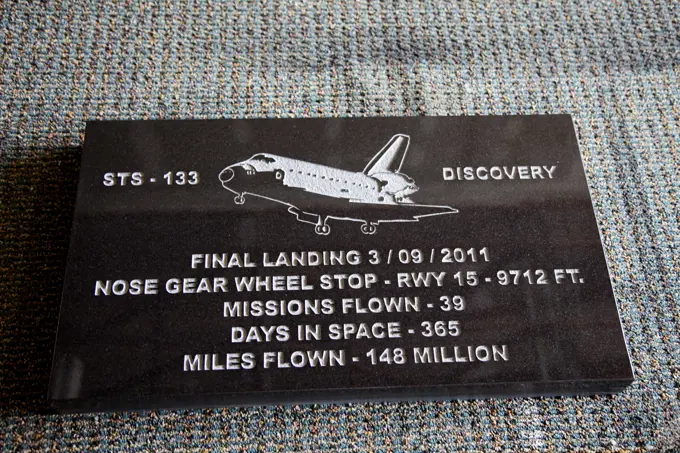
CAPE CANAVERAL, Fla. - At C Spray Glass Blasting of Cocoa Beach, Fla., the commemorative plaque to mark space shuttle Discoverys wheel stop location has been completed. The special plaque will be permanently mounted at the Shuttle Landing Facility, or SLF, runway edge at NASAs Kennedy Space Center in Florida to commemorate Discoverys final landing. Discovery completed the STS-133 mission by landing at the SLF on March 9, 2011, at 11:57 a.m. EST. Discovery flew 39 missions, completed 5,830 orbits of the Earth, traveled 148 million miles and spent 365 days in space. Atlantis carried 252 astronauts to space.
6145-44616541
KENNEDY SPACE CENTER, FLA.  -  The first human journey to the surface of the Moon began at Pad A, Launch Complex 39, Kennedy Space Center, Fla., with the liftoff of Apollo 11 on a Saturn V booster at 9:32 a.m. EDT (13:32 UT) on a clear sunny Wednesday, 16 July 1969.  This year NASA celebrates the 35th anniversary of that historic launch and landing.
6145-44749651
JOHNSON SPACE CENTER, Houston - STS127-S-001 (JSC) -- Space shuttle mission STS-127 is the 32nd construction flight of the International Space Station, or ISS, and the final of a series of three flights dedicated to the assembly of the Japanese "Kibo" laboratory complex.  In addition to delivering, installing and servicing an external scientific platform that will be attached to the end of the Japanese module, STS-127 will bring up a new ISS crew member and return another one to Earth, replace vital components of the ISS electrical production system, and transfer various pieces of hardware to ISS.  Five spacewalks and the operation of four different robotic arms will be required to accomplish these tasks over 10 days.  A crew spokesperson had the following words for the patch: "Bathed in sunlight, the blue Earth is represented without boundaries to remind us that we all share this world.  In the center, the golden flight path of the space shuttle turns into the three distinctive rays o
6145-44513760
ISS001-S-001 (October 2000) --- The first International Space Station (ISS) crew patch is a simplified graphic of the station complex when fully completed. The station is seen with solar arrays turned forward. The last names of the Expedition One crew, Soyuz pilot Yuri Gidzenko, flight engineer Sergei Krikalev, and expedition commander William (Bill) Shepherd, appear under the station symbol.The insignia design for ISS flights is reserved for use by the astronauts and cosmonauts and for other official use as the NASA Administrator and NASA's international partners may authorize. Public availability has been approved only in the form of illustrations by the various news media.  When and if there is any change in this policy, which we do not anticipate, it will be publicly announced.
6145-50605542
A88460A U19AX ALAMO LOGO ROD SHEAR (PROJECT ENGINEER) APR 27 88 EG&G/NTS PHOTO LAB Publication Date: 4/27/1988  ALAMO LOGO; ARTWORKS; EDGERTON, GERMESHAUSEN & GRIER; EG&G; LOGOS; LOS ALAMOS TOUCHSTONE; NEVADA; NEVADA TEST SITE; NTS; NUCLEAR ENERGY TECHNOLOGY; NUCLEAR TESTING; NUCLEAR TESTS; TEST SITES; UGT; UNDERGROUND TESTING; U19AX ALAMO LOGO  historical images. 1972 - 2012. Department of Energy. National Nuclear Security Administration. Photographs Related to Nuclear Weapons Testing at the Nevada Test Site.
7199-70579469
Antarctica, Far East Coast of Antarctica, Princess Elizabeth Land. Australian National Antarctic progam logo.
6145-44740421
SOFIA (Stratospheric Observatory For Infrared Astronomy) with Telescope Configuration Changes Artwork
6145-54487492
Approved Insignia of the Human Systems Center. Country: Unknown
6177-V54000679
6145-44531816
JOHNSON SPACE CENTER, HOUSTON, TEXAS -- EXPEDITION FIVE CREW INSIGNIA (ISS05-S-001) -- The International Space Station (ISS) Expedition Five patch depicts the Station in its completed configuration and represents the vision of mankind's first step as a permanent human presence in space. The United States and Russian flags are joined together in a Roman numeral V to represent both the nationalities of the crew and the fifth crew to live aboard the ISS. Crew members' names are shown in the border of this patch. This increment encompasses a new phase in growth for the Station, with three Shuttle crews delivering critical components and building blocks to the ISS. To signify the participation of each crew member, the Shuttle is docked to the Station beneath a constellation of 17 stars symbolizing all those visiting and living aboard Station during this increment. The NASA insignia design for Shuttle flights is reserved for use by the astronauts and for other official use as the NASA Admini
6145-50597132
A810561 U12N HL/DB LOGO DAINS (PROJECT ENGINEER) SEP 22 81 IN LOGO FILE EG&G/NTS PHOTO LAB Publication Date: 9/22/1981  ARTWORKS; EDGERTON, GERMESHAUSEN & GRIER; EG&G; HL/DB LOGO; HURON LANDING; HURON LANDING TEST; LOGOS; MISSILES; NATIVE AMERICANS; NEVADA; NEVADA TEST SITE; NTS; NUCLEAR ENERGY TECHNOLOGY; NUCLEAR TESTING; NUCLEAR TESTS; TEST SITES; UGT; UNDERGROUND TESTING  historical images. 1972 - 2012. Department of Energy. National Nuclear Security Administration. Photographs Related to Nuclear Weapons Testing at the Nevada Test Site.
6145-44499036
STS042-S-001 (October 1991) --- Designed by the crew members, the International Microgravity Lab-1 (IML-1) insignia depicts the orbiter with the Spacelab Module aboard. The spacecraft is oriented in a quiescent, tail-to-Earth, gravity-gradient attitude to best support the various microgravity payloads and experiments. The international composition of the crew is depicted by symbols representing both the Canadian Space Agency (CSA) and the European Space Agency (ESA). The number 42 is represented by six white stars -- four on one side of the orbiter and two on the other. The single gold star above Earth's horizon honors the memory of astronaut Manley L. (Sonny) Carter, who was killed earlier this year in a commuter plane crash. A crew spokesperson stated that Carter "...was our crew mate, colleague and friend."  Blue letters set against white give the surnames of the five astronauts and two payload specialists for the flight.The NASA insignia design for space shuttle flights is reserv
6145-44637966
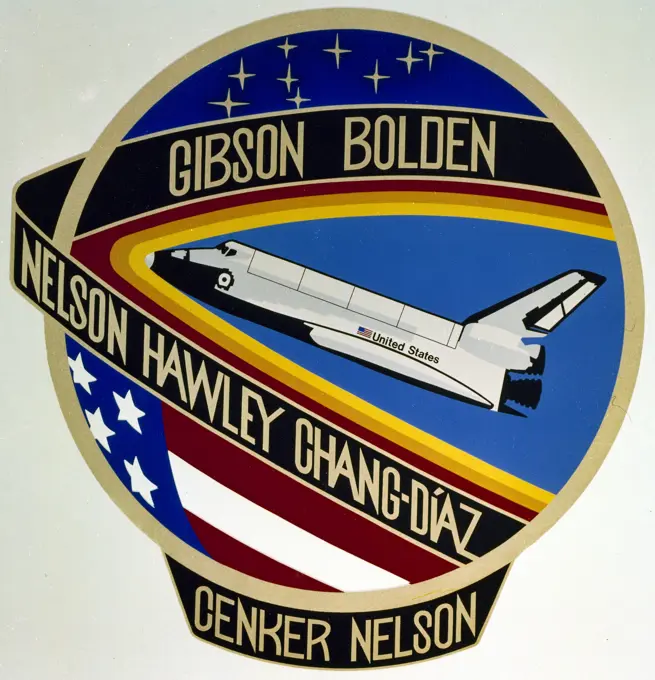
This is the insignia designed by the STS-61B crewmembers to represent their November 1985 mission aboard the Space Shuttle Atlantis, depicted here in earth orbit, making only its second space flight. The design is surrounded by the sumames of the seven crewmembers.
6145-45246448
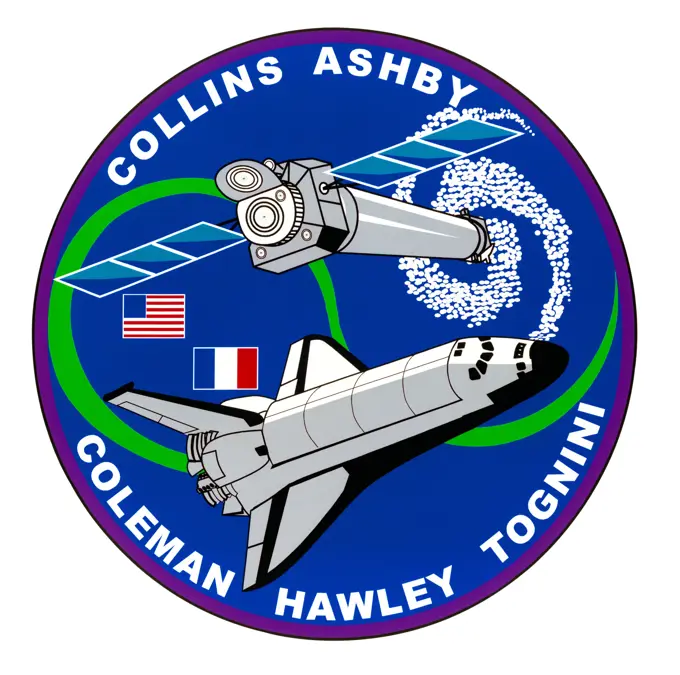
STS093-S-001 (September 1998) --- This is the STS-93 mission insignia designed by the crew members. Space shuttle Columbia will carry the Advanced X-ray Astrophysics Facility (AXAF) into low Earth orbit initiating its planned five-year astronomy mission. AXAF is the third of NASA's great observatories, following the Hubble Space Telescope (HST) and the Compton Gamma Ray Observatory (GRO). AXAF will provide scientists and order-of magnitude improvement over current capabilities at X-ray wavelengths. In the words of the crew, "Observations of X-ray emissions from energetic galaxies and clusters, as well as black holes, promise to greatly expand current understanding of the origin and evolution of our universe." The patch depicts AXAF separating from the space shuttle Columbia after a successful deployment. A spiral galaxy is shown in the background as a possible target for AXAF observations. The two flags represent the international crew, consisting of astronauts from both the United Sta
6145-44721161
S84-26391 (3 April 1984) --- The official mission insignia for the 41-D space shuttle flight features the Discovery--NASA's third orbital vehicle--as it makes its maiden voyage. The ghost ship represents the orbiter's namesakes which have figured prominently in the history of exploration. The space shuttle Discovery heads for new horizons to extend that proud tradition. Surnames for the crew members of NASA's eleventh space shuttle mission encircle the red, white and blue scene. They are astronauts Henry W. Hartsfield Jr., commander; Michael L. Coats, pilot; Judith A. Resnik, Steven A. Hawley and Richard M. (Mike) Mullane, all mission specialists; and Charles D.  Walker, payload specialist. The NASA insignia design for space shuttle flights is reserved for use by the astronauts and for other official use as the NASA Administrator may authorize. Public availability has been approved only in the forms of illustrations by the various news media. When and if there is any change in this p
6145-44533886
The International Space Station (ISS) Expedition 6 crew patch depicts the station orbiting the Earth on its mission of international cooperation and scientific research. The Earth is placed in the center of the patch to emphasize that work conducted aboard this orbiting laboratory is intended to improve life on our home planet. The shape of the Space Stations orbit symbolizes the role that experience gained from ISS will have on future exploration of our solar system and beyond. The American and Russian flags encircling the Earth represent the native countries of the Expedition 6 crew members, which are just two of the many participant countries contributing to the ISS and committed to the peaceful exploration of space.
6145-44637947
The patch features a helmet visor of an astronaut performing an extravehicular activity. In the visor are reflected the sun's rays, the Challenger and its remote manipulator system (RMS) deploying the long duration exposure facility (LDEF), the Earth and blue sky, and another astronaut working at the damaged Solar Maximum Satellite (SMS). The scene is encircled by the surnames of the crewmembers.
6145-44635090
Designed by the STS-88 crew members, this patch commemorates the first assembly flight to carry United States-built hardware for constructing the International Space Station (ISS). This flight's primary task was to assemble the cornerstone of the Space Station the Node with the Functional Cargo Block (FGB). The rising sun symbolizes the dawning of a new era of international cooperation in space and the beginning of a new program the International Space Station. The Earth scene outlines the countries of the Station Partners the United States, Russia, those of the European Space Agency (ESA), Japan, and Canada. Along with the Pressurized Mating Adapters (PMA) and the Functional Cargo Block, the Node is shown in the final mated configuration while berthed to the Space Shuttle during the STS-88/2A mission. The Big Dipper Constellation points the way to the North Star, a guiding light for pioneers and explorers for generations. In the words of the crew, These stars symbolize the efforts of
6145-44928153
Expedition 35/36 (Soyuz 34) SSTF cake cutting ceremony with trainers.  Photo Date: January 17, 2013.  Location: Building 5 - SSTF High Bay.
1848-53380308
Logo of the Norsk Polarinstitutt, Norwegian Polar Institute, Norway's national institution for polar research at Ny-Alesund Research Station, Svalbard, Spitsbergen, Norway, Europe
6145-44635323
Designed by the mission crew members, the STS-66 emblem depicts the Space Shuttle Atlantis launching into Earth orbit to study global environmental change. The payload for the Atmospheric Laboratory for Applications and Science (ATLAS-3) and complementary experiments were part of a continuing study of the atmosphere and the Sun's influence on it. The Space Shuttle is trailed by gold plumes representing the astronaut symbol and is superimposed over Earth, much of which is visible from the flight's high inclination orbit. Sensitive instruments aboard the ATLAS pallet in the Shuttle payload bay and on the free-flying Cryogenic Infrared Spectrometers and Telescopes for the Atmospheric-Shuttle Pallet Satellite (CHRISTA-SPAS) that gazed down on Earth and toward the Sun, are illustrated by the stylized sunrise and visible spectrum.
6145-45245650
STS088-S-001 (September 1998) --- Designed by the crew members, this STS-88 patch commemorates the first assembly flight to carry United States-built hardware for constructing the International Space Station (ISS). This flight's primary task is to assemble the cornerstone of the space station: the Node with the Functional Cargo Block (FGB). The rising sun symbolizes the dawning of a new era of international cooperation in space and the beginning of a new program: the International Space Station. The Earth scene outlines the countries of the Station Partners: the United States, Russia, those of the European Space Agency (ESA), Japan, and Canada. Along with the Pressurized Mating Adapters (PMA) and the Functional Cargo Block, the Node is shown in the final mated configuration while berthed to the space shuttle during the STS-88/2A mission. The Big Dipper Constellation points the way to the North Star, a guiding light for pioneers and explorers for generations. In the words of the crew, "
6145-44721162
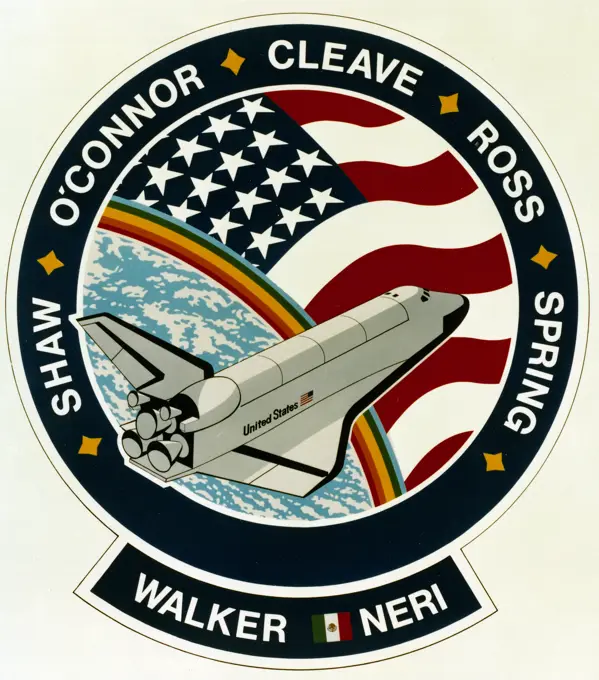
S85-36635 (October 1985) --- This is the insignia designed by the STS-61B crew members to represent their November 1985 mission aboard the space shuttle Atlantis, depicted here in Earth orbit, making only its second spaceflight. The design is surrounded by the surnames of the seven crew members. They are astronauts Brewster Shaw Jr., commander; Bryan D. O'Conner, pilot; Mary L. Cleave, Jerry L. Ross and Sherwood C. Spring, all mission specialists; and payload specialists Charles D. Walker, representing McDonnell Douglas, and Rodolfo Neri, representing Morelos of Mexico (note flag). The NASA insignia design for space shuttle flights is reserved for use by the astronauts and for other official use as the NASA Administrator may authorize. Public availability has been approved only in the forms of illustrations by the various news media. When and if there is any change in this policy, which is not anticipated, the change will be publicly announced.
6145-45245150
STS061-S-001 (1 Oct. 1993) --- Designed by the crew members, the STS-61 crew insignia depicts the astronaut symbol superimposed against the sky with the Earth underneath. Also seen are two circles representing the optical configuration of the Hubble Space Telescope (HST). Light is focused by reflections from a large primary mirror and a smaller secondary mirror. The light is analyzed by various instruments and, according to the crew members, brings to us on Earth knowledge about planets, stars, galaxies and other celestial objects, allowing us to better understand the complex physical processes at work in the universe. The space shuttle Endeavour is also represented as the fundamental tool that allows the crew to perform the first servicing of the Hubble Space Telescope so its scientific deep space mission may be extended for several years to come. The overall design of the emblem, with lines converging to a high point, is also a symbolic representation of the large-scale Earth-based e
6145-44539737
S84-36158 (June 1984) --- The STS-41G Challenger mission insignia focuses on its seven crew members (first to exceed six), the United States flag and the Unity symbol known as the astronaut pin. The pin design in center shows a trio of trajectories merging in infinite space, capped by a bright shining star and encircled by an elliptical wreath denoting orbital flight. Crew members for the (originally-scheduled 17th STS) mission include astronauts Robert L. Crippen and Jon A. McBride, commander and pilot, respectively, whose surnames flank those of the NASA mission specialists - astronauts Kathryn D. Sullivan, David C. Leestma and Sally K. Ride. Paul Scully-Power, a United States Navy oceanographer, and Marc Garneau, a Canadian, join the crew as payload specialists.  The artwork was done for NASA by Patrick Rawlings. The NASA insignia design for space shuttle flights is reserved for use by the astronauts and for other official use as the NASA Administrator may authorize. Public availa
6145-45048205
PHOTO DATE:  3-19-14LOCATION:   Bldg. 5 - High BaySUBJECT: Soyuz 39 crew members (Expedition 41), Maxim Suraev, Greg Wiseman, Alexander Gerst during SSTF Cake Cutting Ceremony marking the end of their training.
6145-44609363
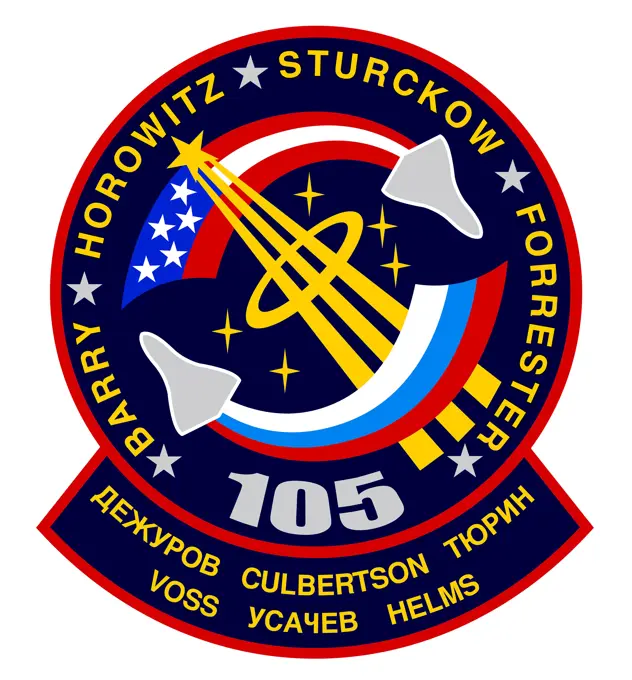
The STS-105 crew patch symbolizes the exchange of the Expedition Two and Expedition Three crews aboard the International Space Station (ISS). The three gold stars near the ascending orbiter represent the U.S. commanded Expedition Three Crew journeying into space, while the two gold stars near the descending orbiter represent the Russian commanded Expedition Two crew on their return to Earth. The ascending and descending Orbiters form a circle that represents both the crew rotation and the continuous presence in space aboard the station. The plumes of each orbiter represent the flags of the U.S. and Russia, symbolizing the close cooperation between the two nations. The Astronaut office symbol, a star with three rays of light, depicts the unbroken link between Earth and the brightest star on the horizon, the ISS. The names of Discovery's crew of four astronauts are shown along the border of the patch while the names of the Expedition crews are shown on the chevron at the bottom of the pa
6145-44541059
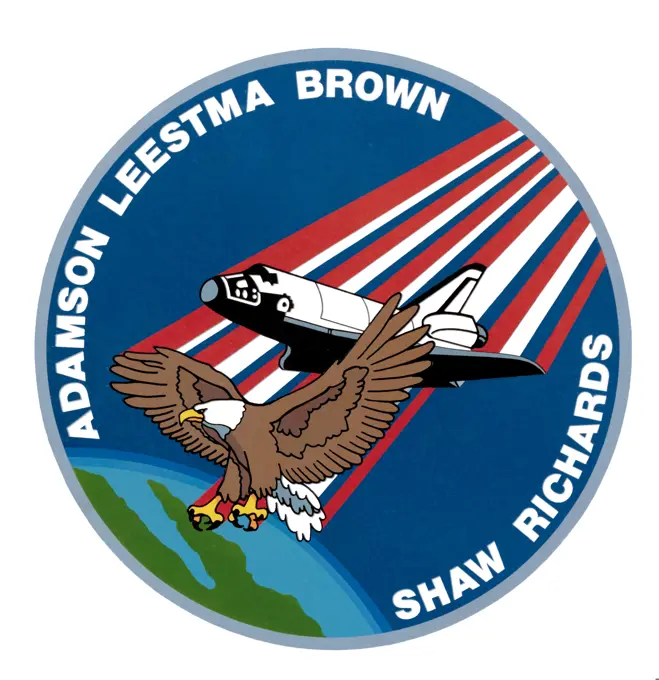
S88-40309 (7 Nov. 1988) --- The STS-28 insignia was designed by the astronaut crew, who said it portrays the pride the American people have in their manned spaceflight program. It depicts America (the eagle) guiding the space program (the space shuttle) safely home from an orbital mission. The view looks south on Baja California and the west coast of the United States as the space travelers re-enter the atmosphere. The hypersonic contrails created by the eagle and shuttle represent the American flag. The crew called the simple boldness of the design symbolic of America's unfaltering commitment to leadership in the exploration and development of space. Crew members for STS-28 are astronauts Brewster H. Shaw Jr.,commander; Richard N. Richards, pilot; and David C. Leestma, Mark N. Brown and James C.  Adamson, mission specialists. The NASA insignia design for space shuttle flights is reserved for use by the astronauts and for other official use as the NASA Administrator may authorize. Pu
6145-51871955
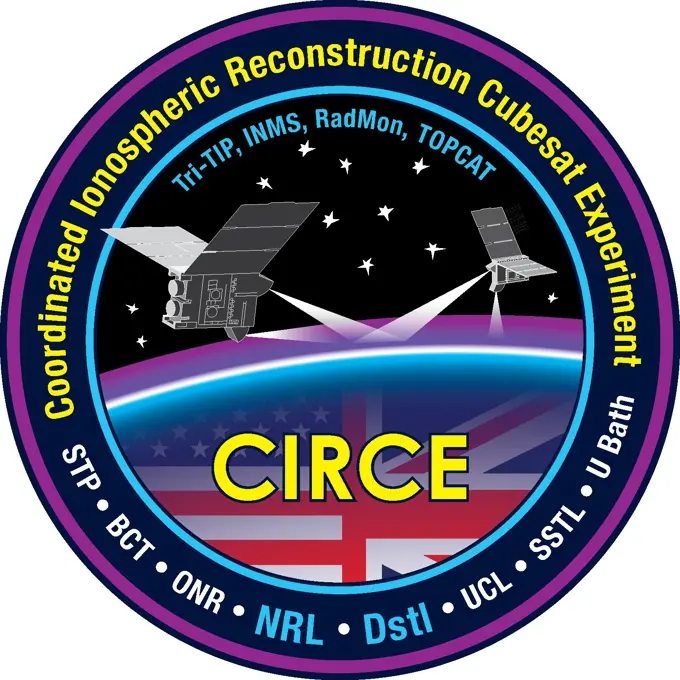
Space Systems Command is partnering with Virgin Orbit National Systems, a U.S.-incorporated, wholly-owned subsidiary to Virgin Orbit, to launch Coordinated Ionospheric Reconstruction CubeSat Experiment (CIRCE). The satellites, which contain twin 6U CubeSats, will fly in a circular orbit at 555 km (344 miles) altitude in a lead/trail formation 300-500 km (186-310 miles) apart in the same orbit plane to measure Earths ionosphere and particle radiation environment.
6145-44605915
This is the STS-102 mission crew insignia. The central image on the crew patch depicts the International Space Station (ISS) in the build configuration that it had at the time of the arrival and docking of Discovery during the STS-102 mission, the first crew exchange flight to the Space Station. The station is shown along the direction of the flight as was seen by the shuttle crew during their final approach and docking, the so-called V-bar approach. The names of the shuttle crew members are depicted in gold around the top of the patch, and surnames of the Expedition crew members being exchanged are shown in the lower barner. The three ribbons swirling up to and around the station signify the rotation of these ISS crew members. The number 2 is for the Expedition 2 crew who flew up to the station, and the number 1 is for the Expedition 1 crew who then returned down to Earth. In conjunction with the face of the Lab module of the Station, these Expedition numbers create the shuttle missio
6145-45103428
ISS051-S-001 --- From as early as the 11th century, coats of arms have been used as emblems representing groups as small as families to as large as countries.  The Expedition 51 patch is designed as a modernized international coat of arms, blending the traditional shield shape with our modernized symbol of achievement, the International Space Station. The background represents our home world and its inhabitants on the left, and outer space to the right.  The bi-color International Space Station is the bridge between the two, symbolizing the benefits on Earth of space research, and at the same time our mission to explore deeper into space, on a path to further discovery and knowledge.
6145-45245907
STS103-S-001 (August 1999) --- Designed by the crew members, the STS-103 emblem depicts the space shuttle Discovery approaching the Hubble Space Telescope (HST) prior to its capture and berthing. The purpose of the mission is to remove and replace some of the Telescope's older and out-of-date systems with newer, more reliable and more capable ones, and to make repairs to HST's exterior thermal insulation that has been damaged by more than nine years of exposure to the space environment. The horizontal and vertical lines centered on the telescope symbolize the ability to reach and maintain a desired attitude in space, essential to the instrument's scientific operation. The preservation of this ability is one of the primary objectives of the mission. After the flight, the telescope will resume its successful exploration of deep space and will continue to be used to study solar system objects, stars in the making, late phases of stellar evolution, galaxies and the early history of the uni
6145-44465918
Attendees visit the NASA Exhibit area during the 37th Space Symposium, Tuesday, April 5, 2022, in Colorado Springs, Colorado.
6145-45244367
STS076-S-001 (November 1995) --- The STS-76 crew patch depicts the space shuttle Atlantis and Russia's Mir Space Station as the space ships prepare for a rendezvous and docking. The "Spirit of 76," an era of new beginnings, is represented by the space shuttle rising through the circle of 13 stars in the Betsy Ross flag. STS-76 begins a new period of international cooperation in space exploration with the first shuttle transport of a United States astronaut, Shannon W. Lucid, to the Mir Space Station for extended joint space research. Frontiers for future exploration are represented by stars and the planets. The three gold trails and the ring of stars in union form the astronaut logo. Two suited extravehicular activity (EVA) crew members in the outer ring represent the first EVA during Shuttle-Mir docked operations. The EVA objectives are to install science experiments on the Mir exterior and to develop procedures for future EVA's on the International Space Station. The surnames of the
6145-44978810
CAPE CANAVERAL, Fla. - The Mars Atmosphere and Volatile Evolution, or MAVEN, mission is being prepared for its scheduled launch on Nov 18, 2013 from Cape Canaveral Air Force Station, Fla. atop a United Launch Alliance Atlas V rocket. Positioned in an orbit above the Red Planet, MAVEN will study the upper atmosphere of Mars in unprecedented detail. It will arrive at Mars in fall 2014. After a five-week transition period during which it will get into its final orbit, deploy booms, and check out the science instruments, MAVEN will carry out its one-Earth-year primary mission. MAVEN will have enough fuel to survive for another six years and will act as a data relay for spacecraft on the surface, as well as continue to take important science data.MAVEN's principal investigator is based at the University of Colorado, Boulder's Laboratory for Atmospheric and Space Physics CU/LASP. The university provided science instruments and leads science operations, as well as education and public outr
824-63194280
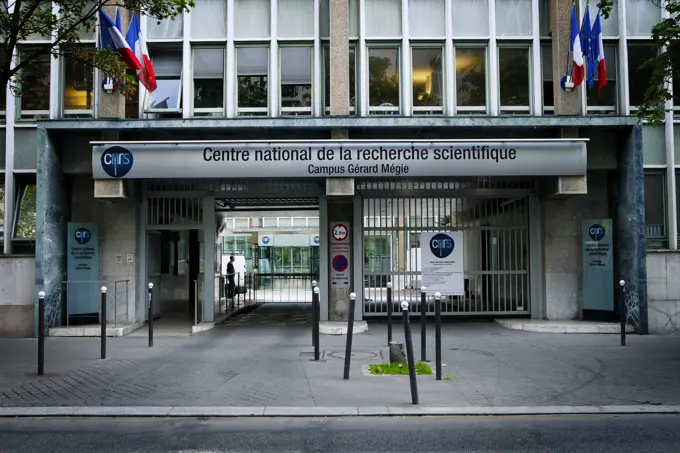
CNRS, Gérard Mégie Campus, Paris.
6145-44638127
Columbia, which opened the era of the Space Transportation System with four orbital flight tests, is featured in re-entry in the emblem designed by the STS-61C crew representing the seven team members who manned the vehicle for its seventh STS mission. Gold lettering against black background honors the astronaut crewmembers on the delta pattern surrounding colorful re-entry shock waves, and the payload specialists are honored similarly below the sphere
1848-50140205
Embry-Riddle Aeronautical University, Rotated Logo, Black Background
6145-44566978
STS79-S-001 (April 1996) --- STS-79 is the fourth in a series of NASA docking missions to the Russian Mir Space Station, leading up to the construction and operation of the International Space Station (ISS). As the first flight of the Spacehab Double Module, STS-79 encompasses research, test and evaluation of ISS, as well as logistics resupply for the Mir Space Station. STS-79 is also the first NASA-Mir American crew member exchange mission, with John E. Blaha (NASA-Mir-3) replacing Shannon W. Lucid (NASA-Mir-2) aboard the Mir Space Station. The lettering of their names either up or down denotes transport up to the Mir Space Station or return to Earth on STS-79. The patch is in the shape of the space shuttles airlock hatch, symbolizing the gateway to international cooperation in space. The patch illustrates the historic cooperation between the United States and Russia in space. With the flags of Russia and the United States as a backdrop, the handshake of Extravehicular Mobility Unit
6145-44539701
S84-42223 (10 Nov. 1984) --- The crew insignia for STS-51C includes the names of its five crew members are astronauts Thomas K. Mattingly, commander; Loren J. Shriver, pilot; Ellison L. Onizuka and James F. Buchli, mission specialists; and Gary E. Payton, payload specialist. The NASA insignia design for space shuttle flights is reserved for use by the astronauts and for other official use as the NASA Administrator may authorize. Public availability has been approved only in the forms of illustrations by the various news media. When and if there is any change in this policy, which is not anticipated, the change will be publicly announced.
6145-44539744
S84-40148 (8 Oct. 1984) --- The space shuttle Discovery en route to Earth orbit for NASA's 51-A mission is reminiscent of a soaring Eagle. The red and white trailing stripes and the blue background, along with the presence of the Eagle, generate memories of America's 208-year-old history and traditions. The two satellites orbiting Earth backgrounded amidst a celestial scene are a universal representation of the versatility of the space shuttle. White lettering against the blue border lists the surnames of the five-member crew--astronauts Frederick H. (Rick) Hauck, David M. Walker, Joseph P. Allen IV, Anna Lee Fisher and Dale A. Gardner. The artwork was done by artist Stephen R. Hustvedt. The NASA insignia design for space shuttle flights is reserved for use by the astronauts and for other official use as the NASA Administrator may authorize. Public availability has been approved only in the forms of illustrations by the various news media. When and if there is any change in this poli
6145-44526071
JOHNSON SPACE CENTER, HOUSTON, TEXAS -- EXPEDITION THREE INSIGNIA -- The Expedition Three crew members -- astronaut Frank L. Culbertson Jr., commander, and cosmonauts Vladimir N. Dezhurov and Mikhail Tyurin -- had the following to say about the insignia for their scheduled mission aboard the International Space Station (ISS):  "The book of space history turns from the chapter written onboard the Russian Mir Station and the U.S. Space Shuttle to the next new chapter, one that will be written on the blank pages of the future by space explorers working for the benefit of the entire world.  The space walker signifies the human element of this endeavor.  The star representing the members of the third expedition, and the entire multi-national Space Station building team, streaks into the dawning era of cooperative space exploration, represented by the image of the International Space Station as it nears completion."The insignia design for ISS flights is reserved for use by the astronauts a
6145-44497479
STS047-S-001 (June 1992) --- Designed by its crew members, the STS-47 mission emblem depicts the space shuttle orbiter with the Spacelab module in the cargo bay against a backdrop of the flags of the United States and Japan. The flags symbolize the side-by-side cooperation of the two nations in this mission. The land masses of Japan and Alaska are represented on the emblem, emphasizing the multi-national aspect of the flight as well as the high inclination orbit of 57 degrees. The initials "SLJ" on the left border of the emblem stand for Spacelab Japan; the name generally used for the mission is Spacelab-J. The Japanese characters on the right border form the word Fuwatto which means "weightlessness."The NASA insignia design for space shuttle flights is reserved for use by the astronauts and for other official use as the NASA Administrator may authorize. Public availability has been approved only in the form of illustrations by the various news media. When and if there is any change
6145-44637934
The crew insignia for STS Flight 51-C includes the names of its five crewmembers. The STS 51-C mission marked the third trip of the Space Shuttle Discovery into space. It was the first Space Shuttle mission totally dedicated to the Department of Defense. The U. S. Air Force Inertial Upper Stage Booster Rocket was successfully deployed. Due to the nature of the mission, few additional details of the flight were made available. Landing was made at the Kennedy Space Center, FL on January 27 at 4 23 PM EST. Mission duration was three days, one hour and 33 minutes.
6145-44548700
STS074-S-001 (July 1995) --- Designed by crew members, this STS-74 crew patch depicts the space shuttle Atlantis docked to Russia's Mir Space Station. The central focus is on the Russian-built Docking Module (DM), drawn with shading to accentuate its pivotal importance to both mission STS-74 and the NASA - Mir Program. The rainbow across the horizon represents Earth's atmosphere, the thin membrane protecting all nations, while the three flags across the bottom show those nations participating in STS-74 - Russia, Canada and the United States. The sunrise is symbolic of the dawn of a new era in NASA space flight - that of space station construction.The NASA insignia design for space shuttle flights is reserved for use by the astronauts and for other official use as the NASA Administrator may authorize. Public availability has been approved only in the forms of illustrations by the various news media. When and if there is any change in this policy, which is not anticipated, the change w
6145-50605543
A88460B U19AX ALAMO LOGO ROD SHEAR (PROJECT ENGINEER) APR 27 88 EG&G/NTS PHOTO LAB Publication Date: 4/27/1988  ALAMO LOGO; ARTWORKS; EDGERTON, GERMESHAUSEN & GRIER; EG&G; LOGOS; LOS ALAMOS TOUCHSTONE; NEVADA; NEVADA TEST SITE; NTS; NUCLEAR ENERGY TECHNOLOGY; NUCLEAR TESTING; NUCLEAR TESTS; TEST SITES; UGT; UNDERGROUND TESTING; U19AX ALAMO LOGO  historical images. 1972 - 2012. Department of Energy. National Nuclear Security Administration. Photographs Related to Nuclear Weapons Testing at the Nevada Test Site.
6145-44831492
ISS029-S-001 (23 March 2011) --- On the Expedition 29 patch, the International Space Station (ISS) is shown following the path of the historic 18th century explorer, Captain James Cook, and his ship, Endeavour.  During Cooks three main voyages, he explored and mapped major portions of the oceans and coastlines under the flight path of the ISS and added immeasurably to the body of knowledge of that time.  As the ISS sails a stardust trail  following the spirit of Endeavour sailing toward the dark unknown and new discoveries  it enlightens Earth below. Through the centuries, the quest for new discoveries has been a significant element of the human character, inspiring us to endure hardships and separation to be part of a mission which is greater than any individual. A spokesman for the crew stated, The crew of Expedition 29 is proud to continue the journey in this greatest of all human endeavors. The NASA insignia design for shuttle and space station flights is reserved for use by
6145-44541208
S88-40316 (12 Dec. 1988) --- The STS-29 patch was designed to capture and represent the energy and dynamic nature of this nation's space program as America continues to look to the future. The folded ribbon border, the first of its kind in the shuttle patch series, gives a sense of three-dimensional depth to the emblem. The stylistic orbital maneuvering system (OMS) burn symbolizes the powerful forward momentum of the shuttle and a continuing determination to explore the frontiers of space. The colors of the U.S. flag are represented in the patch's basic red, white and blue background. In the border, the seven stars between the STS-29 crew names are a tribute to the crew of Challenger. The NASA insignia design for space shuttle flights is reserved for use by the astronauts and for other official use as the NASA Administrator may authorize. Public availability has been approved only in the forms of illustrations by the various news media. When and if there is any change in this policy
6145-52162432
DN-SC-90-01972. Country: Unknown
6145-45245136
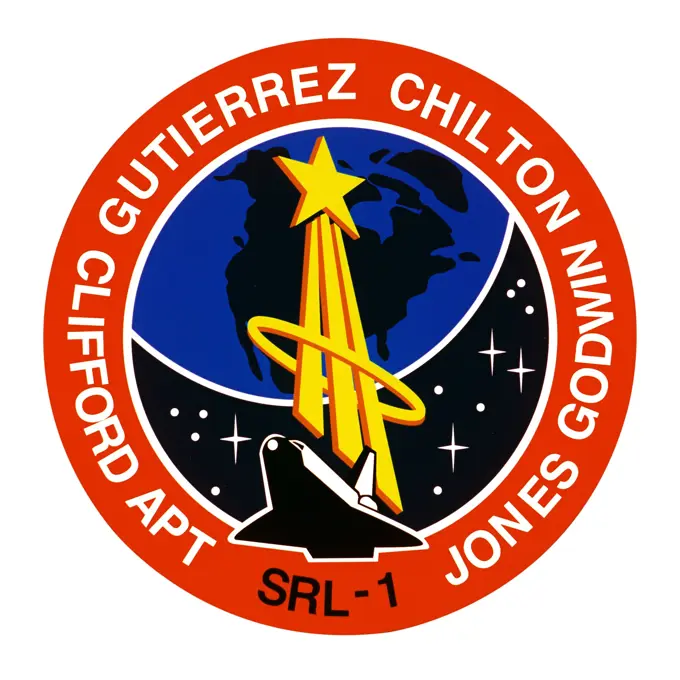
STS059-S-001 (November 1993) --- Designed by the crew members, the STS-59 insignia is dominated by Earth, reflecting the focus of the first Space Radar Laboratory (SRL-1) mission upon our planet's surface and atmosphere. The golden symbol of the astronaut corps emblem sweeps over Earth's surface from the space shuttle Endeavour, representing the operation of the SIR-C/Synthetic Aperture Radar (X-SAR) and the Measurement of Air Pollution from Space (MAPS) sensors. The astronaut emblem also signals the importance of the human element in space exploration and in the study of our planet. Using the unique vantage point of space, Endeavour and its crew -- along with scientists from around the world -- will study Earth and its environment. The starfield visible below Earth represents the many talents and skills of the international (SRL-1) team in working to make this Mission to Planet Earth (MTPE) a scientific and operational success. The NASA insignia design for space shuttle flights is res
6145-44626448
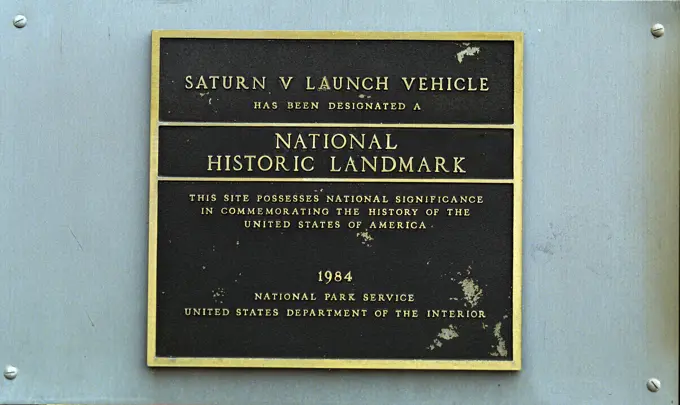
This plaque, displayed on the grounds of Marshall Space Flight Center in Huntsville, Alabama, commemorates the Saturn V Launch Vehicle as a National Historic Landmark. The site was designated as such in 1984 by the National Park Service of the United States Department of the Interior.
6145-45248980
STS104-S-001 (March 2001) --- STS-104, International Space Station (ISS) assembly mission 7A, marks the completion of the initial assembly phase of ISS. The 7A crew will install, activate, and perform the first spacewalk from the Joint Airlock. The Joint Airlock will enable crews to perform spacewalks in either United States or Russian spacesuits while recovering over 90 percent of the gases that were previously lost when airlocks were vented to the vacuum of space.  This patch depicts the launch of space shuttle Atlantis and the successful completion of the mission objectives as signified by the view of the ISS with the airlock installed. The astronaut symbol is displayed behind Atlantis as a tribute to the many crews that have gone before. The hard work, dedication, and teamwork of the airlock team is represented by the ISS components inside the payload bay which include the Joint Airlock and four high pressure gas tanks containing nitrogen and oxygen. In the words of a STS-104 crew
4404-1019
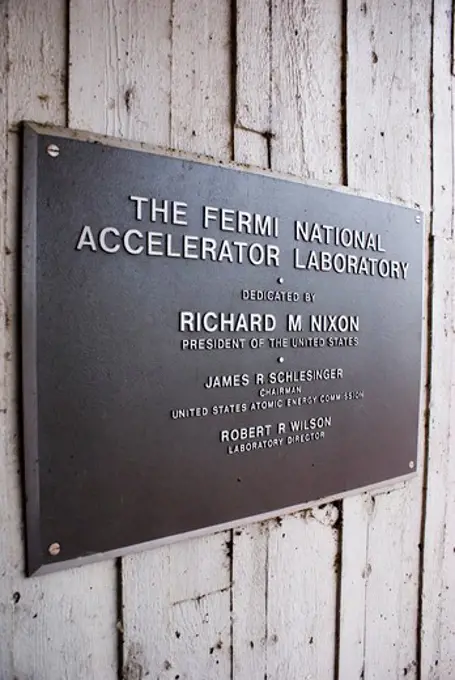
USA, Illinois, Batavia, Fermi National Accelerator Laboratory, Sign at entrance to Wilson Hall
6145-44565333
STS081-S-001 (June 1996) --- The STS-81 crew patch for the fifth Shuttle-Mir docking mission, is shaped to represent the Roman numeral V. The space shuttle Atlantis, OV-104, is launching toward a rendezvous with Russias Mir Space Station, silhouetted in the background. Atlantis and the STS-81 crew will spend several days docked to Mir during which time astronaut Jerry M. Linenger (NASA-Mir 4) will replace astronaut John E. Blaha (NASA-Mir 3) as the United States crew member onboard Mir. Scientific experiments and logistics will also be transferred between Atlantis and Mir. The United States and Russian flags are depicted along with the names of the shuttle crew members: Michael A. Baker, commander; Brent W. Jett, pilot; Peter J. K.(Jeff) Wisoff, mission specialist 1; John W. Grunsfeld, mission specialist 2; Marsha S. Ivins, mission specialist 3; Linenger; mission specialist 4; and Blaha, mission specialist 5.The NASA insignia design for space shuttle flights is reserved for use by t
6145-50606612
A861110 U4T GASCON LOGO SHEAR (Project Engineer) OCT 8 1986 EG&G/NTS PHOTO LAB Publication Date: 10/8/1986  EDGERTON, GERMESHAUSEN & GRIER; EG&G; GASCON LOGO; LOGOS; NEVADA; NEVADA TEST SITE; NTS; NUCLEAR ENERGY TECHNOLOGY; NUCLEAR TESTING; NUCLEAR TESTS; SHEAR, MIKE; TEST SITES; U4T GASCON; UGT; UNDERGROUND TESTING; WEAPONS TECHNOLOGY  historical images. 1972 - 2012. Department of Energy. National Nuclear Security Administration. Photographs Related to Nuclear Weapons Testing at the Nevada Test Site.
6145-51874145
Arnold Engineering Development Complex (AEDC) winners of Air Force Test Center-level winners of the 2021 Air Force Materiel Command Science, Engineering and Technical Management Awards were announced by AEDC leadership. (U.S. Air Force graphic by Brooke Brumley)
PREVIOUS
of 6
NEXT
2401 S. Ervay, Suite 206
Dallas, Texas 75215
United States
Get Started
Free ResearchMy BoardsMy Cart
For Creators
How To License Your ContentContributor PortalFrame of Mind
Resources
API accessPricing
Contact
+1 866 236 0087help@viewpictures.co.uk Contact form
©2026 View Pictures. All Rights Reserved. -A
This site is protected by reCAPTCHA and Google Privacy Policy and Terms of Service apply.