My Boards
View Pictures
  • My Boards

Celestial Bodies and Craters

Images of celestial surfaces featuring craters and geological formations from various planets and moons, showcasing textured gray landscapes.

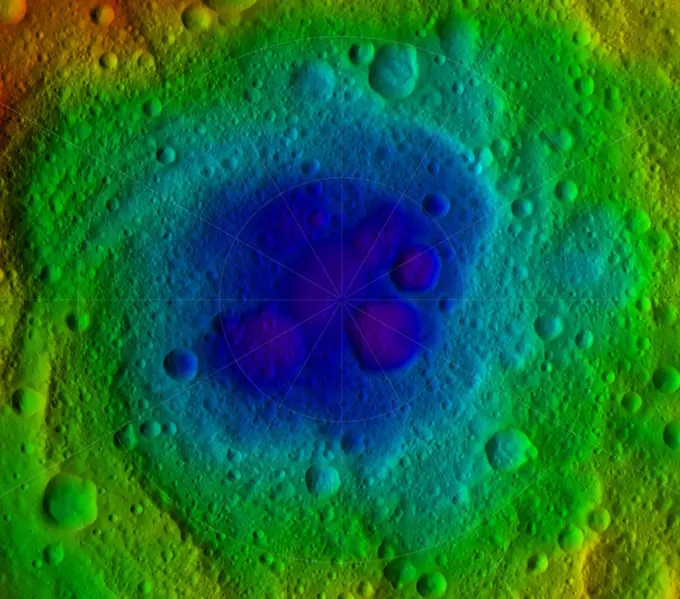
Inside Eminescu
Inside Eminescu
376 assets in this story
6145-44759401
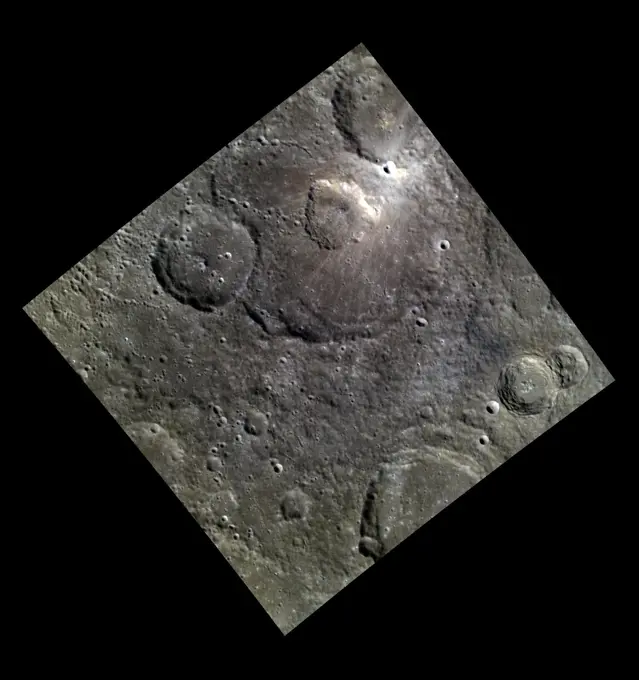
The crater identified in this NAC image was named in November 2008 for Ronald Moody, a 20th century Jamaican sculptor and painter. Moody features a central peak or peak-ring structure and an annulus of dark material on its outer floor (green arrows).
6145-44904625
Details of Dominici
6145-44597964
Crater with Wind Streak
6145-44975577
This image of Marcia AV-L-12, from the atlas of the giant asteroid Vesta, was created from images taken as NASA's Dawn mission flew around the object, also known as a protoplanet.
6145-44917051
Tune in to NASA's News Conference today, November 29, 2012, at 2 p.m. EST for new findings about Mercury's polar regions. a href= http //www.nasa.gov/multimedia/nasatv/index.html rel= nofollow www.nasa.gov/multimedia/nasatv/index.html /a Due to its nearly vertical spin axis, Mercury's north pole is never fully sunlit. If it were, it might look something like this image, which is an orthographic projection of a global mosaic. The dark area towards the center of the image contains the north pole. The MESSENGER spacecraft is the first ever to orbit the planet Mercury, and the spacecraft's seven scientific instruments and radio science investigation are unraveling the history and evolution of the Solar System's innermost planet. Visit the Why Mercury section of this website to learn more about the key science questions that the MESSENGER mission is addressing. During the one-year primary mission, MESSENGER acquired 88,746 images and extensive other data sets. MESSENGER is now in a yearlong
6145-44873853
A Multitude of Rays
6145-44639072
Spirit Traverse Map, Sol 680
6145-44505861
Ganymede - Close Up Photos
6145-44702302
NASA's Mars Reconnaissance Orbiter took two images of the larger of Mars' two moons, Phobos, within 10 minutes of each other on March 23, 2008. 3D glasses are necessary to view this image.
6145-44859365
Abedin's Ejecta
6145-45040393
Windstreaks located in Chryse Planitia as seen by NASA's 2001 Mars Odyssey spacecraft.
6145-44900080
These images from NASA's Dawn spacecraft are located in Urbinia quadrangle, in Vesta's southern hemisphere.
6145-44840279
The southern hemisphere of Saturn's moon Tethys is seen in this updated polar stereographic maps, mosaicked from the best-available images obtained by NASA's Cassini spacecraft.
6145-45106280
One of the strangest landforms spotted by NASA's New Horizons spacecraft when it flew past Pluto last July was the 'bladed' terrain just east of Tombaugh Regio, the informal name given to Pluto's large heart-shaped surface feature.
6145-45105440
NASA's New Horizons views the informally named Sputnik Planum on Pluto (top) and the informally named Vulcan Planum on Charon (bottom).
6145-44928375
This set of images from the radar instrument on NASA's Cassini spacecraft shows a relatively 'fresh' crater called Sinlap (left) and an extremely degraded crater called Soi (right).
6145-45262514
This image was obtained by NASA's Dawn spacecraft on July 31, 2018 from an altitude of about 31 miles (50 kilometers). The center of this picture is located at about 45.4 degrees south latitude and 252.8 degrees east longitude.
6145-44960706
A Volcanic Crater in an Impact Crater
6145-44883434
This image of asteroid Vesta from NASA's Dawn spacecraft shows part of a large crater with a relatively fresh rim located in Vesta's Numisia quadrangle, near the equator.
6145-44911518
Riddles in the Dark
6145-44695659
As NASA's MESSENGER spacecraft sped by Mercury on January 14, 2008, the Narrow Angle Camera (NAC) of the Mercury Dual Imaging System (MDIS) captured this shot looking toward Mercury's north pole.
6145-44964137
This image, which is composed of data obtained by NASA's Cassini spacecraft, shows the topography of a mountain known as Janiculum Dorsa on the Saturnian moon Dione.
6145-44881299
In this image from NASA's Dawn spacecraft, bright material extends out from the crater Canuleia on asteroid Vesta. The bright material appears to have been thrown out of the crater during the impact that created it.
6145-44508760
NASA's Mariner 10 shows a close-up view of one-half of a circular basin the largest observed on Mercury. Hills and valleys extend in a radial fashion outward from the main ring.
6145-44617097
Ares Valles: Night and Day
6145-44616728
Spirit's View on Sol 142 (Vertical)
6145-45015684
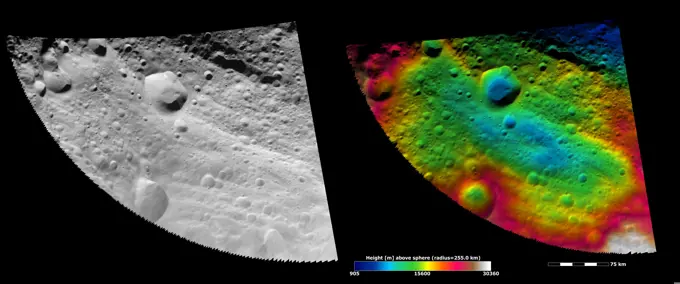
This anaglyph from NASA's Dawn spacecraft image shows the topography of asteroid Vesta's southeastern region. You need 3D glasses to view this image.
6145-45020879
These images show part of asteroid Vesta's equatorial region, which contains impact craters and troughs (linear depressions).
6145-45061737
Craters, Peaks, and Chains
6145-44823362
The Complex Geology of Geddes Crater
6145-45111643
The inset perspective view from NASA's Dawn space of Ceres' bright spot Occator Crator is overlaid with data concerning the composition. Red signifies a high abundance of carbonates, while gray indicates a low carbonate abundance.
6145-44568521
Mitten shaped region of Chaotic Terrain on Europa
6145-44645336
Perspective View of HiRISE First Image
6145-45084876
He (or She) Who Shall Be Named
6145-44613622
Flung Far from Home
6145-44966537
Peaking Out -- in 3-D!
6145-44841278
Bacolor Crater is a magnificent impact feature about 20 kilometers (12 miles) wide. This image is part of an 'All Star' set marking the occasion of NASA's Mars Odyssey as the longest-working Mars spacecraft in history.
6145-44969587
Crater Brilliance
6145-44830720
Young Volcanism on Mercury
6145-44495925
Martian Crater
6145-44615256
ISS009-E-05944 (7 May 2004) --- The Pinacates Biosphere Reserve is featured in this image photographed by an Expedition 9 crewmember on the International Space Station (ISS). The Pinacates—a moon-like volcanic landscape that lies in the Sonoran Desert in Mexico just a few miles from the border with Arizona—is one of the most unique and striking landscapes in North America. The volcanic range is surrounded by one of North America’s largest dune fields, Gran Desierto. The natural history of the region includes thousands of years of human occupation; it is the aboriginal homeland of the O’Odham tribe, also known as the Papago. The region also served as an early training site for Apollo astronauts in the mid-late 1960s. The name Pinacate is derived from “pinacatl,” the Aztec name for the desert stink beetle which is common in the region. The natural and cultural resource management of the region, including the archeological sites and the high biodiversit
6145-45115987
Valleys much younger than well-known ancient valley networks on Mars are evident near the informally named 'Heart Lake' on Mars. This map based on NASA's MGS data presents color-coded topographical information overlaid onto a photo mosaic.
6145-45099527
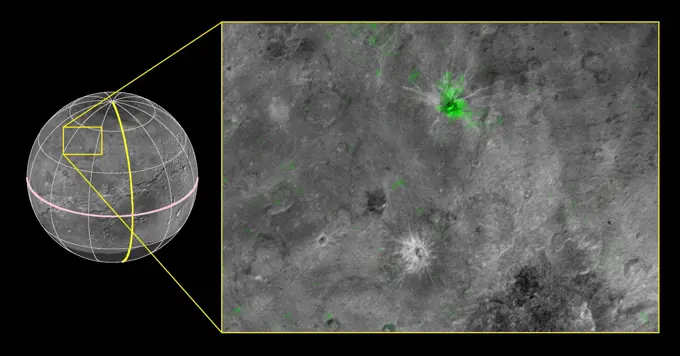
NASA's New Horizons scientists have discovered a striking contrast between one of the fresh craters on Pluto's largest moon Charon and a neighboring crater. The crater, informally named Organa, caught scientists' attention.
6145-44727120
Rock Moved by Mars Lander Arm
6145-45070635
This recent image from NASA's Mars Reconnaissance Orbiter, acquired to certify a landing site for NASA'a InSight mission, shows a distinctive crater with a very sharp rim and ejecta.
6145-45045425
This anaglyph from NASA's Dawn spacecraft shows degraded craters shows partially degraded craters and ridges in asteroid Vesta's Pinaria quadrangle. You need 3D glasses to view this image.
6145-45071175
Standing Out in a Crowd
6145-45041452
Examining Eminescu
6145-45265647
This final traverse map for NASA's Opportunity rover shows where the rover was located within Perseverance Valley on June 10, 2018, the last date it made contact with its engineering team. Visible in this map is a yellow traverse route beginning at Opportunity's landing site, Eagle Crater, and ranging 28.06 miles (45.16 kilometers) to its final resting spot on the rim of Endeavour Crater. The rover was descending down into the crater in Perseverance Valley when the dust storm ended its mission. This map is made from several images taken by the Context Camera on NASA's Mars Reconnaissance Orbiter. Those images are B02_010486_1779_XN_02S005W, P15_006847_1770_XN_03S005W, and P13_006135_1789_XN_01S005W. Malin Space Science Systems in San Diego built and operates the camera.
6145-44617105
Spirit's Trip to the Hills
6145-44625915
Spirit's Route in Black and White
4128-16170526
Artwork of the terminator on the Moon, showing shadows cast by the mountains and crater rims.
6145-44901395
This global digital map of Rhea was created using data taken during NASA's Cassini and Voyager spacecraft flybys.
6145-44729298
Changing Stripes
6145-44900316
This image shows the quadrangle where NASA's Curiosity rover landed, within the expansive Gale Crater. The mission's science team has divided the landing region into several square quadrangles, or quads, of interest about 1-mile (1.3-kilometers) wide.
6145-44751799
NASA's Mariner 10 shows a close-up view of craters Vyasa and Stravinsky on Mercury. Stravinsky is a smooth-floored crater partially seen overlying the rim of the larger, rougher crater Vyasa in the center and left.
6145-44559131
Mars Pathfinder Landing Ellipses
6145-45233155
AS15-97-13168 (31 July-2 Aug. 1971) --- A view of the flow structure on the rim and edge of the crater Tsiolkovsky in the highlands of the lunar farside, as photographed from lunar orbit by astronaut Alfred M. Worden in the Apollo 15 Command and Service Module (CSM). Note the scarp at the edge of the flow and elongated grooves on the flow surface. While astronauts David R. Scott and James B. Irwin descended in the Lunar Module (LM) Falcon to explore the moon's Hadley-Apennine landing site, Worden remained with the CSM in lunar orbit.
6145-44617348
This 3-D image taken by the left and right eyes of the panoramic camera on NASA's Mars Exploration Rover Spirit shows the odd rock formation dubbed 'Cobra Hoods' (center). 3D glasses are necessary to view this image.
6145-44834276
Ejecta from Copernicus
6145-44995552
Mercury in Bronze
6145-44518757
The Subtle Colors of Eros
6145-58966880
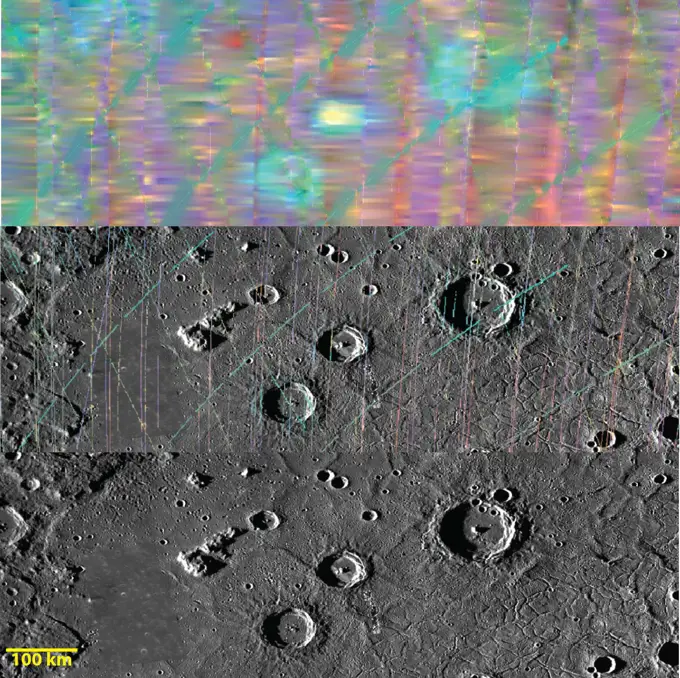
Shown here are color views of the plains near Rudaki crater.
6145-45014386
Hello Hollows
6145-45297216
AS16-119-19161 (16-27 April 1972) --- The prominent rille feature running through the area is Herigonius I. The coordinates for the center of the area pictured are 14.7 degrees south latitude and 36.4 degrees west longitude. The photo was taken by the Apollo 16 astronauts from the Command and Service Modules (CSM) in lunar orbit. While astronauts John W. Young and Charles M. Duke Jr. descended in the Lunar Module (LM) Orion to explore the Descartes highlands region of the moon, astronaut Thomas K. (Ken) Mattingly II, remained with the CSM Casper in lunar orbit.
6145-44818097
NASA's Lunar Reconnaissance Orbiter captured this anaglyph image is a close up view of Copernicus crater. 3D glasses are necessary to view this image.
6145-44857692
Bright Peaks, Big Crater
6145-45259901
. From Orbit, Looking toward Mercury's Horizon
6145-44718031
S72-01711 (July 1972) --- A vertical view of the Apollo 17 landing site in the Taurus-Littrow area of the lunar nearside, with an overlay showing the Lunar Roving Vehicle traverse proposed for the first extravehicular activity. The scale at the bottom is measured in kilometers. One kilometer equals 0.6214 statute mile. The coordinates of the Apollo 17 touchdown point are 30 degrees 44 minutes 58 seconds east longitude and 20 degrees 9 minutes 50 seconds north latitude. This photograph was taken from lunar orbit on an earlier Apollo mission.
1746-19670805
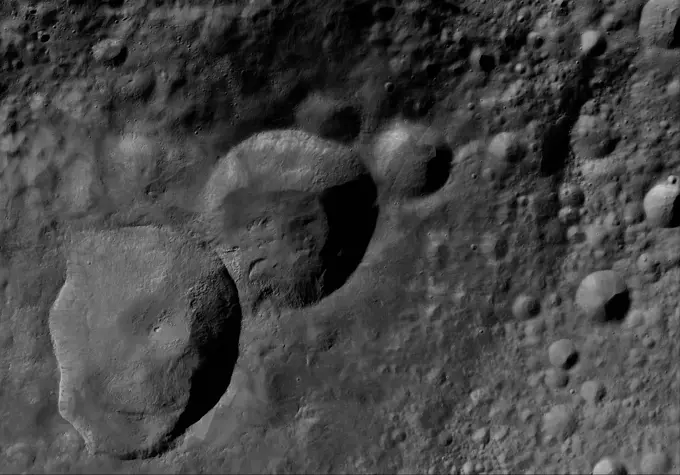
This image from NASA's Dawn mission shows the topography of the northern and southern hemispheres of the giant asteroid Vesta, updated with pictures obtained during Dawn's last look back. Around the time of Dawn's departure from Vesta in the late summer of 2012, dawn was beginning to creep over the high northern latitudes, which were dark when Dawn arrived in the summer of 2011. The three craters that make up Dawn's 'snowman' feature can be seen at the top of the northern hemisphere map on the left. A mountain more than twice the height of Mount Everest, inside the largest impact basin on Vesta, can be seen near the center of the southern hemisphere map on the right.
6145-45065498
You Can Crater on Me. This is a composite image from NASA's MESSENGER spacecraft.
6145-44896058
These images from NASA's Dawn spacecraft are located in asteroid Vesta's Marcia quadrangle, just south of Vesta's equator.
6145-44842323
MESSENGER Image Compilation from 2010
6145-45042511
Color Close-Up of Kuiper
6145-44802140
Precise 3D Measurements of Objects at Apollo 14 Landing Site
6145-44714989
S69-38667 (July 1969) --- A photographic illustration comparing the size of Apollo Landing Site 2 with that of the metropolitan Washington, D.C. area. Site 2 is one of three Apollo 11 lunar landing sites. This will be the landing site if Apollo 11 is launched on July 16, 1969, as scheduled. Site 2 is located at 23 degrees 42 minutes 28 seconds east longitude and 0 degrees 42 minutes 50 seconds north latitude in southwestern Mare Tranquillitatis (Sea of Tranquility). (The white overlay is printed over a lunar surface photograph taken from Apollo 10 during its lunar orbit mission and is numbered AS10-31-4537.)
PREVIOUS
of 4
NEXT
2401 S. Ervay, Suite 206
Dallas, Texas 75215
United States
Get Started
Free ResearchMy BoardsMy Cart
For Creators
How To License Your ContentContributor PortalFrame of Mind
Resources
API accessPricing
Contact
+1 866 236 0087help@viewpictures.co.uk Contact form
©2026 View Pictures. All Rights Reserved. -A
This site is protected by reCAPTCHA and Google Privacy Policy and Terms of Service apply.