My Boards
View Pictures
  • My Boards
← Artworks

Chinese Landscapes and Nature

Elegant depictions of landscapes from Asia, characterized by flowing ink techniques, serene scenes, and elements of nature, embodying traditional artistic styles.

Shrimp, 1864, Kinoshita Itsuun, Japanese, 1800 - 1866, 10 1/8 × 12 1/16 in. (25.72 × 30.64 cm) (image)47 7/16 × 18 5/16 in. (120.49 × 46.51 cm) (mount, without roller), Ink and color on silk, Japan, 19th century
259 assets in this story
6145-29116542
Takasago. Shiokawa Bunrin (Japan, 1808-1877). 19th century. Paintings; screens. Pair of six-panel folding screens; ink and color on paper
6145-52373998
Scroll III.. 1501 - 1599. Illustrations, Manuscripts. Spencer Collection
6145-58826058
Zen painting and calligraphy, Hakuin, 1685 - 1769 Shakamuni.  paper. ink calligraphy Shakamuni.  paper. ink calligraphy
6145-29737338
Piece 18th-19th century Japan. Piece 65811
4443-28729293
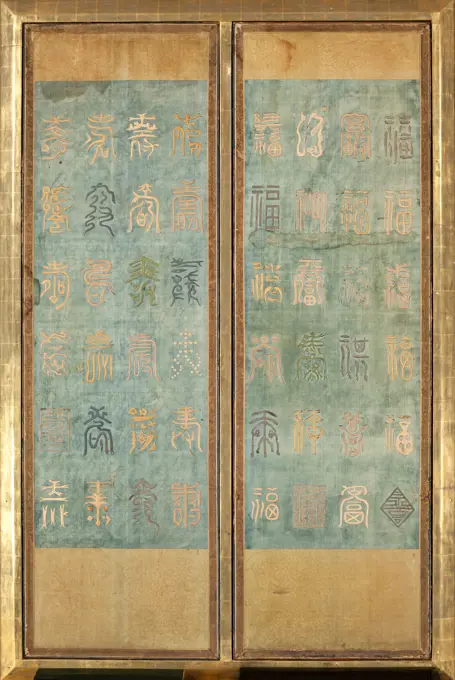
Embroidered Panels with Design of the Chinese Characters for 'Longevity' and 'Good Fortune', 18th-19th century, Unknown Korean, 34 3/16 × 12 7/8 in. (86.84 × 32.7 cm) (image)46 3/4 × 14 3/16 in. (118.75 × 36.04 cm) (mount)50 3/4 × 33 5/8 × 1 in. (128.91 × 85.41 × 2.54 cm) (outer frame), Gold-thread embroidery on silk, Korea, 18th-19th century, Each of these six panels features twenty-four Chinese characters, alternating between the characters for 'longevity' () and 'good fortune' (福). The characters, embroidered in gold thread on a light-blue ground, represent a wide variety of scripts. Some are traditional, while others are less orthodox, including characters whose brushstrokes are formed by stylized bamboo, fish, or birds.
6145-29077953
Paintings after Ancient Masters: Volume 2, 1598-1652. Chen Hongshou (Chinese, 1598/99-1652). Album leaf, ink and color on silk; overall: 30.2 x 26.7 cm (11 7/8 x 10 1/2 in.).
4430-2537
fine arts, China, Yuan Dynasty (1279 - 1368), servant with two horses, ink drawing, by Tsao Soong Sih, National Museum Taipeh, Taiwan,
6145-29724719
Krin's Painting Style (Krin gashiki) 1818 Aikawa Minwa Japanese The early nineteenth century witnessed a renewed interest in the celebrated Rinpa artist Ogata Krin (1658-1716). Nagamura Hchu and Sakai Hitsu led the revival with the publication, respectively, of the The Krin Picture Album (Krin gafu) of 1802 and One Hundred Paintings by Krin (Krin hyakuzu) of 1815 and 1826 (sequel edition). Minwa’s volume was clearly responding to this popular demand for Krin’s designs.. Krin's Painting Style (Krin gashiki). Aikawa Minwa (Japanese, active 1806-1821). Japan. 1818. Set of two Woodblock printed books; ink and color on paper. Edo period (1615-1868). Illustrated Books
6145-51828011
Kyosai Kadan Nihen (Pictorial Accounts of Kyosai), Part I, Volume 2 Kawanabe Kyosai (Japanese, 1831-1889). Kyosai Kadan Nihen (Pictorial Accounts of Kyosai), Part I, Volume 2, 1887. Ink and light colors on paper, 10 1/16 x 6 15/16 in. (25.6 x 17.6 cm).  Kyosai studied many different types of painting and borrowed freely from varied sources when creating his own, innovative print designs. He shared his expertise in Japanese art history in his Treatise on Painting, which offers an analysis of various painting styles and schools as well as discussions of his place within those traditions. The volumes offer a valuable glimpse of how Meiji period artists understood their own artistic heritage. Kyosai spent only two years training in the studio of Kuniyoshi (from age seven to nine), but his time there made a profound impression on the young artist, who later excelled in creating heroic subjects like those of his master. In a double-page illustration, Kyosai depicts himself as a child in Kuni
6145-29268509
Smallpox illustration, Japanese manuscript, c. 1720
6145-45326604
Makata with a dragon motif with a burning pearl unknown
4409-17552417
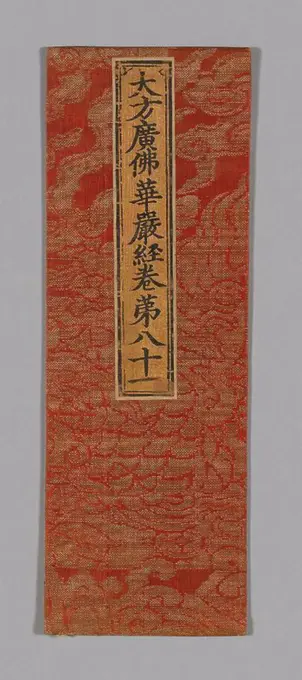
Sutra Cover. China. Date: 1590-1599. Dimensions: 35.1 × 12.1 cm (13 7/8 × 4 3/4 in.). Silk and gold-leaf-over-lacquered-paper strips, plain weave with patterning wefts; wrapped over cardboard and partially backed with paper; applied label of silk, plain weave; with inscribed title painted and/or printed with ink. Origin: China. Museum: The Chicago Art Institute, Chicago, USA.
4409-17387512
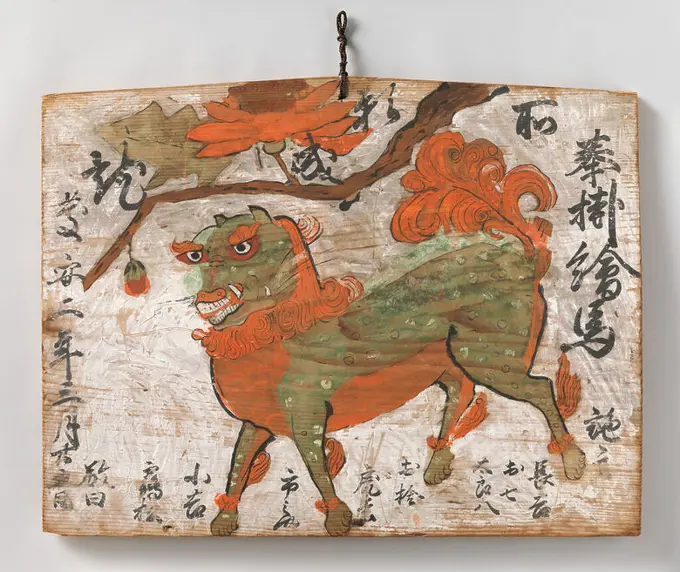
Ema (Votive Painting) of Chinese Lion and Peony Tree. Culture: Japan. Dimensions: 16 15/16 x 21 3/4 in. (43 x 55.3 cm). Date: 1649.This ema was donated by eight people, whose names run along the bottom of the tablet. On either side of the lion is inscribed:This ema is respectfully presented on the twenty-fifth day of the third month of the year 1649.Across the top, as if winding through the peony branch, is the phrase, "may our desires be granted.". Museum: Metropolitan Museum of Art, New York, USA.
6145-52955808
Page from Shi Zhu Zhai China Qing dynasty (1644-1911), Qianlong period (1736-95) View more. Page from Shi Zhu Zhai. China. Polychrome woodblock print; ink and color on paper. Qing dynasty (1644-1911), Qianlong period (1736-95). Prints
6145-29237614
Page from Shi Zhu Zhai China. Page from Shi Zhu Zhai. China. Polychrome woodblock print; ink and color on paper. Qing dynasty (1644-1911), Kangxi period (1662-1722). Prints
6145-29126278
Plum Viewing at Tsukigase. Okada Hankō (Japan, 1782-1846). Japan, 1837. Paintings; scrolls. Handscroll; ink and light colors on paper
4409-17547565
Sutra Cover. China. Date: 1590-1599. Dimensions: 34 × 12 cm (13 3/8 × 4 3/4 in.). Silk and gold-leaf-over-lacquered-paper strips, satin weave with patterning wefts; wrapped over cardboard and partially backed with paper; applied label of silk, plain weave; with inscribed title painted and/or printed with ink. Origin: China. Museum: The Chicago Art Institute, Chicago, USA.
4443-28740358
Landscape, from a triptych of White-robed Kannon with Landscape and Tiger, 17th century, Kano Tan'yū, Japanese, 1602 - 1674, 48 1/16 x 19 3/4 in. (122.08 x 50.17 cm) (image)85 15/16 x 25 15/16 in. (218.28 x 65.88 cm) (overall, without roller), Ink on paper, Japan, 17th century, Kanō Tan'yū was one of the foremost artists of the Edo period (1600-1868). In his position as official painter to the Tokugawa rulers, he had access to their great collections of art including ink paintings by earlier Japanese artists as well as examples imported from China. Flanking an iconic image of a Buddhist deity (in this case, Kannon, the bodhisattva of mercy and compassion) with unconventional themes like the tiger and landscape seen here, was an idea that first emerged among iconoclastic Chinese painters who were adherents of Zen Buddhism. In his impressionistic handling of ink, too, Tan'yū harkens back to earlier Zen-inspired artists who wielded the brush in a free and spontaneous manner.
6145-29780223
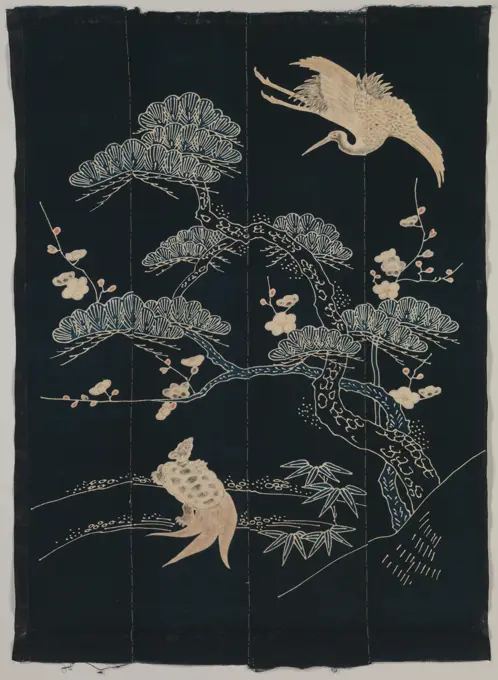
Futon Cover with Turtle, Crane, Pine, Plum, and Bamboo late 19th-early 20th century Japan. Futon Cover with Turtle, Crane, Pine, Plum, and Bamboo 72673
6145-50507342
Stela wotywna. unknown, graphic artist
6145-59080968
Fragment of the verdiure;  XVII/18th century (1680-00-00-1720-00-00);
6145-29187349
Album of Sketches for Lacquer Decoration 1839 Unidentified artist. Album of Sketches for Lacquer Decoration. Unidentified artist. Japan. 1839. Ink and color on paper. Edo period (1615-1868). Illustrated Books
4409-17461965
Wall Paper. Dated: 1934. Dimensions: overall: 54.4 x 36.1 cm (21 7/16 x 14 3/16 in.). Medium: watercolor, gouache, and graphite on paperboard. Museum: National Gallery of Art, Washington DC. Author: Moses Bank.
6145-54532678
Sorimachi 409. text. Illustrations, Botanical illustrations. 1746. Spencer Collection
1899-19137168
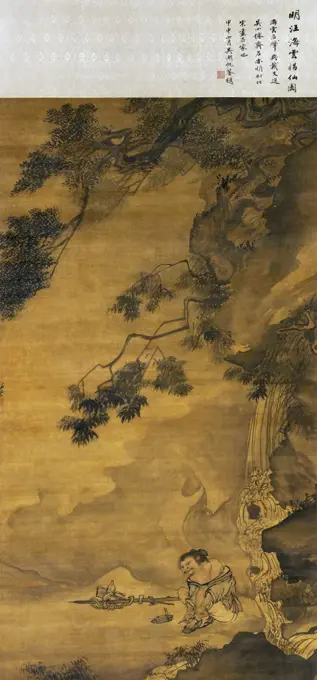
China: 'Iron-Crutch Li', Ming Dynasty hanging scroll painting by Wang Zhao (active 1506-1521), 16th century. Shanghai Museum, Shanghai
6145-29163440
Transmitting the Spirit, Revealing the Form of Things: Hokusai Sketchbooks, volume 10 (Denshin kaishu: Hokusai manga, jūhen) 1819 Katsushika Hokusai Japanese. Transmitting the Spirit, Revealing the Form of Things: Hokusai Sketchbooks, volume 10 (Denshin kaishu: Hokusai manga, jūhen) 57687
4409-17412960
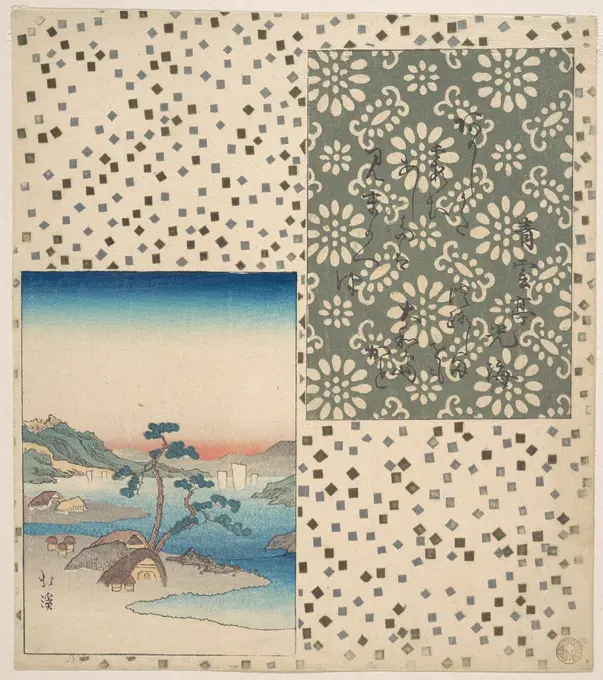
Print. Artist: Totoya Hokkei (Japanese, 1780-1850). Culture: Japan. Dimensions: 8 x 7 1/8 in. (20.3 x 18.1 cm). Date: 1830. Museum: Metropolitan Museum of Art, New York, USA.
4409-17387138
Palaces of the Immortals. Artist: Xu Yang (Chinese, active ca. 1750-after 1776). Culture: China. Dimensions: Image: 6 1/4 x 18 1/2 in. (15.9 x 47 cm)Sheet: 15 × 24 1/2 in. (38.1 × 62.2 cm). Date: dated 1753.Xu Yang was recruited as a court painter in 1751 and became one of the Qianlong Emperor's leading artists, culminating with his being selected in 1764 to execute the Qianlong Southern Inspection Tour. This intimate fan painting shows Xu working in a miniaturist style and a decorative blue-and-green technique that differs markedly from his typically grand imperial commissions. According to the artist's long inscription, Xu was commanded by the emperor to paint this work as a birthday gift to a Mr. Li.Fanciful images of Daoist paradises were suitably auspicious subjects for birthday gifts. Using the archaic blue-and-green landscape style, Xu demonstrates his mastery of this mode with dense mineral colors accented with gold highlights and detailed renderings of architectural forms.
4443-28729945
Taro Root, from an album of vegetables, Bian Shoumin, Chinese, 1684-1752, 7 1/2 x 4 1/2 in. (19.05 x 11.43 cm) (sheet), ink on paper, China
4266-21275
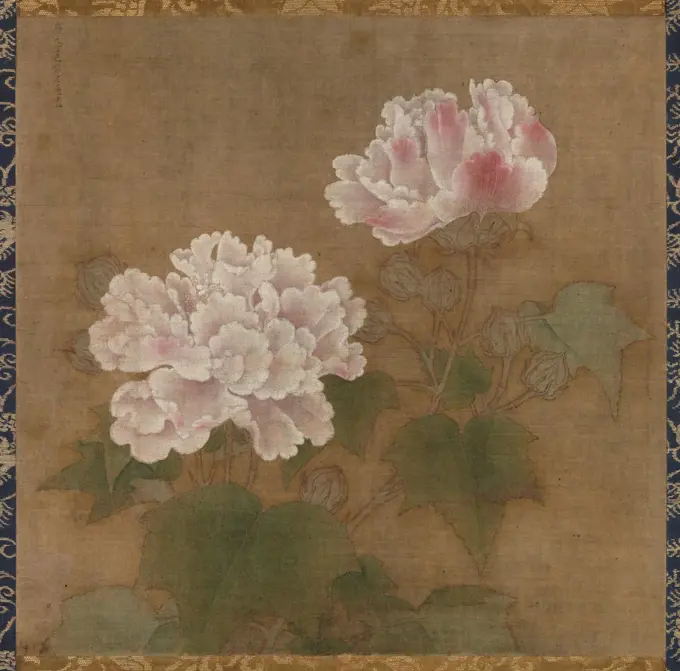
Red hibiscuses (Set of two hanging scrolls) by Li Di (active 12th century)/ Tokyo National Museum/ 1197/ China, Song Dynasty/ Tempera on silk/ The Oriental Arts/ 25,2x25,5/ Still Life
4443-28745012
Summer center right from the set Rice Farming in the Four Seasons, 1620s, Attributed to Kano Sanraku, Japanese, 1559 - 1635, 39 x 37 x 3 1/2 in. (99.06 x 93.98 x 8.89 cm), Ink, light color, and gold on paper, Japan, 17th century, These sliding door panels are part of a group of sixteen, which originally formed the four sides of a small reception chamber at Daikakuji, a Buddhist temple in northwest Kyoto. The paintings show the process of rice cultivation across four seasons. A person seated in the room would have seen the scene unfold from north, beginning with winter and moving clockwise. Spring, the second in order, would have been on the eastern side.
4409-17378546
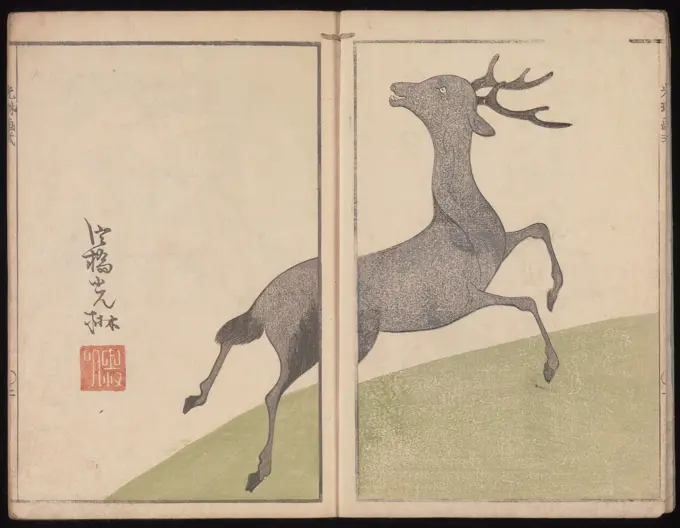
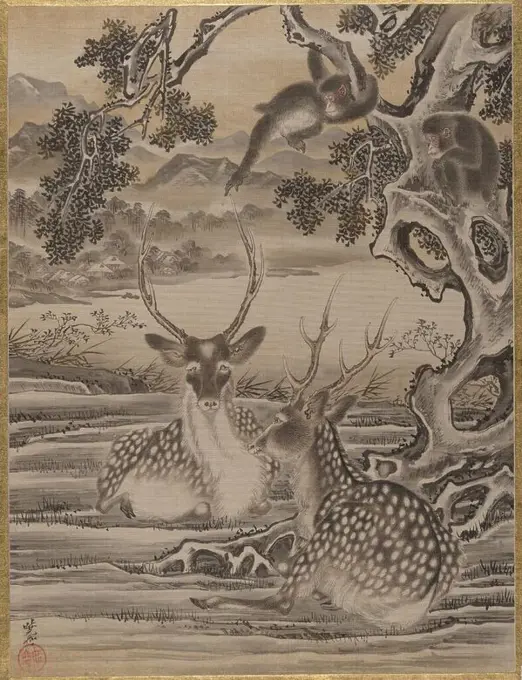
Deer and Monkeys. Artist: Kawanabe Kyosai (Japanese, 1831-1889). Culture: Japan. Dimensions: 14 1/4 x 10 1/2 in. (36.2 x 26.7 cm). Date: ca. 1887. Museum: Metropolitan Museum of Art, New York, USA.
6145-51819024
Two-panel Ando (Sliding Door Panels):Butterflies Shibata Zeshin (Japanese, 1807-1891). , 19th century. A pair of two-panel Ando (sliding door panels), opaque colors and lacquer on gold paper, Image: 9 1/4 x 32 3/4 in. (23.5 x 83.2 cm).   Asian Art 19th century
6145-29753299
Toad and Flowers 19th century Hokusai School. Toad and Flowers. Hokusai School. Japan. 19th century. Unmounted painting; ink and color on paper. Edo period (1615-1868). Paintings
6145-54583152
Morning Glory, Cluster of Grapes, and Spider, folio 10 (verso), from Florilegium (A Book of Flower Studies), 1608. France. Watercolor, ink, silver and gold over occasional traces of pencil, on vellum; sheet: 31.1 x 20.2 cm (12 1/4 x 7 15/16 in.).
6145-46649745
. Representative screen, six-part, episode from the Heiji war.
4409-17350496
Lotus. Artist: Unidentified Artist; Copy after () Huang Qüan (Chinese, active ca. 950). Culture: China. Dimensions: 8 3/4 x 9 1/2 in. (22.2 x 24.1 cm). Museum: Metropolitan Museum of Art, New York, USA.
6145-51828791
An Old Man Walking by a Stream, with Distant Mountains Wu Li (Chinese, 1632-1718). An Old Man Walking by a Stream, with Distant Mountains, 1706. Ink and color on paper, image: 50 3/4 x 13 1/2 in. (128.9 x 34.3 cm).  Wu Li, an acclaimed Qing dynasty painter, expressed himself through the styles of a select lineage of past artists. Here, sparse trees and an empty pavilion allude to Ni Zan (1301-1374), but Wu Li has reworked the dry, sketchy style of the Yuan dynasty master by incorporating loose, moist brushstrokes to create a richer tonality. Wu Lis reinterpretation may have been influenced by an increasing awareness of Western artistic techniques, such as chiaroscuro and one-point perspective. Wu Li converted to Christianity in the 1670s, allowing him close contact with the missionaries who brought new images and skills to China from the West. Asian Art 1706
6145-55951057
Ise monogatari = The Tales of Ise.. text. Illustrations. 1608. Spencer Collection
6145-51821828
Hokusai Manga, Vol. IX Katsushika Hokusai (Japanese, 1760-1849). Hokusai Manga, Vol. IX, 1817. Paper, 9 x 6 1/4 in. (22.9 x 15.9 cm).   Asian Art 1817
1899-19136833
China: Qingming Shang Tu or 'Along the River During the Qingming Festival' (detail), from a 1737 Qing Dynasty version based on the Zhang Zeduan (1085-1145) original scroll painting dating from the Northern Song Dynasty (960-1127)
6145-45692672
Japan - Part five; Nihon - Go. Part five of a set of pattern books; blue cover with image of a pink stylized kimono; 50 sheets with various dust cartridges, kimono designs and some flowers and plants.
1899-19136380
Korea: The embassy of Yi Deok-Hyeong (1566-1645) from Joseon Korea to the Chinese Ming Court in 1592. Watercolour on paper, 1624 (National Museum of Korea, Seoul)
6145-29179037
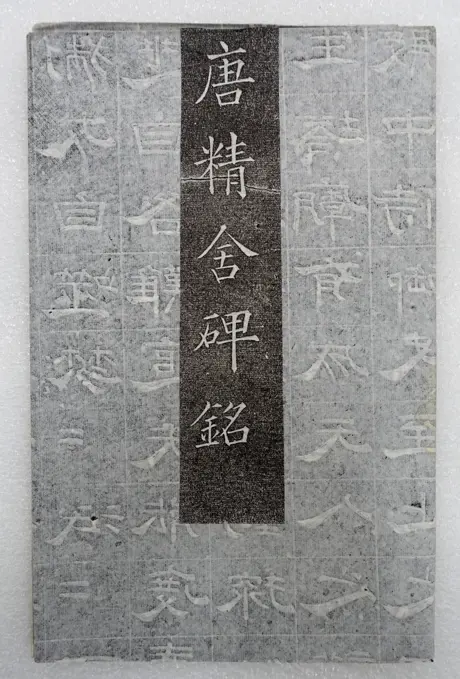
Datang Yushitai Jingshe Bei 20th century China. Datang Yushitai Jingshe Bei. China. 20th century. Ink on paper. Rubbing
6145-29822644
Landscape Painting of Figure in Woodland Setting Unidentified artist. Landscape Painting of Figure in Woodland Setting 53578
4069-2744
Paper making, pasting up the pages, Chinese woodblock print, 19th century
1899-19188958
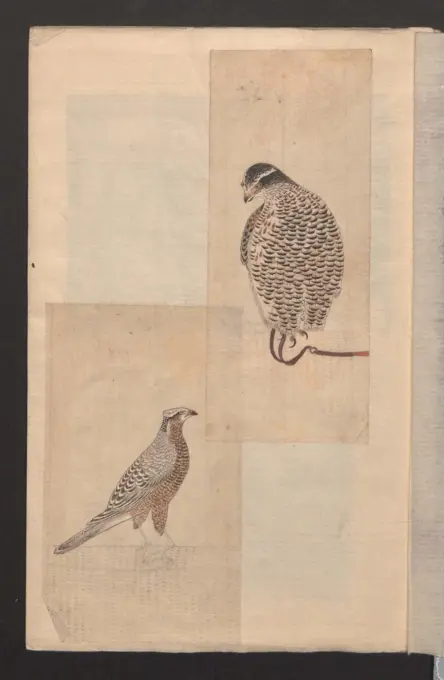
Japan: 'Album of Hawks and Calligraphy'. Album of nine paintings by Kano Tsunenobu (1636-1713), late 17th century. Kano Tsunenobu was a Japanese painter who lived during the Edo Period. He was a student of the Kano school of painting, and had a particular interest in Chinese art styles, often copying or emulating Chinese paintings with very little Japanese influence. He became a second-generation head of the Kano school's Kobikicho branch in Edo (Tokyo).
4443-28736884
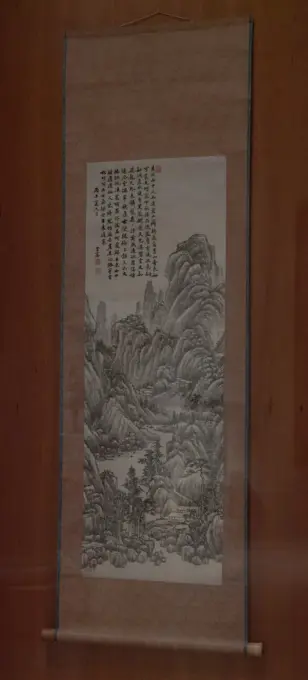
Living in the Mountains, 1786, Shen Zongqian, active 1745 - 1793, 45 15/16 x 15 13/16 in. (116.68 x 40.16 cm) (image), Ink on paper, China, 18th century, Shen Zongqian was born in Wucheng, the modern city of Huzhou in Zhejiang province. While Shen only earned the first literary degree, he became a well-known scholar, calligrapher, and painter. In 1781, he published the Shenzhou Xue Hua Pian, an influential treatise on painting in which he passionately defends the conservative or orthodox view of landscape painting. In it, he writes
6145-46650558
. Range-shaped print with a five-legged lacquered table, with objects are probably used to make fans. Probably one of the poets was a range maker. With two poems.
4443-20306252
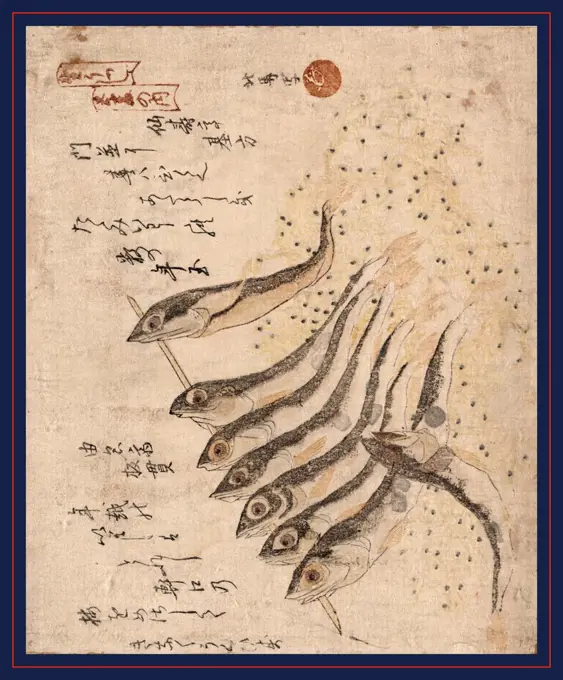
Mezashi to tatamiiwashi, Sardines., Teisai, Hokuba, 1771-1844, artist, between 1810 and 1818, 1 print : woodcut, color ; 14.2 x 17.4 cm., Print shows sardines on a short rod.
6145-48863773
Les pecheurs d'hommes.. Fraget & Viret
6145-46804802
My Sword is True: Chilly as theFrost..  Artist: Mokuan Sh?t?, Chinese, 1611-1684
4409-17354567
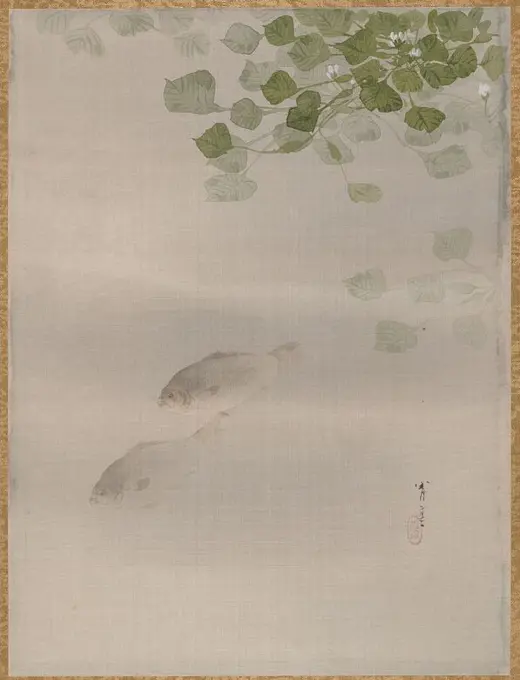
Fishes. Artist: Watanabe Seitei (Japanese, 1851-1918). Culture: Japan. Dimensions: 13 7/8 x 10 1/2 in. (35.2 x 26.7 cm). Date: ca. 1887. Museum: Metropolitan Museum of Art, New York, USA.
4443-28729087
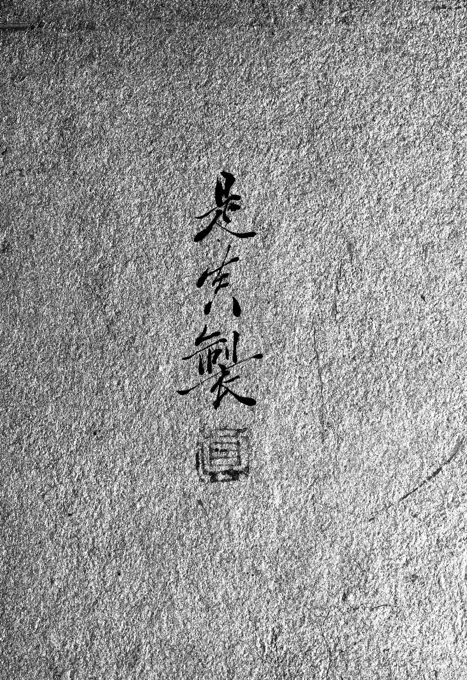
Calligraphy, 1915, Nakahara Nantenbō, Japanese, 1839 - 1925, 53 3/8 × 13 1/8 in. (135.57 × 33.34 cm) (image)80 5/8 × 18 5/16 in. (204.79 × 46.51 cm) (mount, without roller), Ink on paper, Japan, 20th century
6145-29788308
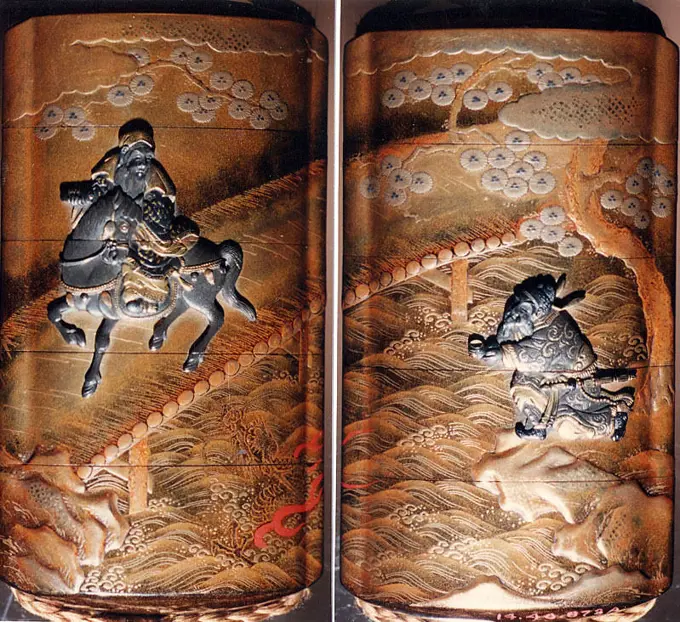
Case (Inrō) with Design of Chōryō and Kōsekikō at Kahi Bridge in China 19th century Japan. Case (Inrō) with Design of Chōryō and Kōsekikō at Kahi Bridge in China 58627
1746-19688506
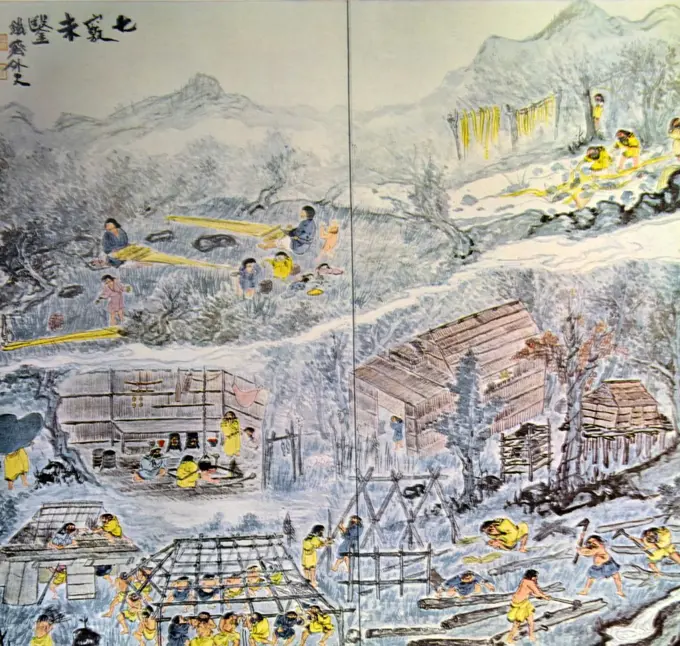
The large painting depicts different scenes of everyday life within an Ainu Village. By Tomioka Tessai (1837 - 1924) Japanese painter and Calligrapher in imperial Japan and one the first major artists of the Nihonga style. Dated 1870
6145-45588675
Vortex - first part; Uzumaki Jo. Part One (of four) of the Roman Uzumaki (vortex); Dark blue cover with image of pink lotus in vortex and top right title in gold; back with lilac lotus flowers and title in gold; Deck and bract, two libelles above vortex; title page with image of snail against yellow background; six pages ads; Foldable frontispies with portrait of young woman at poppies; two sheets photographic images; 1-280, text; one page, colophon; 17-page, advertisements. In yellow cassette with image of two birds against red-brown background.
4443-19533269
Design for a Teacup, Brush and watercolor, gold gouache, graphite on cream paper, Teacup design with lid unfinished (in graphite), gold rim top and bottom; purple grapes, green and orange leaves, gold tendril; pointed handle., Japan, 1880-1910, tableware designs, Drawing, Drawing
6145-46771581
Stamp of Gösta Bodman's Philatelist Association, commenced in 1950.The stamp from Japan, 1951. Motifs of temple decoration, sculpture over God Nyoirin Kannon, Temple Chuguji.
PREVIOUS
of 3
NEXT
2401 S. Ervay, Suite 206
Dallas, Texas 75215
United States
Get Started
Free ResearchMy BoardsMy Cart
For Creators
How To License Your ContentContributor PortalFrame of Mind
Resources
API accessPricing
Contact
+1 866 236 0087help@viewpictures.co.uk Contact form
©2026 View Pictures. All Rights Reserved. -A
This site is protected by reCAPTCHA and Google Privacy Policy and Terms of Service apply.