My Boards
View Pictures
  • My Boards

Classic Miniature Art

A collection of intricate historical miniatures depicting religious themes and narratives, with vibrant colors, detailed characters, and scenes from ancient texts.
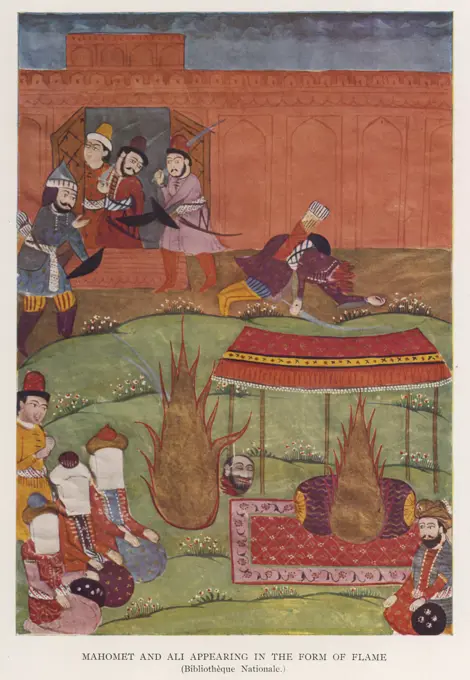
Muhammad and Ali appear in a  vision, in the form of flame,  to a noble, his household and  his veiled womenfolk
Muhammad and Ali appear in a vision, in the form of flame, to a noble, his household and his veiled womenfolk
388 assets in this story
4443-75459907
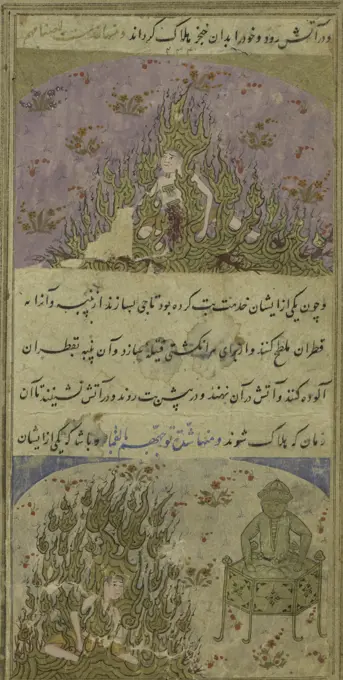
The artwork features two images on one page. The top image depicts a young man stabbing himself in flames, while the bottom image shows an Indian immolating himself in the presence of a golden idol. The overall dimensions of the images are approximately 5.6 x 8.1 cm for the top image and 5.7 x 8 cm for the bottom image. The work is dated approximately between 1220 and 1283 and may have originated in Shîrâz. The surrounding elements include mountains, birds, and animals, reflecting the Persian manuscript style
6145-29284457
Page 49: Guru Nanak listening to some music attended by his holy man. Watercolour drawing.
6145-29082026
Mary ascends the stairs to the temple, from a Mirror of Holiness (Mirat al-quds) of Father Jerome Xavier, 1602-04. Mughal India, Allahabad, made for Prince Salim (1569-1627). Opaque watercolor, ink, color and gold on paper; page: 26.2 x 15.5 cm (10 5/16 x 6 1/8 in.). In this scene from a noncanonical European source on the life of the Virgin Mary, her parents have brought their three-year-old daughter to the temple to be educated. According to the text it was tradition on such occasions for a priest to read a chapter from the Psalms as the child slowly progressed up each of the 15 steps. However, as soon as Mary placed her foot on the first step she pulled her hand away from her guide and quickly walked up the steep staircase without stopping or looking back. The figures around the temple gesture in surprise at her determination and eagerness to enter the service of God.
4409-17422562
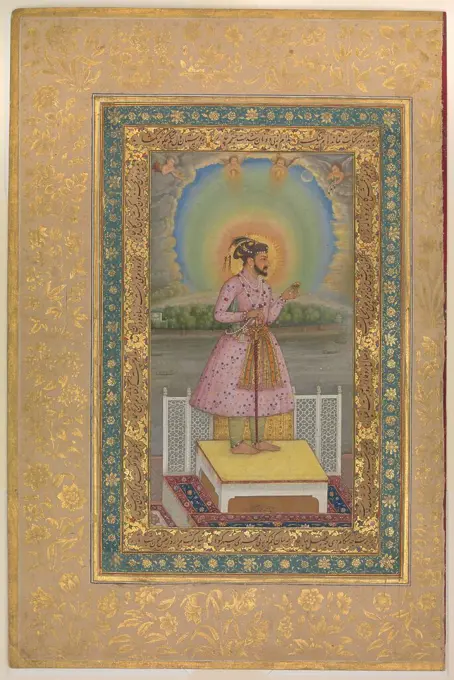
"Shah Jahan on a Terrace, Holding a Pendant Set With His Portrait", Folio from the Shah Jahan Album. Artist: Painting by Chitarman (active ca. 1627-70). Dimensions: H. 15 5/16 in. (38.9 cm)W. 10 1/8 in. (25.7 cm). Date: recto: 1627-28; verso: ca. 1530-50.The presentation of the emperor amplifies the formula evolved during the reigns of Akbar and Jahangir. Shah Jahan is exquisitely dressed and richly adorned with jewels, his imperial rank emphasized by his radiating halo and the hovering angels borrowed from European art. The skills of many craftsmen and designers of the Mughal court--jewelers, weavers, architects, feather workers, armorers, stonecutters, and others--are represented here. This is Chitarman's earliest dated picture, painted soon after Shah Jahan's accession. Museum: Metropolitan Museum of Art, New York, USA.
6145-59274912
Iskander with two ladies, Anonymous, 1490 - 1510 Indian miniature. drawing Against a background of red earth with a blue heavens and clouds above it, Iskander sits on a pillow on a yellow surface, on the left for him two women on visitors, on the right a servant with a fan; Four columns text in Persian handwriting around the performance. The performance is at a third height in the middle two of four columns of text, which are separated from each other by red frames and a narrow space of the leaf, the columns are also on the back. Cashmir paper brush
6145-29769207
Celebration of the Birth of Krishna (Janamashtami) ca. 1880-1900 Attributed to Ragunath. Celebration of the Birth of Krishna (Janamashtami) 74750
6145-29127386
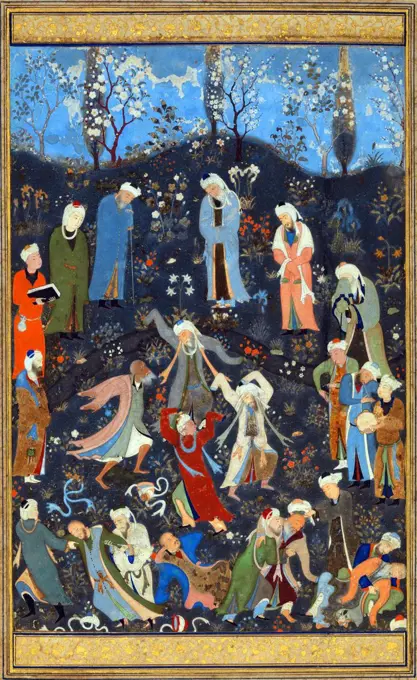
A Standing Dervish
6145-29248412
A Sikh man on a horse followed by a man holding a parasol. Gouache painting by an Indian painter.
6145-55951904
Tawurk, the grandfather of Garshâsp, captures Sarnud of Hind (India).. 1616. Firdawsî. text. illuminated manuscripts, Illuminations, Manuscripts. Spencer Collection. Manuscripts, Persian
6145-51818830
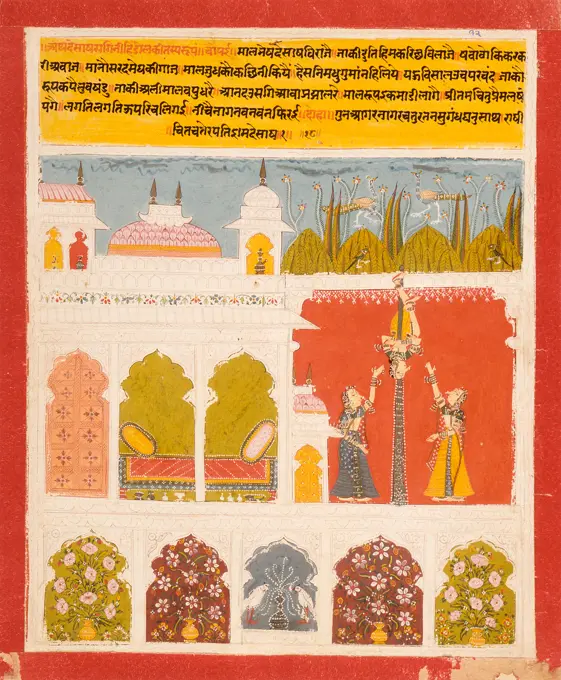
Radha manifesting the effect of love's separation from Krishna, page from a Rasikapriya series of Keshavadasa Kasam Ahmad. Radha manifesting the effect of love's separation from Krishna, page from a Rasikapriya series of Keshavadasa, 1749. Opaque watercolor, gold, and silver on paper, sheet: 10 1/4 x 7 5/16 in. (26.0 x 18.6 cm).   Asian Art 1749
1899-18718260
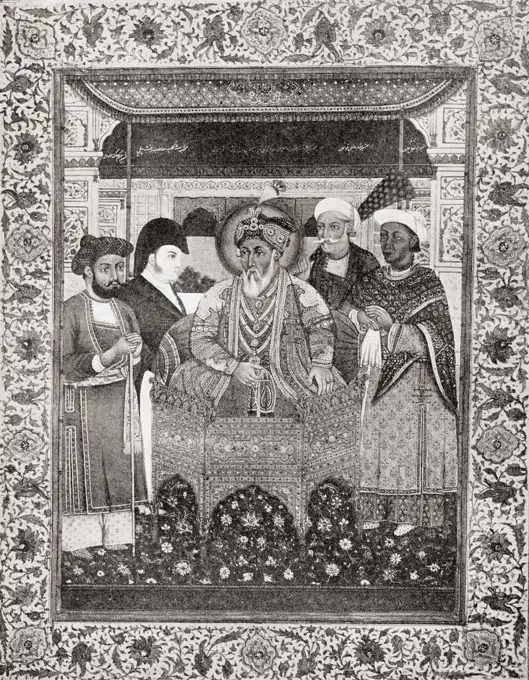
Shahab-ud-din Muhammad Khurram Shah Jahan I (1592-1666) was the emperor of the Mughal Empire in India from 1628 until 1658. The name Shah Jahan comes from Persian meaning 'king of the world'. He was the fifth Mughal ruler after Babur, Humayun, Akbar and Jahangir. While young, he was a favourite of his legendary grandfather Akbar the Great. Even while very young, he was pointed out to be the successor to the Mughal throne after the death of Emperor Jahangir. He succeeded to the throne upon his father's death in 1627 and is considered to be one of the greatest Mughals. His reign has been called the Golden Age of Mughals. Like Akbar, he was eager to expand his empire. In 1658 he fell ill, and was confined by his son Emperor Aurangzeb in the citadel of Agra until his death in 1666.
6145-29290401
Page 101: Guru Nanak attended by his musician and holy man. Gouache drawing.
1746-28993672
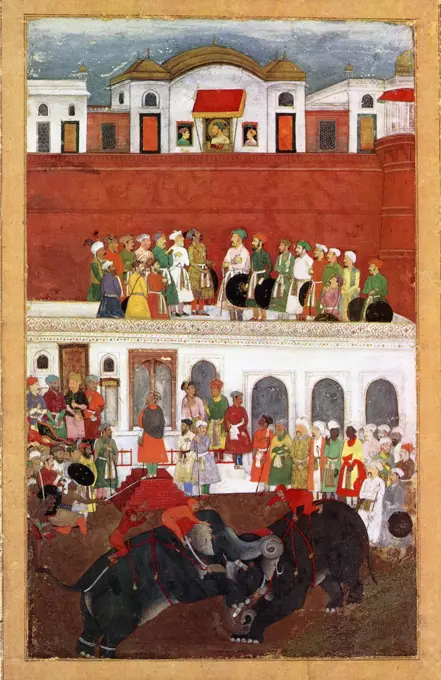
Indian Mughal miniature depicting a Prince being saluted by soldiers after he had killed a White Elephant. Rajasthan school; Album of Ragamala 19th century
4409-28962291
A page from a Book of Dreams/Omens. Date: ca. 1720. Opaque watercolor and gold on paper. Origin: Mewar, Rajasthan state, India. Museum: Freer Gallery of Art and Arthur M. Sackler Gallery.
6145-46809452
The Killing of Kab ben Ashraf, from a Manuscript of Hafiz-i Abrus Majma al-tawarikh
4409-17520994
Image from a Set of Initiation Cards (Tsakali). Southern Tibet. Date: 1301-1500. Dimensions: 16 x 14.5 cm (6 1/4 x 5 3/4 in.). Ink and watercolor on paper. Origin: Tibet. Museum: The Chicago Art Institute, Chicago, USA.
4409-17415152
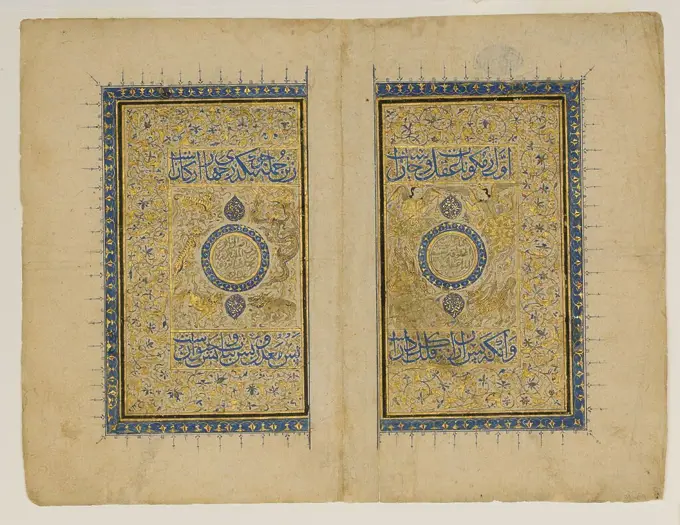
Double Title Page from a `Aja'ib al-Makhluqat wa Ghara'ib al-Mawjudat (The Wonders of Creation and the Oddities of Existence). Author: Zakaria bin Muhammad bin Mahmud Abu Yahya Qazwini (ca. 1203-83). Dimensions: Ht. 11 3/4 in. (29.8 cm)W. 8 7/8 in. (22.5 cm). Date: 1414-35.The Marvels of Creation contained information on various aspects of the heavens, the earth and its minerals, plants, birds and animals, as well as unusual phenomena and imaginary creatures. A rukh (roc) or 'anqa (fabulous bird) attacking an elephant and a karkadann (rhinoceros) can be seen to the right of each medallion, while on the left are depicted two tigers, a dragon and a phoenix, a ch'i-lin and another fabulous creature. Museum: Metropolitan Museum of Art, New York, USA.
4495-16293214
The Kubbealti, part of the Topkapi Palace, and the Mehter Band, 16th century, ms B200, p 1598, Topkapi Palace Museum, Istanbul, Turkey
6188-64596515
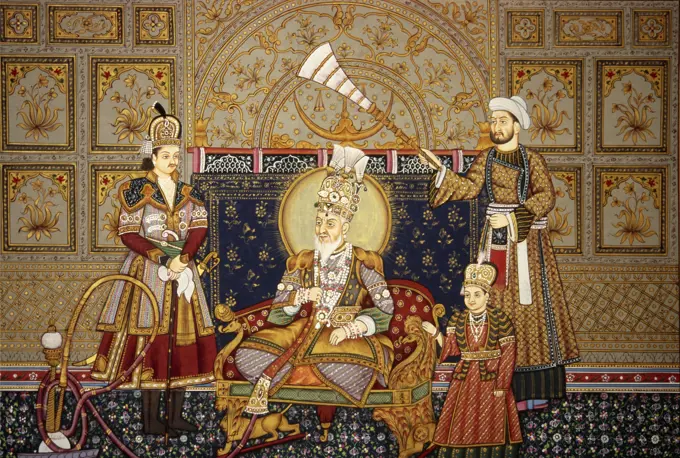
Miniature Painting of Mughal Emperor Shah Jahan on Paper Copyright: xBhagwandasxRupani/DinodiaxPhotox
1899-18788299
Timur (from the Perso-Arabic Timur, ultimately from Chagatai (Middle Turkic) Temur 'iron'; 8 April 1336 18 February 1405), often known as Tamerlane (from Timur-e Lang) in English, was a fourteenth-century conqueror of Western, South and Central Asia, founder of the Timurid Empire and Timurid dynasty (1370-1405) in Central Asia, and great great grandfather of Babur, the founder of the Mughal Dynasty, which survived until 1857 as the Mughal Empire in India.
1746-30011828
Timur feasts in the environs of Samarkand. Timur (1336 - 1405), later Timur Gurkan a Turco-Mongol conqueror who founded the Timurid Empire in and around modern-day Afghanistan, Iran and Central Asia, becoming the first ruler of the Timurid dynasty. As an undefeated commander, he is widely regarded as one of the greatest military lead+E18ers and tacticians in history.
4409-17487160
Maharana Jagat Singh II and Nobles Watching the Raslila Dance Dramas. Date/Period: 1734/1742. Opaque watercolor and gold on paper. Width: 50.2 cm. Height: 66.2 cm (sheet). Author: Unknown Indian.
1788-33051
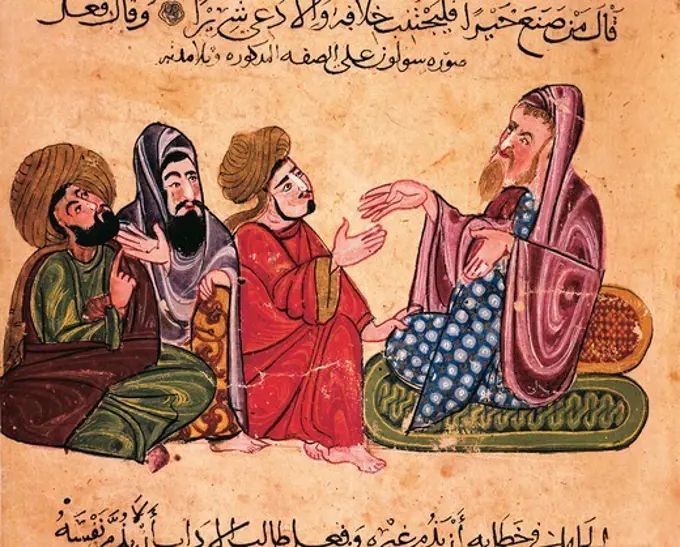
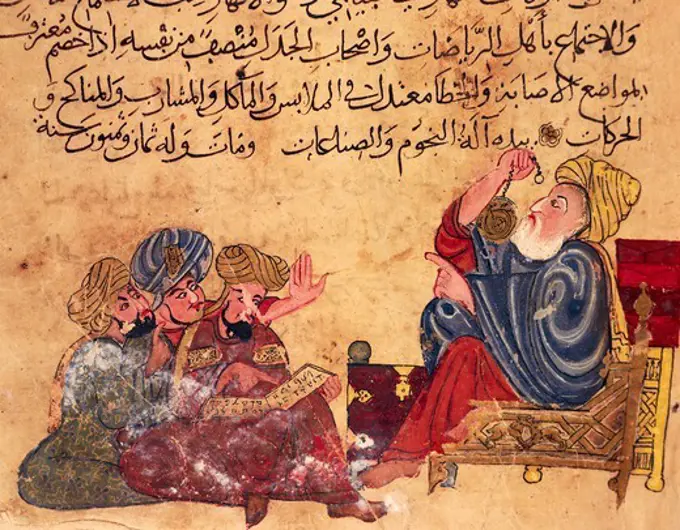
Solon debating with his students, miniature from the best rulings and the most precious sayings of Al-Moubachir, Arabic manuscript, 13th Century.
1848-49276564
The Kaaba in Mecca, plan, construction drawing, presumably 17th century, Saudi Arabia, digitally restored reproduction from an original of the time, Asia
6145-29806175
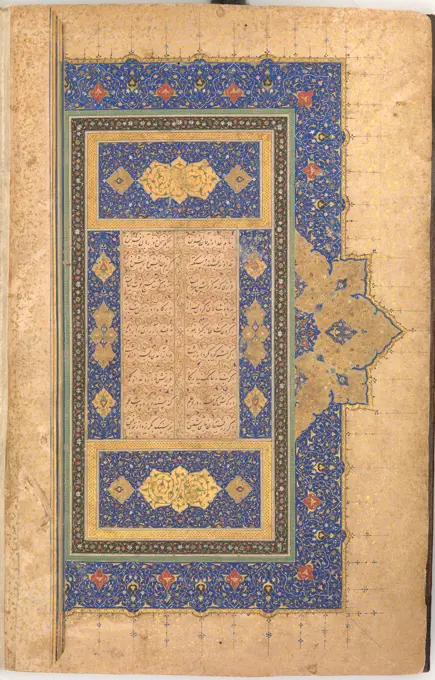
Illuminated Frontispiece of a Bustan of Sa`di dated A.H. 920/ A.D. 1514 Sultan Muhammad Nur This manuscript of the Bustan of Sadi is composed of fifty-one folios including the frontispiece and a leather binding. It was likely copied in Herat, but it was illustrated for an Uzbek patron several years later, probably in Bukhara in the 1530s. The calligrapher, Sultan Muhammad Nur, also worked on the 1524-25 manuscript of the Khamsa of Nizami, several folios of which are in the Museums collection.. Illuminated Frontispiece of a Bustan of Sa`di 452669
4443-75459762
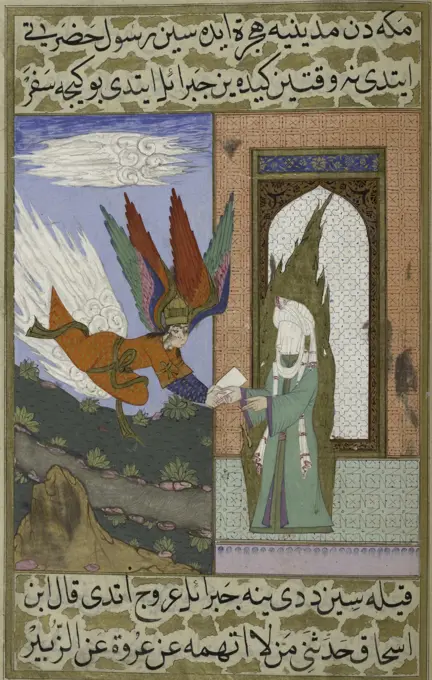
The angel Jibrîl delivers a message from God to Muhammad, ordering him to leave Mecca and go to Medina., 1594 - 1595 (Inferred), Istanbul, Manuscripts Turkish, 19.8 x 17.4 cm
6145-51823345
Worship of Krishna , ca. 1800. Opaque watercolor on paper, 6 5/8 x 9 3/4 in.   Asian Art ca. 1800
6145-55950622
Seated man with white beard and eyebrows holds an astrolabe, f. 283. 1540 - 1545. Qazwīnī, Zakarīyā ibn Muammad, approximately 1203-1283. text. Illuminations, Manuscripts, Miniatures (Illuminations). Spencer Collection. Mountains, Birds, Animals, Manuscripts, Persian
1899-19136456
Palestine/Israel/Iran: Musa (Moses) Slays the Giant 'Uj ibn 'Anaq, from Rashid Al-Din, 'History of the World', c. 1306-1311 CE
1788-33748
Socrates discussng philosophy with his disciples, Arabic miniature from a manuscript, Turkey 13th Century.
6145-29293335
A man sitting down for his prayers. Gouache painting by an Indian painter.
1788-32800
Socrates discussng philosophy with his disciples, Arabic miniature from a manuscript, Turkey 13th Century.
6145-29280740
A Muslim man smoking a hookah under a canopy, with a woman on the left. Gouache, 18--.
6145-29121417
The Emergence of Kaushiki, Folio from a Devimahatmya (Glory of the Goddess). India, Himachal Pradesh, Guler, circa 1750 or earlier. Drawings; watercolors. Opaque watercolor, gold, and silver on paper
6145-45680977
Kali fights against the Chanda and Munda demons. The goddess with two pairs of arms and sitting on a tiger in battle with all sorts of demons in malteaded forms. The show is framed by a wide black border with white frame lines and around it a pink with red dotted wide border with an inscription on top and red frame lines
6145-51833708
Krishna Carried Across the River Indian. Krishna Carried Across the River, first half 19th century. Opaque watercolor and gold on paper, sheet: 10 5/8 x 7 5/16 in. (27.0 x 18.6 cm).  In the story of the god Krishnas life on earth, he is born to a royal family but must be taken from the palace immediately in order to hide him from an evil uncle. This unusual painting shows the circumstances of this departure. In the dark of night, while everyone in the palace is asleep (a small gazebo at right stands in for the palace), Krishnas father carries him across the river Yamuna to the rural community where Krishna will be raised. The father is barely visible here at the center, holding the baby above his head while the giant serpent Vasuki stands above them, offering protection. A lion on the opposite bank of the river might represent the dangers facing them at night, as does the monkey at the upper right and the bolt of lightning. In the upper left is a temple with Krishna enthroned at the
6145-29129878
Desakhya Ragini, Third Wife of Hindola Raga, Folio from a Ragamala (Garland of Melodies). India, Madhya Pradesh, Datia (), circa 1700-1730. Drawings; watercolors. Opaque watercolor, gold, silver, and ink on paper
6145-29882024
Netherlandish 15th Century, Christ as the Man of Sorrows, 15th century Christ as the Man of Sorrows
6188-64596583
year calendar picture & painting for a hindu month kartik, india Copyright: xBhagwandasxRupani/DinodiaxPhotox
6188-64638765
old vintage photo of Akbar Shah II Copyright: xKenxGraham/DinodiaxPhotox
4409-17553467
Image from a Set of Initiation Cards (Tsakali). Southern Tibet. Date: 1301-1500. Dimensions: 16 x 14.5 cm (6 1/4 x 5 3/4 in.). Ink and watercolor on paper. Origin: Tibet. Museum: The Chicago Art Institute, Chicago, USA.
6145-29166257
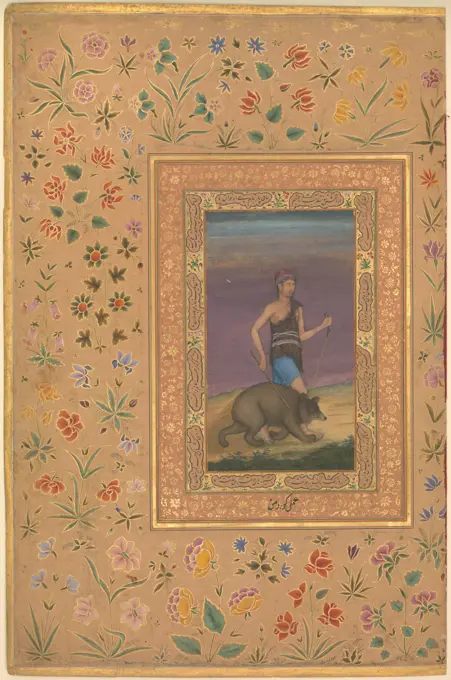
"Dervish Leading a Bear", Folio from the Shah Jahan Album recto: ca. 1630-40; verso: ca. 1530-40 Painting by Govardhan This painting of a dervish reflects the Mughal interest in holy men. Prince Dara-Shikoh, Shah Jahan's eldest son, became a serious student of these spiritual beliefs and this painting was most likely executed under his patronage. A dervish wearing a brown animal fur covering, earrings, bangles, an anklet leads a dark brown bear by a leash. The red earing and iron bangles are customary accessories worn by dervishes of the Qalandar and Haydari orders. His forearms and chest are dotted with markings, caused by self-inflicted burns. These marks, known as dagh (hot) in Persian, demonstrate faithfulness and love for God. The scene suggests an allegory familiar to Sufis in which the higher self (here perhaps symbolized by the dervish) struggles to overcome his baser instincts (the bear). His burns, ragged garb, fasting, and wandering give him strength in this struggle. The Sh
1788-32796
Miniature from The best rulings and the most precious sayings of Al-Moubachir, Arabic manuscript, 13th Century.
1899-18852789
Damarwulan is a Javanese legendary hero who appears in a cycle of stories used in the performance of wayang klitik, as well as Langendriya (female dance-opera) and ketoprak (popular theater). These stories tell of the struggles between the Majapahit and Blambangan kingdoms, in which Damarwulan gains honor. The stories are especially popular in East Java. The Damarwulan legend is associated with the Majapahit court at the time of the queen Suhita, at which time there was a war with Blambangan. However, the names of the characters Damar Wulan (;radiance of the moon') and Menak Jingga ('red knight') suggest that it may incorporate elements of an older sun-moon myth. It is uncertain when the story was first recorded and by whom. The Javanese script, natively known as Hanacaraka), Carakan, or Aksara Jawa, is a pre-colonial script used to write Javanese and several other native languages of Indonesia. It is closely related to the Balinese script.
4266-29608
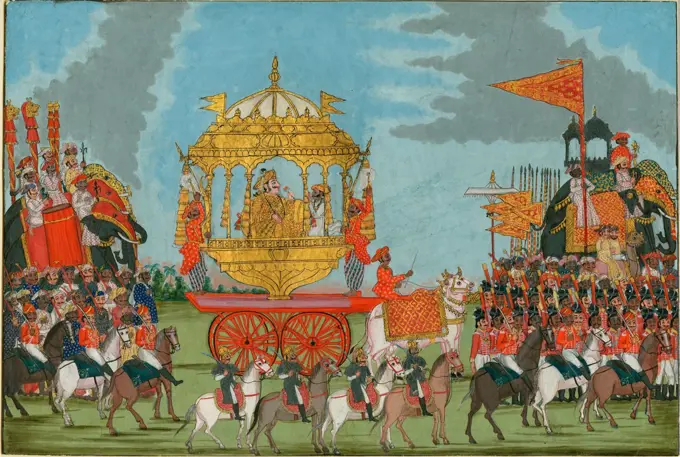
Rajah of Tanjore Riding an Elephant to a marriage ceremony by Indian Art   / Private Collection / c. 1780 / India, Mughal school / Gouache on paper / Genre / 23,4x34,8
1899-18716948
Kufic is the oldest calligraphic form of the various Arabic scripts and consists of a modified form of the old Nabataean script. Its name is derived from the city of Kufa, Iraq. although it was known in Mesopotamia at least 100 years before the foundation of Kufa. At the time of the emergence of Islam, this type of script was already in use in various parts of the Arabian Peninsula. It was in this script that the first copies of the Qur'an were written. Kufic is a form of script consisting of straight lines and angles, often with elongated verticals and horizontals. It is still employed in Islamic countries though it has undergone a number of alterations over the years and also displays regional differences. The difference between the Kufic script used in the Arabian Peninsula and that employed in North African states is very marked.
6145-51818919
Kedara Ragini, Page from a Dispersed Ragamala Series Indian. Kedara Ragini, Page from a Dispersed Ragamala Series, ca. 1800. Opaque watercolor on paper, sheet: 12 x 8 1/4 in. (30.5 x 21.0 cm).   Asian Art ca. 1800
6145-30384184
Krishna and Radha in aPavilion
1746-21105436
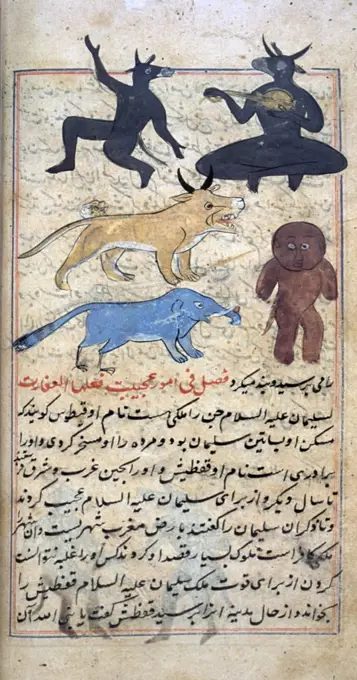
Assorted demons (jinns) and strange creatures, one playing a musical stringed instrument. From the chapter on the subjugation of jinn and on the amazing actions of afreet (lesser demons, ëafarit), in a copy of ëAjíib al-makhlqt wa-gharíib al-mawjdt (Marvels of Things Created and Miraculous Aspects of Things Existing) by al-Qazwn (d. 1283/682). Neither the copyist nor illustrator is named, and the copy is undated. The nature of paper, script, ink, and illustrations suggests that it was pr
6145-59538361
Abdülhamid II with Minister, Anton Molkenboer, 1896 print  Amsterdam paper  minister ~ government. historical persons. political caricatures and satires
4409-17490786
Dewali celebrations at Kotah. Date/Period: Ca. 1690. Opaque Watercolours. Opaque watercolour and gold paint on paper opaque watercolour and gold paint on paper. Height: 482 mm (18.97 in); Width: 438 mm (17.24 in). Author: Indian Unknown.
6145-55951912
Rustam drags Sûdâbah from her throne.. 1616. Firdawsî. text. illuminated manuscripts, Illuminations, Manuscripts. Spencer Collection. Manuscripts, Persian
1899-18792972
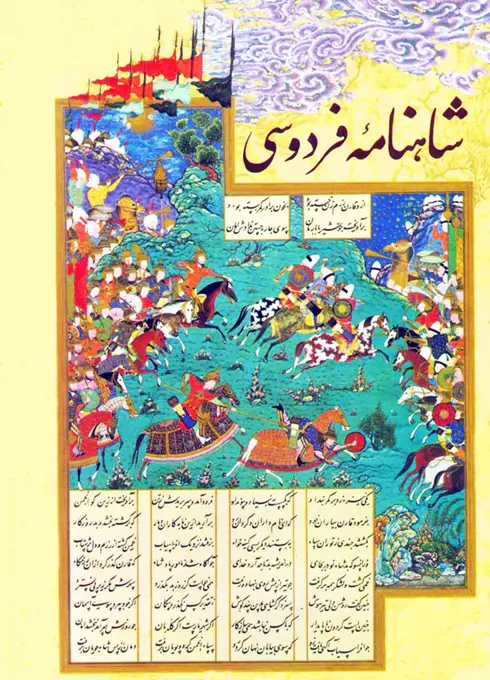
The Shahnameh or Shah-nama (Persian: شاهنامه Šāhnāmeh, 'The Book of Kings') is a long epic poem written by the Persian poet Ferdowsi between c. 977 and 1010 CE and is the national epic of Iran and related Perso-Iranian cultures. Consisting of some 60,000 verses, the Shahnameh tells the mythical and to some extent the historical past of Greater Iran from the creation of the world until the Islamic conquest of Persia in the 7th century. The work is of central importance in Persian culture, regarded as a literary masterpiece, and definitive of ethno-national cultural identity of Iran. It is also important to the contemporary adherents of Zoroastrianism, in that it traces the historical links between the beginnings of the religion with the death of the last Zoroastrian ruler of Persia during the Muslim conquest.
4443-28737820
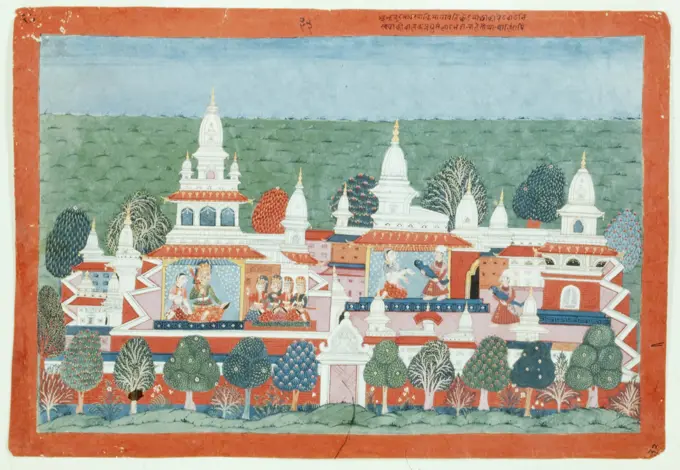
The Story of Pradyumnas Birth, c. 1775, 12 3/4 x 19 1/4 in. (32.39 x 48.9 cm), Opaque watercolors on paper, Nepal, 18th century, Beginning in the mid-seventeenth century, the Nepalese royalty of the Kathmandu Valley became increasingly interested in Rajput paintings from India. Originally influenced by the Malwa and Kangra schools, Nepalese artists nevertheless developed an original spatial sense that utilized birds-eye views and multiple perspective.
1848-49315627
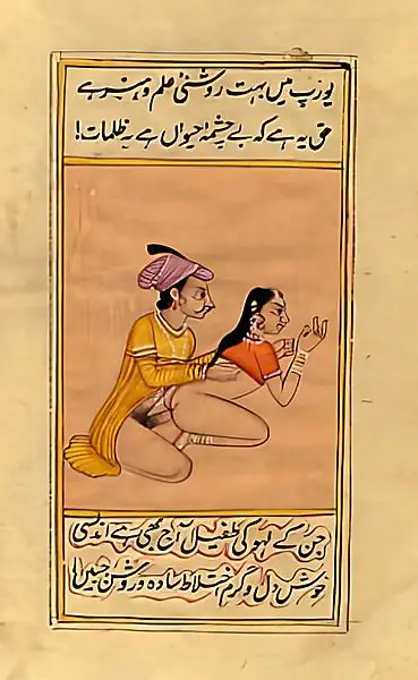
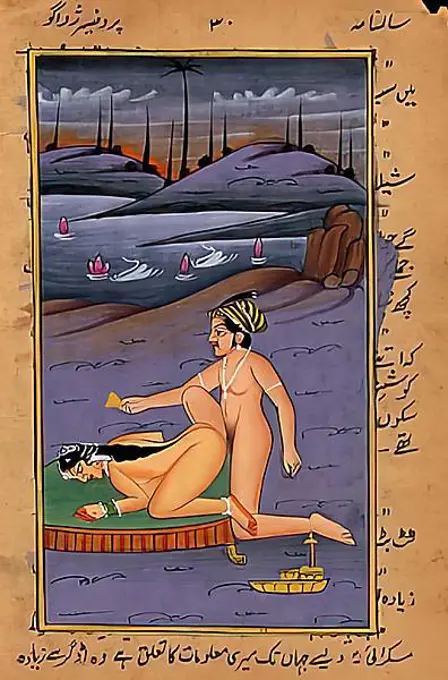
Depiction of an erotic scene, love scene, sex, in a 19th century edition of the Kama Sutra, textbooks on eroticism, India, Arabia, Historical, digitally restored reproduction of an original from the period, Asia
4443-75465480
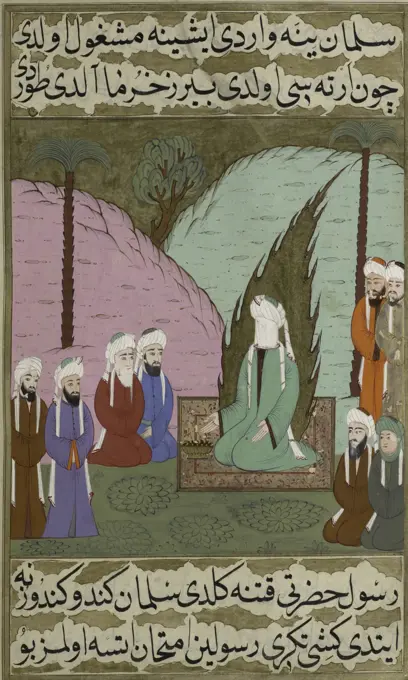
Salmân converts to Islam after finding that Muhammad is a true Prophet., 1594-1595 (Inferred), Istanbul, Manuscripts, Turkish, 19 x 17 cm
4409-17423193
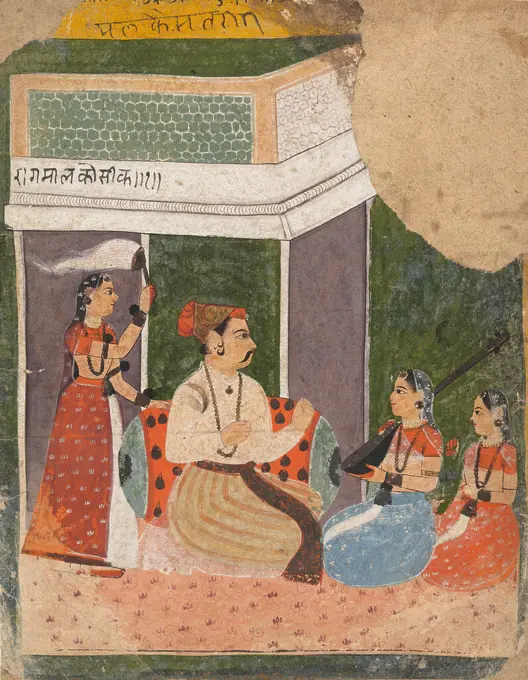
Malkos Raga: Page from a Dispersed Ragamala Series (Garland of Musical Modes). Culture: India (Rajasthan, Marwar). Dimensions: 10 3/8 x 8 in. (26.4 x 20.3 cm). Date: ca. 1640-50.This painting perfectly illustrates the Malkos raga text, which describes a lord attended by a woman with a fly whisk who is entertained by others that play heavenly music like gandharvas; he wears a necklace of elephant pearls and has a gold crest on his head. The text emphasizes that he is saturated with love and that his mind is happy. Here, the artist skillfully integrated these elements in composition that perfectly resonates with the mood of this raga. Museum: Metropolitan Museum of Art, New York, USA.
6145-29271945
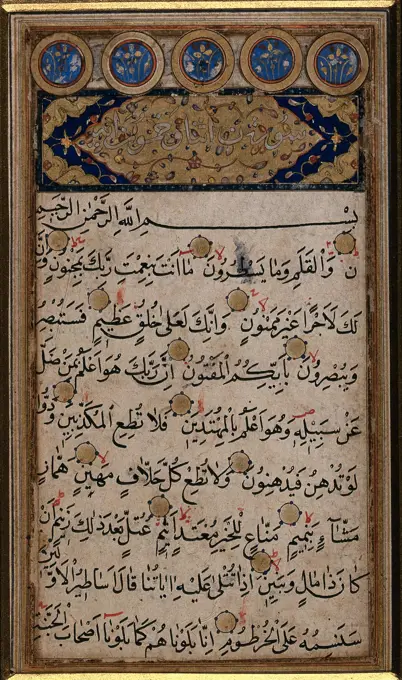
A passage in the Koran with a sura heading and diacritical marks in gold. Gouache painting by a Persian artist.
6145-51832841
The Friends of `Ali at the Hunt, Page from an Illustrated Manuscript of the Khwavarannama of Muhammad b. Husam The Friends of `Ali at the Hunt, Page from an Illustrated Manuscript of the Khwavarannama of Muhammad b. Husam, ca. 1477. Ink and opaque watercolor, and gold on paper, 8 x 6 5/8 in. (20.3 x 16.8 cm).  These pages belong to a dispersed illustrated manuscript and the first known copy of the Khavarannama by the poet Muhammad ibn Husam (d. circa 1470). Modeled on the Iranian national epic, the Shahnama (Book of Kings), the Khavarannama details the life of cAli, the cousin and son-in-law of the Prophet and the most important figure in Shica Islam after Muhammad. The manuscript originally contained 155 miniatures, which appear to have been executed some years after the text and display the vibrant colors and lush vegetation characteristic of the Turkman painting tradition of Shiraz. In one of the paintings shown here, the military leader cAdnan visits cAli, depicted as a enthroned k
1746-21104945
Colour illustration from 'The illuminated manuscript Khamsa of Nizami' a 12th Century a lavishly illustrated manuscript of the Khamsa or 'five poems' of Nizami Ganjavi (1141-1209) a Persian poet.
1899-19188370
A Dervish is someone treading a Sufi Muslim ascetic path or Tariqah, known (notionally) for their extreme poverty and austerity, similar to mendicant friars in Christianity or Hindu / Buddhist / Jain sadhus.
4409-3543
Universal story of explorations. William's atlas. Caravan of pilgrims. Author: AL WASITI.
6145-29810035
Portrait of a Muslim Saint late 17th century. Portrait of a Muslim Saint 451485
1899-18717126
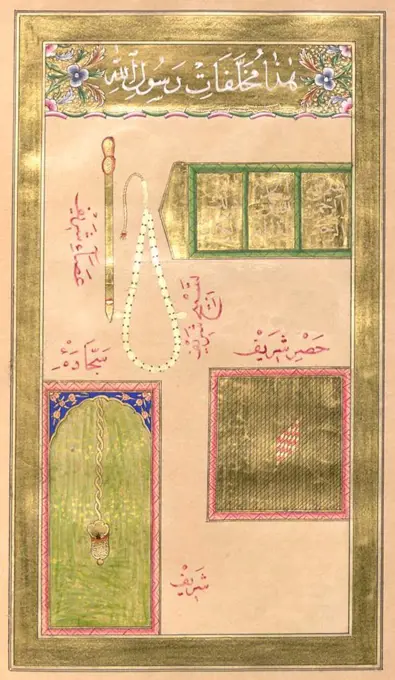
From an illuminated Ottoman dua kitabi or 'prayer book' by Hasan Rashid (Istanbul, 1845) once the property of a Topkapi harem lady. The sword of Ali, Dhu l-Fiqar or Zulfiqar, is bifurcated and considered exceptionally holy by Shia Muslims. The Arabic term 'du'a' is generally translated into English as 'prayer', though a more exact rendering would be 'supplication'. The term is derived from an Arabic word meaning to 'call out' or to 'summon', and Muslims regard this as a profound act of worship. This is when Muslims connect with God and ask him for forgivness or appeal for his favour. The Prophet Muhammad is reported to have said 'Dua is the very essence of worship', while one of Allah's commands expressed through the Qur'an is for Muslims to call out to Him: 'Call to Me; I will answer your prayers'. There is a special emphasis on du'a in Muslim spirituality and early Muslims took great care to record the supplications of Muhammad and transmit them to subsequent generations. These tradi
1899-18792803
Abu Yahya Zakariya' ibn Muhammad al-Qazwini (     ) (born 1203 - died 1283), was a Persian physician, astronomer, geographer and proto-science fiction writer. Born in the Persian town of Qazvin, he was descended from Anas ibn Malik, Zakariya' ibn Muhammad al-Qazwini served as legal expert and judge (qadhi) in several localities in Persia and at Baghdad. He travelled around in Mesopotamia and Syria, and finally entered the circle patronized by the governor of Baghdad, ‘Ata-Malik Juwayni (d. 1283 CE). It was to the latter that al-Qazwini dedicated his famous Arabic-language cosmography titled 'Aja'ib al-makhluqat wa-ghara'ib al-mawjudat      ('Marvels of Creatures and Strange Things Existing'). This treatise, frequently illustrated, was immensely popular and is preserved today in many copies. It was translated into Persian and Turkish. Qazwini was also well-known for his geographical dictionary, Athar al-bilad wa-akhbar al-‘ibad
6145-51833388
Khandita Nayika Indian. Khandita Nayika, ca. 1800-1820. Opaque watercolor and gold on paper, sheet: 10 3/8 x 7 1/2 in. (26.4 x 19.1 cm).  Some traditions celebrate Radha as the more powerful half of the pair because she has captured the heart of God. This painting shows Radha physically elevated above Krishna. He kneels before her, begging forgiveness for a past indiscretion. Her posture and gesture indicate that she does not want to hear his pleas. This painting is from a series depicting generic types of lovers. Khandita is the wronged heroine (nayika) who must be wooed back carefully. By placing Krishna in the role of the wooer, the artist adds layers of complexity to the subject. Asian Art ca. 1800-1820
4443-28738065
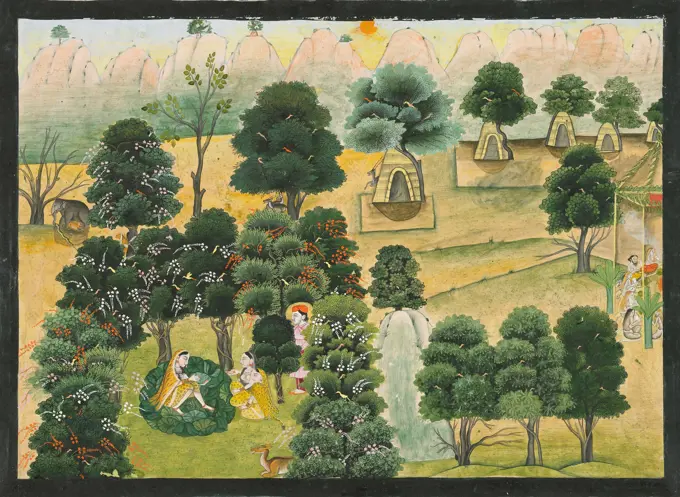
Sita at the Hermitage of Bharadvaja, c. 1810, 8 15/16 x 11 11/16 in. (22.7 x 29.7 cm), Opaque watercolors on paper, India, 19th century, In a scene most likely from the Ramayana, Sita is shown, after her rescue, in a wilderness setting surrounded by trees bejeweled with floral creepers and garlands. Sitting on a bed of leaves, she converses with two attendants who are watched over by a prince, perhaps her brother-in-law, Lakshmana. To the right, in a forest hermitage comprised of several huts, a group of ascetics converses under a canopy, probably representing the sage Valmiki, author of the Ramayana, and his disciples. The power of Valmiki's message is symbolically represented by the peaceful coexistence of natural enemies such as antelopes and tigers, elephant and snake. Artists at Kangra begin to use elevated vantage points, diminutive landscape elements, and flowering trees such as these during the late eighteenth century.
6145-29122159
Two Folios from a Ragamala (Garland of Melodies). India, Karnataka, Bijapur (), early 19th century. Drawings. Ink on paper
4409-17424841
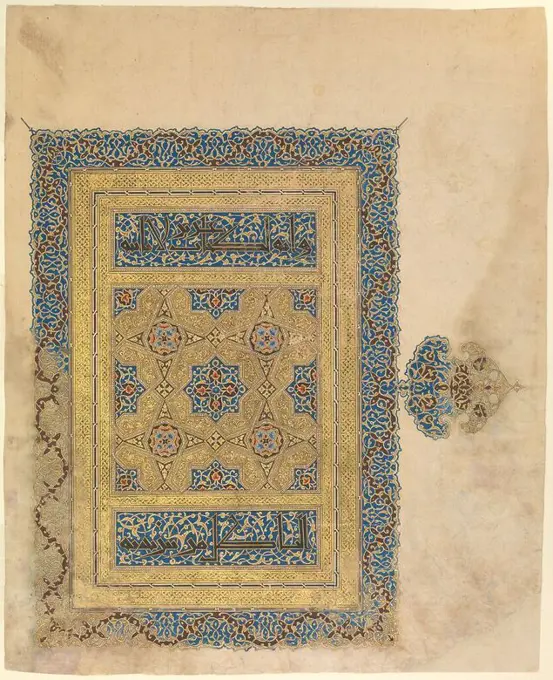
Opening Folio of the 26th Volume of the "Anonymous Baghdad Qur'an". Calligrapher: Ahmad ibn al-Suhrawardi al-Bakri (d. 1320-21). Dimensions: 17 x 13 7/8in. (43.2 x 35.2cm)Mat: 22 x 16 in. (55.9 x 40.6 cm)Frame: 23 x 17 in. (58.4 x 43.2 cm). Illuminator: Muhammad ibn Aibak ibn 'Abdallah. Date: A.H. 706/ A.D 1306-7.This is the right half of a double-page opening to a volume of the Qur'an. Its patron is unknown, but we know that the calligrapher was Ahmad ibn al-Suhrawardi, a famous student of the master scribe Yaqut al-Musta'simi, and that the illuminator was Muhammad ibn Aibak, who collaborated with him on several outstanding Qur'ans. From the surviving parts of this Qur'an, it appears that the illuminator created a different geometric scheme to preface each volume. Museum: Metropolitan Museum of Art, New York, USA.
1899-18856681
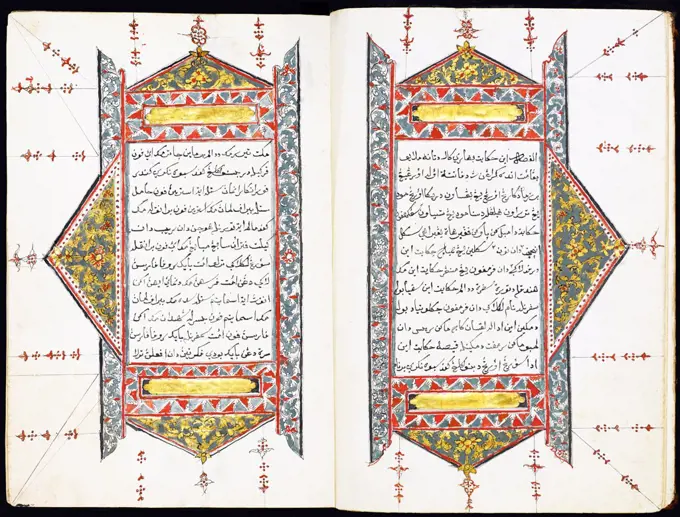
Hikayat (Jawi: حكاية) - an Arabic word that literally translates to 'stories' - is a form of Malay literature, which relate the adventures of national heroes of Malayan kingdoms, or royal chronicles. The stories they contain, though based on history, are heavily romanticised.
1848-50729972
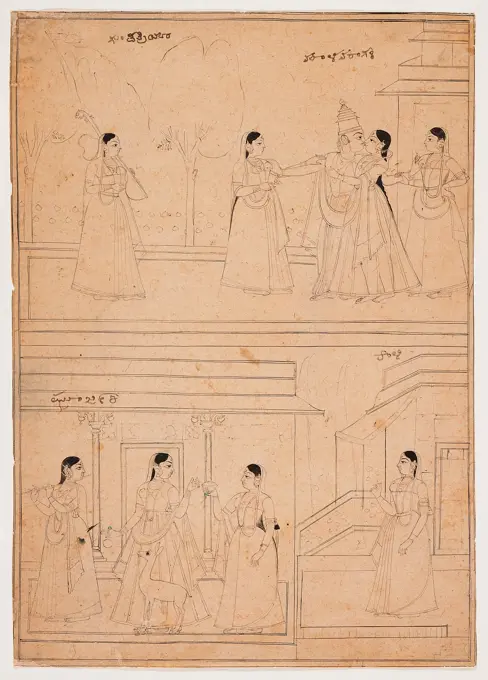
Miniature painting, Meherangarh Fort, Jodpur, Jodpur, Rajasthan, India, Asia
4443-21954478
Chuquillanto; La Plata, Bolivia; completed in 1616; Ms. Ludwig XIII 16, fol. 89
1899-18717128
From an illuminated Ottoman dua kitabi or 'prayer book' by Hasan Rashid (Istanbul, 1845) once the property of a Topkapi harem lady. The Arabic term 'du'a' is generally translated into English as 'prayer', though a more exact rendering would be 'supplication'. The term is derived from an Arabic word meaning to 'call out' or to 'summon', and Muslims regard this as a profound act of worship. This is when Muslims connect with God and ask him for forgivness or appeal for his favour. The Prophet Muhammad is reported to have said 'Dua is the very essence of worship', while one of Allah's commands expressed through the Qur'an is for Muslims to call out to Him: 'Call to Me; I will answer your prayers'. There is a special emphasis on du'a in Muslim spirituality and early Muslims took great care to record the supplications of Muhammad and transmit them to subsequent generations. These traditions precipitated new genres of literature in which prophetic supplications were gathered together in singl
6145-29080037
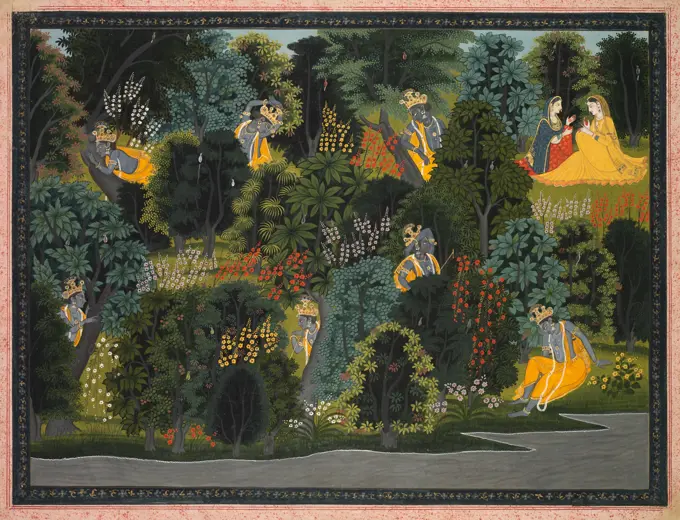
Krishna's Longing for Radha, from the Gita Govinda of Jayadeva, c. 1820-1825. India, Himachal Pradesh, Pahari Kingdom of Kangra, Lambagraon. Gum tempera and gold on paper; image: 24.1 x 32.4 cm (9 1/2 x 12 3/4 in.); with mat: 40.6 x 53.2 cm (16 x 20 15/16 in.); with borders: 25.6 x 33.8 cm (10 1/16 x 13 5/16 in.). In the lush forests on the banks of Indias Yamuna River, the youthful god Krishna waits to rendezvous with his beloved Radha. The artist has rendered his impatience by showing seven Krishnas, in various attitudes of anxious waiting, as though seeing him over a period of time. Meanwhile Radha, dressed in yellow at top right, confers seemingly endlessly with her confidante, as she tries to decide whether she should meet Krishna for the illicit tryst—she is already married and Krishna is prone to flirting with other girls. This scene is a metaphor for how god waits for us to come to him, while the human devotee frets about the bonds of social norms.
6145-51836324
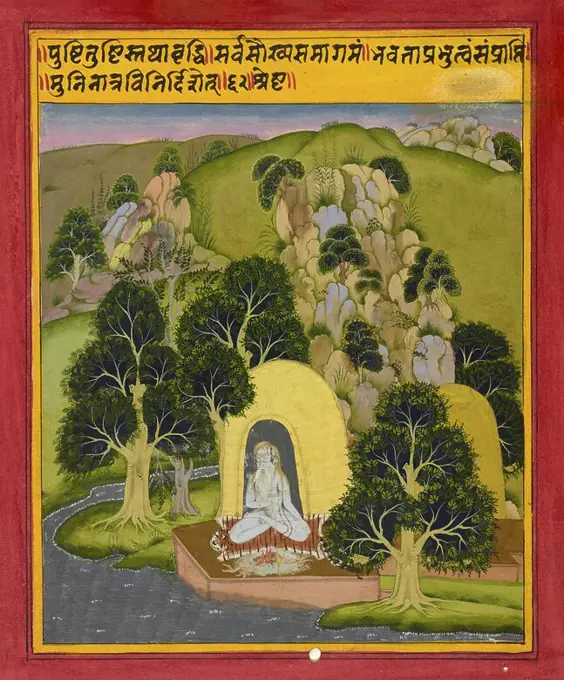
Yogini in a Landscape Indian. Yogini in a Landscape, ca. 1760. Opaque watercolor on paper, sheet: 11 3/8 x 7 7/8 in. (28.9 x 20.0 cm).   Asian Art ca. 1760
1899-18712829
Abu Said Ubaud Allah Ibn Bakhitshu's Ibn Bakhtishu's Manafi' al-Hayawan is an illustrated bestiary in the Persian language. The Bakhtshooa Gondishapoori (also spelled Bukhtishu and Bukht-Yishu) were Assyrian Nestorian Christian physicians from the 7th, 8th, and 9th centuries, spanning 6 generations and 250 years. Some of them served as the personal physicians of Caliphs. Like all physicians in the Abbasid courts, they came from the Academy of Gundishapur in Persia (in modern-day southwestern Iran). They were well versed in the Greek and Hindi sciences, including those of Plato, Aristotle, Pythagoras, and Galen, which they aided in translating while working in Gondeshapur. Yahya al-Barmaki, the vizier and mentor to Harun al-Rashid, provided patronage to the academy and hospital in Gondeshapur and helped assure the promotion and growth of astronomy, medicine, and philosophy, not only in Persia but also in the Abbasid empire in general.
6145-51829691
Manuscript of the Hadiqat al-Su`ada (Garden of the Blessed) of Fuzuli Muhammad bin Sulayman, known as Fuzuli (ca. 1483-1556). Manuscript of the Hadiqat al-Su`ada (Garden of the Blessed) of Fuzuli, AH 1011 / 1602-3 C.E. Opaque watercolor, ink and gold on paper; leather binding, 5 1/2 x 9 3/4 in. (14 x 24.8 cm).  This manuscript is a copy of the sixteenth-century Hadiqat al-Sucada (Garden of the Blessed), written in Baghdad by the Ottoman mystic Muhammad bin Sulayman, known as Fuzuli (circa 1483-1556). It is a text on the Prophets family and belongs to a group of illustrated devotional manuscripts executed in a provincial style in Baghdad under the patronage of the Ottoman sultan Mehmet III (r. 1595-1603). Here, the Prophet is shown veiled and seated on a pulpit, accompanied by his cousin and son-in-law, cAli, and his grandchildren, Hasan and Husayn, all distinguished by haloes of fire. According to the Ottoman Turkish text, Muhammad is conversing with the angel Gabriel and the Angel of
1848-49315620
Depiction of an erotic scene, love scene, sex, in a 19th century edition of the Kama Sutra, textbooks on eroticism, India, Arabia, Historical, digitally restored reproduction of an original from the period, Asia
1899-19188655
Govardhan (fl. 17th century) was a well-known Indian painter from the period of the Mughal Empire. The son of painter Bhavani Das, Govardhan joined imperial service during the reign of Emperor Akbar, and continued serving the imperial court during the reign of Shah Jahan. He was one of the illustrators of the Baburnama.
6176-66912449
Caravan of pilgrims in Ramleh
6145-29812433
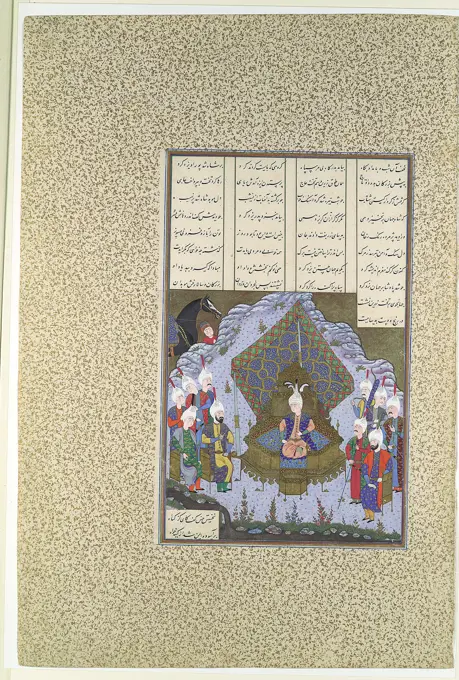
"Yazdigird II Accedes to the Throne", Folio 592r from the Shahnama (Book of Kings) of Shah Tahmasp ca. 1530-35 Abu'l Qasim Firdausi The aged shah Bahram Gur named his son Yazdigird II as his successor. Upon the death of his father, Yazdigird called his noblemen together and, seated on the Golden Throne of Iran, exhorted them to act with justice, humanity, and wisdom. The simplicity of this composition, with the king enthroned between two evenly balanced groups of courtiers, is typical of the later phases of production of the Shahnama and of the work of second-generation artists such as Bashdan Qara.. "Yazdigird II Accedes to the Throne", Folio 592r from the Shahnama (Book of Kings) of Shah Tahmasp 452175
4409-14375
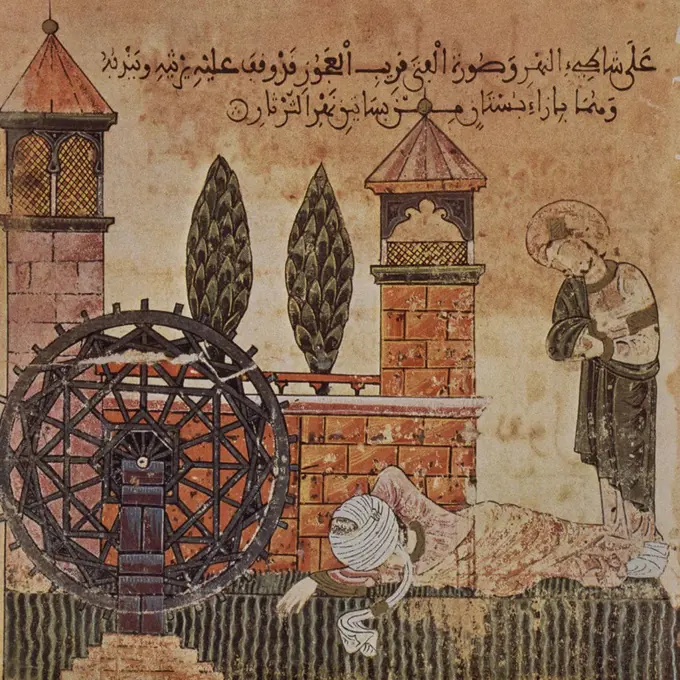
MANUSCRITO DEL HADIT BAYAD WA RIYAD, FOL. 19R, MANUSCRITO ALMOHADE DEL SIGLO XIII, NORIA DE AGUA. Location: BIBLIOTECA APOSTOLICA-COLECCION. VATICANO.
6145-29196910
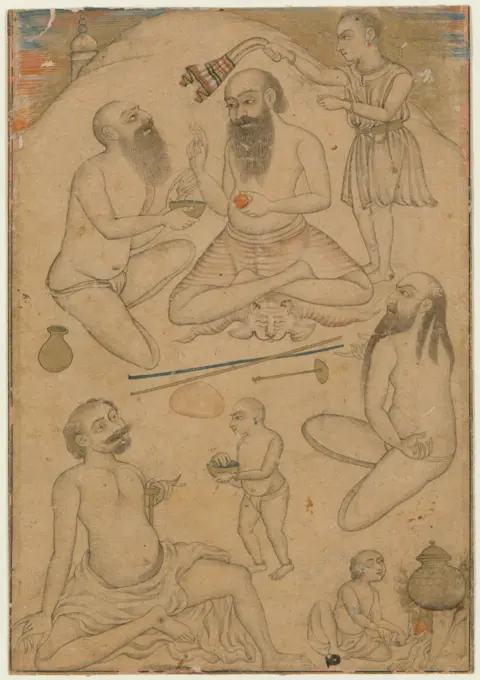
An Encampment of Yogis ca. 1660 India (Deccan, Aurangabad). An Encampment of Yogis. India (Deccan, Aurangabad). ca. 1660. Ink and opaque watercolor on paper. Paintings
4220-20412147
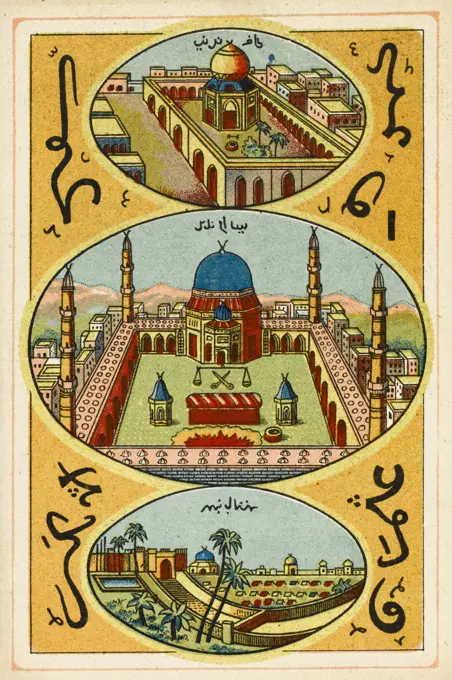
Algerian Fantasy card depicting Mecca     Date: 1920s
6145-51829449
Illustrated Manuscript of the Dala'il al-Khayrat (The Ways of Edification) of al-Jazuli Illustrated Manuscript of the Dala'il al-Khayrat (The Ways of Edification) of al-Jazuli, late 18th century. Ink, opaque watercolor, and gold on paper; tooled and gilded leather binding, 6 3/8 x 4 1/8 in. (16.2 x 10.5 cm).  The Dalail al-Khayrat (The Ways of Edification) of the Sufi mystic Muhammad ibn Sulayman al-Jazuli (d. 1465) is a prayer manual venerating the prophet Muhammad. The text includes a collection of prayers for the Prophet, a description of his tomb, his names and epithets, and other devotional material. It became the center of a popular religious brotherhood, the Ashab al-Dalil, which revolved around the mystical Islamic practice of dhikr, or recitation, of this book of religious piety. This manuscript is an Ottoman copy of al-Jazulis text, opened to an illustrated page containing a depiction of Mecca. Situated at the center of the mosque courtyard, the Kacba—the focal point of Mus
6145-29285025
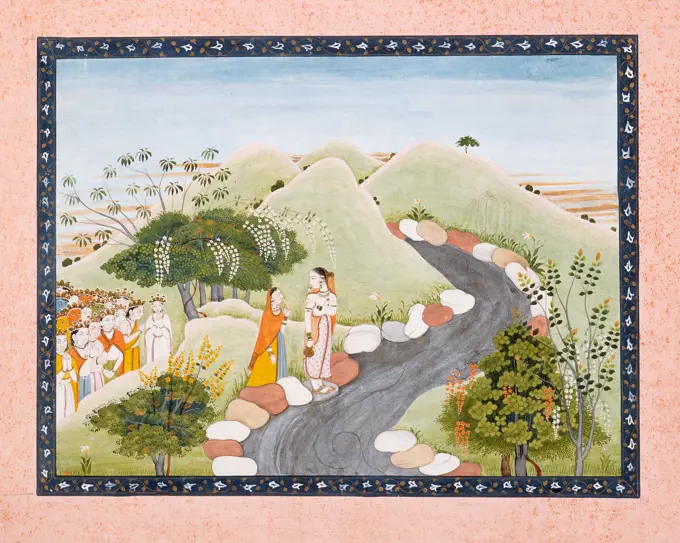
Two Indian women carrying water. Gouache painting by an Indian artist.
6145-29274471
A maidservant holding a jewellery box. Gouache painting on mica by an Indian artist.
6145-58990898
Maurice Denis (1870-1943). "Sacred wood". Esquisse, 1900. Museum of Fine Arts of the City of Paris, Petit Palais. 26306-9 Tree, bath, sacred wood, bucolic, relaxation, water, sketch, woman, carefree, nabi movement, mysticism, dreamlike, country landscape, dream, 20th XX 20th 20th 20th 20th century
PREVIOUS
of 4
NEXT
2401 S. Ervay, Suite 206
Dallas, Texas 75215
United States
Get Started
Free ResearchMy BoardsMy Cart
For Creators
How To License Your ContentContributor PortalFrame of Mind
Resources
API accessPricing
Contact
+1 866 236 0087help@viewpictures.co.uk Contact form
©2026 View Pictures. All Rights Reserved. -A
This site is protected by reCAPTCHA and Google Privacy Policy and Terms of Service apply.