Colorful Decorative Jars

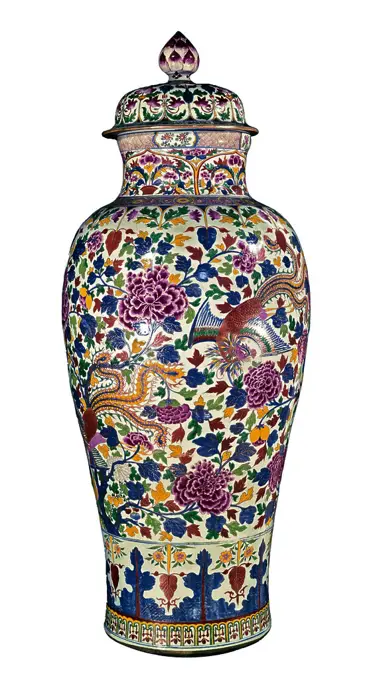
A collection of ornate ceramic jars featuring intricate floral and scenic designs, combining vibrant colors and detailed craftsmanship typical of Chinese porcelain.
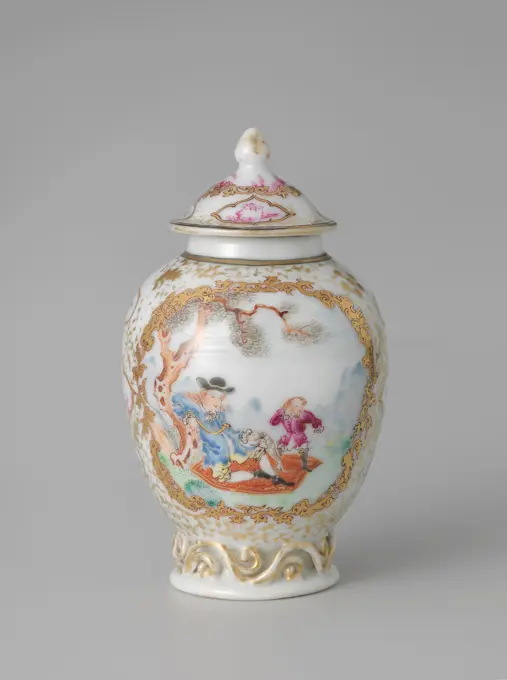
Ovoid tea caddy with European figures in landscapes, anonymous, c. 1740 - c. 1745 Egg -shaped porcelain tea, on a base with open worked curly, painted on the glaze in blue, red, pink, green, yellow, eggplant, black and gold. On the wall twice a cartouche of leaf vines with a European with a basket on its back in a river landscape. The other cartouche with a European sitting on a rug under a tree with a dog. He has a Ruyi-SCEPTER in his hand. A servant next to him. Between the cartouches flower ranks with two medallions and a four -pass with plants in Encre de Chine of Pink. European performance in email colors and Encre de Chine. China porcelain. glaze. gold (metal) painting / gilding / vitrification Egg -shaped porcelain tea, on a base with open worked curly, painted on the glaze in blue, red, pink, green, yellow, eggplant, black and gold. On the wall twice a cartouche of leaf vines with a European with a basket on its back in a river landscape. The other cartouche with a European sit
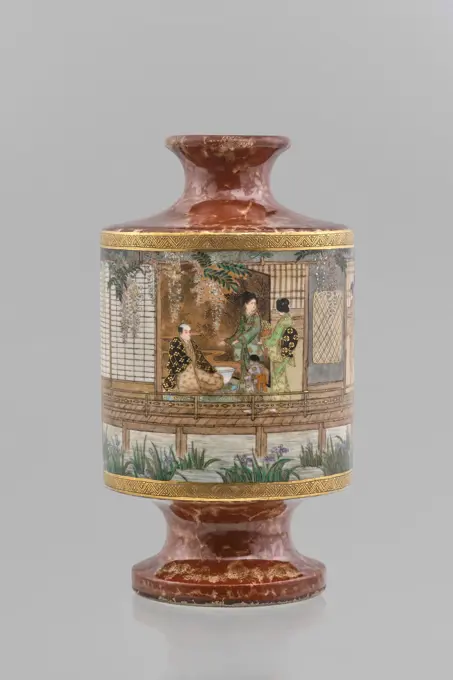
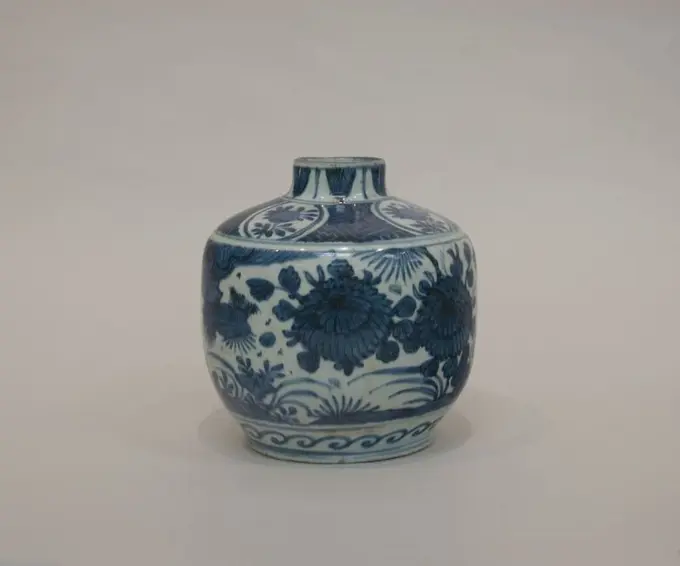
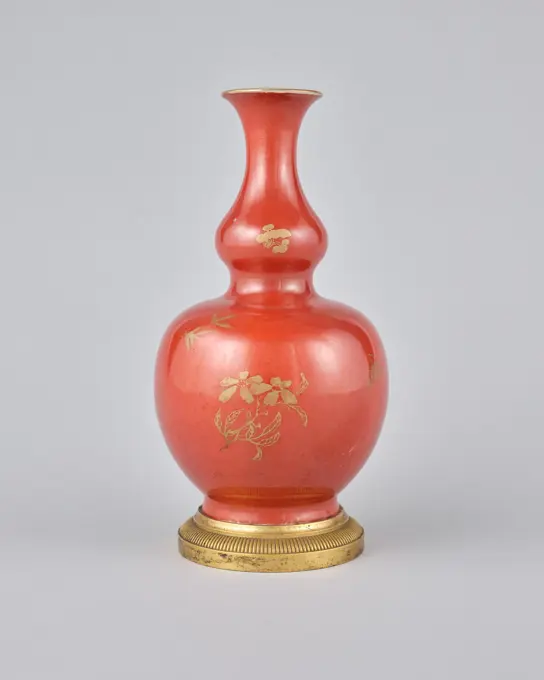
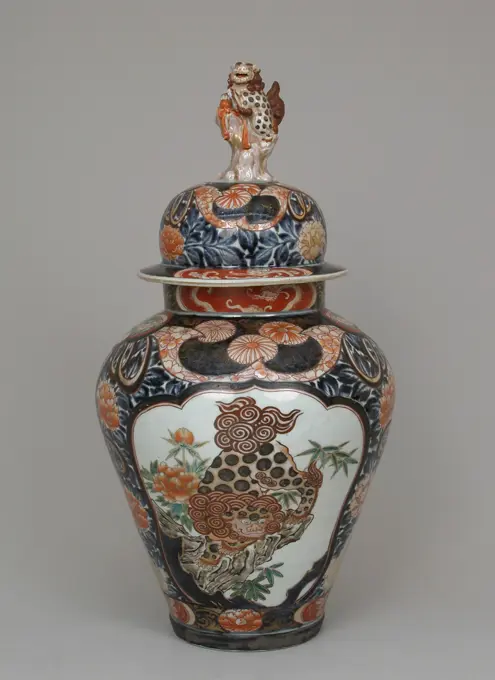
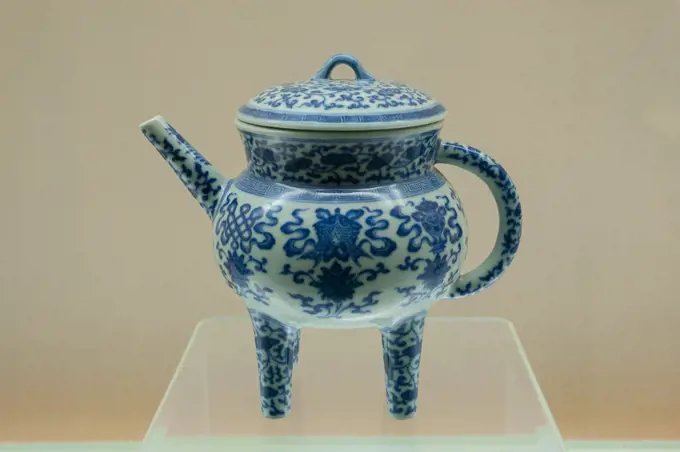
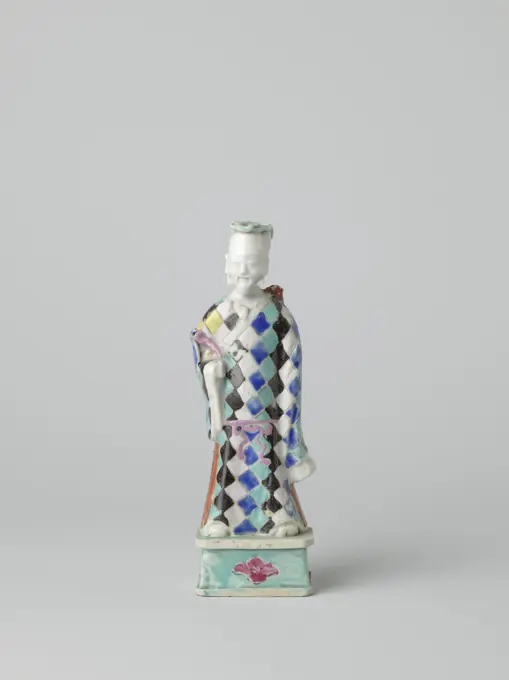
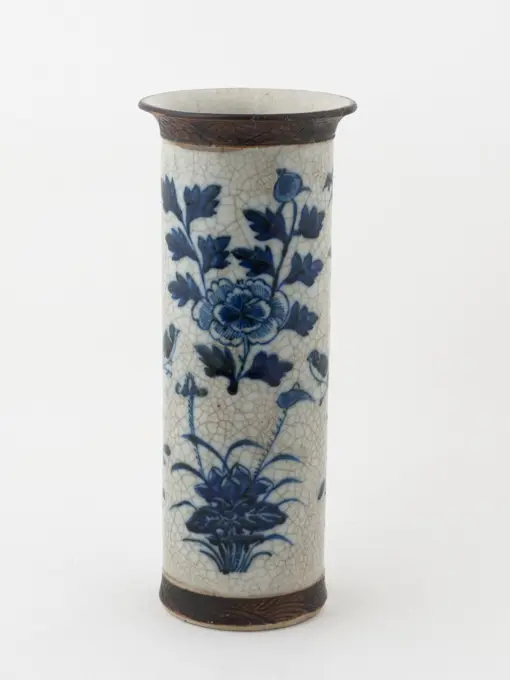
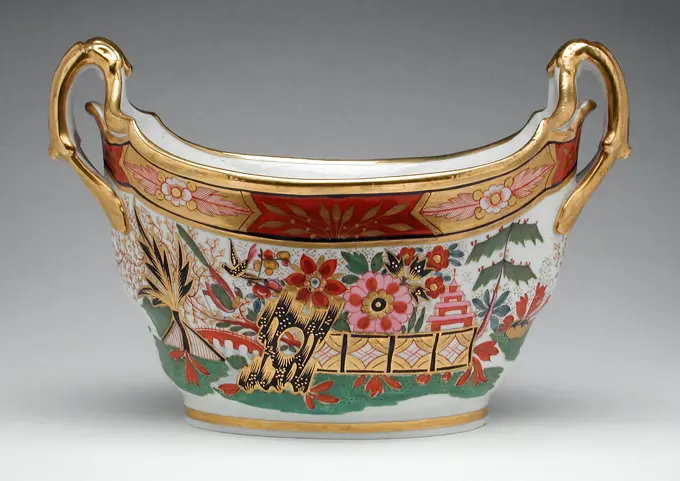
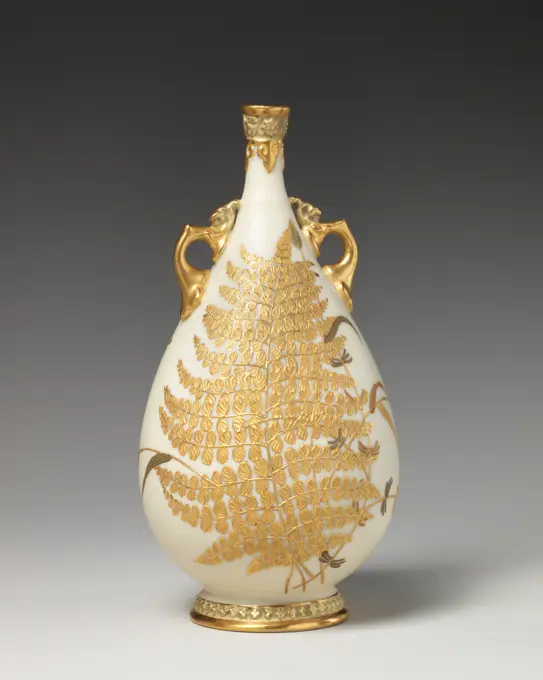
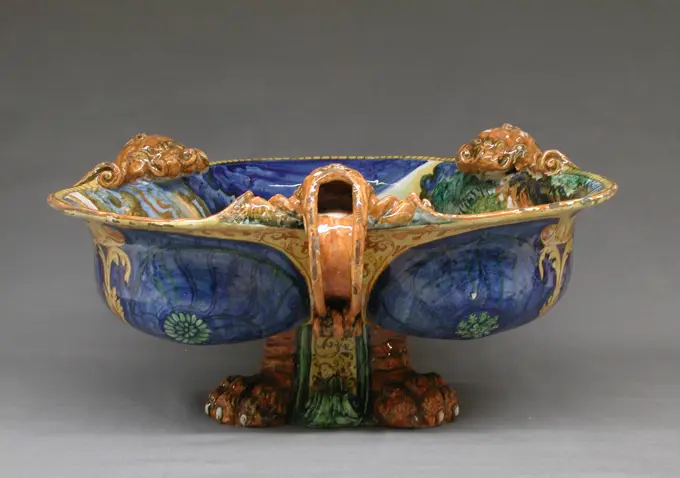
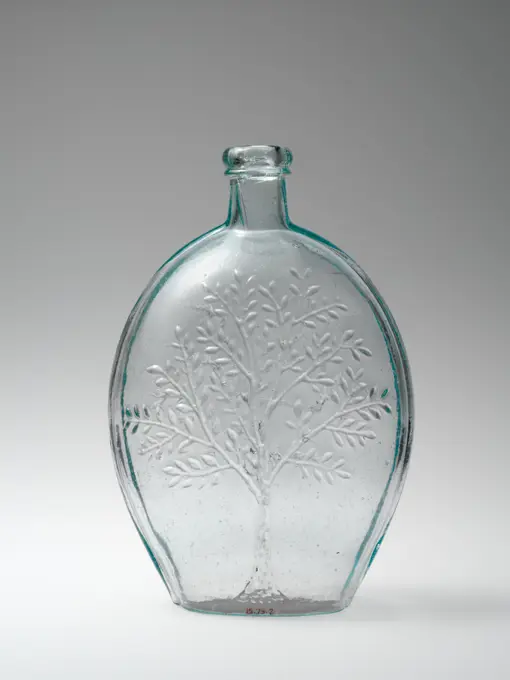
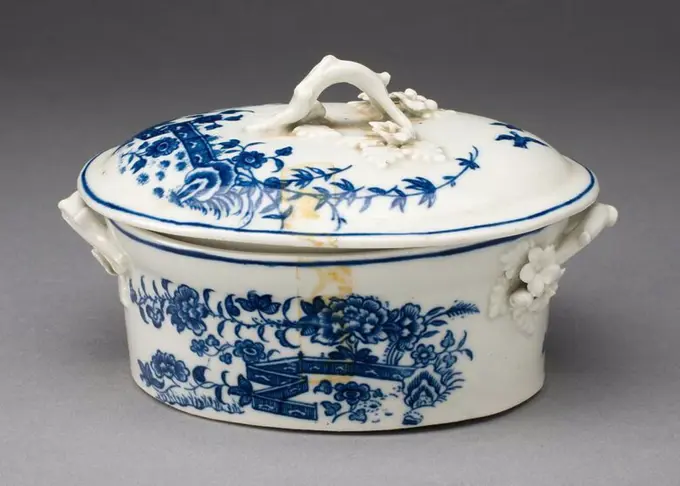
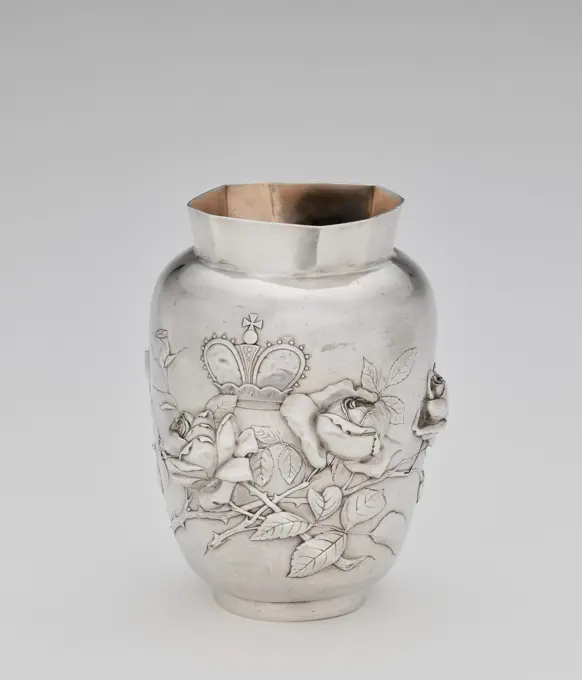
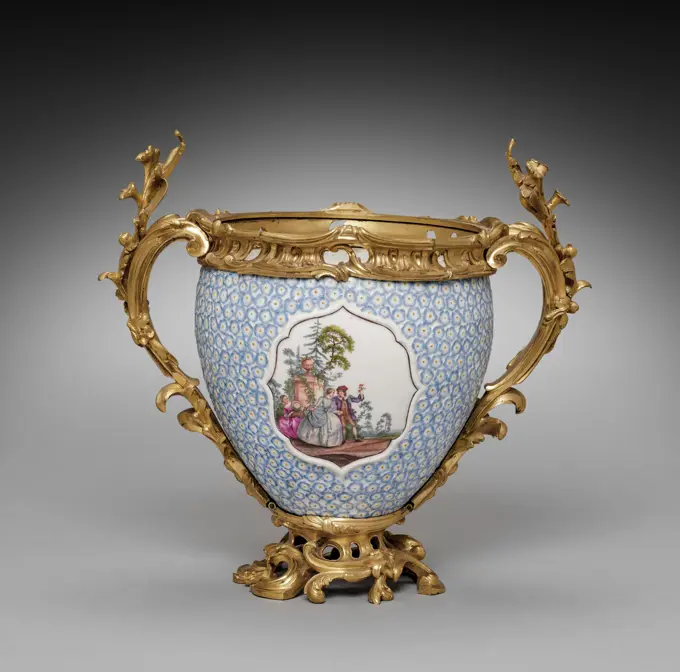
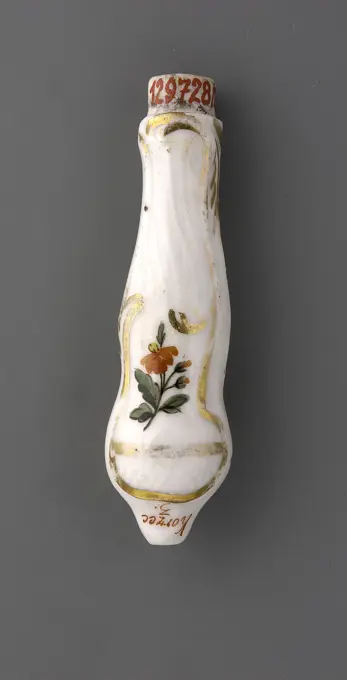
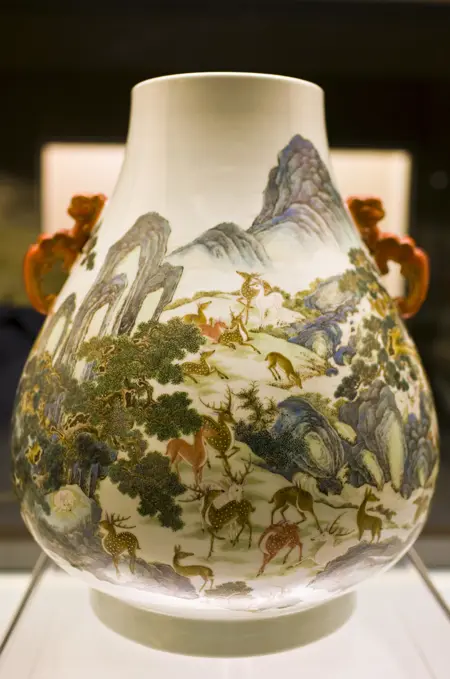
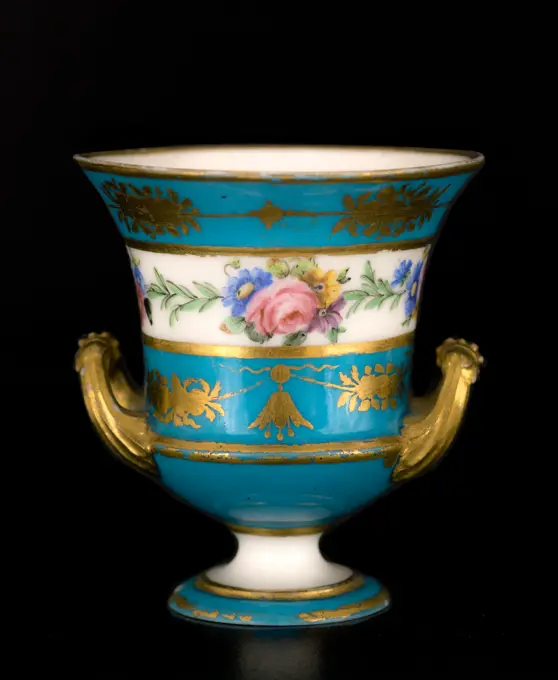
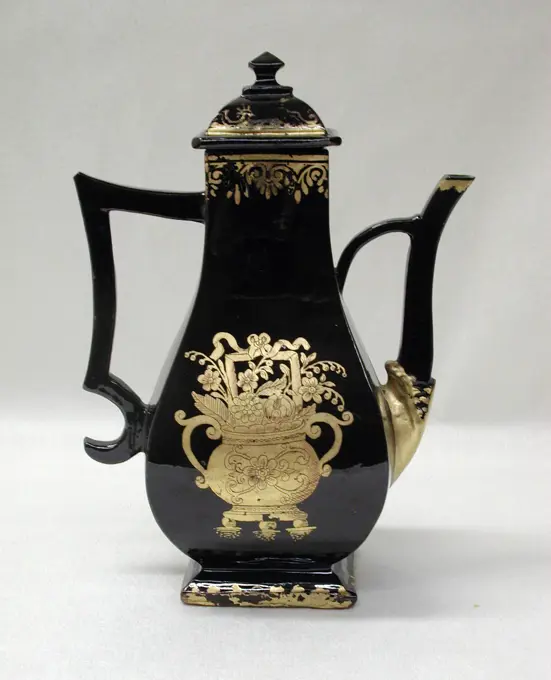
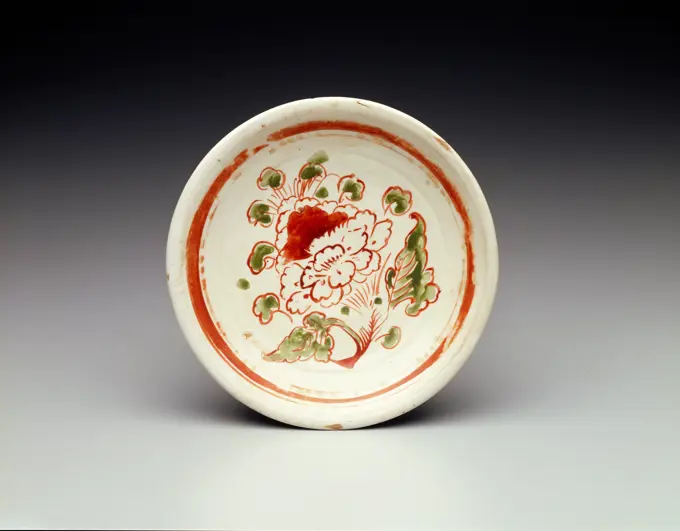
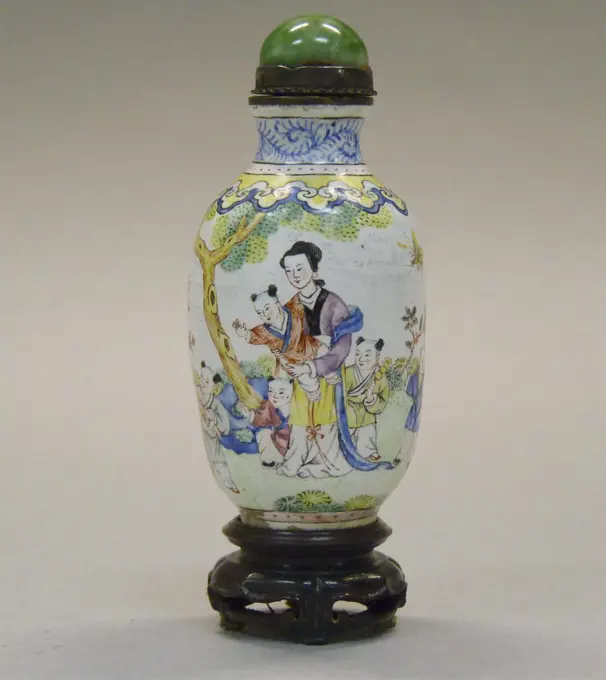
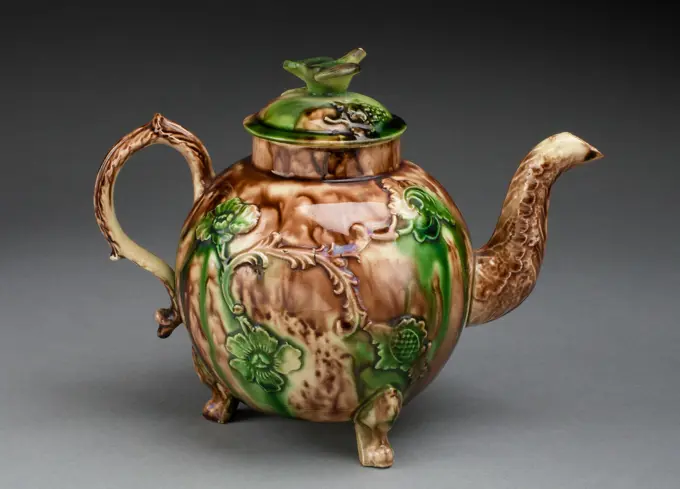
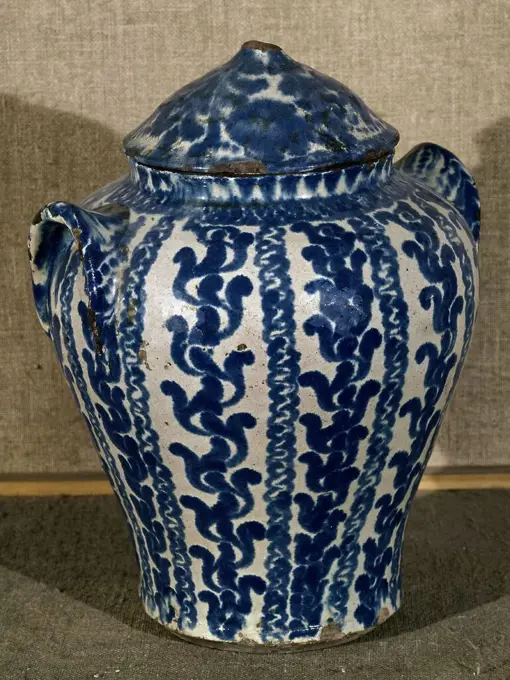
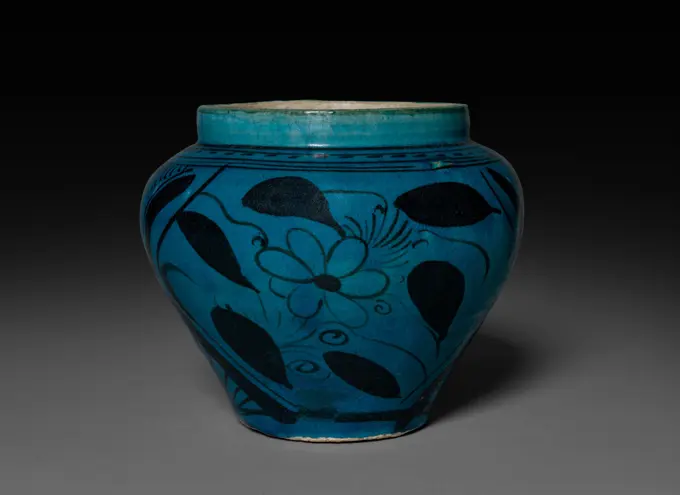
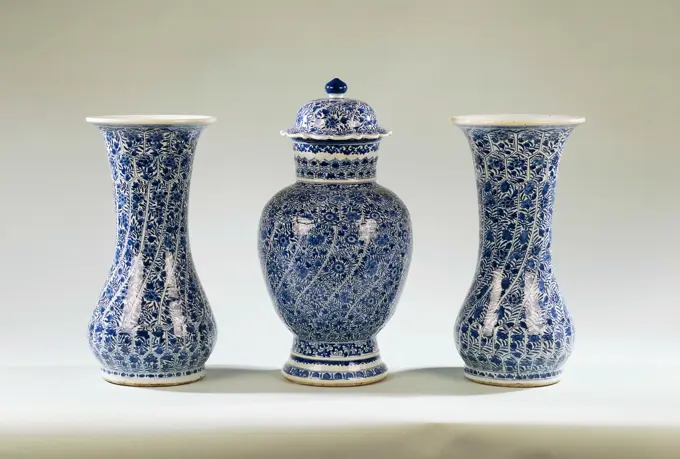
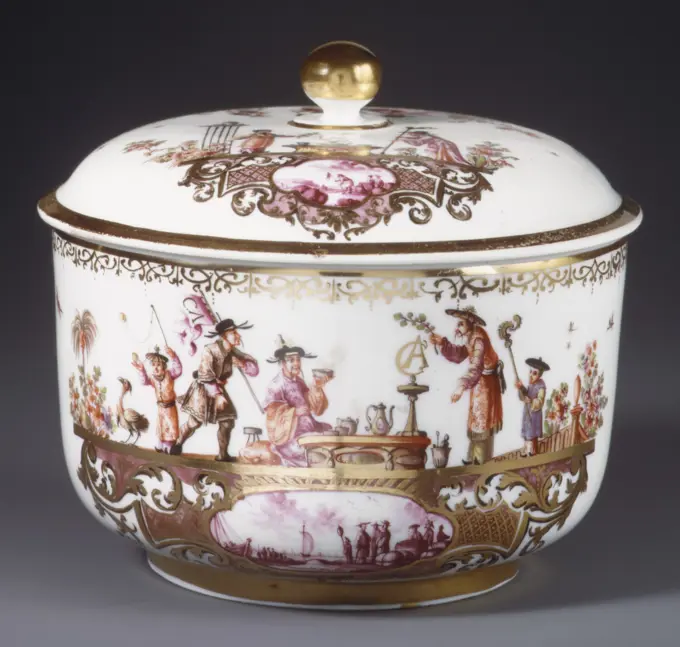
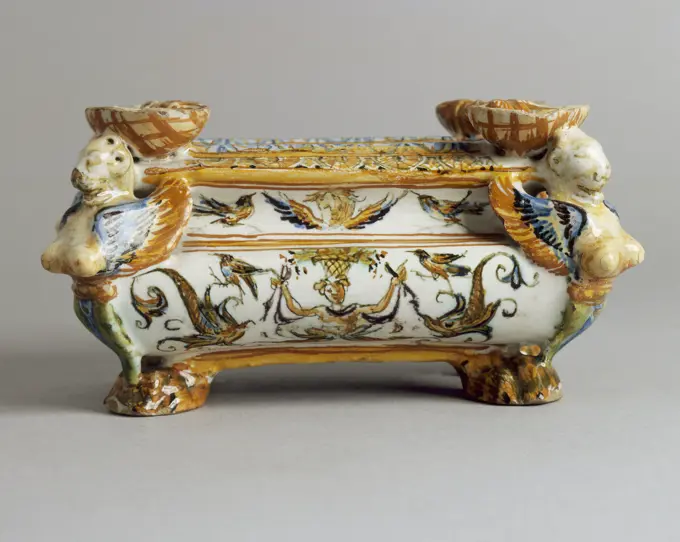
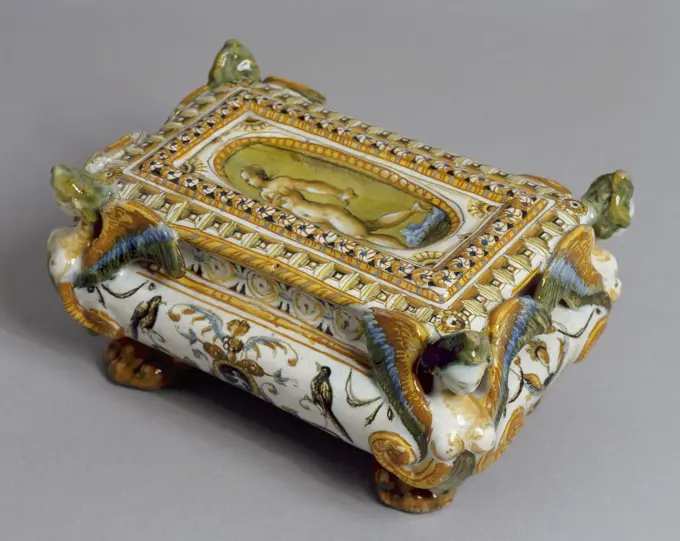
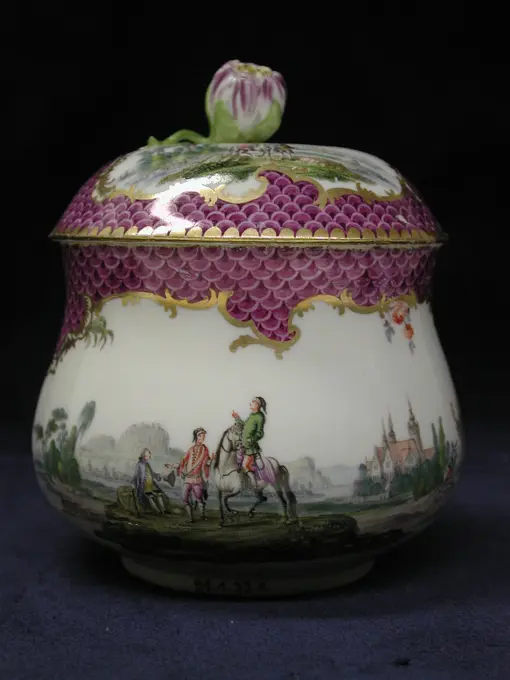
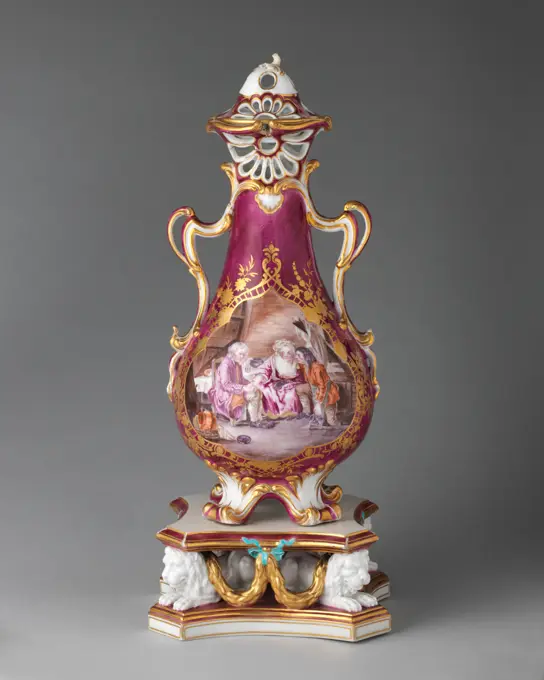
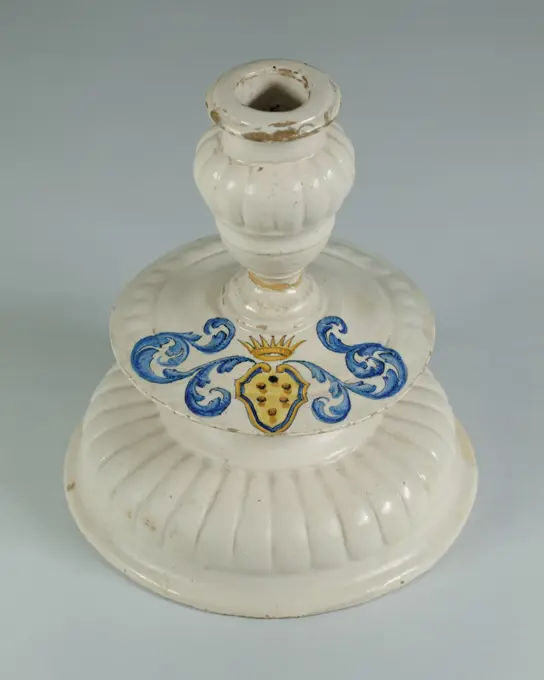
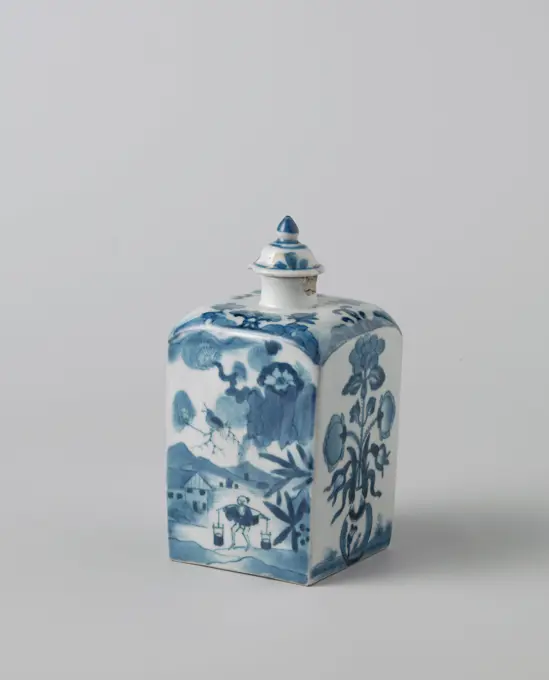
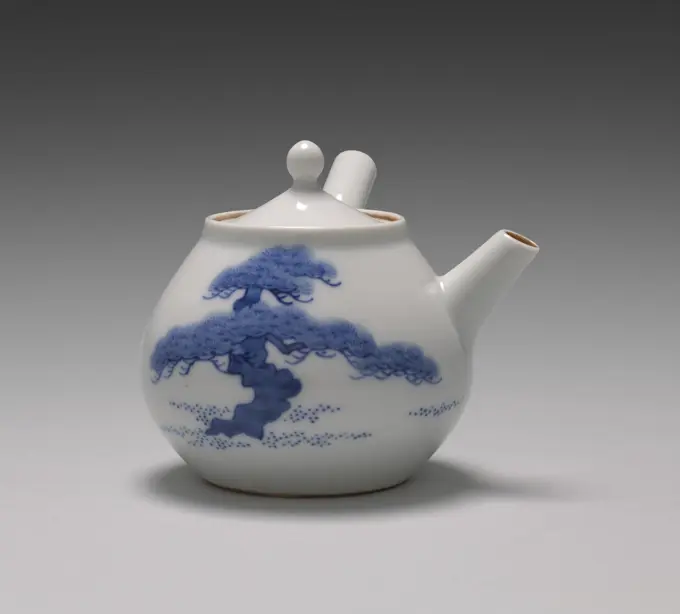
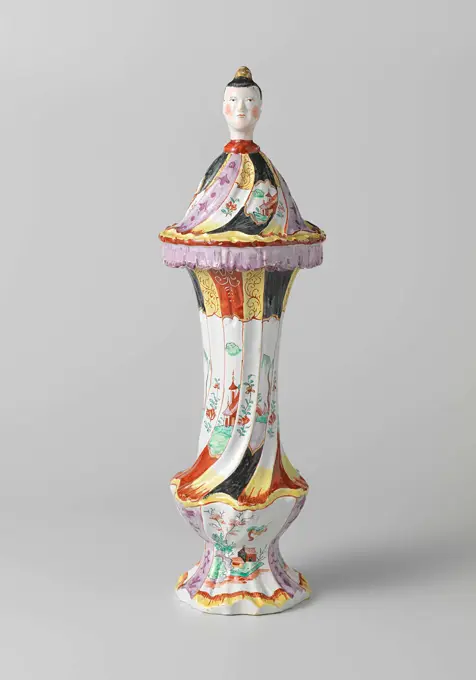
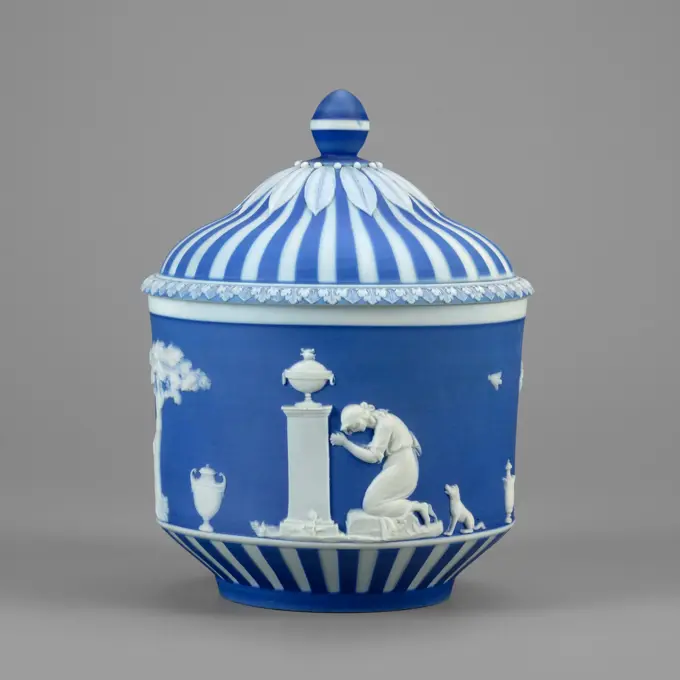
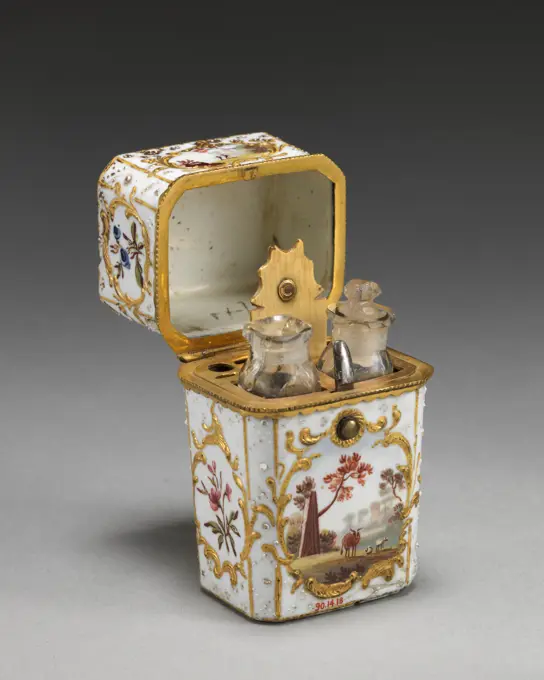
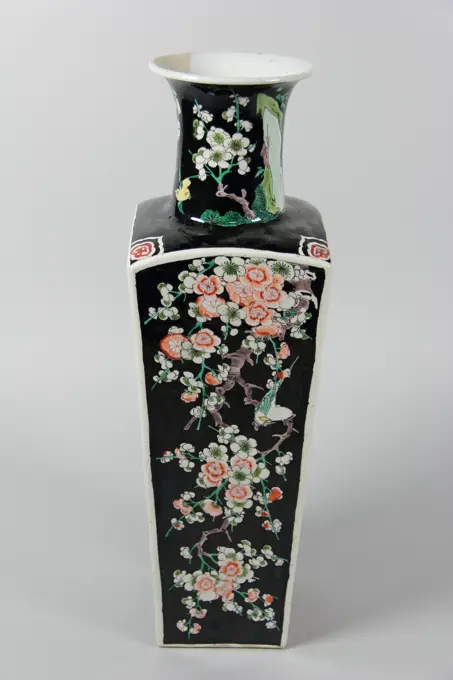
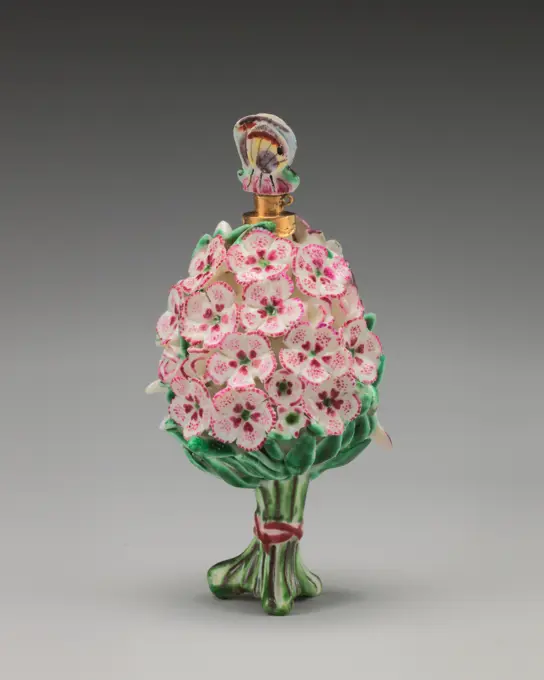
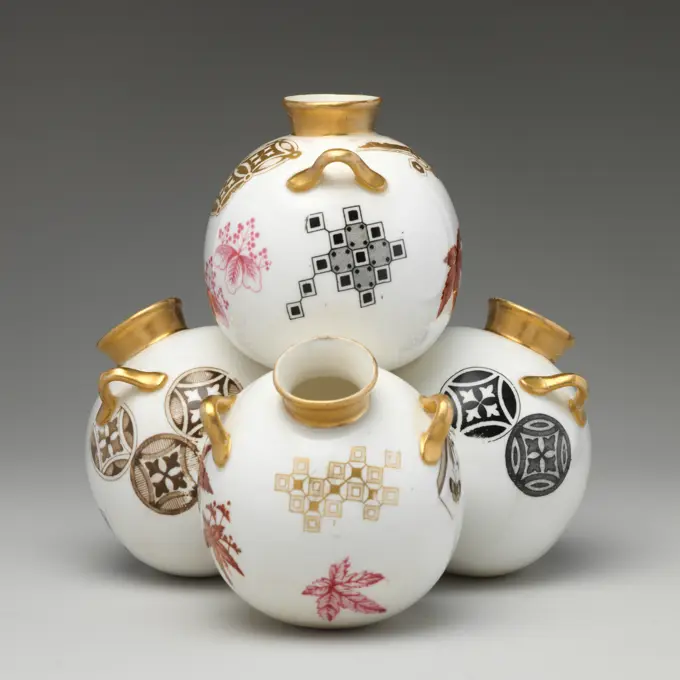
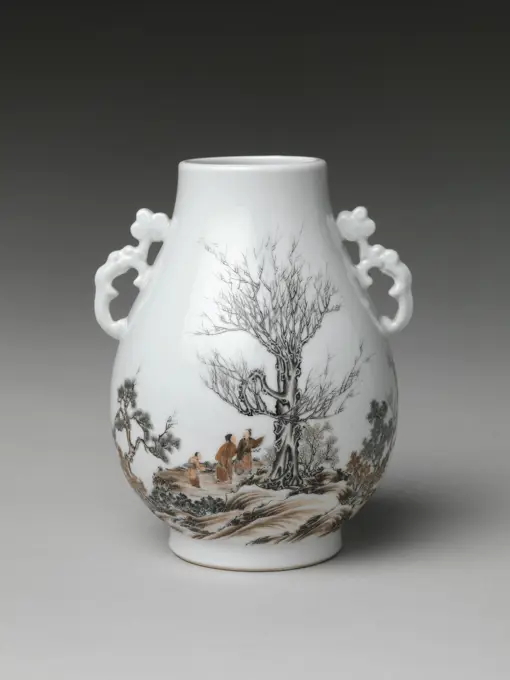
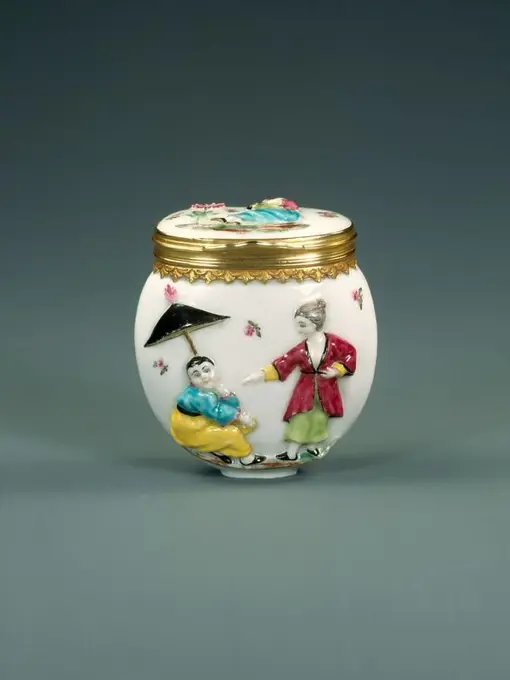
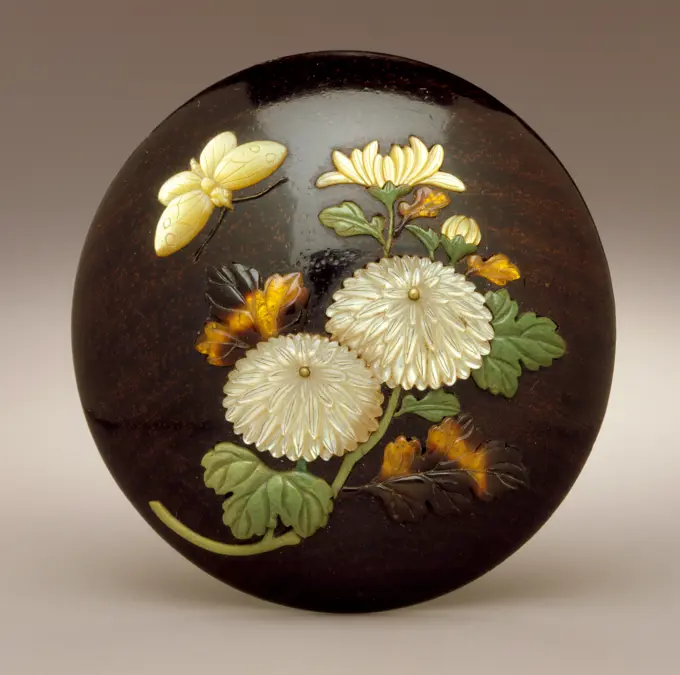
Bottle Vase With Light Brown and Precious Object And Antiques. Point bottle of porcelain with pear-shaped body, covered with a café-au-lait glaze and painted in underglaze blue. The lower part of the body is covered with a light brown glaze above which a tire with a thick cream-colored glaze; The upper part in underglazing blue with napkin interspersed with a flower in a medallion, above antiques (vase, tripod, scepter, books); The neck with pointed leaf motifs. Monochrome brown with blue and white.Small vase. Kinkôzan, Sôbei VII (1867-1927), craftsman, Kinkôzan, workshopBottle. Culture: China. Dimensions: H. 8 in. (20.3 cm); W. 7 1/2 in. (19.1 cm); Diam. of rim: 2 1/2 in. (6.4 cm); Diam. of foot: 5 1/2 in. (14 cm). Museum: Metropolitan Museum of Art, New York, USA.Unknown (n. - d.), Vase (common name). Porcelain, polychrome enamels, gilded bronze base. Petit Palais, Museum of Fine Arts of the City of Paris.Four-sided vase. unknown, craftsmanBaluster-shaped vase (part of a five-piece garniture) ca. 1690-1720 Japanese, for export market (Hizen ware, Imari type) Japanese porcelain vases made for export were avidly sought by aristocratic and royal patrons to decorate their stately homes and palaces in the late seventeenth and early eighteenth centuries. While Chinese porcelains were exported to Europe and Britain in larger quantities during this period, Japanese porcelains were prized for their boldly patterned and richly-colored decoration. The popularity of works such as these changed European taste for Asian porcelain, with a more vivid palette preferred over the blue and white decoration which once defined imported porcelains.. Baluster-shaped vase (part of a five-piece garniture). Japanese, for export market (Hizen ware, Imari type). ca. 1690-1720. Hard-paste porcelain with underglaze blue and overglaze enamel and gilding. Ceramics-Porcelain-ExportIncense Burner 18th century China. Incense Burner. China. 18th century. Painted enamel on copper. Qing dynasty (1644-1911). EnamelsGarniture, anonymous, c. 1800 - c. 1899 Octagonal, 'gu'-shaped cup vessel of porcelain, painted on the glaze in blue, red, pink, green, purple, black and gold. The wall is covered with peon branches against a background of a spiral pattern. On each of the eight sides a saved, scalloped cartouche with alternating flower branches (peony, chrysanthemum, aster, prunus) in a rock or one or more people on a terrace or in a fenced garden with flowering plants and rocks. In the middle of the body a thickened ring with servetwork interspersed with lobed cartouches with deer or birds in a pair of pair of pairing plant. On the edge a band with flower branches on blue frogs. A decorative band around the foot. Bekervaas is part of Kaststel AK-NM-11497. Famle Rose. China porcelain. glaze. gold (metal) painting / gilding / vitrification Octagonal, 'gu'-shaped cup vessel of porcelain, painted on the glaze in blue, red, pink, green, purple, black and gold. The wall is covered with peon branches againstVase Made 1785-1795 Yorkshire .Pottery from 1821 AD (Qing Dynasty) in an exhibit at the Shanghai Museum, a museum of ancient Chinese art, situated on the Peoples Square in the Huangpu District of Shanghai, China.Candlestick with blue -white decoration, the porcelaine bottle, c. 1880 - c. 1920 Candlestick of earthenware. Blue -white decoration with fruit baskets and flowers. Square vaulted foot with baluster-shaped trunk with openwork Nodus, formed by two C-volutes. The candle holder on this. Delft earthenware. glaze Candlestick of earthenware. Blue -white decoration with fruit baskets and flowers. Square vaulted foot with baluster-shaped trunk with openwork Nodus, formed by two C-volutes. The candle holder on this. Delft earthenware. glazeVase 1765-1775 Sèvres. Soft-paste porcelain, dark blue ground, gilding, and gilt-metal mounts . Manufacture nationale de Sèvres (Manufacturer)Figure of a standing man, one of the taoïst Immortals, anonymous, c. 1750 - c. 1774 Image of a standing man on a pedestal of porcelain, painted on the glaze in blue, red, pink, yellow and black. The man has a headgear on and a beard, a checkered robe and has an object in his left hand; A flower on the pedestal. Unidentified due to broken attribute. Hand broken down. Famle Rose. China porcelain. glaze. painting / vitrification Image of a standing man on a pedestal of porcelain, painted on the glaze in blue, red, pink, yellow and black. The man has a headgear on and a beard, a checkered robe and has an object in his left hand; A flower on the pedestal. Unidentified due to broken attribute. Hand broken down. Famle Rose. China porcelain. glaze. painting / vitrificationFopkan, painted with flowers and birds, Anonymous, 1758 Fopkan of Faïence, multi -colored painted with flowers and birds. Delft . Fopkan of Faïence, multi -colored painted with flowers and birds. Delft .Salt cellar.Vase. "Blue and white" porcelain. Paris, Cernuschi museum. 78846-29 Asian art, container, vaseSugar bowl (pot à sucre ovoïde) 1836 Sèvres Manufactory French The interest in depicting foreign and exotic locations on Sèvres porcelain tea and dinner services begins in the earliest years of the nineteenth century, propelled in part by French Emperor Napoléon Is (1769-1821) expedition to Egypt in 1798-99. The fascination with Egypt was both profound and long lasting, and some of the factorys most inventive work is found on services that utilize Egyptian motifs in both two and three dimensions.[1 The curiosity about foreign lands extended far beyond Egypt, however, and the taste for depictions of exotic places lasted into the 1840s.[2 The popularity of this type of subject matter coincided with a growing interest in creating thematic programs for multi-piece services.[3 In a letter from 1834, Alexandre Brongniart (French, 1770-1847), director of the Sèvres factory, stated his belief in the importance of linking sets of objects together by theme, as well as by decorative motifs, Dessert Service (Pail). Flight, Barr & Barr (England, Worcester, 1813-1840). England, 1813. Furnishings; Accessories. PorcelainOvoid tea caddy with the arms of the De Neufville family, anonymous, c. 1740 Cover of egg -shaped porcelain tea with ribbed wall, painted on the glaze in blue, red, black and gold. The lid with a button in the shape of a peach and a decorative tire. Lid not matching. Weapon porcelain with email colors. China porcelain. glaze. gold (metal) painting / gilding / vitrification Cover of egg -shaped porcelain tea with ribbed wall, painted on the glaze in blue, red, black and gold. The lid with a button in the shape of a peach and a decorative tire. Lid not matching. Weapon porcelain with email colors. China porcelain. glaze. gold (metal) painting / gilding / vitrificationVase with gold fern decoration 1870s Worcester factory After the end of the Flight, Barr & Barr ownership of the Worcester factory in 1840, the firm went through a succession of owners and mergers before falling under the ownership of Kerr & Binns in 1852. During the partnership, the factory sought to rebuild its former eighteenth-century reputation in porcelain and known for Renaissance-inspired designs. With the establishment of the Royal Worcester Porcelain Company in 1862, the company gradually gained recognition for its Japanese-inspired designs, which formed part of Japonisme, a collective fascination with Japan that took place in Europe and the United States following the opening of Japanese markets to the West by Commodore Perry in 1853.. Vase with gold fern decoration. British, Worcester. 1870s. Bone china. Ceramics-Porcelain. Sugar bowl with lid of painted porcelain. The pot is painted with port faces within ovals, which are saved in a yellow part. The sugar bowl has been marked.Vase (vase chinois) (one of a pair) 1791 Sèvres Manufactory French Factory archives indicate that Louis XVI purchased two vases chinois decorated by L'Écot in December, 1791 for the substantial price of 960 livres each. It is likely that this was the pair acquired by the king; not only do the date and painter correspond, but the gold and platinum decoration would have justified the high price of 960 livres for each vase.. Vase (vase chinois) (one of a pair) 205428Cistern (one of a pair) ca. 1550-70 Italian, Urbino. Cistern (one of a pair). Italian, Urbino. ca. 1550-70. Maiolica (tin-glazed earthenware). Ceramics-PotteryLiqueur bottle cooler (seau ovale à liqueur). Culture: French, Vincennes. Dimensions: Overall: 4 7/8 × 12 3/8 × 5 3/4 in. (12.4 cm, 14.6 cm). Factory: Vincennes Manufactory (French, ca. 1740-1756). Date: 1755.This cooler, intended for liqueur bottles, is fitted with a central, removable panel that is perforated in a decorative pattern. These holes would allow the water from melting ice to flow from one side to another. Museum: Metropolitan Museum of Art, New York, USA.Vase van Faience, the gilded Blompot, 1790 - 1820 vase Multicolored representation of Jesus with the Samaritan woman. The vase is marked: B-P Delft .Figured flask 1835-60 American. Figured flask. American. 1835-60. Blown-molded glass. Made in United StatesButter Tub. Worcester Porcelain Factory; Worcester, England, founded 1751. Date: 1755-1765. Dimensions: 8.9 x 13.7 x 9.8 cm (3 1/2 x 5 3/8 x 3 7/8 in.). Soft-paste porcelain with underglaze blue decoration. Origin: Worcester. Museum: The Chicago Art Institute, Chicago, USA. Author: Worcester Royal Porcelain Company.Art Nouveau flower vase. Łopieńscy, Bracia (Warszawa ; wytwórnia złotnicza ; 1884-1944), Łopieński, Grzegorz (1863-1939), designer, Nagalski i Psyk (Warszawa ; wytwórnia sreber ; 1884-1917), authorVase. Cincinnati Art Pottery Club (United States, Ohio, Cincinnati)Mary Louise McLaughlin (United States, 1847-1939). United States, 1879. Furnishings; Accessories. EarthenwareVase 1760-65 British. Vase. British. 1760-65. Opaque glass with enamel decoration. Probably made in Bristol, Bristol, EnglandVase, 1749. Meissen Porcelain Factory (German). Porcelain mounted in gilt bronze; overall: 38.1 x 33.7 x 20.7 cm (15 x 13 1/4 x 8 1/8 in.). One of these vases is dated 1749. They were perhaps part of a set of four covered vases that we know from documents were acquired by Mme. de Pompadour, mistress of Louis XV in 1752.Craft, pot in marble, India Copyright: xSatishxParashar/DinodiaxPhotoxBottle with plant flagellum on a IIght turquoise background unknownA handle for articles; Korzec (Porcelain and faience manufacture; 1790-1832); 19th century (1801-00-00-1900-00-00);Ming vase on display in the Shanghai Museum, ChinaAnonymous. Small Parseval vase. Porcelain, 19th century. Paris, Cognacq-Jay museum. 79171-12 Art Menager, Porcelain, Crockery, Parseval vase, 19th XIXth 19th 19th 19th 19th centuryCoffeepot ca. 1735-40 German, Bayreuth The gift of the Hans Syz Collection in 1995 endowed the Museum with nearly three hundred examples of European and Asian ceramics meticulously acquired by Swiss-born collector Dr. Syz (1894-1991) to chart the migration of models and patterns from East to West. Documenting a continuous process of influence and adaptation, these pieces provide a discriminating review of the nuances of stylistic change resulting from three centuries of trade.. Coffeepot 208483Jar with Bird and Flower Decoration, 1700s. Korea, Joseon dynasty (1392-1910). Stoneware with underglaze blue designs; outer diameter: 33 cm (13 in.); overall: 43.4 cm (17 1/16 in.).Covered Tureen, c. 1760-70. France, Marseilles. Faience; overall: 29.7 x 41.1 x 29.9 cm (11 11/16 x 16 3/16 x 11 3/4 in.).Covered Deep Bowl early 18th century China. Covered Deep Bowl. China. early 18th century. Porcelain painted in underglaze blue. Qing dynasty (1644-1911), Kangxi period (1662-1722). CeramicsVase with decoration of rocks, flowers, and butterflies. Culture: China. Dimensions: H. 2 3/4 in. (7 cm); Diam. 8 1/4 in. (21 cm).The decorating of porcelain with lacquer and mother-of-pearl exemplifies the inventiveness of Chinese art from the mid-seventeenth to the early eighteenth century. Although the vase is not marked, the shape is common among works produced during the reign of the Kangxi emperor. However, it is not clear if the lacquer and pearl shell were added when the vase was made or slightly later. Vases with this type of decoration are found in some numbers in Europe, where they are often known as laques burgautés,a term that was coined by nineteenth-century French specialists in porcelain and that is frequently, and incorrectly, used to describe works in lacquer with mother-of-pearl decoration. Museum: Metropolitan Museum of Art, New York, USA.Albarello pharmacy;  16th century (1500-00-00-1600-00-00);Dish, 13th century, 1 3/16 x 5 3/4 in. (3.02 x 14.61 cm), Cizhou ware Stoneware with painted polychrome enamel design over a white slip and clear glaze., China, 13th century, One of the most important technical innovations of the Cizhou kilns was overglaze painted polychrome decor. Enamel overglaze painting, one of the most celebrated traditions of Ming (1368-1644) and Qing (1664-1911) porcelain production, can be traced to Cizhou kilns of the late Song and Jin (1115-1234) periods. Designs in red, yellow, and green enamel are painted in glazed and pre-fired plain white pieces. They are then fired at a lower temperature. The majority of these early polychrome vessels were small, shallow bowls and dishes like this example.Mug 1736-95 Chinese export porcelain was one of the luxuries deemed essential to a well-appointed eighteenth-century house. Until 1784, when direct trade began between China and America, Chinese porcelain came to the colonies by way of Europe. This mug descended in the Verplanck family of New York. View more. Mug. 1736-95. Porcelain. Made in ChinaApothecary jar (albarello). unknown, authorSnuff Bottle with Foreign Figures 18th century China. Snuff Bottle with Foreign Figures. China. 18th century. Painted enamel on copper. Qing dynasty (1644-1911), Qianlong period (1736-95). Snuff BottlesWedgwood Manufacture. "Baluster vase (of a pair)". Wedgwood fine earthenware. Paris, Museum of Romantic Life. VASEVase (one of a pair) ca. 1770 Worcester factory. Vase (one of a pair). British, Worcester. ca. 1770. Soft-paste porcelain. Worcester factory (British, 1751-2008). Ceramics-PorcelainTeapot Made 1760-1770 Staffordshire. Lead-glazed earthenware (creamware) .CERAMICA DE GRANADA - DECORACION EN AZUL. Location: MUSEO DEL PUEBLO ESPAÑOL, MADRID, SPAIN.Jar: Cizhou ware, 1271-1368. China, Yuan dynasty (1271-1368). Stoneware with slip coating, turquoise glaze and painted underglaze decoration; diameter: 14.4 cm (5 11/16 in.); overall: 12.2 cm (4 13/16 in.).Candlestick, painted multi-colored with a kakiemon decor. Octagonal candlestick from painted porcelain. The candlestick has a vaulted foot and a profiled, baluster-shaped strain. The painting consists of spreader flowers and on the edge twice the tiger for bamboo motif and twice a crane. The candlestick is noticed.. Egg-shaped pot with porcelain lid, painted in underglaze blue. On the wall of the pot of tires of tires with flower branches with a double row of flower leaf-shaped compartments with flower branch; Three decorative tires at the foot; On the neck two rows with flower leaf-shaped boxes filled with flour branch with a decorative tape above; to the edge a bond with Ruyi motif; A double circle on the bottom. The lid with button, scalloped edge and chertifies with flower branches. A crack in the foot; The edge of the lid with small damage. Blue White.Sugar bowl with cover ca. 1735 Meissen Manufactory German. Sugar bowl with cover 200920Patanazzi (Atelier des). Salt shaker, Italian majolica of Urbino, between 1580 and 1600 (lateral view of the large side). Museum of Fine Arts of the City of Paris, Petit Palais. 27008-10 Ceramic, Italy, Italian majolica Urbino, bird, Renaissance, saliere, dishesPatanazzi (Atelier des). Salt, Italian majolica of Urbino, between 1570 and 1580 (overview). Museum of Fine Arts of the City of Paris, Petit Palais. 27008-3 Ceramic, woman, Italy, Italian majolica Urbino, female naked, nudite, various object, bird, renaissance, saliere, dishesIncense Burner with Basket Cartouche, Raised Dragon Decor. Japan, 19th century. Ceramics. Hirado Mikawachi ware, porcelain with underglaze blue. Pear-shaped cup spring from porcelain with a trumpet-shaped neck, painted in underglaze blue. Tire tires with flour branches on the wall with a double row of flower leaf-shaped compartments with flower branch; A decorative band at the foot. On the outer edge a bond with arrearing. A chip in the edge. Blue White.Vase. Chang, workshopBowl of a butter fleet, Van Faience, De Witte Starre, 1762 - 1772 Yellow with blue flowers inside. Delft . Yellow with blue flowers inside. Delft .Sugar bowl ca. 1760-70 Meissen Manufactory German. Sugar bowl 187675 Factory: Meissen Manufactory, German, 1710present, Sugar bowl, ca. 176070, Hard-paste porcelain, Height: 4 1/4 in. (10.8 cm). The Metropolitan Museum of Art, New York. Gift of Henry G. Marquand, 1894 (94.4.33a, b)Perfume vase ca. 1761 Chelsea Porcelain Manufactory. Perfume vase. British, Chelsea. ca. 1761. Soft-paste porcelain. Chelsea Porcelain Manufactory (British, 1745-1784, Gold Anchor Period, 1759-69). Ceramics-PorcelainBottle and Cap with European Heraldic Insignia. India, Gujarat, Kathiawar Peninsula, circa 1725-1750 (cap: Europe, 19th century). Furnishings; Accessories. Cobalt blue glass mold-blown with enamel and gilding; silver capVase Vase; Manufactured by Rozenburg Pottery and Porcelain Factory (Netherlands); Painted by Samuel Schellink (1876 - 1958); Netherlands; porcelain, vitreous enamel; 23.5 x 15.5 cm (9 1/4 x 6 1/8 in.)Two vases (rolwagens or sleeve vases), c. 1690 - c. 1700 FaiSence roller car with Tudor-Roos, Distel and Harp (for England, Scotland and Ireland) Delft .   England. Scotland. Ireland FaiSence roller car with Tudor-Roos, Distel and Harp (for England, Scotland and Ireland) Delft .   England. Scotland. IrelandAladdin Vase. Culture: American. Decorator: Maria Longworth Nichols (American, 1849-1932). Dimensions: H. 30 in. (76.2 cm); Diam. 18 1/4 in. (46.4 cm). Manufacturer: Manufactured by Rookwood Pottery (American, Cincinnati, Ohio, 1880-1967). Date: 1880-83. Museum: Metropolitan Museum of Art, New York, USA.Square bottle with birds, flowering plants and pavilions, anonymous, c. 1700 - c. 1724 Square bottle of porcelain with a gilt, painted on the glaze in red, green, yellow, purple, black and gold. On the walls twice pavilions on an island with rocks and flowering plants (bamboo), a bird on a branch, and twice a flying bird at a prunus branch and bamboo. On the shoulder a band with prunus branches and a leaf motif; Rank around the neck. A meander pattern on the neck. The edge has been ground. Arita, decorated in Europe  In the Japanese Kakiemon style. Japanpainter: Europe (possibly) porcelain. glaze. gold (metal) painting / gilding / vitrification Square bottle of porcelain with a gilt, painted on the glaze in red, green, yellow, purple, black and gold. On the walls twice pavilions on an island with rocks and flowering plants (bamboo), a bird on a branch, and twice a flying bird at a prunus branch and bamboo. On the shoulder a band with prunus branches and a leaf motif; Rank around the neLidded Tureen, in the 3 porvenely thecons, c. 1760 - c. 1770 The terrine is on four equal feet in the form of a rocaille. The wavy edge of the container is thickened into a cord whose ends, halfway on top of the Golf, are tied together. There is a shield of rocailles on this knot. On both sides of it a Frisian has been installed along the top with hanging lambrekijns in relief. Delft . The terrine is on four equal feet in the form of a rocaille. The wavy edge of the container is thickened into a cord whose ends, halfway on top of the Golf, are tied together. There is a shield of rocailles on this knot. On both sides of it a Frisian has been installed along the top with hanging lambrekijns in relief. Delft .Tea lid of Tin, 1500 - 1950 Tea lid with tin lid. Crazy painted.  earthenware. deksel: tin (metal) Tea lid with tin lid. Crazy painted.  earthenware. deksel: tin (metal). Vase of pottery, slim shape with long neck. Painted in green, black-gray and brown, with geraniums. Signature: Made in South Holland and factory brand with links "p / a." And right "c.j.v M. egroll Model no. 5012.. The round of tea bus is divided into six lobes. Each lob is decorated in Cut Card technology with a flower on a punched field. A tulip, a garden anemone, a daffodil, a rose, a turkish lily and a marigold. Above the neck, six leaves are applied to the neck, also in Cut Card technology on a punched soil. The lid fits over the cylindrical neck, the straight wall of which is provided with a wide punched band. The flat top shows a marigold, again in cut card technique on a punched soil.Snuff Bottle, 2 1/2 x 1 5/8in. (6.4 x 4.1cm), Turquoise, China, Qing dynastyCandlestick (candeliere) mid-17th century Italian, possibly Montelupo. Candlestick (candeliere). Italian, possibly Montelupo. mid-17th century. Maiolica (tin-glazed earthenware). Ceramics-PotterySquare bottle with figures in a landscape, a flower vase and a flowering plant near a rock, anonymous, c. 1660 - c. 1680 Porcelain bottle of square bottle, painted in underlaze blue. The lid with three branches is not matching. A chip in the edge of the lid. Arita, Blauw-Wit. Japan porcelain. glaze. cobalt (mineral) painting / vitrification Porcelain bottle of square bottle, painted in underlaze blue. The lid with three branches is not matching. A chip in the edge of the lid. Arita, Blauw-Wit. Japan porcelain. glaze. cobalt (mineral) painting / vitrificationThis teapot with images of pines are among Seif Yohei III’s designs painted in blue. Teapot with Pines, 1893-1914. Seifū Yohei III (Japanese, 1851-1914). Porcelain with underglaze blue; height with lid: 8 cm (3 1/8 in.); width with handle: 10.5 cm (4 1/8 in.); diameter: 8 cm (3 1/8 in.).Vase with lid, painted with plants and an insect, Meissener Porzellan Manufaktur, c. 1730 - c. 1745 Vase with lid made of painted porcelain. The vase rejuvenates and has a slightly outstanding foot. The vase is painted in underlaze blue with flowering plants and an insect. The vase is marked. Float porcelain Vase with lid made of painted porcelain. The vase rejuvenates and has a slightly outstanding foot. The vase is painted in underlaze blue with flowering plants and an insect. The vase is marked. Float porcelainBottle with flower vines, shrub branches and dot and stripe ornament, anonymous, c. 1700 - c. 1800 Flat bottom, rectangular, body blown in the shape with profiled corners with flower vessels stylized in yellow, blue, white and red on the front and rear and shrub branches and dot and stripe ornament on the narrow sides and the corners. The neck is caught in a pewter frame. With vaulted screw cap. Middle Europe glass. tin (metal) glassblowing Flat bottom, rectangular, body blown in the shape with profiled corners with flower vessels stylized in yellow, blue, white and red on the front and rear and shrub branches and dot and stripe ornament on the narrow sides and the corners. The neck is caught in a pewter frame. With vaulted screw cap. Middle Europe glass. tin (metal) glassblowingThree vases, part of a garniture. These lidded vases are composed of rocailles, or twisted shell-like motifs, characteristic of the Rococo style. The Chinese heads on the lids make the vases look like female figures with swirling robes. Vases of this kind, painted in striking colours with Chinese motifs, were highly fashionable.VaseVase. Watano, author, Kutani, manufactureMusical instruments. Culture: British, Chelsea. Dimensions: Overall: 1 3/4 × 2 1/2 in. (4.4 × 6.4 cm). Factory: Chelsea Porcelain Manufactory (British, 1745-1784, Red Anchor Period, ca. 1753-58). Date: ca. 1760. Museum: Metropolitan Museum of Art, New York, USA.Candy confectioner; Josiah Wedgwood & Sons (Stoke-On-Trent; Ceramics Factory; 1790-1895); XVIII/19th century (1790-00-00-1810-00-00);Fajertag Maurycy, Wedgwood, Josiah (1730-1795), Akant (ornament), confectioner, anti-icing decorations, Jaspiska stonewarePotpourri with cover 1760-65 Niderviller Niderviller, an area in the Lorraine region of France, came into prominence as a producer of enamel-decorated faience in the mid-eighteenth century when Baron Jean-Louis de Beyerlé purchased a factory there. Under Beyerlé and the chemist-painter François-Antoine Anstett, the factory produced an innovative range of models and colors in petit feu faience, or tin-glazed earthenware that was fired twice. Such forms were undoubtedly influenced by the factorys parallel forays into hard-paste porcelain production from 1760 to 1765. This potpourri with cover exemplifies the Rococo aesthetic that dominated the factory in the middle of the eighteenth century. The rose-hued imaginary landscape on the base is evocative of the designs of Jean Pillement, while the asymmetrical scrolls and openwork on the cover is reminiscent of the ornament designs of Juste-Aurèle Meissonnier. In 1770, Beyerlé sold the factory to the Comte de Custine, who was guillotined durWriting case ca. 1760-1800 British, Staffordshire. Writing case. British, Staffordshire. ca. 1760-1800. Copper, enamel. Enamels-PaintedShepherd boy ca. 1760 Chelsea Porcelain Manufactory. Shepherd boy. British, Chelsea. ca. 1760. Soft-paste porcelain. Chelsea Porcelain Manufactory (British, 1745-1784, Gold Anchor Period, 1759-69). Ceramics-PorcelainSquare vase with birds and flowers 19th century China. Square vase with birds and flowers. China. 19th century. Porcelain painted in polychrome enamels over a black ground (Jingdezhen ware, famille noire). Qing dynasty (1644-1911). CeramicsSugar Bowl with lid from Solitaire Set, c. 1785, Höchst Porcelain Factory, Höchst am Main, Germany, 1746-1796, 2 3/4 x 2 5/8 in. (7 x 6.67 cm), Porcelain, Germany, 18th centuryBouquet ca. 1760 Saint James's Factory Listen to experts illuminate this artwork's story Listen Play or pause #413. Retail Value. High and Low Supported by Bloomberg Philanthropies We're sorry, the transcript for this audio track is not available at this time. We are working to make it available as soon as possible.. Bouquet. British, London. ca. 1760. Soft-paste porcelain. Ceramics-PorcelainQuadruple orb vase 1876 Worcester factory After the end of the Flight, Barr & Barr ownership of the Worcester factory in 1840, the firm went through a succession of owners and mergers before falling under the ownership of Kerr & Binns in 1852. During the partnership, the factory sought to rebuild its former eighteenth-century reputation in porcelain and known for Renaissance-inspired designs. With the establishment of the Royal Worcester Porcelain Company in 1862, the company gradually gained recognition for its Japanese-inspired designs, which formed part of Japonisme, a collective fascination with Japan that took place in Europe and the United States following the opening of Japanese markets to the West by Commodore Perry in 1853. Listen to experts illuminate this artwork's story Listen Play or pause #418. Christopher Dresser and the Birth of Industrial Design Supported by Bloomberg Philanthropies We're sorry, the transcript for this audio track is not available at this time. We are Vase with Scholar in a Landscape (one of a pair) ca. 1915-35 China Early in the twentieth century, under the auspices of Yuan Shikai, some ceramics of surprisingly fine quality were produced at the Jingdezhen kilns of Jiangxi Province. Yuan had been named president of the Chinese Republic in 1912, and his ambitions to become emperor were realized in December 1915, when he "accepted" the throne. His reign was short-lived, however, as he died in June 1916.This pair of vases have mirror-image designs that have been painted over the glaze in sepia and black pigments with minute attention to detail. They are marked on the base with Yuan Shikai's reign title, Hongxian, and they stand as proof of a degree of excellence in ceramic manufacture that is generally unexpected in wares of this period.. Vase with Scholar in a Landscape (one of a pair) 42322Snuffbox. Culture: British, London. Dimensions: 2 1/2 x 2 1/8 in. (6.4 x 5.4cm). Maker: Saint James's Factory (British, ca. 1748/49-1760). Date: ca. 1755. Museum: Metropolitan Museum of Art, New York, USA.Pair of porcelain vasesVase with cover (vase à gland) (one of a pair). Culture: French, Sèvres. Decorator: Quayside scenes attributed to Jean-Louis Morin (French, active 1754-87); Trophy medallions attributed to Charles Buteux (French, active 1756-82). Dimensions: Height: 14 1/16 in. (35.7 cm). Manufactory: Sèvres Manufactory (French, 1740-present). Date: ca. 1775.The two primary reserves of these vases (see also 58.75.76a, b) feature dockside scenes of sailors and merchants with barrels of cargo and the mast of a ship in the middle distance. This type of marine theme was popular at Sèvres and was a specialty of the painter Jean-Louis Morin (act. 1754-87). While neither of these vases bears the painter's mark of Morin, the decoration can be attributed to him on the basis of stylistic affinities to other works on which his mark appears.Jeffrey H. Munger, 2007. Museum: Metropolitan Museum of Art, New York, USA.Vase (part of a garniture) 1723-41 De Witte Starre Manufactory. Vase (part of a garniture) 187847 Maker: De Witte Starre Factory, Factory owner: Period of Cornelison Janson Brouwer, Vase (part of a garniture), 172341, Tin-glazed earthenware, Height: 7 in. (17.8 cm). The Metropolitan Museum of Art, New York. Gift of Henry G. Marquand, 1894 (94.4.337)Bourse. GAL2010.20.1Blue plate, 18th century.Cylindrical, shoulderd vase with powder bleu and panels in reserve with flower sprays and birds, anonymous, c. 1700 - c. 1724 Cylindrical vase of porcelain with sloping shoulder, straight neck and flat, upright edge, painted in underlaze blue and on the glaze blue, red, green, yellow, black and gold. The vase is covered with bleu poudré (powder blue) with two rectangular cartouches with pressed corners filled with a bird on a flower branch (prunus and peony); On the blue a decoration in gold of curls with stylized flowers and two rectangular cartouches with squeezed corners, one filled with rock, bamboo branch and two birds, the other with a prunus branch and a butterfly; On the shoulder a band Ruyi motif with geometric pattern interspersed with lobed cartouches with valuables (window, music stone, roll); the neck with geometric pattern in which two fan -shaped cartouches with flower branch and butterfly or river landscape; The edge with Meander motif. On the bottom an old label with: Large covered bowl wit a continuous landscape with pavillions, mountains and trees, anonymous, c. 1680 - c. 1700 Lid of large lid bowl of porcelain, painted in underlaze blue. The outer wall with a continuous landscape with pavilions, mountains and trees. Below that a decorative band. Cover button in the form of a shishi (lion dog). Arita, Blauw-Wit. Japan porcelain. glaze. cobalt (mineral) painting / vitrification Lid of large lid bowl of porcelain, painted in underlaze blue. The outer wall with a continuous landscape with pavilions, mountains and trees. Below that a decorative band. Cover button in the form of a shishi (lion dog). Arita, Blauw-Wit. Japan porcelain. glaze. cobalt (mineral) painting / vitrificationMing-like style. Chinese jar. 19th century. Madrid, Royal palace. Location: PALACIO REAL-CERAMICA. MADRID. SPAIN.Chrysanthemums and Butterfly. Japan, late 19th century. Costumes; Accessories. Wood with ivory, tortoiseshell, mother-of-pearl inlays; manjū type