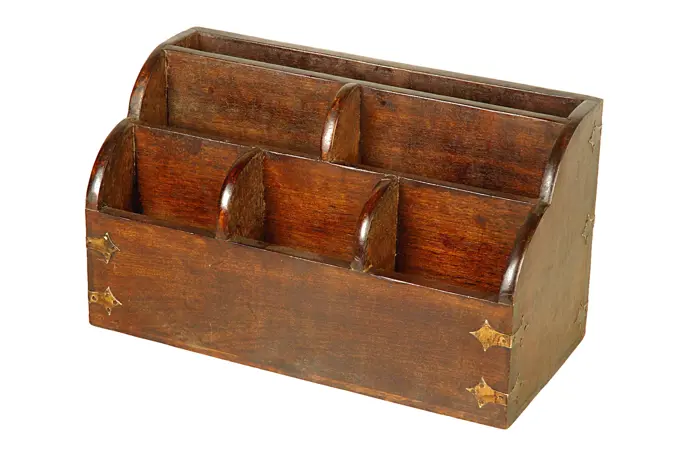
Decorative Boxes

Elegant antique boxes made of materials like leather and copper, featuring intricate designs, used for storing valuable items or keepsakes.

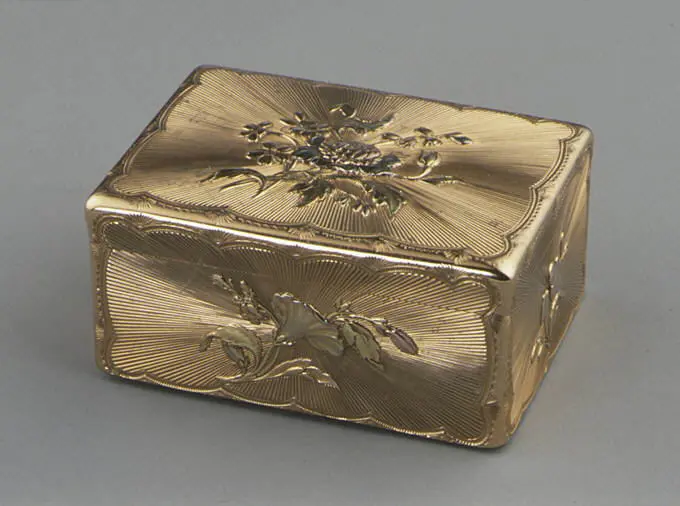
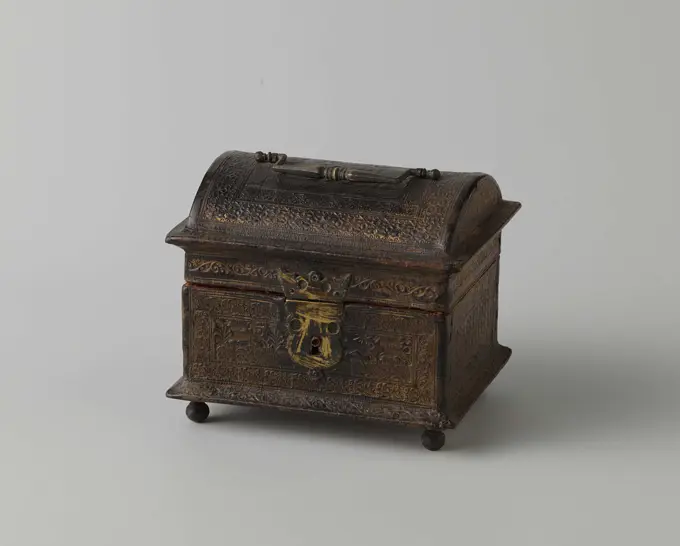
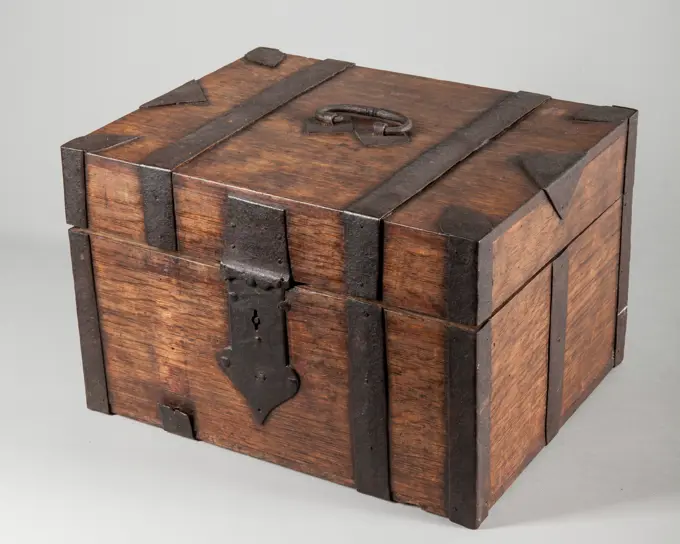
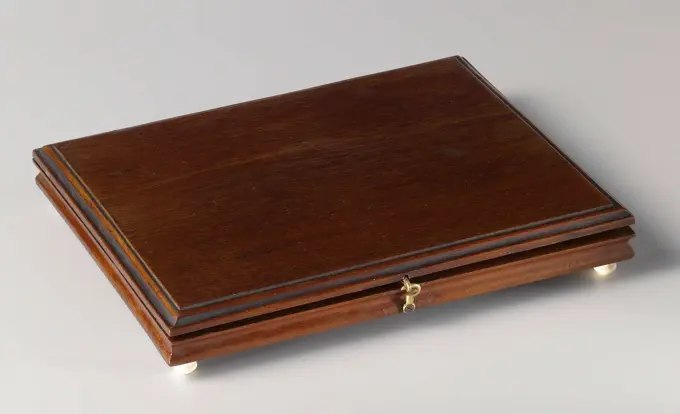
Box, wood, tooled leather, gilded brass, rectangular wooden box, on oiutside covered with gold-tooled leather; sprigs of flowers on sides and surrounding raised central panel of cover, which in center bears coat-of-arms flanked by two quatrefoils, and in corners diapered scrolled cartouches - coat-of-arms: tierced in fess, 1 an eagle displayed, 2 a winged dragon, 3 three mullets on bend - surmouted by cardinal's hat - brass escutcheon, hasp, and two bail handles - inside lined with red undrressed leather., Italy, 18th century, containers, Decorative Arts, Box
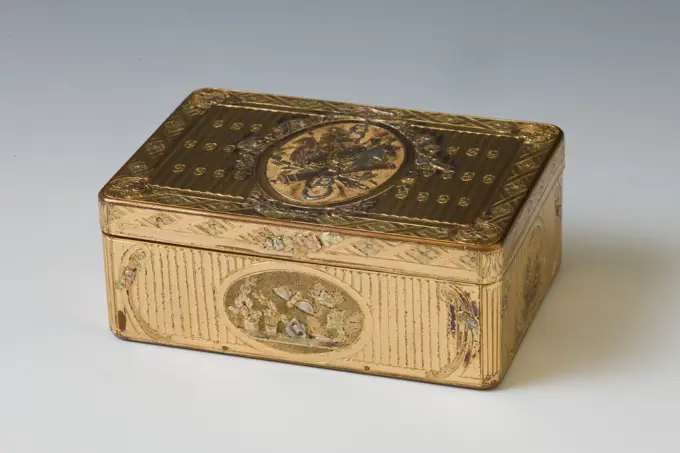
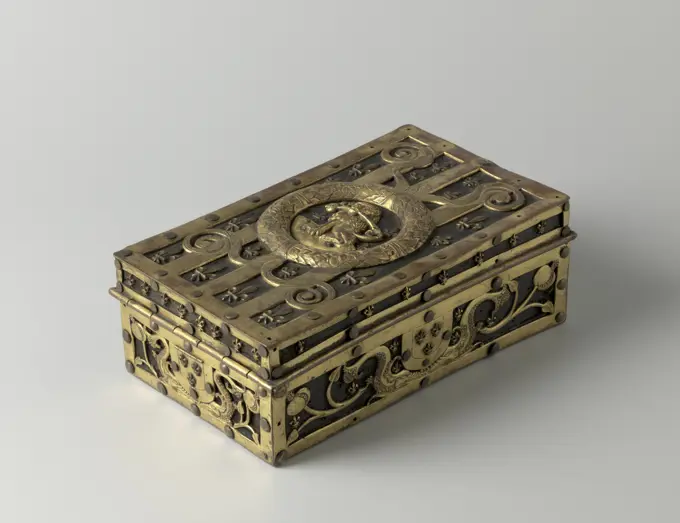
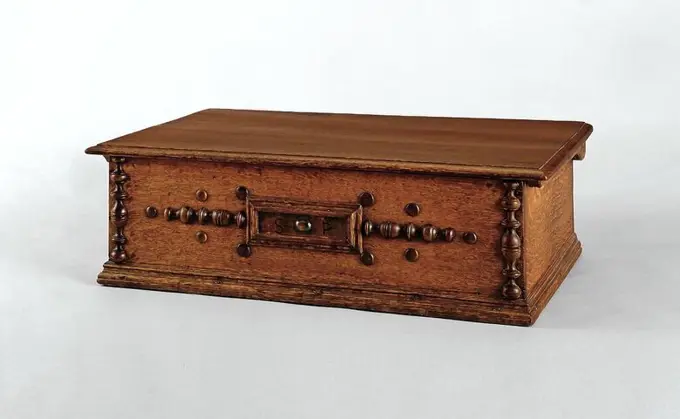
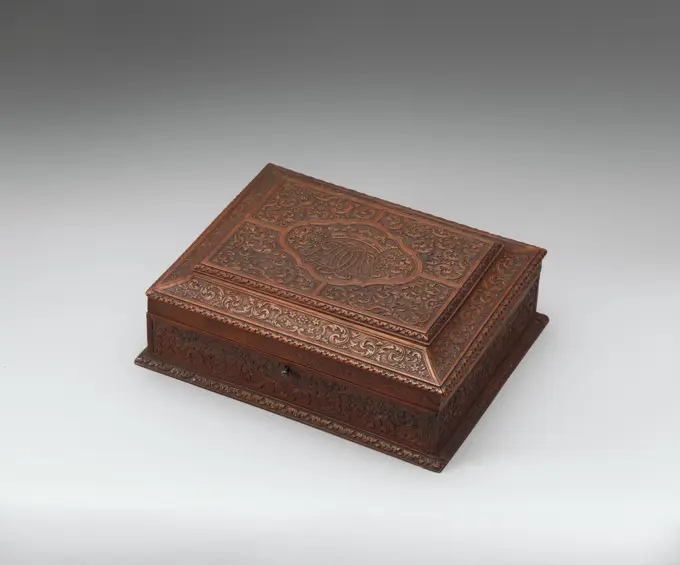
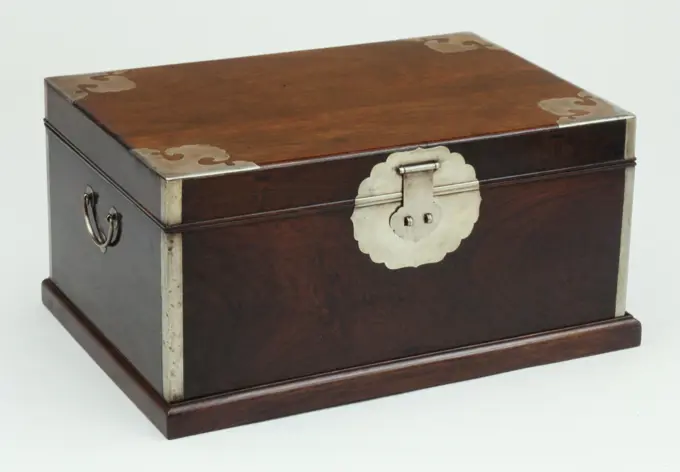
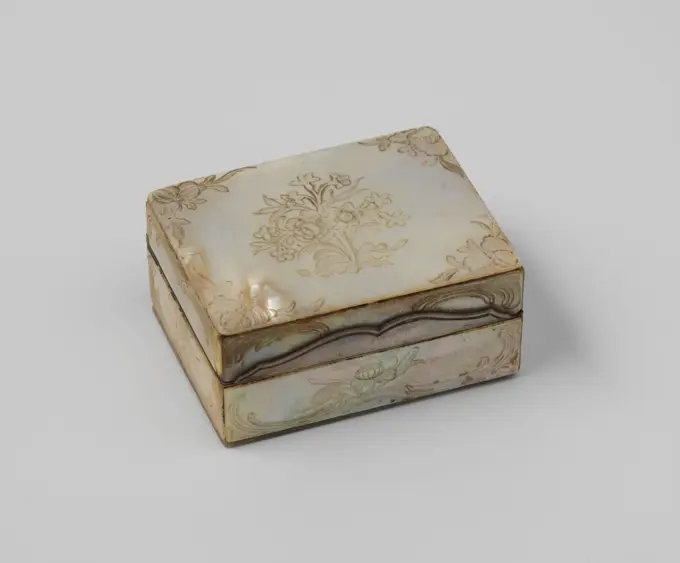
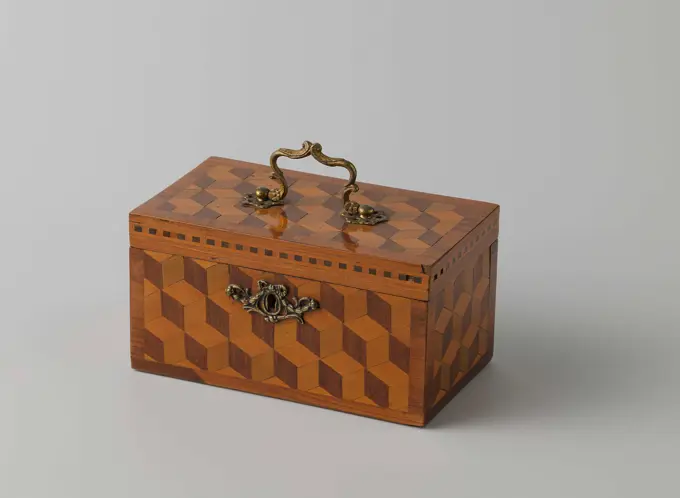
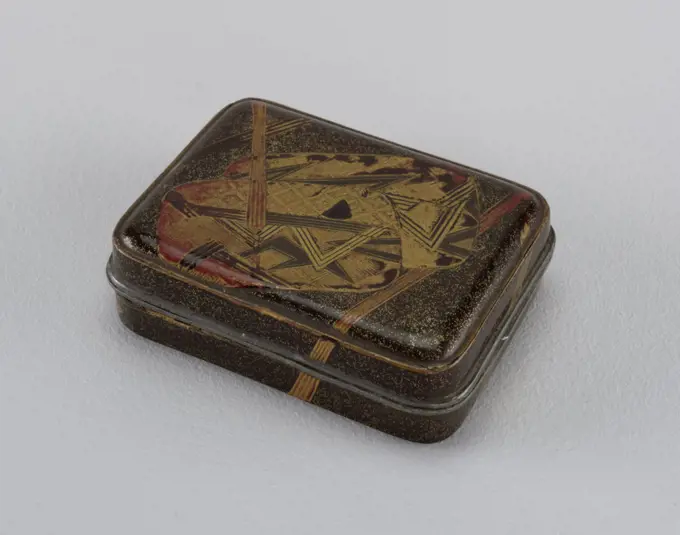
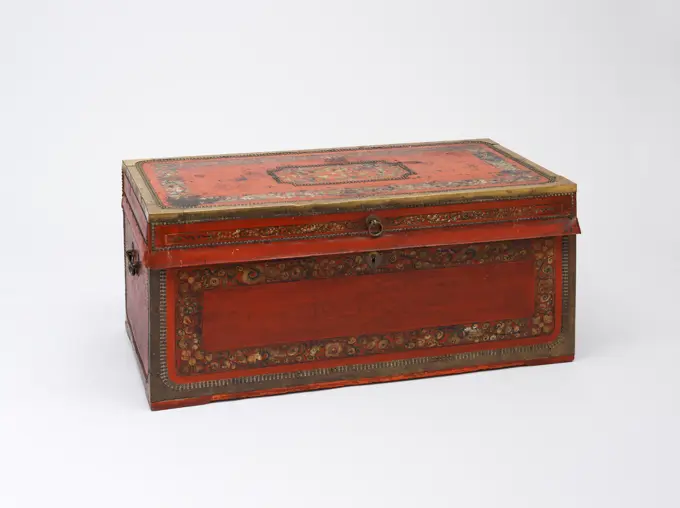
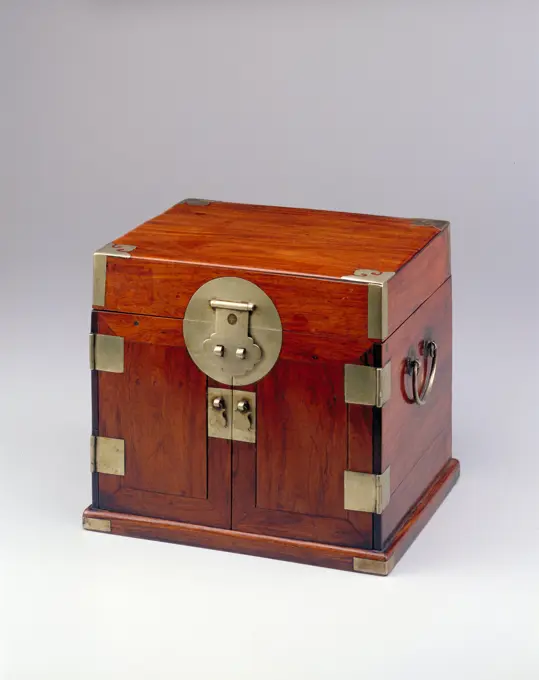
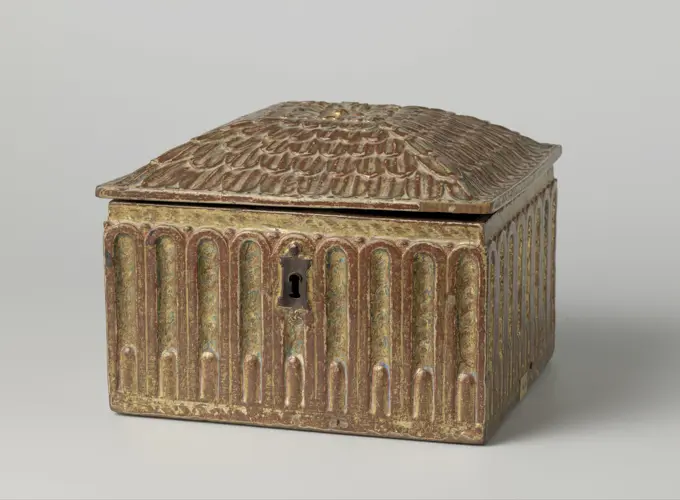
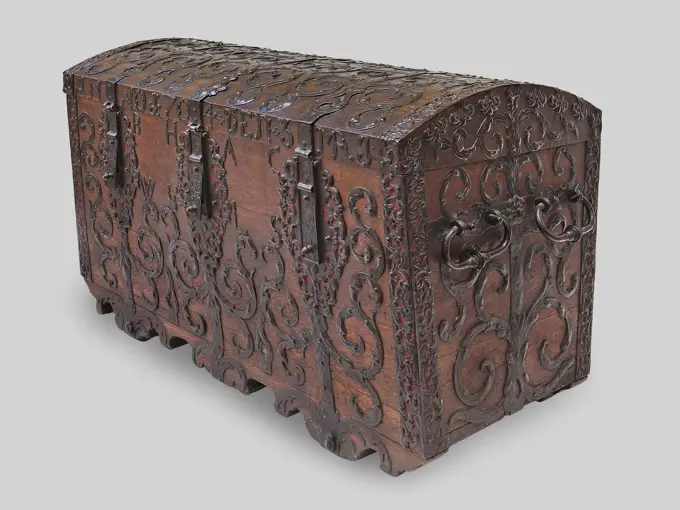
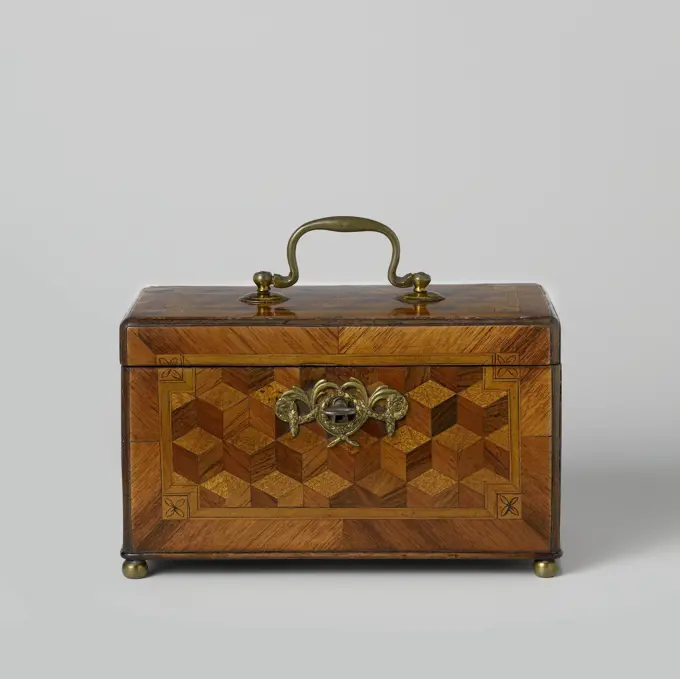
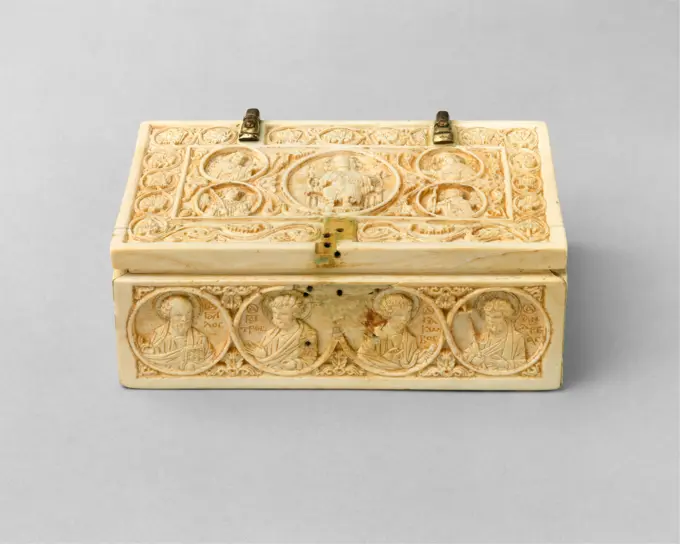
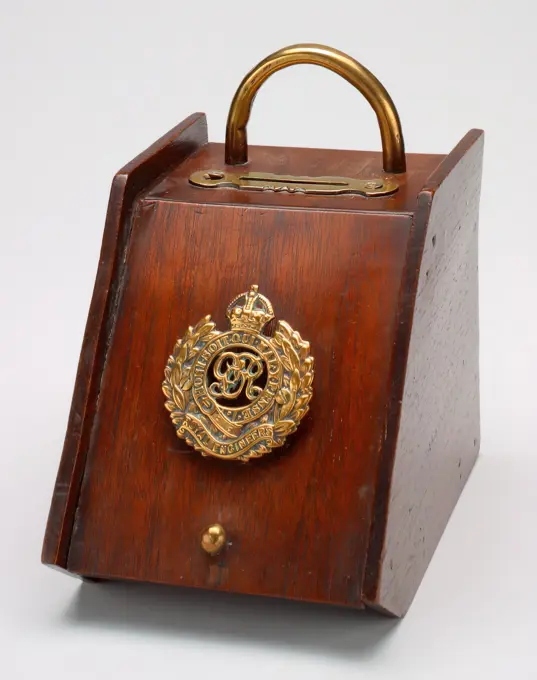
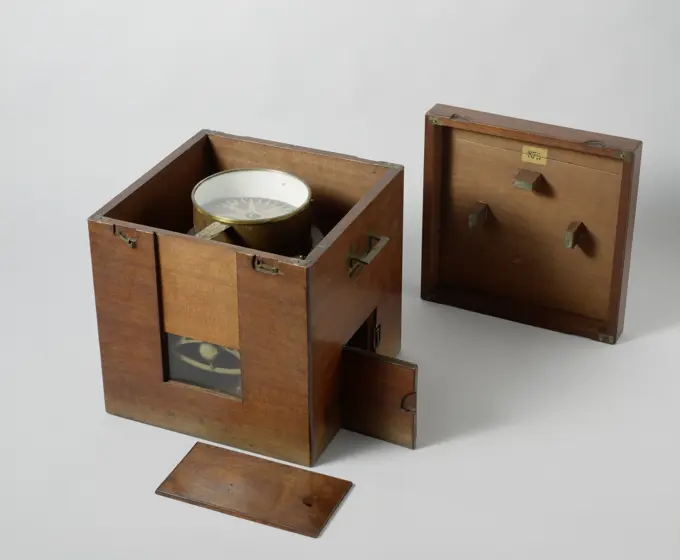
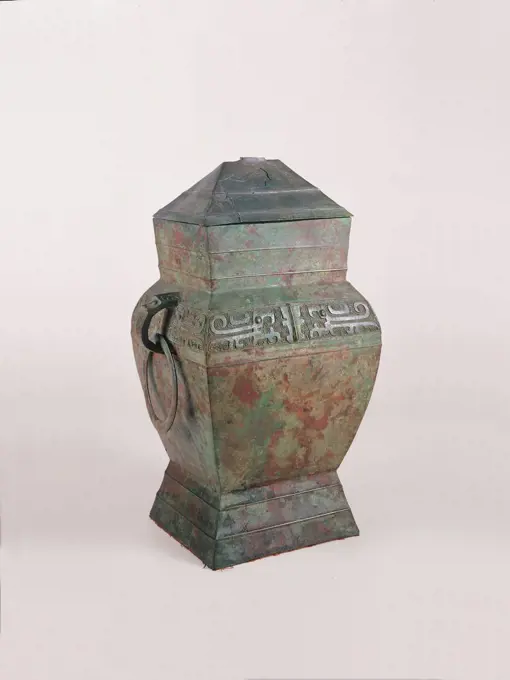
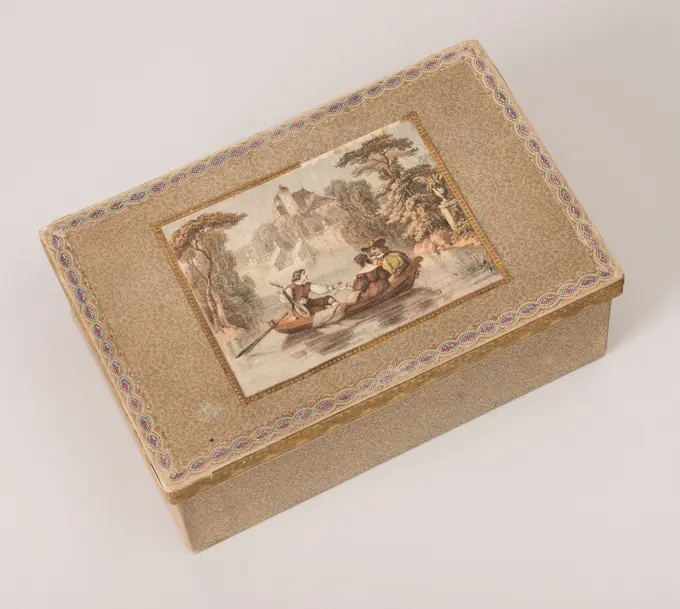
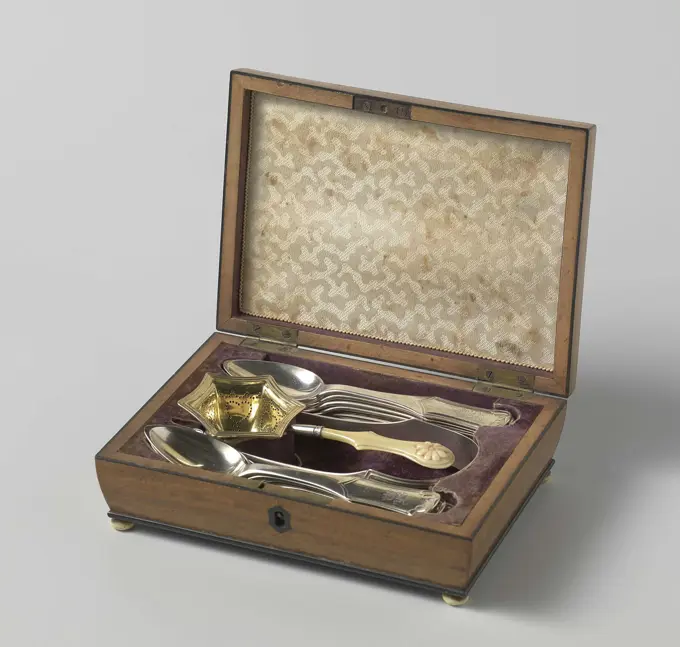
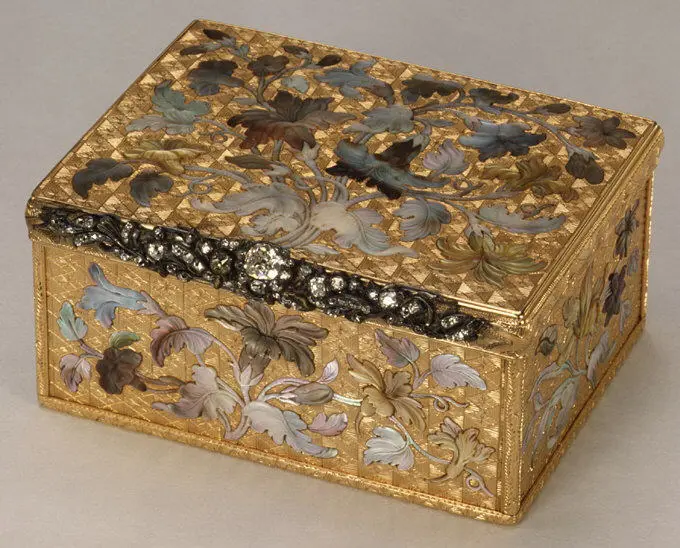
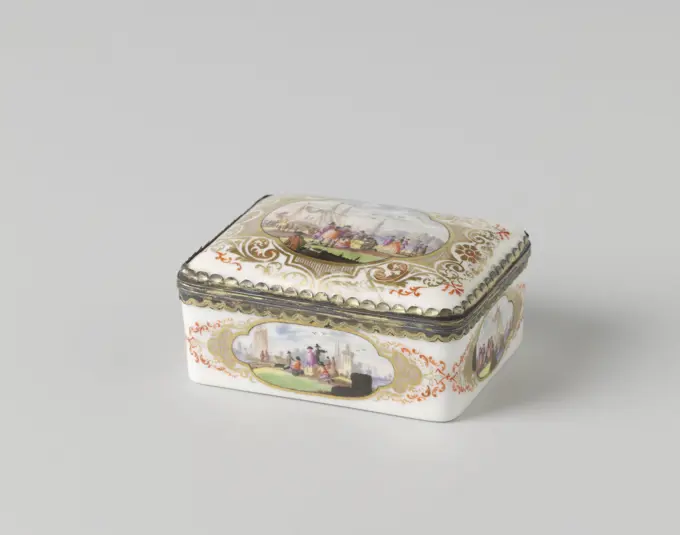
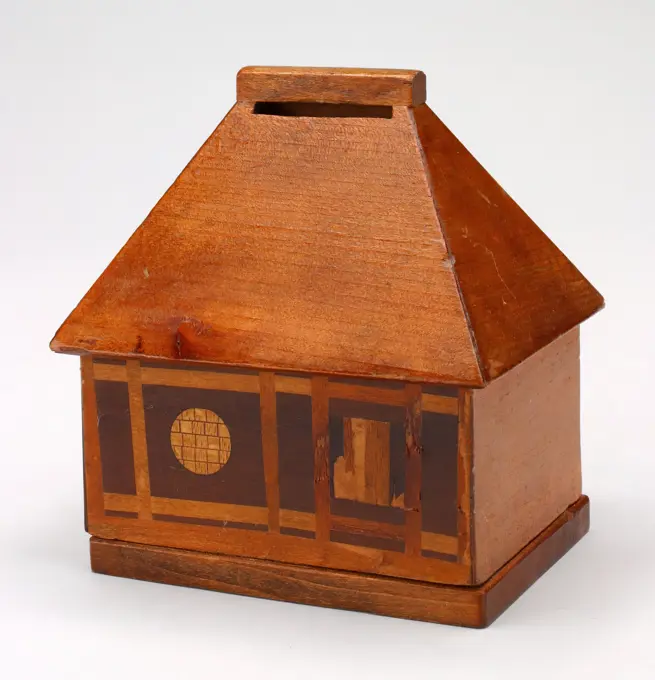
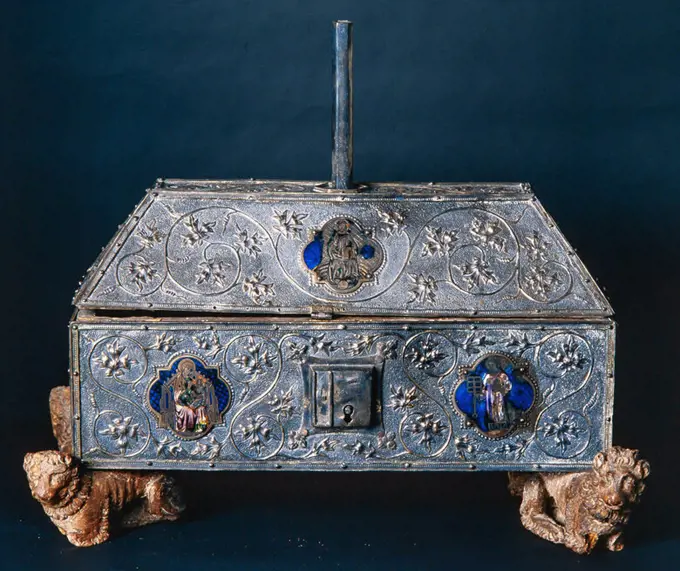
Médaillier with tokens with portraits of the French kings, Anonymous, 1715 chest. medal Chest, square, with red pressed and partially gilded leather exaggerated. In it 7 drawers with sixty -five tokens with the portraits of the French kings. A paper document in the lower drawer. A key belongs to the coffin. Paris oak (wood). leather. silver (metal)  Fleur-de-Lis ~ ornamentTabakierkaWooden box with copper frame., Anonymous, 1500 - 1525 Elongated square wooden box, mounted with heavily gilded copper tires, between which sheets. At the top between the Lelien tires, in the middle of a heavy bay leaf, within which a driven sitting lion with a grenade in the mouth. On the side grenade branches and dolphins, between which the weapon of France (three Lelien). At the front the weapon as a lock plate. It is opened when the lower nail is slid down.  wood (plant material). copper (metal) gilding Elongated square wooden box, mounted with heavily gilded copper tires, between which sheets. At the top between the Lelien tires, in the middle of a heavy bay leaf, within which a driven sitting lion with a grenade in the mouth. On the side grenade branches and dolphins, between which the weapon of France (three Lelien). At the front the weapon as a lock plate. It is opened when the lower nail is slid down.  wood (plant material). copper (metal) gildingOld chest isolated on the white backgroundBox, wood, tooled leather, gilded brass, rectangular wooden box, on oiutside covered with gold-tooled leather; sprigs of flowers on sides and surrounding raised central panel of cover, which in center bears coat-of-arms flanked by two quatrefoils, and in corners diapered scrolled cartouches - coat-of-arms: tierced in fess, 1 an eagle displayed, 2 a winged dragon, 3 three mullets on bend - surmouted by cardinal's hat - brass escutcheon, hasp, and two bail handles - inside lined with red undrressed leather., Italy, 18th century, containers, Decorative Arts, BoxMedicine box, anonymous, 1750 - 1800  Medicine box with partially inserted copper fittings, closed by a lid and two doors. Against the inside of the doors on the right a box subdivided into nine square boxes, including two drawers placed above each other; There is only one drawer in the left door. Behind the doors a compartment with eighteen square boxes including two drawers placed above each other. Entirely under one large drawer. Inscription; On the falls of the drawers: (Chinese characters). Dutch East Indies, The wood (plant material). mahogany (wood). copper (metal). ink forging / inlay (process)  Dutch East Indies, TheBox. Culture: American. Dimensions: 9 x 29 1/2 x 17 1/4 in. (22.9 x 74.9 x 43.8 cm). Date: 1680-1700.Only a small minority of seventeenth-century boxes were decorated with applied ornament rather than carving. The decorative elements on this box are related to an unidentified school of craftsmanship that was active in northern Essex County during the 1680s and 1690s. The box bears the initials "SP"-- presumably those of its first owner. Museum: Metropolitan Museum of Art, New York, USA.Chest of wood, c. 1760 Belonging to 29 magic lantern pictures in wooden frame with (five) round glass plates used for magic lantern.  wood (plant material). copper alloy Belonging to 29 magic lantern pictures in wooden frame with (five) round glass plates used for magic lantern.  wood (plant material). copper alloyBox of cardboard covered with blue marble paper, in which a pattern is cut out on the lid; A birth cushion was stored in the box, anonymous, c. 1750 Box of cardboard, covered with blue marble paper. On the lid this is stuck on yellow paper, that as lists and in the middle, where the marble paper is cut out like a heart and palmet motif. A birth cushion was stored in the box. Netherlands Completely: Cardboard. whole: Paper marbled paper Box of cardboard, covered with blue marble paper. On the lid this is stuck on yellow paper, that as lists and in the middle, where the marble paper is cut out like a heart and palmet motif. A birth cushion was stored in the box. Netherlands Completely: Cardboard. whole: Paper marbled paperJewellery Casket, anonymous, 1740 Jewelry box with bombarded lid and covered with green and yellow parchment in which gilded pressed ornaments. In the inside covered with velvet and silk. On the lid the year 1740. Netherlands (possibly) wood (plant material). parchment (animal material). leather. velvet (fabric weave). silk Jewelry box with bombarded lid and covered with green and yellow parchment in which gilded pressed ornaments. In the inside covered with velvet and silk. On the lid the year 1740. Netherlands (possibly) wood (plant material). parchment (animal material). leather. velvet (fabric weave). silkBox (part of a set) early 18th century French, Lorraine The use of dressing-table sets made of bois de Sainte Lucie was stimulated by Louis XIVs sumptuary edicts of 1689 and 1709, which caused much French silver to be melted down. Named for the patron saint of the Lorraine region, this type of cherry or dense fruitwood from a forest near Nancy was appreciated for its reddish brown color and its pleasant smell reminiscent of cinnamon. It lent itself beautifully to carving, showing intricate patterns that resemble goldsmith work.. Box (part of a set) 202720Clothes Trunk, c. 1650, 15 7/8 x 32 1/2 x 23 1/8 in. (40.32 x 82.55 x 58.74 cm), Huang-hua-li hardwood and paktung hardware, China, 17th century, Although once quite common, very few hardwood storage trunks have survived intact. Given its size, this one was likely used to store articles of clothing and was kept in residential quarters, especially the bedrooms of upper class households.Jewellery Casket. Lined with green and yellow parchment and decorated with gilded ornaments, this wooden jewellery casket is dated 1740. Inside are various compartments, including recesses especially for rings. On the side of the casket are two secret’ drawers. The box’s format made it particularlysuitable for travel.Smoking Stand (Tabako-Bon), wood, lacquer, gold, silver, brass, Rectangular black, gold and red lacquered box (a) with hinged, rectangular silver handle; rectangular domed cover (b) of pierced and molded silver, depicting two flying cranes among pine trees, small loop handle in form of branch at top; deep, rectangular brass tray under cover, set into top of box. Four drawers (d/g) in front of box; one drawer (h) in right side. Continuous lacquer decoration around box showing loaded boat floating on waves, floating dingy, cranes with red crests flying among clouds over water and pine branches. Drawer pulls in wave motifs, hinged pipe hooks on left and right front, and corner guards at base, all of incised silver., Japan, 19th century, containers, Decorative Arts, box, boxMake -up box, rectangular, covered with mother -of -pearl, anonymous, c. 1750 - c. 1770 A make -up box from outside with mother -of -pearl and covered with silver inside. Flowers and leaves are engraved in the mother -of -pearl. In the inside there are a silver spoon and a mirror in two closed compartments with mother -of -pearl lids. Paris mother of pearl. silver (metal) A make -up box from outside with mother -of -pearl and covered with silver inside. Flowers and leaves are engraved in the mother -of -pearl. In the inside there are a silver spoon and a mirror in two closed compartments with mother -of -pearl lids. Paris mother of pearl. silver (metal)Tea box with marquetery. Teahouse artist of oak, glued with marquetery in roses, amaranth and satin, green-deported maple and black pickled wood, with a decor of stacked cubes. Interior divided into three. Handle of gold-plated buyer. With corresponding key.Box with cover, lacquered wood, pewter, Japan, 1875-1900, Decorative Arts, Box with coverBox in the form of two connected windows, anonymous, c. 1750 - c. 1799 Box with lid with black lacquer and decors in gold lacquer. The box has the shape of two overlapping windows and stands on a wide base. The lid falls over the box and completely covers the sides. A leaf fits on the top edge of the box. The top of the lid is painted with water landscapes, the leaf and the side of the lid of flower branches. The walls of the box and the inside of the box and lid in Nashiji. Japan wood (plant material). lacquer (coating). lacquering Box with lid with black lacquer and decors in gold lacquer. The box has the shape of two overlapping windows and stands on a wide base. The lid falls over the box and completely covers the sides. A leaf fits on the top edge of the box. The top of the lid is painted with water landscapes, the leaf and the side of the lid of flower branches. The walls of the box and the inside of the box and lid in Nashiji. Japan wood (plant material). lacquer (coating). lacqCamphorwood Trunk (Baúl de alcánfor). Unidentified artist. China, made for export market, including Latin America, first half of the 19th century. Furnishings; Furniture. Leather, camphorwood, brass, polychromeSeal chest, 17th century, 8 3/4 x 10 1/8 x 8 3/4 in. (22.23 x 25.72 x 22.23 cm), Huang hua-li, silver, China, 17th centurySnuffbox 1754/55 Jean Ducrollay In eighteenth-century Europe, Paris led the production of high-quality luxury goods. Parisian goldsmiths made a wide range of small, personal articles such as snuffboxes; étuis to hold sealing wax, tweezers, or utensils for sewing; souvenirs, which contained thin ivory tablets for note taking; and shuttles for knotting lace. Gold snuffboxes and boxes decorated with portrait miniatures were prized and frequently given as royal gifts, often to ambassadors or members of the court in lieu of cash payments for their services. Coveted and admired, these boxes were produced from a variety of materials. The best were skillfully made of gold and embellished with diamonds, enameled decoration, lacquer, and other luxurious materials. By the middle of the century, the taking of snuff had become an entrenched social ritual, and the snuffbox, too, had become an important social prop. Snuffboxes were considered highly fashionable accessories, with some merchants advertSnuffbox 1755-56 Jean Frémin French. Snuffbox 461204Box with floral scrolls, late 19th early - 20th century, Unknown Korean, 7 1/16 × 7 1/2 × 14 in. (17.94 × 19.05 × 35.56 cm), Black lacquered wood with mother-of-pearl inlay and brass wire, Korea, 19th-20th century, Lacquer boxes from the late Joseon period are frequently decorated with floral scrolls like those seen here. The petals and leaves are made of mother-of-pearl inlaid on the black lacquer ground, while the graceful, curvilinear stems are made of twisted wire.Suitcase with bombed lid. Suitcase with bombed lid. Proposed with pressed and gilt leather. Decorated with a Lord and a lady on the lid. On the front scene with hunting for a hare. With batter and handle of copper.Case. 28 Dominoes, with the image of a figure on every stone. Depicted are the four temperaments, male, female figures, narrowing and other allegorical figures. A sorting of the stones in numerical order does not give the order of aforementioned groups figures. The stones are in a wooden box with hinged lid. The box is on four round legs buttons. The inside of the box is covered with marbled paper.Snuffbox ca. 1760 German, Meissen The box is closely related in both exterior and interior decoration to one in the Kunstindustrimuseum, Copenhagen, and the paintings, although different in subject, appear to be by the same hand. A German mother-of-pearl and ivory box of about 1750 at Waddesdon Manor, Buckinghamshire, is painted inside the lid with an allegorical scene of similar character, also possibly by the same artist. The originals of the two allegorical scenes, which stylistically point to a single painter, are unidentified.. Snuffbox 460479Box of wood with four small boxes in the inside in which fish (chips) of leg. Box of wood with four small boxes in the inside in which fish fishes. The woodwork is painted red on the outside and covered with gold ornaments: figures in parchment cut out in Louis Xive style.Box for Personal Accessories (Tebako) with Decoration Based on a Poem from the Shinkokinshū ca. 1633 Kōami Chōjū (Nagashige). Box for Personal Accessories (Tebako) with Decoration Based on a Poem from the Shinkokinshū 40472Sake container with design of ducks, 17th-18th century, Unknown Japanese, 8 3/4 × 11 7/8 × 3 1/8 in. (22.23 × 30.16 × 7.94 cm), Black lacquer with sprinkled gold and silver, Japan, 17th-18th centuryLakkast, anonymous, c. 1700 Small red lacquer, inlaid with mother -of -pearl. China (possibly) lacquer (coating). mother of pearl Small red lacquer, inlaid with mother -of -pearl. China (possibly) lacquer (coating). mother of pearlred and luxurious treasure chest isolated on white backgroundCasket or Portable Altar with the Crucifixion, Standing Saints, and Christ in Majesty with Symbols of the Evangelists. Culture: North German or Danish. Dimensions: Overall: 4 x 7 7/8 x 5 1/2 in. (10.2 x 20 x 13.9 cm). Date: ca. 1100-1150.Several related caskets functioned as cross bases with sockets for accommodating a crucifix. This example may have originally served the same purpose, but it was perhaps later adapted as a portable altar. Museum: Metropolitan Museum of Art, New York, USA.Box (one of a pair) (part of a set) 1766/67 John Parker British These boxes were part of a toilet service sold by the leading London retailers Parker and Wakelin to John Heathcote, who, a few years earlier, had married the heiress Lydia Moyer. Parker and Wakelins accounts for the sale show that the service included eight such boxes, a pair of candlesticks, two "essence pots," a looking glass, a "jewells trunk," and a pair of octagonal pierced trays. The cost for gilding the service was more than £56—roughly equal to the annual wage of a successful artisan—and the entire bill came to more than £300. There was a further charge of £6 6s for a "red morocco leather case with a drawer & 2 cushions.". Box (one of a pair) (part of a set) 236588Turtle box inlaid with engraved silver, decorated with a monogram and weapons, anonymous, c. 1700 - c. 1800 Turtle box inlaid with engraved silver: monogram C or/and D, K and L, and two weapons within symmetrical acanthus drinks. Rectangular model with curved lid. Silver lock, hinges and nails. Lining of light red moiré side. Netherlands (possibly) whole:. Insert work: Silver (Metal). Lining: Silk. nails: copper (metal) Turtle box inlaid with engraved silver: monogram C or/and D, K and L, and two weapons within symmetrical acanthus drinks. Rectangular model with curved lid. Silver lock, hinges and nails. Lining of light red moiré side. Netherlands (possibly) whole:. Insert work: Silver (Metal). Lining: Silk. nails: copper (metal)Suitcase of black wood with history of Joseph. Suitcase of black wood, decorated with Niello's, representing the history of Joseph.Table, 14th-17th century, 5 1/2 x 6 1/16 x 3 3/4 in. (13.97 x 15.4 x 9.53 cm), Glazed earthenware, China, 14th-17th centuryBox of bridal shoes, Manfield (Possibly), in or after 1900 White cardboard box with lid stating: "Shoes 1890, bridal shoes 1890, white satin, velvet, embroidered shoes embroidered by a friend as marry. Gift". maker: England (possibly)maker: Netherlands (possibly) cardboard White cardboard box with lid stating: "Shoes 1890, bridal shoes 1890, white satin, velvet, embroidered shoes embroidered by a friend as marry. Gift". maker: England (possibly)maker: Netherlands (possibly) cardboardCoffin with carved decorations. Casket of ebony with a drawer at the bottom. Decorated in high relief with flowers to thin stems and a rosette on the lid in the middle. Lock plate with key and rosettes on the corners and on the copper lid.Box 1850-80 Japan. Box 57770Chest with arched lid, decorated with cannelures, anonymous, c. 1400 - c. 1500 Chest, square, with arched lid and decorated on four sides with cannelures that are filled up to one third. On the lid cut from over each other lying leaf work. The whole is gilded on red surface and painted in several places in blue, red and white. The box is painted red inside, the lid heavily gilded with multicolored painting with the letters IHS in praise. The soil is attached to the raised sides with four hooks. Venice walnut (hardwood). paint (coating). chalk. gilding (material) gilding Chest, square, with arched lid and decorated on four sides with cannelures that are filled up to one third. On the lid cut from over each other lying leaf work. The whole is gilded on red surface and painted in several places in blue, red and white. The box is painted red inside, the lid heavily gilded with multicolored painting with the letters IHS in praise. The soil is attached to the raised sides with four hooks. VeTrunk;  1. W. 18th century (1701-00-00-1725-00-00);Baroque (style), monograms, fantastic characters, plant decoration, acanthus wrappingTheekist puts marquetry, Anonymous, 1775 - 1800 Tea player of oak, glued with marqueterie in nut, rose, maple, green stained maple and rosewood, with a decor of stacked cubes. Bol feet of copper and a handle of gilded copper. Netherlands oak (wood). walnut (hardwood). rosewood (wood). maple (wood). rosewood (wood). copper (metal). gilding (material). stain (coating) gilding Tea player of oak, glued with marqueterie in nut, rose, maple, green stained maple and rosewood, with a decor of stacked cubes. Bol feet of copper and a handle of gilded copper. Netherlands oak (wood). walnut (hardwood). rosewood (wood). maple (wood). rosewood (wood). copper (metal). gilding (material). stain (coating) gilding. Black lacquer with boulders lid.Embossing on antique wooden box, Jodhpur, Rajasthan, India Copyright: xSafatxAli/DinodiaxPhotoxAcme Safe' still bank, c. 1890, 5 9/16 x 4 1/4 x 3 9/16 in. (14.13 x 10.8 x 9.05 cm), Tin, pigment, United States, 19th centuryReliquary Casket with the Deesis, Archangels, and the Twelve Apostles 950-1000 Byzantine On the lid of the casket is a Deesis composition showing Christ enthroned in majesty, flanked by the Virgin, John the Forerunner (the Baptist), and archangels. Roundels containing portraits of saints, identified by carefully carved Greek inscriptions, decorate the sides of the casket. Listen to experts illuminate this artwork's story Listen Play or pause #2720. Reliquary Casket with the Deesis, Archangels, and the Twelve Apostles Supported by Bloomberg Philanthropies We're sorry, the transcript for this audio track is not available at this time. We are working to make it available as soon as possible.. Reliquary Casket with the Deesis, Archangels, and the Twelve Apostles. Byzantine. 950-1000. Ivory, with gilt-copper alloy mounts. Made in probablly in Constantinople. IvoriesTabakierka Miśnia (Meissen)James Dwyer, Wooden Chest, c 1939 Wooden ChestSaving Bank' still bank, c. 1904, Kenton Hardware Manufacturing Co., Kenton, Ohio, 1890-1950, 4 1/4 x 3 5/16 x 3 1/4 in. (10.8 x 8.41 x 8.26 cm), Iron, 19th-20th centuryCanister and stopper. Czechy, creatorRoyal Engineers (coal scuttle)' still bank, 20th century, 5 3/8 x 3 5/8 x 5 1/2 in. (13.65 x 9.21 x 13.97 cm), Wood, brass, England, 20th centuryShip Compass, Bramah & Sons, c. 1825 - c. 1829  Compass in a compass house. The glass has disappeared. The Cylindrian copper compartment boiler is weighted with a lead ring around it, which can be adjusted in height. The cardanus ring has been replaced by an unusual suspension: the entire boiler with weight rests on the compass, which balances with a ball on top of a rod in the bottom of the compass house; A spring has been applied to the rod, which absorbs vertical shocks. De Roos has a transparent mica center; The main and main intermediate areas are indicated and subdivided into eight on the paper outer edge. The compass house has a pendulum on the inside, which can be read as a clinometer by a viewing glass at the front. At the top, the pendulum has the Koerswijzer for the compass: Because the compass kettle is hung at a single point, it can turn and the course must be read from the pointer of the quadrant, which follows the pendulum movement of the boiler but does not turn. Two smFeng lei, bronze, cm 31 x 20 x 14Box; cardboard and paperTea box. Bayreuth, factoryPainted oak chest of the surgeon's guild, guild chest archive case casket cabinet furniture furniture interior design wood oak wood pine wood, Exterior painting in cartouche the good Samaritan coats of arms of the headmen and banner with latin text Inside of the lid also text. Two transfer locks; each operable with key, Weapons of the captains and underneath their names: G. v. Dvnen . Wingaert . Cocqvivs J. de Jonge Rotterdam Surgical guild gilde health care disease surgeon cosmas- and damian guild hang-and-latch masterpiece The guild chest is from the Surgeons Guild which probably had it made in 1660.Box with Landscape, 1800s. Japan, Edo period (1615-1868) to Meiji period (1868-1912). Lacquer with sprinkled gold; overall: 7.9 x 18.4 cm (3 1/8 x 7 1/4 in.).Writing Box with Design of the Tatsuta River 19th century Japan. Writing Box with Design of the Tatsuta River 58131Box of Four Trays with Design of Paulownia Crest Japan 18th centurystorage box, gold, jewelry, gold jewelry, isolated on white background, side view. Wooden boxThe Fieschi Morgan Staurotheke. Culture: Byzantine. Dimensions: Overall (with lid): 1 1/16 x 4 1/16 x 2 13/16 in. (2.7 x 10.3 x 7.1 cm)lid only: 2 13/16 x 3 7/8 x 1/8 in. (7.1 x 9.8 x 0.3 cm)vessel only: 7/8 x 2 15/16 x 4 in. (2.2 x 7.5 x 10.1 cm). Date: early 9th century.Elaborately worked in cloisonné enamel, the lid of this box displays Christ on the cross wearing the colobium (sleeveless or short-sleeve tunic) associated with early images of the Crucifixion. Christ stands erect, his eyes wide open. His posture, the sun and the moon on either side of his head, and the flowers growing at the base of the cross express Christ's triumph over death. Beside him the Virgin and John the Theologian raise their hands to their faces in a gesture of mourning. Twenty-seven busts of saints appear on the lid and sides of the box. Worked in niello on the undersurface of the lid are four scenes from the life of Christ--the Annunciation, the Nativity, the Crucifixion, and the Anastasis (Descent inTobacco box 18th century Giese. Tobacco box 205399Desk, Cedar (), brass, silk, velvet, printed cotton, block-printed lining paper, glass, metallic gold braid, Rectangular box with inlaid, rounded brass corner edgings, bandings, and foliate ornaments, lock, and handles at either end, fitted flush: hinged lid into which is fitted accordion folder, cardboard covered with beige and white tea-chest paper, cotton with exotic bird pattern. Interior face of lid covered in bright blue woven-patterned silk with edging and central oval of metallic gold braid. Bottom of box has fitted compartments for writing equipment and hinged fall-front writing surface covered with maroon velvet, edged with ebonized wood., China, 1850-1900, furniture, Decorative Arts, DeskChest;  PO .XVIII century (1745-00-00-1760-00-00);Safe' still bank, 1879-1898, Kyser & Rex Company, Philadelphia, c. 1879-1898, 3 3/8 x 2 1/2 x 2 1/4 in. (8.57 x 6.35 x 5.72 cm), Iron, United States, 19th centurywooden chest isolated on white. The rectangular, satin-fired box has a hinged lid. He rests on four ivory, bolted bolballs and is arranged around the keyhole and along the edges with ebony. In the middle of the lid there is a silver shield, engraved with the letters axle under a crown, mounted. The hinges and the lock are made of brass. The cardboard interior of the box is covered with purple velvet; The inside of the lid with white silk damest.Snuffbox third quarter 18th century Probably by Daniel Baudesson. Snuffbox 193907Snuif box, multi -colored painted with harbor faces and on the inside of the lid a faun that a woman spies, Meissener Porzellan Manufaktur (Falsification of), c. 1850 - in or before 1878  Rectangular snuff box made of painted porcelain. The box is painted on the outside with port faces inside four passes. On the inside of the lid is a faun that spies a sleeping woman. The lid is connected to the box by a gilt silver frame. The box is not marked. The snuff box is made to a Meissen example from around 1735. Float Porcelain. frame: Silver (Metal) gildingLepeldoos, anonymous, c. 1800 - c. 1900 Spoon box of turtle, rectangular, corrugated front and back. Bol valve cover. Four ivory Bolpoten.  . Spoon box of turtle, rectangular, corrugated front and back. Bol valve cover. Four ivory Bolpoten.  .Teahouse' still bank, early 20th century, 3 3/4 x 3 1/16 x 2 5/16 in. (9.53 x 7.78 x 5.87 cm), Wood, pigment, 20th centuryold suitcase close-up isolated on a white backgroundTacaSeal Box with Hunters on Horseback. Culture: Japan (Ryukyu Islands). Dimensions: H. 4 3/8 in. (11.1 cm); W. 6 1/8 in. (15.6 cm); L. 6 1/8 in. (15.6 cm). Date: 17th-18th century.The style of clothing worn by the three equestrian figures on the top of this box identifies them as Mongols, a people who ruled over their vast empire from a capital at Dadu (present-day Beijing) in the thirteenth and fourteenth centuries. The representations of Mongols hunting and the decorative motifs on the sides of this box were once outlined with powdered gold that was sprinkled onto the lacquer base; such a technique was also used in China. Museum: Metropolitan Museum of Art, New York, USA.Indian style wooden jewellery box isolated on whiteBox with seven shell fuses. Small wooden box with seven garnet tubes for point grenades. Three tubes are double, once very, once half of a long-sliced tube. These three couples propose the following tubes: the Field Service Time-Fuse (Armstrong Tube Type E), the Field Service Time and Concuse-Fuse (Armstrong Tube Type F) and the Armstrong Plain Field Service ConcusST-Fuse. The seventh tube, without thread, is the field service concussion fuse (Armstrong tube type C), which could be used in combination with type E.Incense Box in Three Compartments mid-19th century Japan. Incense Box in Three Compartments 57708Box Containing Forty-Four Samples of Wood from Surinam, anonymous, c. 1800 - c. 1858  Rectangular box with forty wood samples: 1. Groenhart (Nectandra Rodiaei) 2. Bijlhout (Walaba, Eperua Spec.) 3. Purperhart (Peltogyne Spec.) 4. Bolletrie (Manilkara Surinamensis) 5. Peto (Mora, Dimorphandra Excelsa) 6 . Manbarkklak (Eschweilera Longipes) 7. Matakkie (Symphonia Globulifera) 8. Matakkie (Symphonia Globulifera) 9. Locus (Hymenaea Courbaril) 10. Kabbis (Andira Spec.) 11. Cedar (not the same) 12. Copy 13 13 13 13 13 . Wane (Ocotea Rubra) 14. KRAPA (Carapa Guyanensis) 15. Kankantrie (Ceiba Pentandra) 16. Wane (Ocotea Rubra) 17. Hoepelboom (Copaifera Guyanensis) 18. Kwatta-Pattoe (not identified) 19. Takroeba (not identified) 20. Bastaard Bolletrie (Mérie, Humiria Floribunda) 21. Matakkie (Symphonia Globulifera) 22. Tapuripa (Genipa Americana or Gustavia Spec.) 23. Negro Wantem (not identified) 24. Mira -Hudu (Escheilaisisisa Longipes) 26. Marsheldoze (Genipa Méreanance of Genipa Edulis) 27.Miniature stew of multicolored painted Faïence, Anonymous, c. 1725 - c. 1760 Square stew multicolour painted with an oriental decor of birds and flowers. Delft . Square stew multicolour painted with an oriental decor of birds and flowers. Delft .Box, c. 1730. Germany, 18th century. Enamel; overall: 2.9 x 7.5 x 5.5 cm (1 1/8 x 2 15/16 x 2 3/16 in.).Arqueta relicario, siglo XIV. Museo Episcopal de Vic.Old money boxNouveaux Contes de Fées (New Fairy Tales). Joseph Cornell; American, 1903-1972. Date: 1948. Dimensions: 12 5/8 × 10 1/4 × 5 7/8 in. Box construction. Origin: United States. Museum: The Chicago Art Institute, Chicago, USA.Brass design fitting on antique wooden pen box, Jodhpur, Rajasthan, India Copyright: xSafatxAli/DinodiaxPhotoxPortfolio of J.R. Thorbecke, Anonymous, 1800 - 1900  Foldable portfolio of red, processed leather. Inside light brown leather with two compartments lined with marble paper. Pointed lip closure.  leather. paper sewingVanity Case (Nécessaire), c. 1760-65. Manner of James Barbot (British). Gold, agate, interior fitted with implements; overall: 7.9 x 6.4 x 5.1 cm (3 1/8 x 2 1/2 x 2 in.).Trunk' still bank, c. 1890, Piaget, United States, 2 5/8 x 3 5/8 x 2 1/8 in. (6.67 x 9.21 x 5.4 cm), Metal, pigment, 19th centuryThe leather book The leather book on a white background Copyright: xZoonar.com/SergiixSvyerchkovx 5884186Box of Perry Pen Nibs. Manufacturer: Josiah Mason. Card box with lid, pen nib mounted on top with gold foil surround containing 50 pen nibsLion (base), 1662-1722. China, Qing dynasty (1644-1911), Kangxi reign (1661-1722). Porcelain with overglaze enamel decoration; overall: 45.2 cm (17 13/16 in.). This porcelain lion is a pair with 1930.642. This lion holding a ball is considered male, while the nurturing female is depicted with a cub. Guardian lions were traditionally placed in front of buildings to protect from harmful spiritual or human forces.Brass design fitting on antique wooden letter holder box, Jodhpur, Rajasthan, India Copyright: xSafatxAli/DinodiaxPhotoxKey (France), ca. 1890; Made by Unknown; metalIndian style wooden jewellery box isolated on whiteOld closet locked retro vintage leather suitcase on whiteDado (France); block-printed on handmade paper; 120.5 x 46.5 cm (47 7/16 x 18 5/16 in.)Box for rouge and patches. Culture: British, London. Dimensions: Overall: 1 × 2 1/8 × 1 5/8 in. (2.5 × 5.4 × 4.1 cm). Date: ca. 1750-55.Resembling a snuffbox but smaller in size, this boîte à mouches contains two closed compartments--one to hold rouge and the other for black taffeta patches. A tiny brush and mirror were placed in the larger compartment. The fashion for beauty products such as rouge and patches was widespread in eighteenth-century French court circles. This dainty box may have been sold in Paris in one of the magasins anglais where English luxury goods were available. Museum: Metropolitan Museum of Art, New York, USA.Brass design fitting on antique wooden box, Jodhpur, Rajasthan, India Copyright: xSafatxAli/DinodiaxPhotoxPudze  19th/20th century (1890-00-00-1950-00-00);gift (provenance), boxAzimuth Compass in Wooden Box. Azimuth compass in a wooden box. The compass has a fixed monitoring device. The eyepiece of this consists of a prismatic visor to read the rose, combined with a slit visor with a black and green blackout glass; The wire visor on the other side is equipped with a tilting black mirror. The boiler is weighted with a lead weight below. With two mechanics in the boiler, the rose can be fixed: one is a lever with a ring around the pen, which lifts the rose of the pen; The other is a feather being pushed against the edge of the rose.