Decorative Helmets

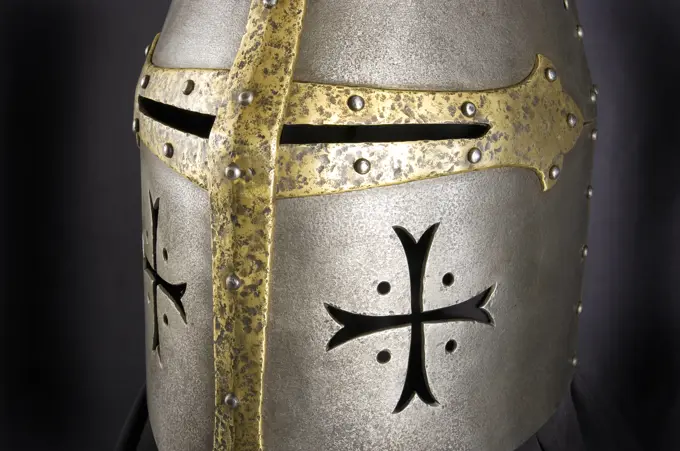
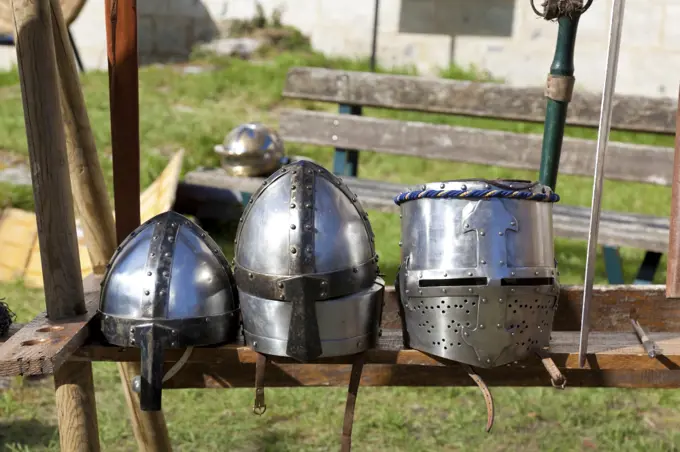
A selection of ornate historical helmets made of metal, showcasing craftsmanship from different cultures and periods, ideal for display.
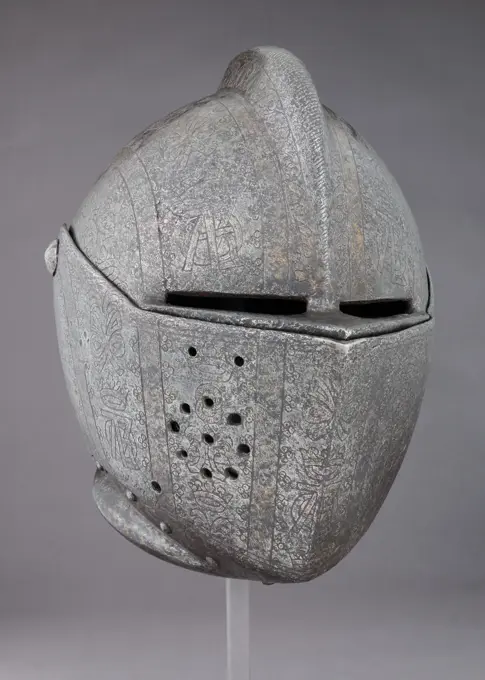
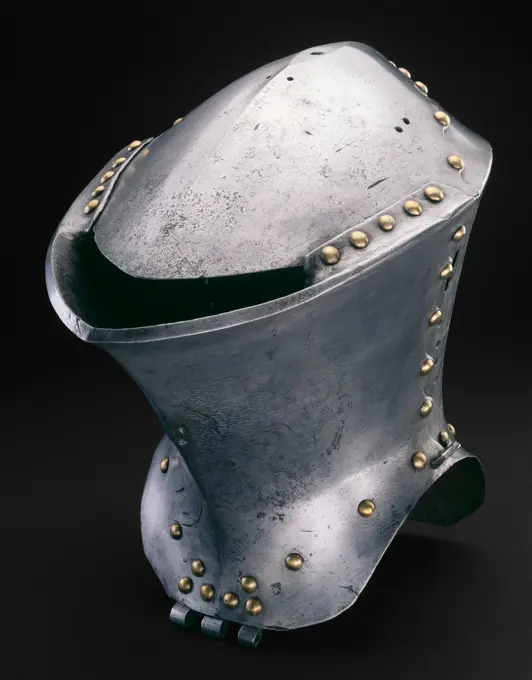
Close-Helmet for the Tournament on Foot ca. 1600-1610 Italian, Milan; or Spanish, Eugui The surfaces were originally blued, deeply engraved and punched, and damascened in gold; though worn with age, some of the original brilliant coloring is preserved beneath the overlapping plates. The ornament includes pairs of entwined rings, a triangle (or delta) with paired palm branches, and crowns surmounting a complex monogram (either the owner's name or device). The form, decorative technique, and ornamental vocabulary are Milanese, but the helmet might also have been made by Milanese armorers working in the Spanish royal workshop at Eugui.. Close-Helmet for the Tournament on Foot 26520
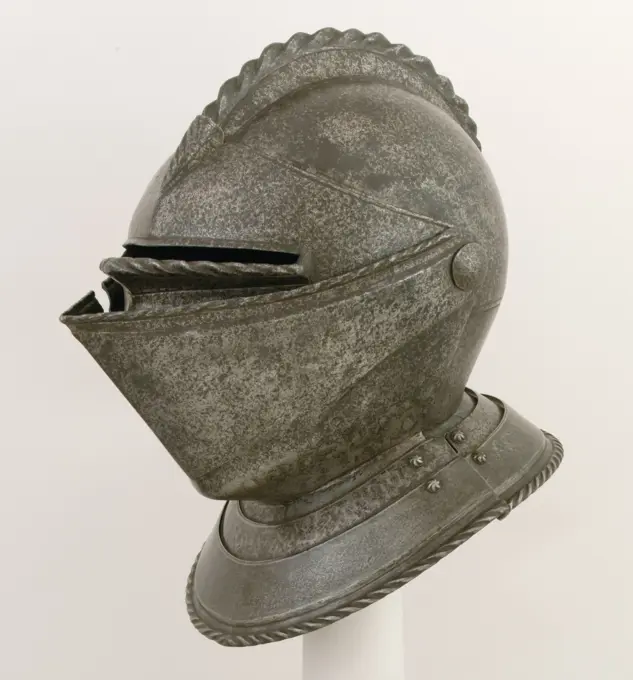
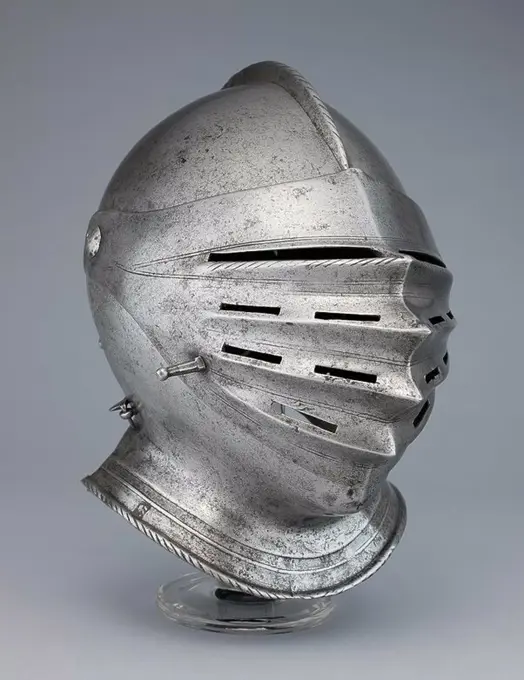
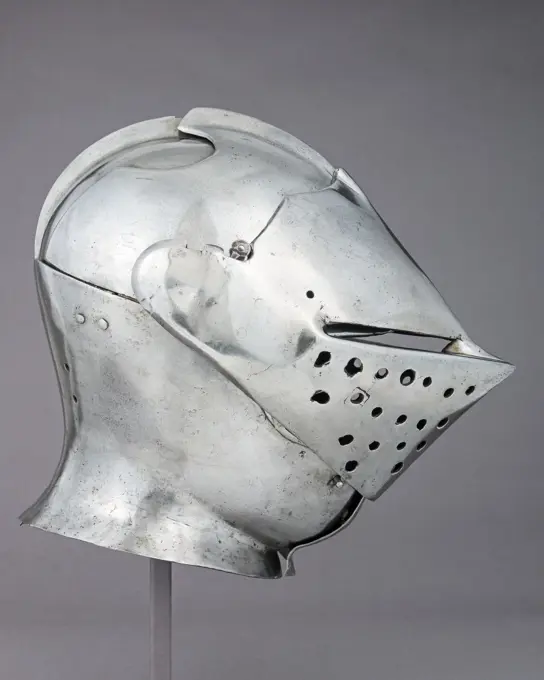
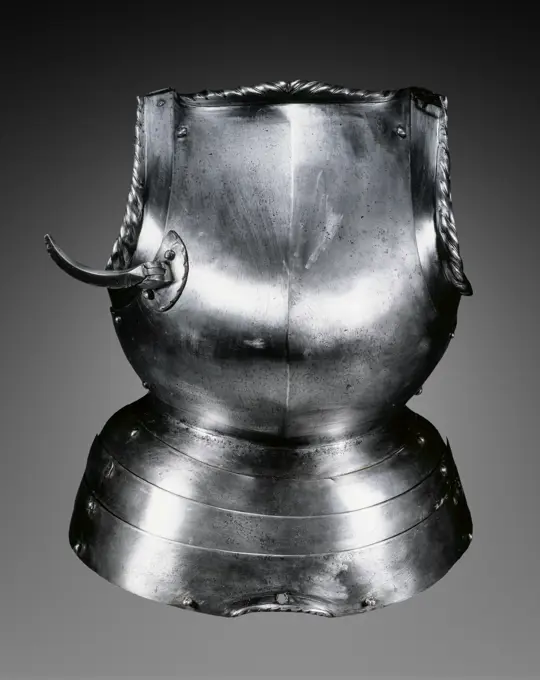
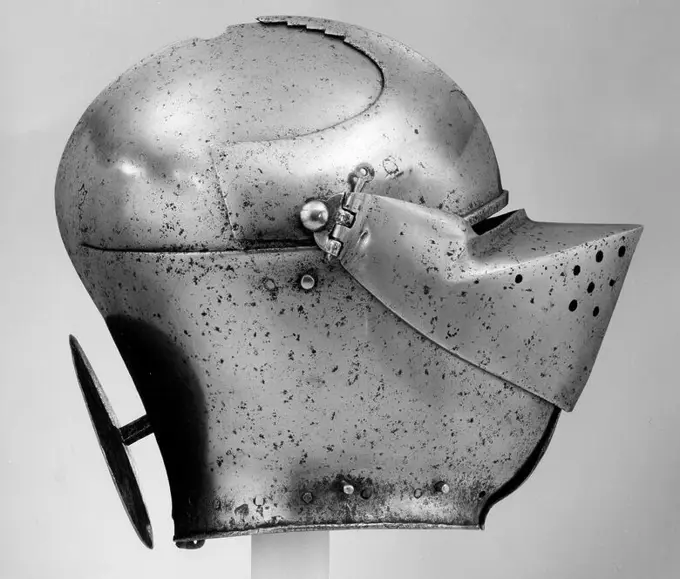
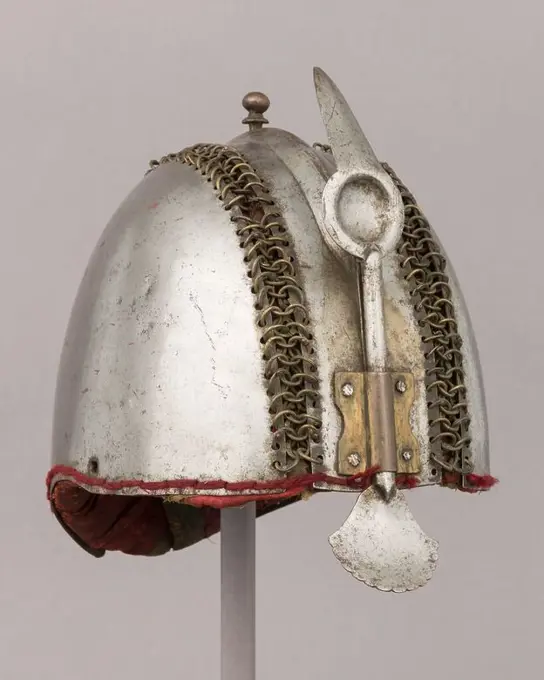
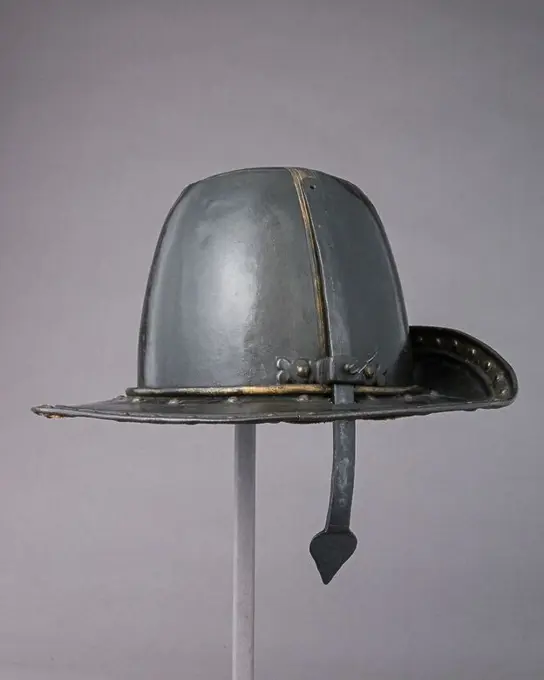
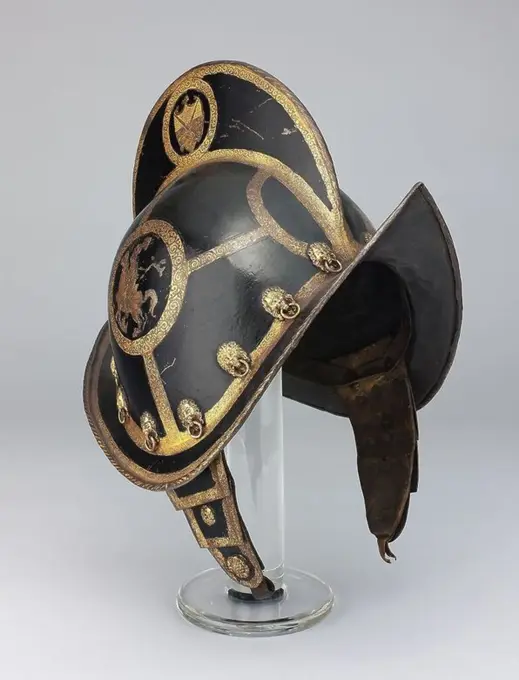
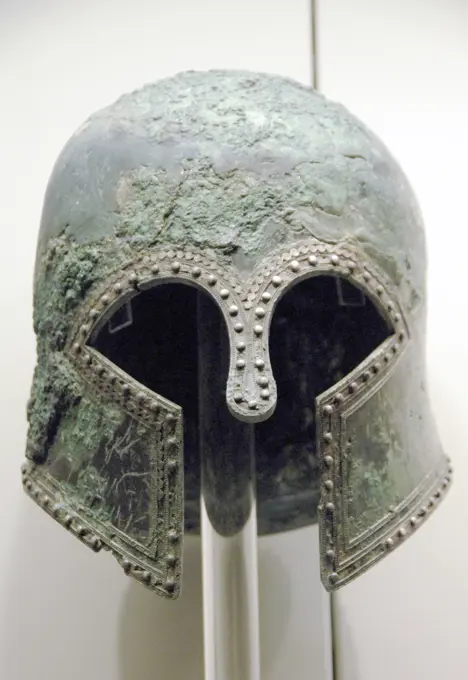
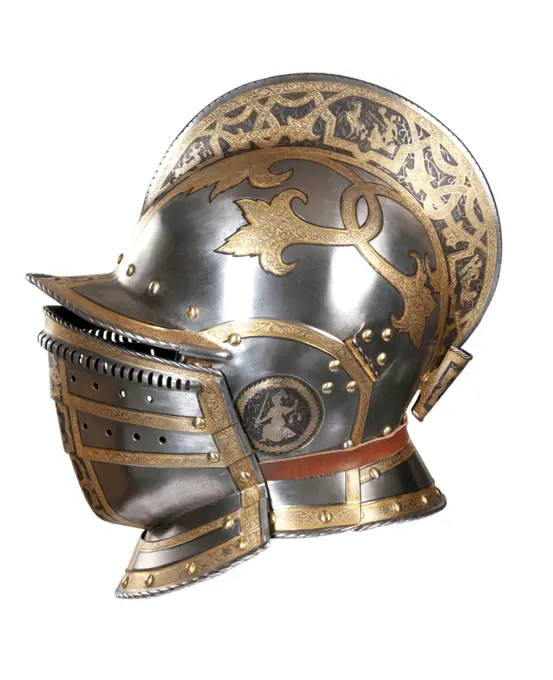
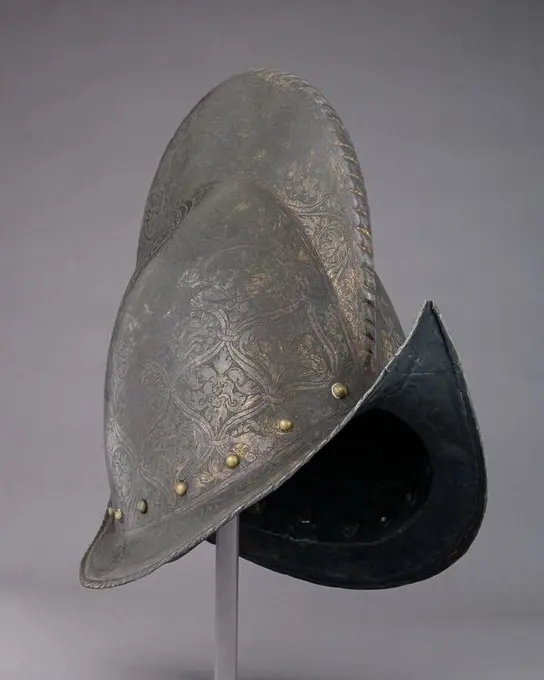
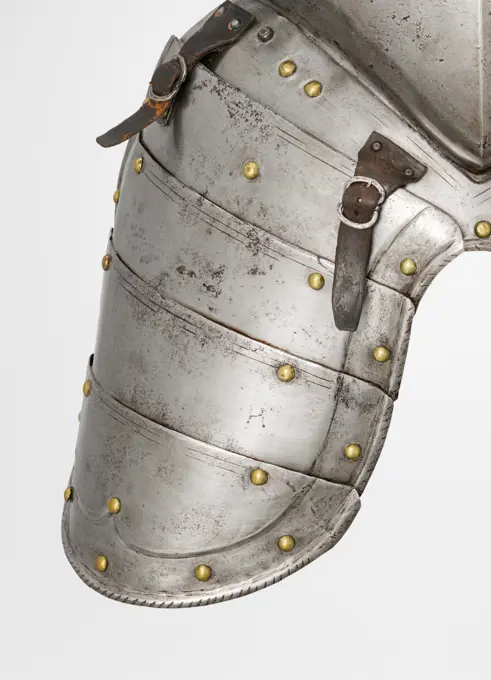
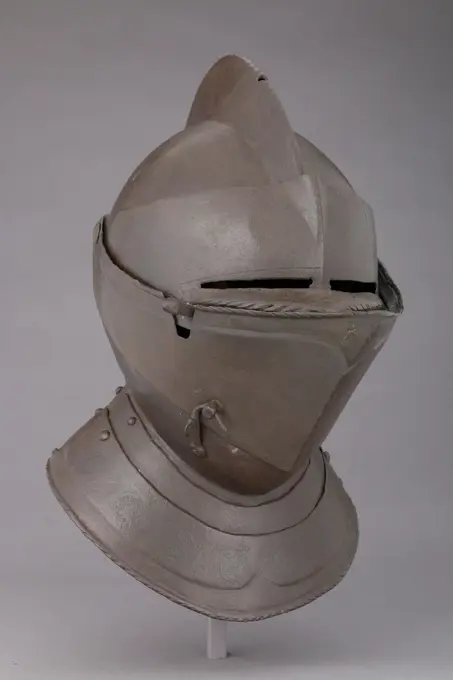
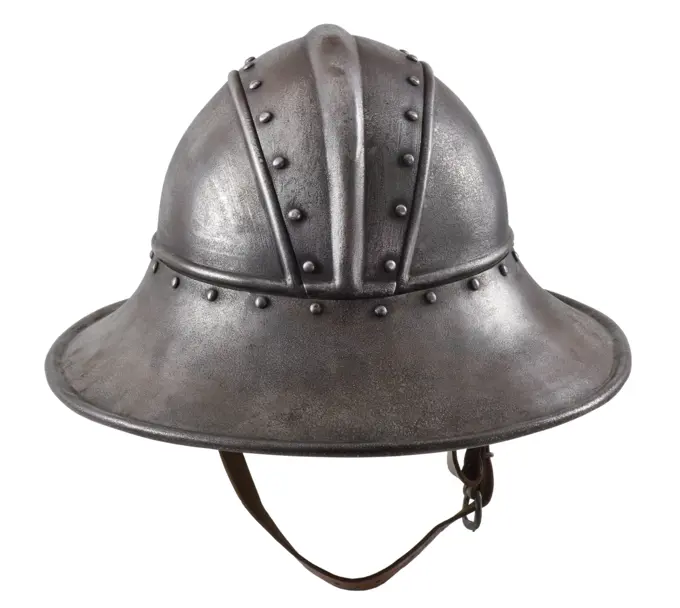
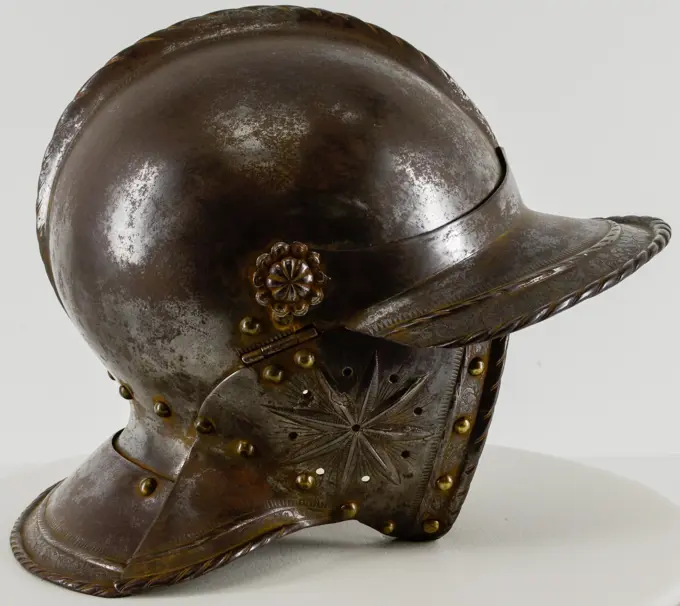
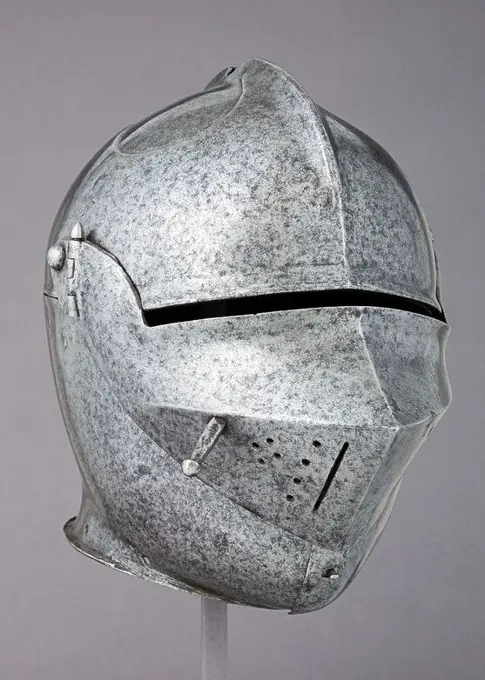
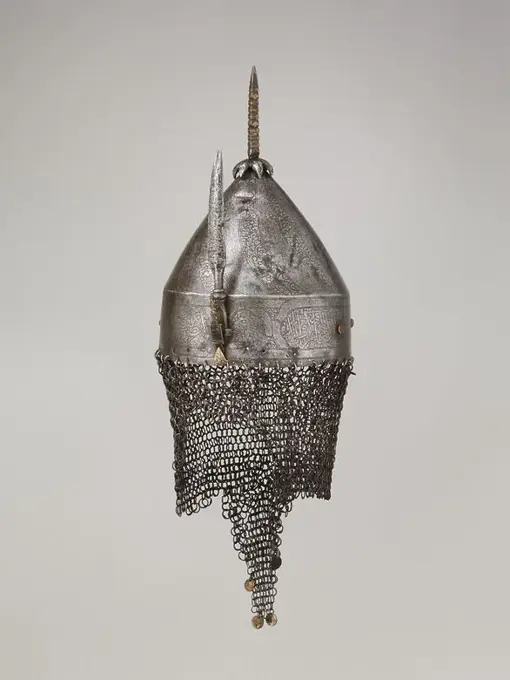
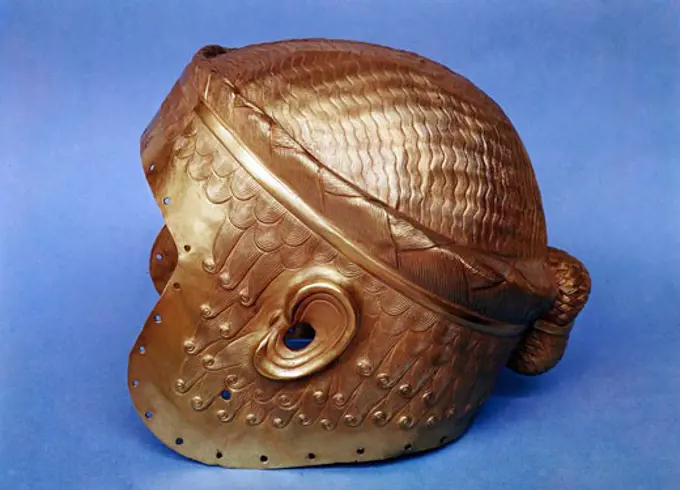
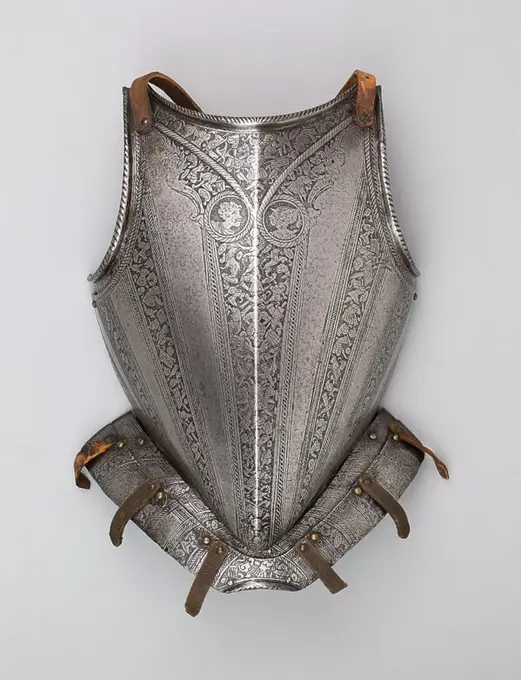
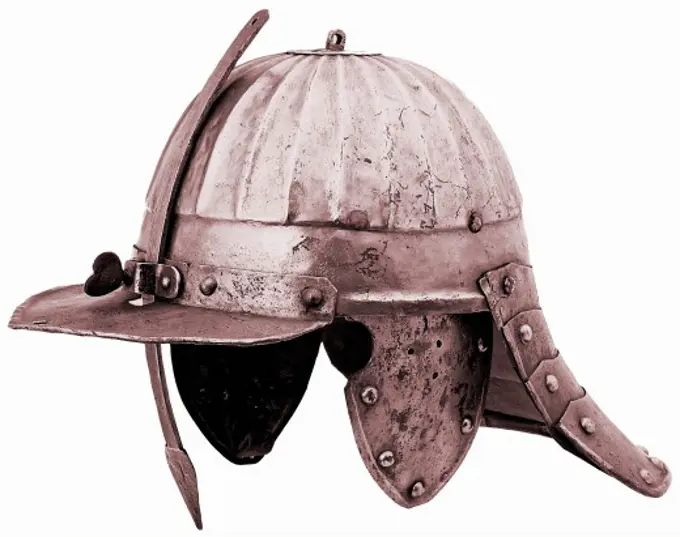
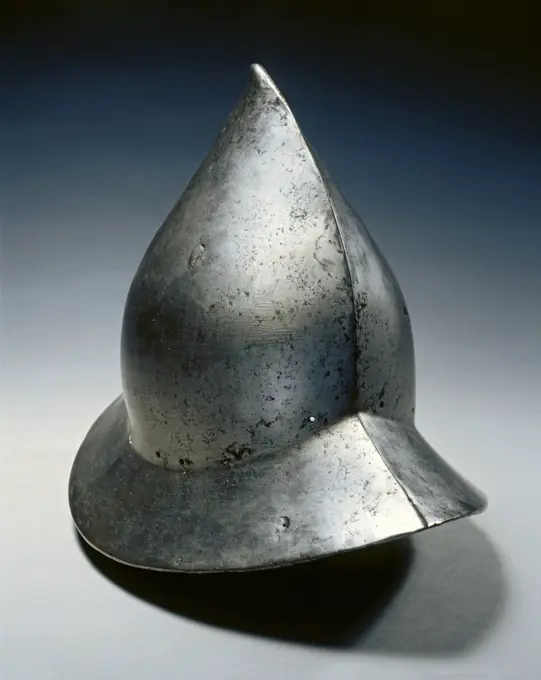
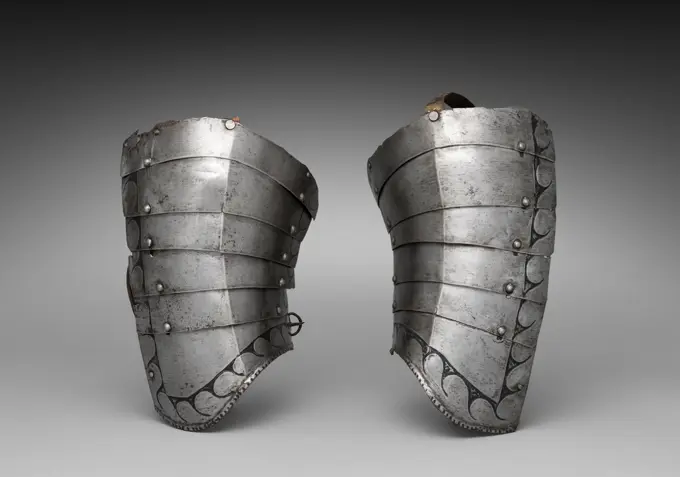
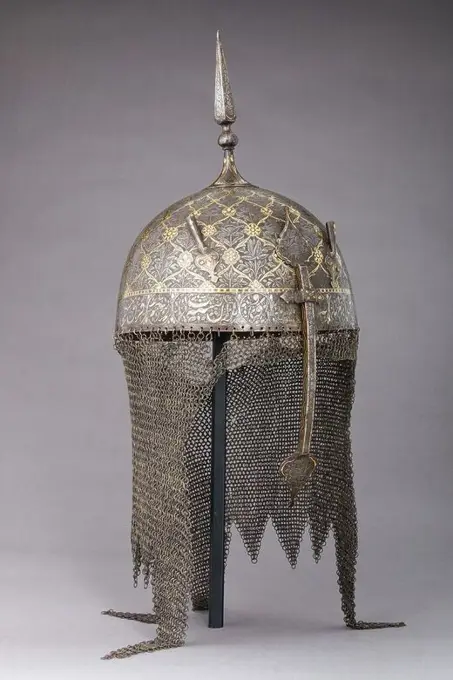
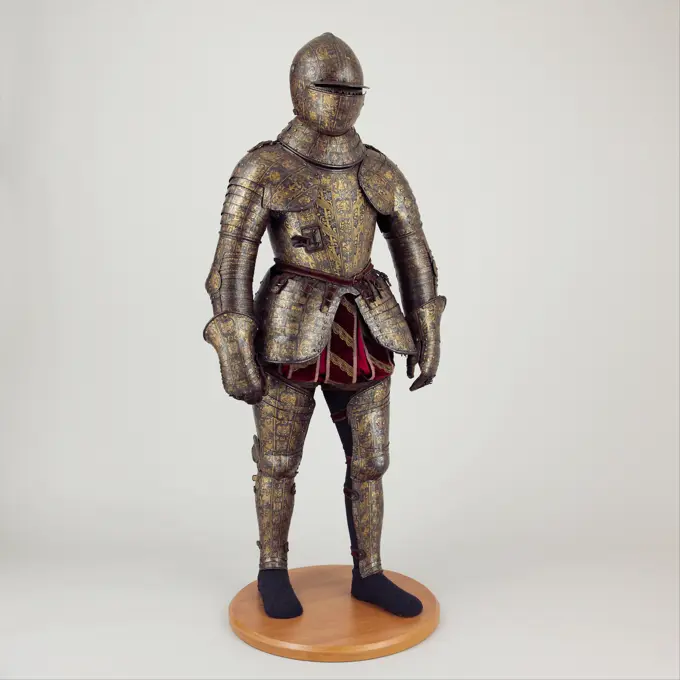
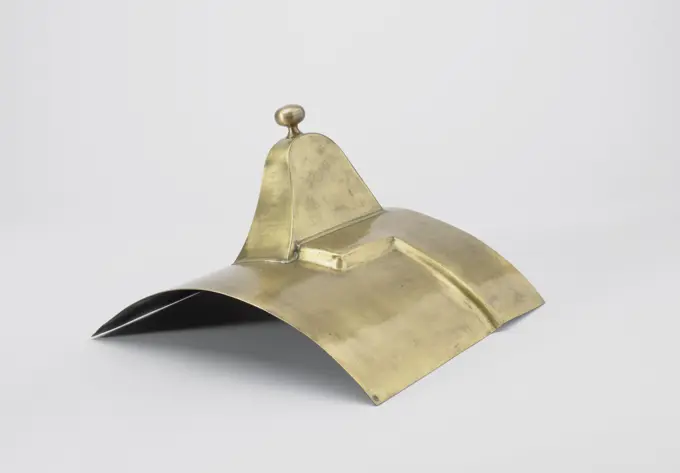
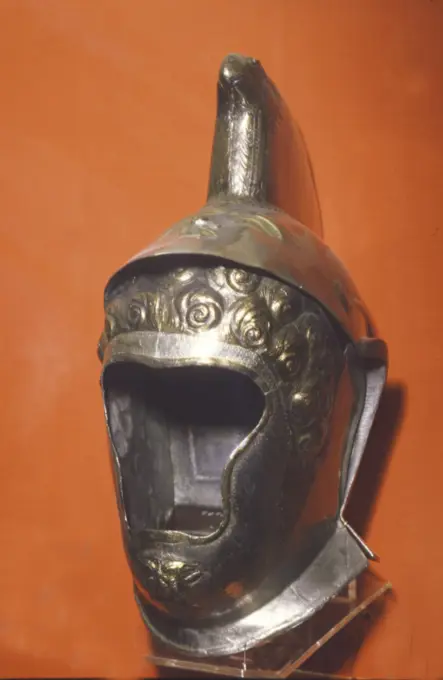
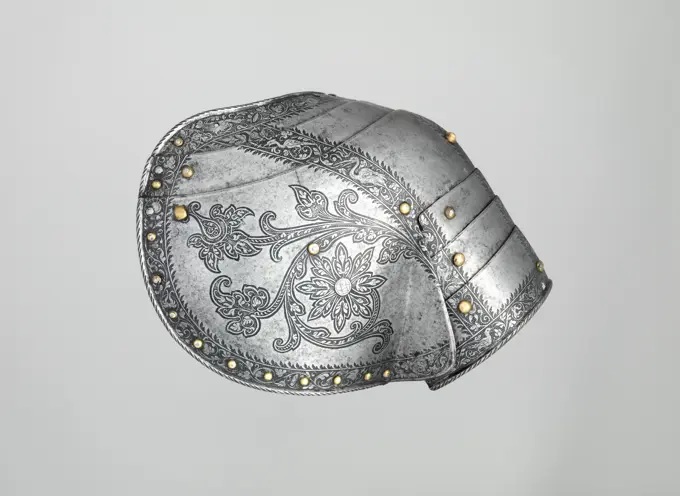
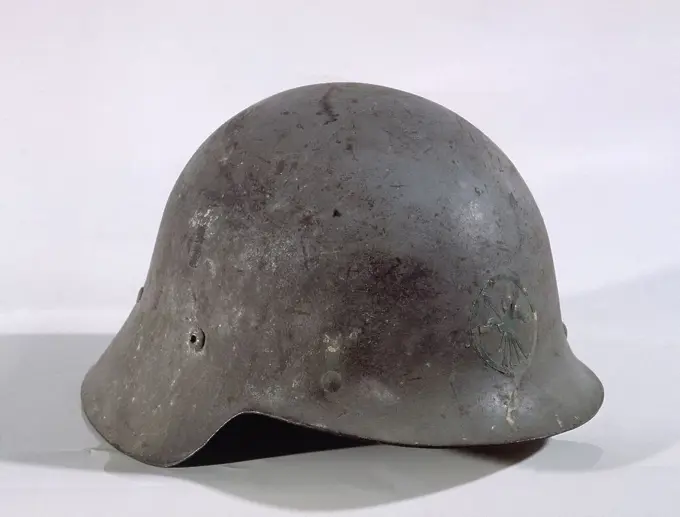
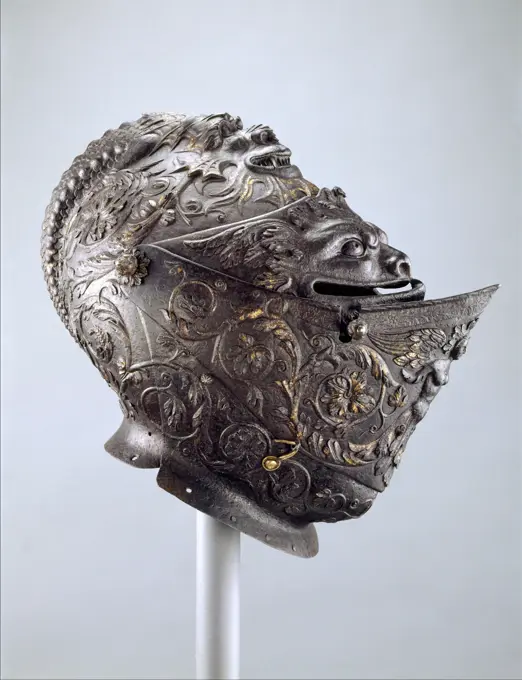
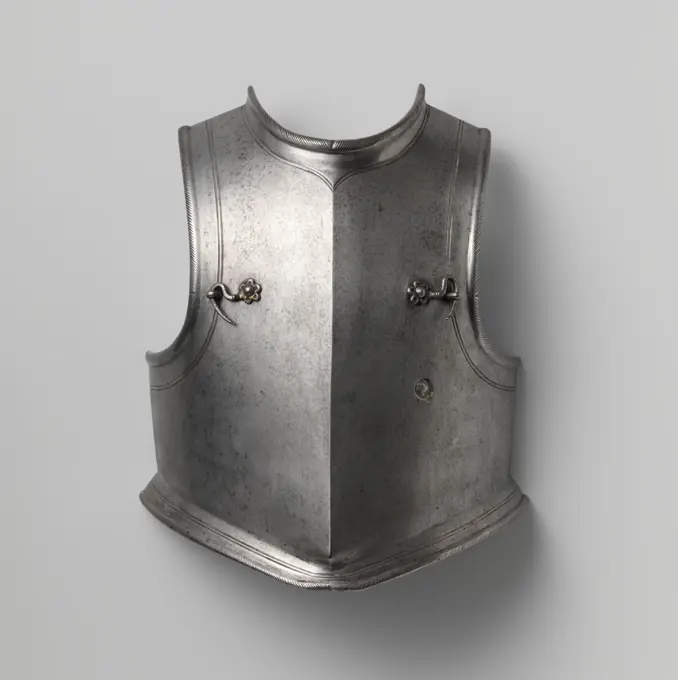
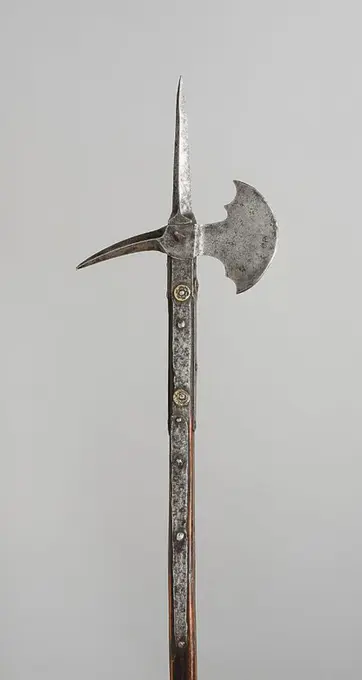
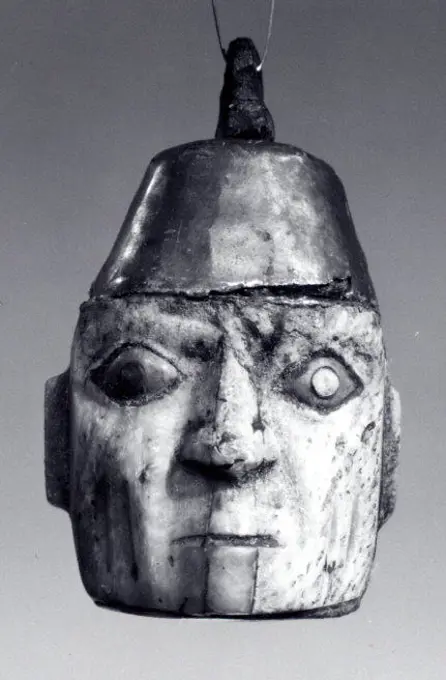
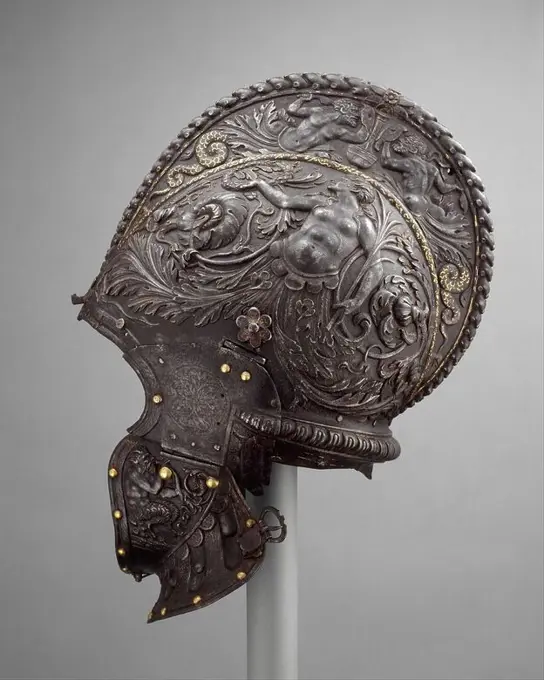
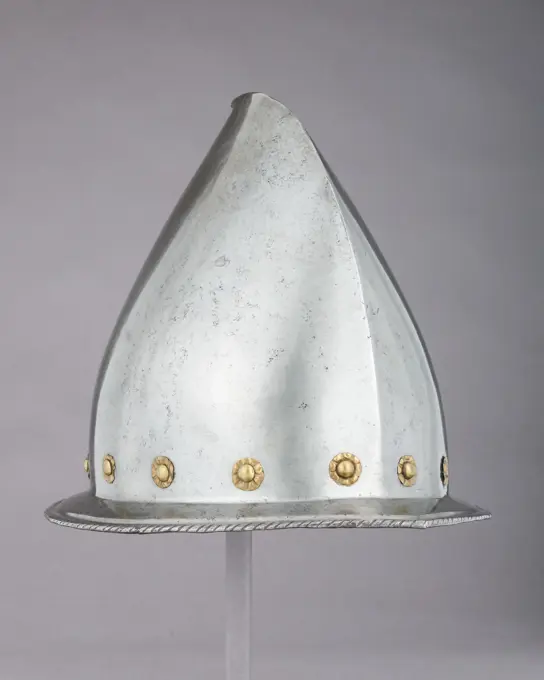
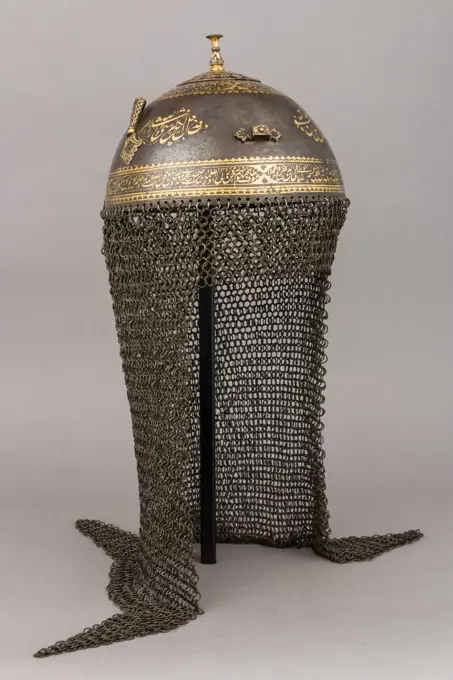
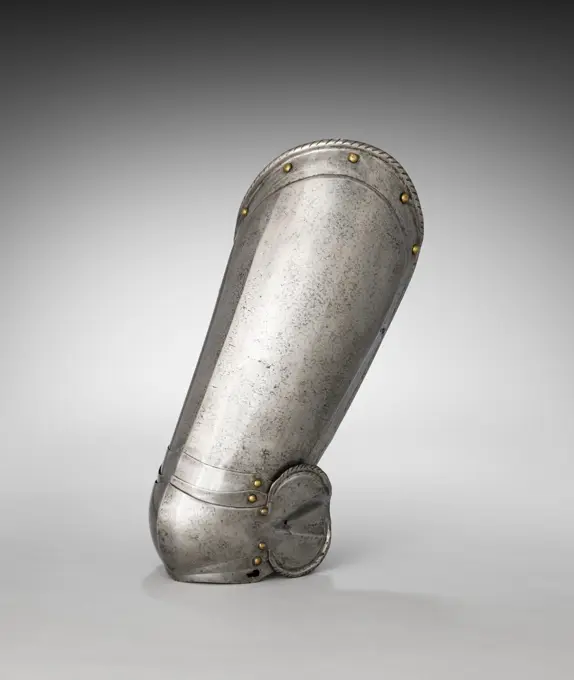
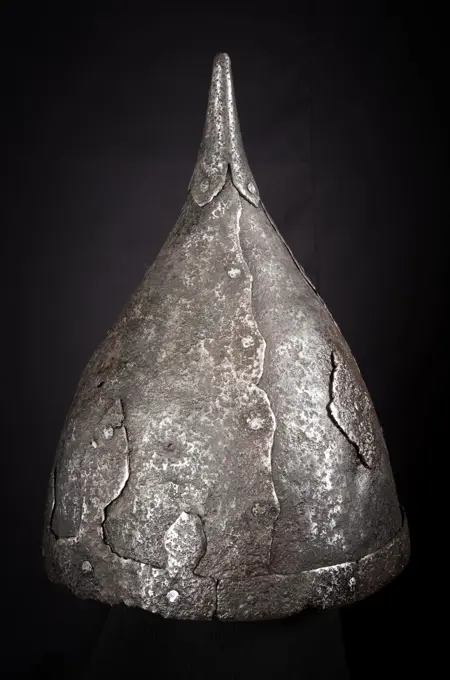
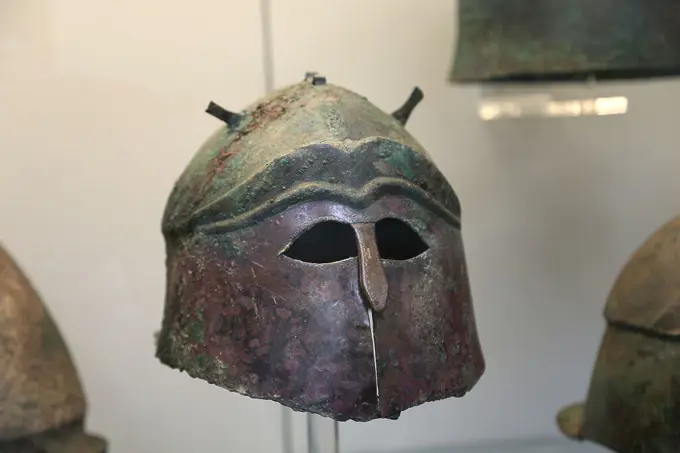
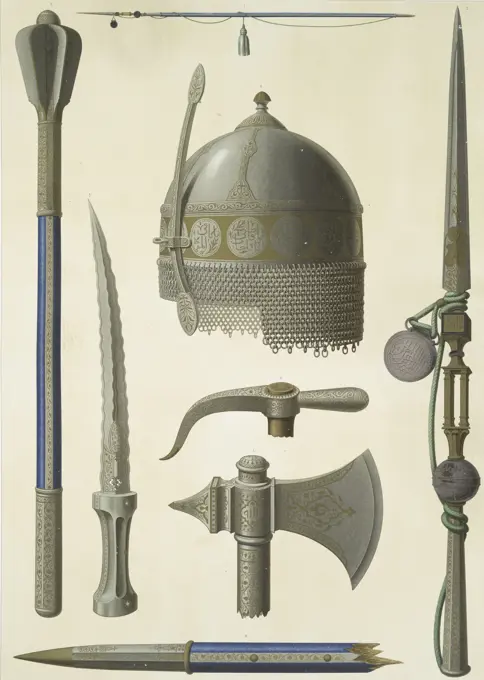
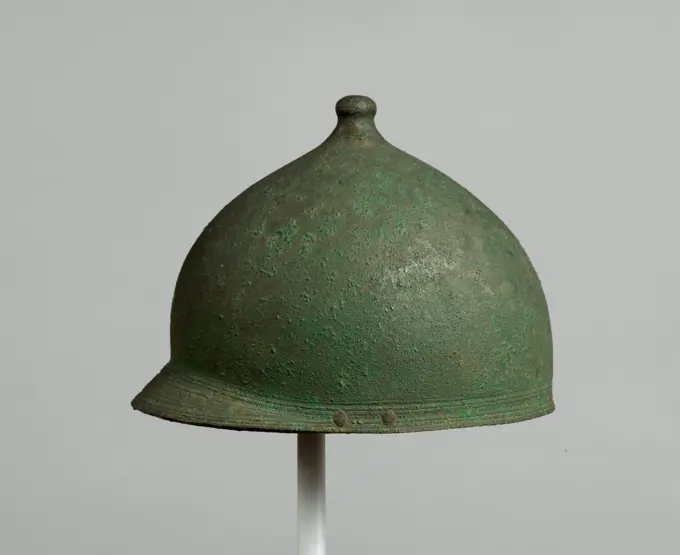
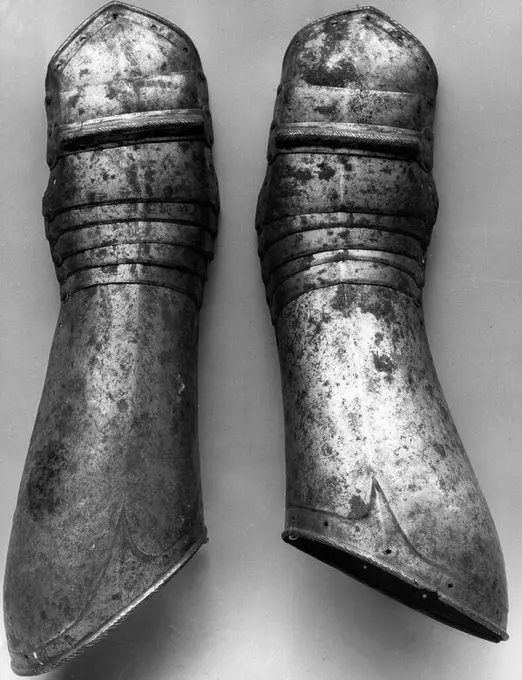
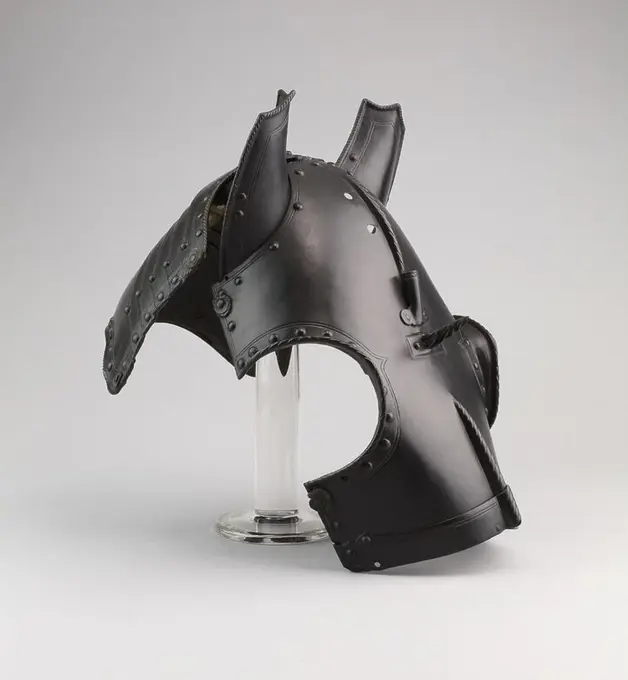
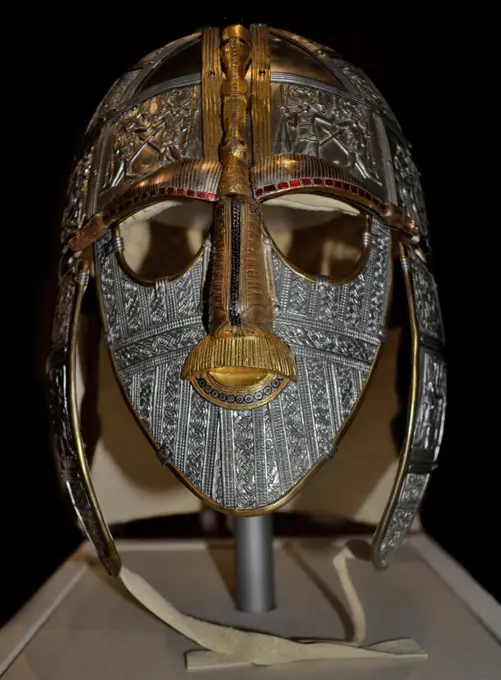
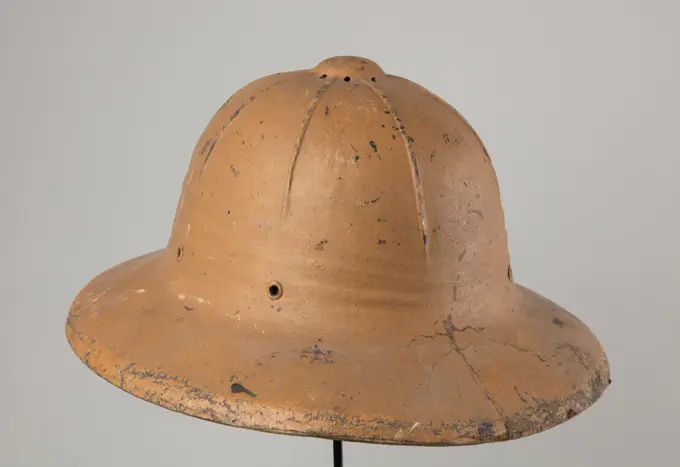
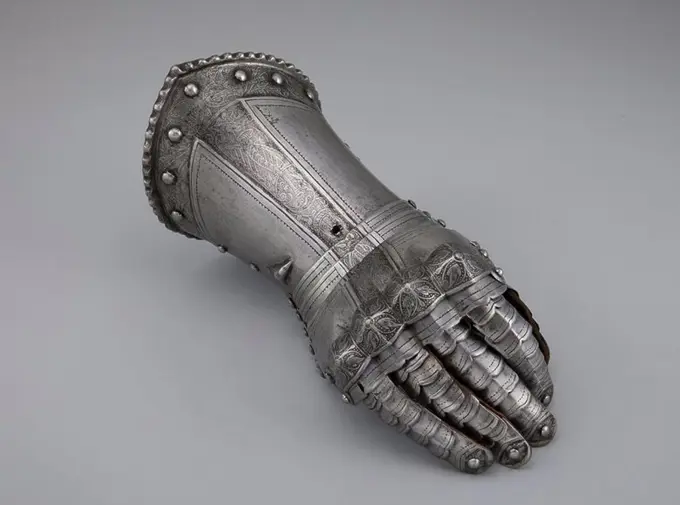
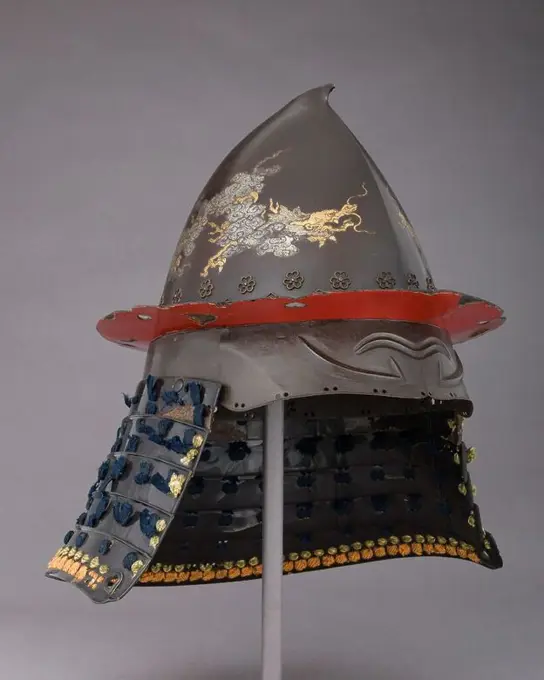
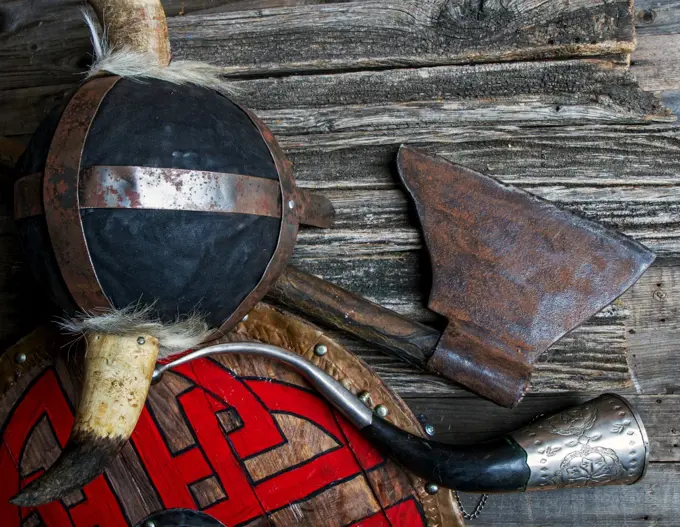
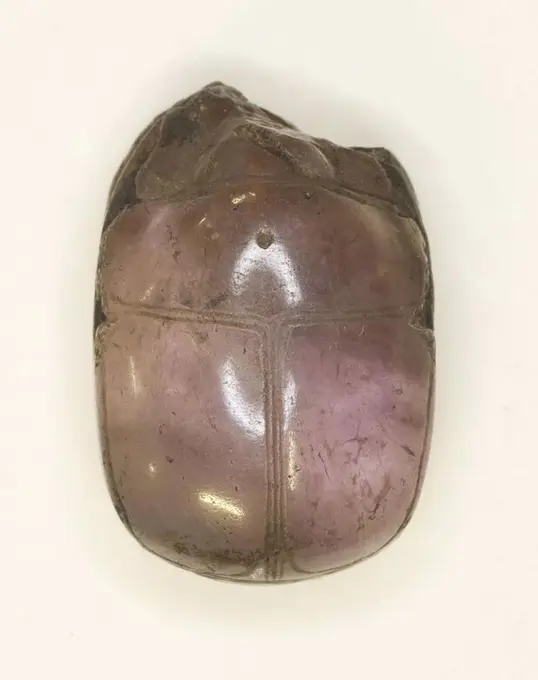
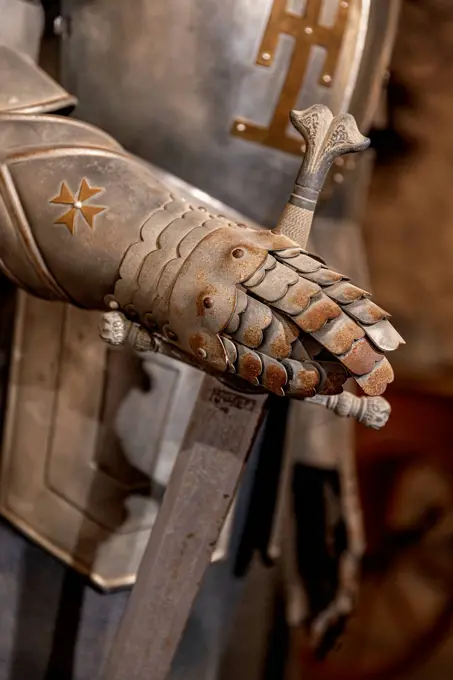
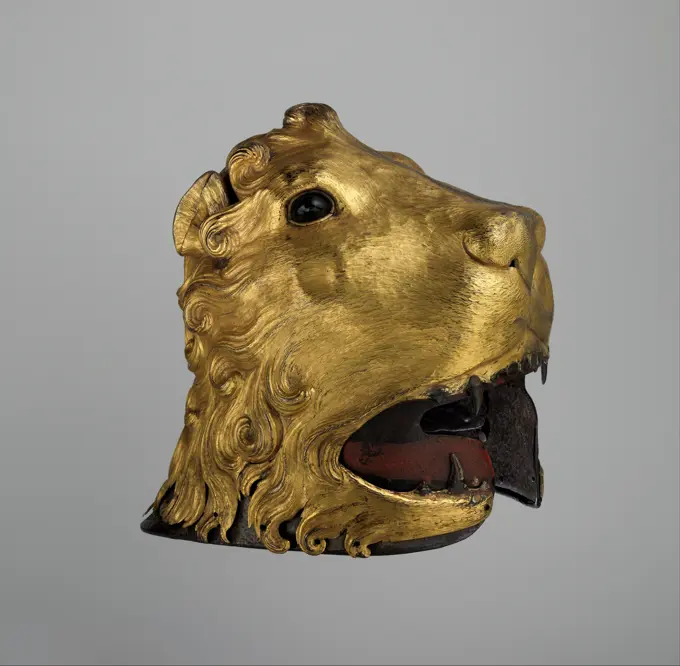
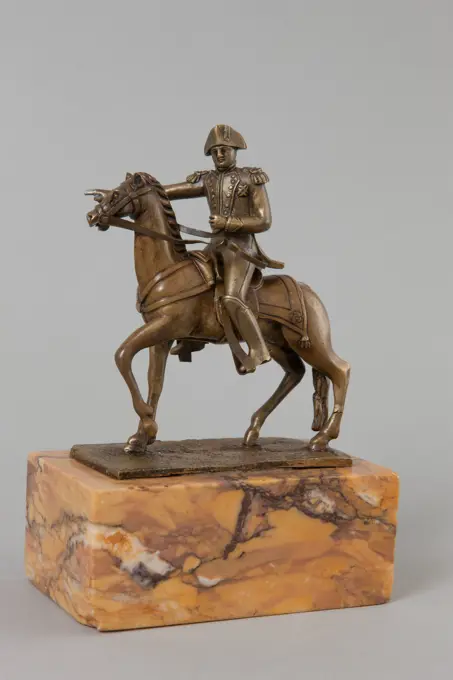
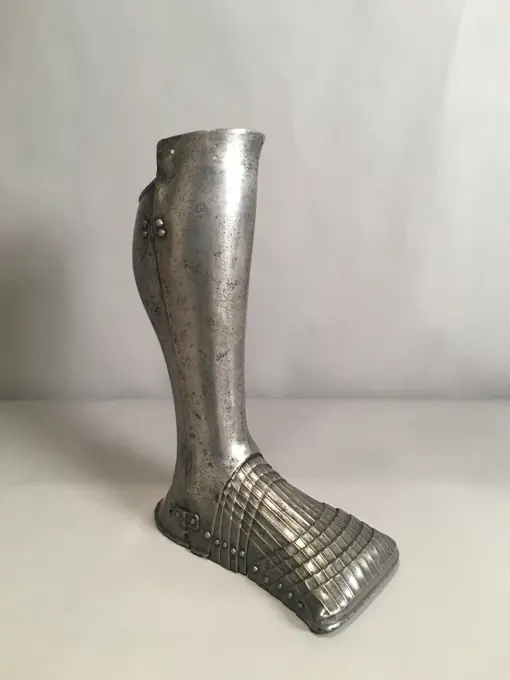
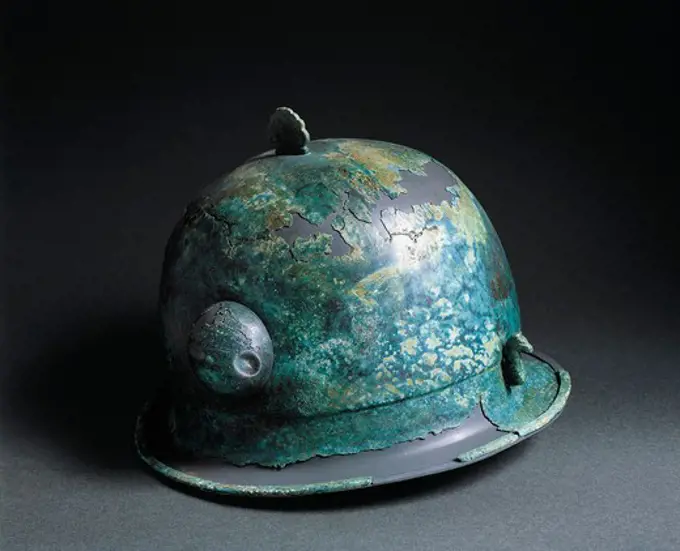
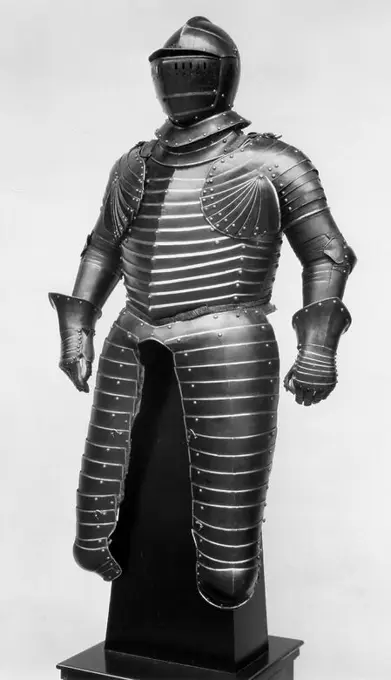
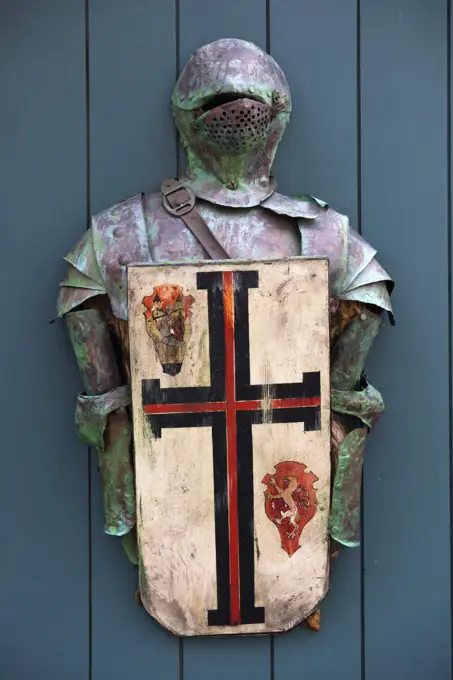
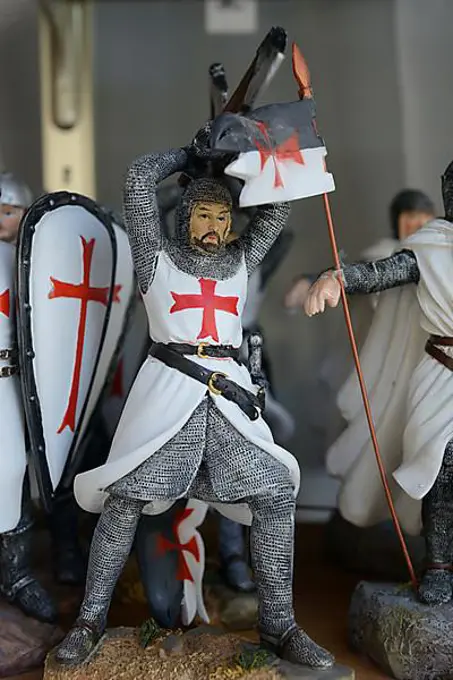
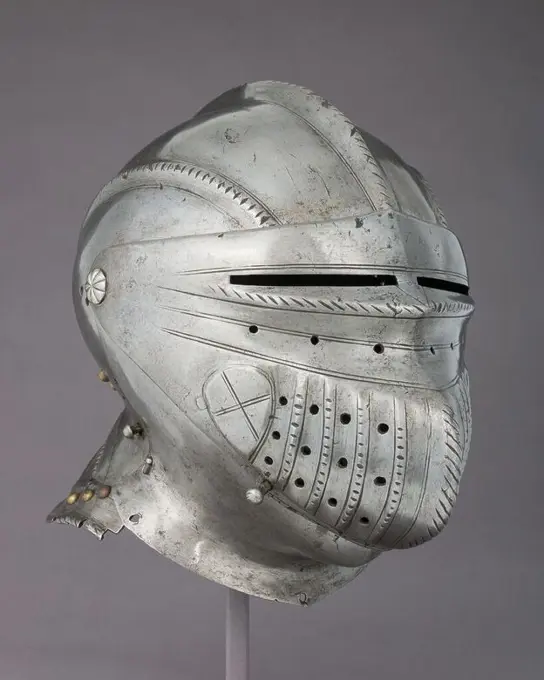
Armet. Culture: German. Dimensions: H. 11 1/2 in. (29.2 cm); W. 9 1/4 in. (23.5 cm); D. 13 in. (33 cm); Wt. 8 lb. 2.4 oz. (3696.8 g). Date: ca. 1535. Museum: Metropolitan Museum of Art, New York, USA.Close Helmet. German or Austrian (possibly Innsbruck). Date: 1500-1520. Dimensions: H. 24.6 cm (9 3/4 in.). Steel and paint. Origin: Innsbruck. Museum: The Chicago Art Institute, Chicago, USA.Jousting Helm (Stechhelm) Made 1475-1500 Innsbruck. This heavy helm, weighing over 20 pounds, was completely impractical in battle but ideal for the joust. In order to be secured, the helm had a hinged steel strap that bolted to the front of the breastplate. Its deep, ìfrog-shapedî front, up to a half-inch thick, was designed to deflect a steel-headed lance. Inside was thick quilted padding with bands to secure the head from whiplash. The deep gouges around the throat and top of the helm bear witness to the force of the encounter.. Steel, brass, and paint .Close Helmet for the Field ca. 1525-30 Italian, Milan Supplanting the armet in the early sixteenth century, the close-helmet was intended for mounted use in the field and typically was constructed with a visor and bevor (lower face and chin defense) rotating on the same pivots at the sides of the bowl. Although this close-helmet apparently is Italian in origin, certain features, such as the stepped profile of the visor and the use of a separate plate to complete the lower part of the bowl at the back, recall helmets found in France and England. This example may, therefore, have been intended for export north of the Alps. (The two front collar lames and the lower rear lame are modern, as is the lifting peg of the visor.). Close Helmet for the Field. Italian, Milan. ca. 1525-30. Steel. Milan. HelmetsClose-Helmet for the Tournament on Foot ca. 1600-1610 Italian, Milan; or Spanish, Eugui The surfaces were originally blued, deeply engraved and punched, and damascened in gold; though worn with age, some of the original brilliant coloring is preserved beneath the overlapping plates. The ornament includes pairs of entwined rings, a triangle (or delta) with paired palm branches, and crowns surmounting a complex monogram (either the owner's name or device). The form, decorative technique, and ornamental vocabulary are Milanese, but the helmet might also have been made by Milanese armorers working in the Spanish royal workshop at Eugui.. Close-Helmet for the Tournament on Foot 26520Close Helmet Made 1500-1520 Germany. Steel .Visored Bascinet Made 1390-1410 Italy. The quintessential knightly helmet of the late 14th century, the bascinet was used throughout Europe. Its pronounced conical skull and pointed visor were designed to deflect blows side to side and were described in its own time in Germany as a Hundsgugel, or houndís hood. The pierced steel pins around the base of the skull were used to attach a mail hood, called an aventail, that protected the shoulders.Complete surviving examples are rare. This helmet is made of two separate period parts, skull and visor, which were repaired and joined in the early 20th century to make a complete example.. Steel and brass .Close Helmet. Southern German, Nuremberg. Date: 1520-1540. Dimensions: H. 19.7 cm (7 3/4 in.). Steel. Origin: Nuremberg. Museum: The Chicago Art Institute, Chicago, USA.Helmet, c. 1560-80. Germany, Saxony, 16th century. Steel; overall: 34.5 x 32 x 22 cm (13 9/16 x 12 5/8 x 8 11/16 in.).Armet ca. 1505 Guillem Margot Flemish The helmet bears traces of the armorer's mark, an M beneath a crescent, possibly that of the Flemish armorer Guillem Margot, who worked for the Hapsburg court and was active in Brussels from 1505 to 1520.. Armet 22775Iron helmet of the medieval knight. Very heavy headdressALMOFAR O ESCOFIA. Location: PALACIO REAL-REAL ARMERIA DE MADRID. MADRID. SPANIEN.Breastplate, c. 1540. Germany, 16th century. Steel; overall: 43.8 x 36.9 cm (17 1/4 x 14 1/2 in.). The breastplate protects the chest and abdomen and is normally worn with a backplate. This one features a lance rest which start to appear as early as the late 1300s. The purpose of the lance rest is not to bear the weight of the lance. Instead allows a mounted warrior to hold the lance firmly couched under his right arm and stops it from sliding backward. If the target is hit the lance rest also acts as a shock absorber, preventing the lance from shooting backward and dispersing the impact via the breastplate all over the upper body rather than leaving it concentrated on the hand. When not needed it can be folded up so that is is out of the way.Armour Armour of the medieval knight. Metal protection of the soldier against the weapon of the opponent Copyright: xZoonar.com/ValeryxxSibrikovx 2415944Antique European Knight Armor An antique European knight armor isolated against white background. Copyright: xZoonar.com/JFsPic Thielemannx 9766423Armet. Culture: Italian, probably Milan. Dimensions: H. 10 3/4 in. (27.3 cm); W. 8 in. (20.3 cm); D. 10 3/4 in. (27.3 cm); Wt. 6 lb. 13.4 oz. (3101.4 g). Date: ca. 1450-60; rondel, stem, and aventail, later. Museum: Metropolitan Museum of Art, New York, USA.Helmet. Culture: Indian, possibly Central Indian. Dimensions: H. including nape defense 11 1/4 in. (28.6 cm); H. including nasal 9 7/8 in. (25.1 cm); H. excluding nape defense and nasal 7 3/4 in. (19.7 cm); W. 6 in. (15.2 cm); D. 8 3/4 in. (22.2 cm); Wt. 1 lb. 13.6 oz. (839.1 g). Date: 18th-19th century. Museum: Metropolitan Museum of Art, New York, USA.Helmet in the Shape of a Cavalier's Hat. Culture: probably British. Dimensions: H. including nasal 10 in. (25.4 cm); H excluding nasal 6 in. (15.2 cm); W. 7 in. (17.8 cm); D. 13 in. (33 cm); Wt. 3 lb. 7 oz. (1550 g). Date: ca. 1630-50.Like costume armors that were in vogue a century earlier, this helmet mimics in steel a style of hat that was popular in the early to mid-seventeenth century. Museum: Metropolitan Museum of Art, New York, USA.Morion for the Bodyguard of the Elector of Saxony. Probably Hans Michel; (German, 1539-1599) Nuremberg. Date: 1570-1590. Dimensions: 35.5 × 34.3 × 24 cm (14 × 13 1/2 × 9 1/2 in.). Steel, brass, gilding, leather, and paint. Origin: Nuremberg. Museum: The Chicago Art Institute, Chicago, USA.Bronze helmet of Corinthian style. 6th century BC. Olympia Archaeological Museum. Ilia Province. Peloponnese region. Greece.Iron helmet of the medieval knight. Very heavy headdressMorion. Culture: Italian. Dimensions: H. 12 13/16 in. (32.5 cm); W. 8 3/4 in. (22.2 cm); D. 13 5/8 in. (34.6 cm); Wt. 4 lb. 12 oz. (2158 g). Date: ca. 1570. Museum: Metropolitan Museum of Art, New York, USA.Iron helmet Iron helmet of the medieval knight. Very heavy headdress Copyright: xZoonar.com/ValeryxxSibrikovx 6496818Iron helmet Iron helmet of the medieval knight. Very heavy headdress Copyright: xZoonar.com/ValeryxxSibrikovx 2454296Tasset (proper right), c. 1560-1580. South Germany, 16th century. Steel, leather straps, brass rivets; overall: 28.2 x 22.3 cm (11 1/8 x 8 3/4 in.). This armor was developed for the joust-a sporting combat between two mounted contestants. Although all of the elements of this armor date from the same period, they are not all from the same suit. This armor is thus called "composed." It also shows the asymmetry of jousting armor. The participants rode along a wall-like barrier known as a "tilt" with their left sides facing one another. Consequently, armor on that side of the body had to be thicker. Note the large plate (grandguard) over the left shoulder for extra protection. Also, the breathing holes in the helmet were placed on the right side (farthest from an opponent's lance) to avoid injuries from splinters. The bracket attached to the right breastplate is called the lance-rest, a shock-absorbing support designed to accommodate the lance when "couched" under the right armpit.Close-Helmet ca. 1550-60 European. Close-Helmet 35858Peytral of a Horse Armor 1500-1530 Germany. Steel .Iron helmet Iron helmet of the medieval knight. Very heavy headdress Copyright: xZoonar.com/VALERY-SIBRIKOVx 7119305Burgonet ca. 1525-30 German, probably Augsburg Designed for service on foot or horseback, this burgonet is a rare example of a type that was popular in the German lands and Italy through the first four decades of the sixteenth century, and notable for the high quality of its design and execution. It is especially significant for its early place within the chronological development of the type; for the original construction of the cheekpieces, which extend rearward and are flanged to form portions of the nape defense, and the plume holder that is riveted to the side of the bowl; and for the excellent workmanship on the part of both the armorer and the etcher. The stars adorning the cheekpieces, which are embossed and imaginatively etched, speak for a close and fruitful collaboration between these professionals, in keeping with the finest decorated armors of the German Renaissance.. Burgonet. German, probably Augsburg. ca. 1525-30. Steel, copper alloy, leather. probably Augsburg. HelmetsArmet. Culture: Italian. Dimensions: H. 10 5/8 in. (27 cm); W. 8 1/2 in. (21.6 cm); D. 12 7/16 in. (31.6 cm); Wt. 7 lb. 1 oz. (3217 g). Date: ca. 1490. Museum: Metropolitan Museum of Art, New York, USA.Helmet. Culture: Egyptian or Syrian. Dimensions: H. including mail 24 1/2 in. (62.2 cm); H. 8 in. (20.3 cm); W. 8 1/2 in. (21.6 cm); D. 8 3/4 in. (22.2 cm); Wt. excluding mail 3 lb. 3.8 oz. (1468.5 g). Date: ca. 1515-1520.The engraved decoration, which includes Qur'anic inscriptions, recalls that found on helmets dating to the last years of Mamluk rule, before the Ottomans conquered Egypt in 1517. The helmet is incised with the mark of the Ottoman arsenal, indicating that it was carried back to Istanbul as booty. The spike at the top, the spear-like fixture at the front, and mail are later North African additions, suggesting that the helmet was recycled for use in Sudan during the Mahdi uprising in the 1880s and 1890s. Museum: Metropolitan Museum of Art, New York, USA.Close Helmet with Mask Visor in Form of a Human Face. Armorer: Attributed to Kolman Helmschmid (German, Augsburg 1471-1532). Culture: German, Augsburg. Dimensions: H. 12 in. (30.5 cm); W. 9 3/4 in. (24.8 cm); D. 13 in. (33 cm); Wt. 4 lb. 12 oz. (2146 g). Date: ca. 1515.Helmets fitted with masklike visors were a popular German and Austrian fashion about 1510 to 1540. With their visors forged and embossed as humorous or grotesque human masks, such helmets were often worn in tournaments held during the exuberant pre-Lenten (Shrovetide) festivals, celebrations somewhat akin to the modern Mardi Gras. Substitute visors of more conventional type were often provided for everyday use. Museum: Metropolitan Museum of Art, New York, USA.Gold helmet from Mesopotamia. 2, 500 BC. Iraq MuseumBreastplate with Folding Lance Rest and Fauld 1540-1560 Innsbruck. Steel .Infantry Breastplate with Fauld. Italian, Milan. Date: 1575. Dimensions: Wt. 5 lb. 7 oz. Steel, leather, and brass. Origin: Milan. Museum: The Chicago Art Institute, Chicago, USA.weapons helmets zischagge for officers German mid 17th century,Yugoslav Spider firefighter's helmet, "Feuer und Flamme - Die Feuerwehr von 1850 bis heute", an exhibition of 150 years of Lauf Fire Department, Lauf Industrial Museum, Lauf an der Pegnitz, Middle Franconia, Bavaria, Germany, EuropeCabacete (Helmet), c. 1480s-90s. Spain, late 15th century. Steel; overall: 27.3 x 26 x 36.5 cm (10 3/4 x 10 1/4 x 14 3/8 in.). This tall open-face cabacete, alternately known as a "kettle hat" or "war hat" and ancestor of the later morion popular during the 1500s, would have been worn by an infantry soldier, not a mounted knight. The helmet has a conical point and a broad swooping brim, and its user may have worn a bevor, or separate chin piece, to protect his lower face and throat. He may also have worn a brigandine, or canvas doublet lined with metal plates, to protect his torso. Infantry troops were generally armed with hafted weapons such as a bill or halberd.Pair of Espaliers (Pauldrons/upper arm canons), 1500s. Germany, 16th century. Steel;Helmet and Shield. Culture: Persian. Dimensions: Helmet (a); H. including mail 24 in. (61 cm); H. including nasal 16 3/4 in. (42.5 cm); H. excluding mail and nasal 10 1/4 in. (26 cm); W. 8 1/2 in. (21.6 cm); D. 9 in. (22.9 cm); Wt. 3 lb. 5.5 oz. (1516.7 g). Date: 19th century. Museum: Metropolitan Museum of Art, New York, USA.Armor with Matching Shaffron and Saddle Plates ca. 1600 Italian, Milan This exceptionally well-preserved armor was made for an adolescent or a small adult who was undoubtedly a member of an important noble family. It belongs to a select group of Milanese armors made between 1590 and 1610, in which etched decoration was abandoned in favor of engraving, punching, gilding, and damascening. This armor demonstrates the high standard maintained by the best northern Italian armorers at the turn of the seventeenth century.It is the form worn by heavy cavalry throughout the sixteenth century, in which the wearer is covered from head to foot, and a lance rest is attached to the right side of the breastplate. Around 1600, however, lance-bearing heavy cavalry was being replaced by cuirassiers, heavy cavalry who were armored only to the knees and carried pistols and a sword. Features found here that are typical of the new cuirassier's armor are the close helmet with barred visor and falling buffe (Model of a Lock Cover, anonymous, c. 1825 demonstration model. flintlock Brass kulas lid with a raised part for a flint lock; On top of a button. Scale 1: 1. Netherlands (possibly) brass (alloy)Parade helmet. Roman Period.Right Shoulder and Arm Defense ca. 1555-60 Attributed to Wolfgang Grosschedel German. Right Shoulder and Arm Defense. German, Landshut. ca. 1555-60. Steel, leather, copper alloy. Landshut. Armor PartsCASCO REGLAMENTARIO EJERCITO ESPANOL 1931. Location: EXPOSICION DE LA GUERRA CIVIL ESPAÑOLA. MADRID. SPAIN.Close Helmet ca. 1540-45 Attributed to Giovan Paolo Negroli Italian This helmet is very close in design and workmanship to the signed breastplate by Giovan Paolo (14.25.1855) ad therefore can be attributed to him with confidence.. Close Helmet. Italian, Milan. ca. 1540-45. Steel, copper alloy, gold. Milan. HelmetsCopper pressed thimble, thimble sewing kit soil find copper metal, pressed Copper pressed thimble spirally drawn on the top crossing without groove in the shaft with blank board with two grooves archeology Rotterdam rail tunnel seamstress tailor sewing textile processing clothing needle and restoring soil Soil discovery Rotterdam tunnel trajectory.Campania Napoli Naples S. Lorenzo Maggiore65. Hutzel, Max 1960-1990 Medieval: Sculpture, architecture, architectural sculpture (including Roman spolia) 13-14th century Chapter house; sarcophagi, gravestones; wall painting. Fragment of mosaic; sculptural fragments in the Sala Capitolare. Post-medieval: Architecture, architectural sculpture, ceiling painting fresco cycle; prints depicting Venice c. 1845 (4), sculpture; life-size creche figures dressed in original Neapolitan costume Church restored in 1882, 1926, 1944; excavations under the transept undertaken between 1958-1962, and in the cloister in 1976, have revealed remains of a Roman macellum (market), street, and the paleochristian basilica of the 6th c. AD. Antiquities: Pottery: black-glazed, archaic banded, domestic wares, bucchero; architectural terracottas, statuettes, lamps, sculpture fragments Object Notes: 3 color negatives with no prints at the end. General Notes: Most objects/paintings/frescoes unidentified. Three batches Ear Pieces of a Helmet, 1500s. Germany, 16th century. Steel, brass headed rivets; overall: 20 x 14 cm (7 7/8 x 5 1/2 in.).Breastplate of Harquebusiers harness for a young man, Anonymous, c. 1610 - c. 1620  Breastplate of Harquebusiers harness for a young man. Probably a Dutch armor with a stadholder's background. Typically Dutch elements are the decorated rivets of the swivel hooks and the flattened surface of other rivets, as well as the 'striped' edges of the neck and arm holes. The accolade -shaped lines on the breastplate and the light nod in the middle of the neck remnant are also characteristics that can often be seen on Dutch harnesses. The rosette -shaped decorations around the rivets still show traces of gilding in a number of places. There are no remains of black paint visible. Unclear if and when the paint has been removed. Such armor were usually black in the seventeenth century. This was done by heating or by applying a black paint layer. Collar is missing.  iron (metal)Corinthian style bronze helmet from tomb 97 at Campovalano necropolis (province of Teramo)Poleaxe. Swiss. Date: 1500. Dimensions: L. 177.8 cm (70 in.)Blade with socket L. 21.9 cm (8 5/8 in.)Wt. 4 lb. 1 oz. Steel, brass, and wood (oak). Origin: Switzerland. Museum: The Chicago Art Institute, Chicago, USA.Head Lime Container 6th-9th century Wari. Head Lime Container 312816Burgonet. Culture: Italian, Milan. Dimensions: H. 15 1/2 in. (39.4 cm); H. of comb 2 1/2 in. (6.4 cm); W. 9 in. (22.9 cm); D. 11 in. (27.9 cm); Wt. 4 lb. 9 oz. (2069.5 g). Date: ca. 1550-55.Allegorical figures of Fame and Victory are embossed on the sides of the bowl. The helmet was originally fitted with a pivoting visor and plates at the nape. Museum: Metropolitan Museum of Art, New York, USA.Cabasset ca. 1600 Italian. Cabasset 22213Helmet (Hoshi Kabuto) 14th century Japanese The helmet bowl, constructed of thirty-two iron plates, dates from the fourteenth century but was remounted for use in the eighteenth century. The metal fittings on the turnbacks of the neck guard include the badge (a cross within a circle) of the Shimazu family, daimyo of Kagoshima.. Helmet (Hoshi Kabuto). Japanese. 14th century. Iron, lacquer, leather, silk, copper-gold alloy (shakud). HelmetsHelmet 17th-18th century Indian. Helmet 32049Black and White Morion, c. 1600. Germany, early 17th Century. Steel with black paint; overall: 36.3 x 28.6 x 24.4 cm (14 5/16 x 11 1/4 x 9 5/8 in.).Proper Left Cuisse and Knee Cop, c. 1560-1580. South Germany, 16th century. Steel, leather straps, brass rivets; overall: 43.7 cm (17 3/16 in.). This armor was developed for the joust-a sporting combat between two mounted contestants. Although all of the elements of this armor date from the same period, they are not all from the same suit. This armor is thus called "composed." It also shows the asymmetry of jousting armor. The participants rode along a wall-like barrier known as a "tilt" with their left sides facing one another. Consequently, armor on that side of the body had to be thicker. Note the large plate (grandguard) over the left shoulder for extra protection. Also, the breathing holes in the helmet were placed on the right side (farthest from an opponent's lance) to avoid injuries from splinters. The bracket attached to the right breastplate is called the lance-rest, a shock-absorbing support designed to accommodate the lance when "couched" under the right armpit.Iron helmet Iron helmet of the medieval knight. Very heavy headdress Copyright: xZoonar.com/ValeryxxSibrikovx 6496792Austrian fireman's helmet from 1900, "Fire and Flame - the fire department from 1850 to today" exhibition, industrial museum, Lauf an der Pegnitz, Middle Franconia, Bavaria, Germany, EuropeSpanish armor, 16th century, Álava Armory Museum, Vitoria, Basque Country, Spain.Ritterrüstung Ritterrüstung Copyright: xZoonar.com/MartinaxBergx 9157273Apulo corintian helmet. 400-350 BC. From Ruvo, Apulia, Italy. British Museum. London. UK.Arabesques armes de Toman-Bay ensembles et détails' (15th century), 1877, by Prisse d'Avennes. The work features intricate Islamic decoration and ornamentation, showcasing various arms and armaments such as daggers, swords, spears, helmets, axes, and armor. The piece measures 45.5 x 32.5 cm and was published in Paris by A. Morel et Cie, Libraires-ÉditeursClose-up of liquid falling from a colanderHelmet of the Montefortino Type late 4th-early 3rd century B.C.; cheekpieces, modern Etruscan Probably inspired by Celtic prototypes, and also quickly adopted by the Romans, Montefortino-type helmets were especially popular in Etruria from the fourth to the second centuries B.C. This example is Etruscan and remarkable for its sturdiness, untouched surface, and distinctive ornamentation. Among well over 400 Montefortino-type helmets that have survived, only one other similarly decorated example is known. Originating from the Necropolis del Frontone, Perugia, it now is in the Museo nazionale de Perguia, Italy (inv. 362 B1286).The helmet has a hemispherical one-piece bowl of cast, hammered, chased, and engraved bronze, which is surmounted by an integral medial knob-shaped finial, and flanged at the rear into a sloped nape guard that slightly flares upward. It is robust, measuring up to ¼ inch in thickness at the rim, except at the rear, where it becomes thinner as the result of having beeHand protection medieval knight. Element protective armorJanusPlaquePair of Elbow Gauntlets. Culture: German. Dimensions: L. of each 17 in. (43.2 cm). Date: 16th century. Museum: Metropolitan Museum of Art, New York, USA.Officer's Helmet with Crest. Culture: Korean. Date: 16th-19th century. Museum: Metropolitan Museum of Art, New York, USA.Gaillard castle, Les Andelys, Haute Normandie, FranceBronze helmet. unknown, authorIron helmet Iron helmet of the medieval knight. Very heavy headdress Copyright: xZoonar.com/ValeryxxSibrikovx 2454158Andiron 17th century or later Model, workshop of Niccolò Roccatagliata Italian. Andiron. Model, workshop of Niccolò Roccatagliata (Italian, born Genoa, active 1593-1636) (), Venice. 17th century or later. Copper alloy with a warm brown patina under a partly worn dark brown to black patina, cast in three segments.. MetalworkMalta, Valletta.  Suits of armour of the Maltese Knights of St John in the Grand Master's Palace in the centre of the old walled city of Valletta.Shaffron. Master M. P. (Flemish); Brussels. Date: 1615-1625. Dimensions: . Steel, paint, leather. Origin: Brussels. Museum: The Chicago Art Institute, Chicago, USA.Knight's helmet, chain armour, medieval camp, Stauferlager camp, 850th anniversary of Gmuend, Schwaebisch Gmuend, Baden-Wuerttemberg, Germany, Europe Replica of Sutton Hoo; ship-burial helmet 7th Century. The panels are decorated with interlacing Germanic Style II animal ornament and heroic scenes and motifs. Tropical US helmet unknown labelFingered Gauntlet for the Right Hand. Southern German, probably Augsburg. Date: 1540-1570. Dimensions: L. 29.9 cm (11 3/4 in.). Steel and leather. Origin: Augsburg. Museum: The Chicago Art Institute, Chicago, USA.Venetian folk art: Man's mask for the annual Masquerade Ball at the Carnival in Venice, italy.War Hat ca. 1475 Western European, probably Burgundy or Flanders The graceful spiral shape distinguishes this as a masterpiece of fifteenth-century armor making. Similar war hats, usually with gilt ornaments mounted on the apex, are often represented in Franco-Burgundian tapestries.. War Hat 21983medieval metal helmet props warrior head protectionCeltic gold helmet, Amfreville, France, 4th century BC. Artist: UnknownHelmet. Culture: Japanese. Dimensions: H. 15 in. (38.1 cm); W. 13 1/4 in. (33.7 cm); D.13 in. (33 cm); Wt. 5 lb. 9.7 oz. (2543 g). Date: 18th century. Museum: Metropolitan Museum of Art, New York, USA.Mexico, mask with nasal ornamentArmor 15th century and 19th century Italian. Armor. Italian. 15th century and 19th century. Steel, leather. Armor for Manbattle ax horned helmet signal horn and shield covered with viking runes on rough wooden table top viewArmour for Field and Tournament of King Henry VIII (1491-1547) King of England. Dated 16th CenturyScarab: Uninscribed. Egyptian. Date: 1985 BC-1773 BC. Dimensions: 1.3 × 1.9 × 1.6 cm (1/2 × 3/4 × 5/8 in.). Amethyst. Origin: Egypt. Museum: The Chicago Art Institute, Chicago, USA. Author: Ancient Egyptian.Armored glove of a medieval knight armorKnights and medieval armor in the castle of Fougeres. Brittany region, Ille et Vilaine department, France, EuropeSallet in the Shape of a Lion's Head ca. 1475-80 Italian This helmet is the earliest surviving example of Renaissance armor all'antica (in the antique style). The lion's head is an outer shell made of embossed and gilt copper that is fitted over an underlying plain steel helmet. It represents the head of the Nemean Lion, whose pelt was worn as a headdress and cloak by the mythological hero Hercules. He was frequently portrayed in Renaissance art as a symbol of indomitable strength, courage, and perseverance. Listen to experts illuminate this artwork's story Listen Play or pause #4403. Sallet in the Shape of a Lion's Head Supported by Bloomberg Philanthropies We're sorry, the transcript for this audio track is not available at this time. We are working to make it available as soon as possible.. Sallet in the Shape of a Lion's Head. Italian. ca. 1475-80. Steel, copper, gold, glass, pigment, textile. HelmetsNapoleon figurinePair of Greaves with Sabatons right greave and sabaton, ca. 1510-30; left greave and sabaton excepting toe-cap, early 20th century German. Pair of Greaves with Sabatons. German. right greave and sabaton, ca. 1510-30; left greave and sabaton excepting toe-cap, early 20th century. Steel. Armor Parts-GreavesItaly, Prehistory. Age of Iron, Culture of Golasecca, bronze helmetThree-Quarter Armor. Culture: German. Dimensions: Wt. 56 lb. 12 oz. (25.75 kg); Wt. of helmet approx. 4 lb. 15 oz. (2250 g). Date: 17th century. Museum: Metropolitan Museum of Art, New York, USA.Estonia, Tallinn, Toompea area, souvenir suits of armorCrusader figures in souvenir shop, Vezelay, Burgundy, Yonne Department, France, Europe