Decorative Lace Borders

Intricate lace borders made from linen, showcasing various techniques and patterns from historical European lace-making traditions.

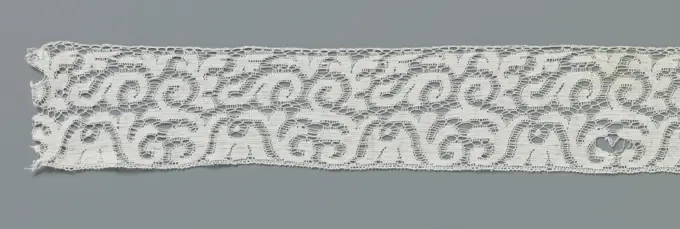
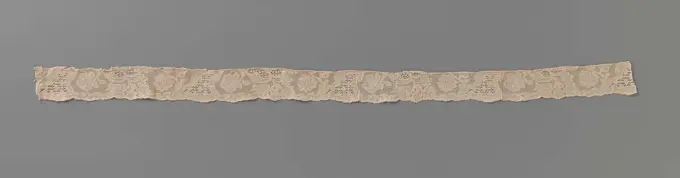
Border, Medium: linen Technique: bobbin lace, Border of Binche bobbin lace in scrolling floral pattern with snowflake ground., Belgium, 18th century, lace, Border
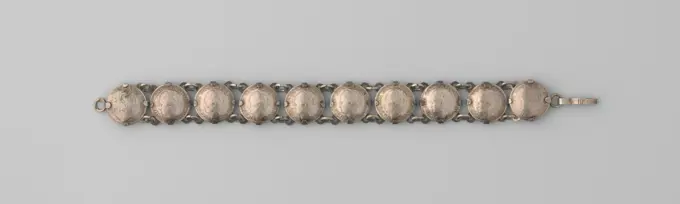
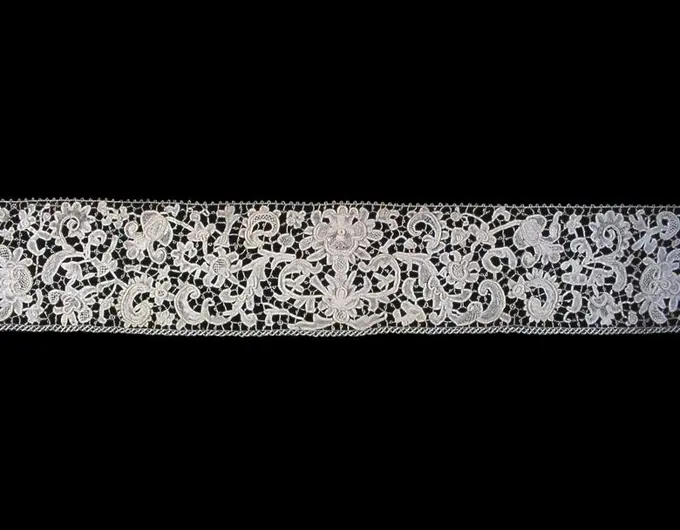
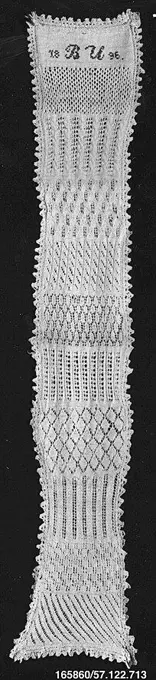
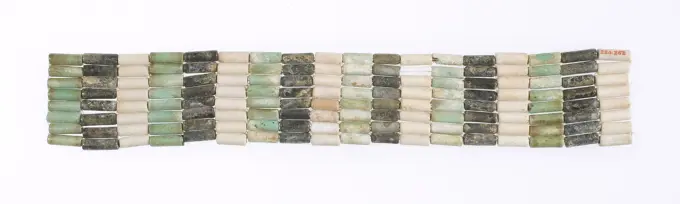
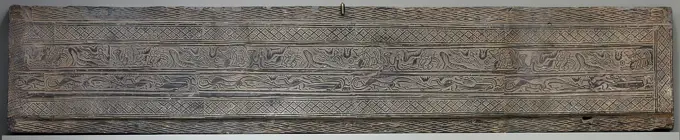
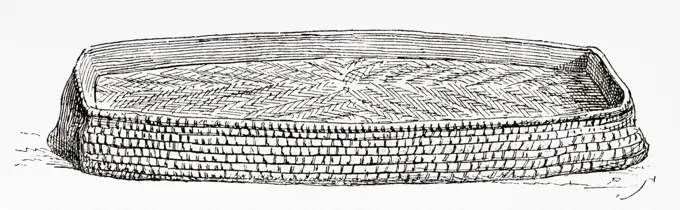
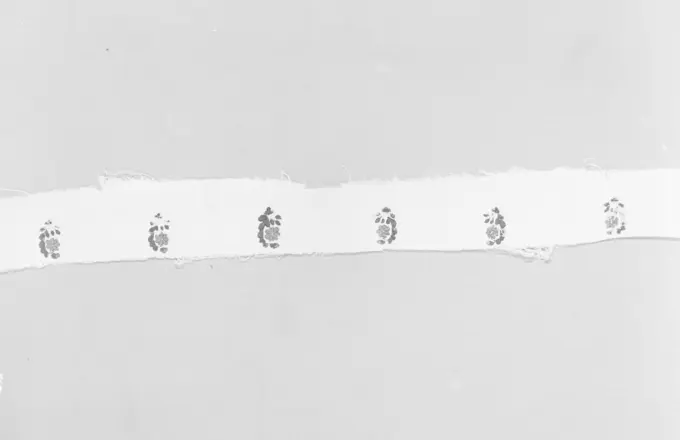
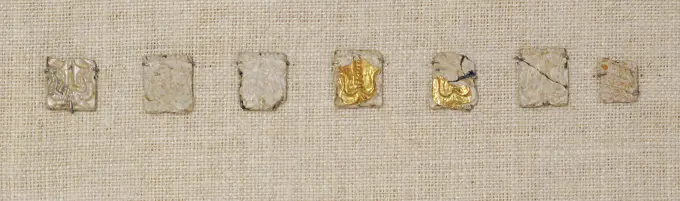
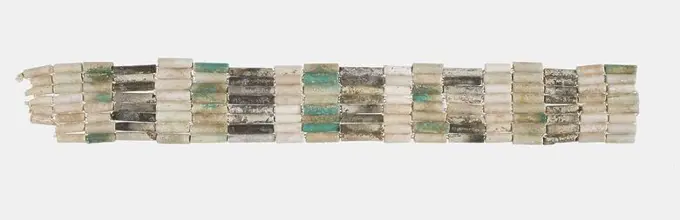
Bobbin Lace Edging, late 18th or early 19th century. France, Valenciennes , late 18th or early 19th century. Lace, bobbin; average: 8 x 157.5 cm (3 1/8 x 62 in.).Silver bracelet made of bol beaten Dutch dimes, c. 1940 - c. 1950 Silver bracelet made of ten ball beaten Dutch dimes with a hook closure. The dimes are connected by round eyes that are attached to each dime with a frame per four of which links are strung. Netherlands silver (metal) Silver bracelet made of ten ball beaten Dutch dimes with a hook closure. The dimes are connected by round eyes that are attached to each dime with a frame per four of which links are strung. Netherlands silver (metal)Galloon 18th century French. Galloon. French. 18th century. Metal thread. Textiles-TrimmingsCeremonial Undergarment (Kamen) Java. Cotton, plain weave; wax resist dyed (batik) .Fragment 17th century Italian. Fragment 212943Selendang (Shawl) Java. Finely woven silk dyed cinnamon brown; all-over design in black made by batik process in diagonal pattern of squares and rectangles enclosing diamond and formalized flower patterns; border consists of hear or leaf shaped band above straight lines running to twisted fringe dyed black .Two Rectangular Ornaments with Strapwork, Foliage and an Eagle 19th century John Gregory Crace British. Two Rectangular Ornaments with Strapwork, Foliage and an Eagle 363504Textile Fragment 3rd-4th century. Textile Fragment. 3rd-4th century. Wool, linen; plain weave, tapestry weave. Made in Egypt. TextilesStrip of machine side with hanging chalice of loose S-Voluten, anonymous, c. 1890 - c. 1914 Strip of natural -colored machine side: Machine Flanders side. The repeating pattern consists along the bottom half of the strip of a hanging chalice, flanked and crowned by loose S-volutes. Openwork edges run around the closed motifs. The motifs are connected by a machine soil that suggests a braid ground. Top and bottom of the strip are straight finished, with the bottom with picots. Nottingham (possibly) cotton (textile) Strip of natural -colored machine side: Machine Flanders side. The repeating pattern consists along the bottom half of the strip of a hanging chalice, flanked and crowned by loose S-volutes. Openwork edges run around the closed motifs. The motifs are connected by a machine soil that suggests a braid ground. Top and bottom of the strip are straight finished, with the bottom with picots. Nottingham (possibly) cotton (textile)Swaddling cloth, Medium: cotton Technique: predominantly warp-faced plain weave patterned by warp floats, Italy, late 19th century, woven textiles, Swaddling clothGold switch bracelet with diamond -shaped link, c. 1935 - c. 1940 Gold bracelet with diamond -shaped link, which is rectangular. Equipped with a baking closure with a safety night. Amsterdam gold (metal) Gold bracelet with diamond -shaped link, which is rectangular. Equipped with a baking closure with a safety night. Amsterdam gold (metal)Trimming, Medium: silk Technique: woven, Yellow trimming fragment in a design of alternately placed lozenge and cross motifs., France, 19th century, trimmings, TrimmingNeedlepoint (Drawnwork or Punto Tirato) Lace Insertion, 16th century. Italy, Venice, 16th century. Lace, needlepoint: linen; average: 3.5 x 29.3 cm (1 3/8 x 11 9/16 in.).Galloon 17th-18th century Italian or French. Galloon. Italian or French. 17th-18th century. Textiles-TrimmingsGalloon 18th century French. Galloon 214047Border (France); block-printed paper, gilt, flocked; 86 x 8.5 cm (33 7/8 x 3 3/8 in.)Edge; straw, silkFragment (Japan)Border (From a Cover). England. Date: 1601-1700. Dimensions: 19.5 × 305.1 cm (7 5/8 × 120 1/2 in.). Linen, needle lace with woven tapes. Origin: England. Museum: The Chicago Art Institute, Chicago, USA.Gimp 16th century Spanish. Gimp. Spanish. 16th century. Textiles-TrimmingsLace, 1700s, maker unknown.Strip bobbin with poppies, anonymous, c. 1600 - c. 1799 Strip of natural -colored bobbin, Portuguese side. The repeating pattern consists of the flower of a poppy, which is alternated by the flower heart of this poppy on a short stem. On the coarse diamond -shaped Maas soil there is a stray pattern here of not clearly defined shapes, which increase in size towards the upper edge. We worked with thick threads. The motifs are made in linen battle with openwork edges and with a configuration of some recesses in the Bloemharten. The underside is slightly wavy and trimmed with picots. The top is straight. Spain (possibly) linen (material) bobbin lace Strip of natural -colored bobbin, Portuguese side. The repeating pattern consists of the flower of a poppy, which is alternated by the flower heart of this poppy on a short stem. On the coarse diamond -shaped Maas soil there is a stray pattern here of not clearly defined shapes, which increase in size towards the upper edge. We worked with thicEdging, Medium: linen Technique: bobbin lace, peasant style, peasant style with zigzag band and animal inserted, Italy, 19th century, lace, EdgingTextile (USA); cottonTowel fragment, Medium: linen, cotton Technique: plain weave with supplementary weft, Supplementary blue weft floating alternatively face to face forming a design of birds flanking a rosette., Italy, 17th century, woven textiles, Towel fragmentPiece (one of three) 18th century French. Piece (one of three) 218294Gold sparkling ribbon for header or decor. Template of golden ribbon. Gold sparkling ribbon for header or decorNeedlepoint (Point Alençon) Lace Edging, late 18th century. France, Alençon, late 18th century. Lace, needlepoint; average: 7.1 x 210.8 cm (2 13/16 x 83 in.).Fragment, Medium: linen Technique: bobbin lace (Brussels-style), Fragment has delicate small-scale diagonal flowering branches with small sprays scattered over vrai droschel ground., Belgium, late 18th century, lace, FragmentBand, Medium: silk, linen, metallic Technique: complementary weft 2/1 twill, Heraldic motifs; shields with 'S' shapes on them, an eagle with outstretched wings and part of a lion., Spain, 14th century, woven textiles, BandNeedlepoint Lace Lappet, 1715-1774. France, Argentan, 18th century (Period of Louis XV, 1715-1774). Lace, needlepoint: linen; overall: 279.4 x 12 cm (110 x 4 3/4 in.).Fragment, Medium: cotton Technique: printed on plain weave, Fragment printed in red, brown and black on a white ground in a design of solid vertical stripes alternating with stripes of geometric patterning., USA, 1870-80, printed, dyed & painted textiles, FragmentGlove, c. 1850. Flanders, 19th century. Bobbin (Duchese) lace; overall: 26.1 x 12.1 cm (10 1/4 x 4 3/4 in.).Galloon mid-18th century French. Galloon 214098Orphrey Band Fragment (Germany); silk, linen, metallicCooper Union Museum Lace Study Card, Medium: linen Technique: bobbin lace, Lace fragment with a five-hole ground referred to as 'fond à cinq trous.' Fragment is mounted on a fabric-covered board and framed behind glass. Frame is natural wood., Belgium, 18th century, lace, Fragment, FragmentMedical Instrument with Forked Blade. UnknownStrook kloskant met bloemtakken tussen hoornvormige reserves.Strip natural colosside: Mechelen side. The repeating pattern consists of flower branches between consecutive horn-shaped reserves, which are up with the curly points and start with the broad base along the bottom. The motifs are connected by a fine Maas soil, the Malinois. The motifs are made in linen stroke with recesses, and with thicker and shiny contour wires. Different ornamental grounds have been applied, including a snowflakes soil and in the ornamental ground in the horns, small motifs are processed in the form of rosette flowers and dots. The scalloped underside comes from the pattern and is finished with picots. The top is just finished.Cap Streamers (Belgium); linenBorder (France); block-printed, flocked, stencilled, handmade paper; 90 x 19 cm (35 7/16 x 7 1/2 in.)Field of four edge tiles with animals, anonymous, c. 1600 - c. 1630 Tile field of four edge tiles (1 x 4), each with a blue painted animal on a ground. Netherlands earthenware. tin glaze majolica Tile field of four edge tiles (1 x 4), each with a blue painted animal on a ground. Netherlands earthenware. tin glaze majolicaTextile, China, 18th-19th century, woven textiles, TextileBobbin Lace Insertion, mid 16th century. Italy, Venice, mid 16th century. Lace, bobbin; average: 3.5 x 24.8 cm (1 3/8 x 9 3/4 in.).Pair of bedposts 18th century French. Pair of bedposts 189741 French, Pair of bedposts, 18th century, Wood, gilt, Length (each): 60 in. (152.4 cm). The Metropolitan Museum of Art, New York. Gift of J. Pierpont Morgan, 1906 (07.225.489a, b)Edging, Medium: linen Technique: bobbin lace (Valenciennes ground), Narrow edge lace in a design of small circular ornaments on diamond mesh with a scalloped border., France, 19th century, lace, EdgingCollar third quarter 17th century Italian. Collar 168284Valence, 18th-19th century, 59 x 12 in. (149.86 x 30.48 cm), Silk; passementerie, 18th-19th centuryStrook gehaakte kant met vijfpuntige sterren en bloemen gemaakt met open cirkels.Strip natural-colored Irish crochet side. Pattern consists of a double row with triangular floral motifs made with open circles, interspersed with one five-pointed star with a circle in the middle and to each point a circle. Crocheted irregular mesh soil with picots. Upper finished with a picoted bow edge. The picoted slot on the underside stems from the pattern with the triangular floral motifs and stars.Frame fragment (cross-bar). Culture: French. Dimensions: 5 × 48 in. (12.7 × 121.9 cm). Date: first half 18th century. Museum: Metropolitan Museum of Art, New York, USA.Fringe (Italy); silkPiece 18th century possibly French. Piece 225147Fragments (England); linenBorder (Italy); silk, metallic threadTrimming (France); 1909-2-169Womans Waist Wrapper Fragment (Sora Langi)Border, Block-printed paper, Against a warm gray band, a yellow serpentine vine with circular tendrils bearing blue grape leaves and clusters of three grapes bordered above and below by a narrow blue stripe and brown band., England, 1865-1875, Wallcoverings, BorderTextile Fragment 5th century. Textile Fragment 443964Silver bracelet 'connected buckle', c. 1940 - c. 1950 Silver bracelet 'connected buckle' with a hook closure. Voorburg silver (metal) Silver bracelet 'connected buckle' with a hook closure. Voorburg silver (metal)Japanese or belt, from double cord strass diamonds. Japanese or belt, from double cord strass diamonds. As a brilliant strass stabs are attached to a silver gallone. With an eye, both cords are attached to each other at the ends.Japanese or belt, from double cord strass diamonds. Japanese or belt, from double cord strass diamonds. As a brilliant strass stabs are attached to a silver gallone. With an eye, both cords are attached to each other at the ends.Sampler 19th century German. Sampler 228636Bobbin Lace Edging with Loops, 17th century. Italy, Venice, 17th century. Lace, bobbin; average: 3.2 x 24.2 cm (1 1/4 x 9 1/2 in.).Trim, printed cotton border, 18th-19th century, 8 x 2 in. (20.32 x 5.08 cm), Cotton; passementerie, 18th-19th centuryDecorative band for clothing, late 19th century, 37 3/4 x 2 3/4 in. (95.89 x 6.99 cm), Silk, cotton; cross-stitch, Uzbekistan, 19th centuryInsertion ca. 1600 Greek. Insertion. Greek. ca. 1600. Bobbin lace. Textiles-LacesBelt -Lace Fragment ca. 1878 American. Lace Fragment 14906Strip crocheted side with five -pointed stars and flowers made with open circles, anonymous, c. 1890 - c. 1909 Strip of natural -colored Irish crocheted side. Pattern consists of a double row with triangular floral motifs made with open circles, interspersed with one five -pointed star with a circle in the middle and a circle on each point. Crochet irregular mesh soil with picots. Top finished with a picoted bow edge. The potented scales on the underside stem from the pattern with the triangular floral motifs and stars. Ireland cotton (textile) Strip of natural -colored Irish crocheted side. Pattern consists of a double row with triangular floral motifs made with open circles, interspersed with one five -pointed star with a circle in the middle and a circle on each point. Crochet irregular mesh soil with picots. Top finished with a picoted bow edge. The potented scales on the underside stem from the pattern with the triangular floral motifs and stars. Ireland cotton (textile)Anklet ca. 1802-1700 B.C. Middle Kingdom. Anklet. ca. 1802-1700 B.C.. Black, white and green faience. Middle Kingdom. From Egypt, Memphite Region, Lisht North, Tomb 954, Burial 954E, MMA excavations, 1921-22. Dynasty 13 to 1700 B.C.Tomb Tile, 1st-2nd century, 9 x 47 x 1 1/4 in. (22.86 x 119.38 x 3.18 cm), Earthenware with impressed decor, China, 1st-2nd century, Tombs of Han nobility were often decorated with ceramic tiles bearing painted or impressed designs like this one, whichBorder, Technique: bobbin lace, Bobbin lace edge, floral tab edge; mid-18th century Flemish, mid-18th century, lace, BorderHeadband, 22 1/4 x 1 1/8 in. (56.52 x 2.86 cm), Cotton, ChinaTypical traditional aboriginal basket. Pagara of the Wayana Indians tribe, French Guiana, South America. Drawing by P. Sellier. From Cayenne to the Andes (1878-1879) by Jules Crevaux (1847 - 1882) Le Tour du Monde 1880Piece ca. 1775 American. Piece. American. ca. 1775. Linen embroidered with wool. Made in New England, United StatesGlass ornaments with gold leaf overlay ca. 1370-1200 B.C. Helladic, Mycenaean Set of six matching ornaments, all made in same or very similar molds.Semi-translucent blue.Square panel; uneven flat back; straight edges; gold leaf overlay.Molded decoration on front: along top or bottom edge, a narrow band of vertical ribs; below, a motif (lotus ) comprising a central vertical spike, flanked to either side by wavy petals or leaves. Two plaques retain part of the gold leaf decoration that covered the front.Three ornaments are intact (one with gold leaf), one is broken but complete, and the other three (one with gold leaf) are fragmentary; dulling, thick creamy brown weathering, and slight iridescence.Deterioration of the glass is responsible for its pale color. The practice of overlaying a glass ornament with gold foil is well attested.. Glass ornaments with gold leaf overlay. Helladic, Mycenaean. ca. 1370-1200 B.C.. Glass; mold-pressed. Late Helladic III. GlassBorder (France); cottonSash, Medium: wool Technique: diagonal interlacing, Long and narrow sash with fringes at each end with pattern of chevrins. known as 'ceinture flêche'., 19th century, SashFringe, Medium: silk, metallic thread (gold strips on silk core) Technique: plain weave, Fringe of red and gold threads with a heading and looped skirt threads arranged to give a scalloped edge; ornamented at intervals with red tufts., Italy, 17th century, trimmings, FringeFragment (Band) Peru. .Fragment, 700s. China or Japan, 8th century. Gauze ground, resist dyed; overall: 24.5 x 2.6 cm (9 5/8 x 1 in.).Panel Made 1870-1880 England. Cotton, plain weave; embroidered with silk in satin, surface satin, and stem stitches; laid work and couching . Morris & Co. (Designer)Needlepoint Lace Insertion, 17th century. Greece, Crete , 17th century. Lace: needlepoint; average: 4.8 x 38.2 cm (1 7/8 x 15 1/16 in.).Velourau Sable, late 19th - early 20th century. France, Germany, Switzerland, America, late 19th - early 20th century. Velvet weave, silk; overall: 150.3 x 18.4 cm (59 3/16 x 7 1/4 in.).Fringe (Spain); silkNeedle. UnknownGimp mid-18th century French. Gimp. French. mid-18th century. Silk. Textiles-TrimmingsTextile with Pomegranate Motif 15th century Italian. Textile with Pomegranate Motif 465908 Italian, Textile with Pomegranate Motif, 15th century, Velvet, Overall: 41 13/16  9 3/4 in. (106.2  24.8 cm) Storage (Mat with 17.29.2): 52  27 in. (132.1  68.6 cm). The Metropolitan Museum of Art, New York. Rogers Fund, 1917 (17.29.3)Tegeltableau van 26 tegels.Tile tile of 26 tiles (13 x 2) with a purple painted festoon of flowers, decorated at the top with a bow and in the middle an oval with landscape.Wampum belt -Rand decoration with pattern of braided ornaments, Reinier Willem Petrus de Vries (1874-1953), 1884 - 1952 print   paper  interlace ~ ornamentGerman gnomes are busy little  fellows, who do many useful  jobs as well as enjoying  themselves  Suspenders; silk, leatherTrimming (France); 1909-2-189Trimming (France); 1909-2-227Band 15th century German. Band. German. 15th century. Silk, metal thread. Textiles-WovenInsertion 18th century French. Insertion 214067Fringe, Medium: silk Technique: plain weave, Pink fringe with a heading and a looped skirt with pointed edges ornamented with tufts of floss., France, late 18th century, trimmings, FringeBracelet. Dimensions: l. 23 cm (9 1/16 in); w. 3 cm (1 3/16 in). Dynasty: Dynasty 12-13. Date: ca. 1981-1640 B.C.. Museum: Metropolitan Museum of Art, New York, USA.Sotck exchange. Mid -19th. GAL1960.63.6Ribbon possibly Austrian late 19th century