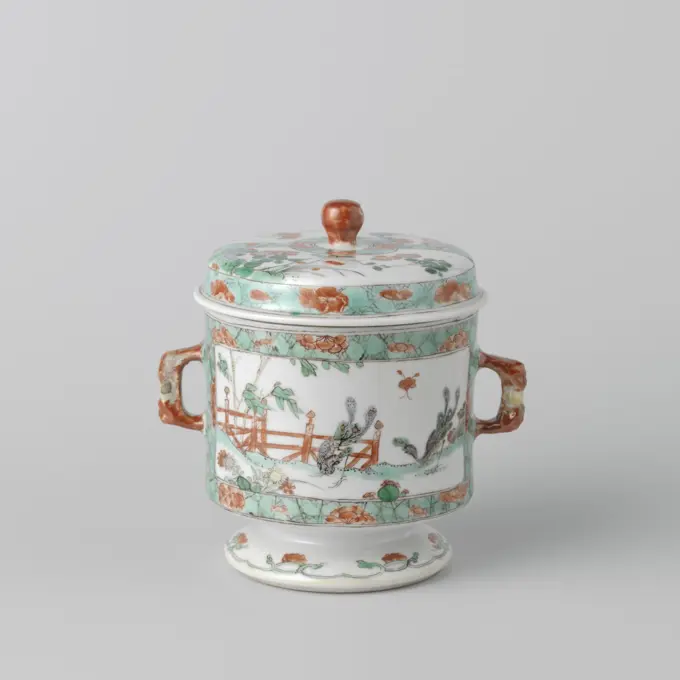
Decorative Porcelain Cups

Elegant porcelain cups and saucers adorned with colorful floral and antique motifs, showcasing craftsmanship from different cultural backgrounds and centuries.

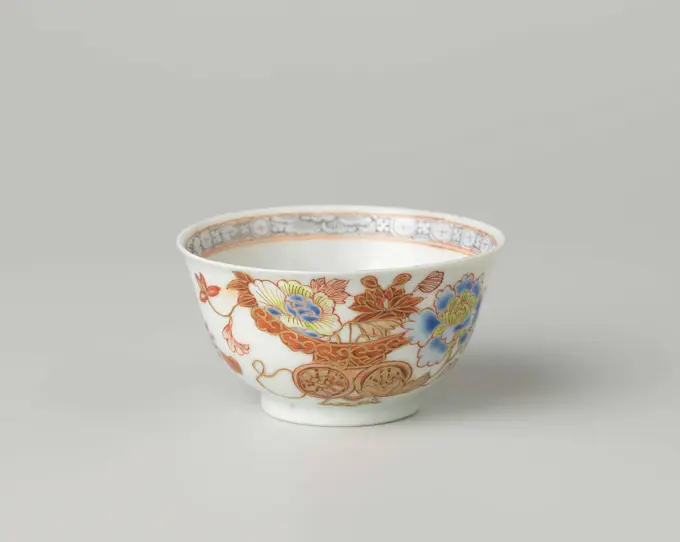
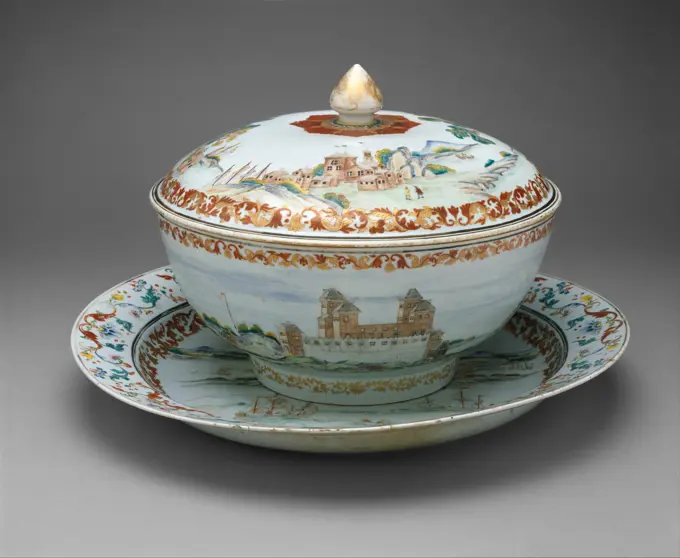
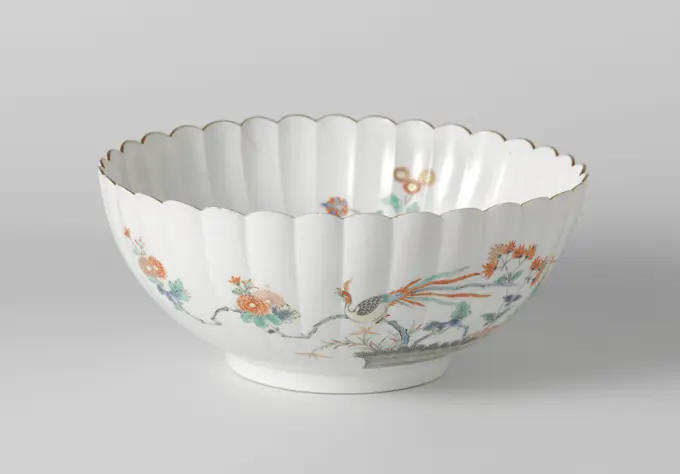
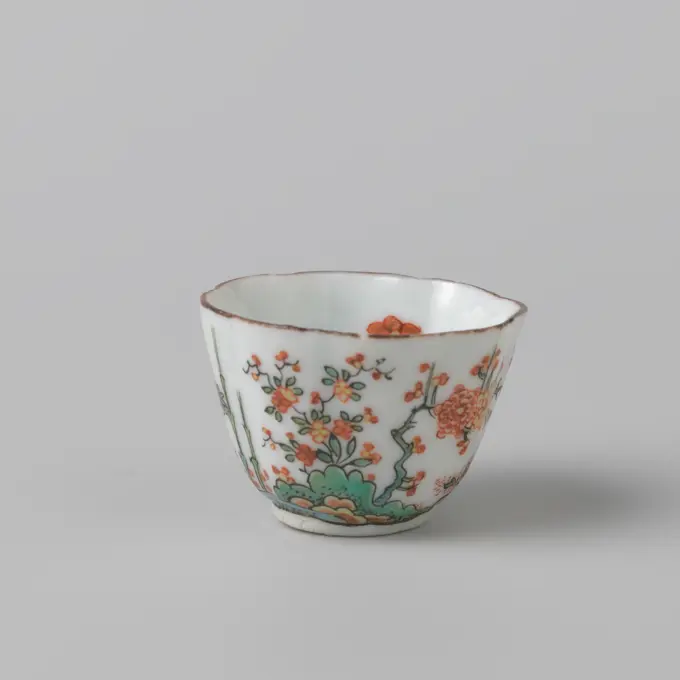
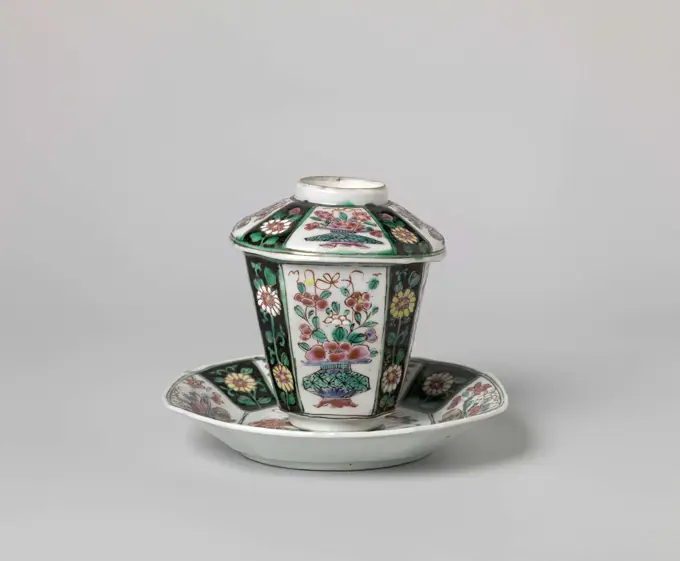
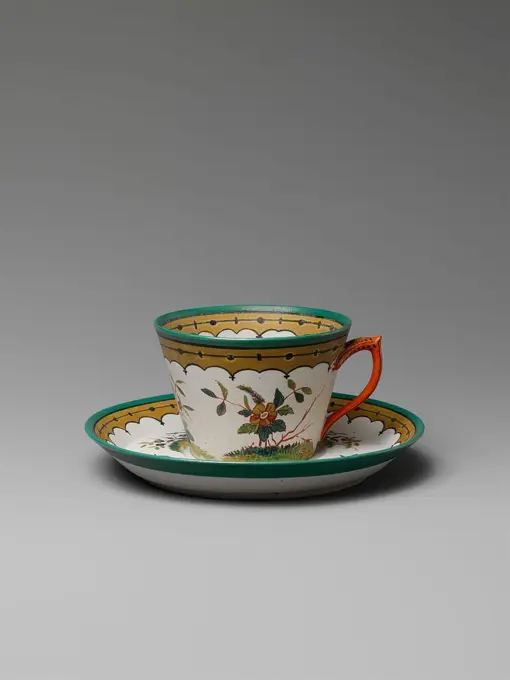
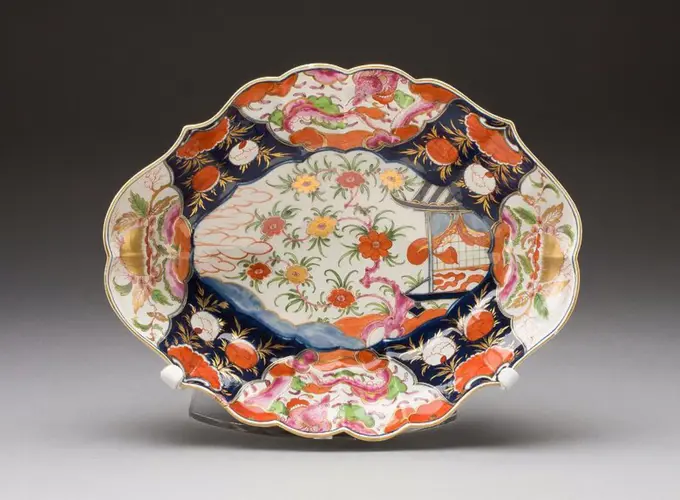
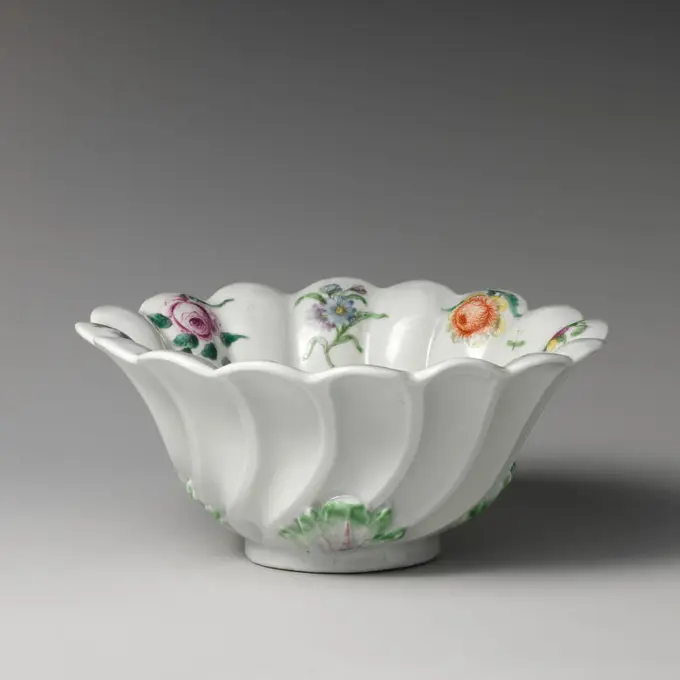
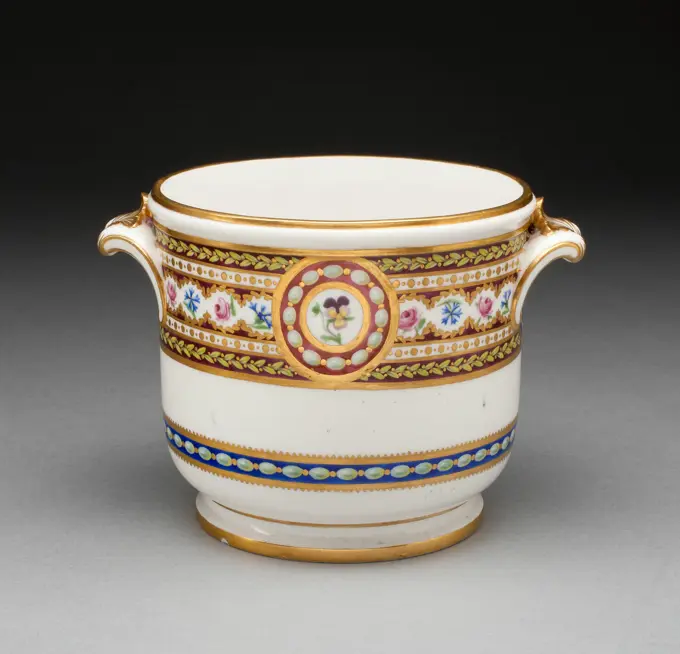
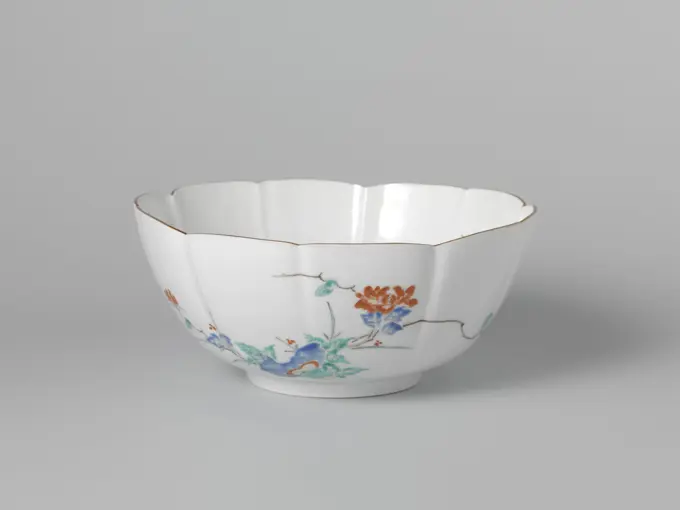
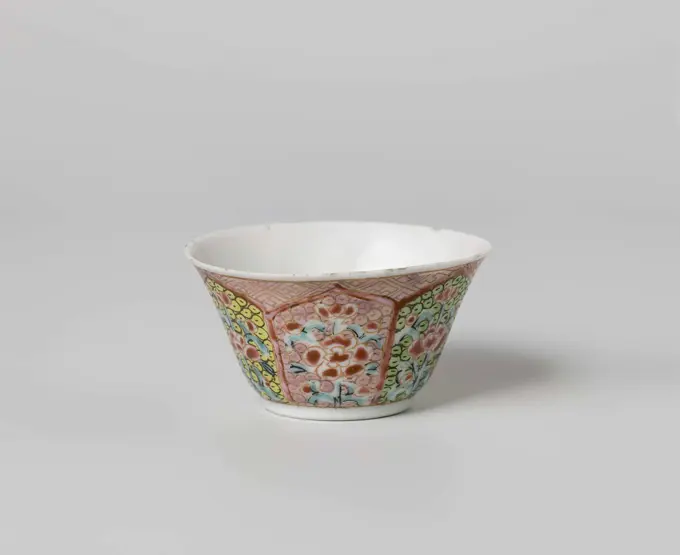
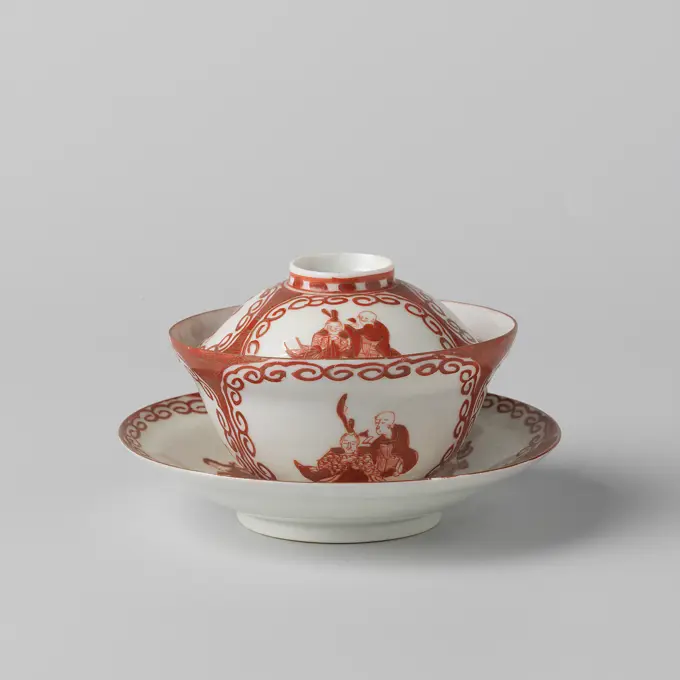
Bell-shaped cup and saucer with a flower basket, anonymous, c. 1725 - c. 1749 Klock -shaped head and dish of porcelain, painted on the glaze in blue, red, green, black and gold. On the flat of the dish a flower basket with two wheels and Ruyi motif filled with peony and lotus; for the basket a second object surrounded by flowers (peony and aster); On the edge a tire servetwork interspersed with flowers. The head with the same decoration. Dish has been broken. Porcelain with email colors. China porcelain. glaze. gold (metal) painting / gilding / vitrification Klock -shaped head and dish of porcelain, painted on the glaze in blue, red, green, black and gold. On the flat of the dish a flower basket with two wheels and Ruyi motif filled with peony and lotus; for the basket a second object surrounded by flowers (peony and aster); On the edge a tire servetwork interspersed with flowers. The head with the same decoration. Dish has been broken. Porcelain with email colors. China porcelain. gla
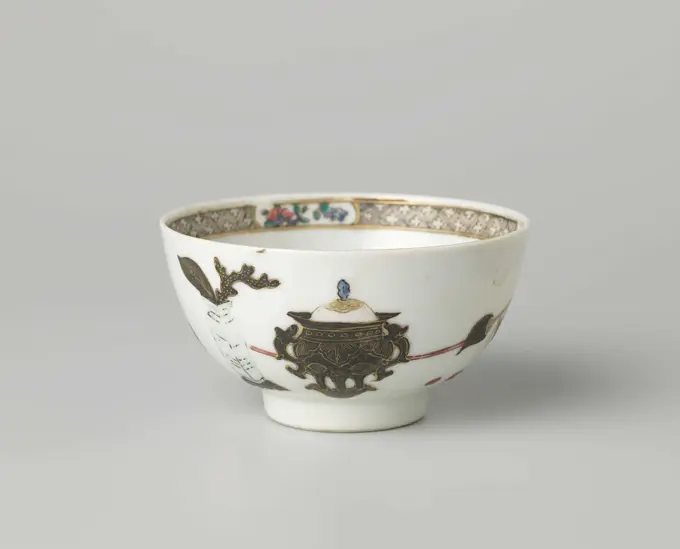
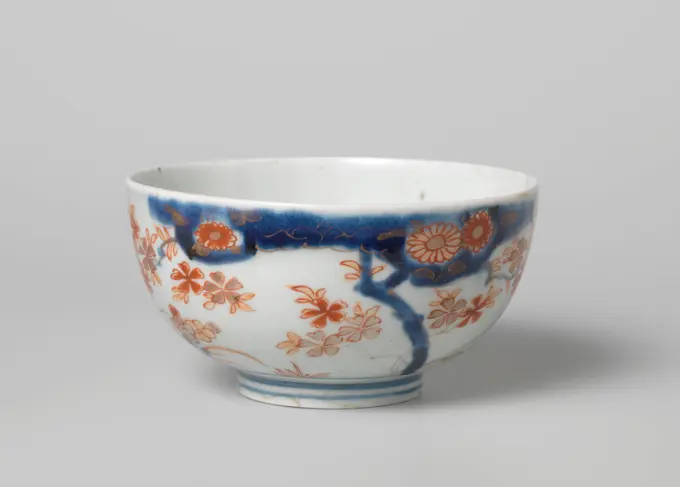
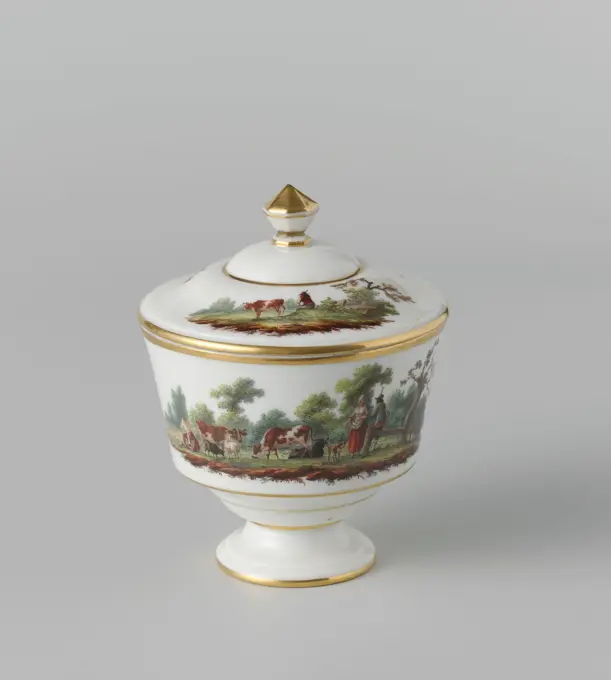
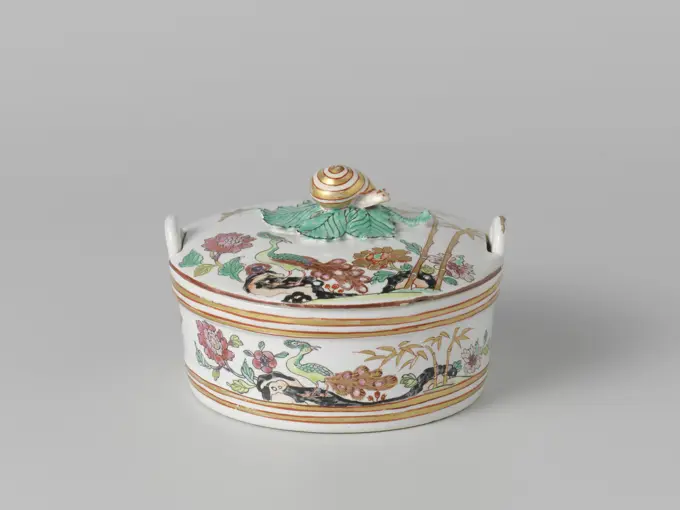
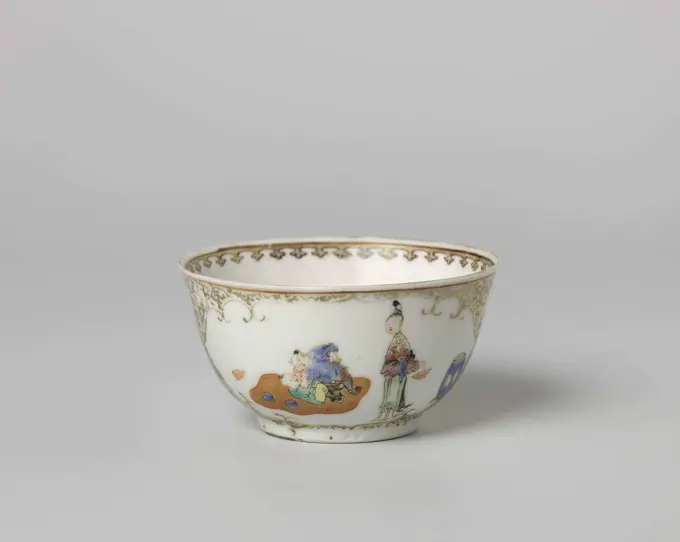
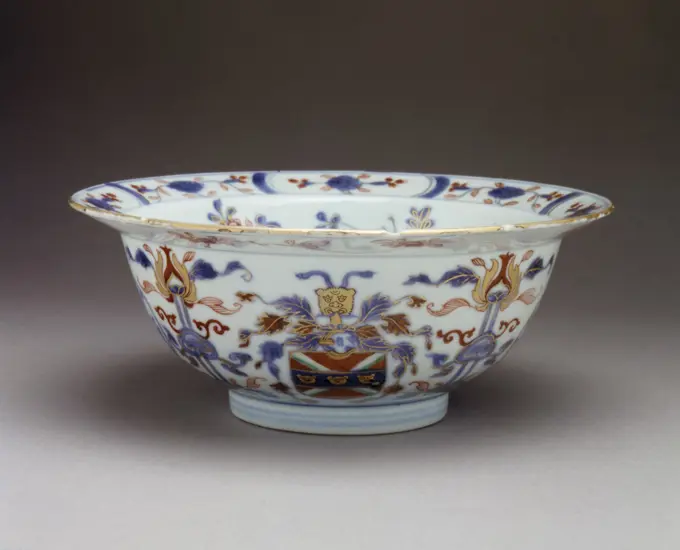
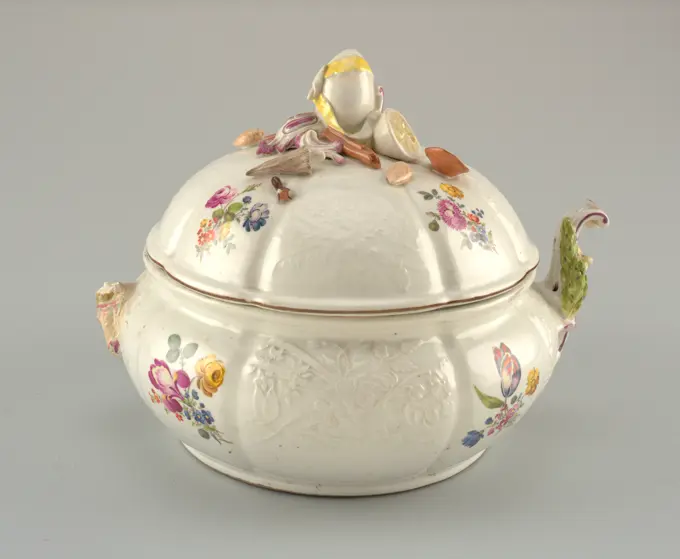
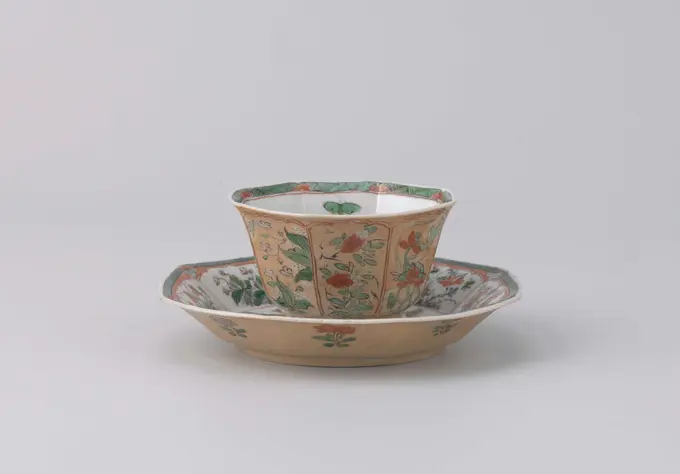
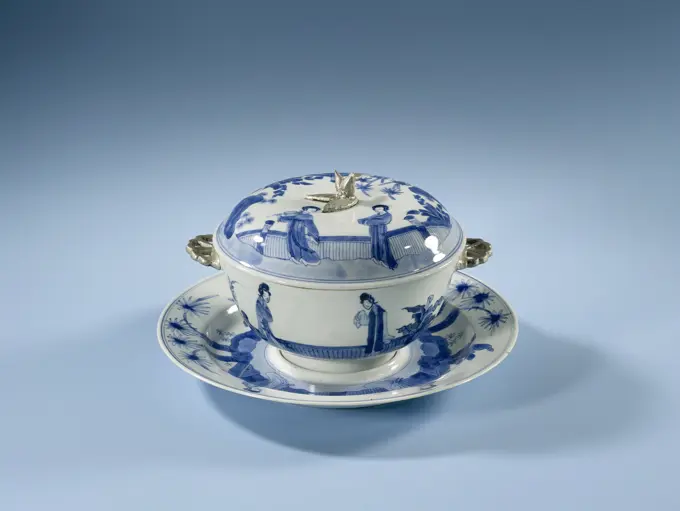
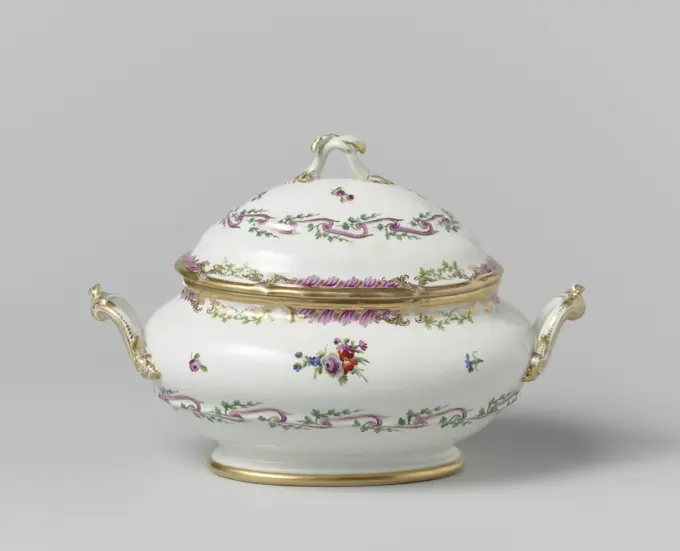
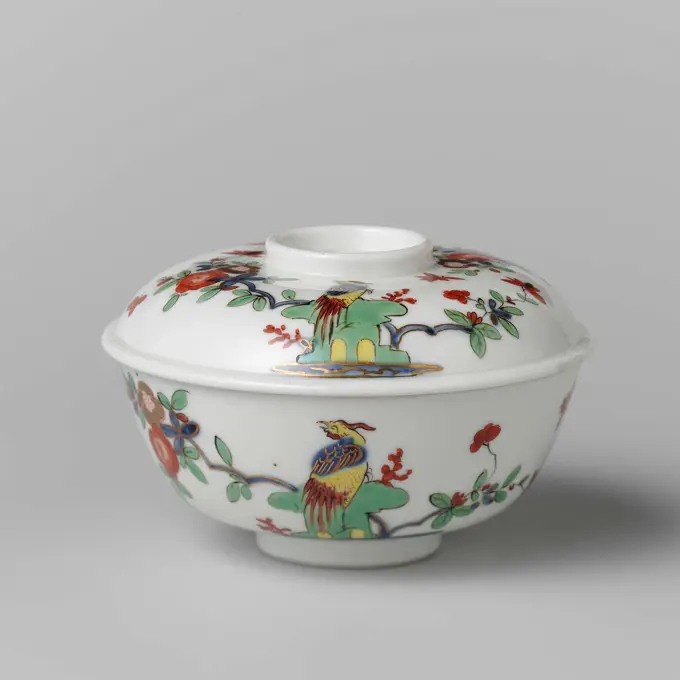
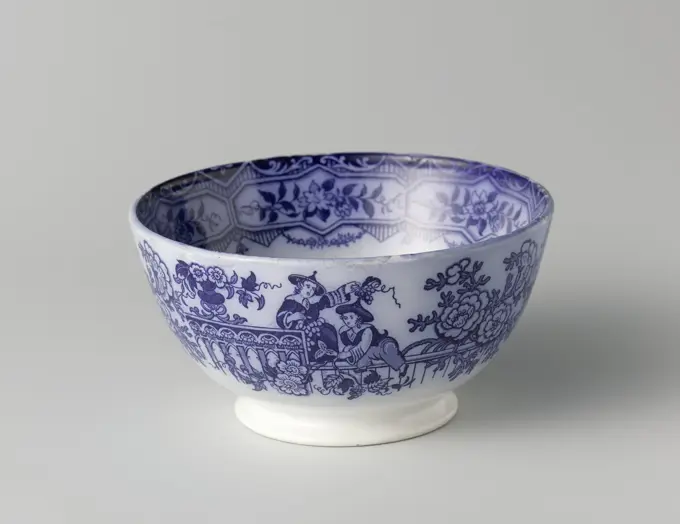
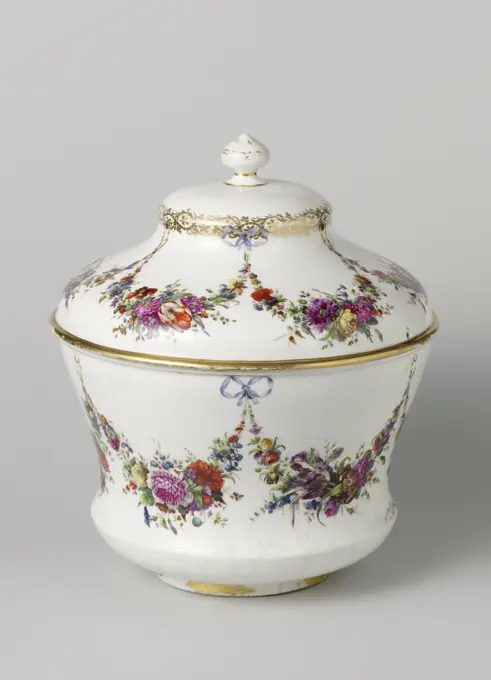
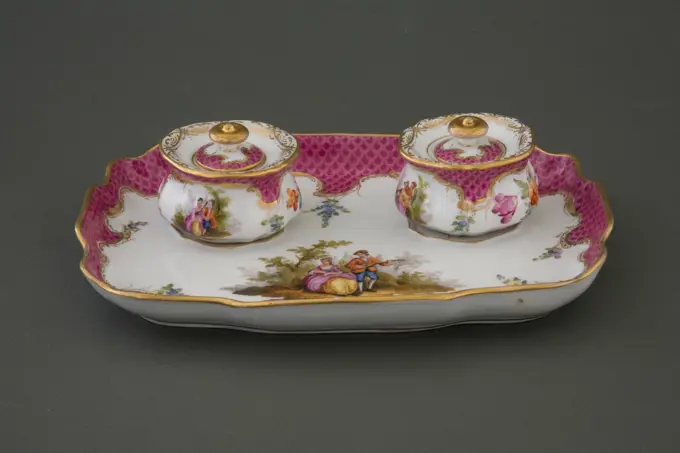
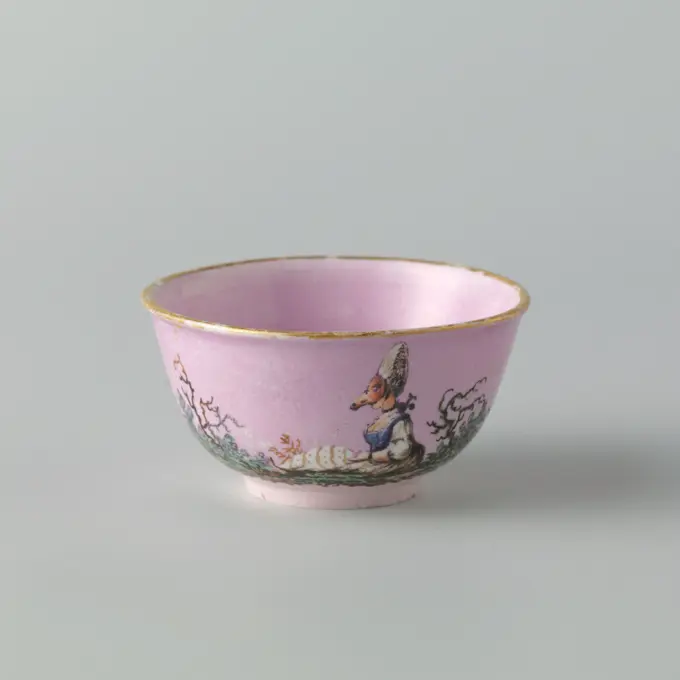
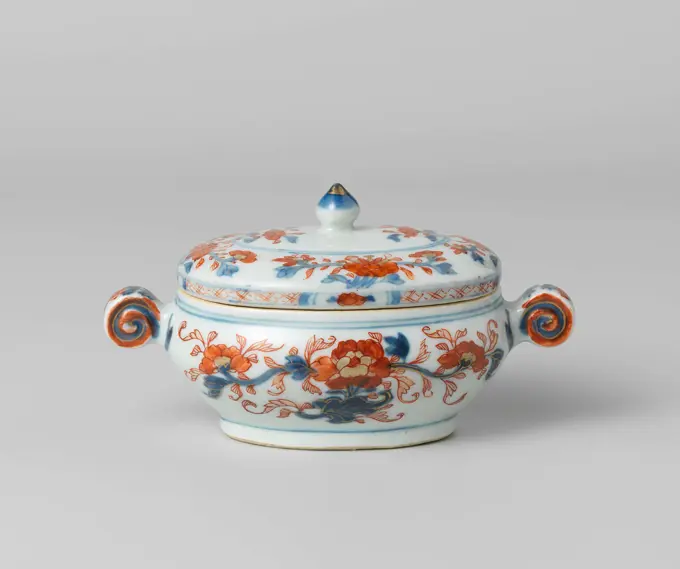
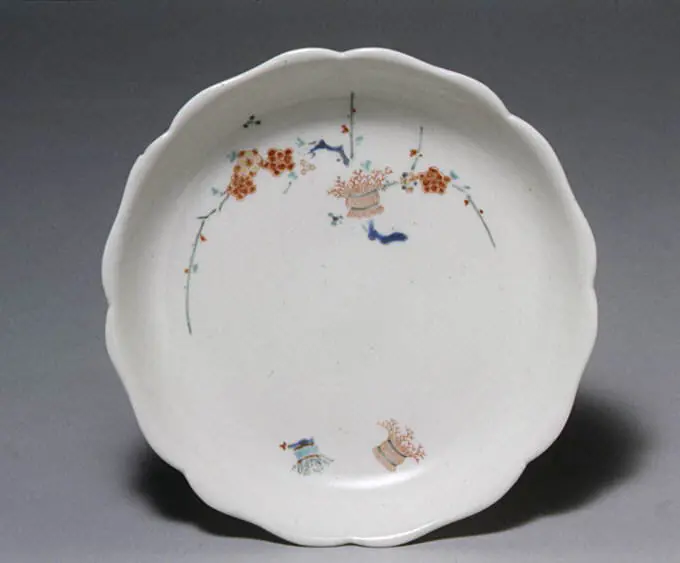
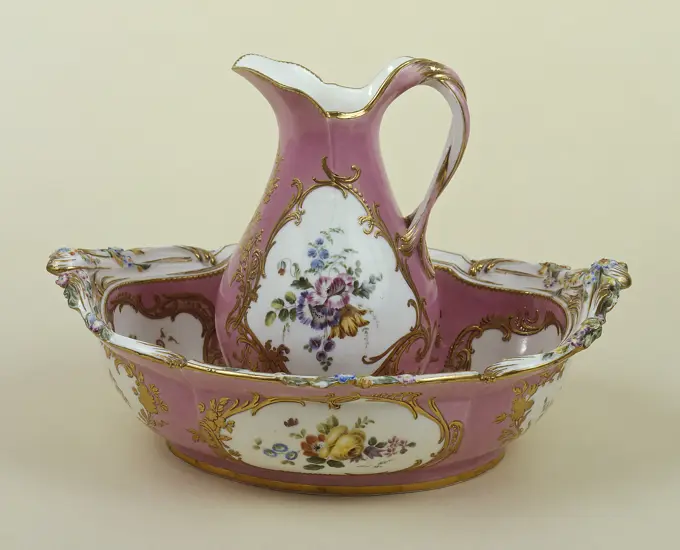
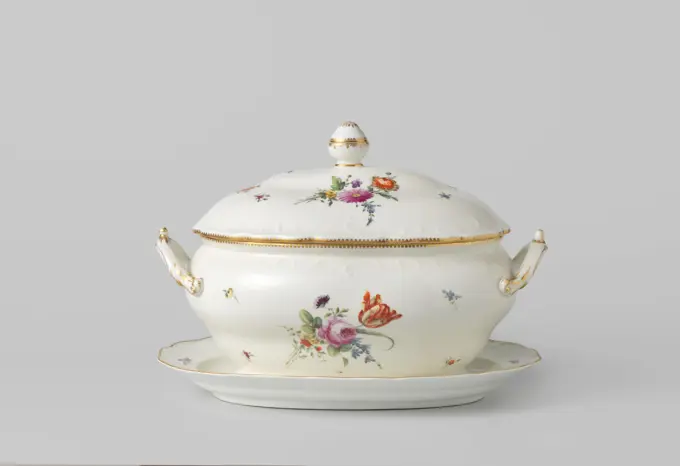
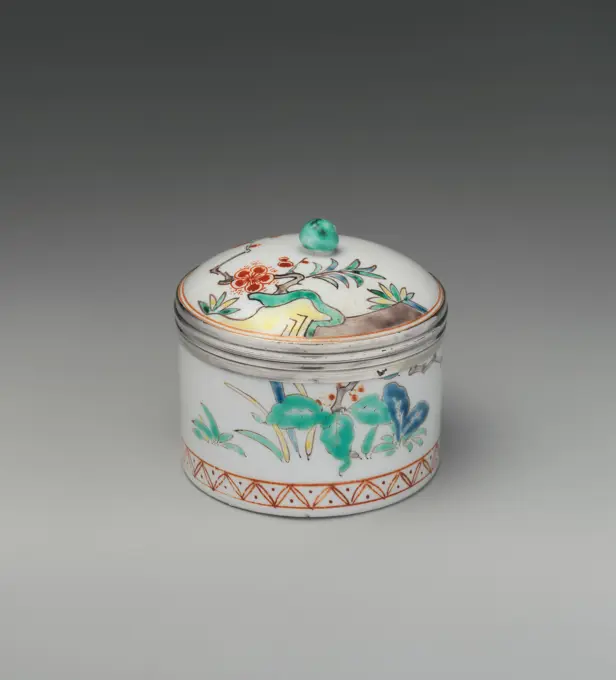
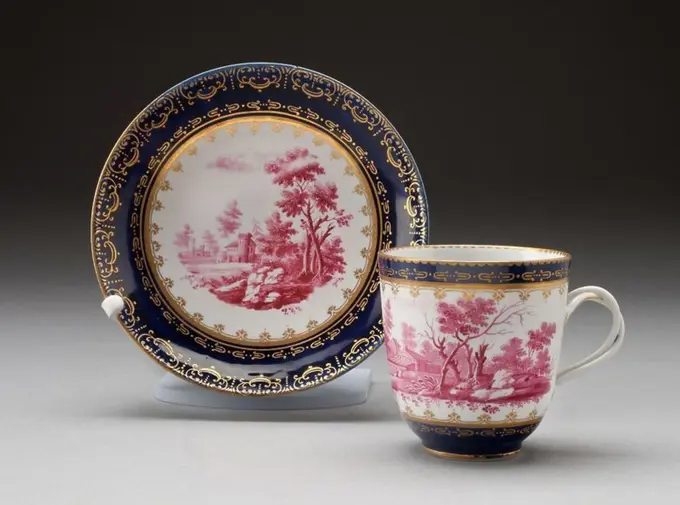
Bell-shaped cup and saucer with a flower basket, anonymous, c. 1725 - c. 1749 Klock -shaped head and dish of porcelain, painted on the glaze in blue, red, green, black and gold. On the flat of the dish a flower basket with two wheels and Ruyi motif filled with peony and lotus; for the basket a second object surrounded by flowers (peony and aster); On the edge a tire servetwork interspersed with flowers. The head with the same decoration. Dish has been broken. Porcelain with email colors. China porcelain. glaze. gold (metal) painting / gilding / vitrification Klock -shaped head and dish of porcelain, painted on the glaze in blue, red, green, black and gold. On the flat of the dish a flower basket with two wheels and Ruyi motif filled with peony and lotus; for the basket a second object surrounded by flowers (peony and aster); On the edge a tire servetwork interspersed with flowers. The head with the same decoration. Dish has been broken. Porcelain with email colors. China porcelain. glaHead with tie, porcelain factory The Hague, c. 1777 - c. 1790 Cup multicolored decorated with a tie on a ground. Along the edges a row of double arches. N.B. German porcelain painted in The Hague. Marked with blue stork. The Hail Hate Company: Ansbach porcelain Cup multicolored decorated with a tie on a ground. Along the edges a row of double arches. N.B. German porcelain painted in The Hague. Marked with blue stork. The Hail Hate Company: Ansbach porcelainOctagonal cup and saucer with light brown, animals and flower sprays, anonymous, c. 1700 - c. 1724 Octagonal cup and saucer of porcelain, partially covered with cafe-au-lait, painted in underly glaze blue and on the glaze red, green, yellow, eggplant and black. The outside of the head is covered with a cafe-au-lait-colored glaze with flower branches and butterflies with famille distance enamel in professional decoration; On the soil two hares and two birds with a rock with flowering plants; the inside of the wall with butterflies; The edge with zigzag work interspersed with flowers. The dish with the same decoration. Head marked on the underside with a hare in red email; The dish marked on the bottom with a character in a double circle. Famle distance with monochrome brown glaze. China porcelain. glaze. cobalt (mineral) painting / painting Octagonal cup and saucer of porcelain, partially covered with cafe-au-lait, painted in underly glaze blue and on the glaze red, green, yellow, eggplCup. Culture: China. Dimensions: H. 1 1/2 in. (3.8 cm); W. 2 3/4 in. (7 cm). Date: first half of the 19th century. Museum: Metropolitan Museum of Art, New York, USA.Cup With Antiques and Flower Sprays. Cup of porcelain with straight wall, painted on the glaze in blue, pink, green, black and gold. A group of antiques (vase with peacock feathers and coral, staff with a music stone, tripod) and a fruit basket with O.A. pomegranate and finger lemon depicted; The inner edge with napkin interspersed with flower branches in cartouches. Family Rose.Head without ear, painted with flowers and ladder motif. Cup without ear of porcelain. Multicolored painted with flower bouquets and a ladder motif along the edges.Bowl, Anonymous, c. 1770 - c. 1800Bell-Shaped Cup With a Flower Basket. Bell-shaped head of porcelain, painted on the glaze in blue, red, green, black and gold. A flower basket with two wheels and ruyi motif filled with peony and lotus; in front of the basket a second object surrounded by flowers (peony and aster); On the edge a band napkin interspersed with flowers. Porcelain with email colors.Bell-Shaped Cup from the 'SwellenGrebel service' with a double crowned monogram and a border with floral scrolls. Bell-shaped head of porcelain, painted on the glaze in blue, red, pink, green, yellow, black and gold. On the outer wall a crowned, double mirror monogram with 'mva' and 'tempered' surrounded by shell motifs, curl work and flower branches, the other side with a lotus drink; the inner edge with a bond with flower drinks; A flower rosette on the bottom. European performance in email colors.Turnen, porcelain factory The Hague, c. 1777 - c. 1790 Terrine with lid and under -phase painted in underly glaze blue and multicolored flower garlands. A fruit as a lid button. Marked with a stork in blue on the glaze. N.B. Doornik's soft porcelain with decoration in under -glaze blue partly painted in The Hague. The HaguePorlaine Company: Doornik porcelain Terrine with lid and under -phase painted in underly glaze blue and multicolored flower garlands. A fruit as a lid button. Marked with a stork in blue on the glaze. N.B. Doornik's soft porcelain with decoration in under -glaze blue partly painted in The Hague. The HaguePorlaine Company: Doornik porcelainBowl with trees and flowering plants, anonymous, c. 1775 - c. 1799 Come from porcelain, painted in underly glaze blue and on the glaze red and gold. On the outer wall a tree with flowers; Flowering plants between the trees. A medallion with a flower branch on the bottom. A crack in the bowl, restored with a Kram. Imari. Japan porcelain. glaze. cobalt (mineral). gold (metal) painting / gilding / vitrification Come from porcelain, painted in underly glaze blue and on the glaze red and gold. On the outer wall a tree with flowers; Flowering plants between the trees. A medallion with a flower branch on the bottom. A crack in the bowl, restored with a Kram. Imari. Japan porcelain. glaze. cobalt (mineral). gold (metal) painting / gilding / vitrificationSlop Bowl, Porcelain Factory The Hague, 1777 - 1790 Rinse bowl with a Roman portrait head in a medallion surrounded by a Guilloches band that is repeated on the upper edge. A bow above the medallion. Marked in blue under the glaze with a stork. N.B. German porcelain painted in The Hague. The Hail Hate Company: Ansbach porcelain Rinse bowl with a Roman portrait head in a medallion surrounded by a Guilloches band that is repeated on the upper edge. A bow above the medallion. Marked in blue under the glaze with a stork. N.B. German porcelain painted in The Hague. The Hail Hate Company: Ansbach porcelainOctagonal cup with flowering plants, anonymous, c. 1700 - c. 1724 Octagonal head of porcelain on four short feet, painted on the glaze in blue, red, green, yellow and black. Painted in Europe with plants flowering on the outer wall (peony, bamboo). A flower branch on the bottom. Marked on the bottom with three imitation Chinese characters. Decorated in Europe in the Japanese Kakiemon style. Chinapainter: Europe porcelain. glaze. painting / vitrification Octagonal head of porcelain on four short feet, painted on the glaze in blue, red, green, yellow and black. Painted in Europe with plants flowering on the outer wall (peony, bamboo). A flower branch on the bottom. Marked on the bottom with three imitation Chinese characters. Decorated in Europe in the Japanese Kakiemon style. Chinapainter: Europe porcelain. glaze. painting / vitrificationSugar vas lid, Royal Porcelain Factory Dommer & Co., c. 1809 - c. 1814 Decksle of sugar vas, painted with cow and farmer in landscape. Sprinkling flowers and golden edges and gold button. Nieuwer-Amstel porcelain Decksle of sugar vas, painted with cow and farmer in landscape. Sprinkling flowers and golden edges and gold button. Nieuwer-Amstel porcelainBotervloot, anonymous, 1740 - 1765 Butter fleet of multicolored painted with birds and flower branches. Delft . Butter fleet of multicolored painted with birds and flower branches. Delft .Bell-Shaped Cup With Ladies, Playing Boys and Floral Scrolls. Bell-shaped head of porcelain, painted on the glaze in blue, red, pink, green, yellow, black and gold. A scalloped cartouche with three ladies and three playing boys depicted surrounded by objects; to the cartouche flower reflection with utyscar in it four oval compartments with plants; A decorative band on the edge. Family Rose.Terrinel lid, belonging to a tableware with swimmotif with leafy branches, flower bouquets and sprinkled flower branches. Terrine lid, belonging to a porcelain crockery, decorated with a swapped ribbon motif in purple and gold with green leaf branches, flower bouquets and scattered flower branches. Edges lightly waved with decoration in gold with purple leaf motif. Since green crossed leaf motif. Signature: M.O.L. and Amstel.Cup with petal-shaped panel around a central medallion, filled with flower sprays, anonymous, c. 1750 - c. 1774 Porcelain head, painted in underly glaze blue and on the glaze red and gold. On the wall six petal-shaped compartments filled with flower branches; A flower vend between the courses; A medallion with flour on the bottom; The inner edge with three separate flowers. Chinese Imari. China porcelain. glaze. cobalt (mineral). gold (metal) painting / gilding / vitrification Porcelain head, painted in underly glaze blue and on the glaze red and gold. On the wall six petal-shaped compartments filled with flower branches; A flower vend between the courses; A medallion with flour on the bottom; The inner edge with three separate flowers. Chinese Imari. China porcelain. glaze. cobalt (mineral). gold (metal) painting / gilding / vitrificationBowl with coat of arms of the Horsmanden family ca. 1715 Chinese, made for British market. Bowl with coat of arms of the Horsmanden family 206348Soup Tureen with Ornamental Cover Tureen, ca. 1745; Manufactured by Meissen Porcelain Manufactory (Germany); porcelain, vitreous enamelCovered Sauce Tureen 1785-90 Chinese, for American market This object belongs to a large dinner service (10.149.1-.248) bearing the Townley family coat-of-arms. The service, probably ordered by Justice Samuel Chase (1741-1811) of Annapolis, Maryland, displays the enamel-painted arms of Margaret Townley, Chase's aunt.. Covered Sauce Tureen 2452Octagonal Cup and Saucer With Light Brown, Animals and Flower Sprays. Octagonal cup and saucer of porcelain, partially covered with café-au-lait, painted in underglaze blue and on the glaze red, green, yellow, eggplant and black. The outside of the head is covered with a café-au-lait-colored glaze with flower branches and butterflies with famille verte email in trade decoration; on the bottom two hare and two birds at a rock with flowering plants; the inside of the wall with butterflies; The edge with zigzag work interspersed with flowers. The dish with the same decoration. Head marked on the bottom with a hare in red email; The dish marked on the underside with a character in a double circle. Famille Verte.Bowl with Lid 17th-18th century. Bowl with Lid. 17th-18th century. Stonepaste; polychrome painted under transparent glaze. Made in Turkey, Kutahya. CeramicsSausom, belonging to service with a flung ribbon motif with leaf branches, flower bouquets and stripped flower branches, manufacture Oud-Loosdrecht, c. 1784 - c. 1809 Sauskom, belonging to porcelain service, decorated with a flung ribbon motif in purple and gold with green leaf branches, flower bouquets and sprinkled flower branches. Borders light golf with decoration in gold with purple leaf motif between which green crossed leaf motif. Marked: M.O.L. and Amstel. Porcelain Company: Loosdrecht-Porcelain Company: Ouder-Amstel porcelain Sauskom, belonging to porcelain service, decorated with a flung ribbon motif in purple and gold with green leaf branches, flower bouquets and sprinkled flower branches. Borders light golf with decoration in gold with purple leaf motif between which green crossed leaf motif. Marked: M.O.L. and Amstel. Porcelain Company: Loosdrecht-Porcelain Company: Ouder-Amstel porcelainCovered bowl with stand with women in a landscape, anonymous, c. 1700 - c. 1724 Come with a lid and underput of porcelain with half flower -shaped ears and flower -shaped button in biscuit, painted in underlaze blue. On the bowl a continuous representation of a fenced terrace with two times two women (long lips), palm tree and banana plant; the lid with the same decoration, now one of the women with fan; the dish with the same decoration, now four palm trees and two banana plants; On the back three peach branches. On the underside of the bowl and the dish marked with the six-character brand of Keizer Kangxi in a double circle. Ears and button later in Europe cashed in. A crack in the edge of the bowl. Blue White. China porcelain. glaze. cobalt (mineral). biscuit (porcelain, material). silver (metal) painting / vitrification Come with a lid and underput of porcelain with half flower -shaped ears and flower -shaped button in biscuit, painted in underlaze blue. On the bowl a continuous reSauce bowl with lid and underpotel, belonging to crockery with flung ribbon motif with leaf branches, flower bouquets and stripped flower branches, manufacture Oud-Loosdrecht, c. 1784 - c. 1809 Saus bowl with lid and underput, belonging to porcelain crockery, decorated with a flung ribbon motif in purple and gold with green leaf branches, flower bouquets and littered flower branches. Borders light golf with decoration in gold with purple leaf motif between which green crossed leaf motif. Marked: M.O.L. and Amstel. Porcelain Company: Loosdrecht-Porcelain Company: Ouder-Amstel porcelain Saus bowl with lid and underput, belonging to porcelain crockery, decorated with a flung ribbon motif in purple and gold with green leaf branches, flower bouquets and littered flower branches. Borders light golf with decoration in gold with purple leaf motif between which green crossed leaf motif. Marked: M.O.L. and Amstel. Porcelain Company: Loosdrecht-Porcelain Company: Ouder-Amstel porcelainTeapot with a tiger, birds and floral scrolls, anonymous, c. 1700 - c. 1799 Teapot of Soft-Paste Porcelain (Pâte Tendre) on foot and an S-shaped spout, painted on the glaze in blue, red, green, yellow, black and gold. The belly is in the form of a cylinder standing on the side, with an elevated medallion and an elevated circle on the flat wall. On the wall a tiger, two birds and a flowering plant. The round wall, the spout and the ear with flower vines. On the neck and the foot a band with archery interrupted by half flowers. The ear has largely been broken down. Porcelain lid with flower vines is not matching. Kakiemon style. Japan porcelain. soft-paste porcelain. glaze. gold (metal) painting / gilding / vitrification Teapot of Soft-Paste Porcelain (Pâte Tendre) on foot and an S-shaped spout, painted on the glaze in blue, red, green, yellow, black and gold. The belly is in the form of a cylinder standing on the side, with an elevated medallion and an elevated circle on the flat wall. Covered Bowl 1815-30 French. Covered Bowl 2449Tulip vase from a garniture ca. 1725 Vienna Established in 1718 in Vienna by Claudius Innocentius Du Paquier (d. 1751), the Du Paquier factory was the second in Europe to produce hard- paste porcelain.1 Since the factory did not have the knowledge of the necessary ingredients or kiln technology to make porcelain, Du Paquier required the expertise of someone from Meissen, the only factory with the capability at this time. Through an intermediary in 1717 Du Paquier enticed Christoph Conrad Hunger (Germany, dates unknown), who was working at Meissen, to assist in his endeavors, and in May of the following year Du Paquier received a privilege from the Habsburg Emperor Charles VI (1685-1740) for the production of “porcelain, majolica, and similar fine Indian wares” for a twenty- five-year period.2 Technical mastery had not been achieved by the date of the imperial privilege, however, and it took the involvement of another worker from Meissen, Samuel Stöltzel (German, 1685-1737), to brinTea Service for Two People (Tête-à-Tête), Manufactuur Oud-Loosdrecht, c. 1782 - c. 1784 Porcelain head. The head is decorated with a gold dipped green stock, which is closed on the edge with a chain motif in gold with gold dots. In this stock, an oval has always been saved with Dutchmen in and near a house on the water, on the other side of slave -made men of African origin working for a European. Loosdrecht porcelain Porcelain head. The head is decorated with a gold dipped green stock, which is closed on the edge with a chain motif in gold with gold dots. In this stock, an oval has always been saved with Dutchmen in and near a house on the water, on the other side of slave -made men of African origin working for a European. Loosdrecht porcelainBowl with prunus sprays.Bowl of porcelain with spreading wall, painted in underglaze blue, red and white sludge. On the wall prunus branches and bamboo leaves; the bottom with prunus brackets saved in a blue ground; On the inner edge a bond with prunus branches saved in a blue ground. Two chips and a crack in the edge; A chip in the foot ring. Signed on the underside with a diamond in a double circle. Middle blue with copper red.Covered Punch Bowl 1745-55 Chinese, for Swedish market This monumental punchbowl, with its original cover and platter, must have been one of the most ambitious porcelains to grace an American colonial household. We can only speculate as to how the bowl, the decoration of which indicates that it was made for the Swedish market, found its way to a prominent Charleston family during the eighteenth century. It was listed among the effects of Mary Brandford Bull, upon her death in 1772, as "1 large China Bowl Dish & Cover." The Bulls, one of Charleston's wealthiest families, lived in the grand style. Through the four daughters, the bowl descended in the family and ended up in Philadelphia by 1790. The detailed painted scene on the platter is based on a 1691 engraving of the Swedish Chteau of Läckö, on Lake Vänern. Two other Swedish chteaus drawn from earlier print sources are represented on the bowl; the cover features two Swedish churches in a landscape with huntsmen, fishermen, and sailCup with hedges, bamboo, prunus and hoo-bird, anonymous, c. 1670 - c. 1690 Porcelain head, painted on the glaze in blue, red, green, yellow, black and gold with bamboo, prunus and another plant with bound hedges, and a Hoo bird. Brown edge. A chip in the edge. Kakiemon. Japan porcelain. glaze. gold (metal) painting / gilding / vitrification Porcelain head, painted on the glaze in blue, red, green, yellow, black and gold with bamboo, prunus and another plant with bound hedges, and a Hoo bird. Brown edge. A chip in the edge. Kakiemon. Japan porcelain. glaze. gold (metal) painting / gilding / vitrificationPetalled bowl with brushwood fences, mistflower, chrysanthemum en hoo, anonymous, c. 1670 - c. 1690 Come, with ribbed wall of 33 ribs, painted on the glaze in blue, red, green, yellow, black and gold, with a Hoo bird on a chrysanthemum on a chrysanthemum in bound hedges and liver herb (Fujibakama, Eupatorium Fortunei ); On the other hand, liver herb and a flying Hoo-Vogel. On the inner wall three equal flower branches and on the bottom two Hoo birds in circular shape. Brown edge. A crack in the wall; A chip in the edge. Old label on the bottom with 'Collection Westendorp/ 108'. Kakiemon. Japan porcelain. glaze. gold (metal) painting / gilding / vitrification Come, with ribbed wall of 33 ribs, painted on the glaze in blue, red, green, yellow, black and gold, with a Hoo bird on a chrysanthemum on a chrysanthemum in bound hedges and liver herb (Fujibakama, Eupatorium Fortunei ); On the other hand, liver herb and a flying Hoo-Vogel. On the inner wall three equal flower branches and on the 4058 Dish; Manufactured by Copeland & Garrett (United Kingdom), Spode Ceramic Works; England; porcelain, overglaze enameling and gilding; 13 x 35.5 x 23.6 cm (5 1/8 x 14 x 9 5/16 in.); Bequest of Emily H. Chauncey; 1959-155-4Bowl with insects, flower sprays and grapevines, Rue Thiroux Parijs, c. 1797 - c. 1798 service (set). bowl Come (coil bowl) from porcelain, painted on the glaze in email colors and gold. The inside and outside are covered with colored insects (butterflies, beetles, dragonflies, etc.) and in gold flower branches and grape vines. Golden edge and gold lines closely. Marked on the underside 'GB/ Rue Thiroux/ à Paris'. Paris porcelain. glaze. gold (metal) painting / gilding / vitrificationDish ca. 1860-66 Chinese, for American market. Dish 3324Cup with Fluted Sides and Flowering Plants. Cup of porcelain with a ribbed wall, painted on the glaze in blue, red, green, yellow and black. Painted in Europe with plants blooming on the outer wall (peony, bamboo). A flower branch on the bottom; Four flower branches on the inner wall. Some chips in the edge. Decorated in the Japanese Kakiemon style in Europe.Covered Cup and Saucer with Flower Baskets and Floral scolls. Square lid head with dish of porcelain with beveled corners, painted on the glaze in blue, red, pink, green, yellow, and black. On the flat three flower branches and three twigs; a flower vase on the wall; On the corners a flower touch against a black soil. Cup and lid with the same decoration; Lid with an annular button. A crack in the head. Family Rose.Bell-Shaped Cup with a Crowned, illegible monogram surrounded by two Flower sprays. Bell-shaped head of porcelain, painted on the glaze in blue, red, pink, green, yellow, black and gold. On the outside wall twice a crowned, unreadable monogram surrounded by two flower branches; In between flower drinks containing two cartouches with a landscape and four medallions with plants. European performance in email colors.Cup and Saucer. Meissen Porcelain Manufactory; German, founded 1710. Date: 1740-1750. Dimensions: Cup: 4.5 x 9.7 cm (1 3/4 x 3 13/16 in.); Saucer: 2.9 x 13.2 cm (1 1/8 x 5 3/16 in.). Hard-paste porcelain, polychrome enamels, and gilding. Origin: Meissen. Museum: The Chicago Art Institute, Chicago, USA.Bowl with large flower sprays, flowering plants and fish, anonymous, c. 1800 - c. 1899 Come from porcelain with a slightly spreading edge, painted in underly glaze blue and on the glaze red, green, yellow, black and gold. The outside of the bowl with large flower branches interspersed with cartouches with flowering plants; On the foot a tire with curl, a decorative strap around the foot, on the edge a tire with servetwork interspersed with a flower branch in cartouche or twice a loose flower; the inside with the same decoration, with the exception of the courses with flowering plants; Five fish, two shells and aquatic plants on the bottom. Marked on the underside with two fish in a double circle. Email colors possible 19th century Japanese. A crack in the bottom. Chinese Imari. China porcelain. glaze. cobalt (mineral). gold (metal) painting / gilding / vitrification Come from porcelain with a slightly spreading edge, painted in underly glaze blue and on the glaze red, green, yellow, blTeacup and saucer. Culture: American. Designer: Designed by Karl L. H. Müller (ca. 1820-1887). Dimensions: Cup: H. 2 in. (5.1 cm); Diam. 2 7/8 in. (7.3 cm)Saucer: Diam. 5 1/16 in. (12.9 cm). Manufacturer: Manufactured by Union Porcelain Works (1863-ca. 1922). Date: ca. 1876.This teacup and saucer are part of a tea set (69.194.7-.14) designed for the 1876 Centennial celebration in Philadelphia. Museum: Metropolitan Museum of Art, New York, USA.Bell-shaped cup with a mountainous landscape with pavilion, river and trees, anonymous, c. 1730 - c. 1740 Bell -shaped head of porcelain, painted on the glaze in blue, red, pink, green, black and gold. A mountain landscape with pavilion, a river, trees and people depicted on a bridge; Two tires on the wall: one with lotus vines and one with servetwork interspersed with a cartouche with angular tiflines. Famle Rose. China porcelain. glaze. gold (metal) painting / gilding / vitrification Bell -shaped head of porcelain, painted on the glaze in blue, red, pink, green, black and gold. A mountain landscape with pavilion, a river, trees and people depicted on a bridge; Two tires on the wall: one with lotus vines and one with servetwork interspersed with a cartouche with angular tiflines. Famle Rose. China porcelain. glaze. gold (metal) painting / gilding / vitrificationSugar Bowl And Cover (France), ca. 1770; Manufactured by Mennecy Porcelain Manufactory (France); molded soft-paste porcelain, polychrome overglaze decoration, gildingBell-Shaped Bowl With Pierced Sides and Landscapes and Flower Sprays in Medallions. Bell-shaped bowl of porcelain, painted in underglaze blue. The wall of the bowl has been opened with recessed medallions. In the medallions river landscapes with trees, mountains and pavilions or a flower branch (Prunus, Aster, Lotus). The underside of the wall with a ruyi-motifs. On the outer edge a bond with napkin. The bottom and the outer edge are unglazed. Some chips in the foot ring; Two chips in the edge. Transition porcelain in blue and white.Butter dish and stand. One of Lijnckers suppliers, the factory in Tournai, produced only pte-tendre, or soft-paste porcelain. This forerunnerof true porcelain consists of a mixture of white clay and ground glass. Characteristic of Tournai porcelain is spirally moulded border, which is found on both the butter dish and on the stand. The meticulously painted flowers on the butter dish are typical of The Hague porcelain.Lid, painted multi-colored with a kakiemon decor. A vaulted lid with a raised ring in the middle. The painting consists of a bird on a rock, behind which a branch with flowers grows on both sides. This performance occurs twice both on the bowl and the lid.Come with two Chinese sitting on a fence with vines and grape bunches, Peter Regout, c. 1834 - c. 1879 Come of earthenware with flow -blue transfer decor. The outside of the bowl with flowers and a fence, on which two Chinese people sit with grape bunches and vines in their hand. The inside of the bowl with six cartouches with flowering branches. Maastricht earthenware Come of earthenware with flow -blue transfer decor. The outside of the bowl with flowers and a fence, on which two Chinese people sit with grape bunches and vines in their hand. The inside of the bowl with six cartouches with flowering branches. Maastricht earthenwareOblong, octagonal dish with flowers, birds and insects, anonymous, c. 1700 - c. 1724 Octagonal, deep, elongated porcelain dish painted on the glaze in blue, red, green, yellow, eggplant, black and gold with a professional decoration filled with flowers and animals. On the flat -flowering plants and two kingfishers; the wall on the inside and outside with four large compartments filled with prunus, peony, chrysanthemum and magnolia, interspersed with smaller compartments with flower areas; The edge on both sides with flower branches and cartouches with insects against a green speckled soil. Multiple chips in the edge; Two drill holes in the foot ring. Dish is part of a Lampet set (AK-RBK-16330-B). Famle Verte. China porcelain. glaze. gold (metal) painting / gilding / vitrification Octagonal, deep, elongated porcelain dish painted on the glaze in blue, red, green, yellow, eggplant, black and gold with a professional decoration filled with flowers and animals. On the flat -flowering plantBell-Shaped Cup with a Crowned, illegible monogram surrounded by two Flower sprays. Bell-shaped head of porcelain, painted on the glaze in blue, red, pink, green, yellow, black and gold. On the outside wall twice a crowned, unreadable monogram surrounded by two flower branches; In between flower drinks containing two cartouches with a landscape and four medallions with plants. European performance in email colors.Dish. Worcester Porcelain Factory; Worcester, England, founded 1751. Date: 1765-1775. Dimensions: 6.5 x 31.5 x 25.5 cm (2 1/2 x 12 3/8 x 10 in.). Soft-paste porcelain, polychrome enamels and gilding. Origin: Worcester. Museum: The Chicago Art Institute, Chicago, USA. Author: Worcester Royal Porcelain Company.Bowl (from a tea set). Culture: British, Worcester. Dimensions: 2 1/2 × 5 5/8 in. (6.4 × 14.3 cm). Manufactory: Worcester factory (British, 1751-2008). Date: ca. 1752. Museum: Metropolitan Museum of Art, New York, USA.Covered dish with bouquets and flower sprays, Fabriek Dominique Denuelle, c. 1839 Bell of porcelain lid, painted on the glaze in blue, red, pink, green, yellow, purple, black and gold. Decorated with bouquets of different flowers and sprinkling flowers. The scale has two angular handles. From the lobed, golden edge of the lid, modeled leaf vines, with gold. Lid button in the shape of a flower. Double foot ring. Marked on the bottom with 'Denuelle/ Boulevard St. Denis 18/ à Paris'. Paris porcelain. glaze. gold (metal) painting / gilding / vitrification Bell of porcelain lid, painted on the glaze in blue, red, pink, green, yellow, purple, black and gold. Decorated with bouquets of different flowers and sprinkling flowers. The scale has two angular handles. From the lobed, golden edge of the lid, modeled leaf vines, with gold. Lid button in the shape of a flower. Double foot ring. Marked on the bottom with 'Denuelle/ Boulevard St. Denis 18/ à Paris'. Paris porcelain. glaze. gold (metal) pCovered Cup and Saucer with Three Panels with Two Seated figures. Porcelain lid with an annular button, painted on the glaze in red and gold. On the front of the lid three cartouches with two sitting people every time surrounded by a band curly; A geometric pattern between the cartouches. Marked on the bottom with three unidentified characters.Arita (Ceramic Production Center), Cannelé Bol and Imari decor (title of the set). Porcelain, polychrome enamels: cobalt blue under glaze, iron and green red on glaze, gilding. Petit Palais, Museum of Fine Arts of the City of Paris.Wineglass Cooler 1789 Sèvres. Soft-paste porcelain, polychrome enamels and gilding . Manufacture nationale de Sèvres (Manufacturer). Half-ball-shaped head of painted porcelain. The head is painted with Höroltt chinoiseries and the coat of arms of the Venetian Morosini family. The head is noticed.Cup with fruit sprays and ruyi-border, anonymous, c. 1725 - c. 1749 Porcelain head, painted on the glaze with red and gold. A branch in a medallion with three fruit branches surrounded around it, a band with Ruyi motif around the edge; A branch on the bottom. A crack in the wall. Milk and blood. China porcelain. glaze. gold (metal) painting / gilding / vitrification Porcelain head, painted on the glaze with red and gold. A branch in a medallion with three fruit branches surrounded around it, a band with Ruyi motif around the edge; A branch on the bottom. A crack in the wall. Milk and blood. China porcelain. glaze. gold (metal) painting / gilding / vitrificationCup and Saucer (<trembluse>), Meissener Porcelain Manufaktur, c. 1735 - c. 1740 Cup of painted porcelain. The head has an ear that is decorated with a gilded acanthus leaf and a gilded palmet on top. The decoration consists of Höroldt chinoiseries. The head is marked. Float porcelain Cup of painted porcelain. The head has an ear that is decorated with a gilded acanthus leaf and a gilded palmet on top. The decoration consists of Höroldt chinoiseries. The head is marked. Float porcelainFili Anka from the website, saucer from the website; Gotzkowsky-Manufaktur; around 1760 (1755-00-00-1765-00-00), around 1763/65 (1763-00-00-1765-00-00);Lobed bowl with peony, pomegranate and horsetail, anonymous, c. 1670 - c. 1690 Tien -lobe bowl of porcelain, painted on the glaze in blue, red, green, yellow and black. On the outer wall a flowering plant (peony) in a rock, a fruit branch (pomegranate) and scrap straw. A pomegranate branch on the inner wall. Brown edge. Arita, Kakiemon. Japan porcelain. glaze. painting / vitrification Tien -lobe bowl of porcelain, painted on the glaze in blue, red, green, yellow and black. On the outer wall a flowering plant (peony) in a rock, a fruit branch (pomegranate) and scrap straw. A pomegranate branch on the inner wall. Brown edge. Arita, Kakiemon. Japan porcelain. glaze. painting / vitrificationCover of a tureen with the coat of arms of Hendrik Peter Godfried Quack and Isabella Gertraud von Carnap, Etienne Blancheron, c. 1790 - c. 1800 Cover of a porcelain terrine with a raised handle painted on the glaze with gold. Decorated with the alliance weapon of Hendrik Peter Godfried Quack and Isabella Gertraud von Carnap and a flower drink. Golden band on the edge. The raised handle has modeled petals with the basic. porcelain company: Paris (possibly)Low Countries (possibly) porcelain. glaze. gold (metal) painting / gilding / vitrification Cover of a porcelain terrine with a raised handle painted on the glaze with gold. Decorated with the alliance weapon of Hendrik Peter Godfried Quack and Isabella Gertraud von Carnap and a flower drink. Golden band on the edge. The raised handle has modeled petals with the basic. porcelain company: Paris (possibly)Low Countries (possibly) porcelain. glaze. gold (metal) painting / gilding / vitrificationCreamboat ca. 1753 Worcester factory. Creamboat. British, Worcester. ca. 1753. Soft-paste porcelain. Worcester factory (British, 1751-2008). Ceramics-PorcelainBonbonnière, painted with chrysanthemums, N.V. Haagsche Plateel Factory Rozenburg, 1913 Bonbonnière of porcelain, hexagonal on round base and painted with chrysanthemums in yellow, green yellow, green, orange -yellow, purple red and intermediate tones. Marked: Kroon, Rozenburg, Ooievaar, The Hague, Bloem (= 1913), work order number 682 and SS (= Sam Schellink). The Hague porcelain Bonbonnière of porcelain, hexagonal on round base and painted with chrysanthemums in yellow, green yellow, green, orange -yellow, purple red and intermediate tones. Marked: Kroon, Rozenburg, Ooievaar, The Hague, Bloem (= 1913), work order number 682 and SS (= Sam Schellink). The Hague porcelainCup and Saucer (tasse et soucoupe), 1700-1720. Saint Cloud Porcelain Factory (French). Soft-paste porcelain with underglaze blue decoration; overall: 7.5 x 7.5 cm (2 15/16 x 2 15/16 in.). The first extensive manufactory of soft-paste porcelain in France was carried out at a factory at Saint-Cloud, near Paris. The earliest porcelains were produced there in 1693, and the factory remained a significant one throughout the first half of the 18th century. Bacause of technical difficulties, most of the wares produced at Saint-Cloud are rather small in size and heavily potted. Stylistic restraint was exercised in both the form and decoration of its wares. Underglaze blue was frequently employed at Saint-Cloud, and pieces of the type resemble closely those attributed to Rouen, leading to the speculation that the two factories were closely related.Covered bowl with stand with women in a landscape, anonymous, c. 1700 - c. 1724 Subtot of bowl with lid of porcelain, painted in underlaze blue. Continuous representation of a fenced terrace with two times two women (long lips) depicted, and four palm trees and two banana plants. On the back three peach branches. The underside marked with the six-character brand of Keizer Kangxi in a double circle. Blue White. China porcelain. glaze. cobalt (mineral). biscuit (porcelain, material). silver (metal) painting / vitrification Subtot of bowl with lid of porcelain, painted in underlaze blue. Continuous representation of a fenced terrace with two times two women (long lips) depicted, and four palm trees and two banana plants. On the back three peach branches. The underside marked with the six-character brand of Keizer Kangxi in a double circle. Blue White. China porcelain. glaze. cobalt (mineral). biscuit (porcelain, material). silver (metal) painting / vitrificationPunchkom, painted with flowerguirles, manufacture Oud-Loosdrecht, c. 1778 - c. 1782 Porchkom of porcelain, multi -colored painted with flowerguirlandes, which alternately hang on blue stricks and gilded red -rande knobs. On the transition from foot to body of the bowl a broad ornament strip in gold. The edges are gilded. Loosdrecht porcelain Porchkom of porcelain, multi -colored painted with flowerguirlandes, which alternately hang on blue stricks and gilded red -rande knobs. On the transition from foot to body of the bowl a broad ornament strip in gold. The edges are gilded. Loosdrecht porcelainBell-shaped covered cup with flowering plants in shaped panels, anonymous, c. 1760 - c. 1780 Bell -shaped head of porcelain, covered with a turquoise glaze and bolted in blue, red, pink, green, black and gold. Covered with a turquoise glaze with a scalloped medallion with a plant in the center, three -saved cartouches with flowering plants and a bird depicted on a branch. Famle Rose. China porcelain. glaze. gold (metal) painting / gilding / vitrification Bell -shaped head of porcelain, covered with a turquoise glaze and bolted in blue, red, pink, green, black and gold. Covered with a turquoise glaze with a scalloped medallion with a plant in the center, three -saved cartouches with flowering plants and a bird depicted on a branch. Famle Rose. China porcelain. glaze. gold (metal) painting / gilding / vitrificationRinse bowl with decoration of trophies to strawed ribbons. Tea set consisting of a teapot, a sugar bowl, a rinse bowl and twelve cups and saucers painted multicolored with trophies hanging on blue bows. The trophies relate to various professions. Signature in black: Amstel (the Amstel N. 805 sugar pace and reel). Different ingrangled marks in the headlines and saucers.Bowl from the Rambouillet service (Jatte écuelle) 1787 Sèvres Manufactory French Queen Marie-Antoinettes dairy at Rambouillet, one of the last royal commissions prior to the Revolution of 1789, initiated a new archeological form of neoclassicism in France, one more reliant on actual classical prototypes than before. The furnishings and porcelain commissioned for the dairy were inspired by the “Etruscan” vases and the excavations at Pompeii and Herculaneum. The Comte dAngiviller, Director General of the Kings Works and a keen proponent of classical art, intended to strengthen the commercial viability of the Sèvres factory by exploiting the current taste for the antique and copying ancient examples, for example, from Pierre dHancarvilles illustrated catalogue of Sir William Hamiltons vase collection.[1 In order to help reform the factorys designs, dAngiviller appointed Jean-Jacques Lagrenée the Younger as Sèvres artistic co-director in 1785 to work with Jean-Jacques Bachelier, wDesk set: stand, inkwell and sandwich Mi Nia (Meissen)Sauceboat and Stand, porcelain factory The Hague, c. 1777 - c. 1790 Sauce bowl on dish with scalloped edge and on the flat multicolored birds in a landscape. Along the edges a blue band trimmed with rocaille ornament between flower garlands. Marked with a stork in blue on the glaze. N.B. Doornik's soft porcelain painted in The Hague. The HaguePorlaine Company: Doornik porcelain Sauce bowl on dish with scalloped edge and on the flat multicolored birds in a landscape. Along the edges a blue band trimmed with rocaille ornament between flower garlands. Marked with a stork in blue on the glaze. N.B. Doornik's soft porcelain painted in The Hague. The HaguePorlaine Company: Doornik porcelainSubdated, painted multi-colored. The subset has an oval shape painted multi-colored with water landscape in cartouches.Porcelain head, with a Rose-Violet Fond, Manufactuur Oud-Loosdrecht (Possible), c. 1772 Porcelain head, with a Rose-Violet Fond. On the head a ground with a sitting woman with a party nose. Porcelain Company: Loosdrecht -Porcelain Company: Weesp porcelain Porcelain head, with a Rose-Violet Fond. On the head a ground with a sitting woman with a party nose. Porcelain Company: Loosdrecht -Porcelain Company: Weesp porcelainBowl with Waterfowl on a Lotus Pond, 1662-1722. China, Jiangxi province, Jingdezhen kilns, Qing dynasty (1644-1911), Kangxi reign (1662-1722). Porcelain with famille verte overglaze enamel decoration; diameter: 12.8 cm (5 1/16 in.); overall: 6.5 cm (2 9/16 in.).Lidded Bowl. UnknownBowl with figural scenes in Panel Decoration. Bowl of porcelain with landscaped wall and lobed edge, painted on the glaze in blue, red, green, yellow, eggplant, black and gold. The wall is divided into four compartments with narrative scenes: a scholar behind a desk on a pavilion with two servants, another man appeals to him; Three warriors on a terrace, one raised the sword towards a bluring man kneeling on the ground; Three people in an interior; The fourth with a sleeping man behind a desk and a man and woman on the stairs of the terrace. On the bottom a seated man with a book and jugs at rocks (perhaps Li Taibai, Chinese poet from the eighth century); On the edge a geometric pattern with flowers interspersed with four cartouches with flower branches (lotus, chrysanthemum, prunus, peony). Wall has been broken. Famille Verte.Cup And Saucer; Possibly by Spode Ceramic Works; porcelain, overglaze enameling and gilding; cup: 6.2 x 10.5 cm (2 7/16 x 4 1/8 in.) saucer: 14.3 x 3 cm (5 5/8 x 1 3/16 in.)Turen With Flower Sprays and Two Vertical Scroll Handles. Terrine lid of porcelain, painted in underglaze blue and on the glaze red and gold. Four flower branches and two flower branches shown in a medallion; On the edge napkin interspersed with a flower branch in a cartouche. Chinese Imari.Saucer 1725-50 Japanese, for European market The gift of the Hans Syz Collection in 1995 endowed the Museum with nearly three hundred examples of European and Asian ceramics meticulously acquired by Swiss-born collector Dr. Syz (1894-1991) to chart the migration of models and patterns from East to West. Documenting a continuous process of influence and adaptation, these pieces provide a discriminating review of the nuances of stylistic change resulting from three centuries of trade.. Saucer 208385Cup with floral scrolls in petal-shaped panels. Cup of porcelain with straight, flared wall, painted on the glaze in blue, red, green, yellow and black. Sections in the shape of a flower depicted, in the center a lotus and in the flower leaf-shaped pockets. Flower raft on different colored napkin; On the edge a Swastika pattern. Some cracks in the wall. Family Rose.Waza from the cover; Prószków L Ski (Factory of the Fajans; 1763-1853); approx. 1785 (1780-00-00-1790-00-00);Sèvres Porcelain Manufactory, Cup and Saucer, 1777, soft-paste porcelain.Tureen with lid and stand, Tin-glazed earthenware, Oval tureen (a) with stepped domed lid (b) having shaped edge and center knop; oval stand (c) with shaped edge; all with white ground decorated with ochre flowers and foliage; narrow band along edges of cover and stand., Moustiers-Sainte Marie, France or Spain, ca. 1760, ceramics, Decorative Arts, Tureen with lid and standCup And Saucer; Possibly by Royal Worcester (England, GB, United Kingdom); porcelain, overglaze enameling and gildingCup and Saucer with Chinoiserie Vignettes, Royal Porcelain Manufactory, Berlin, German, established 1763, hard paste porcelain, vitreous enamel, gold, Germany, ca. 1770, ceramics, Decorative Arts, cup and saucer, cup and saucerCache-Pot; White or Belvedere; around 1770 (1766-00-00-1775-00-00);Broc and porcelain bowl. Manufacture of Sèvres, 18th. Museum of Fine Arts of the City of Paris, Petit Palais. 26344-11 Broc, bowl, decor, gilding, flower, floral, hygiene, sevres factory, pink, toiletCovered Cup With Three Panels With Two Seated Figures. Bell-shaped lid head from porcelain, painted on the glaze in red and gold. On the wall of the cup three cartouches with two sitting people every time surrounded by a band curly; A geometric pattern between the cartouches. Marked on the bottom with three unidentified characters.Tea cup. Tea cup without ear of porcelain. Painted in sepia with figures in a landscape. Along the edges a lilac fries between golden piping.Soup turbine with lid and dish of porcelain, manufacture Oud-Loosdrecht, c. 1774 - c. 1784 Soup turbine with lid on porcelain underpot. Painted with bouquets and sprinkling flowers. The walls are trimmed with rocaillem motifs in gold. The ears of rocaille-leaf shapes are placed in the length axis. Loosdrecht porcelain Soup turbine with lid on porcelain underpot. Painted with bouquets and sprinkling flowers. The walls are trimmed with rocaillem motifs in gold. The ears of rocaille-leaf shapes are placed in the length axis. Loosdrecht porcelainLiqueur bottle cooler (seau ovale à liqueur) (one of a pair) (part of a service). Culture: French, Sèvres. Decorator: François-Joseph Aloncle (French, 1734-1781). Dimensions: H. 4 1/2 in. (11.4 cm.); L. 11 3/4 in. (29.8 cm.). Factory: Sèvres Manufactory (French, 1740-present). Date: 1771.The table services produced at Sèvres in the eighteenth century were highly prized and extremely expensive. They were not only purchased by the Crown and members of the aristocracy but also given by the king as diplomatic gifts to foreign courts and visiting dignitaries, and the esteem in which they were held did much to enhance the factory's prestige and fortunes. Because the number of pieces composing a service was very large, the cost was enormous, but this did not deter many courtiers from ordering a dinner or dessert service, or both.One of the most celebrated services produced at Sèvres was delivered to Louis-René-Édouard, prince de Rohan-Guémenée (1734-1803), on September 7, 1772. All of the p. Salt-glazed stoneware .Pomade pot with cover 1735-40 French, Chantilly The widespread use of beauty products in eighteenth-century France inspired the creation of porcelain toilet jars, or pots à fard, in different sizes, sometimes provided with silver mounts.. Pomade pot with cover 208121Bowl. Culture: Spanish. Dimensions: Overall: 13 in. (33 cm). Date: 1440-1460. Museum: Metropolitan Museum of Art, New York, USA.Cup and Saucer. Doccia Porcelain Factory; Italian, founded 1737. Date: 1770-1780. Dimensions: Cup: 6.6 × 6.8 cm (2 2/3 × 2 11/16 in.); Saucer diam. 13.3 cm (5 1/4 in.). Tin-glazed hard-paste porcelain with underglaze blue, pink enamel and gilding. Origin: Doccia. Museum: The Chicago Art Institute, Chicago, USA. Author: Italy) Manifattura Ginori (Sesto Fiorentino.Covered jar with peacocks and flowering plants in a fenced garden, anonymous, c. 1700 - c. 1724 Porcelain lid jar on a high base and with two raised ears, painted on the glaze in blue, red, green, yellow and black. The pot is covered with loose flowers on a background of 'crackled ice'; It saved two rectangular cartouches with flowering plants (peony, splendidanjer) and a butterfly or two peacocks and bamboo in a fenced garden. A band with flower vines on the foot. The lid with flowering plants with a rock. Chip in the lid button and one ear. Famle Verte. China porcelain. glaze. painting / vitrification Porcelain lid jar on a high base and with two raised ears, painted on the glaze in blue, red, green, yellow and black. The pot is covered with loose flowers on a background of 'crackled ice'; It saved two rectangular cartouches with flowering plants (peony, splendidanjer) and a butterfly or two peacocks and bamboo in a fenced garden. A band with flower vines on the foot. The lid with flScale, porcelain factory The Hague, c. 1780 Oval scalloped scale with an oval medallion on the flat with a Roman portrait head in profile hanging on a bow and decorated with flowerguirles. Wavy ribs in relief along the edge. Marked with A in blue under the glaze and with a stork on the glaze and Ingrift I I. The Hail Hate Company: Ansbach porcelain Oval scalloped scale with an oval medallion on the flat with a Roman portrait head in profile hanging on a bow and decorated with flowerguirles. Wavy ribs in relief along the edge. Marked with A in blue under the glaze and with a stork on the glaze and Ingrift I I. The Hail Hate Company: Ansbach porcelainSaucer with three panels with two seated figures, anonymous, c. 1800 - c. 1899 Porcelain dish with a ring -shaped button, painted on the glaze in red and gold. On the front of the dish three cartouches with two sitting people surrounded by a band curl; A geometric pattern between the cartouches. Marked on the underside with three unidentified characters. Japan porcelain. glaze. gold (metal) painting / gilding / vitrification Porcelain dish with a ring -shaped button, painted on the glaze in red and gold. On the front of the dish three cartouches with two sitting people surrounded by a band curl; A geometric pattern between the cartouches. Marked on the underside with three unidentified characters. Japan porcelain. glaze. gold (metal) painting / gilding / vitrification