Decorative Porcelain Cups

Elegant porcelain cups and saucers adorned with colorful floral and antique motifs, showcasing craftsmanship from different cultural backgrounds and centuries.

Bell-shaped cup and saucer with a flower basket, anonymous, c. 1725 - c. 1749 Klock -shaped head and dish of porcelain, painted on the glaze in blue, red, green, black and gold. On the flat of the dish a flower basket with two wheels and Ruyi motif filled with peony and lotus; for the basket a second object surrounded by flowers (peony and aster); On the edge a tire servetwork interspersed with flowers. The head with the same decoration. Dish has been broken. Porcelain with email colors. China porcelain. glaze. gold (metal) painting / gilding / vitrification Klock -shaped head and dish of porcelain, painted on the glaze in blue, red, green, black and gold. On the flat of the dish a flower basket with two wheels and Ruyi motif filled with peony and lotus; for the basket a second object surrounded by flowers (peony and aster); On the edge a tire servetwork interspersed with flowers. The head with the same decoration. Dish has been broken. Porcelain with email colors. China porcelain. gla
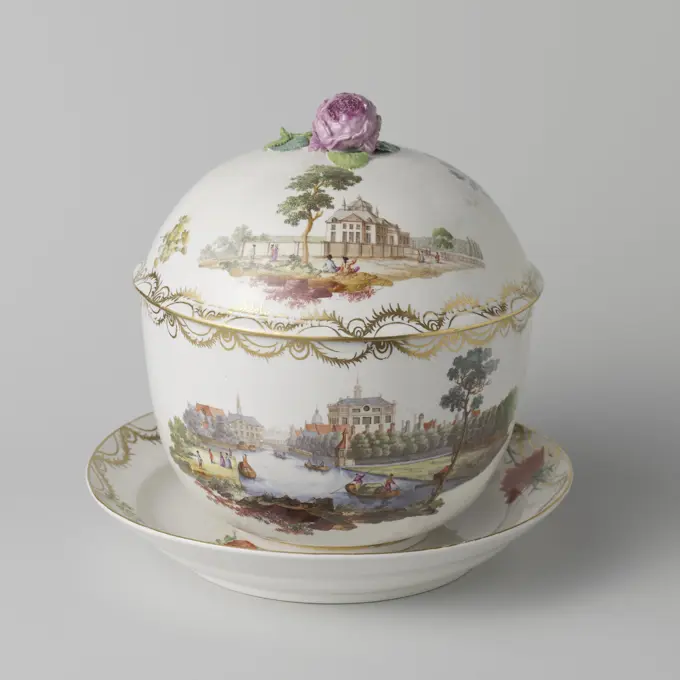
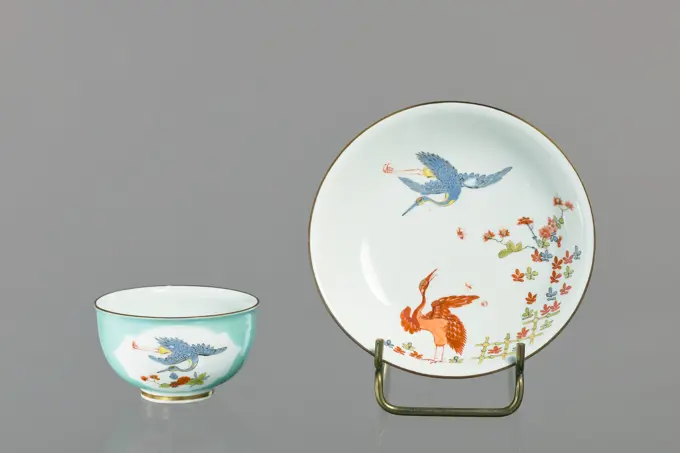
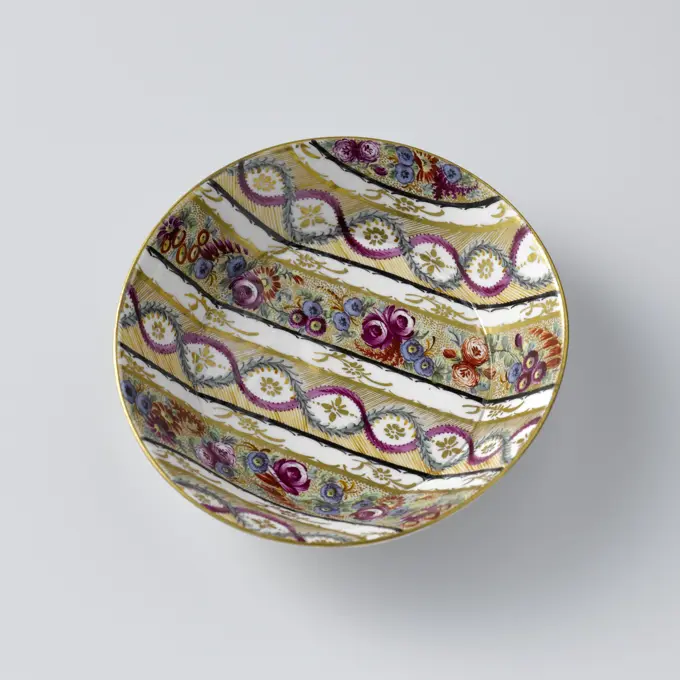
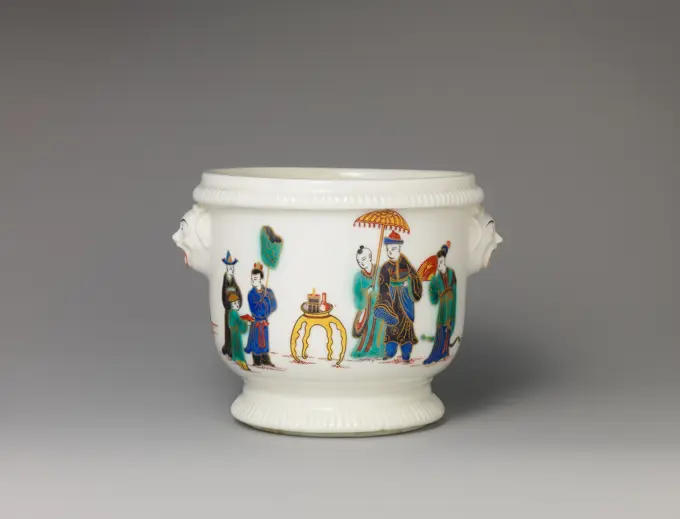
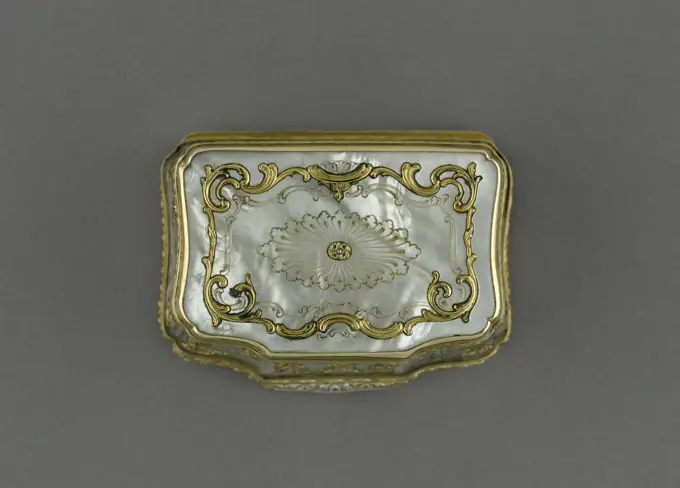
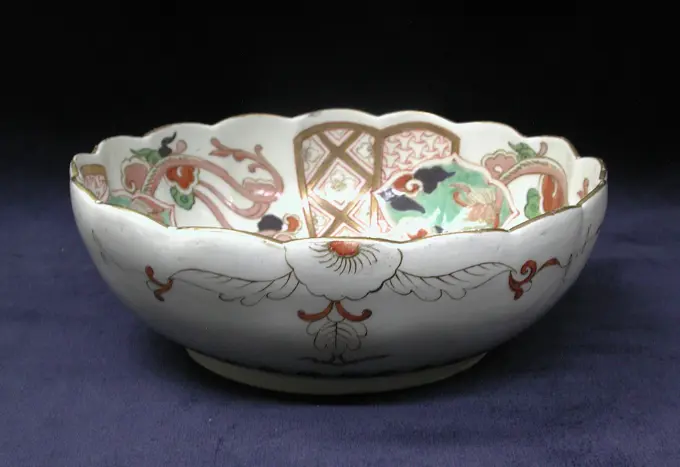
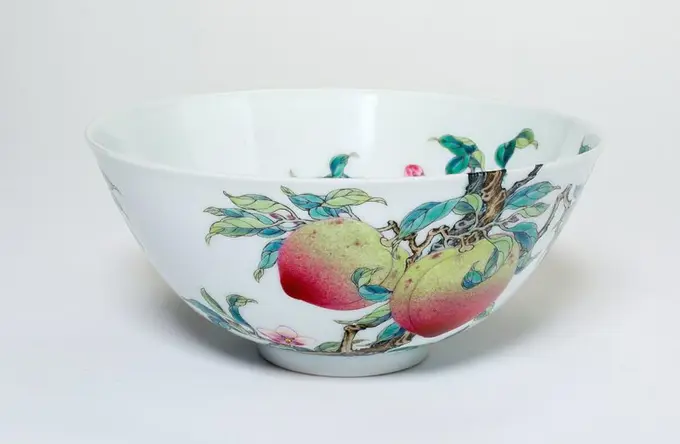
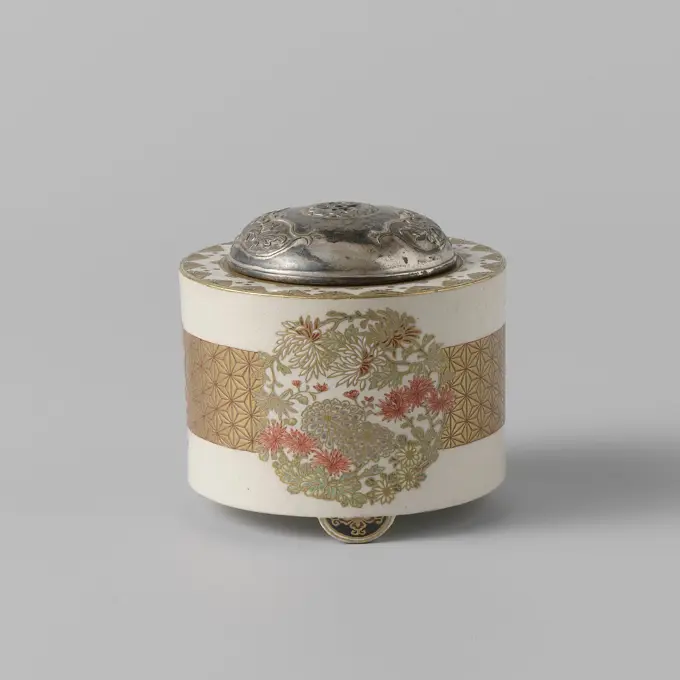
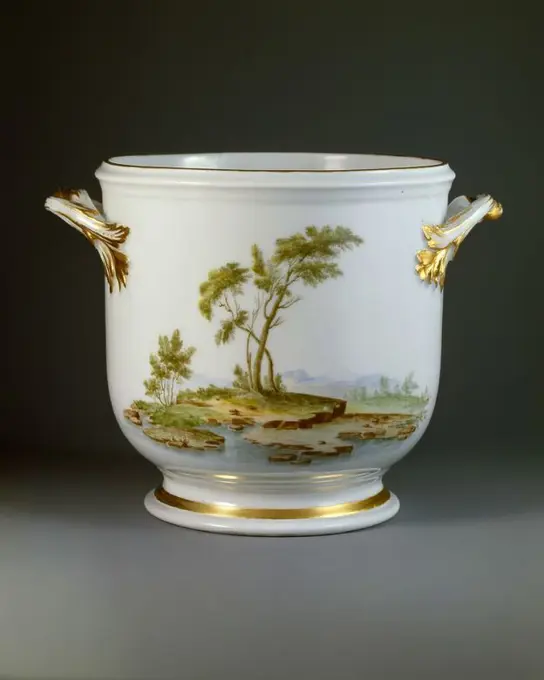
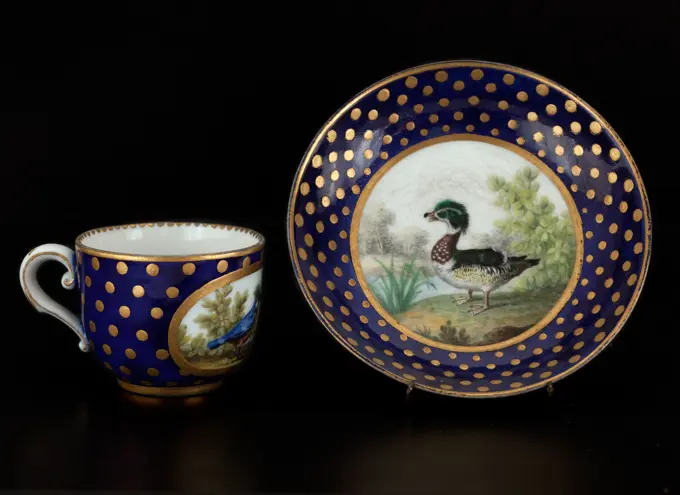
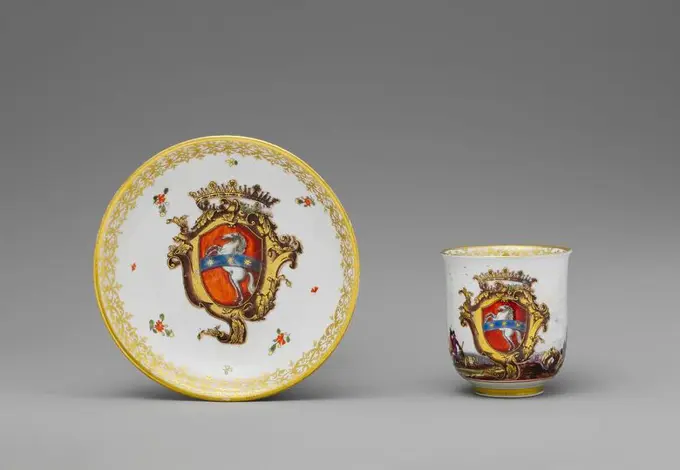
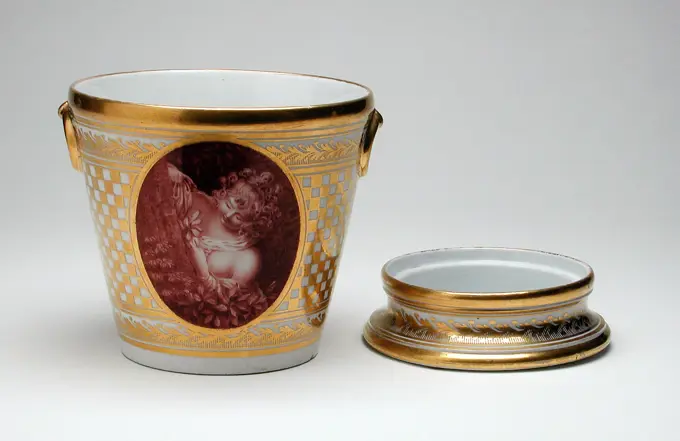
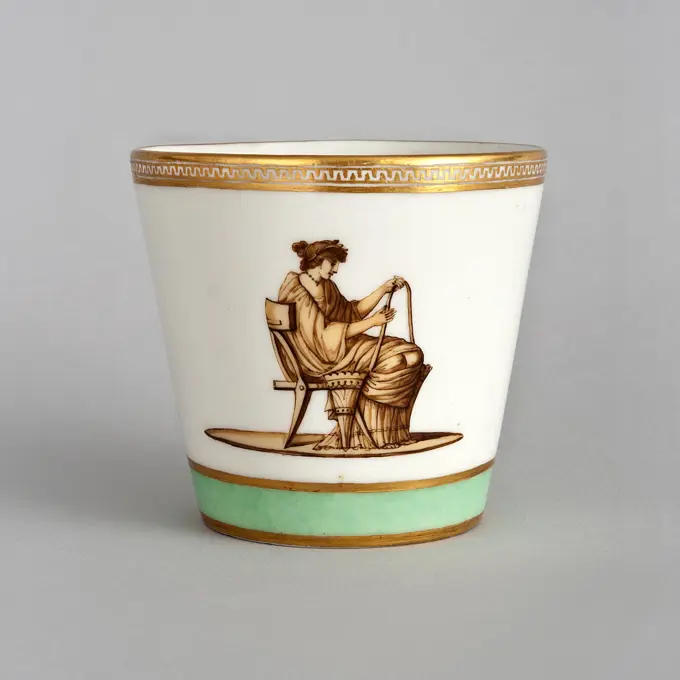
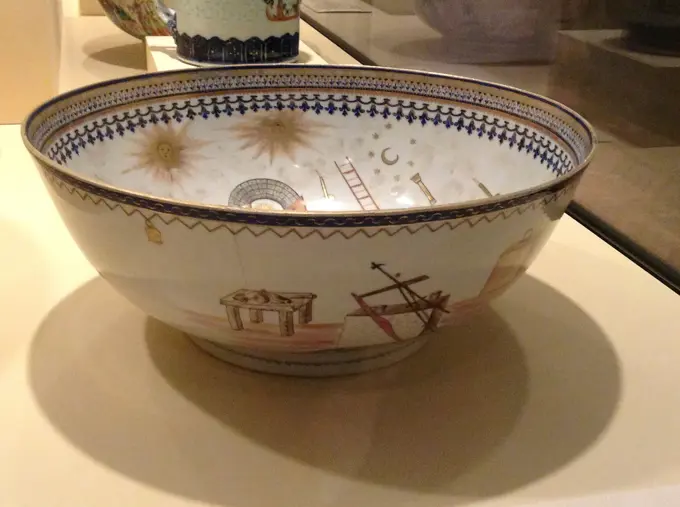
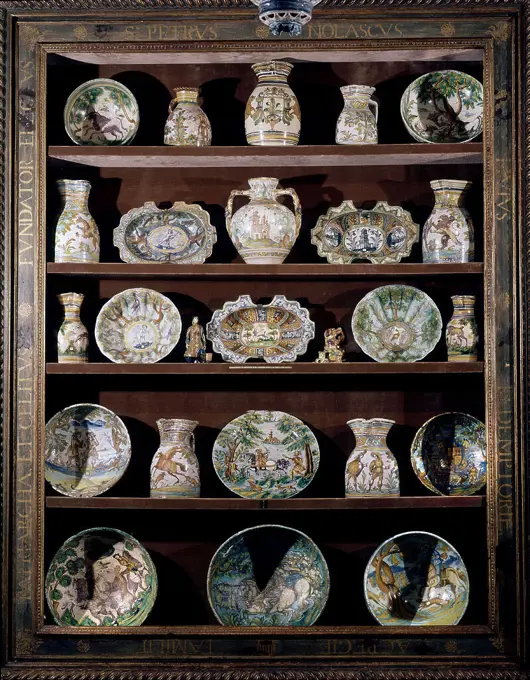
Lid belonging to Punchkom, Ansbach, c. 1777 - c. 1790 Lid belonging to a punch bowl with underpotel. V many painted on two sides with a face on the Portuguese synagogue in Amsterdam on one side and a water landscape with sailing ships. The Ten Bosch house is shown on the lid. A rose as button of the lid. Marked with a stork in blue under the glaze. porcelain company: AnsbachThe Hague porcelain Lid belonging to a punch bowl with underpotel. V many painted on two sides with a face on the Portuguese synagogue in Amsterdam on one side and a water landscape with sailing ships. The Ten Bosch house is shown on the lid. A rose as button of the lid. Marked with a stork in blue under the glaze. porcelain company: AnsbachThe Hague porcelainPunch bowl, Ansbach, c. 1777 - c. 1790 Punch bowl with lid on Subtotel, multicolored painted on two sides with a face on the Portuguese synagogue in Amsterdam on one side and a water landscape with sailing ships. The Ten Bosch house is shown on the lid. A rose as button of the lid. Marked with a stork in blue under the glaze. porcelain company: AnsbachThe Hague porcelain Punch bowl with lid on Subtotel, multicolored painted on two sides with a face on the Portuguese synagogue in Amsterdam on one side and a water landscape with sailing ships. The Ten Bosch house is shown on the lid. A rose as button of the lid. Marked with a stork in blue under the glaze. porcelain company: AnsbachThe Hague porcelainCup French 18th-19th century View more. Cup. French. 18th-19th century. Soft-paste porcelain. Ceramics-PorcelainFili Anka, Spodek; Manufacture Nationale de Porcelaine de Sevres (1756-); 1822 (1822-00-00-1822-00-00);Cup with two figures in a water landscape and a flowering tree, anonymous, c. 1700 - c. 1724 Porcelain head with straight wall, painted on the glaze in red, black and gold. Two people depicted next to a flowering tree and a fence in a river landscape; the edge with curl; A flower on the bottom. Milk and blood. China porcelain. glaze. gold (metal) painting / gilding / vitrification Porcelain head with straight wall, painted on the glaze in red, black and gold. Two people depicted next to a flowering tree and a fence in a river landscape; the edge with curl; A flower on the bottom. Milk and blood. China porcelain. glaze. gold (metal) painting / gilding / vitrificationOil and vinegar, Weesper Porcelain Factory, c. 1760 - c. 1761 Oil and vinegar with lid placed in an openly two-piece basket on eight legs with an ear in the shape of a hose. The whole is decorated with rocailles and cartouches in relief within which multi -colored flower bouquets. Marked with two crossed swords and three bulbs in under -glaze blue. Weesp porcelain Oil and vinegar with lid placed in an openly two-piece basket on eight legs with an ear in the shape of a hose. The whole is decorated with rocailles and cartouches in relief within which multi -colored flower bouquets. Marked with two crossed swords and three bulbs in under -glaze blue. Weesp porcelainCup With Two Figures in a Water Landscape and a Flowering Tree. Cup of porcelain with straight wall, painted on the glaze in red, black and gold. Two people shown in addition to a flowering tree and a fence in a river landscape; the edge with curlwork; A flower on the bottom. Milk and blood.Bowl. Culture: American. Dimensions: 2 5/16 x 9 13/16 x 7 15/16 in. (5.9 x 24.9 x 20.2 cm). Maker: Union Porcelain Works (1863-ca. 1922). Date: 1885.Union Porcelain Works was one of the most important and inventive American porcelain manufacturers in the second-half of the nineteenth century. In addition to their imaginative works designed by the German-born artistic director, Karl H. L. Müller, the firm's mainstay was the production of heavy porcelain hotel dinnerware. This extensive service was made by Thomas Carll Smith, head of the Union Porcelain Works, as a gift to his daughter, Pastora Forest Smith Chace. The neoclassical decoration of the gilt bellflower and basket motif is complimented by turquoise enamel. Unlike the firm's more eccentric and lavish designs created for their display at the Philadelphia Centennial Exposition in 1876, the pottery favored a more restrained classical style for their dinner services. This service descended in the Chace family. Museum: MetropolitanObject from a Dessert Service 'The Razumovsky Service', made from soft-paste porcelain. Dated 18th CenturyCzark with decoration Kakiemon, saucer with decoration Kakiemon; Koenigliche Porcellain Fabrique, Meissen (1710-1763); around 1735 (1730-00-00-1735-00-00);Continental footed porcelain cup, Virginia. Culture: American. Decorator: Joseph S. Potter (1822-1904). Dimensions: H: 4 1/2 in. (11.4 cm). Date: 1878-89. Museum: Metropolitan Museum of Art, New York, USA.Bowl with Floral Scrolls 1821-1850 China. Porcelain painted in overglaze red enamel .Saucer with ornamental borders, 1773 Porcelain dish with a straight wall, painted on the glaze in blue, red, pink, green, yellow, black and gold. The front is divided into straight tires alternately filled with flower vines, each other cutting leaves in which a rosette and narrow tires with golden flower branches. Marked on the underside with IP, a shield with m and a g. Golden Rand. Porcelain Company: Höchstschrezheim porcelain. glaze. gold (metal) painting / gilding / vitrification Porcelain dish with a straight wall, painted on the glaze in blue, red, pink, green, yellow, black and gold. The front is divided into straight tires alternately filled with flower vines, each other cutting leaves in which a rosette and narrow tires with golden flower branches. Marked on the underside with IP, a shield with m and a g. Golden Rand. Porcelain Company: Höchstschrezheim porcelain. glaze. gold (metal) painting / gilding / vitrificationGlass cooler (seau à verre) ca. 1725-30 Saint-Cloud factory It is believed that the Saint-Cloud factory began using enamel colors in the 1720s, and the palette of five colors developed at the factory at this time allowed for a different style of decoration than what had been employed for porcelains painted solely with cobalt blue. For those pieces to be decorated with colored enamels, the painters at Saint-Cloud almost always took their inspiration from Chinese and Japanese art. They sometimes borrowed motifs directly from imported porcelains and lacquer work, but more frequently painters devised images and patterns intended to evoke Far Eastern culture, or combined borrowed motifs in a distinctly European manner. It is probable that the factory painters had access to Chinese and Japanese porcelains either through the collection of Philippe II (1674-1723), duc dOrléans, who granted protection to the factory in 1702, or through the owners of the factory who sold imported porcelains in . Cylindrical box of porcelain on three legs and held together in the form of a crinkle cage by three modeled cords, ending in a raised button as a lid knob. Painted in underglaze blue and on the glaze red, green, yellow and black. The lower half of the box with waves, birds and flower branches; The upper half has been modeled in railing with a floral drink in each compartment. Imari.Couples bowl of translucent agate, oval, mounted with enamelled gold and baroque pearl, anonymous, 1575 - 1600 Couples bowl of translucent agate, oval, mounted with enamelled gold and baroque pearl. Foot shows gold motifs on white stock. Two enamelled enamelled golden ears, crowned by a winged dragon. The frame changed between 1911 and 1914. Germany agate (chalcedony). gold (metal). Couples bowl of translucent agate, oval, mounted with enamelled gold and baroque pearl. Foot shows gold motifs on white stock. Two enamelled enamelled golden ears, crowned by a winged dragon. The frame changed between 1911 and 1914. Germany agate (chalcedony). gold (metal).Golden pearl box inlaid with gold: detail below. Paris, Cognacq-Jay museum. 35598-14 Box, serious, encrusted, mother -of -pearl, goldMANCERINA CON ABRAZADERA 1727. Location: MUSEE D'ARTS DECORATIFS. MADRID. SPAIN.Fili Anka, Spodek; Paris, Despaz, Rue de Recollets; early 19th century (1800-00-00-1810-00-00);Coffee Service 1765-1775 Vienna. Hard-paste porcelain, monochrome black (Schwartzlot), polychrome enamels, and gilding . Vienna State Porcelain Manufactory (Manufacturer)Pair of Mantel Ornaments. American. Date: 1870. Dimensions: Ea. 24.7 × 10.5 cm (9 3/4 × 5 7/8 in.). Glass. Origin: United States. Museum: The Chicago Art Institute, Chicago, USA.Candy dish -Teacup and saucer. Koenigliche Porzellan Manufaktur - KPM (Berlin ; 1763-1918), manufactureTeacup and saucer, with flower decoration. Koenigliche Porzellan Manufaktur - KPM (Berlin ; 1763-1918), factoryBowl late 18th century Worcester factory The gift of the Hans Syz Collection in 1995 endowed the Museum with nearly three hundred examples of European and Asian ceramics meticulously acquired by Swiss-born collector Dr. Syz (1894-1991) to chart the migration of models and patterns from East to West. Documenting a continuous process of influence and adaptation, these pieces provide a discriminating review of the nuances of stylistic change resulting from three centuries of trade.. Bowl 208275Bowl with Fruiting Peaches, Tree Peony, Flowering Plum and Bats. China. Date: 1723-1735. Dimensions: H. 6.6 cm (2 5/8 in.); diam. 14.5 cm (5 11/16 in.). Porcelain painted in overglaze famille rose enamels. Origin: China. Museum: The Chicago Art Institute, Chicago, USA.Incense burner with medallions of floral scrolls, diaper pattern and a silver cover, Toyosai, Toyosai (workshop of), c. 1880 - c. 1900 Incense burner (Koro) of stoneware with a cylindrical body, three short feet and a flat shoulder, painted on the glaze in blue, red, green, yellow, black and gold. On the wall a band with servetwork interrupted by three medallions of flower ranks (peony, prunus, chrysanthemum, aster). On the shoulder a band with stylized flowers. A flower shelf on each foot. The silver lid with twice a cartouche with a lotus plant in relief and an openwork flower rosette in the center. On the bottom the manufacturers brand 'Toyosai sei'. Satsuma. Japan stoneware. glaze. gold (metal). deksel: silver (metal) painting / gilding / vitrification Incense burner (Koro) of stoneware with a cylindrical body, three short feet and a flat shoulder, painted on the glaze in blue, red, green, yellow, black and gold. On the wall a band with servetwork interrupted by three medallions ofWine cooler (seau à demi-bouteille) (one of a pair). Culture: French, Vincennes. Dimensions: 5 1/16 × 6 3/8 in. (12.9 × 16.2 cm). Factory: Vincennes Manufactory (French, ca. 1740-1756). Date: ca. 1751-52.In 1745 the company of shareholders in the Vincennes factory was granted a privilege by Louis XV for the exclusive production in France of porcelain "in the manner of Saxony, painted and gilded, with human figures." It is thus not surprising to encounter Meissen influence in both the forms and decorations of early Vincennes pieces. A well-established Meissen formula of the 1730s and early 1740s was the gold-banded cartouche enclosing a pictorial subject; at Vincennes this was adopted about 1749-52 for use mainly on coolers for wine bottles and glasses, which were painted with landscapes incorporating figures or humble cottages in the Dutch manner.By about 1752, however, the presence at Vincennes of the model designer Jean-Claude Duplessis and the painter Francois Boucher was leading Cup, painted with water landscape with castle / palace. Cup of porcelain, painted multi-colored with water landscape in green and brown with figures in blue, red-brown and purple on the shore and with a large castle / palace across the street with light blue windows and roofs. Golden piping along the edges, the ear is also decorated in gold.Anonymous (n. - d.), Lotus -shaped bowl (common name). Hard porcelain, polychrome enamels. Petit Palais, Museum of Fine Arts of the City of Paris.Spoon tray with a crowned, illegible monogram surrounded by two flower sprays, anonymous, c. 1750 - c. 1774 Rectangular, hexagonal pattipan of porcelain with ribbed wall, painted on the glaze in blue, red, pink, green, yellow, black and gold. On the flat a crowned, illegible monogram surrounded by two flower branches; The wall with flower vines with four cartouches with a landscape and four medallions with plants. A chip in the edge. European performance in email colors. China porcelain. glaze. gold (metal) painting / gilding / vitrification Rectangular, hexagonal pattipan of porcelain with ribbed wall, painted on the glaze in blue, red, pink, green, yellow, black and gold. On the flat a crowned, illegible monogram surrounded by two flower branches; The wall with flower vines with four cartouches with a landscape and four medallions with plants. A chip in the edge. European performance in email colors. China porcelain. glaze. gold (metal) painting / gilding / vitrificationFrançois-Joseph Aloncle (active from 1758 to 1781). Cup called "Mignonette" and saucer. Porcelain, 1767. Paris, Cognacq-Jay museum. 79170-31 Threatening art, duck, porcelain, saucer, cute cup, dishes, 18th 18th 18th 18th 18th 18th 18th centuryTableware from the Munich Court Service, Porzellanmanufaktur Nymphenburg c. 1760/70, National Museum, Munich, Upper Bavaria, Bavaria, Germany, EuropeCup and saucer. Culture: German, Meissen. Dimensions: Cup (.393): H. 2 7/8 in. (7.3 cm.)Saucer (.394): Diam. 5 1/8 in. (13.0 cm.). Factory: Meissen Manufactory (German, 1710-present). Date: ca. 1735. Museum: Metropolitan Museum of Art, New York, USA.Suite of Two Jardinières on Stands and Covered Bough Pot. Thomas Baxter, Jr. (England, London, 1782-1821)Chamberlain's Factory (England, Worcester, 1788-1852). England, 1802. Architecture; Architectural Elements. Porcelain, enamels, gildingBranch from the character allegorical; Koenigliche Porzellan Manufaktur (KPM; Berlin; 1763-1918); approx. 1800 (1790-00-00-1800-00-00);Krystall, Bronisław (1887-1983) - collection, parks, Mojry (mitol.), Mythology, purchase (provenance)Cream jug 18th-19th century Possibly made at Davenport, Longport. Cream jug. British. 18th-19th century. Dark blue printed ware. Ceramics-PotteryCup and Saucer. Wedgwood Manufactory; England, founded 1759. Date: 1810-1820. Dimensions: Cup: 6 × 10.6 cm (2 3/8 × 4 3/16 in.); diam. 9.1 cm (3 9/16 in.); Saucer: H. 2.9 cm (1 1/8 in.); diam. 14 cm (5 1/2 in.). Porcelain with polychrome enamels and gilding. Origin: Burslem. Museum: The Chicago Art Institute, Chicago, USA.Masonic punch bowl, 1800-1805, 4 13/16 x 11 11/16 x 11 11/16 in. (12.22 x 29.69 x 29.69 cm), Porcelain, China, Chinese export, Presumably an American or English freemason placed an order for this punch bowl and related mug decorated with the Western symbols of Masonic brotherhood, including the square, compass, anchor and All Seeing Eye. The images may have been copied from a John Cole design in Illustrations in Masonry, published in 1801.Sèvres Porcelain Manufactory, Cup and Saucer, c. 1792, hard-paste porcelain.VITRINA DE CERAMICA DE TALAVERA. Location: MUSEE D'ARTS DECORATIFS. MADRID. SPAIN.Tea Bowl and Saucer 1695-1705 Augsburg. Silver-gilt, cast, embossed, and chased and enamels on copper . Matthäus Baur, IIClay pan on white background, Clay pan on white background. Copyright: xZoonar.com/BorysxShevchukx 2079234Basket KorzecPorcelain China crockery on display in auction room, Suffolk, England, UK.Spoon and dish from Strasbourg, 18th century, decorated with botanical paintings. Hand-finished chromolithograph from Ris Paquot's General History of Ancient French and Foreign Glazed Pottery, Chez l'Auteur, Paris, 1874.