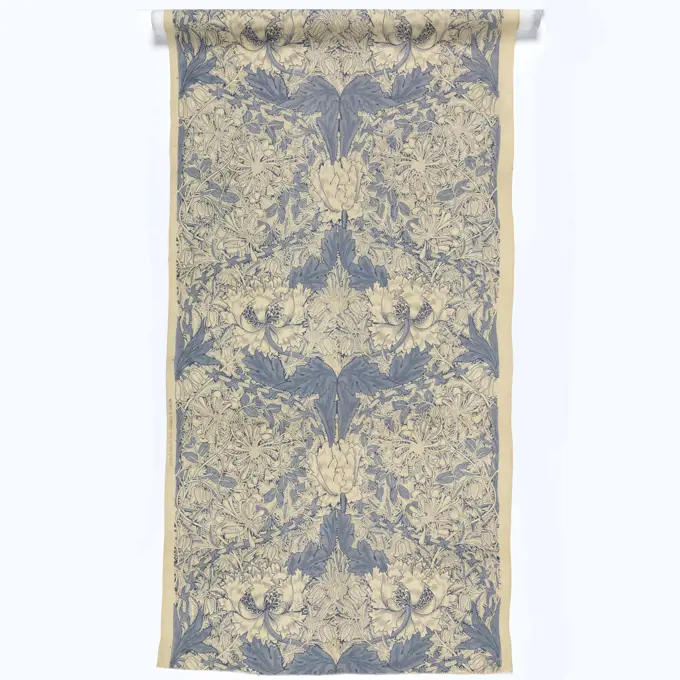
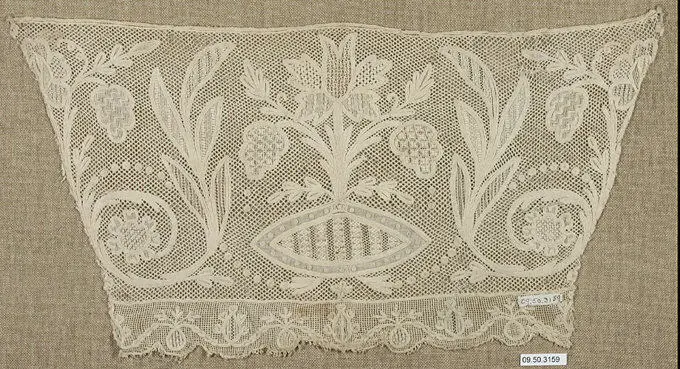
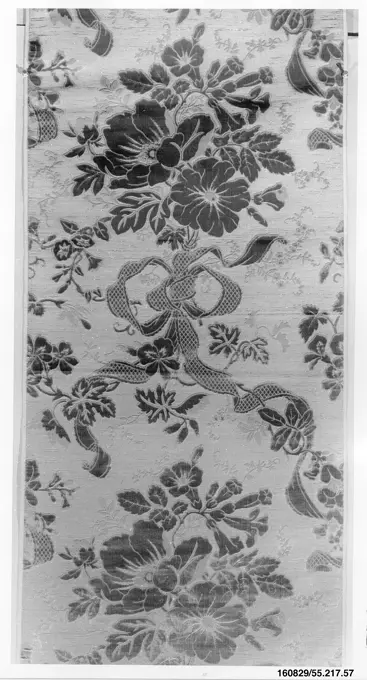
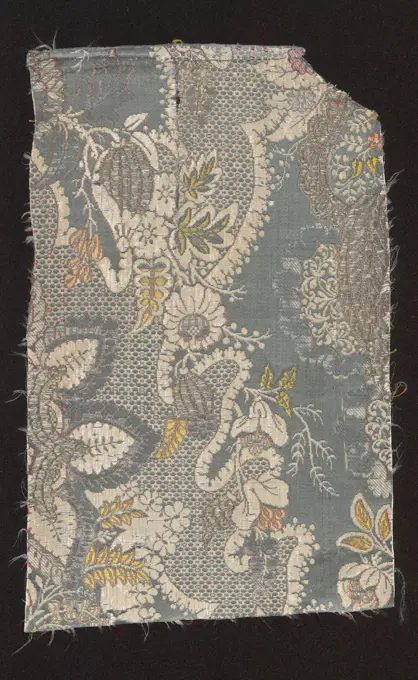
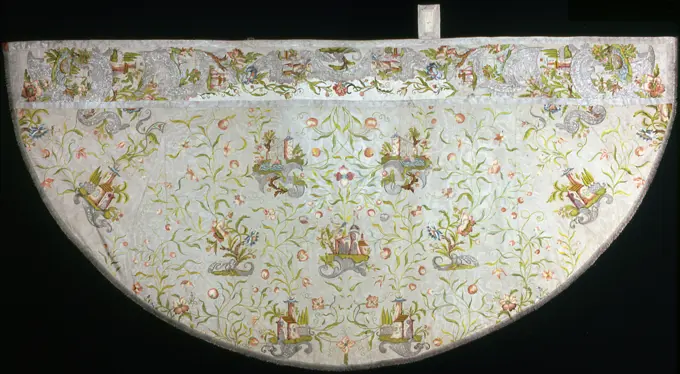
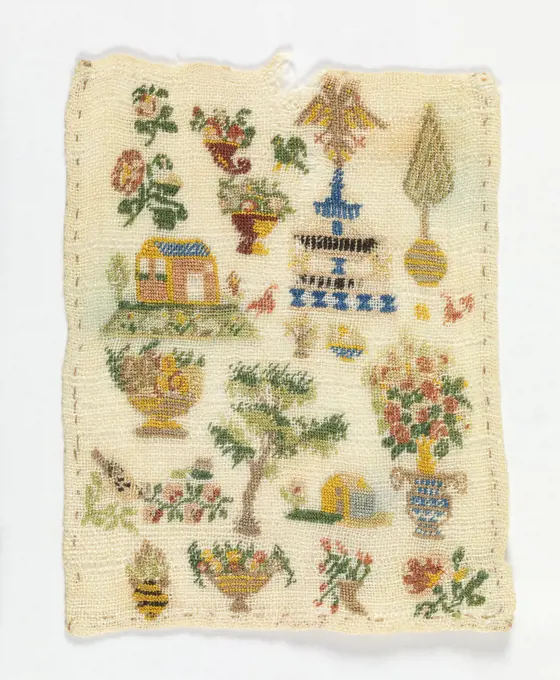
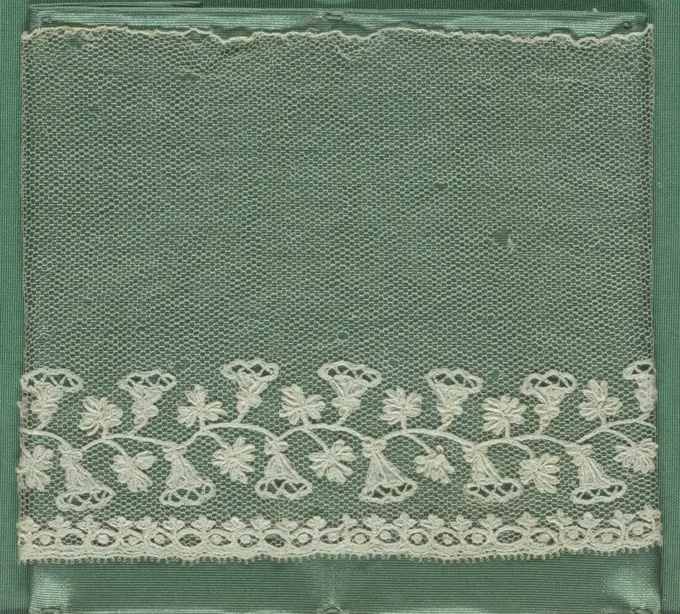
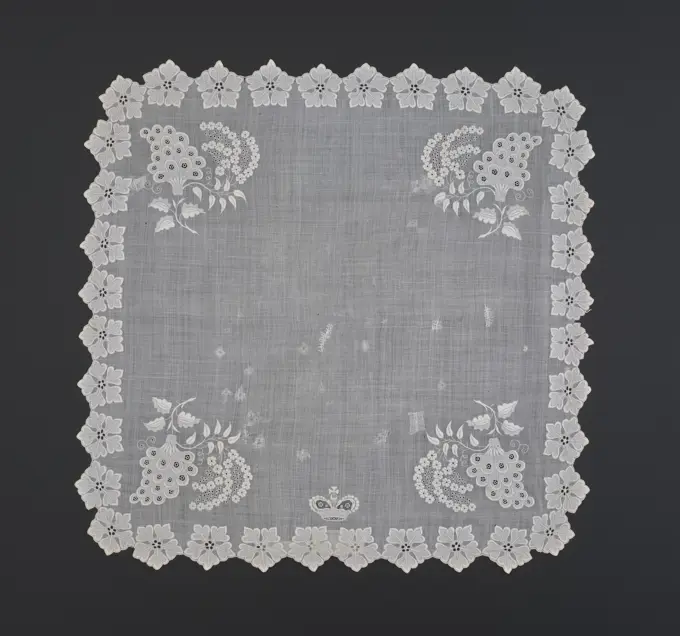
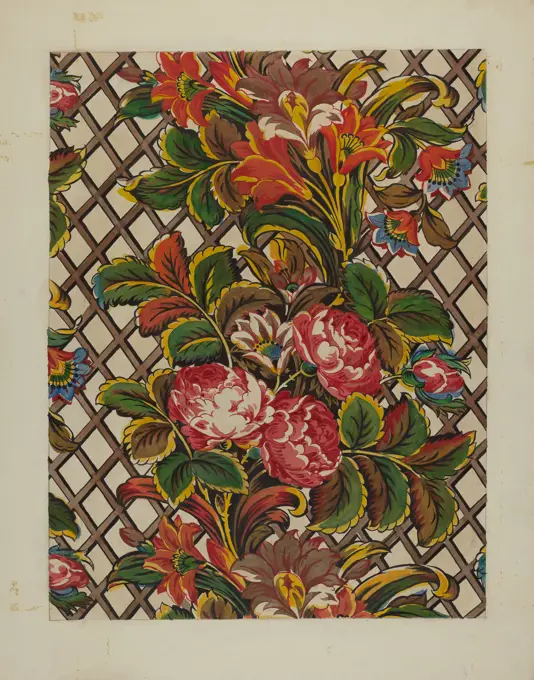
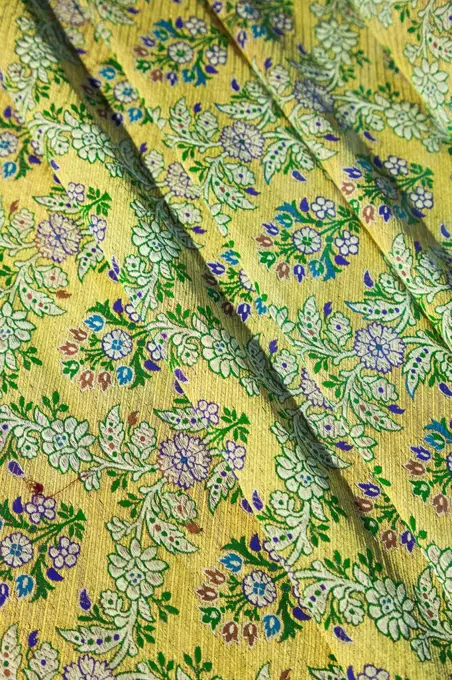
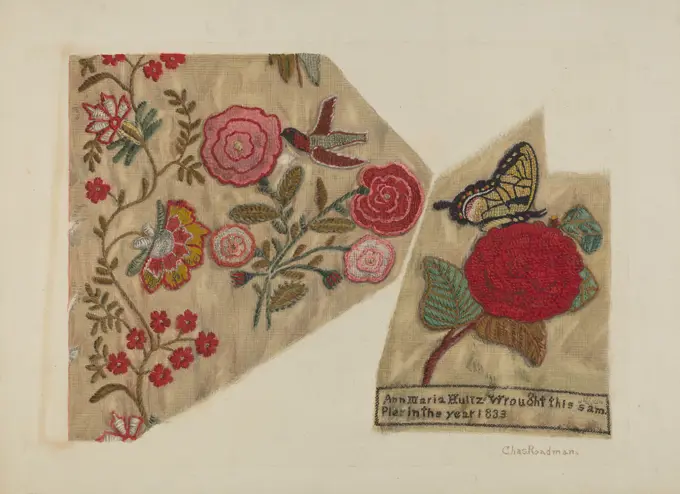
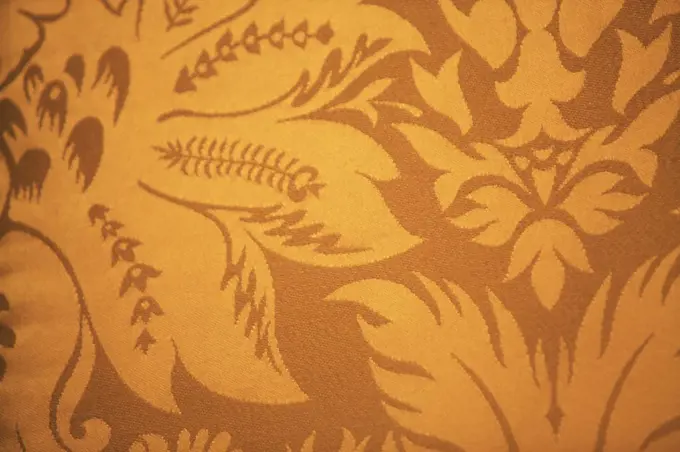
Decorative Silk Fabrics

Textiles featuring vibrant floral patterns and intricate designs, showcasing historical silk and cotton materials from various periods.
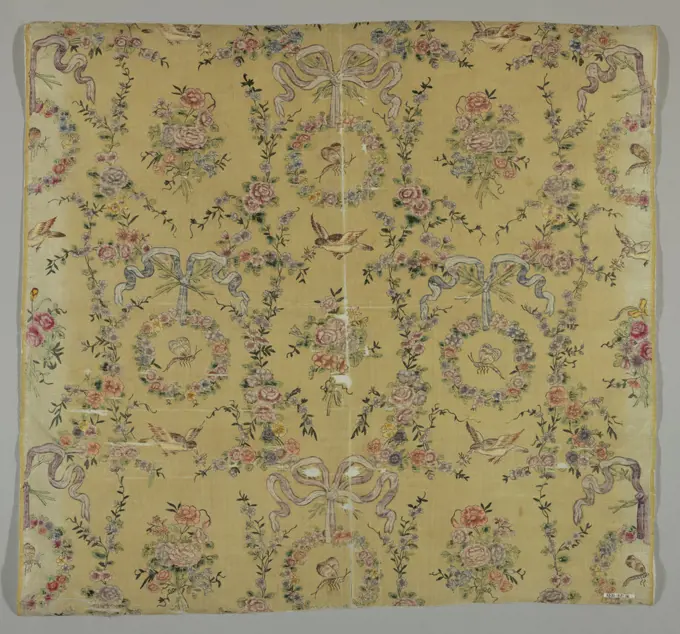
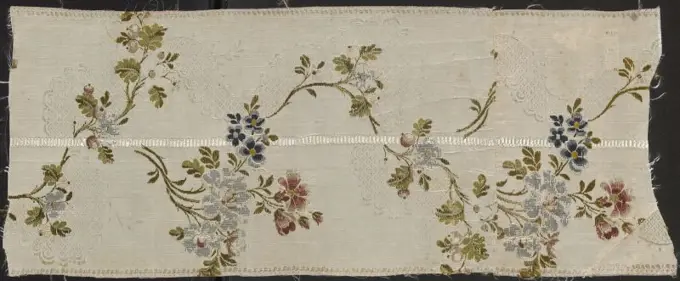
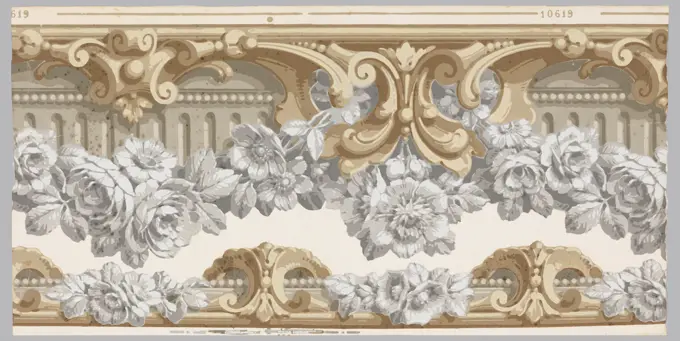
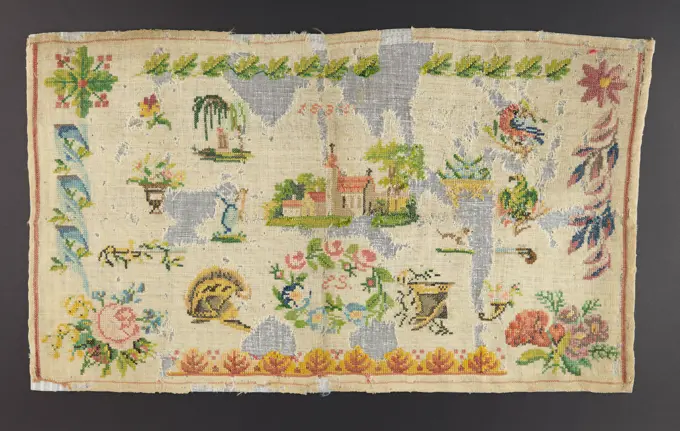
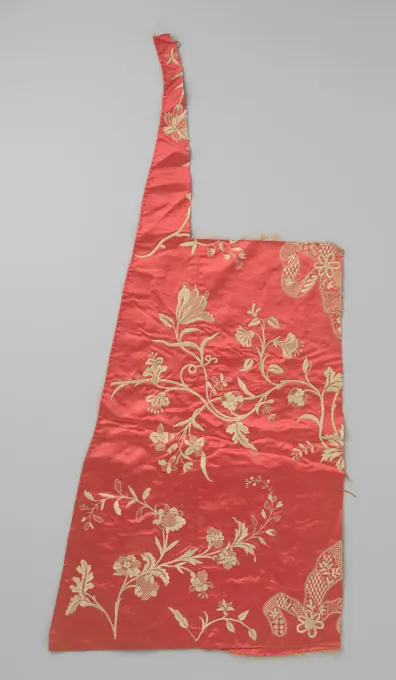
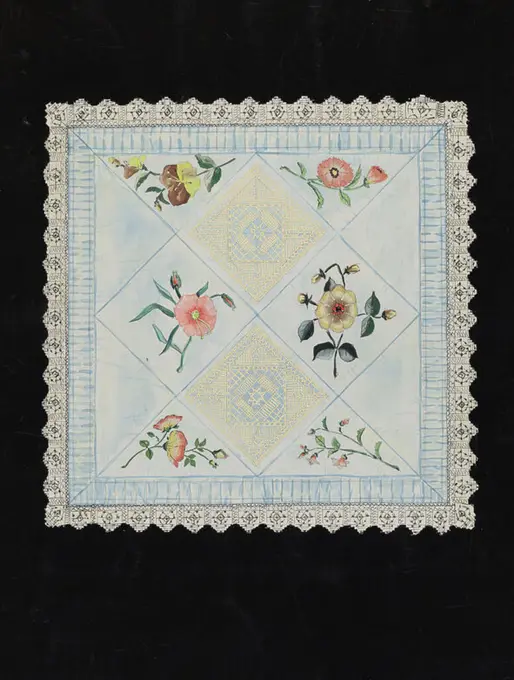
Fragment, Medium: silk; tempera Technique: painted on plain weave, Textile fragment. Cream-colored (originally white) silk with design painted in polychrome tempera. Design of vertical repeat of flower wreaths and garlands, held in place by ribbons, and with birds and insects scattered through the spaces., China, 18th century, printed, dyed & painted textiles, Fragment
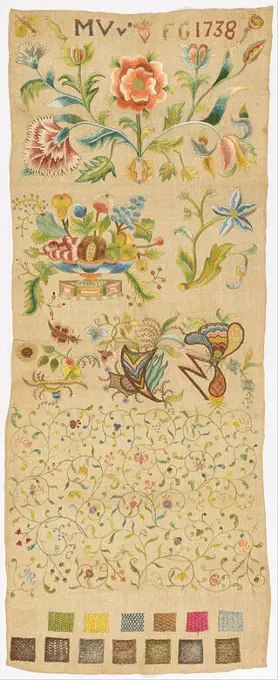
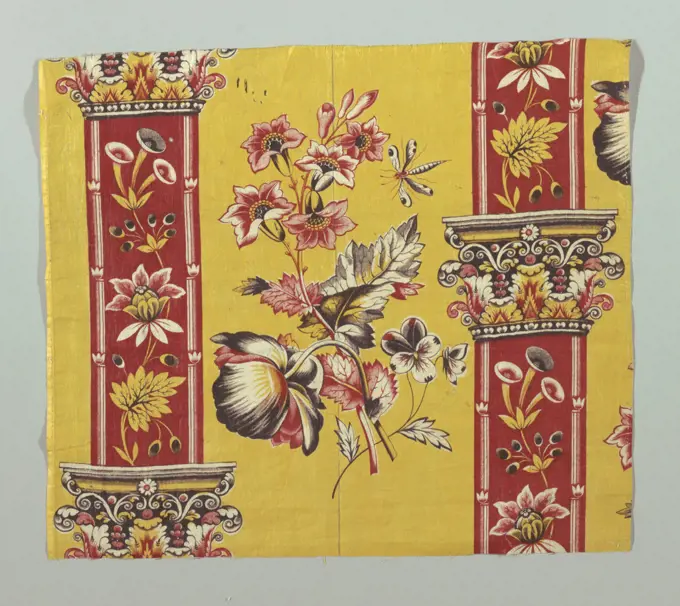
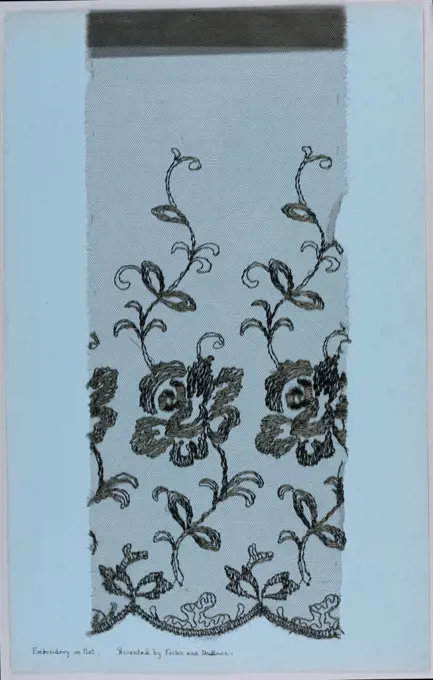
Machine-made openwork samples, Medium: cardboard, linen, silk, metallic Technique: linen embroidery with ground cloth dissolved Examples of embroidery on net produced by the Schiffli machine Metallic embroidery on net Machine-made openwork in imitation of hand-embroidered net Mostly floral and a few geometric patterns, some designs described as 'Spanish' Imitation hand-made filet Machine filet Imitation filet crochet Ploven (burnt-out lace) Fancy curtain lace made on the Levers machines Real filet (handmade) next to Machine-made filet Spotted curtain nets, made chiefly at Nottingham, England and Caudry, France., Samples of machine-made openwork and several examples of hand made lace mounted on boards. They imitate hand-embroidered net, crochet, or needlepoint. All are floral patterns plus a few of early 1920's geometric style., 'Embroidered net' produced by the Schiffli Machine., USA, ca. 1910, lace, Machine-made openwork samplesSidewall, The Afton; USA; 51 x 41 cm (20 1/16 x 16 1/8 in.)Piece 18th-19th century Japan. Piece 67610Batist handkerchief or neck nose cloth and finished all around with a strip of bobbin with a wavy slender and curling of side branches with a peony, anonymous, c. 1640 - c. 1674 Batist handkerchief or nose towel finished all around with a strip of natural -colored bobbin side: Flanders side. Square model. In one of the corners the batist is marked with the crowned text: 'mw 6'. Side: The repeating and continuous pattern consists of a wavy slender with curling leaves and under every wave top and in every golf valley a curled side branch with a peony. The motifs are made in linen battle with openwork edges and some recesses. The motifs are connected by a five -part ground. Top and bottom of the strip are straight finished, with the bottom (outside) with picots. Southern Netherlands linen (material) bobbin lace / Flanders lace Batist handkerchief or nose towel finished all around with a strip of natural -colored bobbin side: Flanders side. Square model. In one of the corners the batist isPiece 17th century Italian. Piece. Italian. 17th century. Silk. Textiles-WovenFragment (China); silk; temperaPiece 1695-1705 Italian. Piece 230857Honeysuckle, William Morris, (British, 1834-1896), Morris & Co., (London, England), Medium: cotton warp, linen weft Technique: printed on plain weave, Large-scale symmetrical pattern of massive poppy-like flowers with curving stems to form ogival framing, in white and blue with deep blue outline on a deep blue ground. Wide plain selvedges. Printed around 1900., England, designed 1876, printed, dyed & painted textiles, Textile, TextileCuff 18th century German. Cuff 217750Piece French, Lyons late 19th centuryIndian ornamentFragment of the fabric;  1. W. 18th century (1715-00-00-1725-00-00);Fabrics, purchase (provenance)Legging Panels. Culture: Eastern Cree. Dimensions: H. 19 1/2 x W. 11 1/2 in. (49.5 x 29.2 cm). Date: ca. 1870. Museum: Metropolitan Museum of Art, New York, USA.Covering on a cup and a finger embroidered unknownRibbon French 19th centuryTextile; cottonTextile (England); wool, cotton, linenFragment (Japan)Piece. Culture: French. Dimensions: L. 20 3/4 x W. 17 inches (52.7 x 43.2 cm). Date: mid-18th century. Museum: Metropolitan Museum of Art, New York, USA.Textile; silk; 1999-43-1Chef De Piece (France); Company: Jacques de Mainville; plain weave cotton; A. Warp: 4 cm (1 1/2in.). Weft:46cm (18in.) B. Warp: 42cm (16 1/2in.). Weft: 32cm (12 1/2in.) Pattern: Not present.National style of embroidery. National style of embroidery.Hand made work. Copyright: xZoonar.com/andriixsalivonx 1746457Fragment. Dimensions: Textile: H. 24 in (61 cm)W. 26 1/2 in (67.3 cm)Mount: H. 28 5/8 in (72.7 cm)W. 31 6/8 in (80.6 cm)D. 7/8 in (2.2 cm). Date: mid-16th century.Woven silk was an integral part of the Ottoman economy and an important trade item that yielded substantial revenue to the Ottoman treasury. It was also a sign of accumulated individual wealth and ranked alongside precious gems and metals as an indication of affluence. The choice of colors in this fragment is restricted to a blue ground with the pattern picked out in white, salmon pink, gold, and silver. The bold and forceful design of palmettes is softened by the graceful overlapping stem systems in the interstices. The palmettes, which form the heart of the ogival framework, are composed of three medallions: the innermost has a spiky outline with a tulip tree placed on a dotted ground, the middle one has a serrated edge anchoring an acanthus-type leaf facing the center, and the largest is decorated with palmette trees Fragment, Medium: silk Technique: painted, Flowers and leaves on branches., France, 19th century, printed, dyed & painted textiles, FragmentPiece of fabric. unknown, authorSampler. Date/Period: 1738. Sampler. Medium: silk and metal-wrapped silk embroidery, linen foundation. Technique: satin, stem, knot, cross, running, rococo and couching stitches on plain weave. Height: 960 mm (37.79 in); Width: 390 mm (15.35 in). Author: UNKNOWN.Fragment of a multi -colored Zijddamast, 1740 - 1760 Two fragments of a silk tissue. On a red satin soil a symmetrical branch gold or silver woven leaves, two blue carnations and a light-salmon-colored rose.  silk damask Two fragments of a silk tissue. On a red satin soil a symmetrical branch gold or silver woven leaves, two blue carnations and a light-salmon-colored rose.  silk damaskTextile, Medium: cotton Technique: roller (mule) printed on plain weave, Piece of thin glazed chintz, printed by combination of roller and block or roller and 'surface roller'. Yellow ground, pillar design in red with capitols in yellow, black and red; sides of pillars ornamented with flower sprays in yellow, red and black. In yellow field between flower clusters of natural size, roses, pansies and columbines, with butterfly, in shades of red, sepia and yellow., England, ca. 1830, printed, dyed & painted textiles, TextileTextile (England or United States); Warp x Weft: 65 x 41 cm (25 9/16 x 16 1/8 in.) Repeat H (half-drop repeat): 38.1 cm (15 in.)Embroidery patch made of multicolored silk on linen, anonymous, c. 1780  The embroidery has rococo or bundle stitch and petit point. The signing can still be seen. South-Holland silk. linen (material) embroideringFragment 1850-75 French. Fragment 222092Frieze (USA); Manufactured by Janeway & Co. Inc.; machine-printed paper; 92.5 x 49.5 cm (36 7/16 x 19 1/2 in.)Cope Made 1775-1825 France. Silk, warp-faced, weft-ribbed plain weave; embroidered with silk floss and yarns, gilt- and silvered-metal-strip-wrapped silk, and silvered-metal strips in satin, split, and stem stitches; couching, padded couching, laid work and French knots; edged with silk and gilt-metal-strip-wrapped silk, woven tapes and fringe .Chintz Fragment (India); cottonFragment of a cotton tissue (wall covering), C. 1770 Fragment of a complex tissue of cotton. The tissue has an orange/brown color with a pattern of flower branches in a cream color.  cotton (textile) Fragment of a complex tissue of cotton. The tissue has an orange/brown color with a pattern of flower branches in a cream color.  cotton (textile)Handkerchief third quarter 19th century Belgian. Handkerchief 168494Seeding Machines, Anonymous  Fragment, 19th century, 16 x 17 in. (40.64 x 43.2 cm), Linen, silk; needlework, Turkey, 19th centuryPiece 18th-19th century Japan. Piece 66034Valance (England); cotton, linenSampler, Medium: silk on linen Technique: embroidered in tent, satin and half cross stitches on plain weave foundation, Small sampler with assorted motifs., Austria, early 19th century, embroidery & stitching, SamplerApron (France); silk on silk foundation, metal-wrapped silk, flat metallic strips, flat metallic strips plied with metal-wrapped silkFlounce, Medium: linen Technique: bobbin lace, 18th century, lace, FlounceSilk tissues, 13th century, Anonymous, 1857 - 1864 print Two examples of silk tissues, 13th century.  paper  textile fabric, clothTextile (USA); cottonWoman's necktie 1870-80 French. Woman's necktie 221657Handkerchief;  19th/20th century (1890-00-00-1920-00-00);Illustration of a flower composition in mocha mousse Pantone colorField of sixteen tiles with birds, anonymous, c. 1640 - c. 1660 Field of sixteen tiles (4 x 4) each with a multicolored (blue, green, yellow, orange and purple) bird on a branch with berries. In the corners, an Ossekop. Netherlands earthenware. tin glaze majolica Field of sixteen tiles (4 x 4) each with a multicolored (blue, green, yellow, orange and purple) bird on a branch with berries. In the corners, an Ossekop. Netherlands earthenware. tin glaze majolicaFrieze (USA); Manufactured by Maxwell & Co., S.A. (United States); machine-printed paper; 92 x 49.5 cm (36 1/4 x 19 1/2 in.)Panel. France. Date: 1701-1725. Dimensions: 163.3 × 54 cm (64 1/2 × 21 1/4 in.)Height repeat: 54.7 cm (21 1/2 in.). Silk, gilt metal strips, and gilt metal strips wound around silk fiber core, plain weave with supplementary patterning warps, supplementary patterning wefts and supplementary binding warps tying some supplemenatary brocading wefts in plain interlacing (lampas). Origin: France. Museum: The Chicago Art Institute, Chicago, USA.Fragments, Medium: silk Technique: damask, 5 unit satin, Length of red damask with large scale vertically symmetrical pattern with large leaves and flowers., 19th century, woven textiles, Fragments. Letter bag in rectangular envelope model of ivory-colored satin, on which two flowers and four animals are embroidered on the front in multicolor floss side. On the valve three applications of multicolored stylized flowers in thick silk thread. On the back, 'ISVs' or 'Isus' and '1713' is embroidered. Between this inscription two men are embroidered in a red suit with a flagstone in every hand. The lower man is placed in a shield shape, surrounded with curls in purple, red and gray. The bag is bordered with gold edge. On the valve a loop from gold edge that can be done to close the bag to close the bag. The inside is lined with unforeseen gloss pink linen.Fragment; silkSample Book Page (USA); cardboard, linen, silk, metallic; 1971-26-2-3Linnamast finger cloth with Marguérite -Dessin and in the middle a crowned weapon with a lion, Cornelis van der Sluys, 1891 - 1944 Linnamast finger cloth with Marguérite-Dessin and in the middle a crowned weapon with a lion. Eindhoven linen (material) Linnamast finger cloth with Marguérite-Dessin and in the middle a crowned weapon with a lion. Eindhoven linen (material)Sampler worked in cross stitch in colored silk on unbleached cotton, marked MVN 1841, lettercloth sampler embroidery needlework images silk cotton, textile embroidery cross stitch Rectangular piece of unbleached cotton with selvedge on the left and hem edge of 0.5 cm wide on the other sides. the piece is embroided in cross stitch with silk in the colors beige golden yellow light green olive green ivory color soft pink and old pink dark brown and dark blue. The piece is arranged quite symmetrically. Around it is simple link edge embroided in cross stitch embroided among others: JVN MVSB 1841 MVN 15 needleworkNapkin van Wit Linnamast ,, 1831 - 1850 White linen Damstic napkin with flower branches and flower edge. Brand HW 12 North Netherlands linen (material) damask White linen Damstic napkin with flower branches and flower edge. Brand HW 12 North Netherlands linen (material) damaskSutra Cover. China. Date: 1590-1599. Dimensions: 36.2 × 14.6 cm (14 1/4 × 5 3/4 in.)Repeat: 19.3 × 11.1 cm (7 5/8 × 4 3/8 in.). Silk, warp-float faced 4:1 satin weave with supplementary patterning wefts bound in weft-float faced 1:4 satin interlacings. Origin: China. Museum: The Chicago Art Institute, Chicago, USA.Elizabethan ornamentQuilt, Album pattern. Culture: American. Dimensions: 83 1/2 x 84 1/2 in. (212.1 x 214.6 cm). Maker: Members of the First Reform Churches of Fishkill and Hopewell. Date: ca. 1855-60.Album quilts were extremely popular in the mid-nineteenth century and were made in every part of the country. They often commemorated a particular event such as a birth, marriage, retirement, or leave-taking. Sometimes, however, this type of quilt was made purely to acknowledge and give expression to the bonds of friendship that linked those who contributed to them. Although the signatures of individual makers do appear on some of the blocks, neither dates nor place names appear on this quilt. It is thought to have been made in southeastern New York State because the unusual names found on the quilt match those found in the towns of Fishkill and Hopewell in Dutchess County. Some of the makers' names were found in the records of the Dutch First Reformed churches for these towns. Stylistically, the quilt coulTextile (France); Manufactured by Petitpierre et Cie; cottonFragments (France); silkIndian ornamentIIturgical clothing  stole unknownTextile, Medium: silk Technique: compound satin weave with supplementary weft, Waistcoat panel, front proper right piece, of coral, figured silk brocaded in greenish-gold, blue, white, green and lavender in a 'bizarre' type pattern of small, bending flower sprays that grow out of a larger shape suggesting curling acanthus leaf., Italy, 1700-1750, woven textiles, TextileSamples (USA); Manufactured by Orinoka Mills (United States); Warp x Weft (a): 21 x 64 cm (8 1/4 x 25 3/16 in.) Warp x Weft (b): 17.5 x 18.5 cm (6 7/8 x 7 5/16 in.)Chalice veil 17th century French. Chalice veil 229060Panel Made 1725-1750 England. Wool, 7 1 satin damask weave with supplementary brocading wefts bound in weft-float faced 1 3 'Z' twill interlacings; full loom width and fragment joined .Sampler, Medium: silk embroidery, linen foundation, Initialed 'I. S.' In wreaths, 'O U D 10' 'YAAR' and 'ANNO 1791.' Vase with flowers, baskets of flowers, trees and animals with floral border., Netherlands, 1791, embroidery & stitching, SamplerFragment of stole, embroidered, white unknownPanel Made 1810-1830 England. Silk and silvered-metal-strip-wrapped silk, and silvered-metal strips, plain weave with supplementary brocading wefts and plain and twill interlacings of secondary binding warps and supplementary facing and patterning wefts .Fragment decorated with pine, bamboo, and plum in snowflakes, 19th century, Unknown Ryukyuan, 12 1/2 × 12 11/16 in. (31.75 × 32.23 cm) (overall), Cloth: cotton; bingata (stencil resist with applied pigments), Japan, 19th centurySleeve Bands, 1880-1940. China, Qing dynasty (1644-1911) or Republican period (1912-49). Embroidery, silk; average: 82.3 x 9.5 cm (32 3/8 x 3 3/4 in.).Piece 16th-17th century Italian. Piece. Italian. 16th-17th century. Silk. Textiles-WovenWatercolor wreath with forget me not flowers and chamomile, green leaves. Illustration. Watercolor wreath with forget me not flowers and chamomile, green leaves.Square; silkField of nine tiles with fruit bowls, anonymous, c. 1640 - c. 1660 Field of nine tiles (3 x 3) each with a multicolored (blue, green, yellow and orange) fruit bowl on foot with a lily in the corners. Netherlands earthenware. tin glaze majolica Field of nine tiles (3 x 3) each with a multicolored (blue, green, yellow and orange) fruit bowl on foot with a lily in the corners. Netherlands earthenware. tin glaze majolicaTextile Swatch Textile Swatch, 1950s to 1960s. Silk, 21 3/4 x 10 1/2 in. (55.2 x 26.7 cm).    1950s to 1960sHans Simon Holtclubs (1620-1671); Maria Sibylla Weians (1647-1717), convolvulus Tripiolor (Jomfruskored); IPomeoea purpurea (purple-pragts nerve), 1649-1659Panel (Possibly a Shawl or bedspread ) Made 1801-1900 England. Plain weave, block printed .Tray; Yabu, Meizan (1853-1934); End of the 19th century (1891-00-00-1900-00-00);Border (England); Distributed by W.H.S. Lloyd Co., Inc.; block-printed; 56.5 x 28 cm (22 1/4 x 11 in.)Textile, Möven; Designed by Wiener Werkstätte (Austria), Dagobert Peche (Austrian, 1887-1923, active Vienna, 1911-1923); silkEmbroidery pattern unknownHandkerchief, Medium: linen Technique: plain weave, bobbin lace, Brussels style, Handkerchief with center of linen and wide bobbin lace border of Brussels lace. Pattern of floral sprays edged by festoons and open flowers., Belgium, late 19th century, lace, HandkerchiefEmbroidered Interior Textile, anonymous, c. 1750 - c. 1760  France (possibly) silk embroidering  France (possibly) silk embroideringPair of Satin Pillow Shams. Dated: c. 1936. Dimensions: overall: 33 x 25.4 cm (13 x 10 in.) Original IAD Object: 34 1/2" high; 34 1/4" wide. Medium: watercolor, graphite, and gouache on paper. Museum: National Gallery of Art, Washington DC. Author: Sebastian Simonet.Sampler. Date/Period: May 11, 1852. Sampler. Medium: wool, silk. Technique: embroidered in satin, stem, knot, cross, buttonhole, chain, herringbone, feather, and running stitches with withdrawn element work and needle made fillings on plain weave foundation. Height: 650 mm (25.59 in); Width: 660 mm (25.98 in). Author: Maria de la Luz Garcia.Textile (England); silk, metallic yarnsSample early 19th century French. Sample 224731Frances Lichten, Patchwork Bedspread Material, c 1936 Patchwork Bedspread MaterialIran, Tehran, Niyavaran Palace Complex, palace of the last Shah, drape detailCharles Roadman, Sampler, c 1940 SamplerSachet - embroidery with a motif of styIIsed flowersEmbroidery, Germany 19th century. Hem pattern with roses, peach blossoms and vine leafs.Flower designvintage cardBag (France); cottonGold leather, strip of so-called lofty gold leather, with ornament from grotesken. Gold leather, strip, supposed exalted gold leather, with ornament from grotesken in which included fish, dragons, mask, flowers, leaves and c-volutes, framed by a "jewelry edge", painted in green, red, blue and orange / gold against a In diamonds pressed background.