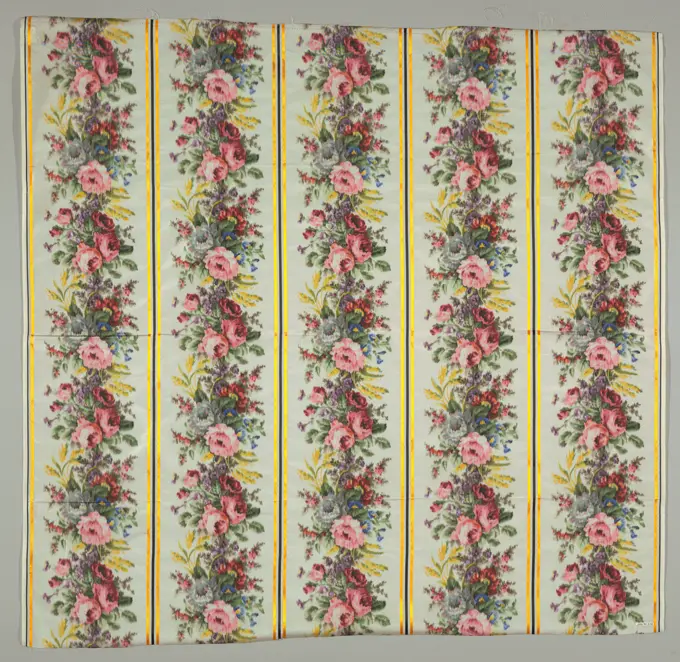
Decorative Silk Fabrics

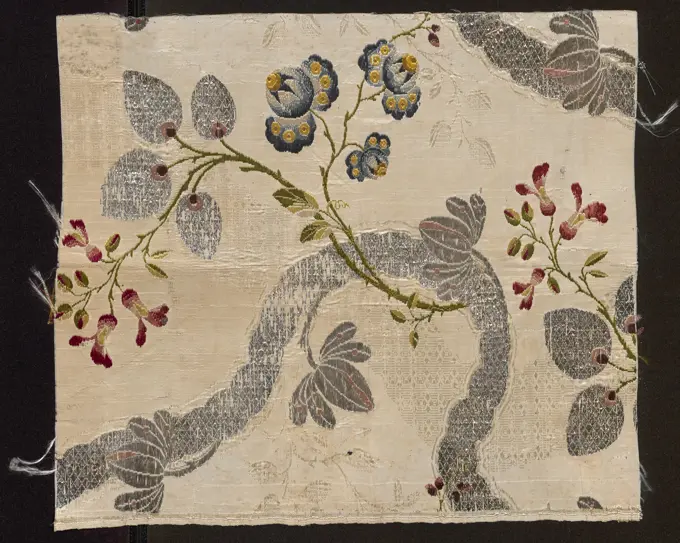
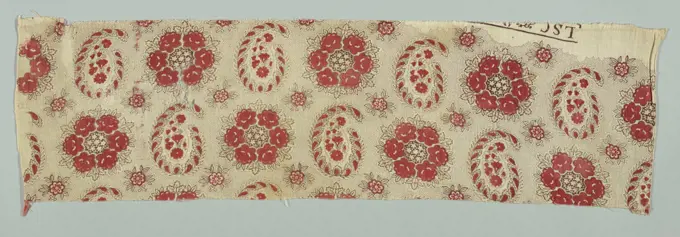
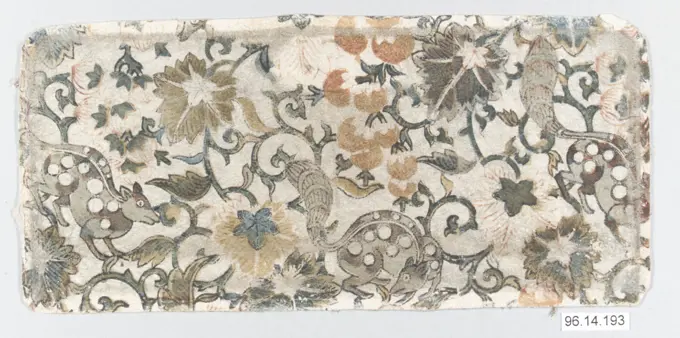
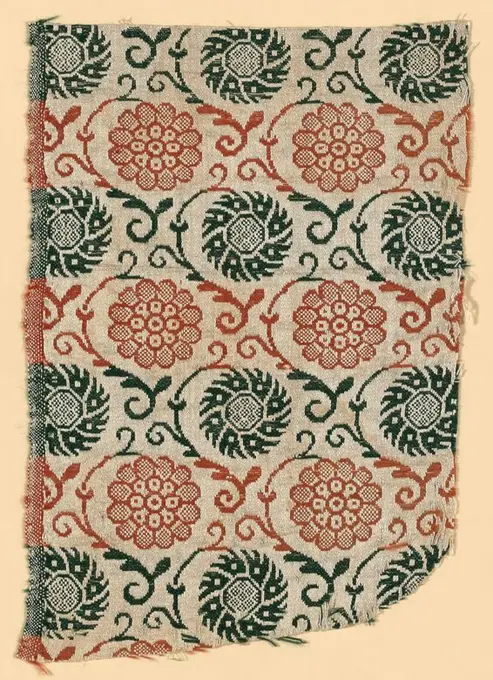
Textiles featuring vibrant floral patterns and intricate designs, showcasing historical silk and cotton materials from various periods.
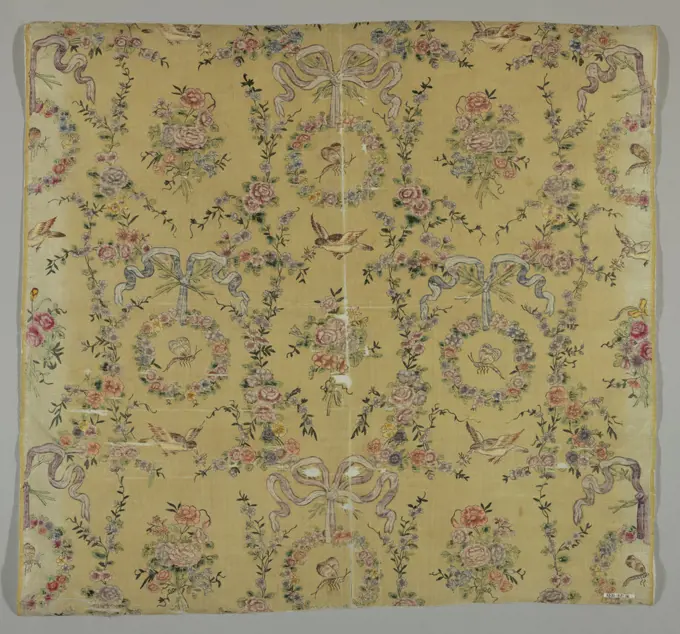
Fragment, Medium: silk; tempera Technique: painted on plain weave, Textile fragment. Cream-colored (originally white) silk with design painted in polychrome tempera. Design of vertical repeat of flower wreaths and garlands, held in place by ribbons, and with birds and insects scattered through the spaces., China, 18th century, printed, dyed & painted textiles, Fragment
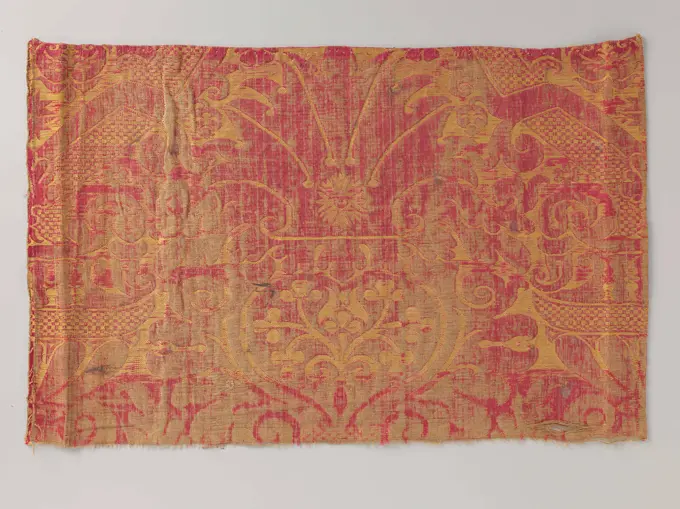
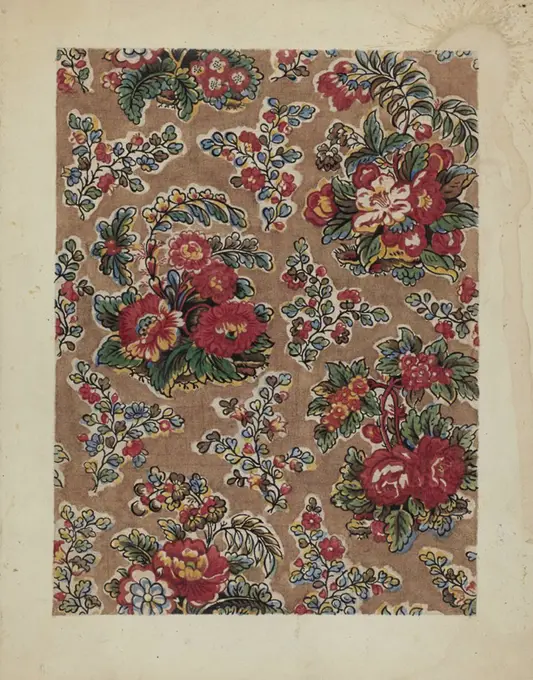
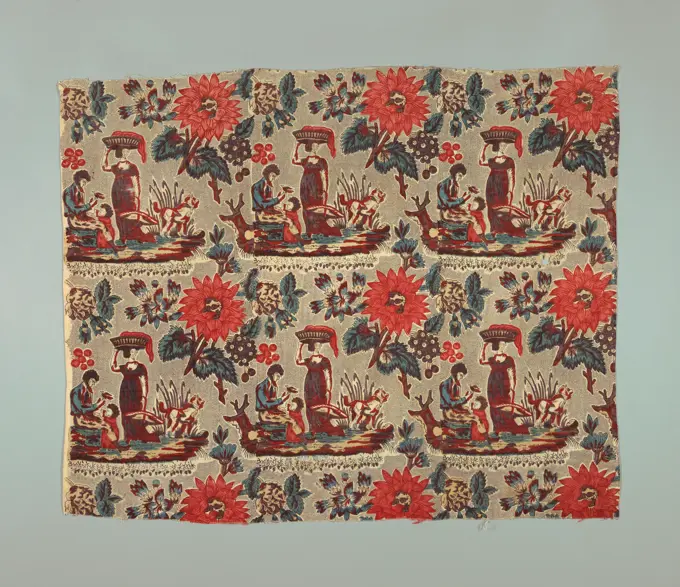
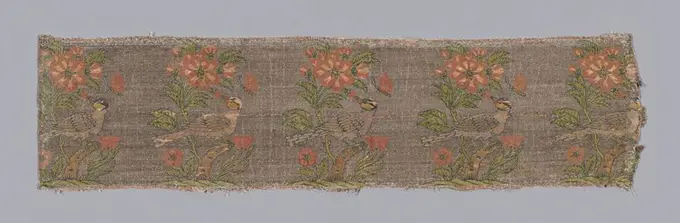
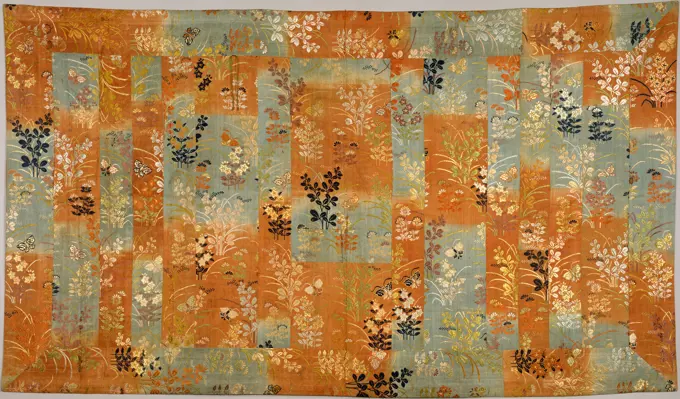
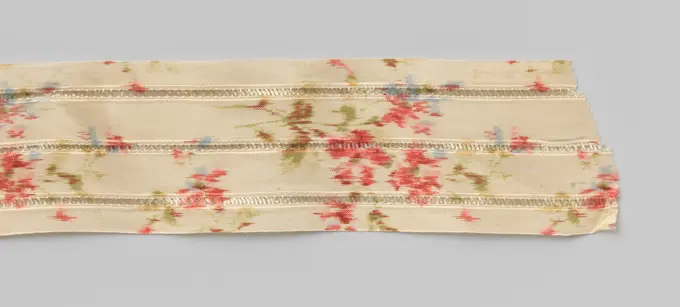
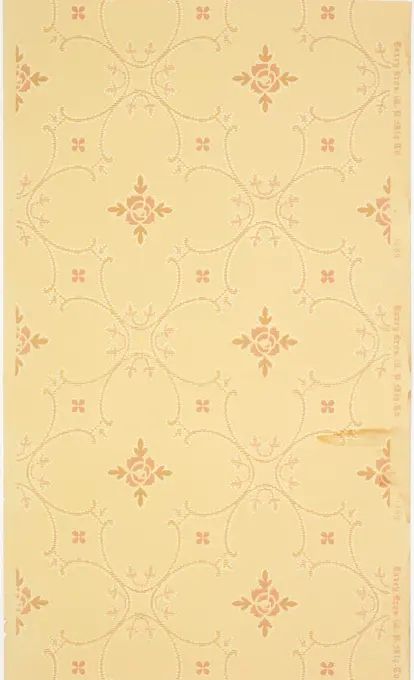
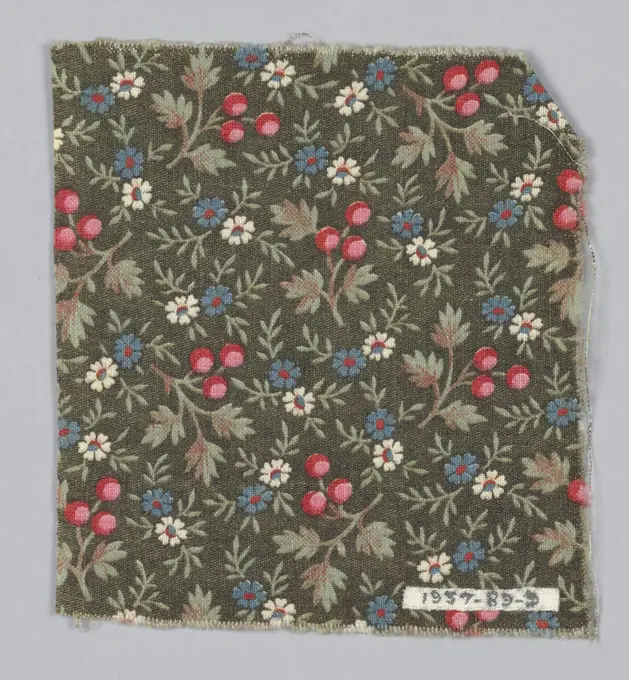
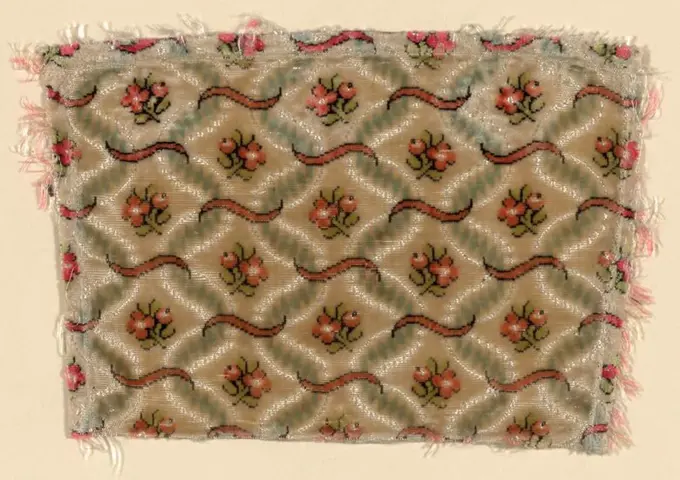
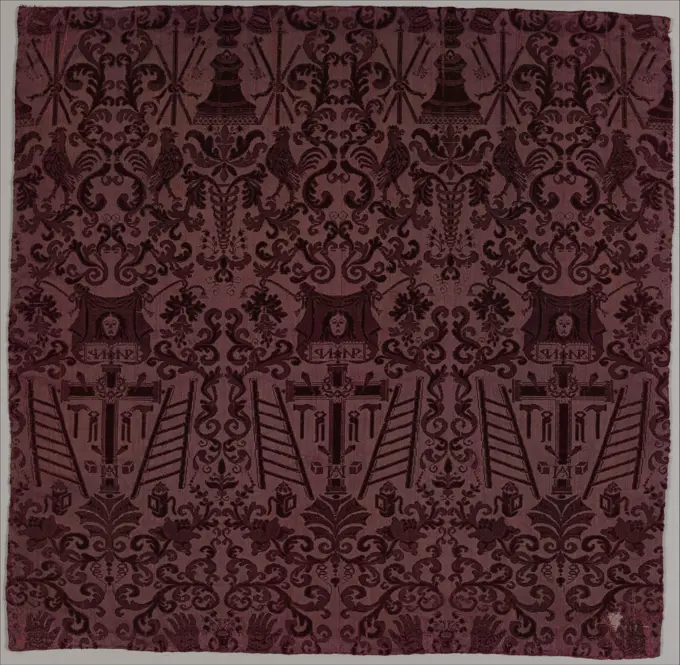
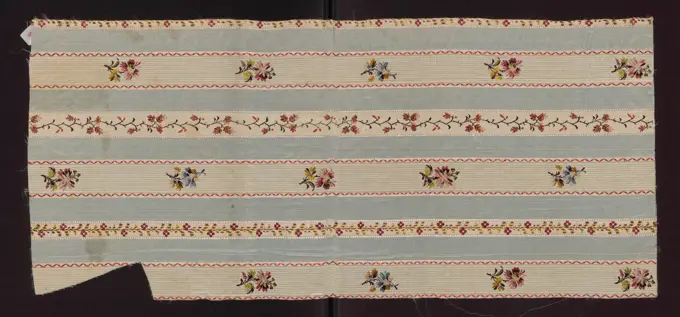
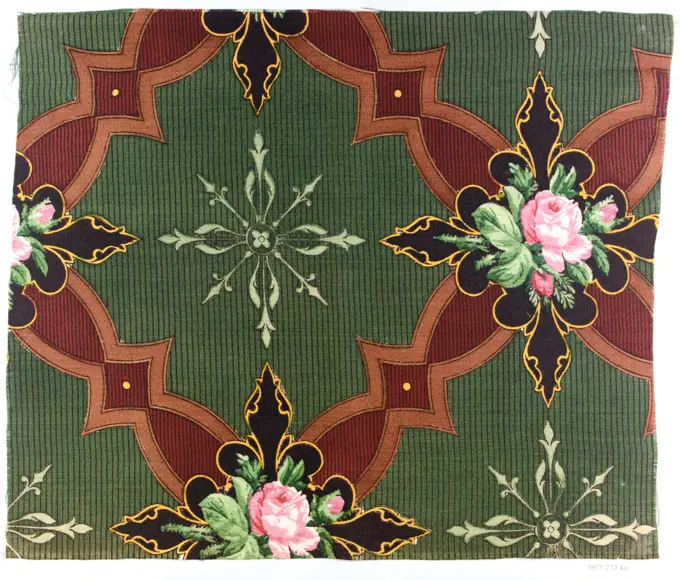
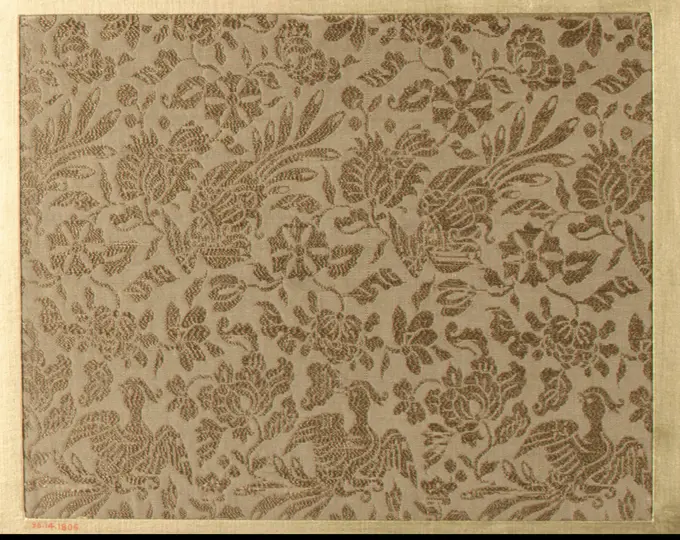
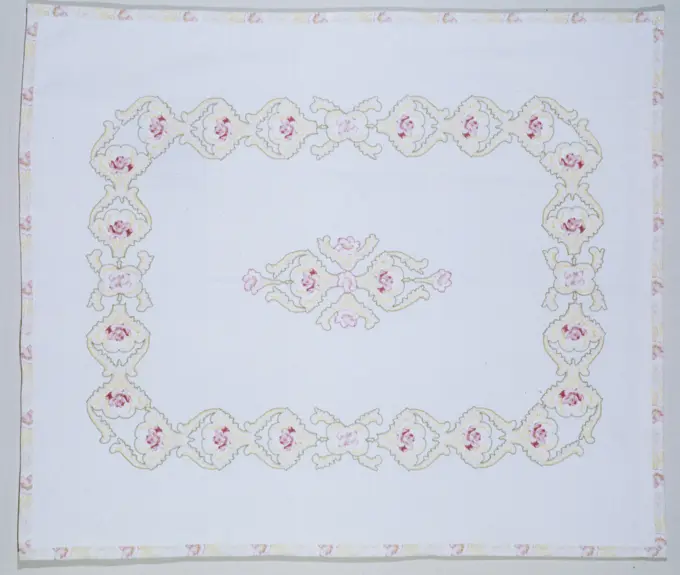
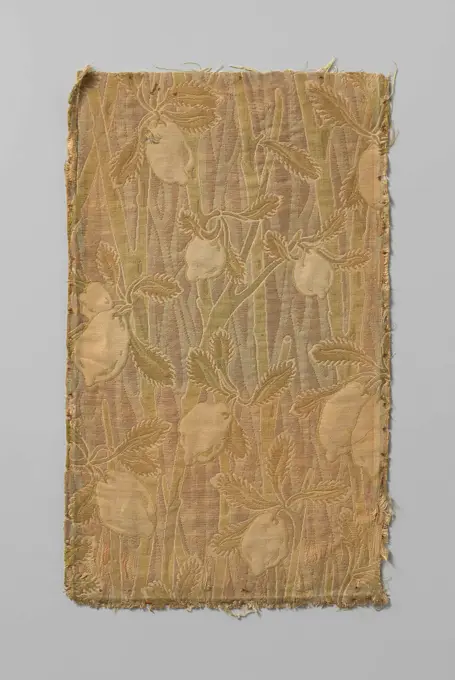
Fragment of stress with pattern of sunflower and butterflies within Spitsovalen, Theo Nieuwenhuis, c. 1909 - c. 1924 Fragment of spancing material with pattern of sunflower and butterflies within Spitsovalen. Purple impact on yellow-white chain. Netherlandsmaker: Helmond cotton (textile) jacquard Fragment of spancing material with pattern of sunflower and butterflies within Spitsovalen. Purple impact on yellow-white chain. Netherlandsmaker: Helmond cotton (textile) jacquardFragment yellow with red silk brocatel with pattern of flower ornament flanked by vases. Fragment yellow with red silk brocatel with pattern of a large flower ornament, flanked by vases from which wide garlands develop. Fond is formed by the yellow warp.Fragment, Medium: silk, metallic Technique: woven, Serpentines and floral bouquets on striped background., France, 18th century, woven textiles, FragmentChasuble Back; silk, metallic threadDress of oriental textile with multicolored embroidery. Dress of multicolored chewy cotton, decorated with flower drinks and ornament, lined with cotton.Textile, Medium: cotton Technique: printed by engraved roller and block printed; glazed, A) Molette-printed ground of tan zig-zags; unprinted white areas form stripe and moire patterns. Over-printed with grey and white lilac sprays and pink and green rose clusters. B) Ground molette-printed in grey with pattern of stripes consisting of checks formed by tiny dots. Over-printed with lilac sprays in brown and white. C) Same with lilacs in blue and white., mid-19th century, printed, dyed & painted textiles, TextilePiece ca. 1735 French. Piece 220143Hanging ca. 1780 British. Hanging 228737Sidewall (USA); Manufactured by Thomas Strahan & Co., Manufactory (United States); machine-printed paper; 91 x 51 cm (35 13/16 x 20 1/16 in.)Textile (France); silk, metallic threadFragment, Medium: silk, metallic Technique: supplementary wefts in plain weave foundation, Oscillating circular motifs on a red background., 17th century, woven textiles, FragmentPatchwork Bedspread. Dated: c. 1936. Dimensions: overall: 35.6 x 27.9 cm (14 x 11 in.). Medium: watercolor, graphite, and pen and ink on paperboard. Museum: National Gallery of Art, Washington DC. Author: Frances Lichten.Ceiling Paper (USA); Manufactured by Carey Bros. W.P. Mfg. Co.; machine-printed paper, ribbed; 95 x 49.5 cm (37 3/8 x 19 1/2 in.)Fragments; silkBag made of multicolored printed trijp, anonymous, c. 1890 - c. 1900 Bag of multicolored printed trijp. Decorated with poppies and in the background grasses. The bag is lined with salmon-colored silk and has two green sides. England . printing Bag of multicolored printed trijp. Decorated with poppies and in the background grasses. The bag is lined with salmon-colored silk and has two green sides. England . printingTextile, Charmeur d'Oiseaux; cottonPanel Made 1725-1775 France. Silk, plain weave with plain interlacings of secondary binding warps and supplementary patterning wefts .Textiles, Medium: silk Technique: damask, Silk damask textile in cream and grey-green showing florals with large and small fleur-de-lys., possibly Spain, possibly Italy, 17th century, woven textiles, TextilesDress or Furnishing Fabric. Iran. Date: 1675-1700. Dimensions: 16.5 x 64.7 cm (6 1/2 x 25 1/2 in.). Silk, gilt-metal-strip-wrapped silk and silver-metal-strip-wrapped silk; twill weave foundation with supplementary twill weave and brocading wefts. Origin: Iran. Museum: The Chicago Art Institute, Chicago, USA.Sidewall, 1680; leather, embossed, silvered, varnished, paintedCeiling Paper (USA); Manufactured by Maxwell & Co., S.A. (United States); machine-printed paper, liquid mica; 84.5 x 47.5 cm (33 1/4 x 18 11/16 in.)Fragment of the fabric;  2. PO. 18th century (1760-00-00-1770-00-00);gift (provenance), variaFragment of four fragments of silk dam mast with, among other things, horizontal rows with large flowers, anonymous, c. 1880 - c. 1920 Fragment of four parts of silk tissues. This is a launched Zijddamast with a design of horizontal rows of large -scale flowers with upright branch on which flowers and leaves, located on a table top, trimmed with a spent border in brown on a creme -colored stock. Following French tissues from around 1730. France (possibly) silk lampas (textile material) Fragment of four parts of silk tissues. This is a launched Zijddamast with a design of horizontal rows of large -scale flowers with upright branch on which flowers and leaves, located on a table top, trimmed with a spent border in brown on a creme -colored stock. Following French tissues from around 1730. France (possibly) silk lampas (textile material)Length of compoundtwillFragments (China); tempera on silkFragment, Medium: cotton Technique: block printed on plain weave foundation, Floral bouquets alternate with paisley botehs in black and red and faded yellow on white., France, late 18th-early 19th century, printed, dyed & painted textiles, FragmentFragment, Medium: silk Technique: cut supplementary warp pile (velvet) in a woven foundation, Fragment of cut dark green velvet pile in a stylized symmetrically placed repeated floral and foliated motif against a red ground., Italy, early 17th century, woven textiles, FragmentPiece 18th-19th century Japan. Piece. Japan. 18th-19th century. Leather. Edo period (1615-1868). LeatherworkFragment. Europe. Date: 1625-1675. Dimensions: 31.7 × 21.6 cm (12 1/2 × 8 1/2 in.)Repeat: 8.6 × 8.9 cm (3 3/8 × 3 1/2 in.). Linen and wool, plain weave, tied and free double cloth. Origin: Europe. Museum: The Chicago Art Institute, Chicago, USA.Excerpt yellow sides atine with pattern in white and blue, consisting of twigs with curled stylized leaf work and large -leaf flowers, anonymous, c. 1770 - c. 1780 Fragment yellow silk damask with pattern in white and blue, consisting of twigs with curled stylized leaf work and large -leaf flowers. Spain silk twill Fragment yellow silk damask with pattern in white and blue, consisting of twigs with curled stylized leaf work and large -leaf flowers. Spain silk twillTextile (France); cotton; Warp x Weft: 121 x 74.5 cm (47 5/8 x 29 5/16 in.); Bequest of Elinor Merrell; 1995-50-342Fragment of silk fabric  colourful sprays of flowers in net composition unknownBand (from Woman's Trousers or Robe) Made 1875-1900 China. .Textile; silkTextile, Medium: silk on cotton Technique: drawnwork and knot stitch embroidery on twill weave; bobbin lace, White on white. Large panel of twill-weave cotton, embroidered in white silk thread along border, edged by bobbin lace, showing drawnwork and knot stitches. Pattern shows flowers and scrolls., England, late 17th century-early 18th century, embroidery & stitching, TextileBaan silk with a three times three branches with leaves, c. 1900 - c. 1920 Baan silk with design of three times three branches with leaves of gold thread (metal lamel around yellow sides core) on a dark green stock. Eastern textile. Japan silk. Baan silk with design of three times three branches with leaves of gold thread (metal lamel around yellow sides core) on a dark green stock. Eastern textile. Japan silk.Textile; cotton; L x W: 111 x 62 cm (43 11/16 x 24 7/16 in.)Piece 18th century Japan. Piece 71589Buddhist Vestment (Kesa) Made from a Noh Costume (Karaori) with Autumn Grasses and Butterflies 18th-19th century Japan Buddhist vestments were often made from donated garments or textiles. Perhaps ironically, this kesa, once used by an old monk, was probably fashioned from a gorgeous eighteenth-century karaori, a type of costume worn by a male actor playing the role of a young woman in a Noh play. Karaori (translated literally as "Chinese weaving) is also the name of a type of multicolored brocaded silk, and this textile has a pattern of butterflies and autumn grasses on a ground of blue and red. The autumn plants all belong to the standard group of seven used in Japanese art and poetry: bush clover (hagi); Chinese bellflower (kiky?); miscanthus grass (obana); “purple trousers flower (fujibakama); large pink (nadeshiko); pampas grass (susuki), and valerian, sometimes called maiden flower (ominaeshi).. Buddhist Vestment (Kesa) Made from a Noh Costume (Karaori) with Autumn Grasses and Fragment of the fabric;  18th century (1701-00-00-1800-00-00);fabricsFragment 17th century Italian. Fragment. Italian. 17th century. Silk. Textiles-VelvetsA fragment of silk fabric unknownRoll Chiné ribbon () With three jobs Ajour work and printed flower pattern in Rose, Green and Blue, Gustav Schnitzler, c. 1875 - c. 1900 Roll Chiné ribbon () With three jobs Ajour work and printed flower pattern in Rose, Green and Blue. Nijmegenfrance silk printing Roll Chiné ribbon () With three jobs Ajour work and printed flower pattern in Rose, Green and Blue. Nijmegenfrance silk printingTextile, Schwartz-Huguenin, Medium: cotton Technique: printed by engraved roller and/or block printed on plain weave; glazed, Two pieces, same design, different colors. A) White ground with broad stripes made of pin stripes of minute bars in rose color, centre area in minute zig-zag with elongated interlace in brown; in white area, sprays of field flowers in shades of red, block-printed or surface roller. Ground probably 'molette.' B) Same design in blue. Glazed., Mulhouse, Alsace, France, 1851-63, printed, dyed & painted textiles, TextileFragment complex silk tissue. Fragment silk tissue with a white ground on which a pattern of brown and white flower bouquets, connected by white winding tendrils.Sidewall - Sample, Indian; Designed by William Morris (British, 1834-1896); Manufactured by Jeffrey & Company (United Kingdom); Made for Morris & Co. (United Kingdom); block-printed paperCecil, Jeffrey & Company, 1836-1930 London, England, Block-printed paper, embossed, hand-rubbed oil finish, Imitation leather. Large scale design of interlacing bands and conventionalized flowers, with vase and tulip forming center axis. Embossed and gilt, and the ground over-printed with green. Straight match and repeat., London, England, ca. 1890, Wallcoverings, Sidewall, SidewallCeiling paper, Maxwell & Co., S.A., Chicago, Illinois, USA, Machine-printed paper, liquid mica, On textured light gray-lavender ground, light green treillage in octagonal shape containing singular purple flowers with four green leaves., USA, 1905-1915, Wallcoverings, Ceiling paperCeiling Paper (USA); Manufactured by Carey Bros. W.P. Mfg. Co.; machine-printed paper, liquid mica; 84 x 49 cm (33 1/16 x 19 5/16 in.)Fragment (Spain); silk; Warp x Weft: 205.7 x 184.2 cm (6 ft. 9 in. x 6 ft. 1/2 in.); dimensions reflect three components stitched together.Floral print ca. 1788 French, Nantes. Floral print 221961Textile, Medium: cotton Technique: block printed on plain weave, Half-drop repeat of leaves and flowers on diagonal branches in browns with green a brown background., England, ca. 1810, printed, dyed & painted textiles, TextilePiece 18th century French. Piece 223286Textile, Medium: cotton Technique: printed on plain weave, Fabric printed with floral patterns in a field and side border, to be used as a hanging or bed cover, in reds and yellows, now faded. The floral patterns of the field and border are designed to be seen from either end, making it easy to join two lengths, one turned 180 degrees, to make a large field with a border on left and right., England, 1880s, printed, dyed & painted textiles, TextileFragment, Medium: cotton Technique: printed on plain weave, Fragment with a dark greenish-black ground and a design of blue and white daisies and red berries, with grey-green foliage., Normandy, France, ca. 1850, printed, dyed & painted textiles, FragmentUpholstery panels for a side chair ca. 1763-64 German, Würzburg The settees and chairs illustrated here (see 1974.356.114-.121) were made for the Franckenstein Pavilion in the gardens of Seehof Castle near Bamberg, one of the three summer residences in Southern Germany used by Adam Friedrich von Seinsheim, prince bishop of Würzberg and Bamberg. A true garden enthusiast, it was under von Seinsheim that the gardens of Seehof were embellished, which must have resembled the still extant Rococo gardens completed by von Seinsheim at Veitshöchheim. His love for gardens and garden imagery also carried over into the interior decoration and furnishings of his castles, as the Seehof furniture demonstrates. A unique example of German Rococo furniture executed in a more flamboyant style than its French prototypes, the ensemble was designed specifically for the Garden Room in the Franckenstein Pavilion. Used as an audience room, it was referred to as the "Green Trellis Chamber" in the 1774 Seehof inFragment. France. Date: 1725-1750. Dimensions: 11.6 × 16.7 cm (4 5/8 × 6 5/8 in.). Silk, cut, and voided velvet with additional patterning wefts tied in twill weave against plain weave foundation. Origin: France. Museum: The Chicago Art Institute, Chicago, USA.Piece 18th-19th century Japan. Piece 67424Back of a chasuble, embroidered unknownVeil. unknown, authorBook cover with overall pattern of rosettes 19th century Anonymous. Book cover with overall pattern of rosettes. Anonymous , 19th century. 19th century. Relief print (wood or metal). PrintsChiné piece, late 19th century, 22 7/8 x 14 3/4 in. (58.1 x 37.47 cm), Silk; printed, France, 19th centuryFront cover. Musset, Alfred de (1810-1857). bindings (gathered matter components), Book covers. 1896. Spencer Collection. BookbindingTextile, The Twin Rose; Designed by Arthur Wilcock; England; cottonCeiling Paper (USA); Manufactured by Maxwell & Co., S.A. (United States); machine-printed paper, liquid mica; 97.5 x 48.5 cm (38 3/8 x 19 1/8 in.)Textile, Medium: silk Technique: satin weave with discontinuous supplementary weft patterning (brocade), Silk brocade with a symmetrical design of intertwined flowering vines, one with very prominent horizontal striping., Europe, 18th century, woven textiles, TextileTextile (England); woolDorothy Kiernan, Woven Brocade (Chair Covers), 1935 1942 Woven Brocade (Chair Covers)Fragment (China); tempera on silkFragment (Egypt); woolFragment of semi silksemi silk fabric  flower bouquet motif with diagonal stripes in the background unknownSquare, Medium: silk Technique: printed on plain weave, Kerchief or square with a pink ground containing scalloped forms, each containing stylized multicolored floral spray on a dotted ground. Narrow floral border on four sides. Silk fringe knotted at one inch intervals., Switzerland, 19th century, printed, dyed & painted textiles, SquareSquare; linenEmbroidery patch of beige tinted linen. The embroidery has Petit Point with Rococo stitch. The Merklap is part of nine brand laps of different sizes, c. 1760 - c. 1780 Embroidery patch of beige tinted linen. The embroidery has Petit Point with Rococo stitch. The Merklap is part of nine brand laps of different sizes (BK-NM-10759-A to BK-NM-10759-I). South Holland (Possible) linen (material) embroidering Embroidery patch of beige tinted linen. The embroidery has Petit Point with Rococo stitch. The Merklap is part of nine brand laps of different sizes (BK-NM-10759-A to BK-NM-10759-I). South Holland (Possible) linen (material) embroideringFragment silk tissue; damaged Lampas, c. 1725 - c. 1750 Two fragments of silk tissue with a pattern of flowers of green, brown, yellow and pink silk and of gold council. The color pink has faded to cream. Lyon silk lampas (textile material) / damask Two fragments of silk tissue with a pattern of flowers of green, brown, yellow and pink silk and of gold council. The color pink has faded to cream. Lyon silk lampas (textile material) / damaskBedcover (Album Quilt). United States. Date: 1845-1850. Dimensions: 228 x 229.5 cm (89 3/4 x 90 3/8 in.). Cotton, plain weave; quilted; appliquéd with plain weaves, some printed, some glazed, some padded; embroidered in buttonhole, chain, satin, and straight stitches. Origin: United States. Museum: The Chicago Art Institute, Chicago, USA.Fragment of a wall tension of painted and printed red silk. Fragment of red silk painted with flowers and leaves in yellow, blue, white and green.Textile, Medium: cotton Technique: printed by engraved roller on plain weave; glazed, On white ground, in red, sepia, blue with traces of yellow (double-green), two bunches of flowers separated by vertical 'pillars' of row of buds and leaves flanked by thin, very wiggly columns., England, ca. 1800-30, printed, dyed & painted textiles, TextileWorkpiece for diploma beautiful crafts, Geesje Smid, c. 1890 - c. 1900 Linen with flower branch embroidered in red with satin stitch. Netherlands satin. cotton (textile) embroidering Linen with flower branch embroidered in red with satin stitch. Netherlands satin. cotton (textile) embroideringPillow Cover (USA); cottonTextile, Medium: silk Technique:, Large square of peach color satin with rococo floral pattern in light green, yellow and white., Italy, mid-18th century, woven textiles, TextileBorder, Medium: silk Technique: woven, Multi-colored design of tulips and other flowers arranged on a curving stem on a gray ground with a white border., France, early-mid-19th century, woven textiles, BorderLength of velvet with Instruments of the Passion 16th-17th century possibly Spanish. Length of velvet with Instruments of the Passion 227534Fragment of the fabric;  19th century (1801-00-00-1900-00-00);Society of Friends of the Museum, Collection, FabricsYellow Rose with floral repeat pattern. Sample mid-19th century French. Sample 229339Piece 1750-60 French. Piece 224387Textile (Portugal); cottonPiece 18th-19th century Japan. Piece 67519Sidewall - sample, Machine-printed, Floral bouquet in medallion, printed in void of moire-like background. Printed in green, pink and white., USA, 1907-08, Wallcoverings, Sidewall - sampleChair Seat Made 1801-1900 England. Linen, plain weave; embroidered with wool in tent stitches .Textile; Warp x Weft: 39.5 × 34.5 cm (15 9/16 × 13 9/16 in.)Piece ca. 1735 French. Piece 220163Fragment Multicolor silk Pekin. A fragment of white silk tissue with stripes of pink, blue and red. Colored bouquets of garlands.Quilt, c. 1900, 81 1/2 x 70 1/2 in. (207.01 x 179.07 cm), Cotton, quilted, United States, 19th-20th centuryPiece French, possibly Alsace 19th centuryTextile; linenFragment half silk tissue. Fragment half silk tissue. The fragment has an irregular pattern of branched twigs in olive and moss green, to which lemon-like fruits in white, circumference through a leaf rack, on a beige-brown soil.Hooked Rug. Dated: c. 1936. Dimensions: overall: 35.6 x 25 cm (14 x 9 13/16 in.) Original IAD Object: 24" wide; 33" long. Medium: watercolor, pen and ink, and graphite on paper. Museum: National Gallery of Art, Washington DC. Author: Ruth M. Barnes.Textile (France); silk