Decorative Textiles

Collection of historical textile pieces featuring intricate floral patterns and designs, showcasing various techniques and materials from different centuries.

Textile, Medium: silk Technique: woven with continuous and discontinuous supplementary weft patterning (brocade), Silk brocade with a loose lattice framework formed of naturalistic flowers and leaves, in pale greens, pinks and oranges on an off-white ground., France, England, ca. 1740, woven textiles, Textile
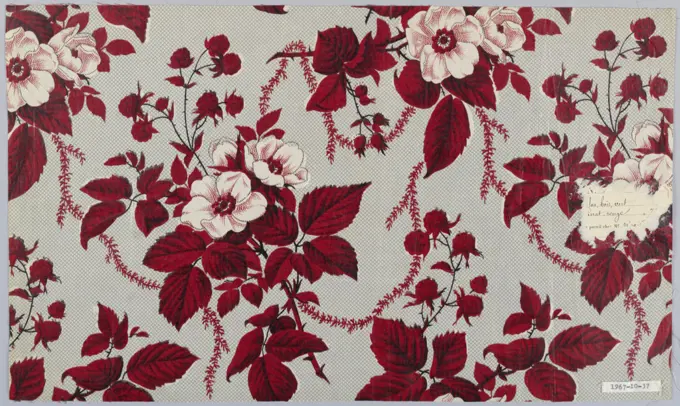
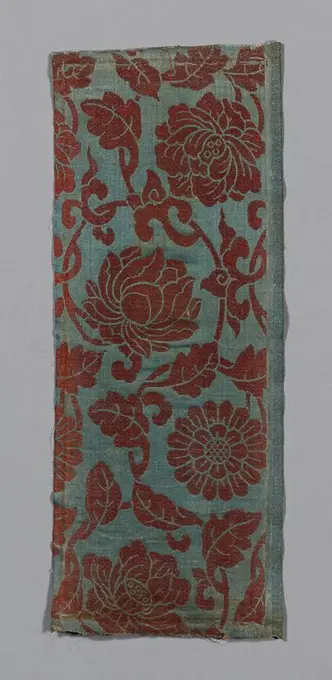
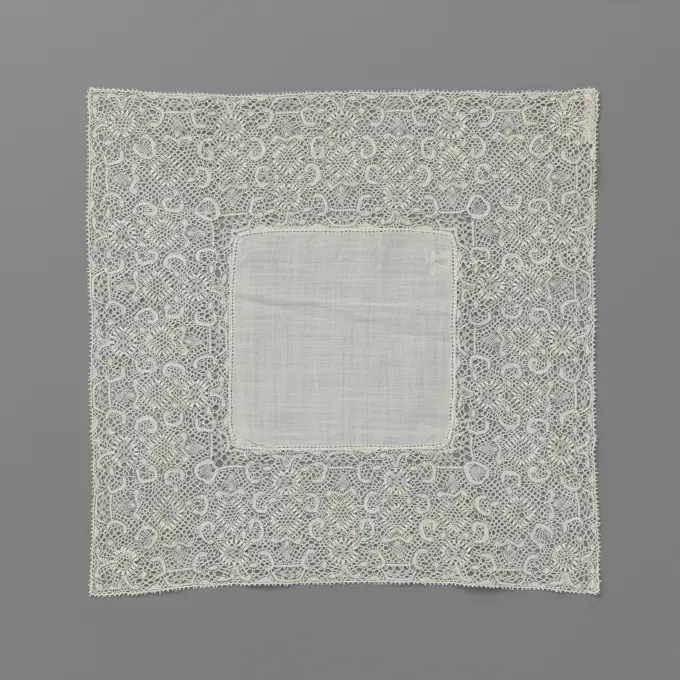
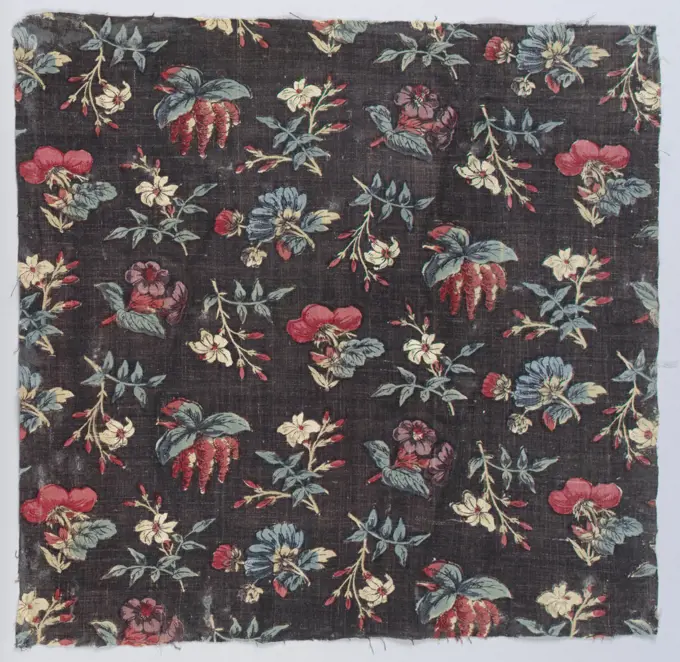
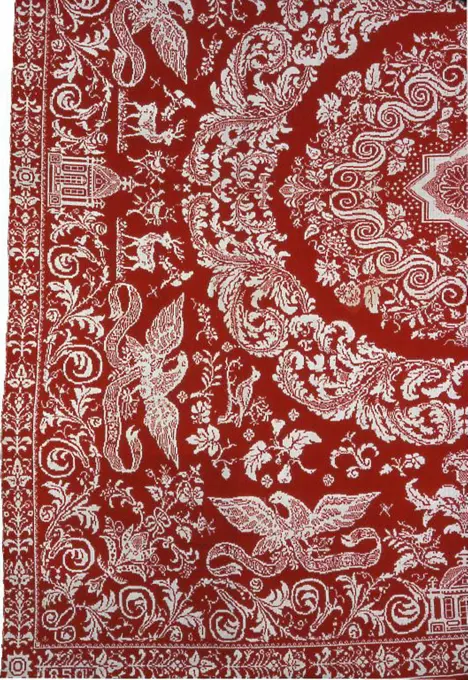
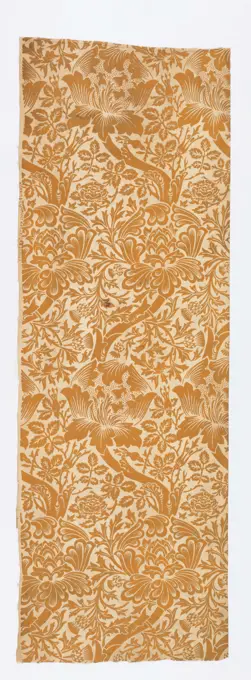
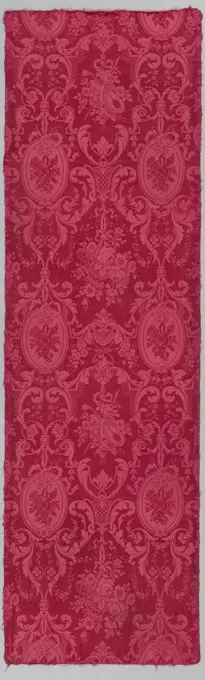
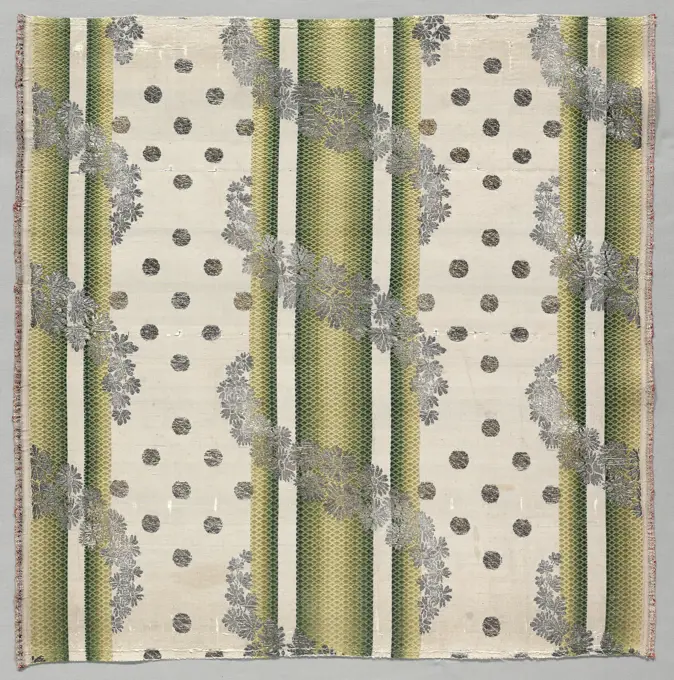
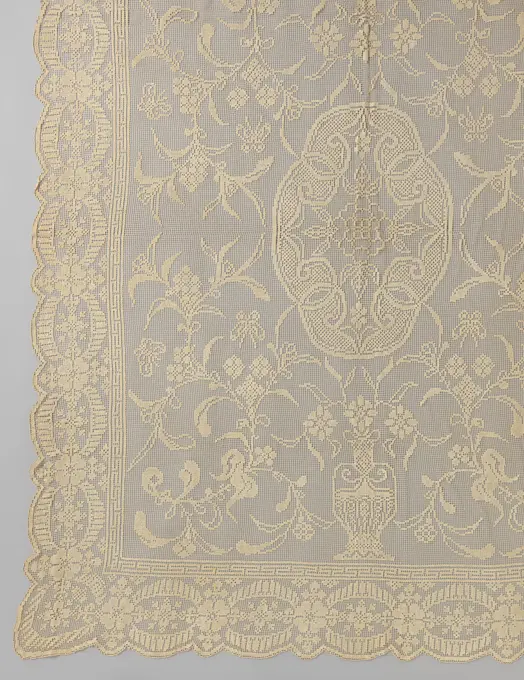
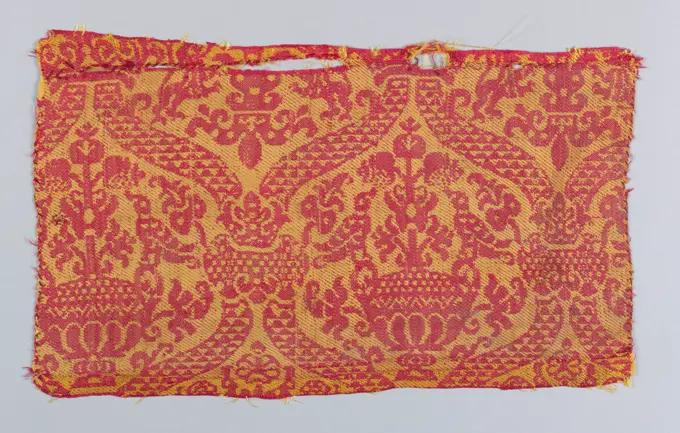
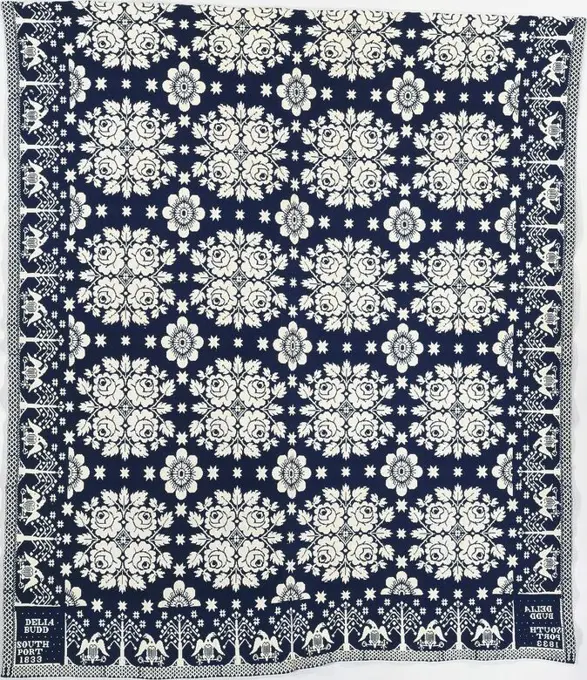
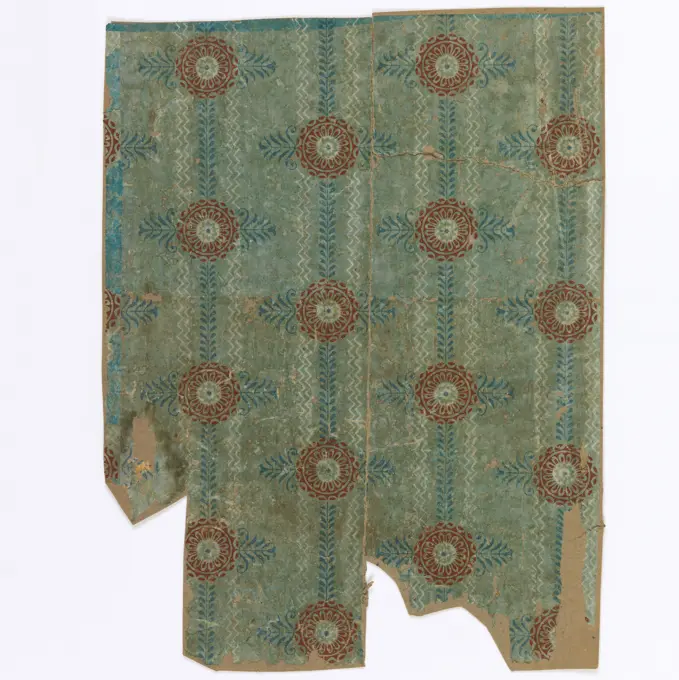
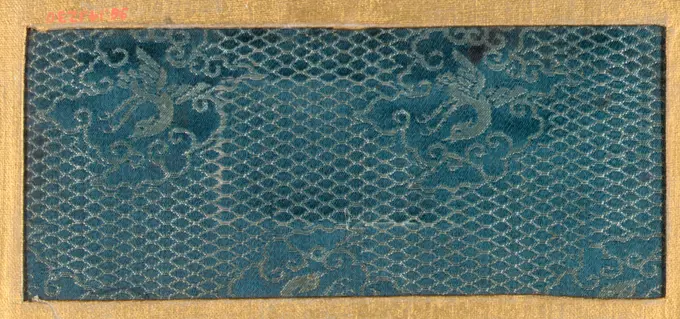
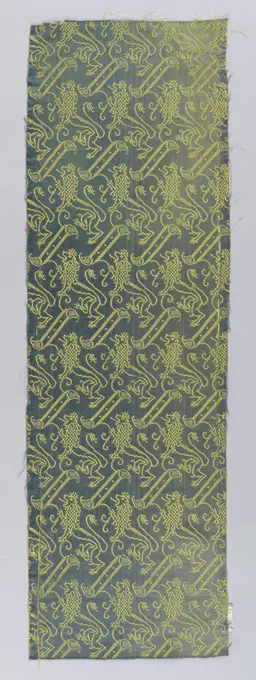
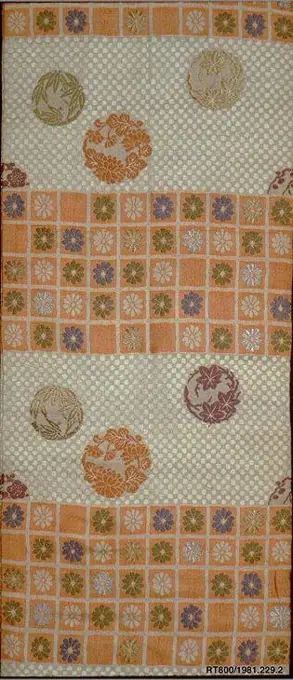
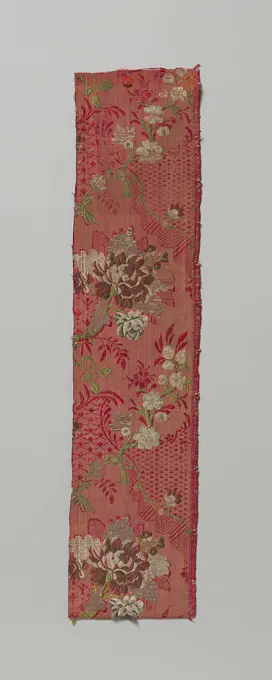
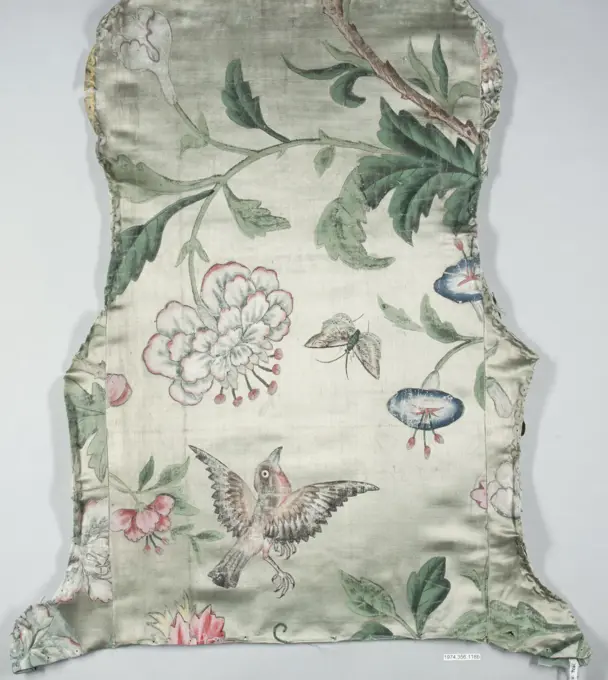
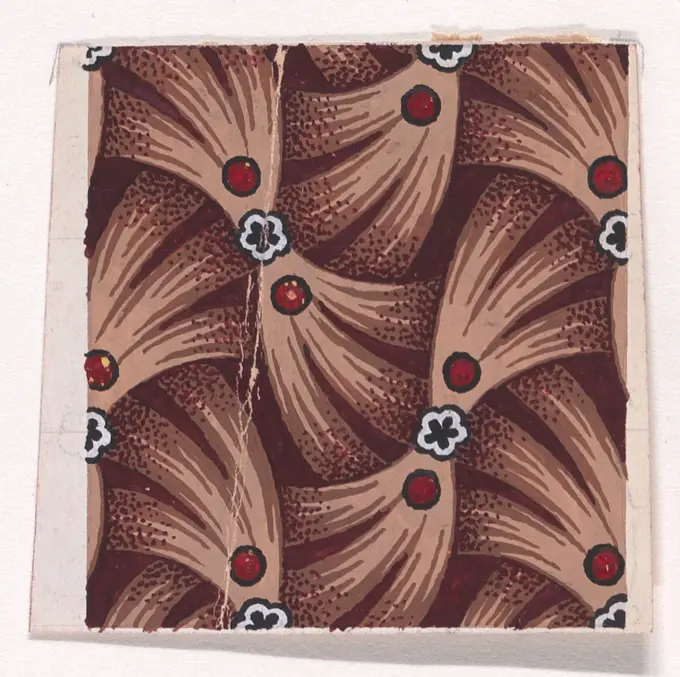
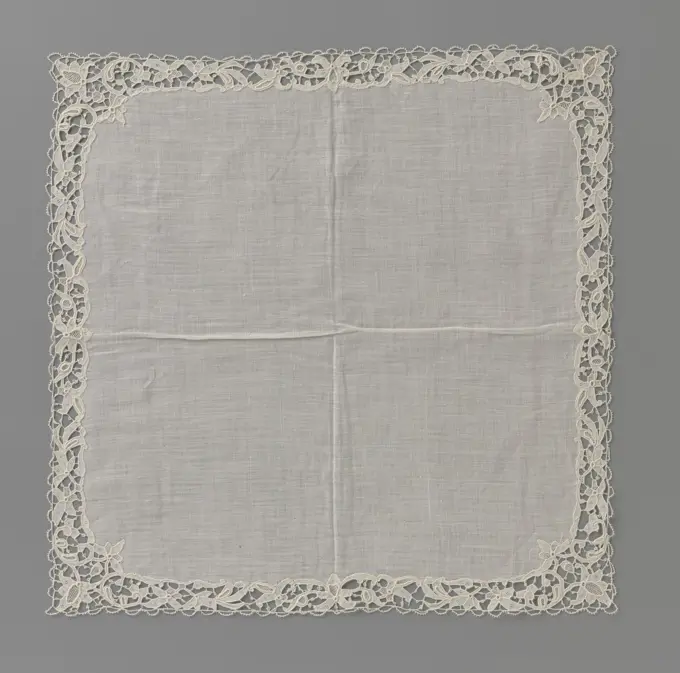
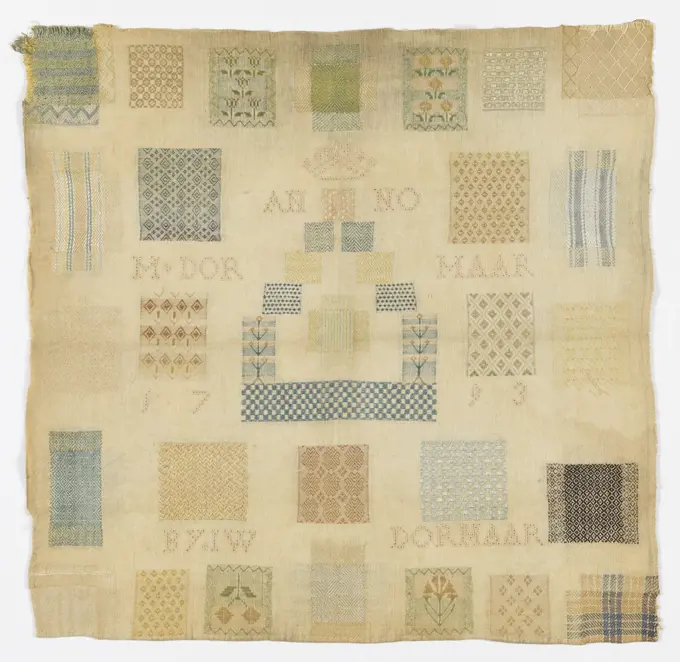
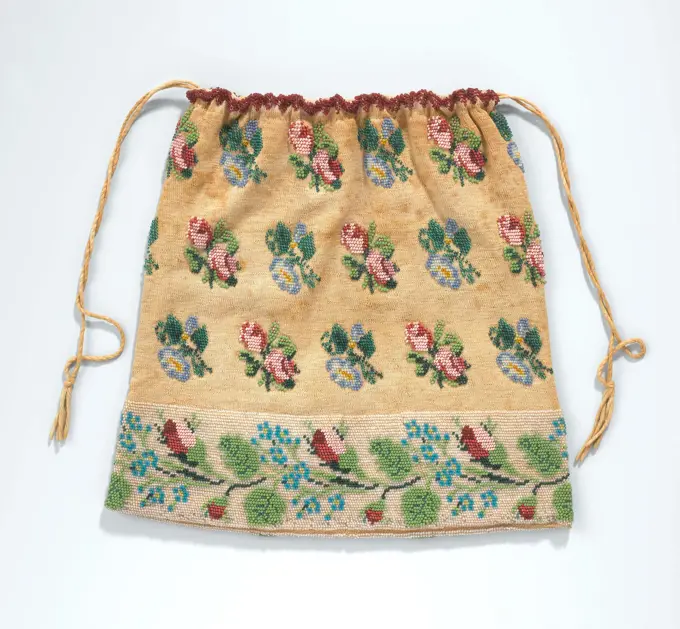
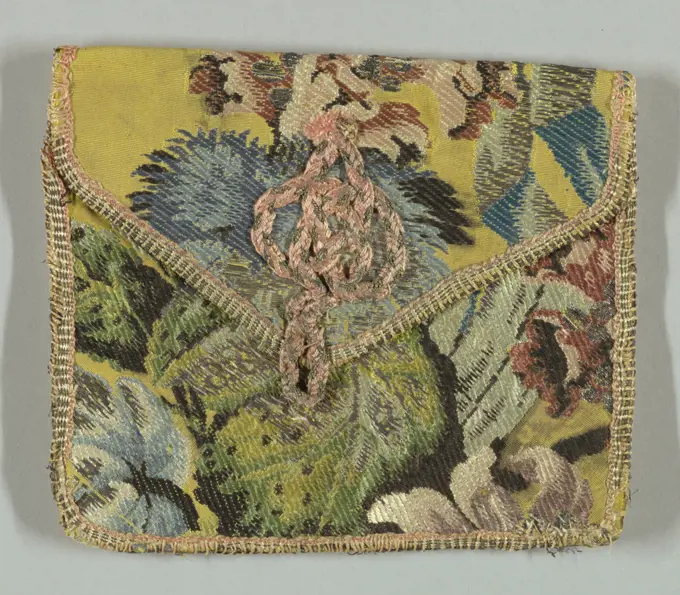
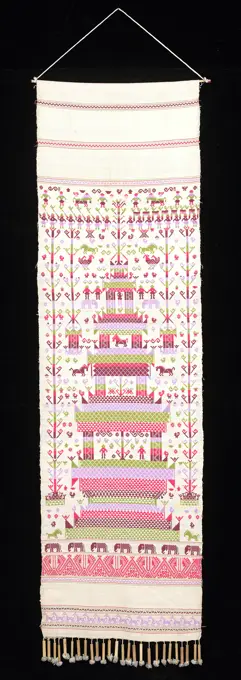
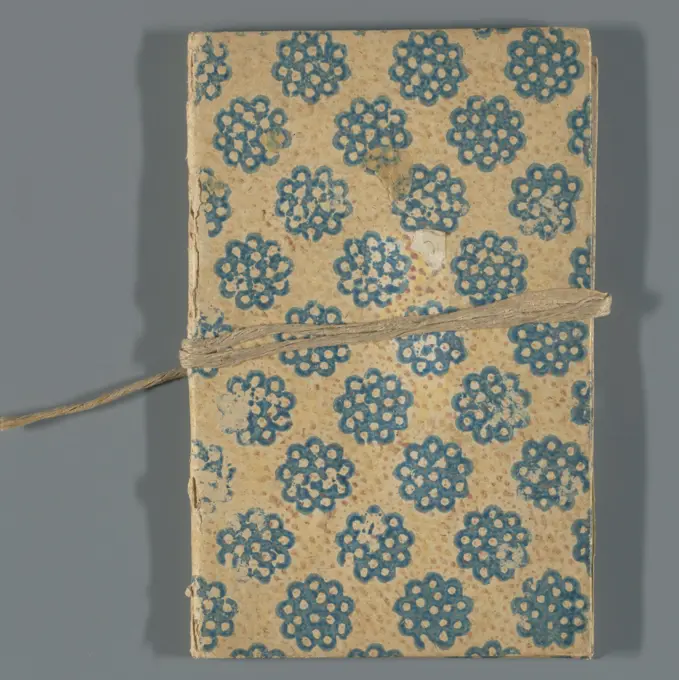
Textile (Iran); silk, metallic threadsTextile, Medium: cotton Technique: printed by engraved roller and block printed, Ground printed in grey, by molette, in minute all-over disapered pattern; clusters of white moss roses, red raspberries and foliage connected by slender meandering vine, are printed over the molette ground., 1851-63, printed, dyed & painted textiles, TextileSutra Cover. China. Date: 1590-1599. Dimensions: 35.4 × 13.7 cm (14 × 5 3/8 in.)Weft repeat: 11.1 cm (4 3/8 in.). Silk, warp-float faced 4:1 satin weave with supplementary patterning wefts bound in weft-float faced 1:4 satin interlacings. Origin: China. Museum: The Chicago Art Institute, Chicago, USA.Fragment, 1902-1-304Medium: silk Technique: 5-harness satin damask, Short length of red damask in a symmetrical arrangement of large flowers and scrolling leaves., France, 17th-18th century, woven textiles, FragmentPiece 19th century Japan. Piece 67109Purse, Medium: metal thread on silk Technique: embroidered on satin foundation, Purse with symmetrical brown floral embroidery on the front and back. Center back embroidery could be a family emblem., France or England, late 17th century, costume & accessories, PurseZakdoek van kloskant met c-voluten waartussen een ruitvormige bloem in een pot en een rond boompje.Natural batist handkerchief deposited with a wide edge of a climbing side: Magician side. Square model with straight sides that are finished with picots. The pattern consists of a lines of c-voluten with ringed snowflakes, between which a diamond-shaped flower stands up in a pot and a round tree. In the corners there is a slightly different but similar pattern that is placed obliquely. The motifs are made in linse stroke and and they are interconnected by a twisted crossbeat soil. The shape strokes with which the contours of the diamond forms and circles are made striking.Textile (possibly USA); cottonHandkerchief, 1857. Madeira, 19th century. Plain weave cotton with cotton embroidery; average: 45.8 x 41.3 cm (18 1/16 x 16 1/4 in.).Panel (From Woman's Trousers) Made 1801-1900 Iran. .Fragments of embroidery from the chasuble unknownTextile (France); silk, metallic threadFragment, Medium: cotton Technique: madder colors block printed, blue applied by brush on plain weave, Non-directional pattern of floral sprigs on a deep purple background., Europe, late 18th century, printed, dyed & painted textiles, FragmentPanel Made 1860-1880 Lyon. Silk and cotton, satin weave, cut and uncut voided velvet . Mathevon et Bouvard (Producer)Palempore with flower drinks and pre-bizarre motifs. Cotton bedspread, multicolored sits with gold, lined with shredded cotton, decorated with floral drinks and pre-bizarre motifs.Coverlet Made 1850 New York. Cotton and wool, plain weave double cloth; woven on loom with Jacquard attachment; full loom width; seamless .Handkerchief, Medium: piña (pineapple) fiber, cotton Technique: appliqué, embroidery and drawnwork on plain weave, Handkerchief in piña cloth edged with a wide border, embroidered in cotton in drawnwork in large scale floral sprays., Philippines, 19th century, embroidery & stitching, HandkerchiefBorder, Medium: linen Technique: needle lace, Elaborate symmetrical design of a small-scale urn with flowers and very small confronted birds. Much detail in relief., France, 18th century, lace, BorderTextile (England); Made by Morris & Co. (United Kingdom); cottonCoverlet Made 1836 New York. Cotton and wool, plain weave double cloth; woven on loom with Jacquard attachment . Harry Tyler (Weaver)Excerpt of a wall covering of cerise -red silk damask, anonymous, 1850 - 1875 Fragment of a wall covering, of cerise-red silk damask. (In satin, taft and twill binding). A strict symmetrical ornament of acanthus leaves right and round lines of two pointed fields lined above each other, within which unymmetrical motifs are hung on a ribbon with bow; The one consisting of a precious flower basket with naturalistic flower arrangement, the other formed by a mandolin and a tambourine. Intermediate fields of approximately the same size, and staggering with the first, wear an oval medallion with pearl edge, also hanging on tied ribbons, starting at the junctions of the Acanthus ornament. The medallions are filled with two crossed horns of abundance. The main ornament is enlivened with fine winding twigs and symmetrical fields with net filling. This fragment comes from the Balzaal in the official residence of the mayor of Amsterdam, Herengracht 502, demolished in September 1950. France (possibBedcover Made 1775-1800 New York .Patchwork Quilt. Dated: c. 1938. Dimensions: overall: 49.8 x 37.4 cm (19 5/8 x 14 3/4 in.). Medium: watercolor and graphite on paper. Museum: National Gallery of Art, Washington DC. Author: Elbert S. Mowery.Napkin from white Linnamast ,, 1677 White linen Damas napkin with thrown flowers, including emperor crown, snail, butterflies and other insects. Netherlands (possibly) linen (material) damask White linen Damas napkin with thrown flowers, including emperor crown, snail, butterflies and other insects. Netherlands (possibly) linen (material) damaskFront doubleur. 1908 - 1897. Coppée, François (1842-1908). bindings (gathered matter components), Book covers. Spencer Collection. BookbindingNapkin with Dessin of Gareda's, woven for the Prince Mangkoe Nagoro VII from Surakarta .. Linen Damaken napkin with a crowned bird in the middle surrounded by sunflowers. In the corners showing gongradas and winged monogram HB, woven for Prince Mang cow Nagoro VII from Surakarta.Length of Taffeta, 1774-1793. France, late 18th century, Peirod of Louis XVI (1774-1793). Taffeta, warp-patterned and brocaded; silk; overall: 58 x 56.5 cm (22 13/16 x 22 1/4 in.); mounted: 63.7 x 62.9 cm (25 1/16 x 24 3/4 in.).Fragment Made 1501-1600 Italy. Silk and gilt-metal strips, plain weave with supplementary patterning wefts bound by main warps in plain interlacing .Piece. Culture: French. Dimensions: 8 1/2 x 34 inches (21.6 x 86.4 cm). Date: ca. 1750. Museum: Metropolitan Museum of Art, New York, USA.Piece 1760-70 French. Piece 220254Napkin with a flower pattern, anonymous, c. 1680 - c. 1690 Linnamast napkin with a pattern of large flower branches, partly tied. Standing edges: volutes and flower branches. Lying edges volutes and flower branch. Corners: A leafy branch with rose and rosez knob. Tussen edges with stylized motives. Southern Netherlands (possibly) linen (material) damask Linnamast napkin with a pattern of large flower branches, partly tied. Standing edges: volutes and flower branches. Lying edges volutes and flower branch. Corners: A leafy branch with rose and rosez knob. Tussen edges with stylized motives. Southern Netherlands (possibly) linen (material) damaskPiece 17th century China or Japan. Piece 70973Suspenders 19th century European. Suspenders 102540Fragment; silk, metallic threadTablecloth of linen with pattern of a vase with roses in fillet cross. Tablecloth of linen with a pattern of a vase with roses in filet cross.Textile Swatches Onondaga Silk Company, Inc. (1925-1981). Textile Swatches, 1948-1959. 72 silk, 28 acetate, 47 1/2 x 35 1/2 in. (120.7 x 90.2 cm).    1948-1959Fragment, 17th century; silkCoverlet. Culture: American. Dimensions: 88 x 76 3/4 in. (223.5 x 194.9 cm). Date: 1833.This dark blue wool and undyed cotton coverlet is woven in two panels and seamed at the center. The central field is patterned with quadrupled rose medallions, while the borders show alternating eagles and fruit trees. Museum: Metropolitan Museum of Art, New York, USA.Textile (England); cotton; Warp x Weft: 109.2 x 55.9 cm (43 x 22 in.) Repeat H (half-drop): 33 x 23.5 cm (13 x 9 1/4 in.)Sidewall (possibly USA); block-printed on handmade paper; a) Overall: 65 x 50 cm (25 9/16 x 19 11/16 in.) b) Overall: 18 x 23.5 cm (7 1/16 x 9 1/4 in.) c) Overall: 7.5 x 21 cm (2 15/16 x 8 1/4 in.)Piece. Culture: French. Dimensions: L. 49 1/2 x W. 22 inches125.7 x 55.9 cm. Date: 18th century. Museum: Metropolitan Museum of Art, New York, USA.Piece European 19th centuryHandkerchief, Medium: linen, cotton Technique: embroidered, White linen handkerchief with wide border of embroidery. A diagonally placed spray of flowers alternates with leaf spray above a scalloped border with drawnwork ornament; initials M.B.C., Switzerland, ca. 1870, embroidery & stitching, HandkerchiefPiece 18th-19th century Japan. Piece 66949Book Cover, 1680-1720. China, Qing dynasty (1644-1911). Silk; overall: 21.6 x 12.7 cm (8 1/2 x 5 in.).Fragment, Medium: cotton Technique: block printed (two reds, black) and blue applied by brush on plain weave, Widely spread clusters of roses surrounded by tiny blue leaves on a black background., Europe, late 18th century, printed, dyed & painted textiles, FragmentFragment, Medium: silk: Technique:, Lions and diagonal bars in blue and gold., Italy, 17th century, woven textiles, FragmentChair back and seat cover 1811 Séguin et Cie The Mobilier National, successor to Colbert's royal Garde-Meuble de la Couronne, has been responsible for the decoration of state residences in France to the present day. During the seventeenth and eighteenth centuries, the Garde-Meuble oversaw the ordering of textiles from Lyon as part of a general plan to support French industry and decrease competitive textile imports from Italy and elsewhere. Lyon silk manufacturers, known collectively as the Grande Fabrique, were sustained by these commissions and, in response to strict regulatory edicts, brought an unsurpassed degree of beauty and quality to the fabrics they produced. After 1792, all work for the Garde-Meuble ceased in Lyon until January 1802, when Napoleon and Josephine toured the factories on the Quai Saint-Clair. Commissions were soon underway to decorate the palaces being refurbished by the Garde-Meuble, which Napoleon reorganized and designated the Mobilier Impérial.Designed by JePiece 1750-75 French. Piece 220559Length of Fabric for Clothing 18th century This length of fabric with intact selvedges is decorated with rows of poppies on a ground of shimmering silver-wrapped thread. Textiles like this example, with repeating patterns of formally arranged, naturalistic flowers on a blank background, were produced in great numbers in Mughal India beginning in the seventeenth century.. Length of Fabric for Clothing 453215Border (USA); machine-printed paper, liquid mica; 92.5 x 47.5 cm (36 7/16 x 18 11/16 in.)Textile Swatches Onondaga Silk Company, Inc. (1925-1981). Textile Swatches, 1948-1959. 72 silk; 28 metal, a-d: 8 × 4 1/2 in. (20.3 × 11.4 cm).    1948-1959Textile (France); silk, metallic thread; Anonymous bequest in memory of Albert and Rebecca Elsberg; 1938-82-43-bTextile (USA); Manufactured by DuPont Rayon Company; linenSidewall - Fragment (USA); machine-printed; 13 x 11 cm (5 1/8 x 4 5/16 in.)Fragment (China); silk; temperaPiece 18th-19th century Japan. Piece. Japan. 18th-19th century. Silk. Textiles-WovenFragment, Medium: silk Technique: cut voided supplementary warp pile in a plain weave foundation with supplementary weft (velvet), Voided pattern of Chinese motifs on a yellow-gold cut velvet ground., China, 19th century, woven textiles, FragmentNapkin van Wit Linnamast with lace pattern and name and weapon input of Hendrik van Isselmuden and year 1731, Anonymous, 1731 Servet of white Linnamast with lace pattern and name and weapon input of Hendrik van Isselmuden and year 1731. Flanders (Possible) linen (material) damask Servet of white Linnamast with lace pattern and name and weapon input of Hendrik van Isselmuden and year 1731. Flanders (Possible) linen (material) damaskNapkin, Cherry: Design no. 600; Designed by Chris Lebeau (Dutch, 1875 - 1945); Manufactured by E.F.J. Van Dissel and Son; NetherlandsAltar Frontal Made 1735-1745 France. Silk, satin weave; embroidered in silk and gold and silver thread .Woman's Letter Case. France, circa 1760. Costumes; Accessories. Glass beads, silk and metallic thread plain weave ribbon, and silk plain weaveTextile 19th century Japan. Textile 68077Fragment of silk fabric  floral pattern in belt composition unknownPiece French 19th centuryFragments of embroidery unknownInvitation and greeting card, old and baroque stile, vintage frame.Obi with Pattern of Checks and Floral Roundels 19th century Japan. Obi with Pattern of Checks and Floral Roundels. Japan. 19th century. Silk, metallic thread; twill with supplementary weft patterning and brocading. CostumesFragment red brochet side with a multicolor pattern with bouquet and flower garlands and so-called edge edge.fragment of Red Silk Soil With Ditto Darker Figures, Interwoven With Multicolored Bouquets and Flower Garlands and So-Called Lace Edge.Leaf with pattern of flower pots between leaf vines, anonymous, c. 1700 - c. 1850  Leaf with pattern of flower pots between leaf vines with flowers. Used as a cover.  paper. block printing (relief printing process) ornament derived from plant formsUpholstery panels for an armchair ca. 1763-64 German, Würzburg The settees and chairs illustrated here (see 1974.356.114-.121) were made for the Franckenstein Pavilion in the gardens of Seehof Castle near Bamberg, one of the three summer residences in Southern Germany used by Adam Friedrich von Seinsheim, prince bishop of Würzberg and Bamberg. A true garden enthusiast, it was under von Seinsheim that the gardens of Seehof were embellished, which must have resembled the still extant Rococo gardens completed by von Seinsheim at Veitshöchheim. His love for gardens and garden imagery also carried over into the interior decoration and furnishings of his castles, as the Seehof furniture demonstrates. A unique example of German Rococo furniture executed in a more flamboyant style than its French prototypes, the ensemble was designed specifically for the Garden Room in the Franckenstein Pavilion. Used as an audience room, it was referred to as the "Green Trellis Chamber" in the 1774 Seehof invAlbum with ornament prints with cartouches, masks, vases and capitals; Ornaments; Disegni, et abbozzi di Agostino Mitelli Intagliati Dal Figluolo di Lui Gioseppe Maria Mitelli. Album with title print and twenty-four ornament prints with cartouches, masks, vases and capitals. It concerns the print series entitled: Disegni, et abbozzi di Agostino Mitelli intagliati dal figluolo di Lui Gioseppe Maria Mitelli. Folder of decorative paper with floral pattern in blue and yellow, colored with the help of templates, tied with rope.Fragment of silk fabric  gold and silver contoured pattern with band motif and bunches of pomegranates and flowers unknownFragment. Spain. Date: 1601-1700. Dimensions: 49 x 50.8 cm (19 1/4 x 20 in.). Silk, plain weave with plain interlacings of secondary binding warps and patterning wefts. Origin: Spain. Museum: The Chicago Art Institute, Chicago, USA.Ôhi (Stole) Made 1775-1825 Japan. Fancy compound satin in silk threads and golden paper strips .Textile, Medium: silk and metallic thread on silk Technique: embroidered on taffeta foundation, Design of curving stems with several different kinds of flowers and leaves; worked in couching, French knots, laid and satin stitches. Colors: pinks, blues, green, and much gold on brown ground., Italy, 1750-75, embroidery & stitching, TextileTextile Design with Alternating Rows of Bundles of Hay Decorated with Rosettes and Pearls 1840 Anonymous, Alsatian, 19th century Rectangular sheet of paper with a textile design from a group, dated 1840, made in Mulhouse, Alsace, which was an important nineteenth-century center for textile production in the Haut-Rhin region of France. The design is made up of alternating rows of bundles of hay of light tan color decorated with rosettes of five petals with two pearls on the sides, over a dark reddish-brown ground. The rosettes are of black color with white outlines; the pearls are colored with red.. Textile Design with Alternating Rows of Bundles of Hay Decorated with Rosettes and Pearls. Anonymous, Alsatian, 19th century. 1840. GouacheTextile 19th century Japan. Textile 68060Woman's Shawl. England, probably Norwich, mid-19th century. Costumes; outerwear. Silk and wool twill with silk and wool supplementary-weft patterning.Piece 1740-50 French. Piece 217200Handkerchief. NideckaFragment (Furnishing Fabric) Made 1775-1800 France. Cotton, plain weave; block printed .Needle handkerchief with flowers and an inner piece of batist, anonymous, c. 1870 - c. 1909 Batist handkerchief with a edge of natural -colored needle side: Venetian relief side. The inner piece of Linen Batist is somewhat sculpted. On a bar soil there are tumbles with multifaceted flowers that are symmetrical grouped. BURANO linen (material) Venetian raised work Batist handkerchief with a edge of natural -colored needle side: Venetian relief side. The inner piece of Linen Batist is somewhat sculpted. On a bar soil there are tumbles with multifaceted flowers that are symmetrical grouped. BURANO linen (material) Venetian raised workSampler, Medium: silk embroidery, cotton foundation Technique: running (pattern darning) and eyelet stitches on plain weave, Seven darning crosses, four darning corners, twenty-six darning patches., Middelburg, Netherlands, 1793, embroidery & stitching, Samplerold typical tiles from PortugalGreen Leaf on Pink Background Pattern. Border Made 1801-1825 France. Silk, warp-float faced satin weave with twill interlacings of secondary binding warps and supplementary patterning wefts .Textile, Medium: cotton Technique: block printed on plain weave, Heavy cream-colored ground in a design with detached motifs of small flower clusters and seed pods. Red, blue, green (yellow over blue) with dark brown for outlines of stems and leaf veins. Seamed in center. Right selvage present., France, 18th century, printed, dyed & painted textiles, TextileNapkin from white Linnamast ,, c. 1853 - c. 1885 White Linen Damas napkin with the linked weapons of Junius van Hemert and Van Rijck. North Brabant (Possibly) linen (material) damask White Linen Damas napkin with the linked weapons of Junius van Hemert and Van Rijck. North Brabant (Possibly) linen (material) damask. Retricule in a flat rectangular model of knitted ecru-colored cotton with fried floral pattern of multicolored glass beads. Along the entire bottom a band of five centimeters with white beads has been knitted in which a knitted pattern of green branches with larger red pink flowers, interspersed with several small blue flowers. On the same distance, three rows of a few flowers, in turn red pink and blue, with green leaves. Along the top an edge of dark red beads. By means of a twisted cotton cord, which runs through a tunnel on the inside, the reticle is moved together. The lining is made of unfiled fine ecru-colored linen.Napkin van Wit Linnamast, S.J. Spaniard, 1859 White Linen Damas napkin with "Convolvulos", Brand Kroon H. Borne linen (material) damask White Linen Damas napkin with "Convolvulos", Brand Kroon H. Borne linen (material) damaskFragment 16th century Spanish or Italian. Fragment 216896Letter case, Medium: silk, metallic thread Technique: plain weave with supplementary weft, Purse with large floral pattern on a yellow ground. Edges bound with braid and lining is white silk., Spain, 18th century, costume & accessories, Letter caseTextile, "Labor is Honorable" Unknown. Textile, "Labor is Honorable," ca. 1880. Cotton, 19 x 24 in. (48.3 x 61 cm).    ca. 1880Temple banner (Tung), 20th century, 68 x 19 in. (172.72 x 48.26 cm) (including fringe), Cotton, bamboo, plastic tie, Thailand, 20th centurySidewall (USA); machine-printed; 1976-9-5Map, 1700 - 1800 folder (container) One of three folders, two of which (A and B) with title, in which cards, printed and then colored, with 'theater scenes' in various landscapes; Some forms a series to be put after each other. Most have a number written with pen. There is the impression that the correct order is no longer present. The folders can be tied with strings. Note: see NG-1091-A and B.  paper. cardboard. textile materials printingTextile; silk; a) Warp x Weft: 94 x 13.5 cm (37 x 5 5/16 in.) b) Warp x Weft: 94 x 14 cm (37 x 5 1/2 in.)Woman's necktie 1870-80 French. Woman's necktie 221661Piece French 19th century