Delicate Lace Fragments

Historical lace pieces featuring intricate floral and geometric designs, representing traditional craftsmanship in textiles from various centuries.
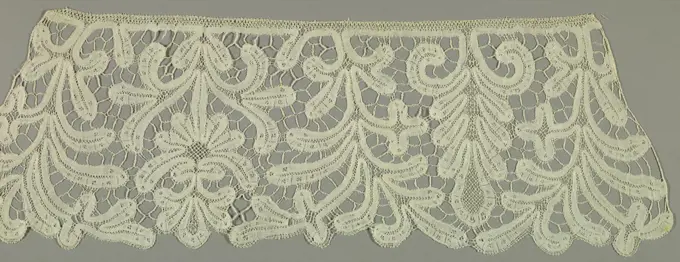
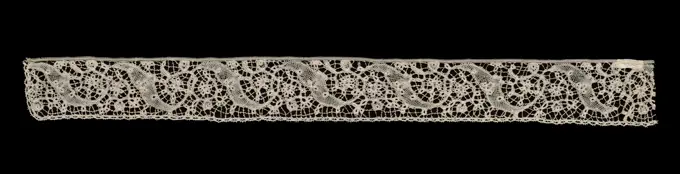
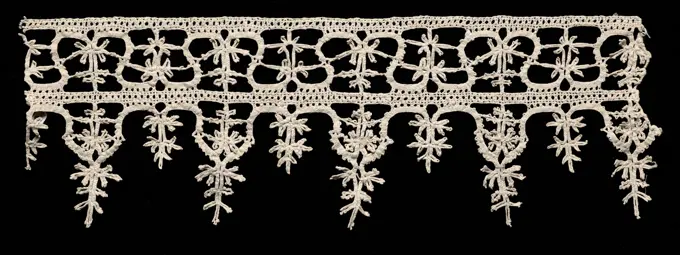
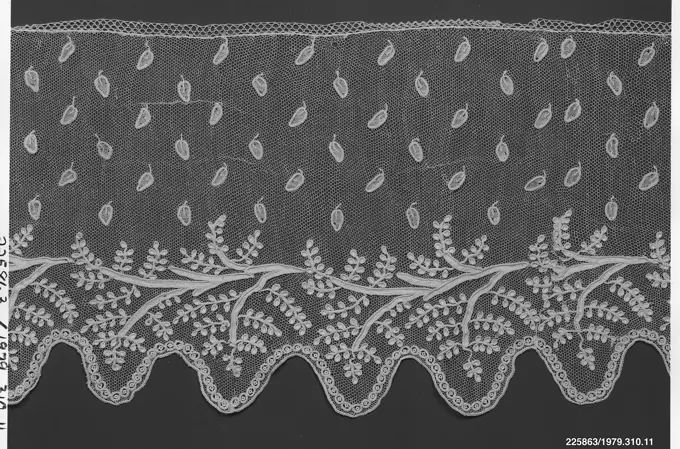
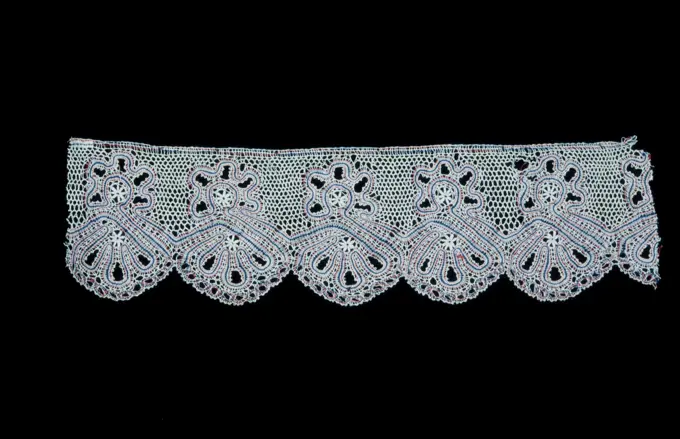
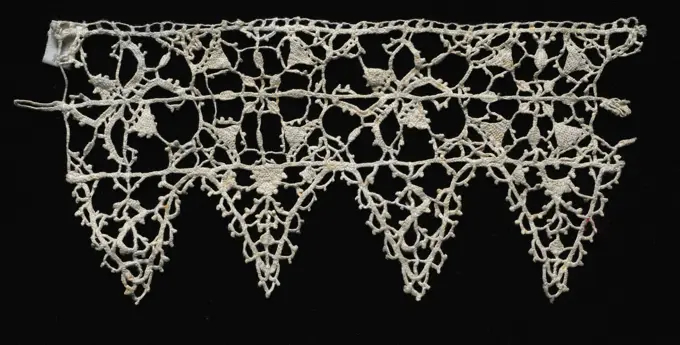
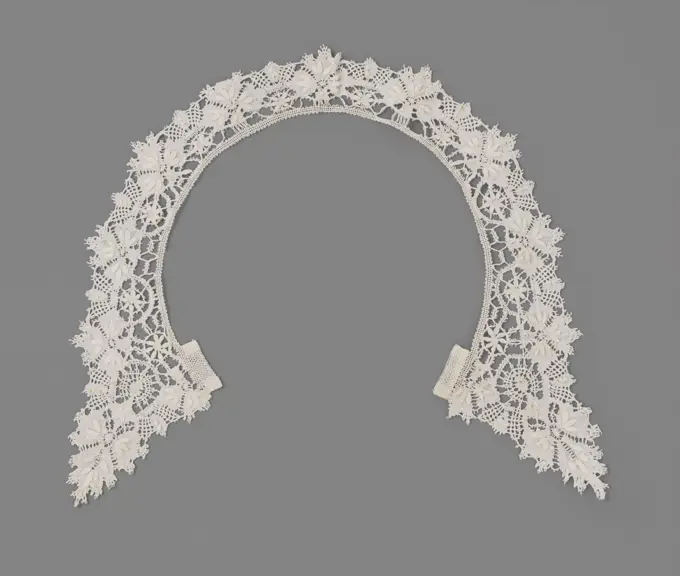
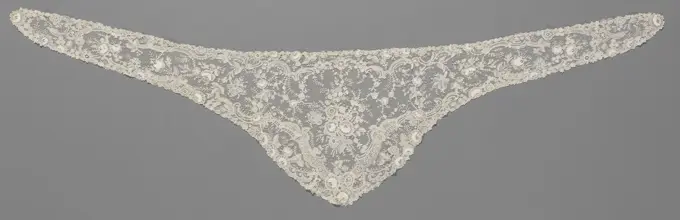
Fragment, Medium: linen Technique: bobbin lace, continuous tape with bars added, Patterns shows pendant flower with spray on either side, alternating with leaf motif. Tape has ornamental stitches, and parts are connected with brides picotees. (parts are connected with bars that have picots), 19th century, lace, Fragment
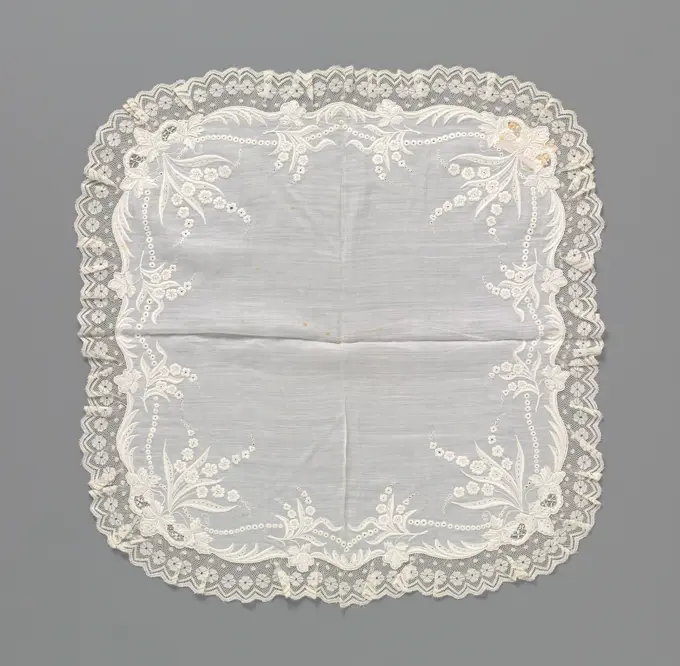
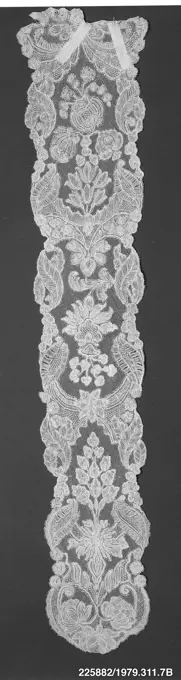
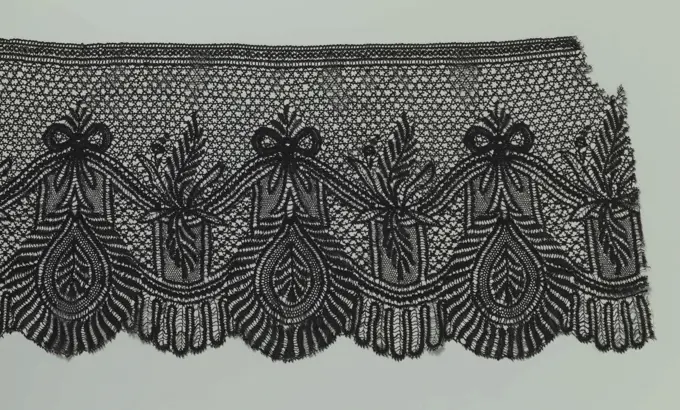
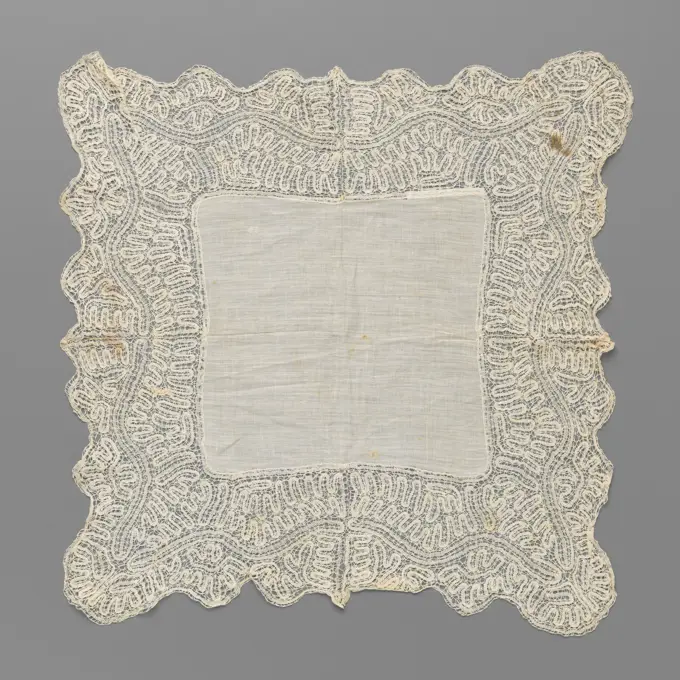
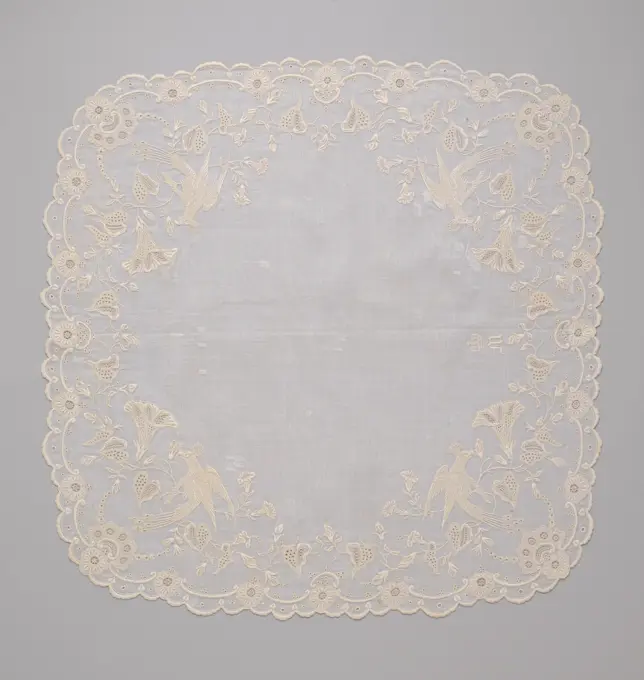
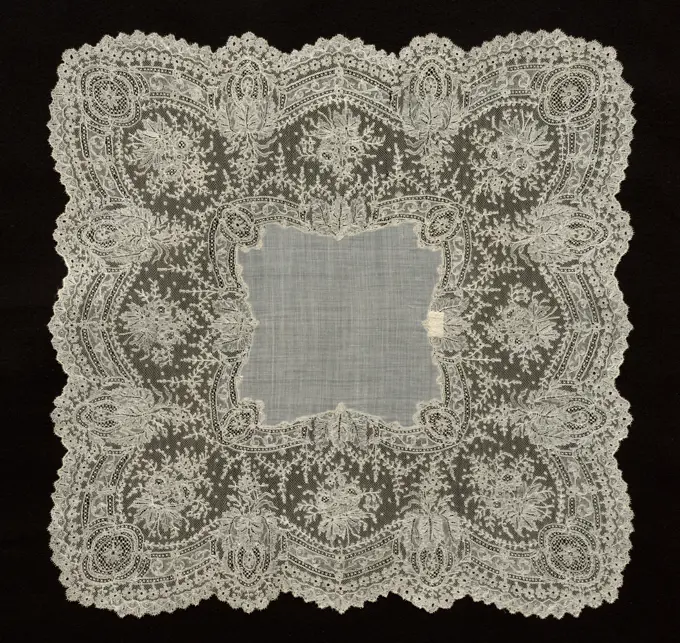
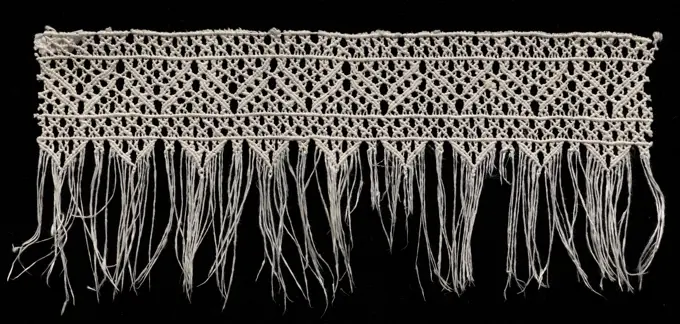
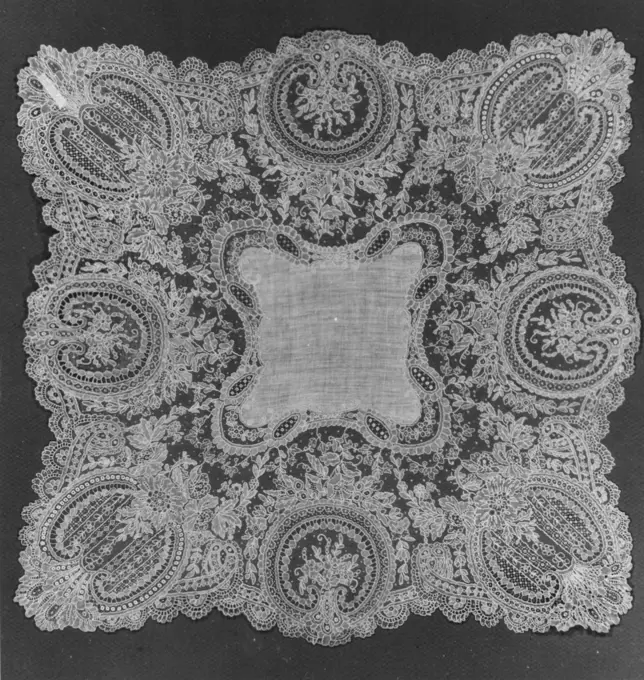
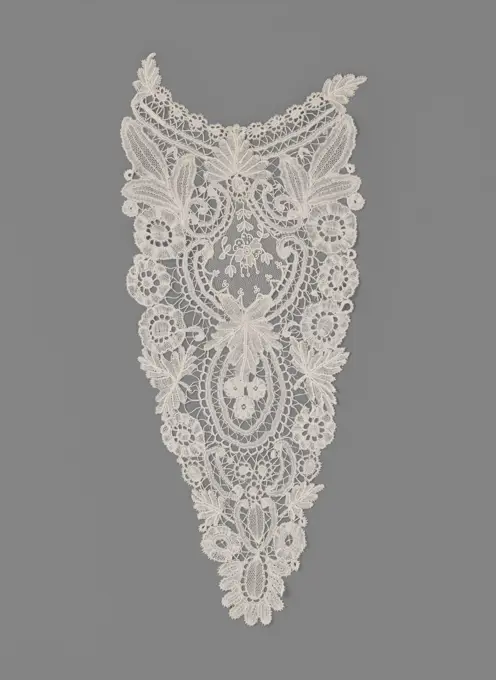
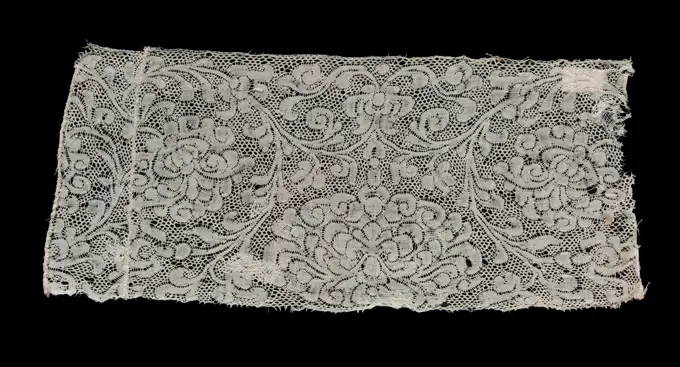
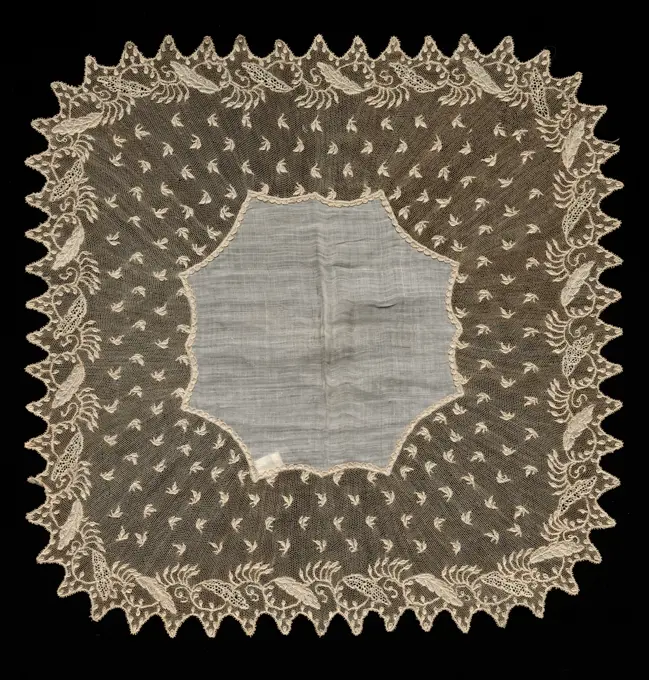
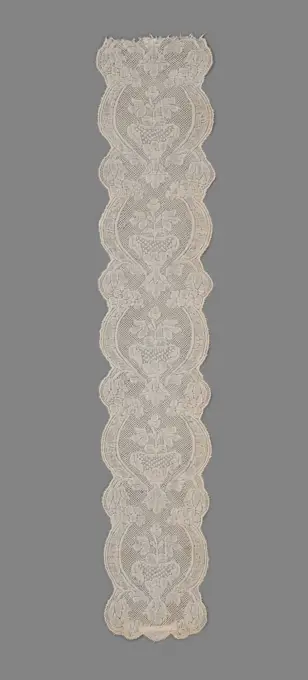
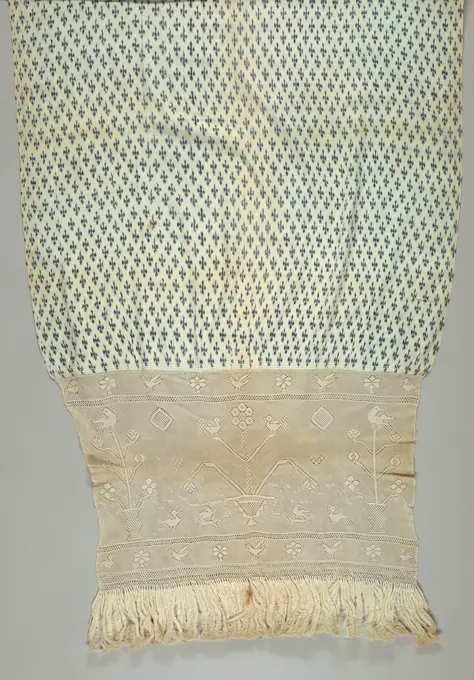
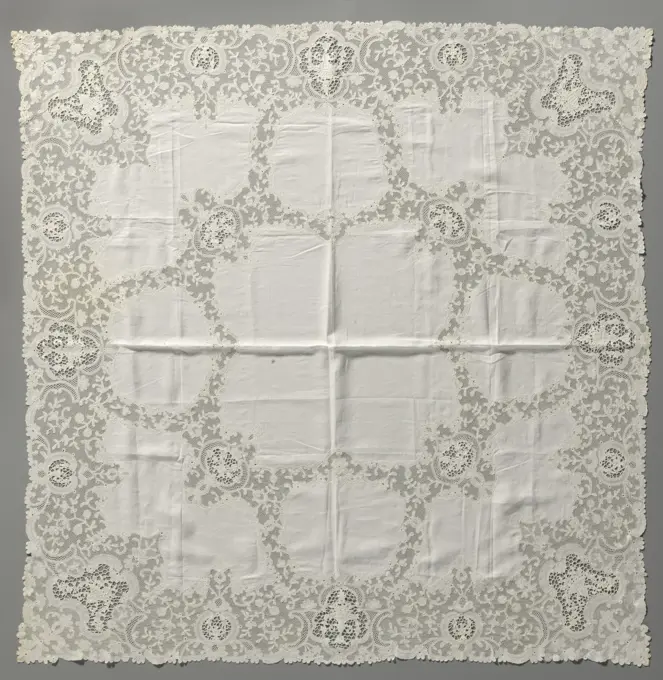
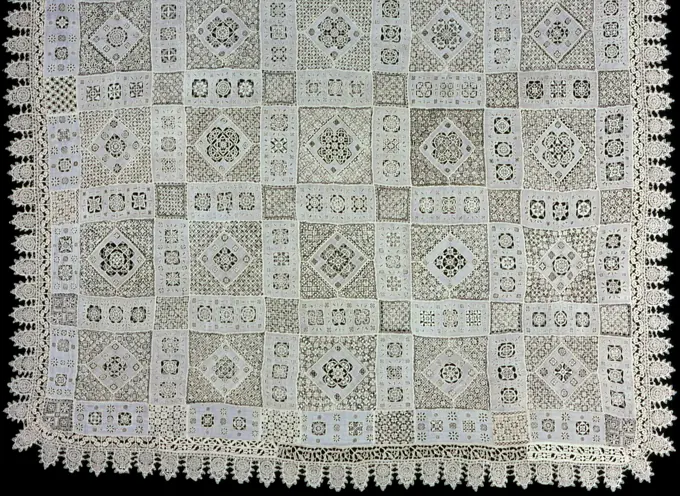
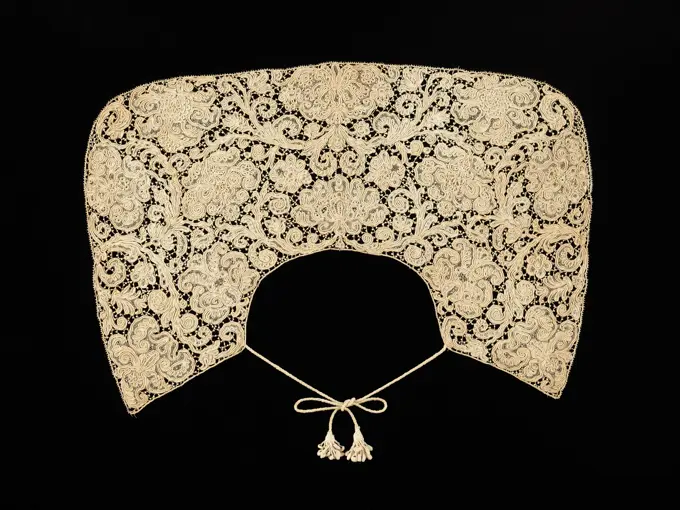
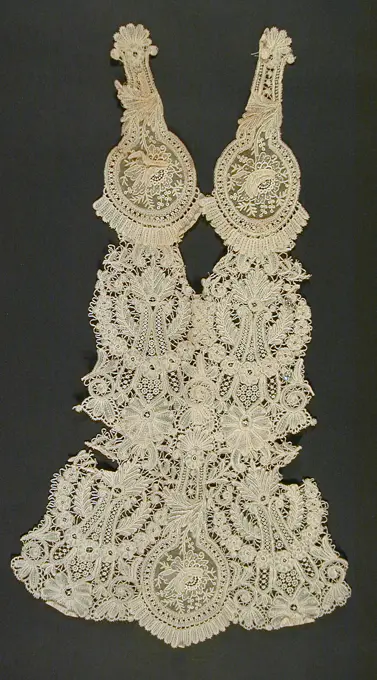
Strook kloskant met ster en halve maan.Strip of black climbing side, Cluny side. Symmetrical design with deep slippers and braid soil. Each scallop is filled with an eight-pointed star that is covered by a horizontal half moon. The slot edge is finished with arcs and fine dots of picoted braids. The top of the strip is straight finished.Strip bobbin and silver side with flower vessel and hanging berries, anonymous, c. 1805 - c. 1815 Strip bobbin, silver side, blonde. On a mesh soil, a tuler of silk, a silver thread has been a repeating and continuous pattern of a flower vend with hanging berries. The flower drink runs over the center line of the strip and the berries hang with two or three under each other in the unevenly zigzagging sculptures along the underside of the strip. Thinner filé yarn were used for the fullwork than for the thick filé yarn with which the contours of the motifs and sculptes are emphasized. The top of the strip is straight finished, but partly damaged. The Zigzag sculptes are finished with Picots of Silver Brao. France silk. silver thread bobbin lace / blonde (lace) Strip bobbin, silver side, blonde. On a mesh soil, a tuler of silk, a silver thread has been a repeating and continuous pattern of a flower vend with hanging berries. The flower drink runs over the center line of the strip and the Zakdoek van batist met borduurwerk en rondom afgewerkt met een rand kloskant.Handkerchief from Batist with embroidery and completed around with an edge natural colosside: Valenciennes-side. Square model with rounded corners. Embroidery: There are four long narrow leaves in the corners, aimed at the center of the handkerchief and always between two leaves a cord to which rosette flowers from large to small. Below three winger leaves between which open sewing with needle lace standards. In the middle along the sides a comparable smaller pattern. Side: The repetitive pattern consists of a row of rosette flowers above which a row of dots or moes. Along the outer edge slightly pointed bow torch, finished with picots.Shawl Made 1875-1900 Belgium. Cotton, mixed lace bobbin lace of a type known as Point de Gaze .Dress of lace pledger with rising suns along diamond shape, anonymous, c. 1900 - c. 1949 Square rug of natural -colored lace bobbins, cut work. Pattern with a square that is made up of four small squares. Each small square is divided by a diagonal line, with a 'rising sun' on the outside and a triangle on the inside. Together this provides a diamond shape with a four -pointed star in the middle in the large square. Around the large square on all sides, a border with rectangles, filled with bundles of wires or with a dense grid with openwork diamonds. A finished edge in linen battle on all sides. unknown cotton (textile) Square rug of natural -colored lace bobbins, cut work. Pattern with a square that is made up of four small squares. Each small square is divided by a diagonal line, with a 'rising sun' on the outside and a triangle on the inside. Together this provides a diamond shape with a four -pointed star in the middle in the large square. Around the large square on all sides, a boShawl ca. 1840 Belgian, Brussels. Shawl. Belgian, Brussels. ca. 1840. Needle lace, Point de Gaze. Textiles-LacesLace fragment, 1800s, Spain, maker unknown. Gift of Mrs G. Acland Allen, 1955.Pair of lappets mid-18th century Flemish The Metropolitan Museum's great lace collection was started when the Museum became the first among American museums to organize a permanent collection of lace with the acceptance of the McCallum Collection in 1879 and the bequests of Mrs. John Jacob Astor, Mrs. Robert L. Stuart, Mrs. Augustus Cleveland, and Mrs. A. W. Winters shortly thereafter. In 1893 a loan collection of antique laces shown at the World's Columbian Exposition in Chicago was assembled by a committee of New York women headed by Catharine Augusta Newbold. About 1900 Miss Newbold arranged and labeled an exhibition of laces and linenworks lent to the Metropolitan Museum by Mrs. James Boorman Johnstone and the Misses Johnstone. "Her scholarly knowledge of lace technique enabled the Museum for the first time to offer a comprehensive display of lace illustrating its historical development," wrote Miss Frances Morris, then curator of the textile department. Miss Newbold's name occurs Border Made 1675-1725 Flanders. Linen, bobbin part lace .Strook kloskant met druppelvormige schulp onder strik.Strip of black climbing side. The repeating pattern consists of a regularly wavy ornamental band around the horizontal center line of the strip. Each wave cap has been awarded by a bow, including a large drop-shaped motif until the bottom of the strip is hanging and forms a shell. Each golf valley is overcurred by a pair of spring-shaped leaves, one standing the other hanging. Above the wavy band, the motifs are connected by a fantasy ground with picoted braids. Among other things, the motifs are made up with peripheral lines in linen stroke or 'dashes', which are connected to each other by crossing couples, braids or ornamental grounds. The top of the strip is straight finished. The slip edge along the underside is finished with picots.Fragment (Italy); linenLace - a fragment of the Żabot;  1st half 18th century (1701-00-00-1750-00-00);Border fragment, Medium: linen Technique: withdrawn element work, knotting (macramé), Border fragment with deep knotted fringe., Italy, 18th century, knotted, knitted and crocheted textiles, Border fragment. Linen, needle lace of a type known as Point d'Argentan with buttonholed mesh ground .Pair of Woman's Cuffs. United States, circa 1860. Costumes; Accessories. a-b) Linen plain weave, cotton embroidery, drawn threadworkFragment 16th century Italian. Fragment 212308Strip crocheted side with flowers and grape vouchers, anonymous, c. 1890 - c. 1909 Pointed strip of natural -colored Irish crocheted side. Pattern with flowers and grape bunches and a crocheted irregular mesh soil with picots. Finished straight on one short side and partly finished on one long side. Along the other edges, the finish of semi -circular sculptes is trimmed with picoted arches. Ierland (possibly) cotton (textile) Pointed strip of natural -colored Irish crocheted side. Pattern with flowers and grape bunches and a crocheted irregular mesh soil with picots. Finished straight on one short side and partly finished on one long side. Along the other edges, the finish of semi -circular sculptes is trimmed with picoted arches. Ierland (possibly) cotton (textile)Tie slip of a strike tie in Point de Gaze de Bruxelles, Anonymous, c. 1870 - c. 1880 Tie slip of a strike tie in Point de Gaze de Bruxelles, rectangular in shape and irregularly sculpted. The pattern has a rectangular medallion at the start and two ovals on the bottom. Along the potented edges, the pattern has flowers and feathered sheets; A slender in the middle. The decoration is equipped with thickened contour threads. Brussels . bobbin lace Tie slip of a strike tie in Point de Gaze de Bruxelles, rectangular in shape and irregularly sculpted. The pattern has a rectangular medallion at the start and two ovals on the bottom. Along the potented edges, the pattern has flowers and feathered sheets; A slender in the middle. The decoration is equipped with thickened contour threads. Brussels . bobbin laceBatist handkerchief with corners of corn in one corner and finished around with an edge machining. Batist Handkerchief with Corners Embroidered in One Corner and Finished Around With A Double Strip Machine Side: Machining Valenciennes-Side. Square Model With Rounded Corners.Batist cuff decorated with English embroidery, c. 1875 - c. 1925 Batist cuff decorated with English embroidery. The cuff is trimmed with a founded Schulprand. West-Europa whole: Batiste Batist cuff decorated with English embroidery. The cuff is trimmed with a founded Schulprand. West-Europa whole: BatisteCollar late 19th century Belgian. Collar 102695Laces, 17th-18th century. Collar made with fragments of a flat or royal stitch (Punto Piatto or Punto Reale) lace of 1685-99.Fragment, 19th century, 15 1/2 x 17 1/2 in. (39.37 x 44.45 cm), Silk, France, 19th centuryBatist handkerchief with an edge of the eastern European side with narrow winding straps cloned in a symmetrical pattern, anonymous, c. 1875 Batist handkerchief with a border bobbin: Eastern European side. Square model with rounded corners and a scrap edge. The lace pattern is symmetrical along each side to the length axis. A double slightly wavy line divides the pattern into an upper and part in which highly winding lines form standing and lying waves. Eastern Europe linen (material) bobbin lace / East European lace Batist handkerchief with a border bobbin: Eastern European side. Square model with rounded corners and a scrap edge. The lace pattern is symmetrical along each side to the length axis. A double slightly wavy line divides the pattern into an upper and part in which highly winding lines form standing and lying waves. Eastern Europe linen (material) bobbin lace / East European laceHandkerchief 1840-80 French or Swiss. Handkerchief 236970Dress of edge embroidery with emerging suns along diamond shape. Square dress of natural-colored edge embroidery, carved work. Pattern with a square made up of four small squares. Each small square is divided by a diagonal line, with a 'rising sun' on the outside and a triangle on the inside. Together this ensures a diamond shape in the large square with a four-pointed star in the middle. To the large square on all sides a border with rectangles, filled with bundles of wires or with a dense grid work with opened diamonds. A finished edge in linen stroke on all sides.Strip bobbin with a winding ribbon that forms whimsical motifs, anonymous, c. 1900 - c. 1915  Strip of natural -colored bobbin: Eastern European side. A winding ribbon is whimsical motifs. The ribbon has been hit in linen battle. The top of the short strip is finished straight. The very silly outskirts of scales are finished with picots. Eastern Europe (Possible) linen (material) bobbin lace / tape lace (bobbin lace) / East European laceBobbin Lace Edging, 18th century. Flanders or Italy, 18th century. Lace, bobbin; average: 7 x 61 cm (2 3/4 x 24 in.).Handkerchief of climbing side with straight and curved lines. Black climbing side handkerchief: Chantilly side. To a cross-shaped white batters cloth runs a wide edge black side. The symmetrical ornament consists of wide tires, strewn with saved asterisks and which are laid in hollow and convex semi-circular and straight lines. On the middle of the edge are turned to the left-facing tuils, including consisting of a chali flour and two daisies.Cuffs 19th century British. Cuffs 102561Dress of lace pledger with rising suns along diamond shape, anonymous, c. 1900 - c. 1949 Square rug of natural -colored lace bobbins, cut work. Pattern with a square that is made up of four small squares. Each small square is divided by a diagonal line, with a 'rising sun' on the outside and a triangle on the inside. Together this provides a diamond shape with a four -pointed star in the middle in the large square. Around the large square on all sides, a border with rectangles, filled with bundles of wires or with a dense grid with openwork diamonds. A finished edge in linen battle on all sides. unknown cotton (textile) Square rug of natural -colored lace bobbins, cut work. Pattern with a square that is made up of four small squares. Each small square is divided by a diagonal line, with a 'rising sun' on the outside and a triangle on the inside. Together this provides a diamond shape with a four -pointed star in the middle in the large square. Around the large square on all sides, a boEdging 17th century Italian. Edging 217753Border fragment, Medium: linen Technique: bobbin lace, continuous braid-like, Border fragment of three rows of very small squares filled and connected by linear pattern., Venice, Italy, late 16th-early 17th century, lace, Border fragmentLace laceBobbin Lace Edging, mid 18th century. Belgium, Mechelen, mid 18th century. Linen center with Mechlin lace border; average: 36.9 x 36.9 cm (14 1/2 x 14 1/2 in.).Knotted Lace Edging and Fringe, 16th century. Italy, 16th century. average: 10.2 x 25.7 cm (4 x 10 1/8 in.).Bobbin Lace Insertion and Edging of Points, early 17th century. Italy, Venice, early 17th century. Lace, bobbin; average: 11.5 x 35.3 cm (4 1/2 x 13 7/8 in.).Kraag van naaldkant met uiteenlopende bloemen en omkrullende bladeren aan ranken.Collar of natural needle side: Venetian relief side. Curved strip-shaped model. Pattern: Different flowers and curling leaves to tendrils. The motifs are made with feston stitches, in which different patterns have been realized in flowers and leaves with recesses. They are equipped with relief contours and the cordons are or not decorated with picots. The motifs are connected by an irregular soil with bars with picots and rover picots. The collar is finished along the short sides and bottom with a bow edge. The top is finished with a splitting strap, with a cross pattern made with leaf-shaped fleece sters.Handkerchief Belgian, Brussels 19th centuryBorder Made 1850-1875 Denmark. Cotton and linen, bobbin straight lace .Kraag van naaldkant met bloemen en c-voluten.Collar of natural needle side: Venetian relief side. Curved strip-shaped model. The pattern consists in the middle of a more or less symmetrical composition with a flower that is flanked by C volutes. The remaining pattern, with mainly flowers, some leaves and stems, is not symmetrical. The motifs are made with feston stitches and are equipped with relief contours and thick cordons decorated with picots. The top is finished with a splitting strap. The collar is finished along the short sides and bottom with a bow edge. It may be a 19th century imitation of a late 17th century fragment.Table Cover Made 1875-1900 England. Silk, Pusher machine lace .Fichu van Linnenbatist, triangular and scalloped, with a genopter fond and passed along the edges with a decoration of flower bouquets of white cotton, anonymous, c. 1800 Fichu van Linen Batist, triangular and scalloped, with a gene stock and trimmed along the edges with a decoration of flower bouquets of white cotton. Decoration: Midfield has a scatter motif of three small studs. Lying flower bouquets are embroidered in the sculptures interspersed with one standing flower on the inner point. The hearts of the flowers and a pearl edge underneath have been opened. Netherlands whole: Linen (Material). Decoration: Cotton (textile) embroidering Fichu van Linen Batist, triangular and scalloped, with a gene stock and trimmed along the edges with a decoration of flower bouquets of white cotton. Decoration: Midfield has a scatter motif of three small studs. Lying flower bouquets are embroidered in the sculptures interspersed with one standing flower on the inner point. The hearts of the flowerPlastron van Duchesse de Bruxelles with a needle of needle, anonymous, c. 1880 - c. 1900 Plastron van Duchesse de Bruxelles with a needle of needle. The insert is decorated with a flower branch within a shield -shaped medallion, outlined with volutes. Above it a palmet, underneath a large leaf and an oval medallion in which three flowers. The whole has an irregular scalloped and potented edge of flowers and leaves. Belgium . Brussels bobbin lace Plastron van Duchesse de Bruxelles with a needle of needle. The insert is decorated with a flower branch within a shield -shaped medallion, outlined with volutes. Above it a palmet, underneath a large leaf and an oval medallion in which three flowers. The whole has an irregular scalloped and potented edge of flowers and leaves. Belgium . Brussels bobbin lacehandmade lace on red flat layBobbin Lace Edging, early 18th century. Belgium, Binche, early 18th century. Lace, bobbin: linen; average: 9.6 x 20.4 cm (3 3/4 x 8 1/16 in.).Frank van Goud, 1700 - 1900 Fringes of gold.  . Fringes of gold.  .Jabot van Kloskant, Anonymous, c. 1925 Jabot van Kloskant. Model with necklace and a depositing medallion decorated with a flower branch. In the . bobbin lace Jabot van Kloskant. Model with necklace and a depositing medallion decorated with a flower branch. In the . bobbin laceEdging late 18th-early 19th century French The Metropolitan Museum's great lace collection was started when the Museum became the first among American museums to organize a permanent collection of lace with the acceptance of the McCallum Collection in 1879 and the bequests of Mrs. John Jacob Astor, Mrs. Robert L. Stuart, Mrs. Augustus Cleveland, and Mrs. A. W. Winters shortly thereafter. In 1893 a loan collection of antique laces shown at the World's Columbian Exposition in Chicago was assembled by a committee of New York women headed by Catharine Augusta Newbold. About 1900 Miss Newbold arranged and labeled an exhibition of laces and linenworks lent to the Metropolitan Museum by Mrs. James Boorman Johnstone and the Misses Johnstone. "Her scholarly knowledge of lace technique enabled the Museum for the first time to offer a comprehensive display of lace illustrating its historical development," wrote Miss Frances Morris, then curator of the textile department. Miss Newbold's name occurSampler 19th century German. Sampler 228628Collar of mixed side with sickle leaves. Collar of natural mixed side, climbing side - duchesse-lace and mesh soil. Two-thirds of the collar exhibits a mesh fence along the inside, a third part a very open barfond. Long stems are long stems, deflecting left and right per half, on the Mazen Fund section; The stems are crowned by a wreath of starflowers and a palm with sickle leaves, which are on the open fond.Textile, laceEdging 16th century Italian, Genoa. Edging. Italian, Genoa. 16th century. Bobbin lace. Textiles-LacesWoman's Collar. United States, circa 1850. Costumes; Accessories. Linen plain weave, drawn threadwork, cotton embroideryShawl. Culture: French. Date: 1860-70.Shawls of this type were de riguer for wearing with the large hoop skirts of the 1860s. Rigid architectural forms contrasting with organic plant forms was a favored design scheme. This is a fine example of what could be done on the Lever machines. Museum: Metropolitan Museum of Art, New York, USA.Embroidery and Needlepoint (Point Alençon) Lace Handkerchief, late 18th century. France, Alençon, late 18th century. average: 33.1 x 32.5 cm (13 1/16 x 12 13/16 in.).Cutslip from Binchekant, Anonymous, c. 1750 Capsive from Binchekant, with square, scalloped ends. The pattern has a repetition of five flower pots placed one bow -shaped frames underneath, which are connected to a hanging fruit thros below and up. Binche linen (material). Binche Lace Capsive from Binchekant, with square, scalloped ends. The pattern has a repetition of five flower pots placed one bow -shaped frames underneath, which are connected to a hanging fruit thros below and up. Binche linen (material). Binche LaceNeedlepoint (Point de Gaze) Lace Narrow Strip, 19th century. Belgium, Brussels, 19th century. Lace, needlepoint; average: 54 x 7.7 cm (21 1/4 x 3 1/16 in.).Altar Frontal Made 1601-1700 Italy. .Strip knotted side with two rows of loops. Natured strip knotted side: Frivolité. Two rows of loops. At each tab a Picot is at the top and bottom.Cap Crown; linen; Bequest of Marian Hague; 1971-50-412Edging 18th century Italian, Abruzzi. Edging 221135Shawl (Ecuador); cotton ()Round finger rug from Kloskant with C-Voluten and winding ribbons, anonymous, c. 1900 - c. 1999 Natural closs of the finger rug. Round model. The repeating pattern consists of two C-Voluten bothered together. Each volute is made with a narrow ribbon in linen battle. One curling end ends in a rosette flower and there is a split stem at the other curling end with two drop -shaped flowers. This pattern repeats itself three times and forms a circle with a star -shaped residual space in the center of the rug and more or less triangular residual spaces on the outside. The residual spaces are filled with a pattern of strongly winding narrower ribbons. The ribbons and motifs are largely made in linen battle, with or without openwork edges and contour threads. The motifs are connected by braids. A few petals and small motifs are made with a decorative soil: a diamond -shaped grid. Italy linen (material) bobbin lace / tape lace (bobbin lace) Natural closs of the finger rug. Round model. The repeNeedlepoint (Reticella) and Bobbin Lace Insertion and Edging, late 16th century. Italy, Venice, late 16th century. Lace, needlepoint and bobbin: linen; average: 9.9 x 15.6 cm (3 7/8 x 6 1/8 in.).Fragment, Medium: linen Technique: needle lace, Fragment with an elaborate floral motif of tiny, superimposed rosettes. Central portion has a fine diamond diaper design. Picot edge., Venice, Italy, 17th century, lace, FragmentFragments, Medium: linen Technique: needle lace, Fragments of closely-worked lace in a scroll and floral design., Burano, Italy, ca. 1660, lace, FragmentsFragment of the lace;  18th century (1701-00-00-1800-00-00);Batists handkerchief with plumetis embroidery and an edge of Valenciennes side, anonymous, c. 1850 - c. 1860 Natural-colored batist with embroidery- Whitework- with a border bobbin: Valenciennes side. Square model with rounded corners. The embroidery is located along the edges and consists of bouquets with ivy leaves and forget-me-nots. The twelve bouquets are placed at the same distance from each other and connected by a decorative band of rosette flowers and dots between two dotted lines. The edge of the batist is finished with small regular shells, with a rosette flower in each shell. The strip side is wrinkled on the batist. It has a scrap edge with continuous fested arches. The same, slightly slanted leaf is in each shell. The motifs are made in linen battle with openwork edges and recesses. They are connected by a square Valenciennes ground. The scrap edge is finished with picots. Europe cotton (textile) Embroidering / Bobbi Lace / Valenciennes Lace Natural-colored batist with emhaekeleien 5 haekeleien 5 Copyright: xZoonar.com/murxxxx 1882533Doily of linen rosette -shaped with eight lobes and around a border bobbin, anonymous, the Molenwiekje, c. 1925 - c. 1949 Doily of natural linen with a border bobbin all around: Dutch side. Rosette -shaped model with eight semi -circular scallops or lobes. The Doily is sewn with a few stitches to three the same rugs, forming a larger rug. They almost overlap each other half. It is a merger of the rugs with the following object numbers: BK -1970-370 -B, -c, -e and -f. Netherlands linen (material) bobbin lace Doily of natural linen with a border bobbin all around: Dutch side. Rosette -shaped model with eight semi -circular scallops or lobes. The Doily is sewn with a few stitches to three the same rugs, forming a larger rug. They almost overlap each other half. It is a merger of the rugs with the following object numbers: BK -1970-370 -B, -c, -e and -f. Netherlands linen (material) bobbin laceCuff of climbing side with ivy leaf. Cuff from natural colosside: Valenciennes side. Repetitive motif from ivy leaves on a fine square Valenciennes ground, with a row with something staggered above. The top is finished with a straight edge. Slightly slightly shuts that are formed by concealed cogs. Around the cuff at the height of the row is leaves a piece of double folded and sewn, so that the pattern is partly falling away.Fragment; linen; 1897-8-151Fragment 16th century Italian. Fragment. Italian. 16th century. Bobbin lace. Textiles-LacesRound lying collar of Clunykant, Anonymous, c. 1910 Round lying collar of Clunykant with points on the corners. The decoration consists of two edges, the lower of which is potented and is equipped with leaves interspersed with grille work, the edge above consists of roses in wheels. Le Puy (possibly) . Cluny lace Round lying collar of Clunykant with points on the corners. The decoration consists of two edges, the lower of which is potented and is equipped with leaves interspersed with grille work, the edge above consists of roses in wheels. Le Puy (possibly) . Cluny laceBand, Medium: linen Technique: bobbin lace, continuous braid-like, Fragment of a band with geometric panels., Italy, possibly 16th century, lace, BandFragment, Medium: linen Technique: bobbin lace (Lille-style), Corner fragment has a design of delicate floral sprays and a fond chant ground., France, late 18th century, lace, FragmentFontaneldoek van Linen with a strip of bobbin with Velden Drieblad between leaf voles, anonymous, c. 1700 - c. 1799 Fontaneldoek van Linen with a strip of natural-colored bobbin, binche side. Pattern with fields in which a three -leaf stands between leaf voltuits. The motifs are connected by a grid, a five -part ground. Europe linen (material) bobbin lace Fontaneldoek van Linen with a strip of natural-colored bobbin, binche side. Pattern with fields in which a three -leaf stands between leaf voltuits. The motifs are connected by a grid, a five -part ground. Europe linen (material) bobbin laceBorder for a cover 16th century Italian. Border for a cover. Italian. 16th century. Needle lace. Textiles-LacesFragment of silk fabric, Eastern. unknownCollar mid-19th century Belgian. Collar 120896Batist tablecloth and mixed side with cartouches and flower vases, anonymous, c. 1925 - c. 1929 Batist tablecloth and natural mixed side, bobbin and needle side. Rectangular model with a piece of batist in the middle with eight smaller pieces of batist around it. The pieces in the corners are palm -shaped, with four palmets and the pieces between the corners are light trapezoidal with rounded corners. The pieces are connected to each other by Kant intermediate sets, which run into a wide edge side with sculptures, with which the tablecloth is finished all around. The side has a symmetrical pattern with flower vessels, C-Voluten, flower vases and cartouches from Kloskant. In the cartouches, patterns are made with rosette flowers and leaves, whether or not in combination with flower vases. The motifs in the bobbin side are connected by a mesh soil with rectangular meshes. The needle side motifs are connected by a potente land, mainly with irregular five and hexags. Brussels linen (materiFichu van Naaldant with V -shaped sling, Anonymous, 1870 - 1890 In the triangular back piece there is a large bouquet of Margriet, roses, ranuncels and forget mineits within a V-shaped winding strap with circular filling. The ends are rushing. A pendulum of C-Voluten runs in the top edge. The florets show a imposed relief. There are pellets on the stock. Point the Gaze de Bruxelles. Brussels linen (material) In the triangular back piece there is a large bouquet of Margriet, roses, ranuncels and forget mineits within a V-shaped winding strap with circular filling. The ends are rushing. A pendulum of C-Voluten runs in the top edge. The florets show a imposed relief. There are pellets on the stock. Point the Gaze de Bruxelles. Brussels linen (material)Fragments, Medium: linen Technique: needle lace, Argentan lace fragments showing a heavily-worked floral pattern., France, 18th century, lace, FragmentsCover Made 1601-1625 Italy. Squares and rectangles of linen, plain weave; cut and drawn work embroidered in back, hem, overcast, square open work stitches and needle lace fillings; and squares of linen, knotted square netting embroidered in cloth, darning, and interlocking lace stitches; darned and overcast bars, darned points and squares, and darned and woven wheels; edged with linen, bobbin lace; linen, plain weave cut work with needle lace fillings, and points of linen, needle lace worked on a cut and drawn thread grid .Length of Lace. England or Central Europe (), 19th century. Textiles; textile lengths. Cotton bobbin tape laceCollar late 17th century Spanish As it was customary to refashion fine laces, early lace pieces in their original form are fairly rare. That the lace pattern fills the whole space and conforms to the shape of the piece indicates this collar is in its original form. The ties are later replacements for the original ones.. Collar 156386Cap late 18th century American. Cap 105520Fragment, Medium: linen Technique: bobbin lace, Fragment of Valenciennes with six-petal blossoms over round mesh ground., France, late 18th century, lace, FragmentApron early 17th century Italian. Apron 102520Pattern With Uncompleted Piece Of Lace; parchment, linen thread; 1939-19-7-a,bFragment of Lace. Belgium, 19th century. Textiles; fragments. Cotton Duchesse bobbin lace and cotton point de gaze needle laceMachinale collar with thirteen rush -hour sculptures at the bottom and eleven semi -circular scallops at the top, anonymous, c. 1905 - c. 1910 Machinal side: Etskant, imitation crochet. Half-circle-shaped model with a scrap edge on both lower and top. The thirteen rushed shells on the underside of the collar increase towards the middle in large. The scums are made up of five to ten arches. The arches are thick, as thick -founded cordons, and are interconnected with picoted bars. In the middle shell is a star -shaped flower with a rosette flower as a flower heart. Left and right are still a rose in a shell and in another shell a rosette flower with six oval petals. The eleven semi -circle -shaped scoops at the top of the collar are built in the same way, but are rounder than the lower sculptures. With this scrap edge, the middle shell is the smallest and it contains a rose. In the two-after-last and also largest shell in this edge, there is a flower with seven Spitsovale leaves on the lCollar. Culture: probably Irish. Date: ca. 1890. Museum: Metropolitan Museum of Art, New York, USA.Fragment; linen; 1897-8-321Cap 19th century British. Cap. British. 19th century. linenFragment of needlelace unknownLace doily on dark woodBelt, Medium: wool Technique: double cloth, Man's pocket-belt with geometrical motifs in tan on red background., Mexico, probably 19th century, woven textiles, BeltFragment of bobbin lace ca. 1700 French. Fragment of bobbin lace 853243