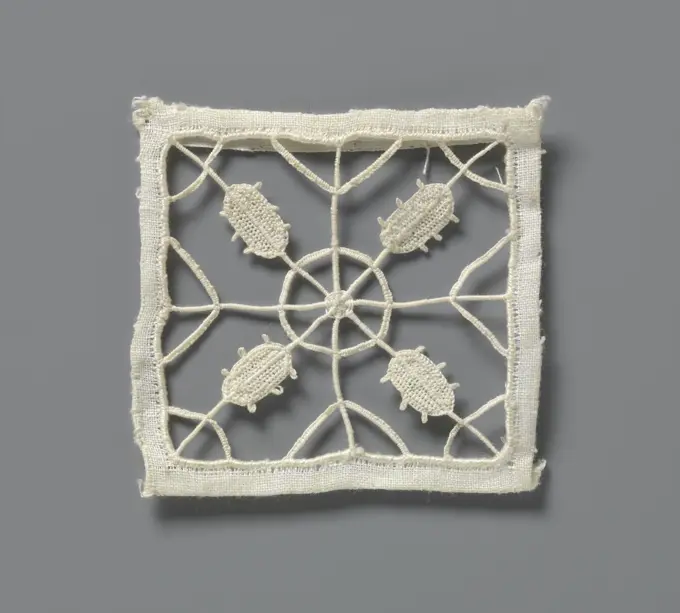
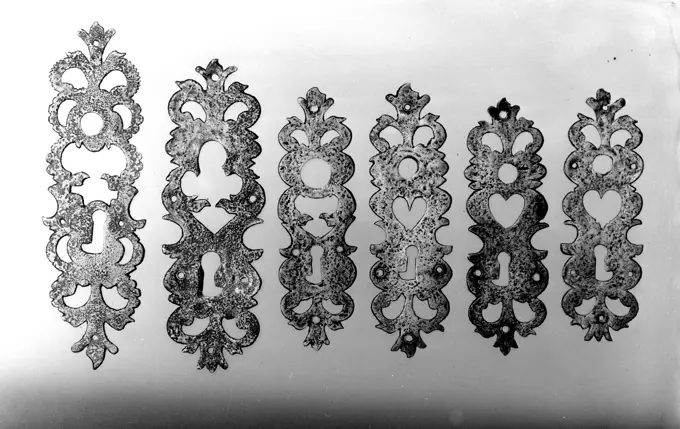
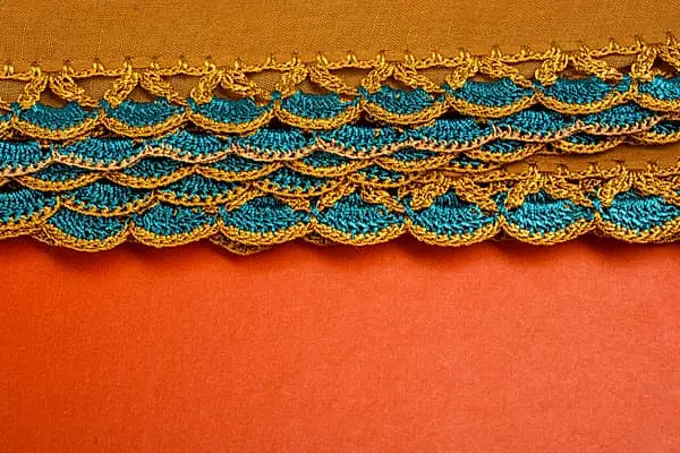
Delicate Lace Textiles

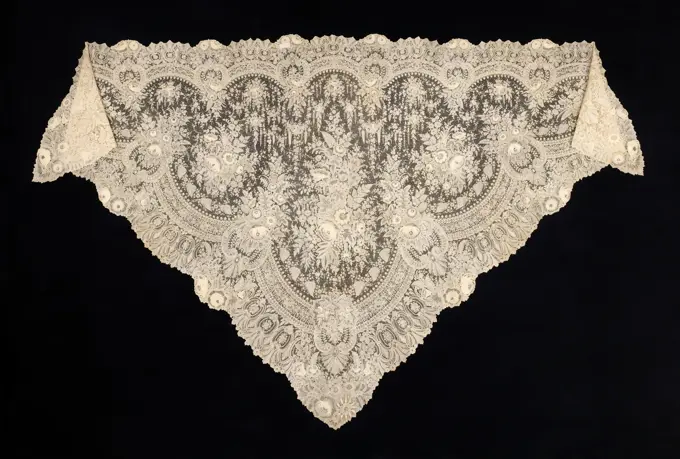
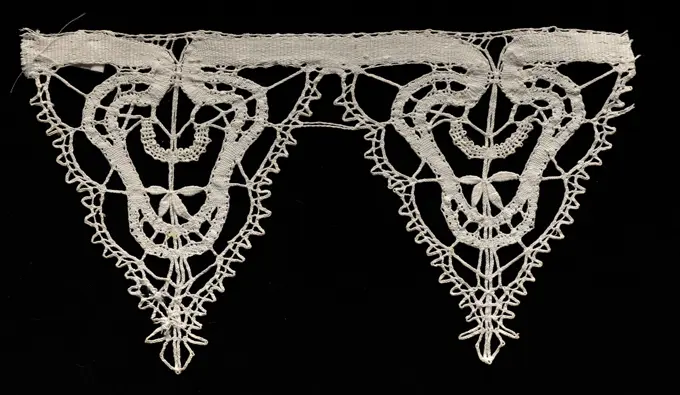
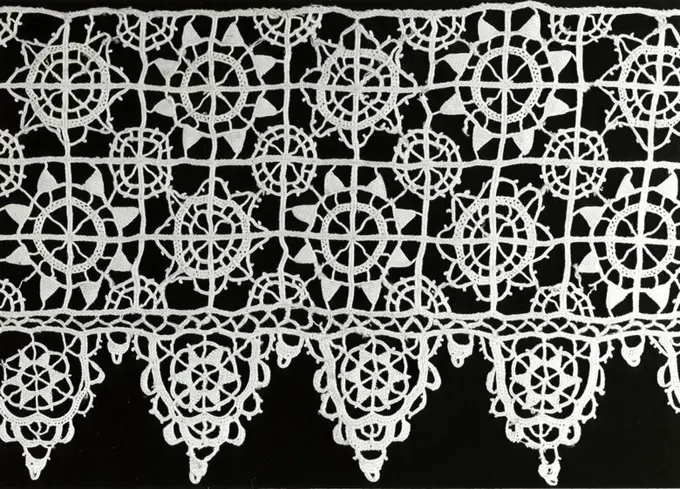
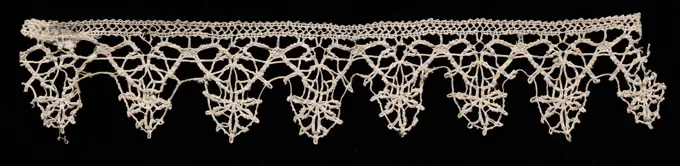
A selection of intricate lace strips showcasing various patterns, including floral and geometric designs, ideal for fashion or home decor applications.

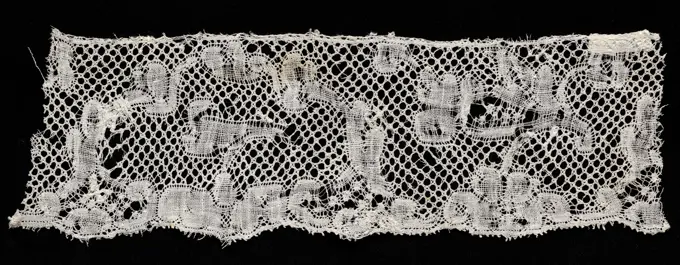
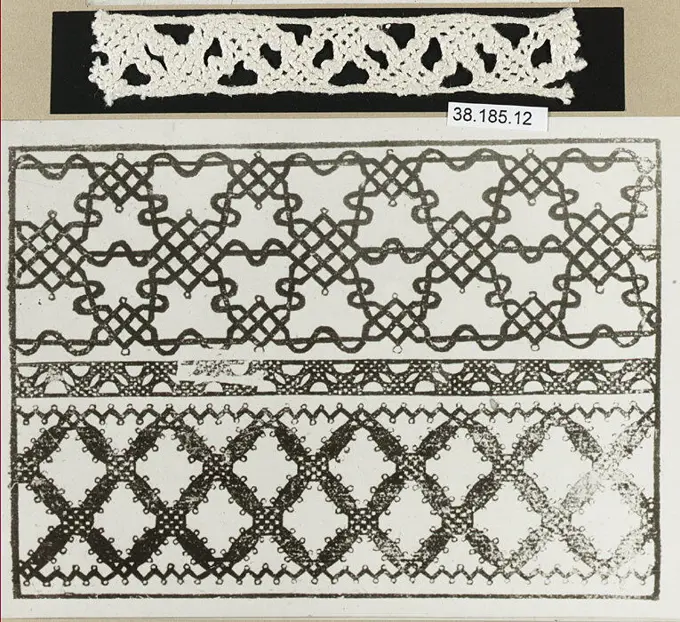
Strip bobbin with heart spreading pattern and pine jar motif under thin zigzag line, anonymous, c. 1800 Strip of natural -colored bobbin: Mechelse side. A thin zigzag line runs under a spreading pattern of four rows of hearts, with a pine cone-shaped motif under each zigzag valley that hangs down to the bottom of the strip. Between the pine jar motifs is an open decorative border along the underside of the strip, decorated with cubes made in form. The motifs are connected by a fine Maas soil, a Mechelen soil. The sparing fullwork is made in linen battle with thicker and shiny contour threads. The top and bottom of the strip are straight finished, with the bottom with picots. Mechelen linen (material) bobbin lace / Mechlin (lace) Strip of natural -colored bobbin: Mechelse side. A thin zigzag line runs under a spreading pattern of four rows of hearts, with a pine cone-shaped motif under each zigzag valley that hangs down to the bottom of the strip. Between the pine jar motifs is an open
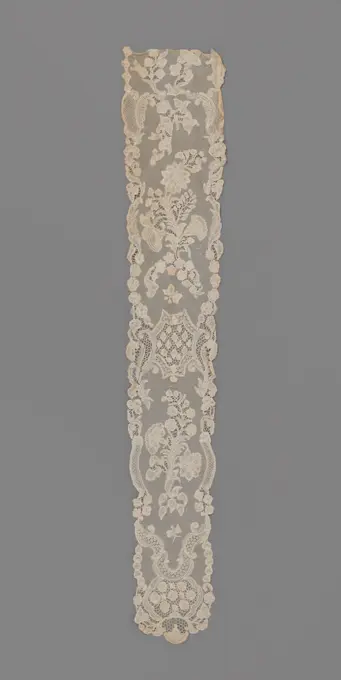
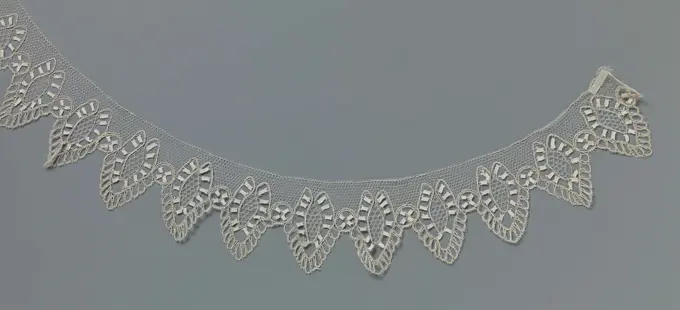
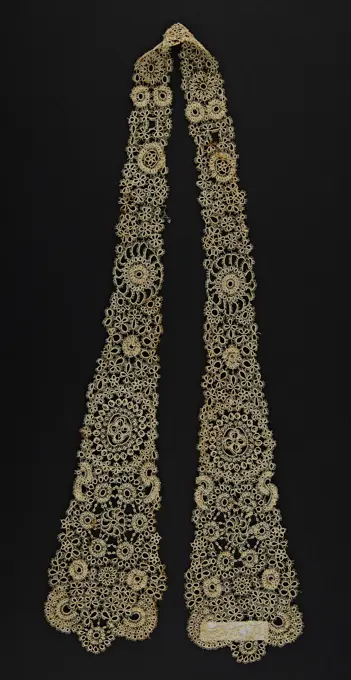
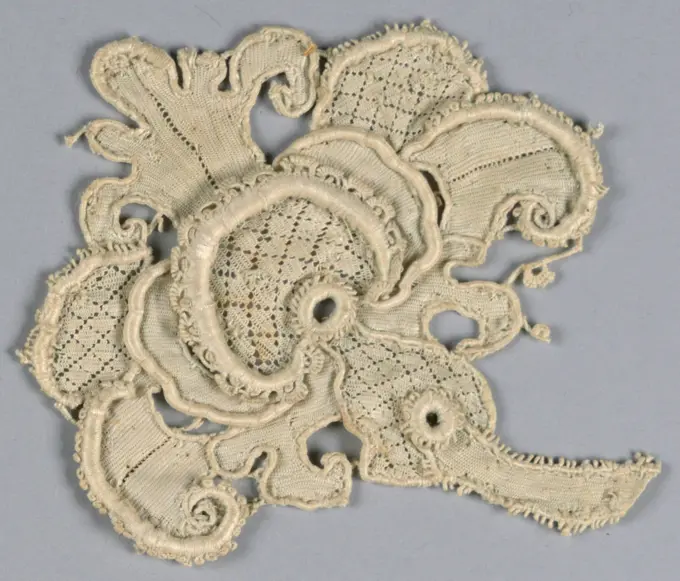
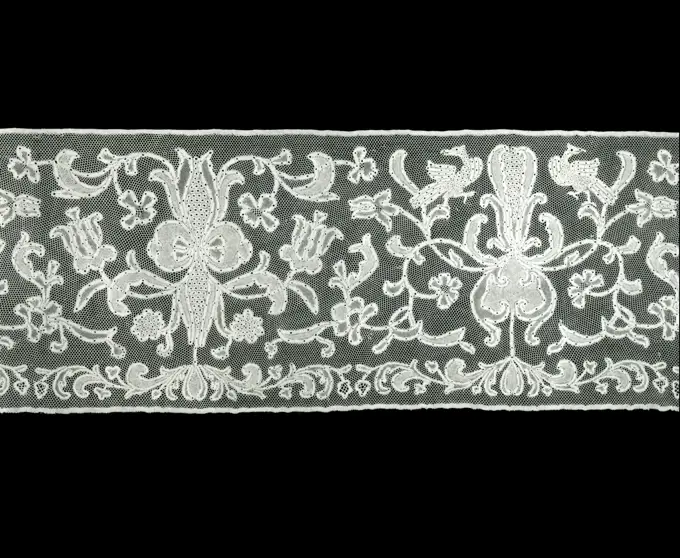
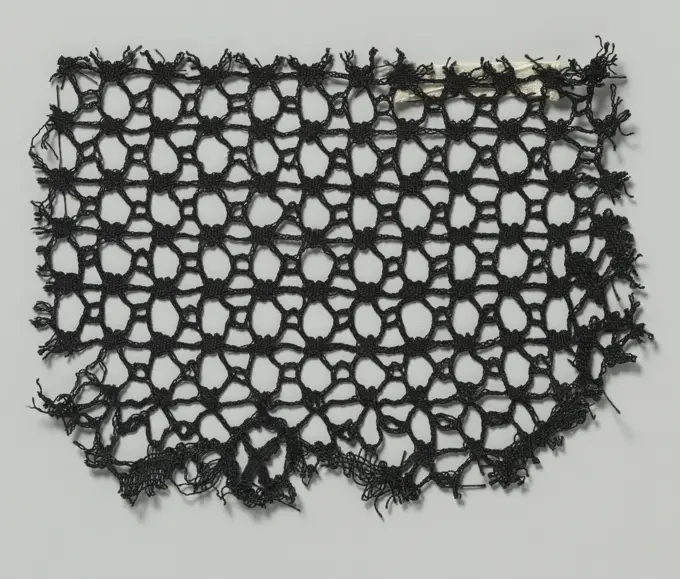
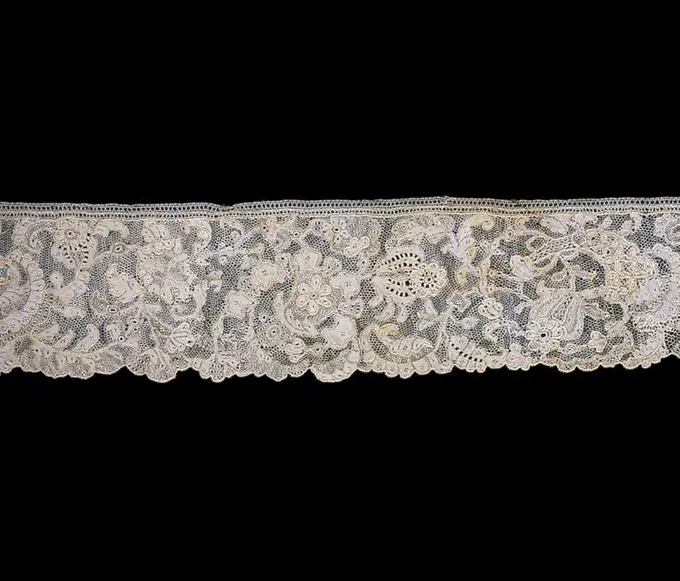
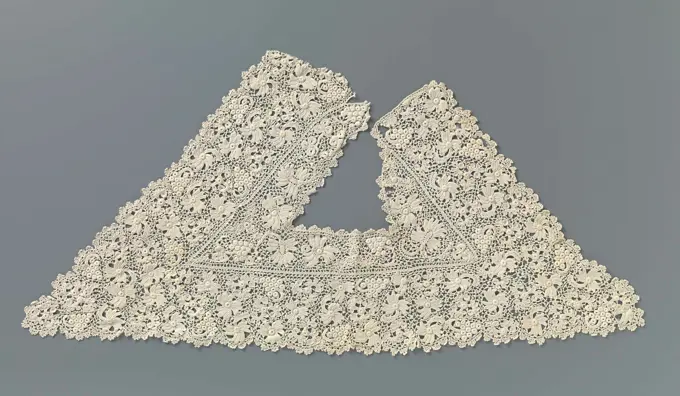
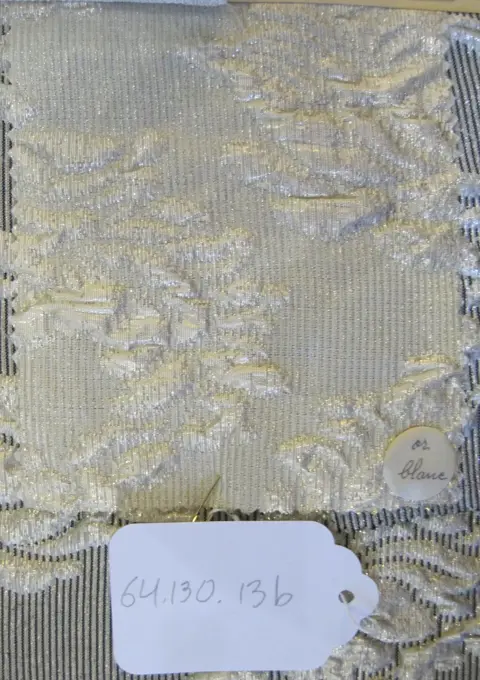
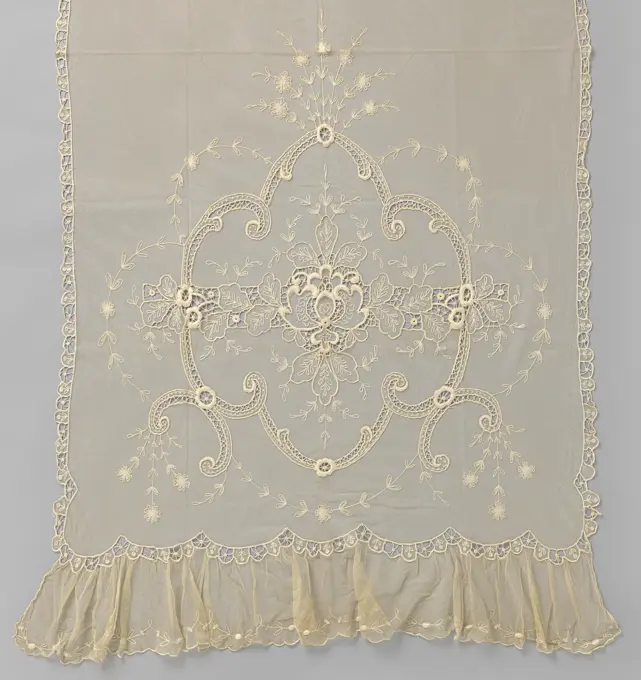
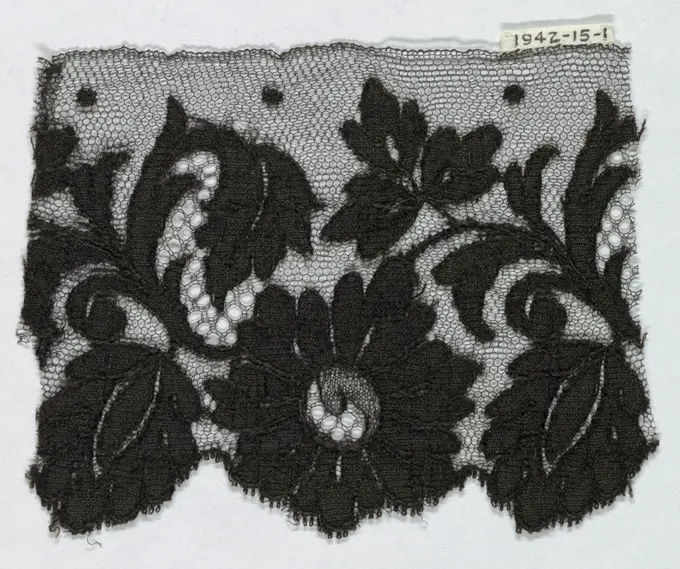
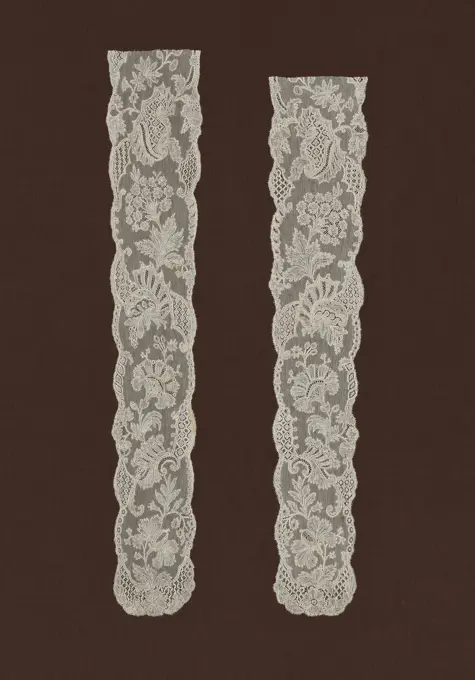
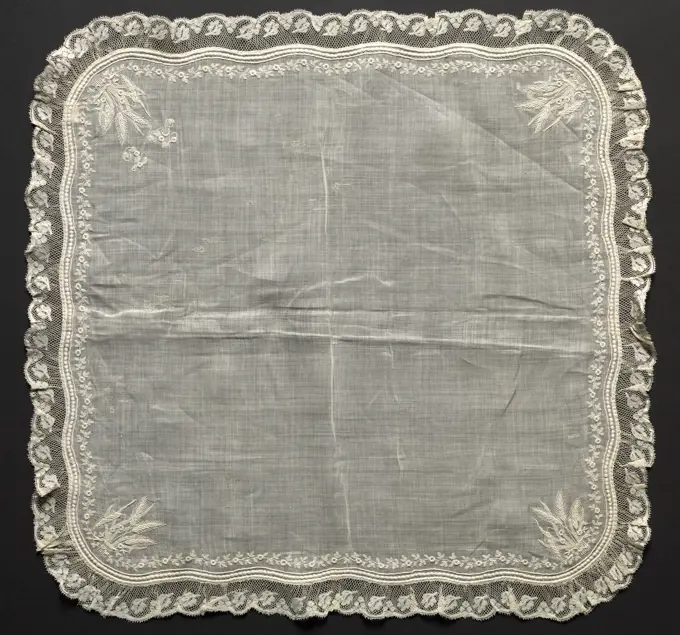
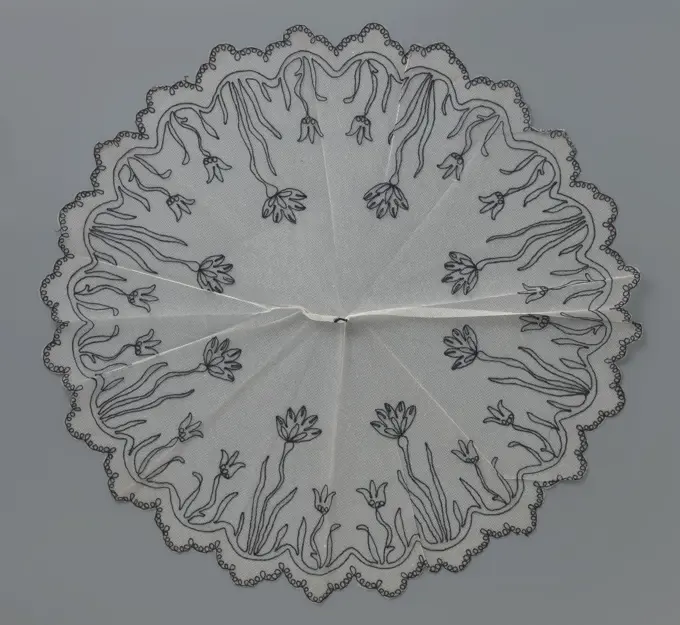
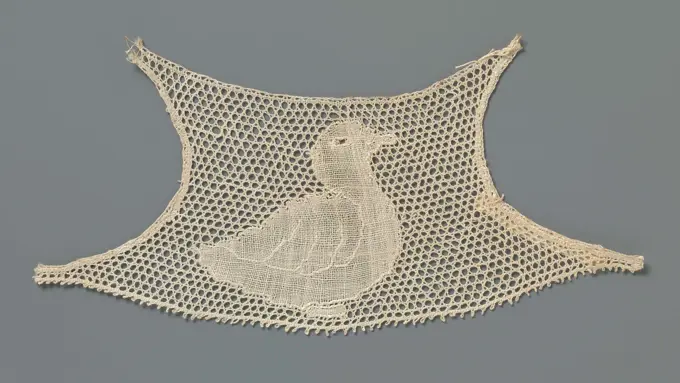
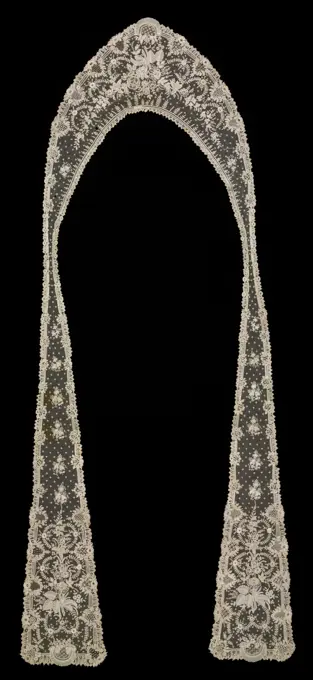
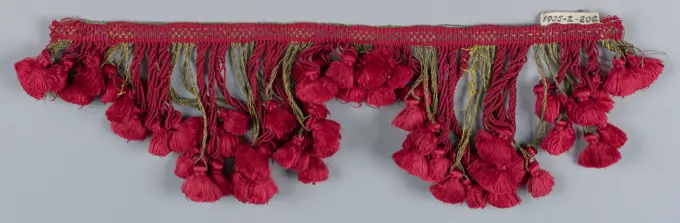
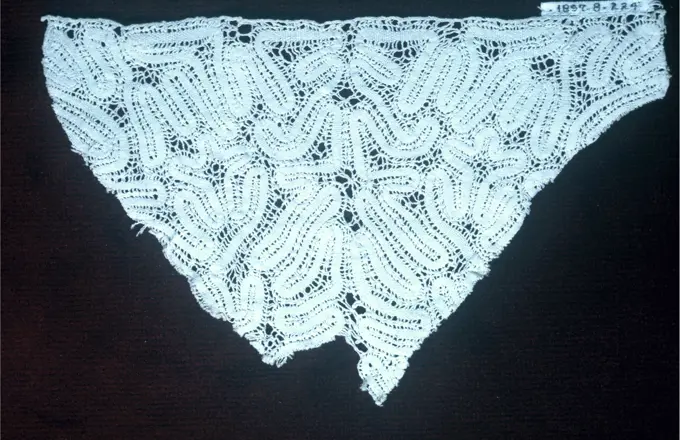
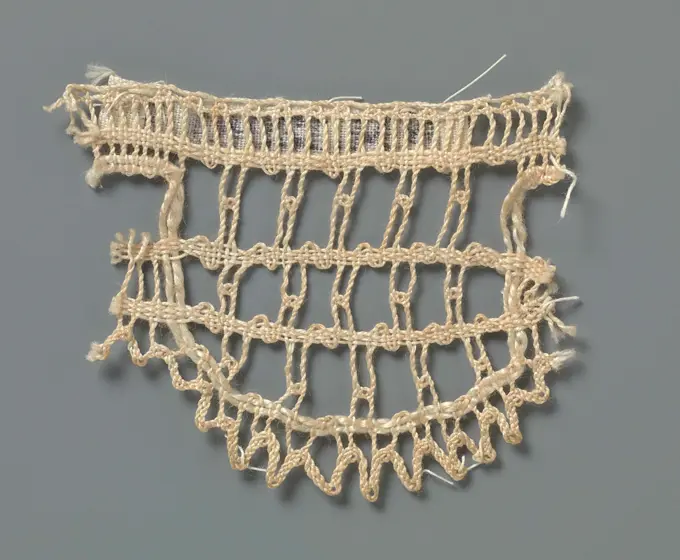
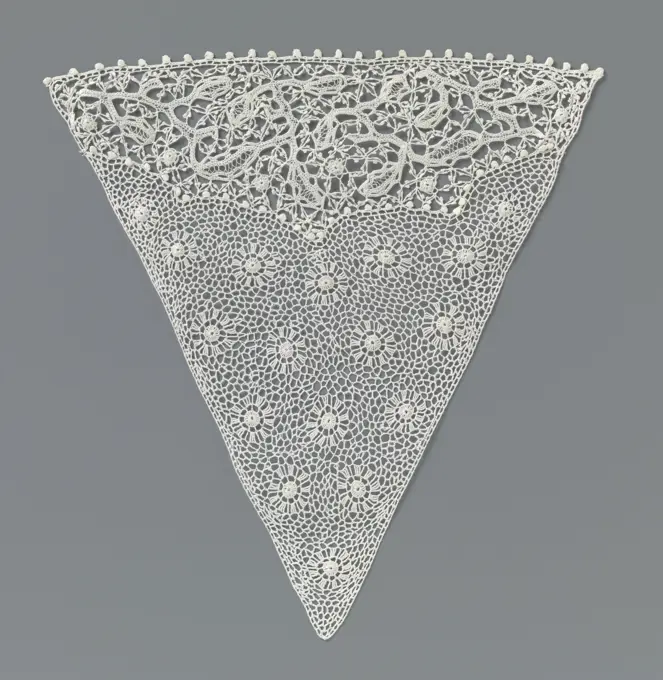
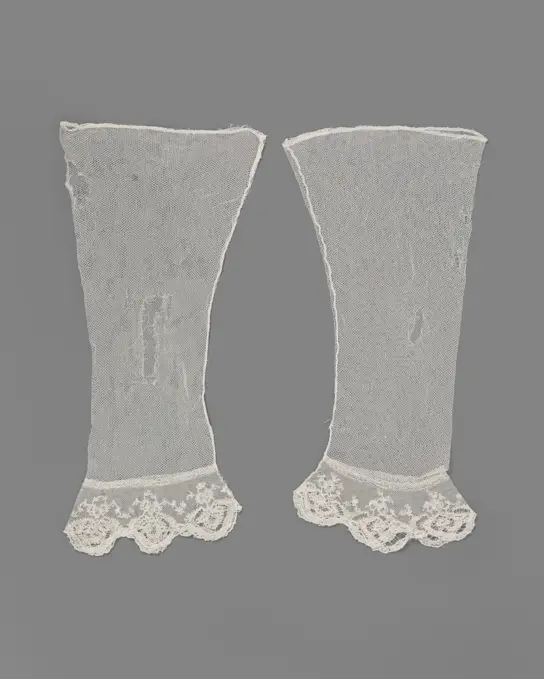
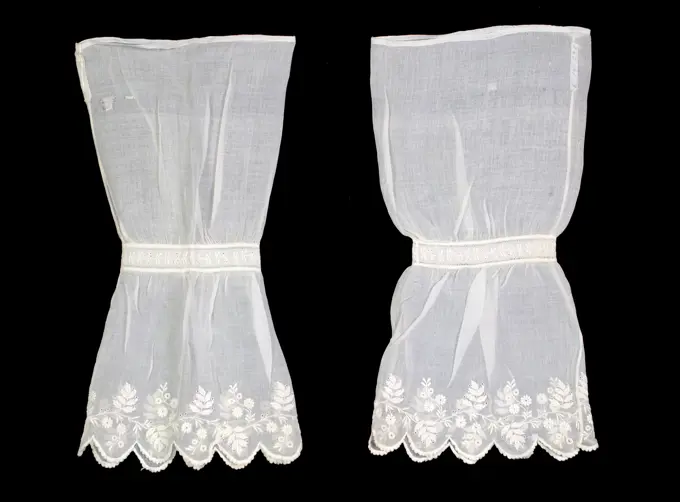
Handkerchief fourth quarter 19th century probably Belgian. Handkerchief. probably Belgian. fourth quarter 19th century. LinenFragment; linenHat -slip (barbe) of Brussels bobbin side decorated with, among other things, a fly and a butterfly, Anonymous, c. 1735 - c. 1750 Heat slip (Barbe) of Brussels bobbin, irregularly sculpted with a round end and fully equipped with a picotrand. The pattern consists of volutes, flowers, flower branches, foliage, a fly and a butterfly. Brussels linen (material) Brussels bobbin lace Heat slip (Barbe) of Brussels bobbin, irregularly sculpted with a round end and fully equipped with a picotrand. The pattern consists of volutes, flowers, flower branches, foliage, a fly and a butterfly. Brussels linen (material) Brussels bobbin laceFragment of needlelace unknownFragment, Medium: linen Technique: Brussels style bobbin lace, Circular motifs and detached leaves., Belgium, late 19th century, lace, FragmentStrook kloskant met ovalen die diepe puntige schulpen vormen.Strip natural colosside: blonde. The color tends vague to blue. The repeating pattern consists of an oval with one pointed point, which depends down and forms a deep glule. The successive shelters are connected to each other by a cut-away circle, in which an X-shaped motif is made in shape stroke. The ovals are formed by an ornamental ground, a rose ground, where a wide openwork runway runs from contour wires between which cubes are made in shape stroke. An additional decorative tire is still running around the lower part of the ovals, which is formed by a concatenation of opened ovals with fine picots. The contour wires consist of a combination of a bundle of floss wires and a twisted wire. At the top, the motifs are connected by a grille, a toel. The top is just finished.Tatting Lappets unknownFragment (Italy); linenPiece 18th century French. Piece 214107Flounce Made 1725-1750 Northern Italy. Linen, bobbin part lace (worked in large sections with the aid of a hook) .Fragment bobbin with crosses between seven horizontal lines, anonymous, c. 1875 - c. 1899 fragment Fragment black bobbin, Cluny side. It is a rectangular fragment that is unfinished on all sides. The fragment shows a decorative land with seven thin straight lines, with more or less heart -shaped motifs at a short and regular distance. In between the straight lines, these motifs are connected by crosses between curved cross line. In the center of each cross there is an open square. The straight, bent and intersecting lines concern braids. The heart -shaped motifs are made in linen battle. A worked circle can be seen on one of the longer sides, in which a cross has been made in leaf -shaped forms. Cluny silk bobbin lace / Cluny laceEmbroidered Handkerchief, 1860. Switzerland, 19th century. Embroidery: linen; average: 47 x 47 cm (18 1/2 x 18 1/2 in.).Doily of tape and needle lace, circa 1890, maker unknown. Gift of Dr Tom Farrar, 2010.Border, 16th-17th century, 6 1/8 x 3/4 in. (15.54 x 1.91 cm), Linen; needlelace, England, 16th-17th centuryKnitted lower hat of fine cotton, with openwork stitch, c. 1900 Underut of knitwear from fine cotton. The lace stitch shows a zigzag pattern with frames along the forehead and from the middle of the crown to the middle behind. Friesland (possibly) cotton (textile) knitting Underut of knitwear from fine cotton. The lace stitch shows a zigzag pattern with frames along the forehead and from the middle of the crown to the middle behind. Friesland (possibly) cotton (textile) knittingBorder, Medium: Technique: needle lace, Needle lace edge, floral pattern; early 18th century Alencon, early 18th century, lace, BorderCollar of tulle with application side, c. 1850 - c. 1920 Collar of tulle with application side, the edge is irregularly sculpted and provided with picots; There are three hanging leaves interspersed with a rosette in the sculpes. West-Europa . Collar of tulle with application side, the edge is irregularly sculpted and provided with picots; There are three hanging leaves interspersed with a rosette in the sculpes. West-Europa .Border. France or Flanders. Date: 1701-1725. Dimensions: 7.7 × 697.3 cm (3 × 274 1/2 in.)Width repeat: 25.5 cm 25.4 cm (10 in.). Linen, needle lace. Origin: France. Museum: The Chicago Art Institute, Chicago, USA.Purse (USA); linenCap Streamers (Belgium); linenOplegstuk van gehaakte kant met bloemen en druiventrossen.Strip or impregnation with two sharp corners of natural-colored Irish crochet side. Pattern with flowers and grape fees and a crochet irregular maase with picots. Along the outside, the semi-circular shelters are trimmed with picoted arcs. The inside is finished with a straight edge.Application side with round cartouches, anonymous, c. 1850  Cuff of natural -colored application side: Batist applied on mechanical tulle. The repeating pattern consists of two C-volutes along the lower edge that form a more or less around cartouche. There is a three -litter motif in every cartouche. The cartouches are interconnected by one pair of swingers of openwork circles. Above is a spreading pattern of moesjes and small flowers or leaves. The top is finished with a zoompje. The scrap edge on the bottom runs in both short sides is finished with picots. The cuff can be closed by means of two brackets. Netherlands cotton (textile). batisteTextile Swatches Onondaga Silk Company, Inc. (1925-1981). Textile Swatches, 1948-1959. Possibly metal; acetate; nylon, (a) - (c): 6 x 4 1/2 in. (15.2 x 11.4 cm).    1948-1959Fragment (Belgium); linenBorder 18th century Italian, Genoa. Border 215044Kloskant motif in very silly S-shape with short pointed ends, Sophia Gerardine Cenijn-Smit, c. 1914 Motif in very silly S-shape with short pointed ends of natural-colored bobbin: Cluny side. The contour of the S-shape is made in linen battle. Within the contour there is a braided branch with eleven leaves made in it in form. A field has been made in the ends in the ends. The last leaf on the branch has been worked over the traly land. Amsterdam linen (material) bobbin lace / Cluny lace Motif in very silly S-shape with short pointed ends of natural-colored bobbin: Cluny side. The contour of the S-shape is made in linen battle. Within the contour there is a braided branch with eleven leaves made in it in form. A field has been made in the ends in the ends. The last leaf on the branch has been worked over the traly land. Amsterdam linen (material) bobbin lace / Cluny laceCurtain from a four-poster bed of machine tulle with embroidery. Curtain of a four-poster bed of machine tulle in white embroidered with chain and feston stitch with openworks in the way of richelieu embroidery. Large flower and leaf motif within a cartouche of C-Volutes, around whom flower garlands and branches.Bobbin Lace Edging, 18th century. Spain, Huelva, 18th century. Lace, bobbin; average: 5.5 x 19.1 cm (2 3/16 x 7 1/2 in.).Collar 1700-1938 American. Collar 119104Fragment, Medium: silk Technique: machine-made ground with hand embroidery, Black Spanish blonde lace with handrun pattern of flowers and leaves on machine ground., Spain, ca. 1850, lace, FragmentCuff of linen with a richieuwerk, with a running pattern of sliding leaf shapes with volute branches, anonymous, c. 1920 Cuff of linen with a richieuwerk, with an ongoing pattern of sliding leaf shapes with volute branches. West-Europa whole: Linen (Material) Cuff of linen with a richieuwerk, with an ongoing pattern of sliding leaf shapes with volute branches. West-Europa whole: Linen (Material)Fragment (of a Band) with Floral Pattern, 16th century. Italy, 16th century. Needle lace, filet/lacis (knotted ground and darned in two directions); bleached linen (est.); overall: 10.7 x 15.4 cm (4 3/16 x 6 1/16 in.). Lace was often used in large quantities to produce opulent effects of light and contrasting texture. Bands of this width may have originally adorned a woman’s skirt or petticoat, heightening the design and overall impact with its rich floral pattern.Pair of Lappets Made 1750-1759 Mechelen. Linen, bobbin straight lace of a type known as Mechlin with a Mechlin mesh ground .Shawl 1860-70 Belgian Point de gaze lace produced in Belgium was highly valued in the second half of the 19th century. A signature characteristic is the two-dimensional rose motif which adds surface interest. Often lace pieces of this size combine handmade motifs with machine-made net grounds, but this is completely handmade. It would have been extremely expensive to produce, considering the sheer size of the piece, the density of the motifs and the time required to work it all by hand. It is a premier example of mid-19th century lace-making.. Shawl 158170Batist's handkerchief with sloping edge of half oval arcs and rosette flower with star-shaped flower heart in the corners. Batist's handkerchief around finished with a clust side: fine bridges flower work. The clamping side exists along the edges of the handkerchief from four narrow and faint wavy lines, which partly overlap. Attached to this is a concatenation of open-worked half ovals, arcs, which form the tube edge. In every corner, overhoeks is placed on two C volutes one large rosette flower, with a cut-away around flower heart with a star in it. The motifs are made in linen battle with openwork edges and thick contour lines. The veins of the petals are depicted with recesses. The sloping edge is finished with picots.Fragment of lace. unknown, authorStrook gehaakte kant met bloemen en druiventros.Spire tapering strip natural colored Irish crochet side. Pattern with flowers and grape fees and a crochet irregular maase with picots. Finished on one short side and partially finished straight along one long side. Along the other edges, the finish of semi-circular shelters is deposited with picoted arcs.Increasing climbing side with circles in diamond field. Increasing natural colosside, Cluny side. Square model with slightly hollow drawn sides. The symmetrical pattern consists of a diamond-shaped field with on the outside of each of the four sides, a semi-circular field with seven spokes, made alternately with braids and leaf-shaped shape stroke. In the center of the diamond-shaped field is a double circle with eight spokes made with braids. Outside the central circle, these spokes alternately run out in a funnel-shaped motif or a leaf-shaped motif. Both motifs are made in shape stroke, where the funnel has nine ribs and the leaf-shaped motif three ribs. The funnel-shaped motifs are crowned by semi-circular field with three spokes made with braids.Fragment, 18th century, 7 1/2 x 6 3/4 in. (19.05 x 17.15 cm), Linen; lacis; lace, England, 18th centuryBobbin Lace (Needlepoint Design) Edging of Points, 17th century. Italy, Genoa, 17th century. Lace, bobbin; average: 10.2 x 19.1 cm (4 x 7 1/2 in.).Shawl Made 1805-1830 Spitalfields. Silk, plain 1 1 gauze weave with supplementary brocading wefts .Cuff from crocheted side with fan -shaped flowers, anonymous, c. 1890 - c. 1909 Cuff made of natural Irish crocheted side, imitation coarse Venetian side. Pattern with fan -shaped flowers with stems and a crocheted irregular mesh soil with picots. The top is finished with a straight edge. The semi -circular sculpts on the lower edge are trimmed with picoted arches. Ireland cotton (textile) Cuff made of natural Irish crocheted side, imitation coarse Venetian side. Pattern with fan -shaped flowers with stems and a crocheted irregular mesh soil with picots. The top is finished with a straight edge. The semi -circular sculpts on the lower edge are trimmed with picoted arches. Ireland cotton (textile)Collar ca. 1850 French. Collar 168299Fringe European 19th centuryFragment; linenPassementerie Border. Spain, 1600-1625. Textiles; passementerie. Silk core wrapped gilded silver thread and metal strip bobbin lace with silk embroideryBorder. Probably Italy. Date: 1601-1625. Dimensions: 13.8 x 65.8 cm (5 1/2 x 25 7/8 in.). Linen, needle lace worked on a laid and plaited thread grid, Reticello pattern. Origin: Italy. Museum: The Chicago Art Institute, Chicago, USA.Handkerchief Made 1801-1900 Philippines. Linen; embroidered .Square (Italy); linenBobbin Lace Edging with Points, 16th-17th century. Italy, Venice, 16th-17th century. Lace, bobbin; average: 5.1 x 24.2 cm (2 x 9 1/2 in.).Collar of needle side with curling tendrils to which some flowers and a bow border with three-piece arcs. Collar of natural needle side: Venetian relief side. The symmetrical pattern consists of curling tendrils with some flowers. The flower (or fruit) In the middle it is greatest and has an oval center around which seven petals protruded and at the bottom a circle between two volutes and with a triple motif. The motifs are equipped with light relief contours and are interconnected by a picoted bars soil. Ornamental grounds are applied in the flowers. The collar is finished along the outside with three-piece arcs with picots. The rightly finished neck / neckline are sewn together, so that the collar is folded folded. It is not clear why people have done this.Bobbin Lace (Needlepoint Design) Edging, 17th century. Italy, Genoa, 17th century. Lace, bobbin; average: 8.3 x 74.3 cm (3 1/4 x 29 1/4 in.).Cap Made 1850-1900 France. Cotton, machine-made twist net; embroidered with cotton and linen in chain stitches (tambour work), darning, overcast, and wave filling stitches .Insertion 16th century Italian. Insertion. Italian. 16th century. Bobbin lace. Textiles-LacesCuffs late 18th century British. Cuffs 118623Sampler 19th century German. Sampler 228632Cape Collar Made 1850-1875 Malta. Silk, bobbin straight lace (in bands) .Band, Medium: linen Technique: bobbin lace, continuous braid-like, Band fragment with peacocks forming a scroll., Italy, 16th century, lace, BandNapkin van Wit Linnamast ,, 1890 - 1910 White Linnamasten Napkin with a stylized flower pattern, brand MB 24. Germany linen (material) damask White Linnamasten Napkin with a stylized flower pattern, brand MB 24. Germany linen (material) damaskFragment, Medium: linen Technique: needle lace, Fragment of Argentan lace with a leaf design., France, 18th century, lace, FragmentMachinal furniture decorations, anonymous, c. 1900 Furniture decoration of natural -colored machine side: Etskant. The side imitates needle side: Reticella and Punto in Aria. On a rectangular strip, two pointed debts are sewn at the ends, which overlap more than half with the strip. There are smaller point sculpts on the underside of the strip between these pointed sculpts. The point sculptures have a rosette in a standing oval medallion in the middle. Three metal hooks are sewn at the back, for attachment to an eye. Switzerland cotton (textile). metal Furniture decoration of natural -colored machine side: Etskant. The side imitates needle side: Reticella and Punto in Aria. On a rectangular strip, two pointed debts are sewn at the ends, which overlap more than half with the strip. There are smaller point sculpts on the underside of the strip between these pointed sculpts. The point sculptures have a rosette in a standing oval medallion in the middle. Three metal hooks are sewn at the bEdging, Technique: bobbin lace, Edge of bobbin lace, scrolling plant and scalloped edge; late 18th century Buckinghamshire., late 18th century, lace, EdgingCollar from three layers of Valenciennes side, Anonymous, c. 1850 - c. 1900 Collar from three layers of Valenciennes side with a scalloped edge with picots. Each shell is decorated with a leaf volute and upwards the side is decorated with moes. West-Europa linen (material) Valenciennes lace Collar from three layers of Valenciennes side with a scalloped edge with picots. Each shell is decorated with a leaf volute and upwards the side is decorated with moes. West-Europa linen (material) Valenciennes laceEmbroidery Fragment. Germany, Dresden, second half of the 18th century. Textiles; embroidery. Linen plain weave with linen embroidery (Dresden work)Embroidered Handkerchief, 19th century. Switzerland, 19th century. Embroidery: linen; average: 31.1 x 31.1 cm (12 1/4 x 12 1/4 in.).Edging 18th century Flemish, possibly Brussels. Edging 213301Border 18th century French. Border 223026Fragment van kloskant met bloempjes tussen c-voluten en bloemen met lusvormige blaadjes.Fragment of natural colosside: Honiton side. The repeating pattern consists of c-volutes with a flower clamped between the beginning and end with a loop-shaped flower heart and four openwork lobes such as petals. Above a few connected flowers to narrow stems with loop-shaped leaves. The contours of the motifs are made in linen stroke with openwork edges and partly in the battery, with shiny contour wires. In some flowers, cubes are used in shape stroke. The motifs are connected without a ground. Part of the fragment is finished with picots.Rond vingerkomkleedje van kloskant met naar elkaar toegewende c-voluten en slingerende linten.Finger card made of natural colosside. Round model. The repeating pattern consists of two c-volutes dawned towards each other. Each volute was made with a narrow ribbon in linen stroke. One curling end runs out in a rosette flower and the other curling end is a split stem with two drop-shaped flowers. This pattern repeats itself three times and forms a circle with a star-shaped residual space in the center of the dress and along the outside more or less triangular residues. The residual spaces are filled with a pattern of strong winding narrower ribbons. The ribbons and motifs are largely made in linen stroke, with or without open edges and contour wires. The motifs are connected by braids. Some petals and small motifs are made with an ornamental ground: a diamond-shaped grille.Trimming 18th century Flemish. Trimming 119470Dress of needle side with geometric motif and four leaves, anonymous, c. 1925 - Before 1938  Dress of natural -colored needle side with geometric motif, reticella. The vertical horizontal and diagonal support wires are coordonized. The leaves are formed by processing the tense support wires into Nerf, festivating them to both sides and finishing them with picots. Taormina linen (material)Border (Italy); linenEmbroidery sample;  XVII century (1601-00-00-1700-00-00);embroidery, embroidery samplesFragment (Italy); linenVeil late 18th-early 19th century Flemish. Veil 102676Escutcheon 1730-70 American. Escutcheon. American. 1730-70. Wrought iron. Made in Pennsylvania, United StatesEmbroidered Handkerchief, 18th century. Switzerland, 18th century. Embroidery: linen; average: 41.3 x 42 cm (16 1/4 x 16 9/16 in.).Fragment (France); linenTwo pointing clasp of climbing side with pointed leaves. Two pointed lines of natural colosside, cluny side. Two sharp triangular pointing shuts are only connected to each other at one point at the straight top. A smaller triangle hangs down in each triangle from the top. The circumference of the triangles are formed by a narrow strap in linen stroke. The triangles spaces are filled with braid soil and peak leaves made in shape stroke.Turkish needle work embroidery Ornamental with lace patterns, details, flowersWhite tulle parasold deck, decorated with a tulip pattern in black tambourer work, Gustav Schnitzler, c. 1875 - c. 1900 White tulle parasold deck; Decorated with black tambouring work. The deck is round and has a scalloped edge. Along the edge, the deck is decorated with a tulip pattern in black tambooering. Nijmegenwitzerland whole: Cotton (textile). White tulle parasold deck; Decorated with black tambouring work. The deck is round and has a scalloped edge. Along the edge, the deck is decorated with a tulip pattern in black tambooering. Nijmegenwitzerland whole: Cotton (textile).Halve kaarsenkap van kloskant met zittende eend.Half candle hood of natural colosside, Parisian side. Slightly curved rectangular model with disconnected curve on both short sides. In the middle of the candle cover, a sitting duck is made in a Maas soil, a Paris soil. The duck is made in linen stroke with a recess as an eye and thicker shiny contour wires, which go through in the linen work to form the contours of the wing. All sides of the strip are straight finished, with the underside with picots.Fichu, c. 1875-1880. France or Belgium, 19th century. Composite lace. Machine-made netting (reseau), Brussels bobbin lace and French needle point lace; linen; overall: 193 x 53.3 cm (76 x 21 in.).Mammoth ivory comb. Tungus People. East Siberia. 19th cent. Russia.Bobbin Lace (Needlepoint Design) Edging of Points, second half of 16th century. Italy, Genoa, second half of 16th century. Lace, bobbin; average: 5.1 x 13.1 cm (2 x 5 3/16 in.).Console table. Culture: French. Dimensions: Overall: 17 3/4 × 47 1/4 × 11 3/4 in. (45.1 × 120 × 29.8 cm). Date: 18th century. Museum: Metropolitan Museum of Art, New York, USA.Fringe (Italy); silk, metallic thread (gold strips on silk core)Fragment; linenFragment; linen; 1897-8-200Strip of a climbing side with vertical and horizontal lines in semicircular shell. Strip natural colosside. The pattern consists of horizontal lines between which crossing couples for a dash cartridge. In the middle of the dashes, a small circle is always realized. The horizontal lines are made in linen stroke. With a double ornamental thread, a curved line is made along the underside, creating a semicircular shell. This is finished with a braid that forms narrow triangular lobes.Loop.Fragment (France); linen; 1897-8-305Strip of a climbing side with cross of four leaves. Strip natural colosside, sling. The strip is short, only a part of the pattern is visible. In a kind of octagonal shape made in a cut-off center, a cut-away center was made with a cross of four leaves made in shape stroke. These crosses in a cut-away part repeat themselves along the top and bottom of the strip, but only a part is visible. Upper and bottom of the strip are straight finished.Steel bobbin with coarse wire as an example of a contemporary five -hour ground (grid), anonymous, c. 1900 - In or Before 1930 sample Steel natural -colored bobbin side with coarse wire as an example of a contemporary five -hour ground with a fragment side in which this technique has been applied. The date concerns the steel. Amsterdam cotton (textile) bobbin laceModestie from crocheted side with 'seaweed pattern' and sunbathing, anonymous, c. 1890 - c. 1909 Triangular fashionsty of natural -colored crocheted side. Along the top edge a kind of whimsical 'seaweed pattern'. In the point underneath a crocheted irregular mesh soil, with a spread pattern of rosettes or sunbathing. The different patterns are separated from each other by a well -shaped row of studs, also studs along the straight upper edge. The two sloping sides are straight finished, without studies. France (possibly) cotton (textile) Triangular fashionsty of natural -colored crocheted side. Along the top edge a kind of whimsical 'seaweed pattern'. In the point underneath a crocheted irregular mesh soil, with a spread pattern of rosettes or sunbathing. The different patterns are separated from each other by a well -shaped row of studs, also studs along the straight upper edge. The two sloping sides are straight finished, without studies. France (possibly) cotton (textile)Underemen of tulle with lace board, anonymous, c. 1935 Under sleeve from tulle and lace. Smooth model sleeve with a hanging machine sculpted strip lace, decorated with flowers. West-Europa board: Under sleeve from tulle and lace. Smooth model sleeve with a hanging machine sculpted strip lace, decorated with flowers. West-Europa board:Undersleeves ca. 1855 American. Undersleeves 169449Small collar late 17th-early 18th century Italian, Venice. Small collar 218108Length of Lace. Italy, 19th century. Textiles; textile lengths. Embroidered linenburato laceAmethyst Lace Agate from Durango, Mexico.