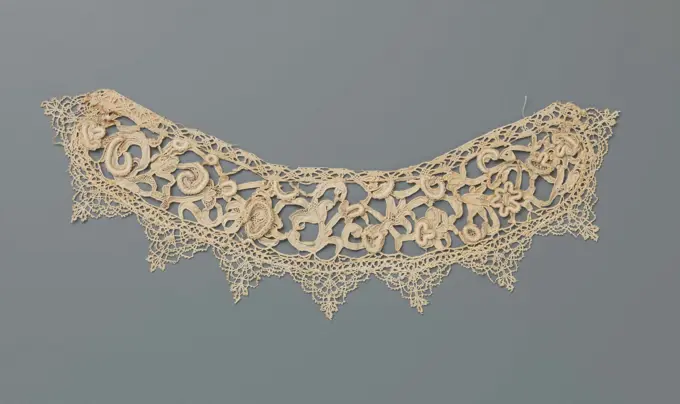
Delicate Lace Textiles

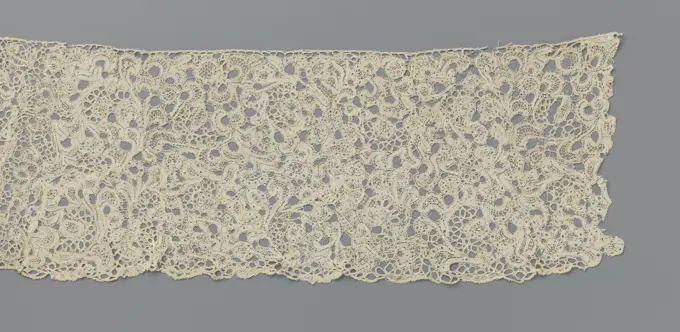
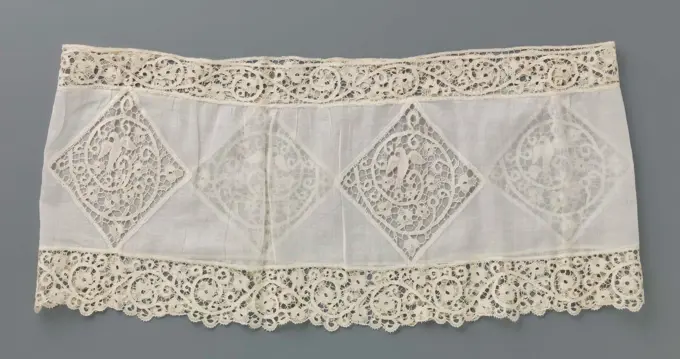
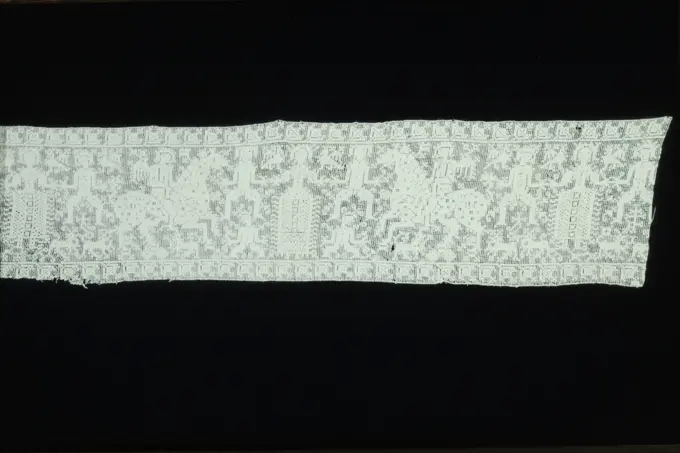
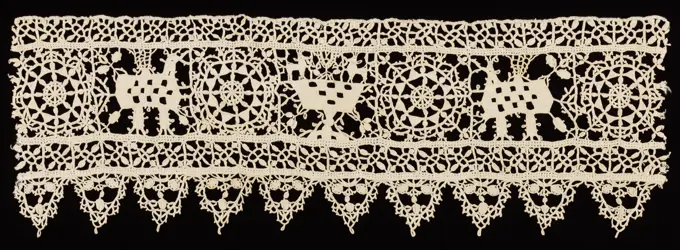
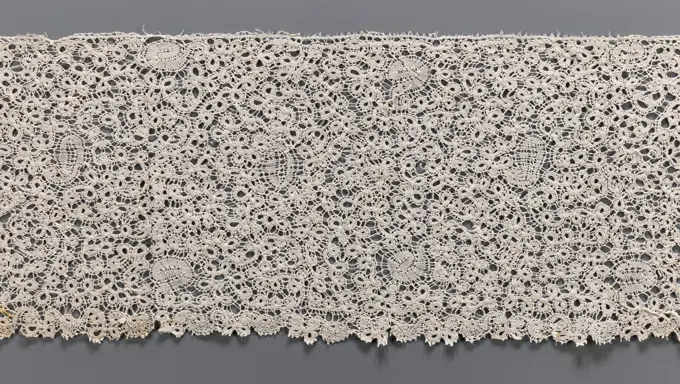
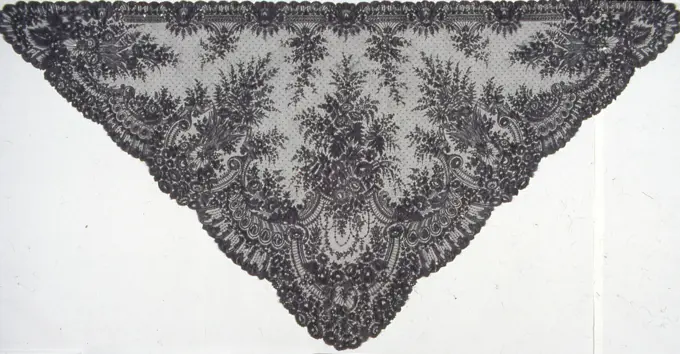
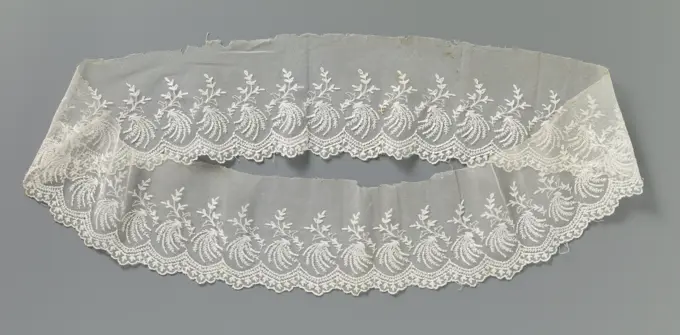
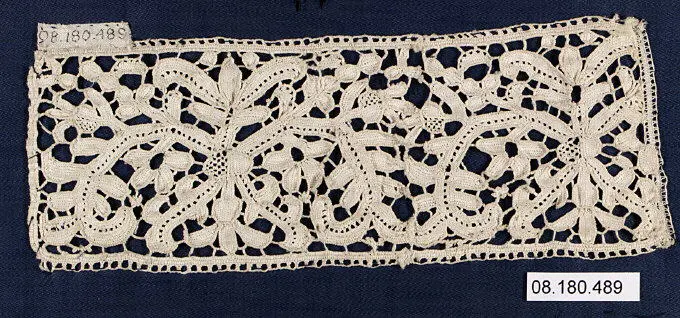
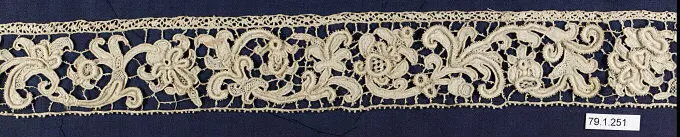
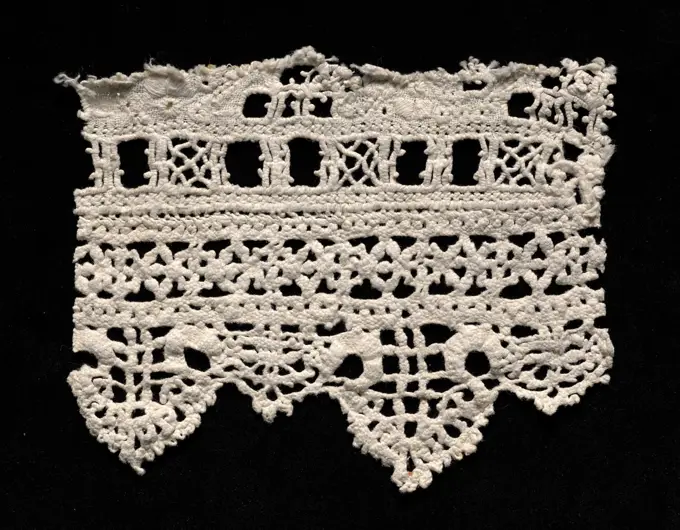
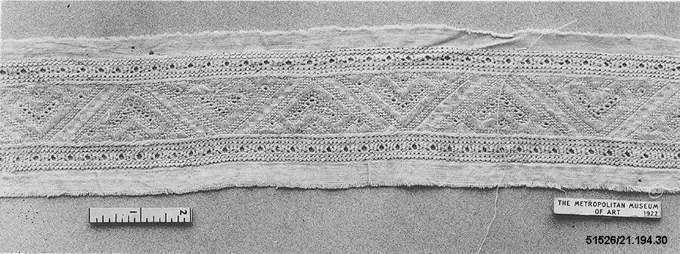
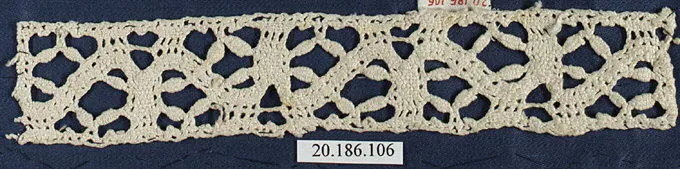
A selection of intricate lace strips showcasing various patterns, including floral and geometric designs, ideal for fashion or home decor applications.

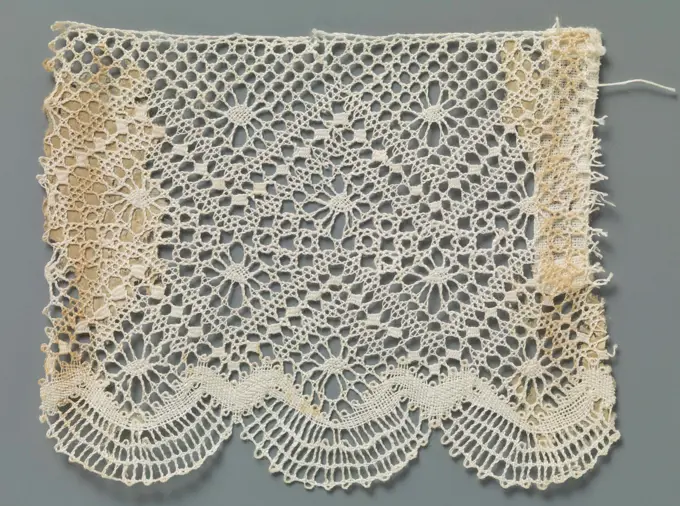
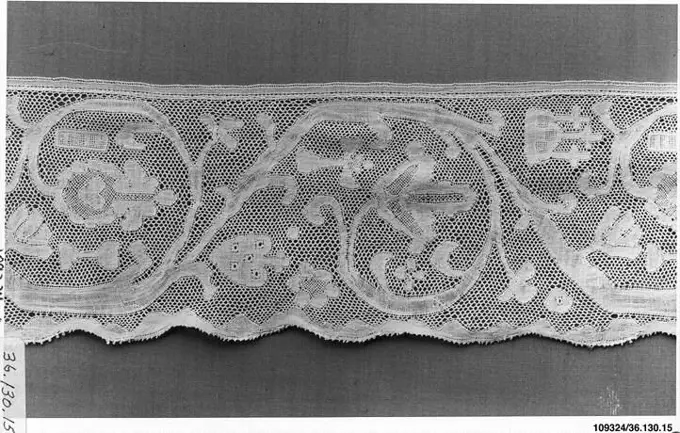
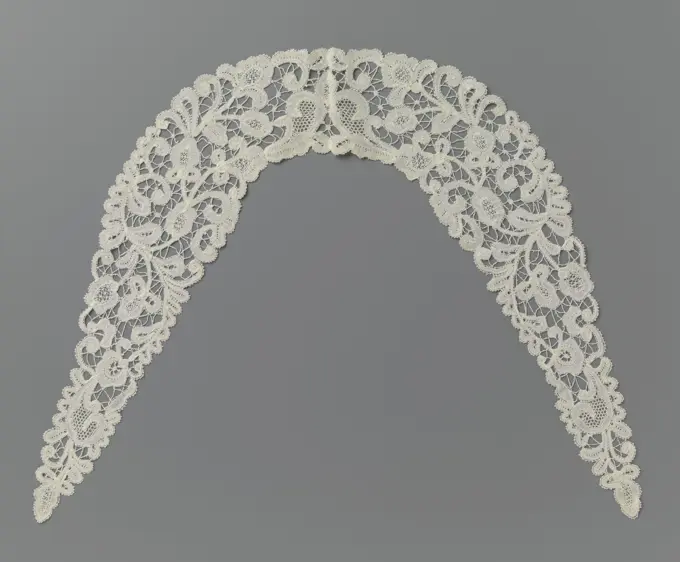
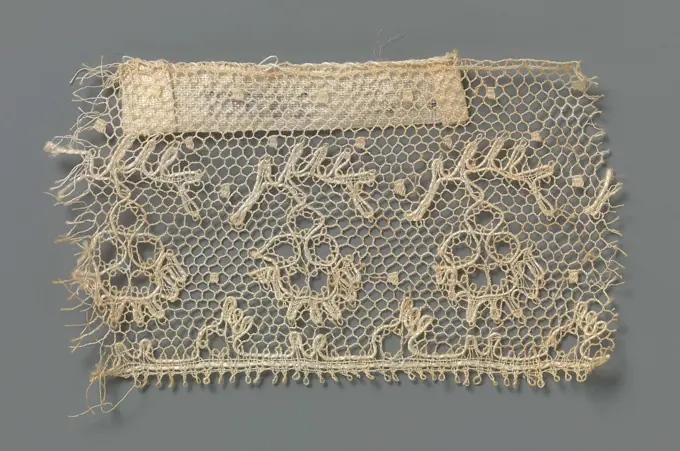
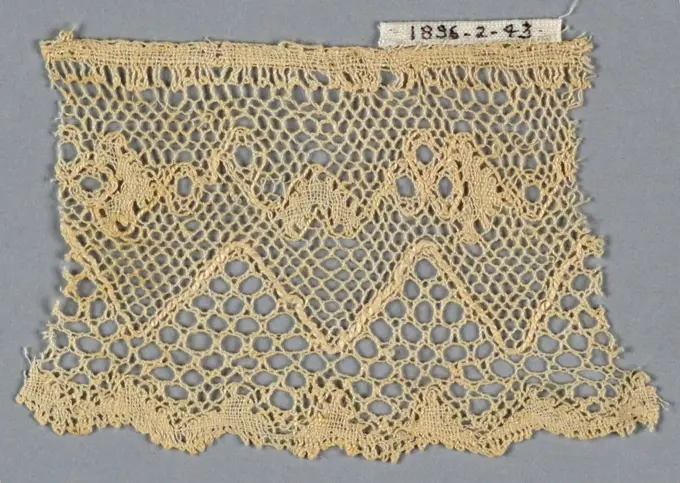
Strip bobbin with heart spreading pattern and pine jar motif under thin zigzag line, anonymous, c. 1800 Strip of natural -colored bobbin: Mechelse side. A thin zigzag line runs under a spreading pattern of four rows of hearts, with a pine cone-shaped motif under each zigzag valley that hangs down to the bottom of the strip. Between the pine jar motifs is an open decorative border along the underside of the strip, decorated with cubes made in form. The motifs are connected by a fine Maas soil, a Mechelen soil. The sparing fullwork is made in linen battle with thicker and shiny contour threads. The top and bottom of the strip are straight finished, with the bottom with picots. Mechelen linen (material) bobbin lace / Mechlin (lace) Strip of natural -colored bobbin: Mechelse side. A thin zigzag line runs under a spreading pattern of four rows of hearts, with a pine cone-shaped motif under each zigzag valley that hangs down to the bottom of the strip. Between the pine jar motifs is an open
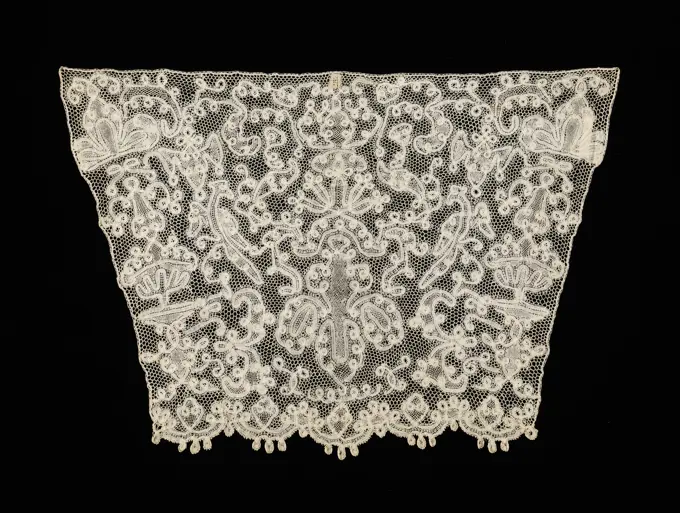
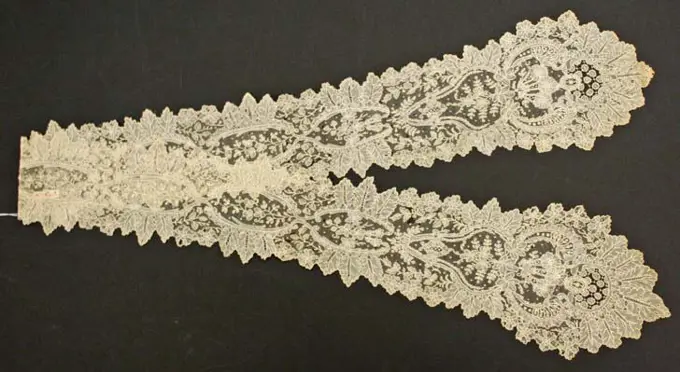
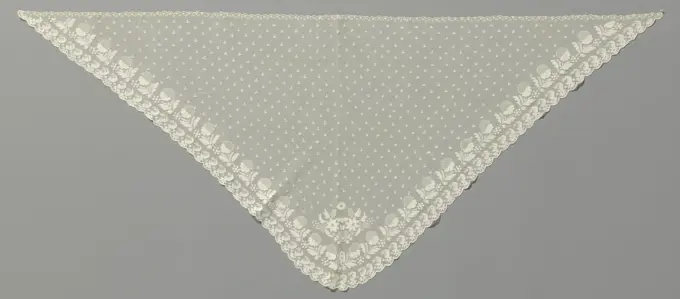
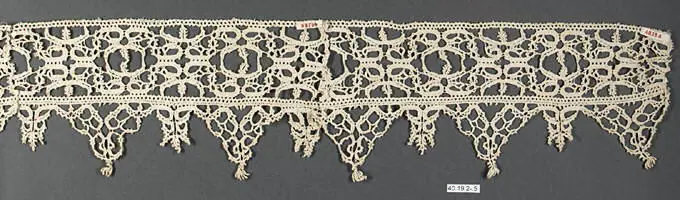
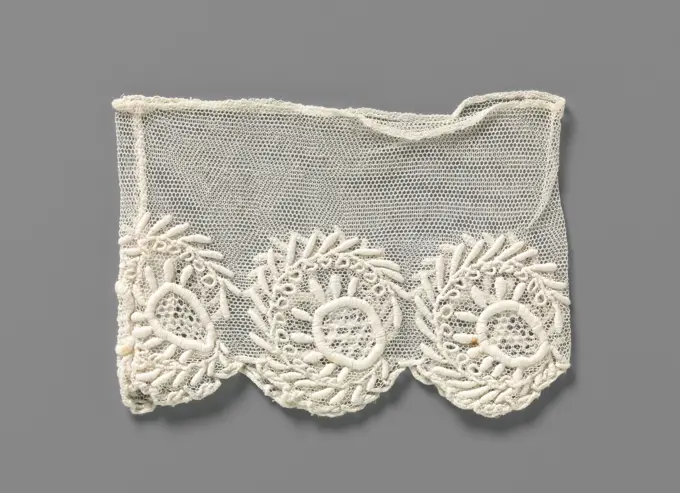
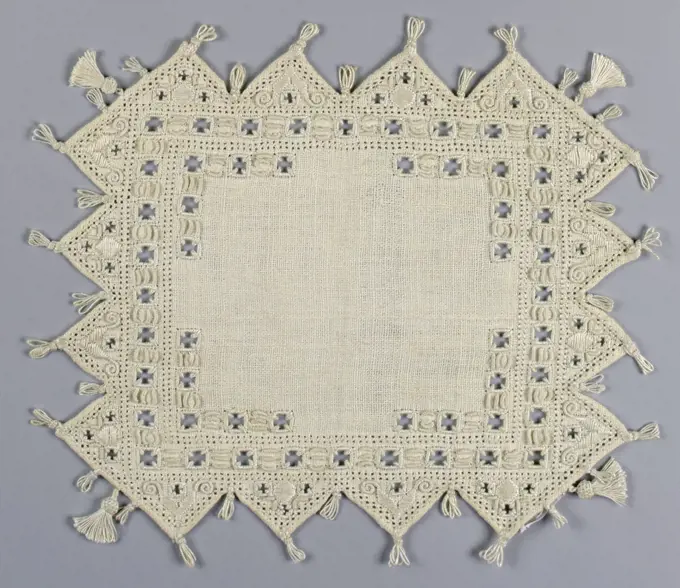
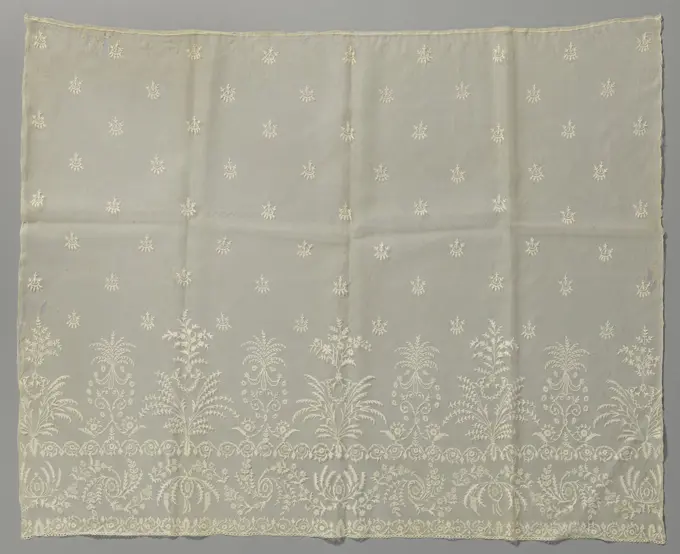
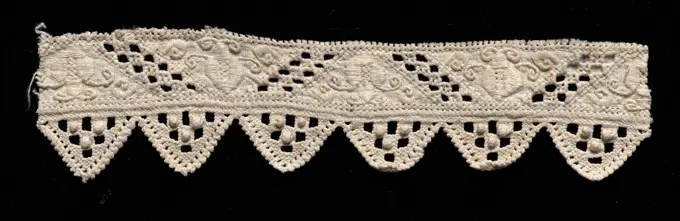
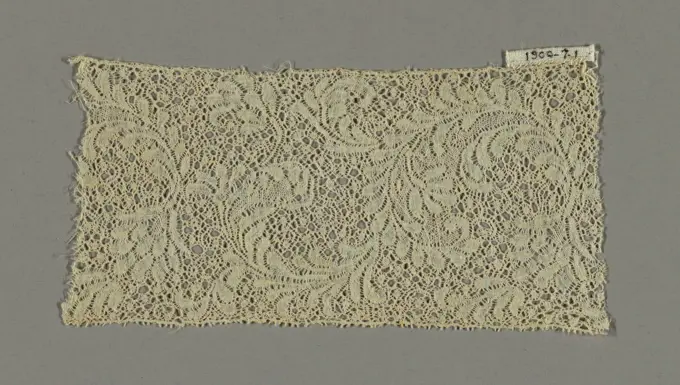
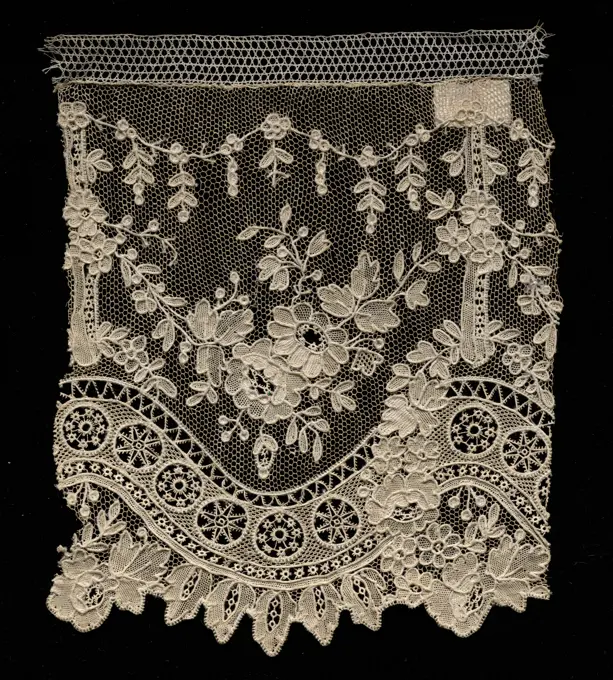
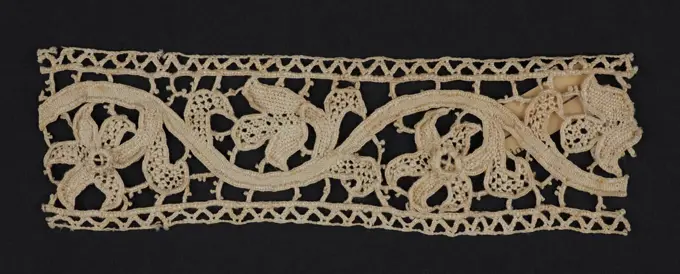
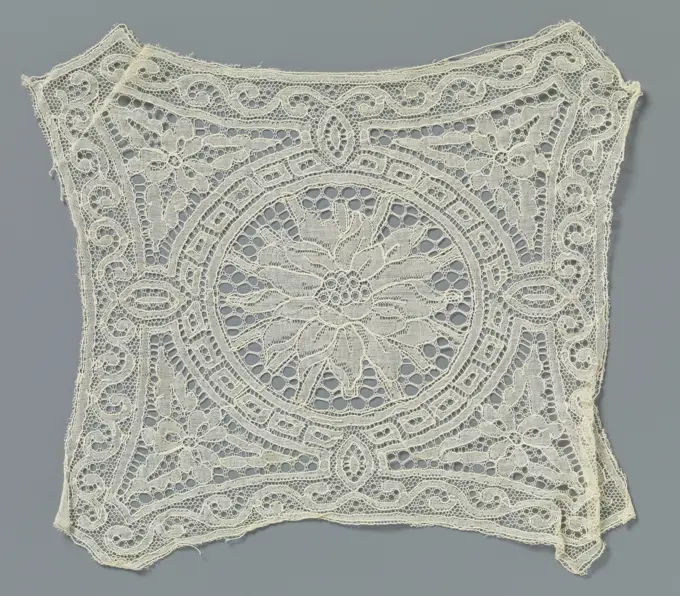
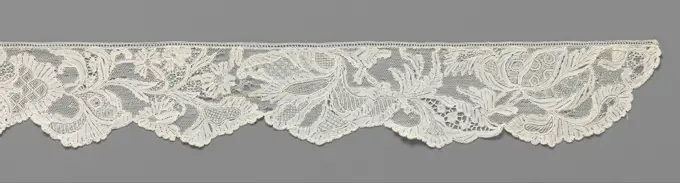
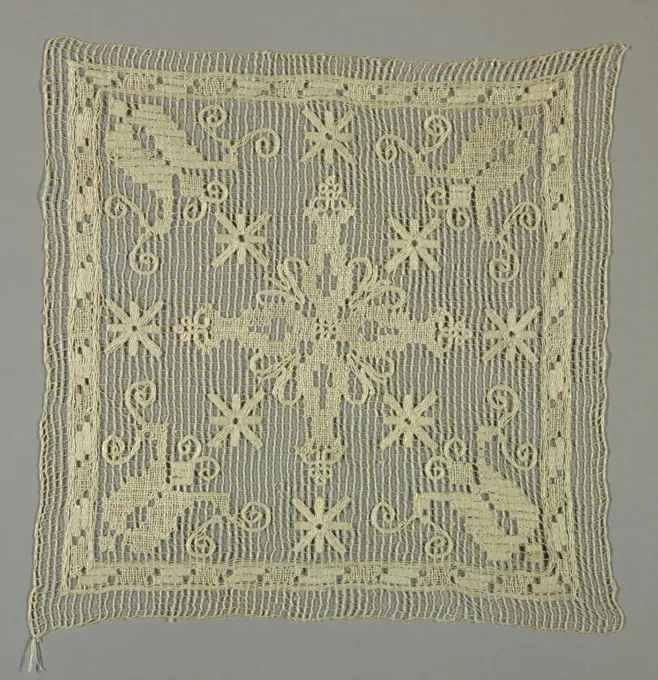
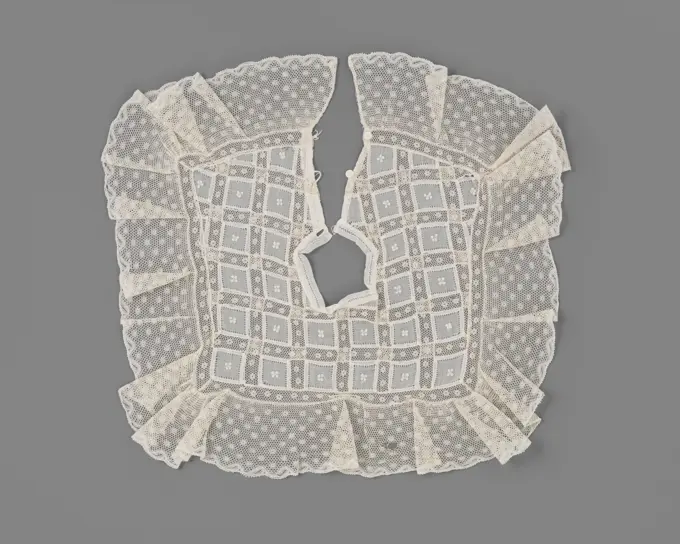
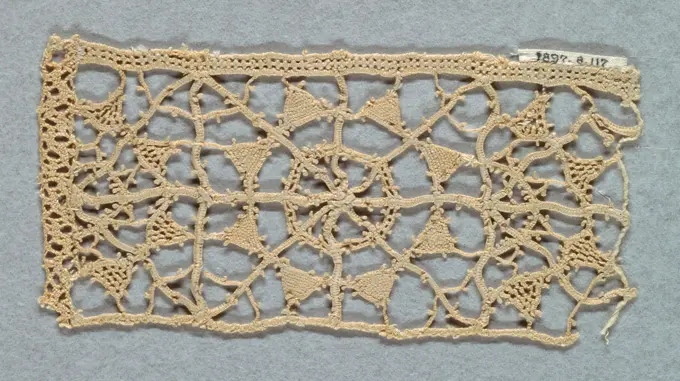
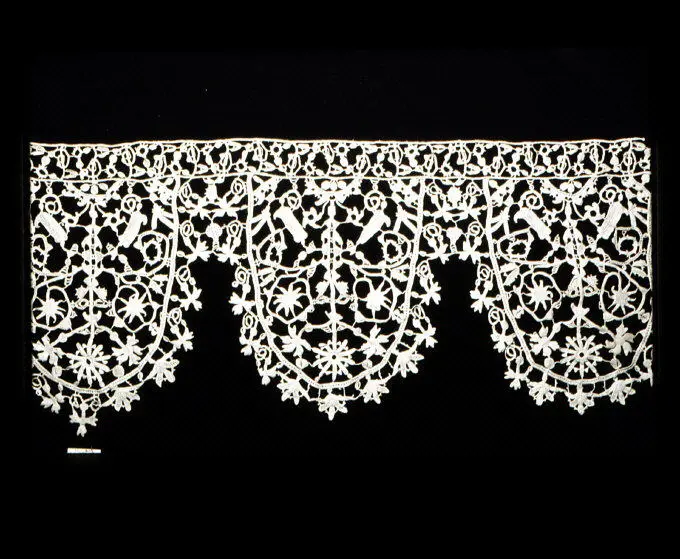
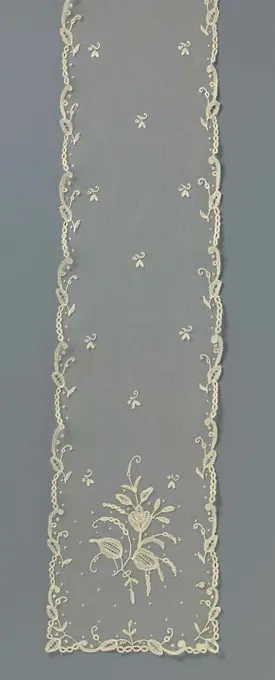
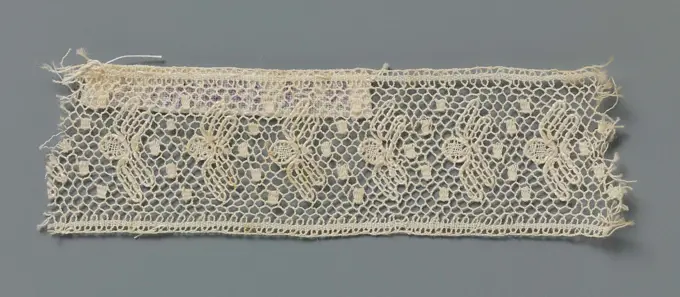
Strook kloskant met gestileerde insectjes en moesjes in een hoek.Strip natural colosside, Buckingham side. The repeating pattern forms a wide job over the center line of the strip. It consists of five square moes, which are placed under each other in a corner, interspersed with a stylized insect with a circular body with double wings thereto, which make the same angle as the square moes. The Moeses are made in shape stroke. Each circular body of the insects is made in linen stroke. A thick and shiny contour wire runs around the circle, which goes through in the Maas forest and forms the wings. The Maas soil is a tulet. Upper and bottom of the strip are straight finished.Piece 18th century Flemish. Piece 214574Border (Italy); linenInsertion 16th century Italian. Insertion 214873Border, Technique: bobbin lace, Bobbin lace border, symmetrical floral; early 18th century Brabant, early 18th century, lace, BorderCuffs mid-17th century Italian One of a pair of men's cuffs, the animated figural imagery flanking central motif is a highlight of this well-designed lace piece. AS they were a coslty commodity, men's lace accessories represented status and were featured prominently in portraiture from the period.. Cuffs 156393Strip clamp side with a three-leaf. On a fine mesh network there is a stiff row of three-part leaves in the outer half, which are unilaterally directed. A straight edge shows smaller, oppositely directed flower branches. Valenciennes side.Machinale Point Coupé, Anonymous, c. 1910 Cuff from a strip of crepe with a wide edge of machine side: machine -cut work. Rectangular model with pointed sculptures. The pattern consists of a grid of larger squares with a cross through diagonal and straight lines, framed by smaller squares with a circle in each between spanning threads, like suns. Belgium (possibly) cotton (textile). crepe (textile) Cuff from a strip of crepe with a wide edge of machine side: machine -cut work. Rectangular model with pointed sculptures. The pattern consists of a grid of larger squares with a cross through diagonal and straight lines, framed by smaller squares with a circle in each between spanning threads, like suns. Belgium (possibly) cotton (textile). crepe (textile)Square (one of four) 18th century Italian, Venice. Square (one of four) 218864Lace, 1800s , Italy, maker unknown. Gift of Mrs G. Acland Allen, 1955.Three Flounces Made 1875-1900 Belgium. Cotton, needle lace of a type known as Point de Gaze .Barbe 1860-80 Belgian. Barbe 102551Machinal side with tambourer work and needle side decorative fillings, anonymous, c. 1830 Fichu of natural -colored machine side: Machine tambooering on mechanical tulle. Triangular model with pointed side points and a rounded point at the bottom. The long side between the two pointed points has a fine edge of scales along which a narrow pattern runs with a small Drieblad and four moes alternately. From here, the midfield is filled with a spreading pattern of two leaves between which a dot is a dot like a flower on a short stalk. Along the two sloping sides runs a slightly coarser edge of scales, along which a double row of flowers, the outer row nicer than the inner edge consisting of slightly curved violin branches interspersed by rosettes made with seven dots. There is a symmetrical double flower branch in the rounded point. Netherlands . Fichu of natural -colored machine side: Machine tambooering on mechanical tulle. Triangular model with pointed side points and a rounded point at Echarpe made of mixed side with tulips, anonymous, c. 1875 - c. 1899 Echarpe made of natural -colored mixed side: Brussels bobbin with needle -seal, a fine mesh side. This type of lace is also called Point d'Angleterre. A rectangular shape shows a reserve with an inward -facing top façade at the ends. The contours of this symmetrical reserve consist of small C-volutes, rocailles and overhoekse ovals. There is a branch with tulips and a large palm flower. Some volutes and rocailles have needle side fillings. There is a lot of relief of gems. In the middle, symmetrical compared to two axes, a pattern of five palm flowers and four tulips on fine branches. Moreover, the flowers and fine side branches with gems are decorated in thick relief. Ornamental stitches made of open grid, zigzags and pearls. Brussels linen (material) mixed lace / Brussels bobbin lace Echarpe made of natural -colored mixed side: Brussels bobbin with needle -seal, a fine mesh side. This type of lace is also called PoiVoile of lace pledger on tulle with falling leaves, anonymous, c. 1900 - c. 1924 Voile of natural -colored lace -up work: tuldoor stop work on mechanical tulle. A rectangular tulle is filled with rows of leaves and on three sides bordered with rosettes on densely leafed stems. Straight finish with feston stitches. Belgium (possibly) linen (material) embroidering Voile of natural -colored lace -up work: tuldoor stop work on mechanical tulle. A rectangular tulle is filled with rows of leaves and on three sides bordered with rosettes on densely leafed stems. Straight finish with feston stitches. Belgium (possibly) linen (material) embroideringEdging 17th century Italian, Liguria. Edging 221009Fragment of LaceFragment late 18th century French. Fragment 214585Insertion 16th century Italian, Venice. Insertion 221092Strip of a climbing side with two zigzag jobs and impeller shellars. Strip natural colosside: straw side. The repeating pattern consists of two parallel running zigzag courts with a center line of co-switched fine diamonds made in shape stroke. Law under every zigzag top hangs a fan-shaped motif on the underside of the strip. The linked impellers form the tube edge. A nozzle ground is applied on the top of the strip and a twisted crossbeat soil has been used between the zigzag courts. Spood releases are in the grounds. The top of the strip is straight finished.Strip bobbin with leaf vines, anonymous, c. 1685 - c. 1699 Strip of natural-colored bobbin, old Flemish or Italian side. The pattern consists of unclear defined leaf vines. The contours of the motifs are made with hurt ribbons and are connected to each other with short -crossing connections. Rings have been formed in various places by crossing narrower burst ribbons, such as at Occhiolini. The faintly scalloped underside follows the pattern and is finished with picots. The top is straight. Flanders (Possible) linen (material) bobbin lace Strip of natural-colored bobbin, old Flemish or Italian side. The pattern consists of unclear defined leaf vines. The contours of the motifs are made with hurt ribbons and are connected to each other with short -crossing connections. Rings have been formed in various places by crossing narrower burst ribbons, such as at Occhiolini. The faintly scalloped underside follows the pattern and is finished with picots. The top is straight. Flanders (Possible) Bobbin Lace Lappet, 18th century. Belgium, Mechelen, 18th century. Lace, bobbin: linen; average: 105.5 x 10.2 cm (41 9/16 x 4 in.).Lampenkap van kloskant met vogels op spiraal.A batters, surrounding middle part, has four deployed windows, an entre-deux at the top and a shulp lane at the bottom. A fond of barges exhibits running spiral drinks. Each diamond has a single, large spiral, on which a bird is sitting with spread wings. The strips show tendrils with up and down spirals, to which acorn-shaped flower buds and adhesive berries grow. Close edge, possibly cantu side.Band, 16th-17th Century, 70 x 10 3/4 in. (177.8 x 27.31 cm), Linen; Punto Ricamato a Maglia Quadra (embroidered net); lace, Italy, 16th-17th CenturyFragment, A .G. Jennings & Sons, American, Medium: silk Technique: machine made lace, Net ground with a floral pattern., USA, ca. 1884, lace, FragmentBlanket, late 19th century, L.37 x W.63-1/2, Cotton, silk; supplementary weft patterning, Laos, 19th centuryBorder (Italy); linenFragment of the lace;  beginning of the 18th century (1700-00-00-1710-00-00);Cuff of linen batist finished on three sides with open hems and an arc of crocheted side, anonymous, c. 1900 - c. 1910 Cuff of natural -colored batist finished on three sides with a narrow edge of open sewing along the homen: work with pulled out threads. Along one long and one short sides, a scrap edge is made with arcs: crocheted side. Amsterdam linen (material). batiste crocheting Cuff of natural -colored batist finished on three sides with a narrow edge of open sewing along the homen: work with pulled out threads. Along one long and one short sides, a scrap edge is made with arcs: crocheted side. Amsterdam linen (material). batiste crochetingHalf Shawl Made 1860-1869 France. Silk and mohair, produced on a Pusher lace machine .Strip of needle side with three medallion motifs and tibs, anonymous, c. 1690 - c. 1699 Strip of natural -colored needle side: Point de France. Various symmetrical compositions can be distinguished in an apparent jumble of volutes and flower buds, including volutes that form cartouches and that surround a rosette flower or further on a heart with a rosette flower underneath. The motifs are made with feston stitches and decorative stitches. Very light relief has been realized by the way in which part of the volutes is made and around the flat motifs. The motifs are connected to each other by potented bars that form an irregular hexagonal bars of bar. The top of the strip is straight finished with a narrow stretched strap. The bottom is finished with an arc edge. Alençon linen (material) Strip of natural -colored needle side: Point de France. Various symmetrical compositions can be distinguished in an apparent jumble of volutes and flower buds, including volutes that form cartouches and Insertion Italian, Rome 17th centuryStrip of lace plunger on mechanical tulle with grass blades, anonymous, c. 1900 - c. 1949 Strip of natural -colored lace -ups on mechanical tulle, tulleboarding. Repetitive motif of a hanging grove with seven grass blades and one curved branch with leaves, on a fine hexagonal Maas soil. The bushes hang above a scalloped border of band work with hanging leaves. The top is cut and not finished. The short sides of the strip are sewn together. Plauen cotton (textile) embroidering Strip of natural -colored lace -ups on mechanical tulle, tulleboarding. Repetitive motif of a hanging grove with seven grass blades and one curved branch with leaves, on a fine hexagonal Maas soil. The bushes hang above a scalloped border of band work with hanging leaves. The top is cut and not finished. The short sides of the strip are sewn together. Plauen cotton (textile) embroideringBorder Made 1625-1650 Italy. Linen, needle lace worked on laid and plaited thread grid, Reticello pattern .Cuff 17th century Italian, Venice. Cuff 214839Fragment of Lace. Probably France, 19th century. Textiles; fragments. Cotton and linen Lille-type bobbin laceBorder 17th-18th century Flemish. Border 226035Border and fragments (3) 17th century Italian, Venice. Border and fragments (3). Italian, Venice. 17th century. Bobbin lace. Textiles-LacesBobbin Lace (Needlepoint Design) Insertion, 17th century. Italy, Genoa, 17th century. Lace, bobbin; average: 5.1 x 18.5 cm (2 x 7 5/16 in.).Lappet 18th century Flemish. Lappet 117719Cuff made of lace pledger with sickle -shaped feathered branch that includes a circle with rays on one side, anonymous, c. 1850 Cuff made of natural -colored lace bobbin: embroidery on mechanical tulle. Rectangular model. The repeating pattern consists of a sickle -shaped feathered branch that includes a circle with rays on one side. Various mechanical decorations have been placed in the circles with the tulle or not removed. The scrap edge along the underside forms semi -circular scallops around the successive sickle -shaped leaves. Netherlands cotton (textile). Cuff made of natural -colored lace bobbin: embroidery on mechanical tulle. Rectangular model. The repeating pattern consists of a sickle -shaped feathered branch that includes a circle with rays on one side. Various mechanical decorations have been placed in the circles with the tulle or not removed. The scrap edge along the underside forms semi -circular scallops around the successive sickle -shaped leaves. Netherlands cottonEdging French, La Chaise-Dieu 19th centuryCover, Medium: linen Technique: cutwork with embroidery, Small cover with broad sawtooth edges decorated with white linen embroidery, tassels and fringe., New York, New York, USA, ca. 1910, embroidery & stitching, CoverTablier or veil from application side with vortex, anonymous, c. 1790 - c. 1805 Table or veil of natural -colored application side, bobbin on drochel soil. Below an open, sown pattern of 'triangles' are stuffed edges. The lower one has a lying motif, closed by two straights. The upper edge, with standing motifs and wider than the lower edge, cuts the field with pointed, rising motifs. The downstairs edge shows rotating tibs for a core of small oval medallions. The intermediate hems consist of pair -wise spirals. The upper edge has two varied candelabre motifs; One stands on two large reed plumes, the other shows an X-rank, crowned with a smaller plume. The bottom is straight with an eye edge the top with a slot for a cord. Brussels linen (material) Brussels Applied Table or veil of natural -colored application side, bobbin on drochel soil. Below an open, sown pattern of 'triangles' are stuffed edges. The lower one has a lying motif, closed by two straights. The upper edge, with standinNeedlepoint (Cutwork) Lace Insertion and Punto Avorio Lace Edging, 16th century. Italy, Venice, 16th century. Lace, needlepoint: linen; average: 3.5 x 15.9 cm (1 3/8 x 6 1/4 in.).Strip bobbin with careless scales, anonymous, c. 1875 - c. 1899 Strip of natural-colored bobbin: Valenciennes side. Pattern with careless half -circular sculptures, above which a hanging daisy between 'sequins'. Belgium (possibly) linen (material) Bobbi Lace / Valenciennes Lace Strip of natural-colored bobbin: Valenciennes side. Pattern with careless half -circular sculptures, above which a hanging daisy between 'sequins'. Belgium (possibly) linen (material) Bobbi Lace / Valenciennes LaceFragment; linenKloskant collar with Fleur de Lys between Long Ranks, Leon Sacré, c. 1907 Collar of natural -colored bobbin: Flemish Guipure. The narrow round, horizontal shawl collar has a braid ground, on which a symmetrical pattern of a Fleur de Lys, from which spiral vines go out with thick palm flowers and very lumpy leaves. Brussels linen (material) bobbin lace / Flemish guipure lace Collar of natural -colored bobbin: Flemish Guipure. The narrow round, horizontal shawl collar has a braid ground, on which a symmetrical pattern of a Fleur de Lys, from which spiral vines go out with thick palm flowers and very lumpy leaves. Brussels linen (material) bobbin lace / Flemish guipure laceEdging (two pieces) French 19th centuryFichu from machining with tambourish and coniferous skylight. FICHU OF NATURAL MACHINAL SMEA: Machining tambourish on machine tulle. Triangular model with pointed side points and at the bottom of a rounded point. The long side between the two pointed points has a fine sloping edge along which a narrow pattern runs with alternately a small three-leaf and four mashes. From here, the midfield is filled with a spreading pattern of two leaves between which a dot is on a short stalk as a flower. Along the two sloping sides, a slightly coarse slip edge walks along a double row of flowers, the outer row of finer than the inner edge that consists of lightly curved violin branches interspersed by rosettes made with seven dots. There is a symmetrical double flower branch in the rounded point.Doubled strip of needle side with heart -shaped slens, anonymous, c. 1690 - c. 1699 Strip of natural -colored needle side: flat Venetian side. On a soil of regular six-sided meshes is a fine pattern of two symmetrical, heart-shaped slens connected by serpentine ranks. Straight finish of large triangles. Venice linen (material) flat Venetian (needle point) Strip of natural -colored needle side: flat Venetian side. On a soil of regular six-sided meshes is a fine pattern of two symmetrical, heart-shaped slens connected by serpentine ranks. Straight finish of large triangles. Venice linen (material) flat Venetian (needle point)Lappet ca. 1725-50 Flemish. Lappet 212399Strip of a climbing side with flour under curved leaf. Strip natural colosside, Lille side. The repeating pattern consists of a sprig with a curved leaf under which a flower hangs. The flower consists of five circles made with an ornamental ground, a rose ground, and a border with whimsical lobes. Along the bottom of the strip is always one circle with a few lobes between the consecutive flowers. The motifs are connected by a maas land, a tulet, strewn with square moes. The very sparse full work is made in linen stroke, where the thicker and shiny contour wires dominate. The Moeses are made in shape stroke. The top and bottom of the strip are straight finished, the underside with picots.Band (Italy); linen; Bequest of Marian Hague; 1971-50-331Border 16th century Italian or Spanish. Border 222695Cotton strip made of cotton with bobbin rods in large openwork motifs where, anonymous, c. 1900 Curtain strip of natural cotton with large openwork motifs with bets of two different types of grater rounds (bobbin). Decorations have been applied around the motifs with embroidery: whitework. The motifs are arranged in three rows and five columns with the biggest motives in the middle row. The motifs include circular, heart -shaped, butterfly -shaped and crescent. The strip is rectangular in shape and finished on all sides with a narrow zoom. Hungary cotton (textile) embroidering / bobbin lace Curtain strip of natural cotton with large openwork motifs with bets of two different types of grater rounds (bobbin). Decorations have been applied around the motifs with embroidery: whitework. The motifs are arranged in three rows and five columns with the biggest motives in the middle row. The motifs include circular, heart -shaped, butterfly -shaped and crescent. The strip is rectangular in shapNeedlepoint Lace Edging, 20th century. France, Alençon, 20th century. Lace, needlepoint: linen; average: 12.7 x 10.2 cm (5 x 4 in.).Fragment of needlelace unknownCollar ca. 1650 Italian. Collar 230791Cuff of climbing side with ivy leaf. Cuff of natural colosside: Valenciennes side. The cuff consists of two strips sewn together. The strip at the top has a repetitive motif with ivy leaves on a square valenciennes ground. There are always two dots between the consecutive leaves. The top and bottom are finished with a straight edge. The strip at the bottom also has a repetitive motif of leaves on a square valenciennes ground, with a row with something staggered above. The top is finished with a straight edge. Slightly slightly shuts that are formed by concealed cogs. Around the bottom of the bottom row is leaves a piece of double folded and sewn, so that the pattern is partly falling away.Collar ca. 1890 Belgian. Collar. Belgian. ca. 1890. LinenSquare rug of mechanical side with large flower in the middle, anonymous, c. 1920 Dress of natural -colored machine side. Square model with hollow sides and dull corners. The pattern consists of an oval medallion with a large flower in the center with many over -cutting petals, such as with a Dalhia or Chrysanthemum. In the corners, the pattern has three -hand floral motifs and the edge has a decorative band of Volutes and Spitsovale medallions. The motifs are equipped with contour threads and are connected by a variation of machine reasons with coarser and finer round grater. A mechanical rose soil has been used as a decorative soil. Europe cotton (textile) Dress of natural -colored machine side. Square model with hollow sides and dull corners. The pattern consists of an oval medallion with a large flower in the center with many over -cutting petals, such as with a Dalhia or Chrysanthemum. In the corners, the pattern has three -hand floral motifs and the edge has a decorative band of Border (Italy); linen; 10 x 80 cm (3 15/16 x 31 1/2 in. )Kerchief with Lace Border and Insets, 17th-19th century, 29 1/2 x 27 in. (74.93 x 68.6 cm), lace, Philippines, 17th-19th centuryHandkerchief 1850-70 probably French The dense embroidery on this handkerchief is detailed and refined. The beautiful overall design combines complex motifs and embroidery stitches with high-quality lace. The execution of detail in the heraldic shields is particularly fine.. Handkerchief 157750Fragment (England); linenStrip bobbin with flower branches between horn -shaped reserves, anonymous, c. 1735 - c. 1765 Strip of natural -colored bobbin: Mechelse side. The repeating pattern consists of flower branches between successive horn -shaped reserves, which stand up with the curling points and start with the wide base along the underside. The motifs are connected by a fine Maas soil, the Mechelen soil. The motifs are made in linen battle with recesses, and equipped with thicker and shiny contour threads. Different decorative lands have been applied, including a snowflake land and in the decorative soil in the horns, small motifs have been incorporated in the form of rosette flowers and dots. The scalloped underside stems from the pattern and is finished with picots. The top is straight. Southern Netherlands linen (material) bobbin lace / Mechlin (lace) Strip of natural -colored bobbin: Mechelse side. The repeating pattern consists of flower branches between successive horn -shaped reserves, which standFragment of lace. unknown, authorLength of Lace. Italy, Burano (), 19th century. Textiles; textile lengths. Needlepoint lace in the style of Venetian Rose Point (cotton)Lappet Made 1780-1789 Flanders. Linen, bobbin part lace of a type known as Brussels .Strip of needle side with hooking arches, anonymous, c. 1775 - c. 1795 Strip of natural-colored needle side: Alençon side. Strooi pattern of hooking arches, on a fine hexagonal mesh ground. The pattern on the underside consists of a connected row of medallions on an even finer hexagonal mesh ground. There is a hole with a circular cordon in the center of each medallion. The top is trimmed with a border bobbin. Picoted lower edge with radio picots at a regular distance. unknown linen (material) Alençon Lace Strip of natural-colored needle side: Alençon side. Strooi pattern of hooking arches, on a fine hexagonal mesh ground. The pattern on the underside consists of a connected row of medallions on an even finer hexagonal mesh ground. There is a hole with a circular cordon in the center of each medallion. The top is trimmed with a border bobbin. Picoted lower edge with radio picots at a regular distance. unknown linen (material) Alençon LaceNeedle -sided Engageante with bunches and tulips, anonymous, c. 1710 - c. 1730 Engageante of natural -colored needle side: flat Venetian net land side. Elongated rectangular model with widened center piece and a scrap edge along the underside. The symmetrical pattern consists of three skewers in the middle, from where to other sides of waves, which cover the entire width of the Engageante, with waving composite leaves, bunches and large tulips. The motifs are made with undisputed feston stitches, with countless fine recesses between them. A slightly thicker, but equally fine contour wire has been used to accentuate pattern parts. The motifs are connected by a fine Maas soil with transfers. In and around most flowers and leaves, very fine decorative lands have been used in many variants, including decorative land with diamonds, 'patrixties', cubes and zigzag lines. In a few leaves a bar of land is decorated with picots used as a decorative soil. The scrap edge is finished with picots. TChalice cover, Medium: linen Technique: needlework on knotted net, Central ornament surrounded by strap flowers and tulips in each corner., Italy, 18th century, lace, Chalice coverStrip 17th century Italian, Venice. Strip. Italian, Venice. 17th century. Needle lace, gros point lace. Textiles-LacesNeedlepoint (Reticella and Cutwork) and Bobbin Lace Fragment, 17th century. Italy, Genoa, 17th century. Lace, needlepoint and bobbin: linen; average: 9.6 x 12.5 cm (3 3/4 x 4 15/16 in.).Collar 19th century Maltese. Collar 79075Fragment of LaceLappet early 18th century Flemish, Brussels. Lappet 218601Cuff of English embroidery with pointed wrinkled sculpten strip, c. 1700 - c. 1850  Cuff of English embroidery with pointed wrinkled sculpten strip. Netherlands linen (material). knoop: mother of pearlBatist square handkerchief with plumetis and a peripheral border border, anonymous, c. 1800 - c. 1899 Batist handkerchief with embroidery - plumetis and open embroidery - and an edge of lace bobbins: work with pulled out threads. Square model with a scrap of fine shells through a wavy edge. France linen (material) embroidering Batist handkerchief with embroidery - plumetis and open embroidery - and an edge of lace bobbins: work with pulled out threads. Square model with a scrap of fine shells through a wavy edge. France linen (material) embroideringBorder; medium:Border Made 1801-1825 France. Linen, needle lace of a type known as Point d'AlenÁon .Border fragment, Medium: silk Technique: bobbin lace, Fragment showing a design of flowers made with outlining thread and honeycomb fillings sprinkled on a ground of hexagons and arranged as a border., England, ca. 1870, lace, Border fragmentAn ornamental platterCollar 18th century Italian. Collar. Italian. 18th century. Crochet. Textiles-LacesBand late 18th-early 19th century Hungarian. Band 221382Edge, Medium: linen Technique: bobbin lace, peasant style, Fragment of a band with small rosettes forming tabs., Italy or Belgium, 17th century, lace, EdgeInsertion 17th century Italian, Genoa. Insertion 220916Children's collar in square form of batists squares caught in mechanical valenciennes side intermediate sinks, anonymous, c. 1910 Children's collar in square form of batists squares caught in machine valenciennes side intermediate sinks with moesjes. Highly model with smooth shoulder part of six times six squares of Batist with always a flower in whitework in the middle. The closure is at the rear and has two knots of mother -of -pearl. Amsterdam batiste. knoop: mother of pearl Valenciennes lace Children's collar in square form of batists squares caught in machine valenciennes side intermediate sinks with moesjes. Highly model with smooth shoulder part of six times six squares of Batist with always a flower in whitework in the middle. The closure is at the rear and has two knots of mother -of -pearl. Amsterdam batiste. knoop: mother of pearl Valenciennes laceFragment (Italy); linenHandkerchief with a border of needle side with eight ovals and eight circles. Handkerchief with an edge of natural needle lace, Brussels mesh edge. Around a large cross-shaped batters center piece runs a narrow edge edge with eight deep shelters, the closing pieces of which are formed by eight ovals. The angular shells each exhibit two above-standing circles. The sculpture consists of a leaf branch and a edge of leaves, which form the scallops. Small, hollow C-Volutes form the inner edge.Needlepoint (Punto Avorio or Ivory Stitch) Lace Insertion, 17th century. Italy, 17th century. Lace, needlepoint; average: 2.6 x 27.3 cm (1 x 10 3/4 in.).Edging early 17th century Italian Punto in arialiterally, "stitches in the air"is one of the earliest styles of needle lace, which is itself developed from cutwork of primarily geometric design. When lacemakers transitioned to using a foundation of threads laid out according to a pattern drawn on parchment, they were able to incorporate more fluid lines and curves into their designs.. Edging 212449Mutsenslip van applicatiekant met enkele bloemtak.Barbe of natural-colored application side, climbing side applicated on machine tulle. Some loose scattering branches are applied to the center of the rectangular field; These are on one piece in duds and on the other in tambourish. At the straight ends there is always a coarse branch with flowers and leaves on a sowed feathers. Edge of flat slot, turning from a switchband and a knob with a close-up drink.Needlepoint (Venetian Raised Point) Lace Collar, 17th century. Italy, Venice, 17th century. Lace, needlepoint: linen; overall: 43.2 x 128.5 cm (17 x 50 9/16 in.).Kraag van naaldkant en kloskant met bloemenranken en negen puntige schulpen.Collar consisting of a strip of natural colored Venetian needle side "Gros Point", with edges of natural old crop side. Slightly curved strip-shaped model. The inner strip of needle side has a pattern of voluntaries and composite flowers. The motifs are equipped with contour wires and partly of thick cordons, decorated with pictos. Various decorative stitches have been used, mainly in the flower hearts. Along the bottom and continuous in the short sides, a strip of clamping is set, with a splitting intermediate sequence. The clamping side consists entirely of braids (inside work), which form a geometric pattern of a total of nine pointed slopes. The clusted strap along the top of the collar is made from always four rectangles in linse stroke, with an octagonal motif with cutouts, connected to each other with braids. The lump side of the climbing side is probably older than the needle side and is made in the SouBobbin Lace Insertion and Edging, mid 16th century. Italy, Venice, mid 16th century. Lace, bobbin; average: 6.1 x 43.3 cm (2 3/8 x 17 1/16 in.).Textile, laceEdging ca. 1600 Italian Punto in arialiterally, "stitches in the air"is one of the earliest styles of needle lace, which is itself developed from cutwork of primarily geometric design. When lacemakers transitioned to using a foundation of threads laid out according to a pattern drawn on parchment, they were able to incorporate more fluid lines and curves into their designs.. Edging 217993Fragment, Medium: linen Technique: bobbin lace (Brussels-style), Narrow fragment with a scalloped border has a serpentine design with interspaced flowers., Belgium, 1750-1800, lace, Fragment