My Boards
View Pictures
  • My Boards

Distant Galaxies in Space

Stunning images of galaxies in deep space, featuring vibrant colors and intricate structures, conveying the vastness and beauty of the universe.
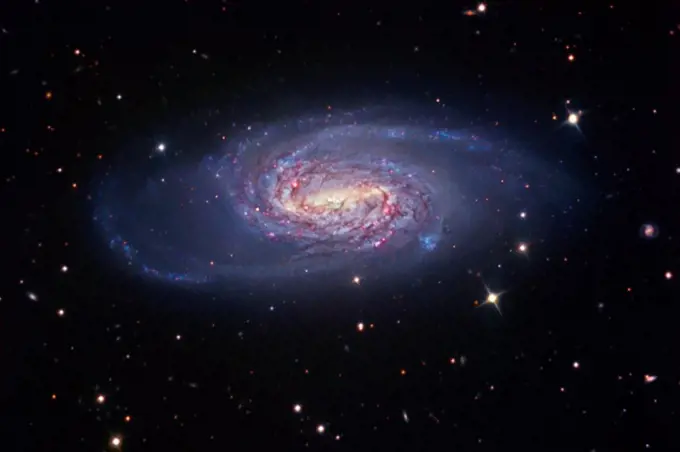
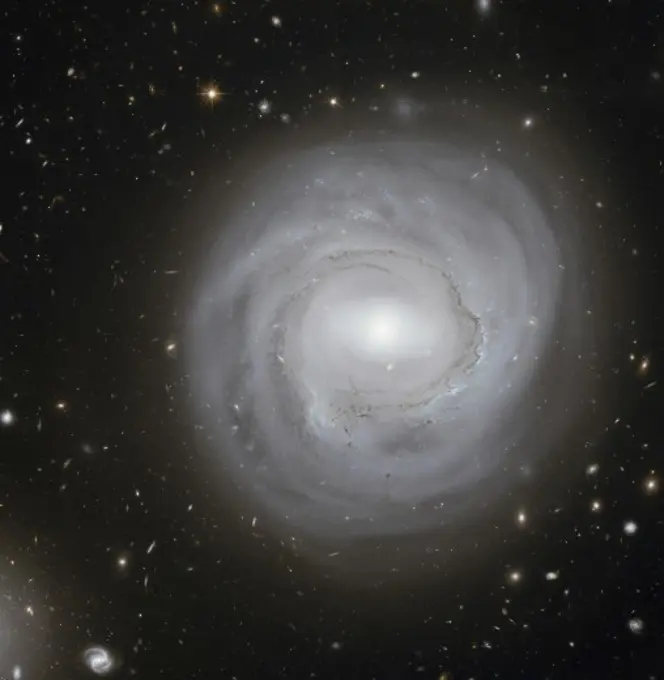
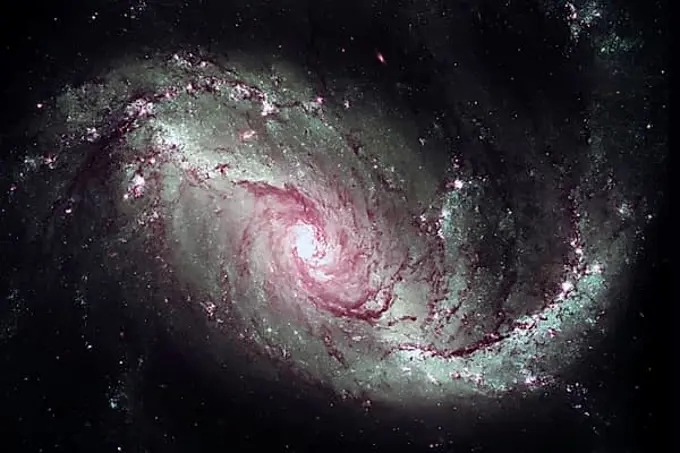
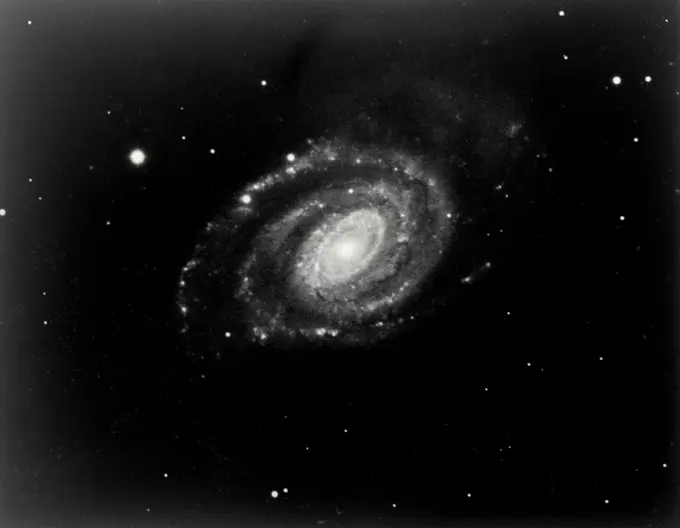
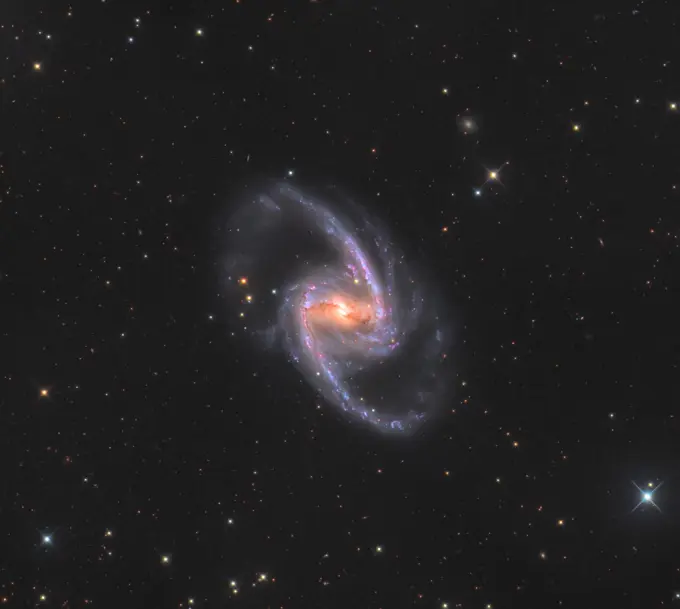
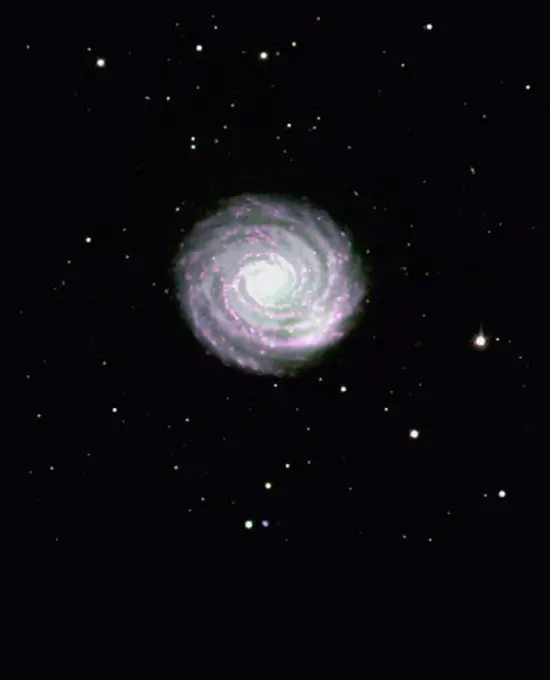
This beautiful galaxy shows an interesting "bar" in the nucleus area and two symetrical arms. It lies about 20 million light years distant in the constellation Leo.
177 assets in this story
1746-19671397
This ultraviolet image from NASA's Galaxy Evolution Explorer shows NGC 3242, a planetary nebula frequently referred to as 'Jupiter's Ghost.'
6145-44882386
Time is running out for the galaxy NGC 3801, seen in this composite image from NASA's Galaxy Evolution Explorer and other instruments combining light from across the spectrum, ranging from ultraviolet to radio.
6145-44631115
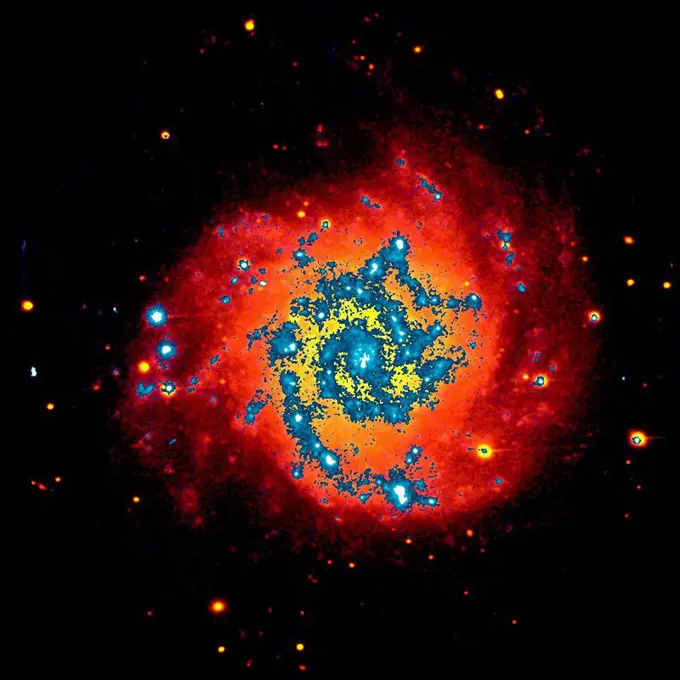
Ultraviolet images such as this one from NASA's Galaxy Evolution Explorer suggest the M83 has unusual pockets of star formation separated by large distances from the spiral arms in the main disk of the galaxy.
6145-44745965
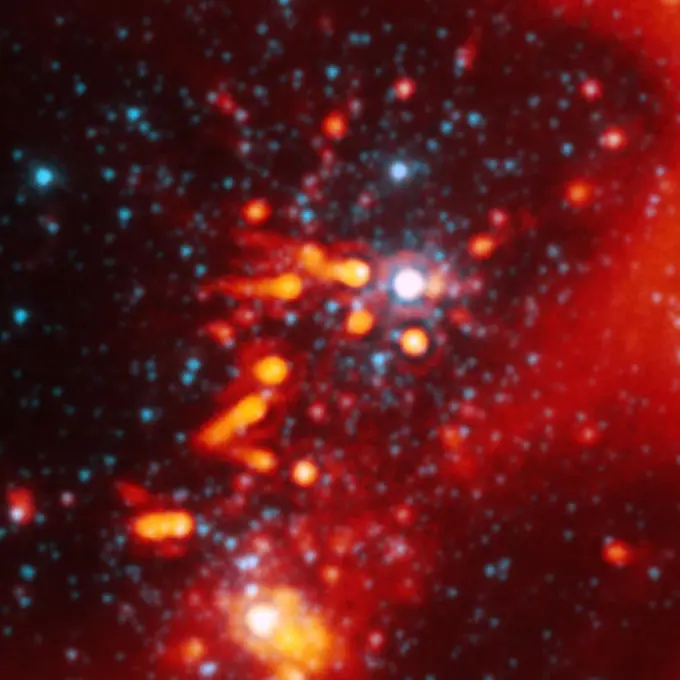
This image from NASA's Spitzer Space Telescope shows the nasty effects of living near a group of massive stars: radiation and winds from the massive stars (white spot in center) are blasting planet-making material away from stars like our sun.
6145-44824404
NASA image release August 5, 2010 A beautiful new image of two colliding galaxies has been released by NASA's Great Observatories. The Antennae galaxies, located about 62 million light-years from Earth, are shown in this composite image from the Chandra X-ray Observatory (blue), the Hubble Space Telescope (gold and brown), and the Spitzer Space Telescope (red). The Antennae galaxies take their name from the long antenna-like "arms," seen in wide-angle views of the system. These features were produced by tidal forces generated in the collision. The collision, which began more than 100 million years ago and is still occurring, has triggered the formation of millions of stars in clouds of dusts and gas in the galaxies. The most massive of these young stars have already sped through their evolution in a few million years and exploded as supernovas. The X-ray image from Chandra shows huge clouds of hot, interstellar gas that have been injected with rich deposits of elements from s
4389-1933
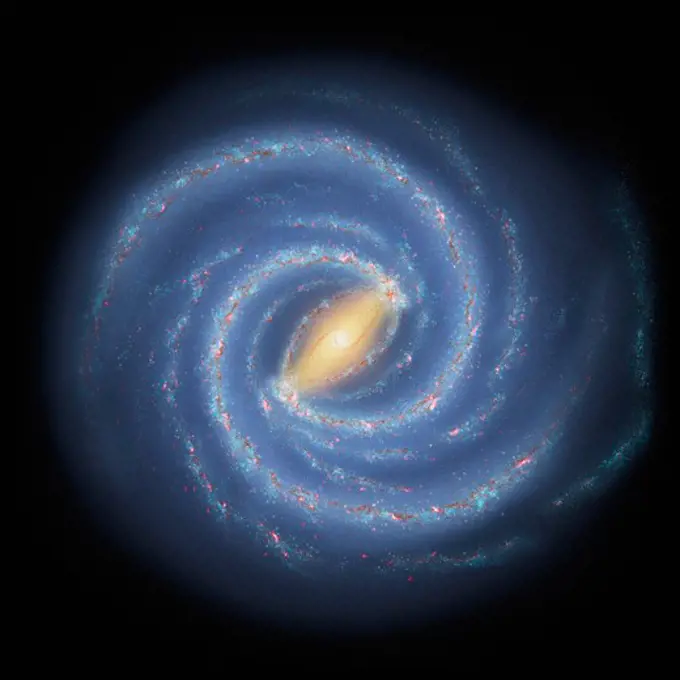
Our Galaxy
4389-1482
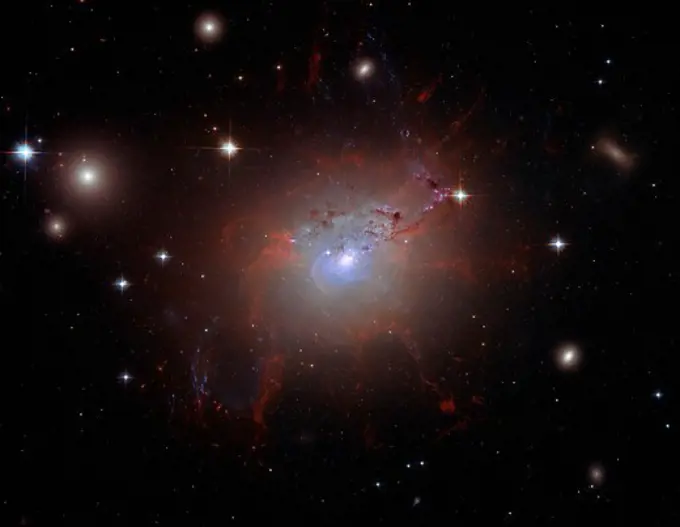
Magnetically Active Galaxy NGC 1275
1746-19663789
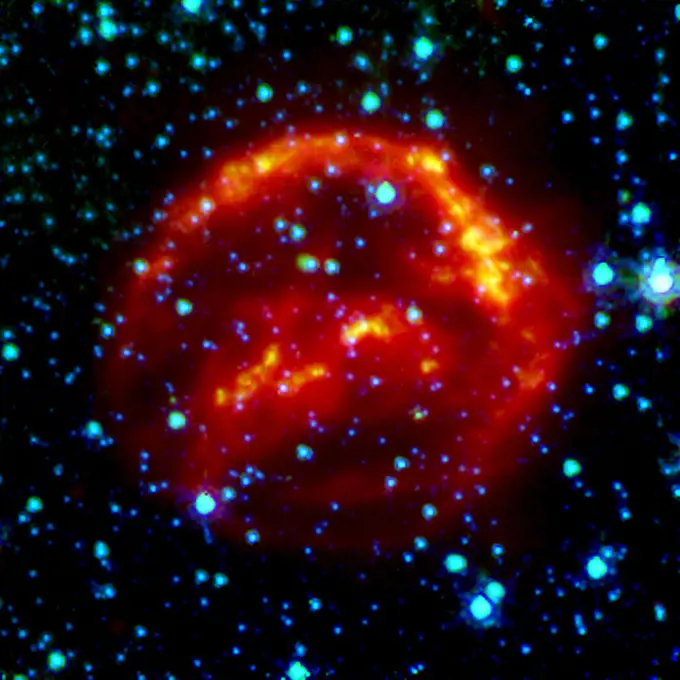
Keplers Supernova Remnant: A View from Spitzer Space Telescope. This Spitzer false-colour image is a composite of data from the 24 micron channel of Spitzers multiband imaging photometer (red), and three channels of its infrared array camera: 8 micron (yellow), 5.6 micron (blue), and 4.8 micron (green). Stars are most prominent in the two shorter wavelengths, causing them to show up as turquoise. The supernova remnant is most prominent at 24 microns, arising from dust that has been heated by the supernova shock wave, and re-radiated in the infrared. The 8 micron data shows infrared emission from regions closely associated with the optically emitting regions. These are the densest regions being encountered by the shock wave, and probably arose from condensations in the surrounding material that was lost by the supernova star before it exploded.
4239R-988
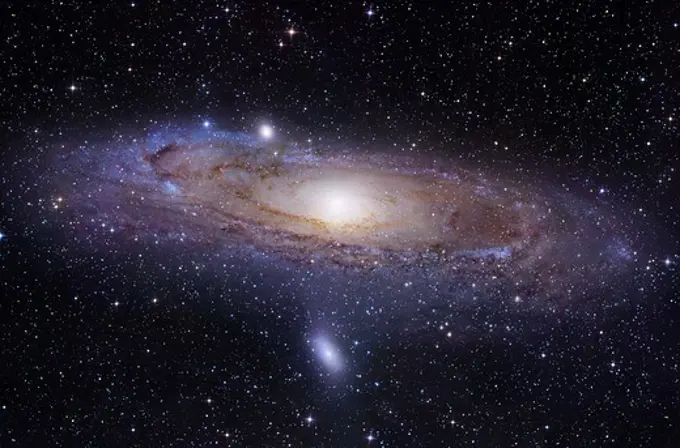
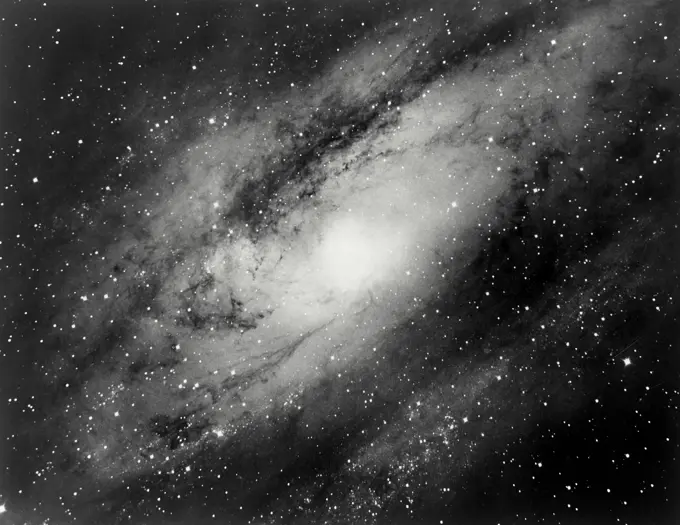
The Andromeda Galaxy, also known as Messier 31 or NGC 224, in the constellation Andromeda
1746-19671348
The 'ring' is a thick cylinder of glowing gas and dust around the doomed star. As the star begins to run out of fuel, its core becomes smaller and hotter, boiling off its outer layers. Ring Nebula. Spitzer Space Telescope.
1574R-35297
Spiral Galaxy NGC 4921
6145-45116299
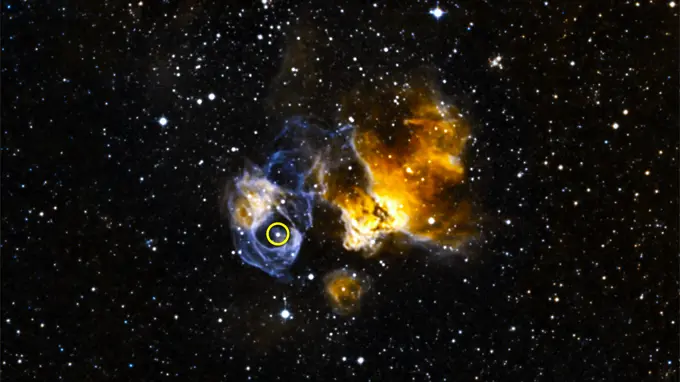
This composite image contains data from Chandra (purple) that provides evidence for the survival of a companion star from the blast of a supernova explosion.  Chandra's X-rays reveal a point-like source in the supernova remnant at the location of a massive star.  The data suggest that mass is being pulled away from the massive star towards a neutron star or a black hole companion.  If confirmed, this would be only the third binary system containing both a massive star and a neutron star or black hole ever found in the aftermath of a supernova. This supernova remnant is found embedded in clouds of ionized hydrogen, which are shown in optical light (yellow and cyan) from the MCELS survey, along with additional optical data from the DSS (white).
6188-65179293
Stars, dust and gas nebula in a far galaxy Stars, dust and gas nebula in a far galaxy. Elements of this image furnished by NASA Copyright: xZoonar.com/gannaxacheretx 11662973
4389-975
NGC 300
6145-45124489
The beautiful spiral galaxy visible in the center of the image is known as RX J1140.1+0307, a galaxy in the Virgo constellation imaged by the NASA/ESA Hubble Space Telescope, and it presents an interesting puzzle. At first glance, this galaxy appears to be a normal spiral galaxy, much like the Milky Way, but first appearances can be deceptive! The Milky Way galaxy, like most large galaxies, has a supermassive black hole at its center, but some galaxies are centered on lighter, intermediate-mass black holes. RX J1140.1+0307 is such a galaxy  in fact, it is centered on one of the lowest black hole masses known in any luminous galactic core. What puzzles scientists about this particular galaxy is that the calculations don’t add up. With such a relatively low mass for the central black hole, models for the emission from the object cannot explain the observed spectrum. There must be other mechanisms at play in the interactions between the inner and outer parts of the accretion disk surroun
1788-58383
Andromeda Galaxy (M 31), a spiral galaxy with two small satellite galaxies. Drawing.
6145-44916526
In this Hubble observation, astronomers used the massive galaxy cluster MACS J0647+7015 as the giant cosmic telescope. The bright yellow galaxies near the center of the image are cluster members.
6188-65179134
Stars, dust and gas nebula in a far galaxy Stars, dust and gas nebula in a far galaxy. Elements of this image furnished by NASA Copyright: xZoonar.com/gannaxacheretx 11663423
4197-62718871
Star, universe or nebula in space on dark background in the natural milky way solar system for astronomy. Light, galaxy and infinity of the night sky in the cosmos for fantasy or wallpaper background
4239-57497010
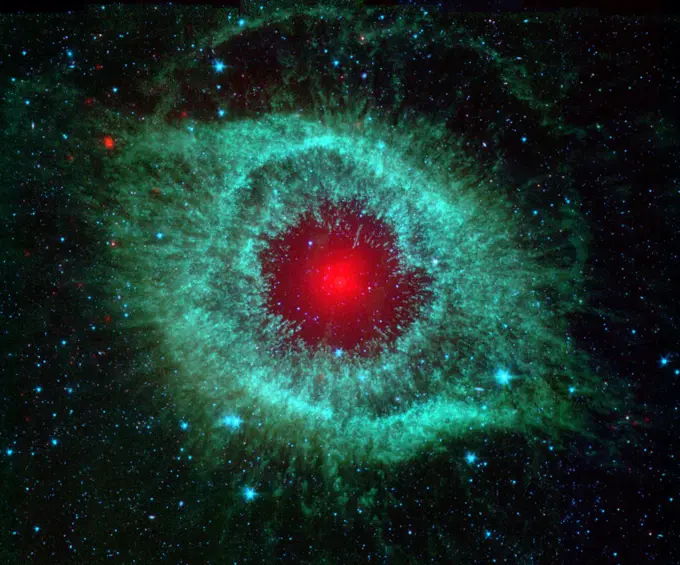
Eye galaxy in space
4239R-2468
A dense star cluster forms this galaxy out in space.
1746-19663094
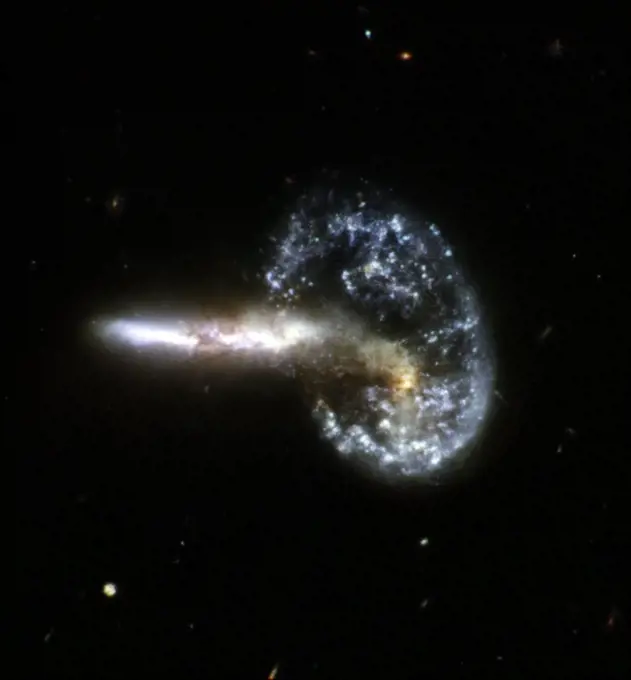
Hubble Interacting Galaxy Arp 148, the staggering aftermath of an encounter between two galaxies, resulting in a ring-shaped galaxy and a long-tailed companion. The collision between the two parent galaxies produced a shockwave effect that first drew matter into the center and then caused it to propagate outwards in a ring. The elongated companion perpendicular to the ring suggests that Arp 148 is a unique snapshot of an ongoing collision. Infrared observations reveal a strong obscuration region that appears as a dark dust lane across the nucleus in optical light. Arp 148 is nicknamed Mayall s object and is located in the constellation of Ursa Major, the Great Bear, approximately 500 million light-years away. This interacting pair of galaxies is included in Arps catalog of peculiar galaxies as number 148.
1746-21120223
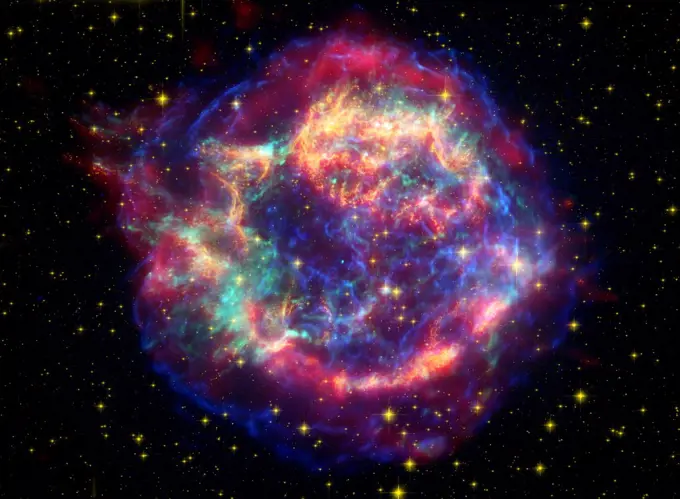
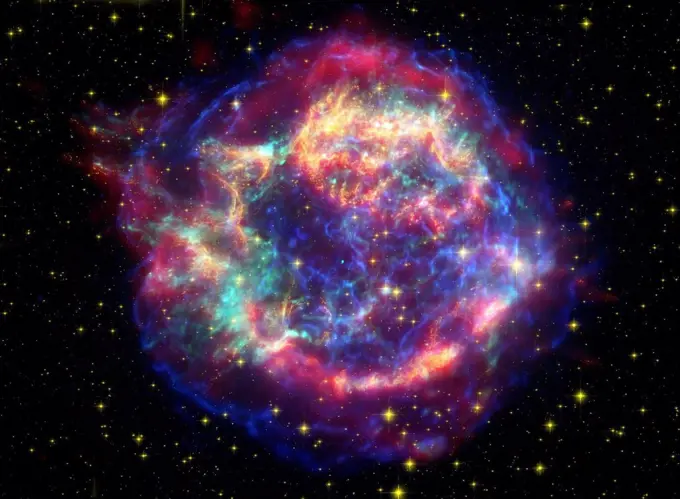
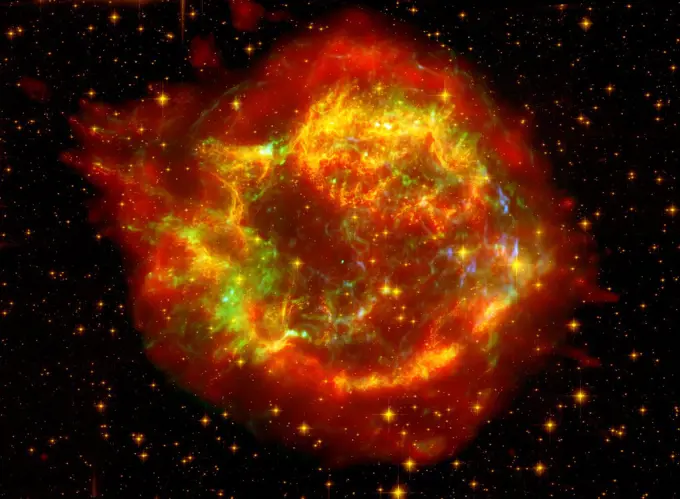
A false-colour image of Cassiopeia A, this supernova remnant is located 10,000 light-years away in the constellation Cassiopeia
1746-19663767
M74 is about the same size as the Milky Way Galaxy. M74 is classified a spiral galaxy. M74s sweeping lanes of stars and dust combined with its small nucleus make it a classic Grand Design Spiral. On the Hubble Sequence of Galaxies, M74 is listed as Sc. In the picture, visible light is shown in red and ultraviolet light superposed in blue. In general, older stars are more red and younger stars are blue.
6145-44667059
Tipped toward Earth and illuminated by the star, these rings look like ellipses in images taken with NASA's Spitzer Space Telescope. The massive star at the center, which lies within the constellation Sagittarius, is about 7,200 light-years from Earth.
1848-64914186
Stellar Nursery, Spiral galaxy, Space background, Elements of this image are furnished by NASA
1746-19631689
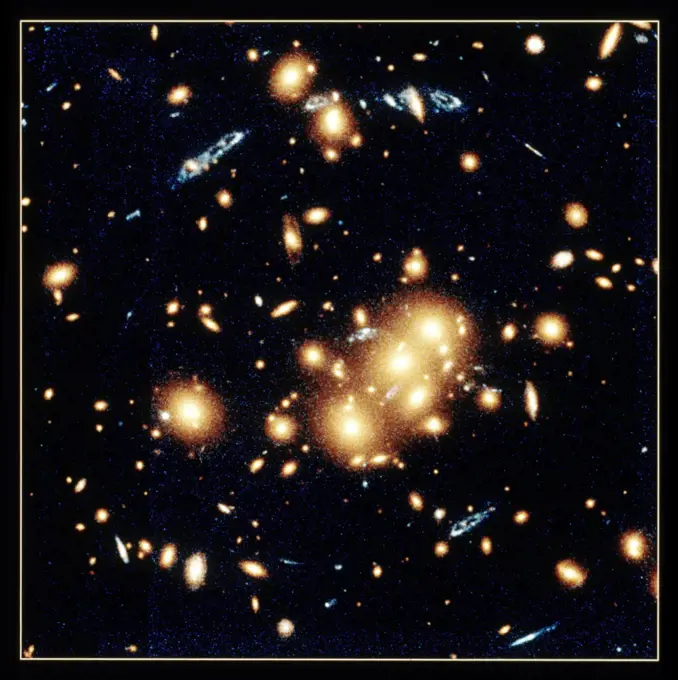
Gravitational lens in CL0024+1654. W.Collet (Princeton). NASA photograph.
6145-44599062
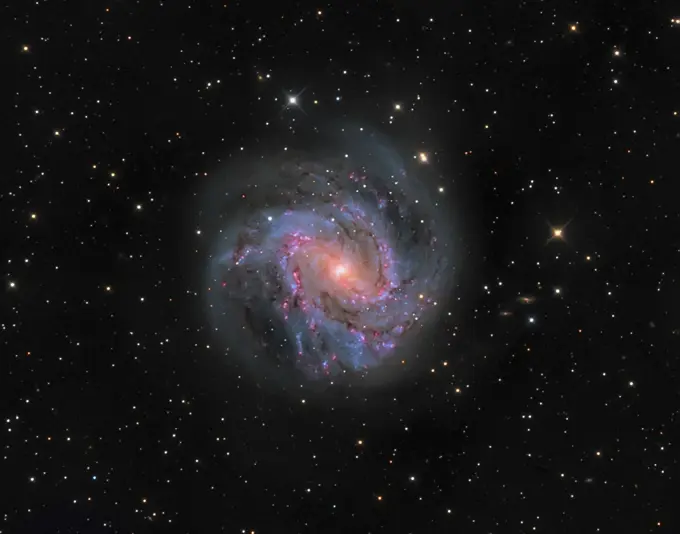
This image of the spiral galaxy Messier 83 was taken by NASA's Galaxy Evolution Explorer on June 7, 2003. Located 15 million light years from Earth and known as the Southern Pinwheel Galaxy,
255-29057915
Vintage Photograph. NGC 5364 Spiral nebula in Virgo taken with 200 inch Hale telescope.
4128R-7893
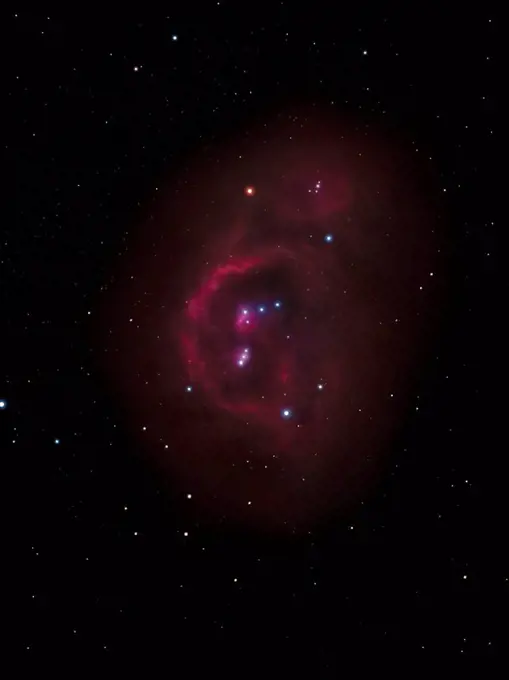
The constellation of Orion the Hunter is bathed in a sea of nebulosity, of which the Orion Nebula and the Horsehead Nebula are merely the brightest pa...
6145-44499279
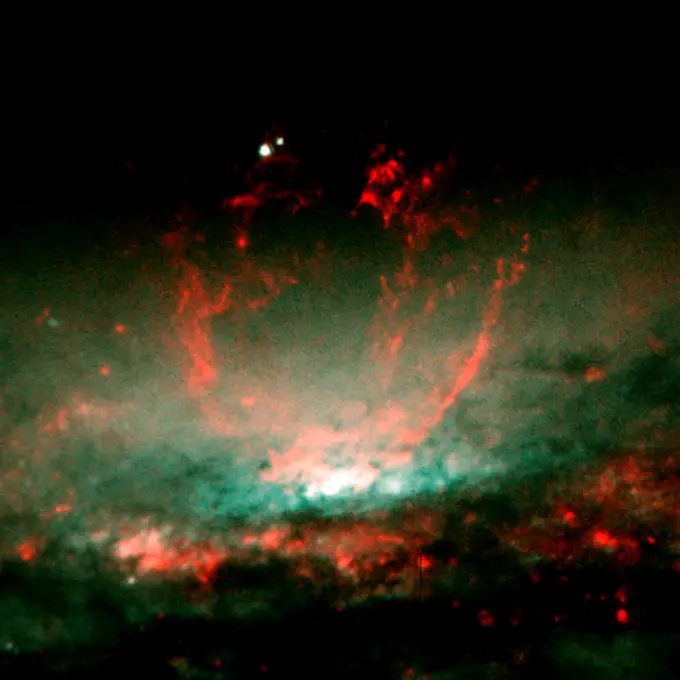
A lumpy bubble of hot gas rises from a cauldron of glowing matter in a distant galaxy, as seen by NASA's Hubble Space Telescope.
1848-64913082
Colliding galaxies, Mice Galaxies, spiral galaxies in constellation Coma Berenices. Elements of this image furnished by NASA. Retouched image
1746-19671376
The remnant, called N132D, is the wispy pink shell of gas at the center of this image. The pinkish color reveals a clash between the explosion's high-energy shockwaves and surrounding dust grains. Spitzer
4239R-20480285
This stunning false-color picture shows off the many sides of the supernova remnant Cassiopeia A, which is made up of images taken by three observatories, using three different wavebands of light. Infrared data from the Spitzer Space Telescope are colored red; visible data from the Hubble Space Telescope are yellow; and X-ray data from the Chandra X-ray Observatory are green and blue.  Located 10,000 light-years away in the northern constellation Cassiopeia, Cassiopeia A is the remnant of a once
6145-44810241
This image shows a smoothed reconstruction of the total (mostly dark) matter distribution in the COSMOS field, created from data taken by the NASA/ESA Hubble Space Telescope and ground-based telescopes. It was inferred from the weak gravitational lensing distortions that are imprinted onto the shapes of background galaxies. The colour coding indicates the distance of the foreground mass concentrations as gathered from the weak lensing effect. Structures shown in white, cyan, and green are typically closer to us than those indicated in orange and red. To improve the resolution of the map, data from galaxies both with and without redshift information were used.The new study presents the most comprehensive analysis of data from the COSMOS survey. The researchers have, for the first time ever, used Hubble and the natural "weak lenses" in space to characterise the accelerated expansion of the Universe.
6145-44916589
Are We Human or Are We Dancers
4239R-20480328
Helix nebula
1746-21120254
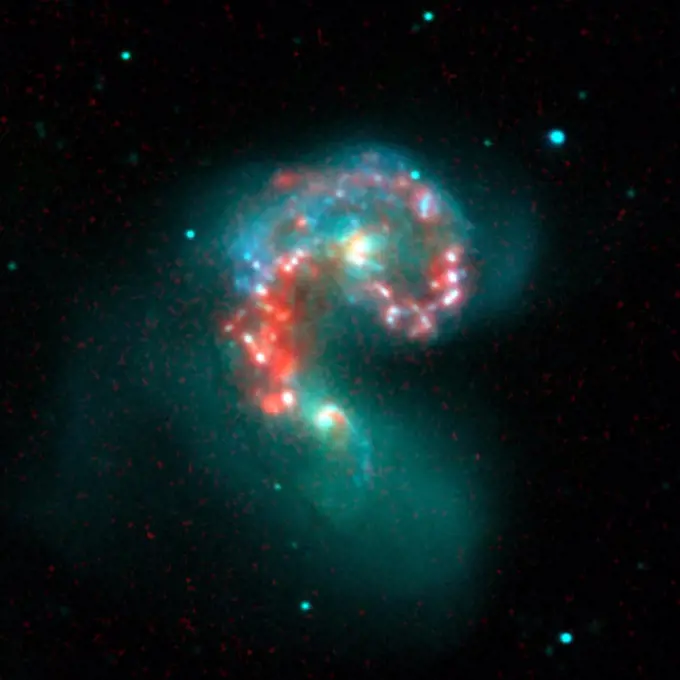
False-coloured image by the Spitzer Space Telescope revealing a hidden populations of new-born stars at the heart of the colliding 'Antennae' galaxies
6145-45100309
This is view from ESA's Hubble Space Telescope of a very massive cluster of galaxies, MACS J0416.1-2403, located roughly 4 billion light-years away and weighing as much as a million billion suns.
6145-44880998
NASA's Hubble Space Telescope's sharp view was used to look for gravitational arcs and rings which are produced when one galaxy acts as a lens to magnify and distort the appearance of another galaxy behind it.
6145-45095666
This dramatic image shows the NASA/ESA Hubble Space Telescopes view of dwarf galaxy known as NGC 1140, which lies 60 million light-years away in the constellation of Eridanus. As can be seen in this image NGC 1140 has an irregular form, much like the Large Magellanic Cloud — a small galaxy that orbits the Milky Way. This small galaxy is undergoing what is known as a starburst. Despite being almost ten times smaller than the Milky Way it is creating stars at about the same rate, with the equivalent of one star the size of our sun being created per year. This is clearly visible in the image, which shows the galaxy illuminated by bright, blue-white, young stars. Galaxies like NGC 1140 — small, starbursting and containing large amounts of primordial gas with far fewer elements heavier than hydrogen and helium than are present in our sun — are of particular interest to astronomers. Their composition makes them similar to the intensely star-forming galaxies in the early Universe. And these
6145-44856644
NASA image release April 6, 2011 Images from Swift's Ultraviolet/Optical (white, purple) and X-ray telescopes (yellow and red) were combined in this view of GRB 110328A. The blast was detected only in X-rays, which were collected over a 3.4-hour period on March 28.
1746-19663104
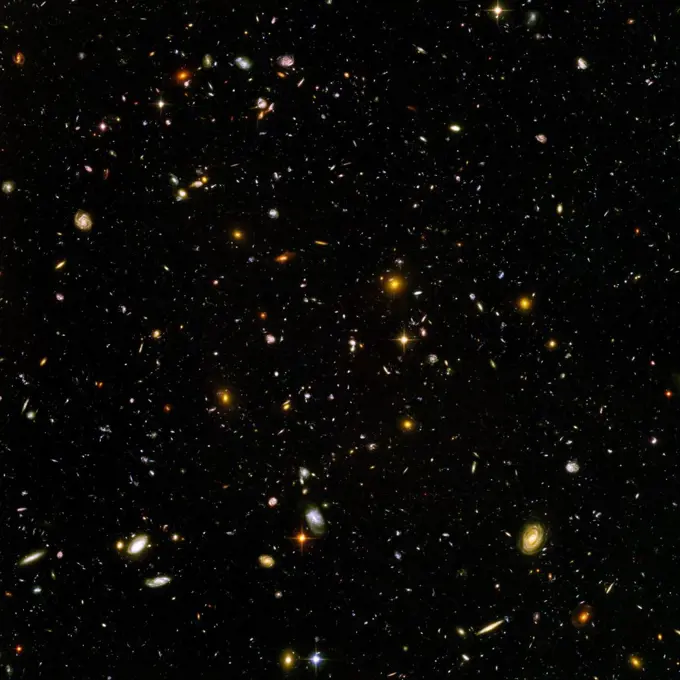
The Hubble Ultra Deep Field, is an image of a small region of space in the constellation Fornax, composited from Hubble Space Telescope data accumulated over a period from September 3, 2003 through January 16, 2004. The patch of sky in which the galaxies reside was chosen because it had a low density of bright stars in the near-field.
6145-44596645
NASA's Hubble Space Telescope (HST) captures a lumpy bubble of hot gas rising from a cauldron of glowing matter in Galaxy NGC 3079, located 50 million light-years from Earth in the constellation Ursa Major. Astronomers suspect the bubble is being blown by winds or high speed streams of particles, released during a burst of star formation. The bubble's lumpy surface has four columns of gaseous filaments towering above the galaxy's disc that whirl around in a vortex and are expelled into space. Eventually, this gas will rain down on the disc and may collide with gas clouds, compress them, and form a new generation of stars.
255-29057917
Vintage Photograph. Great spiral nebula NGC 224 in Andromeda Messier 31 Central Region taken with a 100 in hooker telescope.
6145-44937516
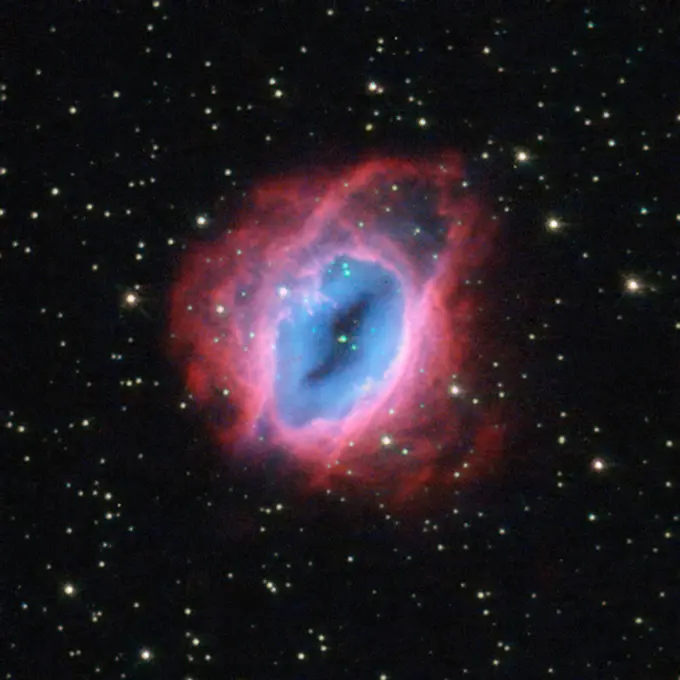
It may look like something from "The Lord of the Rings," but this fiery swirl is actually a planetary nebula known as ESO 456-67. Set against a backdrop of bright stars, the rust-colored object lies in the constellation of Sagittarius (The Archer), in the southern sky. In this image of ESO 456-67, it is possible to see the various layers of material expelled by the central star. Each appears in a different hue - red, orange, yellow, and green-tinted bands of gas are visible, with clear patches of space at the heart of the nebula. It is not fully understood how planetary nebulae form such a wide variety of shapes and structures; some appear to be spherical, some elliptical, others shoot material in waves from their polar regions, some look like hourglasses or figures of eight, and others resemble large, messy stellar explosions - to name but a few.
6145-44612011
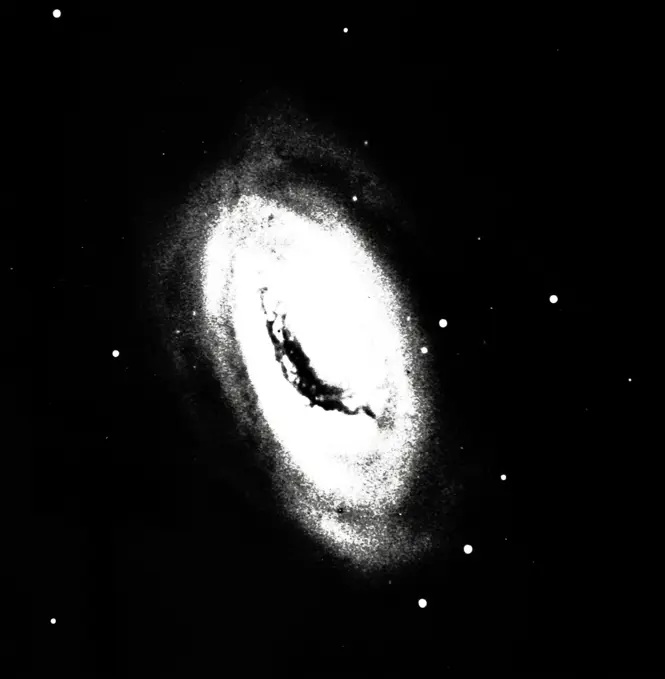
Residing roughly 17 million light years from Earth, in the northern constellation Coma Berenices, is a merged star system known as Messier 64 (M64). First cataloged in the 18th century by the French astronomer Messier, M64 is a result of two colliding galaxies and has an unusual appearance as well as bizarre internal motions. It has a spectacular dark band of absorbing dust in front of its bright nucleus, lending to it the nickname of the Black Eye or Evil Eye galaxy. Fine details of the dark band can be seen in this image of the central portion of M64 obtained by the Wide Field Planetary Camera (WFPC2) of NASA's Hubble Space Telescope (HST). Appearing to be a fairly normal pinwheel-shaped galaxy, the M64 stars are rotating in the same direction, clockwise, as in the majority of galaxies. However, detailed studies in the 1990's led to the remarkable discovery that the interstellar gas in the outer regions of M64 rotates in the opposite direction from the gas and stars in the irner regi
4239R-20480292
The disk galaxy NGC 5866 tilted nearly edge-on to our line-of-sight.
4239R-9858
Messier 106, a spiral galaxy in the constellation Canes Venatici.
6145-44988901
. A Lot of Galaxies Need Guarding in this NASA Hubble View
4239-57495497
NGC 1365, a double-barred spiral galaxy in the constellation Fornax.
4389-430
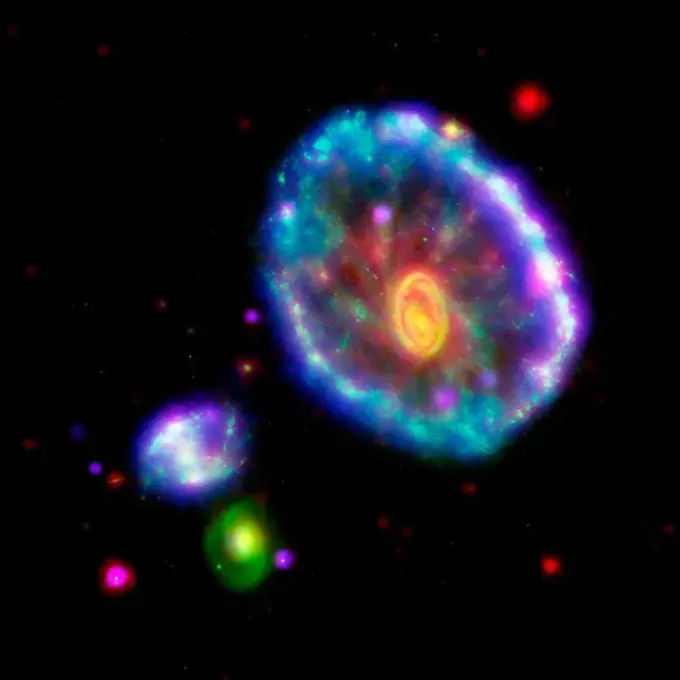
Cartwheel Galaxy, A Ring Galaxy
1746-29953802
Photograph of spiral galaxy (M 64) in constellation Coma Berenices, showing obscuring matter in central regions. Dated 20th century
1574R-011282
NGC 1288
1746-19671313
The many sides of the supernova remnant Cassiopeia A. Located 10,000 light-years away in the northern constellation Cassiopeia, Cassiopeia A is the remnant of a once massive star that died in a violent supernova explosion 325 years ago. Hubble Space Telescope (HST), Spitzer Space Telescope.
6145-45071461
Millions of galaxies populate the patch of sky known as the COSMOS field, short for Cosmic Evolution Survey, a portion of which is shown here. Even the smallest dots in this image are galaxies, some up to 12 billion light-years away.
4239R-9220
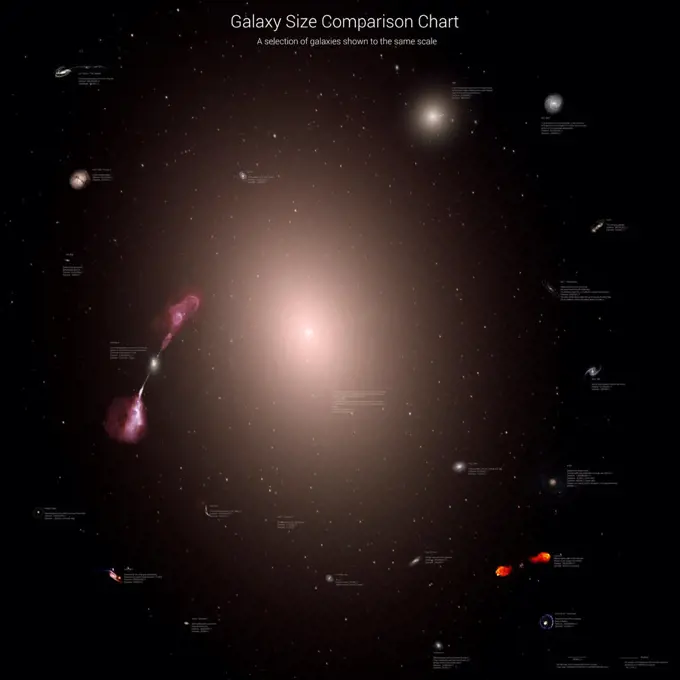
Galaxy size comparison chart. A selection of galaxies shown to the same scale.
1746-19627160
Spiral Galaxy M81 in constallation of Ursa Minor. This galaxy about is 12 million light years from Earth Photograph.  NASA photograph
6145-45265145
This image from NASA's Spitzer Space Telescope shows the elliptical galaxy Messier 87 (M87), the home galaxy of the supermassive black hole recently imaged by the Event Horizon Telescope (EHT). Spitzer's infrared view shows a faint trace of a jet of material spewing to the right of the galaxy - a feature that was previously one key indicator that a supermassive black hole lived at the galaxy's center. More prominent in the image is the shockwave created by that jet. The inset in the image below shows a close-up view of the shockwave on the right side of the galaxy, as well as the shockwave from a second jet traveling to the left of the galaxy. Located about 55 million light-years from Earth, M87 has been a subject of astronomical study for more than 100 years and has been imaged by many NASA observatories, including the Hubble Space Telescope, the Chandra X-ray Observatory and NuSTAR. In 1918, astronomer Heber Curtis first noticed a curious straight ray extending from the galaxy's cent
6145-44612013
This photo, captured by the NASA Hubble Space Telescope's (HST) Advanced Camera for Surveys, is Hubble's latest view of an expanding halo of light around the distant star V838 Monocerotis, or V Mon, caused by an unusual stellar outburst that occurred back in January 2002. A burst of light from the bizarre star is spreading into space and reflecting off of surrounding circumstellar dust. As different parts are sequentially illuminated, the appearance of the dust changes. This effect is referred to as a light echo . Located about 20,000 light-years away in the winter constellation Monoceros (the Unicorn), the star brightened to more than 600,000 times our Sun's luminosity. The light echo gives the illusion of contracting, until it finally disappears by the end of the decade.
1457R-232
Spiral Galaxy NGC 1288
6145-44829891
Image release September 2, 2010 ABOUT THIS IMAGE:  This image shows the entire region around supernova 1987A. The most prominent feature in the image is a ring with dozens of bright spots. A shock wave of material unleashed by the stellar blast is slamming into regions along the ring's inner regions, heating them up, and causing them to glow. The ring, about a light-year across, was probably shed by the star about 20,000 years before it exploded.An international team of astronomers using the Hubble Space Telescope reports a significant brightening of the emissions from Supernova 1987A. The results, which appear in this week's Science magazine, are consistent with theoretical predictions about how supernovae interact with their immediate galactic environment.The team observed the supernova remnant in optical, ultraviolet, and near-infrared light. They studied the interaction between the ejecta from the stellar explosion and a glowing 6-trillion-mile-diameter ring of gas encircling
6145-44881050
LROC Wide Angle Camera (WAC) visible to ultraviolet portrait of Copernicus crater
1848-53423492
Beautiful galaxy somewhere in deep space. Cosmic wallpaper. Elements of this image furnished by NASA
6145-44685104
A newly expanded image of the Helix nebula lends a festive touch to the fourth anniversary of the launch of NASA's Spitzer Space Telescope
4239-57495490
Messier 83, known as the Southern Pinwheel Galaxy.
6145-44875655
Image released 11 Aug 2011. The "Necklace Nebula" is located 15,000 light-years away in the constellation Sagitta (the Arrow). In this composite image, taken on July 2, 2011, Hubble's Wide Field Camera 3 captured the glow of hydrogen (blue), oxygen (green), and nitrogen (red). The object, aptly named the Necklace Nebula, is a recently discovered planetary nebula, the glowing remains of an ordinary, Sun-like star. The nebula consists of a bright ring, measuring 12 trillion miles wide, dotted with dense, bright knots of gas that resemble diamonds in a necklace. a href= http //www.nasa.gov/mission_pages/hubble/science/necklace-nebula.html target= _blank rel= nofollow /a b
6145-44631123
This ultraviolet image (left) and visual image (right) from NASA's Galaxy Evolution Explorer is of the irregular dwarf galaxy IC 1613.
6145-44744899
This composite image of the Tycho supernova remnant combines infrared and X-ray observations obtained with NASA's Spitzer and Chandra space observatories, respectively,
6145-44894391
The galaxies pictured here have so much dust surrounding them that the brilliant light from their quasars cannot be seen in these images from NASA's Hubble Space Telescope.
6145-44882087
Researchers using NASA's Stratospheric Observatory for Infrared Astronomy (SOFIA) have captured infrared images of the last exhalations of a dying sun-like star. This image is of the planetary Nebula M2-9.
1848-64916426
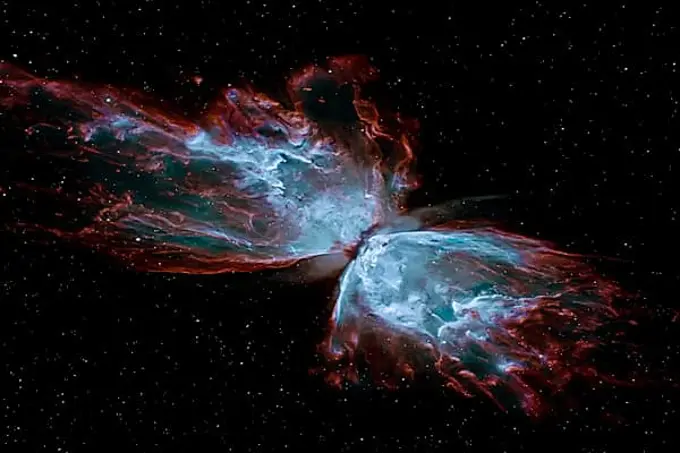
The Butterfly Nebula, dying star nebula, Elements of this image furnished by NASA. Retouched image
6145-45088058
In the center of this image, taken with the NASA/ESA Hubble Space Telescope, is the galaxy cluster SDSS J1038+4849  and it seems to be smiling. You can make out its two orange eyes and white button nose. In the case of this “happy face”, the two eyes are very bright galaxies and the misleading smile lines are actually arcs caused by an effect known as strong gravitational lensing. Galaxy clusters are the most massive structures in the Universe and exert such a powerful gravitational pull that they warp the spacetime around them and act as cosmic lenses which can magnify, distort and bend the light behind them. This phenomenon, crucial to many of Hubble’s discoveries, can be explained by Einstein’s theory of general relativity. In this special case of gravitational lensing, a ring  known as an Einstein Ring  is produced from this bending of light, a consequence of the exact and symmetrical alignment of the source, lens and observer and resulting in the ring-like structure we see here
6145-44623800
NASA's three Great Observatories -- the Hubble Space Telescope, the SpitzerSpace Telescope, and the Chandra X-ray Observatory -- joined forces to probe theexpanding remains of a supernova, called Kepler's supernova remnant.
6145-45137432
Hubbles Spirograph In this classic Hubble image from 2000, the planetary nebula IC 418 glows like a multifaceted jewel with enigmatic patterns. IC 418 lies about 2,000 light-years from Earth in the direction of the constellation Lepus. A planetary nebula represents the final stage in the evolution of a star similar to our sun. The star at the center of IC 418 was a red giant a few thousand years ago, but then ejected its outer layers into space to form the nebula, which has now expanded to a diameter of about 0.1 light-year. The stellar remnant at the center is the hot core of the red giant, from which ultraviolet radiation floods out into the surrounding gas, causing it to fluoresce. Over the next several thousand years, the nebula will gradually disperse into space, and then the star will cool and fade away for billions of years as a white dwarf. Our own sun is expected to undergo a similar fate, but fortunately, this will not occur until some 5 billion years from now. The Hubble im
6145-45008547
Comet NEOWISE was first observed by NASA's NEOWISE spacecraft on Valentine's Day, 2014. This heat-sensitive infrared image was made by combining six exposures taken by the NEOWISE mission of the newly discovered comet.
6145-44805570
This image from NASA's Wide-field Infrared Survey Explorer highlights the dust that speckles the Andromeda galaxy's spiral arms. The hot dust, which is being heated by newborn stars, traces the spidery arms all the way to the center of the galaxy.
PREVIOUS
of 2
NEXT
2401 S. Ervay, Suite 206
Dallas, Texas 75215
United States
Get Started
Free ResearchMy BoardsMy Cart
For Creators
How To License Your ContentContributor PortalFrame of Mind
Resources
API accessPricing
Contact
+1 866 236 0087help@viewpictures.co.uk Contact form
©2026 View Pictures. All Rights Reserved. -A
This site is protected by reCAPTCHA and Google Privacy Policy and Terms of Service apply.