My Boards
View Pictures
  • My Boards

Earth Observations from Space

Images from the ISS showcasing Earth's atmosphere, clouds, and lunar observations, with striking contrasts between light and dark.

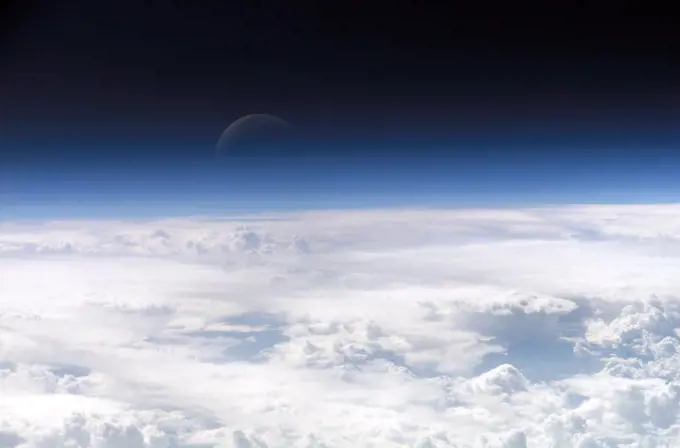
The moon over the airglow of Earth's atmosphere.
269 assets in this story
6145-44769080
STS009-11-675 (December 1983) --- The Space Shuttle Columbia passes into a brilliant sunrise scene during the STS-9Spacelab 1 mission. The photograph was taken with a 35mm camera aimed through Columbia's aft flight deck windows. Part of the science module, which hosted more than a week's scientific experimentation, is silhouetted against the scene.
6145-44838211
ISS025-E-012937 (7 Nov. 2010) --- Aurora Borealis sits on the horizon of this night view over much of Europe. The Strait of Dover is relatively clear as is Paris, the City of Lights.  There is some fog over the western part of England and London.
6145-45060184
ISS040-E-008409 (8 June 2014) --- The thin line of Earth's atmosphere and the blackness of space are featured in this image photographed by an Expedition 40 crew member on the International Space Station.
6145-45089827
Earth observation taken during a night pass by the Expedition 43 crew aboard the International Space Station (ISS).
6145-44973991
Earth observation taken during a day pass by the Expedition 37 crew. Per Twitter message Caught the reflection of Earth's horizon on our solar arrays at sunset.
6145-44888111
ISS030 star trail composite using iss030e158927 thru iss030e158944
1838-51330360
View of Earth, showing Africa, Europe and Asia taken by Apollo 11 crewmember during its trans-lunar coast toward the moon, Johnson Space Center, NASA, July 16, 1969
6145-58970319
iss062e098243 (March 16, 2020) --- The city lights of Japan, with Tokyo at bottom, seemingly trail off onto into an orbital sunrise as the International Space Station orbited 260 miles above the Pacific Ocean.
6145-45087000
N/A
6145-44881824
ISS030-E-177670 (28 March 2012) --- One of the Expedition 30 crew members photographed this nighttime scene while the International Space Station was flying at an altitude approximately 240 miles over the eastern North Atlantic. The view looks northeastward. Center point coordinates are 46.8 degrees north latitude and 14.3 degrees west longitude. The night lights of the cities of Ireland, in the foreground, and the United Kingdom, in the back and to the right, are contrasted by the bright sunrise in the background. The greens and purples of the Aurora Borealis are seen along the rest of the horizon.
6145-45286901
iss064e024089 (Jan. 18, 2021) --- The International Space Station was orbiting 263 miles above Romania when this photograph was taken of the city lights of Sweden and Finland with an aurora above the Earth's horizon. The dark area in between the two Scandinavian nations is the Baltic Sea.
6145-45286902
iss064e024095 (Jan. 18, 2021) --- The International Space Station was orbiting 263 miles above Ukraine when this photograph was taken of the city lights and an aurora above Russia.
6145-45066990
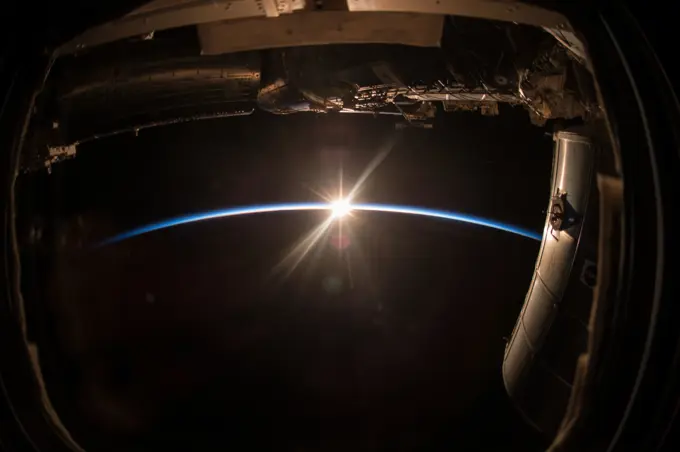
ISS040-E-083603 (31 July 2013) --- The sun, peeking through the thin line of Earth's atmosphere, is featured in this image photographed by an Expedition 40 crew member on the International Space Station. Crew members onboard the space station see, on average, sixteen sunrises and sunsets during a 24-hour orbital period.
6145-44485429
The first rays of an orbital sunrise begin illuminating the Earth's atmosphere in this photograph taken from the International Space Station as it orbited 262 miles above the Pacific Ocean.
1525-23809480
Surface of procedural planet in deep space. Outer dark space wallpaper.
6177-V53472049
6145-45068310
Earth observation taken during a night pass by the Expedition 40 crew aboard the International Space Station (ISS). Folder lists this as US East Coast pre-dawn. City lights.
6145-44506137
S66-25771 (16 March 1966) --- Earth's limb with cloud layers in silhouette, sunrise over Guam, as seen from the Gemini-Titan VIII (GT-8) spacecraft during its third revolution of the Earth.
6177-V54005112
6145-45041993
ISS030-E-114095 (6 Feb. 2012)--- Minor activity of Aurora Borealis is easily recognized "piggybacking" Earth's limb in this 24-mm image photographed by one of the Expedition 30 crew members aboard the International Space station from approximately 240 miles above Earth. Clouds obscure what would be any recognizable points on the planet.A section of one of the solar array panels on the orbital outpost is seen across the top of the frame.
6145-45141902
A total solar eclipse is seen on Monday, August 21, 2017 from onboard a NASA Armstrong Flight Research Centers Gulfstream III 25,000 feet above the Oregon coast. A total solar eclipse swept across a narrow portion of the contiguous United States from Lincoln Beach, Oregon to Charleston, South Carolina.
1525-28439059
Space, Sun and planet Earth at Night
6145-45083087
GMT340_00_04_Terry Virts_Aurora_123
6145-44539959
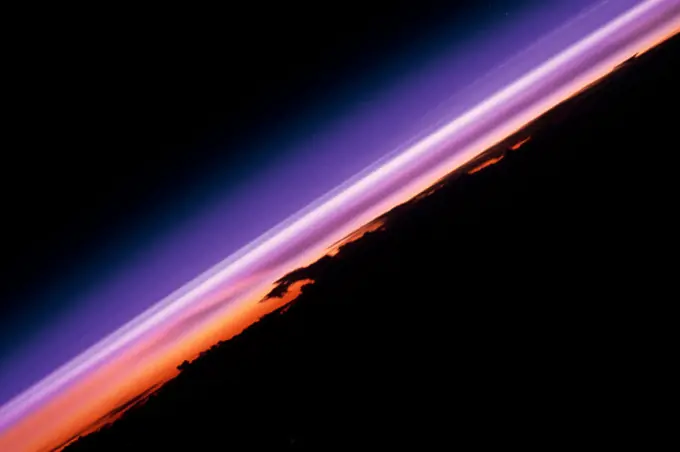
41G-34-036 (5-13 Oct 1984) --- When in space, Space Shuttle astronauts experience 18-dawns to every one on terra firma.  The crew of NASA's STS-41G mission captured these spectacular colors just prior to passing through one of those orbital dawns in October of 1984.  The scene is over the Pacific Ocean, approximately 2,000 miles from Tokyo.  The bands of color represent the various layers of aerosol which surround the planet.  The brilliant red is the atmosphere; the overlap between red and blue is the stratosphere; the blue layer is the ionosphere.  With increased altitude, the electrons and ions are reduced in number, leaving the vast blackness of space.
6177-V54019918
6145-44983067
ISS038-E-007980 (23 Nov. 2013) --- A close inspection of this image, photographed by one of the Expedition 38 crew members aboard the International Space Station, reveals a pin-head sized view of an object which is actually the comet ISON, seen just to the right of center and a little below center in the frame. Hardware components of the orbital outpost and Earth's atmosphere above the horizon take up most of the image. Most of the other bright dots in the sky are heavenly bodies. The comet is distinguishable by its tail.
6145-44589403
ISS006-E-028961 (16 Feb. 2003) ---  The Expedition Six crew enjoyed this green aurora dancing over the night side of the Earth just after sunset on February 16, 2003. The reds and blues of sunset light up the air layer to the west. The image was recorded  with a 58 mm lens on a digital still camera. Because auroras follow Earth's magnetic field, they are observed at Earth's poles when the oxygen and nitrogen atoms start to glow when bombarded by charged particles coming from the sun.  In a sense, auroras are the "neon lights" of the poles.
6145-45065948
Earth observation taken during a night pass by the Expedition 40 crew aboard the International Space Station. Folder lists this as Night-Egypt & war in Israel - missile impacts.
6177-V53843560
4351-229
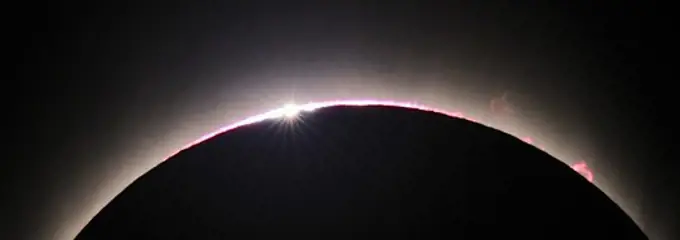
Baily's Beads and Prominences During Solar Eclipse
6145-45141900
A total solar eclipse is seen on Monday, August 21, 2017 from onboard a NASA Armstrong Flight Research Centers Gulfstream III 25,000 feet above the Oregon coast. A total solar eclipse swept across a narrow portion of the contiguous United States from Lincoln Beach, Oregon to Charleston, South Carolina.
6145-45244358
STS039-23-020 (28 April-6 May 1991) --- A 35mm frame of the Aurora Australis, also known as the Southern Lights, photographed from Space Shuttle Discovery's flight deck by one of its seven crew members. One of the mission objectives was to measure the spectral and spatial characteristics of auroral emissions. While passing over the sunlighted portion of Earth, the crew was able to take a number of photos of the various geographic points on the planet; much of the time on nightside passes was devoted to a thorough study and documentation of auroral displays.
4128-18800478
Communication satellite, illustration
4239R-556
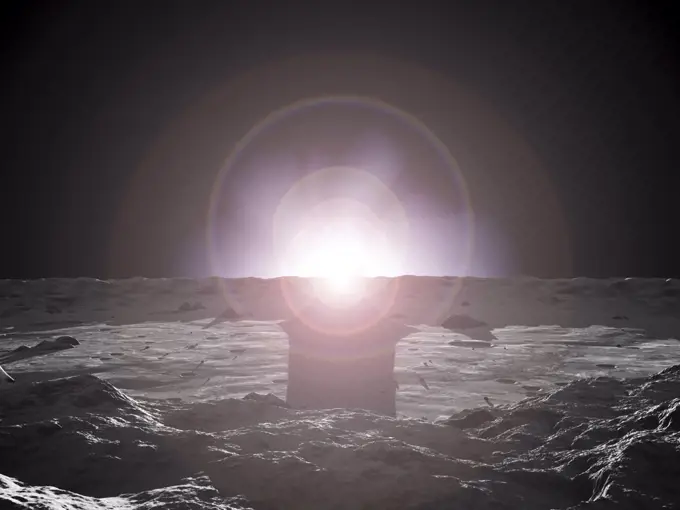
Sunrise on Mercury
6145-44597954
ISS007-E-07878 (22 June 2003) --- This image, photographed by an Expedition 7 crewmember onboard the International Space Station (ISS), was merged with image ISS007-E-07872 to create a mosaic of a dust storm and thunderstorm over the Red Sea.The mosaic can be viewed on http://eol.jsc.nasa.gov
6145-44524250
S100-E-5498 (26 April 2001) --- Earth's limb--the edge of the planet seen at twilight--was captured with a digital still camera by one of the STS-100 crew members aboard the Space Shuttle Endeavour. Near center frame the silhouette of cloud layers can be seen in the atmosphere, above which lies an airglow layer (left).
4128-V58567718
6145-44735660
Photo by Apollo 17 Earth
6145-45289148
iss064e035804 (Feb. 21, 2021) --- The International Space Station, pictured with Russia's ISS Progress 77 cargo craft attached to the Pirs docking compartment, orbits into a sunset 270 miles above the South Pacific. This long duration photograph also shows Earth's airglow (a faint emission of light in the upper atmosphere) and a starry night sky.
6145-45049229
ISS039-E-005427 (25 March 2014) --- One of the Expedition 39 crew members aboard the International Space Station photographed this image while the outpost was over northeastern Kazakhstan. The crew member aimed the camera due  north or toward Russia, capturing the Aurora Borealis, which appears above the blue atmosphere.
1899-18985053
(12 - 20 Sept 1992) --- The colors in this photograph provide insight into the relative density of the atmosphere.  The crew members had many opportunities to witness sunrises and sunsets, considering they orbit the Earth every 90 minutes, but few, they said, compared to this scene.  It captures the silhouette of several mature thunderstorms with their cirrus anvil tops spreading out against the tropopause (the top of the lowest layer of Earth's atmosphere) at sunset.  The lowest layer (troposphere) is the densest and refracts light at the red end of the visible spectrum (7,400 Angstroms), while the blues (4,000 Angstroms) are separated in the least dense portion of the atmosphere (middle and upper atmosphere, or stratosphere and mesosphere).  Several layers of blue can be seen.  .
1899-51631571
Green Comet C2022 E3, Passing The Earth
6145-44676457
ISS015-E-10469 (3 June 2007) --- The profile of the atmosphere and a setting sun are featured in this image photographed by an Expedition 15 crewmember on the International Space Station.
6145-44978470
View of a solar array taken by the Expedition 37 crew.
6145-44549971
STS080-752-011 (19 Nov.-7 Dec. 1996) --- This view, photographed by one the crewmembers aboard the Earth-orbiting space shuttle Columbia, shows an area covered with clouds near the terminator thus the long shadows from the towering clouds.  A portion of the vertical stabilizer of the space shuttle Columbia is seen on the right.  Vortices indicate that it is a Southern Hemisphere photograph.
6145-44556097
STS085-365-006 (7 - 19 August 1997) --- A 35mm camera with a time exposure was used to record this image of the southern lights or the aurora Australis.  The vertical stabilizer of the Space Shuttle Discovery appears in the foreground.
6145-45054115
Earth observation taken by the Expedition 39 crew aboard the ISS. Image was downlinked in folder aurora south of Africa.
6145-45244254
STS047-20-015 (12-20 Sept. 1992) --- This 35mm frame represents one of the more spectacular views of Aurora Australis, photographed by the crew. The crew observed and photographed a great deal of auroral activity from the Earth-orbiting Space Shuttle Endeavour during the eight-day Spacelab-J mission.
6145-45040934
ISS030-E-074752 (25 Jan. 2012 ) --- This nighttime panorama of much of Europe was photographed by one of the Expedition 30 crew members aboard the International Space Station flying approximately 240 miles above the Tyrrhenian Sea on Jan. 25, 2012. Most of the country of Italy is visible running horizontally across the center of the frame, with the night lights of Rome and Naples being visible to the center and right center, respectively.  Sardinia, and Corsica  are in the lower left quadrant of the photo, and Sicily is at lower right corner. The Adriatic Sea is on the other side of Italy, and beyond it to the east and north can be seen parts of several other European nations.
6145-44502978
STS099-734-012 (11-22 February 2000) ---As photographed by one of the STS-99 crew members aboard the Space Shuttle Endeavour, a shallow atmosphere displays the various layers by color.  The layer that holds the gases we breathe are under the yellow band called the tropopause.
6145-45094699
ISS044E012986 (07/13/2015) --- This Night Earth Observation of an Aurora Borealis was captured by NASA astronaut Scott Kelly of Expedition 44 on the International Space Station.
4239-57495567
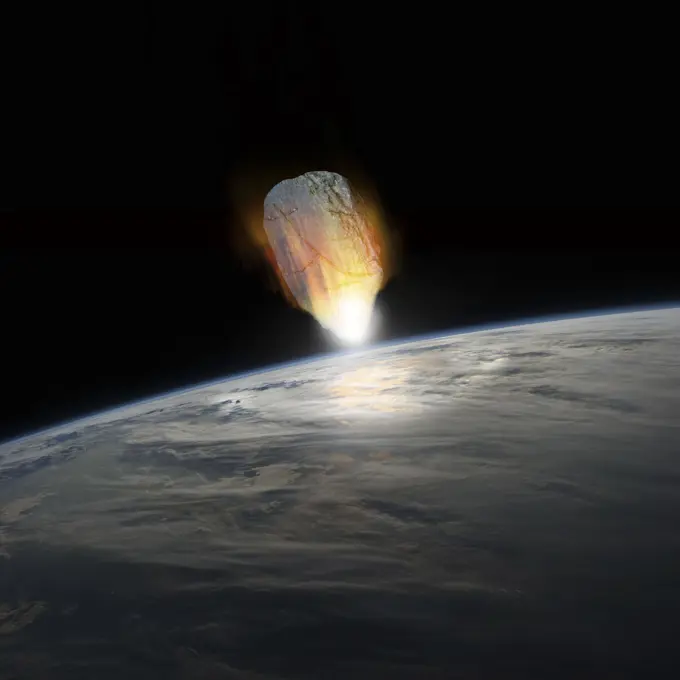
A massive asteroid enters Earth's atmosphere moments before impact with the planet.
6145-45250252
ISS006-327-026 (March 2003) --- The Aurora Borealis, also known as “northern lights”, is featured in this photograph taken by astronaut Donald R. Pettit, Expedition 6 NASA ISS science officer, onboard the International Space Station (ISS).
6145-45064114
ISS040-E-040088 (5 July 2014) --- As the International Space Station was flying at an altitude of 226 nautical miles on July 5 above a point in the southern Indian Ocean near South Africa's Prince Edwards Islands, one of the Expedition 40 crew members photographed this image of Aurora Australis.
6145-45050482
Earth observation taken by the Expedition 39 crew aboard the ISS. Night view of airglow, aurora, and city lights. Image was released by astronaut on Twitter and downlinked in folder north lights.
6145-45127251
A test rocket is launched the night of Feb. 17 from the Poker Flat Research Range in Alaska. Test rockets are launched as part of the countdown to test out the radar tracking systems. NASA is launching five sounding rockets from the Poker Range into active auroras to explore the Earth's magnetic environment and its impact on Earths upper atmosphere and ionosphere. The launch window for the four remaining rockets runs through March 3.
6145-45197077
iss059e013117 (April 4, 2019) --- The aurora australis, also known as the "southern lights," is pictured as the International Space Station orbited 264 miles above the Indian Ocean south of the Western Australia city of Perth.
6145-45035537
DATE: 1-4-11LOCATION: JSCSUBJECT: Space Station flying by the moon
4239-57495541
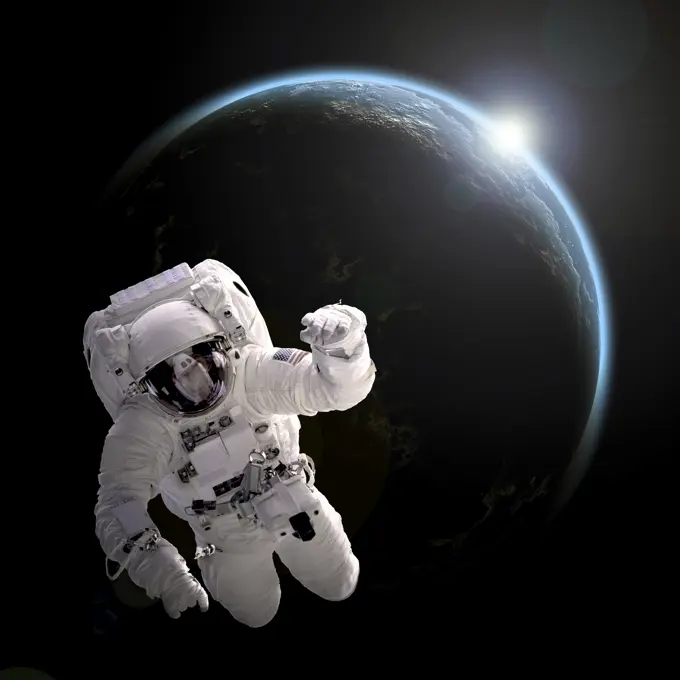
Astronaut floating in space as the sun rises on an Earth-like planet.
6145-44942926
Earth Observations taken by Expedition 34 crewmember.
6145-45129958
This is the highest-resolution color departure shot of Pluto's receding crescent from NASA's New Horizons spacecraft, taken when the spacecraft was 120,000 miles (200,000 kilometers) away from Pluto.
6145-44934240
ISS034-E-045223 (10 Feb. 2013) -- One of the Expedition 34 crew members aboard the International Space Station captured this night panorama featuring a display of Northern Lights, also known as Aurora Borealis, and scattered lights in the more highly populated areas in the state of Colorado and possibly the states north of it. A 50 millimeter lens was used to record the image.
6145-45286197
iss064e022759 (Jan. 12, 2021) --- A starry night sky and an aurora are pictured above Russia as the International Space Station orbited 264 miles over the western Kazakhstan border.
6145-45070637
Time lapse Earth Observation (ISS040E111401 thru ISS040E112398) taken during a night pass by the Expedition 40 crew aboard the International Space Station (ISS). Folder lists this as SUPER Aurora south.
6145-45254128
STS117-S-012 (8 June 2007) --- The drifting smoke plumes from the launch of Space Shuttle Atlantis (out of frame) swirl above the Vehicle Assembly Building near sunset. Atlantis and its seven-member STS-117 crew head toward Earth-orbit and a scheduled link-up with the International Space Station. Liftoff from Kennedy Space Center's launch pad 39A occurred at 7:38 p.m. (EDT) on June 8, 2007. Onboard are astronauts Rick Sturckow, commander; Lee Archambault, pilot; Jim Reilly, Patrick Forrester, John "Danny" Olivas, Steven Swanson and Clayton Anderson, all mission specialists. Anderson will join Expedition 15 in progress to serve as a flight engineer aboard the station. Atlantis will dock with the orbital outpost on Sunday, June 10, to begin a joint mission that will increase the complex's power generation capability. Using the shuttle and station robotic arms and conducting three scheduled spacewalks, the astronauts will install another set of giant solar array wings on the station and r
4239-57495735
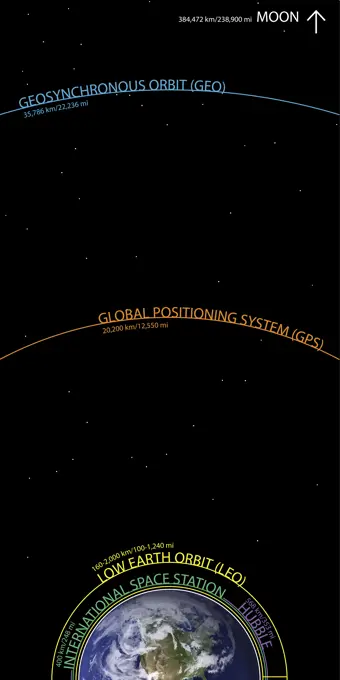
Satellite orbital heights above the Earth.
6145-45252814
STS114-332-031 (6 August 2005) --- This view featuring the Aurora Australis or “southern lights” was recorded on 35mm film by a crewmember aboard the Space Shuttle Discovery during the STS-114 mission.
6145-44578333
STS111-362-036 (5-19 June 2002) --- This view featuring the Aurora Australis or “southern lights” was photographed by the STS-111 crew members aboard the Space Shuttle Endeavour.  When this photograph was taken, the shuttle  was in a position south of Australia.
6145-45288390
The Empire State Building is illuminated in red to celebrate this Thursday's scheduled landing on Mars of NASA's Perseverance rover, Tuesday, Feb. 16, 2021 in New York City. A key objective for Perseverances mission on Mars is astrobiology, including the search for signs of ancient microbial life. The rover will characterize the planets geology and past climate, pave the way for human exploration of the Red Planet, and be the first mission to collect and cache Martian rock and regolith.
PREVIOUS
of 3
NEXT
2401 S. Ervay, Suite 206
Dallas, Texas 75215
United States
Get Started
Free ResearchMy BoardsMy Cart
For Creators
How To License Your ContentContributor PortalFrame of Mind
Resources
API accessPricing
Contact
+1 866 236 0087help@viewpictures.co.uk Contact form
©2026 View Pictures. All Rights Reserved. -B
This site is protected by reCAPTCHA and Google Privacy Policy and Terms of Service apply.