My Boards
View Pictures
  • My Boards
← Artworks

Edo Period Japanese Art

Woodblock prints showcasing traditional Japanese scenes and figures, exhibiting vibrant colors and intricate patterns characteristic of the Edo period.

A woodcut created in 1730 depicting the moon
181 assets in this story
6145-59566193
Gong, c. 1870 - c. 1880 print Humorous erotic print; group of naked men and a dressed courtier, two running men encouraging; When beating a gong, hanging on a penis.  paper color woodcut man (showing himself) undressed, quasi-nude. percussion instruments. running
4443-28729840
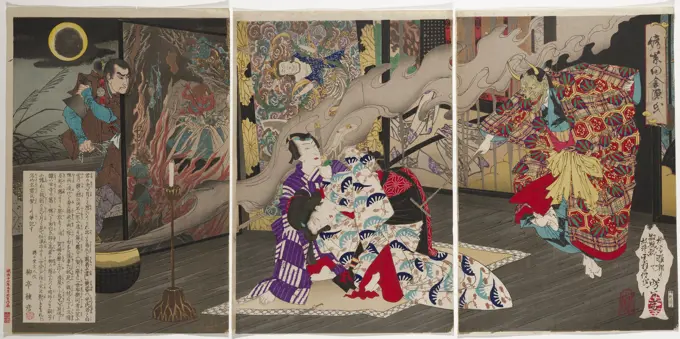
A Rustic Genji by a Fraudulent Murasaki, May 1884, Tsukioka Yoshitoshi; Author: Takabatake Ransen; Publisher: Akiyama Buemon; Carver: Noguchi Enkatsu, Japanese, 1839 - 1892, 14 1/2 × 10 in. (36.83 × 25.4 cm) (sheet, each, approx., vertical ōban triptych), Woodblock print (nishiki-e); ink and color on paper, Japan, 19th century, Text by Tentendō Shujin after Ryūtei Tanehiko.
6145-59300273
Grave monument with Gothic towers, 1862 - 1867  Leaf 55 Verso from a sketchbook with 58 sheets.  paper. pencil. watercolor (paint) brush sham-grave, cenotaph
6145-29171862
Illustrated Book of Classical Instruction Unidentified artist. Illustrated Book of Classical Instruction. Unidentified artist. Japan. 20 illustrated pages; monochrome woodblock print; ink on paper. Edo period (1615-1868). Illustrated Books
6145-43639766
Emperor and a scribe" - figural scene. unknown, painter
4409-20989025
Sastres trabajando. Museum: FREE LIBRARY PHILADELPH EEUU.
1100-790
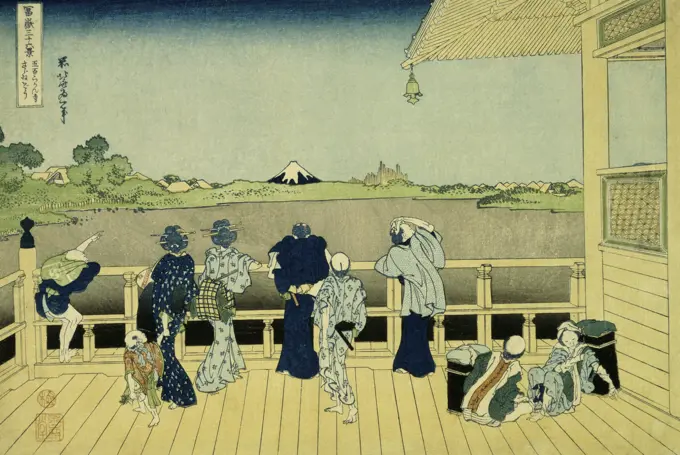
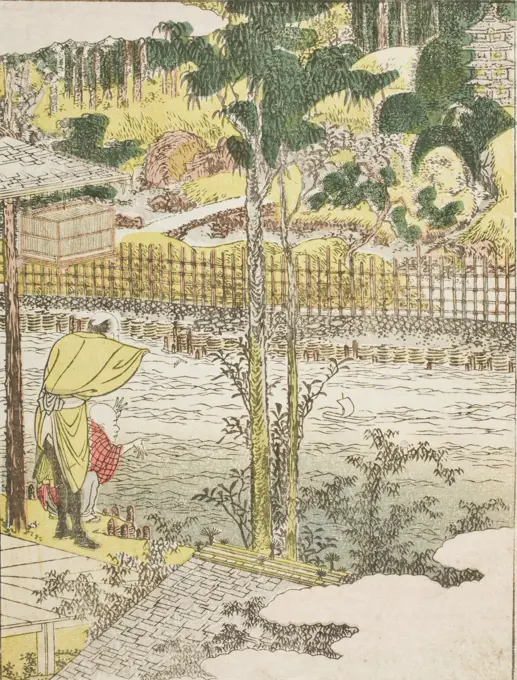
The Sazai Hall of the 500  Rakan Temple from the Series: 36 Views of Mount Fuji  Katsushika Hokusai (1760-1849/ Japanese) Woodblock print
4409-17383424
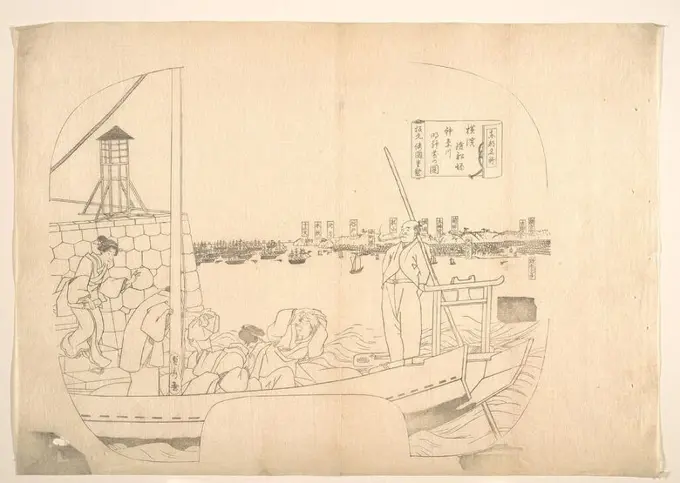
Proof Line-Block Print for Fan. Artist: Utagawa (Gountei) Sadahide (Japanese, 1807-1878/79). Culture: Japan. Dimensions: Image: 12 x 9 1/2 in. (30.5 x 24.1 cm). Date: 19th century. Museum: Metropolitan Museum of Art, New York, USA.
1899-48157990
Japan: Traditional crafts and trades of the 18th century from a hand-painted album by an anonymous artist. Unnumbered folio 2. Hand-coloured illustration from a Japanese miscellany on traditional trades, crafts and customs in mid-18th century Japan, dated Meiwa Era (1764-1772) Year 6 (c. 1770 CE).
7062-70068417
Asia, Vietnam, Saigon. Lacquer paintings in Reunification Palace
4409-17422143
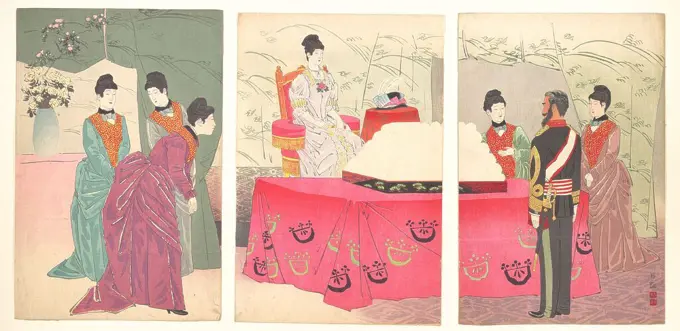
Illustration of the Empress Visiting the General Staff Headquarters to present a tray of bandages (Sanbo honbu gyokei no zu). Artist: Kobayashi Kiyochika (Japanese, 1847-1915). Culture: Japan. Dimensions: 14 × 27 3/4 in. (35.6 × 70.5 cm). Date: 1895. Museum: Metropolitan Museum of Art, New York, USA.
6145-59564561
THE LONLY HOUSE ON ADACHI MOOR, TSUKIOKA YOSHITOSHI, 1890 print An old woman with a large knife in her hand, against a black background with gourds. A poem in the squares of cartouche. This print is a scene from the Kabuki play 'The remote house' (Hitotsuya), with actor Onoe Kikugorô V in the role of the old murderous witch of the Achi plain, performed in the fourth month of 1890 in the Ichimura Theater. (triptych)  paper colour woodcut
4443-28728988
Roosters and Hens left of a pair, Second half 18th century, Itō Jakuchū, Japanese, 1716 - 1800, 49 3/4 × 19 1/2 in. (126.37 × 49.53 cm) (image, each panel)68 1/4 × 145 1/2 × 3/4 in. (173.36 × 369.57 × 1.91 cm) (outer frame), Ink on paper, Japan, 18th century, This pair of folding screens features twelve individual compositions, each pasted onto its own panel, a format known as an oshiebari screen. Each painting shows either a rooster or a hen (look out for two chicks hidden in one picture). Overlaid brushstrokes in varied ink tones capture the details of feathers and combs. Against white paper marked with only the briefest suggestions of natural settingscactus, bamboo, pine tree, banana plant, willow treethe birds’ flamboyant poses and dramatic plumage stand out. Chickens were the favorite subject of Itō Jakuchū, one the best-known painters in Kyoto in the 1700s.
6145-45496869
Three figures on a moonIIt night Kunisada II, Utagawa (1823 1880)
4409-17434842
Procession of the Emperor and Suite. Artist: Kano School. Culture: Japan. Dimensions: Image: 10 1/4 in. × 44 ft. 5 1/4 in. (26 × 1354.5 cm)Overall (entire length): 10 1/4 in. × 46 ft. 8 1/4 in. (26 × 1423 cm). Date: 1626. Museum: Metropolitan Museum of Art, New York, USA.
1746-21133216
Painting of the Korean Embassy to Japan. Painted by Kano Toun Yasunobu. Dated 1655
6145-29089583
Flowers of a Hundred Worlds (Momoyogusa): Nakaguni (Nakaguni), 1909. Kamisaka Sekka (Japanese, 1866-1942). Ink and color on paper;
1788-22043520
Scenes of everyday life in China, detail of the Chinese wallpaper, Chinese cabinet, Hunting residence (UNESCO World Heritage Site, 1997), by Filippo Juvarra (1678-1736), Stupinigi, Piedmont, Italy, 18th century.
6145-59028416
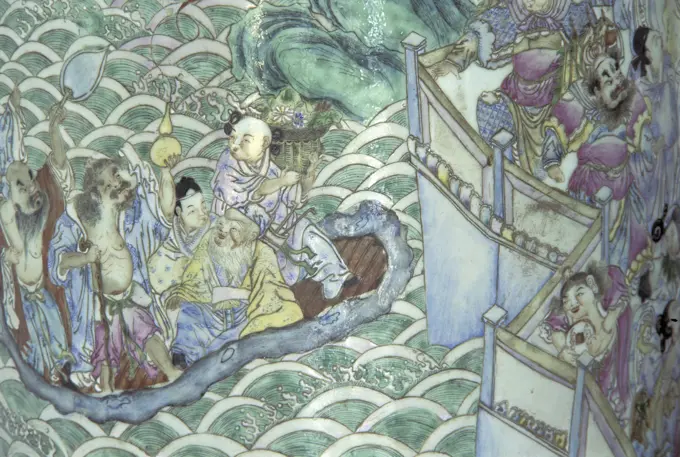
Anonymous, two immortals (attributed title). Ink and colors on silk. Cernuschi Museum, Asia Museum of Asia in the city of Paris.
6145-51418322
The beach, Capri, circa 1930, Capri, by Maud Sherwood. Gift of Mrs T.W. McDonald and Mrs W.J. Hutchison, the artist's sister and niece, 1960.
4443-28728808
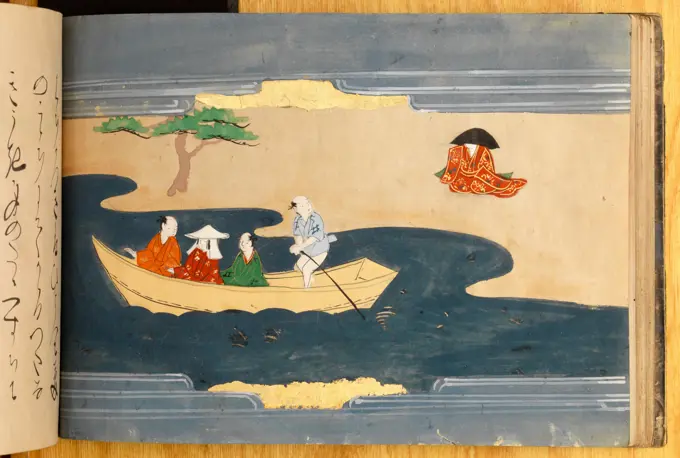
The Tale of Hachikazuki, vol. 1, late 17th century, Unknown Japanese, 6 1/2 × 9 1/2 × 5/16 in. (16.51 × 24.13 × 0.79 cm), Ink, color, gold, and gold leaf on paper, Japan, 17th century
4266-24744
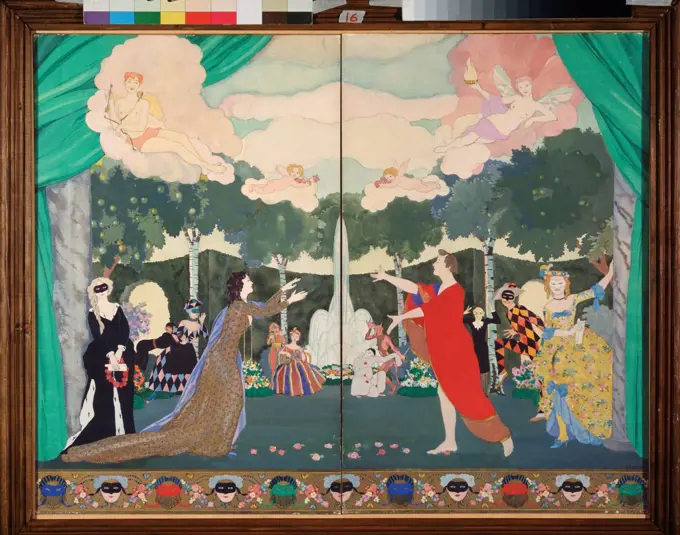
Curtain design for the Free Theatre in Moscow by Somov, Konstantin Andreyevich (1869-1939) State Central A. Bakhrushin Theatre Museum, Moscow 1913 Watercolour on paper 75,5x96,7 Russia Theatrical scenic painting Opera, Ballet, Theatre Painting
6145-50635510
TwiIIght in Takanawa, from the series: Famous views of Edo /Toto meisho
6145-29271227
A Chinese market where street-traders load up their baskets. Brush drawing by Chinese artist, ca. 1850.
6145-59469365
Five Nationalities on a Banket, Utagawa Yoshikazu, 1861 print A dining room with 18 people around an exuberantly set table. On the far left a French couple with child, in addition two Chinese servants. At the table from left to right an English couple, two Dutch men, a German couple and the far right Americans. Through the open window a face on a ship (Yokohama-e). Japan paper nishiki-e / color woodcut banquet of elegant company
6145-50634849
At Giheis home, scene from the 10th act of the drama: Treasury of fideIIty /Chishingura
4443-19375638
Shells, Octagonal print in album with 39 prints., Ayaoka Yûshin (mentioned on object), Japan, 1880 - 1890, paper, colour woodcut, h 223 mm × w 287 mm
6145-51379740
Drawing, Chinoiserie Pavilion; Frederick Crace (English, 1779-1859); England; pen and black ink, brush and watercolor on white wove paper
1899-19188308
Toyohara Chikanobu, better known to his contemporaries as Yoshu Chikanobu, was a prolific woodblock artist of Japan's Meiji period. His works capture the transition from the age of the samurai to Meiji modernity. In 1875 (Meiji 8), he decided to try to make a living as an artist. He travelled to Tokyo. He found work as an artist for the Kaishin Shimbun. In addition, he produced nishiki-e artworks. In his younger days, he had studied the Kano school of painting; but his interest was drawn to ukiyo-e. Like many ukiyo-e artists, Chikanobu turned his attention towards a great variety of subjects. His work ranged from Japanese mythology to depictions of the battlefields of his lifetime to women's fashions. As well as a number of the other artists of this period, he too portrayed kabuki actors in character, and is well-known for his impressions of the mie (formal pose) of kabuki productions. Chikanobu was known as a master of bijinga, images of beautiful women, and for illustrating changes i
4443-73251450
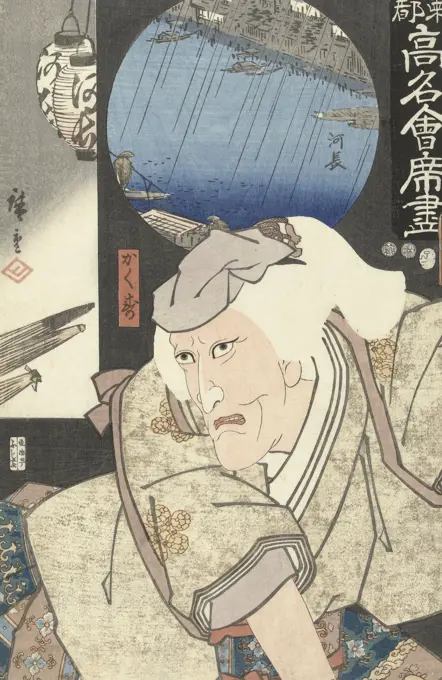
Japan, Fujiokaya Keijiro, Murata Heiemon, Kinugasa Fusajiro, Hiroshige (I), Utagawa, Kunisada (I), Toto komei kaitei tsukushi, Famous restaurants in the Eastern capital, Kakuju in Kawacho, Actor in the role of the old woman Kakuju, with white hair and a headdress, a sword in the right hand; rectangular cartouche with lanterns and umbrellas; round cartouche with a view of a river and bank in the rain. The actor is a design by Kunisada, the cartouches by Hiroshige., print, prints, Japan (collection), height 364 mm, width 253 mm, Japanese, 1786 - 1865, print maker, printmaker, 1852 - 1852, third quarter 19th century, paper, nishiki-e, colour woodcut, colour woodblock, 1797 - 1858, censor, Publication (Event), Publication, publisher
4443-73195182
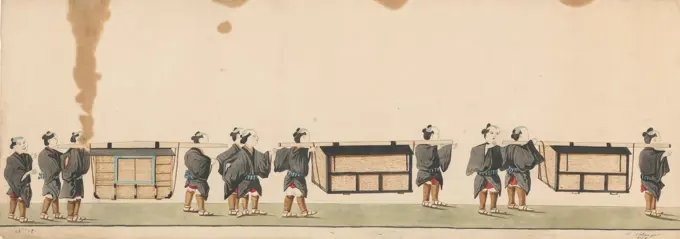
Japan, Rolland, H., Drawing, One of ten pen drawings, Asian figures, sometimes accompanied by horses, moving to the right and on two sheets to the left, carrying packages with partly the emblem of the VOC Zeeland. Signed; ll: H. Rolland pinxit. Inscription; ll: 12. lr: 521, 6. Note: see NG-1007-A to J., drawing, teken, drawings, tekeningen, height 27.2 cm, width 76.3 cm, draughtsman, tekenaar, 1775 - 1775, third quarter 18th century, derde kwart 18e eeuw, fourth quarter 18th century, vier kwart 18e eeuw, paper, papier, ink, inkt, pen, brush, Borstel, Expression creation
1606-175679
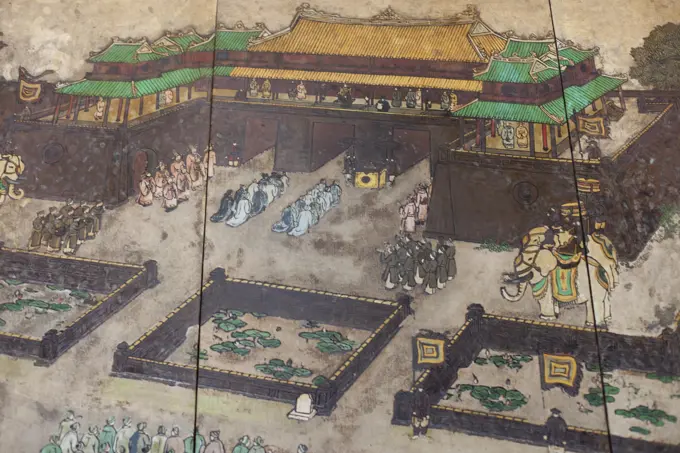
Vietnam,Hue,Citadel,Imperial Enclosure,Wall Painting inside Ngo Mon Gate
1323-372
6145-29710533
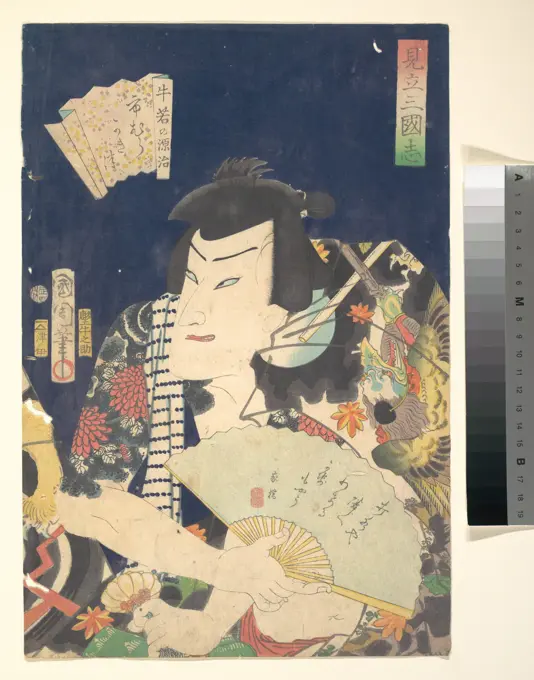
Ichimura Kakitsu IV as Ushiwaka no Genji in the Kabuki play A Parody of the Romance of the Three Kingdoms (Mitate Sangokushi-Ushiwaka no Genji) 4th month, 1868 Toyohara Kunichika Japanese. Ichimura Kakitsu IV as Ushiwaka no Genji in the Kabuki play A Parody of the Romance of the Three Kingdoms (Mitate Sangokushi-Ushiwaka no Genji) 55525
6145-29724899
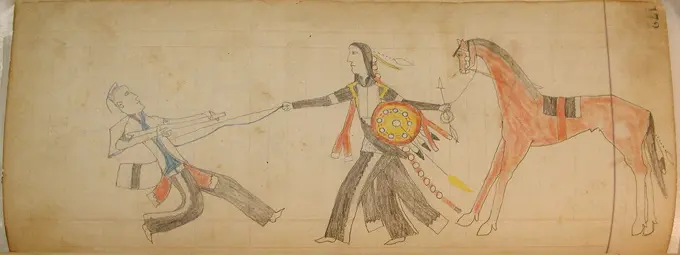
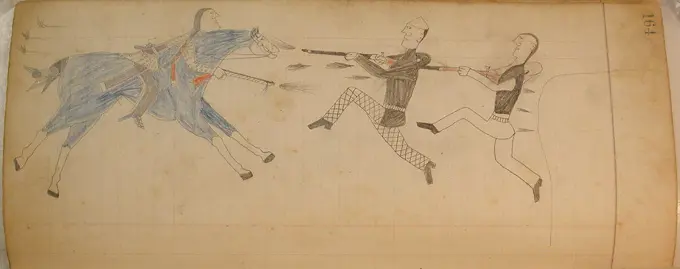
Maffet Ledger: Drawing ca. 1874-81 Southern and Northern Cheyenne. Maffet Ledger: Drawing. Southern and Northern Cheyenne. ca. 1874-81. Graphite, watercolor, and crayon on paper. United States, Oklahoma. Paper-Drawings
6145-59567790
Ichikawa Danjuro IX ALS KUSUNOKI MASATSURA BIJ DE STRIJD VAN SHIJONAWATE, 1886 print Standing warrior with different wounds is shot at with a lot of arrows.  paper color woodcut archer's weapons: arrow. violent death by arrow(s) - EE - death not certain; wounded person
4443-75467285
Selected images from Teikin Orai and Onna Inagawa, 1828, 1834, Woodcuts
6145-29136246
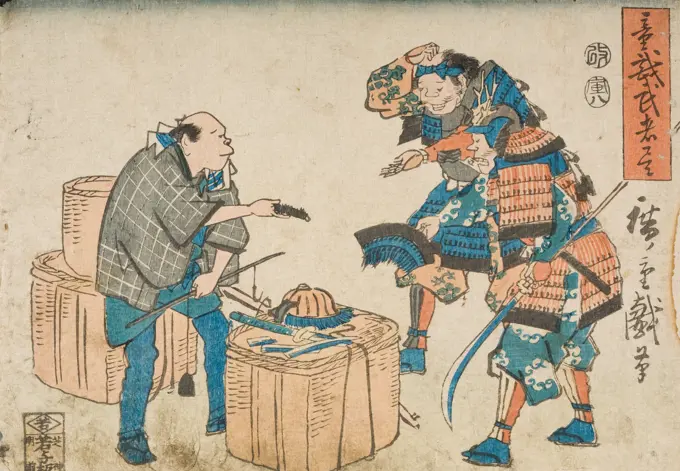
Selling Armor to a Scrap Metal Merchant. Utagawa Hiroshige (Japan, Edo, 1797-1858). 1854, 8th month. Prints; woodblocks. Color woodblock print; chūban
6145-29262599
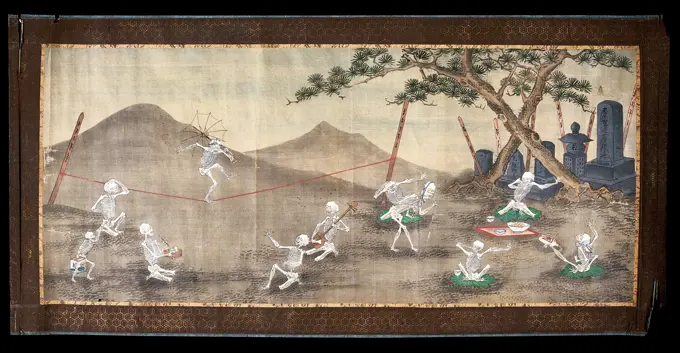
Skeletons on a tightrope. Gouache painting by a Japanese () painter.
6145-29198850
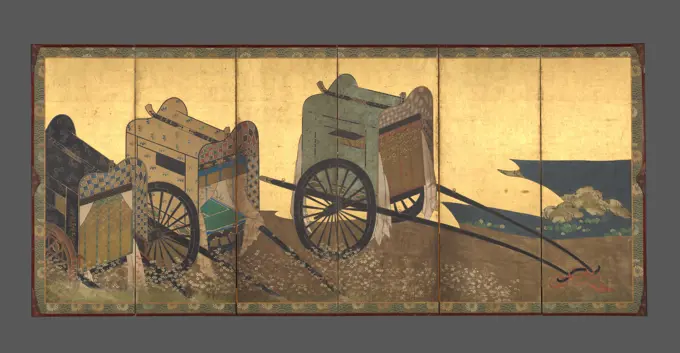
Imperial Carts (Gosho guruma) mid-17th century Japan In ancient and medieval Kyoto, the imperial family and nobility rode in carriages drawn by oxen. In this depiction of three carriages, lowered bamboo blinds tantalizingly suggest the presence of an elegant lady or nobleman. This image alludes to several classic literary scenes, among them an event from the Leaves of Wild Ginger” (Aoi) chapter in The Tale of Genji, in which attendants of Genji’s wife and his former lover create a crush of carts as they compete for the best position from which to view the Kamo festival in Kyoto. Such beautifully appointed vehicles, decorated with a wild ginger motif, were a popular subject for decorative art objects and textiles. Lacking evidence of a dispute, the composition is a decorative representation of carts set among the delicate pink blossoms of early summer. The painting convention of omitting human presence, common in the decorative arts, came to be called the motif of absence” (rusu moy?)
1788-22043514
Scenes of everyday life in China, detail of the Chinese wallpaper, Chinese cabinet, Hunting residence (UNESCO World Heritage Site, 1997), by Filippo Juvarra (1678-1736), Stupinigi, Piedmont, Italy, 18th century.
6145-58896417
Art on scrolls. Art on scrolls
1899-18856840
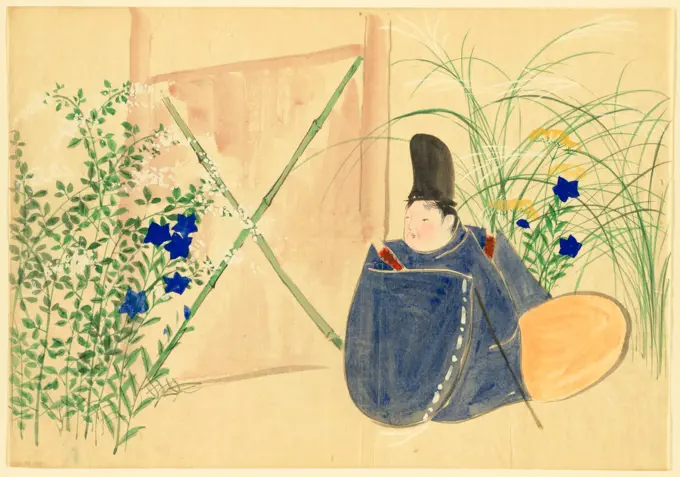
Tsukioka Kogyo, sometimes called Sakamaki Kogyo, (April 18, 1869 - February 25, 1927) was a Japanese artist of the Meiji period. He was a student and adopted son of Tsukioka Yoshitoshi, and also studied with Ogata Gekko. Although Kogyo sometimes painted other subjects, for most of his career he made pictures of Japanese noh theatre, either as large-scale paintings or colored woodblock prints.
4409-17557156
Saigyo Hoshi gazing at Mt. Fuji. Nishimura Shigenaga; Japanese, 1697 ()-1756. Date: 1730-1739. Dimensions: 13 3/8 x 6 3/8 in. Hand-colored woodblock print; hosoban, urushi-e. Origin: Japan. Museum: The Chicago Art Institute, Chicago, USA.
6145-46832539
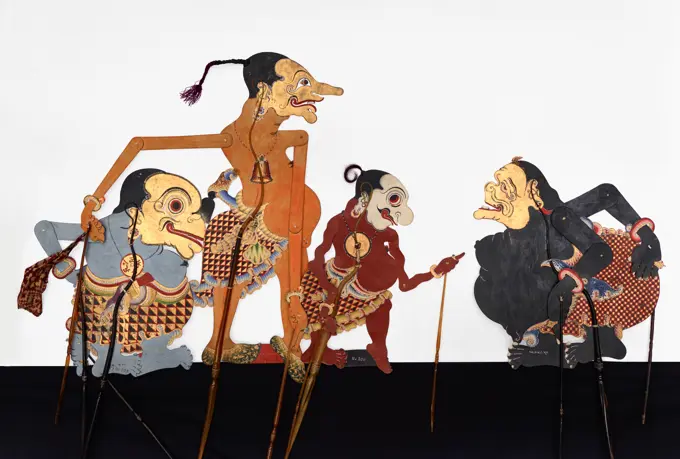
Shadow Puppet (Wayang Kulit) of Gareng, from the set KyaiNugroho.   Maker: Marto Suwondo  Maker: Ki Kertiwanda  Maker: Ki Bekel Prawirasucitra
4409-28962755
Garden and interior: an artist painting a lady's portrait. Origin: Japan. Period: Edo period. Color, ink, and gold on paper. Date: 18th century. Museum: Freer Gallery of Art and Arthur M. Sackler Gallery.
1899-18712682
Shin Yun-bok, better known by his pen name Hyewon, (born 1758) was a Korean painter of the Joseon Dynasty. Like his contemporaries Danwon and Geungjae, he is known for his realistic depictions of daily life in his time. His genre paintings are distinctly more erotic than Danwon's, a fact which contributed to his expulsion from the royal painting institute, Dohwaseo. Painting was frequently a hereditary occupation in the Joseon period, and Hyewon's father and grandfather had both been court painters. Together with Danwon and the later painter Owon, Hyewon is remembered today as one of the Three Wons’ of Joseon-period painting. Shin Yun-bok, despite being greatly influenced and overshadowed by Kim Hong-do during his career, developed his own unique technique and artistry. Whereas Kim depicted everyday life of peasants with a humorous touch, Shin showed glimpses of eroticism in his paintings of townspeople and gisaeng. His choice of characters, composition, and painting method differed f
4443-28739110
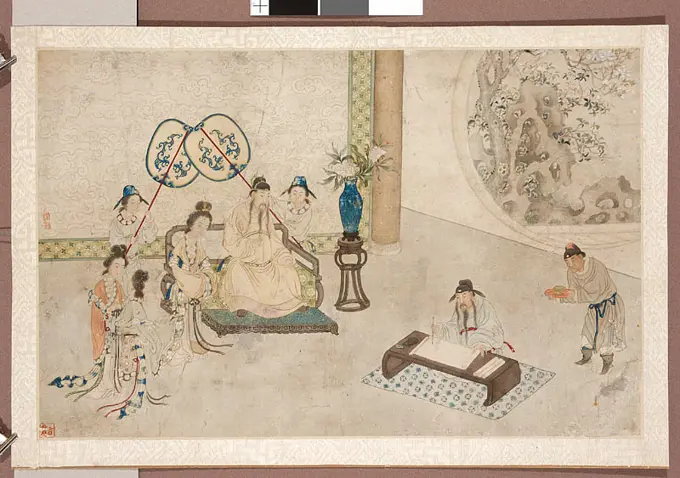
Portrait of Wang Shimin, late 17th century, Gu Jianlong, Chinese, 1606-1687, 13 7/8 × 47 1/8 in. (35.2 × 119.7 cm) (image), Ink and color on silk, China, 17th century, The revered early-Qing painter and literatus Wang Shimin is portrayed in the very center of this painting in the main hall of his chambers, surrounded by the hardwood furniture and scholarly accoutrements of his station. While Wang seems to dominate the scene here, there are several women also depicted in the paintingsome off in a chamber to the upper right, obscured from view; others seem to be working in the kitchen, while another appears to be a nanny, watching a child. This is a typical portrayal of the family of a scholar-official, in which the male figure relaxes while the women work or are hidden away from the viewer’s eye. The architectural elements of this painting allow for the women to be physically and visually separate from the scholar.
6145-29253136
A Chinese man standing revealing a portrait of a man within his chest. Watercolour.
6145-29779900
Maffet Ledger: Drawing ca. 1874-81 Southern and Northern Cheyenne. Maffet Ledger: Drawing 767482
6145-50636404
Fudo Waterfall in Oji /Oji, FUDO NO TAKI, BOARD 47 from The Series: One Hundred Famous Views of Edo /Meisho Edo Hyakkei HIROSHIGE, Ichiryusai (1797 1858)
4435-3906
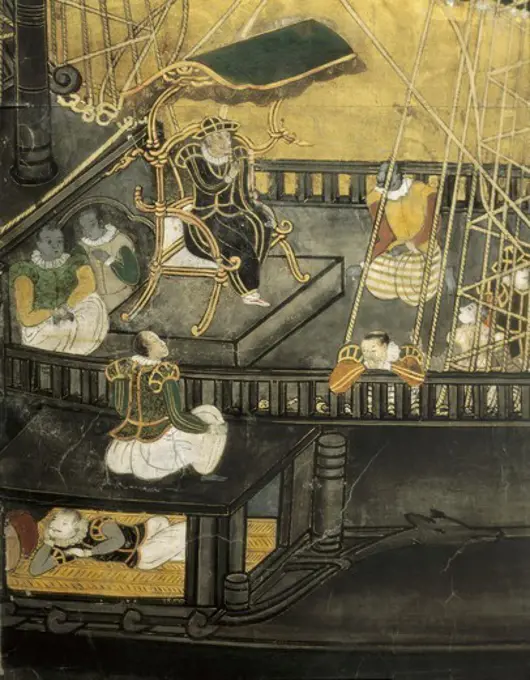
Arrival of the Portuguese to Japan in 16th c. Namban Period. Detail with a Portuguese boat. Japanese art. Painting. PORTUGAL. Porto. Soares dos Reis National Museum.
4435-3921
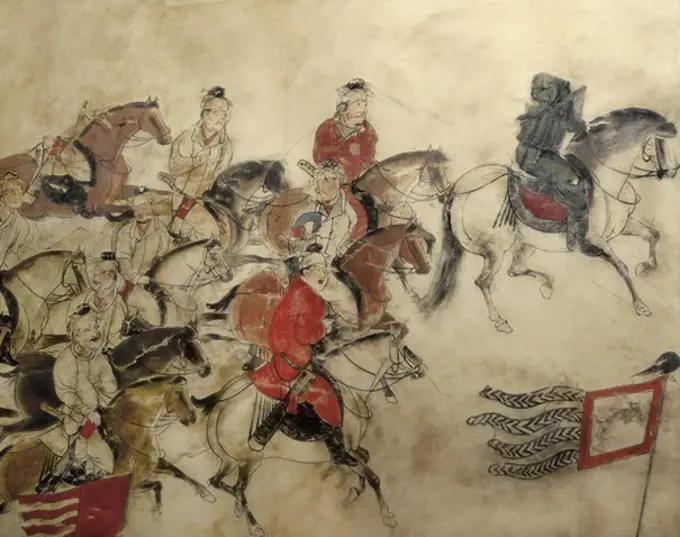
Tomb of the Crown Prince Zhanghuai. 711. CHINA. Xian. Tomb of Li Xian, Prince Zhanghuai. Hunting scene with horses. Chinese art. Tang period. Painting.
4443-75460626
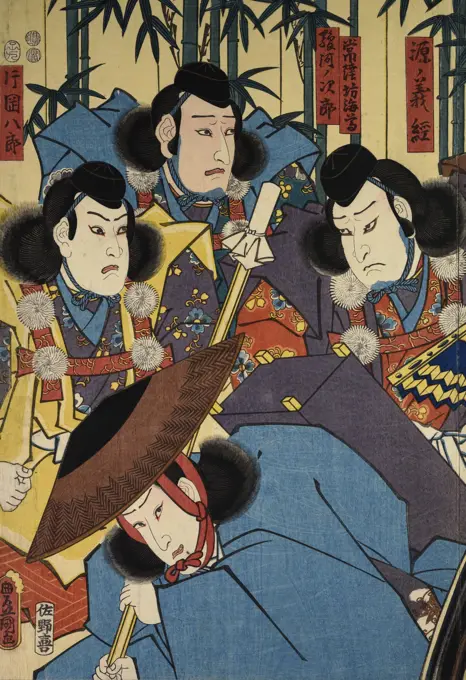
Four actors as samurai before a bamboo screen., 1806 - 1865. Woodcuts., Missing one sheet of triptych. Paper/Sheet 14 15/16 x 10 5/8 in. (38 x 27 cm)
6145-29136467
Ōji Ebiya. Katsushika Hokusai (Japan, 1760-1849). circa 1802. Books. Single sheet from a double-page book illustration; color woodblock print
6145-29291594
An actor as a hero who emerges from a well. Colour woodcut by Yoshitaki, early 1860s.
6145-48965842
Amateurs in the country of Algiers. (IT)
4409-17564856
Equestrienne (At the Cirque Fernando). Henri de Toulouse-Lautrec; French, 1864-1901. Date: 1882-1892. Dimensions: 39 1/2 × 63 1/2 in. (100.3 × 161.3 cm). Oil on canvas. Origin: France. Museum: The Chicago Art Institute, USA.
1899-19188727
USA: 'Hyde and Seek'. Woodblock print by Helen Hyde (1868-1919), 1897. Helen Hyde (April 6, 1868 - May 13, 1919) was an American engraver and etcher. Born in Lima, New York, she became well known for her colour etching process, as well as her woodblock prints of Japanese children and women.
4443-73254543
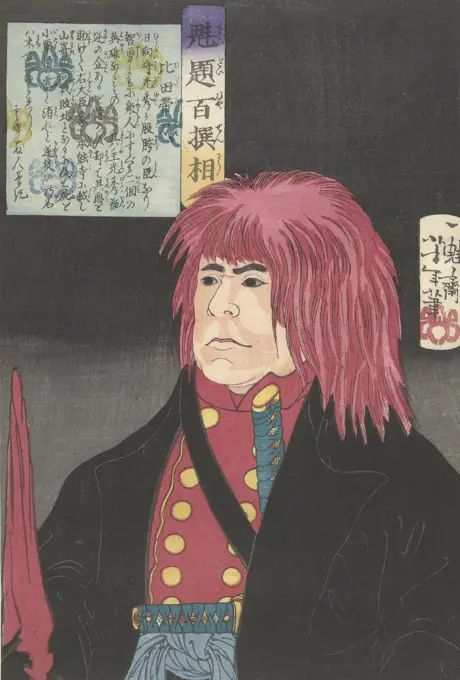
Tokyo, Ôhashiya Yashichi, Japan, Yoshitoshi, Tsukioka, Kaidai hyaku senso, One Hundred Warriors Selected by Yoshitoshi, Hida no Tatewaki, verso - stamped, Bust portrait of the sixteenth-century warrior Hida no Tatewaki, depicted in nineteenth-century Western costume, wearing a red wig., print, prints, Japan (collection), height 364 mm, width 241 mm, Japanese, 1839 - 1892, print maker, printmaker, 1868 - 1868, third quarter 19th century, paper, papier, nishiki-e, colour woodcut, Publication (Event), Publication, publisher
7062-70064648
Painting depicting people's life along the Grand Canal in the old days, Taierzhuang Ancient Town, Shandong Province, China
4443-19525483
Chinese Chippendale, Block-printed paper, Portion of a palace with triple roof. In foreground, man, dressed in blue and pink, seated on stool next to paved walkway. Width numbered 28 at bottom., France, ca. 1850, Wallcoverings, Scenic, Scenic
1899-19189035
Japan: 'Portrait of Tokugawa Yoshinobu'. Oil on canvas painting by Kawamura Kiyoo (1852-1934), c. 1880s-1890s. Tokugawa Yoshinobu, also known as 'Keiki', was the 15th and last shogun of the Tokugawa shogunate of Japan. He was part of a movement which aimed to reform the aging shogunate, but was ultimately unsuccessful. Kawamura Kiyoo (1852-1934) was a Japanese painter from Edo. He became a follower of the yoga (Western-style) of painting, and journeyed for a time through France and Italy. He aided in the formation of the Meiji Bijutsukai in 1889, the first art association in Japan championing western-style painting.
4409-17384910
Seven Sages of the Bamboo Grove. Culture: Japan. Dimensions: 35 1/4 x 24 3/16 in. (89.6 x 61.5 cm). Museum: Metropolitan Museum of Art, New York, USA.
1788-42107
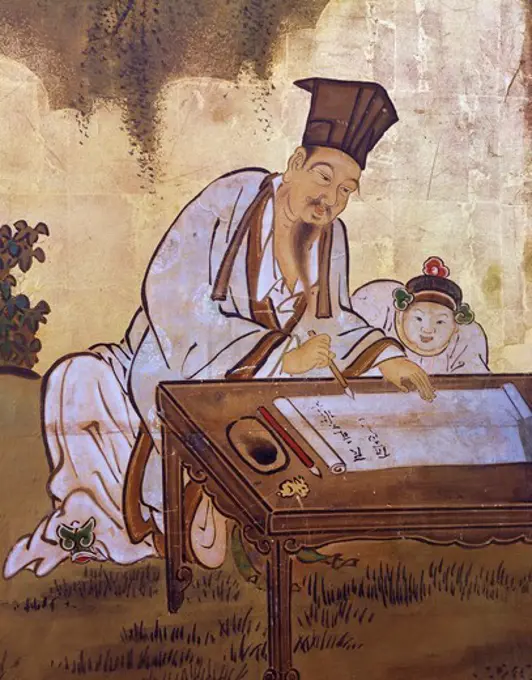
Elegant pastimes,calligraphy, screen, by Kano Tansetsu (1654-1713), Japan. Detail. Japanese Civilisation, Edo period, early 18th century.
4443-73244493
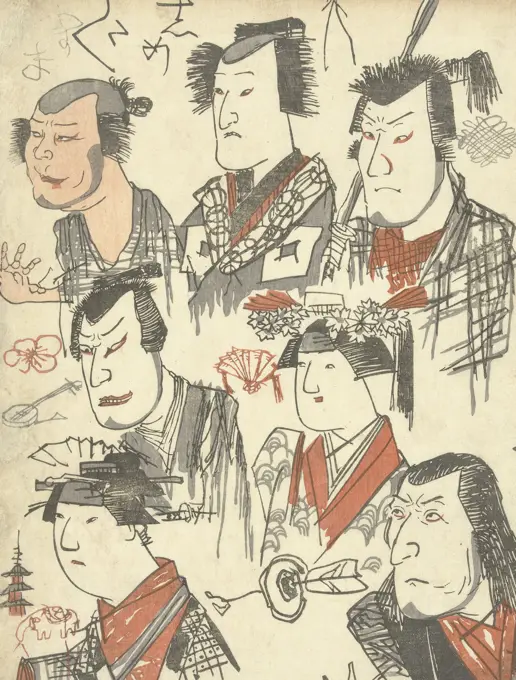
Japan, Ibaya Senzaburô, Kinugasa Fusajiro, Hama Yahei, Kuniyoshi, Utagawa, Nitakaragura kabe no mudagaki, Scribbles on a department store wall, Seven portraits of actors, under print - stamped, Wall with graffiti depicting seven portraits of actors, a fan, a stringed instrument, a pagoda and an elephant., print, prints, Japan (collection), height 366 mm, width 257 mm, Japanese, 1798 - 1861-04-14, print maker, 1847 - 1847, second quarter 19th century, paper, papier, nishiki-e, color woodcut, censor, Publication (Event), Publication, publisher
4168-14152
China, Gansu Province, Dunhuang, Mosaic Tiled Wall
4443-73252886
Nihonbashi, Matsuki Heikichi, Japan, Kôgyo, Tsukioka, Nogaku zue, Pictures of Noh plays, Yamauba, Scene from the Nog play 'Yamauba', verso - stamped, Actor in the role of the old woman Yamauba, with a wild grey wig and a fan in her right hand., print, prints, Japan (collection), height 244 mm, width 358 mm, 1869 - 1927, print maker, printmaker, 1898-08 - 1898-08, fourth quarter 19th century, paper, silver powder, bronze powder, colour woodcut, Publication (Event), Publication, Japanese, publisher
1899-18788950
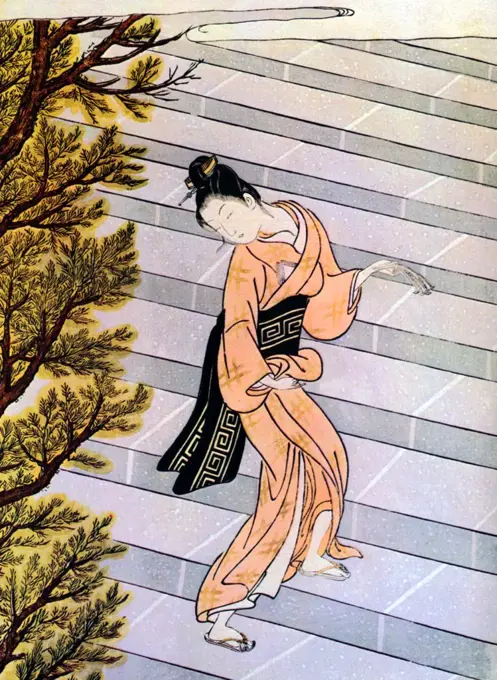
Suzuki Harunobu (1724 July 7, 1770) was a Japanese woodblock print artist, one of the most famous in the Ukiyo-e style. He was an innovator, the first to produce full-color prints (nishiki-e) in 1765, rendering obsolete the former modes of two- and three-color prints. Harunobu used many special techniques, and depicted a wide variety of subjects, from classical poems to contemporary beauties (bijin, bijin-ga). Like many artists of his day, Harunobu also produced a number of shunga, or erotic images. During his lifetime and shortly afterwards, many artists imitated his style. A few, such as Harushige, even boasted of their ability to forge the work of the great master. Much about Harunobu's life is unknown.
6145-29131471
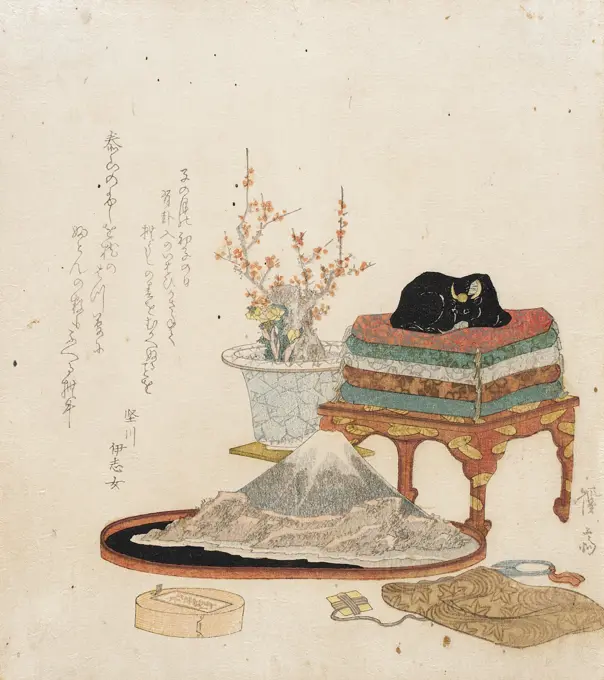
Still Life with 'Stroking Ox'. Keisai Eisen (Japan, 1790-1848). Japan, 1829. Prints; woodblocks. Surimono; color woodblock print with mica on paper
4443-28725685
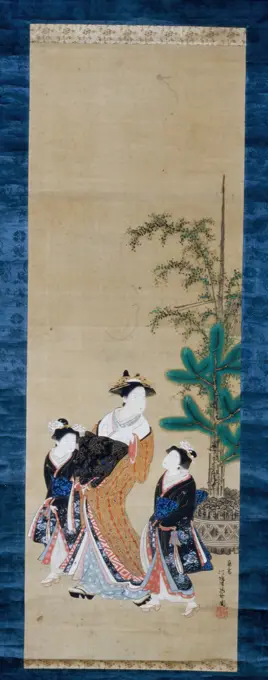
Prostitute with Two Attendants, second half 18th century, Isoda Koryūsai, Japanese, 1735 - 1790 , 40 3/16 x 13 3/4 in. (102 x 35 cm) (image)71 5/8 x 18 11/16 in. (182 x 47.5 cm) (mount) 53 cm w w/rollers, Hanging scroll; ink and color on paper, Japan, Nikuhitsu ukiyo-e, The two girls are kamuro, young attendants of high-class prostitutes. They are trainees and will ultimately become prostitutes themselves, the debut of whom was always an important event in the pleasure quarters. In the back is a kadomatsu, literally 'gate pine,' a traditional New Year’s decoration made of pine, bamboo, and sprigs of flowering plum trees.
6145-30094398
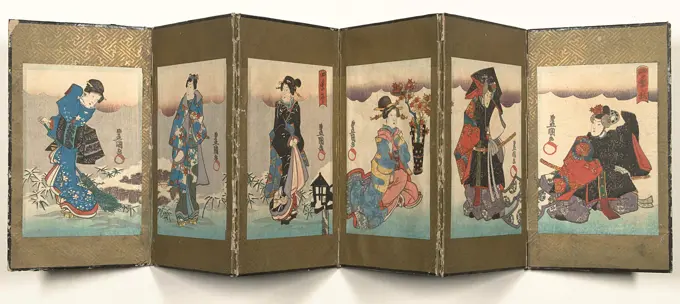
Herfst en winter; Vier seizoenen; Shiki.Left screen of two-piece miniature room screen; From right to left: AKI - Fall, two men and a woman at autumn branches; Fuyu - winter, two women and a man at snowy bamboo branches. Back side screen: blue and green flower pattern against gray background.
4409-28959690
From a series of sixteen scenes of the death and burial of a man in Japan. Date: 19th century. Japan watercolor on silk or paper. Museum: Cooper Hewitt, Smithsonian Design Museum.
6145-45302777
Sketches of figures and objects, as well as animals and plants, from the series: Fifty three stages of the Tokaido Road /Tokaido gojusan zugi HIROSHIGE, Ichiryusai (1797 1858)
4409-53866
Japan. Florist. Colored engraving from 1882.
1525-22367281
Fan
4409-17447360
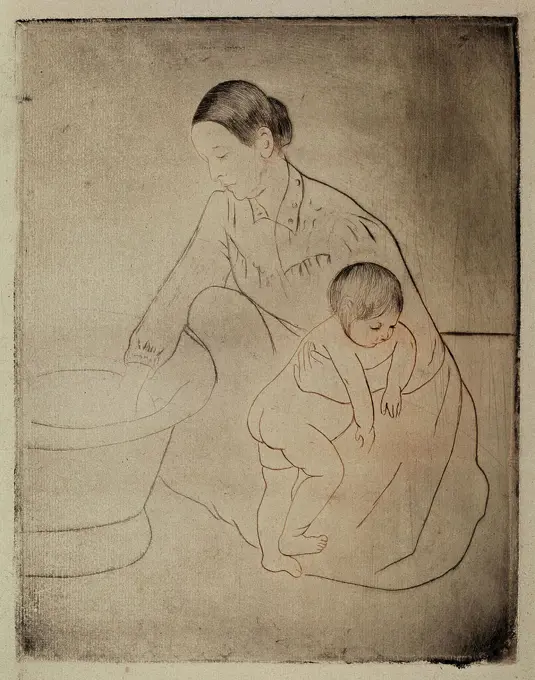
The Bath. Dated: 1890-1891. Dimensions: plate: 32.07 × 24.77 cm (12 5/8 × 9 3/4 in.). Medium: drypoint and softground etching in black. Museum: National Gallery of Art, Washington DC. Author: Mary Cassatt.
1899-18713262
T. Enami (Enami Nobukuni, 1859 - 1929) was the trade name of a celebrated Meiji period photographer. The T. of his trade name is thought to have stood for Toshi, though he never spelled it out on any personal or business document. Born in Edo (now Tokyo) during the Bakumatsu era, Enami was first a student of, and then an assistant to the well known photographer and collotypist, Ogawa Kazumasa. Enami relocated to Yokohama, and opened a studio on Benten-dori (Benten Street) in 1892. Just a few doors away from him was the studio of the already well known Tamamura Kozaburo. He and Enami would work together on at least three related projects over the years. Enami became quietly unique as the only photographer of that period known to work in all popular formats, including the production of large-format photographs compiled into what are commonly called 'Yokohama Albums'. Enami went on to become Japan's most prolific photographer of small-format images such as the stereoview and glass lantern
4453-20019794
The Allegory of the Sorbonne by Pierre Puvis de Chavannes; oil on canvas; 1889
6145-48887784
Winding Off the Silk From the Cocoons. Shinichi Suzuki (Japanese, 1835 - 1919)
4409-21520426
Momoyogusa = Flowers of a Hundred Generations., Kamisaka, Sekka, (Artist), Date Issued: 1909.
PREVIOUS
of 2
NEXT
2401 S. Ervay, Suite 206
Dallas, Texas 75215
United States
Get Started
Free ResearchMy BoardsMy Cart
For Creators
How To License Your ContentContributor PortalFrame of Mind
Resources
API accessPricing
Contact
+1 866 236 0087help@viewpictures.co.uk Contact form
©2026 View Pictures. All Rights Reserved. -A
This site is protected by reCAPTCHA and Google Privacy Policy and Terms of Service apply.