Elegant Historical Fashion Accessories

A collection of vintage clothing accessories including bonnets, sleeves, and brocade fragments, showcasing intricate details and historical textiles.
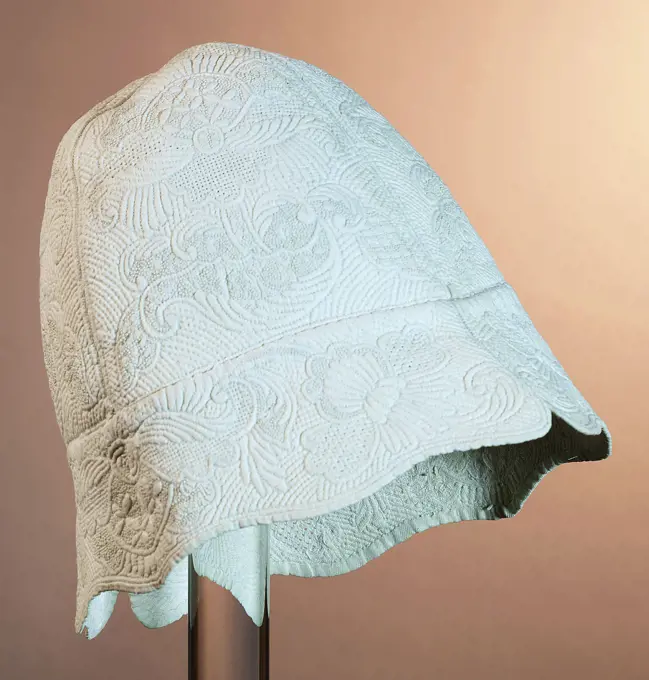
Kraammansmuts, typical cap worn by new fathers, made of white cotton, ball with Zaans stitching, cap hat cap headgear men's clothing linen cotton, filling, textile Cap hat made of white cotton ball with Zaans stitching of four parts with sewn-in edge edge man dress head cover night inside house birth maternity period
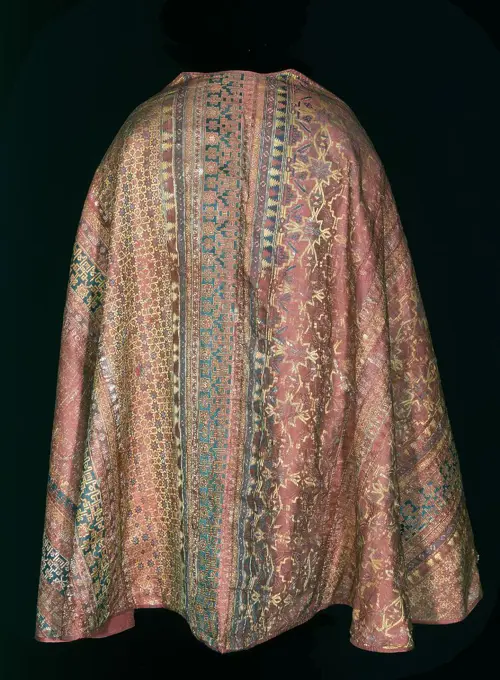
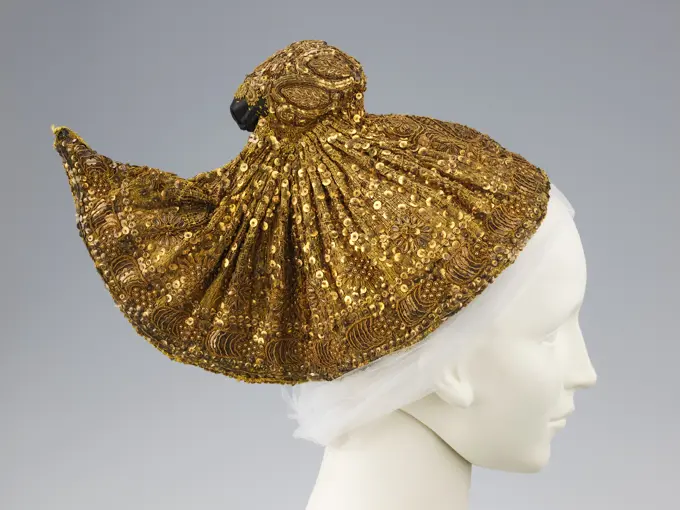
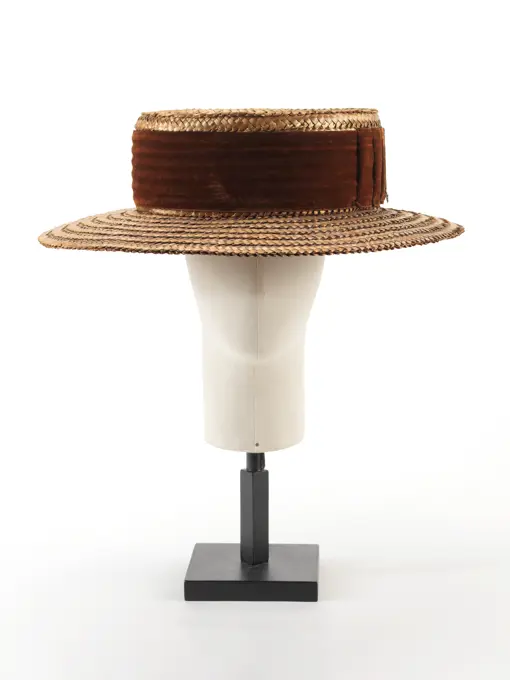
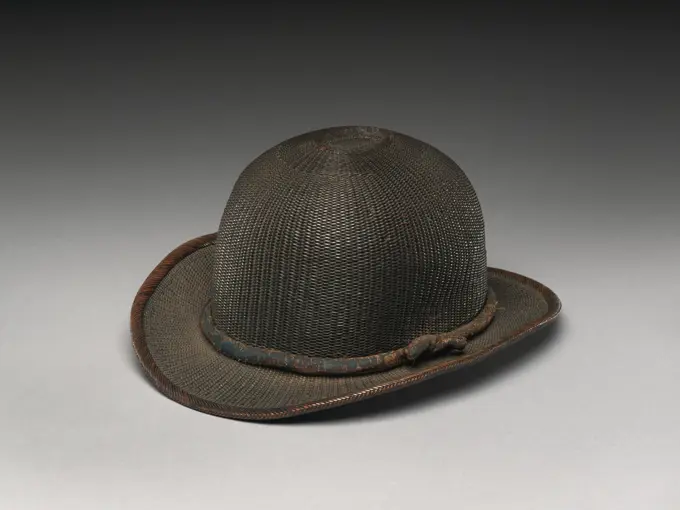
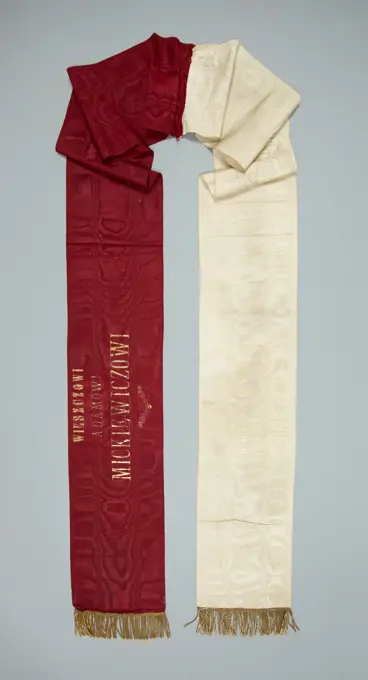
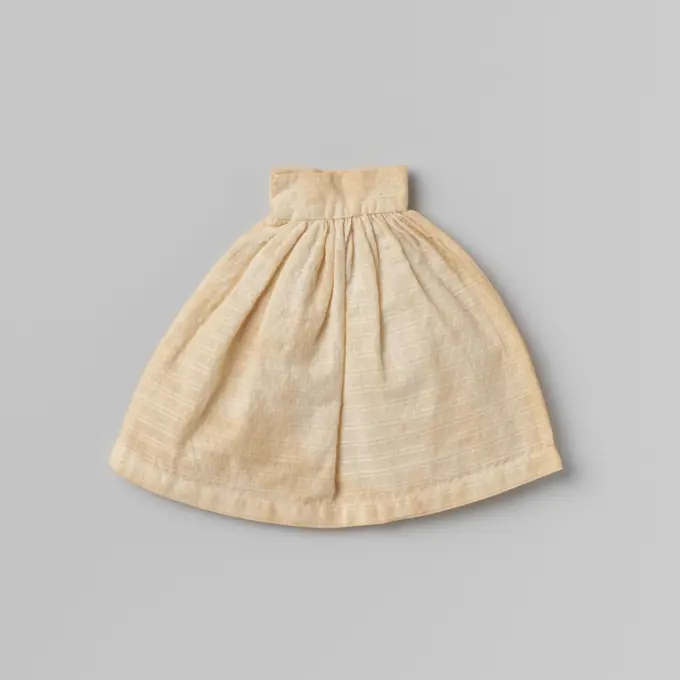
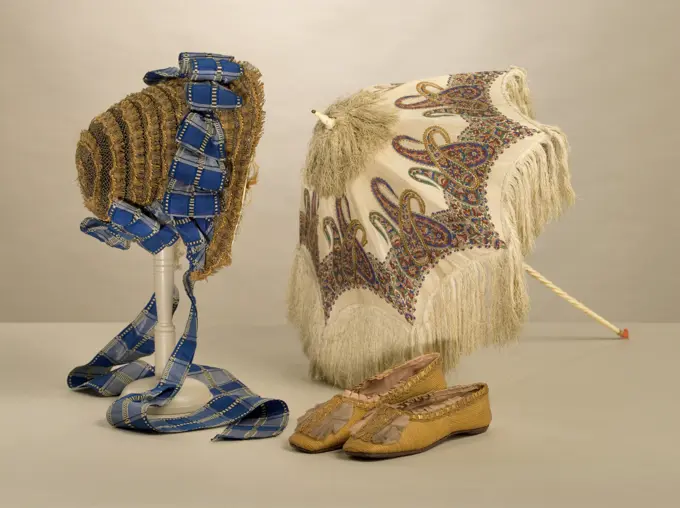
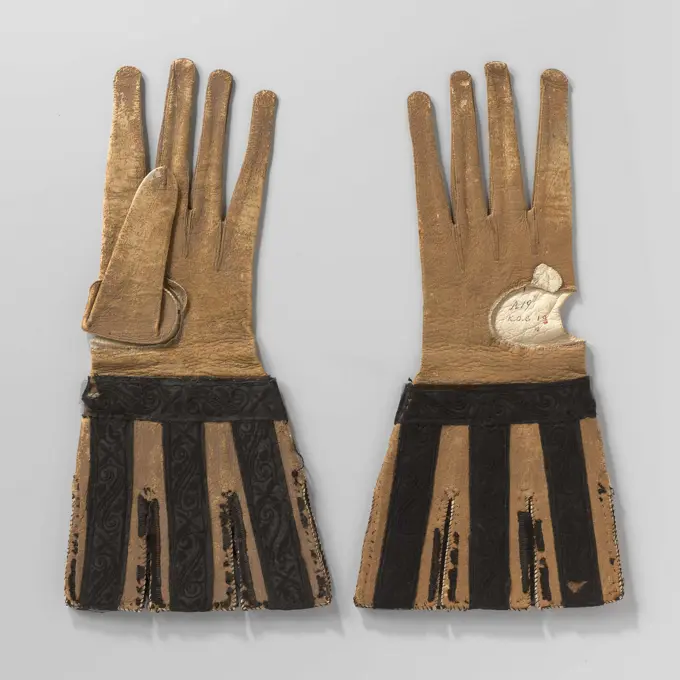
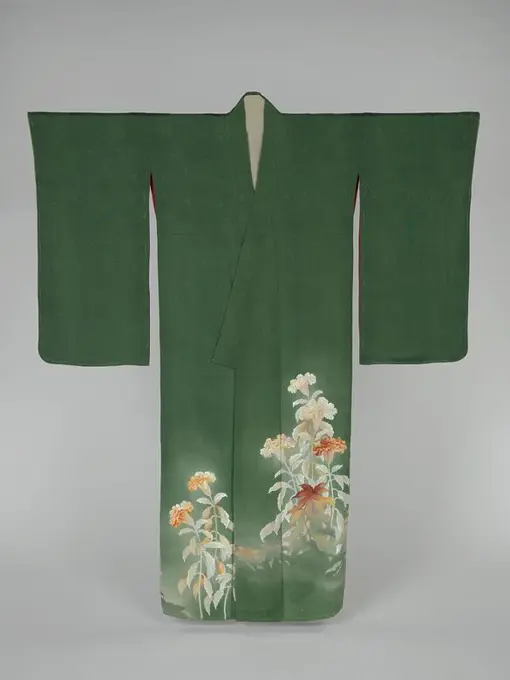
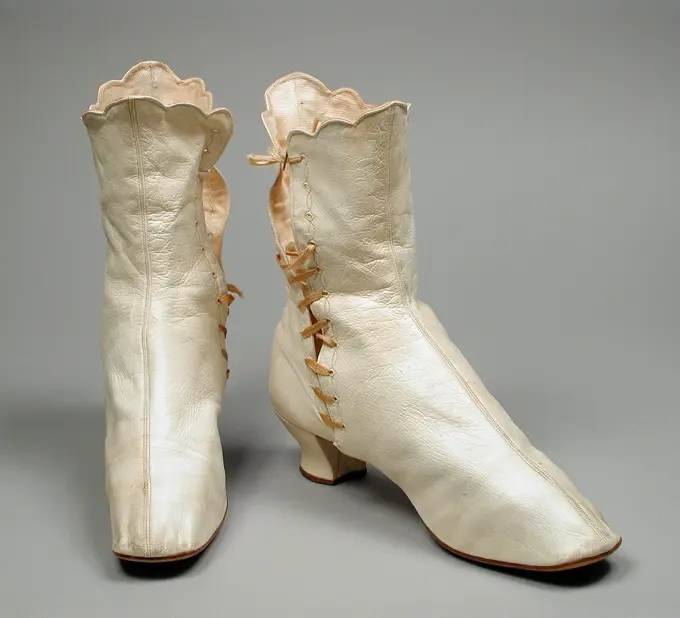
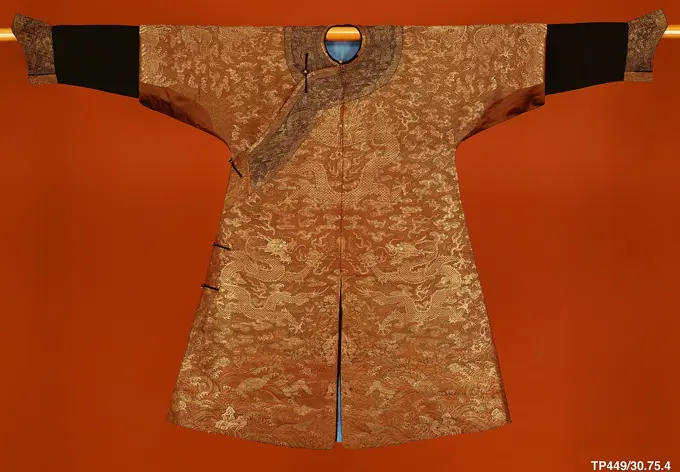
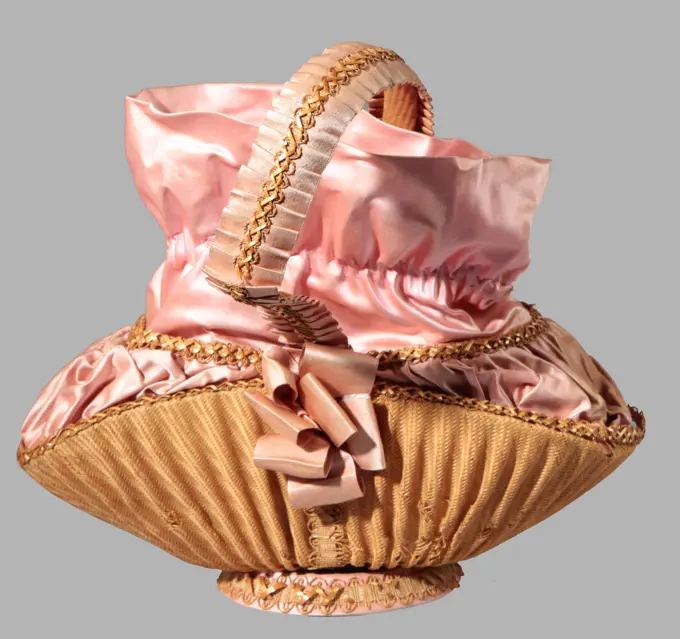
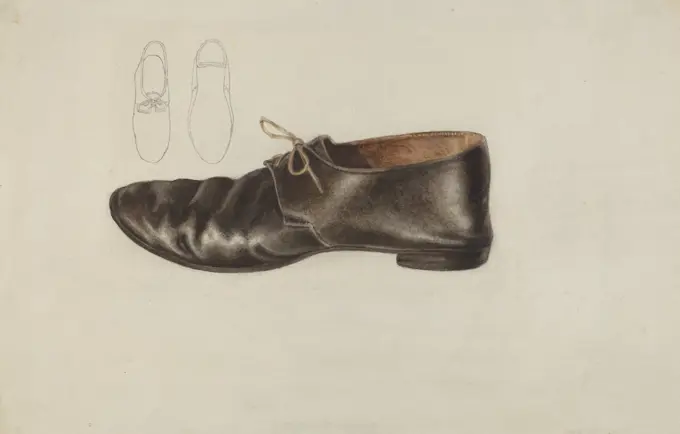
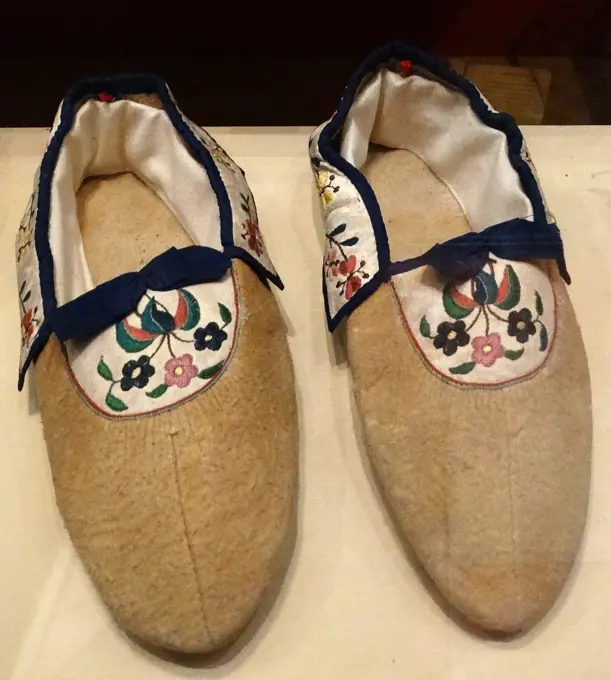
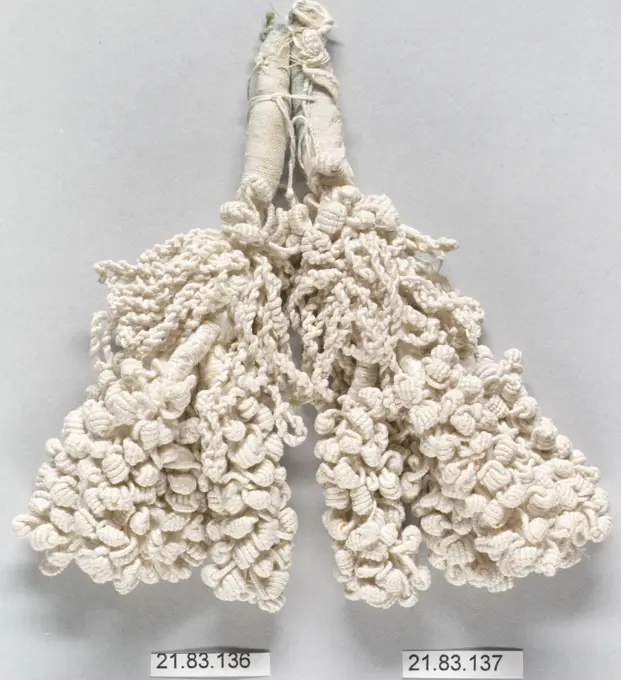
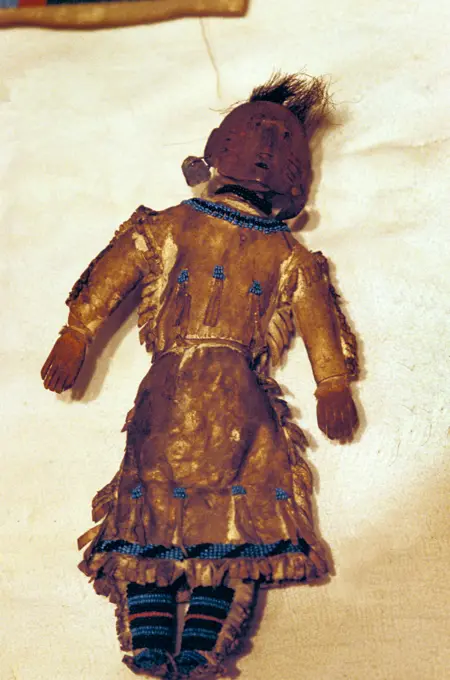
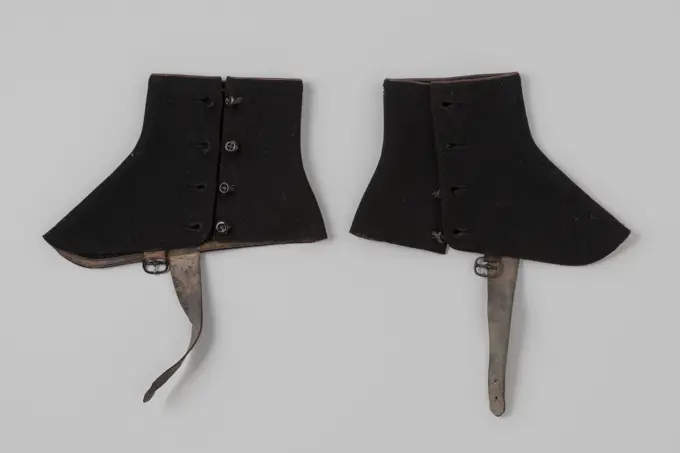
Slobbouses of black sheet with four black buttons and a leather belt with metal buckle, The Diamond Gaiter, c. 1900 - c. 1930 Slobbouses of black sheet with four black buttons and a leather belt with metal buckle. Seams inside with leather piping. Black satin trim along the top edge on which: 'The Diamond Gaiter. Reg'd '. England whole: Cloth. Buttons:. Buckle: Metal. Bies: Leather. Bies: Silk Slobbouses of black sheet with four black buttons and a leather belt with metal buckle. Seams inside with leather piping. Black satin trim along the top edge on which: 'The Diamond Gaiter. Reg'd '. England whole: Cloth. Buttons:. Buckle: Metal. Bies: Leather. Bies: SilkReticule in a flat model, of black velvet, decorated with a regular pattern of subs of silver -colored steel beads, anonymous, c. 1850 - c. 1870 Reticule in a flat model consisting of two pattes of black velvet. The front and back is decorated with a regular pattern of subs of silver-colored steel beads. Along the two sides short, diagonal jobs of six beads each, at the bottom loops of steel beads. Through the tunnel on the top edge a twisted, dark cord. Lining of solid beige -colored linen. West-Europa whole: velvet (fabric weave). Decoration: Steel (Alloy). Lining: Linen (Material). Cord: Cotton (textile) cutting / grinding / gilding Reticule in a flat model consisting of two pattes of black velvet. The front and back is decorated with a regular pattern of subs of silver-colored steel beads. Along the two sides short, diagonal jobs of six beads each, at the bottom loops of steel beads. Through the tunnel on the top edge a twisted, dark cord. Lining of solid beige -colored linen. WestCAPA PLUVIAL NAZARI - SIGLO XV. Location: INSTITUTO VALENCIA DE DON JUAN-COLECCION. MADRID. SPANIEN.Pocket, Medium: cotton Technique: quilted, knitted edging, Woman's pocket in a pattern of a symmetrical floral form with knitted trim., England, 18th century, embroidery & stitching, PocketSummer hat of braided beige nylon with tire of brown velvet, anonymous, c. 1950 Summer hat of coarse braided beige nylon, imitation of straw. On the hat a tire of brown velvet. Flambard type, high sphere with ring-dent. Rand asymmetrical from the front, hanging on the right, left short and outstanding. Foldered outer edge, reinforced by a laiton. Stras on the tire of velvet. Netherlands (possibly) geheel: nylon. band: velvet (fabric weave). gesp: paste (glass) braiding Summer hat of coarse braided beige nylon, imitation of straw. On the hat a tire of brown velvet. Flambard type, high sphere with ring-dent. Rand asymmetrical from the front, hanging on the right, left short and outstanding. Foldered outer edge, reinforced by a laiton. Stras on the tire of velvet. Netherlands (possibly) geheel: nylon. band: velvet (fabric weave). gesp: paste (glass) braidingGloves. Culture: British. Date: 17th century. Museum: Metropolitan Museum of Art, New York, USA.While unknownSlippers mid-19th century American. Slippers 98058Boots 1830s American. Boots 112740Parasol early 18th century Italian. Parasol 122615Saccos. Culture: Russian. Dimensions: L. 52 1/4 x W. (includ. sleeves) 54 1/2 inches (132.7 x 138.4 cm). Date: 1802. Museum: Metropolitan Museum of Art, New York, USA.BabyschoentjeCap fourth quarter 19th century Austrian The form of the traditional flügelhaben bears a striking resemblance to Roman helmets. The city of Linz was founded by the Romans and became an important trading post in the Holy Roman Empire. This cap provides an excellent example of the continuity of traditional folk costume throughout generations.. Cap 156290Beige felt gloves. Decorated with floral pattern on the hood, c. 1723 - c. 1749 Left glove from beige felt. Decorated with floral pattern on the hood on inside and outside. Three radiating cords on the back. Fully lined with felt. Glove of the Haarlem giant D. Cajanus. West-Europa whole: Wool Left glove from beige felt. Decorated with floral pattern on the hood on inside and outside. Three radiating cords on the back. Fully lined with felt. Glove of the Haarlem giant D. Cajanus. West-Europa whole: WoolGloves early 18th century probably Spanish. Gloves 170255Hat with a full -knit bull in fine knitwear, trimmed with a strip of Rijssel side folded along the forehead, anonymous, c. 1800 - c. 1900 Hat with a full -knit ball ball in fine knitwear, trimmed with a strip of Rijssel side that is folded along the forehead. Friesland whole: Linen (Material) knitting / Lille lace Hat with a full -knit ball ball in fine knitwear, trimmed with a strip of Rijssel side that is folded along the forehead. Friesland whole: Linen (Material) knitting / Lille laceBatist sub-sleek with cuff from Valenciennes side, c. 1880 - c. 1900  Batist sub-sleek with cuff from Valenciennes side. West-Europa cambric. MANDER: Valenciennes laceManchu Woman's Shoe late 19th-early 20th century China. Manchu Woman's Shoe 69725Wedding shoes 1889 American. Wedding shoes 113175Cape. Dated: 1935/1942. Dimensions: overall: 29.2 x 22.8 cm (11 1/2 x 9 in.). Medium: watercolor and gouache on paper. Museum: National Gallery of Art, Washington DC. Author: Charles Criswell.CDK unknownClose-up of pebbles in a bagChild's Hat, 20th century, 14 1/2 x 8 1/2 x 9 in. (36.8 x 21.6 x 22.9 cm), Silk, China, 20th centuryMary Jane -Dirty checked shirtPair of tassels 17th century Italian. Pair of tassels. Italian. 17th century. Linen. Textiles-TrimmingsAccessory set 1870s British. Accessory set 83767Evening slippers 1885-95 French. Evening slippers 168348Wedding boots 1871 Belgian. Wedding boots 168804Kosode Made 1775-1800 Japan. Silk and gold-leaf-over-lacquered-paper strips, warp-float faced twill weave with weft float faced twill interlacings of secondary binding warps and supplementary patterning wefts; interlined with cotton, plain weave .Pair of Woman's Shoes. Probably England, 1750-1760. Costumes; Accessories. Silk damask and leatherNew galleries, 1905. Braided straw, silk velvet. Cut steel. Cotton canvas. Palais Galliera, fashion museum of the city of Paris.Suit 1894 American. Suit 103797Cap 1863-65 probably American. Cap 116702Bowler Hat ca. 1880s-90s Hayakawa Shkosai I Among the more unusual works by Hayakawa Shkosai I is a Westernstyle rattan bowler hat made with mat plaiting (gozameami) and other traditional techniques. Favored by Ichikawa Danjr IX (1838-1903), the greatest Meijiperiod star of the Kabuki theater, Shkosai’s hats are a great example of the careful balance he struck between the complex Chinese techniques and his own innovations inspired by Japanese art and Western culture.. Bowler Hat. Hayakawa Shkosai I (Japanese, 1815-1897). Japan. ca. 1880s-90s. Timber bamboo, rattan, and brocaded silk. Meiji period (1868-1912). BambooBoy unknownA sash from the funeral of Adam Mickiewicz in Krakow on July 4, 1890Chaleco de Indianas, Mallorca, M.A.I.T.P.Drawers -Undersleeves ca. 1850 American. Undersleeves. American. ca. 1850. CottonUnderwear with window and striped motif, Anonymous, c. 1750 - c. 1800 A underskirt of white cotton with narrow window and stripe pattern; arranged on the tire of the same fabric; No closure at the split; Zoom on the bottom. Netherlands cotton (textile) A underskirt of white cotton with narrow window and stripe pattern; arranged on the tire of the same fabric; No closure at the split; Zoom on the bottom. Netherlands cotton (textile)Closeup of a colorful  zipper with metal teethReticule (France); silk, painted paper, wireGlass glove, short model, clasp with three buttons of mother-of-pearl. Left glove from glacer leather. At the wrist a split with three mother-of-pearl buttons. On the hand three stitched lines.Capot, blacksmith, pumps. Shadow: Cover in Cream Silk Print with polychrome arrangements, Cream silk canvas, Metal carcass with eight branches, pink and white glass needle, flowing in chiseled gold, tip, mast and twisted ivory handle, coral pearls . Capote: Like decorated with straw lace arranged in a spiral; Scottish ribbon. Pumps: blonde straw, knot and lining in pale pink silk taffeta, leather sole. 1848-1860. Galliera, fashion museum of the city of Paris. Spiral arrangement of straw lace. Scottish ribbon. Accessory, needle, ring, white, hood, cord, blue tile, shoe, flow, cover, polychrome arrangement, lining, tip, pump, female, printing, twisted ivory, handle, mat, metal, shadow, gold chisel, white straw , Coral pearl, pale pink, ribbon, silk canvas cream, pink glassEvening hat ca. 1888 Carpenter. Evening hat 156785Boots ca. 1862 American. Boots 104019Ceremonial Uniform: Skirt, 1644-1911. China, Qing dynasty (1644-1911). Satin weave silk with gold metal thread embroidery; supplementary weft; black velvet; metal (brass); lined in blue silk; overall: 106.1 x 127 cm (41 3/4 x 50 in.).DELANTAL NEGRO-S XIX CAT 456. Author: BALENCIAGA CRISTOBAL. Location: EXPOSICION BALENCIAGA. Lyon. France.American 20th Century, Silk Bonnet, c 1940 Silk BonnetFoot. Egypt, Hellenistic Period (400 - 150 BCE). Sculpture. TerracottaWall Pocket Made 1770-1780 Staffordshire. Lead-glazed earthenware (creamware) .Pair of boots, c. 1900, 15 5/16 x 4 x 12 1/4in. (38.9 x 10.2 x 31.1cm), Leather, ox hyde, Mongolia, 19th-20th centuryLace and Straw Bonnet. Dated: c. 1940. Dimensions: overall: 47.8 x 42 cm (18 13/16 x 16 9/16 in.). Medium: watercolor and graphite on paperboard. Museum: National Gallery of Art, Washington DC. Author: Henry De Wolfe.Pair of Gloves 1795-1805 Barcelona. Leather, copper plate printed . Willhelm König (Influence)Mitts 19th century American. Mitts 98121Glove from glacer leather with opening to side seam, on hand perforations between which swinging decoration of cord that has been achieved by perforations. Left glove from glacer leather. Opening to the side seam. His perforations are applied, between which swinging decoration of natural cord that has been achieved by the perforations.Afternoon hat 1897 American. Afternoon hat 112943Shaker Glove. Dated: 1935/1942. Dimensions: overall: 36 x 25.6 cm (14 3/16 x 10 1/16 in.). Medium: watercolor, pen and ink, and graphite on paper. Museum: National Gallery of Art, Washington DC. Author: Elizabeth Moutal.FAJA DEL GRAL CANTERAC. Location: ALCAZAR / MUSEO DEL EJERCITO-COLECCIÓN. Toledo. SPANIEN.Evening slippers 1845-65 P. Rouillier. Evening slippers 168927Shoes ca. 1900 J. & J. Slater American. Shoes 107301Man's Shirt Man's Shirt, 19th century. Embroidered muslin, 66 15/16 x 44 1/2 in. (170 x 113 cm).   Arts of Africa 19th centuryClose-up of traditional Chinese outfits embroidered on a boxDoll from South Africa,  1925-1992Europe, The Netherlands, Holland, Amsterdam, Klederdracht Museum, Dutch Costume Museum. Lace head wear.Evening slippers ca. 1894 J. & J. Slater American. Evening slippers 168344Women's court shoes. unknown, author. Goat's right glove () Leather, urge-colored painted with incised, loose caps decorated with black satin strap embroidered with a floral pattern in black silk. Model: Long narrow fingers whose stitch through on top of hand to wake up the illusion of even longer fingers. The thumb is partially loose. Sewn with green silk. The loose caps are set to the glove with coarse stitches. These caps are reinforced with three layers of gray paper and originally lined with black satin that is largely perished. Along the incisions, the caps are deposited with long-haired black silk passion (largely perished), which is roughly coated with black silk. The hand is unfinished. Decoration: The exterior of the glove seems to be colored with a pasta-like paint ocher yellow. The caps are decorated with black satin strap, embroidered with a black side where the stitches were inserted through the leather and the paper. The leaf and floral pattern is made up of volutes in cord stitch over a black silk wire, Doll from Greece,  1925-1992Kimono with Cockscomb Flowers. Culture: Japan. Dimensions: Overall: 60 7/16 x 50 9/16 in. (153.5 x 128.5 cm).The early twentieth century saw an interest in objective, near-photographic naturalism in yuzen-dyed and painted kimono patterns, such as the stand of cockscomb flowers on the lower half of this robe. In English and Japanese, the name of the showy cockscomb flower, or keito (literally, "chicken's head"), celebrates the flamboyant head of the rooster. The pattern on this robe could almost serve as an illustration of a 1915 poem by Nagatsuka Takashi (1879-1915), who was known for his acute sensitivity to the progression of the seasons:Keito wa hietaki aki no hi ni haete iyo-iyo akaku sae ni keru kamo Cockscomb flowersresponding to the chillof autumn dayswill turn even redder when the sun comes up.--Trans. John T. Carpenter. Museum: Metropolitan Museum of Art, New York, USA.Glove of gray beige leather, anonymous, c. 1900 - c. 1915 Left glove made of gray beige leather. Two radiating cords on the back. West-Europa whole: Chamois (Animal Material) Left glove made of gray beige leather. Two radiating cords on the back. West-Europa whole: Chamois (Animal Material)Shoe, flat, with cover sheet and heel of incised - to light yellow - velvet and equipped with beef leather sole with a geometric decoration, tire closure on the instep, anonymous, c. 1550 - c. 1574 Shoe, flat, from incised - to light yellow faded - originally apple green velvet with beef leather sole. The model consists of a cover sheet, two equal heel pieces or 'quarters' and a sole. The, high -ray -ended, cover sheet is decorated with 63 horizontal cuts with feston stitches. The nose is unadorned and somewhat bone. The heel is divided into eight equal parts by means of six long, vertical, fested incisions. From the heel part, two narrow, tires extended to tires end in a festonated, round opening. In the middle of the instep there are two identical fested round openings, which are closed together with the loose tires by means of a (missing) lace on top of the instep. The shoes are lined with a solid light sides fabric. On the inside, a remnant of the original color of the velvet is stWoman's Boots. probably United States, 1870. Costumes; Accessories. LeatherShoes 1845-65 American. Shoes. American. 1845-65. LeatherBliżej Kultury unknownRoach headdress -High angle view of a chair with a pair of sandals beside itImperial Court Robe China. Imperial Court Robe 68509Sombrero femenino, siglo XIX, MTIB89525. Museu Textil i d'Indumentaria de Barcelona.Child gloves of Gijs Zemkin. Right child gloves from Gijs Zemkin. Three ljen on the back and close with pearl nuts button at the back of the hand.Pair of Gauntlets, 1500s. Europe, 15th century. Chain mail;Poke bonnet ca. 1835 American. Poke bonnet 98072Striped uniform worn by prisoners in Nazi concentration camps.Wedding slippers 1867-75 probably American. Wedding slippers 168585Basket.Lucille Chabot, Shoe, 1935 1942 ShoeAnn Gene Buckley, Dancing Slipper, 1935 1942 Dancing SlipperPromenade bonnet 1851-62 American. Promenade bonnet 113216Umbrella early 19th century British. Umbrella 98237Fashion, Italy, 19th century. Straw hat with silk ornament and copper brooch.Mandarin Hat 20th century China Officials' hat feathers could include one, two, or three peacock-feather eyes; this example has two. The emperor bestowed the feathers on officials for meritorious service, and the greater the number of eyes, the higher the honor. Near the end of the dynasty, however, such hat feathers were widely available in shops.. Mandarin Hat. China. 20th century. Satin, velvet, glass, jade. Qing dynasty (1644-1911). Costumes-WovenPlains Cree, women's handmade moccasins, Canadian. Dated 1900Gaiter. False pair of US gaiters for foot troop. Canvas sewn machine, ink, painted metal, 1942-1943. General Leclerc Museum of Hauteclocque and the Liberation of Paris, Jean Moulin Museum. 78985-13 American army, military equipment, 1939-1945 war, war 39-45, Guetre, Second World WarPair of tassels 17th century Italian. Pair of tassels. Italian. 17th century. Linen. Textiles-TrimmingsAntique Blackfeet wooden doll in deerskin clothingHat104.epsStroller from A. W. Nilsson factories, Malmö.166.eps