Elegant Lace Strips

Delicate strips of vintage lace featuring intricate floral and geometric patterns in soft natural tones, showcasing textile craftsmanship.

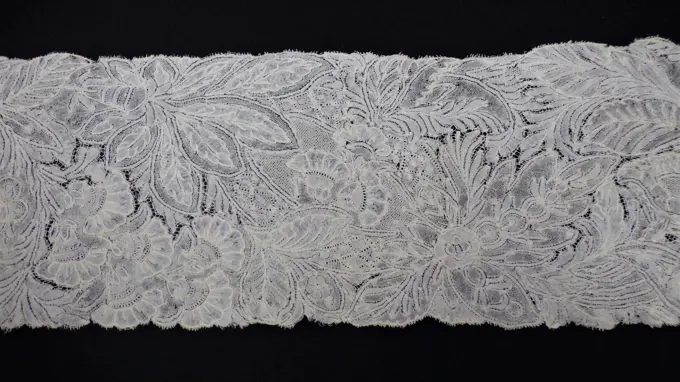
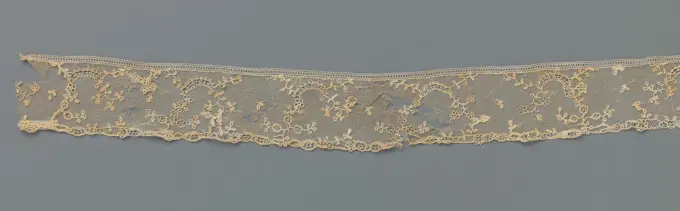
Strip Application side with grape bunches and halved leaves, anonymous, c. 1850 - c. 1890 Strip of natural -colored application side, bobbin lacquered on mechanical tulle. A narrow part, along the inside, shows a running pattern of halved, lobed leaves, which also accompanies a halved medallion with grid filling. On a wide part with a tulle surface are symmetrical, deep sculptures, which are alternately filled with a grape vice and a fan plant. Belgium (possibly) linen (material) Strip of natural -colored application side, bobbin lacquered on mechanical tulle. A narrow part, along the inside, shows a running pattern of halved, lobed leaves, which also accompanies a halved medallion with grid filling. On a wide part with a tulle surface are symmetrical, deep sculptures, which are alternately filled with a grape vice and a fan plant. Belgium (possibly) linen (material)
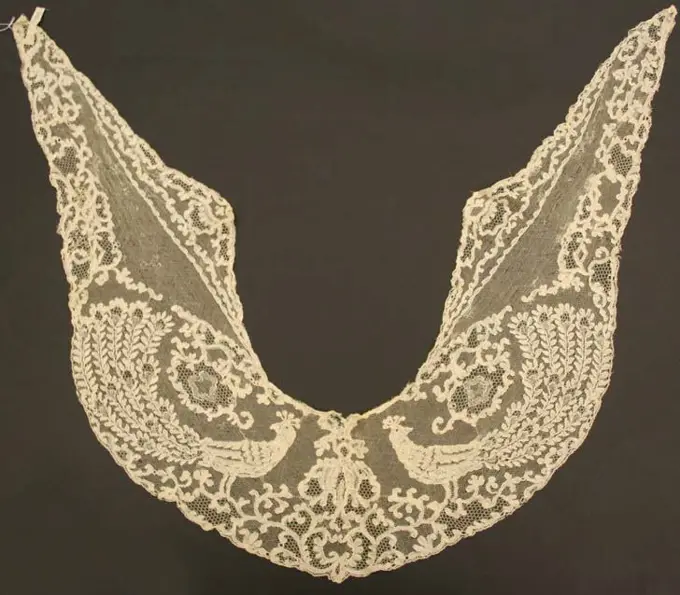
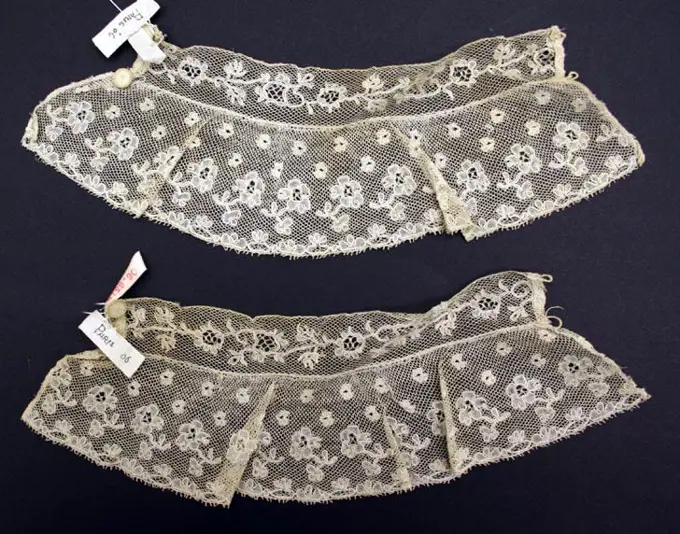
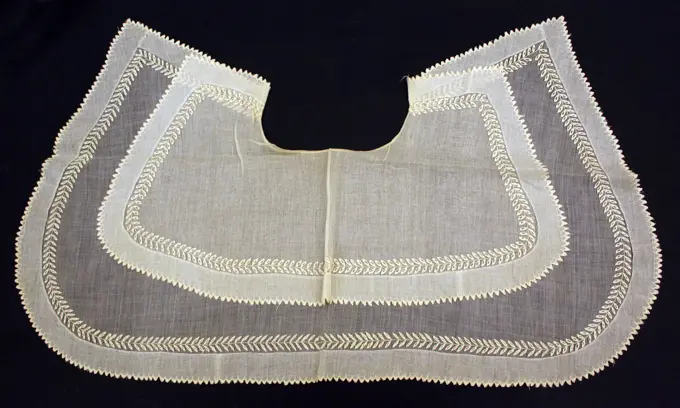
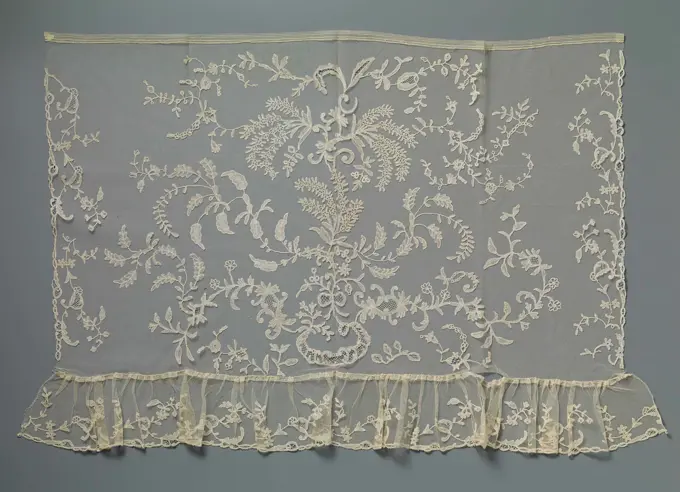
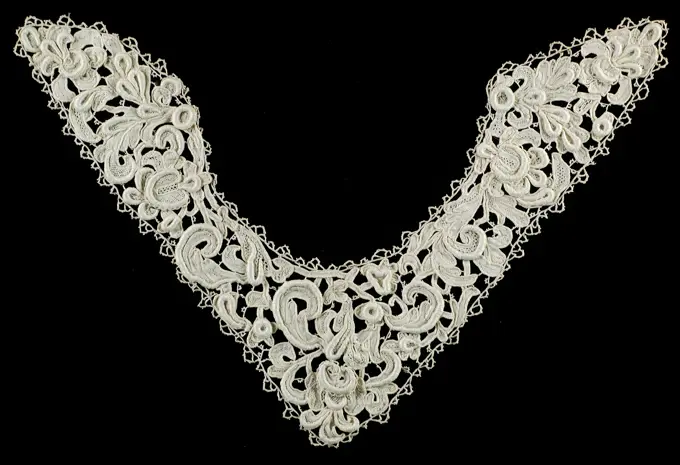
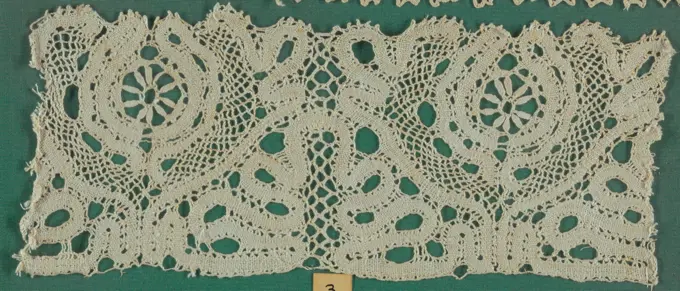
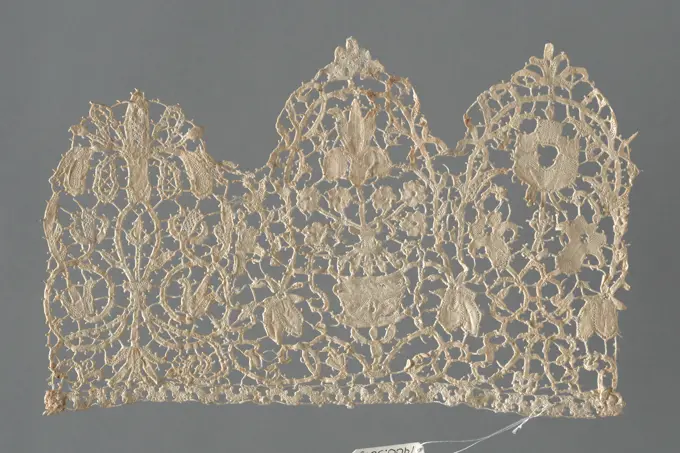
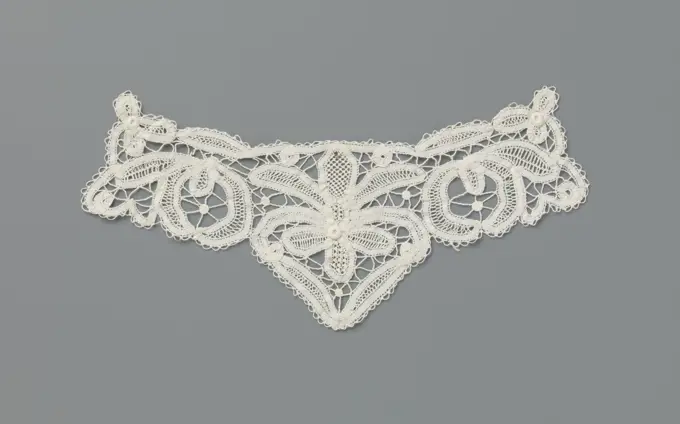
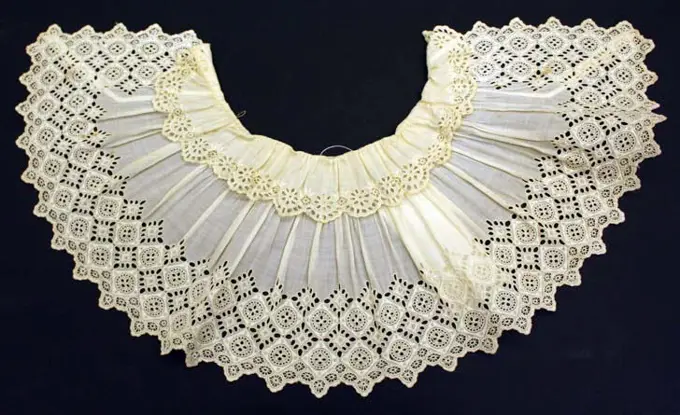
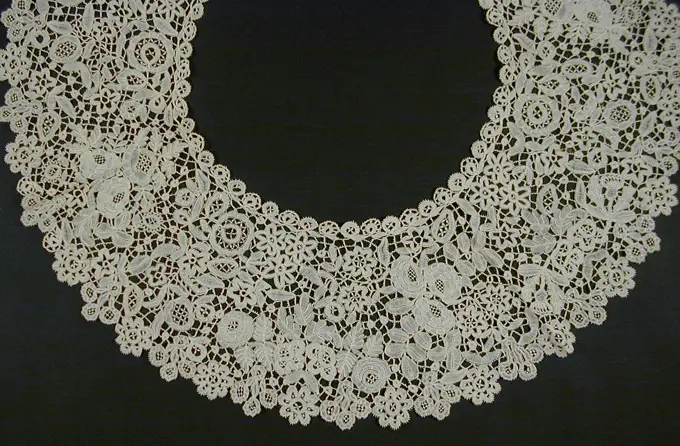
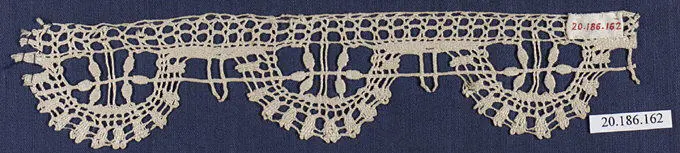
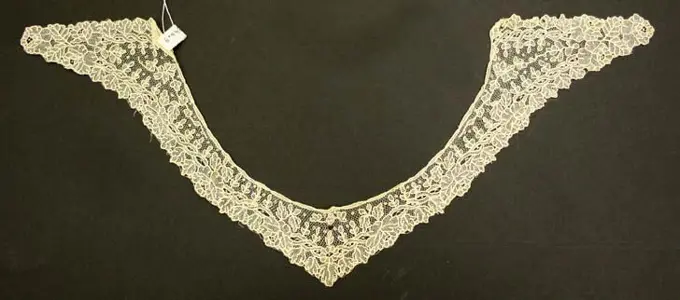
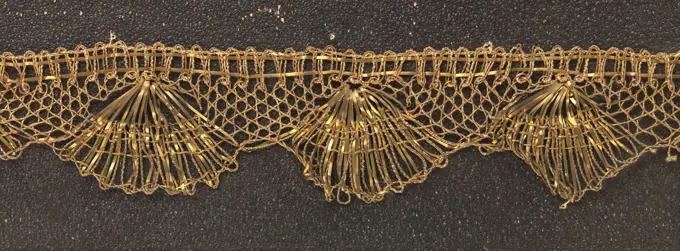
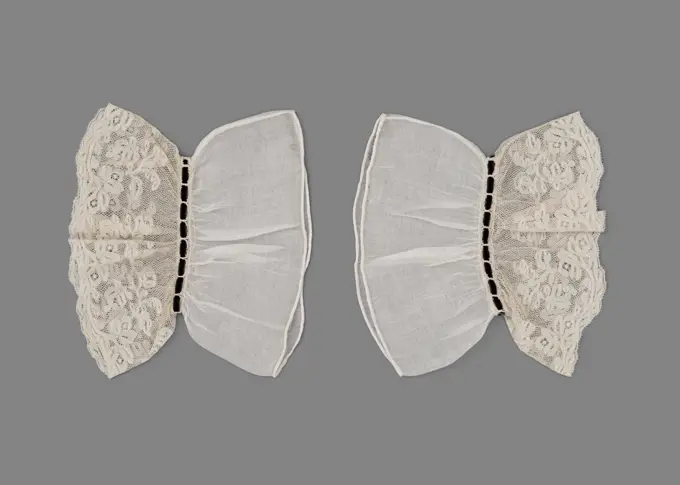
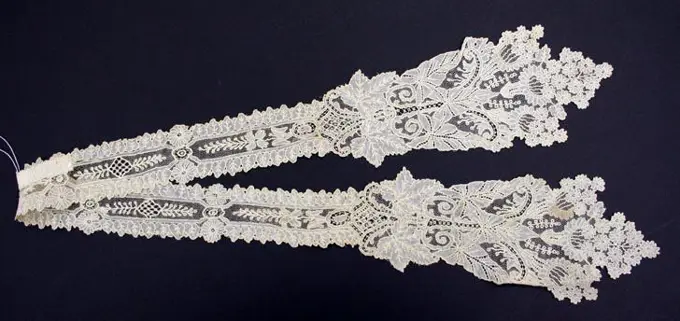
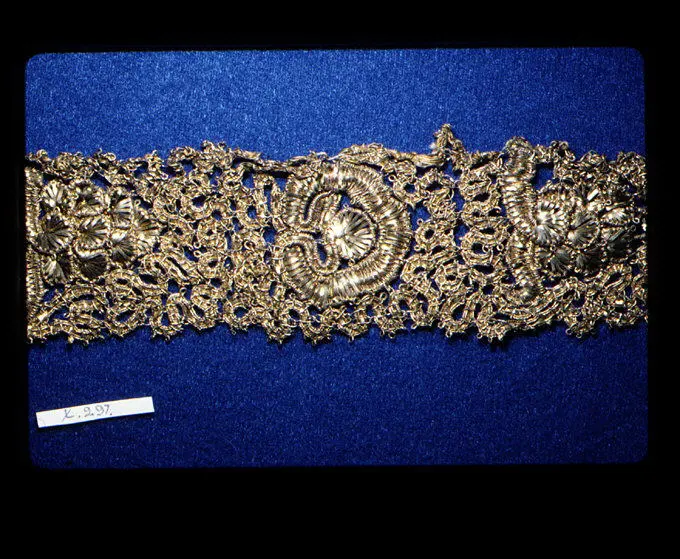
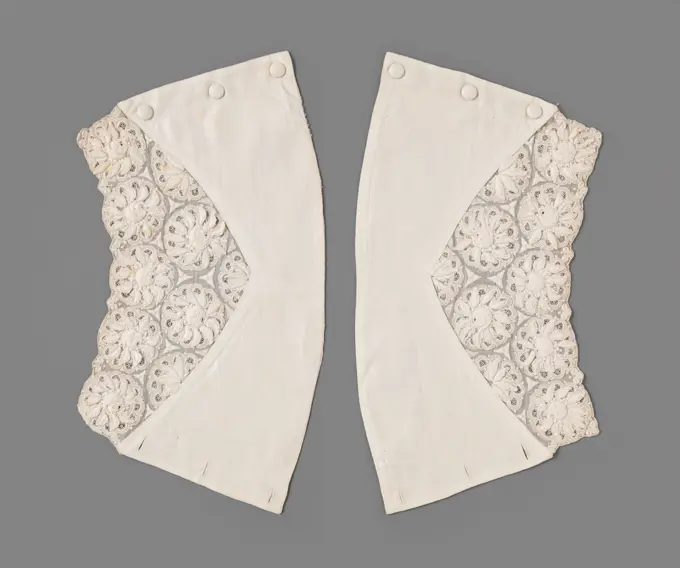
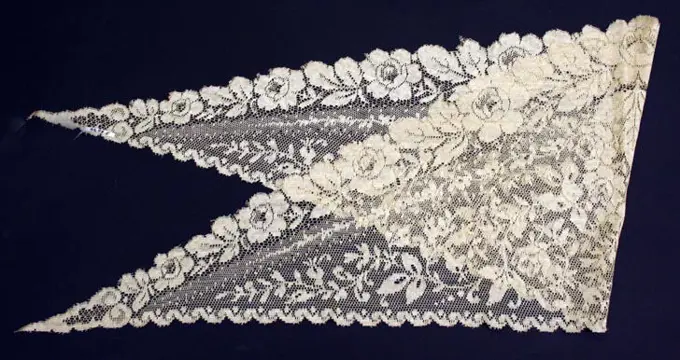
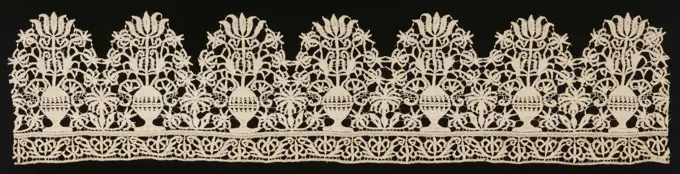
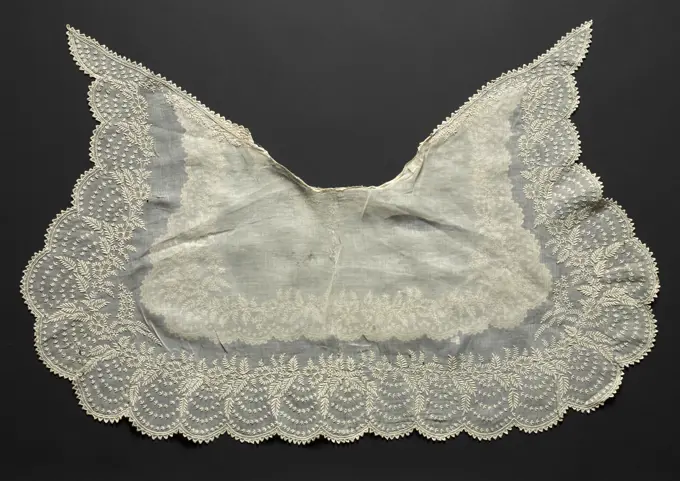
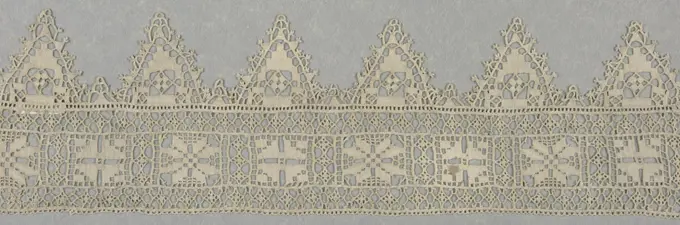
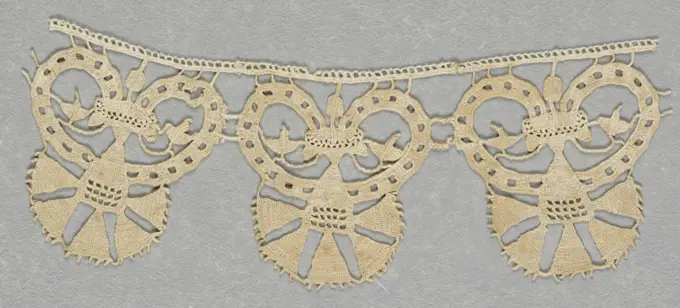
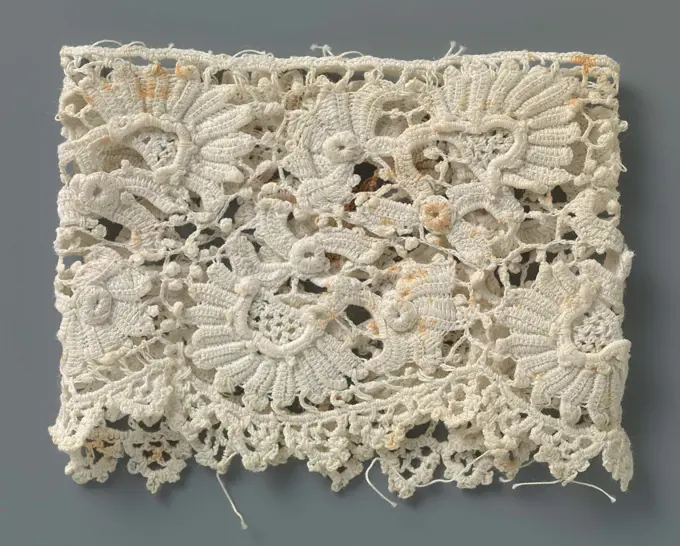
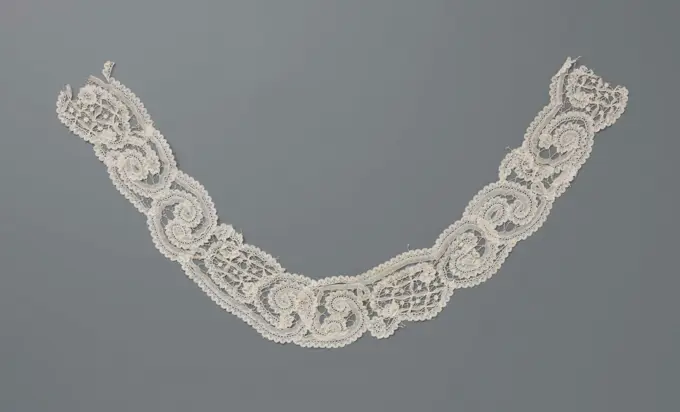
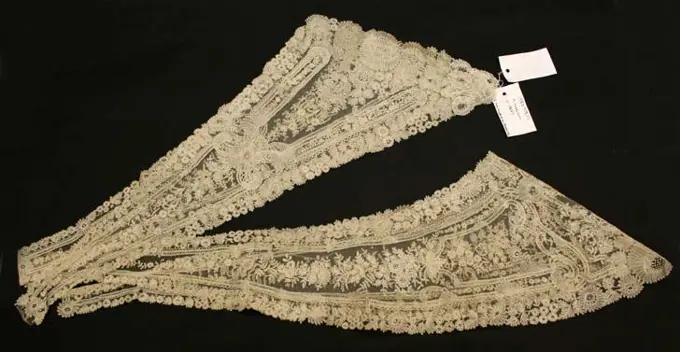
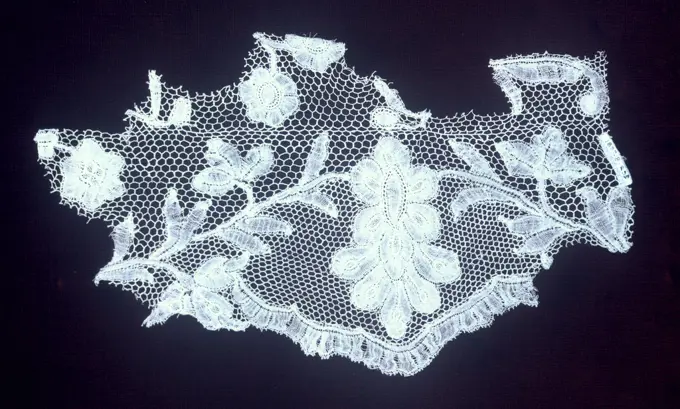
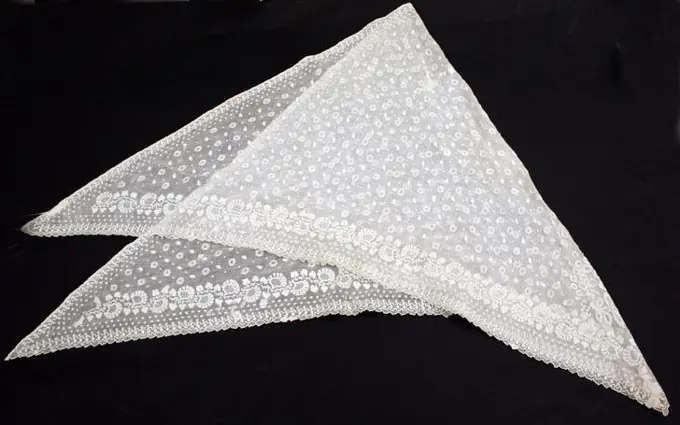
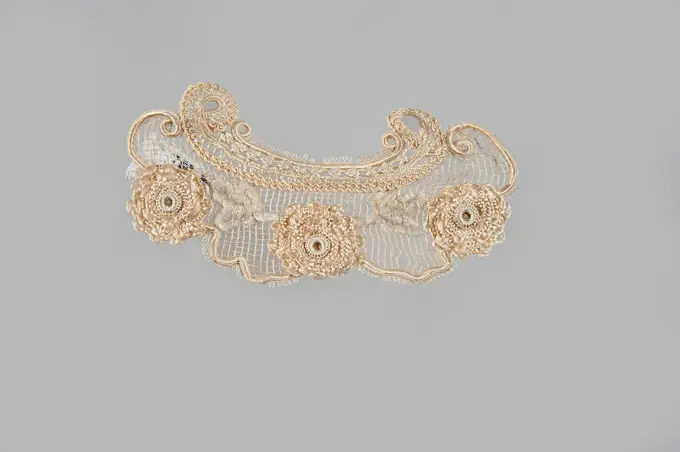
Lace application for a dress;  around 1920 (1915-00-00-1925-00-00);Magdalena, Witwińska, Dar (provenance)Fichu 19th century British. Fichu 102567Bobbin Lace Insertion, 18th century. Italy, Abruzzi, 18th century. Lace, bobbin; average: 2 x 13.4 cm (13/16 x 5 1/4 in.).Bertha and Cuffs, 1800s , maker unknown.Insertion 16th century Italian. Insertion. Italian. 16th century. Bobbin lace. Textiles-LacesFragment crocheted side with flowers and grapes, anonymous, c. 1890 - c. 1909 Fragment of natural -colored Irish crocheted side. Pattern of which two more flowers and one grape voucher can be seen and a crocheted irregular mesh soil with picots. In addition, a part of the edge finish with semi -circular sculptes can be seen that are trimmed with picoted arches. Ierland (possibly) cotton (textile) Fragment of natural -colored Irish crocheted side. Pattern of which two more flowers and one grape voucher can be seen and a crocheted irregular mesh soil with picots. In addition, a part of the edge finish with semi -circular sculptes can be seen that are trimmed with picoted arches. Ierland (possibly) cotton (textile)Cuffs early 19th century Flemish. Cuffs 79073Kloskant collar with Volute vranks, J.H. Preging-Faber, c. 1915 - c. 1919 Collar of natural-colored bobbin: Duchesse side. U-shaped neckline with sharp points at the front and sides with corners that are over the shoulders like points. The symmetrical pattern consists of volute vines, with a flower at each curling end. A few flowers, leaves and berries on side branches ensure a scum on all sides of the collar. The motifs are largely made in linen battle with openwork edges and fine recesses. Different parts of motifs are made in Netslag. The motifs are provided with thicker and shiny contour threads and here and there of cracked relief contours. Several (ornamental) lands have been applied, including a Paris soil, a rose ground, a soil strewn with square forms and also connected connections between a few motifs. Decorations have been used with form strokes in various ways. The sculpting edges are finished with picots. Striking is the difference in the collar points at the front, with aCollar 1830s probably American. Collar 110145Fragment of the lace;  18th century (1701-00-00-1800-00-00);Fragments of Lace. Italy, 17th century. Textiles; fragments. Linen macraméEdge, Medium: linen Technique: bobbin lace made in Lille style with heavy outlining thread, 19th century, lace, EdgeBorder; linenTie slip of a strike tie in Point de Gaze de Bruxelles, Anonymous, c. 1870 - c. 1880 Tie slip of a strike tie in Point de Gaze de Bruxelles, rectangular in shape and irregularly sculpted. The pattern has a rectangular medallion at the start and two ovals on the bottom. Along the potented edges, the pattern has flowers and feathered sheets; A slender in the middle. The decoration is equipped with thickened contour threads. Brussels . bobbin lace Tie slip of a strike tie in Point de Gaze de Bruxelles, rectangular in shape and irregularly sculpted. The pattern has a rectangular medallion at the start and two ovals on the bottom. Along the potented edges, the pattern has flowers and feathered sheets; A slender in the middle. The decoration is equipped with thickened contour threads. Brussels . bobbin laceCuff made of lace -ups with a symmetrical pattern of a rose above a decorative band with a zigzag and godrons, anonymous, c. 1850 - c. 1899 Cuff made of lace -ups: machine tulle with tracing. Rectangular model with sculp edges. The punched symmetrical pattern consists of a rose above a decorative band with a zigzag and godrons. On either side of the rose there are two slanted volute leaves between which three small rosette floors and including a large incised leaf, which points with the tip to the angle where there is still a rosette flower. The top of the cuff is finished with a zoompje. The other sides have lobed sculpting edges, which are finished with feston stitches. West-Europa cotton (textile). embroidering Cuff made of lace -ups: machine tulle with tracing. Rectangular model with sculp edges. The punched symmetrical pattern consists of a rose above a decorative band with a zigzag and godrons. On either side of the rose there are two slanted volute leaves between which three smaZakdoek van batist met boeket in geschulpte hoeken in borduurwerk en een rand machinale kant.Natural linen handkerchief with embroidery - whiteware with plethus - and rounded around with an edge Machine side: machine valenciennes side. Square model with rounded corners where the strip side has been wrinkled. The embroidery is in the corners and is right in every corner. It exists along the edge from five lying C-volutes, connected by palms. In the c-volute in the corner is a small rosette flower with a large bouquet above. The bouquet is symmetrical and has wingerd leaves, forget-me-stapling, aidry grass and in the top three cone-shaped flowers with high radiating stamens. The pattern of the side exists along the underside from a continuous arc border that forms a slip edge. In each shell, an oval flower hangs between two oval leaves. The sloping edge is finished with picots.Lace, 1800s , Malta, maker unknown. Gift of Mrs G. Acland Allen, 1955.Border (From a Pillow Cover) Made 1550-1600 Italy. Linen, needle lace worked on a plain weave cut and drawn work grid; edged with bobbin straight lace .Chalice cover, Medium: linen Technique: needle lace (gros point de venise), Chalice cover in a symmetrical design of floral and foliated forms surrounding central floral motif in high relief., Italy, late 17th century, lace, Chalice coverCuff (Italy); linenDouble collar ca. 1835 American. Double collar 98044Strip of needle side with mushrooms, anonymous, c. 1795 Strip of natural-colored needle side: Alençon side. Under a spreading pattern of three rows of hanging flower branches, it is repeating and continuous pattern along the underside of the strip from mushrooms, interspersed with a thin volute with a circle crowned in the center by a standing oval. The scrap edge is formed by fan -shaped motifs, one under each mushroom. The impellers are connected by a pendulum of three circles with rader picots in it. The motifs are connected to each other by a fine hexagonal Maas soil, an alençon soil with collected feston stitches. The sparing fullwork is made with feston stitches, the motives are equipped with relief contours. A few different fine decorative lands have been used in the motifs in the pattern on the underside of the strip. The top of the strip is finished with a separate strap. The scums along the bottom are finished with picots. Alençon linen (material) Alençon Lace Strip of naturaCoverlet Made 1855 New York. Cotton and wool, plain weave double cloth; woven on loom with Jacquard attachment; full loom width . Ira Hadsell (Weaver)Handkerchief third quarter 19th century Belgian. Handkerchief 168700Fragment 17th century German, Holstein. Fragment 214685Border Made 1601-1625 Italy. Gold-gilt-silver-strip-wrapped silk, bobbin straight lace .Fragment of embroidery motifs of palms and shrubs (edge of the kerchief) unknownVolant of application side with V-shaped twigs, Maison Sacré, c. 1914 Volant of natural -colored application side, bobbin lacquered on mechanical tulle. A quarter of the long distance is empty, a quarter is strewn with mushes and the outer half is covered with a symmetrical decor. V-shaped twigs that end with inner and outward volutes, spring from a leaf rose in the fairly straight outside. This rosette forms the shells with a rose and to the left and right -bending twigs with bows. Brussels linen (material) Volant of natural -colored application side, bobbin lacquered on mechanical tulle. A quarter of the long distance is empty, a quarter is strewn with mushes and the outer half is covered with a symmetrical decor. V-shaped twigs that end with inner and outward volutes, spring from a leaf rose in the fairly straight outside. This rosette forms the shells with a rose and to the left and right -bending twigs with bows. Brussels linen (material)Japon decoration of application side with mimosis branches. Japanese decoration of natural applicators, climbing side applicated on machine tulle. A rectangular piece of tulle is finished with flat shelters on the two short sides. On the short axis there is a substantially symmetrical wavy branch with three bunches of mimosakes and wide varied side branches with feathered leaves. The branch starts with a bow above a landscape C-voltage.Collar ca. 1860 Italian. Collar 168488Fragment 16th century Italian. Fragment 214875Border (Fragment). Belgium, Flanders, Brussels. Date: 1720-1730. Dimensions: 5.7 × 37.0 cm (2 1//4 × 14 1/2 in.). Linen, bobbin part lace of a type known as "Brussels" with a Droschel mesh ground. Origin: Flanders. Museum: The Chicago Art Institute, Chicago, USA.Jabot from application side with flower branch edge, c. 1910 - c. 1930 Jabot of natural -colored application side: Needle side Applicated on Machine Tulle. The jabot is made of an oval -shaped piece of tulle, which is strongly wrinkled in the middle. The faintly scalloped edge is always overstrained by one curved flower branch. Each branch is fine leaves and a few smaller and one larger flower. Belgium linen (material) Jabot of natural -colored application side: Needle side Applicated on Machine Tulle. The jabot is made of an oval -shaped piece of tulle, which is strongly wrinkled in the middle. The faintly scalloped edge is always overstrained by one curved flower branch. Each branch is fine leaves and a few smaller and one larger flower. Belgium linen (material)LappetsFragment, Cooper Union Museum Lace Study Card; Made for Cooper Union Museum; Italy; linenEdging (Spain); silkMachine jabot with drop -shaped leaves and round flower, anonymous, c. 1890 - c. 1935 Jabot of natural-colored machine side: Machinal Valenciennes side. On a standing band, a lace lane is zewed zigzagually, so that the Jabot falls back and forth seven times. A cut embroidery rose has been put at the top. The repeating pattern consists of a hanging drop -shaped leaf with a round flower on a short bent stalk. The motifs are connected by a machine Valenciennes ground with square Maas. A semi -round shell has been formed around the bottom of the strip, with the Maas soil turning into a strap. The top of the strip is straight and then zigzagging fixed as described above. The scrap edge along the bottom is finished with picots. France (possibly) cotton (textile) Jabot of natural-colored machine side: Machinal Valenciennes side. On a standing band, a lace lane is zewed zigzagually, so that the Jabot falls back and forth seven times. A cut embroidery rose has been put at the top. The repeatingFragment (France); linenBand, Edge of bobbin lace, floral ovals repeated; early 18th century Bedford., early 18th century, lace, BandFragment (Border) Made 1630-1639 Venice. Linen, needle lace .Mixed side cuff with a faint V-shaped model, anonymous, c. 1890 - c. 1910 Cuff made of natural ribbon side (mixed side): luxurious lace, with a woven ribbon and needle side fillings. Faint V-shaped model, with rectangular ends and a widened triangular center. The symmetrical pattern consists of motifs whose contours are formed by a narrow woven ribbon. In the middle is the largest flower with a three -lobe center, flanked by Voluten under which there is a triangular point. And crowned by a circle from which three leaves spring. In addition to this central palmet flower, there is an openwork oval flower on each side, made with two sikkels placed against each other, two oval leaves and a three -lobe flower in each top corner. The three -lobby flowers and the central flower have an elevated (relief) and feasted circular flower heart. Within the contours with which the motifs are formed, decorative lands (needle side) with coarser yarn are used for making the ribbon. The motifs are connectStrip bobbin with lobes formed by a ribbon, anonymous, c. 1900  Strip of natural -colored bobbin: Russian side. The pattern is formed by a ribbon that forms lobbing. The ribbon is made in closed linen battle, with openwork edges. The winding ribbon is kept in shape by braids. The top is straight. The lower lobes form the scums and they are finished with triangles made of braids, with a picot on each dot. Russia cotton (textile) bobbin lace / Russian laceTrimming Ornament (USA); linenSpecimen 1650 Italian. Specimen 218588Collar 1700-1941 American. Collar 119187Border; medium:Woman's Collar. England, Honiton, late 19th century. Costumes; Accessories. Cotton bobbin laceFragment (France); linenKloskant cuff with Margrietjes, Anonymous, c. 1900 - c. 1924 A coarse mesh stock (square Maas) with daisies above scoops of pearls. Valenciennes side. Sluis (Possible) linen (material) Bobbi Lace / Valenciennes Lace A coarse mesh stock (square Maas) with daisies above scoops of pearls. Valenciennes side. Sluis (Possible) linen (material) Bobbi Lace / Valenciennes LaceSleeve cuff, Medium: linen, cotton () Technique: needle lace, Length of Alençon lace intended for sleeve cuffs has two rows of small circles that outline the scalloped edge of the lace. Each scallop is filled with a flower sprig. The space above has rows of tiny leaves repeating in alternate directions., France, ca. 1850, lace, Sleeve cuffEdging 17th century Italian, Genoa. Edging 220972Collar 1860 probably European. Collar 108549Strip of Goudkant.strip or Gold Side.Sampler (Spain); linen; Warp x Weft: 35 x 50 cm (13 3/4 x 19 11/16 in.); Bequest of Mrs. Henry E. Coe; 1941-69-263Batist handkerchief with a border of mixed side with heart -shaped medallions in the corners, anonymous, c. 1850 - c. 1899 Batist handkerchief with an edge of natural -colored mixed side - bobbin in combination with needle side - Brussels Duchesse. Square model with scalloped inner piece and sculpy edge along the outside. In the edge of Kloskant - Fine Bruges flower arrangements - Heart -shaped medallions of needle side were used on the corners: Brussels gauze side. The bobbin pattern consists of a rosette flower with five lobes on the corners with two curls on either side. This pattern encloses the tip of the heart -shaped medallion of the needle side. The needle side pattern consists of a fan -shaped bouquet or a flower basket on a handle, in a spreading pattern of festonized rings, so -called pearls. The showered motifs are connected by a braid ground. The showered motifs are made in netslag and linen battle with openwork edges, with the motifs largely equipped with thicker and thinBand; linenLace, bobbin, circa 1700, Flanders, maker unknown. Gift of Yvonne Riddiford, 2007.Underemen of glass batist with black ribbon velvet, anonymous, c. 1885 - c. 1900 Sub -sleek of glass batist, lace and ribbon black velvet. Short coup; Instructed at the wrist, where a black ribbon has been raised. The side has a pattern with wide, flat scoops with a one -sided volute of a leafy branch with flowers in each shell. Netherlands (possibly) .. velvet (fabric weave) Valenciennes lace Sub -sleek of glass batist, lace and ribbon black velvet. Short coup; Instructed at the wrist, where a black ribbon has been raised. The side has a pattern with wide, flat scoops with a one -sided volute of a leafy branch with flowers in each shell. Netherlands (possibly) .. velvet (fabric weave) Valenciennes laceStrook applicatiekant met een rij boogjes en ijle takjes.Strip natural colored Brussels application side: needle side applicated on slighten ground. The repeating pattern consists of a row of openwork bowets with thin ranks at the ends. At the bottom of the strip, Isoble twigs with always three openwork round flowers, which reaches to the bow. There are some scattered flowers between the arcs. The sparse full work is enclosed by widely spotted thread bundles. The top is finished with a separate clust strap. The virtually straight finished bottom is equipped with very fine picots.Fragment, Medium: linen Technique: bobbin lace (Binche style with no ground but snowball pattern), Binche style fragment of a scrolling ribbon-like design with snowballs and braided connections., Belgium, 17th century, lace, FragmentNecktie 1860-65 European. Necktie. European. 1860-65. linenPiece European 19th centuryBorder Made 1701-1750 Northern Italy. Linen, bobbin part lace .Cuff of linen batist decorated with whitework with needle fillings, anonymous, c. 1850 - c. 1900 Cuff of linen batist with an embroidery insert. The pattern consists of circles within which rosettes of sand stitches and needle edges fillings. The cuff has three knots and three buttonholes. West-Europa linen (material). Cuff of linen batist with an embroidery insert. The pattern consists of circles within which rosettes of sand stitches and needle edges fillings. The cuff has three knots and three buttonholes. West-Europa linen (material).Border, Medium: linen Technique: knotting (macramé), Fragment of the end of a cover in blue and white line with a knotted border., Italy or Spain, 18th-19th century, knotted, knitted and crocheted textiles, BorderCuff of linen batist decorated with embroidery and bobbin, anonymous, c. 1890 Linenbatist cuff to which a strip is attached to a combination of whitework in the form of flowers and leaves with bobbin side. The cuff can be closed by means of three batist knots. West-Europa linen (material). bobbin lace Linenbatist cuff to which a strip is attached to a combination of whitework in the form of flowers and leaves with bobbin side. The cuff can be closed by means of three batist knots. West-Europa linen (material). bobbin laceStrip of black and white bobbin side with one row of margrites above semi-rounds, anonymous, c. 1870 - c. 1890  Strip of black and white bobbin: Cluny side. The repeating pattern consists of connected squares with a white Margriet with a black flower heart in each. A bow under each square. These arcs form the scrap edge. Above the row of flowers, a network of white windows between two black cobbled straps. Le Puy (possibly) silk bobbin lace / Cluny lacePiece mid-19th century British. Piece. British. mid-19th century. Cotton and linen, applied. Textiles-LacesFragment, 1800s. India, Jaipur, 19th century. Embroidery; silk and gold filé on silk velvet ground; overall: 64.8 x 14.9 cm (25 1/2 x 5 7/8 in.).Waaierblad van gemengde kant met vlindertjes.Layerblad of natural-colored mixed side: dick edge (duchesse-lace) with inserts of applicationant (climbing side applicated on machining tulle). Semi-circular. Symmetrical pattern of three large reserves in scallop form (tulle), on which scattered butterflies are applicated. A frame (docking side) with braid soil exhibits symmetrical, multiplic cutting stems with bunches of currants and hand-shaped leaves.Voile from application side with scattered double leaves, anonymous, c. 1890 - c. 1910 Voile of natural application side, needle side applicated on machine tulle, point d'Angleterre. In a triangle there is a scattered pattern of double leaves. Thrive edge, along two sides, of moving twigs with chalice and carnated flowers. Flat, stretched scallops along the three sides. Brussels linen (material) Voile of natural application side, needle side applicated on machine tulle, point d'Angleterre. In a triangle there is a scattered pattern of double leaves. Thrive edge, along two sides, of moving twigs with chalice and carnated flowers. Flat, stretched scallops along the three sides. Brussels linen (material)Border; linenFichu 1860-85 American. Fichu. American. 1860-85. silkBorder (Belgium); linenCollar (Belgium); linenBand, Medium: linen Technique: needle lace, early 17th c. and style, Deeply pointed punto-in-aria border in floral patterns. Blue bell design alternating with lily sprays., Italy, 1601-50, lace, BandDouble Collar, 1830. America, 19th century. Embroidery; cotton mull; overall: 54 x 81.3 cm (21 1/4 x 32 in.).Border, Medium: linen Technique: needle knotting, Border of squares surrounded by a small-scale pattern and edged with triangular pendants., 17th century, lace, BorderFichu van Linnenbatist, triangular and sculpted, embroidered with border flower garlands in Point de Dresde, Anonymous, c. 1750 - c. 1775 Fichu van Linnenbatist, triangular and sculpted, embroidered with border flower garlands in Point de Dresde. Cut diagonally on the wire. Decoration: The sculptures are varied with leaf garlands and composite floral ornaments. Above large flowers alternating with leaf garlands and floral ornaments. Point the Dress or Whitework including founded holes, combined with different types of needle side in various combinations. In the point a stacked symmetrical ornament crowned with a vase with leaves. Netherlands linen (material) embroidering Fichu van Linnenbatist, triangular and sculpted, embroidered with border flower garlands in Point de Dresde. Cut diagonally on the wire. Decoration: The sculptures are varied with leaf garlands and composite floral ornaments. Above large flowers alternating with leaf garlands and floral ornaments. Point the Dress or WhBorder, Medium: linen Technique: 17th century needle lace (punto in aria), Fragment of a border with flowerheads, probably carnations, supported by scrolling forms., Italy, 1575-1699, lace, BorderCurtainCuff of crocheted side with fan shaped flowers. Cuff of natural colored Irish crochet side, imitation coarse Venetian side. Pattern with impeller-shaped flowers with stems and a crocheted irregular maase ground with picots. The top is finished with a straight edge. The semi-circular shelter on the lower edge are deposited with picoted arcs.Strook of kraag van gemengde kant met in elkaar hakende krullende linten met daarlangs golvende sierbandjes.Strip or collar of natural-colored mixed side: climbing side with needle lace ornamental stitches. Curved model, possibly a collar (). The strip is made up of closted in linen stroke, curling ribbons. The ribbons are equipped with a thick contour wire on the outside and then scrolled by a separate, wavy decorative belt. The curly ends of the ribbons crochet. Between the ribbons are picoted bars applied to some intersections relatively coarse ornamental stitches - circles - from needle side. The fragment has been found at a black body (BK-1978-265).Fringe, Medium: silk Technique: plain weave, Yellow fringe with a heading and looped skirt threads forming a pointed edge; each group of four supporting a tuft., Spain, 18th century, trimmings, FringeFragment, Medium: linen Technique: needle lace, Fragment showing large delicate ribbon-tied floral sprays. Very irregular in shape., France, late 18th century, lace, FragmentBasket SawskTwo pointed scales of bobbin with pointed leaves, anonymous, c. 1925 Two point sculptures of natural-colored bobbin, Cluny side. Two sharp triangular point sculptes are only connected to each other on the straight top. A smaller triangle hangs down from the top in each triangle. The outlines of the triangles are formed by a narrow strap in linen battle. The spaces in the triangles are filled with a braid ground and pointed leaves made in form. Netherlands (possibly) linen (material) bobbin lace / Cluny lace Two point sculptures of natural-colored bobbin, Cluny side. Two sharp triangular point sculptes are only connected to each other on the straight top. A smaller triangle hangs down from the top in each triangle. The outlines of the triangles are formed by a narrow strap in linen battle. The spaces in the triangles are filled with a braid ground and pointed leaves made in form. Netherlands (possibly) linen (material) bobbin lace / Cluny laceSteel needle side with a decorative soil made in fine diamond stitch, anonymous, c. 1700 - c. 1799 sample Steel natural-colored needle side with a decorative land that is used in Alençon side, among others. Study material. The needle lace stitch that is used in the ornamental soil is also called 'Point de Mignon', a fine diamond stitch. The edges of the steel are finished with feston stitches. The steel that was made as a study around 1925 includes a fragment Alençon side from the 18th century in which this diamond stitch was used in the ornamental land. Netherlands (possibly) linen (material) Alençon LaceWoman's necktie 1870-80 French. Woman's necktie 221666Jabot van Kloskant with a scalloped pot, anonymous, c. 1900 - c. 1970 Jabot van Kloskant with a scalloped potented border with a floral motif. Used . mixed lace / Bruges lace Jabot van Kloskant with a scalloped potented border with a floral motif. Used . mixed lace / Bruges laceShawl ca. 1857 American. Shawl 120901Fragment; linen; 1897-8-295Fichu early 19th century American or European. Fichu 119393Round rug with a border in chosk side with horns of abundance. Round rug with a natural linen middle piece, with a smoothly mounted rounded edge of clamping, rosaline. Running pattern of voluntary leaves and stems coming out of horns of abundance. The horns form the inside circle. The flat shelters along the outer edge stem from the pattern. Full work made with curved straps into linen stroke with small recesses, filled with an ornamental ground of diamonds. Very economical use of braids to connect motifs.Collar. Culture: Italian. Date: ca. 1890.Collars this size have a strong presence and this scale is a good vehicle for large and dramatic lace designs such as this one. Notable in the design are the realistic depictions of four different flower varieties, including iris and tulips and the significant variation of grounds in the floral motifs which heightens the visual interest. Laces composed of premade tapes such as this one were a less expensive version of their bobbin or needle-made counterparts, in this case Milanese type. Museum: Metropolitan Museum of Art, New York, USA.Double collar 1830s American. Double collar 119323Bobbin Lace (Mechlin) Lappet, mid 18th century. Belgium, Mechelen , mid 18th century. Lace, bobbin: linen; average: 94.6 x 10.2 cm (37 1/4 x 4 in.).Tie (France); linenFragment of band, Medium: linen Technique: bobbin lace, discontinuous tape, Band with elongated blossoms forming tabs., Northern Europe, 17th century, lace, Fragment of bandSteel needle side with mesh side, anonymous, c. 1925 - c. 1929 sample Steel natural -colored needle side with a hexagonal Maas soil: a mesh side. The use of this type of Maas soil with single meshes, formed by rows of feston stitches worked back and forth, is characteristic of Brussels gauze side. The edges of the steel are finished with feston stitches. Netherlands (possibly) linen (material) Brussels Gaze Point