Elegant Lace Strips

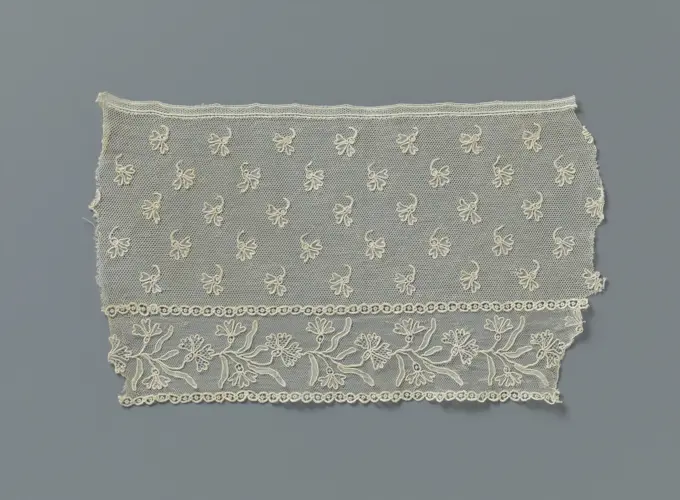
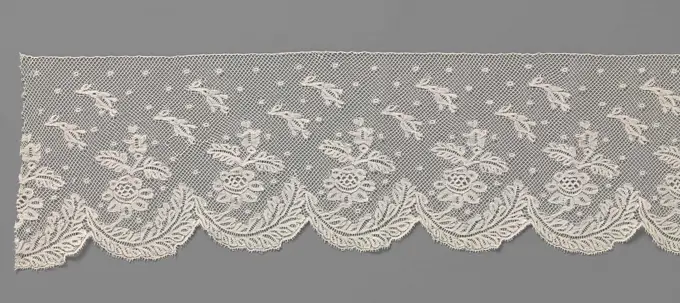
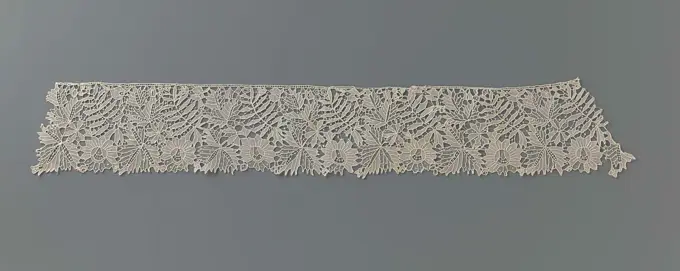
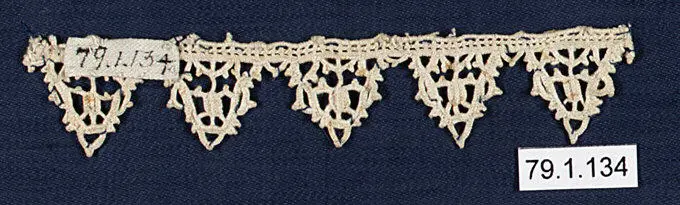
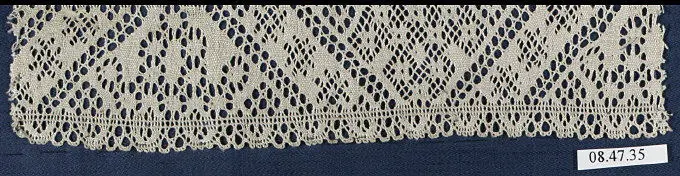
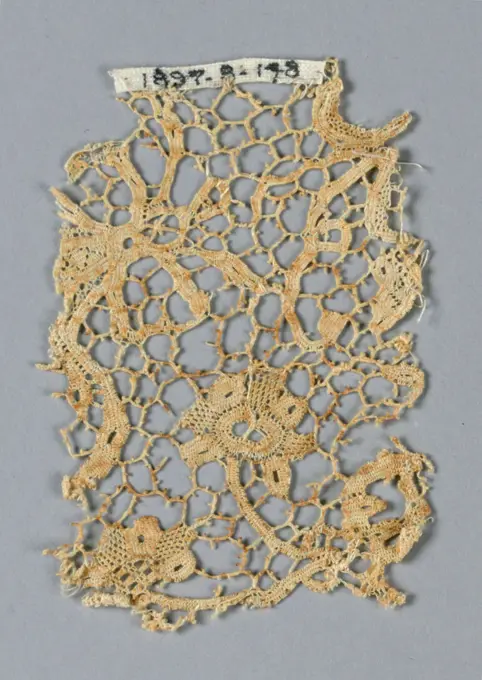
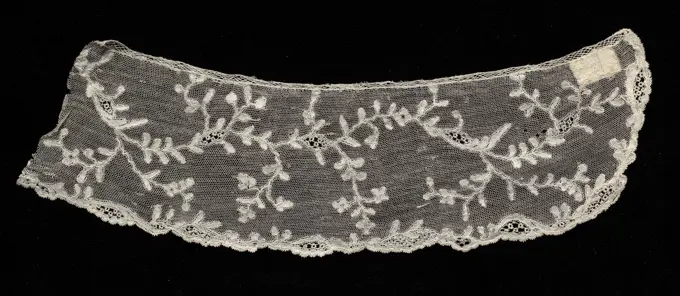
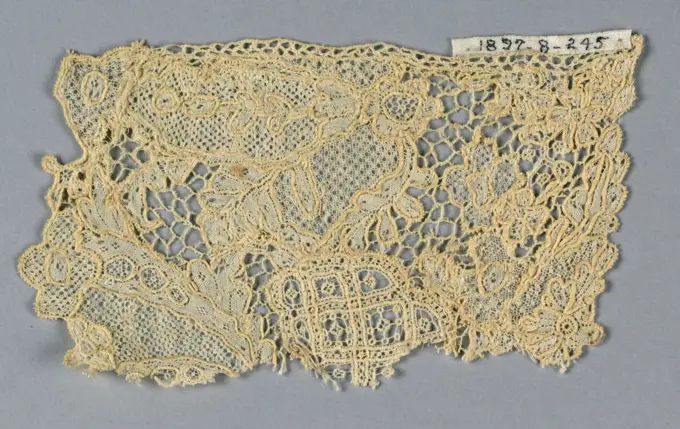
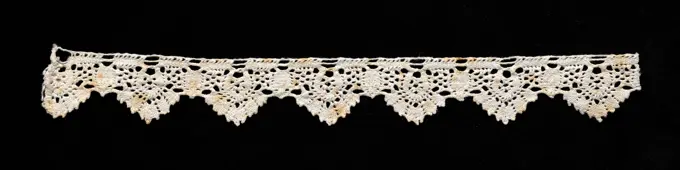
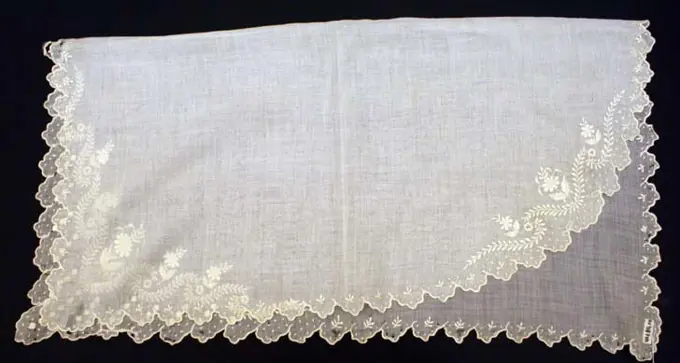
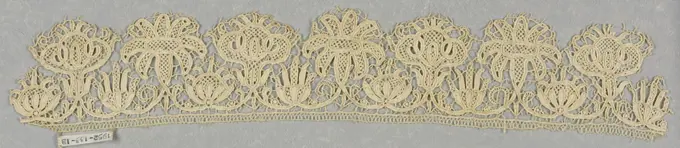
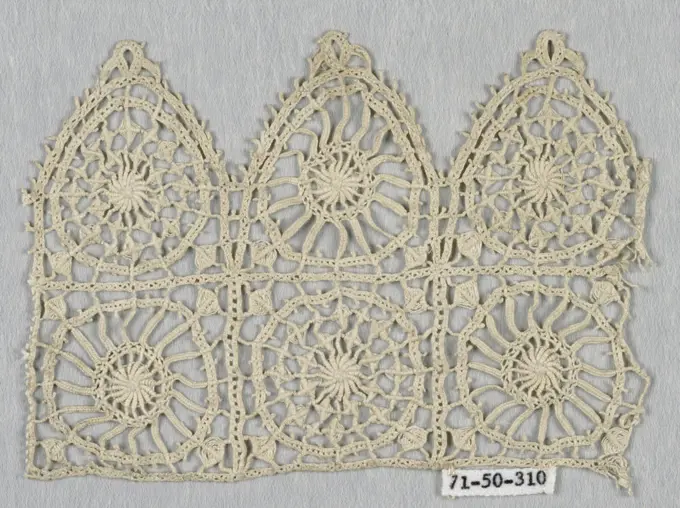
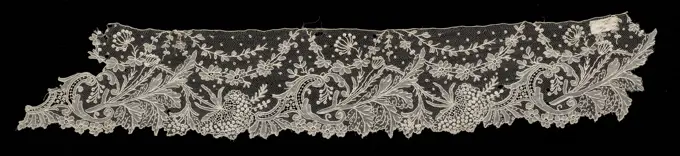
Delicate strips of vintage lace featuring intricate floral and geometric patterns in soft natural tones, showcasing textile craftsmanship.

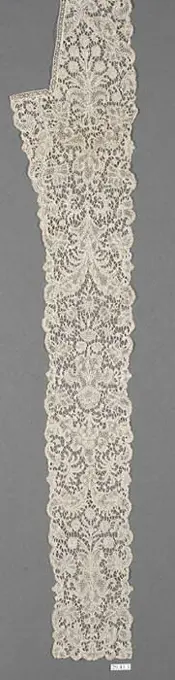
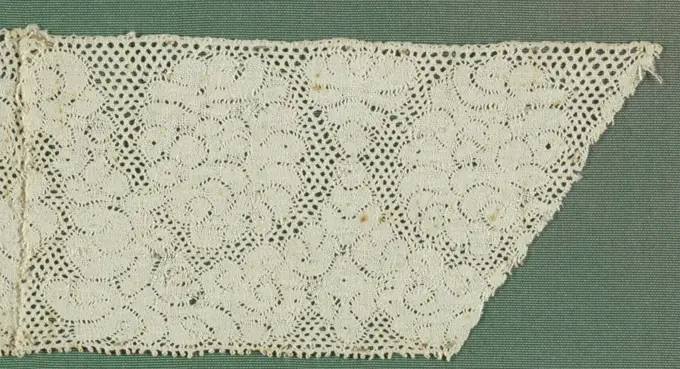
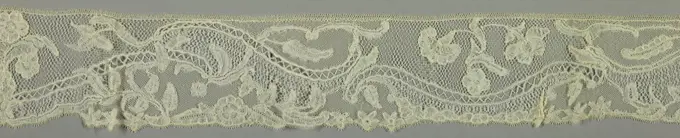
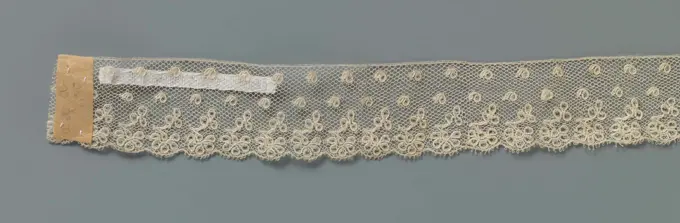
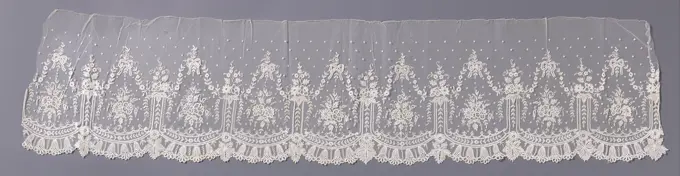
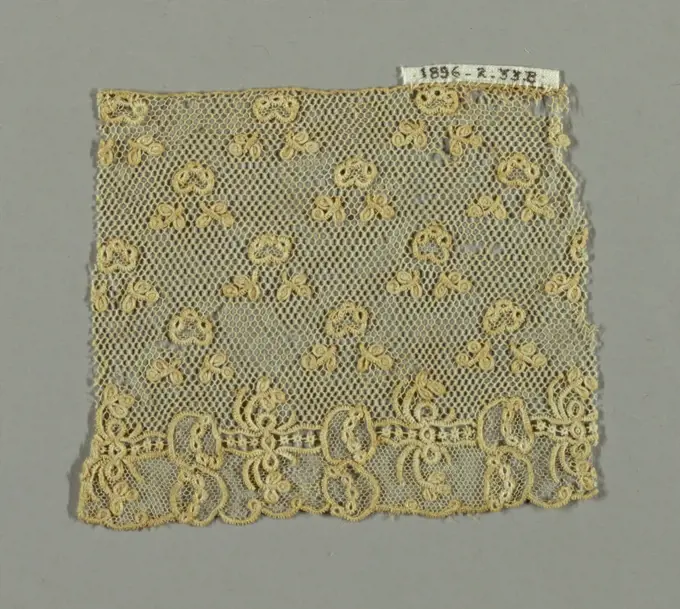
Strip Application side with grape bunches and halved leaves, anonymous, c. 1850 - c. 1890 Strip of natural -colored application side, bobbin lacquered on mechanical tulle. A narrow part, along the inside, shows a running pattern of halved, lobed leaves, which also accompanies a halved medallion with grid filling. On a wide part with a tulle surface are symmetrical, deep sculptures, which are alternately filled with a grape vice and a fan plant. Belgium (possibly) linen (material) Strip of natural -colored application side, bobbin lacquered on mechanical tulle. A narrow part, along the inside, shows a running pattern of halved, lobed leaves, which also accompanies a halved medallion with grid filling. On a wide part with a tulle surface are symmetrical, deep sculptures, which are alternately filled with a grape vice and a fan plant. Belgium (possibly) linen (material)
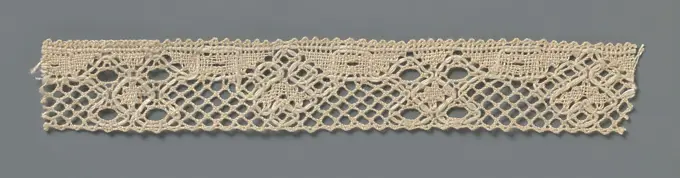
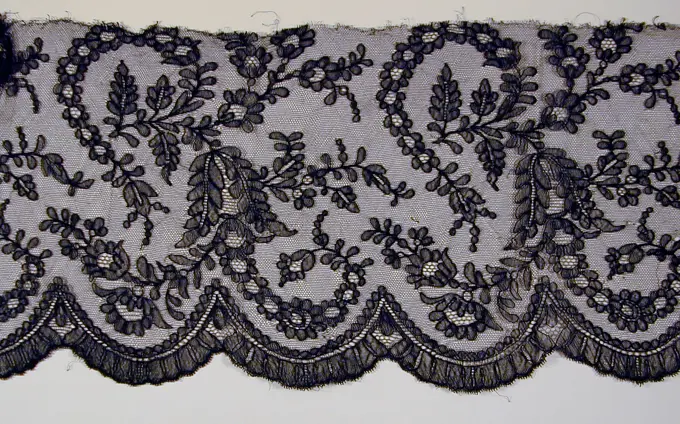
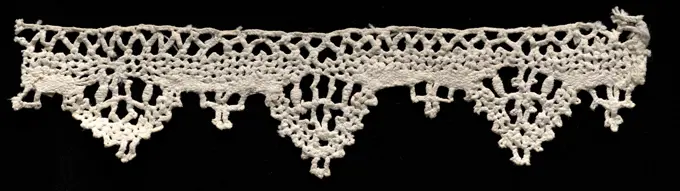
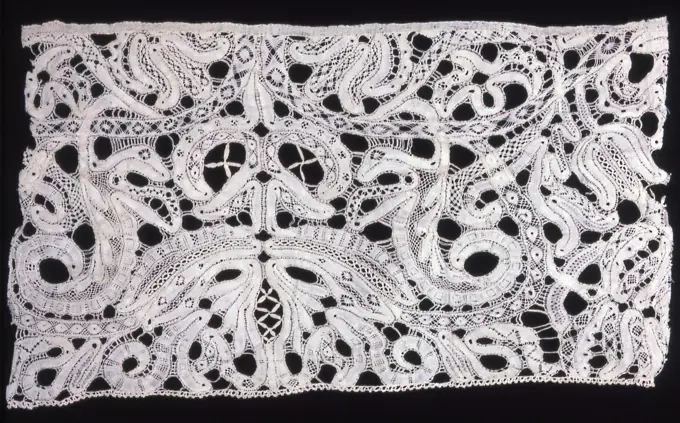
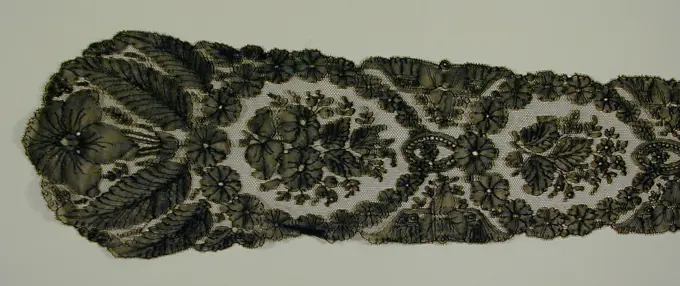
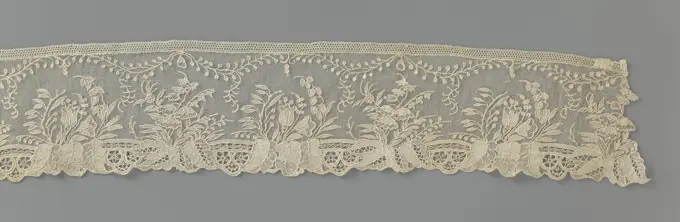
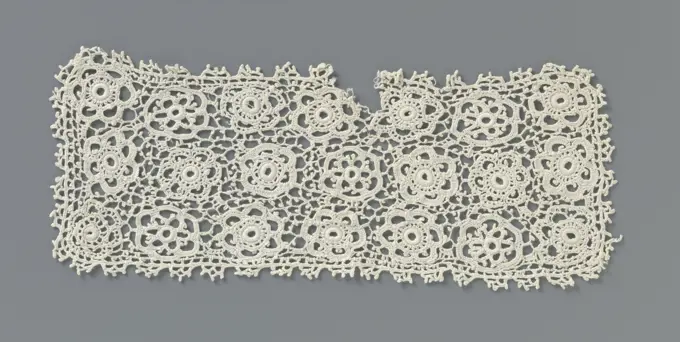
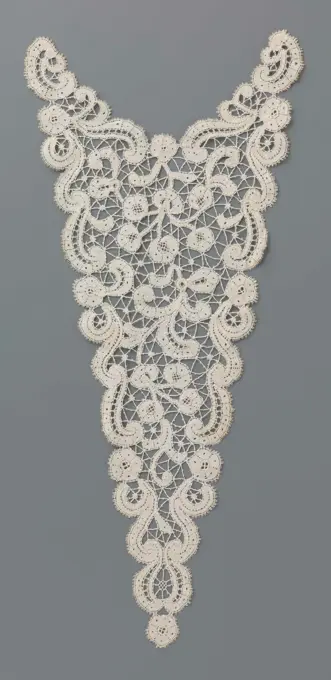
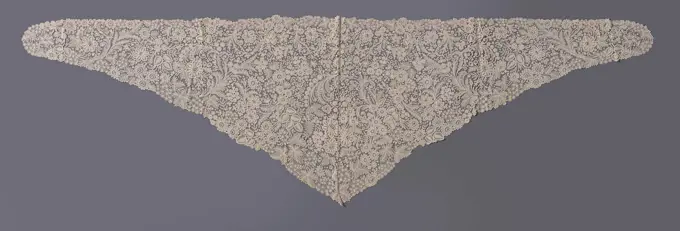
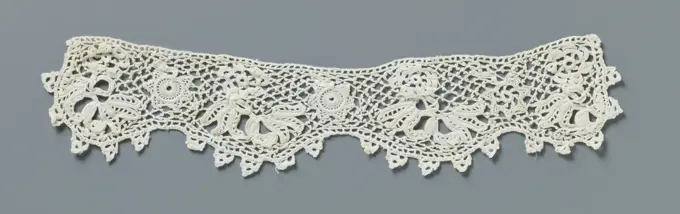
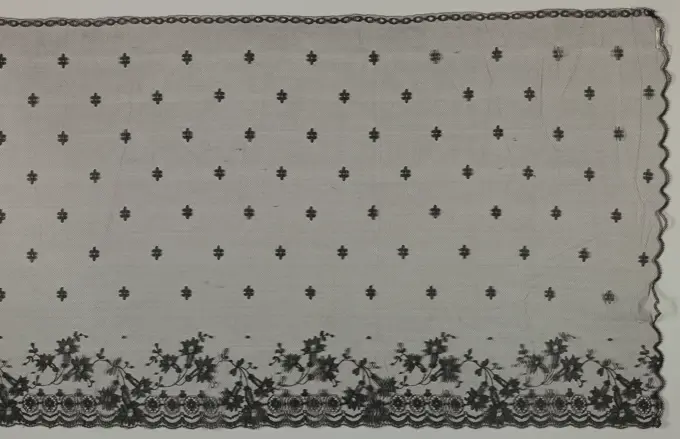
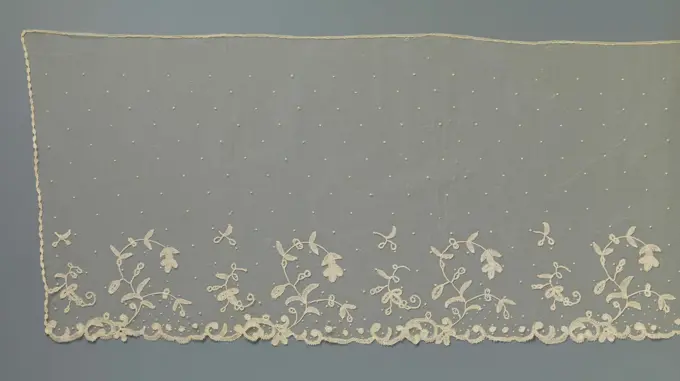
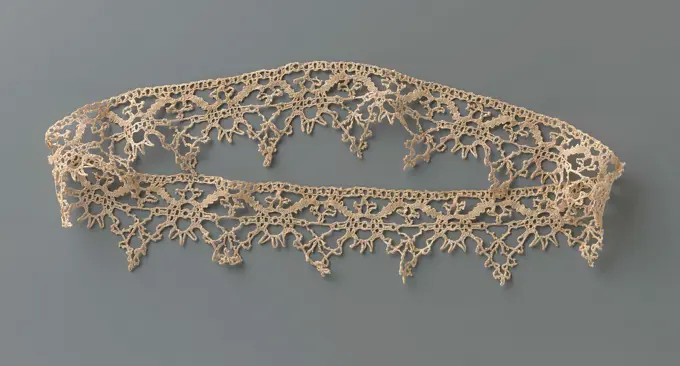
Bobbin Lace (Punto di Milano) Band, 17th-18th century. Italy, Milan, 17th-18th century. Lace, bobbin; average: 14.3 x 31.1 cm (5 5/8 x 12 1/4 in.).Lappet 1700-1750 Flemish, Brussels. Lappet 222258Strip early 18th century Flemish. Strip 212375Bobbin Lace (Rose Lace) Edging of Points, 17th century. Italy, Genoa, 17th century. Lace, bobbin; average: 6.7 x 36.2 cm (2 5/8 x 14 1/4 in.).Cravat end, Medium: linen Technique: needle lace, Large collar and pair of cuffs. Needle lace, Flat Point de Venise, in all-over branching floral pattern, connected by bride picotées. Portes throughout., Italy, mid-late 16th century, lace, Cravat endStrip bobbin with double row of oval flanked by four leaves, anonymous, c. 1875 - c. 1899  Strip of natural-colored bobbin: Cluny side. The repeating and symmetrical pattern consists of a double row of ovals. Each oval is made in linen battle and is flanked by four leaves made in shape. The ovals are connected by a braid with a picot on both sides. And between the rows of ovals a tire runs over the center of the strip with an oval grid. Top and bottom of the strip are straight finished with similar but narrower tires with a single row of oval meshes. Russia silk bobbin lace / Cluny laceFragment, Bobbin Lace 3; Made for Cooper Union Museum; linenFragment (England); linenStrook kloskant met een ruitje tussen vier cirkels en een hartje tussen zes ruitjes.Natural collate strip, Swedish side. The strip is attached with pins on a light blue carton, with seven other strips. Above the strip is written on the cardboard "Laces from Dalecarlia. (Dalarna)". The repeating pattern is formed by a bundle wires, which has been worked through a maas basis, a diamond-shaped nozzle ground. The wires alternately form a heart surrounded by six checks and a diamond surrounded by four circles. Along the bottom of the strip, there is always a trapezoidal motif between these consecutive motifs, with a small recess in the center. The hearts, diamonds and trapezia are made in linen battle with openwork edges and the contours of which are formed by the thick wires. A larger oval mesh is made in each circle (around the diamonds) between the meshes of the straw rotation. Upper and bottom of the strip are straight finished and provided with picots.Strip machine side with black soil and natural motifs. Strip multi-colored machining: machine blonde. Black soil and natural motifs. The strip is probably intended or used for a dress. The repeating pattern consists of a curved branch with two openwork flowers with a half-lunar-shaped petals wreath. The branch springs with a bend on the underside of the strip and bends back with a large bow where it ends with one of the flowers. The other flower springs halfway on the branch and is sloping upwards. A large opened sheet or reserve is under the branch along the underside of the strip where it forms the tube edge. The motifs are connected above the flowers by a hexagonal machine ground ground and under the flowers through a diamond-shaped machine ground. Ornamental grounds are used in the motifs, including a machining rose and a coarse irregular grille. The top of the strip is straight finished. The slip edge along the underside is finished with picots. One short side is finished with a sBorder (Italy); linenEdging 17th century Italian, Abruzzi. Edging 220967Strip of a climbing side with foded slot. Strip natural colosside: Valenciennes-side. Pattern with embraced semi-circlical slump, above which a hanging daisy between 'sequins'.Fragment of Lace Flounce. Probably France or Spain, late 19th century. Costumes. Silk machine-made laceStrip of needle side with leaf vines, anonymous, c. 1875 - c. 1899 Strip of natural needle side, point the gaze de bruxelles. Repetitive motif with vertical leaf vines on a fine ground with single rotated meshes, which is littered with a few mushes. Scalloped underside. The top is trimmed with a border bobbin. Brussels linen (material) Strip of natural needle side, point the gaze de bruxelles. Repetitive motif with vertical leaf vines on a fine ground with single rotated meshes, which is littered with a few mushes. Scalloped underside. The top is trimmed with a border bobbin. Brussels linen (material)Border Made 1575-1625 Italy. Linen, plain weave; cut and drawn work embroidered in interlocking lace and overcast stitches; darned bars and woven picots; embroidered in Italian hem, overcast back, overcast, and satin stitches; eyelet holes; edged with bobbin straight lace .Bobbin Lace (Needlepoint Design) Edging of Points, 17th century. Italy, Genoa, 17th century. Lace, bobbin; average: 4.5 x 20 cm (1 3/4 x 7 7/8 in.).Strip of needle side with cornflowers, anonymous, c. 1800 - c. 1820 Two -thirds of the width is filled with a spreading pattern of falling cornflowers on a coarse soil (of flooded bars). A third of the width forms a right-winged outer edge (with a single alençon soil), lined with two pearl lists, and decorated with a horizontal flank of stretched stalks, each with three cornflowers, which are always in the same direction. Alençon side. France linen (material) Alençon Lace Two -thirds of the width is filled with a spreading pattern of falling cornflowers on a coarse soil (of flooded bars). A third of the width forms a right-winged outer edge (with a single alençon soil), lined with two pearl lists, and decorated with a horizontal flank of stretched stalks, each with three cornflowers, which are always in the same direction. Alençon side. France linen (material) Alençon LaceStrook kloskant met anemonen.There is an ongoing pattern on a coarse mesh stock (Square Maas). In an open part there are two rows of roses between Moesjes. In a more filled part is above the feathered leaves that form the semi-circular slot a branch with an anemone, a double sheet and a button. The strip consists of four parts sewn together and is sewn on a strip in 1966 with a similar, but not identical pattern. Valenciennes side.Fragment; linen; 1923-35-4Strook naaldkant met ingesneden blad.Running pattern of incised leaves above a rose and a three-leaf, which together form the sharply toothed outside line. Cross-shaped bars with button (soil of long X-shaped bars with a spider). The REMPLIS consists of buttonhole stitches and a Fond Gazé. German side: 'Carlsbead points'.Fragment 16th-17th century Italian Punto in arialiterally, "stitches in the air"is one of the earliest styles of needle lace, which is itself developed from cutwork of primarily geometric design. When lacemakers transitioned to using a foundation of threads laid out according to a pattern drawn on parchment, they were able to incorporate more fluid lines and curves into their designs.. Fragment 212340Edging, Technique: bobbin lace, Bobbin lace edge, curves with plants; early 18th century Brabant, early 18th century, lace, EdgingFragment, A .G. Jennings & Sons, American, Medium: silk Technique: machine made lace, Net ground with scattered ornaments and a floral border., USA, ca. 1884, lace, FragmentEdging 18th century Italian, Abruzzi (Pescocostanzo). Edging 221141Jabot van Kloskant with a wave of a fan -shaped flour and feathered leaves, anonymous, c. 1720 - c. 1749 A small jabot of natural-colored bobbin, binche side with a border of Valenciennes side. The model is rectangular with one rounded short side, like half an oval. The binche-side pattern consists of a curved flower stem, with a fan-shaped flower, from which a large feathered leaf originates that bends in the opposite direction. The motifs are connected by a decorative land, a snowflake ground. The motifs are made in linen battle with openwork edges. The straight short side is finished with a zoompje. The other sides are finished with a continuous edge of Valenciennes side with diamond-shaped grater. The repeating pattern consists of three ovals on the tops of connected arcs, along which a sculpy edge runs that is finished with picots. Southern Netherlands linen (material) Bobbi Lace / Binche Lace A small jabot of natural-colored bobbin, binche side with a border of Valenciennes side.Fragments (Italy); natural linen; Bequest of Marian Hague; 1971-50-284-a/cStrip bobbin with flour with pointed flower leaves and four -lobbig rosette, anonymous, c. 1850 - c. 1899 Strip of natural-colored bobbin, cluny side. The repeating pattern consists of a flower with eight long pointed flower leaves and a four -lobbish rosette with four connected circles on the center line of the strip. Along the top of the strip is a similar but flatter four -lobbish rosette. And right above each rosette on the center line is a triangular field along the top of the strip. Along the underside, connected circles form a scrap edge. Most motifs are made in linen battle and largely equipped with thick contour threads. The petals are made in shape. Formalities are also used to make thick dots in the linen work, in the flower heart and the circular motifs in the rosettes and the edge along the underside. The motifs are connected by picoted braids. The top of the strip is straight finished. Along the underside, arches of arches have been made with which the scrap edge is finisStrip with two sharp corners from crocheted side, anonymous, c. 1890 - c. 1909 Strip with two sharp corners of crocheted side, possibly used as a attachment for a piece of clothing. Pattern with C-shaped stems to which always one large flower, stems with three three-part leaves and a triangular motif with rosette flowers on the points. Crochet irregular mesh soil with picots. Straight finished on the outside. Triangular shells on the inside. Ierland (possibly) cotton (textile) Strip with two sharp corners of crocheted side, possibly used as a attachment for a piece of clothing. Pattern with C-shaped stems to which always one large flower, stems with three three-part leaves and a triangular motif with rosette flowers on the points. Crochet irregular mesh soil with picots. Straight finished on the outside. Triangular shells on the inside. Ierland (possibly) cotton (textile)Border, Medium: linen Technique: Brussels-style bobbin lace, Duchesse-style lace in pattern of open flowers with leaves., Belgium, late 19th century, lace, BorderBorder, Medium: linen Technique: bobbin lace (Valenciennes style), Border of a garland intersected at intervals by small floral bouquets., Belgium, 18th century, lace, BorderTwo Border Fragments Made 1675-1725 Milan. Linen, bobbin part lace .Cap crown. Date/Period: 18th century. Cap crown. Medium: linen. Technique: needle lace with a ground of loop & twist with twist return. Author: UNKNOWN.Fragment, Medium: linen Technique: bobbin lace, Binche style with no ground, Binche style fragment with a scolling ribbon like design with snowballs and graided connections. Narrow scalloped border made sparately and sewn on., Belgium, 17th century, lace, FragmentStrip application side with wine range, anonymous, c. 1800 - c. 1815 Strip of natural -colored Brussels Application side: Needle side Applicated on Drochelgrond. Under a spray pattern of wine leaves, a continuous slender runs along the lower edge, from which branches sprout to two sides with wine leaves and grape bunches. The very flat scrap edge is formed by straight upright wine leaves, interspersed by wreaths with pearl edges and filled with decorative stitches. Motives are constructed with feston stitches and are accentuated by relief contours of wide -ranging wire bundles. The top is straight finished with a messing strap. Brussels linen (material) Brussels Applied Strip of natural -colored Brussels Application side: Needle side Applicated on Drochelgrond. Under a spray pattern of wine leaves, a continuous slender runs along the lower edge, from which branches sprout to two sides with wine leaves and grape bunches. The very flat scrap edge is formed by straight upright wine leavesPair of Lappets. Belgium, Grammont, circa 1870-1880s. Costumes. Silk Chantilly bobbin laceSleeve of needle side with stripes and moes. Short and straight coupe, narrow to the bottom edge. Stripes, shaped by a swinging twig with fine buttons alternate with intermediate strips, strewn with moes. On the lower side a double edge of standing oval is running the lower shapes. Alençon side.Collar, Medium: linen, metal-wrapped silk Technique: bobbin lace, Brussels style, Man's collar of Brussels-style lace in a pattern of stylized floral and foliated forms in a large scale symmetrical arrangement and connected by brides., Northern Europe, 1670-85, lace, CollarEdging 17th century Italian, Genoa. Edging. Italian, Genoa. 17th century. Bobbin lace. Textiles-LacesStrip of needle side with poppies and tulips, anonymous, c. 1870 Strip of natural-colored needle side: Alençon side. Under a fine, hung sling on the inside, there is a little tuild of poppies and tulips. A wide edge is formed by 'rail rails' and three by large leaf rosettes cut -cut wheels, which are under the tuils. The leaves are separated by the Nerf in a bright white and a blurry white part. Brussels linen (material) Alençon Lace Strip of natural-colored needle side: Alençon side. Under a fine, hung sling on the inside, there is a little tuild of poppies and tulips. A wide edge is formed by 'rail rails' and three by large leaf rosettes cut -cut wheels, which are under the tuils. The leaves are separated by the Nerf in a bright white and a blurry white part. Brussels linen (material) Alençon LaceInsertion 16th century Italian, Venice. Insertion 221072Strook kloskant met roosmotief.Strip natural colosside: Mechelen side. Under a spreading pattern made of double leaves along the underside of the strip, a repeating pattern of a hanging rosary branch. The flower has five petals on one side of the flower heart. Each flower hangs in a hemisphere scallop. A short twig with a triple leaf is directed up. The motifs are connected by a fine Maas soil, a Mechelen soil. The motifs are mainly made by deviating openings in the Maas soil, worked with thicker and shiny contour wires around it. Very sparing linen was used in the motifs, decorated with loops. The top of the strip is straight finished. The sloping edge along the bottom of the strip is finished with picots.Cuff from crocheted side with three rows of flat rosette flowers, anonymous, c. 1890 - c. 1909 Cuff made of natural Irish crocheted side. Pattern with three rows of flat rosette flowers and a crocheted irregular mesh soil with picots. Finished on all sides with three -part arches with picots. Ireland cotton (textile) Cuff made of natural Irish crocheted side. Pattern with three rows of flat rosette flowers and a crocheted irregular mesh soil with picots. Finished on all sides with three -part arches with picots. Ireland cotton (textile)Borders, Medium: linen Technique: bobbin lace, Mechlin style, N. Europe, 19th century, lace, BordersFragment (Italy); linenBand 16th-17th century Italian, Sicily. Band 217780Woman's CollarVest van kloskant met hangende tros in symmetrische omlijsting.Triangular vest of natural colosside, Flemish guipure. In a symmetrical frame of S volutes, rosettes and C volutes, an asymmetrical bunch with round-shaped fruits or flowers hangs. Braiding ground. Finish on all sides with uneven slot, which arise from the pattern.Shawl 1860-70 Belgian. Shawl 158160Sjaal van gemengde kant met spiralen.Three-wearing scarf of natural colosside, Brussels Duchesse. A closed pattern is connected by a braid ground. In the wide backing, a substantial to the left is displaced with padded leaves and three large composite flowers. Left and right have been placed symmetrical, clever spirits. LNAGS The straight top runs a narrow edge of Spirlaen. Along the point are winger leaves and bunches of berries from the Gelderse Roos.Samples (USA); Manufactured by Orinoka Mills (United States); Warp x Weft (a): 15 × 44 cm (5 7/8 × 17 5/16 in.) Warp x Weft (b): 14 × 23 cm (5 1/2 × 9 1/16 in.)Strip of lace plunger with squares and rectangles, anonymous, c. 1900 - c. 1949 Strip of natural -colored lace, sliced work. Symmetrical pattern of three squares between which two rectangles. The squares are made up of nine small squares. The rectangles are made up of six times three small squares. In the squares a diamond -shaped grid and closed triangles. In the center of the rectangles a cross with a double four -pointed star on either side. Around the pattern a narrow edge work with pulled threads and finished linen tissue. Along two short and one long side, the strip is trimmed with a fringe of braided and founded threads with picots. unknown linen (material) Strip of natural -colored lace, sliced work. Symmetrical pattern of three squares between which two rectangles. The squares are made up of nine small squares. The rectangles are made up of six times three small squares. In the squares a diamond -shaped grid and closed triangles. In the center of the rectangles a cross with a Border 17th century German. Border 217776Piece early 19th century British, Northamptonshire. Piece 214394Fragment ca. 1725 French. Fragment. French. ca. 1725. Bobbin lace. Textiles-LacesStrip bobbin with flowers, anonymous, c. 1800 - c. 1899 Strip of natural-colored bobbin, cluny side. The strip is very short and the pattern is not completely visible. There are two slanted flowers, each with eight petals made in form stroke. They are connected to each other by a cross -stroke ground with recesses. The top of the strip is straight finished. Along the lower edge you can see a part of a semicircular shell with, at the point where the next shell starts an oval motif in linen battle. The shell is finished with a winding and looping braid. Buckingham cotton (textile) bobbin lace / Cluny lace Strip of natural-colored bobbin, cluny side. The strip is very short and the pattern is not completely visible. There are two slanted flowers, each with eight petals made in form stroke. They are connected to each other by a cross -stroke ground with recesses. The top of the strip is straight finished. Along the lower edge you can see a part of a semicircular shell with, at the point whChair Seat Made 1878-1898 England. Cotton, twill weave weave with supplementary pile wefts forming cut solid (velveteen); block printed; fringe cotton, silk and wool; woven . Thomas Wardle (Designer)Collar (France); cottonEdging late 16th-early 17th century Italian, Venice. Edging 220997Strip Application side with U-shaped cartouches with bows and flowers above and bell flowers underneath, anonymous, c. 1840 - c. 1860 Japon strip of natural -colored Brussels Application side: bobbin with needle lace -up stitches - Brussels Duchesse - Applicated on mechanical tulle. The repeating pattern consists of U-shaped cartouches with a flower branch in each. Above each cartouche a flower garland with a bow. Under each cartouche there are four bell flowers between two large leaves, each crowned by a rosette flower. The machine tuler is littered with ring -shaped moes. The motifs are made in linen battle with openwork edges. The motifs are largely equipped with contour threads and in various places, bursts of relief contours have been used. Needle -lace -up stitches have been used in the largest flowers, whether or not applicated on pieces of finer tulle. The top of the strip is cut and not finished. The scrap edge stems from the pattern with the U-shaped cartouches, where the cloCuff (Belgium); linenStrip late 16th century Italian, possibly Sardinia. Strip 212936Strip crocheted side with tossed twig and star -shaped flower, anonymous, c. 1890 - c. 1909 Strip of natural -colored Irish crocheted side, possibly a part of a collar. Pattern in which a flower branch with a rosette flower and several elongated leaves is interspersed with a hanging star -shaped flour on a short stem without leaves. Crochet diamond -shaped Maas soil with picots. The top is finished with a straight edge. The wavy lower edge is trimmed with potentially three -part arches. Ireland cotton (textile) Strip of natural -colored Irish crocheted side, possibly a part of a collar. Pattern in which a flower branch with a rosette flower and several elongated leaves is interspersed with a hanging star -shaped flour on a short stem without leaves. Crochet diamond -shaped Maas soil with picots. The top is finished with a straight edge. The wavy lower edge is trimmed with potentially three -part arches. Ireland cotton (textile)Fragment Swedish, Skane 19th centuryFragment; linenFragment of Needlepoint (Burano Point) Lace Collar, 18th century. Italy, Burano, 18th century. Lace, needlepoint: linen; average: 6.1 x 20.4 cm (2 3/8 x 8 1/16 in.).Bobbin Lace Edging, 20th century. France, Valenciennes or Flanders, 20th century. Lace, bobbin: linen; average: 14.6 x 138.4 cm (5 3/4 x 54 1/2 in.).Sleeve (Philippines); piña (pineapple) fiber, cottonBed curtain border 1800-1850 Russian. Bed curtain border 175596Edging 16th century Italian, Genoa. Edging. Italian, Genoa. 16th century. Bobbin lace. Textiles-LacesBobbin Lace Lappet, 18th century. Belgium, Mechelen, 18th century. Lace, bobbin: linen; average: 108 x 9 cm (42 1/2 x 3 9/16 in.).Half Shawl Made 1860-1869 England. Silk and mohair, Pusher machine lace .Fragment (France); linenCap van Clunykant with a pattern of a dais with radiating leaves, anonymous, c. 1900 - c. 1925 Hat van Kloskant (Neglige). The hat has a round sphere around which two intermediate sinks and a shell strip are sewn. The shell strip has cracks for a ride slip. The pattern has a daisy with radiating leaves in the middle. The edges in turn have a window and a star. Le Puy-en-Velay (Possible) . Cluny lace Hat van Kloskant (Neglige). The hat has a round sphere around which two intermediate sinks and a shell strip are sewn. The shell strip has cracks for a ride slip. The pattern has a daisy with radiating leaves in the middle. The edges in turn have a window and a star. Le Puy-en-Velay (Possible) . Cluny laceBorder; linenHapslip van Kloskant with carnation and rocaille, anonymous, c. 1750 - c. 1760  Heat slip of natural -colored bobbin: Mechelen side. One rounded end and the other end is straightened straight and not finished. The repeating pattern consists of a carnation that is placed in the length direction of the hat-slip exchanged by a rocaille motif from which a split branch with leaves rises. Some of the leaves affect one of the long sides. The pattern along the long sides also consists of connected leaves and a rocaille motif at a regular distance. The motives are made in linen battle with sparingly applied recesses and equipped with thicker contour threads. The motifs are connected by a grid, a Mechelen soil. Decorative lands have been used in the rocailles and between some leaves. Apart from the cut end, the edges of the hat slip are finished with picots. Mechelen linen (material) bobbin lace / Mechlin (lace)Strook kantborduurwerk met uitgetrokken draden met rozetbloemen aan een golvende rank.Natural linen batist strip in which a square network has emerged by work with pulled out wires. In the network a pattern in linen has been saved from a continuous wavy rank, with a strong curly stem with one rosette flower. One long side is unfinished, a narrow edge has been substantiated. The other long side is the self-side of the linen. The short sides are not finished.Strip needle side with cut out point and bows. Strip natural needle side, carved work and work with pulled out wires. Pattern with a widely cut point in the middle. Cutting edges with triangles where 'bows' in feston stitches form the connection between the opposite triangles on the cutting edge. On the left of this embroidery in the form of insect wings. To the right of the outskirts of embroidery in the form of coats of arms. The edges along the strip on top and bottom consist of work with pulled out wires, with a pattern of a row of squares with alternating a spider and a stylized flower.Bobbin Lace Edging of Bell Points, 18th century. Italy, Abruzzi, 18th century. Lace, bobbin; average: 2.9 x 22.3 cm (1 1/8 x 8 3/4 in.).Bobbin Lace (Needlepoint Design) Insertion, 17th century. Italy, Genoa, 17th century. Lace, bobbin; average: 7.7 x 21.3 cm (3 1/16 x 8 3/8 in.).Kerchief 1860s American. Kerchief 115822Border, Medium: linen Technique: lace of pre-made tape (looks like needle made) with needle work fillings, Border fragments of needle lace with a variety of floral blossoms connected by stems falling into rhythmic patterns. Patterns outlined by cordonnet, connected by brides, and interspersed by portes., Italy, late 19th century, lace, BorderFragment, Medium: linen Technique: grid of laid cords with needle lace, reticella style, Fragment of a border with tabs containing small concentric circles and wheel-shapes., Italy or Spain, 16th-17th century, lace, FragmentRibbon 18th century French. Ribbon 215686Insertion 16th century Italian, Venice. Insertion 220901Cutslip from Binchekant, c. 1750 Capsive from Binchekant, with square, scalloped ends. The pattern has a repetition of five flower pots placed one bow -shaped frames underneath, which are connected to a hanging fruit thros below and up. Binche linen (material). Binche Lace Capsive from Binchekant, with square, scalloped ends. The pattern has a repetition of five flower pots placed one bow -shaped frames underneath, which are connected to a hanging fruit thros below and up. Binche linen (material). Binche LaceBonnet Veil (USA)Bobbin Lace Edging, 18th century. Belgium, Mechelen, 18th century. Lace, bobbin: linen; average: 6.1 x 38.1 cm (2 3/8 x 15 in.).Fragment, Medium: linen Technique: needle lace with ground of loop & twist with loop & twist return, late 19th century, lace, FragmentPanel (Made from Six Joined Insertions) Made 1551-1625 Italy. Linen, bobbin straight lace .Fragment, Medium: linen Technique: bobbin lace, Binche style with no ground, Scrolling ribbon like design of snowballs., 18th century, lace, FragmentFragment, Medium: linen Technique: needle lace, Alençon-style fragment with minute powdered floral design. Hexagonal mesh reinforced with buttonhole stitches (brides tortillées)., France, late 18th century, lace, FragmentVoile van applicatiekant met grote s-vormige takken.Voile of natural-colored application side, climbing side applied to machine tulle. A rectangular model with a fond that is largely littered with moes. The slopes along the lower edge are varied from flat arcs and convex c-volutes; From the last large S-shaped flower branches, which overhangs to the right. Two smaller flower branches placed above each other can be seen between the S-shaped branches.Fragment early 18th century Flemish. Fragment 217800Double Lappets Made 1701-1725 Eastern Europe. Linen, bobbin straight lace .Strook kloskant met gevlochten puntschulpen.Strip natural-colored genuese clamping side, shouted to example of lace from the first half of the 17th century. The repeating pattern consists of a straight job in which a wavy line runs. Under the straight track a sloping edge with braided pointing cubes. With the exception of the wavy line cost in linen stroke, the pattern is almost entirely made up of braids. A text belongs to the strip: "Nach Vorlage Einer Alten Venetianischen GuipureSpitse Aus Dem 17 Jahrhundert auf Order Klöppelt in Der Berliner Spitzeschule, Genthinerstrasse No. 7.Table mat or doily with needle lace, circa 1890, maker unknown. Gift of Dr Tom Farrar, 2010.Needlepoint (Point de Gaze) Lace Edging, 19th century. Belgium, Brussels, 19th century. Lace, needlepoint: linen; average: 6.7 x 40.7 cm (2 5/8 x 16 in.).Sleeve of application side with the peer -shaped medallions, anonymous, c. 1840 - c. 1849 Sleeve of a natural application side, bobbin and needle side applied on mechanical tulle. Against a background, which is widely littered with moesjes, closed -worked Schulpen in turn filled with a pear -shaped medallion with violets and a circle arch with a flower branch. The pear shape is surrounded by a flower wreath with a flower branch in the top. The branch above the circle arc is C-shaped and shows two large hanging chalice, a dune rose and an anemone (both of the needle side) and hanging bells. Brussels linen (material) Sleeve of a natural application side, bobbin and needle side applied on mechanical tulle. Against a background, which is widely littered with moesjes, closed -worked Schulpen in turn filled with a pear -shaped medallion with violets and a circle arch with a flower branch. The pear shape is surrounded by a flower wreath with a flower branch in the top. The branch above the ciFragment 17th century German. Fragment 215418