Floral Textiles of the 18th-19th Century

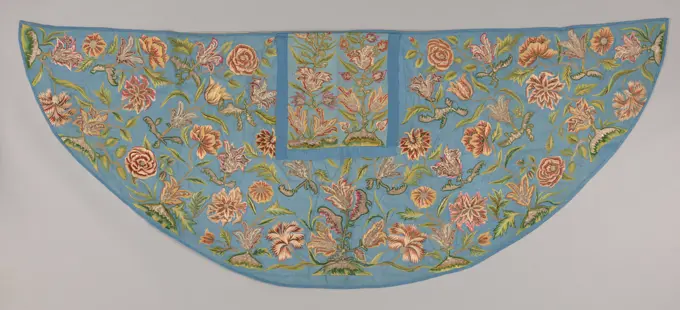
A collection of floral-patterned textiles featuring intricate designs in soft colors. Textiles include silk and paper prints with nature-inspired motifs.
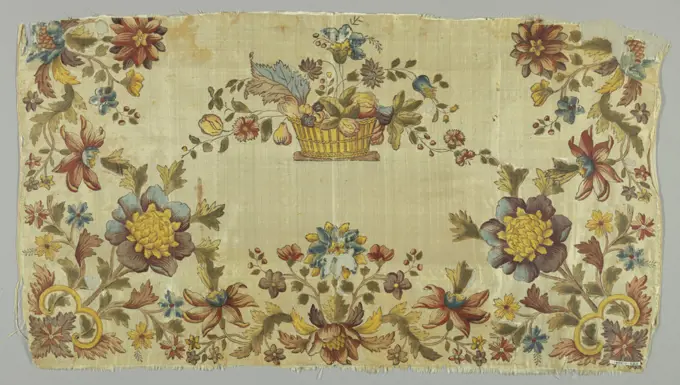
Panel, Medium: silk Technique: printed and painted on twill weave, Polychrome floral border on three sides and a basket of flowers in the center., France, 18th century, printed, dyed & painted textiles, Panel
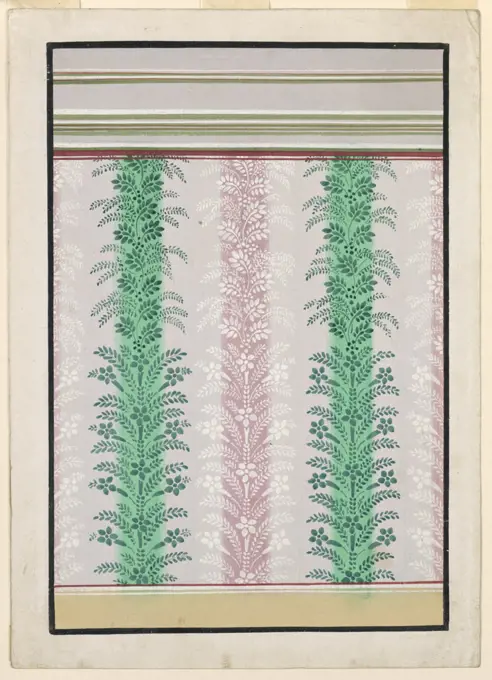
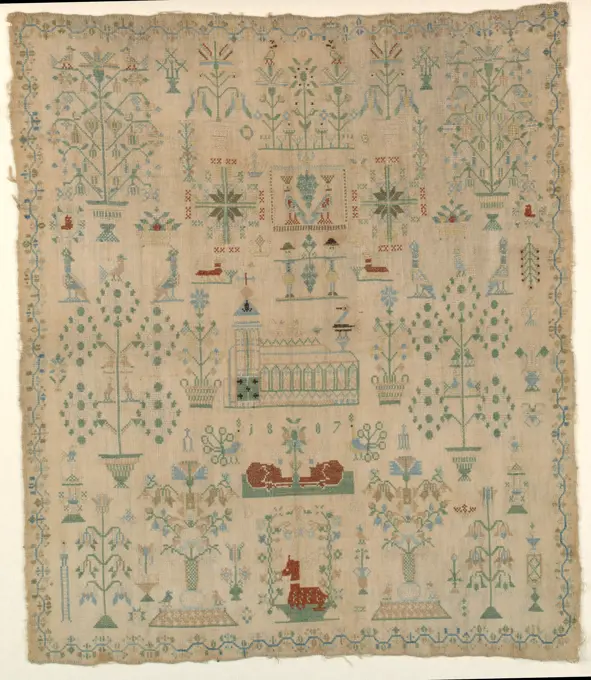
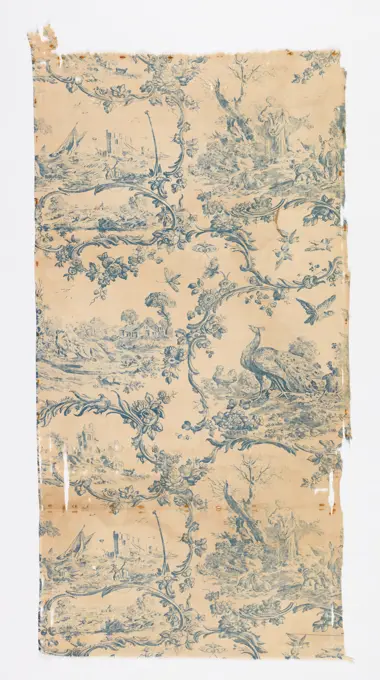
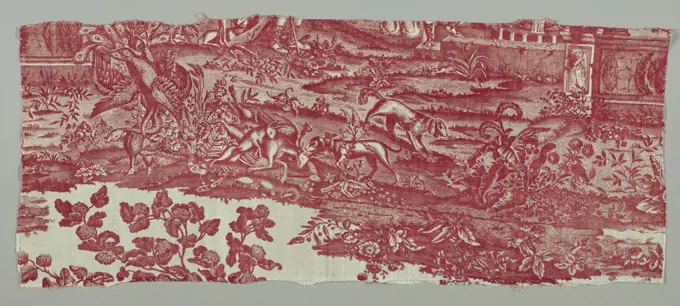
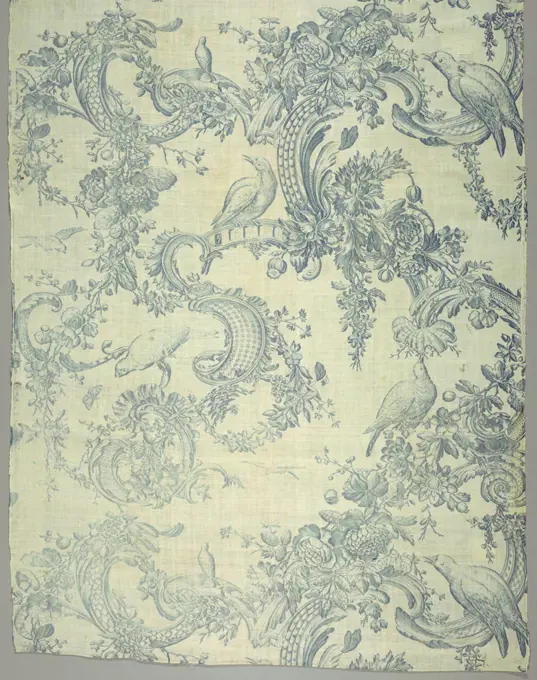
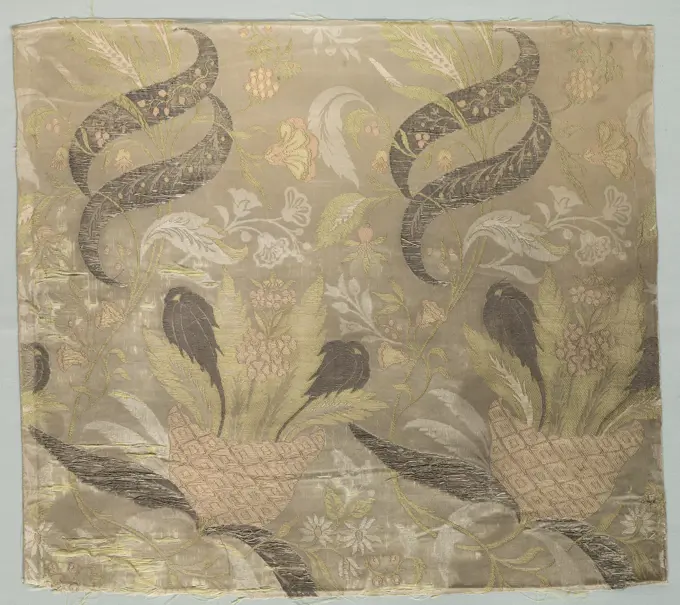
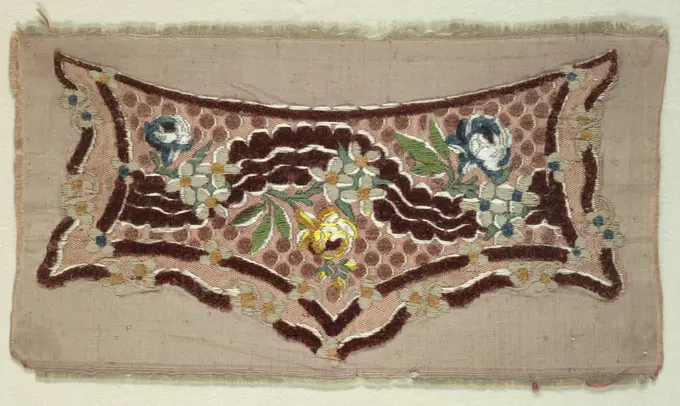
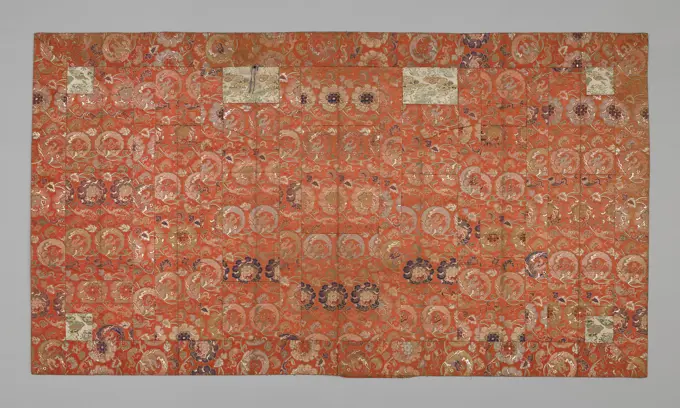
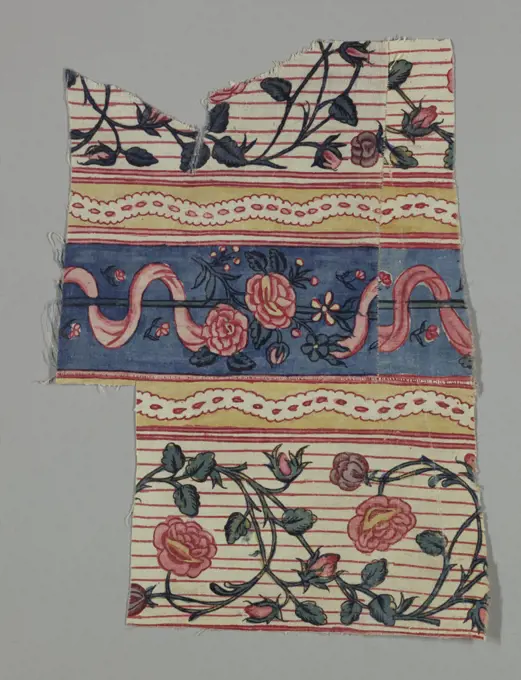
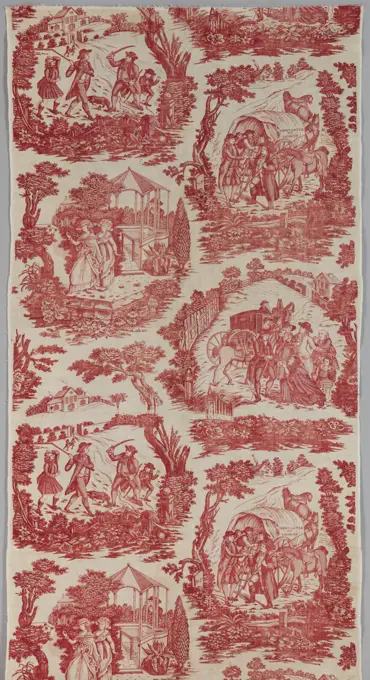
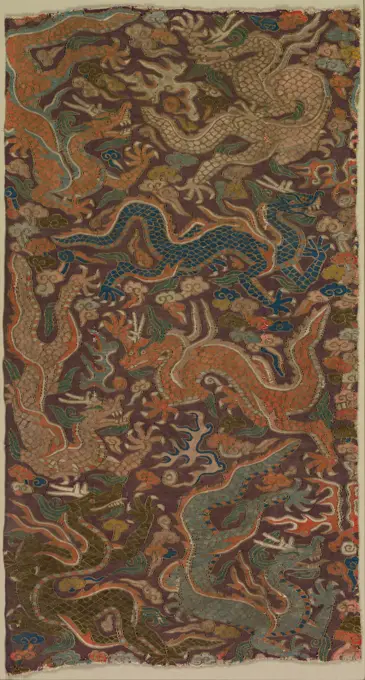
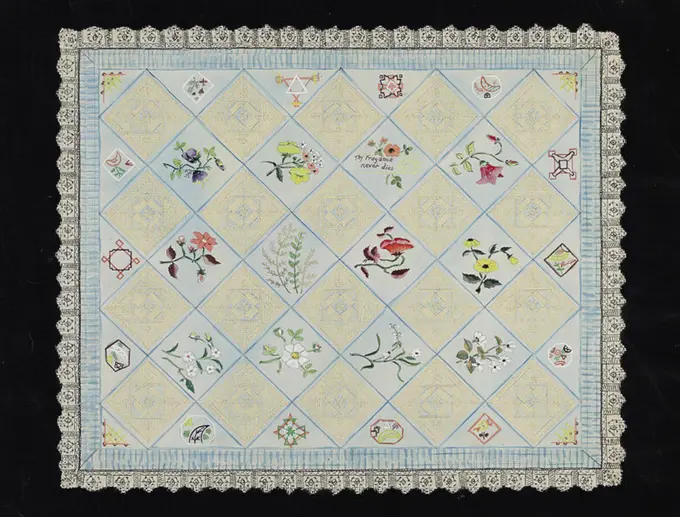
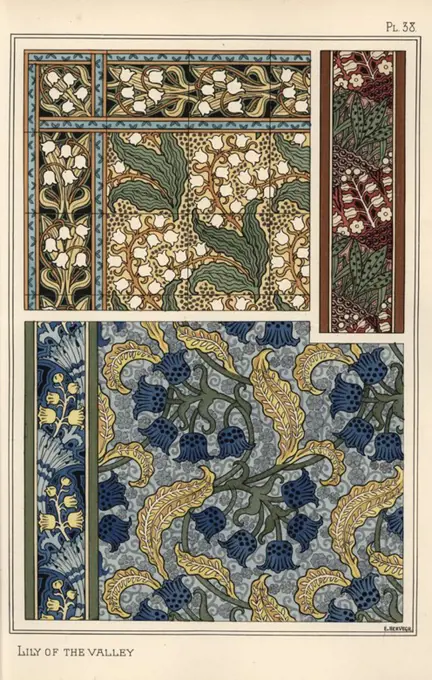
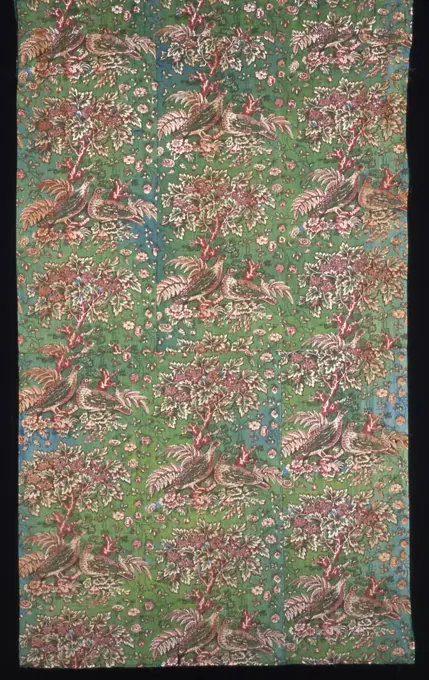
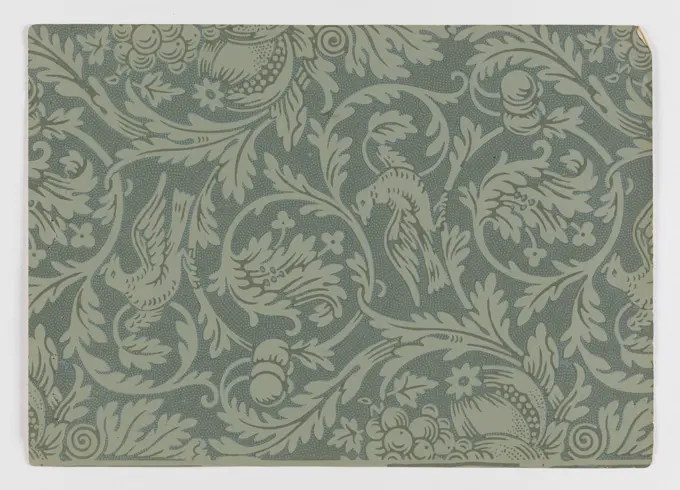
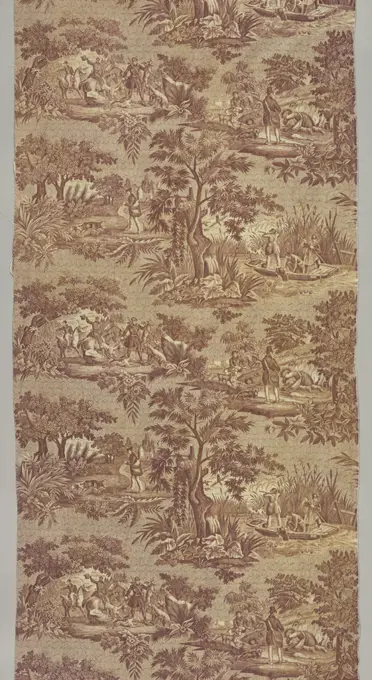
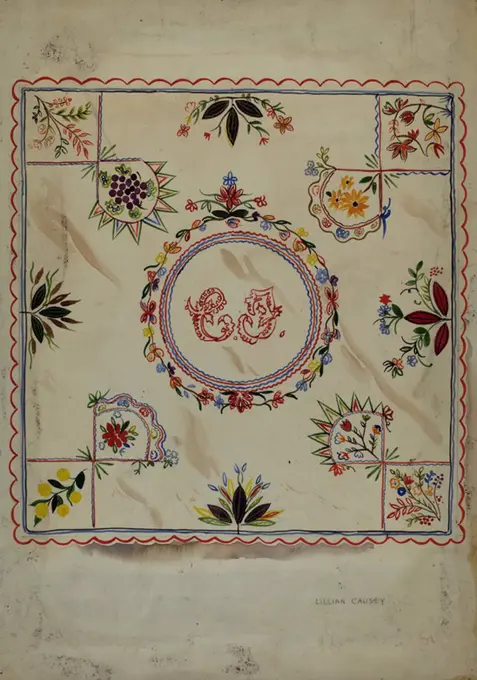
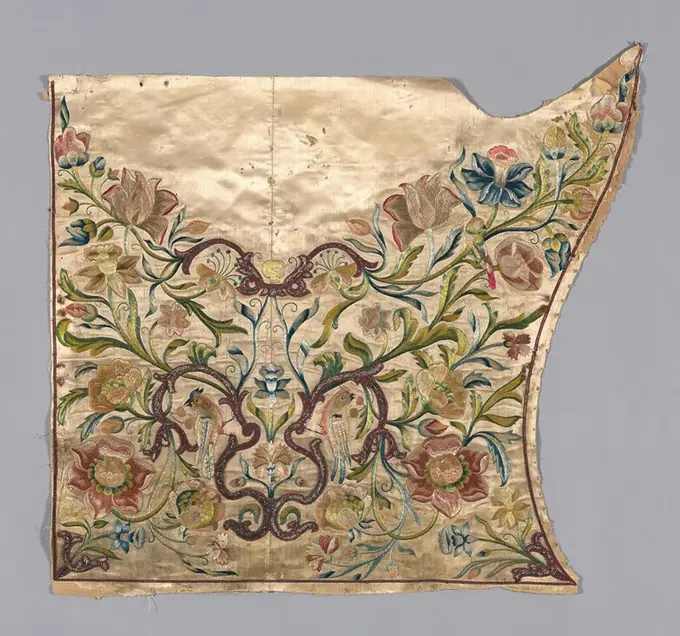
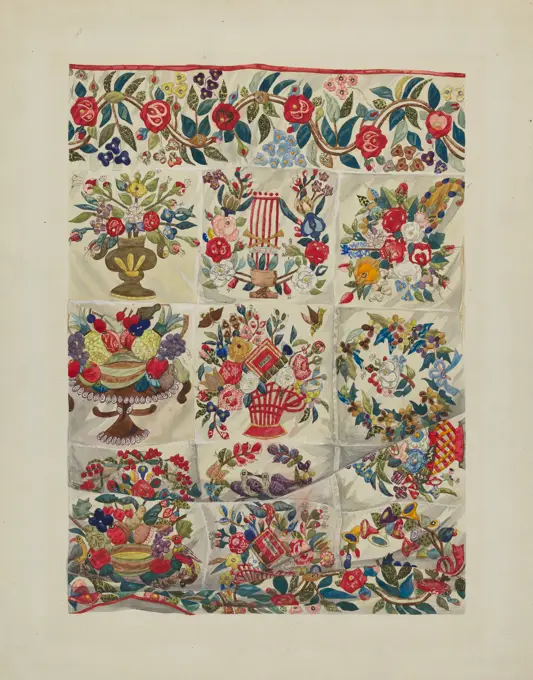
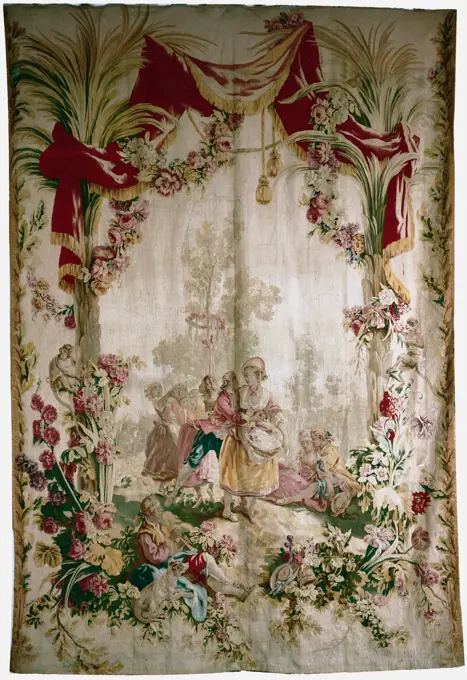
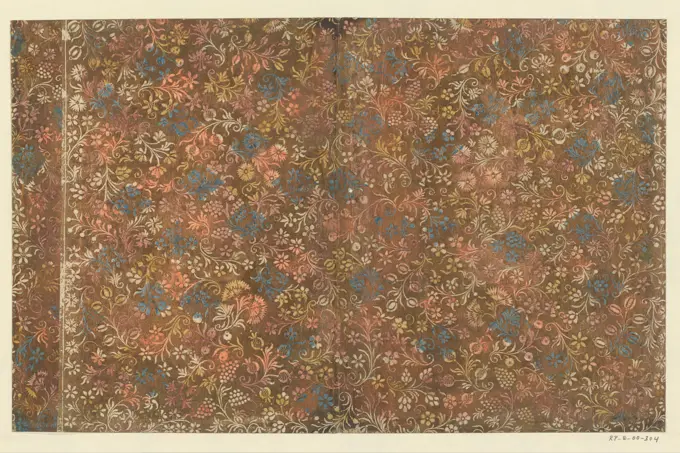
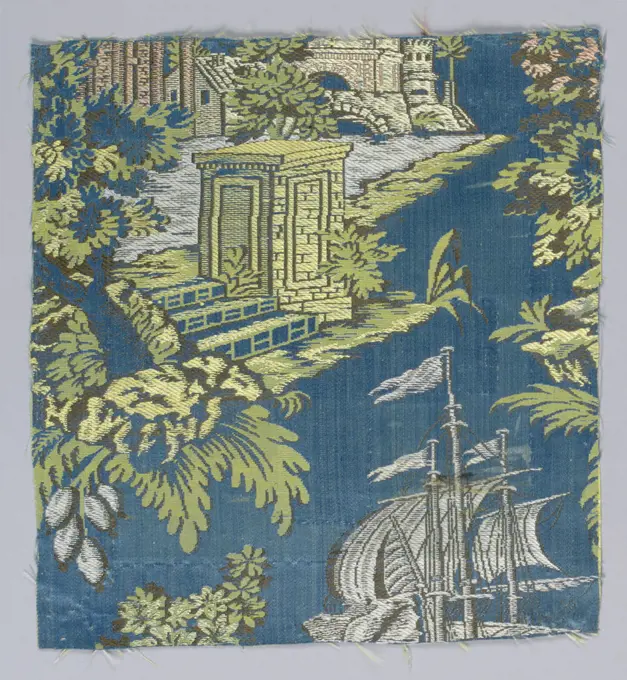
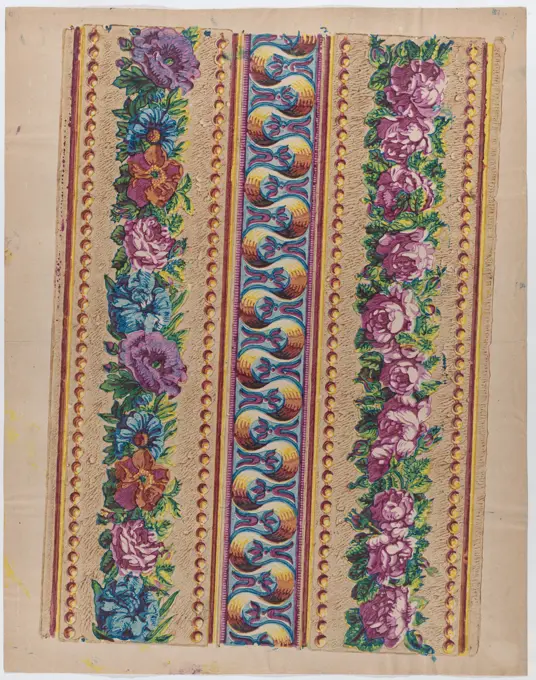
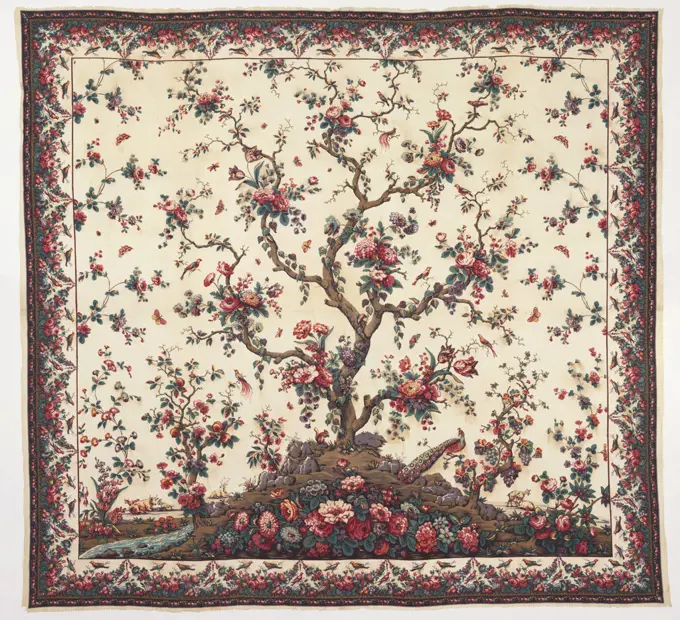
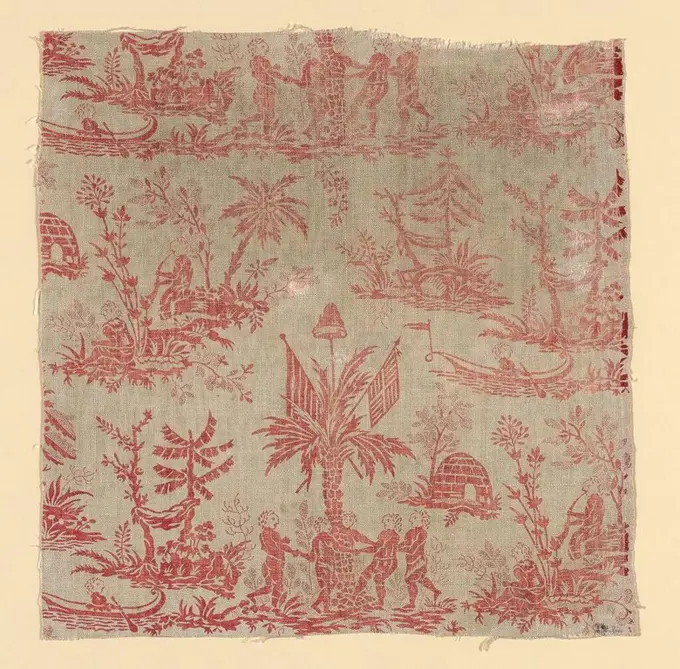
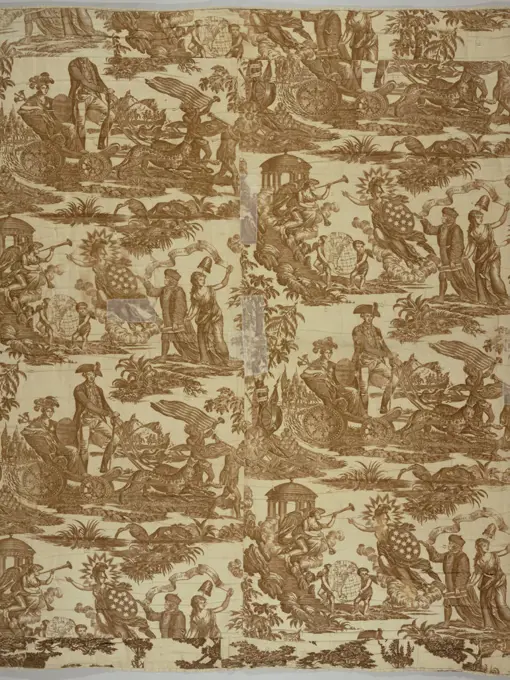
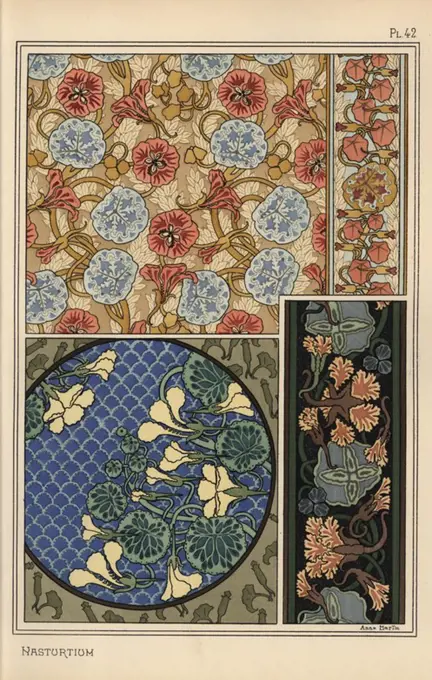
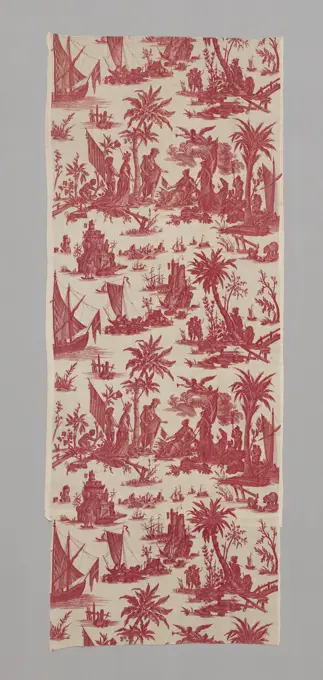
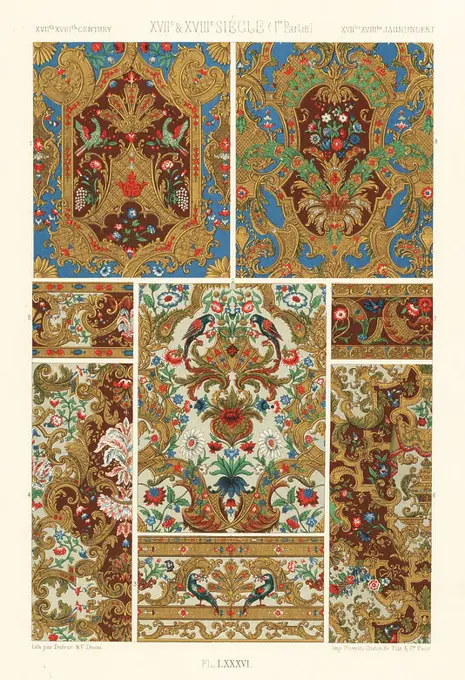
Gilded leather and borders, 17th and 18th centuries. Decorated with foliage, birds, flowers, and arabesques. XVIIme XVIIIme Siecle. Hand-finished chromolithograph by Dufour & F. Durin from Albert-Charles-Auguste Racinets LOrnement Polychrome, (Polychromatic Ornament), Firmin-Didot, Paris, 1869-73.Drawing, Design for an Embroidered or Woven Border of the "Fabrique de St. Ruf"; Designed by Fabrique de Saint Ruf; France; brush and white gouache on glazed tracing paper; 6.3 × 11.9 cm (2 1/2 × 4 11/16 in.)Wallpaper Design, Brush and gouache, graphite on white paper, A dado is shown at the bottom, an entablature on top. The background of the panel is divided into broad pale rose and narrow green and dark rose stripes. Upon these rise candelabra, for which two designs are suggested alternatively, in the lower and upper parts. They consist of straight stems with petals and blossom and leaf boughs and of two kinds of leaf boughs, respectively. Two horizontal and purple stripes are on top., Austria, 1840-60, wallpaper designs, Drawing, DrawingSampler (Netherlands); silk embroidery on cotton foundationPanel Made 1820-1840 France. Cotton, plain weave; block printed .Fragment, Medium: tempera on silk Technique: painted on plain weave, White ground with serpentine of intertwining ribbons and vines with floral sprays springing from them. Painted in rose, green, blue, white, orange, yellow, brown, purple, gold and silver., China, 18th century, printed, dyed & painted textiles, Fragment"Four Quarters of the Globe" ca. 1788 Jean-Baptiste Huet I French. "Four Quarters of the Globe". French, Jouy-en-Josas. ca. 1788. Cotton. Textiles-PrintedTextile (England); Printed by Bromley Hall (United Kingdom); cotton; Warp x Weft: 131 x 67.5 cm (51 9/16 x 26 9/16 in.) Repeat H: 87 cm (34 1/4 in.)Temple of Diana, Medium: cotton Technique: copperplate printed, Panel printed in red on white with a design of the temple of Diana., England, ca. 1790, printed, dyed & painted textiles, Textile, TextilePanel of Ornament, possibly Metalwork. Artist: Anonymous, British, 19th century. Dimensions: sheet: 12 9/16 x 7 5/8 in. (31.9 x 19.4 cm). Date: second half 19th century. Museum: Metropolitan Museum of Art, New York, USA.Birds, Medium: cotton Technique: plain weave, cooperplate printed, Large scale design printed in blue on white shows birds among rococo scrolls, flowers and foliage., England or France, ca. 1775, printed, dyed & painted textiles, Textile, TextileFlounce late 17th century Italian, Venice. Flounce 229952Large Floral Motif, 1830-1899. France, 19th century. Plain compound satin; overall: 47.6 x 53.3 cm (18 3/4 x 21 in.).Panel (Dress Fabric). France. Date: 1718-1720. Dimensions: 60.2 x 54.7 cm (23 3/4 x 21 1/2 in.)Repeat: 49.2 x 26.6 cm (19 3/8 x 10 1/2 in.). Silk and gilt-metal-strip-wrapped silk, warp-stripe 4:1 satin weave with supplementary patterning wefts and supplementary brocading wefts and self-patterned by reversing of faces. Origin: France. Museum: The Chicago Art Institute, Chicago, USA.Waistcoat pocket, Medium: silk Technique: cut supplementary warp pile (velvet) in a satin foundation, Pocket flap of cut velvet and brocading in a design of roses and floral sprigs against a dark red serpentine ribbon., France, 18th century, woven textiles, Waistcoat pocketSampler, Sarah C. Neal, American, Medium: silk embroidery on linen foundation Technique: embroidered in cross, satin, and stem stitches on plain weave foundation, Bands of alphabets and numerals with geometric cross borders, and an inscription., In the lower half, baskets of flowering vines and birds fill the field. With a black and white diamond border., Newmarket, New Hampshire, USA, 1826, embroidery & stitching, SamplerArtisan workshop of cordobanes and guadamecies, Cordoba, Region of Andalusia, Spain, Europe.Kesa Made 1801-1825 Japan. .Chintz fragment, Medium: cotton Technique: mordant for 2 reds and purple applied by pen and brush; madder dyed; blue applied (probably by immersion) over resist; chintz on plain weave, Stripes of roses and ribbons on different background. Three pieces sewn together., India, 1750-1800, printed, dyed & painted textiles, Chintz fragmentMise-en-carte (Point-paper) Made 1760-1790 France. Ink and gouache on hand drawn graph paper . Germain Frères (Designer)The Fall of the Bastille ca. 1790 British. The Fall of the Bastille 221864Breadth ca. 1790 British or Scottish. Breadth. British or Scottish. ca. 1790. Cotton. Textiles-PrintedDragons Chasing Flaming Pearls, 1200s or earlier. Central China, 13th century or earlier. Tapestry, silk and gold thread; overall: 60 x 32 cm (23 5/8 x 12 5/8 in.). Although the theme of dragons chasing the flaming pearl is Chinese, the eccentric form of the dragons and the way they have been crowded together are not. Other kesi woven with this design preserve parts of a bracketed medallion resembling the so-called cloud-collars worn in Central Asia. The intended purpose of kesi with cloud-collar medallions is not clear. Considering that cloud-collars were worn in Central Asia, these tapestries may have been woven for use as clothing. Hong Hao (1088-1155), a Chinese emissary, reported that the Uyghurs wove robes of kesi. Cloud-collar medallions, however, were also used in other decorative contexts, and it is possible that tapestries such as these served other purposes.Les Quatre Saisons (The Four Seasons), Medium: cotton Technique: printed by engraved plate on plain weave, Long panel of rural scenes indicative of the four seasons of the year (skating, maypole, fishing, harvesting) in red on white. Panel bound with woven tape on both sides. Quilted., Jouy, France, late 18th century, printed, dyed & painted textiles, Panel, PanelChest Design. Dated: 1935/1942. Dimensions: overall: 56.6 x 73.7 cm (22 5/16 x 29 in.). Medium: gouache and watercolor on paper. Museum: National Gallery of Art, Washington DC. Author: Chester Faris.Textile, Medium: linen warp, cotton weft Technique: printed by engraved copper plate on plain weave; mordant for brown, Repeat of four oval-shaped outdoor scenes which fill the full width of the fabric. Scenes include: a covered wagon 'Newcastle to London' and passengers; carriage with travelers hearing their fortune; two men fighting over two dead animals; and two women in a garden with gazebo, spied upon by a man behind a hedge. Pattern printed over both edges., England, ca. 1775-85, printed, dyed & painted textiles, TextilePanel Made 1735-1740 Lyon. Silk, gilt-and-silvered-metal strip, and gilt-and-silvered-metal strip wrapped silk, plain weave with supplementary patterning warps and supplementary patterning and brocading weftsChinoiserie Design, early 1800s. England, early 19th century. Block printed cotton; overall: 23.2 x 64.7 cm (9 1/8 x 25 1/2 in.).Sampler, Ann Thornton, American, Medium: silk embroidery on linen foundation Technique: embroidered in cross stitch on plain weave foundation, Several bands of alphabets and numerals separated by geometric and floral cross borders, with a verse and inscription:, God give me grace i ask no more, Contentment is a constant store, Ann Thornton Aged nine Years Anno Domini 1798, In the lower half, a landscape showing trees growing out of mounds with animals, birds, insects, and baskets of flowers. With an angular strawberry vine border., USA, 1798, embroidery & stitching, SamplerAmsterdam, Senegat, Alexander, Design for textiles, verso - stamped, Design for textiles with fantasy flowers and leaves., ornamental print, prints, ornamental prints, height 390 mm, width 264 mm, print maker, printmaker, 1719-03 - 1719-03, first quarter 18th century, paper, papier, etching, etchingsBook cover with floral pattern with orange background 18th century Anonymous. Book cover with floral pattern with orange background. Anonymous , Italian, 18th century. 18th century. Relief print (wood or metal). PrintsTextile (France); linen; Warp x Weft: 58.2 x 79 cm (22 15/16 x 31 1/8 in.)Scenic, Chinese; Made by Jones and Erwin, Inc.; China; hand-painted paper; 145.5 x 103 cm (57 5/16 x 40 9/16 in.)Sheet with pattern of bouquets and lion heads late 18th-mid-19th century Anonymous. Sheet with pattern of bouquets and lion heads. Anonymous , Italian, late 18th-mid 19th century. late 18th-mid-19th century. Relief print (wood or metal). PrintsWall Paper and Border. Dated: c. 1937. Dimensions: overall: 22.5 x 29 cm (8 7/8 x 11 7/16 in.) Original IAD Object: 14" repeat. Medium: watercolor, gouache, and graphite on paperboard. Museum: National Gallery of Art, Washington DC. Author: Sidney Liswood.Perce-neige. Milesi, J.. Prints, Botanical illustrations, Design drawings. 1896. The Miriam and Ira D. Wallach Division of Art, Prints and Photographs: Art & Architecture Collection. Decoration and ornament , Plant formsLa Trève de Dieu (God's Truce) (Furnishing Fabric). France. Date: 1815-1830. Dimensions: 56.2 × 54.6 cm (22 1/8 × 21 1/4 in.)Repeat: 28.2 × 33.7 cm (11 1/8 × 13 1/4 in.). Cotton, plain weave; block printed. Origin: France. Museum: The Chicago Art Institute, USA.Textile (France); cotton; Warp: 235 cm (92 1/2 in.) Weft: 75 cm (29 1/2 in.) Both selvedges present. Height of repeat: 42.5 cm (16 3/4 in.); Bequest of Elinor Merrell; 1995-50-194Satin Bedspread. Dated: c. 1936. Dimensions: overall: 34.2 x 25.9 cm (13 7/16 x 10 3/16 in.) Original IAD Object: 65" wide; 77" long. Medium: watercolor, gouache, graphite, and pen and ink on paper. Museum: National Gallery of Art, Washington DC. Author: Sebastian Simonet.Lily of the valley in patterns for ceramic tiles, borders and wallpaper. Lithograph by E. Hervegh with pochoir (stencil) handcoloring from Eugene Grasset's Plants and their Application to Ornament,” Paris, 1897. Eugene Grasset (1841-1917) was a Swiss artist whose innovative designs inspired the art nouveau” movement at the end of the 19th century.Plum Trees and Pheasants (Furnishing Fabric) Made 1820-1850 England. Cotton, plain weave; block printed . Bannister Hall Print Works (Printer)Fragment, Medium: cotton Technique: block printed on plain weave, Half-drop repeat of a scene of three children with a bow and arrow suspended from floral pendants., Villefranche, Rhone, France, early 19th century, printed, dyed & painted textiles, FragmentGroningen, Jelissen, Meynert, Black ornaments for gold and silversmiths and enamellers, Five Schweifwerk ornaments surrounded by flowers, One elongated Schweifwerk ornament in the middle, surrounded by four smaller ones., print, ornament print, prints, ornament prints, height 147 mm, width 200 mm, print maker, printmaker, 1622 - 1622, first quarter 17th century, paper, etching, etchings, engraving, engraving (printing process), Work conception, after a design by, Publication (Event), Publication, publisherSidewall - Fragment (France); block-printed on handmade paper, glazed; 55.5 x 38.5 cm (21 7/8 x 15 3/16 in.)Sidewall, Governor Gore; Manufactured by M.H. Birge & Sons Co. (United States); USA; machine-printed paper; 58.5 x 45 cm (23 1/16 x 17 11/16 in.)Textile Sample from Sample Book 19th century Japan. Textile Sample from Sample Book. Japan. 19th century. Silk. Textiles-Painted and PrintedTextile, Medium: silk Technique: painted on plain weave, Design of serpentine tree trunk throwing off flowering branches with birds. Panel is composed of several pieces, pasted together and mounted. White ground., China, 18th century, printed, dyed & painted textiles, TextileKosode (Kimono) Fragment with Bamboo, Chrysanthemum, and Emblems of Good Fortune (Takaramono). Japan, Edo period (1615-1868), mid-18th century. Textiles. Silk figured satin (rinzu) with silk and gilt-paper-wrapped-silk-thread embroideryJonquille. Verneuil, M. P. (Maurice Pillard), 1869-1942. Prints, Botanical illustrations, Design drawings. 1896. The Miriam and Ira D. Wallach Division of Art, Prints and Photographs: Art & Architecture Collection. Decoration and ornament , Plant formsBliej Kultury Krakow workshops, Batiki studio under the direction of Antoni Buszka, Stankówna, JaninaSidewall - Sample, Queen Anne; Designed by William Morris (British, 1834-1896); Manufactured by Jeffrey & Company (United Kingdom); Made for Morris & Co. (United Kingdom); block-printed paperBliej Kultury unknownSidewall (USA); machine-printed on ingrain paper; 69 x 50 cm (27 3/16 x 19 11/16 in.)Textile, Printed by engraved roller on cotton plain weave,, Four scenes, captioned in French, showing different kinds of hunting on a background of scrolls. in brown on white., Rouen area, France, 1800-1850, printed, dyed & painted textiles, TextileAltar Frontal, 18th century, L. 35 ½ x W. 39 ⅜ in. (88.9 x 99.06 cm), Silk, satin, gold, China, 18th century, The upper section of this panel depicts sacred vessels surrounded by a pattern of clouds, bats carrying flowers, butterflies, eight Daoist attributes, and seasonal plants (orchid, narcissus, plum, peony, camellia, bamboo, and fungus). Below that is a large golden dragon in a celestial landscape, which includes smaller dragons, mountains, waves, coral, and flying bats.Textile, Medium: cotton Technique: printed by engraved copper plate on plain weave, Plate printed in red showing design of a man and woman dressed in eighteenth century garments. The man is seated in front of a house with a shoe, beside him is a box of tools. Woman is looking out of the entrance door. Scene is set within large scale garlands of birds, flowers and fruit., France, mid-late 18th century, printed, dyed & painted textiles, TextilePieced Quilt. Dimensions: Original IAD Object: 118 1/2" square. Museum: National Gallery of Art, Washington DC. Author: Francis Law Durand.Blanket. Dated: c. 1936. Dimensions: overall: 35.4 x 25.1 cm (13 15/16 x 9 7/8 in.). Medium: watercolor and graphite on paper. Museum: National Gallery of Art, Washington DC. Author: Lillian Causey.Hanging, 18th century, 36 x 17 11/16 in. (91.4 x 44.9 cm) (without fringe), Silk, linen, Algeria, 18th centuryBand, Medium: silk on linen Technique: chain and counted running stitch embroidery on plain weave, Long band of linen, pieced in four places, embroidered in blue. The design is reserved in the ground of the linen, the background solidly worked with embroidery stitches. Design consists of fantastical mermaid-like figures in profile confronted on either side of a fountain-like structure. Figures alternate with smaller-winged confronted grotesques. Narrow cream looped fringe trims the top and bottom edges., Italy, Spain or Morocco, 18th century, embroidery & stitching, BandPanel (formerly Cover from a Sedan Chair). France. Date: 1710-1730. Dimensions: 77.5 × 82.5 cm (30 1/2 × 32 1/2 in.). Silk compound weave, brocaded. Origin: France. Museum: The Chicago Art Institute, Chicago, USA.Carpet ca. 1660-65 Savonnerie Manufactory Contemporary with Louis XIV's rise to power in 1661, this carpet elegantly illustrates aspects of earlier French design while being a harbinger of the later Savonnerie production made specifically for the Sun King. The work is closely related to the so-called Louis XIII carpets, examples of which postdate that monarch's death in 1643. Characteristic of this group is a profusion of flowers enclosed by a central medallion, gathered in elaborate arrangements, and strewn throughout a field that is usually black, as in the present work. These carpets also exhibit a clearly defined border and a simple guard pattern. Indicative of the forthcoming transition to the grandeur of the more severe and classical style of later carpets, such as those made for the Grande Galerie of the Louvre, of which two examples are currently on display in the Wrightsman Galleries, are the large, scrolling acanthus leaves that simultaneously divide, organize, and enliven thVerna Tallman, Applique Quilt (Friendship Quilt), c 1937 Applique Quilt (Friendship Quilt)Jonquille. Hervegh, E.. Prints, Botanical illustrations, Design drawings. 1896. The Miriam and Ira D. Wallach Division of Art, Prints and Photographs: Art & Architecture Collection. Decoration and ornament , Plant formsMaypole. Huet, Jean-Baptiste (French, 1745-1811) (author of design) painter Boucher, François (French, 1703-1770) (designed after, some figures ()) painter De Menou (French, act. 1780-1793) (workshop) weaver c. 1780-1790 Tapestry Dimensions: H 10'1" x W 7'2" Tapestry Materials/Techniques: wool (warp); wool & silk (weft) Culture: French Weaving Center: Beauvais Ownership History: Goldschmidt-Rothschild coll., Berlin. Sold at Parke Bernet (Sherwell sale, no. 2212), lot 442, 10/11/1963. French & Co. received from Henri Azria, received 2/1/1964; returned 2/28/1966. Couple embracing in front of 2 women dancing & in front of 2 additional figures; couple seated on ground to the R of the group; maypole behind the group; young man seated on ground plays coronet (BRD) scene framed by pair of palm trees with tall flowering stems at base, climbing monkeys at mid-points, & drapery, floral garland & tassels on cords looped from tree to tree across top; narrow leafy border on sides Some figures may bDesign for an Embroidered or Woven Horizontal Border of the 'Fabrique de St. Ruf', Fabrique de Saint Ruf, Lyon, France, Brush and white gouache on glazed tracing paper, The repeat, four of which are shown, consists of five bell-like forms disposed radially around a central rosette, and of a bough with a fantastic cluster of flowers rising on the left side., France, 1805-1815, Drawing, DrawingFragment, Medium: linen Technique: damask, Damask with a stylized floral border surrounding three horizontal rows containing Biblical scenes. The top row has three repeats of the Ascension along the text, 'Jesus schwingt die Virges Sohn.' The middle row depicts two men flanking a tree with the text, 'Simon Petrus' written above. On the bottom row is a city scene with the word 'Jerusalem' written above., Germany, 17th century, woven textiles, FragmentTextile, Tigers Chasing Deer, with Dragon.  China, Eastern, 11th-12th century, Silk and gold thread; tapestry.   The design motifs of this kesia dragon at the top, bands of pearls and split palmettes, and tigers chasing deer with mushroom-shaped antlersare a synthesis of Western and Chinese elements.Leaf with flowers and fruits, anonymous, 1700 - 1800 brocade paper Leaf with flowers and fruits. Used as a cover. Germany paper. paint (coating) relief printing ornament derived from plant formsFragment, silk woven, Fragment showing a portion of a ship under sail and a flight of steps leading to a group of buildings., 18th century, woven textiles, FragmentTextile, Medium: wool Technique: block printed on plain weave, One of seven pages from a printed fabric sample book has a bright purple ground with horizontal garlands of plaid ribbon and bunches of pink roses and small orange flowers., England, ca. 1860, printed, dyed & painted textiles, TextileToile Fragment, c. 1800, 12 5/8 x 13 1/2in. (32.1 x 34.3cm), fabric; printed, France, 18th-19th centuryBorder. Italy. Date: 1601-1625. Dimensions: 104.7 × 28.9 cm (41 1/4 × 11 3/8 in.). Silk, satin weave self-patterned by reversing of faces. Origin: Italy. Museum: The Chicago Art Institute, Chicago, USA.Branches and Vines Quilt. Culture: American. Dimensions: 88 × 86 in. (223.5 × 218.4 cm). Maker: Ernestine Eberhardt Zaumseil (American, 1828-1904). Date: ca. 1875.Working in the later years of the nineteenth century, Ernestine Zaumseil created this extraordinary quilt employing the Tree of Life pattern, a design that has been popular for use on bedcovers since the seventeenth century. The first Tree of Life bedcovers, called "palampores", were of Indian origin and featured a stylized tree bearing fantastical fruits and flowers. An Indian palampore makes up the central panel of quilt 2014.263 in the American Wing's collection. In Zaumseil's quilt, the trees and branches are much more realistic, in part because she seems to have traced leaves from actual trees and vines to serve as patterns for her appliquéd designs. Museum: Metropolitan Museum of Art, New York, USA.Mise-en-carte (Point-paper). Designed by J Bte Clere and Germain Frères; France. Date: 1760-1790. Dimensions: 39.4 × 55.6 cm (15 1/2 × 21 7/8 in.). Ink and gouache on hand drawn graph paper. Origin: France. Museum: The Chicago Art Institute, USA.Fragment textile. Textile fragment, embroidery of the Chinese character `shou`.Side Panel of a Bedspread, 1700s. Greece, Sporades Islands, Skyros, 18th century. Embroidery: silk on linen tabby ground; overall: 241.3 x 57.1 cm (95 x 22 1/2 in.).Quilt. Dated: c. 1937. Dimensions: overall: 30.4 x 22.7 cm (11 15/16 x 8 15/16 in.). Medium: watercolor and graphite on paperboard. Museum: National Gallery of Art, Washington DC. Author: Gladys Phillips.Fragment, ca. 1700; silk, metallic yarnsChintz, Medium: cotton Technique: mordants (for black, purple, brown and 2 reds, including madder) and dye (yellow) applied by brush or pen; blue applied by brush over resist; chintz on plain weave, Very loose diamond lattice made up of flowering vines and fruits, in black, brown, blue, purple, red, and pink on a white ground., India, 18th century, printed, dyed & painted textiles, ChintzLes Vendanges, Jean-Baptiste Marie Huet, (French, 1745-1811), Medium: cotton Technique: printed by engraved copper plate on plain weave, Panel of cotton printed in red showing a design of women harvesting grapes and a man in front of an inn with vessels of wine around him., Jouy, France, 1785, printed, dyed & painted textiles, Textile, TextileTextile Fragment (Japan); silk, paper with applied gold foil; Warp x Weft: 20.3 x 14 cm (8 in. x 5 1/2 in.)Bed Canopy Detail. Dated: c. 1937. Dimensions: overall: 57.3 x 43.3 cm (22 9/16 x 17 1/16 in.). Medium: watercolor and graphite on paper. Museum: National Gallery of Art, Washington DC. Author: Mildred E. Bent.Textile (Spain); cottonAlbum, Les Cinq Sens de Nature Inventé & Dessiné par Jean Pillement; Designed by Jean-Baptiste Pillement (French, 1728-1808); Print Maker: Robert Cooper (British, active 1795 - 1836); Published by Jean-Baptiste Crépy (French, active 1753 - d. 1796)Drawing, Design for Woven or Printed Textile; France; brush and gouache with graphite on off-white laid paper; 48.1 x 47.9 cm (18 15/16 x 18 7/8 in.), irregularSheet with a border with pink and multicolor floral garlands late 18th-mid-19th century Anonymous. Sheet with a border with pink and multicolor floral garlands. Anonymous , Italian, late 18th-mid 19th century. late 18th-mid-19th century. Relief print (wood or metal). PrintsMezzaro (shawl or headcovering), Medium: cotton Technique: block printed, Mezzaro in a multicolored design on a white ground. Central large-scale tree with many different blossoms. Small flanking tree on either side. Floral sprays, insects, birds and animals scattered over the ground. Border of massed flowers and fruit with perching birds., Genoa, Italy, 1800-1850, printed, dyed & painted textiles, Mezzaro (shawl or headcovering)Textile With Chef De Piece, Le Triomphe de Voltaire; Manufactured by Manufacture de Dubern & Comp. a Nantes; France; cotton; Repeat H: 103.5cm (40 3/4in.) Repeat H (plate): 103.5 cm (40 3/4 in.) Warp x Weft: 147.5 x 94.5 cm (58 1/16 x 37 3/16 in.)Design for an Embroidered or Woven Horizontal Border of the 'Fabrique de St. Ruf', Fabrique de Saint Ruf, Lyon, France, Brush and white gouache on glazed tracing paper, The design is an enriched variation of -87 showing besides leaves and blossoms branching off, a big lacy blossom covering the bough. At the bottom are a row of boughs with threee leaves and a flower each and a row of leaf scrolls. Somewhat more than one repeat is shown., France, 1805-1815, Drawing, DrawingPiece ca. 1710 Italian, Venice Panels such as thiswith its extraordinary patterns in long repeatswere called "bizarre" by the Danish scholar Slomann, who believed they were made in India. Most scholars consider them an exotic phase in the history of European silk weaving.. Piece 217272La Danse des Noirs (The Dance of the Blacks) (Furnishing Fabric). Manufactured by Christophe Philippe Oberkampf (French, 1738-1815); France, Jouy-en-Josas. Date: 1760-1795. Dimensions: 40.5 × 39.4 cm (16 × 15 1/2 in.)Warp repeat: 31.4 cm (12 3/8 in.). Linen and cotton, plain weave; block printed. Origin: France. Museum: The Chicago Art Institute, Chicago, USA. Author: Christophe Phillipe Oberkampf.Quilt, Medium: cotton Technique: copperplate printed on plain weave, Obverse is comprised of two pieces of toile. The design is known as The Victory of Washington or The Apotheosis of Franklin. Reverse is made of three pieces of toile depicting rural festivities, including a maypole dance. Bound on the edges with white tape., England, ca. 1780, printed, dyed & painted textiles, QuiltLilas. Martin, Anna. Prints, Botanical illustrations, Design drawings. 1896. The Miriam and Ira D. Wallach Division of Art, Prints and Photographs: Art & Architecture Collection. Decoration and ornament , Plant formsNasturtium in art nouveau patterns for fabrics, wallpapers and borders. Lithograph by Anna Martin with pochoir (stencil) handcoloring from Eugene Grasset's Plants and their Application to Ornament,” Paris, 1897. Eugene Grasset (1841-1917) was a Swiss artist whose innovative designs inspired the art nouveau” movement at the end of the 19th century.Fragment (Japan)Panel Made 1725-1750 France. Silk and silvered-metal-strip-wrapped silk, satin weave with brocading wefts and self-patterned by areas of twill interlacings and ground weft floats .L'Hommage de l'Amérique á la France (America's Tribute to France) (Furnishing Fabric) Made 1780-1790 France. Cotton, plain weave; copperplate printedDrawing, Floral field and border; France; white on glazed paperSidewall (France); stencilled, painted, distemper paints; 125.5 x 97 cm (49 7/16 x 38 3/16 in.)