My Boards
View Pictures
  • My Boards

Futuristic Space Exploration Concepts

Illustrations depicting imaginative concepts of space exploration, including satellites, space stations, and lunar bases from past decades.

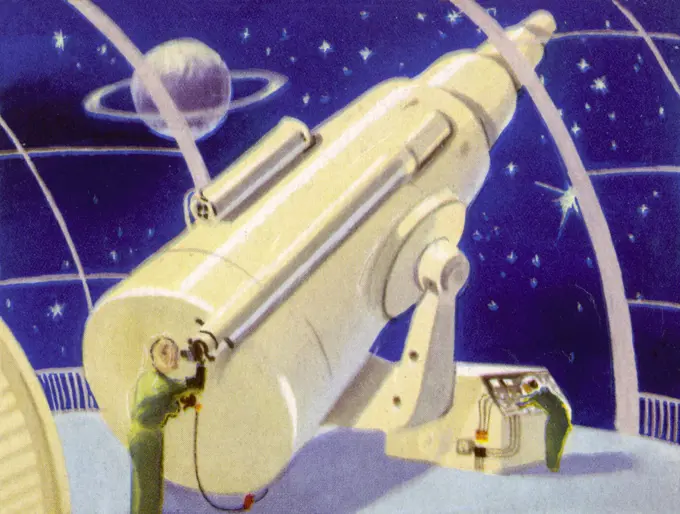
 METEOROLOGICAL STATION  IN SPACE        Date: circa 1950
METEOROLOGICAL STATION IN SPACE Date: circa 1950
414 assets in this story
6145-44603932
This is the astronaut designed mission insignia for the STS-96 space flight, the second Space Shuttle Mission dedicated to the assembly of the International Space Station (ISS). The crew member designed patch highlights the major themes of the Station program Earth-directed research, the advancement of human space exploration, and international cooperation. The Space Shuttle Discovery is depicted shortly after reaching orbit as the crew prepares for the first docking with the new station. At this early stage in its construction, the ISS consisted of two modules; The Russian Zarya and the U.S. Unity, shown orbiting the Earth. The triangular shape represents building on the knowledge and experience of earlier missions, while the three vertical bars point toward future human endeavors in space. The five pointed star is symbolic of the five space agencies participating in the development of the ISS NASA, the Russian Space Agency, the European Space Agency, the National Space Development Ag
6145-44733488
This official NASA commemorative logo marks the 25th anniversary of the first lunar landing. The design incorporates an eagle, from the original Apoll 11 crew insignia, descending toward the lunar surface with an olive branch, symbolizing America's peaceful mission in space. Alternative Headquarters number is 93-HC-312 or 93-H-336.
6145-44580690
ISS006-S-001 (September 2002) --- The International Space Station (ISS) Expedition Six crew patch depicts the station orbiting the Earth on its mission of international cooperation and scientific research. The Earth is placed in the center of the patch to emphasize that work conducted aboard this orbiting laboratory is intended to improve life on our home planet. The shape of the space station’s orbit symbolizes the role that experience gained from ISS will have on future exploration of our solar system and beyond. The American and Russian flags encircling the Earth represent the native countries of the Expedition 6 crew members, which are just two of the many participant countries contributing to the ISS and committed to the peaceful exploration of space.The NASA insignia design for International Space Station (ISS) missions is reserved for use by the crew members and for other official use as the NASA Administrator may authorize. Public availability has been approved only in
6145-44637940
The primary payload for Space Shuttle Mission STS-42, launched January 22, 1992, was the International Microgravity Laboratory-1 (IML-1), a pressurized manned Spacelab module. The goal of IML-1 was to explore in depth the complex effects of weightlessness of living organisms and materials processing. Around-the-clock research was performed on the human nervous system's adaptation to low gravity and effects of microgravity on other life forms such as shrimp eggs, lentil seedlings, fruit fly eggs, and bacteria. Materials processing experiments were also conducted, including crystal growth from a variety of substances such as enzymes, mercury iodide and a virus. More than 200 scientists from 16 countries participated in the investigations. This is the logo or emblem that was designed to represent the IML-1 payload.
6145-44895224
CAPE CANAVERAL, Fla. -- Throughout the past 50 years, NASA's Kennedy Space Center has carried on America's legacy of processing, testing and launching a wide array of rockets and spacecraft to distant planets and other destinations in space. Launch vehicles, from left, include the Mercury Atlas, Gemini Titan, Apollo Saturn V, Atlas, Delta and the space shuttle. Across the top, a Mercury spacecraft is checked out in Hangar S at Cape Canaveral Air Force Station, an Apollo countdown is monitored from a Launch Control Center Firing Room, and mission managers celebrate the launch of the final space shuttle mission -- STS-135. In the lower right, STS-129 mission specialists Randy Bresnik, left, and Leland Melvin indicate they are "go for launch" as they prepare to enter space shuttle Atlantis from the White Room. Also in the image are human destinations the center helped NASA reach, including Earth's orbit, the International Space Station and destination beyond.
6145-44711043
S66-23978 (March 1966) --- Color design for the emblem of the Gemini-8 spaceflight. Roman numeral indicates the eighth flight in the Gemini series. Prime crewmen for the mission are astronauts Neil A. Armstrong, command pilot; and David R. Scott, pilot. The NASA insignia design for Gemini flights is reserved for use by the astronauts and for other official use as the NASA Administrator may authorize. Public availability has been approved only in the form of illustrations by the various news media. When and if there is any change in this policy, which we do not anticipate, it will be publicly announced.
6145-45245646
STS054-S-001 (July 1992) --- Designed by the crew members, the STS-54 crew patch depicts our national symbol, the American bald eagle, soaring above the Earth; and represents the United States Space Shuttle as a national asset in service to America and the world. The eagle is clutching an eight pointed star in its talons and is placing this larger star among a constellation of four others representing the placement of the fifth Tracking and Data Relay Satellite (TDRS) into orbit among the four already in service. The blackness of space with stars conspicuously absent represents the mission s other primary objective in carrying the Diffuse X-ray Spectrometer into orbit to conduct astronomical observations of x-ray sources within the galaxy and throughout the universe. The depiction of our planet showing the crew s home continent of North America is an expression of their and NASA s intention that the medical and scientific experiments conducted onboard are for the benefit of all mankind
6145-45048206
PHOTO DATE:  3-19-14LOCATION:   Bldg. 5 - High BaySUBJECT: Soyuz 39 crew members (Expedition 41), Maxim Suraev, Greg Wiseman, Alexander Gerst during SSTF Cake Cutting Ceremony marking the end of their training.
6145-45064371
PHOTO DATE: 09 July 2014LOCATION: Bldg. 5 - Space Station Training Facility High BaySUBJECT:  Expedition 42/43 cake cutting ceremony Soyuz 40(Soyuz 40(Alexander Samokutyaev, Yelena Serova, Barry Wilmore) & Soyuz 41(Anton Shkaplerov, Samantha Cristoforetti, Terry Virts) with ISS trainers.
6145-44626446
This plaque, displayed on the grounds of Marshall Space Flight Center in Huntsville, Alabama, commemorates the Saturn V Dynamic Test Stand as a National Historic Landmark. The site was designated as such in 1985 by the National Park Service of the United States Department of the Interior.
6145-45064372
PHOTO DATE: 09 July 2014LOCATION: Bldg. 5 - Space Station Training Facility High BaySUBJECT:  Expedition 42/43 cake cutting ceremony Soyuz 40(Soyuz 40(Alexander Samokutyaev, Yelena Serova, Barry Wilmore) & Soyuz 41(Anton Shkaplerov, Samantha Cristoforetti, Terry Virts) with ISS trainers.
6145-44635321
This STS-68 patch was designed by artist Sean Collins. Exploration of Earth from space is the focus of the design of the insignia, the second flight of the Space Radar Laboratory (SRL-2). SRL-2 was part of NASA's Mission to Planet Earth (MTPE) project. The world's land masses and oceans dominate the center field, with the Space Shuttle Endeavour circling the globe. The SRL-2 letters span the width and breadth of planet Earth, symbolizing worldwide coverage of the two prime experiments of STS-68 The Shuttle Imaging Radar-C and X-Band Synthetic Aperture Radar (SIR-C/X-SAR) instruments; and the Measurement of Air Pollution from Satellites (MAPS) sensor. The red, blue, and black colors of the insignia represent the three operating wavelengths of SIR-C/X-SAR, and the gold band surrounding the globe symbolizes the atmospheric envelope examined by MAPS. The flags of international partners Germany and Italy are shown opposite Endeavour. The relationship of the Orbiter to Earth highlights the u
6145-44999475
CAPE CANAVERAL, Fla. - This memorial message was added to the Atlas V rocket for NASA's Tracking and Data Relay Satellite, or TDRS-L, spacecraft being prepared for launch from Cape Canaveral Air Force Station's Launch Complex 41. Arthur J. "Skip" Mackey Jr. was the Voice of NASA” during the 1960s, 1970s and early 1980s for flight commentary after liftoff for expendable vehicles launched from Cape Canaveral. Mackey served as branch chief for Telemetry and Communications at Hangar AE in the agency’s Expendable Launch Vehicle Program and then the Launch Services Program for 39 years. He died in Fort Lauderdale, Fla., on Nov. 19, 2013. The TDRS-L spacecraft is the second of three new satellites designed to ensure vital operational continuity for NASA by expanding the lifespan of the Tracking and Data Relay Satellite System TDRSS fleet, which consists of eight satellites in geosynchronous orbit. The spacecraft provide tracking, telemetry, command and high bandwidth data return services for
6145-44544321
STS068-S-001 (March 1994) --- Exploration of Earth from space is the focus of the design of the STS-68 insignia, the second flight of the Space Radar Laboratory (SRL-2). SRL-2 is part of NASA's Mission to Planet Earth (MTPE) *project. The world's land masses and oceans dominate the center field, with the space shuttle Endeavour circling the globe. The SRL-2 letters span the width and breadth of planet Earth, symbolizing worldwide coverage of the two prime experiments of STS-68 - The Shuttle Imaging Radar-C and X-Band Synthetic Aperture Radar (SIR-C/X-SAR) instruments, and the Measurement of Air Pollution from Satellites (MAPS) sensor. The red, blue and black colors of the insignia represent the three operating wavelengths of SIR-C/X-SAR, and the gold band surrounding the globe symbolizes the atmospheric envelope examined by MAPS. The flags of international partners Germany and Italy are shown opposite Endeavour. The relationship of the orbiter to Earth highlights the usefulness of huma
PREVIOUS
of 5
NEXT
2401 S. Ervay, Suite 206
Dallas, Texas 75215
United States
Get Started
Free ResearchMy BoardsMy Cart
For Creators
How To License Your ContentContributor PortalFrame of Mind
Resources
API accessPricing
Contact
+1 866 236 0087help@viewpictures.co.uk Contact form
©2026 View Pictures. All Rights Reserved. -A
This site is protected by reCAPTCHA and Google Privacy Policy and Terms of Service apply.