My Boards
View Pictures
  • My Boards

Galactic Nebulae and Stars

Stunning images of nebulae and galaxies showcasing vibrant colors, glowing stars, and cosmic dust, ideal for conveying the beauty of space.

galaxy in a free space Stars of a planet and galaxy in a free space Copyright: xZoonar.com/gannaxacheretx 11720085
309 assets in this story
1848-64916115
Space background with silhouette of telescope. Pinwheel Galaxy Messier 101, M101 in the constellation Ursa Major Elements of this image are furnished by NASA
6145-45087799
Our Milky Way galaxy is ablaze with dust in this new all-sky map from Planck, a European Space Agency mission with important NASA contributions. The towers of fiery colors are actually dust in the galaxy and beyond that has been polarized.
6145-44667044
In the 19th century, astronomer V. M. Slipher first discovered a hat-like object that appeared to be rushing away from us at 700 miles per second. This enormous velocity offered some of the earliest clues that it was really another galaxy, and that the universe was expanding in all directions. The trained razor sharp eye of the Hubble Space Telescope (HST) easily resolves this Sombrero galaxy, Messier 104 (M104). The galaxy is 50,000 light-years across and is located 28 million light-years from Earth at the southern edge of the rich Virgo cluster of galaxies. Equivalent to 800 billion suns, Sombrero is one of the most massive objects in that group. The hallmark of Sombrero is a brilliant white, bulbous core encircled by the thick dust lanes comprising the spiral structure of the galaxy. As seen from Earth, the galaxy is tilted nearly edge-on. We view it from just six degrees north of its equatorial plane. At a relatively bright magnitude of +8, M104 is just beyond the limit of naked-ey
6145-44591832
This panoramic view encompasses the entire sky as seen by Two Micron All-Sky Survey. This image is centered on the core of our own Milky Way galaxy, toward the constellation of Sagittarius.
6145-44889606
NEOWISE, the asteroid-hunting portion of NASA's WISE mission, illustrates the differences between orbits of a typical near-Earth asteroid (blue) and a potentially hazardous asteroid, or PHA (orange). PHAs are a subset of the near-Earth asteroids (NEAs).
4239-69143504
Artist's concept of supernova SN 1997D.
6145-45099269
This image shows the galaxy Messier 94, which lies in the small northern constellation of the Hunting Dogs, about 16 million light-years away. Within the bright ring or starburst ring around Messier 94, new stars are forming at a high rate and many young, bright stars are present within it. The cause of this peculiarly shaped star-forming region is likely a pressure wave going outwards from the galactic center, compressing the gas and dust in the outer region. The compression of material means the gas starts to collapse into denser clouds. Inside these dense clouds, gravity pulls the gas and dust together until temperature and pressure are high enough for stars to be born.
4239R-9218
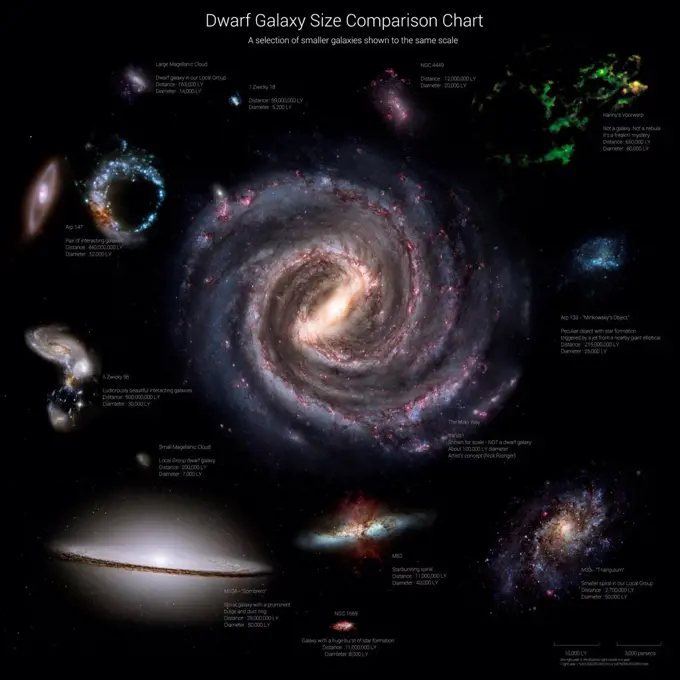
Galaxy sizes compared to IC 1101, the largest known galaxy.
6145-44913775
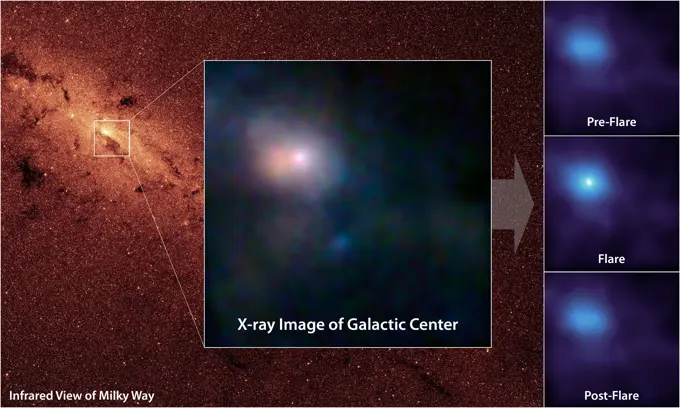
NASA's NuSTAR has captured these first, focused views of the supermassive black hole at the heart of our Milky Way galaxy in high-energy X-ray light.
PREVIOUS
of 4
NEXT
2401 S. Ervay, Suite 206
Dallas, Texas 75215
United States
Get Started
Free ResearchMy BoardsMy Cart
For Creators
How To License Your ContentContributor PortalFrame of Mind
Resources
API accessPricing
Contact
+1 866 236 0087help@viewpictures.co.uk Contact form
©2026 View Pictures. All Rights Reserved. -A
This site is protected by reCAPTCHA and Google Privacy Policy and Terms of Service apply.