My Boards
View Pictures
  • My Boards

Galaxies In Deep Space

Vibrant images of distant galaxies filled with stars, dust, and gas nebulae. The cosmic scenes feature rich colors, intricate patterns, and a sense of infinity.

Milky way, space and spiral stars in universe on black background with light, pattern and solar system glow. Galaxy, infinity and planets in cosmos with nebula shine, dark sky and color in aerospace.
252 assets in this story
6145-44633212
This image shows the hidden spiral arms that were discovered around the galaxy called NGC 4625 (top) by the ultraviolet eyes of NASA's Galaxy Evolution Explorer. An armless companion galaxy called NGC 4618 is pictured below.
6145-45261753
NASA image release September 25, 2012 Like photographers assembling a portfolio of best shots, astronomers have assembled a new, improved portrait of mankind's deepest-ever view of the universe. Called the eXtreme Deep Field, or XDF, the photo was assembled by combining 10 years of NASA Hubble Space Telescope photographs taken of a patch of sky at the center of the original Hubble Ultra Deep Field. The XDF is a small fraction of the angular diameter of the full moon. The Hubble Ultra Deep Field is an image of a small area of space in the constellation Fornax, created using Hubble Space Telescope data from 2003 and 2004. By collecting faint light over many hours of observation, it revealed thousands of galaxies, both nearby and very distant, making it the deepest image of the universe ever taken at that time. The new full-color XDF image is even more sensitive, and contains about 5,500 galaxies even within its smaller field of view. The faintest galaxies are one ten-billionth the bright
6145-44823119
Some might see a blood-red jellyfish, while others might see a pair of lips. In fact, the red-colored object in this new image from NASA's Wide-field Infrared Survey Explorer is a sphere of stellar innards.
6145-44527346
Huge waves are sculpted in this two-lobed nebula called the Red Spider Nebula, located some 3,000 light-years away in the constellation of Sagittarius. This warm planetary nebula harbors one of the hottest stars known and its powerful stellar winds generate waves 100 billion kilometers (62.4 billion miles) high. The waves are caused by supersonic shocks, formed when the local gas is compressed and heated in front of the rapidly expanding lobes. The atoms caught in the shock emit the spectacular radiation seen in this image.
4389-1416
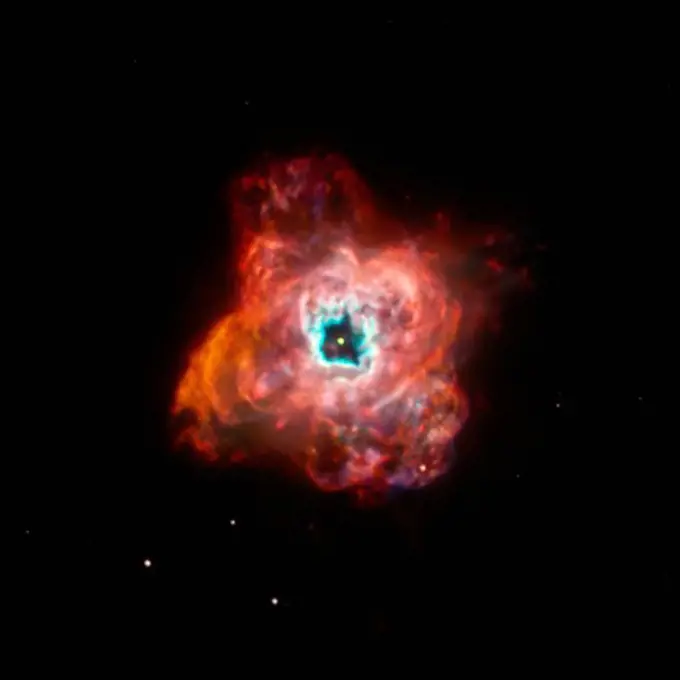
Planetary Nebula NGC 5315
6145-44621247
The Cat's Eye Nebula, one of the first planetary nebulae discovered, also has one of the most complex forms known to this kind of nebula. Eleven rings, or shells, of gas make up the Cat's Eye.
6145-44609406
"Light Echo" Illuminates Dust Around Supergiant Star V838 Monocerotis (V838 Mon)
4389-1873
WISE and Hubble Images of NGC 3603
6145-45245394
This Chandra X-Ray Observatory image of the mysterious superstar Eta Carinae reveals a surprising hot irner core, creating more questions than answers for astronomers. The image shows three distinct structures An outer, horseshoe shaped ring about 2 light-years in diameter, a hot inner core about 3 light-months in diameter, and a hot central source less than a light-month in diameter which may contain the superstar. In 1 month, light travels a distance of approximately 489 billion miles (about 788 billion kilometers). All three structures are thought to represent shock waves produced by matter rushing away from the superstar at supersonic speeds. The temperature of the shock-heated gas ranges from 60 million degrees Kelvin in the central regions to 7 million degrees Kelvin on the outer structure. Eta Carinae is one of the most enigmatic and intriguing objects in our galaxy. Between 1837 and 1856, it increased dramatically in brightness to become the most prominent star in the sky excep
6145-45096405
A dying stars final moments are captured in this image from the NASA/ESA Hubble Space Telescope. The death throes of this star may only last mere moments on a cosmological timescale, but this stars demise is still quite lengthy by our standards, lasting tens of thousands of years! The stars agony has culminated in a wonderful planetary nebula known as NGC 6565, a cloud of gas that was ejected from the star after strong stellar winds pushed the stars outer layers away into space. Once enough material was ejected, the stars luminous core was exposed, enabling its ultraviolet radiation to excite the surrounding gas to varying degrees and causing it to radiate in an attractive array of colors. These same colors can be seen in the famous and impressive Ring Nebula (heic1310), a prominent example of a nebula like this one. Planetary nebulae are illuminated for around 10,000 years before the central star begins to cool and shrink to become a white dwarf. When this happens, the stars lig
4389-1877
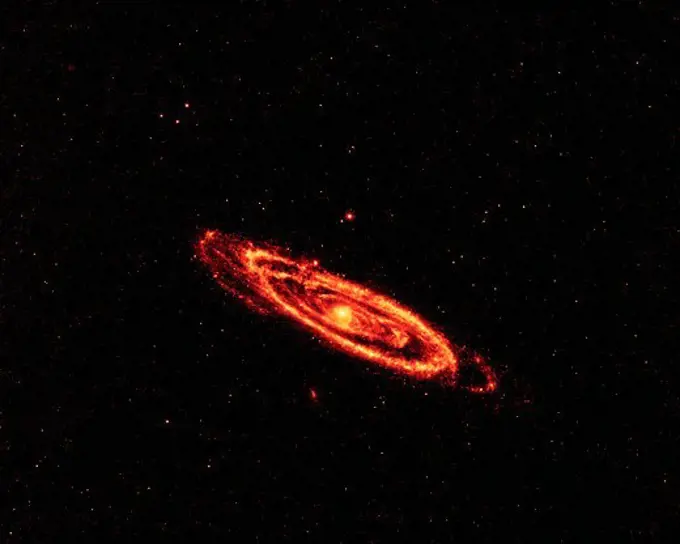
Andromeda Galaxy
4239R-20480333
This is a so-called scatter model based on the Hubble Space Telescope image of the planetary debris encircling the star AU Microscopii. Though the real disk is tilted nearly edge-on to Earth, this oblique view is from 30 degrees above the disk plane. This model clearly shows a central hole that may have been swept out by an unseen planet. Holes in the centers of young dusty disks are common among stars and are compelling circumstantial evidence for planets.
1889-48989306
Celestial Objects
6145-44969112
This image shows two of the galaxy clusters observed by NASA's WISE and Spitzer Space Telescope missions. Galaxy clusters are among the most massive structures in the universe.
4329-153
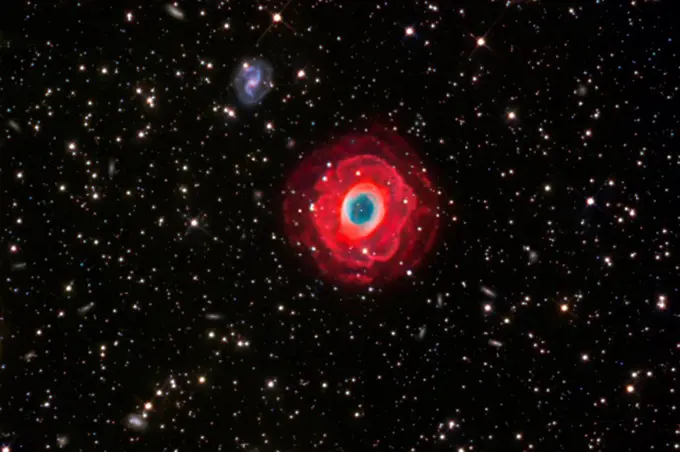
In the constellation Lyra, the Ring Nebula lies 2000 light years from Earth. A very deep image with the nebula surrounded by faintly glowing HII regions. Also visible is the faint galaxy IC 1296; the depth shows the color of the galaxy and that it is surrounded by a ring of its own.
6176-66093915
In this new view of the Andromeda, also known as M31, galaxy from the Herschel space observatory, cool lanes of forming stars are revealed in the finest detail yet. M31 is the nearest major galaxy to our own Milky Way at a distance of 2.5 million light-year
1746-19671297
The scattered remains of an exploded star named Cassiopeia A. Much of the star's original layering had been preserved. NASA's Spitzer Space Telescope.
1746-19663098
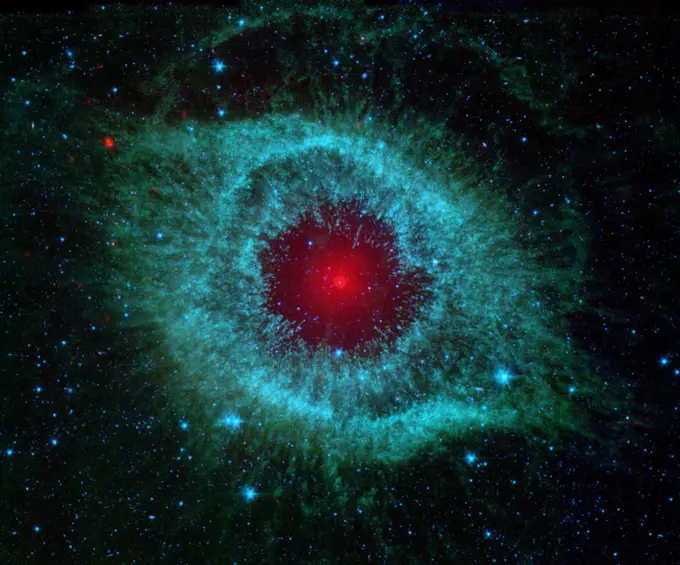
infrared image from NASAs Spitzer Space Telescope shows the Helix Nebula located about 700 light-years away in the constellation Aquarius, belongs to a class of objects called planetary nebulae. Planetary nebulae are the remains of stars that once looked a lot like the sun. When sun-like stars die, they puff out their outer gaseous layers. In Spitzers infrared view of the Helix nebula, the eye looks more like that of a green monsters. Infrared light from the outer gaseous layers is represented in blues and greens. The white dwarf is visible as a tiny white dot in the center of the picture. The red color in the middle of the eye denotes the final layers of gas blown out when the star died. The brighter red circle in the very center is the glow of a dusty disk circling the white dwarf (the disk itself is too small to be resolved). This dust, discovered by Spitzers infrared heat-seeking vision, was most likely kicked up by comets that survived the death of their star. Before the star
6145-44995811
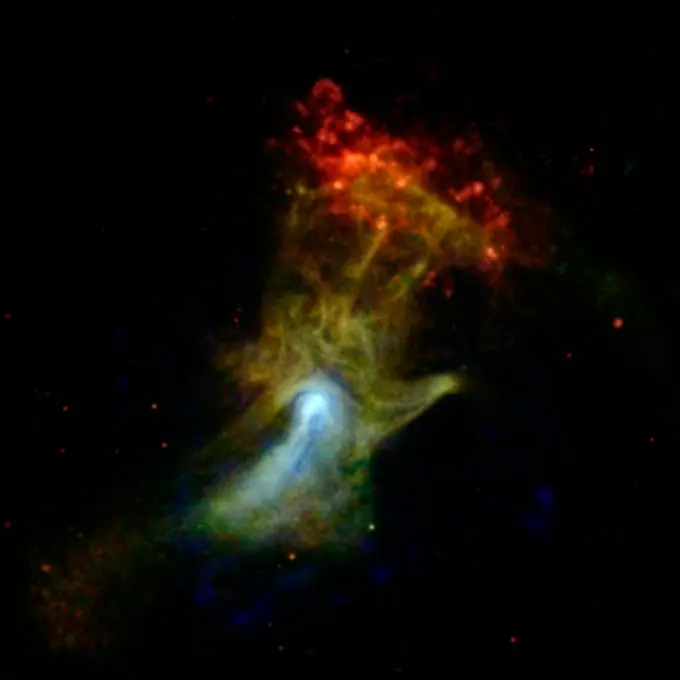
Nicknamed the 'Hand of God,' this object is called a pulsar wind nebula, imaged by NASA's NuSTAR. It's powered by the leftover, dense core of a star that blew up in a supernova explosion.
1848-64914961
Space background with silhouette of telescope. Globular cluster 47 Tucanae, NGC 104 in the constellation Tucana Elements of this image are furnished by NASA
6145-44640949
Six hundred and fifty light-years away in the constellation Aquarius, a dead star about the size of Earth, is refusing to fade away peacefully. NASA's Hubble and Spitzer Space Telescopes have captured the complex structure of the Helix nebula.
6145-44596338
This image was taken May 21 and 22, 2003, by NASA's Galaxy Evolution Explorer. The image was made from data gathered by the two channels of the spacecraft camera during the mission's 'first light' milestone.
1746-19671502
The object, named NGC 1514, is a planetary nebula. These are dying stars similar to our sun, that blow off their outer layers. WISE.
6145-44499418
This image from NASA's Hubble Space Telescope image of a celestial object called the Ant Nebula may shed new light on the future demise of our Sun.
1746-19663787
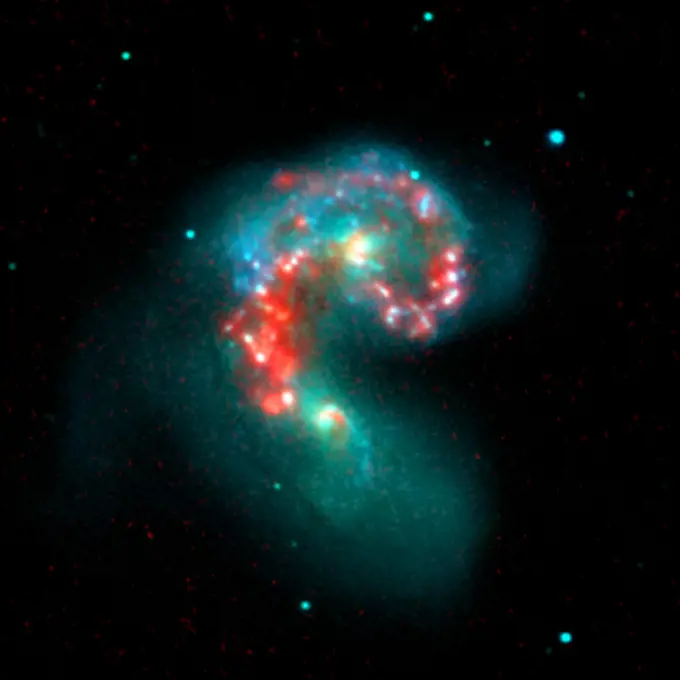
This false-colour image composite from NASAs Spitzer Space Telescope reveals hidden populations of new-born stars at the heart of the colliding Antennae galaxies. These two galaxies, known individually as NGC 4038 and 4039, are located around 68 million light-years away and have been merging together for about the last 800 million years. The image is a composite of infrared data from Spitzer and visible-light data from Kitt Peak National Observatory, Tucson, Ariz. Visible light from stars in the galaxies (blue and green) is shown together with infrared light from warm dust clouds heated by new-born stars (red). The two nuclei, or centres, of the merging galaxies show up as yellow-white areas, one above the other. The brightest clouds of forming stars lie in the overlap region between and left of the nuclei.
4239-57497702
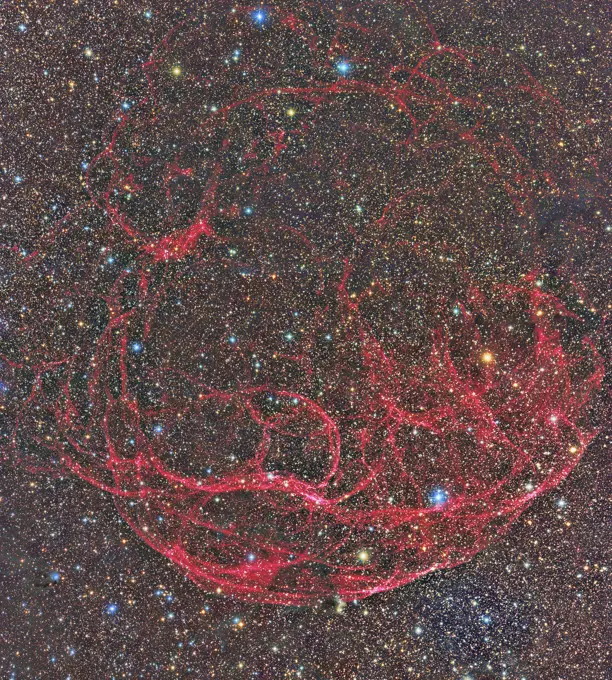
Spaghetti Nebula, Sh2-240.
1889-48989311
Celestial Objects
1848-64912998
Spiral Galaxy, Space background, Messier 66. Elements of this image furnished by NASA. Retouched image
227-454B
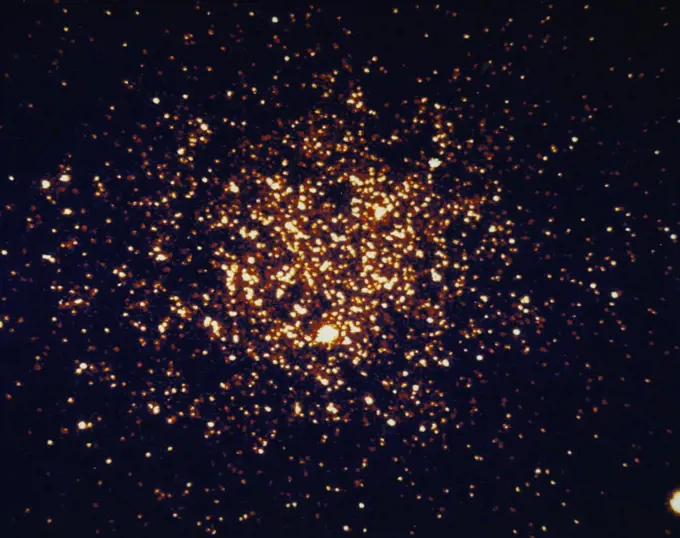
Globular Cluster Omega Centauri (17,000 Light Years from Earth) Taken by Ultraviolet Imaging Telescope
6145-44599300
Chandra X-Ray Observatory provided this composite X-ray (blue and green) and optical (red) image of the active galaxy NGC 1068 showing gas blowing away in a high-speed wind from the vicinity of a central supermassive black hole. Regions of intense star formation in the irner spiral arms of the galaxy are highlighted by both optical and x-ray emissions. A doughnut shaped cloud of cool gas and dust surrounding the black hole, known as the torus, appears as the elongated white spot . It has has a mass of about 5 million suns and is estimated to extend from within a few light years of the black hole out to about 300 light years.
4239-57494249
NGC 300, spiral galaxy in Sculptor.
6145-44702319
A cluster brimming with millions of stars glistens like an iridescent opal in this image from NASA's Spitzer Space Telescope. Called Omega Centauri, the sparkling orb of stars is like a miniature galaxy.
6145-44876484
AUGUST 31, 2011: A team of scientists has collected enough high-resolution Hubble Space Telescope images over a 14-year period to stitch together time-lapse movies of powerful jets ejected from three young stars.The jets, a byproduct of gas accretion around newly forming stars, shoot off at supersonic speeds in opposite directions through space. These phenomena are providing clues about the final stages of a stars birth, offering a peek at how our Sun came into existence 4.5 billion years ago. Hubbles unprecedented sharpness allows astronomers to see changes in the jets over just a few years time. Most astronomical processes change over timescales that are much longer than a human lifetime.Object Name: HH 2Image Type: Astronomical
6145-44634064
This false-color image from NASA's Spitzer Space Telescope shows a distant galaxy (yellow) that houses a quasar, a super-massive black hole circled by a ring, or torus, of gas and dust.
6145-45231159
This is an extraordinary first image from the Chandra X-Ray Observatory (CXO), the supernova remnant Cassiopeia A, tracing the aftermath of a gigantic stellar explosion in such sturning detail that scientists can see evidence of what may be a neutron star or black hole near the center. The red, green, and blue regions in this image of the supernova remnant Cassiopeia A show where the intensity of low, medium, and high energy X-rays, respectively, is greatest. The red material on the left outer edge is enriched in iron, whereas the bright greenish white region on the low left is enriched in silicon and sulfur. In the blue region on the right edge, low and medium energy X-rays have been filtered out by a cloud of dust and gas in the remnant . The image was made with the CXO's Advanced Charged-Coupled Device (CCD) Imaging Spectrometer (ACIS).
1746-19663774
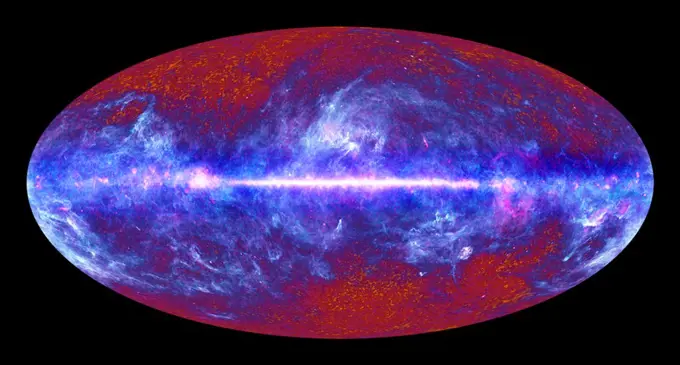
image of the microwave sky synthesized using data spanning the range of light frequencies detected by Planck. These low frequencies, which cannot be seen with the human eye, cover the range of 30 to 857 gigahertz. The grainy structure of the cosmic microwave background, with its tiny temperature fluctuations reflecting the density variations from which the cosmic web of our universe originated.
6145-44816803
A low activity, star-formation region in the constellation Perseus, as seen by the European Space Agency's Planck.
1746-19631688
Supernova 19i87A observed with Huble Space Telescope, wide field planetary telescope 2. NASA photograph.
1746-19663817
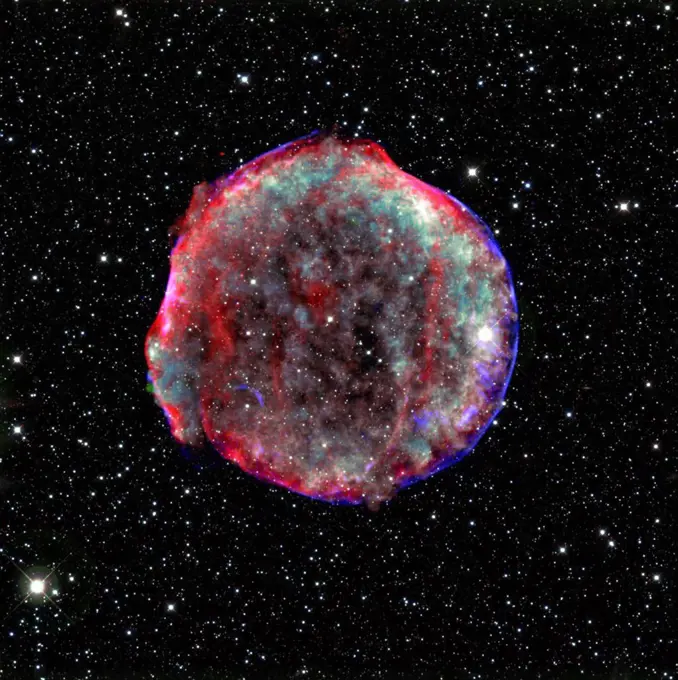
composite image of the Tycho supernova remnant combines infrared and X-ray observations obtained with NASAs Spitzer and Chandra space observatories, respectively, and the Calar Alto observatory, Spain. It shows the scene more than four centuries after the brilliant star explosion witnessed by Tycho Brahe and other astronomers of that era. The explosion has left a blazing hot cloud of expanding debris (green and yellow). The location of the blasts outer shock wave can be seen as a blue sphere of ultra-energetic electrons. Newly synthesized dust in the ejected material and heated pre-existing dust from the area around the supernova radiate at infrared wavelengths of 24 microns (red). Foreground and background stars in the image are white.
6145-44499041
Scientists are mystified by what may be unexpected, wandering, planet-sized objects.This image taken by NASA's Hubble Space Telescope implies the presence of these objects.
6145-44759682
This image zooms into a small portion of NASA's Kepler's full field of view, an expansive, 100-square-degree patch of sky in our Milky Way galaxy. An eight-billion-year-old cluster of stars 13,000 light-years from Earth, called NGC 6791, is seen here.
1457-1336
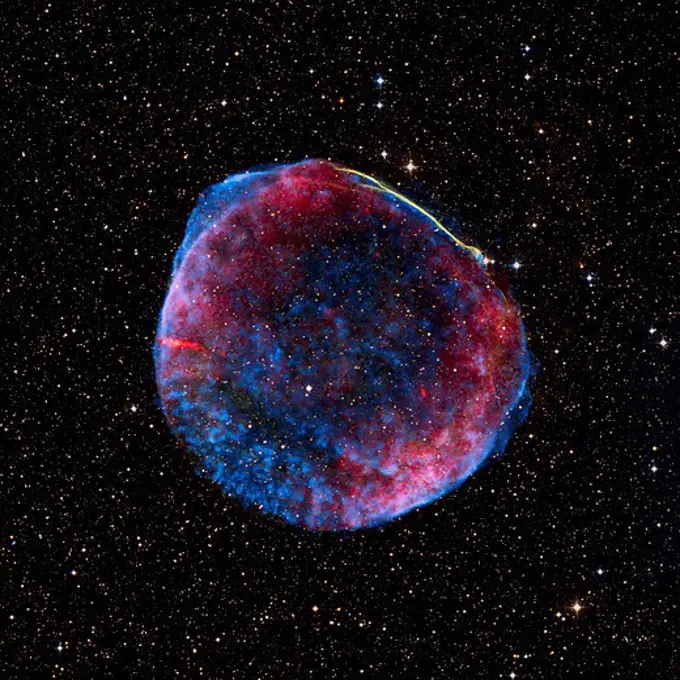
A composite image of the SN 1006 supernova remnant, which is located about 7000 light years from Earth
1525-27552844
Planet in a deep space against stars and nebula. Elements of this image furnished by NASA.. Planet in a deep space against stars.
6145-44863317
A colorful collection of galaxy specimens from NASA's Wide-field Infrared Survey Explorer mission showcases galaxies of several types, from elegant grand design spirals to more patchy flocculent spirals.
6145-44918310
A galaxy cluster 7.7 billion light-years away has been discovered using infrared data from NASA's Wide-field Infrared Survey Explorer (WISE). The discovery image is shown in the main panel.
1746-19671581
Asteroid 2010 TK7 is circled in green, in this single frame taken by NASA's WISE. The majority of the other dots are stars or galaxies far beyond our solar system.
6145-45093880
Astronomers using data from NASA's WISE are helping to trace the shape of our Milky Way galaxy's spiral arms. Here, WISE data revealed clusters of young stars shrouded in dust, called embedded clusters, which are known to reside in spiral arms.
6145-44839522
This image composite shows two views of a puffy, dying star, or planetary nebula, known as NGC 1514. At left is a view from a ground-based, visible-light telescope; the view on the right shows the object in infrared light from NASA's WISE telescope.
1746-19671580
Asteroid 2010 TK7 is circled in green, in this single frame taken by NASA's WISE. The majority of the other dots are stars or galaxies far beyond our solar system.
6145-44499325
Atlas Image mosaic, covering 7' x 7' on the sky of the interacting galaxies NGC 4038 and NGC 4039, better known as the Antennae, or Ring Tail galaxies. The two galaxies are engaged in a tug-of-war as they collide.
6145-45244629
A comparison image of the M100 Galactic Nucleus, taken by the Hubble Space Telescope (HST) Wide Field Planetary Camera-1 (WF/PC1) and Wide Field Planetary Camera-2 (WF/PC2). The HST was placed in a low-Earth orbit by the Space Shuttle Discovery, STS-31 mission, in April 1990. Two months after its deployment in space, scientists detected a 2-micron spherical aberration in the primary mirror of the HST that affected the telescope's ability to focus faint light sources into a precise point. This imperfection was very slight, one-fiftieth of the width of a human hair. During four spacewalks, the STS-61 crew replaced the solar panel with its flexing problems; the WF/PC1 with the WF/PC2, with built-in corrective optics; and the High-Speed Photometer with the Corrective Optics Space Telescope Axial Replacement (COSTAR), to correct the aberration for the remaining instruments. The purpose of the HST, the most complex and sensitive optical telescope ever made, is to study the cosmos from a low-
4239R-9217
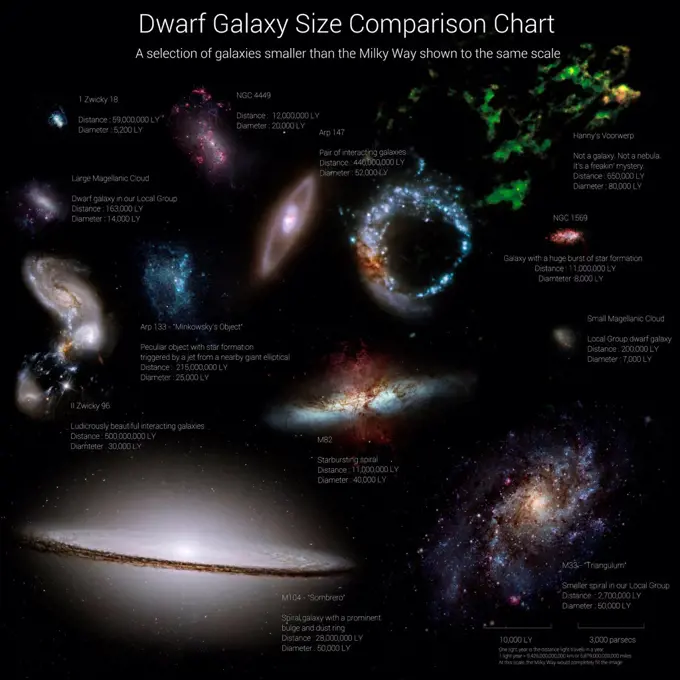
Galaxy size comparison chart. A selection of galaxies smaller than the Milky Way shown to the same scale.
PREVIOUS
of 3
NEXT
2401 S. Ervay, Suite 206
Dallas, Texas 75215
United States
Get Started
Free ResearchMy BoardsMy Cart
For Creators
How To License Your ContentContributor PortalFrame of Mind
Resources
API accessPricing
Contact
+1 866 236 0087help@viewpictures.co.uk Contact form
©2026 View Pictures. All Rights Reserved. -A
This site is protected by reCAPTCHA and Google Privacy Policy and Terms of Service apply.