My Boards
View Pictures
  • My Boards

Historic Space Missions

Images depicting astronauts in training and missions, showcasing space suits, mock-ups, and equipment. The scenes capture the spirit of exploration and engineering in the space program.

S65-24623 (May 1962) --- Astronaut M. Scott Carpenter, prime pilot for the Mercury-Atlas 7 (MA-7) flight, is seen in Hanger S crew quarters during a suiting exercise. Carpenter is seated in a mock-up of his pilot's seat while fully suited.
165 assets in this story
6145-44710804
S65-56190 (20 Oct. 1965) --- Astronauts Walter M. Schirra Jr. (seated), command pilot; and Thomas P. Stafford, pilot, the prime crew of NASA's Gemini-Titan-Agena 6 space mission, go through suiting up exercises in preparation for their forthcoming flight. The suit technicians are James Garrepy (left) and Joe Schmitt.
6145-44801602
S62-08774 (July 1960) --- These seven men, wearing spacesuits in this portrait, composed the first group of astronauts announced by the National Aeronautics and Space Administration
6145-44514524
Astronaut Fred Wallace Haise, Jr. at NASA Langley Lunar Research Facility, Gantry test at night. Haise was the lunar module pilot on Apollo 13 (April 11-17, 1970) and has logged 142 hours and 54 minutes in space.
6145-44521622
A worker (right) at Launch Pad 17-A, Cape Canaveral Air Force Station, looks at the camera recently attached to the second stage of the Delta II rocket for the Mars Odyssey launch. The orbiter carries three science instruments THEMIS, the Gamma Ray Spectrometer (GRS), and the Mars Radiation Environment Experiment (MARIE) that will map the mineralogy and morphology of the Martian surface. The Mars Odyssey Orbiter is scheduled for launch on April 7, 2001
6145-44569340
S61-02845 (1961) --- Portrait of astronaut Virgil I. (Gus) Grissom in his pressure suit and wearing his helmet in Hanger S at Cape Canaveral, Florida before the Mercury-Redstone 4 mission.
6145-45240260
AS17-163-24129 (7-19 Dec. 1972) --- A fellow crewman took this photograph of astronaut Eugene A. Cernan eating a meal under weightlessness conditions of space during the final lunar landing mission in NASA's Apollo program. Also, aboard the Apollo 17 spacecraft were astronaut Ronald E. Evans, command module pilot, and scientist-astronaut Harrison H. Jack Schmitt, lunar module pilot. Cernan was the mission commander.
6145-44518256
John Manke is shown here on the lakebed next to the HL-10, one of four different lifting-body vehicles he flew, including the X-24B, which he flew 16 times. His final total was 42 lifting-body flights.
6145-58965754
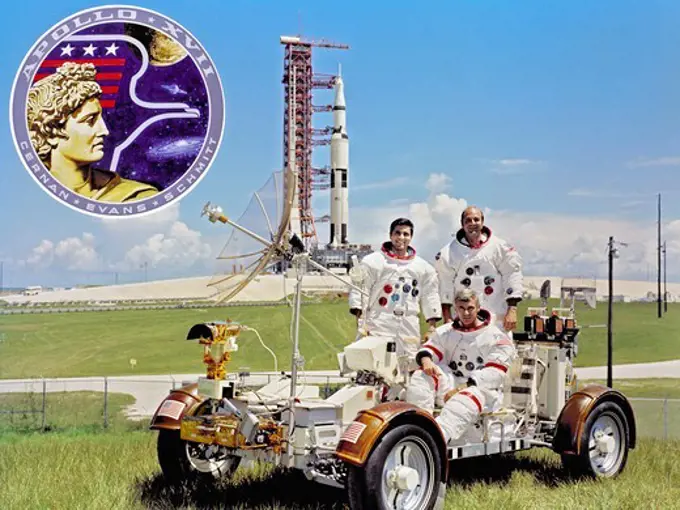
CAPE CANAVERAL, Fla. -- The Apollo 17 crew took time out from training to pose for the press after the Space Vehicle for their Manned Lunar Landing Mission was moved to Pad A, Complex 39 today. Apollo 17 Commander Eugene A Cernan sits at the controls of the One-G Lunar Roving Vehicle Simulator used to simulate operations on the Moons surface. With Cernan are Lunar Module Pilot Dr. Harrison H. Jack Schmitt, left and Command Module Plot Ronald A. Evans. The Apollo 17 Space Vehicle, scheduled for launch from KSC on the sixth U.S. Manned Lunar Landing Mission on December 6, 1972 is in the background.
6145-44507623
KENNEDY SPACE CENTER, FLA. --  Inside the SPACEHAB module, STS-106 Mission Specialists Richard A. Mastracchio (left) and Edward T. Lu (right) check out the equipment in the module that will fly on the mission. At center is a SPACEHAB worker. The two astronauts and other crew members Commander Terrence W. Wilcutt, Pilot Scott D. Altman, and Mission Specialists Boris V. Morukov, Yuri I. Malenchenko and Daniel C. Burbank are taking part Crew Equipment Interface Test activities at KSC. On the 11-day mission, the seven-member crew will perform support tasks on orbit, transfer supplies and prepare the living quarters in the newly arrived Zvezda Service Module for the first long-duration crew, dubbed Expedition One,” which is due to arrive at the Station in late fall. STS-106 is scheduled to launch Sept. 8, 2000, at 8:31 a.m. EDT from Launch Pad 39B
6177-V53842676
6145-58965918
MANNED SPACECRAFT CENTER, HOUSTON, TX. -- FIRST ASTRONAUT TEAM -- Project Mercury Astronauts, whose selection was announced on April 9, 1959, only six months after the National Aeronautics and Space Administration was formally established on Oct. 1, 1958, included front row, left to right, Walter H. Schirra Jr., Donald K. Slayton, John H. Glenn Jr., and Scott Carpenter back row, Alan B. Shepard Jr., Virgil I. 'Gus' Grissom, and L. Gordon Cooper.
6145-44803754
S65-20636 (1965) --- Astronauts John W. Young (left), pilot, and Virgil I. Grissom, command pilot, for the Gemini-Titan 3 flight, are shown leaving the launch pad after simulations in the Gemini-3 spacecraft.
6145-44654255
S62-04047 (24 May 1962) --- Close-up of astronaut M. Scott Carpenter inside his Aurora 7 spacecraft before the launch of the Mercury-Atlas 7 (MA-7) mission.
6177-V54017746
1746-111348889
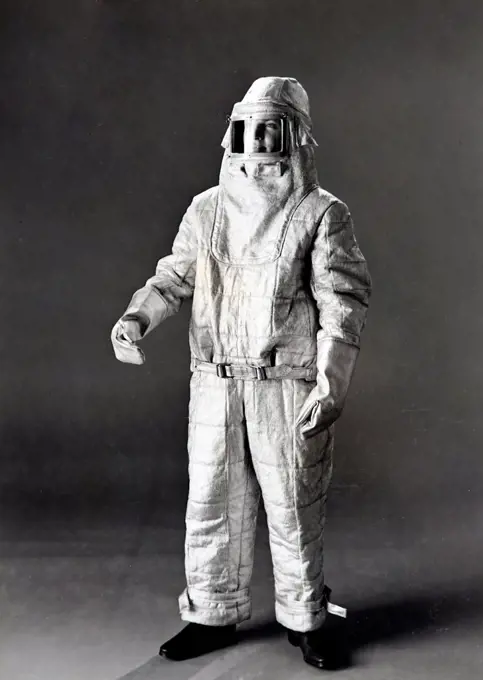
From Siebe, Gorman & Co. Ltd. A heat-protective suit for fire-fighters and others in proximity to great heat. The outer layer of the garment takes advantage of the property of aluminium foil in reflecting radiant heat, thus reducing the absorption rate of heat by the under layer of asbestos. Model: Michael O'Connor
6145-44714703
S69-25883 (3 March 1969) --- The Apollo 9 crew leaves the Kennedy Space Center's Manned Spacecraft Operations Building during the Apollo 9 prelaunch countdown. Leading is astronaut James A. McDivitt, commander; followed by astronaut David R. Scott, command module pilot; and Russell L. Schweickart, lunar module pilot. Moments later they entered the special transfer van which transported them to their waiting spacecraft at Pad A, Launch Complex 39. Apollo 9 was launched at 11 a.m. (EST), March 3, 1969, on a 10-day Earth-orbital mission.
4220-21917752
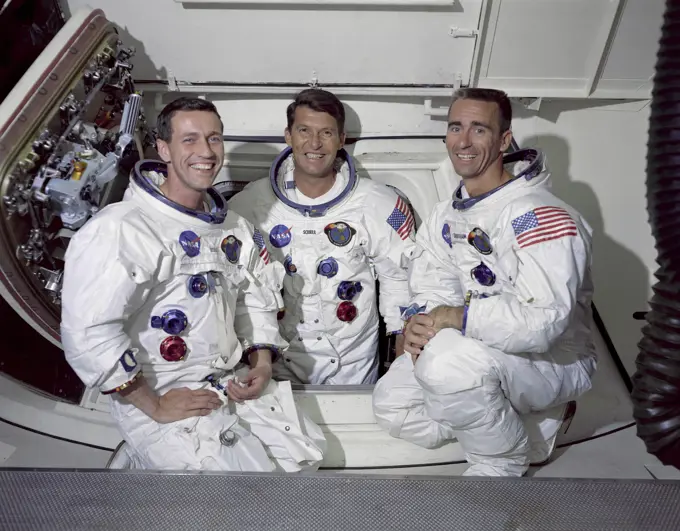
The prime crew of the first  manned Apollo space mission  (from l to r) Module Pilot Don  F Eisele, Commander Walter M  Schirra Jr. and Lunar Module  pilot Walter Cunningham     Date: 22nd May 1968
255-67768349
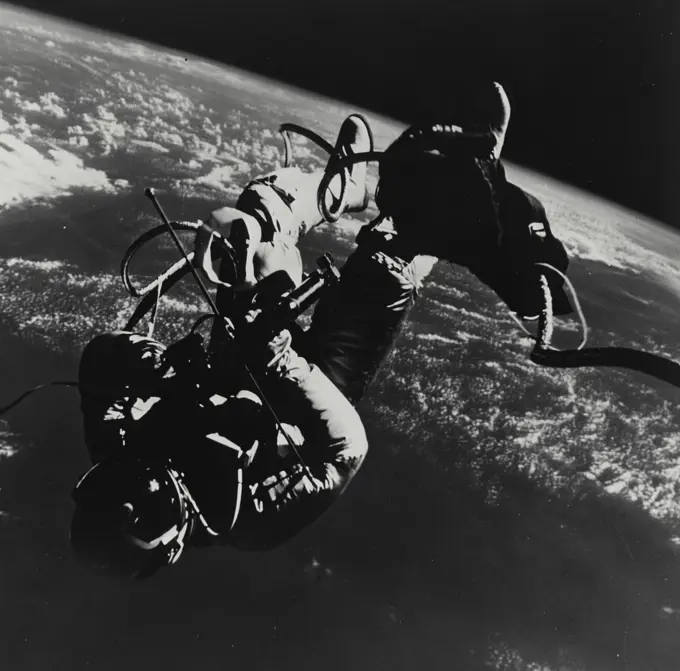
Vintage Photograph. Astronaut Edward White II is shown in space feat during the third orbit of the Geini 4 Flight.
6145-45235931
Astronaut Alan Shepard fitted with space suit prior to the first marned suborbital flight. Freedom 7, carrying Astronaut Alan Shepard, boosted by the Mercury-Redstone launch vehicle, lifted off on May 5, 1961. Astronaut Shepard became the first American in space.
6145-29553440
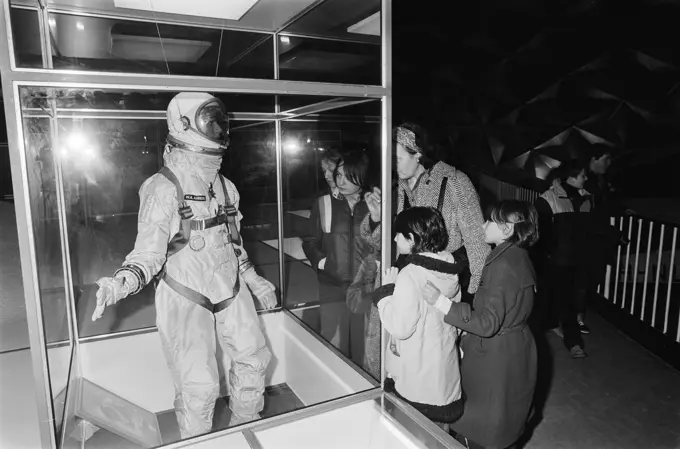
Anefo photo collection. Polish children's guest in the Netherlands. Polish children in the Aviodome. Viewing the space pack of an astronate (W.A. Ander). March 2, 1982. Noord-Holland, Schiphol
4409-50137118
07/21/1969. Nixon applauds the crew of the "Apollo XI" after the return of the mission.
6145-44497471
In the Orbiter Processing Facility (OPF) bay 1, STS-103 Commander Curtis L. Brown Jr. sits in the command seat of the orbiter Discovery, inspecting the window. Brown and other crew members are at KSC to take part in a Crew Equipment Interface Test. The rest of the crew are Pilot Scott J. Kelly, and Mission Specialists Steven L. Smith, C. Michael Foale (Ph.D.), John M. Grunsfeld (Ph.D.), Claude Nicollier of Switzerland, and Jean-François Clervoy of France. Nicollier and Clervoy are with the European Space Agency. Mission STS-103 is a "call-up" due to the need to replace portions of the pointing system, the gyros, which have begun to fail on the Hubble Space Telescope. Although Hubble is operating normally and conducting its scientific observations, only three of its six gyroscopes are working properly. The gyroscopes allow the telescope to point at stars, galaxies and planets. The STS-103 crew will not only replace gyroscopes, it will also replace a Fine Guidance Sensor and an older com
1899-18984808
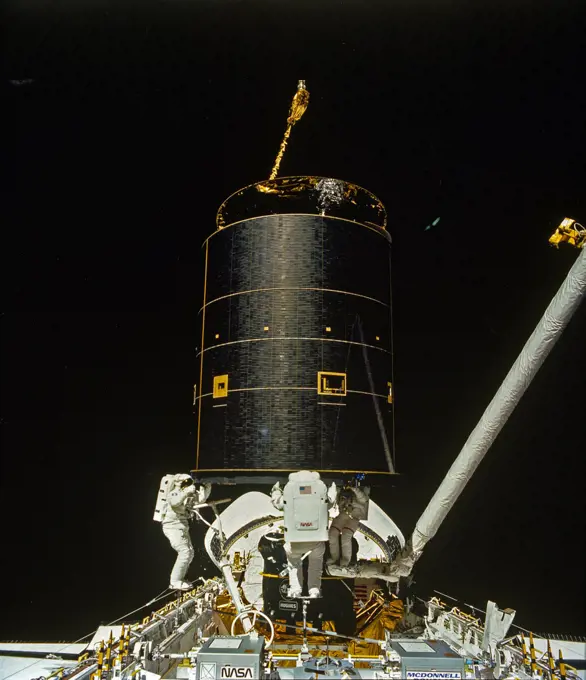
1992 - The 4.5 ton INTELSAT VI was successfully snared by three astronauts on a third EVA. The three hand-grabbed the errant satellite, pulled it into the cargo bay, and attached a boost-given perigee stage before its release..
1746-28992685
From Siebe, Gorman & Co. Ltd. A heat-protective suit for fire-fighters and others in proximity to great heat. The outer layer of the garment takes advantage of the property of aluminium foil in reflecting radiant heat, thus reducing the absorption rate of heat by the under layer of asbestos. Model: Michael O'Connor
6145-44650419
S62-00377 (20 Feb. 1962) --- Astronaut John H. Glenn Jr., walking out of building with Dr. William K. Douglas (to Glenn's left), and Joe W. Schmitt, NASA's suit technician (in front of Dr. Douglas). This Mercury Atlas 6 (MA-6) Friendship 7 flight marks America's first manned Earth-orbiting spaceflight.
6177-V54689341
6145-44618626
This is a view of astronaut Richard F. Gordon attaching a high resolution telephoto lens to a camera aboard the Apollo 12 Command Module (CM) Yankee Clipper. The second manned lunar landing mission, Apollo 12 launched from launch pad 39-A at Kennedy Space Center in Florida on November 14, 1969 via a Saturn V launch vehicle. The Saturn V vehicle was developed by the Marshall Space Flight Center (MSFC) under the direction of Dr. Wernher von Braun. Aboard Apollo 12 was a crew of three astronauts Alan L. Bean, pilot of the Lunar Module (LM), Intrepid; Richard Gordon, pilot of the Command Module (CM), Yankee Clipper; and Spacecraft Commander Charles Conrad. The LM, Intrepid, landed astronauts Conrad and Bean on the lunar surface in whats known as the Ocean of Storms. Their lunar soil activities included the deployment of the Apollo Lunar Surface Experiments Package (ALSEP), finding the unmanned Surveyor 3 that landed on the Moon on April 19, 1967, and collecting 75 pounds (34 kilograms) of
6145-44525014
View of O&C Building Altitude Chambers
6145-44538946
S81-39573 (12-14 Nov. 1981) --- This photograph was taken during a two-and a fourth-day stay in Earth orbit by astronauts Joe H. Engle, here shaving, and Richard H. Truly, photographer for this frame. A portion of that time was spent in the living area of middeck portion of the 122-ft-long (37 meters) vehicle as the astronauts ate, slept and took care of hygiene matters here. An onboard fire extinguisher is in upper right corner.  Partially out of the frame at right edge is a photograph of George W. S. Abbey, Director of Flight Operations at Johnson Space Center.  Engle is attired in an onboard constant wear type garment.
4186-572
1960S Standing Full Length Portrait Of Astronaut In Space Suit And Helmet
6145-44718292
S72-44423 (8 Sept. 1972) --- Two Apollo 17 crewmen ready a Lunar Roving Vehicle trainer following its deployment from a Lunar Module trainer in the Flight Crew Training Building at the Kennedy Space Center, Florida. Taking part in the Apollo 17 training exercise were astronauts Eugene A. Cernan (right), commander; and Harrison H. Jack Schmitt, lunar module pilot.
6145-29099136
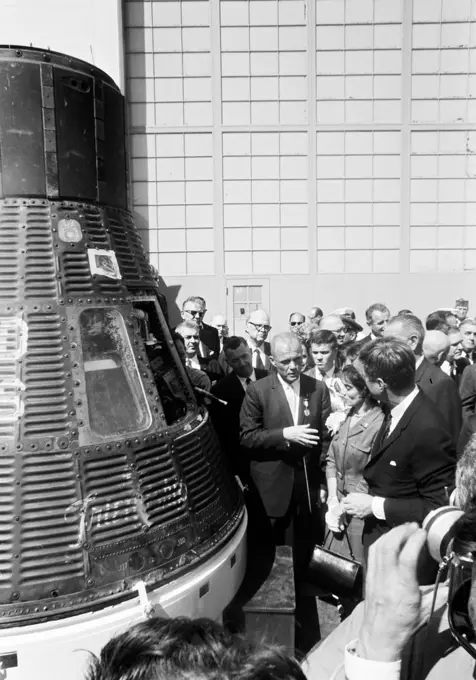
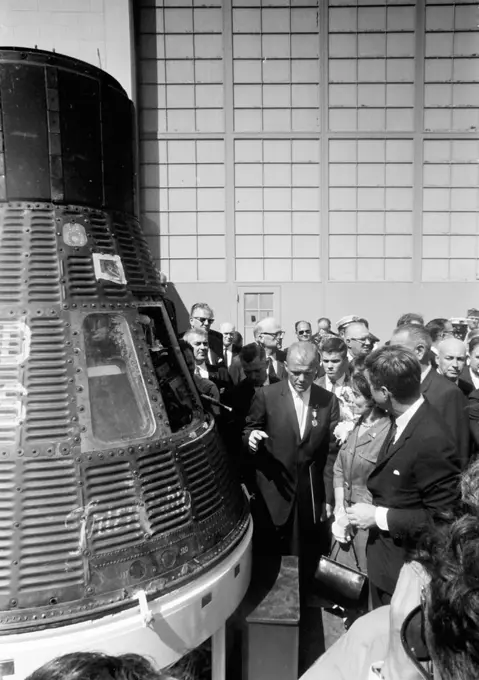
Presentation of the NASA (National Aeronautics and Space Administration) Distinguished Service Medal (DSM) to Astronaut John Herschel Glenn, Jr., at Cape Canaveral. Astronaut Lieutenant Colonel John H. Glenn, Jr. (left) explains the details of the space capsule Friendship 7 to President John F. Kennedy (at right, facing away) following the presentation ceremony of his National Aeronautics and Space Administration (NASA) Distinguished Service Medal at Hangar S,' Cape Canaveral Air Force Station, Brevard County, Florida. The Friendship 7 carried Lieutenant Colonel Glenn in orbit around the earth three times. Those looking on include: Senator Robert Kerr of Oklahoma (wearing glasses, behind Lieutenant Colonel Glenn), Glenns son David Glenn (over Glenns shoulder), Congressman Harold C. Ostertag of New York (in profile, behind David Glenn), Glenns wife Annie Glenn (left of President Kennedy), Vice President Lyndon B. Johnson (partially hidden behind the President), Senator George Smathers
4290-6567
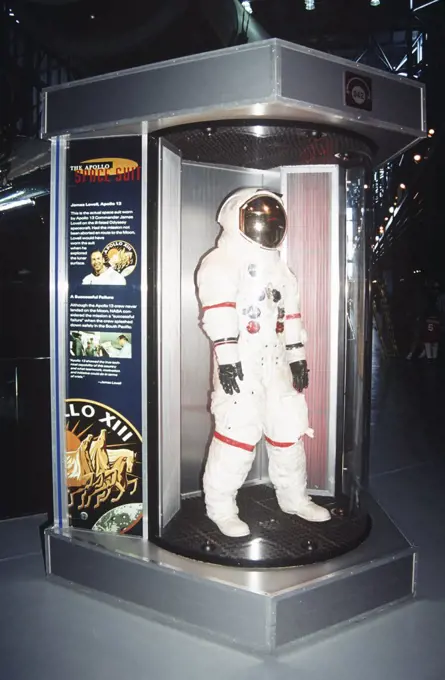
James Lovell space suit, John F Kennedy Space Center, Cape Canaveral, Brevard County, Florida, USA
6145-45239487
The final launch of a Saturn rocket came on July 15, 1975 as part of the Apollo-Soyuz Test Project. Earlier that day, a Russian Soyuz spacecraft lifted off its launch pad at a Soviet launch site carrying three cosmonauts. Seven and one-half hours later, the U.S. Apollo spacecraft was launched with its crew of American astronauts. Rendezvous and docking of the two ships were accomplished on July 17. The two ships remained docked for two days, conducting joint experiments and exchanging national mementos. In this photograph, astronauts Donald Slayton and Thomas Stafford chat with cosmonaut Alexei Leonov during their visit to the Soyuz Orbital Module.
6145-44502181
JSC2000-01441 (14 December 1999) ---  Astronaut Frank L. Culbertson, Jr., dons a training version of the Sokol cosmonaut suit prior to a training session at the Gagarin Cosmonaut Training Center in Russia. Culbertson is in training as commander for Expedition Three.  He was named to that positionin September of this year.
6177-V54019297
6145-58965981
KENNEDY SPACE CENTER, FLA. -- A technician helps astronaut Thomas P. Stafford, Apollo 10 commander, suit up for the Countdown Demonstration Test (CDDT) which ended successfully at 1 01 p.m. today. The CDDT is a dress rehearsal for the launch of Apollo 10 from Pad B at Launch Complex 39 May 18 at 12 49 p.m.
6176-67048911
Inside a futuristic space station, c1970s.Artist: NASA
6145-44618638
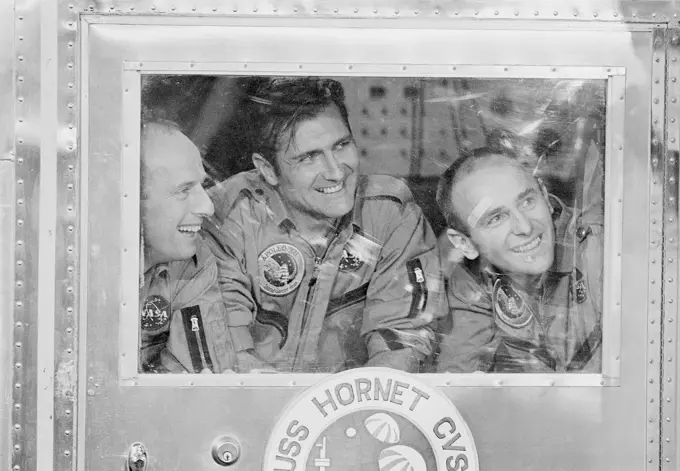
The smiling Apollo 12 astronauts peer out of the window of the mobile quarantine facility aboard the recovery ship, USS Hornet. Pictured (Left to right) are Spacecraft Commander, Charles Conrad; Command Module (CM) Pilot, Richard Gordon; and Lunar Module (LM) Pilot, Alan L. Bean. The crew were housed in the quarantine facility immediately after the Pacific recovery operation took place. The second manned lunar landing mission, Apollo 12 launched from launch pad 39-A at Kennedy Space Center in Florida on November 14, 1969 via a Saturn V launch vehicle. The Saturn V vehicle was developed by the Marshall Space Flight Center (MSFC) under the direction of Dr. Wernher von Braun. The LM, Intrepid, landed astronauts Conrad and Bean on the lunar surface in whats known as the Ocean of Storms while astronaut Richard Gordon piloted the CM, Yankee Clipper, in a parking orbit around the Moon. Lunar soil activities included the deployment of the Apollo Lunar Surface Experiments Package (ALSEP), find
6145-44710555
S65-18713 (23 March 1965) --- Astronauts John W. Young (left) and Virgil I. Grissom are shown during their first inspection of the Gemini 3 spacecraft aboard the USS Intrepid following their successful Gemini-Titan 3 flight.
6145-44691238
S66-44501 (23 July 1966) --- Astronaut Charles Conrad Jr., prime crew command pilot of the Gemini-11 spaceflight, relaxes on deck of the NASA Motor Vessel Retriever after suiting up for water egress training in the Gulf of Mexico.
4389-448
Installing Explorer 1 Prior to Launch
6145-29099137
Presentation of the NASA (National Aeronautics and Space Administration) Distinguished Service Medal (DSM) to Astronaut John Herschel Glenn, Jr., at Cape Canaveral. Astronaut Lieutenant Colonel John H. Glenn, Jr. (left) explains the details of the space capsule Friendship 7 to President John F. Kennedy (at right, facing away) following the presentation ceremony of his National Aeronautics and Space Administration (NASA) Distinguished Service Medal at Hangar S,' Cape Canaveral Air Force Station, Brevard County, Florida. The Friendship 7 carried Lieutenant Colonel Glenn in orbit around the earth three times. Those looking on include: Senator Robert Kerr of Oklahoma (in profile, behind Lieutenant Colonel Glenn), Glenns son David Glenn (over Glenns shoulder), Congressman Harold C. Ostertag of New York (in profile, behind David Glenn), Glenns wife Annie Glenn (left of President Kennedy), Vice President Lyndon B. Johnson (partially hidden behind the President), and Director of the Manned Sp
6145-45239512
This photograph is of Astronaut Kerwin wearing the Sleep Monitoring cap (Experiment M133) taken during the Skylab-2 mission. The Sleep Monitoring Experiment was a medical evaluation designed to objectively determine the amount and quality of crew members' inflight sleep. The experiment monitored and recorded electroencephalographic (EEG) and electrooculographic (EOG) activity during astronauts' sleep periods. One of the astronauts was selected for this experiment and wore a fitted cap during his sleep periods.
6145-45239261
Marshall Space Flight Center (MSFC) Director, Dr. von Braun, is shown fitted with suit and diving equipment as he prepares for a tryout in the MSFC Neutral Buoyancy Simulator (NBS). Weighted to a neutrally buoyant condition, Dr. von Braun was able to perform tasks underwater which simulated weightless conditions found in space.
6145-44541224
Press release information, September 13, 1968: "FIRST ASTRONAUT TEAM: Project Mercury Astronauts, whose selection was announced on April 9, 1959, only six months after the National Aeronautics and Space Administration was formally established on Oct. 1, 1958, Included: Front row, left to right, Walter M. Schirra, Jr., Donald K. Slayton, John H. Glenn, Jr., and M. Scott Carpenter; back row, Alan B. Shepard, Jr., Virgil I. "Gus" Grissom and L. Gordon Cooper. (1962), *89-361 Also in B&W. This copy of original negative was edited without shadows in the background. Photo taken a Langley by Life Magazine photographer and negative copied for other centers.
6145-44815486
S66-45605 (26 Sept. 1966) --- Movie film of the Gemini-11 extravehicular activity and rendezvous with the Agena Target Docking Vehicle was shown at the Gemini-11 press conference in the MSC Building 1 auditorium. Astronauts Charles Conrad Jr. (left), command pilot, and Richard F. Gordon Jr., pilot, discussed the Gemini-11 EVA and rendezvous mission during the film. Picture on screen shows close-up of astronaut Gordon connecting the Agena Target Vehicle to the spacecraft with a tether line during his spacewalk.
6145-44684064
Apollo 8 astronaut William Anders, Lunar Module (LM) pilot, is suited up for the Apollo 8 mission countdown demonstration test. The first manned Apollo mission launched aboard the Saturn V and first manned Apollo craft to enter lunar orbit, the SA-503, Apollo 8 mission lift off occurred on December 21, 1968 and returned safely to Earth on December 27, 1968. Aboard were Anders and fellow astronauts James Lovell, Command Module (CM) pilot; and Frank Borman, commander. The mission achieved operational experience and tested the Apollo command module systems, including communications, tracking, and life-support, in cis-lunar space and lunar orbit, and allowed evaluation of crew performance on a lunar orbiting mission. The crew photographed the lunar surface, both far side and near side, obtaining information on topography and landmarks as well as other scientific information necessary for future Apollo landings. All systems operated within allowable parameters and all objectives of the miss
6145-44809967
S65-43482 (20 Aug. 1965) --- Table-top view of several of the optical and photographic pieces of equipment planned for use on the Gemini-5 spacecraft before installation in the spacecraft.
6145-29099157
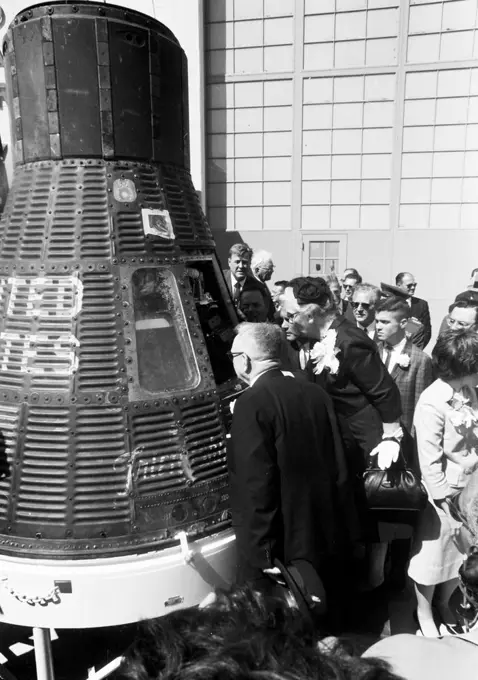
Presentation of the NASA (National Aeronautics and Space Administration) Distinguished Service Medal (DSM) to Astronaut John Herschel Glenn, Jr., at Cape Canaveral. John H. Glenn, Sr. (center) and Clara Sproat Glenn, parents of astronaut Lieutenant Colonel John H. Glenn, Jr. (partially hidden behind Mrs. Glenn, Sr.), look inside the space capsule Friendship 7 following the presentation ceremony of the National Aeronautics and Space Administration (NASA) Distinguished Service Medal to Lieutenant Colonel Glenn at Hangar S,' Cape Canaveral Air Force Station, Brevard County, Florida. The Friendship 7 carried Lieutenant Colonel Glenn in orbit around the earth three times. Those looking on include: Senator Warren G. Magnuson of Washington (back left, facing the camera), Lieutenant Colonel Glenns son David Glenn (right of Mrs. Glenn, Sr.), Edward P. Boland of Massachusetts (right of David Glenn, partially hidden), and Lieutenant Colonel Glenns daughter Lyn Glenn (far right, facing away).
6145-44719335
S73-20713 (1 March 1973) --- Astronaut Charles Conrad Jr., commander of the first manned Skylab mission, wipes perspiration from his face following an exercise session on the bicycle ergometer during Skylab training at Johnson Space Center. Conrad is in the work and experiments compartment of the crew quarters of the Skylab Orbital Workshop (OWS) trainer at JSC. In addition to being the prime exercise for the crewmen, the ergometer is also used for the vector-cardiogram test and the metabolic activity experiment. The bicycle ergometer produces measured workloads for use in determining man's metabolic effectiveness.
4389-2271
Apollo 17 Prime Crew
6145-58965820
CAPE CANAVERAL, Fla. - The Apollo 15 crew walks around the launch tower July 14, 1971.
5513-75517036
American Asbestos Suits. October 15, 1951.
4409-23183
YURI GAGARIN 1934/1968 PRIMER HOMBRE LANZADO AL ESPACIO EN LA NAVE VOSTOK 1 EL 12 DE ABRIL DE 1961.
1899-18979368
Astronaut Charles Conrad Jr. tweaks astronaut L. Gordon Cooper's eight-day growth of beard for the cameramen while onboard the prime recovery vessel after their Gemini-5 flight.
6145-45235692
S62-01004 (1962) --- Astronaut John H. Glenn Jr., pilot of the Mercury Atlas 6 (MA-6) mission, participates in Mercury egress training during MA-6 preflight preparations. Glenn made the free world's first manned Earth-orbital flight on Feb. 20, 1962.
6145-44676554
The Apollo 11 mission, the first manned lunar mission, launched from the Kennedy Space Center, Florida via the Saturn V launch vehicle on July 16, 1969 and safely returned to Earth on July 24, 1969. The Saturn V vehicle was developed by the Marshall Space Flight Center (MSFC) under the direction of Dr. Wernher von Braun. Aboard were astronauts Neil A. Armstrong, commander; Michael Collins, Command Module (CM) pilot; and Edwin E. Aldrin Jr., Lunar Module (LM) pilot. The CM, piloted by Michael Collins remained in a parking orbit around the Moon while the LM, named Eagle’’, carrying astronauts Neil Armstrong and Edwin Aldrin, landed on the Moon. Armstrong was the first human to ever stand on the lunar surface, followed by Edwin (Buzz) Aldrin. During 2½ hours of surface exploration, the crew collected 47 pounds of lunar surface material for analysis back on Earth. Shown here is the recovery operation of the capsule in the Pacific Ocean after splashdown. The three astronauts wait in the li
6145-58965973
KENNEDY SPACE CENTER, FLA. -- AWAITING ORDERS to proceed to the launching site for Project Mercury's second attempt to launch a man into space, Astronaut Virgil I. 'Gus' Grissom relaxes in a contour chair in the Personal Equipment Room Hangar 'S,' Cape Canaveral, Fla. A parabolic plexiglas mirror on his chest reflects the faces of two fellow Mercury pilots Walter M. Schirra (left) and M. Scott Carpenter. The mirror, which was not included in the May 5 Shepard flight, will be used to reflect the instrument panel, bringing it into view of the pilot observer camera. MR-4, known as Liberty Bell 7, has been rescheduled for Friday, July 21. (NASA Photo
6145-58965972
KENNEDY SPACE CENTER, FLA. -- Project Mercury Astronaut Virgil I. Grissom, primary pilot for the Mercury-Redstone 4 manned space flight known as Liberty Bell 7, gets an assist from suit specialist Joe W. Schmidt as he prepares for the Mercury-Redstone 4 manned space flight. The flight, the second manned shot in the Mercury program, was postponed because of bad weather in the launch area. (NASA Photo
6145-44970985
S63-03984 (1963) --- Astronaut L. Gordon Cooper Jr., prime pilot for the Mercury-Atlas 9 (MA-9) mission, is pictured just after his helmet had been removed. He has just spent approximately five hours in the spacecraft during altitude chamber tests.
6145-44571247
S62-01358 (1962) --- Project Mercury astronaut M. Scott Carpenter, prime pilot of the Mercury-Atlas 7 (MA-7) spaceflight, goes through a water egress test. He is in the Mercury pressure suit, without the helmet, and is wearing a life vest.
6145-44815488
S66-50715 (12 Sept. 1966) --- Astronaut Charles Conrad Jr., command pilot of the Gemini-11 spaceflight, undergoes suiting up operations in the Launch Complex 16 suit trailer during the Gemini-11 prelaunch countdown. Later, astronauts Conrad and Richard F. Gordon Jr., pilot, entered a transport van which carried them to Pad 19 and their waiting spacecraft in preparation for their scheduled three-day mission in space. Suit technician James L. Garrepy assists.
6145-45231359
Space Shuttle Columbia at Launch Site (Cockpit crew John Young, Commander and Robert Crippen, Pilot) (ref 80-HC-602)
6145-45239021
This photograph is a montage of astronaut crews for the three Skylab missions with simple biographical data of each astronaut. The 1st mission was designated as Skylab-2, 2nd mission as Skylab-3, and 3rd mission as Skylab-4. The Skylab-1 mission placed the Skylab Orbital Work Shop in orbit by a modified Saturn V launch vehicle. Skylab's 3 different 3-man crews spent up to 84 days in Earth orbit and performed a variety of more than 100 experiments.
PREVIOUS
of 2
NEXT
2401 S. Ervay, Suite 206
Dallas, Texas 75215
United States
Get Started
Free ResearchMy BoardsMy Cart
For Creators
How To License Your ContentContributor PortalFrame of Mind
Resources
API accessPricing
Contact
+1 866 236 0087help@viewpictures.co.uk Contact form
©2026 View Pictures. All Rights Reserved. -A
This site is protected by reCAPTCHA and Google Privacy Policy and Terms of Service apply.