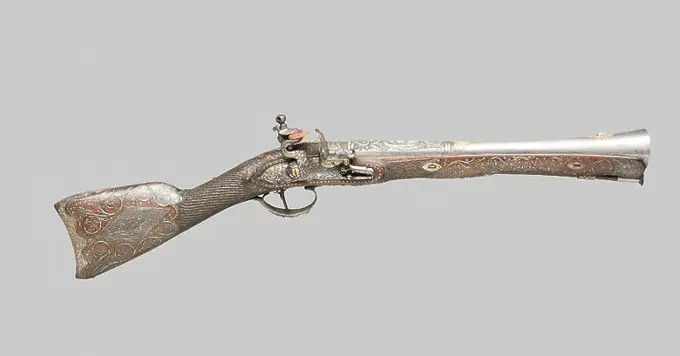
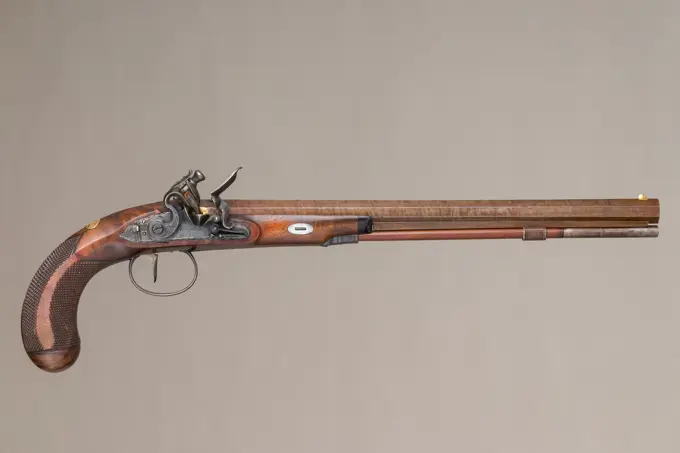
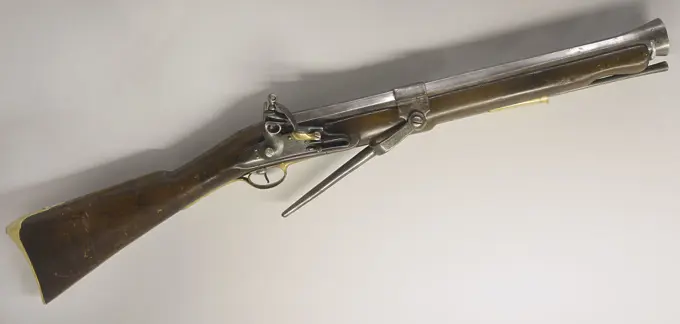
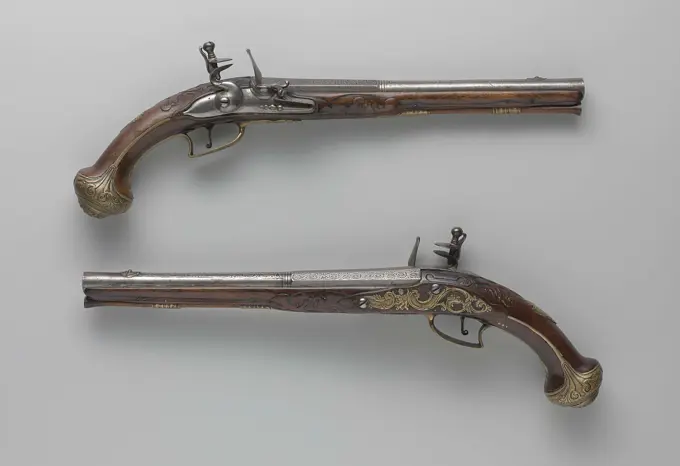
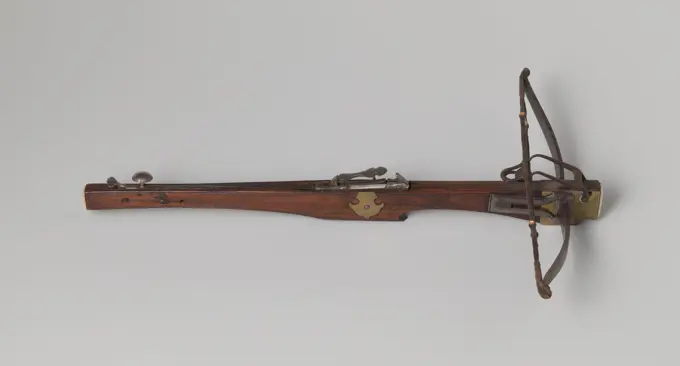
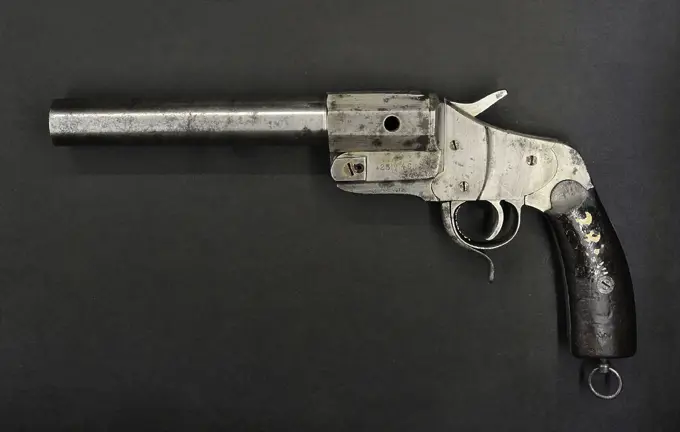
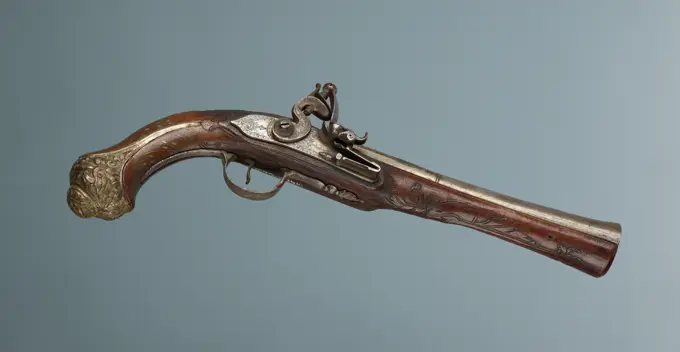
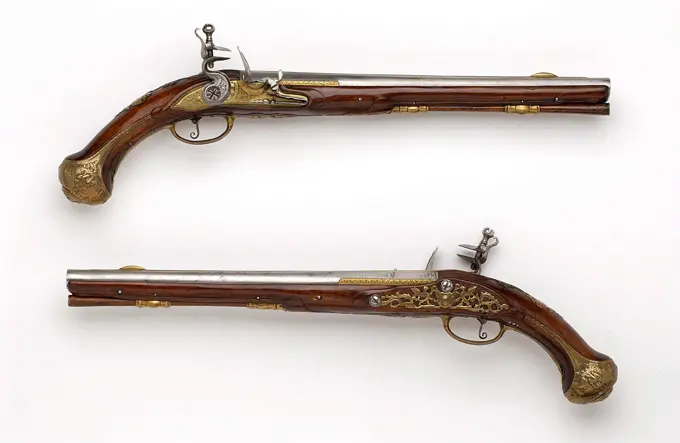
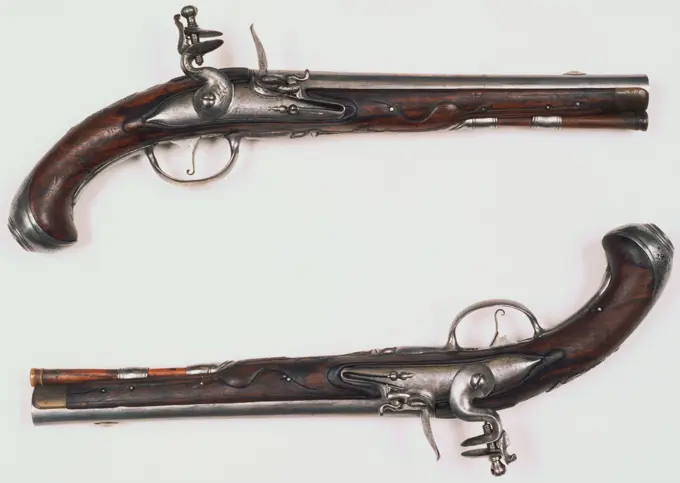
Historical Firearms

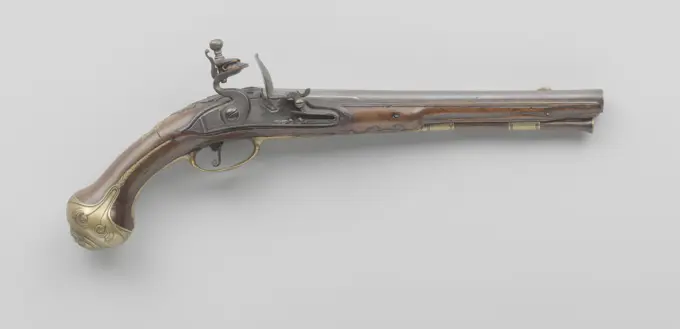
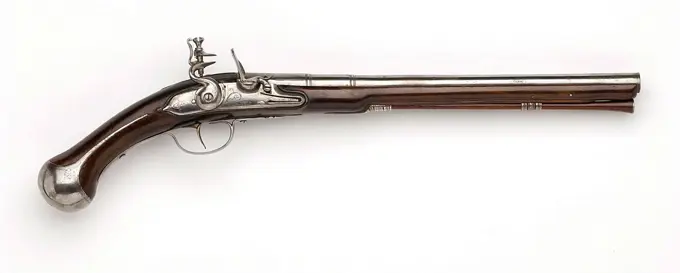
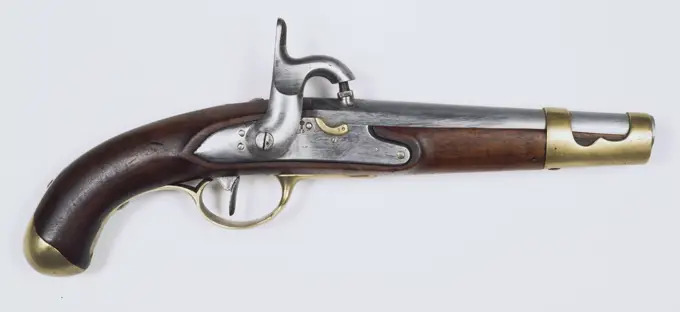
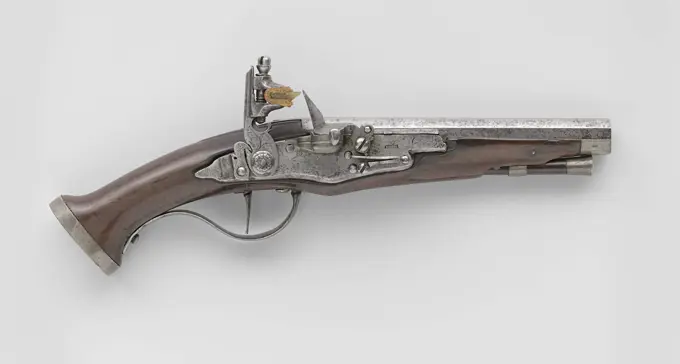
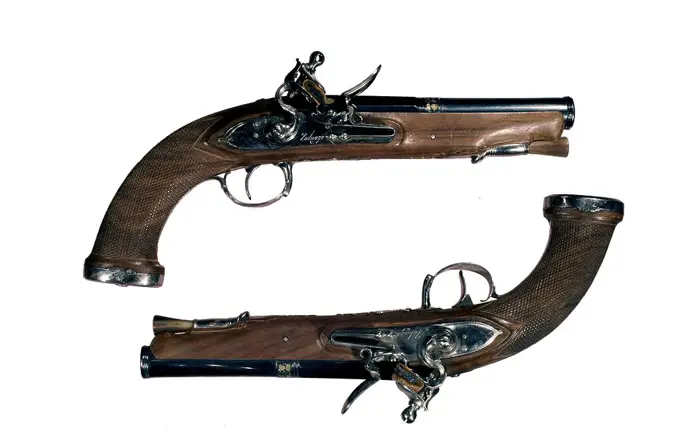
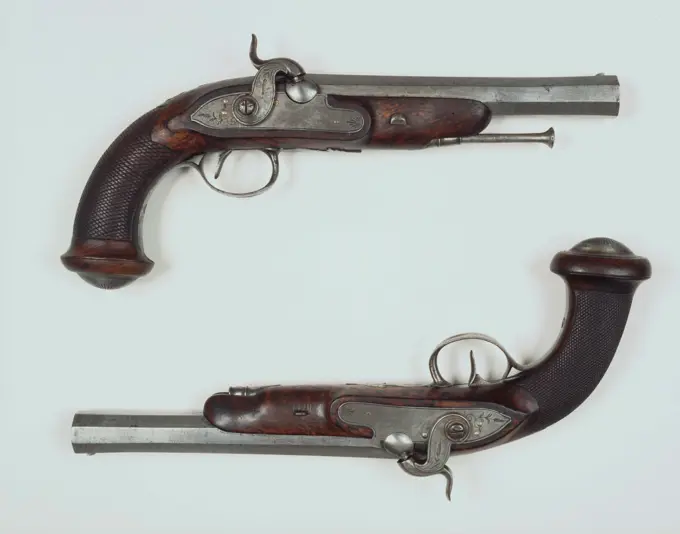
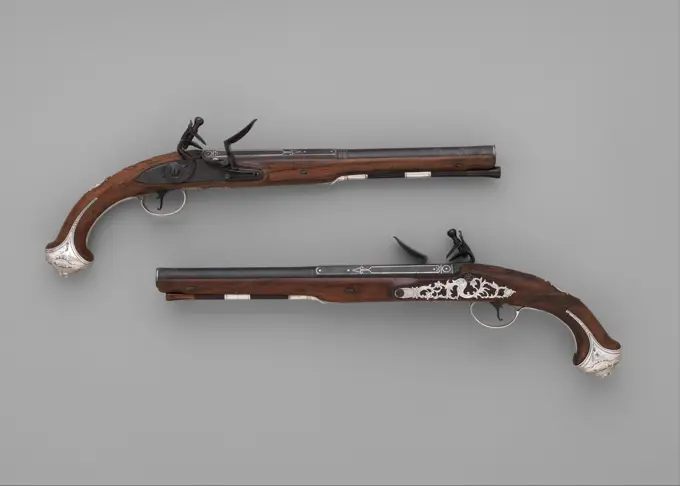
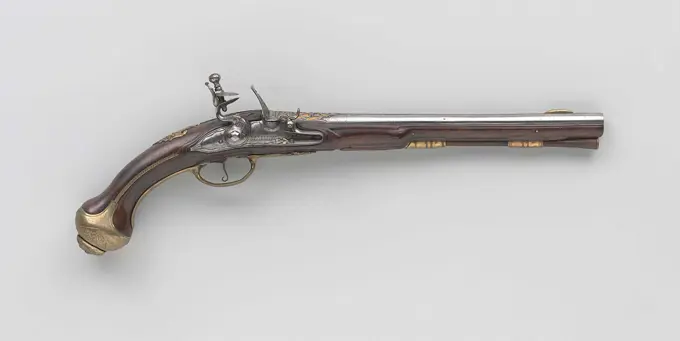
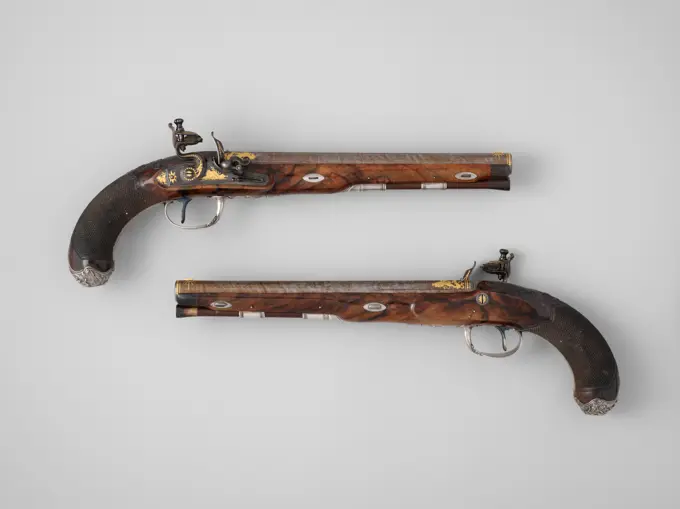
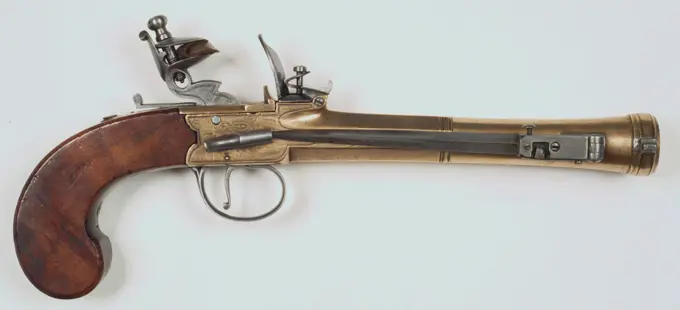
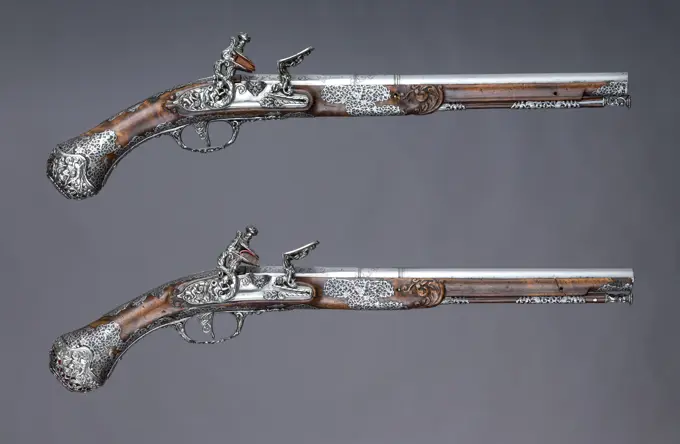
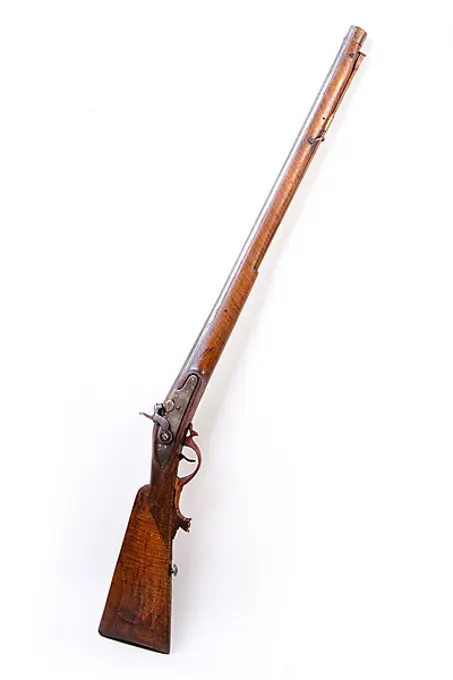
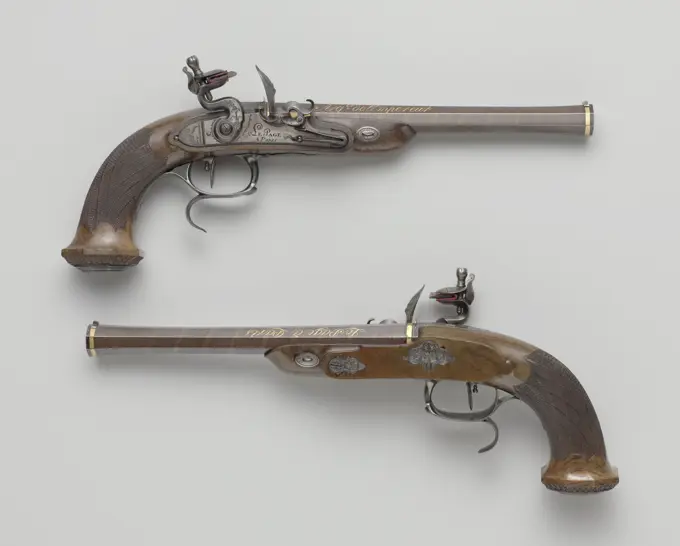
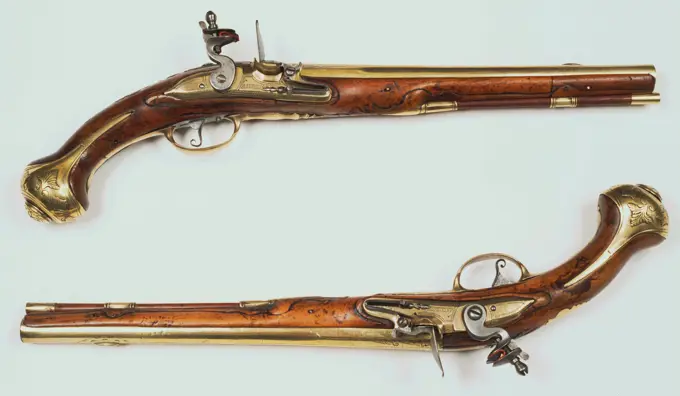
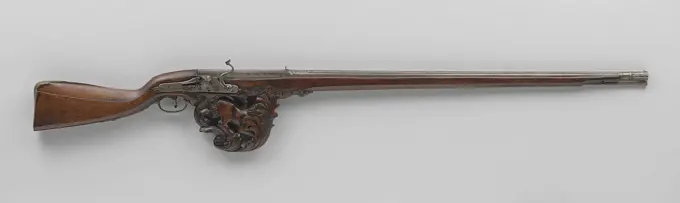
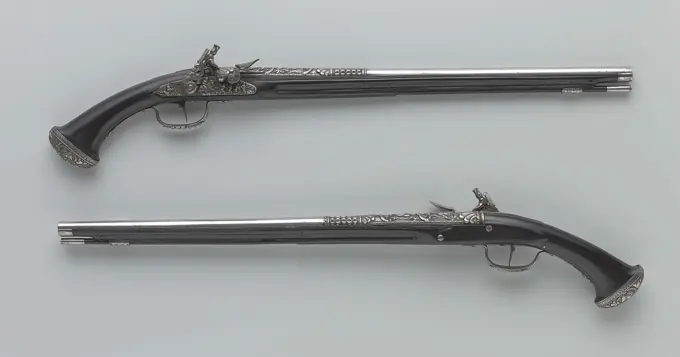
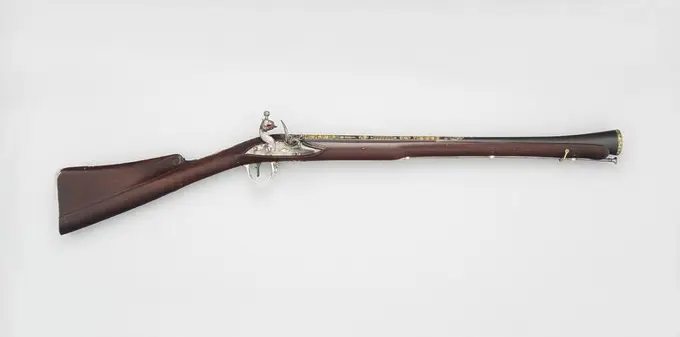
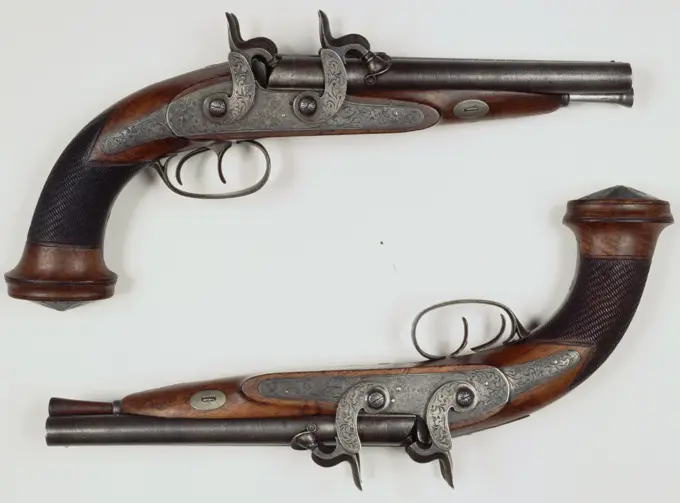
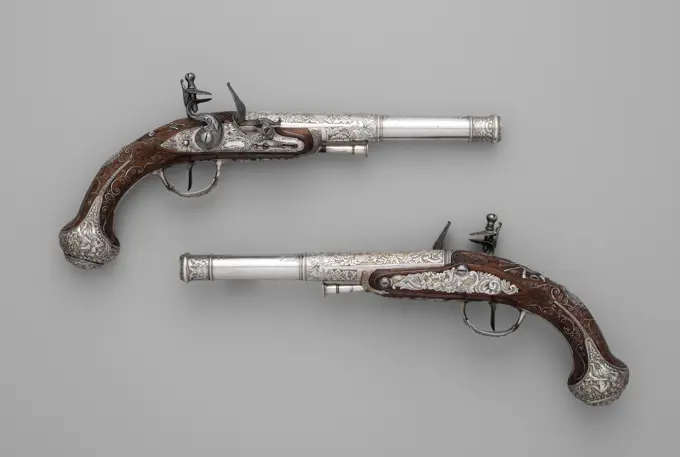
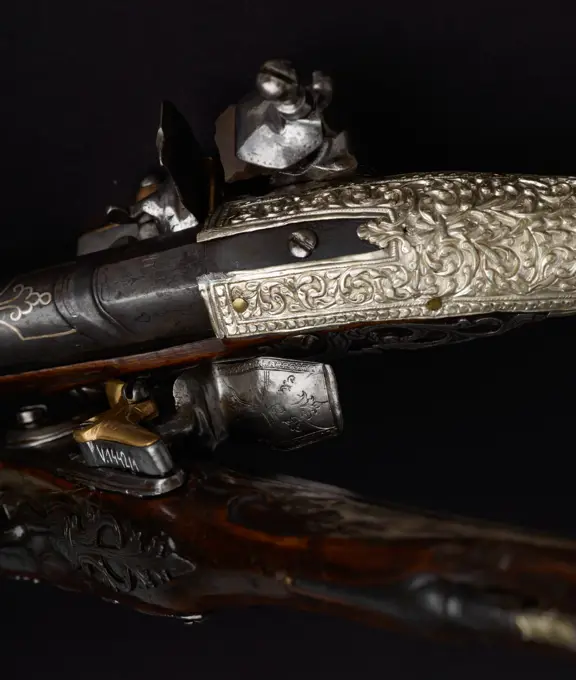
Collection of historical firearms including flintlock pistols and percussion army pistols, showcasing intricate metalwork and wooden craftsmanship.

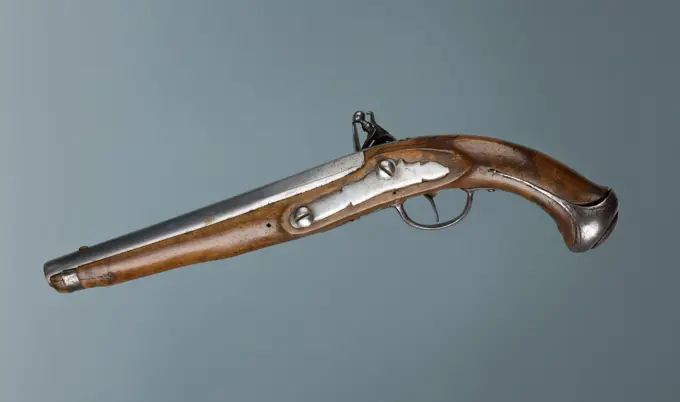
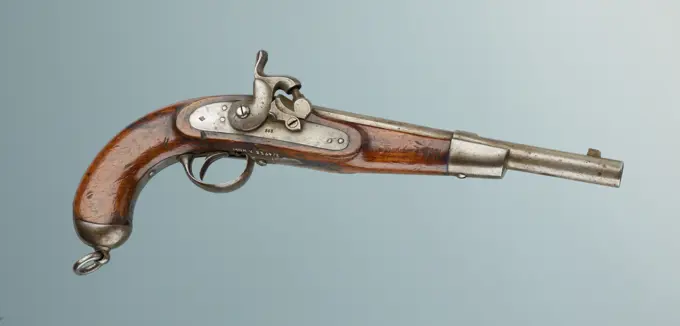
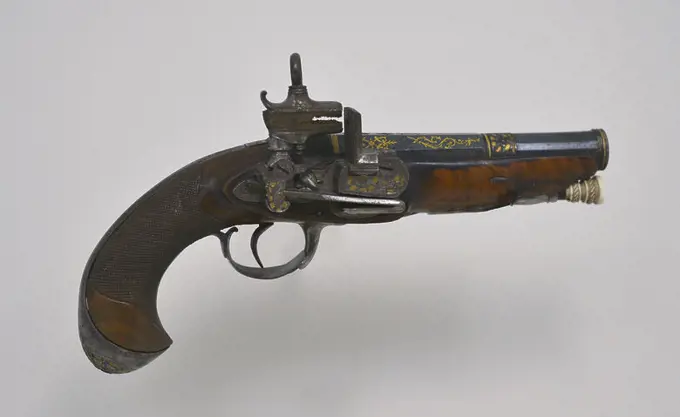
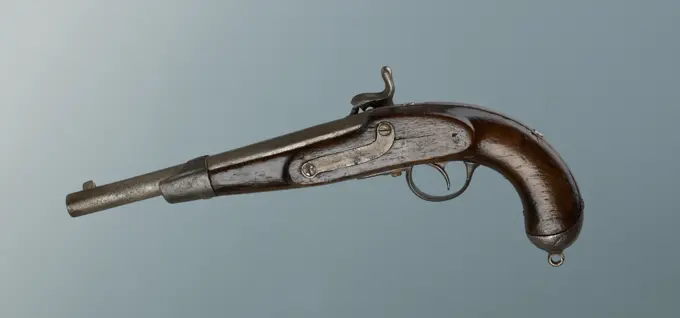
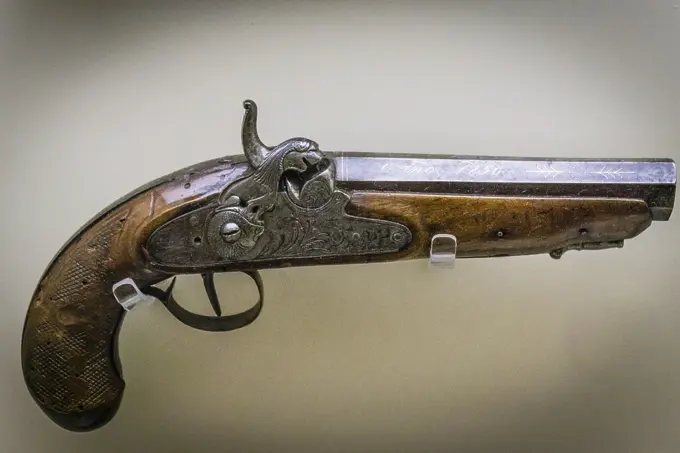
Percussion army pistool Model M 1815, Anonymous, c. 1815 - c. 1816  Percussion army pistool Model M 1815. Smooth, round loop, which turns into the room in a five -sided part. A percussion was taken into the top of the room. An unreadable brand on the tail piece of the loop. In the room: 1816. is, (crown above) and gb. Slot: Originally flint battery lock, later adjusted for percussion. The brass powder pan is cut off. Marked: 16, SB and Kroon on top of each other. Wood: walnut. Spunned a round stamp in which GH-Delft-1848. Batter: brass. At the front of the drawer is an openwork tube, which serves to confirm the loop; Tegenlotplaat; tractor bracket; Kolf hood. Netherlands Lads, bat: Walnut (Hardwood). Batting, tractor bracket, pan: brass (alloy). walk, cock, lock plate, tractor: iron (metal)
Percussion army pistool Model M 1815, Anonymous, c. 1815 - c. 1816 Percussion army pistool Model M 1815. Smooth, round loop, which turns into the room in a five -sided part. A percussion was taken into the top of the room. An unreadable brand on the tail piece of the loop. In the room: 1816. is, (crown above) and gb. Slot: Originally flint battery lock, later adjusted for percussion. The brass powder pan is cut off. Marked: 16, SB and Kroon on top of each other. Wood: walnut. Spunned a round stamp in which GH-Delft-1848. Batter: brass. At the front of the drawer is an openwork tube, which serves to confirm the loop; Tegenlotplaat; tractor bracket; Kolf hood. Netherlands Lads, bat: Walnut (Hardwood). Batting, tractor bracket, pan: brass (alloy). walk, cock, lock plate, tractor: iron (metal)
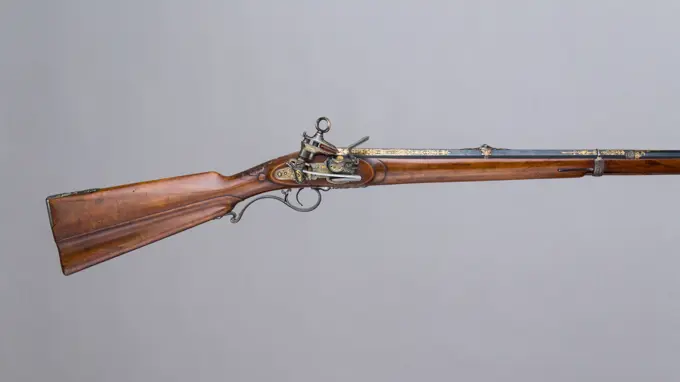
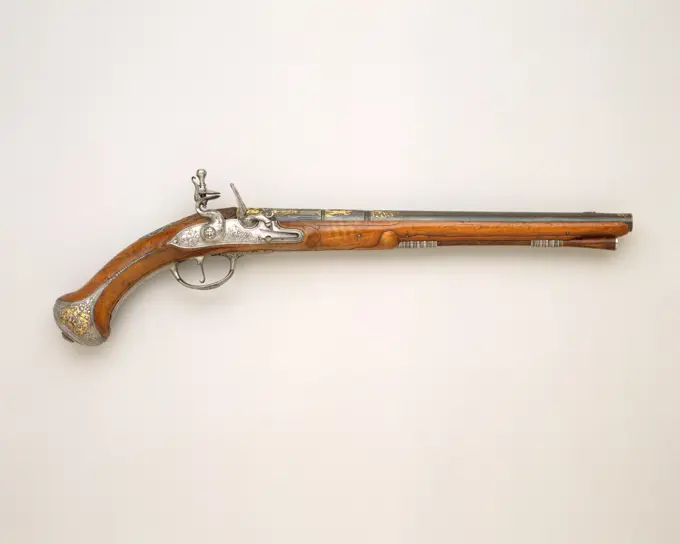
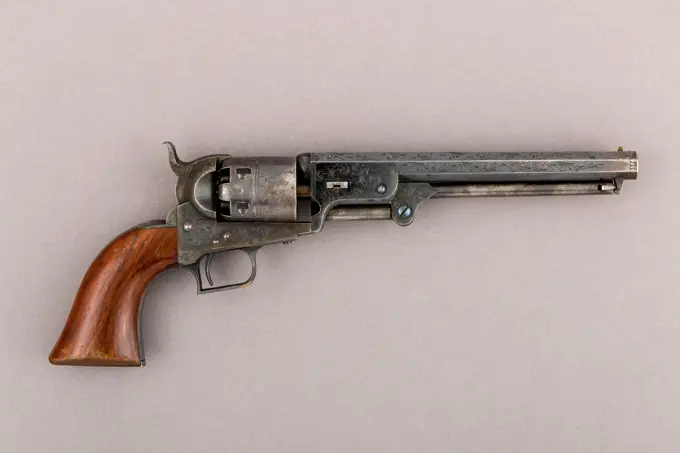
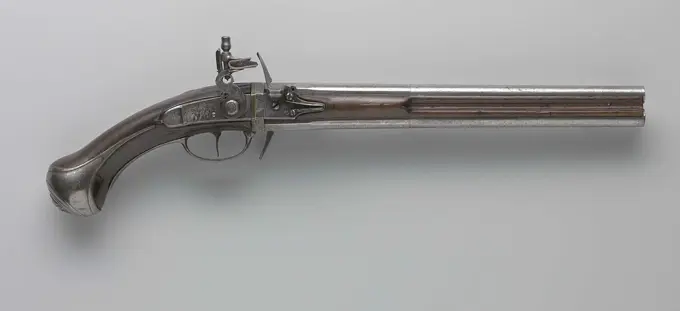
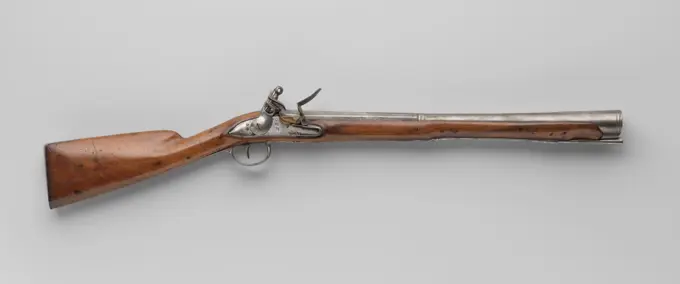
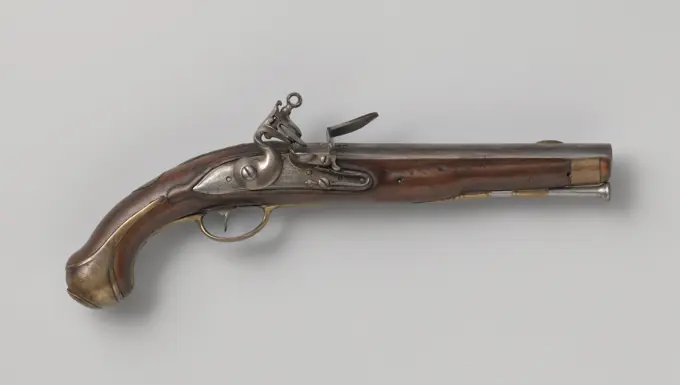
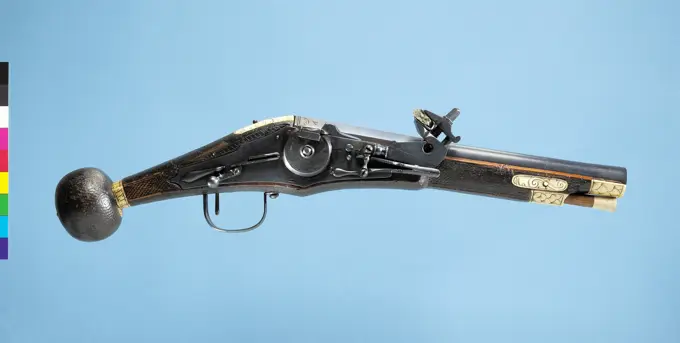
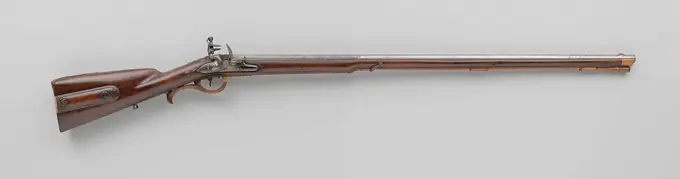
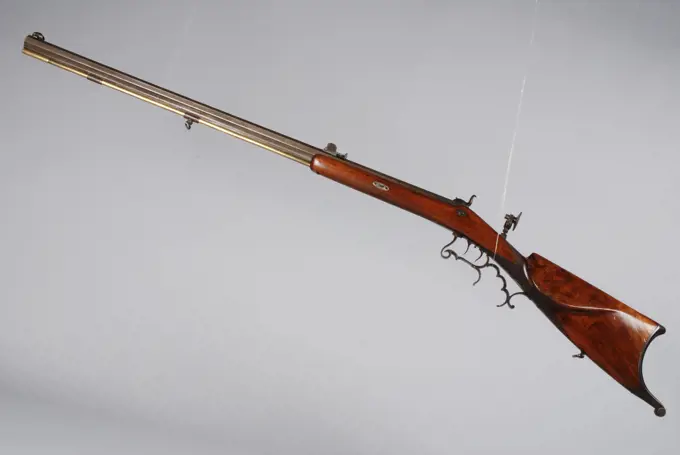
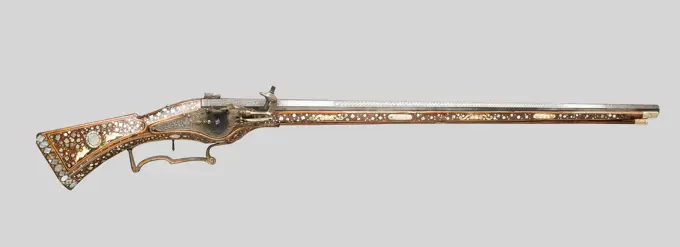
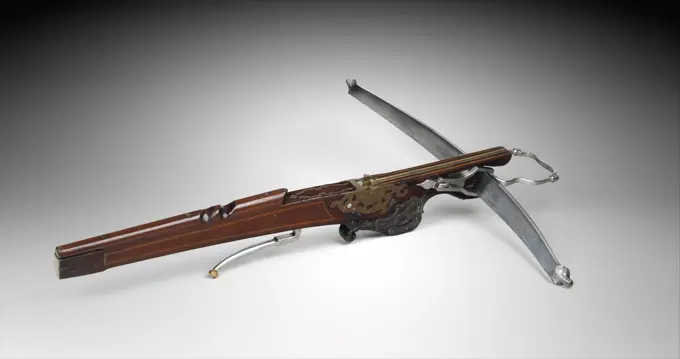
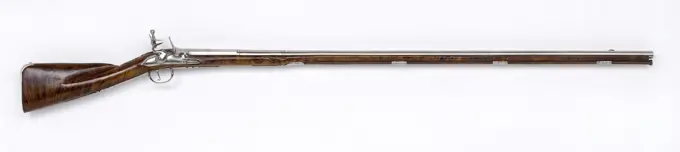
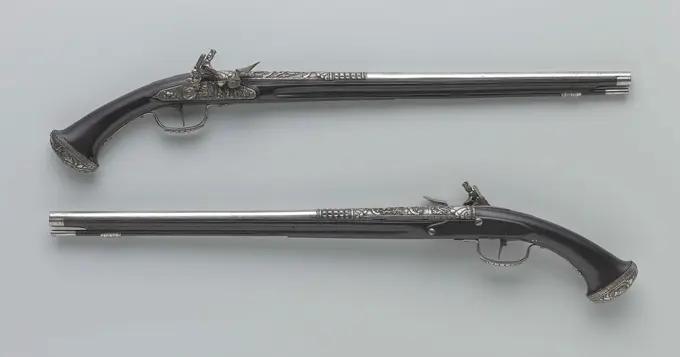
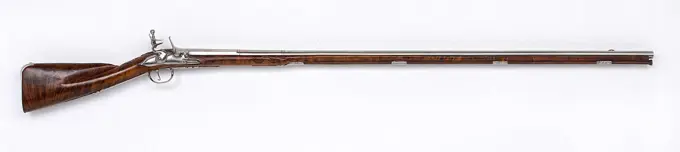
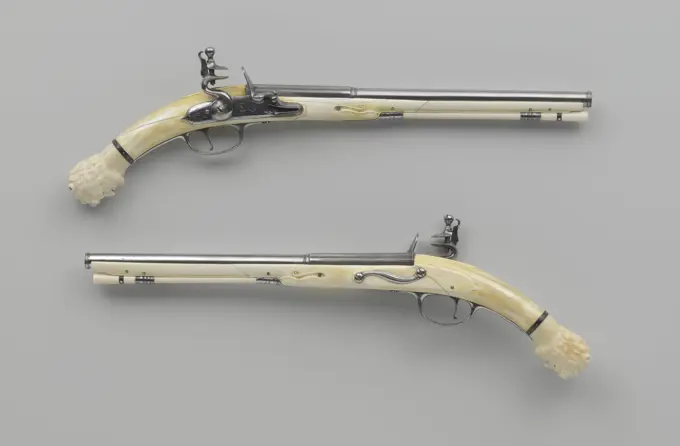
Cavaleric carabine of the Belgian Dragonder, Joseph Malherbex, 1829  Carabiner with flint lock. The carbine is by Baron M.C. Van Alderwerlt Houtuyn, conquered as the Ritmeester of the 5th Regiment Light Dragonders. On the flask he wrote with ink himself: `1831 (August) of a sabelding dragonder '. Cavalry carabinage from Belgian dragonder (ten -day campaign). Round run with letters: Place in an oval; brass visor grain; brass band with iron rotation tongs; lock; rooster with heart -shaped opening; brass side plate, flask plate, tire, tractor plate and bracket; On flask brand smashed from: Joseph Malherbex. Liège 1829. Without a loading stick. Liège iron (metal). wood (plant material). copper (metal). brass (alloy). ink writing (processes)  BelgiumFlint gun, Koeter Pijper, c. 1710 flintlock pistol The lock plate has a stepped tail and is engraved with praise in panels and a signature; De Haan is decorated in bas-relief. The loop is stamped both up and bottom with the Wapen van Utrecht and has a ripple over to the Tromp; There is a wing -shaped rearvizier on the tail of the loop, the visor grain is made of yellow icon. The flask is cut with, among other things, acanthus leaves. The previously gilt, yellow -headed batter with partially fitted relief decoration, except for the two octagonal chargers, consists of a symmetrical screw plate of ajour processed curls, partially granulated, a tractor bracket framed by leaf vines, an unprocessed, oval thumb plate with a crown with a crown with a crown with a crown with a crown with a crown with a crown with a crown with a crown with a crown of a crown with a crown with a crown of a crown with a crown of a crown with a crown with a crown with a crown with a crown with a crown with a crown Flint gun with belt hook. Solder gun with belt hook. The lock is engraved with praise and a signature. The loop is divided by three rings, one of which is trunk; At the back of the coat of arms of Utrecht and at the bottom with a C. The flask is hardly cut. The iron batter consists of two loading bokekers with slits between the rings, a screw plate in the form of a stretched s with a belt hook over it and a kollaf hood engraved with prainmesh and edges; The loading stick is equipped with an iron hood.Percussion army pistool Model M 1815, Anonymous, c. 1815  Percussion army pistool Model M 1815. Walk: smooth, round loop, which turns into the room into a five -sided part. A percussion was taken into the top of the room. On the tail piece of the loop: M.1815. Slot: Originally flint battery lock. The brass powder pan is cut off. The lock is marked: 15, s and Ekroon on top of each other. Wood: walnut. Batter: brass: at the front of the drawer is an openwork tube, which serves to confirm the loop; Tegenlotplaat; tractor bracket; Kolf hood. Netherlands Lads, bat: Walnut (Hardwood). Batting, pan, tractor bracket: brass (alloy). cock, lock plate, walk: Iron (metal)Kapishone pistol with a special lock design Gyorgy JungDonderbus on which the weapon of Tromp, Anonymous, c. 1659 flintlock gun Dutch Donderbus with flint battery lock with flat locking plate and rooster. Equipped with a slider. Nuthout drawer with brass batter (18th century). The lock plate does not wear signature or brands. The loop carries the weapon of Tromp at the top in relief. Only lock and loop are original, drawer and brass batter were added in the eighteenth century. Netherlands copper (metal)Flight gun or pocket gun. The lock plate is engraved with leaf, a back-over lady with a bird and a difficult-to-read signature; The two pans are mounted above each other and separated by a tilting plate to give access to the lowest pan. The loop is octagonal over the entire length. In addition to an iron tractor bracket that can be separated from the flask, the batter of silver.Miquelet Sporting Gun for the Prince Regent of Portugal, Joío VI (1767-1826) dated 1802 Jacintho Xavier This miquelet sporting gun was made for the Prince Regent of Portugal, John/Joío VI (1767-1826), who reigned from 1816 to 1826 as King of Portugal and Algarve and from 1816 to 1822 as King of the United Kingdom of Portugal, Brazil, and Algarve. Made in 1802 by Jacintho Xavier, master of the Royal Military Arsenal in Lisbon from 1794 to 1808 and therefore Portugals leading gunmaker, it was intended as one of the Regents personal hunting arms. The superb gold-inlaid decoration of the metal parts, contrasted by the blued steel ground, attest to the care and luxury of manufacture, while the presence of the Portuguese arms on the stock and trigger guard confirm the royal ownership.. Miquelet Sporting Gun for the Prince Regent of Portugal, Joío VI (1767-1826). Portuguese, Lisbon. dated 1802. Steel, gold, wood, horn. Lisbon. Firearms-Guns-MiqueletPercussion army pistool Model M 1815, Anonymous, c. 1815 - c. 1816  Percussion army pistool Model M 1815. Smooth, round loop, which turns into the room in a five -sided part. A percussion was taken into the top of the room. An unreadable brand on the tail piece of the loop. In the room: 1816. is, (crown above) and gb. Slot: Originally flint battery lock, later adjusted for percussion. The brass powder pan is cut off. Marked: 16, SB and Kroon on top of each other. Wood: walnut. Spunned a round stamp in which GH-Delft-1848. Batter: brass. At the front of the drawer is an openwork tube, which serves to confirm the loop; Tegenlotplaat; tractor bracket; Kolf hood. Netherlands Lads, bat: Walnut (Hardwood). Batting, tractor bracket, pan: brass (alloy). walk, cock, lock plate, tractor: iron (metal)Flintlock Pistol Made for Charles XI of Sweden (1655-1697) dated 1676 Bertrand Piraube French This is the earliest dated firearm by Piraube, the leading gunmaker in France during the reign of Louis XIV (1643-1715). Piraube worked in the Louvre, where lodging was granted by the French monarchs to the finest craftsmen in their employ. Firearms by Piraube were sought by princes throughout Europe, including Charles XI of Sweden (1655-1697), whose court emulated that of the French king. The Swedish royal arms are found on the barrel and on an escutcheon on the stock.. Flintlock Pistol Made for Charles XI of Sweden (1655-1697). French, Paris. dated 1676. Steel, gold, wood (walnut). Paris. FirearmsFlint gun, Barend Penterman, After 1703 flintlock pistol Part of a couple. The lock plate is engraved with a classic warrior and a signature; A vertical edge of leaves is chiseled on the tail of the lock plate and braid with leaves on the rooster. The loop is divided into three parts with rings, the middle and shortest part of which is chiseled with braid with leaves just like the lock; The sight grain is made of silver; The loop is stamped on the back with the city choir of Utrecht, the brand below 143-B is missing. The flask is simply cut. The tractor and the tractor plate are made of iron; The rest of the batter is silver and consists of a flask hood with a mask, a tractor bracket with ends in the shape of a leaf, a cast and fitted screw plate in the form of a grotesque mask with leaf trees with a sample, two loading stokkokers sharpened on either side as diamonds, and an oval thumb plate under a Duke crown framed by monsters and engraved with the coat of arms of Duke Carl Rudolf voColt Model 1851 Navy Percussion Revolver, serial no. 2 1850 Samuel Colt American In 1835 and 1836, the American inventor and industrialist Samuel Colt (1814-1862) patented a revolutionary type of multishot pistol that is still used today. Colt's revolvers had a rotating cylinder that could be loaded with several rounds and fired quickly by cocking and releasing the hammer or, in later models, by simply pulling the trigger. Early Colt firearms used percussion ignition and had to be loaded with powder, bullets, and ignition caps in separate operations. After 1870, Colt models were produced for self-contained cartridges that are much like modern pistol ammunition.First manufactured by Colt's factory in Peterson, New Jersey (1836-42), from 1847, the revolvers were made at a much larger plant in Hartford, Connecticut. A special workshop at the Hartford factory employed highly skilled decorators and artisans, many of German origin. Their ornamental motifs, still popular in American gunmakingFlint gun, J Wilkin, c. 1685 flintlock pistol The lock is chiseled in relief with flower vines, branches and a grotesque mask and engraved with curl work, a monster with leaves and the inscription Mastreck. The loop has a flat rib with a signature and the iron sight grain; The loop is chiseled in relief with curls, a grotesque mask and a flower challenge and engraved with praise in between; The tail of the loop is equipped with a groove for the rear visor and the inscription N4P above an engraved fern and stamped on the bottom with a r. The flask is cut with, among other things, praise; The chap is made of cow horn. The iron batter is chiseled in relief, apart from the two loading stokkers, and consists of a symmetrical screw plate consisting of curls, the tractor bracket with a mask, an unadorned, oval thumb plate in ajour -edged leaf vines and a flask hood with a grotesk masker on the flask cover plate browse vessels; The loading stick has a hood of cow horn. Maastricht iron (metal).Percussion army pistool Model M 1815, Anonymous, c. 1815  Percussion army pistool Model M 1815. Smooth, round loop, which turns into the room in a five -sided part. A percussion was taken into the top of the room. On the tail piece of the loop: m 1815. marked on the loop: t (crown above it) and yes (crown above). Slot: percussion lock. Originally flint battery lock, later adjusted for percussion. The brass powder pan is cut off. Percussion. Marked on the final plate: D (crown above). Wood: walnut. Batter: brass. At the front of the drawer is an openwork sleeve, which serves to confirm the loop; Tegenlotplaat; tractor bracket; Kolf hood. Netherlands Drawer, Kolf: Walnut (Hardwood). Walker, flask hood, bracket: Brass (Alloy). lock, run: Iron (metal)Double-shift fire testing gun. The slot is equipped with floral and leaf drinks with a mask and a putto, partly in bass relief, partially tissed and carries a signature. The two runs are mounted above each other. The flask has a groove on both sides containing the loading stick on one side. The iron fittings consists of an ajour processed, curled screw plate and the kolf hood with cover plate with a chartened mask.Flintlock Blunderbuss Carbine. Spanish. Date: 1500-1525. Dimensions: . Walnut, silver, and gold. Origin: Spain. Museum: The Chicago Art Institute, Chicago, USA.Flintlock Target Pistol of Prince William Frederick, Second Duke of Gloucester and Edinburgh (1776-1834), with Case and Accessories 1801-3 Wogdon & Barton Robert Wogdon, a gunmaker most famous for his dueling pistols, partnered with John Barton late in his career. This supremely elegant target pistol is among their most accomplished work. Its long barrel, measuring nearly twelve inches in length, indicates its intended use for targets. Graceful, understated, and built with fine attention to detail, it belonged to a cousin of George IV, Prince William Frederick, second Duke of Gloucester and Edinburgh, whose arms are engraved on the grips gold escutcheon. The finest London firearms made in the classic British style of the early nineteenth century rank among the most stately and innovative in the history of gunmaking. They are immediately recognizable by their elegant proportions, restrained ornament, and technical refinement. Graceful yet practical and perfectly balanced in the hand, tPistol with a capither castle PIRMET, THE CLOCC, Miko AJ (FL. Ca 1780 1830)Naval blunderbuss. Muzzle-loading flintlock gunwale blunderbuss. Made in France, first half of the 19th century. Maritime Museum. Lisbon, Portugal.Flight gun. Part of a couple. The lock is unfinished on a signature and a brand after. The loop is etched at the top with arabians in relief; Equipped with an inscription and left behind stamped with the coat of arms of Utrecht; The visor grain has silver relief decoration in the form of a grotesk mask. The flask has been cut with, among other things, praise. The batter is from Geelkoper, formerly gold-plated, with the two charging bokekers except the two charging bokeers on a granular surface, and consists of: on the screw plate on either side of a human figure, one of which is running into a dragon head; a angular trigger bracket with acanthus decoration; A thumb plate framed by praise with a mask at the bottom; The roughly decorated with a lion's head with a lion's head as a central flask plate; The loading stick is equipped with a gold-plated glass cap.Wheellock Gun 1580-1590 Augsburg. Steel, gold, silver, fruitwood, ebony, horn, and staghorn . Bernhard AlbrechtA cavalry pistol with a rock castleWheel-lock breech-loading piston, by Unknown, 17th Century, Unknow. Italy, Piemonte, Turin, Royal Armory. Whole artwork. Firearm barrel wheel trigger butt handle.Flint Donderbus -Karabijn, Royal Rifle Factory Culemborg, 1798 - 1809  Military flint Donderbus carabiner. The lock is based on the French army model 1774 and 1777; The outside of the lock plate is marked with R, DM and Kulenborg under a crown, the inside T and D or V. The loop increases in diameter towards the tromp and is stamped on the bottom with I.H. The flask is simply cut. The iron batter includes a triangular screw plate with decorated edges and a forked tractor bracket; The loading stick is made of steel. Culemborg iron (metal). steel (alloy). copper (metal). wood (plant material) engraving / cuttingFlint Marinepistool, Laurens Constant, 1770 - 1780 flintlock pistol The lock is unadversely except for a signature; The inside of the lock plate is stamped with LC, the stoodel with JV. The loop is chiseled with a large emblem consisting of two crossed anchors with the letters A, O, D and M in between; Stamped on the bottom with a brand that is not to be deciphered and a globe with a cross above a U or a horseshoe; The sight grain is made of a loader. The flask is simply cut. The brass batter consists of a drawer, an S-shaped screw plate, an unadorned, oval thumb plate attached with two yellow-cut nails, and a flask hood with long tracks, a border in relief and an unadorned pump cover plate; The loading stick is made of steel. Rotterdam brass (alloy). steel (alloy). wood (plant material) engraving / cutting  RotterdamCavalry pistol with the Lorenza Capida Castle, M1859 Sederl, ThomasDubbelloops flint turning gun, Egbert Tencinck, 1660 - 1665 flintlock pistol Part of a couple. The lock is decorated with tendrils and half-human and half-die characters that wear a curly banderole with a signature on it and a tulip. The two runs are mounted one above the other and provided with an inscription. The flask has two grooves, one of which offers a place on the seam. The batter includes two loading stokkers, a tractor bracket, a flask hood engraved with tendrils with leaves and dragons and a cargo with iron roof. Utrecht iron (metal) striking (metalworking) / engravingVuursteenpistool.The lock is engraved with brords and animals and a signature. The loop has two rings, one of which is the trump. The flask is easily cut. The iron fittings consists of a loading stick and a boat-shaped kolf cap, engraved around the screw in the middle with a flower celk and the short traces with prainmesh; The loading stick is provided with an iron hood.Body of fireman with firefighting equipmentFlintlock Rifle 1740-1760 Vienna. Walnut, steel, gold, and horn .Crossbow, anonymous, c. 1600 - c. 1699  Crossbow, the string is missing. Handle of elm () Wood, decorated with a copper plate in the form of a stylized lily on both sides. The bow is made of iron, wearing and hanging an iron bent fork at the top.  wood (plant material). copper (metal). iron (metal). rope. ivoryRussian riffle loaded in the chamber (1859). SPAIN. BASQUE COUNTRY. ALAVA. Vitoria. Museum of the Armera (armoury).Pistol with a rock castle, from steam Kuchenreuter, Johann Christoph, II (1755 1818)18-mm calibre flintlock pistol and holster. Belonged to Spanish Captain General Leopoldo O'Donnell. Gift of Prince Muley-Abbas.belonging to Captain General Leopoldo O'Donnell. Gift from Prince Muley Abbas. Irusta (barrel), Gaspar Zuloaga (gunsmith), Hirsuta, c. 1860. Steel, gold, silver, wanut and ivory. Army Museum. Toledo, Spain.Mauser flare pistol M.1894, Germany. Latvian War Museum. Riga. Latvia.Pistol  fIIntlock blunderbussStone Crossbow with Spanner for a Child 1690-1710 Germany. Wood, bone, and fiber .Flight gun. Part of a couple. The Geelkoperen lock plate is engraved with getting trophies and a signature; The pan is rainproof. The loop is on top of a glass ridge engraved with prainmesh, the head of a sample, a signature and a crowned oval shield blistered with three sickles with the open side to the left; The glass side faces are engraved with acanthus leaves; The tail of the loop is covered with selector and grooved for a hooker; The visor grain is also from Geelkoper; Mounted with IC and a rosette or star. The flask is easily cut with praise. The molded and facilitated batter of selector is partially engraved with praise and consists of a trigger bracket that runs into a leaf, a crowned, oval thumb plate with a male-based on framed by praise, an ajour processed screw plate consisting of praise and band work around two griffins either side of a shield with a male bra, and a kolf cap with braid and praise, two seated classic figures and a mask below; The loading stick is equipped Flint gun, Anonymous, 1699 - 1899 flintlock pistol Flint gun with an iron round loop with an iron sight grain at the end. Wooden drawer with bred leaf motifs with horn inlaid at end. Iron engraved round lock plate and rooster with the brand name "Ifr. Covna", engraved rooster and rusty fire steel, other side iron batter with leaf motifs. The flask is made of wood with an iron flask plate on which an engraved weapon trophy of banners, drums and a shield with a figure above it. On the Kolfhals an iron floral pattern with a wood -cut leaf above it. Iron tractor bracket with iron tractor. Under the wooden drawer a wooden chest of charge whose head of Hoorn is. West-Europa Loop, lock plate, flask hood: Iron (metal). drawer, flask, chest of drawers: Wood (plant material). Charging stake: Horn (Animal Material) engraving  NetherlandsPISTOLA DE SILEX 1810. MANUFACTURA DE EIBAR. Author: EUSEBIO ZULOAGA GONZALEZ (1808-1898) ARMERO. Location: ALCAZAR / MUSEO DEL EJERCITO-COLECCIÓN. Toledo. SPAIN.Percussion gun for officers of J.A. Baron De Vos Van Steenwijk. Percussion gun, part of torque, with octagonal drawn loop. The flask is made of walnuts and has a diamond-grooved grip, under the flask an iron flask with a stubbed stallist. The loop is in half a tray of walnut. The iron slot is flat and has engraved floral motifs on its disposal. The rooster is also engraved. At the end of the belt hook a grooved notch for the thumb. The trigger bracket is made of iron and has flower decorations over the entire length. Under the drawer an iron loading stick. On the course the Liège quality mark E.L.G.Pair of Flintlock Pistols ca. 1775 Irish. Pair of Flintlock Pistols 27377Flintlock Pocket Pistol. Maker: Henry Nock. Made in London, EnglandFlintlock pistol.The Pentermans were a family of gunmakers who played a leading role in firearms production in both Utrecht and Leeuwarden. An unusual feature of this pistol are its hidden screws. To disassemble the weapon, the rounded mask on the butt cap must be removed, as this conceals the first screw.Pair of Flintlock Pistols of the Prince of Wales, later George IV (1762-1830), with Case and Accessories hallmarked for 1787-88 Durs Egg Tastefully embellished with low-relief silver pommels depicting a cavalry combat scene, gold-inlaid barrels and locks displaying the royal arms, and luxuriously carved, figured walnut stocks, these pistols were made for George IV when Prince of Wales (1762-1830) by Durs Egg, one of the most talented and influential gunmakers of his era. The pair exemplifies Eggs finest work.Eggs workshop produced the pistols for the Prince just as Egg was reaching the peak of his career. Though fully functional for the purposes of dueling and self-defense, with light, easily maneuverable barrels, fast locks, set triggers, and ergonomically rounded, checkered stocks for enhanced grip, the pairs decorations suggest their intended use was for less dramatic activities, particularly target shooting.The set is emblematic of the princes lifelong interest in collecting coFlint gun with Bajonet from J.D. Tothmeijer. Fire handle gun with iron bayonet, smooth, bronze round loop that is interrupted by a profile tape and turned octagonal in the lock plate. Below two engraved weapons are visible in the form of two crossed those under a crown. The sides of the lock plate are engraved with floral motifs, on the left, the 'Tayler & Mander brand is on the left. The flask is made of wood. Iron trigger bracket on the underside engraved, iron tractor whose end bends contra.A pair of pistols with a rock castle Keeping, Joseph II (1753  1854)Percussions cap muzzle loader of the 19. th century 8mmPair of Flintlock Pistols ca. 1686 Giovan Battista Francino Italian The pistols are inscribed in Latin Viena Liberata (Vienna liberated) and Buda Superata (Buda captured) in commemoration of the two major events, in 1683 and 1686, in the war between Austria and Turkey.. Pair of Flintlock Pistols. Italian, Brescia. ca. 1686. Steel, wood (walnut), wool. Brescia. Firearms-Pistols-FlintlockPercussions cap muzzle loader of the 19. th century 18mmFlint gun with battery lock, 1808 flintlock pistol Flint gun with battery lock, belonging to torque. An octagonal loop of blewy steel, somewhat widening at the mouth. On the front part of the loop is a steel visor grain. The loop is decorated with tires of gold leaf and at the tailpiece; The part at the Zundgat is completely gilded. The top of the loop is marked with gold. The number was smashed at the top of the loop. The soul has so -called "hair drawing". The tail piece consists of a separate block with a square hole in which the hook -shaped final piece of the loop fits. There is a visorkeep on the tailpiece part. Lock: flint battery lock; Blowded steel. The rear part of the lock plate is at a lower level and is engraved with an eagle on a tree branch; De Haan is decorated with engraved leaf and pain appin motives. The slot plate of gun carries inscription. The ditches are marked on the inside. Wood: (polished) walnut; Flattened flask which at the bottom straight sealed, diamond -sPercussions cap muzzle loader of the 19. th century 16mmFlight gun with battery lock. Pistol belongs to torque. Loop: Steel loop, which is covered with a mantle of brass. The front, round, part of the course, passes the room in a five-sided section. Elongated Vizier Grain of Brass. About almost the entire length of the loop is located at the top a tire to the back. On the left side of the room a brand (G). Engraved line and geometric motifs around the visor grain, on the tire at the top of the loop, in the room and the tailpiece. Slot: Battery lock: The flat lock plate of brass is flattened at the top and bottom. The pan is made of brass and has facets. The rooster flattened on the outside. The top from the pledge lid and the front of the stop surface have facets. On the lock plate engraved with line and sawtooth motifs the signature: A. Streignard. The lock is attached with two bolts. Wood: Nut wood: at the rear loading stick carrier and behind the tail of the loop cut with stylized leafwork motifs. Batter: brass: flat from one piece consiPercussion revolver.dean Adams Revolver, drawn six-shot percussion. The revolver is made of blued steel with an iron cylinder, rooster and tractor. He has an even throat. The patterns must be applied in the cylinder, whereby it can be adjusted to a lever along the loop by means of a pestle. The impact hats are applied to scratches on the back of the cylinder.Flint gun from Cornelis Tromp. Haags Flints gun from Cornelis Tromp, part of couple. Flint battery lock with flat lock plate and rooster. Walnut tray with engraved silver kolf cap and silver loading stick carrier. The lock plate is signed. The engraved weapon of trump has been applied to the silver kolf cap.Pistol with a rock castleDoelroer met tondelslot en achttiende-eeuwse lade.The lock plate has a tip at the ends. The loop is of the so-called halber box loung, equipped with a glass of sight and grain; The ring for the octagonal kulas is chiseled with the year 1611; The round portion of the loop is stamped twice with a brand in the form of a leaf. The walnut flask is equipped with a large support bell at the bottom in which acanthus leaves and a lion are cut out; The figure XXIIII is carved in the belly of the flask. The previously gold-plated, selector batter consists of a tractor plate, a trigger bracket and a flask with a pointed, corrugated upper piece stamped with from Goes; The loading stick is made of steel.Model of the old gun on the white background, souvenirFlight gun. Part of a couple. The Geelkoperen lock plate is engraved with getting trophies and a signature; The pan is rainproof. The loop is on top of a glass ridge engraved with prainmesh, the head of a sample, a signature and a crowned oval shield blistered with three sickles with the open side to the left; The glass side faces are engraved with acanthus leaves; The tail of the loop is covered with selector and grooved for a hooker; The visor grain is also from Geelkoper; Not below marked with IC and a rosette or star, as is the case at 145-a. The flask is easily cut with praise. The molded and facilitated batter of selector is partially engraved with praise and consists of a trigger bracket that runs into a leaf, a crowned, oval thumb plate with a male-based on framed by praise, an ajour processed screw plate consisting of praise and band work around two griffins either side of a shield with a male bra, and a kolf cap with braid and praise, two seated classic figures and a mask belRadslotpistool, anonymous, 1588  Radslot gun. Radslot is secured with two lock screws. The loop is partly octagonal (back) and round. Narrow profile band in the middle. At the bottom marked W.L. Lade is decorated with simple granula motif and inlaid with engraved legs. A engraved legs ring between the flask button and flask. Signed, dated and marked in the room: H.R. 1588. State good. Almost identical Radslot gun: NG-NM-11422. Germany iron (metal). pear (wood). bone (material) forging / cutting / engravingVuursteenjachtgeweer.The lock has been edited ajour and easily engraved with praise and the name of the maker in a gold-inlaid panel. The loop has a glass of visor grain and a glass zund hole. The root nutshell flask is crazy with rococo curls, including the chimney plate decorated with a star of alternating ivory and ebony and on the right a folk box including a flower and a shell. The batter consists of two iron, pivotable cordon brackets, the rest is made of palm wood and consists of, among other things, three loading bokekers, a screw plate in the form of praise, the trigger bracket, a flask plate divided into two parts, of which the upper with a large counterfeit screw head of Dark wood and the bottom with two iron screws, and the wooden loading stick with a cow hood.pistols, eibar, 1843, Castle of San Carlos, seventeenth century, Palma, Mallorca, Spain.Cavalry pistol with the Lorenza Capida Castle, M1859Wilhelm van Kreyfelt, Luxury single-loop disc-shotgun front loader with percussion ignition, shotgun rifle firearm weapon iron steel wood walnut brass silver metal, running from 2.5 to 2.2 single barrel shotgun percussion ignition trailing lock caliber 9 mm octogonal drawn barrel Adjustable pearl pellet adjustable bow visor on loop adjustable diopter on long tailpiece puller and trigger accelerator with adjusting screw. Richly shaped trigger guard overflowing in articulated handle Iron fitting with silver scrolling brass ramrod half-wood cheek plate on buttock flask with beak Loading rod of straight brass rod. Mounted socket with hollow nose of brass for the impact surface so as not to damage the pointed ball and the traits and fields during insertion looped signed Wilh. v. Kreyfelt. Rotterdam weapon hunting nature wild food rose sport prize man militariaWheellock Gun 1610-1630 Germany. Steel, walnut, gilding, horn, and mother-of-pearl .Pistol with a capshable castle converted from rock SegalasTarget Crossbow with Windlass tiller of crossbow, mid-18th century; bow, probably 19th century; windlass, ca. 1600-1750 probably Belgian or Dutch. Target Crossbow with Windlass. probably Belgian or Dutch. tiller of crossbow, mid-18th century; bow, probably 19th century; windlass, ca. 1600-1750. Steel, wood (possibly mahogany), copper alloy, staghorn, hemp. Archery Equipment-CrossbowsFlint gun, Carmigel, 1715 - 1725 flintlock pistol Part of a couple. The lock is engraved with edges, leafs and a signature from the maker. The loop is equipped with three ties with rings and a gilded, yellowed visor grain in the form of a grotesque mask in relief; On top marked with the weapon of Utrecht and on the bottom twice with a crowned heart. The flask is easily cut with, among other things, acanthus leaves. The previously gilt, broneloper fittings with after -fringed relief decoration, apart from the two octagonal loading stokkokers, consists of a tractor bracket on it, a symmetrical screw plate of ajour -edged leaf vines around a mask, a crowned thumb plate with birds and a masker, and a mask, and a mask, and a mask pump hood with a mask at the bottom; The loading stick has a hood of cow horn. Utrecht brass (alloy). gilding (material). horn (animal material) engraving / gilding / cuttingClose up of pistol against white backgroundFlint hunt rifle, Barend Penterman, 1700 flintlock gun The final plate is unadorned except for a signature. The loop has two rings; The sight grain is made of iron; Stamped at the bottom with an unrecognizable stamp and the Wapen van Utrecht; On top of the weapon of Utrecht is also stamped. The root knot wood drawer is easily cut with, among other things, praise. The iron batter includes four loading stokkokers, an ajour processed screw plate with two snakes and praise, and the ajour edited thumb plate with grotesque masks, leaf vines and a shield engraved with the initials E: C: D: N: S: Boven the year 1700; The wooden chest of drawers has an iron roof. Utrecht iron (metal). wood (plant material) cutting / engravingPair of flintlock pistols.These two flintlock pistols have exceptionally long barrels. Their fine decoration is characteristic of a group of arms produced around 1650 in the region between Maastricht, Liège and Sedan. The lockplates (on the side of the pistols) are decorated with a Classical scene featuring the wine god Bacchus. The cock is in the form of a snake with a coiled tail.Double-Barrel Wheellock Pistol (Puffer) Made 1580-1600 Saxony. Steel, copper alloy, pyrite, leather, fruitwood, and staghorn .Flintlock Blunderbuss. Culture: Indian, Mysore, Srirangapatna. Dimensions: L. 40 3/8 in. (102.5 cm); L. of barrel 23 3/4 in. (60.2 cm); Cal. 1.75 (44.0 mm); Wt. 6 lb. (2741 g). Date: dated Mauludi-era 1225/A.D. 1796-97.This gun comes from the armory of Tipu Sultan, ruler of Mysore, a Muslim state within southern (Hindu) India, from 1782 to 1799. Tipu called himself the "Tiger of Mysore" and employed tiger imagery in every aspect of his court. The cock of this flintlock is a tiger's head and the barrel is damascened in gold with tiger stripes. Manufactured in the capital of Seringapatam and incorporating the latest European technology, Tipu's firearms were the most distinctive and sophisticated in India at the time. Museum: Metropolitan Museum of Art, New York, USA.Signal Pistol  light gunPair of Flintlock Pistols 1700-1800 Brescia. Wood and steel . Lazzarino Cominazzospark gun, 1780, Castle of San Carlos, seventeenth century, Palma, Mallorca, Spain.Percussiepistool with two walks and four roosters, c. 1844 - c. 1862  PercussiePistolool with two iron rounds located next to each other. Located. Four iron with praise engraved roosters. The lock plate is made of iron and engraved with praise. A wooden pump that has been processed. An iron flask hood that is engraved with praise. The tractor bracket is made of iron and is completely engraved from below with praise. Two tractors of which the rear is longer than the front tractor. The drawer is completely made of wood. Under the walking a loading sticker in which an iron loading stick is located. A small engraved metal plate under the opening of the chest of drawers. Marked on the Dewalle Frères left slot plate; Marked on the BréVetés a Liége judge slot. Liège Kolf, drawer: Wood (Plant Material). Loop, Slotplaat: Iron (Metal) engraving / cutting  NetherlandsPISTOLA ASTRA FABRICADA EN ESPAÑA POR UNCETA Y CIA. DE EIBAR. Location: ALCAZAR / MUSEO DEL EJERCITO-COLECCIÓN. Toledo. SPAIN.Pair of Flintlock Pistols ca. 1786 Claude Martin These pistols bear markings indicating they were made in the Arsenal at Lucknow, India, under the direction of Arsenal Superintendent Claude Martin, who oversaw the production of firearms by Indian craftsmen there from 1776 until his death in 1800. While many luxury arms of this period include finely decorated mounts and inlay of silver and gold, these pistols are extraordinary for having, in addition to those features, solid silver barrels and lock-plates. The cock, steel, trigger, steel spring, and internal components of the lock are the only metal parts of the pistols made of steel.Martin, the French polymath, inventor, intellectual, bibliophile, architect, adventurer, art patron, investor, and soldier, held various military and administrative positions under the British in India since he was twenty-five years old. Born in Lyon, France, he defected to the British forces during the siege of Pondicherry in 1760, thereafter steadily climFlint gun, Godefroi Corbeau (II), c. 1750 flintlock pistol Part of a couple. The final plate is unadorned except for a signature; The fire sample of the lock is chiseled in relief with the shape of a drop; Rain -tight pan. The loop has a large, silver visor grain and two tires of rings, the front of which is incised; Stamped at the bottom with a brand that cannot be deciphered. The flask is easily cut with, among other things, praise; The handle is curved. The silver fittings are unadmanned from narrow edges and consists of a triangular screw plate with a dot at the end, and a pear -shaped thumb plate engraved with the monogram CS; The drawer is equipped with a silver roof. Maastricht silver (metal). wood (plant material). iron (metal) engraving / cuttingDouble barrelled flintlock pistol with a dagger in the stockThe outer rad of the lock is covered with an iron plate and secured with three screws; The lock plate is marked with an anchor on the inside. The loop is marked with a jumping deer, flanked by I.K, and at the bottom with CMIL. The flask shows circular cavities for the final bolts. On the wide tire around the end of the grip after, which is engraved with prainmesh, the iron fittings is unfinished and consists of a drawer cap, a loading cooker, and a angular trigger bracket; The loading stick is equipped with an iron hood.Two lounged hunting shotgun Ż27 E And a mechanical denturePair of flintlock pistols.These two flintlock pistols have exceptionally long barrels. Their fine decoration is characteristic of a group of arms produced around 1650 in the region between Maastricht, Liège and Sedan. The lockplates (on the side of the pistols) are decorated with a Classical scene featuring the wine god Bacchus. The cock is in the form of a snake with a coiled tail.Pair of flintlock pistols, Leonard Cleuter, c. 1660 - c. 1664 flintlock pistol Part of a couple. The lock is engraved in bas-relief with leaf vines and a cartouche with a signature. The loop is blewy and engraved in bass relief with arabesks, flower vines, a running hare and a bird on a branch; On the back is a golden protrusion, probably the rear visor, and a grotesque mask is engraved; On the bottom is the C.Mil brand. The solid ivory flask is cut into relief with a grotesque mask, acanthus leaves and a large dragon head flanked by two flaming tongues; The handle ends after an engraved iron ring in a flask button in the form of a crown head with a wreath. The iron batter consists of a loading sticker, the tractor bracket with engraved field and N 125 on it, and an ebony chest of the chest with an iron roof. Maastricht ivory. iron (metal). gold (metal). ebony (wood) cutting / striking (metalworking) / engravingCassette for couple Pistols with accessories, Jean Le Page, 1808 gun accessories Cassette: polished mahogany box, with a handle of brass at the top, a diamond -shaped key hole of brass on the front. Wrought iron key. The lid is covered on the inside with a green saflan leather, on which edge motifs in gold stamping. The storage space is covered with red leather and in specially saved spaces, there are two pistols and accessories. Paris mahogany (wood). brass (alloy). leather. gold (metal)Percussion rifle - Enfield EnfieldVuursteenjachtgeweer.The lock plate is unfinished on a signature. The loop has two rings; The visor grain is made of iron; stamped at the bottom with an unrecognizable stamp and the weapon of Utrecht; The coat of arms of Utrecht are also stamped on top. The carrot nut wood tray is easily cut with praise. The iron attachment includes four loading bokekers, an ajour processed screw plate with two hoses and prain work, and the Ajour processed thumb plate with grotesque masks, leaflets and a shield engraved with the initials E: C: P: D: N: S: upstairs the year 1700; The wooden loading stick is equipped with an iron hood.Pair of Miquelet Pistols 1770-1790 Ripoll. steel, brass, walnut, and flint .Old pistol with the hammer cocked, isolated on white background Old pistol with the hammer cocked, isolated on white background Copyright: xZoonar.com/OleksandrxKostiuchenkox 8906050Percussion rifle - Snider-Enfield Snider-EnfieldFlint gun with ivory drawer, Charles Fabri, 1675 - 1680 flintlock pistol Part of a couple. The slot, which is bluated on the inside, is decorated with a single slender, a bird on a branch and a signature on the lock plate. On the barrel are the GMA letters -stapled letters. The solid ivory flask is cut into relief and ends after a band of ivory inlaid ebbenhout in the all -cut flask button in the form of the bearded head of Hercules with the head of the Nemeian lion as a helmet. The iron batter consists of, among other things, an ivory boundary whose head is separated by an ebony band such as between the handle and the flask button. Maastricht ivory. ebony (wood). iron (metal). gold (metal) cutting / striking (metalworking) / engraving / inlay (process) (story of) Hercules (Heracles)piston gun, Eibar, 1850, Castle of San Carlos, seventeenth century, Palma, Mallorca, Spain.Percussion Powder Tester. Belgian, Probably. Date: 1810-1850. Dimensions: L. 15.5 cm (6 in.). Walnut, brass, and steel. Origin: Europe. Museum: The Chicago Art Institute, Chicago, USA.Old pistol with the hammer cocked, isolated on white background Old pistol with the hammer cocked, isolated on white background Copyright: xZoonar.com/OleksandrxKostiuchenkox 8903390Pair of fIIntlock pistols unknown scruxPair of wheellock rifles with spanner from Cornelis Tromp, anonymous, c. 1650 - c. 1690  Radslot bugs or bird stirrer. A hunting weapon with drawn running of a small caliber, equipped with a hair tractor (Stecher) and precision vizier, intended to shoot sitting game. The octagonal walking is 69 cm long and equipped with eight right -hand traits; The caliber is 12 mm. The walnut drawers have a so -called German flask, inlaid with Hertshoorn, Been and Pearl; In addition to lions, unicorns, birds, dogs and griffins, flowers and fruits, a left -handed hunter is depicted on the pumps that, with the right foot on the tail of his dog standing his rifle, imposed on a tree, on a non -visible bird and so on A clear picture gives how these rifles were shot. Radslot with outside wheel that runs behind an iron ring. No brands or signature. The shape of the flasks is German, but the insert is from Teschen in Silesia, where in the second half of the seventeenth century the art of the art flourished aWheellock gun mid-17th century Cominazzo workshop Italian The bold and distinctive chiseling of the steel fittings is thought to be a style favored in southern Italy.. Wheellock gun 21964Wall Gun (Hakenbüchse) with Stock and Stand. European, possibly German. Date: 1500-1533. Dimensions: Length overall of cannon: 39 1/16 in. (99.3 cm)Caliber: 7/8 in. (2.3 cm)Weight of cannon: 37 lb. 3 oz. Bronze. Origin: Europe. Museum: The Chicago Art Institute, Chicago, USA.Violin with white background, Isolated violin without background with copy