Historical Firearms Collection

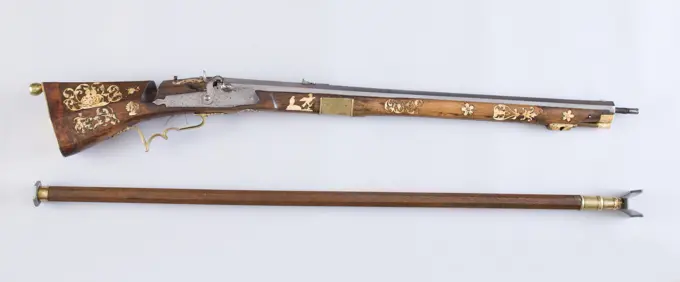
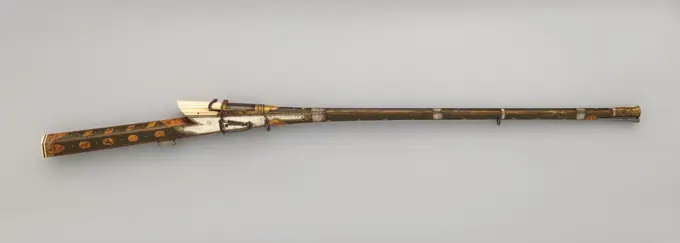
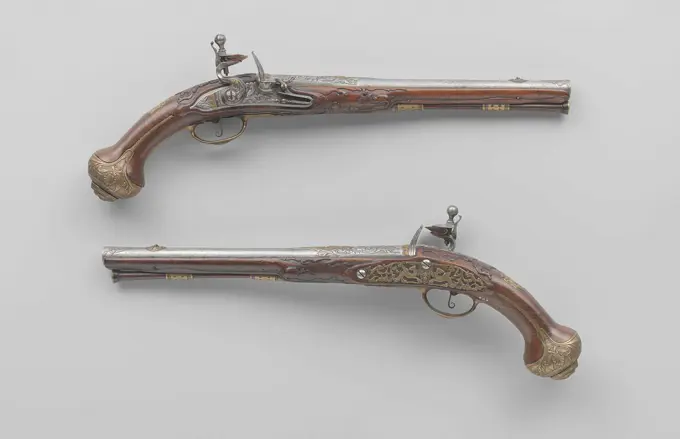
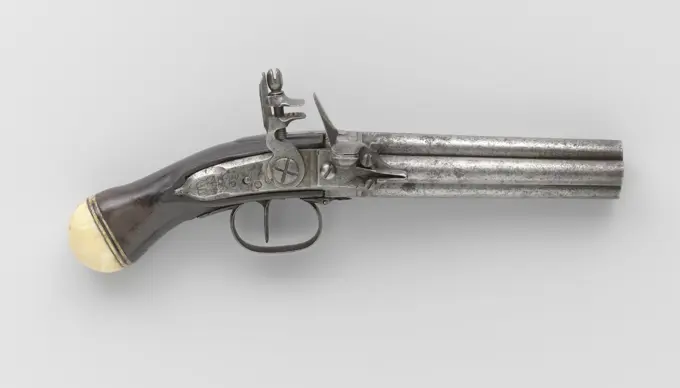
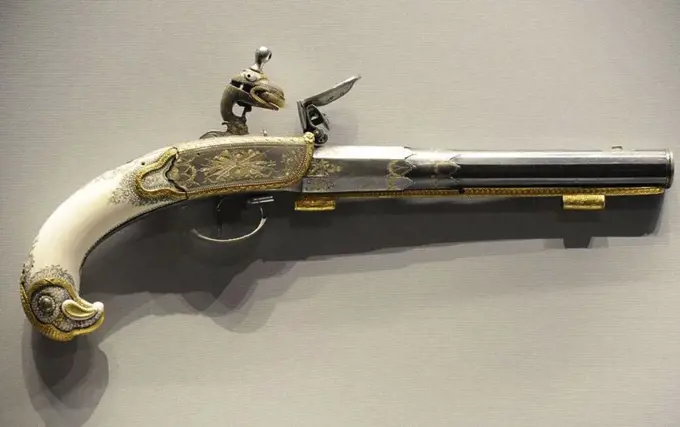
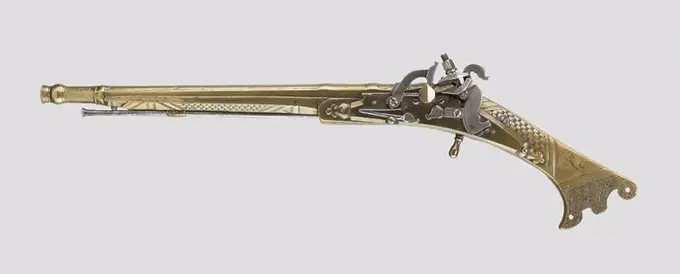
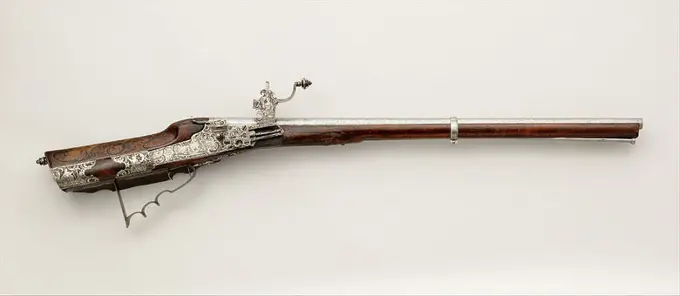
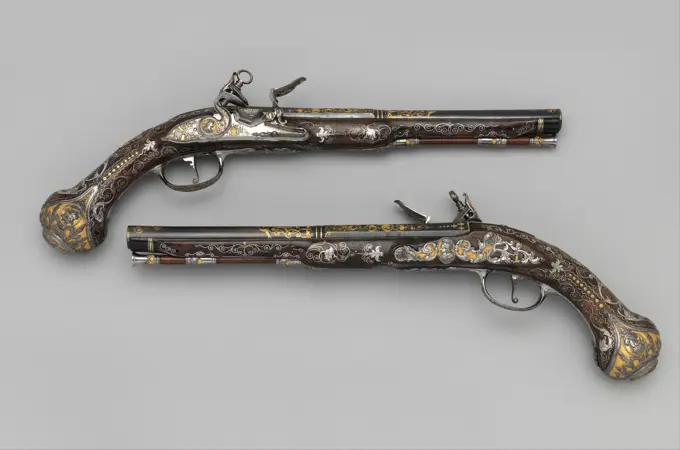
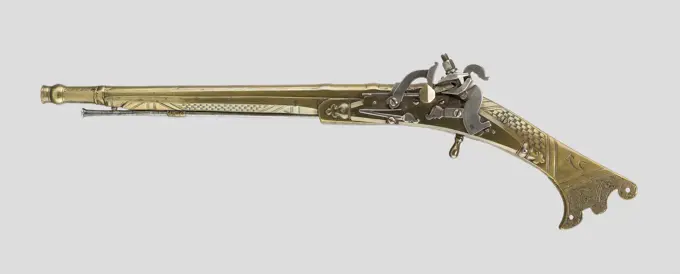
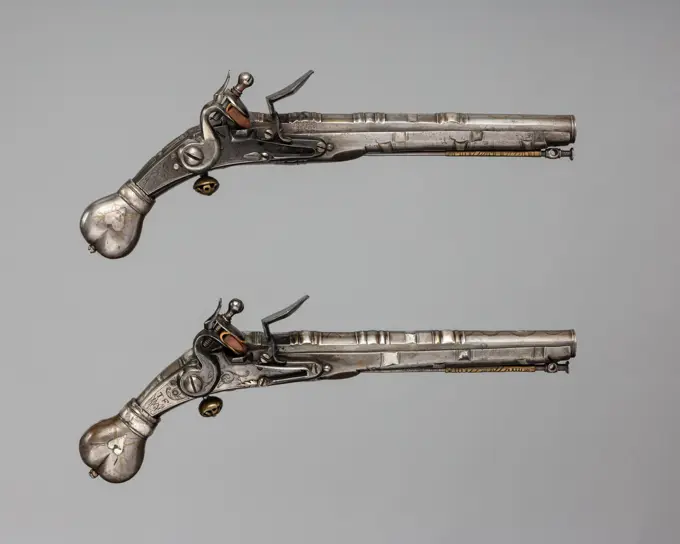
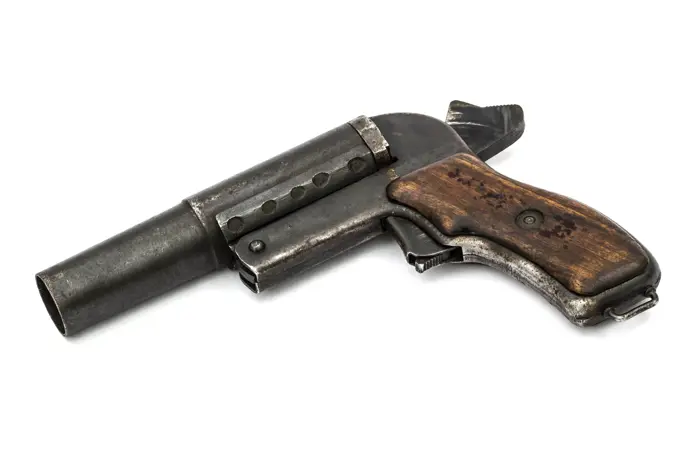
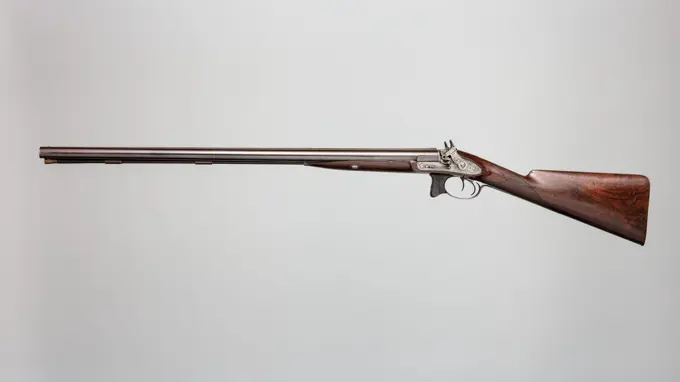
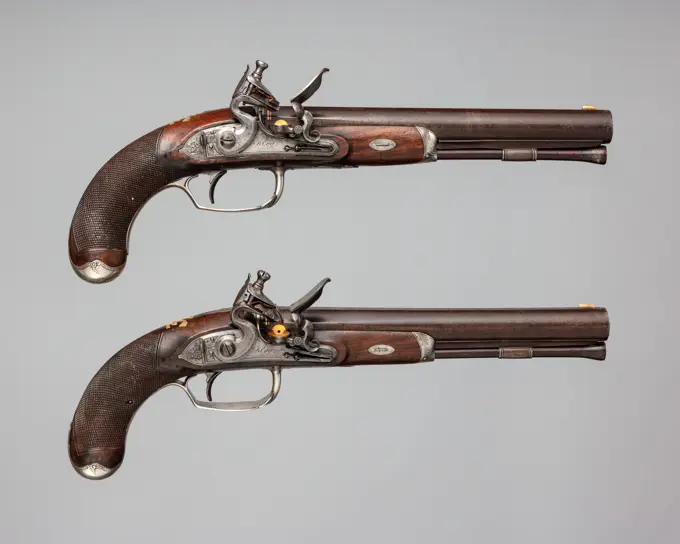
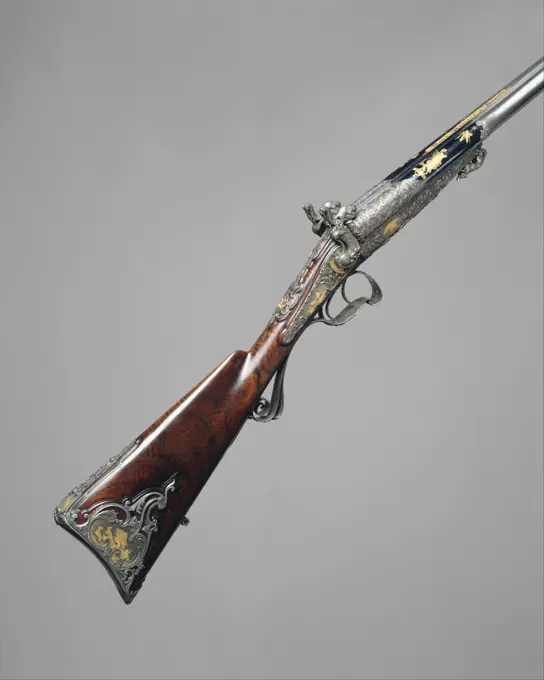
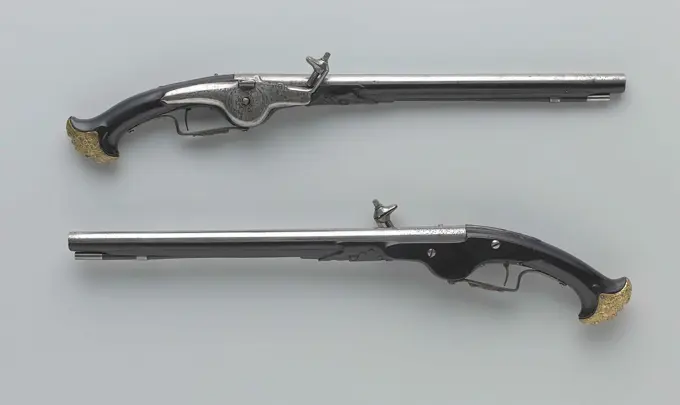
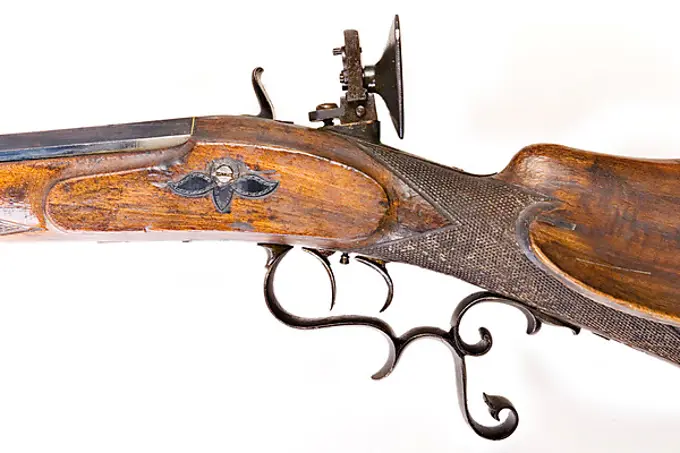
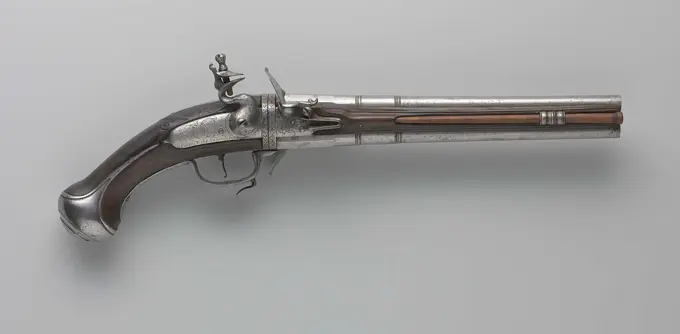
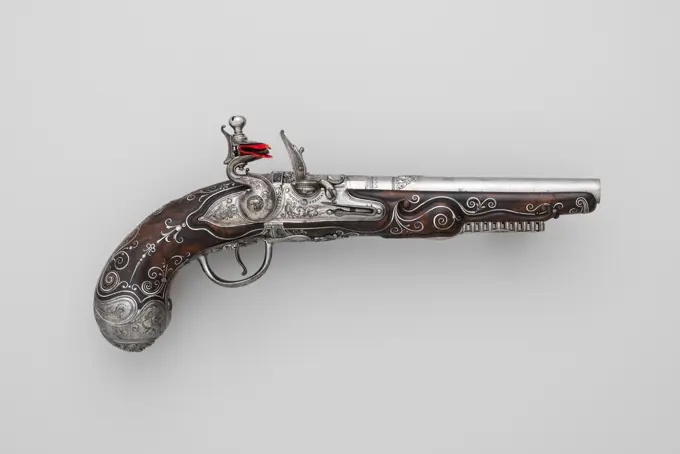
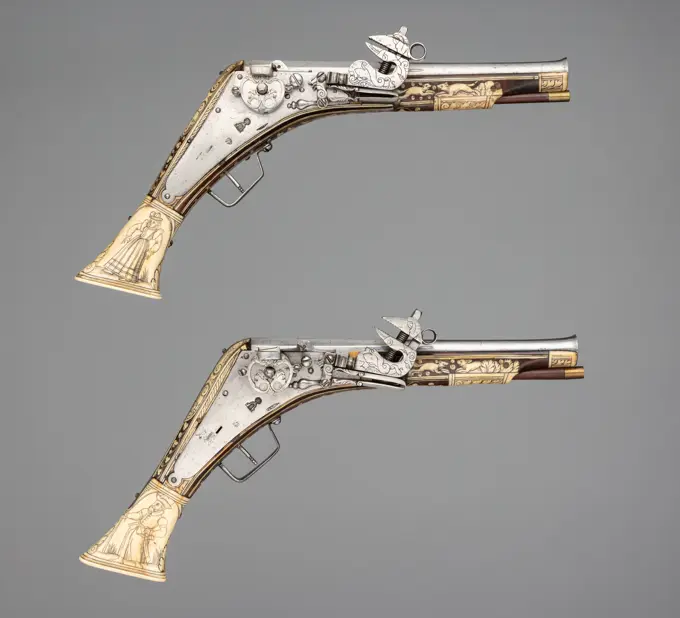
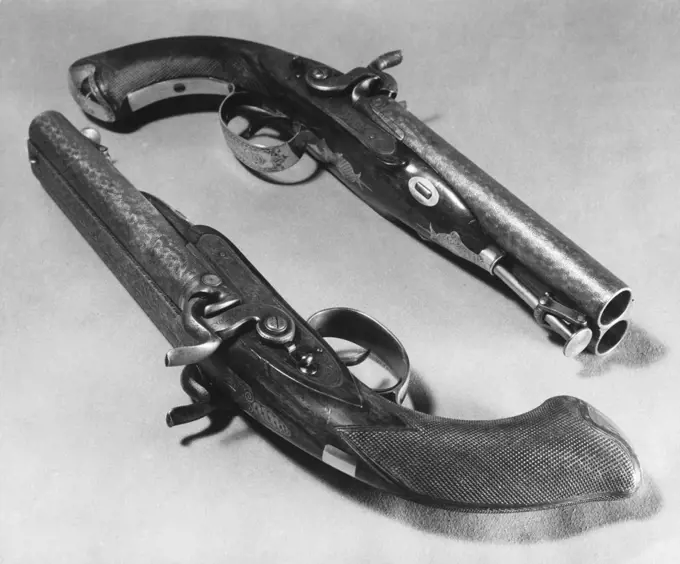
A variety of historical firearms, including flintlock pistols and matchlock guns, showcasing intricate designs and craftsmanship from different eras.

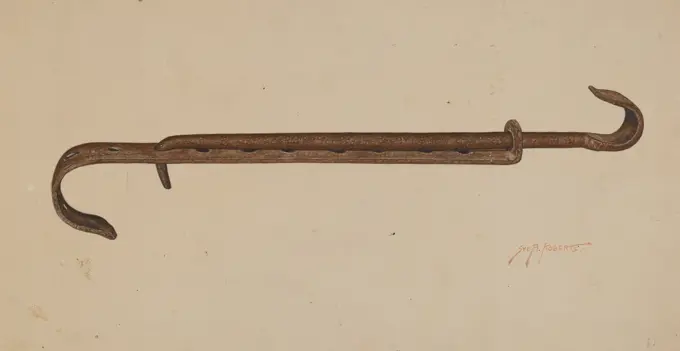
Model of the End of a Gaff, anonymous, 1860 - 1870 demonstration model Model of the peak of a fork with a hole for a disk for a ridge and against the bottom a rail on which oval rings run. The leuvers of the Gaffel sail were beaten in the rings. This interior was for 'curtain sails', which could easily be sought against the mast. Netherlands (possibly) wood (plant material). brass (alloy)
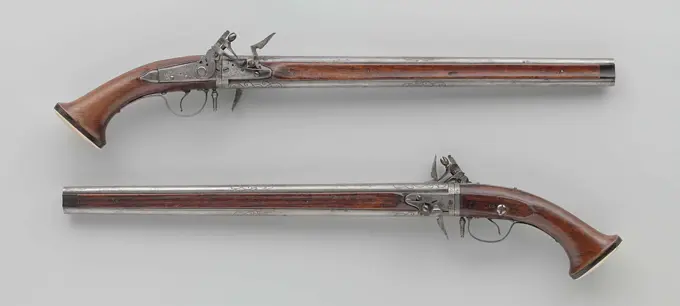
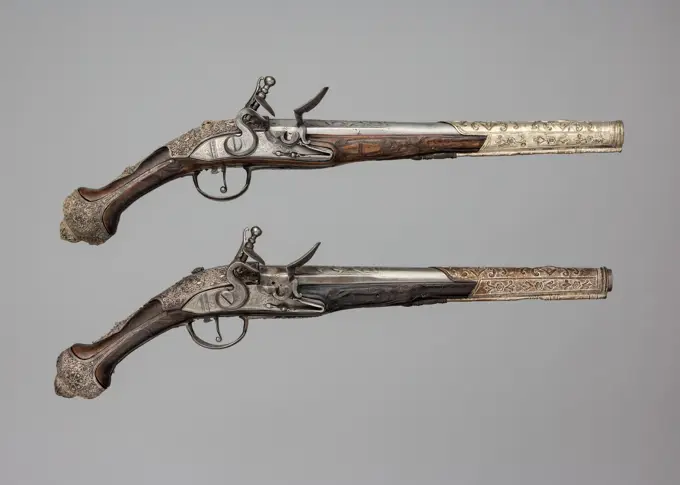
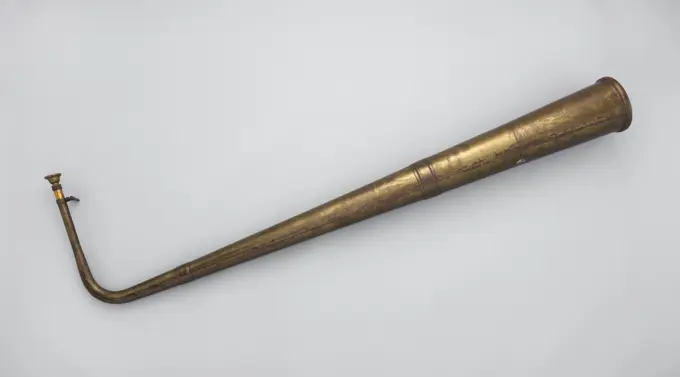
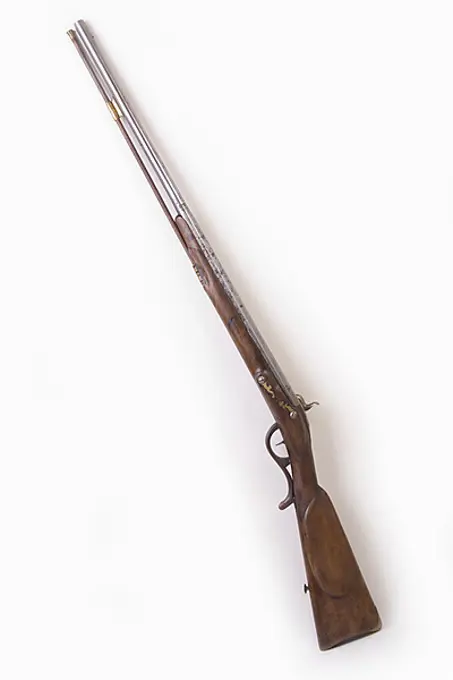
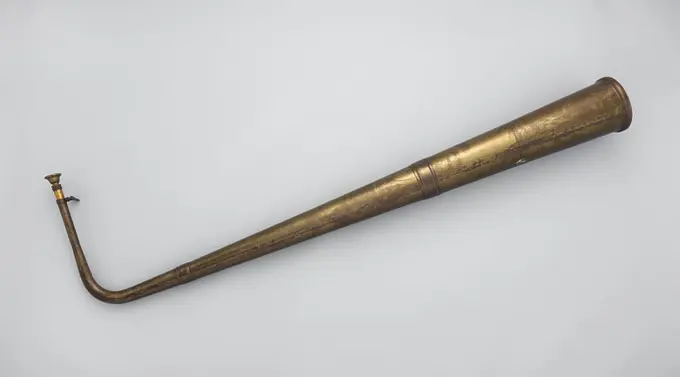
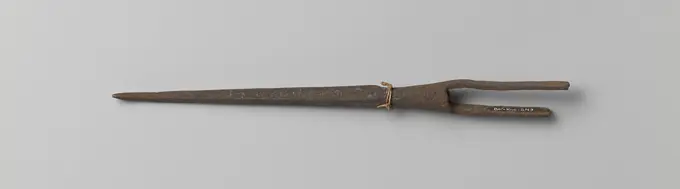
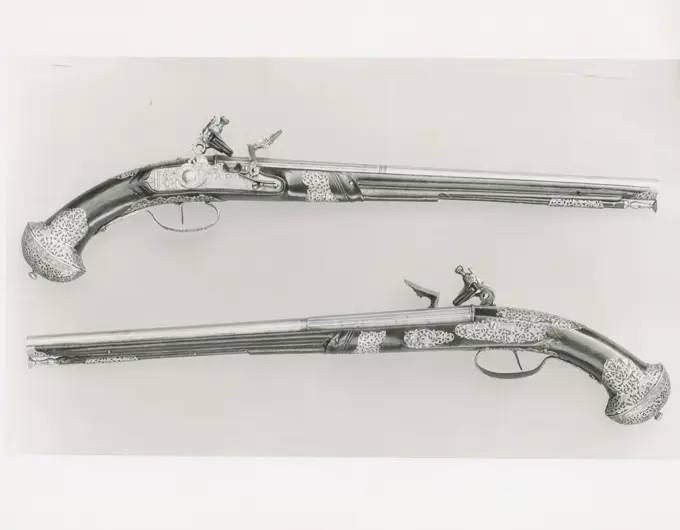
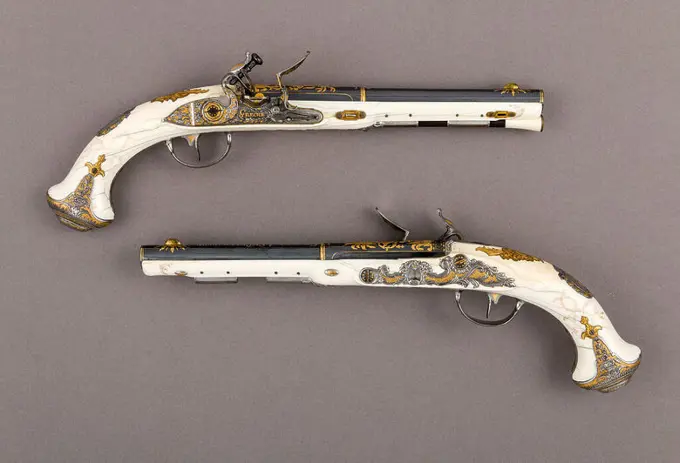
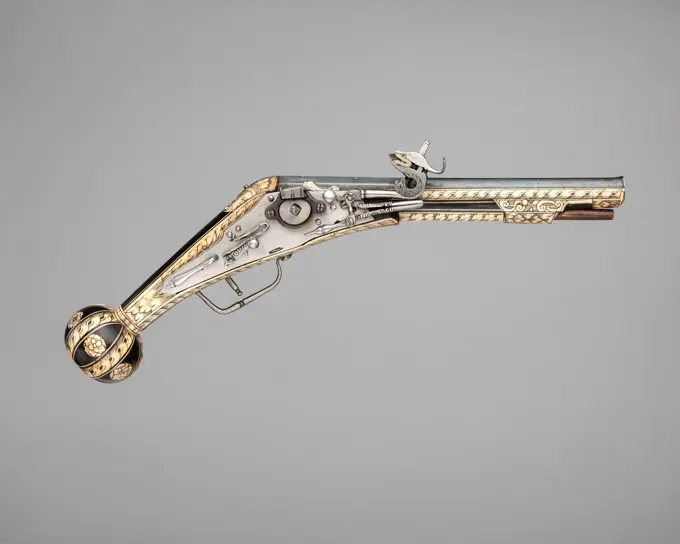
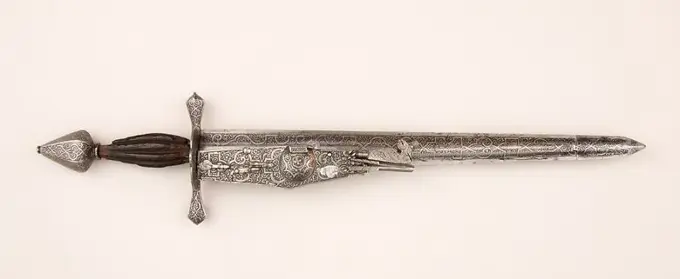
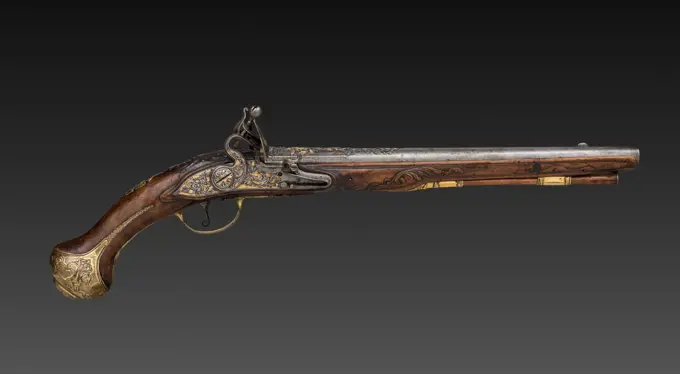
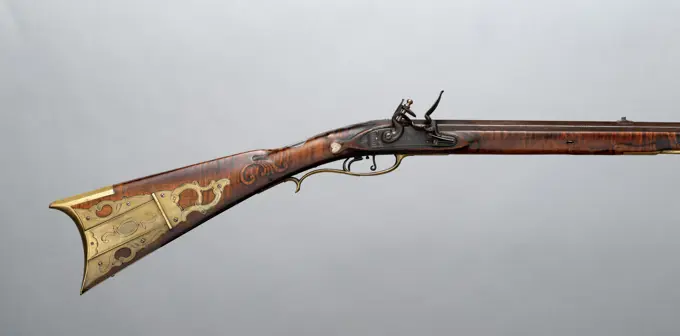
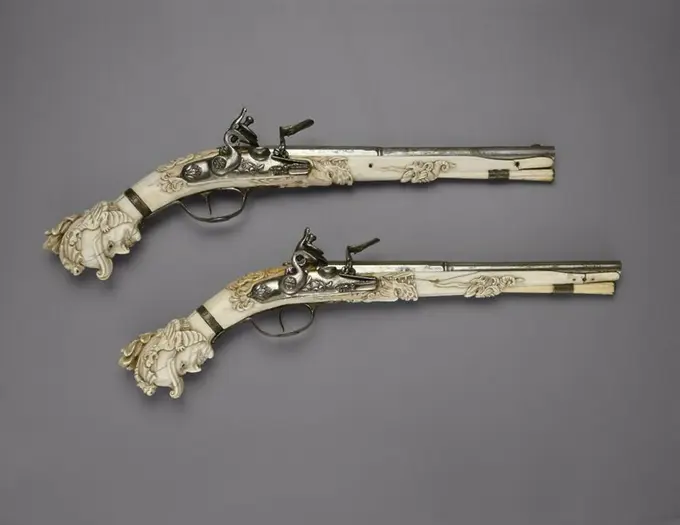
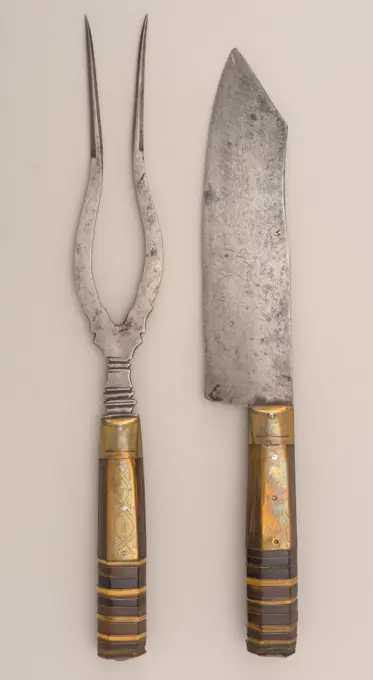
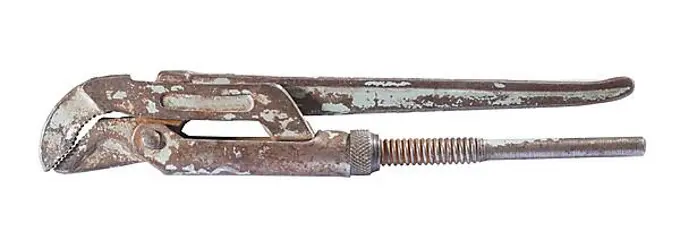
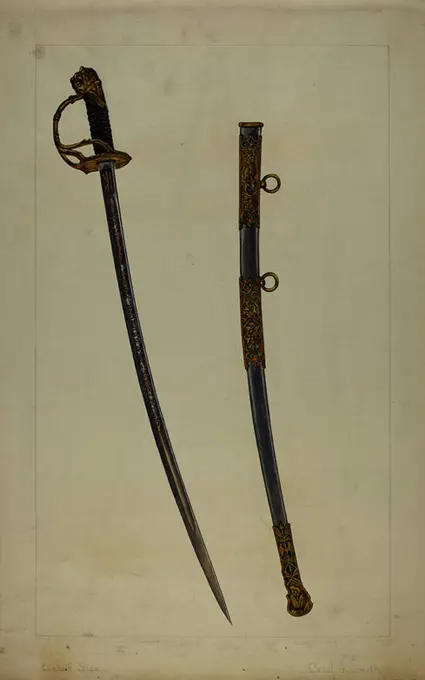
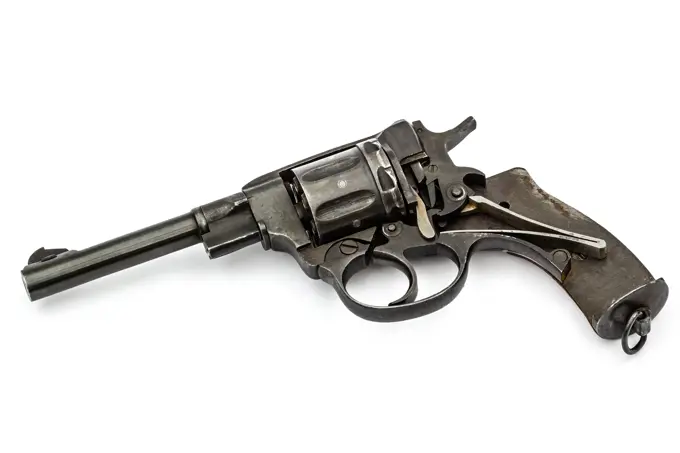
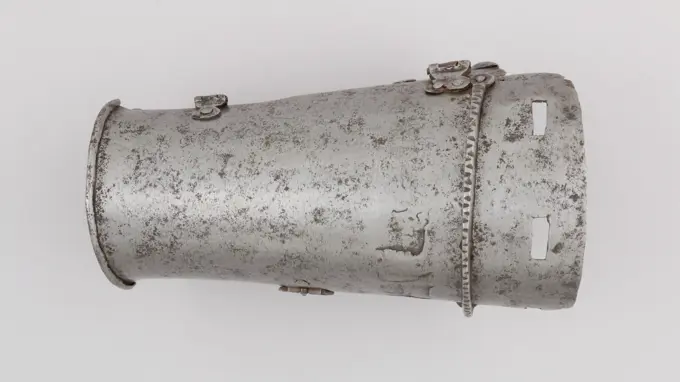
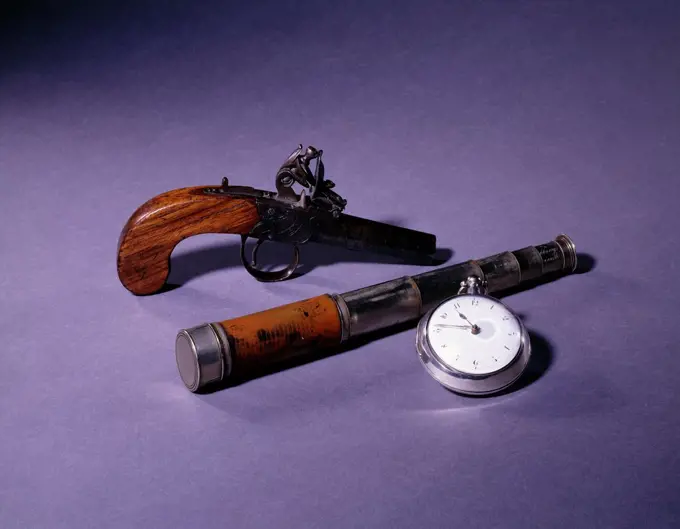
Model of the End of a Gaff, anonymous, 1860 - 1870 demonstration model Model of the peak of a fork with a hole for a disk for a ridge and against the bottom a rail on which oval rings run. The leuvers of the Gaffel sail were beaten in the rings. This interior was for 'curtain sails', which could easily be sought against the mast. Netherlands (possibly) wood (plant material). brass (alloy)Flint gun, Michel Delahaye, c. 1680 flintlock pistol Part of a couple. The lock plate is decorated on the edges with wavy curls in relief; The fire steel is chiseled in relief like a three -leaf; provided with a signature. The round loop has flattened surfaces on the back and a rib on top to the iron visor grain; provided with signature; On top of the tail of the loop is the tieched rearvizier. The flask is easily cut with edges and praise. The iron batter consists of the flask hood and tractor bracket decorated and suite with the lock plate, the flask hood also with a lily, an ajour processed thumb plate and screw plate as a hose with shoots in the form of praise and a dragon head, and two loading stokokers; The chest of drawers has an iron roof. Maastricht iron (metal) engraving / cuttingHeavy musket with a furketMatchlock Gun late 18th-19th century Indian, Rajasthan, possibly Gwalior With its delicately painted stock and distinctive barrel type with an enlarged breech end, this gun was likely manufactured in Rajasthan, in northern India. Intended for the hunt, such richly decorated firearms were made for an aristocratic clientele. A similar example appears in a portrait of the Mughal emperor Shah Jahan (r. 1628-58) from around 1635, indicating that guns of this style remained in fashion for several centuries with very little change.. Matchlock Gun 32138Military flint gun, Frans Delahaye, 1705 - 1710 flintlock pistol Military gun; Part of a couple. The outside of the locking plate carries a signature, the inside is stamped with IG. The course of gilded yellow buyer has a rib on the top, a yellow-held visor grain and a rearvizier consisting of two yellow-copying plates in a V-shaped angle on the tail of the barrel. The flask is simply cut. The gold-plated yellow-lugging fittings with a fitted relief decoration includes a battery screw plate, an unadorned, rectangular thumb plate with rounded top and ends that run into acanthus leaves on the top and top, and a faceted dumping hood with long tracks and decorated with two curls on each flat and a small, octagonal flask cover plate with a point; The loading stick has a yellow cap. Maastricht brass (alloy). gilding (material). iron (metal). wood (plant material). engraving / gilding / cuttingFlight gun. Part of a couple. The slot is decorated with chiseled relief, partly against a granular background and partially covered with selector; The rooster is decorated with a glass head with a tiara-like headdress; The lock plate is engraved with Utrecht and a brand in the form of a crowned heart, and marked on the inside with a H. The loop is stamped behind with the coat of arms of Utrecht and once again with the coat of arms of Utrecht and a crowned heart; In the same way decorated as the lock, where the central motif is a column with two birds; Signed with Penterman; Equipped with a silver vizor grain in the form of a grotesk mask. The flask has been cut with, among other things, praise. The previously gold-plated, selector's fittings with nagicled relief decoration consists of an ajour machined symmetrical screw plate with a mask flanked by griffions, a tractor bracket with relief decoration against a granular background, including a mask, a crowned thumb plate with birds on eMusket.Slot: Lontlot. Slightly bumped, narrow lock plate, from behind with punished bulging, secured with three lock screws. Loop: Round, with a thickening around the trump. Grain of brass. Tray: Inexplied. Two dense brass drawer tires. Flask: Copper flask. Signed: Jan Knoop Utrecht / on lock plate.Four -walking flint turning bag gun, Jan Flock, 1650 - 1655 flintlock pistol Flint pocket gun with four walking. A tulip is engraved on the tail of the lock plate, praise on the rooster; The lock plate is signed. The four round walking must be turned by hand; Hardly soldered to the core and screwed on the back to a round iron plate. The flask consists of a short handle that runs into the flask button, half of which is ivory. The batter consists of an unprocessed tractor bracket that must be pulled back to unblock the turning mechanism; No provision for a chest of drawers. Utrecht wood (plant material). ivory. iron (metal) engraving / solderingDubbelloops vuursteendraailooppistool.Flint gun with rotating walking; Part of a couple. The lock consists of three plates: a back plate with the lock mechanism and the two front plates, each with a pan and a fire steel; De Haan is ajour edited in the form of a cat; The lock is engraved with flour rinks. The two mounted on top of each other are decorated with arabes of instruments in silver; Rushed on the back and in the middle and engraved with the trumps; Included at the bottom of CMIL and small not to be deciphering not to be deciphering, including an F and T. The flask consists of two parts: the grooved veneer, on a side for the loading stick, and the handle that excludes in a flask with an ebony plate decorated at the bottom rotated silver wire, which is covered again by an ivory plate engraved with a flower celk; The venolag is equipped with an ivory hood and easily cut. The batter consists of two silver loading bokeers engraved with crucifixes and an iron trigger bracket decoratPercussion army pistool Model M 1815, Anonymous, c. 1815 - c. 1826  Percussion army pistool Model M 1815. Walk: smooth, round loop, which turns into the room into a five -sided part. A percussion was taken into the top of the room. On the tail piece of the loop: M.1815. Marked in the room: 1816 and pb. Slot: Originally flint battery lock, the brass powder pan is cut off. The lock is marked: 26, s and Kroon on top of each other. (Corrected). Wood: walnut. Seizure. Brass: at the front of the drawer is an openwork tube, which serves to confirm the loop; Tegenlotplaat; tractor bracket; Kolf hood. Netherlands Lads, bat: Walnut (Hardwood). Batting, pan, tractor bracket: brass (alloy). cock, lock plate, walking, tractor: Iron (metal)Vuursteengesweer, Frans Musket Modèle 1777, Royal rifle factory Culemborg, 1807 - 1809 flintlock gun Flint rifle to the French musket Modèle 1777. The lock plate is wearing an inscription with the factory name and is stamped with a crowned L; The NG brand is stamped on the inside. On the tail of the loop is m 1777 and an S on the bottom and a brand that cannot be identified; A bayonethaft is attached under the tromp. The flask is simply cut with, among other things, a six -leaf flower in a circle that is clearly applied with a passer, and an 8; Stamped with a round arsenal brand. The iron batter consists of three sliding runs, one of which is a broke-grain, a J-shaped screw plate and the tractor bracket in two parts with a hard-soldered, yell-up-shaped grain; The loading stick is made of steel. With accompanying bayonet. Culemborg iron (metal). brass (alloy). steel (alloy). wood (plant material) engraving / cutting / solderingWheellock Gun for a Boy Made 1595-1605 Nuremberg. Steel, silver, fruitwood, staghorn, and motherñofñpearl .Flint gun, Cornelis Coster, 1685 - 1692 flintlock pistol Part of a couple. The lock is engraved with leaf vines, animal heads and a signature. The loop is engraved with praise and the same signature on a ripple that runs over the barrel to the yellow -hooded sight grain; Stamped on the back with the Wapen van Utrecht and on the bottom with a brand in the form of a crowned heart. The flask made of carrot nut wood is easily cut. The iron batter includes a screw plate in the form of a wrinkled sea snake, a large, heart -shaped thumb plate with a decorated border and a flask cover plate with a flower on it; The walnut wooden loading stick has an iron roof. Utrecht brass (alloy). iron (metal). wood (plant material) engraving / cuttingVuursteenpistool met afgeplat tromblon.Flight gun with flattened thromblon, round loop that is interrupted by a profile tape after which the loop ends octagonal. Wooden drawer with three iron pins. The lock case is entirely made of iron, fire steel is mounted separately. The flask is made of wood and has an iron kolf cap. The trigger bracket is completely made of iron and has the shape of a gang at the end. Under the drawer a wooden loading stick in an iron loading cupPair of Flintlock Pistols 19th century Possibly Albanian. Pair of Flintlock Pistols. Possibly Albanian. 19th century. Steel, silver, silver wire. Firearms-Pistols-FlintlockFlintlock Pistol, one of a pair, c. 1830, 6 1/4 x 12 3/4 x 2 1/4 in. (15.88 x 32.39 x 5.72 cm), Wood, metal, 19th centuryFlint Gordelpistool, Lambertus Michaelis Thone, 1790 - 1795 flintlock pistol This belt polish was probably from the State fleet; Part of a couple. The lock is the same as that of 173; imitation of the French model 1777; The lock plate carries a signature and is stamped on the inside with an M. The loop is stamped on the back with the weapon of Amsterdam and on the bottom with the letters HH; The sight grain is made of a loader. The flask is simply cut; The recess for the tail of the loop is stamped with a Broad Arrow brand. The yellow -leaking batter consists of a drawer, a loading sticker, an unadorned thumb plate and the tractor bracket; an iron tractor plate and belt hook; The wooden chest of the load is equipped with a yellow cap. Amsterdam brass (alloy). iron (metal). wood (plant material) cuttingOhotniche Rogi sounding E 1873-89 N. N. Federov. Ohotniche Rogi sounding E. Russian. 1873-89. Brass. Moscow, Russia. Aerophone-Lip Vibrated-hornPercussions cap muzzle loader of the 19. th century 15mmFlintlock pistol. Steel, bone, copper alloy; forging, casting, chasing, engraving, inlay, gilding, bluing. Tula, Russia. Ca. 1790. By Ivan Lyalin. The State Hermitage Museum. Saint Petersburg. Russia.Snaphance Pistol. Scottish, Dundee. Date: 1609-1619. Dimensions: L. 43.8 cm (17 1/4 in.) Barrel L. 27.5 cm (11 13/16 in.) Wt. 1 lb. 12 oz.Caliber .39. Brass, steel. Origin: Dundee. Museum: The Chicago Art Institute, Chicago, USA.Spear 18th-19th century Madurese. Spear 30772Wheellock Gun. Culture: German, Dingolfing, Bavaria. Dimensions: L. 41 3/4 in (106 cm); Wt. 8 lb. 14 oz. (4026 g). Date: ca. 1730-40. Museum: Metropolitan Museum of Art, New York, USA.Pair of Flintlock Pistols Made for Ferdinand IV, King of Naples and Sicily (1751-1825) ca. 1768 Royal Arms Manufactory at Torre Annunziata Italian The Royal Arms Factory in Naples was established in 1757 with the significant participation of Spanish gunmakers, who strongly influenced Neopolitan arms production in both technical innovations and artistic style. These magnificent pistols are signed by two leading craftsmen of the factory and appear to have been made for their patron, King Ferdinand IV of Naples and Sicily (1751-1825). What may be portraits of the young king and his queen on the butts of the pistols suggests that they were made to commemorate the royal wedding in 1768.. Pair of Flintlock Pistols Made for Ferdinand IV, King of Naples and Sicily (1751-1825). Italo-Spanish, Naples. ca. 1768. Steel, gold, wood (walnut), silver. Naples. Firearms-PistolsFlight gun. Part of a couple. The lock plate and the rooster are embossed with wavy edges and engraved with prainmesh with a bird, a grotesk mask and around the cockroot with a flower; Equipped with an inscription. The round loop has flattened surfaces, the upper engraved with a signature, which is justified with tendrils that end in snake heads; The tail of the loop is engraved with vary branches and a grotesk mask and continues in the rear part of the loop; Stamped at the bottom with an illegible brand. The flask is easily cut. The iron batter consists of two loading boos, a screw plate in the form of a hose ending in leaves, an incredible trigger bracket with a shoot-shaped end, a crowned, drip-shaped thumb plate engraved with the claw of an eagle, framed by leaf drinks, and the kolf hood engraved with A grotesque mask framed by leaves, with long traces, around a border and suite with the lock plate and below a cap with a button; The loading stick has a hood of Koehoorn.Snaphance Pistol Made 1609-1619 Dundee. Brass, steel .Pair of Flintlock Pistols 18th century Scottish. Pair of Flintlock Pistols. Scottish. 18th century. Steel, silver, brass. Firearms-Pistols-FlintlockFlight gun. Part of a couple. The lock plate is engraved with a laurred head of a young man in an oval and the signature of the maker. The transition between the rear part of the loop, the kulas, and the rest is indicated by rings; There are two thickenings on the Kulas and a deep visoral race over the entire length; The visor grain is from Geelkoper; To the left of the awareness stamped with the coat of arms of Utrecht and no with the crowned heart of 155-a, but with the coat of arms of Utrecht. The flask has been cut with, among other things, praise. The gold-plated, geelkoperen attachment with the embossed relief decoration includes two octagonal loaders, a trigger bracket with borders of leaves, a symmetrical screw plate from AJOUR processed leaf drinks with dragon heads at the ends on either side of a mask, an ornamental dumper framed by edges and praise with a Mask at the bottom, and a kolf hood on both sides engraved with acanthus leaves in a triangle and below a mask on an octaOhotniche Rogi sounding E. Culture: Russian. Dimensions: Length 1438 mm (perpendicular to bell), Diameter of bell 147 mm. Maker: N. N. Federov. Date: 1873-89. Museum: Metropolitan Museum of Art, New York, USA.Speerpunt.Spearhead of iron, soil find.Vuursteenjachtgeweer.The lock is equipped with a fire trail in the form of a dolphin; embossed with leaf drinks and the screw of the rooster chiseled as a mask; The lock plate is chiseled with a mask with leaves on the tail and engraved with a signature. The loop is chiseled with praise around a classic warrior; On top of it runs a rib with an inscription; Stamped with the coat of arms of Utrecht. The root nutshell flask has been cut with, among other things, praise. The iron fittings, apart from the four partially faceted loading bokekokers, is embossed with figures, and consists of the tractor bracket, an ajour processed screw plate in the form of, among other things, a classical warrior, getting trophies and praise, an ajour processed, award-winning thumb plate with A small, unprocessed central shield flanked by naked carriers with leaves, and a flask with a classic warrior and prainmade; The loading stick has a hood of Koehoorn.Four -walking flint turning bag gun, Cornelis Coster, c. 1660 - c. 1670 flintlock pistol Flint pocket gun with four walking; Part of a couple. The long lock plate is engraved with praise and signed; The fire sample is chiseled at the bottom. The four rotating walks are held together by an iron ring at the tromp; There is a yellow cylinder behind the mounting plate. The flask consists of only a short handle whose flask button is covered with ajour, after -fried silver praise, partly against a background of brass tin, including a grotesque mask on top of the handle. The batter consists of an iron tractor bracket that has to be pulled back to unblock the turning mechanism and a silver screw plate, ajour processed and complained with leaf vines with a deer against a background of brass tin; The loading stick is formed by two steel feathers in a recess between walking. Utrecht iron (metal). brass (alloy). silver (metal). brass (alloy). steel (alloy) engravingPair of Flintlock Pistols ca. 1650-60 Girolamo Francino Italian The Francino gunsmiths of Brescia and Gardone were celebrated. The superiority of Brescian barrels was long recognized. Aside from embellishment, they were sought for the quality of their metal, which was light in weight yet strong. The delicately pierced steel ornament inlaid to be flush with the surface of the stock is a characteristic design feature of Brescian firearms of this period.. Pair of Flintlock Pistols. Italian, Brescia. ca. 1650-60. Steel, wood (walnut). Brescia. Firearms-Pistols-FlintlockPair of wheellock pistols.These firearms are typically Dutch in that they are functional, slender and sober, yet elegant in design. The rounded lockplates are characteristic of Dutch wheellocks. This early manifestation of Dutch design’ was valued far outside the Netherlands during the 17th century. These two wheellock pistols found their way to Germany, where they were owned by the Counts of Salm-Reifferscheidt- Dyck at Schloss Dyck in Westphalia.Pair of Flintlock Pistols of Empress Catherine the Great (1729-1796). Culture: Russian, Saint Petersburg. Dimensions: L. of each 14 1/2 in. (36.8 cm). Gunsmith: Johan Adolph Grecke (Russian, Saint Petersburg, recorded 1755-90). Date: 1786.These pistols are part of a deluxe garniture of ivory-stocked hunting arms made for Empress Catherine the Great (reigned 1762-96), whose intial (E for Ekaterine) is on the escutcheons of the grips. The garniture, which originally consisted of these pistols, a fowling piece dated 1786 (National Museum, Warsaw), and a rifle (whereabouts unknown), was later given to her favorite, Prince Stanislas August Poniatowski (1732-1798), whom she backed as king of Poland (reigned 1763-95). Firearms with ivory stocks, generally out of fashion in western Europe by the eighteenth century, were in vogue in the ostentatious Russian court during the last quarter of the century. Museum: Metropolitan Museum of Art, New York, USA.Wheellock Pistol ca. 1570-80 German, Augsburg The blued barrel is in two stages, round at the front with a flaring muzzle, octagonal at the breech, and it is ornamented with chiseled roping, stamped crescents, and circles. It bears two marks; a hunting horn in a shield, the gunmaker's mark (similary to Støckel 5223), and a pine cone, the control mark of the city of Augsburg. The wheellock has a spring-closed pan cover with release button, and safety catch. The cock is chiseled with a stylized dragon.The ebonized stock is inlaid with staghorn engraved with stylized foliage and geometric patterns, and with a lion's mask on the forestock, two crowned female heads on the grip, and two grotesque dragons with devil's faces on the left side. The incisions were blackened to make the design stand out.After the automatic-ignition mechanism--the wheellock--was devised around 1500, it was first applied to firearms used on horseback. In fact the appearance of pistols--weapons handled with one hand-Pair of Wheellock Pistols. A. Drechsler; German, Dresden. Date: 1577. Dimensions: L. 62 cm (24 3/8 in.). Steel. Origin: Dresden. Museum: The Chicago Art Institute, Chicago, USA.FIIntlock cavalry pistol, model 1809 Fabryka Broni in Tule ( )Combination Dagger and Wheellock Pistol. Culture: German, possibly Saxony. Dimensions: L. 18 15/16 in. (48.1 cm); L. of blade 13 13/16 in. (35.1 cm); L. of blade (without tip) 11 11/16 in. (29.7 cm); L. of quillons 4 1/4 in. (10.8 cm); Cal.29 in. (7.4 mm); Wt. 1 lb. 11 oz. (765.4 g). Date: ca. 1575-1600.Combination weapons usually were made as technical novelties and showpieces and therefore, often are highly decorated. The finely etched strapwork pattern on this example also is found on the best German firearms, edged weapons, and armor of the late sixteenth century. Before firing this dagger-pistol, the tip of the blade had to be removed, revealing the muzzle of the gun barrel. Museum: Metropolitan Museum of Art, New York, USA.Musketmaat, complete with leather sleeve and rope, anonymous, c. 1590 - c. 1596  Musket size, complete with leather sleeve and rope.  brass (alloy). leather striking (metalworking)  Nova Zembla. Saving HuysFlintlock Pistol (2 of 2), early 1700s. Franco-Flemish, Liège, early 18th Century. Steel with gold inlay, gilt-brass mounts; walnut burl stock; chiseled high-relief decoration; overall: 49.5 cm (19 1/2 in.); barrel: 32.1 cm (12 5/8 in.); bore: 1.5 cm (9/16 in.). The barrel of this pistol is signed G. MASSIN, a gunsmith apparently working in eastern France or French-speaking Flanders, possibly the city of Liège. The exquisite ornament along the breech of the barrel is chiseled and engraved. The gilded lock-plate and mounts may be compared to the finest contemporary work in other media, such as furniture with ormolu mounts.PISTOLA CARABINA BOORGHARDT DE 7,65 mm. Y SU CARGADOR DE CARTUCHOS DESMONTADO. Location: ALCAZAR / MUSEO DEL EJERCITO-COLECCIÓN. Toledo. SPAIN.Wager cup in the shape of a cannon, anonymous, 1589 Stone cup (drinking) of stoneware in the form of a cannon or cart rope. Partly covered with cobalt blue. At the rear of the cannon the inscription 'Iersvs Christvs' and the date '1589'. The grape with decorative tires. Raeren. Rae stoneware. glaze. cobalt (mineral) vitrification Stone cup (drinking) of stoneware in the form of a cannon or cart rope. Partly covered with cobalt blue. At the rear of the cannon the inscription 'Iersvs Christvs' and the date '1589'. The grape with decorative tires. Raeren. Rae stoneware. glaze. cobalt (mineral) vitrificationOld signal pistol, flare gun with the hammer cocked, isolated on white Old signal pistol, flare gun with the hammer cocked, isolated on white background Copyright: xZoonar.com/OleksandrxKostiuchenkox 8897069Flintlock Longrifle ca. 1815-1825 David Cooley David Cooley's rifles have an uncluttered appearance and feature crisp, high relief carving, fine engraving, and elegant overall architecture. This is perhaps the most refined of his few surviving works. He was strongly influenced by his proximity to two important schools of gunmaking: the Emmitsburg School, to the south in Maryland, and the Chambersburg School, to the west in Franklin County.. Flintlock Longrifle. American, Heidlersburg, Tyrone Township, Adams County, Pennsylvania. ca. 1815-1825. Wood (curly maple, ash), steel, silver, brass. Heidlersburg, Pennsylvania. Firearms-Guns-FlintlockPair of Flintlock Pistols. Dutch, Maastricht. Date: 1655-1670. Dimensions: L. 45.6 cm (17 15/16 in.). Steel, silver, ivory, ebony, leather, and flint. Origin: Maastricht. Museum: The Chicago Art Institute, Chicago, USA.Flint rifle with battery lock, Anonymous, 1599 - 1799 flintlock gun Flint rifle with battery lock; octagonal drawn run with inlaid brass brand plate with letters: ibjs; elongated brass visor grain; On the front part of room a visorkeep that ends in leaf motif; round lock plate; with pan saddle; Behind the rooster a safety pins; flat pandicel for which assessment surface with bolt attached; tractor palm moving horizontally; Nutenhouten French flask with carved leaf motifs; On the left flask, image of mask with inserted eyes; Golf slide with star shape in wood and leg and two plates with engraved images of flour, bird and flower vines; iron fittings; Three profiled chest of drawers; counter -strike in the form of volute; precision tractor; tractor bracket with three bulges; An oval smooth iron plate on the left. Europe loop, slot: iron (metal). lade, kolf: wood (plant material)Kruithoorn, Bullet Gietstang, Bus, Laadstok, Cleaning Stick, Hamer, Screwdriver et al., Jean Le Page, 1808 Powder Horn. Bullet mold. framework. hammer Accessories consisting of: Kruithoorn of brass and polished horn; bullet molding; for oil van; Extendable measure for ignition chick; Pokhout cargo; ditto cleaning stick; Hammer and screwdriver. Furthermore, two storage rooms for cast bullets, cleaning brush, flax etc. On the red leather of the box there are several wax stamps. Belongs to Casette and couple of pistols. Paris brass (alloy). leatherBlade and Mounting for a Sword (Katana) blade, 17th century; mounting, 19th century Japanese A katana is a sword with a curved blade longer than 60 cm fitted with an uchigatana-style mounting and worn in a waist sash with the cutting edge facing up.. Blade and Mounting for a Sword (Katana). Japanese. blade, 17th century; mounting, 19th century. Steel, wood, silder iron, copper-silver alloy (shibuichi), copper-gold alloy (shakud), copper, gold. Tokyo. SwordsTarget gun used by the Guild of Arquebusiers in Amsterdam, Jacobus Jaspers (attributed to), 1675 - 1699  Target gun or goal rudder. The yellow -cut lock shows traces of the past gilt; The final plate is trimmed with copper; The pan is based on a base in the form of a sea shell. The loop is ribbed and grooved on the back; The square tromp has the shape of a Corinthian column; The visor and grain are made of a loader. The flask is inlaid with mother -of -pearl and cut into relief with praise, snakes and dolphins; The support bobbin for the tractor bracket ends in a bird claw around a ball flattened at the bottom. Apart from the cheat of choremum, the batter from previously gilded yellow buyer is and consists of a screw plate engraved with a name, and a flask with a track over the entire grip; The chest of drawers has an iron roof. Amsterdam wood (plant material). brass (alloy). gilding (material). copper (metal). mother of pearl. horn (animal material). iron (metal) gilding / inlay (procSpear 18th-19th century Sri Lankan. Spear 30749Sydney Roberts, Fireplace Tool, c 1940 Fireplace ToolFlint gun, Lambertus Michaelis Thone, 1780 flintlock pistol Part of a couple. The lock plate carries a signature. The barrel is decorated with Arabesken, the coat of arms of the Van Hees van Berkel family and two small engravings, one of which is stolen in gold; Stamped on the left with the weapon of Amsterdam and at the bottom with an indefinable stamp and IR; The grain is made of silver. The flask is cut in high relief with praise and inlaid with silver thread. In addition to the loading sticker, the silver batter is engraved and consists of a drawer tape, the driven and fitted screw plate with a medaljon with a flower challenge, the tractor bracket with decorated thumb plate, the flask with a martial trophy, the cob cover plate with a flower chalice and the loading With a silver hood. Amsterdam wood (plant material). silver (metal). silver thread. gold (metal) cutting / striking (metalworking) / engraving / inlay (process)Moroccan knife Koummya with the vaginaSacrificial Axe. Culture: Indian or Nepalese. Dimensions: H. 24 in. (61 cm); W. 6 3/4 in. (17.1 cm); Wt. 2 lb. 13.8 oz. (1298.4 g). Date: 18th-19th century. Museum: Metropolitan Museum of Art, New York, USA.Flint pocket gun with battery lock, anonymous, c. 1825 - c. 1850 flintlock pistol Flint pocket gun with battery lock and a round, screw -on course of white steel, with an elevated narrow strap on the rear part, which serves to support the key with which the loop is taught. The room is vebonds with a square part, which contains the lock mechanism. On the left side of the room is the brand: X, LG and E above each other. (Test brand from Liège). Slot: battery lock, the lock mechanism is stored in the square part behind the room (English: box-lock). De Haan, Pan and Pandeksel with stop surface are located in the middle of the top. The tractor can be turned in such a way that it is the same with the bottom of the lock cupboard. When tensioning the rooster, the tractor turns outside again. The sides of the lock cupboard are engraved with leaf and floral motifs reduced to geometric shapes, a rank motif at the bottom. Behind the rooster is a sliding pen, which, pushed over the back of the roosHolster gun with flint lock by Jonkheer H.D. Hooft van Woudenberg and Geerestein, in or before 1831 flintlock pistol Holster gun with flint lock, part of couple. Octagonal run. Vizier grain and iron roof. Flat lock plate. Two bronze side plates. Bronze batter with edited handle. Iron cheststick. Walk finely pulled. Pistool of Jonkheer H.D. Hooft van Woudenberg and Geerestein, former Lieutenant of the Amsterdam militia on horseback, 1831. West-Europa Loop, lock plate, Haan: Iron (Metal). Kolf hood, tractor bracket: Bronze (Metal). Drawer, Kolf: Wood (Plant Material) cutting  AmsterdamDouble-Barreled Side-by-Side Tube-Lock Shotgun with Case ca. 1819-20 Joseph Manton Joseph Manton, one of the most influential and esteemed gunmakers in London in the late 18th -early 19th century, patented the tube-lock mechanism in 1818 (patent no. 4285). London gunmakers invented dozens of new percussion technologies in the first half of the 19th century, but the tube-lock was one of the few that was widely adopted. This shotgun is a typical example of the type made by the technologys inventor.. Double-Barreled Side-by-Side Tube-Lock Shotgun with Case. British, London. ca. 1819-20. Steel, wood (walnut, mahogany), horn, brass, silver. London. Firearms-GunsPair of Flintlock Pistols of the Prince of Wales, later George IV (1762-1830) hallmarked for 1793-94 Durs Egg British firearms made for the Prince of Wales usually feature his distinctive crest, three ostrich feathers and a royal coronet, and motto, ICH DIEN (I serve), inlaid in gold or silver on the stock. Decorated with engraved silver mounts, these royal pistols have a small piece of lead embedded inside the grip, added by Egg as a counterbalance to the barrel and to give the firearm heft. The long, flat trigger guard with a bar at the front end is a regular characteristic of Durs Eggs work and is a typical feature of contemporary French firearms.. Pair of Flintlock Pistols of the Prince of Wales, later George IV (1762-1830). British, London. hallmarked for 1793-94. Steel, wood (walnut, rosewood), silver, gold, horn, lead. London. Firearms-Pistols-FlintlockCarabinieri pistol, model 1814, Piedmontese armyDouble-Barrel Breech-Loading Pinfire Shotgun dated 1866 J. C. A. Brun French The Second Empire (1852-70) marked the twilight of French gunmaking, which had dominated the design of European firearms since the period of Louis XIV. Parisian gunmakers consistently employed the finest contemporary designers, silversmiths, sculptors, and engravers to transform functional hunting and target weapons into works of art. This exquisitely decorated shotgun reflects the period's predilection for historical revivals--in this case, the style of Louix XV. Especially noteworthy is the harmonious combination of Rococo ornamental vocabulary and blue-and-gold coloring, which together evoke eighteenth-century taste. Exhibited by Brun at the Exposition Universelle of 1867, the gun is actually a collaborative work by several of the leading artists and craftsmen of the time: the damascus twist barrels are by Léopold Bernard; the overall design and the intricately chiseled steel mounts are by the goldsmiths FrFlint rifle for State Army, Lambertus Michaelis Thone, c. 1795 - c. 1806 flintlock gun Flint rifle for the State army; Identical to the French model 1777. The final plate bears a signature and is stamped on the inside with 411. The Wapen van Amsterdam is stamped on the barrel; There is a bayonethaft under the tromp. The flask is simply cut and stamped with 81403 and 1403. The yellow-copying batter includes four-sliding running loops according to Austrian model, the first of which is stamped with N10, a bacon-shaped screw plate, an unprocessed thumb plate and a flask with a track W.L.I. Fund is marked; The loading stick is made of steel. With accompanying bayonet. Amsterdam brass (alloy). wood (plant material). steel (alloy) cutting / engravingSignal pistol wz. 1894 Hebel Factory productPowder tester, anonymous, c. 1775 - c. 1800  Flint crawl tester or powder tasting; Wheel type mounted on a gun pump. The final plate is engraved with praise and Mastrich. The flask is simply cut with curls behind the barrel. The iron fittings are partly chiseled and engraved in relief, and consists of, among other things, an ajour processed screw plate in the form of a hose with praise in a bust, a heart -shaped thumb plate with an extension on the underside, and a pump hood engraved with praise; A large U-shaped twopoot supports the frontade. The iron test mechanism has a round valve resting on a vertical chimney and attached to a round plate largely with saw teeth, on which a division into surfaces of 0 to 40 is engraved. Maastricht wood (plant material). iron (metal) engraving / cutting  MaastrichtRadslotpistool.Part of a couple. The inner rad of the slot is engraved with panels with grotesque animals, human figures and prainmeshoe; The pan must be operated by hand. The loop is engraved on the back of praise; The stamp GI of 89-B is missing. The ebony flask with grooved vain sauce, is sliced in high relief with the head of a sample for the lock and an acanthus leaf behind the loop. The batter shall consist of an iron loading stove engraved with praise, a silver tractor bracket embossed decorated with Judith who holds the head of holofernes, a kolf hood of gold-plated, cast selector in high relief with a rider in classical outfit and with a radlot gun in the right hand on a scenting horse above a reported enemy; The ebony loading stick is equipped with an iron hood.Rifle. Dated: 1938. Dimensions: overall: 30.4 x 41.6 cm (11 15/16 x 16 3/8 in.). Medium: watercolor, graphite, and colored pencil on paper. Museum: National Gallery of Art, Washington DC. Author: Charles Moss.Werndl gun 1867Oboe.Hobo of ebony, mounted with ivory. The three silver valves are rich engraved with musical figures. Signature: H. Directors.Does not SquadDouble-shift fire trailure gun. On the lock, flower drinks and a signature are. Both run are marked below. The batter includes the tractor bracket with the drainy locking poll assembled in the bracket on which a cross flower is engraved.Combination Flintlock Pistol and Concealed Dagger ca. 1690 Probably by Matteo Cecchi, called Acquafresca This dagger-pistol, remarkable for its delicately chiseled and engraved steel mounts, elegant wire inlay, gracefully modeled stock, and novel design in which the blade is concealed within the stock, counts among the finest Italian combination weapons of the late seventeenth century. It was made by Matteo Cecchi, called Acquafresca (1651-1738) ca. 1690, the most gifted member of the famed Acquafresca family of gunmakers.The Acquafresca family resided and worked in the mountain village of Bargi, located in the Tosco-Emilian Apennines between Florence and Bologna, over two-hundred kilometers from Brescia, where many of Italys most talented gunmakers concentrated for over two centuries. Despite their remote location, the Acquafresca gained the patronage of wealthy aristocratic families and the Medici court in Florence, earning reputations as the finest gunmakers in Italy. Sebastiano AcPistol with a rock castleRadslotpistool, Eat Kitzen, 1640 - 1650  Part of a couple. The lock is equipped with an outside wheel marked with an inverted S. The round loop has a narrow rib on the top, flanked on the back by two shorter; The tail of the loop is engraved with the number 11 or II and 19; Stamped on both sides of the rib with I and K and a brand that is not to be ignited, on the bottom with a brand in the shape of a circle and pen. The ebony flask has a grooved frontade and a flattened surface on the side opposite the lock; There are no screw plates for the lock bolts. Apart from the loop -shaped iron tractor bracket, the batter of silver, engraved with large cross flowers, and consists of the chest of drawers, two loading stokikers and the flask hood, the edge of which is engraved with a keper motif; The ebbenhoute loading stick is equipped with a silver cap decorated and suite with the drawer hood. Maastricht ebony (wood). iron (metal). silver (metal) engraving / cuttingWooden handle with decoration of fish and shells; wooden sheath decorated with carving; Kozuka, Anonymous, 1500 - 1900  Japan metal. wood (plant material). mother of pearl  Japan metal. wood (plant material). mother of pearlRadslotpistool, anonymous, 1645 - 1650  Part of a couple. The outer wheel has a hook on the underside; The pandel is opened with a pressure pen. The barrel is completely stamped around and on top with an unable brand. The flask of gust of walnut wood has a flask of ivory, engraved with stylized praise and with a gilded metal button in the middle; The flower -shaped screw plates for the three lock bolts are made of cow horn. Apart from the loop -shaped tractor bracket of gilded yellow buyer, the batter from previously gilded silver and engraved with praise; consisting of the chap, a loading stick and a tire around the flask button; The cheat of gushed walnut wood is equipped with an ivory roof. Maastricht walnut (hardwood). ivory. gilding (material). metal. horn (animal material). silver (metal). brass (alloy) gilding / engravingZakpistool met percussieslot, 1814 - 1866  Pocket gun with percussion slot, part of torque, iron with wood, octagonal iron loop with wooden flask whose iron hood is made of iron with engraved praise. The lock is built into the gun. The rooster is made of iron and is engraved on the side with some praise. Bracket is engraved with praise on the bottom. Iron visor grain. At the top of the course of the name of the manufacturer Invon Delvigne. West-Europa Haan, walk, tractor, bracket: Iron (metal). Kolf: Wood (Plant Material) engraving  NetherlandsMatchlock Gun. Culture: Indian, Rajasthan or Lahore. Dimensions: L. 61 5/8 in. (156.4 cm); L. of barrel 42 7/8 in. (108.8 cm); Cal.44 in. (11.0 mm); Wt. 8 lb. (3631 g). Date: late 18th-early 19th century.Firearms were used in India starting in the fifteenth century and the matchlock remained the preferred firearms mechanism until about 1830. This sporting gun is distinctive for its delicately painted stock covered with hunting scenes, birds and other animals, and landscapes. The gold-damascened barrel is a masterpiece of forging, having both a square cross section and a square bore. It is signed by the smith Haji Sha'ban, who signed two other barrels on guns captured by the British at Lahore, in northwest India (now Pakistan), in the nineteenth century. Museum: Metropolitan Museum of Art, New York, USA.Sheath for a Kris 18th-19th century Philippine. Sheath for a Kris. Philippine. 18th-19th century. Wood, cane (rattan). KrissesVintage bellows isolated with clipping path included Pair of Wheellock Pistols ca. 1590 German, Nuremberg After the wheellock ignition mechanism was devised around 1500, it was first applied to firearms used on horseback. In fact the appearance of pistols--weapons handled with one hand--was due to the invention of the wheellock, and by the middle of the sixteenth century they became part of the equipment of middle and light cavalry, not just weapons available exclusively to men of high rank as had initially been the case. Since an ordinary pistol could deliver only one shot and had to be reloaded to fire the next round, pistols were commonly made in pairs and carried in leather holsters, one on each side of the saddle. A large pommel, often ball-shaped, on the pistol grip made it easier to retrieve from the holster and also helped to conterbalance a heavy barrel.. Pair of Wheellock Pistols. German, Nuremberg. ca. 1590. Steel, wood, ivory. Nuremberg. Firearms-Pistols-WheellockClose-up of two antique handgunsFork (Germany); steel, brass, horn, bone; L x W: 32.3 x 4.5 cm (12 11/16 x 1 3/4 in.); The Robert L. Metzenberg Collection, gift of Eleanor L. Metzenberg; 1985-103-10Old pipe wrench insulatedScissors. Turkey, Ottoman, 18th-19th century. Metal. Gilt steel and brassDagger (Kindjal) with Sheath. Culture: Caucasian. Dimensions: L. with sheath 24 1/2 in. (62.2 cm); L. without sheath 24 1/4 in. (61.6 cm); L. of blade 18 1/4 in. (46.4 cm); W. 2 1/2 in. (6.4 cm); Wt. 1 lb. 2.3 oz. (519 g); Wt. of sheath 5 oz. (141.7 g). Date: 18th-19th century. Museum: Metropolitan Museum of Art, New York, USA.Knife (Dha) with Sheath 18th-19th century Thai. Knife (Dha) with Sheath 31608Silversmith's art, 16th century. Silver cutlery set for game.PISTOLA DE RUEDA S XVI FABRICADA EN NUREMBERG. Location: MUSEO LAZARO GALDIANO-COLECCION. MADRID. SPANIEN.Spear with Detachable Knife Head 18th-19th century Indian. Spear with Detachable Knife Head. Indian. 18th-19th century. Steel, wood (pepper reed), silver, velvet. Shafted WeaponsColt Model 1851 Navy Revolver with Thuer Conversion for Self-Contained Cartridges, Serial no. 27060. Culture: American, Hartford, Connecticut. Dimensions: L. 13 in. (33.02 cm); L. of barrel 7 1/2 in. (19.05 cm); Cal.36 in. (9 mm). Manufacturer: Samuel Colt (American, Hartford, Connecticut 1814-1862). Date: 1853; converted for cartidges, ca. 1868-71. Museum: Metropolitan Museum of Art, New York, USA.From tweezers to the first syringe. Al-Zahrawi's at-Tasrif contains descriptions and illustrations of about 200 surgical instruments. One is a fine tube of silver or ivory with a plunger. This constitutes the first documented syringe.Knife with a sheathSword and Sheath. Dated: c. 1938. Dimensions: overall: 55.9 x 35.5 cm (22 x 14 in.) Original IAD Object: 37" long. Medium: watercolor, graphite, and pen and ink on paper. Museum: National Gallery of Art, Washington DC. Author: Cecil Smith.Disassembled revolver, pistol mechanism, isolated on white background Disassembled revolver, pistol mechanism, isolated on white background Copyright: xZoonar.com/OleksandrxKostiuchenkox 8905638Pocket gun with flint lock, c. 1799 - c. 1899 flintlock pistol Pocket gun with flint lock, part of couple. All of iron. Walking stretches. Slotplaat Both sides marked: 'London'. London whole: Iron (metal) engraving  NetherlandsForearm Defense (Vambrace) ca. 1450-70 Italian This is part of a large find of medieval armor discovered in 1840 in the ruins of the fortress of Chalcis, on the Greek island of Euboea (then a Venetian colony called Negroponte). The fortress had been captured and destroyed by the Turks in 1470. Now divided largely between the Ethnological Museum, Athens, and The Metropolitan Museum of Art, the Chalcis hoard contains many rare and unusual elements of fourteenth- and fifteenth-century armor. Of particular importance are the variety of headpieces and the many fragments of brigandines (armor for the torso constructed of small plates riveted to layers of fabric), some of which retain portions of their original velvet covering. The Chalcis armor provides a unique picture of the armament used in the Aegean, one of the easternmost military outposts of the Venetian empire.. Forearm Defense (Vambrace) 662438Nipple wrench -Sword with Scabbard 18th-19th century Dyak. Sword with Scabbard. Dyak. 18th-19th century. Wood, lead. SwordsA pocket telescope by George Stebbing, Plymouth, a silver pair case Pocket Watch by JNO Williams, London, no 58927, hallmark London 1802, and a box-lock pocket pistol signed by J. Smith, London. All said to have belonged to William Bligh of the HMS Bounty.