Historical Footwear Collection

An assortment of vintage shoes including ballet flats, oxfords, and slippers from various eras, showcasing unique materials and designs, demonstrating the evolution of footwear.
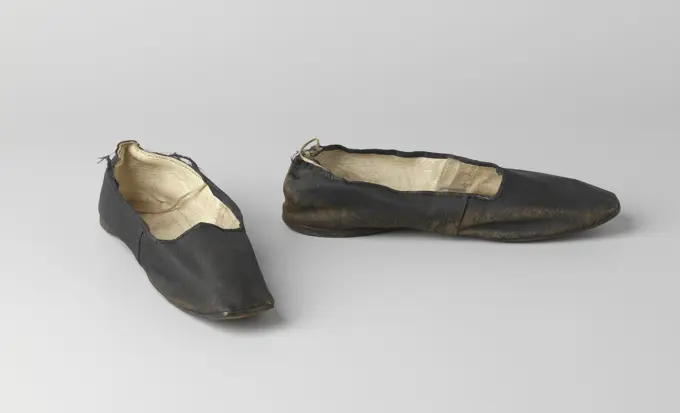
Shoe made of black cotton with small wedge heel, c. 1820 - c. 1840 Shoe made of black cotton. No right/left difference. Built -in heel of one layer of leather. Pointed forefoot. Square nose. Tire closure in a silk omboard. North Netherlands whole: Cotton (textile). Sole: Leather Shoe made of black cotton. No right/left difference. Built -in heel of one layer of leather. Pointed forefoot. Square nose. Tire closure in a silk omboard. North Netherlands whole: Cotton (textile). Sole: Leather
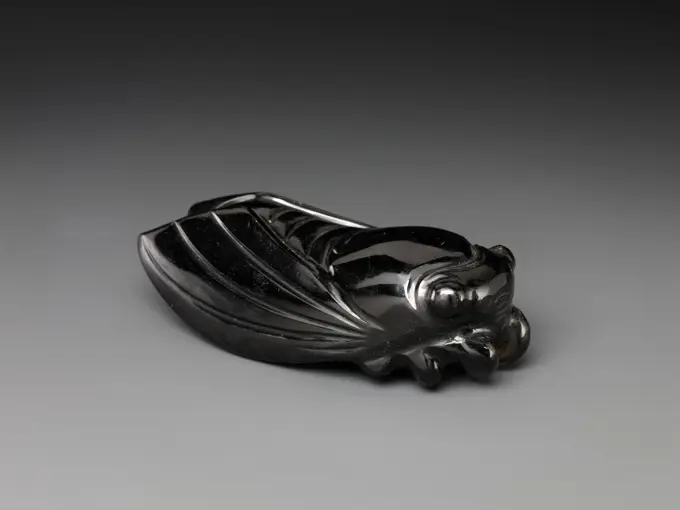
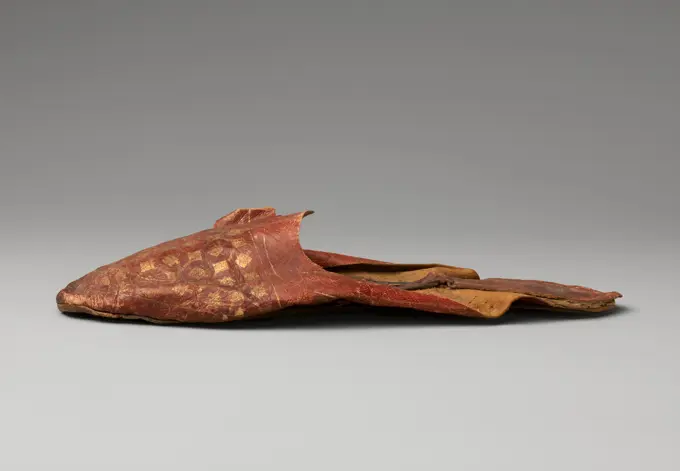
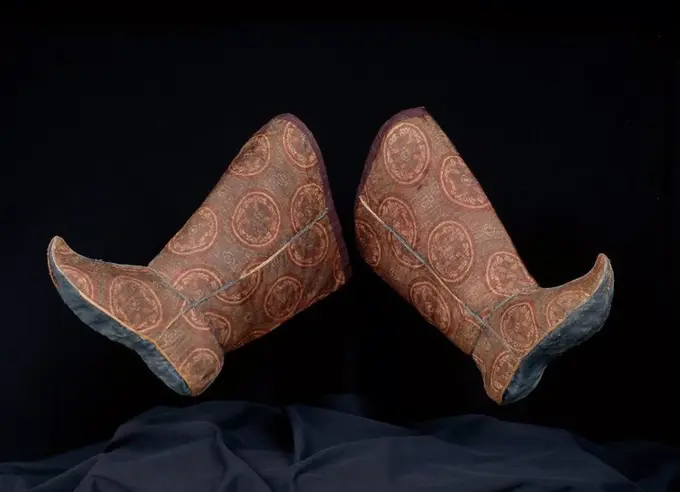
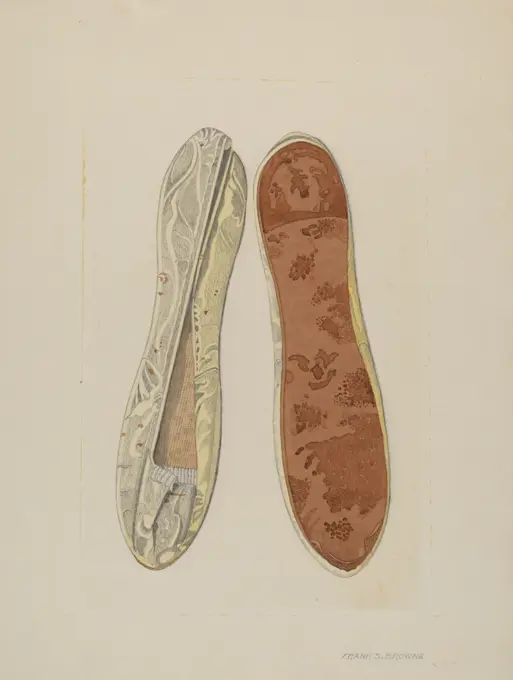
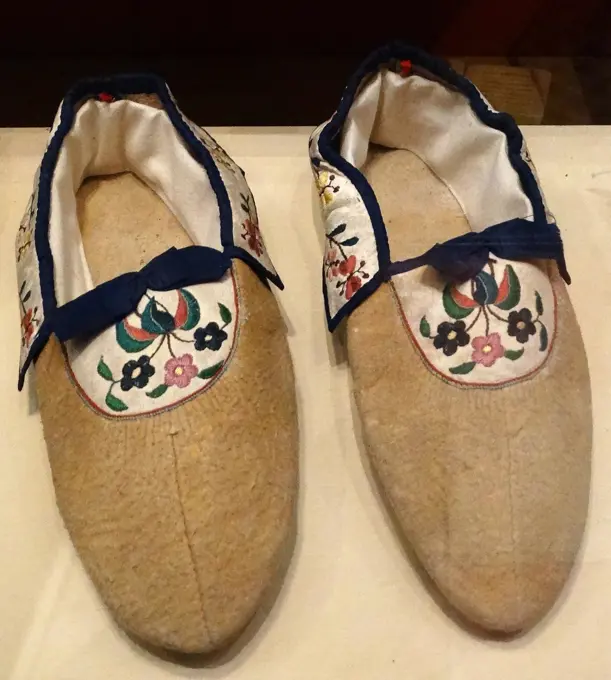
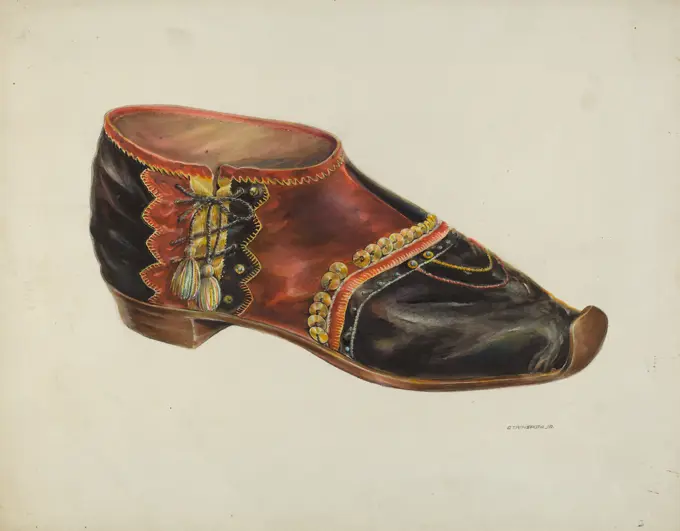
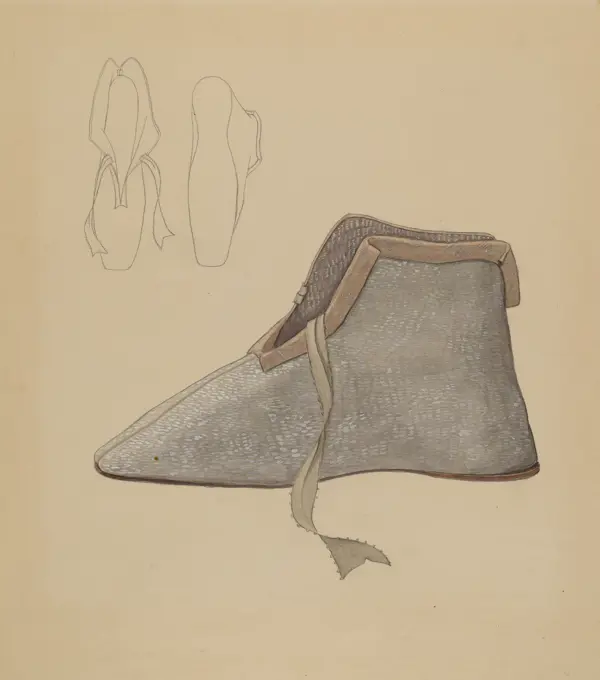
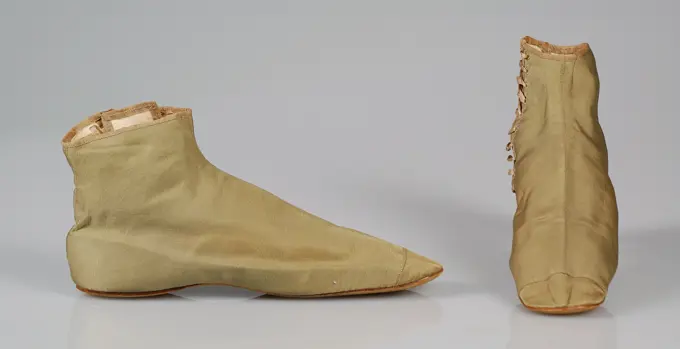
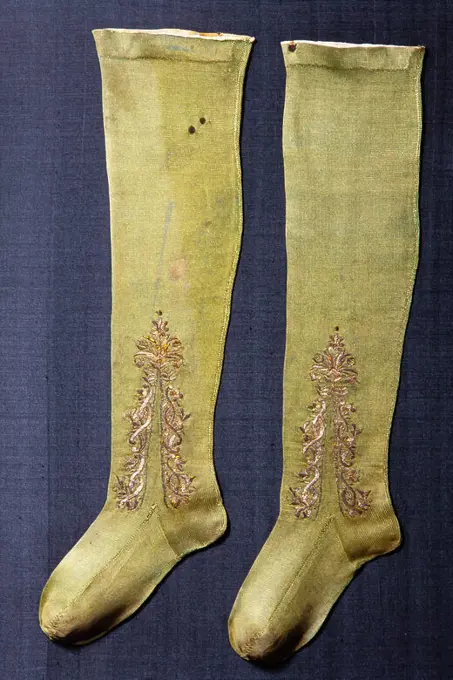
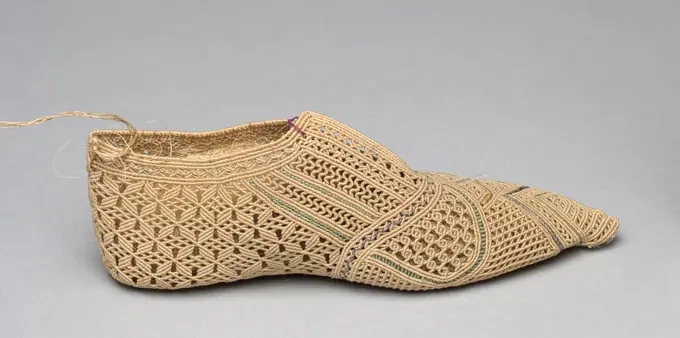
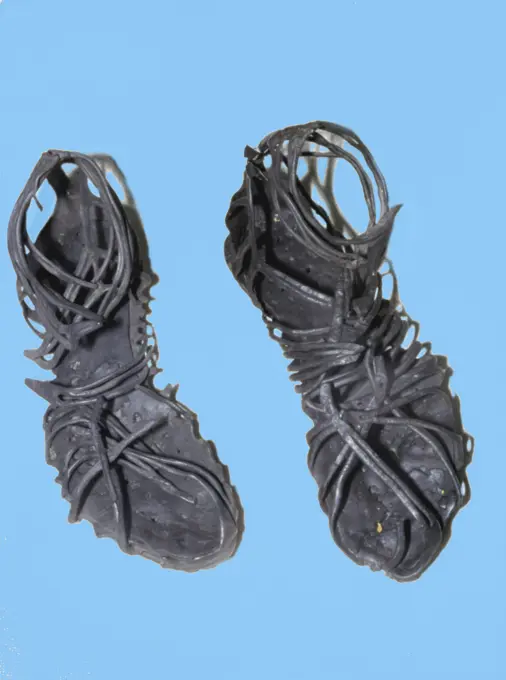
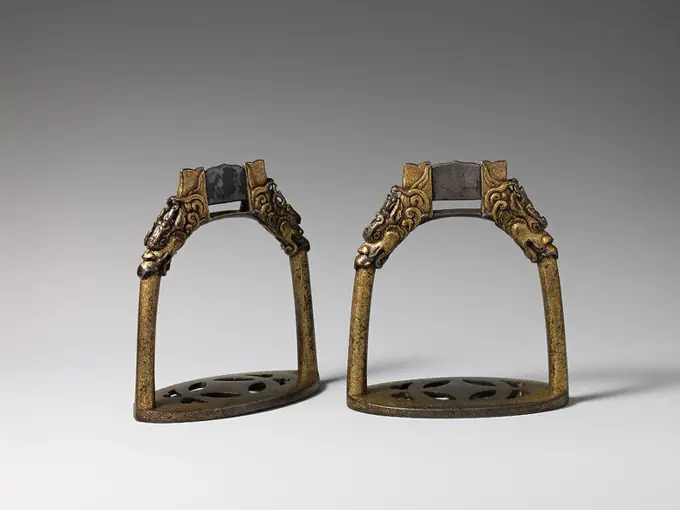
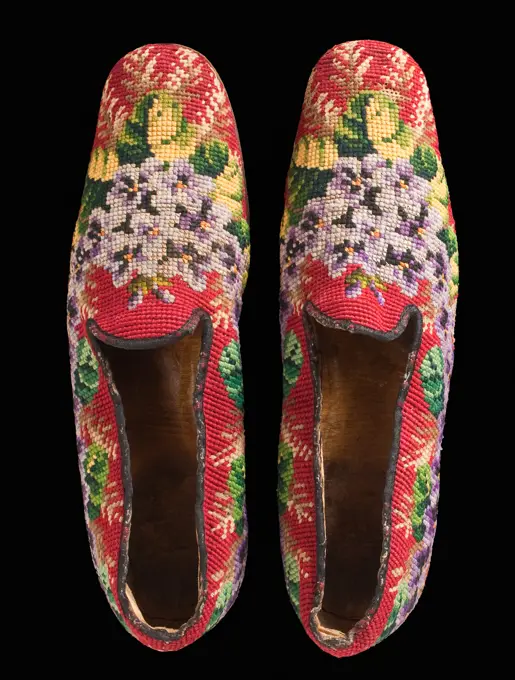
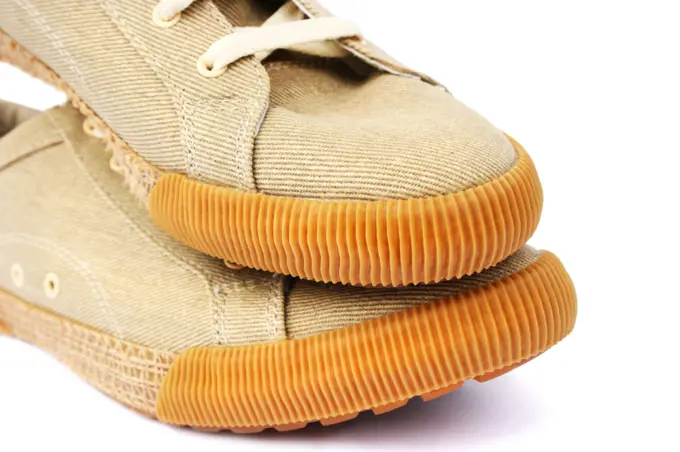
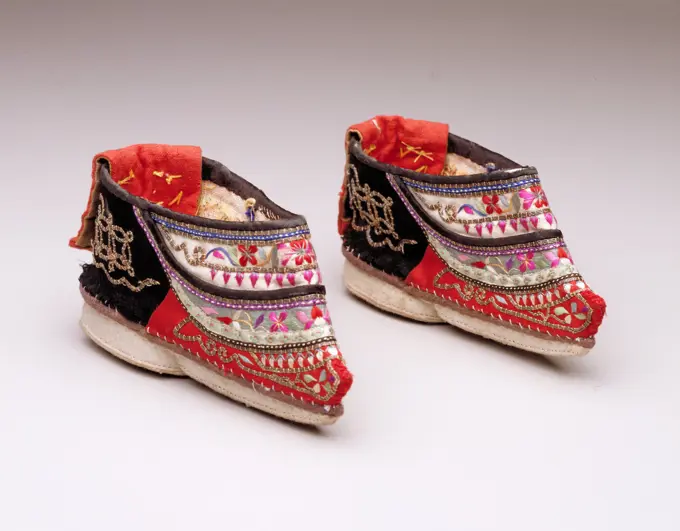
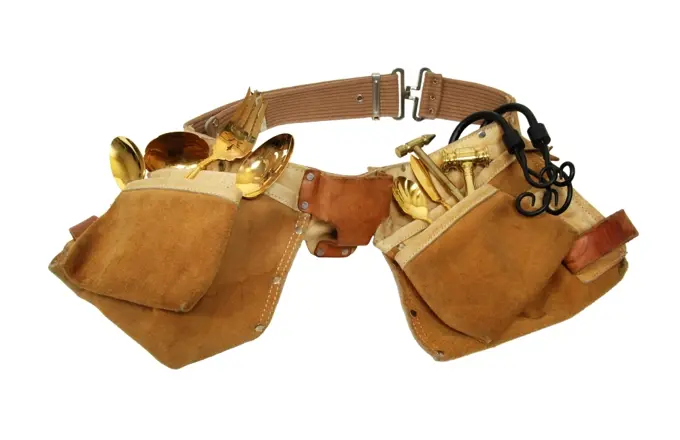
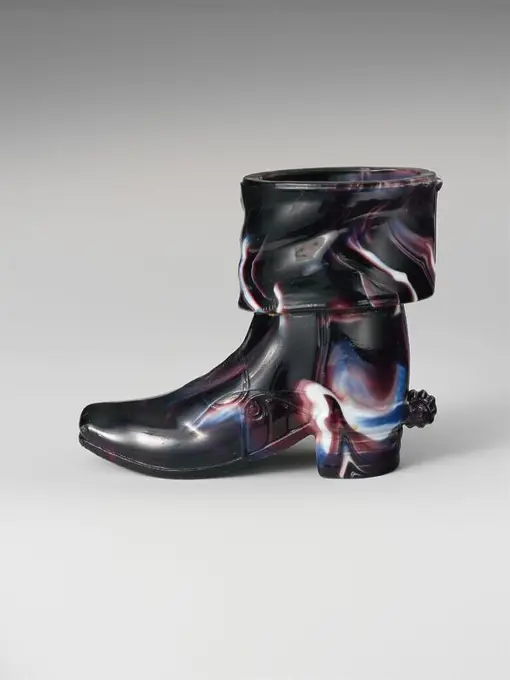
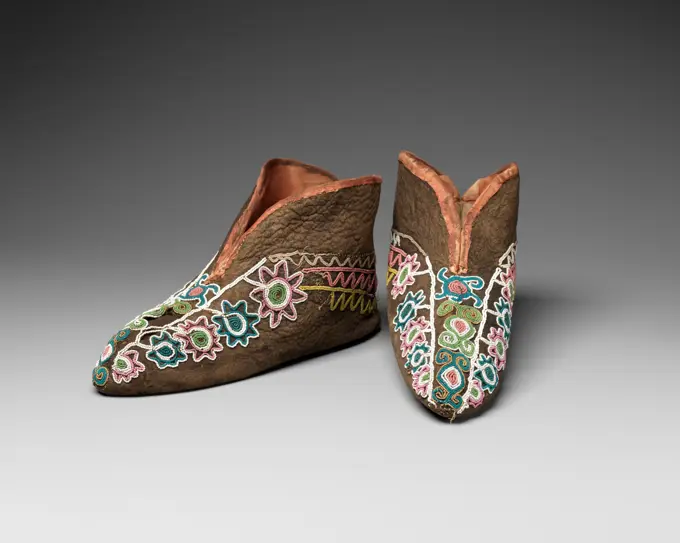
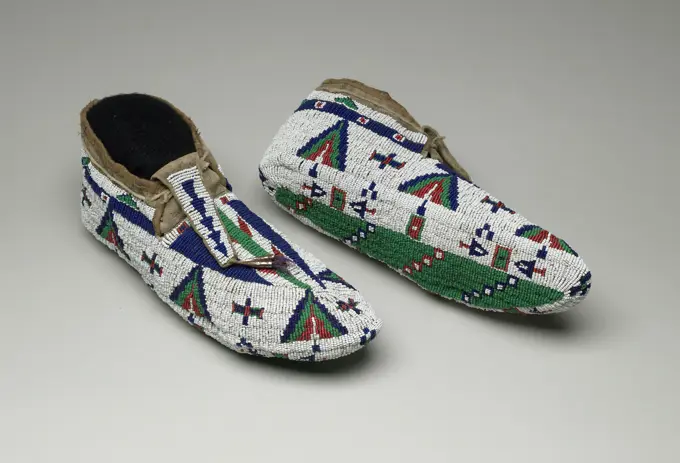
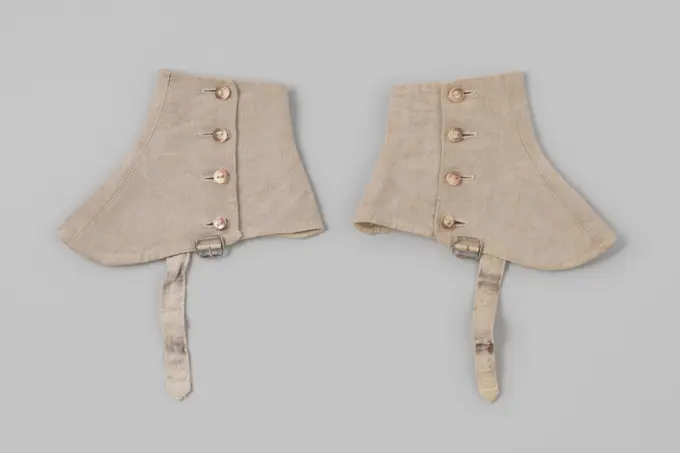
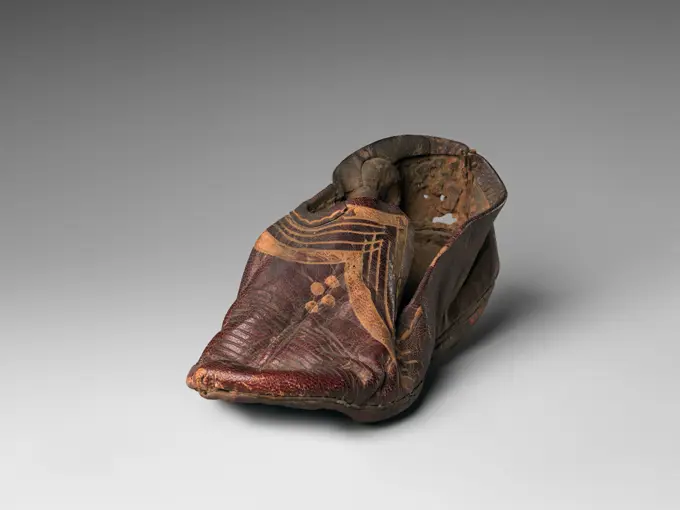
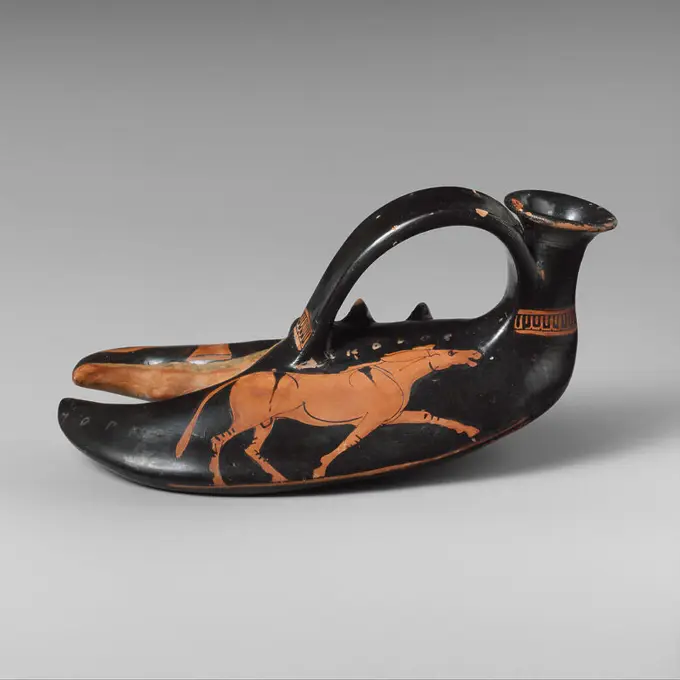
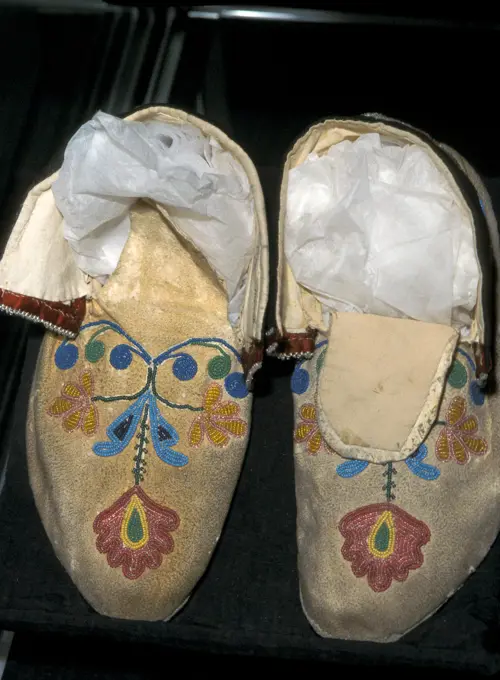
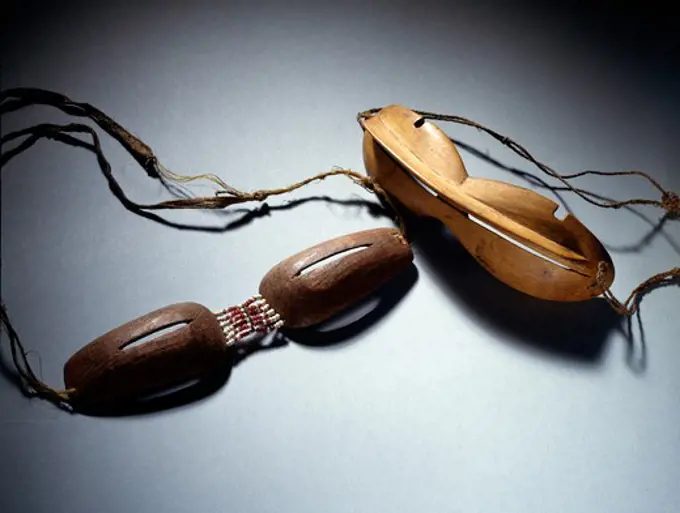
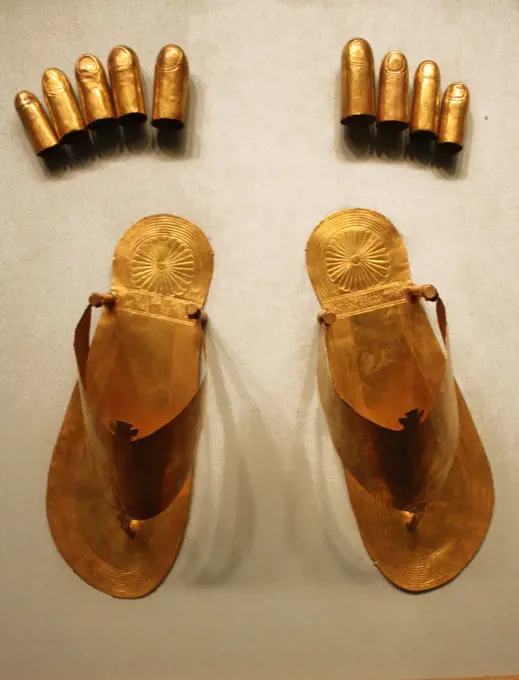
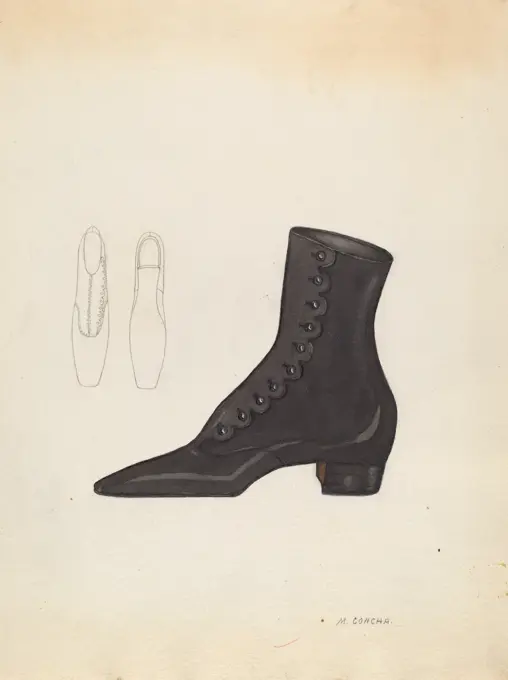
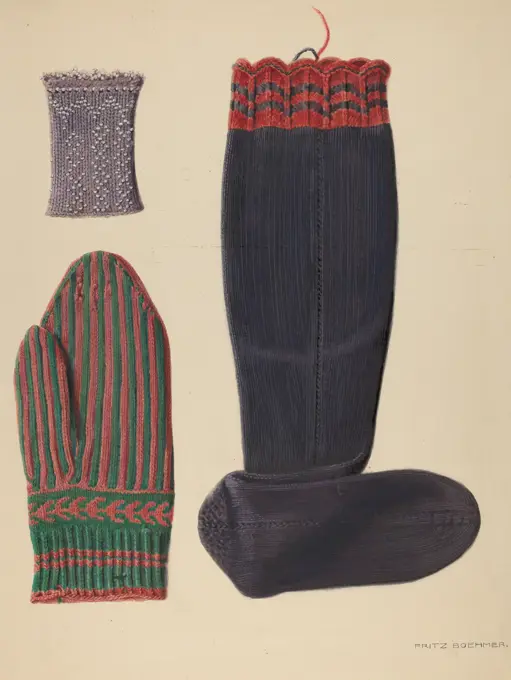
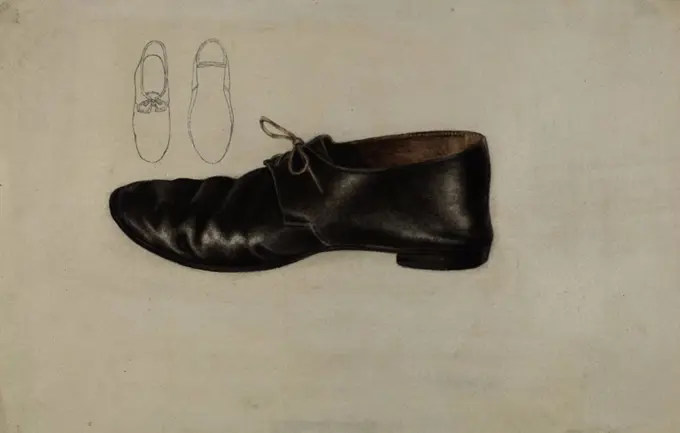
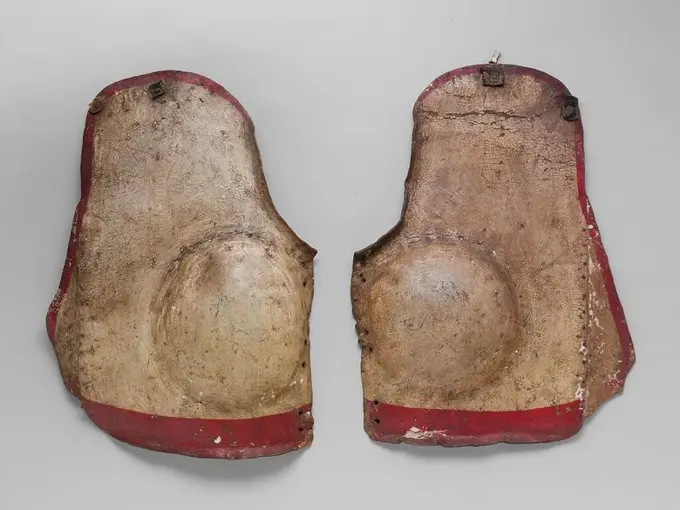
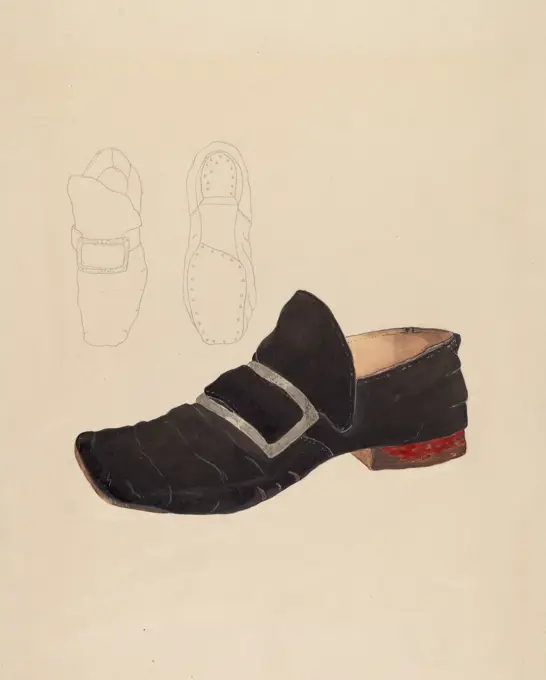
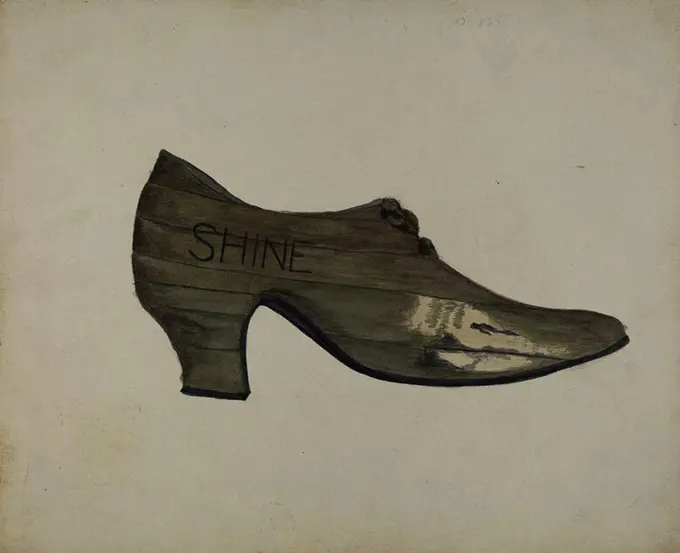
Woman's gloves, Medium: suede Technique: printed, Woman's long suede gloves printed in black ink. Small band of leaves around thumb piece; a country scene with boy and girl on back of hand; and, at the wrist, three bands with medallion showing boy's head. Inside right glove is a mark, now indecipherable except for the 'patent' and what appears to be a crowned shield with coat of arms supported by a lion and a unicorn., England, ca. 1820, costume & accessories, Woman's glovesMiser's purse, Medium: silk, metal Technique: crocheted, Crocheted dark brown silk ornamented with cut steel beads in geometric pattern. Two cut steel rings control side opening; steel pendant at each end., France, early 19th century, costume & accessories, Miser's purseWoman's Shoe. Dated: c. 1936. Dimensions: overall: 30.5 x 22.4 cm (12 x 8 13/16 in.). Medium: watercolor, gouache, and graphite on paper. Museum: National Gallery of Art, Washington DC. Author: Margaret Concha.Exotic SlippersFigure of a cicada late 18th-early 19th century China. Figure of a cicada 44118Leather Shoe with Gilded Decoration 4th-7th century Documentary and archaeological sources attest to the variety of footwear in Byzantine Egypt. Written evidence suggests that sandals were worn by government officials, slippers by monks and clergy, and boots by soldiers and laborers; the poorest members of society would have gone barefoot.The gold that creates the lattice pattern was stamped onto the red leather of this sumptuously decorated shoe.. Leather Shoe with Gilded Decoration. 4th-7th century. Leather; gilded. From Egypt, Akhmim (former Panopolis). LeatherA pair of men's slippers unknowna pair of white shoes on a white background. close-upPair of Woman's Boots with Tying Ribbon. China. Date: 900 AD-1000. Dimensions: a: 40 × 29.2 cm (15 3/4 × 11 1/2 in.)b: 39.2 × 28.6 cm (15 3/8 × 11 1/4 in.)Repeat: 13.2-14 × 12 cm (5 1/8-5 1/2 × 4 3/4 in.)c (ribbon): 1.45 × 60.8 cm (5/8 × 24 in.). Outer boot: silk, complementary weft twill weave with inner warps; seam trim cord: silk, oblique interlacing; ribbon and top boot edge binding: silk, simple and complex gauze weave; lined with silk, plain weave; lining's upper edge facing: silk, twill damask weave; sole: silk, plain weave; tying ribbon: twill weave self-patterned by areas of twill weave. Origin: China. Museum: The Chicago Art Institute, Chicago, USA.Fashion concept - Summer shoes on the backgroundFrank S Browne, Slippers, c 1940 SlippersTerracotta fragments of a kylix: eye-cup (drinking cup) 520 B.C. Attributed to the Andokides Painter Exterior, handle; below, part of wreathed amphora; rim fragment with part of eye and vine. Terracotta fragments of a kylix: eye-cup (drinking cup) 704328Plains Cree, women's handmade moccasins, Canadian. Dated 1900Bootees 1840-60 American. Bootees 168578Gerald Transpota, Velvet Shoe, c 1937 Velvet ShoeDoris Beer, Carriage Boot, c 1936 Carriage BootShoe, Adam Sijbel, c. 1770 - c. 1780 Shoe from Faience. Multicolored painted with flowers. Amsterdam . Shoe from Faience. Multicolored painted with flowers. Amsterdam .Boots 1850-65 American. Boots 169871ESCULTURA-BOTA. Author: EVA LOOTZ.Hat used for the uniform of the advisor of the Court of the Republic of Poland after Jacek LorentskiHandschoen van wit zeemleer.Right glove, from white corner leather with a split with three pearl-colored buttons at the wrist.Powder Flask, c. 1575-1625. Germany, late 16th-early 17th century. Horn (two branches); engraved allegorical scenes (unidentified); mounts missing; overall: 18.4 x 15.8 cm (7 1/4 x 6 1/4 in.).Medias de hombre, siglo XVII. Museu del Disseny de Barcelona.Wooden sandals, "Klåmper", from Nuckö, Estonia. Nordic Museum Inv.nr NM.0145305 NordicChild's Shoe. Dated: c. 1936. Dimensions: overall: 30.1 x 22.7 cm (11 7/8 x 8 15/16 in.). Medium: watercolor and graphite on paper. Museum: National Gallery of Art, Washington DC. Author: Margaret Concha.Shoe, Before 1932. Philippines. Macrame; overall: 8.6 x 22.9 x 7 cm (3 3/8 x 9 x 2 3/4 in.).ballet slippers pointe gift  on the green backgroundA pair of women's slippers unknownPair of Man's Moccasins, c. 1895-1910, 4 x 11 7/16 x 4 1/2 in. (10.16 x 29.05 x 11.43 cm) (each), Hide, beads, cotton, pigment, United StatesDorothy Handy, Shop Sign  Man's Shoe, c 1939 Shop Sign: Man's ShoeEngland, London, Kensington, Victoria and Albert Museum aka V&A, The Japan Room, Display of 1990s Womans Heeless ShoesZoar Beaded Wristlet, Mitten and Sock. Dated: c. 1938. Dimensions: overall: 55.2 x 44.8 cm (21 3/4 x 17 5/8 in.). Medium: watercolor and graphite on paperboard. Museum: National Gallery of Art, Washington DC. Author: Fritz Boehmer.Stockings 1850-60 American. Stockings 174799Woman's Shoes Made 1770-1779 England. Leather, silk, satin, weave .Pair of Woman's Shoes. England, 1760-1765. Costumes; Accessories. Silk satin, leather, linen, kid leatherRoman leather sandals ITALY.Traditional Arabic shoes over white backgroundSanta Boot, close-upStockings early 19th century Italian. Stockings 121207Dorothy Dwin, Slipper, c 1941 SlipperPair of Stirrups. Culture: Chinese. Dimensions: H. 5 1/2 in. (14 cm); W. 5 in. (12.5 cm). Date: probably 17th century.In addition to the sculptural chiseling of the dragon heads on each stirrup, the upright posts are damascened in gold with a hexagonal design representing stylized armor, a pattern that is seen frequently on luxury objects in China and Tibet. The treads of the stirrups are pierced with the design of a symbolic jewel, representing prosperity. Museum: Metropolitan Museum of Art, New York, USA.Pair of Greaves (Lower Leg Defenses). Culture: Italian. Dimensions: 27.159.10; L. 13 7/8 in. (35.3 cm); W. 5 in. (12.7 cm); D. 4 1/2 in. (11.4 cm); Wt. 1 lb. 7.6 oz. (669 g); 27.159.11; L. 13 7/8 in. (35.3 cm); W. 5 in. (12.7 cm); D. 4 1/2 in. (11.4 cm); Wt. 1 lb. 6.1 oz. (626.5 g). Date: ca. 1550 to 1575.This pair of greaves (lower leg defenses) is part of an unusually large armor garniture (acc. no. 27.159.1) from the armory of the Dos Aguas family in Valencia, Spain. The garniture contains pieces for use in battle and for the tilt in both the Italian and German fashions. The tilt was a tournament fought on horseback between two opponents armed with lances and separated by a lengthwise barrier.The armor as mounted is equipped with a helmet and vambraces (arm defenses) for the tournament. The buffe (chin defense), second breastplate (27.159.2), and manifer (reinforced left gauntlet) (27.159.6) would have been added to make the armor ready for exchange pieces for different forms of tSlippers. Culture: American. Date: 1865-85.Throughout the Victorian era, middle and upper class women were expected to exhibit their domestic and needleworking skills in the making of useful and attractive items. The embroidery of slipper uppers was widespread domestic pastime that addressed this expectation. The example here is typical of late 19th-century house slippers in both cut and decorative design, and features high quality needlepoint embroidery which retains most of it original bright coloration. Museum: Metropolitan Museum of Art, New York, USA.Anonymous, (US) Shoes, Service, Sole composition (Type II) - American embroidequins (common name), 1941, metal, leather, rubber, Paris Liberation Museum - General Leclerc Museum - Jean Moulin Museum.Lazio Latina Sezze Antiquarium Comunale54. Hutzel, Max 1960-1990 German-born photographer and scholar Max Hutzel (1911-1988) photographed in Italy from the early 1960s until his death. The result of this project, referred to by Hutzel as Foto Arte Minore, is thorough documentation of art historical development in Italy up to the 18th century, including objects of the Etruscans and the Romans, as well as early Medieval, Romanesque, Gothic, Renaissance and Baroque monuments. Images are organized by geographic region in Italy, then by province, city, site complex and monument.Blue baby leather shoes on a white background Blue baby leather shoes on a white background Copyright: xZoonar.com/BorisxZerwannx 7009550Woven rush Egyptian sandals from Saqqara 1000 BC-300 BCSlippers. Europe or United States, 1850-1900. Costumes; Accessories. Linen canvas with wool needlepoint (Berlin work) and leatherManifer (Reinforced Left Gauntlet) ca. 1550 to 1575 Italian This manifer (reinforced left gauntlet) is part of an unusually large armor garniture (acc. no. 27.159.1) from the armory of the Dos Aguas family in Valencia, Spain. The garniture contains pieces for use in battle and for the tilt in both the Italian and German fashions. The tilt was a tournament fought on horseback between two opponents armed with lances and separated by a lengthwise barrier.The armor as mounted is equipped with a helmet and vambraces (arm defenses) for the tournament. The buffe (chin defense), second breastplate (27.159.2), and manifer (reinforced left gauntlet) (27.159.6) would have been added to make the armor ready for exchange pieces for different forms of the tournament. For the German tilt, the trellised targe (shield) (27.159.7), small elbow defense (27.159.5), and small stomach defense (27.159.3) were added. For the Italian tilt, these elements were replaced by the form-fitting reinforce covering theShoes isolated on white background.A pair of ballet slippersPair of Boundfoot Shoes, c. 1890, 2 3/4 x 1 5/8 x 5 3/4 in. (7 x 4.1 x 14.6 cm) (each), Silk, cotton, China, 19th centuryGolden ballet shoes isolated on whiteMadrid, 11/28/2017. Exhibition on Auschwitz. Photo: Maya Balanya Archdc.Leather tool belt of many trades for carrying items conveniently including a gavel, hangers, hammer, and goldware - path includedBronze foot-guards from ancient Greece. Dated 6th Century BCBoot with Spur. Culture: American. Dimensions: H. 3 1/2 in. (8.9 cm); Diam. 2 1/16 in. (5.2 cm). Maker: Challinor, Taylor and Company (1866-1891). Date: 1870-90. Museum: Metropolitan Museum of Art, New York, USA.Luff Tackle.A third hand mark according to the rules of 1865. The third-hand valley consists of a single and a double-disc block, attached the fixed part to the nozzle nozzle; Both blocks have an iron wire nozzle with iron wire binding without splitting, an iron stocking and a hook.Shoe. Shoe of faience. Many color painted with flowers.Stocky of white knitted cotton, ajour fantasy pattern on Klink and rubbed, c. 1850 - c. 1900 Pair of stockings of white knitted cotton. Fantasy pattern on leg and rubbed. With seam and square heel. On the board some narrow, round tires. Under the board to the right of the seam with Red Cross stitches marked: RVG. Coming from the Van Geuns family in Amsterdam: Rebekka Anna van Geuns (1839-1909) or Regina Christina van Geuns (1848-). Netherlands whole: Cotton (textile) knitting / embroidering Pair of stockings of white knitted cotton. Fantasy pattern on leg and rubbed. With seam and square heel. On the board some narrow, round tires. Under the board to the right of the seam with Red Cross stitches marked: RVG. Coming from the Van Geuns family in Amsterdam: Rebekka Anna van Geuns (1839-1909) or Regina Christina van Geuns (1848-). Netherlands whole: Cotton (textile) knitting / embroideringMitaine, fragment, silk with red, white and black stripes, anonymous, c. 1800 - c. 1820 Mitaine, fragment, silk with red, white and black stripes. Set with white lace and silver -spiveron. Zaanstreek whole: Silk. Turnout: Galloon Mitaine, fragment, silk with red, white and black stripes. Set with white lace and silver -spiveron. Zaanstreek whole: Silk. Turnout: GalloonBonnet 1855-60 British. Bonnet 113111Moccasins ca. 1830 Muscogee/ Creek, Native American Women constructed each delicate yet functional center-seam moccasin from a single piece of dyed hide. This pair of moccasins, likely worn on special occasions, features elaborate floral and zigzag patterns. They are embroidered with tiny trade beads strung on a cotton thread with a stiffened tip and then secured to the hide with a needle and thread. The golden beads on the toes are metal, a valuable trade good, and the silk lining allowed the wearer to reveal a glint of luxury fabric at the ankle.. Moccasins. Muscogee/ Creek, Native American. ca. 1830. Tanned leather, dye, cotton cloth, silk ribbon, and glass and metal beads. Possibly made in Georgia, United States; Possibly made in Alabama, United StatesDoll's Shoe Made 1870 England. Black leather .Woman's Shoes. Europe, 1840-1855. Costumes; Accessories. Silk plain weave with glass beads, and leatherMoccasins, 10 1/2 x 3 x 3 1/2 in. (26.67 x 7.62 x 8.89 cm) (each), Animal hide, beads, metal bugle beads, horse hair, United StatesSlobkous of sand -colored linen cotton, on which four knots and a linen belt with buckle under the foot, c. 1900 - c. 1930 Slobkous made of sand -colored coarse linen cotton, on which four brown mother -of -colored knots and a linen belt with silver -colored metal buckle under the foot. Lined with ecrinkey fine linen cotton. Netherlands whole: Cotton (textile). lining: cotton (textile). Buttons: Mother of Pearl. buckle: Metal cutting Slobkous made of sand -colored coarse linen cotton, on which four brown mother -of -colored knots and a linen belt with silver -colored metal buckle under the foot. Lined with ecrinkey fine linen cotton. Netherlands whole: Cotton (textile). lining: cotton (textile). Buttons: Mother of Pearl. buckle: Metal cuttingSlipper 3rd-7th century. Slipper. 3rd-7th century. Leather. From Egypt, Akhmim (former Panopolis). LeatherTerracotta vase in the form of a lobster claw. Culture: Greek, Attic. Dimensions: Overall: 2 3/4 x 2 7/8 in. (7 x 7.3 cm)Other: 6 1/4in. (15.9cm). Date: ca. 460 B.C..Donkey; keras (drinking horn)Because so many aspects of Greek life depended on the sea, a vase in the shape of a lobster claw is not surprising. It is, however, exceptional and may be a variant of the askos--a bag-shaped oil container provided with a vertical mouth and strap handle. The Dionysiac iconography of the lobster claw suggests that it was a novelty item used at symposia (drinking parties). Museum: Metropolitan Museum of Art, New York, USA.Socks early 19th century Italian. Socks 121210Pair of Shawnee ladies deerskin moccasins decorated with floral beadworkStockings late 18th-early 19th century European. Stockings 121500Treasure of Tanis, funerary gold sandals of King SheshongBowl - RavenWarm slippers isolated on white backgroundUtrecht (wooden shoe)' still bank, 20th century, 2 1/4 x 2 x 6 in. (5.72 x 5.08 x 15.24 cm), Wood, pigment, metal, The Netherlands (probably), 20th centurySnowgoggles (Iinguak), Eskimo Art, USA, Washington DC, Smithsonian Institution (National Museum of Natural History)Marie Mitchell, Man's Shoe, c 1936 Man's ShoeGold sandals, toe and finger stalls. Dynasty 18, reign of Thutmose 111 (ca.1479-1425 B.C.) Gold. From the tomb of the three minor wives of Thutmose 111, in the Wady Gabbanat el-Qurud, Thebes.Woman's Shoes. Dated: c. 1940. Dimensions: overall: 29.2 x 22.6 cm (11 1/2 x 8 7/8 in.). Medium: watercolor and graphite on paper. Museum: National Gallery of Art, Washington DC. Author: Margaret Concha.Margaret Concha, Woman's Shoe, c 1937 Woman's ShoeClose-up of a pair of shoesClose-up of a stack of high heels slippersPair of Shoes (Formely Belonging to Queen Victoria 1819-1901) Made 1840-1860 London. Leather and silk, satin weave . Gundry & Sons (Designer)Handschoen van wit leer.Left evening glove, medium length, from white leather. A split with three pearl-like knots at the wrist.Fritz Boehmer, Zoar Beaded Wristlet, Mitten and Sock, c 1938 Zoar Beaded Wristlet, Mitten and SockCouple of old worn black slippers with holes in them against red backgroundGold sandals of Sheshanq from TanisOrnament China. Ornament 60663Shoe. Dated: 1935/1942. Dimensions: overall: 22.1 x 33 cm (8 11/16 x 13 in.). Medium: watercolor and graphite on paper. Museum: National Gallery of Art, Washington DC. Author: Lucille Chabot.Peytral Plates. Culture: Possibly Flemish or German. Dimensions: left: 24 1/2 x 18 3/8 in. (62.2 x 46.7 cm); Wt. 2 lb. (907 g); right: 25 3/8 x 15 3/4 in. (64.4 x 42.6 cm); Wt. 1 lb. 15 oz. (876 g). Date: early 16th century.Much lighter, and probably faster and cheaper to produce than in metal, armor made from shaped and hardened leather (cuir bouilli) was used throughout Europe for war, tournament, and parades. Surviving elements of leather armor are today extremely rare, but the use of hardened leather defenses, especially for horses, due to its advantages, was once much more widespread than is commonly assumed.The Museum's three elements (this pair of peytral plates, and a crupper plate, acc. no. 26.235.1) originally formed part of a horse's complete front and rear defense. The front defense is represented by two side panels (the central section is missing). Of the rear defense, or crupper, only the upper plate is preserved (several further plates would have extended the crGladys Cook, Man's Shoe, 1935 1942 Man's ShoeShoe Shop Sign. Dated: c. 1937. Dimensions: overall: 23 x 28 cm (9 1/16 x 11 in.) Original IAD Object: 18" long. Medium: watercolor and graphite on paperboard. Museum: National Gallery of Art, Washington DC. Author: Alfred Denghausen.17th Century English costume shoes, USA, New York State, New York City, Metropolitan Museum of ArtShoes ca. 1910 American. Shoes 90440Woman's Shoe. Dated: c. 1939. Dimensions: overall: 35.6 x 28.5 cm (14 x 11 1/4 in.). Medium: watercolor and graphite on paperboard. Museum: National Gallery of Art, Washington DC. Author: Daniel Marshack.Pair of Osage beaded leather moccasins using colorful seed beads and sewn to create beautiful geometric patternsStockings 1807 American. Stockings 173552GORRAS DE FIBRA VEGETAL PROCEDENTES DE MONTEHERMOSO (CACERES). Location: UAM / MUSEO ARTES POPULARES. CANTOBLANCO. MADRID. SPAIN.Slobbouses of black sheet with four black buttons and a leather belt with metal buckle, c. 1900 - c. 1930 Slobbouses of black sheet with four black buttons and a leather belt with metal buckle. Seams inside with leather piping. Black satin trim along the top edge on which: 'The Diamond Gaiter. Reg'd '. England whole: Cloth. Buttons:. Buckle: Metal. Bies: Leather. Bies: Silk Slobbouses of black sheet with four black buttons and a leather belt with metal buckle. Seams inside with leather piping. Black satin trim along the top edge on which: 'The Diamond Gaiter. Reg'd '. England whole: Cloth. Buttons:. Buckle: Metal. Bies: Leather. Bies: Silk