My Boards
View Pictures
  • My Boards

Historical Indian Miniatures

Miniature paintings depicting historical narratives, featuring vibrant colors and detailed scenes from Indian culture and mythology.
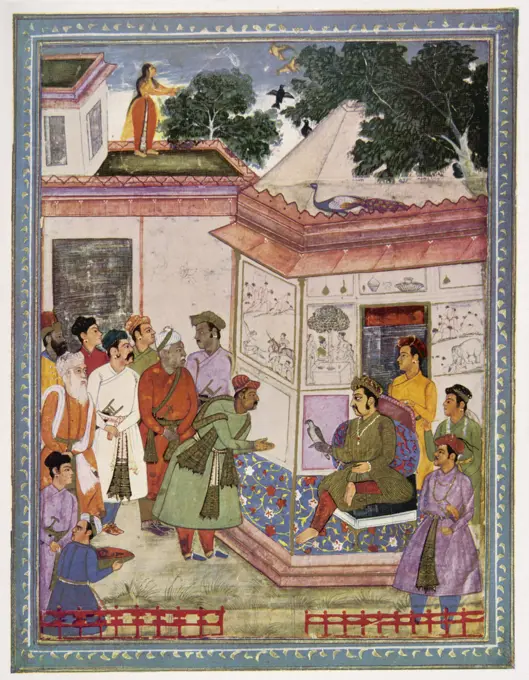
A Persian emir amidst his  courtiers appraises a  falcon, while on the palace  roof one of his harem ladies  looses a hawk after a game  bird.     Date: 17th century
A Persian emir amidst his courtiers appraises a falcon, while on the palace roof one of his harem ladies looses a hawk after a game bird. Date: 17th century
348 assets in this story
1540-111858371
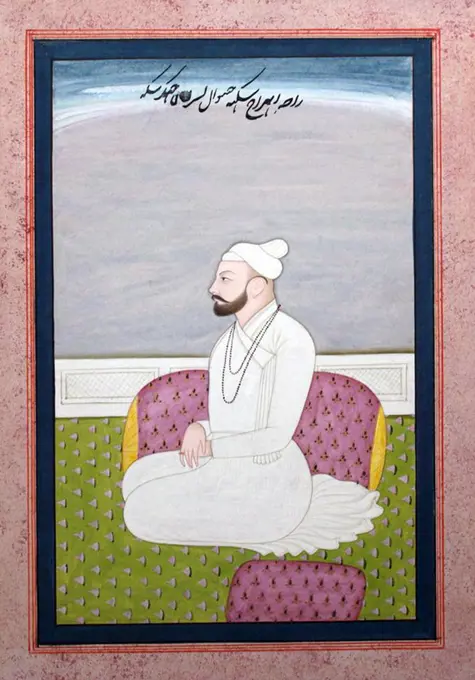
Bahadur Khan I ; The first ruler of the State1748 - 1758 ; Junagadh ; Gujarat ; India
4435-6673
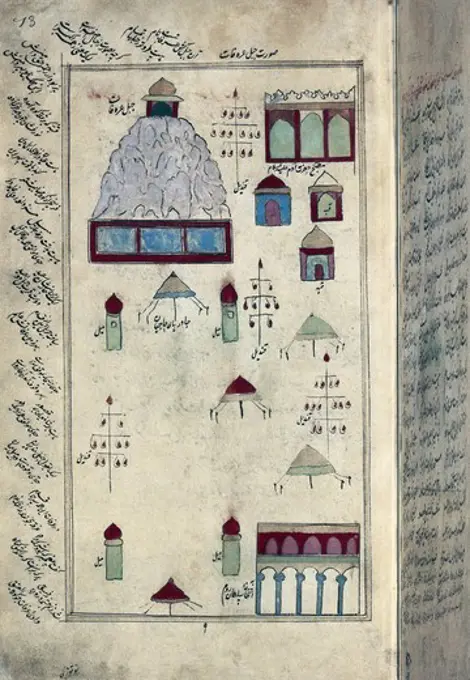
Mecca. Manuscript from the 17th century. Persian art. Miniature Painting. FRANCE. LE-DE-FRANCE. Paris. National Library.
6188-63966038
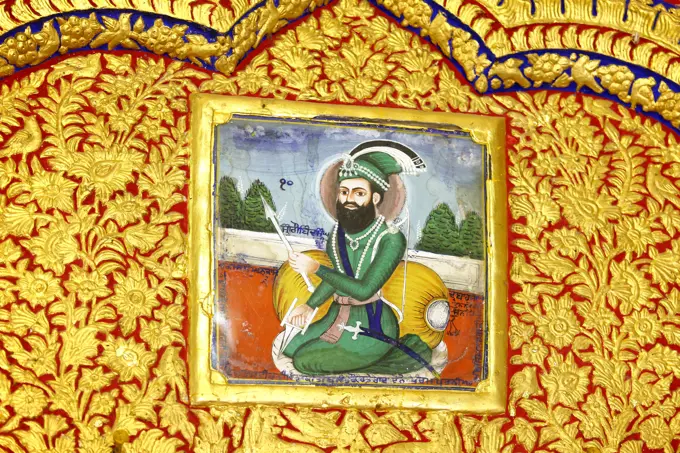
Sikhism Gurudwara Gold plated wall Nanded Maharashtra India Copyright: xHarixMahidhar/DinodiaxPhotox
6176-66915309
Tile with the Great Mosque of Mecca
6145-55951961
Gurûy executes Siyâvush.. 1616. Firdawsî. text. illuminated manuscripts, Illuminations, Manuscripts. Spencer Collection. Manuscripts, Persian
6188-64596579
year calendar picture & painting for a hindu month fagun, india Copyright: xBhagwandasxRupani/DinodiaxPhotox
6145-29126599
Yusuf in the Well, Page from an Unidentified Manuscript
6145-29294646
A Sikh () woman in a bright orange dress holding an umbrella and walking. Gouache painting by an Indian painter.
4409-8284
ABD ALLAH PADRE DE MAHOMA ANUNCIA LA BISMILLAH-RITUAL DE INICIACION DELANTE DE LA KAABA-SIGLO XV-XVI MINIATURA ARABE. Location: PALACIO TOPKAPI-BIBLIOTECA. ISTANBUL. TURQUIA.
6145-55950722
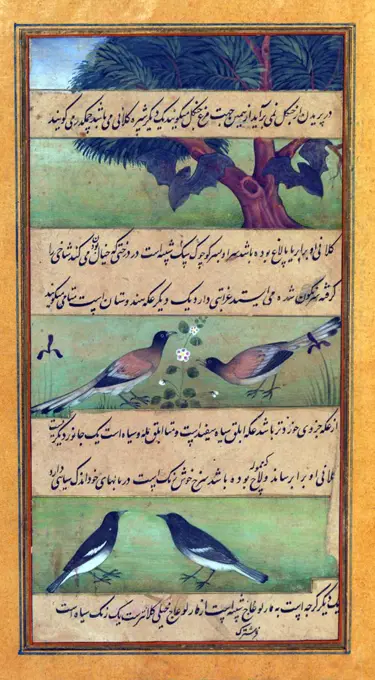
Another raven ghurâb top; Crane (ghurbîq) bottom, f. 351v. 1540 - 1545. Qazwīnī, Zakarīyā ibn Muammad, approximately 1203-1283. text. Illuminations, Manuscripts, Miniatures (Illuminations). Spencer Collection. Mountains, Birds, Animals, Manuscripts, Persian
6145-29276640
The Nawāb of Farrukhabad, Muzaffar Jang, smoking a huqqa. Gouache painting by an Indian artist.
6145-29284964
Persian couple copulating
4443-21200283
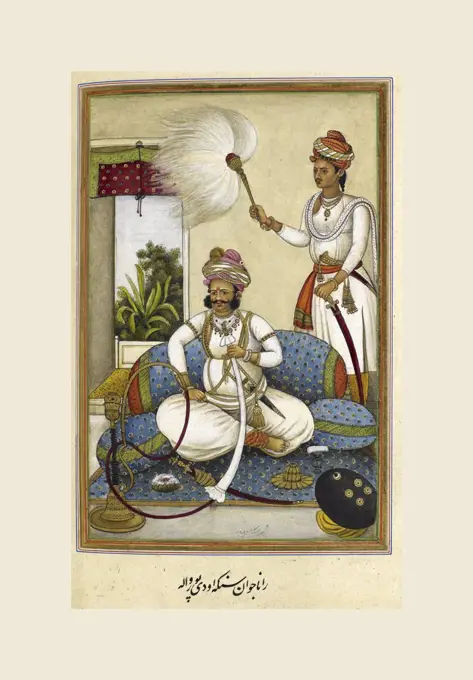
Portrait of Maharana Java, 19th century. Tashrih al-aqvam, an account of origins and occupations of some of the sects, castes, and tribes of India, 1825.
6176-66904455
Lovers Embracing, circa 1630, Indian and Southeast Asian Art
1788-33673
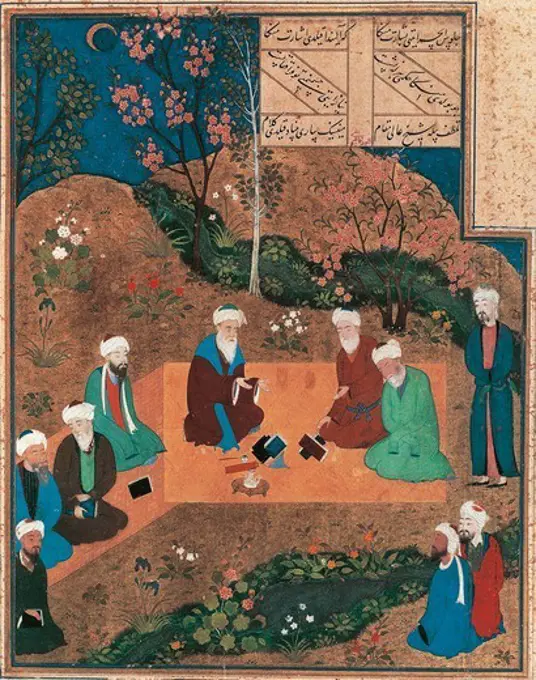
Mystical meeting outdoors, Arabic miniature from the Elliot manuscript 339 folio 95 verso.
6145-29070315
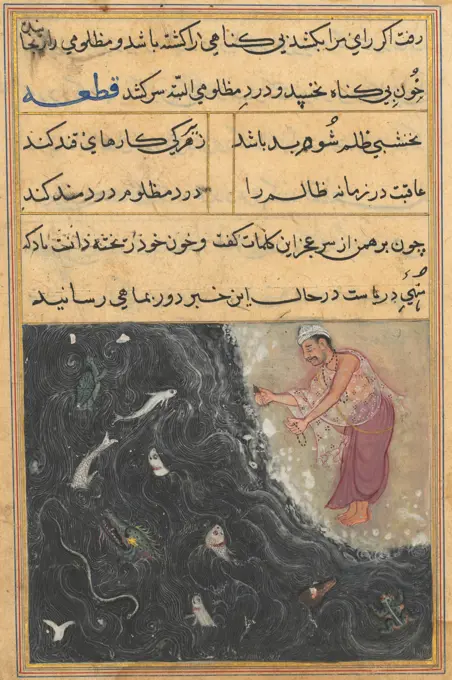
The Brahmans predicament is conveyed by the wind to the fish who carries the news to the king of the Ocean, from a Tuti-nama (Tales of a Parrot): Eleventh Night, c. 1560. Mughal India, court of Akbar (reigned 1556-1605). Gum tempera, ink, and gold on paper; overall: 20.3 x 14 cm (8 x 5 1/2 in.); painting only: 8.3 x 10.2 cm (3 1/4 x 4 in.). A Brahman stands on a sandy beach prayerfully calling out for help to send a message to the king of the ocean. His own raja (sovereign) had sent him on pain of death to bring the king of the ocean to the Rajas sons wedding in three days. In the text, the wind brings the Brahmans message to the ocean, and the fish, hearing it, take the news of the wedding invitation to their king. The swirling eddies and foamy shore suggest the presence of wind. Besides fish, a crocodile, sea snake, frog, and turtle also heed the message.
6145-59606592
Three Indian women sitting by a tree, anonymous, c. 1750 - c. 1800 print Probably made to an Indian miniature.  paper etching / engraving Asiatic races and peoples: Indians. trees. water-pipe, hookah, narghile (+ taking (particular) foodstuffs: eating, drinking, smoking, chewing, etc.). ornaments, jewels
6145-29296309
Persian couple copulating
4409-17487161
Mediating Ascetic. Date/Period: 1720/1740. Painting. Gouache and ink on buff paper. Width: 15.9 cm. Height: 23.2 cm (image). Author: Unknown Indian.
1746-21105407
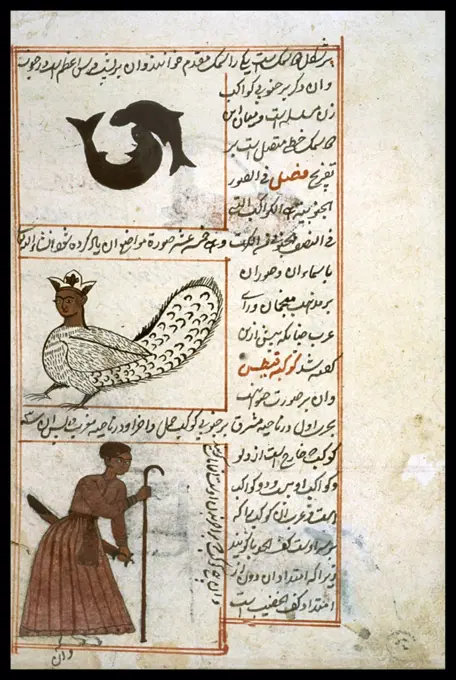
Three constellations: above, the zodiacal constellation of Pisces, in the middle, the southern constellation of Cetus shown here as a harpy wearing a crown, and, below, the constellation of Orion depicted as a man carrying a sword in is left hand and a shepherd's staff in his right. From ëAjíib al-makhlqt wa-gharíib al-mawjdt (Marvels of Things Created and Miraculous Aspects of Things Existing) by al-Qazwn (d. 1283/682). The copy was made in 1537/944, probably in western India.
6145-29278954
Guru Gobind Singh mixing nectar for his disciples at the birth of Khalsa. Coloured transfer lithograph.
6145-29283120
A Sikh and his wife. Gouache drawing.
1899-20226465
Illuminated Calligraphic Folio.
4443-75464084
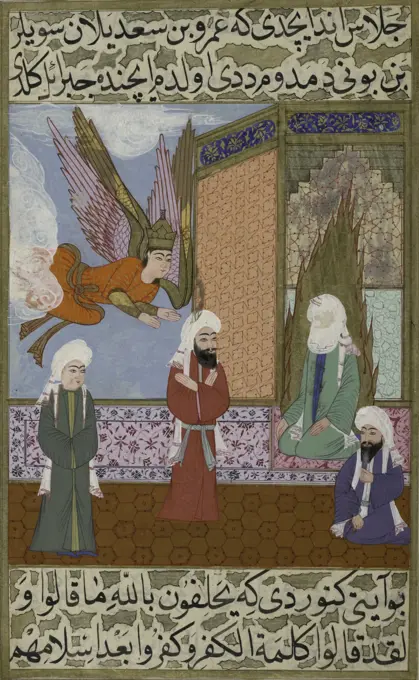
Text After Jalâl speaks ill of Muhammad and his statements are reported by 'Amr ibn Sa'ad, he tries to deny them and attributes them to 'Amr. At that moment, Jibrîl brings down a section of the sûrah on repentance., 1594 - 1595 (Inferred), Istanbul, Manuscripts Turkish, 19.7 x 17 cm, A manuscript page depicting the scene where Jalâl speaks ill of Muhammad, followed by a reference to 'Amr ibn Sa'ad reporting his statements and Jalâl's subsequent denial. The presence of Jibrîl is emphasized as he reveals a section of the sûrah concerning repentance
6145-29270634
Persian couple copulating
1899-48157933
The prince, a son of the ruler of Sistan, enters the service of a serpent, from a Tuti-nama, Tales of a Parrot. Tutinama, Tales of a Parrot, is a series of 52 stories in Persian from the 14th century, in the 16th century Mughal Emperor Agbar commissioned an illustrated version, Thirty-seventh Night, circa 1560. Mughal India, court of Akbar (reigned 1556-1605)., Historical, digitally restored reproduction of a original from that time.
1899-18853442
Commonly known as Rana Sanga, the Rajput Maharana Sangram Singh (born April 12, 1484) was the ruler of Mewar, which was located within the geographic boundaries of present-day India's modern state of Rajasthan. He ruled between 1509 and 1527. A scion of the Sisodia clan of Suryavanshi Rajputs, Rana Sanga succeeded his father Rana Raimal as king of Mewar in 1509. He fought against the Mughals in the Battle of Khanwa, which ended with Mughal victory, dying shortly thereafter, on March 17, 1527.
4408-2871
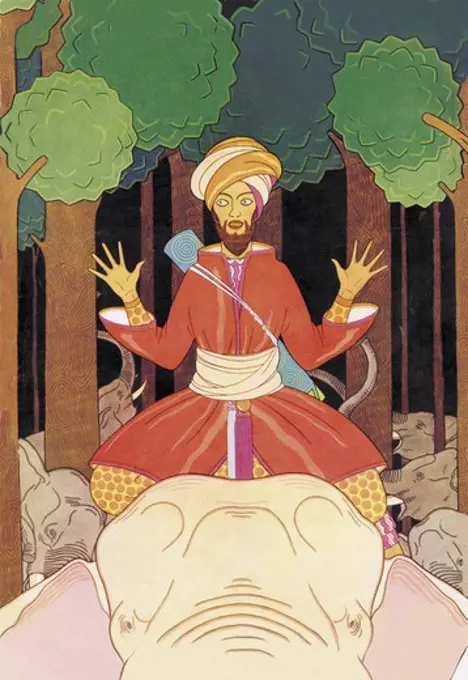
Sinbad the Sailor - The Seventh Voyage , Asia - Magazine Covers
1899-18853441
Kota, Rajasthani: , formerly known as Kotah, is the third biggest city in the northern Indian state of Rajasthan after Jaipur and Jodhpur. It is located 240 kilometres (149 miles) south of state capital, Jaipur. The city of Kota is situated near the center of the southeastern region of Rajasthan, a region widely known as Hadoti, the land of the Hadas. Kota lies along the banks of the Chambal river.  It became a separate princely state in the 17th century. Apart from the several monuments that reflect the erstwhile glory of the town, Kota is also known for its palaces and gardens.
6145-29738199
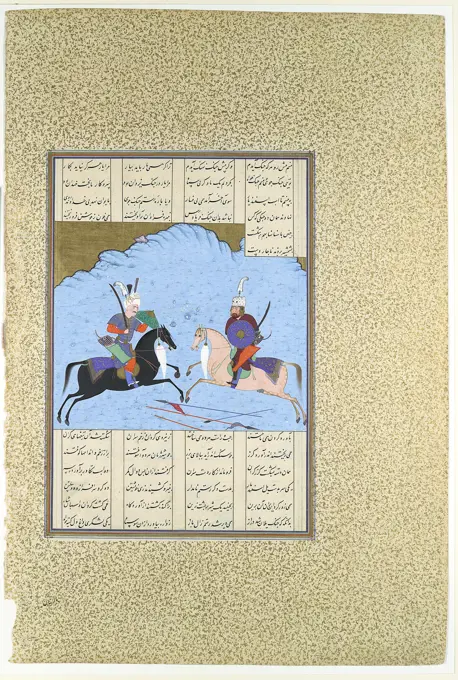
"Rustam and Isfandiyar Begin Their Combat", Folio 461v from the Shahnama (Book of Kings) of Shah Tahmasp ca. 1530-35 Abu'l Qasim Firdausi After a lengthy discussion of Gushtasp's demands of Rustam and his and Isfandiyar's obligations to the shah, they decide to resolve the disagreement through combat. Fighting first with lances, they parry and pierce each other's armor until the lances fall apart. They then turn to their swords but again succeed only in breaking each other's weapons. So it goes with maces and hand combat as well, and by the end of the day, neither has the upper hand. They decide to rest.. "Rustam and Isfandiyar Begin Their Combat", Folio 461v from the Shahnama (Book of Kings) of Shah Tahmasp 452163
1899-18852396
Shivaji Bhosale (19 February 1630 - 3 April 1680), was the founder of the Maratha Empire, which lasted until 1820, and at its peak covered much of the Indian subcontinent. An aristocrat of the Bhosle Maratha clan, Shivaji led a resistance against the Adilshahi sultanate of Bijapur and the Mughal Empire and established Hindavi Swarajya ('self-rule of Hindu people'). He created an independent Maratha kingdom with Raigad as its capital, and was crowned Chhatrapati ('paramount sovereign') of the Marathas in 1674. Shivaji established a competent and progressive civil rule with the help of a disciplined military and well-structured administrative organisations. He innovated military tactics, pioneering guerrilla warfare methods which employed strategic factors like geography, speed, and surprise and focused pinpoint attacks to defeat his larger and more powerful enemies. From a small contingent of 2,000 soldiers inherited from his father, Shivaji created a force of 100,000 soldiers; he built
6145-29248976
Moorish tailor and wife offering him betel leaves. Gouache drawing.
6145-29235099
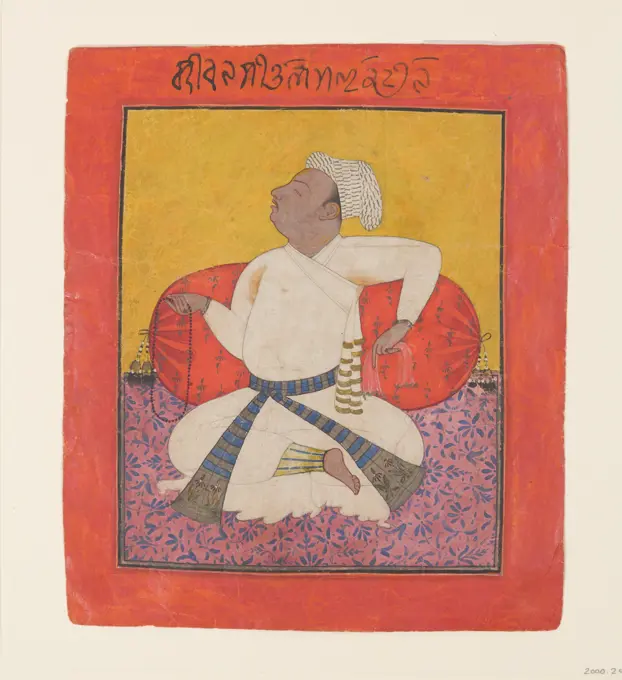
Maharaja Sital Dev in Devotion ca. 1690 India (Punjab Hills, Basohli) The image of the blind raja Sital Dev stands apart from other dynastic portraits. Here, the focus is on his private devotion, as he sits holding a mala (rosary) and reciting mantras. Not only is he unattended, but his surroundings are simple and stripped of the iconography of kingship. The immediacy and poignancy of the depiction is surprising since it dates to more than thirty years after Sital Devs death and reflects the subdued Basohli style of this later period. For the patron who commissioned this work, it was the maharajas spiritual quest that was important, rather than his standing as a ruler.. Maharaja Sital Dev in Devotion. India (Punjab Hills, Basohli). ca. 1690. Ink, opaque watercolor, and silver on paper. Paintings
6145-29117103
Krishna and Worshipper. India, Himachal Pradesh, Mandi, 17th century. Drawings; watercolors. Opaque watercolor on paper
1899-18792813
Abu Yahya Zakariya' ibn Muhammad al-Qazwini (     ) (born 1203 - died 1283), was a Persian physician, astronomer, geographer and proto-science fiction writer. Born in the Persian town of Qazvin, he was descended from Anas ibn Malik, Zakariya' ibn Muhammad al-Qazwini served as legal expert and judge (qadhi) in several localities in Persia and at Baghdad. He travelled around in Mesopotamia and Syria, and finally entered the circle patronized by the governor of Baghdad, ‘Ata-Malik Juwayni (d. 1283 CE). It was to the latter that al-Qazwini dedicated his famous Arabic-language cosmography titled 'Aja'ib al-makhluqat wa-ghara'ib al-mawjudat      ('Marvels of Creatures and Strange Things Existing'). This treatise, frequently illustrated, was immensely popular and is preserved today in many copies. It was translated into Persian and Turkish. Qazwini was also well-known for his geographical dictionary, Athar al-bilad wa-akhbar al-‘ibad
1899-18792349
Bāburnāma (Chagatai/Persian: بابر نامہ;´, literally: 'Book of Babur' or 'Letters of Babur'; alternatively known as Tuzk-e Babri) is the name given to the memoirs of ahīr ud-Dīn Muḥammad Bābur (1483-1530), founder of the Mughal Empire and a great-great-great-grandson of Timur. It is an autobiographical work, originally written in the Chagatai language, known to Babur as 'Turki' (meaning Turkic), the spoken language of the Andijan-Timurids. Because of Babur's cultural origin, his prose is highly Persianized in its sentence structure, morphology, and vocabulary, and also contains many phrases and smaller poems in Persian. During Emperor Akbar's reign, the work was completely translated to Persian by a Mughal courtier, Abdul Rahīm, in AH 998 (1589-90 CE).
6145-51829357
Manuscript of the Hadiqat al-Su`ada (Garden of the Blessed) of Fuzuli Muhammad bin Sulayman, known as Fuzuli (ca. 1483-1556). Manuscript of the Hadiqat al-Su`ada (Garden of the Blessed) of Fuzuli, AH 1011 / 1602-3 C.E. Opaque watercolor, ink and gold on paper; leather binding, 5 1/2 x 9 3/4 in. (14 x 24.8 cm).  This manuscript is a copy of the sixteenth-century Hadiqat al-Sucada (Garden of the Blessed), written in Baghdad by the Ottoman mystic Muhammad bin Sulayman, known as Fuzuli (circa 1483-1556). It is a text on the Prophets family and belongs to a group of illustrated devotional manuscripts executed in a provincial style in Baghdad under the patronage of the Ottoman sultan Mehmet III (r. 1595-1603). Here, the Prophet is shown veiled and seated on a pulpit, accompanied by his cousin and son-in-law, cAli, and his grandchildren, Hasan and Husayn, all distinguished by haloes of fire. According to the Ottoman Turkish text, Muhammad is conversing with the angel Gabriel and the Angel of
6145-45901565
Krishna kills hose-demon Aghasura. In red frame lines, representation of a large snake in a bright yellow hilly landscape in which very small people and cows lie; Krishna is in the opened mouth brought from the hose and two figures are still; In the background against a cloudy sky two boats with gods that spread flowers, a river with lotus flowers in the foreground. The performance is horizontally framed by two red frame lines and vertically by 2 x 2 red frame lines that run into the leaf edge and on the back; Under the show a line of text in Indian scripture.
1899-18853418
Jahangir (Hindi: नूरुद्दी सलीम जहांगीर Urdu: سلیم جهانگیر نورالدینPersian: نورالدین سلیم جهانگیر) (full title: Al-Sultan al-'Azam wal Khaqan al-Mukarram, Khushru-i-Giti Panah, Abu'l-Fath Nur-ud-din Muhammad Jahangir Padshah Ghazi [Jannat-Makaani) (20 September 1569 - 8 November 1627) was the ruler of the Mughal Empire from 1605 until his death in 1627. The name Jahangir is from Persian جهانگیر,meaning 'World Conqueror'. Nur-ud-din or Nur al-Din is an Arabic name which means 'Light of the Faith'. Born as Prince Muhammad Salim, he was the third and eldest surviving son of Mogul Emperor Akbar. Akbar's twin sons, Hasan and Hussain, died in infancy. His mother was the Rajput Princess of Amber, Jodhabai (born Rajkumari Hira Kunwari, eldest daughter of Raja Bihar Mal or Bharmal, Raja of Amber, Rajasthan). Jahangir was a child of many prayers. It is said to be by the blessing of Shaikh Salim Chishti (one of the revered sages of his times) that Akbar's first surviving child, the future Jahang
6145-29260764
A Jain horsegroom with his wife offering him a betel leaf. Gouache drawing.
6145-29284963
Muhammad Mu'izz Al-Dīn Jahānrārshāh. Gouache painting by an Indian artist, ca. 1850 ().
1899-18853443
Jaswan was a precolonial Indian state centred at Rajpura, in modern-day Himachal Pradesh. It was founded in 1170 by Raja Purab Chand, a scion of the ancient royal family of Kangra. In 1815, the Sikh Maharaja Ranjit Singh ordered all his available forces to assemble at Sialkot. The raja of Jaswan, Ummed Singh (1800-1849), failed to obey the summons and was fined a sum beyond his means. The raja was forced to relinquish his state to the Sikh emperor, and accepted a jagir of 21 villages and 12,000 Rs per annum. In 1848, he joined the Sikh in an unsuccessful revolt against the British. His palaces were plundered and razed to the ground, and his territory annexed. He was stripped of his title and exiled to Almora, where he died a year later. In 1877, the jagir in Jaswan, along with several other former properties in Rajpura and Amb, was restored to Ummed's grandson Ran Singh (b. 1833), who also later acquired the jagir of Ramkot in Jammu upon marriage to a granddaughter of Maharaja Gulab Si
4408-6185
Shepherds, Bilibin - Russian Tales
1746-19665136
Detail from a 19th century enamel and glazed picture depicting the Hindu legend of the Ramayana. The Ramayana is one of the two epic Hindu poems, the other being the Mahabharata. The Ramayana describes a love story between Rama, an ancient King, and Sita, who is captured by Ravan, the King of Ceylon. Rama lays siege to Ceylon and wins back Sita
1899-18792396
Jahangir (Hindi: नूरुद्दी सलीम जहांगीर Urdu: سلیم جهانگیر نورالدینPersian: نورالدین سلیم جهانگیر) (full title: Al-Sultan al-'Azam wal Khaqan al-Mukarram, Khushru-i-Giti Panah, Abu'l-Fath Nur-ud-din Muhammad Jahangir Padshah Ghazi [Jannat-Makaani) (20 September 1569 - 8 November 1627) was the ruler of the Mughal Empire from 1605 until his death in 1627. The name Jahangir is from Persian جهانگیر,meaning 'World Conqueror'. Nur-ud-din or Nur al-Din is an Arabic name which means 'Light of the Faith'. Born as Prince Muhammad Salim, he was the third and eldest surviving son of Mogul Emperor Akbar. Akbar's twin sons, Hasan and Hussain, died in infancy. His mother was the Rajput Princess of Amber, Jodhabai (born Rajkumari Hira Kunwari, eldest daughter of Raja Bihar Mal or Bharmal, Raja of Amber, Rajasthan). Jahangir was a child of many prayers. It is said to be by the blessing of Shaikh Salim Chishti (one of the revered sages of his times) that Akbar's first surviving child, the future Jahang
1899-19136356
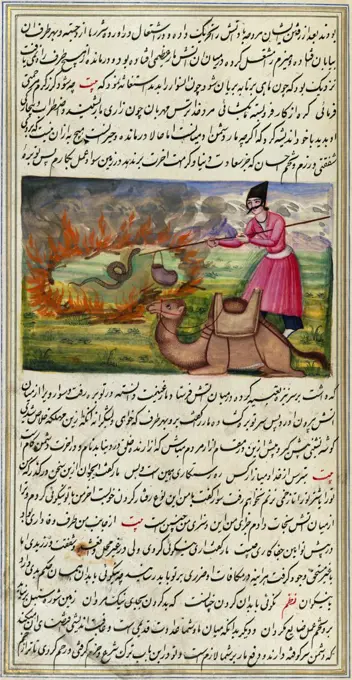
Persia/Iran: Page from the illuminated manuscript 'The Lights of Canopus' (Anwar-i Suhayli) depicting a man saving a snake from a fire, by Mirza Rahim, 19th century, Iran
6145-29254036
A servant standing next to a dining table, holding a fly whisk. Gouache painting on mica by an Indian artist.
1899-18853339
Samrat Hem Chandra Vikramaditya (also known as Hemu Vikramaditya, Raja Vikramaditya or simply Hemu) (1501 - 5 November 1556) was a Hindu emperor of north India during the sixteenth century CE, a period when Mughals and Afghans were vying for power in the region. The son of a Hindu priest, who later became a food seller, and a vendor of saltpetre at Rewari, Hemu rose to become Chief of Army and Prime Minister of Adil Shah Suri of the Suri Dynasty. He fought Afghan rebels across North India from the Punjab to Bengal and the Mughal forces of Akbar and Humayun in Agra and Delhi, winning 22 consecutive battles. Hemu acceded to the throne of Delhi on 7 October 1556, assuming the title of Vikramaditya that had been adopted by many Hindu kings since Vedic times. His rajyabhishek (coronation) as Samrat was held at Purana Quila in Delhi. Hemu re-established Hindu rule (albeit for a short duration) in North India, after over 350 years of Muslim rule.
PREVIOUS
of 4
NEXT
2401 S. Ervay, Suite 206
Dallas, Texas 75215
United States
Get Started
Free ResearchMy BoardsMy Cart
For Creators
How To License Your ContentContributor PortalFrame of Mind
Resources
API accessPricing
Contact
+1 866 236 0087help@viewpictures.co.uk Contact form
©2026 View Pictures. All Rights Reserved. -A
This site is protected by reCAPTCHA and Google Privacy Policy and Terms of Service apply.