Historical Military Actions in France

Photographs document U.S. Army activities in various French locations during WWI, highlighting logistics and interactions with local populations.

Two soldiers stand outside the 2D Army Corps Headquarters in Mericourt-sur-Soume, France. The photograph was taken on October 1, 1918, by Cpl. Gunshor from the Signal Corps. It was released by the A.E.F. Censor on December 23, 1918. Photographer's recommendation date - December 18, 1918. Image description number - E. Aye FAB 30716.
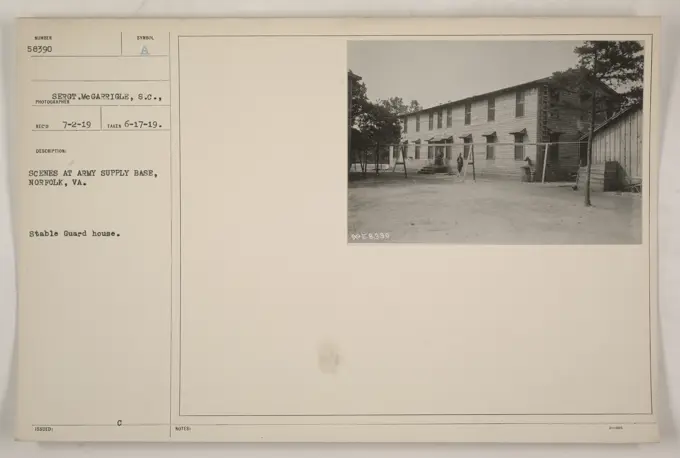
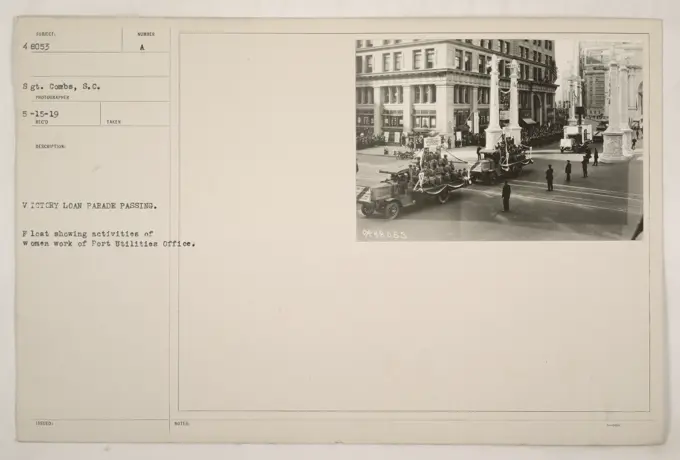
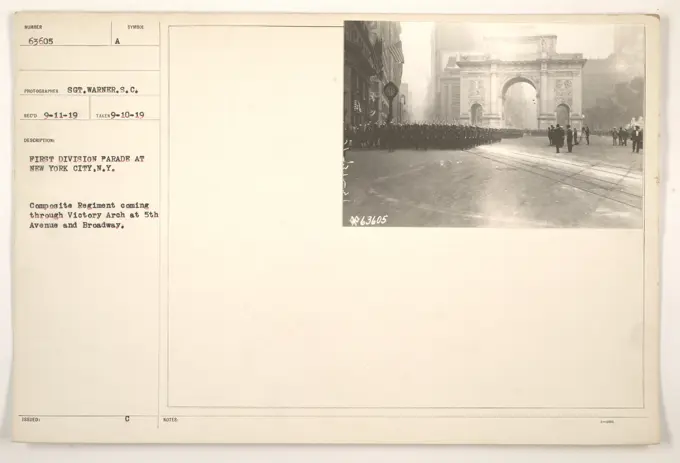
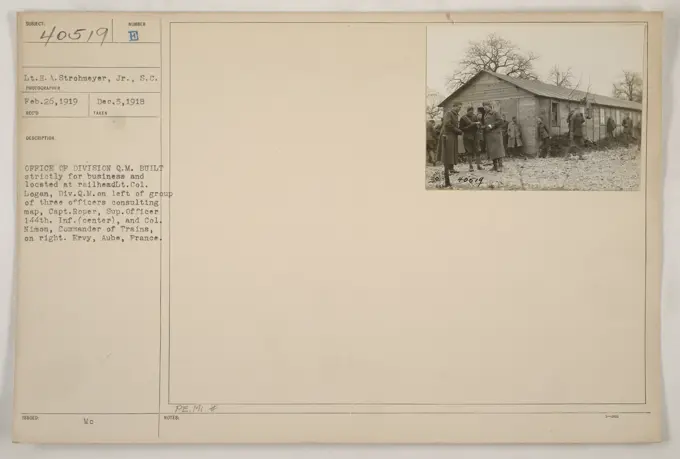
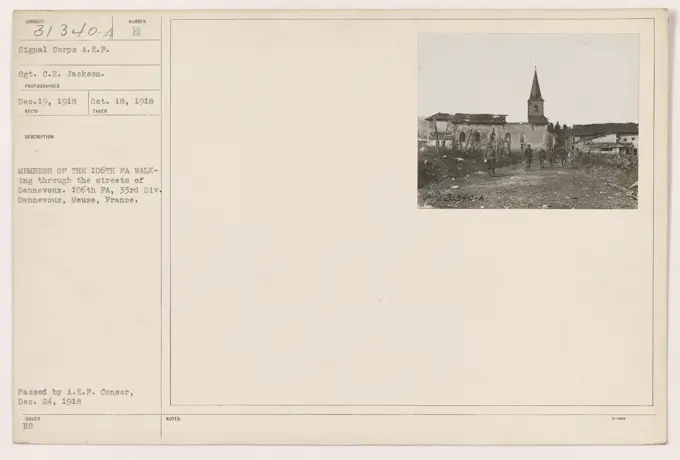
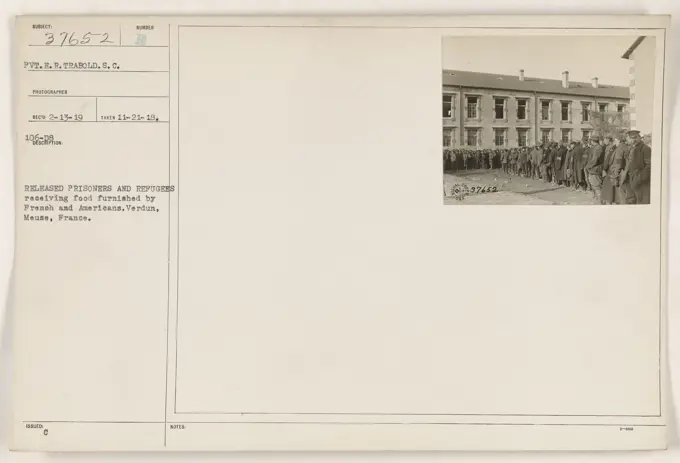
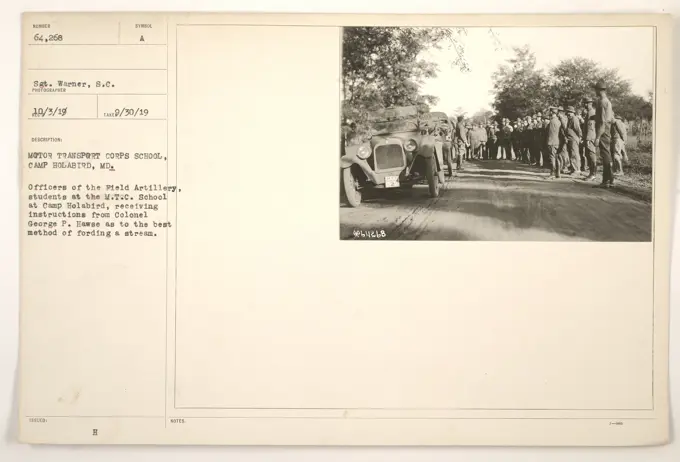
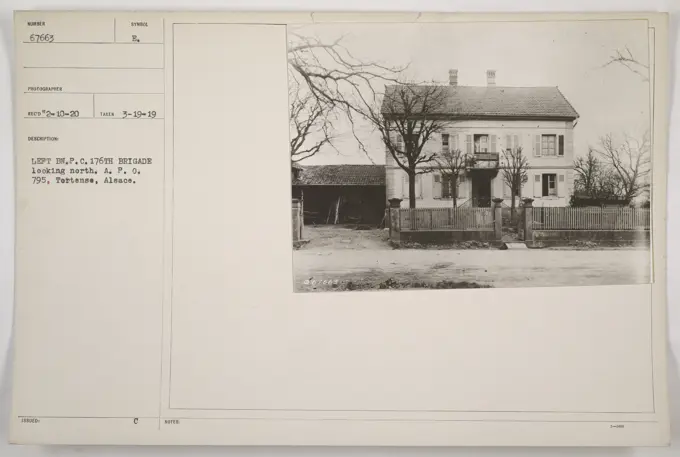
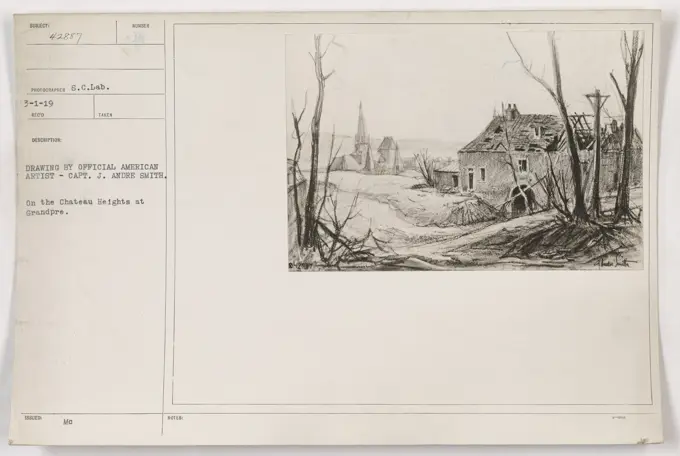
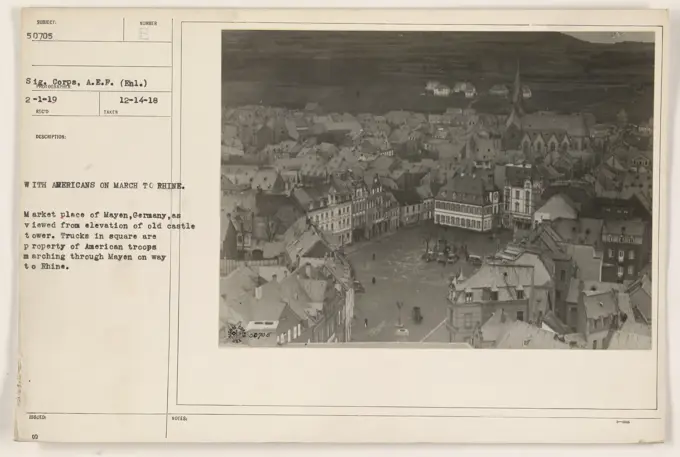
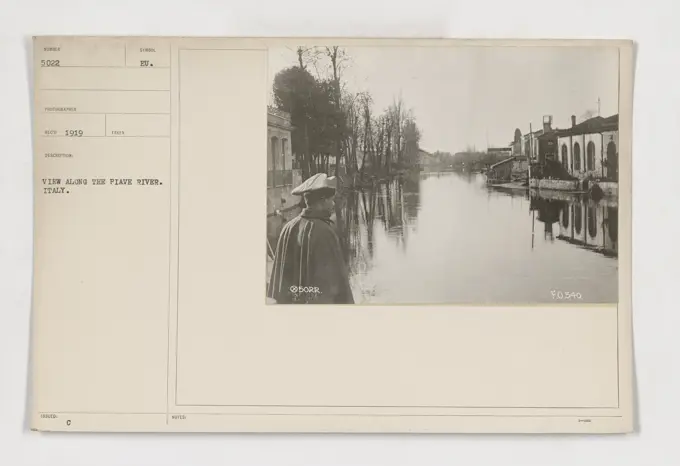
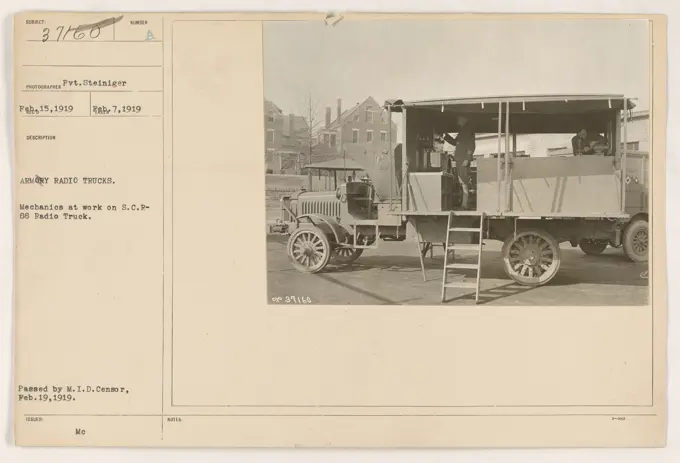
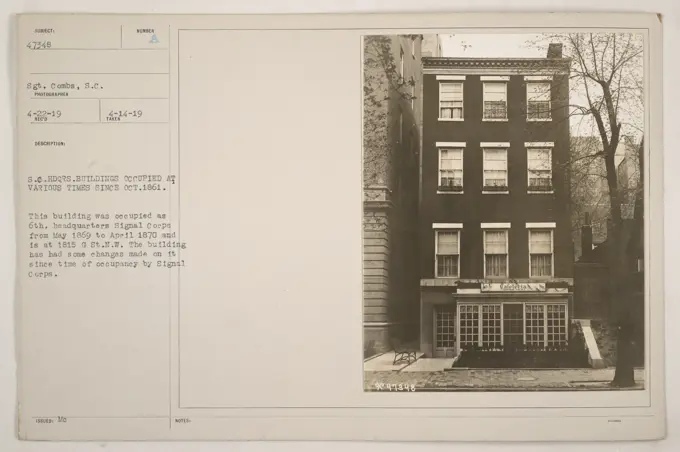
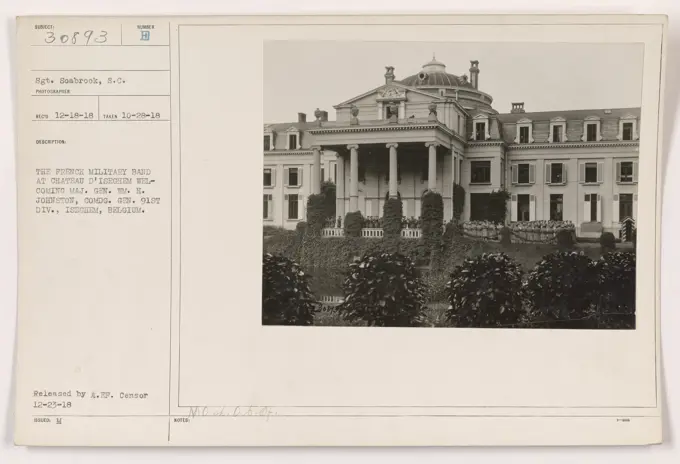
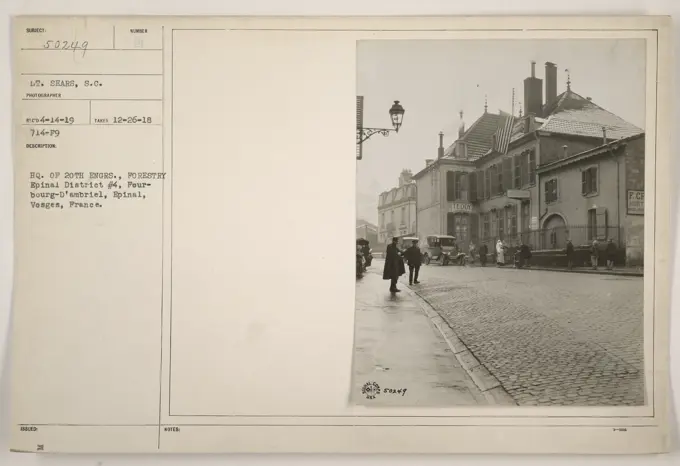
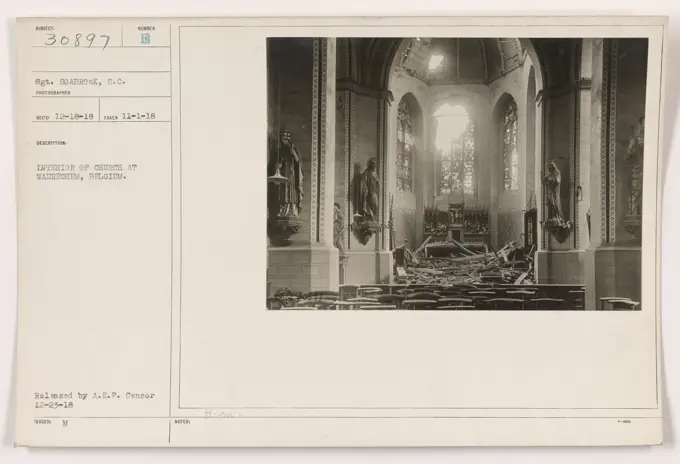
Street scene in Bignicourt, France showing the aftermath of heavy artillery fire from the enemy during World War One. Many buildings in the area were destroyed. This photograph was taken by G-2 66361 Photographer on Step 5-12-19 and is part of a series documenting American military activities during the war.Image depicting a stable guard house at Army Supply Base in Norfolk, VA. The photograph was taken on June 17, 1919, by Sergeant Me Garrigle, a photographer for the S.C. Army. The image is numbered 58390 and is part of a collection titled "Scenes at Army Supply Base, Norfolk, VA."U.S. Army athletes march to the U.S.S "Great Northern" for transport to France to compete in the Inter-Allied Games during World War One. The photograph was taken on June 6, 1919, by S.C. Steininger, an official photographer for the U.S. Army. The image was received and described on June 4, 1919.Supplies of motor gasoline and trucks are seen ready to go out in St. Nazaire, France during World War I. This photograph was taken on April 3, 1918, at the Reception Park of Auto Construction. It is important to note that this image was not intended for publication.Float showcasing the work of women in the Port Utilities Office during the Victory Loan Parade. This photograph, taken by Sgt. Combe on May 15, 1919, captures the parade passing by. It is archived under the RECO NUMBER 5-15-19 and contains additional notes labeled 4F 9948053 LLIM.First Division of the U.S. military parades through Victory Arch at 5th Avenue and Broadway in New York City. The composite regiment is seen at this prominent location, capturing the celebratory atmosphere during World War One. Sergeant Warner.S.C. Symbo took the photograph on September 10, 1919, and it was issued under the notes 63605.Lt. Col. Logan, Division Q.M., is seen on the left, along with Capt. Roper, Sup. Officer of the 144th Infantry in the center, and Col. Nimon, Commander of Trains, on the right. The photo was taken in Ervy, Aube, France on December 5, 1918. It is a candid moment of three officers consulting a map in the B Office of Division Q.M., which was strictly for business and located at railhead. PE.ML. # NOTES 40619.Photograph depicting the aftermath of a shell explosion in a town located in the northern area of the Toul sector during World War One. The image is an official war drawing by American military artist, Captain Ernest Peixetto. (Photographer: Signal Corps. Rec. G 1918)Members of the 106th Field Artillery are seen walking through the streets of Dannevoux in this photograph taken on October 18, 1918. The 106th Field Artillery belongs to the 33rd Division and is stationed in Dannevoux, Meuse, France. This photograph was received and taken by Sgt. C.H. Jackson of the Signal Corps. It was passed by the A.E.P. censor on December 24, 1918 and issued for use with notes 31940-A.Fifty soldiers march down a crowded New York street during a Victory Parade in 1919. In the background, an exhibit displays Trench Warfare ammunition from the Army Ordnance. This photograph, taken by Lieutenant Geo. H. Lyon, S.C., captures a moment of celebration and the pride of victorious soldiers.Soldiers at Camp Stuart, Virginia, walking along a concrete road. This photograph was taken in 1919 by the Signal Corps.Image showing the infirmary staff of medical personnel at Camp 5, Base Section 1, St. Nazaire, France during World War One. 2nd Lieutenant Wm. W. Winters, M.C.U.S.A. is the officer in charge seen on the left, and a German prison guard is also pictured. The photo was taken on August 15, 1918, and the censor approval date is not given.Pvt. E. R. Trabold, a photographer for the 8th Corps, took this photograph on November 21, 1919, in Verdun, Meuse, France. The image captures released prisoners and refugees receiving food provided by the French and Americans. This description is noted as 37652 in the collection.Rear view of main building showing tents used for venereal and contagious diseases at the U.S.A. Camp Hospital in Joinville, La Pont, Seine, France. The photograph is numbered 48829 and was taken by Sgt. J. C. Jones on January 16, 1919. There are also notes stating that there are 752 cases related to venereal and contagious diseases.President Wilson arriving at Guild Hall in London, England, greeted by a Guard of Honor and decorations. This photograph was taken in December 1918 and was part of the collection of American military activities during World War One. Symbol photographer: Signal Corps.West Point Class of 1921 during their tour in France, Belgium, and Germany. This photo shows a street in Fismes, France with Lieutenant Colonel G. R. Harrison capturing the scene on December 13, 1919. Image number 64680, photographer was Red.Group of officers from the Field Artillery receive instructions on the best techniques for crossing a stream at the Motor Transport Corps School in Camp Holabird, Maryland. They are taught by Colonel George P. Hawse. This photograph was taken on March 19, 1919, by Sergeant Warner, S.C.166th Infantry passing through Baccarat, France, headquarters of the 42nd Division. The photo was taken on April 27, 1918, by a photographer from the Signal Corps. The description symbol is B. It is labeled for official use only and identified as number 12310 in the collection.Soldiers in formation during a military exercise in Marchais. This photograph was taken by a photographer from the Red 5-12-19 team. The soldiers can be seen wearing G-2 gear and carrying equipment labeled with the symbol BU’.American soldiers gather in the town square of Altkirch, Alsace during World War One. This photograph was taken by an unidentified photographer from the Signal Corps. The image was received on February 10, 1920 and the description mentions a symbol issued on March 15, 1919. The town square appears peaceful, but note the bullet holes and scars from the conflict.This photograph shows the view looking north from the left battalion headquarters of the 176th Brigade in Tortense, Alsace. The photograph was taken on March 19, 1919, and was received on February 10, 1920. The photographer's description is marked with the symbol "E."Pvt. Pay P. Antrim of the 3rd A.C. is seen in this photograph taken by Sgt. B.M. Matlick on March 1, 1919, in Neuwied, Germany. The image shows Capt. D. S. Gressing, the Ordnance officer in charge, and his force. Pvt. Antrim was issued number 12-19-18.Lt. Downs and Pvt. Winger from the Signal Corps pose for a photo outside the Chief Surgeon Office Building in Nevers, France. Date taken: March 12, 1919. This photograph was issued on January 10, 1919, and its official number is 111-SC-42717.Caption: "Victory Parade in New York City, featuring a bake shop belonging to the 11th Cavalry. The photograph, taken by Lt. Lyon S.C., depicts members of the cavalry participating in the parade. The event celebrates the Allied victory in World War One, emphasizing the importance of sharing victory and the costs associated with it."Sgt. 1st Cl. C. H. White of the 117th Signal Battalion is seen at the radio station of Headquarters, 42nd Division in Baccarat, France on May 4, 1918. The photograph was taken by a photographer named RECO on June 6, 1918, and was censored and released by the M.I.B censor on June 10, 1918.Soldiers and American Red Cross officers photographed outside the Officers Rest Hotel in Ingleston, South Carolina during World War One. From left to right: Pvt. Herbert Roylance, 51st Pioneers; Miss Ruth Smith, A.R.C.; Miss M.D. Andress, A.R.C.; Pvt. J. Murphy, 51st Pioneers; and Joseph French, an associate. The image was captured as part of a tour in Meurthe et Moselle, France. Released by the A.E.F. Censor on January 7, 1919.Aerial view of telephone installations at Camp Zachary Taylor in Louisville, KY on February 22, 1919. The photograph shows an aerial cable turn looking toward the headquarters of the camp. The image was taken by the photographer on April 2, 1919, and is labeled as subject 43182.Caption: A photograph taken during the Victory Parade in New York, depicting the bomb release mechanism of the Harley-Page Bombing machine used by the military during World War One. The bomb release mechanism was produced by the Army Ordnance and was crucial in performing successful bombing operations.First American troops crossing the Rhine at Coblenz on December 13, 1918. The photo captures soldiers marching over a pontoon bridge. The image shows the significant role played by American forces in the aftermath of World War I. (50 words)Marines from the Second Division participating in a parade and review in Washington, D.C. The platoon is seen executing a right by squads maneuver. The photograph, taken on August 18, 1919, by GT. JOR HITZ.S.C., was officially issued with the notes 96223/3-10.Caption: Entrance to the Pathe Factory in Paris, France, decorated for the celebration on July 14, 1918. Photograph taken by Pvt. Mauldin of the US Army. The image is numbered 17562 and was received in 1918. It was in the possession of C Company and is identified as symbol photographer. Notes indicate that it was taken on July 14, 1918.Members of the Construction Division of the United States Military participate in a victory parade in New York City. They showcase their skills in concrete works, representing their contribution to the war effort during World War I. The photograph was taken on May 3, 1919, by photographer Geo.H.Lyon.S.C.Sgt. P. Busttner of the American military captured this photo on December 1, 1916. The image shows the population of Saapburg, in the Rhine Province of Germany, waiting for American troops as they advance towards the Rhine. The scene depicts the buildup of American military activities during World War One.A black and white photograph showing General Hospital #2 at Fort McHenry in Baltimore, Maryland. The photograph was taken by a Signal Corps photographer on February 24, 1919. The hospital is identified by the number symbol 61501. It was contracted by J. Henry Miller, Inc. #319.Soldiers gathered on a dock in Porto Rico during World War One. The photo, taken by the Signal Corps, captures scenes of military activities on the island. (50 words)A photograph taken on March 18, 1919, showing a hunting lodge in Alsace. It is identified by the number 67678 and was taken by a photographer from the Sig Corps. The image is part of the collection named "Photographs of American Military Activities during World War One."Soldiers resting at Camp Morn Hill in Winal Down, England. A photograph taken on July 29, 1918, during World War I. The image was issued under the authority of the A.E.F. censor. Caption notes indicate the photograph number as 18746."Navy machine gun nest at the Victory Parade in New York, NY. Photograph taken on May 3, 1919 by Lieutenant Lyon. Image number 47927."A group of military personnel stand outside the 88th Division Headquarters in Herecourt, France. Photographer Signature Corps, image number 67649. The photograph was received on February 10, 1920, and was described by E. Talen on March 11, 1919. Notes mention Comaxx 267649 and Hotel de la Poste.Sergeant W.S.Legge of the Signal Corps is seen in the photograph. The image was taken during World War One at the Radio Department Observers School in Tours, Indre et Loire, France. It was released for official use only in November 1919."Telephone installations at Fort Benjamin Harrison, Indiana, on March 1, 1919. A terminal pole is seen in front of the 34th Engineers officers mess. Photograph taken by LS. C. Seed, with the issued number 43129. 9043/29 - Photograph from the collection of American Military Activities during World War One."Pvt. Antrim of the U.S. Army photographed a truck train belonging to the 451st Motor Transportation Co. The train is seen moving the 3rd Army Corps towards the German frontier in Junglinster, Luxembourg on November 30, 1918. This image is part of the collection numbered 38495 and was captured on February 13, 1919. It was issued under the category M NOTEB 38415.Funeral procession for Major J.P. Mitchell in New York City on July 11, 1918. The photo was taken at 26th Street, with the Flatiron Building in the background.Caption: "Image caption from a series of photographs of American Military Activities during World War One. This specific image is a drawing by official artist T.S. A. Vacqueville, depicting the village of Vacqueville behind the lines. The drawing, done in color by Capt. J. Andre Smith, was censored and released by A.E.P. Censor."American soldiers patrolling the streets of St. Leger, Belgium during World War I. Lt. Paul W. Cloud is pictured here, overseeing the military activities. The photograph, taken on December 1, 1918, highlights the important role of American soldiers in maintaining security in war-torn areas.Cpl. J.J. Lyon of the U.S. Army Signal Corps captured this photograph on Dec. 27, 1916, at the civilian labor reception depot in St. Denis, near Paris, France. The entrance to the depot is shown in the image. It is uncertain when this photograph was cleared by the A.E.F. censor.Wounded soldiers of the 77th Division, who were still recovering, being transported in automobiles during a parade in New York City. This photograph, taken on May 6, 1919, by Lt. Lyon of the Signal Corps, captures the scene of the 77th Division Parade. Image source: Photographs of American Military Activities during World War One. Record number: 49879.MARYLAND: This photograph from the collection of American Military Activities during World War One shows Pier No. 6 at Locust Point, Maryland. This pier is where overseas freight was handled during the war. The photo features Subject 47492, CPL. STEINIGER, taken by photographer S.C. on April 18, 1919.A group of military Veterans marches in a Victory Parade in New York City, New York during World War I. The image shows the housing construction division that was responsible for providing accommodations for the army. The photograph was taken on May 3, 1919, by Lt. G.H. Lyon.S.C.This photograph shows Major General Clarence Edwards, General d'Esprey, and the Prince of Monaco in Paris, France in 1918 during World War One.The image shows the power house at Camp Pullman in Aytre, France, belonging to the 218th Grand Division Transportation Corps. This photograph was taken on November 22, 1918. It has a description symbol of RECO 7-15-19 and is labeled "Number 58105." This image is for official use only.Soldiers from the Clothing and Equipage Division participate in a victory parade in New York, NY. The photograph, taken on May 3, 1919, shows the soldiers marching in formation. Note that 1000 soldiers were involved in the parade.Soldiers from the 2nd Army Corps stand in the rear of the Cathedral of St. Quentin in Aisne, France. The photograph was taken by Lt. E.O. Harrs on October 14, 1918. No further information regarding the image's description or approval date is available.Soldiers entering Camp Hospital No. 27 in Tours, France. The photo, taken on Feb. 26, 1919, shows the entrance gate of the hospital. Photographer Pvt. Eddy captured the image during World War One, likely in 1918. It was later issued as part of the collection "Photographs of American Military Activities."Captain Ernest Peixotto of the Signal Corps in the U.S. Army is pictured in this photo. He is taking official drawings by American military artists in France during World War One. The photo was taken on November 4, 1918, in the Market Place of Fere-on-Tardenois. The image shows the damaged houses and the rounded slope of Hill 184 in the background. The drawing in the photo was done by Captain Ernest Peixotto himself.Wounded troops from the 369th Infantry Division are seen in ambulances during a parade in New York City. The photograph, taken by Lieutenant Geo. H. Lyon, S.C., is numbered 38757 and was taken on February 29, 1919 at 15:49.Members of the M.S.E. Esquadrilli, S.C. unit are seen in the photo. The image shows the kitchen yard of a house, which has been converted into barracks for the photo division of the Signal Corps. The location is Avenue de la Villa, Vincennes Paris, France. The photograph was checked and authorized by the A.E.F. censor, although the exact date is unknown.Electricians from the University of Florida Training Detachment are seen working on conduit installation. A line has been relayed from the dynamo room to an external conduit, which will provide power for lights above the road entrance. This photograph was taken by Photographer 59100 from S.A.T.C. University of Florida on April 27, 1919. The image contains detailed notes indicating that it is for official use only.111-SC-3317: Scene at Langley Field in Hampton, VA. The photograph depicts an aviation experiment station in Lamington, showing soldiers and equipment engaged in military activities during World War One. This image is from the collection of American Military Activities during WWI.2nd Lt. Nat. S. Dewell, SC, captures a photo of the Rosarium from the steps of Villa Henkel, now serving as the Division Headquarters for the 32nd Division. The owner of the villa, who currently resides in Dusseldorf, is also the proprietor of the "Henkel Chemical Fabric" factory, producing soda and saltpeter. Capt. Carl Hanton, Historical Officer, and 1st Lt. D.C. Crawford, aide-de-camp of the 32nd Division, can be seen on the left side of the image. The location is Rengsdorf, Germany.Soldiers waiting in line at the mess hall of the S.A.T.C., Knox College, in Galesburg, Illinois during World War One. The photograph was taken on March 29, 1919.Photograph 111-SC-6104 depicts the Officers' billet in Blois, France near the Casual Camp in January 1918. The image was captured by Rich Mar, a photographer for the 1818 Signal Corps, U.S.A. It is marked as not for publication and is part of the laboratory notes dated June 4th.Street in Rheims camouflaged with brown burlap for wartime concealment. The burlap is similar to theatrical drops.Band of 52D Pioneers Regiment, in front of Hq. Building, Adv. S.O.S. playing on New Year's Day for reception by Maj. Gen. C. P. Summerall of 5th Army Corps, Nogent en Bassigney, Marne, France. This photo was taken on January 1, 1919, by Lt. S.C. Sears. Image ID: 52029. Shot taken on 1-1-19.American military artist, Capt. Ernest Peixetto, took this official war drawing in 1918, depicting a bombarded town in the North Toul sector. The town has been deserted by its civil population. This photograph is part of the 2006 P signal corps polls collection. (111-SC-20068)Sgt. Gallivan captured a photograph on November 13, 1918, depicting General John J. Pershing awarding General Petain of the French Army with the Distinguished Service Medal at French headquarters in Provins, Seine et Marne, France. The photo was cleared by the A.E.F. censor and is marked with the reference number 31505.Soldiers seated in a reading room at the Committee on Public Information, Mexico Section, City of Mexico. Note: Image is for official use only. Image reference: 111-SC-16535.An image showing a building in Baraguey d'Hilliers, France, used by officers of the Chief Quarter- master of the American Expeditionary Force (A.E.F). The photograph was taken by Cpl. F.G. Carnochan. No specific date is provided, but the image was approved by the A.E.P. Consor and assigned the reference number 111-SC-25870.Caption: Sergeant McGarrigle at Police Headquarters - Camp Joseph E. Johnston, Jacksonville, FL, November 22, 1918. This photograph was taken by an American military photographer on November 29, 1918, and received on December 4, 1918. The image shows Sgt. McGarrigle in uniform at the police headquarters of the camp."Soldiers at Love Field in Dallas, Texas, conducting radio work during World War One. The radio station is set up on the structure of a tank. Image number 37821. Captured on September 3, 1918, and released for official use only, as per censorship by the M.I.D."American soldiers on the Chateau Heights at Grandpre, France during World War One. Photograph captures Captain J. André Smith, an official American artist, sketching the scene.American troops and their vehicles can be seen in the market place of Mayen, Germany, as viewed from an elevation of an old castle tower. This image was taken during World War I when the American troops were marching through Mayen on their way to the Rhine. The trucks in the square belong to the American troops.Soldiers patrolling along the Piave River in Italy during World War I. The image was taken in 1919 and captures the military activities in the area. It depicts the soldiers equipped with weapons and wearing uniforms. The photograph was labeled as "BORR. FOS40" in the archive.The photograph depicts the rear of Bachelor Officers Quarters at Fort Leavenworth in Kansas during World War One. It shows the wiring for telephone installations in the alley of the quarters. This image is part of the collection 111-SC-43176, taken by photographer 4-2-19. Census records indicate that Cpl. Jack W. Mills served at Fort Leavenworth during this period. He was ten years old at the time.Mechanics working on an S.C.R-88 Radio Truck at an armory. The photo was taken by Pvt. Steiniger on February 15, 1919, and was passed by the M.I.D. censor on February 19, 1919. Caption notes suggest the truck is equipped with radio communication.Soldiers at an Army base in Port Newark, New Jersey during World War I. The photograph, taken by a Signal Corps photographer, shows military activities at the base. The image was issued with the symbol AU TAX12/19/18 and is part of the collection numbered 39,991. It was taken on December 19, 1918.Pvt. Jas.W. Morse, S.C., captured this photograph on Dec. 13, 1918, at Le Bourget, Seine, France. The image shows the orderly room at the commission used for the reception of Avions. This photo is part of the collection of American Military Activities during World War One, specifically depicting scenes from the front lines."Building at 1815 G St. N.W., occupied as 6th headquarters Signal Corps from May 1869 to April 1870. Modifications made since then. Photograph taken on 4-22-19. Description number 4-14-19. Sergeant Combs pictured. Photographer: unknown. Source: Photographs of American Military Activities during World War One."French military band at Chateau d'Isenheim welcoming Major General M.H. Johnston, Commanding General of the 91st Division, in Isechem, Belgium. The photograph was taken on October 28, 1918 and received on December 18, 1918. It was released by the A.E.F. Censor on December 23, 1918. The image includes approximately 1500 people.Image of Lt. Sears at the headquarters of the 20th Engineers, Forestry Epinal District #4, Fourbourg-D'ambriel, Epinal, Vosges, France. The photo, taken on December 26, 1918, reveals Lt. Sears in a military uniform. This photo was issued with the number F50249, captured by photographer REC04-14-19, and archived as 714-79.Damage caused by bombing inside a church in Waereghem, Belgium during World War One. The photograph, taken by Sgt. S0 Abrook on November 1, 1918, shows the destruction caused by the war. It was released by the A.E.F. censor on December 23, 1918.Crowd outside shed , Armories, Ordnance industry, Crowds, Watertown Arsenal Mass..  Records of U.S. Army OperationalPhotograph of the 88th Division Headquarters in Valdoie, France, taken on October 3, 1918. The photographer is from the Signal Corps and the description was issued with the symbol "E". The location is north of Belfort. Please note the caption does not have any further details.Soldier operating a repeater unit for telegraph communications at the Signal Corps office in Limoges, France. The photo was taken on January 12, 1919. In the background, there is a sign for "La Banque de Bordeaux" and other nearby businesses.This image shows the view looking south from Right Battalion 176th Brigade in Badricourt, Alsace. The photograph was taken in 1919 by a photographer from the Signal Corps. The image is part of a series identified by the number 67718. The description was issued with the photograph and includes the symbol E. NOTE: The last sentence appears to be cut off, so the information is incomplete.The image depicts the Church of Reherry, a village where soldiers found respite from the trenches during World War I. Despite the ongoing war, the village remained untouched and possessed natural beauty. The presence of army mules, trucks, and occasional aerial scouting visits served as a reminder of the war happening just a few miles away. Drawn by Capt. J. Andre Smith. This photograph is not meant for public use and is intended for official purposes only. Related image: 14340 F. (50 words)Caption: Capt. Earl Cooper, S.C., photographed a wrecked bridge over a canal in Remilly, Ardennes, France on November 13, 1918. This image, labeled as Subject 39183, was taken on February 26, 1919. Source: Photographs of American Military Activities during World War One - 111-SC-39283.Soldiers gather outside the Y.M.C.A. building in Dijon, France during World War I. The photograph was taken by Sgt. Reyden on December 2, 1918, and can be seen in the records of American Military Activities during the war. The image was approved by the A.E.P. censor, although the exact date of approval is unknown.Sgt. Leo Morper, S.C, photographed Camp Hospital No. 87 at Cour Cheverny. The hospital is located at the Signal Corps Replacement Depot, where Capt. A.H. Dunn serves as both the Commanding Officer and Chief Surgeon. The photograph was taken on November 30, 1918, in Cour Cheverny, Loir et Cher, France. It was approved by the A.E.F. censor, but no specific date was provided.Men in cars in France, on the right a Slee, Anonymous, 1902 photograph Part of photo album of an army exercise in Southwest France in 1902. France paper. photographic support  automobile. sledge, sleigh (winter sports) FranceAnefo photo collection. Terror. Putten 1945. April 18, 1945. Gelderland, PuttenA photograph of the Right Battalion Headquarters of the 175th Brigade during World War One. The photo was taken by a photographer with Reco in 1919. It was part of the 81st Corps and issued with the symbol E. The taker of the photo is noted as March 18, 1919."Headquarters Supply Train of the 1st Division, led by Col. Stewart, halts on Lincoln Highway approximately 15 miles northeast of Baltimore while enroute from New York City to Washington, D.C. Sgt. Warner captured the moment on Sept. 13th, 1919."Soldiers observing a drawing by official American artist Captain J. Andre Smith in Bramme village on the Moselle during World War I.Soldiers participating in a retreat ceremony at Walter Reed Hospital's vocational school for wounded soldiers in Washington, D.C. - Image 37166 from the series Photographs of American Military Activities during World War One.Anefo photo collection. Recovery. Arnhem. 1945. Arnhem, GelderlandCorp. Keen Polk, S.c. took this photograph on May 5, 1918, in Euville, France. The image captures Algerian troops observing the passing of Companies A and B from the 101st Supply Train. This photograph was classified as not suitable for publication.Group of American soldiers participating in the Students Army Training Corps in Helena, Montana during World War One. The soldiers are wearing military uniforms and standing in formation.Soldiers for a car, Anonymous, 1941 - 1945 photograph This photo is part of an album. Netherlands paper. photographic support gelatin silver print occupation ~ war. historical persons. road, path. automobile NetherlandsCousin, barracks of the Guard Cuerassier Regiment and the Queen-Augusta-Garde-Grenadier Regiment No. 4, Berlin (1895-1897): Guard-Cürassier-Regiment, officer-Faternitals: Grundriss Earth floor 1: 100. Lithograph colored on cardboard, 54.1 x 56.9 cm (including scan edges) Vetter : Kaserne des Garde-Kürassier-Regiments und des Königin-Augusta-Garde-Grenadier-Regiments Nr. 4, Berlin