My Boards
View Pictures
  • My Boards

Historical Moon Missions

Iconic lunar exploration images featuring astronauts on the moon's surface, documenting key moments from Apollo missions.

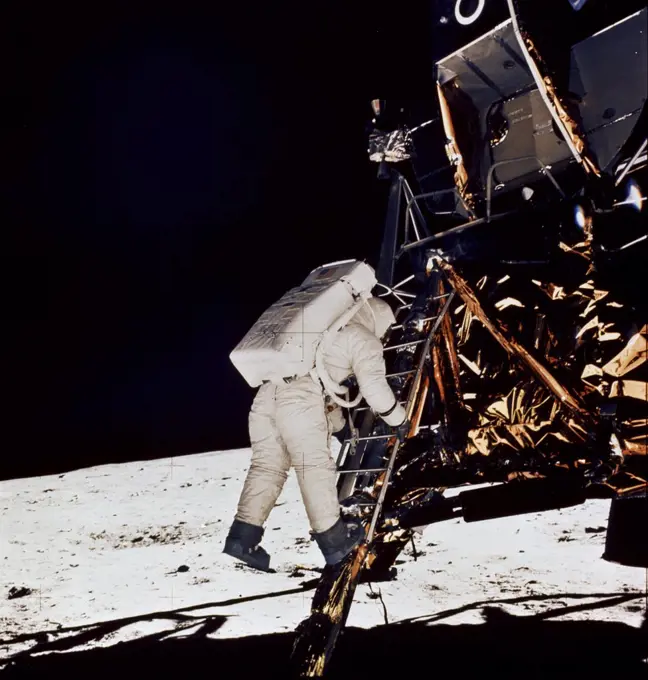
Edwin E. Aldrin, Jr, descending the lunar module ladder to the moon surface, Apollo 11, July 20, 1969
154 assets in this story
6145-45233145
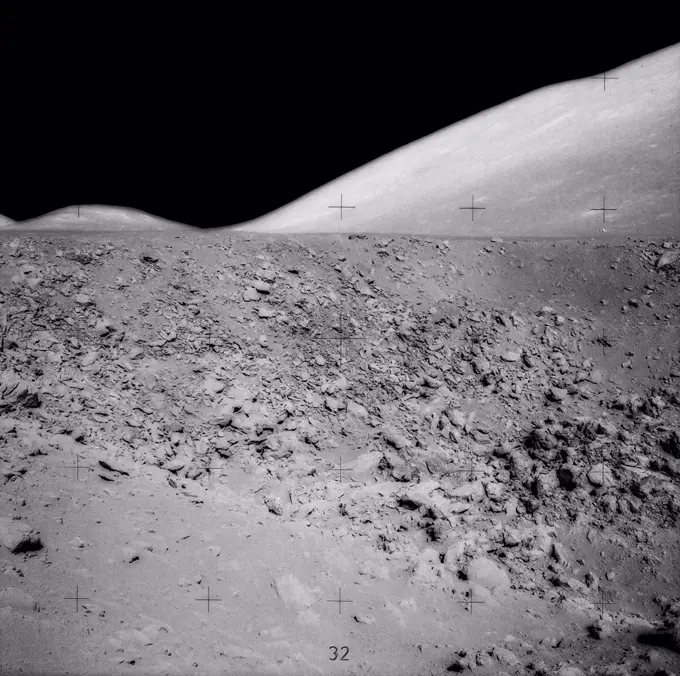
AS15-82-11123 (2 Aug. 1971) --- A view of the strewn rock scene encountered by Apollo 15 astronauts David R. Scott, commander, and James B. Irwin, lunar module pilot, during their third extravehicular activity (EVA) of the mission. Irwin took this photograph with a handheld 70mm camera. While astronauts Scott and Irwin descended in the Lunar Module (LM) Falcon to explore the moon, astronaut Alfred M. Worden, command module pilot, remained with the Command and Service Modules (CSM) in lunar orbit.
6145-45233153
AS17-134-20473 (13 Dec. 1972) --- Earth appears in the far distant background above the hi-gain antenna of the Lunar Roving Vehicle in this photograph taken by scientist-astronaut Harrison H. Schmitt during the third Apollo 17 extravehicular activity (EVA) at the Taurus-Littrow landing site. Astronaut Eugene A. Cernan, Apollo 17 commander, stands beside the LRV. Schmitt is the mission's lunar module pilot. While Cernan and Schmitt descended in the lunar module Challenger to explore the moon, astronaut Ronald E. Evans, command module pilot, remained with the Command and Service Modules in lunar orbit.
6145-44755764
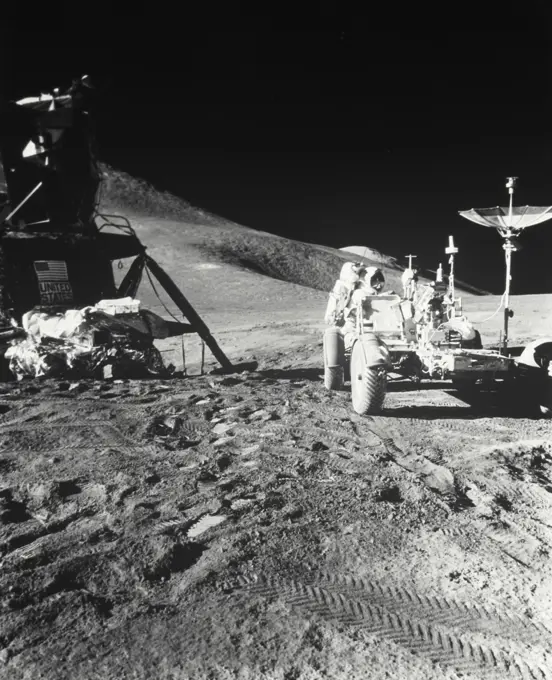
AS16-114-18439 (22 April 1972) --- Astronaut Charles M. Duke Jr., lunar module pilot, stands in the shadow of the Lunar Module (LM) behind the ultraviolet (UV) camera which is in operation. This photograph was taken by astronaut John W. Young, commander, during the mission's second extravehicular activity (EVA). The UV camera's gold surface is designed to maintain the correct temperature. The astronauts set the prescribed angles of azimuth and elevation (here 14 degrees for photography of the large Magellanic Cloud) and pointed the camera. Over 180 photographs and spectra in far-ultraviolet light were obtained showing clouds of hydrogen and other gases and several thousand stars. The United States flag and Lunar Roving Vehicle (LRV) are in the left background. While astronauts Young and Duke descended in the Apollo 16 Lunar Module (LM) Orion to explore the Descartes highlands landing site on the moon, astronaut Thomas K. Mattingly II, command module pilot, remained with the Command and
6145-45238243
The Lunar Roving Vehicle (LRV) was designed to transport astronauts and materials on the Moon. An LRV was used on each of the last three Apollo missions, Apollo 15, Apollo 16, and Apollo 17, in 1971 and 1972 to permit the crew to travel several miles from the lunar landing site. This photograph was taken during the Apollo 15 mission.
4239R-20480288
Apollo 17. The western wall of Van Serg with (Old) Family Mountain left of center on the horizon and the North Massif on the right.
255-22862
Astronaut David R. Scott, Apollo 15 Mission, 1971
6145-44718526
S72-55065 (11 Dec. 1972) --- Scientist-astronaut Harrison H. Schmitt is seen anchoring the geophone module with a flag during the first Apollo 17 extravehicular activity (EVA) at the Taurus-Littrow landing site, in the black and white reproduction taken from a color television transmission made by the color RCA TV camera mounted on the Lunar Roving Vehicle. Schmitt is the lunar module mounted on the Lunar Roving Vehicle. Schmitt is the lunar module pilot of the Apollo 17 lunar landing mission. Astronaut Ronald E. Evans, command module pilot, remained with the Apollo 17 Command and Service Modules in lunar orbit while astronauts Schmitt and Eugene A. Cernan, commander, descended in the Lunar Module to explore the moon. The geophone module is part of the Lunar Seismic Profiling Experiment (S-203), a component of the Apollo Lunar Surface Experiments Package (ALSEP). Other ALSEP components are visible in the picture.
1570-V111111121
6145-44743331
Photo by Apollo Crew The Apollo 14 crew catch a cresent view of the Earth as it raises above the lunar horizon during one moon orbit
4239R-20480090
A high forward oblique view of Rima Ariadaeus on the Moon, as photographed by the Apollo 10 astronauts in May of 1969.
6145-45240044
AS14-66-9340 (6 Feb. 1971) --- A view from inside the Lunar Module (LM) following the second Apollo 14 extravehicular activity (EVA). At the left foreground is the modularized equipment transporter (MET). Tracks made by the two-wheeled Rickshaw -type cart can be seen in the left background. The Apollo 35mm stereo close-up camera lies next to the MET, near a huge shadow of the erectable S-Band antenna. The area is largely covered with bootprints made by astronauts Alan B. Shepard Jr., commander, and Edgar D. Mitchell, lunar module pilot. While the pair explored the moon, astronaut Stuart A. Roosa, command module pilot, remained with the Command and Service Modules (CSM) in lunar orbit.
1899-61056
Astronaut Schmitt, Apollo 17, Near Us Flag At Taurus-Littrew Site.
1457R-1071
Astronauts with In Situ Resource Utilization on the moon's south pole
1525-28439189
lunar landing mission on the Moon
6145-44512965
Photomosaic of lunar panorama near the Tycho crater taken by Surveyor 7. The hills on the center horizon are about eight miles away from the spacecraft.
1035-20589380
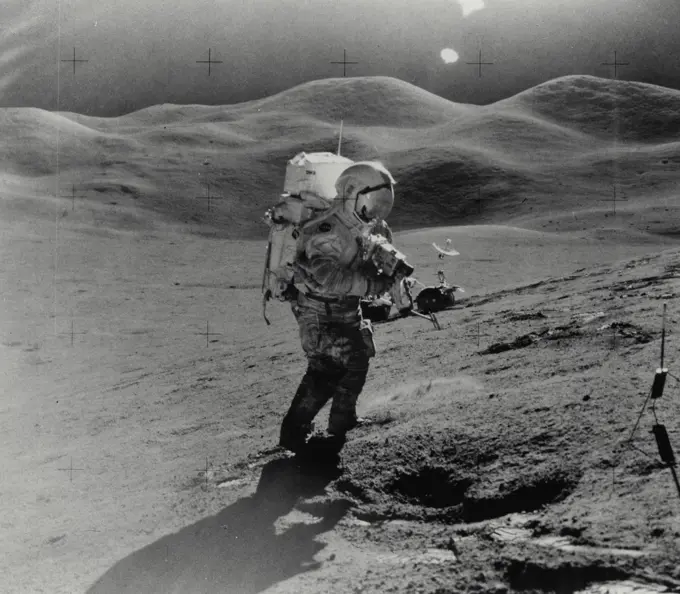
Moon: December 12, 1972 Astronaut Harrison Schmitt, lunar module pilot, standing next to a huge split boulder during the third Apollo 17 extravehicular activity in the TaurusÐLittrow valley landing site.
6177-V53855879
4409-17309622
CRATER HERODOTO 35 KM LARGO FOTO DESDE APOLO 15.
1570R-133475
Two astronauts on the moon enjoying some leisure time
1838-51330362
U.S. flag deployed on moon surface surrounded by footprints of astronauts Neil A. Armstrong and Edwin E. Aldrin Jr., with lunar surface television camera in background, photographed from inside Lunar Module, Kennedy Space Center, NASA, July 20, 1969
6145-45236713
AS15-87-11849 (31 July-2 Aug. 1971) --- An excellent view of Mount Hadley, fully lighted, showing abundant linear features, as photographed during the Apollo 15 lunar surface extravehicular activity (EVA). This view is looking north from the Apollo Lunar Surface Experiments Package (ALSEP) site. Mount Hadley rises about 4,500 meters (approximately 14,765 feet) above the plain. While astronauts David R. Scott, commander, and James B. Irwin, lunar module pilot, descended in the Apollo 15 Lunar Module (LM) Falcon to explore the Hadley-Apennine area of the moon, astronaut Alfred M. Worden, command module pilot, remained with the Command and Service Modules (CSM) in lunar orbit.
6145-44527097
S72-55300 (13 Dec. 1972) --- The two moon-exploring Apollo 17 crewmen are seen standing near the deployed U.S. flag during the third extravehicular activity (EVA) at the Taurus-Littrow landing site, in this black and white reproduction made from a color television transmission made by the color RCA TV camera mounted on the Lunar Roving Vehicle. They are astronaut Eugene A. Cernan (on left), commander; and scientist-astronaut Harrison H. Schmitt, lunar module pilot. Astronaut Ronald E. Evans, command module pilot, remained with the Apollo 17 Command and Service Modules in lunar orbit.
6145-44715975
S69-55553 (October 1969) --- Ryan Aeronautical Company artist's concept depicting a close-up view of Surveyor 3 resting in the Ocean of Storms on the lunar nearside. Two Apollo 12 astronauts are seen approaching in the background. The Apollo 12 Lunar Module (LM) is in the left background. The Earth is in the right background. The inspection of Surveyor 3, which has been resting on the moon since April 1967, is an important objective of the Apollo 12 lunar landing mission. Selected pieces of Surveyor 3 will be brought back to Earth for scientific examination. Ryan landing radar has guided both Surveyor and Apollo spacecraft to soft landings on the moon.
7050-70037053
USA, Florida, Titusville, Kennedy Space Center, Apollo/Saturn V center, NASA, astronaut on moon display.
255-22865
Astronaut James B. Irwin, Lunar Roving Vehicle, Apollo 15 Mission, 1971
6145-45240251
AS16-116-18653 (23 April 1972) --- Astronaut Charles M. Duke Jr., Apollo 16 lunar module pilot, stands at a big rock adjacent (south) to the huge House Rock (barely out of view at right edge). Note shadow at extreme right center where the two moon-exploring crew members of the mission sampled what they referred to as the east-by-west split of House Rock or the open space between this rock and House Rock . At their post-mission press conference, the crewmen expressed the opinion that this rock was once a part of House Rock which had broken away. The two sampled the big boulder seen here also. Duke has a sample bag in his hand, and a lunar surface rake leans against the large boulder. Astronaut John W. Young, commander, exposed this view with a color magazine in his 70mm Hasselblad camera. While astronauts Young and Duke descended in the Apollo 16 Lunar Module (LM) Orion to explore the Descartes highlands landing site on the moon, astronaut Thomas K. Mattingly II, command module pilot, r
6145-45297214
AS14-67-9364 (5 Feb. 1971) --- A close-up view of the charged particle lunar environment experiment (CPLEE), a component of the Apollo lunar surface experiments package (ALSEP) which was deployed on the moon by the Apollo 14 astronauts. While astronauts Alan B. Shepard Jr., commander, and Edgar D. Mitchell, lunar module pilot, descended in the Lunar Module (LM) to explore the moon, astronaut Stuart A. Roosa, command module pilot, remained with the Command and Service Modules (CSM) in lunar orbit.
6177-V53839717
1570R-133484
An astronaut gardening on the moon
7067-69953544
USA, Florida, Titusville, Kennedy Space Center, Apollo/Saturn V center, NASA, astronaut on moon display.
6145-44618625
Sitting on the lunar surface, this Solar Wind Spectrometer is measuring the energies of the particles that make up the solar wind. This was one of the instruments used during the Apollo 12 mission. The second manned lunar landing mission, Apollo 12 launched from launch pad 39-A at Kennedy Space Center in Florida on November 14, 1969 via a Saturn V launch vehicle. The Saturn V vehicle was developed by the Marshall Space Flight Center (MSFC) under the direction of Dr. Wernher von Braun. Aboard Apollo 12 was a crew of three astronauts Alan L. Bean, pilot of the Lunar Module (LM), Intrepid; Richard Gordon, pilot of the Command Module (CM), Yankee Clipper; and Spacecraft Commander Charles Conrad. The LM, Intrepid, landed astronauts Conrad and Bean on the lunar surface in whats known as the Ocean of Storms while astronaut Richard Gordon piloted the CM, Yankee Clipper, in a parking orbit around the Moon. Lunar soil activities included the deployment of the Apollo Lunar Surface Experiments Pa
4389-308
Apollo 17 - The Crescent Earth Rises
1574R-34936
The Lunar CRater Observation and Sensing Satellite (LCROSS)
4048-10595
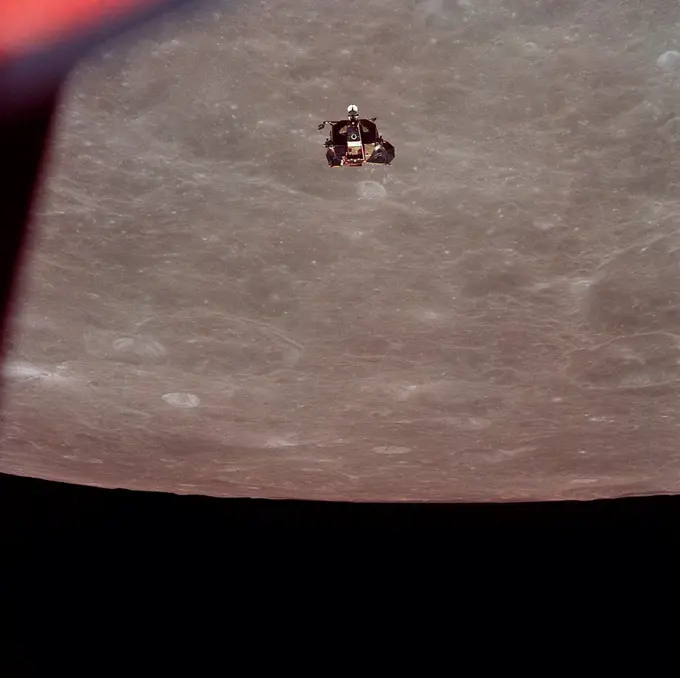
The Apollo 11 Lunar Module ascending from Moon's surface. July 20, 1969.
4239R-8787
Astronaut exploring an asteroid in outer space.
4239R-20480261
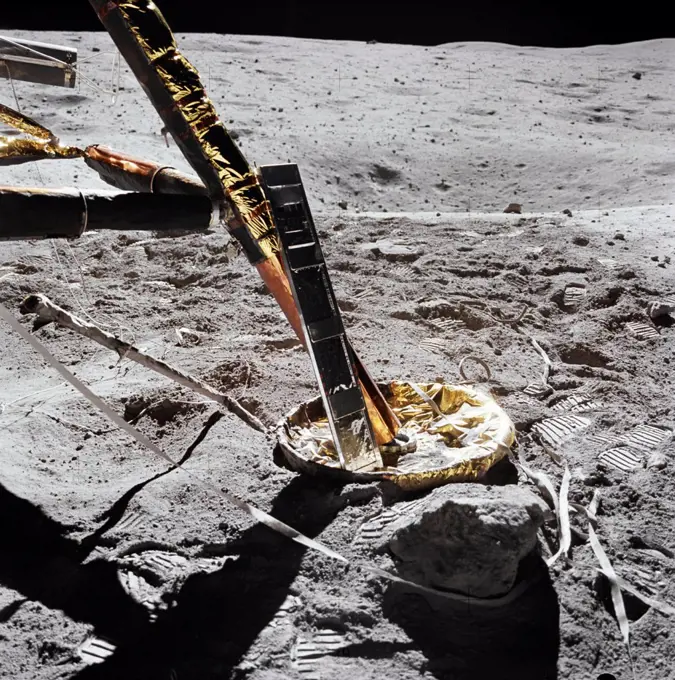
April 22, 1972 - A close-up view of the Apollo 16 Cosmic Ray Detector (CRD) experiment deployed at the +Y strut of the Lunar Module. The crew members moved it to this position from near the deployment site of the Apollo Lunar Surface Experiments Package (ALSEP) because, in the words of astronaut John W. Young, commander, The panels were getting a little warm. Note that the Lunar Module did not skid upon landing, as evidenced by the landing contact probe's folded back (neatly) position and the la
1838-51330369
First human footprint on moon surface during Apollo 11 space mission, Johnson Space Center, NASA, July 21, 1969
1746-29958666
from a series of cards for Brooke Bond Tea; 1973; "The Race into Space", illustrated by David Lawson; illustrated colour image of Lunar Roving Vehicle intended to be carried by Apollo 16, 17, 18 and 19 (A series of 50 cards, no. 42).
6145-45297210
AS17-146-22351 (7-19 Dec. 1972) --- This view, photographed by astronaut Eugene A. Cernan, shows a large boulder which was discovered by astronauts Cernan and Harrison H. Schmitt during one of their space walks. The astronauts later pointed out light clasts on the boulder. South Massif is in the background. Tracks left by the Lunar Roving Vehicle (LRV) can be seen near foreground. While astronauts Cernan, commander, and Schmitt, lunar module pilot, descended in the Lunar Module (LM) Challenger to explore the Taurus-Littrow region of the moon, astronaut Ronald E. Evans, command module pilot, remained with the Command and Service Modules (CSM) America in lunar orbit.
6145-45240262
AS17-137-20992 (12 Dec. 1972) --- A view looking into Shorty Crater, taken at Station 4, showing the orange soil. Astronaut Harrison H. Schmitt found the orange soil on the moon during the second Apollo 17 extravehicular activity (EVA) at the Taurus-Littrow landing site. While astronauts Eugene A. Cernan, commander, and Schmitt, lunar module pilot, descended in the Lunar Module (LM) Challenger to explore the Taurus-Littrow region of the moon, astronaut Ronald E. Evans, command module pilot, remained with the Command and Service Modules (CSM) America in lunar orbit.
6145-45238982
AS11-44-6626 (21 July 1969) --- The Apollo 11 Lunar Module (LM) ascent stage, with astronauts Neil A. Armstrong and Edwin E. Aldrin Jr. aboard, is photographed from the Command and Service Modules (CSM) in lunar orbit. Astronaut Michael Collins, command module pilot, remained with the CSM in lunar orbit while Armstrong and Aldrin explored the moon. The LM is approaching from below. The coordinates of the center of the lunar terrain seen below is located at 102 degrees east longitude and 1 degree north latitude.
6145-44618423
This is a detailed view of the back side of Moon in the vicinity of Crater No. 308 taken during the Apollo 11 mission. Apollo 11, the first manned lunar mission, launched from The Kennedy Space Center, Florida via a Saturn V launch vehicle on July 16, 1969 and safely returned to Earth on July 24, 1969. The Saturn V vehicle was developed by the Marshall Space Flight Center (MSFC) under the direction of Dr. Wernher von Braun. The 3-man crew aboard the flight consisted of Neil A. Armstrong, commander; Michael Collins, Command Module pilot; and Edwin E. Aldrin Jr., Lunar Module pilot. The Lunar Module (LM), named Eagle, carrying astronauts Neil Armstrong and Edwin Aldrin, was the first crewed vehicle to land on the Moon. Meanwhile, astronaut Collins piloted the Command Module in a parking orbit around the Moon. Armstrong was the first human to ever stand on the lunar surface, followed by Edwin (Buzz) Aldrin. The crew collected 47 pounds of lunar surface material which was returned to Eart
1899-19513208
(7-19 Dec. 1972) --- This 70mm frame features a close-up view of a large multi-cracked boulder discovered by astronauts Eugene A. Cernan, commander, and Harrison H. (Jack) Schmitt, lunar module pilot, during their visit to extravehicular activity (EVA) Station 6.
6145-45237695
AS17-137-21011 (12 Dec. 1972) --- An excellent view of the desolate lunarscape at Station 4 showing scientist-astronaut Harrison H. Schmitt, lunar module pilot, working at the Lunar Roving Vehicle (LRV) during the second Apollo 17 extravehicular activity (EVA) at the Taurus-Littrow landing site. This is the area where Schmitt first spotted the orange soil, the orange soil is clearly visible on either side of the LRV in this picture. Shorty Crater is to the right, and the peak in the center background is Family Mountain. A portion of South Massif is on the horizon at the left edge. This photograph was taken by astronaut Eugene A. Cernan, commander. While astronauts Cernan and Schmitt descended in the Lunar Module (LM) Challenger to explore the moon, astronaut Ronald E. Evans, command module pilot, remained with the Command and Service Modules (CSM) in lunar orbit.
6145-44756025
AS16-120-19332 (April 1972) --- This picture of the lunar surface was photographed from lunar orbit during the Apollo 16 lunar landing mission. Mersenius C Crater, dozens of smaller craters and several small rille features can be seen in the frame. Center point coordinates are located at 19.5 degrees south latitude and 45 degrees west longitude. While astronauts John W. Young, commander; and Charles M. Duke Jr., lunar module pilot; descended in the Apollo 16 Lunar Module (LM) "Orion" to explore the Descartes highlands landing site on the moon, astronaut Thomas K. Mattingly II, command module pilot, remained with the Command and Service Modules (CSM) "Casper" in lunar orbit.
1848-57204355
Lunar Roving Vehicle
6145-29241252
Lunar Surface Photographed by Surveyor V 1967 National Aeronautics and Space Administration (NASA) American. Lunar Surface Photographed by Surveyor V. National Aeronautics and Space Administration (NASA). 1967. Gelatin silver print. Photographs
4239-57496204
Lunar city. Earth rise seen from the moon.
6145-44516160
View of Command and Service Module (CSM) over the surface of the moon as it travels over the west Sea of Tranquility, the landing site of the Lunar Module (LM). Crater Schmidt is visible. Image taken from inside the LM from orbital altitude over the moon during the Apollo 11 Mission. Original film magazine was labeled R.  Film Type:  Ektachrome EF SO 168 Color on a 2.5 mil Estar polyester base,taken with an 80mm lens. Approximatel Photo Scale: 1:1,385,200. Principal Point Latitude 0.5 degrees North,Longitude 18.5 degrees East. Sun angle is Low. Approximate tilt angle minimum is 5,maximum 10. Tilt direction: West (W).
6145-44516937
JOHNSON SPACE CENTER, HOUSTON, TEXAS -- Armstrong and Aldrin landed on the Moon July 20, 1969, and, after take-off from the Moon July 21, joined Collins in the Command Module circling the Moon.  The astronauts splashed down in the Pacific Ocean and recovery was made by the U.S.S. Hornet at 12:50 p.m. EDT, July 24, 1969.
1570R-130677
An American flag on the surface of the moon
1570R-130658
HELP message written on the surface on the moon
6145-45240052
AS14-67-9362 (5 Feb. 1971) --- A close-up view of the passive seismic experiment (PSE), a component of the Apollo lunar surface experiments package (ALSEP), which was deployed on the moon by the Apollo 14 astronauts during their first extravehicular activity (EVA). While astronauts Alan B. Shepard Jr., commander, and Edgar D. Mitchell, lunar module pilot, descended in the Lunar Module (LM) to explore the moon, astronaut Stuart A. Roosa, command module pilot, remained with the Command and Service Modules (CSM) in lunar orbit.
6145-44715992
S69-59538 (November 1969) --- Apollo 12 extravehicular activity (EVA-2) Traverse Overlay.
PREVIOUS
of 2
NEXT
2401 S. Ervay, Suite 206
Dallas, Texas 75215
United States
Get Started
Free ResearchMy BoardsMy Cart
For Creators
How To License Your ContentContributor PortalFrame of Mind
Resources
API accessPricing
Contact
+1 866 236 0087help@viewpictures.co.uk Contact form
©2026 View Pictures. All Rights Reserved. -A
This site is protected by reCAPTCHA and Google Privacy Policy and Terms of Service apply.