My Boards
View Pictures
  • My Boards

Impressive Gas Giants and Moons

Stunning images of Saturn and its moon Titan, alongside visuals of exoplanets and Jupiter with its moons, showcasing vibrant colors and celestial grandeur.

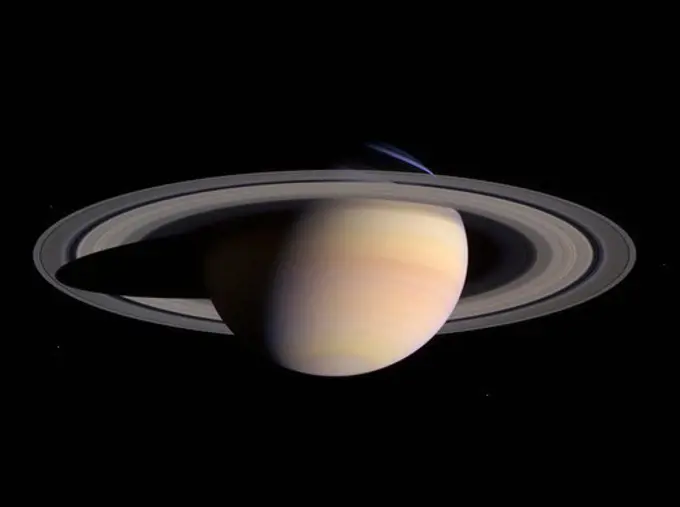
Beautiful Saturn, as Seen by the Cassini Space Probe
170 assets in this story
6145-44510934
Jovian Ring System Mosaic
4239R-575
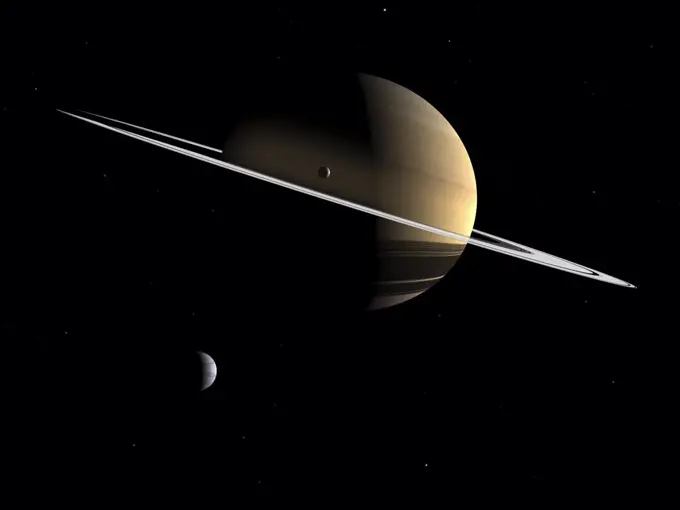
Artist's concept of Saturn and its moons Dione and Tethys
6145-45262238
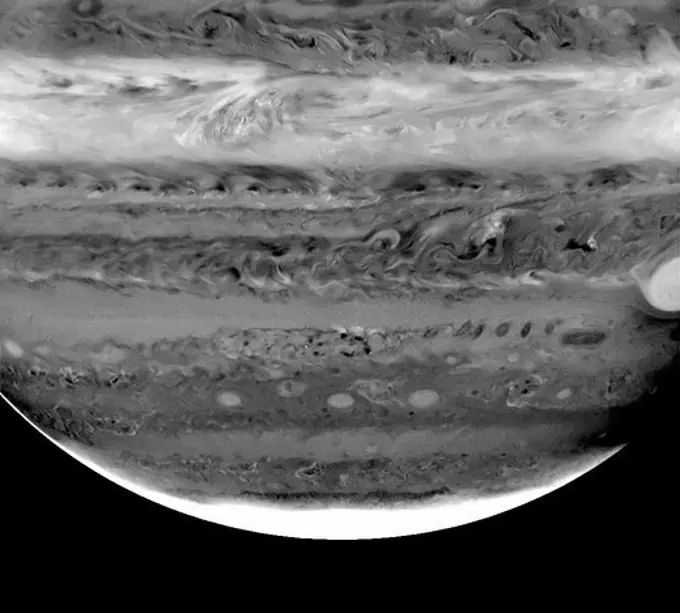
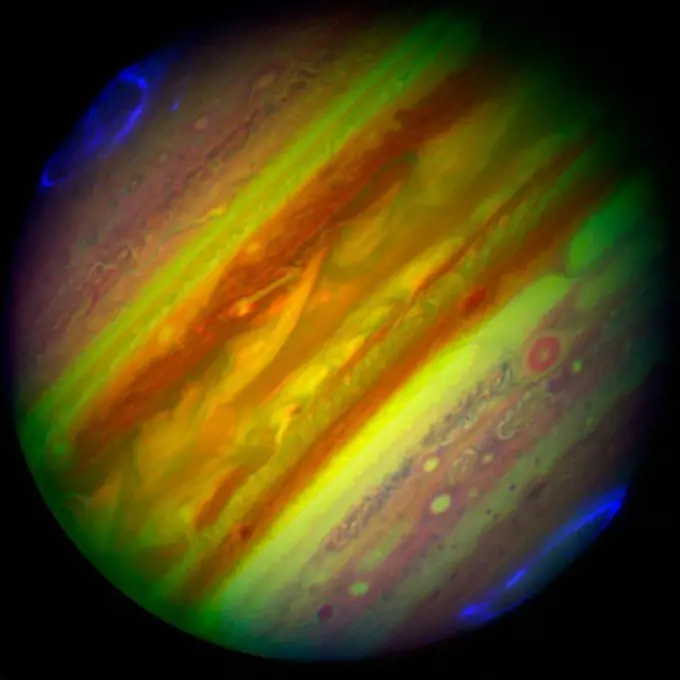
This enhanced-color image of Jupiter's bands of light and dark clouds was created by citizen scientists Gerald Eichstädt and Seán Doran using data from the JunoCam imager on NASA's Juno spacecraft. Three of the white oval storms known as the String of Pearls are visible near the top of the image. Each of the alternating light and dark atmospheric bands in this image is wider than Earth, and each rages around Jupiter at hundreds of miles (kilometers) per hour. The lighter areas are regions where gas is rising, and the darker bands are regions where gas is sinking. Juno acquired the image on May 19, 2017, at 11 30 a.m. PST (2 30 p.m. EST) from an altitude of about 20,800 miles (33,400 kilometers) above Jupiter's cloud tops.
4353-284
Digital Illustration of the Planet Neptune
4389-1267
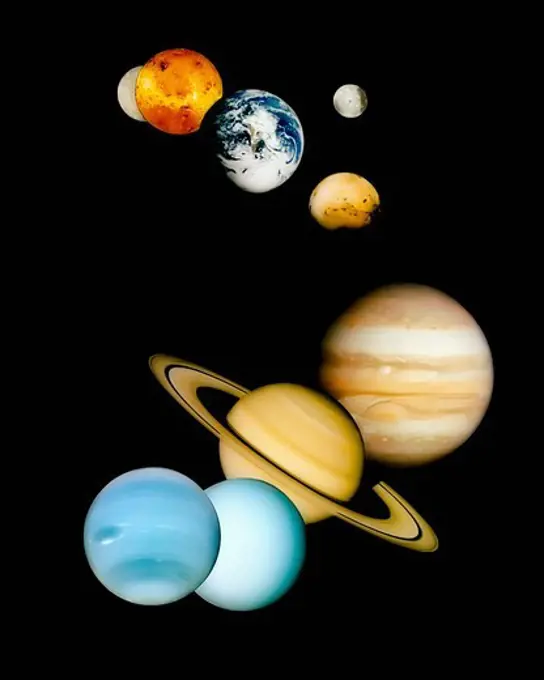
Planets of the Solar System
6145-45265126
NASA's Juno spacecraft captured this stunning Jovian cloudscape at 5 38 a.m. PST (8 38 a.m. EST) on Feb. 7, 2018, as the spacecraft performed its 11th close flyby of Jupiter. Citizen scientist Kevin M. Gill created this color-enhanced image using data from the spacecraft's JunoCam imager.
6145-44497218
Hubble Views Ancient Storm in the Atmosphere of Jupiter - July, 1994
4239-69143490
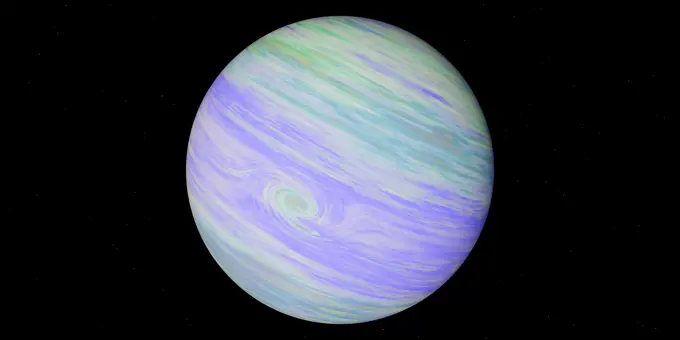
Artist's concept of exoplanet Pi Mensae c.
6145-44620598
Bold Saturn
4239R-509
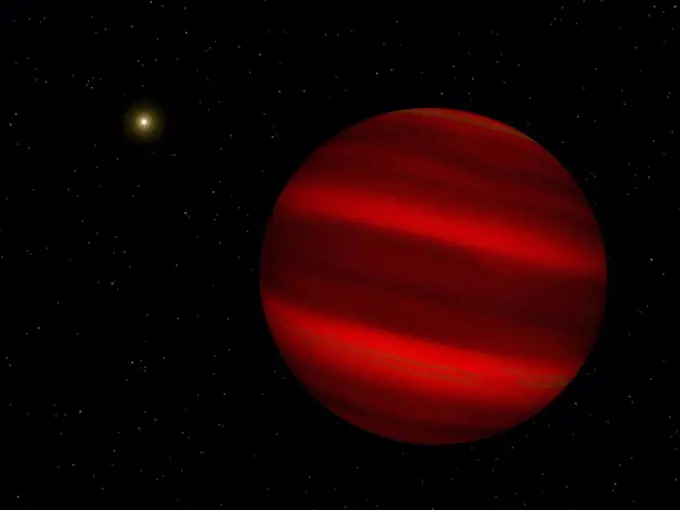
Artist's concept of how the brown dwarf Gliese 229 b might appear from a distance of about a half million miles
1746-111906499
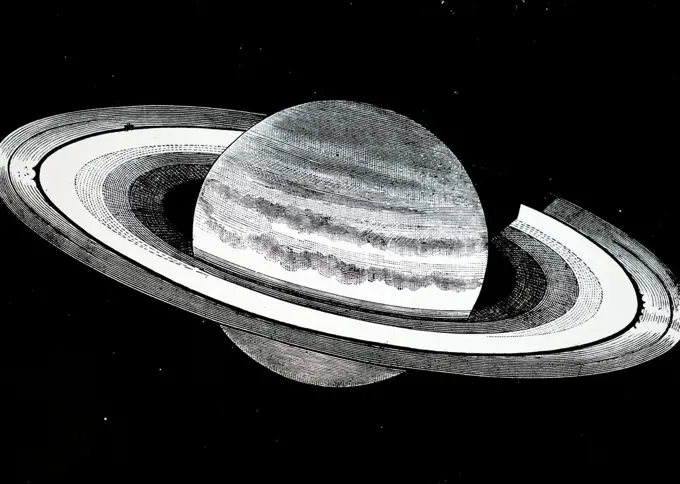
Engraving depicting the planet Saturn by Étienne Léopold Trouvelot. Étienne Léopold Trouvelot (1827-1895) a French artist, astronomer and amateur entomologist. Dated 19th century
6145-44625926
Bright, young disks can be imaged directly by visible-light telescopes, such as NASA's Hubble Space Telescope. Older, fainter debris disks can be detected only by infrared telescopes like NASA's Spitzer Space Telescope, which sense the disks' dim heat.
6176-67048900
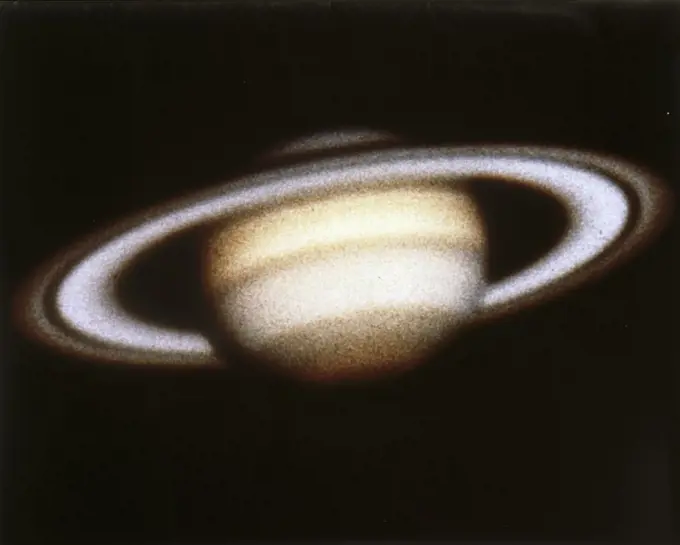
The planet Saturn, 1980. Artist: Unknown
6145-44600132
Saturn's Rings in Ultraviolet Light
1439R-1092880
Solar system
6145-45130208
This image, taken by the JunoCam imager on NASA's Juno spacecraft, highlights a swirling storm just south of one of the white oval storms on Jupiter.
6145-44562284
These images, taken on February 19, 1997 by NASA's Galileo orbiter, show two of the three long-lived White Ovals that formed to the south of the Jupiter's Great Red Spot.
6145-44546616
This view of the Great Red Spot is seen in greatly exaggerated color. The colors do not represent the true hues seen in the Jovian atmosphere but have been produced by special computer processing to enhance subtle variations in both color and shading.
6145-44844475
These infrared images obtained from NASA's Infrared Telescope Facility in Mauna Kea, Hawaii, show before and aftereffects from particle debris in Jupiter's atmosphere after an object hurtled into the atmosphere on July 19, 2009.
4389-1412
Aurorae Around Jupiter
6145-44546615
This view of the region just to the Southeast of the Great Red Spot was taken by NASA's Voyager 1 on March 4, 1979 at a distance of 1,100,000 miles (1,800,000 km).
6145-44671732
On Approach: Jupiter and Io
4239-57497610
Planets in deep space.
1525-26565632
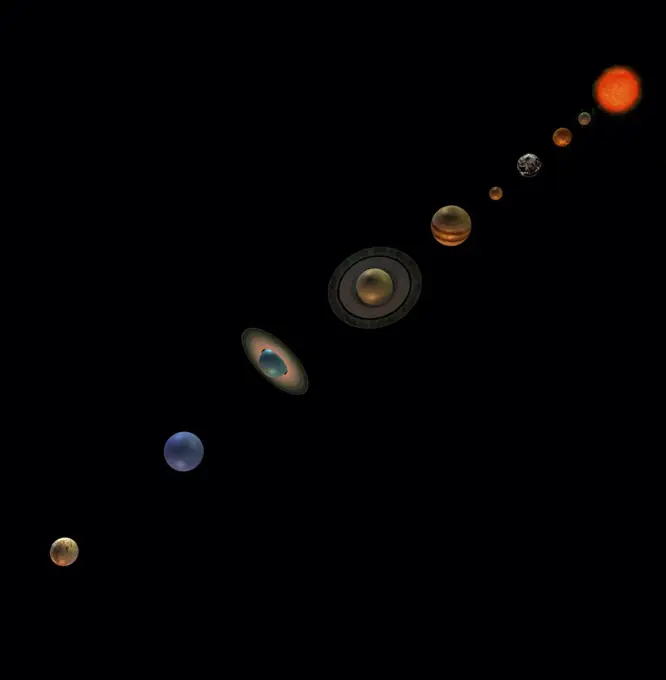
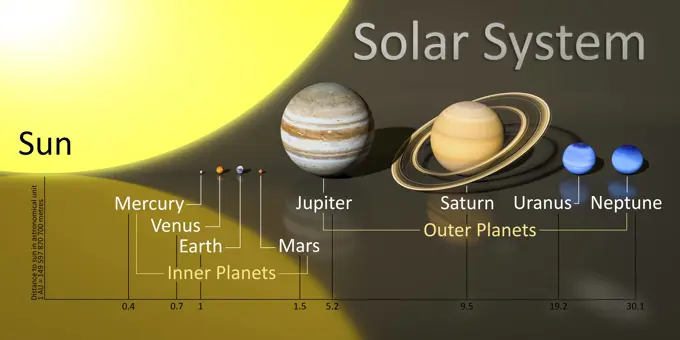
Solar system scale. Sun Mercury Venus Moon Earth Mars Jupiter Saturn Uranus Neptune Pluto. Elements of this image furnished by NASA
4289-32572
Highway Lights with Saturn Digital Composite
6145-44736444
Voyager 1 Image of Jupiter and two of its satellites (Io, left, and Europa). Io is about 350,000 kilometers (220,000 miles) above Jupiter's Great Red Spot; Europa is about 600,000 kilometers (375,000 miles) above Jupiter's clouds. Although both satellites have about the same brightness, Io's color is very different from Europa's. Io's equatorial region show two types of material -- dark orange, broken by several bright spots -- producing a mottled appearance. The poles are darker and reddish. Preliminary evidence suggests color variations within and between the polar regions. Io's surface composition is unknown, but scientists believe it may be a mixture of salts and sulfur. Erupoa is less strongly colored, although still relatively dark at short wavelengths. Markings on Eruopa are less evident that on the other satellites, although this picture shows darker regions toward the trailing half of the visible disk. Jupiter at this point is about 20 million kilometers (12.4 million miles) f
4128R-14846303
Earth compared to Venus, illustration
4389-573
Structures in Jupiter's Clouds
6145-44733724
Pioneer 11 pre-encounter with Saturn as painted by Wilson Hurley
6145-44737260
P- 24281 Saturn and it's seven moons, as photographed by Voyager 2. composite image
6145-44695654
NASA's Hubble Space Telescope shows detailed analysis of two continent-sized storms that erupted in Jupiter's atmosphere in March 2007 shows that Jupiter's internal heat plays a significant role in generating atmospheric disturbances.
6145-45262243
This color-enhanced image of a massive, raging storm in Jupiter's northern hemisphere was captured by NASA's Juno spacecraft during its ninth close flyby of the gas giant planet. The image was taken on Oct. 24, 2017 at 10 32 a.m. PDT (1 32 p.m. EDT). At the time the image was taken, the spacecraft was about 6,281 miles (10,108 kilometers) from the tops of the clouds of Jupiter at a latitude of 41.84 degrees. The spatial scale in this image is 4.2 miles/pixel (6.7 kilometers/pixel). The storm is rotating counter-clockwise with a wide range of cloud altitudes. The darker clouds are expected to be deeper in the atmosphere than the brightest clouds. Within some of the bright arms of this storm, smaller clouds and banks of clouds can be seen, some of which are casting shadows to the right side of this picture (sunlight is coming from the left). The bright clouds and their shadows range from approximately 4 to 8 miles (7 to 12 kilometers) in both widths and lengths. These appear similar to t
4128-18680611
Moons of the eight major planets.
6145-44497222
Hubble Views Ancient Storm in the Atmosphere of Jupiter - October, 1996
6145-44562322
Jupiter's Northern Hemisphere in False Color (Time Set 3)
6145-45264612
Saturn's rings display their subtle colors in this view captured on Aug. 22, 2009, by NASA's Cassini spacecraft. The particles that make up the rings range in size from smaller than a grain of sand to as large as mountains, and are mostly made of water ice. The exact nature of the material responsible for bestowing color on the rings remains a matter of intense debate among scientists. Images taken using red, green and blue spectral filters were combined to create this natural color view. Cassini's narrow-angle camera took the images at a distance of approximately 1.27 million miles (2.05 million kilometers) from the center of the rings. The Cassini spacecraft ended its mission on Sept. 15, 2017
6145-44546651
This image of clouds in Neptune's atmosphere is the first that tests the accuracy of the weather forecast that was made eight days earlier to select targets for NASA's Voyager narrow angle camera.
6145-45262031
This sequence of color-enhanced images shows how quickly the viewing geometry changes for NASA's Juno spacecraft as it swoops by Jupiter. The images were obtained by JunoCam. Once every 53 days, Juno swings close to Jupiter, speeding over its clouds. In just two hours, the spacecraft travels from a perch over Jupiter's north pole through its closest approach (perijove), then passes over the south pole on its way back out. This sequence shows 11 color-enhanced images from Perijove 8 (Sept. 1, 2017) with the south pole on the left (11th image in the sequence) and the north pole on the right (first image in the sequence). The first image on the right shows a half-lit globe of Jupiter, with the north pole approximately at the upper center of the image close to the terminator -- the dividing line between night and day. As the spacecraft gets closer to Jupiter, the horizon moves in and the range of visible latitudes shrinks. The second and third images in this sequence show the north polar r
227-18
Close-up of the planet Saturn
6145-45099015
Scientists produced new global maps of Jupiter using the Wide Field Camera 3 on NASA's Hubble Space Telescope. One color map is shown here, projected onto a globe and as a flat image.
6145-44556292
False color representation of Jupiter's Great Red Spot (GRS) taken by NASA's Galileo imaging system. The Great Red Spot appears pink and the surrounding region blue because of the particular color coding used in this representation.
6145-44566172
Hubble Views Saturn Ring-Plane Crossing (Satellites Labeled)
6145-44562293
These images, taken on February 19, 1997 by NASA's Galileo orbiter, show two of the three long-lived White Ovals that formed to the south of the Jupiter's Great Red Spot.
6145-44856098
Comet Impact Into Jupiter (Artist's Concept)
6145-44671747
LORRI Takes an Even Closer Look at the Little Red Spot
6145-44729250
Saturn's South Polar Region Revealed
4128R-15582471
Illustration of Neptune
6145-45094574
This still from an animation of four images shows Jupiter in infrared light as seen by NASA's InfraRed Telescope Facility, or IRTF, on May 16, 2015. The observations were obtained in support of NASA's Juno mission.
4389-1268
Saturn in Ultraviolet Light
6145-44561481
True and false color views of Jupiter from NASA's Galileo spacecraft show an equatorial 'hotspot' on Jupiter. These images cover an area 34,000 kilometers by 11,000 kilometers (about 21,100 by 6,800 miles) and were taken on December 17, 1996.
6145-44842602
This artist concept depicts the Juno spacecraft which will launch from Earth in 2011 and will arrive at Jupiter in 2016 to study the giant planet from an elliptical, polar orbit.
4128R-11312739
Uranus, computer artwork.
6145-44985008
This colorful view from NASA's Cassini mission, known as the
6145-44566163
An Infrared View of Saturn
6145-45130475
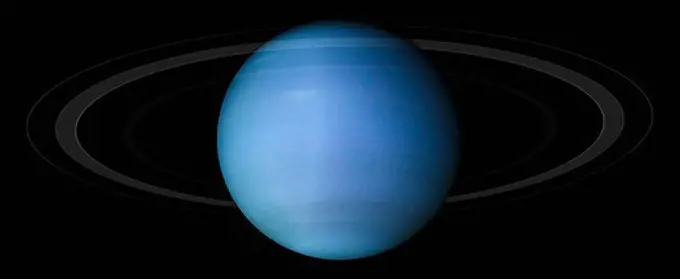
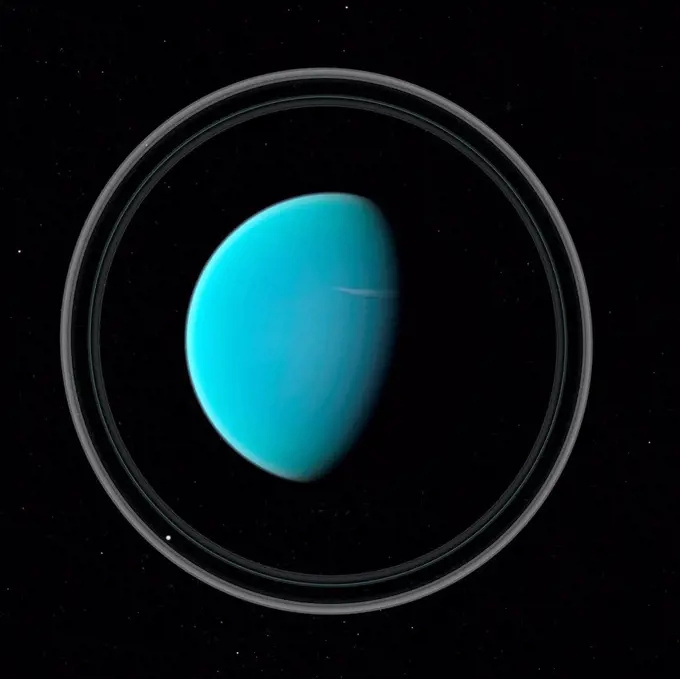
This is a composite image of Uranus by Voyager 2 and two different observations made by Hubble  one for the ring and one for the auroras. Ever since Voyager 2 beamed home spectacular images of the planets in the 1980s, planet-lovers have been hooked on auroras on other planets. Auroras are caused by streams of charged particles like electrons that come from various origins such as solar winds, the planetary ionosphere, and moon volcanism. They become caught in powerful magnetic fields and are channeled into the upper atmosphere, where their interactions with gas particles, such as oxygen or nitrogen, set off spectacular bursts of light. The auroras on Jupiter and Saturn are well-studied, but not much is known about the auroras of the giant ice planet Uranus. In 2011, the NASA/ESA Hubble Space Telescope became the first Earth-based telescope to snap an image of the auroras on Uranus. In 2012 and 2014 a team led by an astronomer from Paris Observatory took a second look at the auroras u
6145-44896076
False-color images from NASA's Cassini spacecraft show the development of a hood of high-altitude haze, which appears orange in this image, forming over the south pole of Saturn's moon Titan.
6145-44737226
Range 76 million km. ( 47 million miles) P-22892C This, Voyager 1 image shows Saturn and five of its satellites. Saturn's largest moon, Titan, is clearly seen in the upper right corner. The smaller satellites, Dione & Tethys, are shown in the upper left corner, top and bottom respectively. Two of the innermost satellites, Mimas & Enceladus, appear to the lower right of the planet, with Mimas closest to Satun. The bright object to the left of the rings is not a moon, but an artifact of processing. Voyager 1 will make its closest approach November 12th, 1980, ata distance of 124,200 km. (77,176 mi.). this photo is just one of 17,000 images taken of Saturn, its rings, and its satellites by Voyager 1.
6145-44494457
Saturn's Atmosphere
6145-44566170
Saturn's Rings Edge-on
6145-44808699
New thermal images from powerful ground-based telescopes show swirls of warmer air and cooler regions never seen before within Jupiter's Great Red Spot.
6145-44563584
Jupiter's Upper Atmospheric Winds Revealed in Ultraviolet Images by Hubble Telescope
6145-44566180
These NASA Hubble Space Telescope views of the blue-green planet Neptune provide three snapshots of changing weather conditions. The images were taken in 1994 on 3 separate days when Neptune was 2.8 billion miles (4.5 billion kilometers) from Earth.
6188-65602427
our sun system with distances 3d rendering of a our sun system with distances Copyright: xZoonar.com/magannx 9742999
6145-44736407
Artist Rick Guidace This artist concept depicts the rings of Uranus in polar rotation as discovered by NASA Ames C-141 Kuiper Airborne Observatory
6145-44561483
A Jovian Hotspot in True and False Colors (Time set 1)
7218-71267382
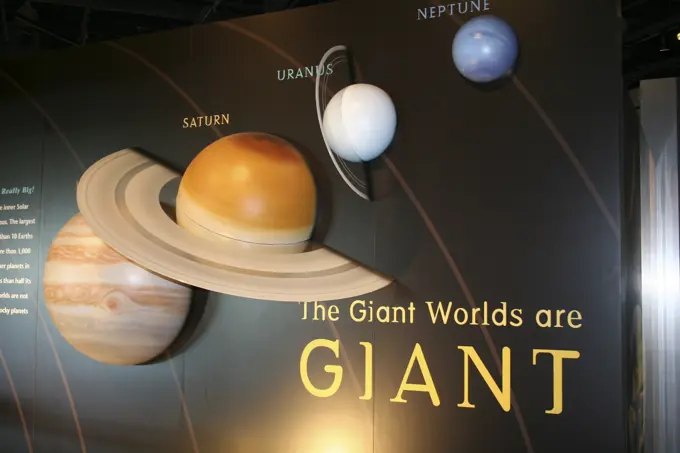
Space exhibit Science Center, Orlando, Florida
1525-25685436
3d rendering of a our sun system with distances
1525-24971765
The official eight planets of our solar system isolated in black
6145-45044168
This series of false-color images obtained by NASA's Cassini spacecraft shows the dissolving cloud cover over the north pole of Saturn's moon Titan, allowing scientists to see the underlying northern lakes and seas, including Kraken Mare.
4239R-388
A diagram showing how the planets of Beta Pictoris orbit within a ring of dust surrounding the star
PREVIOUS
of 2
NEXT
2401 S. Ervay, Suite 206
Dallas, Texas 75215
United States
Get Started
Free ResearchMy BoardsMy Cart
For Creators
How To License Your ContentContributor PortalFrame of Mind
Resources
API accessPricing
Contact
+1 866 236 0087help@viewpictures.co.uk Contact form
©2026 View Pictures. All Rights Reserved. -A
This site is protected by reCAPTCHA and Google Privacy Policy and Terms of Service apply.