My Boards
View Pictures
  • My Boards

Indian Classical Art and Ragas

A collection of Indian classical art featuring musical themes, depictions of deities, and dramatic narratives. Rich colors and intricate details illustrate cultural traditions.
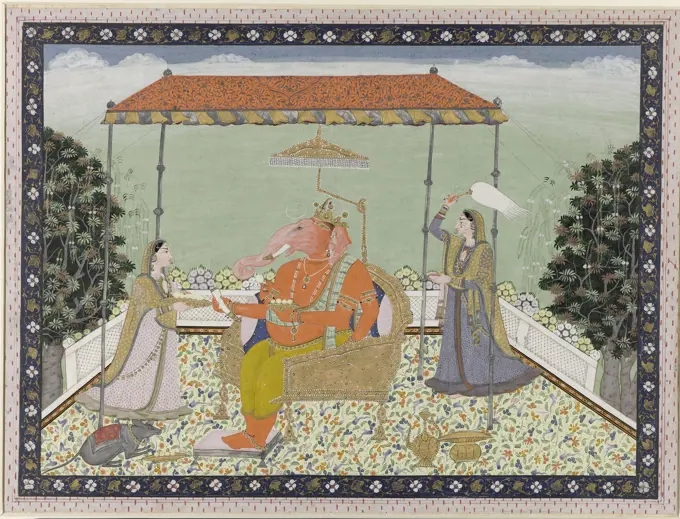
God Ganesa (Ganapati) with elephant trunk with his two servants Siddhi and Buddhi sitting under a beam, draughtsman: anonymous, Kangra, c. 1775 - c. 1823, paper, brush, h 243 mm × w 325 mm, h 206 mm × w 286 mm
266 assets in this story
1095-1250
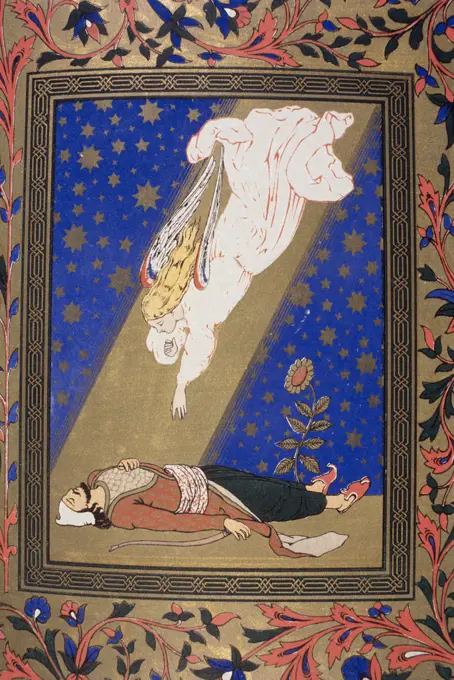
Angel Descending On Dead Man (From "Paradise And The Peri" By T. Moore) 1860 Artist Unknown Newberry Library, Chicago, Illinois, USA
6188-64562584
Shiva-sakti, pots, woman, clay pots, brass pots, artist S. Rajam, hindu belief, hindu, hinduism, art, himalayan academy art, blessing, devas, shiva, shakti Copyright: xHimalayanxAcademy/DinodiaxPhotox
1899-18853408
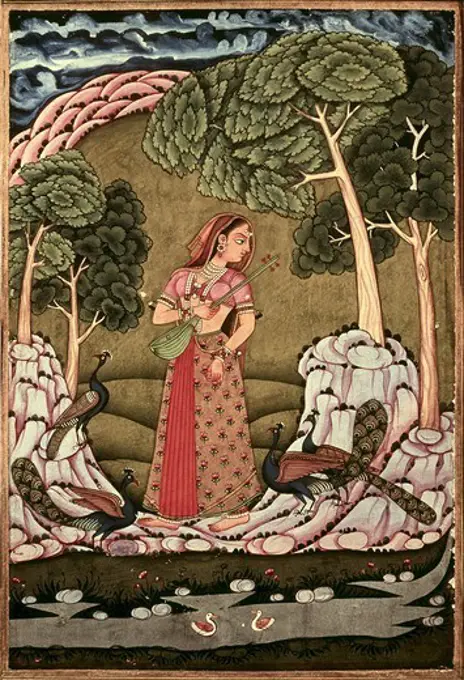
The tambura, tanpura, tamboura or taanpura or tanipurani is a long-necked plucked lute (a stringed instrument found in different forms and in many places). The body shape of the tambura somewhat resembles that of the sitar, but it has no frets - and the strings are played open. One or more tamburas may accompany other musicians or vocalists. It has four or five (rarely six) wire strings, which are plucked one after another in a regular pattern to create a harmonic resonance on the basic note (bourdon or drone function). An electronic tanpura is often substituted in contemporary Indian classical music performance.
4409-17520251
Lady Offering Food to a Monk, From a Set of Initiation Cards (Tsakali). Southern Tibet. Date: 1301-1500. Dimensions: 16 x 14.5 cm (6 1/4 x 5 3/4 in.). Ink and watercolor on paper. Origin: Tibet. Museum: The Chicago Art Institute, USA.
6145-45811639
Portrait of Umed Singh from Chamba. Portrait of Umed Singh from Chamba (1748-1764), leaned in a green robe against a roll cushion with profile to the left; A water pipe smoking. The show is framed by a narrow black edge and a wide red border with white frame limits.
6145-30403361
Krishna Lifts Mount Govardhan, from a History of the Lord (Bhagavata Purana)manuscript
6145-51831458
Kakubha Ragini, Page from a Dispersed Ragamala Series Indian. Kakubha Ragini, Page from a Dispersed Ragamala Series, ca. 1727 (). Opaque watercolor on paper, sheet: 10 x 7 1/8 in. (25.4 x 18.1 cm).  Indian Paintings of Musical Themes The most prevalent form of classical music in northern India is the raga. A raga is not a composed piece of music but an established set of tonal, rhythmic, and expressive guidelines from which a musician creates an improvised performance. The guidelines are specific enough that a seasoned listener can recognize any particular raga if it is performed properly. There are many different ragas, and over the centuries they have been organized into categories, described as families, in which related musical themes—called raginis—are considered the wives of a raga, and still others—calledraga-putras—are considered the raga’s sons and daughters. Each raga is associated with an emotional state and a time of the day and year. Poets imagined brief narratives to cap
1899-18792373
Akbar (Urdu: جلال الدین محمد اکبر , Hindi: लालुद्दीन मुहम्मद अकबर, Jalāl ud-Dīn Muhammad Akbar), also known as Shahanshah Akbar-e-Azam or Akbar the Great (25 October 1542 - 27 October 1605), was the third Mughal Emperor. He was of Timurid descent; the son of Emperor Humayun, and the grandson of Emperor Babur, the ruler who founded the Mughal dynasty in India. At the end of his reign in 1605 the Mughal empire covered most of the northern and central India. Akbar was thirteen years old when he ascended the Mughal throne in Delhi (February 1556), following the death of his father Humayun. During his reign, he eliminated military threats from the powerful Pashtun descendants of Sher Shah Suri, and at the Second Battle of Panipat he decisively defeated the newly self-declared Hindu king Hemu. It took him nearly two more decades to consolidate his power and bring all the parts of northern and central India into his direct realm. He dominated the whole of the Indian Subcontinent and he ruled
4443-21954392
Tupac Inca Yupanqui; La Plata, Bolivia; completed in 1616; Ms. Ludwig XIII 16, fol. 47v
4435-5763
Young princess playing veena (string instrument), 1770. Hyderabad school. Hindu art. Miniature Painting.
1899-18853394
Bundi is a city in the Hadoti region of Rajasthan state in northwest India. It is of particular architectural note for its ornate forts, palaces, and stepwell reservoirs known as baoris. It is the administrative headquarters of Bundi District. The town of Bundi is situated 35 km from Kota and 210 km from Jaipur. It is located at 25.44°N 75.64°E and an average elevation of 268 metres (879 feet). The city lies near a narrow gorge, and is surrounded on three sides by hills of the Aravalli Range. A substantial wall with four gateways encircles the city. The town of Indragarh and nearby places are famous for the renowned temples of Bijasan Mata and Kamleshwar. The Indargarh step well is considered as one of the most attractive places in the Bundi district, especially during the rainy season.
6145-45815944
Portrait of Ajmat Dev from Mankot, a hookah (water pipe) smoking, behind him a servant with a range.
6145-29777198
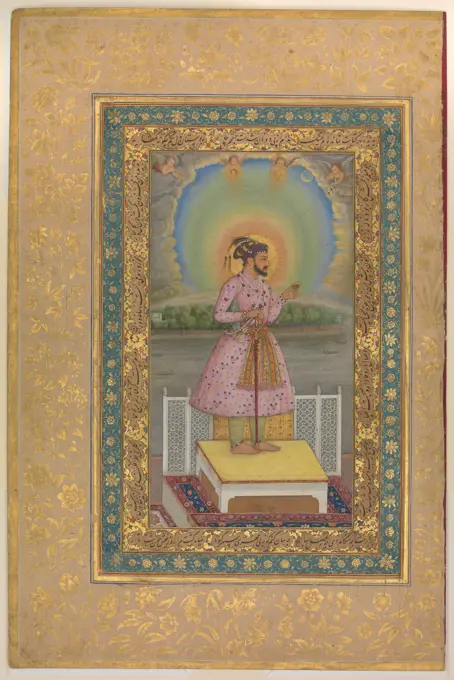
"Shah Jahan on a Terrace, Holding a Pendant Set With His Portrait", Folio from the Shah Jahan Album recto: dated 1627-28; verso: ca. 1530-50 Painted by Chitarman The presentation of the emperor amplifies the formula evolved during the reigns of Akbar and Jahangir. Shah Jahan is exquisitely dressed and richly adorned with jewels, his imperial rank emphasized by his radiating halo and the hovering angels borrowed from European art. The skills of many craftsmen and designers of the Mughal courtjewelers, weavers, architects, feather workers, armorers, stonecutters, and othersare represented here. This is Chitarman’s earliest dated picture, painted soon after Shah Jahan’s accession.. "Shah Jahan on a Terrace, Holding a Pendant Set With His Portrait", Folio from the Shah Jahan Album 451270
1848-49227446
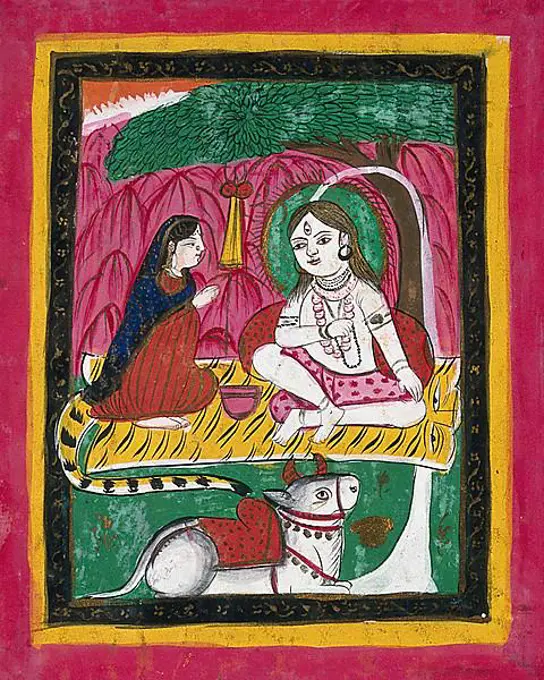
Shiva, one of the main Hindu gods and Parvati seated with Nandi bull, 1890, East India, Bengal, Kolkata, Temple Kalighat, Historic, digitally restored reproduction from a 19th century original
1848-49315635
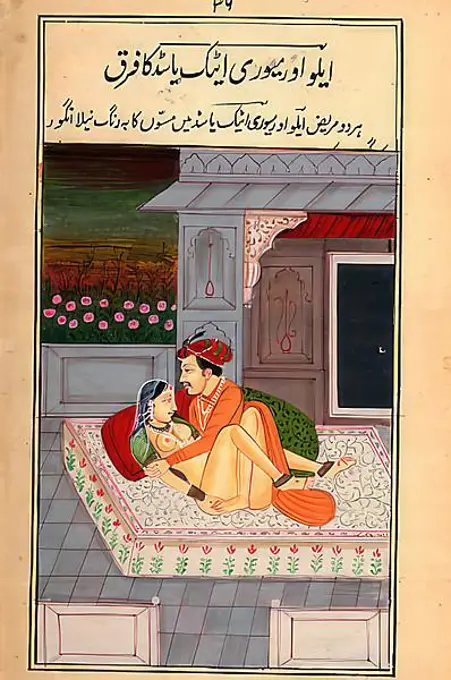
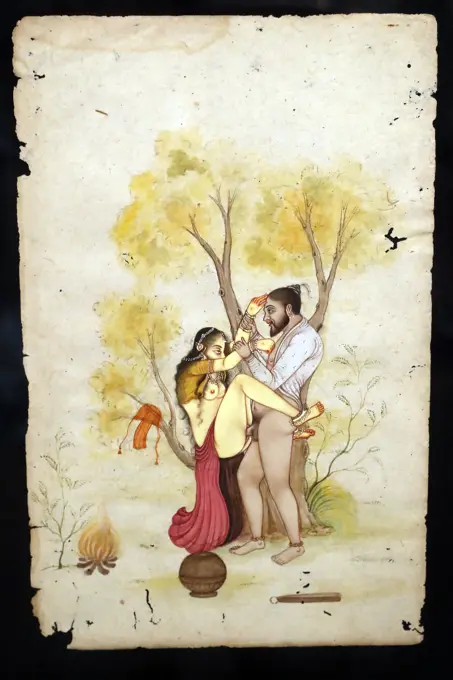
Depiction of an erotic scene, love scene, sex, in a 19th century edition of the Kama Sutra, textbooks on eroticism, India, Arabia, Historical, digitally restored reproduction of an original from the period, Asia
1899-18717226
In ancient times Miran was a busy trading center on the southern part of the Silk Road, after the route split into two (the northern route and the southern route), as caravans of merchants sought to escape travel across the harsh wasteland of the desert (called by the Chinese 'The Sea of Death') and the Tarim Basin. They went by going around its north or south rim. It was also a thriving center of Buddhism with many monasteries and stupas. Marc Aurel Stein was the first archaeologist to systematically study the ruins at Miran in 1907. The many artifacts found in Miran demonstrate the extensive and sophisticated trade connections these ancient towns had with places as far away as the Mediterranean Sea. Archaeological evidence from Miran shows the influence of Buddhism on artistic work as early as the first century BCE. Early Buddhist sculptures and murals excavated from the site show stylistic similarities to the traditions of Central Asia and North India and other artistic aspects of t
6145-30187102
Image from a Set of Initiation Cards (Tsakali) 1301-1500 Tibet. Ink and watercolor on paper .
4409-157991
VIRGEN CON ANGELES Y CORDEROS - SIGLO XX - 42x52. Author: MARQUINA JULIA. Location: PRIVATE COLLECTION. MADRID. SPAIN.
4409-17400535
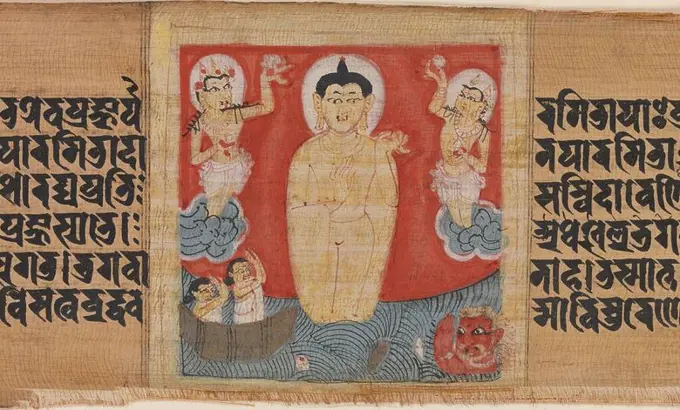
Buddha Giving Safety (Abhayananda) to Mariners, Leaf from a Dispersed Pancavimsatisahasrika Prajnapramita. Culture: India (Bengal) or Bangladesh. Dimensions: H. 2 1/4 in. (5.7 cm); L. 22 1/8 in. (56.2 cm). Date: ca. 1090.above: Buddha giving safety (abhayandada) to mariners, a role more typically assumed by Bodhisattava Avalokitesvara. Celestial celebrants emerge from clouds above, and from the sea, a deity submits to the Buddha's calming powers; perhaps this the planetary deity Rahu, who causes eclipses, hence an association with storms. below: A bodhisattva in a mountain grotto, playing a stringed instrument (vina). Museum: Metropolitan Museum of Art, New York, USA.
4409-14374
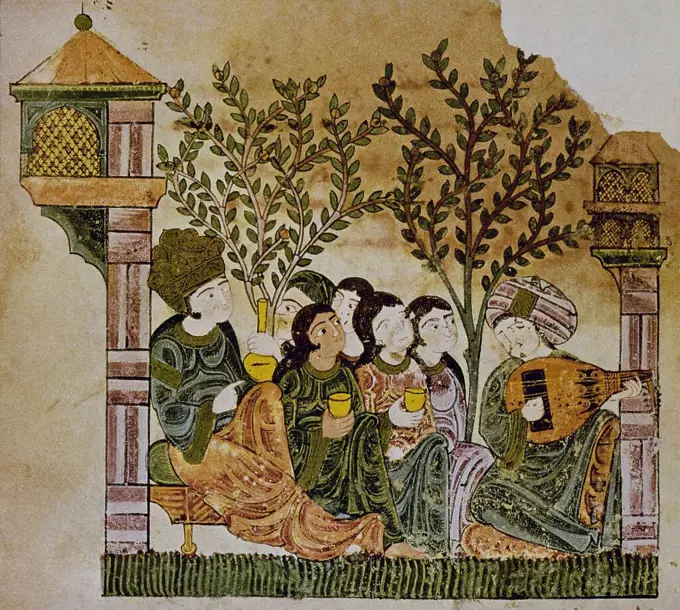
TAÑEDOR DE LAUD - 1219 - MANUSCRITO ANDALUSI - BAYAD EN EL JARDIN CON SUS DAMAS CRIADAS Y MUSICOS. Author: YAHYA IBN MAHMUD AL WASITI (SIGLO XIII) PINTOR. Location: NATIONAL LIBRARY. France.
1340-663
Murals- Epic Ramayana-Wall Paintings in Ramasamy Temple at Kumbakonam, Tamil Nadu, India- Sita in Asokavanam(Forest)after being kidnapped by Ravana Artist Unknown
6145-29122701
Rama and Lakshmana Meet Sugriva at Matanga's Hermitage, Folio from a Ramayana (Adventures of Rama). India, Sub-Imperial Mughal, Agra (), circa 1595. Drawings; watercolors. Opaque watercolor, gold, and ink on paper
6145-29293488
Persian couple copulating
6188-64559910
Hinduism, hindu art, himalayan academy art, religion, spirituality, artist S. Rajam, saint, swami, sannyasin, shiva, worship Copyright: xHimalayanxAcademy/DinodiaxPhotox
1899-18719067
Wat Phumin was constructed in 1596 and is famous for its cruciform ubosoth and well preserved Tai Lue murals depicting everyday life in the 19th century. Nan dates from the mid-14th century and for much of its history was an isolated kingdom. The present day city spreads out along the Nan River's right bank.
6188-63971185
Indian miniature painting water color on paper patmanjari ragini , Rajasthan, India Copyright: xSafatxAli/DinodiaxPhotox
6188-64583337
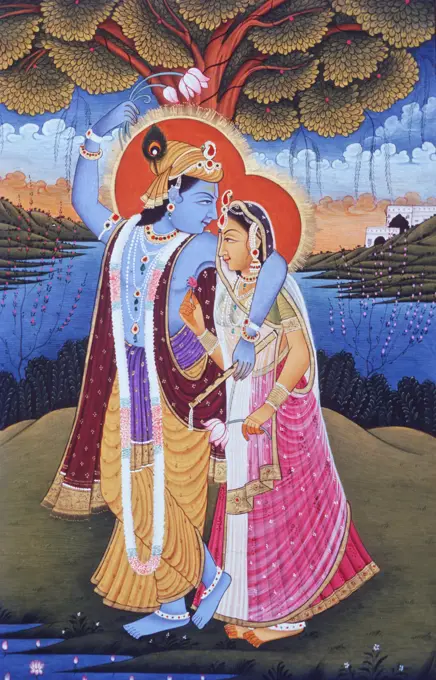
miniature painting of radha krishna, india Copyright: xBhagwandasxRupani/DinodiaxPhotox
1899-18792365
Nasir ud-din Muhammad Humayun (Persian: نصیر الدین محمد همایون; full title: Al-Sultan al-'Azam wal Khaqan al-Mukarram, Jam-i-Sultanat-i-haqiqi wa Majazi, Sayyid al-Salatin, Abu'l Muzaffar Nasir ud-din Muhammad Humayun Padshah Ghazi, Zillu'llah; 7 March 1508 - 22 February 1556) was the second Mughal Emperor who ruled present day Afghanistan, Pakistan, and parts of northern India from 1530-1540 and again from 1555-1556. Like his father, Babur, he lost his kingdom early, but with Persian aid, he eventually regained an even larger one. On the eve of his death in 1556, the Mughal empire spanned almost one million square kilometers. He succeeded his father in India in 1530, while his half-brother Kamran Mirza, who was to become a rather bitter rival, obtained the sovereignty of Kabul and Lahore, the more northern parts of their father's empire. He originally ascended the throne at the age of 22 and was somewhat inexperienced when he came to power. Humayun lost his Indian territories to the P
6145-59094416
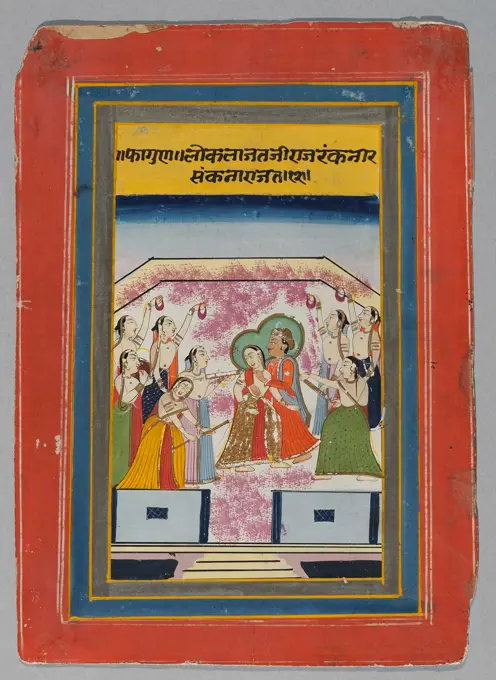
Miniature with a presentation of Phalgun's month;  19th century (1801-00-00-1900-00-00);
6145-48518150
Miniature with image of the month of Phalguna (Krishna with his beloved in the company of eight women). unknown, painter
6145-29727261
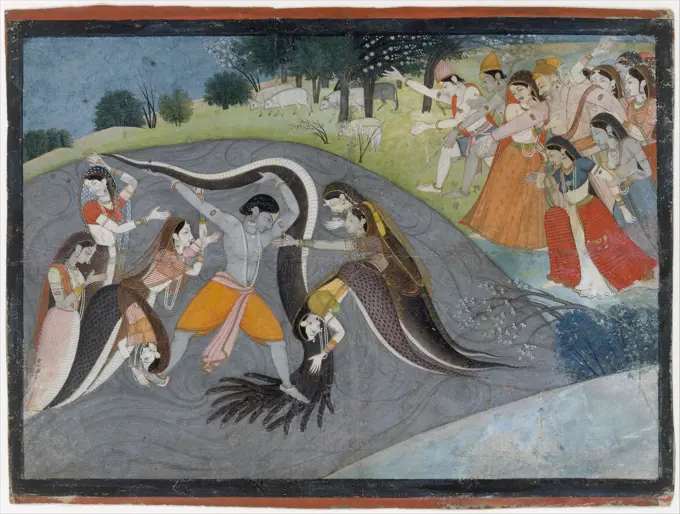
Krishna Subduing Kaliya, the Snake Demon: Folio from a Bhagavata Purana Series ca. 1785 First generation after Manaku and Nainsukh In this celebrated scene vividly described in the Bhagavata Purana, Krishna battles Kaliya, a hundred-headed serpent (naga) who was poisoning the river Yamuna. At first, Krishna was ensnared in the demons mighty coils, but he sprang free by summoning the power of the universe and trapping the snake beneath his foot. The snake submitted to Krishnas supreme powers and the river was purified. Kaliyas wives, seen here with serpent bodies, pleaded with Krishna to show mercy to their husband, which he granted. The dramatic composition foregrounds the beauty and power of Krishna to restore order in the world of men.. Krishna Subduing Kaliya, the Snake Demon: Folio from a Bhagavata Purana Series 37946
6145-29767175
"Portrait of Raja Bikramajit (Sundar Das)", Folio from the Shah Jahan Album recto: ca. 1620; verso: ca. 1540 Painting by Bichitr Sundar Das was a Hindu whoses ancestors had been considerable landowners. He entered the service of Prince Khurram (Shah Jahan) and in 1617 Jahangir awarded him the title of Raja Bikramajit "which among Hindus is the highest" as Jahangir wrote in his memoirs. Raja Bikramajit was a brilliant military strategist and instrumental to the success of Prince Khurram's campaigns in the Deccan. In Shah Jahan's rebellion against Jahanagir in 1623-24, Raja Bikramajit sided with the prince, and when he was killed in battle, Jahangir was unashamedly gleeful, writing "By losing him the Wretch Shah Jahan lost courage, as though his luck, ambition, and reason were all found up with that Hindu dog." In Bichitr's brilliant portrait, the figure positively pulses with life.. "Portrait of Raja Bikramajit (Sundar Das)", Folio from the Shah Jahan Album 451257
6145-59606594
Indian woman in lotus position, anonymous, c. 1750 - c. 1800 print Probably made to an Indian miniature.  paper etching Asiatic races and peoples: Indians. Buddha-posture, 'lotus'-posture
6145-29777416
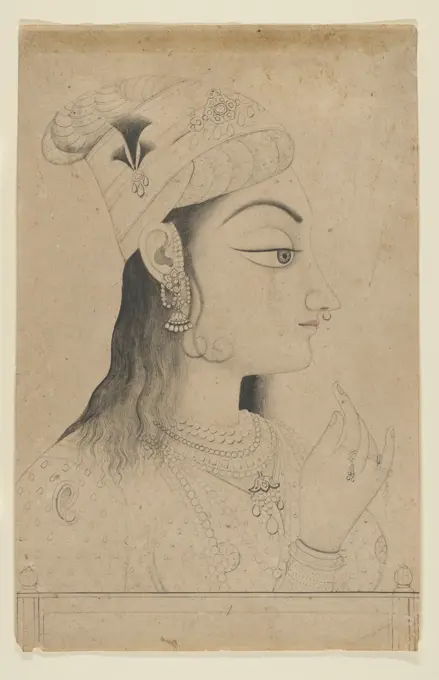
Woman with a Turban Dressed as Radha late 19th century India (Rajasthan, Kishangarh) This woman of the Kishangarh court is dressed as Radha, Krishna's lover. The elongated head and stylized eye are typical of a figural type that emerged in the Kishangarh court in the late eighteenth century. This drawing is the pendant to 2008.359.27.. Woman with a Turban Dressed as Radha 74680
1899-18853356
Abul Muzaffar Muhy-ud-Din Muhammad Aurangzeb Alamgir (Urdu: ابلمظفر- محىالدين - محمد اورنگزيب- عالمگیر, Hindi: बुल मुज़फ्फर मुहिउद्दीन मुहम्मद औरंगज़ेब आलमगीर) (4 November 1618 - 3 March 1707, more commonly known as Aurangzeb (Hindi: औरंगज़ेब) or by his chosen imperial title Alamgir (Hindi: आलमगीर) ('Conquerer of the World', Urdu: عالمگیر), was the sixth Mughal Emperor of India, whose reign lasted from 1658 until his death in 1707. Aurangzeb, having ruled most of the Indian subcontinent for nearly half a century, was the second longest reigning Mughal emperor after Akbar.
6145-51819787
Lady in the Wilderness, Fragment of a Page from a Bhagavata Purana Series Indian. Lady in the Wilderness, Fragment of a Page from a Bhagavata Purana Series, ca. 1590-1600. Opaque watercolors and gold on paper, sheet: 6 5/8 x 4 1/2 in. (16.8 x 11.4 cm).   Asian Art ca. 1590-1600
6188-64562559
Hinduism, hindu art, himalayan academy art, religion, spirituality, artist S. Rajam, village, music, bhajan, hut, home, family Copyright: xHimalayanxAcademy/DinodiaxPhotox
6145-29831841
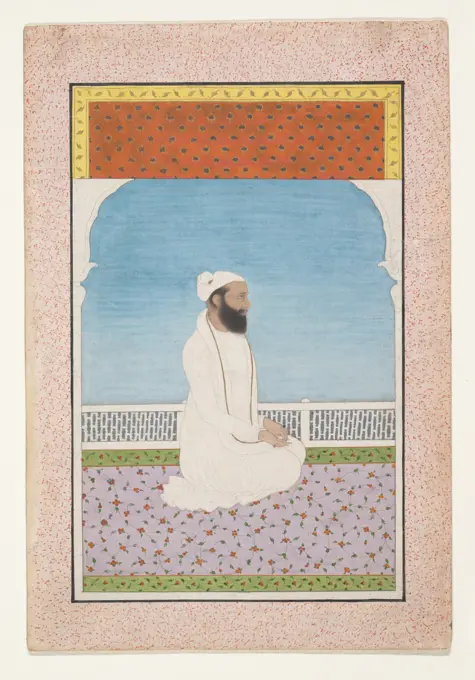
A Holy Man Seated on a Terrace ca. 1850 India (Punjab Hills, Kangra) The artist has masterfully used the sparse setting to highlight his subject. The figure is placed against a pale sky of graduated blues, framed on the sides by a marble archway and above by a fabric blind, the hot orange and yellow of which contrast with the pink rug with a softer green border in the lower portion of the page. The white of the holy man's robe seems blinding in its stark whiteness. These deftly handled coloristic effects set the stage for the sensitively observed portrait.. A Holy Man Seated on a Terrace. India (Punjab Hills, Kangra). ca. 1850. Ink and opaque watercolor on paper. Paintings
6145-59224535
On the banks of the Yamuna in Brindaban, Krishna dances with the Gopis, Anonymous, 1800 - 1825 drawing. Indian miniature On the banks of the Yamuna in Brindaban, north of Mathura, Krishna dances with the Gopis on the right, pilgrims take a ritual bath. Benares (possibly) paper. deck paint. watercolor (paint) brush
4435-3486
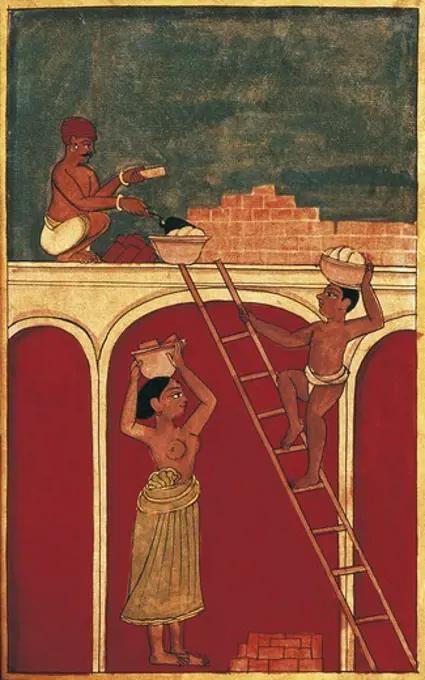
Indian construction workers making a building. Hindu art. Miniature Painting. FRANCE. ëLE-DE-FRANCE. Paris. National Library.
6145-29261512
Indian coral merchant selling jewelry to a woman. Gouache drawing.
6145-29287034
A man holding a peacock feather and a gold fan, with a woman holding a spear. Gouache, 18--.
4443-21200289
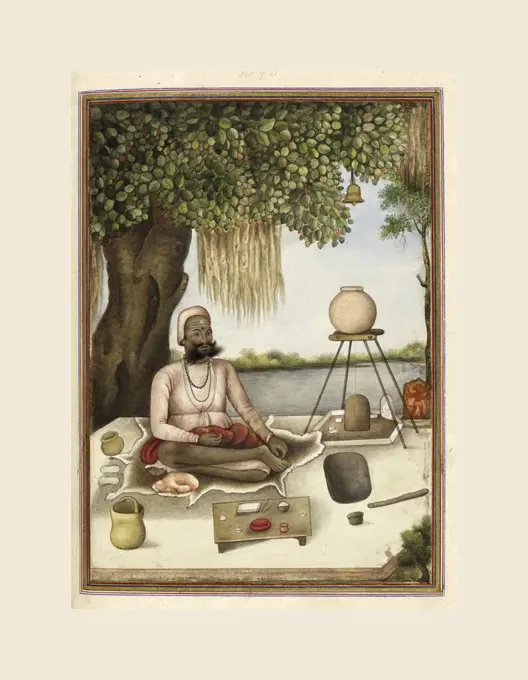
Tashrih al-aqvam, some of the sects, castes, and tribes of India, 1825. Sannyasia a Saiva mendicant
6145-29289509
A key keeper and wife offering him a betel leaf. Gouache drawing.
6145-51829698
Zumurrud Shah Takes Refuge in the Mountains Indian. Zumurrud Shah Takes Refuge in the Mountains, ca. 1570. Opaque watercolor and gold on cotton cloth, sheet: 31 x 25 in. (78.7 x 63.5 cm).   Asian Art ca. 1570
6188-64595048
Miniature Painting on Paper, Ragini saurav, naltdwara school Copyright: xBhagwandasxRupani/DinodiaxPhotox
6145-29816612
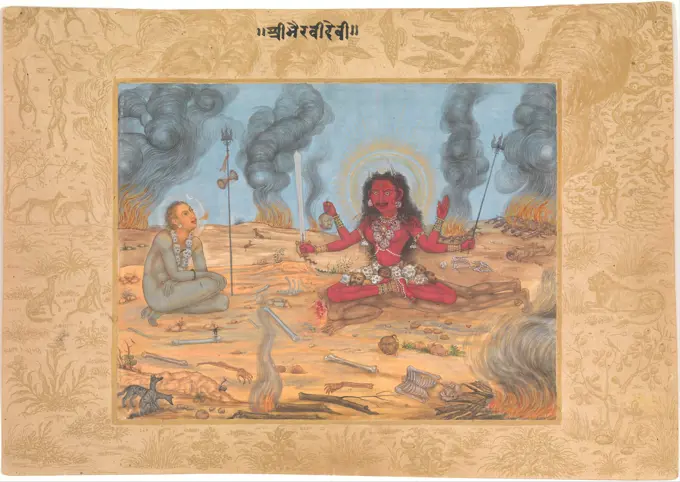
The Goddess Bhairavi Devi with Shiva ca. 1630-35 Attributed to Payag Indian In this painting, attributed to the Mughal artist Payag, a demonic form of the Hindu goddess Bhairavi, female counterpart to Shiva, sits on the body of a decomposing corpse. Wearing jewelry and a skirt made of skulls, and horns in the form of spear heads, she is accompanied by Shiva who appears in the form of a devotee. Three of her hands carry symbols of destruction, while her fourth extends a gesture of blessing. The borders, executed in gold monochrome, form a continuation of the desolate landscape in the painting itself. The inscription above the image, written in Devanagari script, identifies the figure as Bhairavi.. The Goddess Bhairavi Devi with Shiva 457743
1848-49227392
Pravira kneeling at the feet of Jana, c. 1890, East India, Bengal, Kolkata, Temple Kalighat, Historic, digitally restored reproduction from a 19th century original
6145-29708302
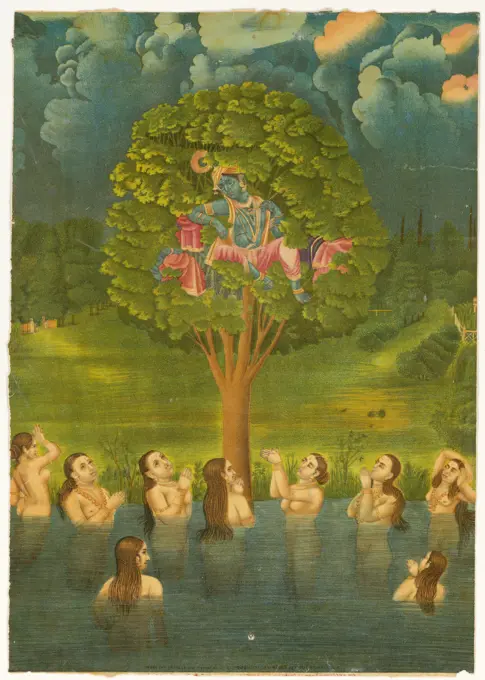
Krishna Steals the Clothes of the Gopis ca. 1875-80 India A popular episode from the story of Krishnas youthful years at Vrindavan, known as Gopi Vastraharana (‘theft of the gopis clothes), recounts his playful theft of the clothes of the female cowherds, the gopis, who had left their clothes on the Yamuna River bank while bathing. Krishna placed them high in the branches of a tree, in which he is seen perched, daring the gopis to venture from the water. Metaphorically, this story serves to convey the power of devotion, to stand vulnerable before ones God, secure in the power of bhakti, the unquestioning devotion to ones god.. Krishna Steals the Clothes of the Gopis. India. ca. 1875-80. Color lithorgraph, varnish. Prints
6145-29250128
A rishi (Hindu teacher of mystical knowledge) with 'Vishnu' marks on his forehead and body. Gouache painting by an Indian artist.
6137-28690797
World Erotic Art Museum.  Menaka and Vishwamitra. Hindu mythology. Menaka is considered to be one of the most beautiful celestial nymphs.  Miami, Florida, USA.
6145-29288860
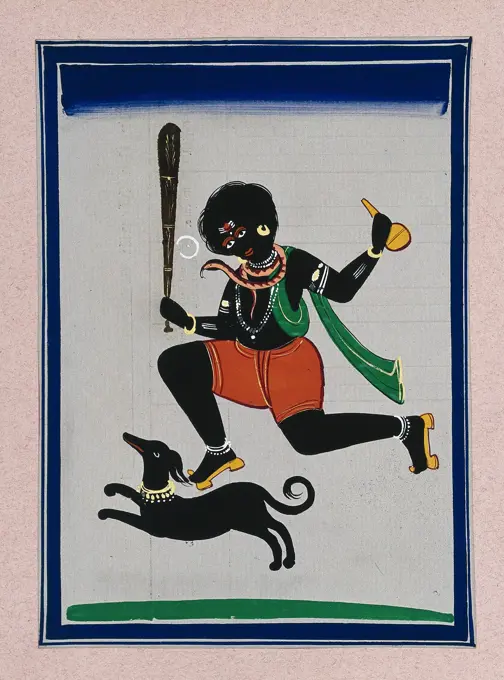
Lord Shiva in his form as Bhairav along with his vehicle, the dog. Gouache painting by an Indian artist.
6188-63971188
Indian miniature painting water color on paper sri raag, Rajasthan, India Copyright: xSafatxAli/DinodiaxPhotox
6176-66902079
A night scene of Shiva puja (recto); Calligraphy (verso) by Muhammad Rizavi Hindi, circa 1670
6145-29297762
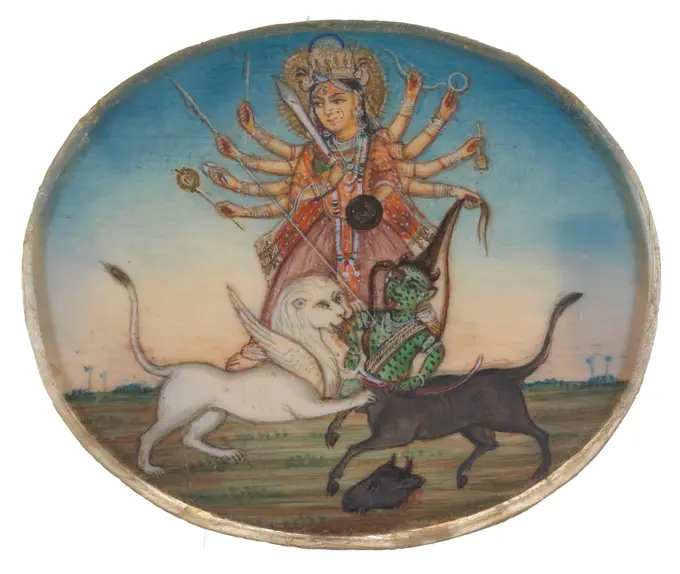
Durga slaying the buffalo demon, Mahishasura. Gouache painting by an Indian artist.
4409-17550343
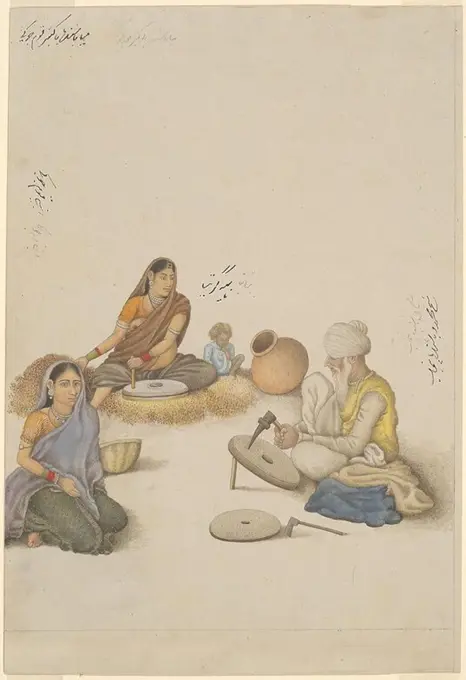
Villagers Grinding Corn, page from the Fraser Album. India, Delhi. Date: 1815-1825. Dimensions: 31.1 x 21.3 cm (12 1/4 x 8 3/8 in.). Opaque watercolor on paper. Origin: India. Museum: The Chicago Art Institute, Chicago, USA.
6145-29276504
Two women in blue and red sarees sitting together. Gouache painting by an Indian artist.
6145-51819387
Standing Woman Indian. Standing Woman, 1875-1900. Opaque watercolor and gold on paper, sheet: 19 11/16 x 11 3/4 in. (50 x 29.8 cm).   Asian Art 1875-1900
6145-29289077
Indian fortune-teller with client. Gouache drawing.
1899-19136534
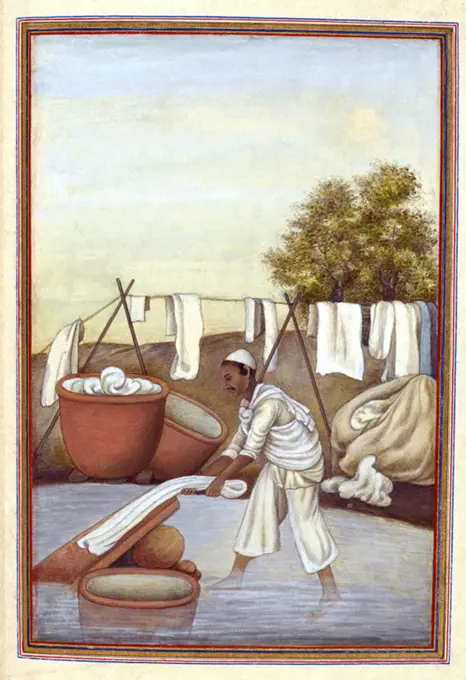
India: A dhobi or washerman. Tashrih al-aqvam, Hansi: James Skinner, 1825
6176-67043203
'The Birth of Krishna', 1920. Krishna is born to Devaki and her husband, Vasudeva  who secretly carries the infant across the Yamuna for safety in exile. From "Myths of the Hindus & Buddhists", by The Sister Nivedita and Ananda K. Coomaraswamy. George G. Harrap & Company Ltd, London, 1920
1899-18858187
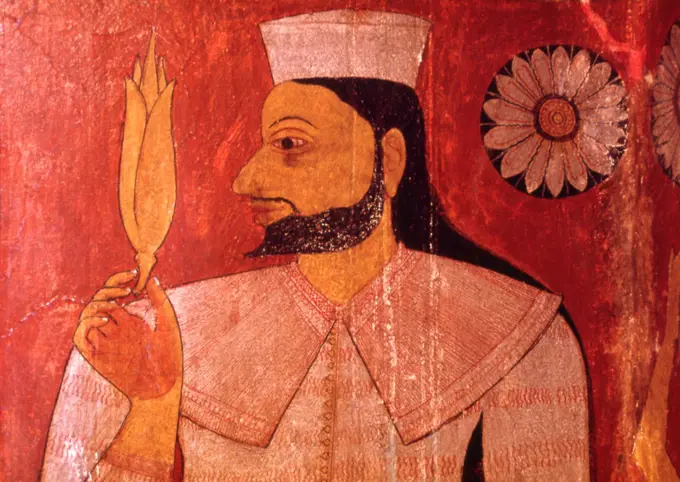
The Medawala Rajamaha Viharaya or Tempitiya Vihara, north of Kandy is a typical tempath vihara, a small wooden image house or shrine, placed on stilts or piles. The tempath vihara can be regarded as Kandys most significant contribution to Buddhist architecture, but there are not many specimen of its kind left. Some of the frescoes in the Rajamaha Viharaya depict the king and the royal family; but they also depict the everyday life of the commoners, such as a farmer tilling his field with the help of a white bull. One enigmatic painting shows a recumbent Buddha, sleeping safely tucked away behind a mosquito net. Though the frescoes exhibit all the hallmarks of the 18th century, the original construction of the Raja Mahavihara is said to go back to much earlier times. Despite the artistic merit of the frescoes, the most remarkable single feature in the image house is the small ivory figure of a Buddha. The figure is surrounded by an intricately carved wooden shrine.
6176-66911623
Arab woman being attended to by servants. circa 1900
4409-17487135
Wall Hanging (Puthia) depicting the Feet of a Jain Monk. Date/Period: 1667 (Samvat 1724). Textiles. Silk plain weave with silk, silver, and silver gilt thread embroidery in couching, chain, darning, and satin stitches Silk plain weave with silk, silver, and silver gilt thread embroidery in couching, chain, darning, and satin stitches. Height: 330.45 mm (13 in); Width: 384.30 mm (15.12 in). Author: India unknown.
1899-18792389
Mariam uz-Zamani Begum Sahiba (Imperial Princess), née Rajkumari (Princess) Hira Kunwari, alias Harkha Bai (October 1, 1542 - 1622) was a Rajput princess who became the Mughal Empress, after her marriage to Mughal Emperor Akbar. She was the eldest daughter of Kachwaha Rajput, Raja Bharmal of Amber, the older name of the Rajput State of Jaipur. Her notability arises from her marriage to the Mughal emperor Jalaluddin Muhammad Akbar. She was also the mother of emperor Nuruddin Salim Jahangir, her husband's heir. Her name as recorded in Mughal chronicles was Mariam-uz-Zamani. This is why the mosque of Mariyam Zamani Begum was constructed in Lahore, Pakistan, in her honour. She has been also referred to as Jodha Bai or Jodhabai. Hira Kunwar, Akbar's first Rajput wife, was the eldest daughter of Raja Bhar Mal of Amber. She was also the sister of Bhagwandas and the aunt of Man Singh I of Amber, who later became one the nine jewels (Navaratnas) in the court of Akbar. The Mosque of Mariyam Zama
6188-63971163
Indian miniature painting water color on paper daisii ragini, Rajasthan, India Copyright: xSafatxAli/DinodiaxPhotox
PREVIOUS
of 3
NEXT
2401 S. Ervay, Suite 206
Dallas, Texas 75215
United States
Get Started
Free ResearchMy BoardsMy Cart
For Creators
How To License Your ContentContributor PortalFrame of Mind
Resources
API accessPricing
Contact
+1 866 236 0087help@viewpictures.co.uk Contact form
©2026 View Pictures. All Rights Reserved. -A
This site is protected by reCAPTCHA and Google Privacy Policy and Terms of Service apply.