My Boards
View Pictures
  • My Boards
← Science

International Space Station Activities

Astronauts and cosmonauts engaged in various maintenance tasks inside the International Space Station, with a focus on equipment and research.

ISS025-E-010852 (3 Nov. 2010) --- Russian cosmonaut Alexander Kaleri, Expedition 25 flight engineer, works on the newly installed Russian experiment KPT-10 "Kulonovskiy Kristall" (Coulomb Crystal), assembling the payload equipment and initiating operation, in a Russian module on the International Space Station.
365 assets in this story
6145-44542829
STS043-03-009 (5 Aug 1991) ---- Astronaut John E. Blaha is pictured executing development test objective  (DTO) 1208, Space Station Cursor Control Device Evaluation II and advanced applications.  The purpose of the Cursor Control Device Experiment is to evaluate human performance under space flight conditions of cursor control devices which are similar to the devices under consideration for use onboard Space Station computers.  Here, the mission commander uses a thumbball/handgrip control device.  Each crewmember evaluated the different types of cursor control devices during the nine-day STS-43 mission.  Other methods of cursor control evaluated were the built-in trackball, a side mounted trackball with restraints and an optical pad with mouse.
6145-44804220
PHOTO DATE: -02-10-10LOCATION: BLG 9NW ,  ISS AirlockSUBJECT:  STS-133 SSMTF ISS JNT AL HDW 31105 training. Four crew members (Drew, Kopra, Barrett, Stott).
6145-58970174
S129-E-006290 (17 Nov. 2009) --- Astronaut Robert L. Satcher Jr., STS-129 mission specialist, occupies the commanders station on the flight deck of Space Shuttle Atlantis during flight day two activities.
6145-44811333
PHOTO DATE: 04/01/10LOCATION:B9 ISS Mock upSUBJECT:  STS-132 crew during Transfer Hands-On Practice training
6145-44506710
JSC2000-E-16590 (15 June 2000) --- Astronaut Scott D. Altman, STS-106 pilot, simulates control of the remote manipulator system (RMS) for the Space Shuttle Atlantis during a training session in the Johnson Space Center'sSystems Integration Facility.
6145-44697469
ISS016-E-028872 (9 Feb. 2008) --- Astronaut Leland Melvin (background), STS-122 mission specialist, works the controls of the space station's robotic Canadarm2 in the Destiny laboratory of the International Space Station while Space Shuttle Atlantis is docked with the station. European Space Agency (ESA) astronaut Leopold Eyharts, Expedition 16 flight engineer, assisted Melvin.
6145-44522953
STS-100 Mission Specialist Scott E. Parazynski practices maneuvers on a simulator for installing the Canadian-built Space Station Remote Manipulator System (SSRMS). He and Mission Specialist Chris A. Hadfield will undertake two spacewalks to install the SSRMS. The 11-day mission to the International Space Station will also deliver the Multi-Purpose Logistics Module Raffaello, carrying six system racks and two storage racks for the U.S. Lab. Liftoff on mission STS-100 is scheduled at 2:41 p.m. EDT April 19
6145-44578586
KENNEDY SPACE CENTER, FLA. -- During a Crew Equipment Interface Test, STS-112 Mission Specialist Piers Sellers (left) points to an engine line on Atlantis, the designated orbiter for the mission, while Commander Jeffrey Ashby (right) looks on.  STS-112 is the 15th assembly flight to the International Space Station and will be ferrying the S1 Integrated Truss Structure. The S1 truss is the first starboard (right-side) truss segment, whose main job is providing structural support for the radiator panels that cool the Space Station's complex power system. The S1 truss segment also will house communications systems, external experiment positions and other subsystems.  The S1 truss will be attached to the S0 truss.  STS-112 is currently scheduled for launch Aug. 22, 2002
6145-45085936
ISS042E119635 (01/11/2015) --- US Astronaut Barry Wilmore, Expedition 42 Commander sits in the International Space Stations CUPOLA after successfully controling the robotic Canadarm to grapple the SPACEX Dragon spacecraft, bringing it into the port where it can be unloaded. It carried 2 and a half tons of supplies and science equipment.
6145-58970223
JSC2009-E-244220 (23 Nov. 2009) --- Astronaut George Zamka (background), STS-130 commander; along with astronauts Nicholas Patrick (left) and Robert Behnken, both mission specialists, participate in a training session in an International Space Station mock-up/trainer in the Space Vehicle Mock-up Facility at NASA's Johnson Space Center.
6145-44968203
PHOTO DATE:  07-18-13LOCATION:  Bldg. 9NW - ISS Mockups SUBJECT: Expedition 38 crew's Emergency Scenarios Training in SVMTF's ISS Mockups.
6145-44857683
ISS027-E-013408 (18 April 2011) --- Russian cosmonaut Andrey Borisenko, Expedition 27 flight engineer, conducts an active session for the Russian experiment KPT-10 "Kulonovskiy Kristall" (Coulomb Crystal) in the Poisk Mini-Research Module 2 (MRM2) of the International Space Station.
6145-44600860
U. S. Congressman Culbertson, Texas and Mr John Webb, Webb & Associates visit and tour Ames Research Center with Center Director G. Scott Hubbard (Culbertson in cab of VMS)
6145-45119465
NASA astronauts Suni WIlliams and Eric Boe check the Boeing Mission Simulator at the Boeing facility in St. Louis, Missouri, prior to its completion and shipment to NASA's Johnson Space Center in Houston. The simulator is a full-scale mockup of Boeing's Starliner spacecraft. The simulator will be used to train crews to fly the spacecraft.
6145-44490992
. iss068e017239 (Oct. 13, 2022) --- Roscosmos cosmonaut and Expedition 68 Flight Engineer Anna Kikina works on electronics and communications maintenance inside the International Space Station's Nauka multipurpose laboratory module. Credit: Roscosmos
6145-44690691
S120-E-008839 (4 Nov. 2007) --- Astronauts Stephanie Wilson (right), STS-120 mission specialist, and Peggy Whitson, Expedition 16 commander, exchange hugs during a farewell ceremony in the Destiny laboratory of the International Space Station. Hatches were closed between the station and Space Shuttle Discovery at 2:03 p.m. (CST) on Nov. 4.
6145-44821325
S132-E-012914 (26 May 2010) --- Attired in his shuttle launch and entry suit, NASA astronaut Ken Ham, STS-132 commander, occupies the commanders station on the flight deck of space shuttle Atlantis as the crew prepares for landing at NASAs Kennedy Space Center, Florida.
6145-44834266
PHOTO DATE: 30 September 2010, LOCATION: Bldg. 9NW, CCT-II, PCBM and VOT Mockup, SUBJECT: STS-133 crew during SSMTF IN/EG TIMELINE 91105 training with instructors Bob Behrendsen and Glenn Johnson.
6145-44744876
United Space Alliance flight systems technicians Troy Mann, Mark Shimei and Jim Smodell remove the lower portion of an Extravehicular Mobility Unit (EMU) suit from Endeavour's airlock.
6145-44692800
KENNEDY SPACE CENTER, FLA. --  In the Orbiter Processing Facility, STS-123 crew members inspect the wheel well on the underside of space shuttle Endeavour.  From left front are astronaut Garrett Reisman, Mission Specialists Takao Doi, Michael Foreman and Richard Linnehan, Commander Dominic Gorie, Pilot Gregory Johnson and Mission Specialist Robert Behnken. They are at NASA's Kennedy Space Center for a crew equipment interface test, a process of familiarization with payloads, hardware and the space shuttle. The STS-123 mission is targeted for launch on space shuttle Endeavour on Feb. 14.  It will be the 25th assembly flight of the station.
6145-45240387
STS033-93-034 (22-27 Nov. 1989) --- Astronaut Frederick D. Gregory, STS-33 commander looks through aft flight deck viewing window while onboard the Space Shuttle Discovery.
6145-44754715
ISS018-E-041493 (20 March 2009) --- Crewmembers on the International Space Station are busy with various tasks in the Destiny laboratory while Space Shuttle Discovery remains docked with the station. Pictured are astronauts Steve Swanson (bottom left) and Joseph Acaba, both STS-119 mission specialists; along with Japan Aerospace Exploration Agencys (JAXA) Koichi Wakata (top), Expedition 18 flight engineer. Astronaut Michael Fincke, Expedition 18 commander, is at top left.
4389-1426
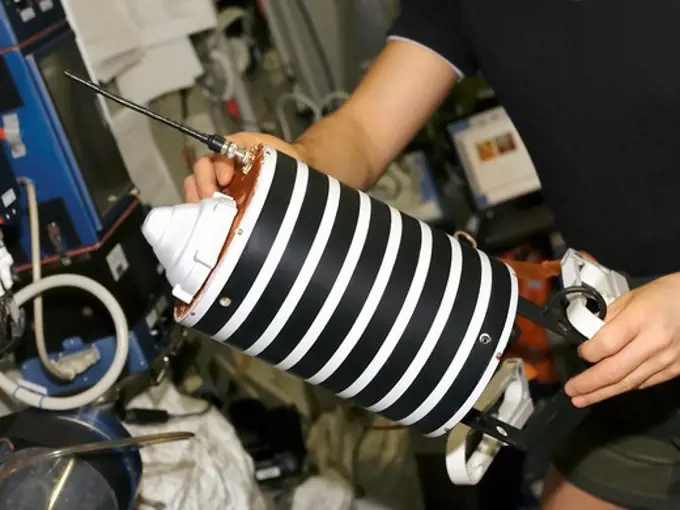
Nanosputnik
6145-44683795
Perseid Meteor flight on Google's Gulfstream Aircraft. P.I. Peter Jenniskens, SETI Group, with M.W. Koop, Meteor Society, CA
6145-45097181
Astronaut Scott Kelly initiated VEG-01 B, the second crop of lettuce, on July, 8, 2015, and both Kelly and Astronaut Kjell Lindgren cared for the plants. The crop grew for 33 days. VEG-01 B included one set of six plant pillows planted with red romaine lettuce seeds. On Aug. 10, 2015, the crew harvested and consumed leaves from each plant. This was the first crop grown and consumed in NASA hardware. They harvested the rest of the plant tissue and froze it in the stations Minus Eighty-Degree Laboratory Freezer for ISS (MELFI) for return to Earth for further study including microbial analysis, antioxidant capacity, mineral analysis and anthocyanin concentration.
6145-44981108
STS093-319-003 (23-27 July 1999) ---Astronaut Catherine G. (Cady) Coleman,mission specialist, handles a tiny mouse ear plant on Columbia's flight deck. The plant experiment is part of the Plant Growth Investigations in Microgravity (PGIM).
6145-44660216
KENNEDY SPACE CENTER, FLA. -    In the Vehicle Assembly Building, STS-116 Mission Specialist Christer Fugelsang (left) and Pilot William Oefelein look at one of the solid rocket boosters designated to launch Space Shuttle Discovery.  Fugelsang represents the European Space Agency.  The crew is at KSC for a Crew Equipment Interface Test.  Mission crews make frequent trips to the Kennedy Space Center to become familiar with the equipment and payloads they will be using.  STS-116 will be mission No. 20 to the International Space Station and construction flight 12A.1.  The mission payload is the SPACEHAB module, the P5 integrated truss structure and other key components.   Launch is scheduled for no earlier than Dec. 7.
6145-45141681
Robert Lightfoot, acting NASA administrator, takes photo of eclipse using eclipse glasses on cell phone.
6145-44510276
S106-E-5202 (13 September 2000) --- Cosmonaut Yuri I. Malenchenko, mission specialist representing the Russian Aviation and Space Agency, teams up withastronaut Edward T. Lu for some electrical work aboard the Zvezda service module on the International Space Station (ISS).  Electrical work was the hallmark of the day as four of the mission specialists aboard ISS (temporarily docked with the Space Shuttle Atlantis) replaced batteries inside the Zarya and Zvezda modules while supply transfer continued around them. Astronaut Edward T. Lu, is out of frame at right.
6145-44628768
ISS010-E-19105 (3 March 2005) --- Cosmonaut Salizhan S. Sharipov, Expedition 10 flight engineer representing Russia's Federal Space Agency, holds the Progress supply vehicle probe-and-cone docking mechanism in the Zvezda Service Module of the International Space Station (ISS).
6145-44655856
NASA Monsoon Multidisciplinary analysis (NAMMA) deployment, Sal Island, Cape Verde Africia
6145-44707086
S124-E-005475 (1 June 2008) --- NASA astronaut Ken Ham (foreground), STS-124 pilot, and Japan Aerospace Exploration Agency (JAXA) astronaut Akihiko Hoshide, mission specialist, are pictured near the galley on the middeck of Space Shuttle Discovery.
6145-44509997
S106-E-5122 (12 September) --- Astronaut Terrence W. Wilcutt (left), mission commander, and cosmonaut Yuri I. Malenchenko, mission specialist, look over what is basicallyan agenda for several busy days ahead for readying the International Space Station (ISS) for its first inhabitants.Malenchenko is one of two Russian cosmonauts on the flight.  He had joinedastronaut Edward T. Lu earlier in the mission for six-plus hours of extravehicular work on the station.
6145-44549450
STS079-304-001 (16 Sept. 1996)--- Astronaut Carl E. Walz totes a bag carrying a space suit used by the cosmonauts.  At the completion of the STS-79 mission, the suit was brought back to Earth for analysis.  This photograph is one of fifteen 35mm frames (along with four 70mm frames) of still photography documenting the activities of NASA's STS-79 mission, which began with a September 16, 1996, liftoff from Launch Pad 39A the Kennedy Space Center (KSC) and ended with a landing at KSC on September 26, 1996.  Onboard for the launch were astronauts William F. Readdy, commander; Terrence W. Wilcutt, pilot; John E. Blaha, Jerome (Jay) Apt, Thomas D. Akers and Walz, all mission specialists.  On flight day 4, the crew docked with Russia's Mir Space Station.  Shannon W. Lucid, who had spent six months aboard Mir, switched cosmonaut guest researcher roles with Blaha.  The latter joined fellow Mir-22 crew members Valeri G. Korzun, commander, and Aleksandr Y. Kaleri, flight engineer.
6145-44968415
ISS036-E-021856 (21 July 2013) --- NASA astronaut Chris Cassidy, Expedition 36 flight engineer, uses a sewing kit to repair a glove in the Tranquility node of the International Space Station.
6145-44613591
European Space Agency astronaut Andre Kuipers of the Netherlands signs a photograph in the space museum located at the Baikonur Cosmodrome, Wednesday, April 14, 2004, in Baikonur, Kazakhstan.
6145-44776915
CAPE CANAVERAL, Fla. - On a tour of NASA's Kennedy Space Center in Florida, NASA Administrator Charles Bolden steps inside one of the Ares I-X segments in the Vehicle Assembly Building with NASA engineer Trent Smith. Bolden is touring several facilities at Kennedy involved with NASA's  Constellation Program. Bolden also was at Kennedy for several events, including the landing of space shuttle Endeavour's STS-127 mission and the signing of the joint NASA-Japan Aerospace Exploration Agency agreement defining the terms of cooperation between the agencies on the Global Precipitation Measurement, or GPM, mission.
6145-58963601
KENNEDY SPACE CENTER, FLA. - Jeff Richards, a plant physiologist with Dynamac Corporation, displays a crop of strawberries grown in a controlled environment chamber at the Space Life Sciences Lab during a tour of the facility for members of the news media. In missions to the International Space Station or early planetary outposts, plant production systems will likely be small and rely upon the spacecraft or habitat environment to regulate temperature, relative humidity, and carbon dioxide concentrations. Various crops are being grown in conditions that might be experienced in a spacecraft to evaluate the effects of different environmental conditions on plant growth, crop yield, and product quality.
6145-45061762
ISS040-E-015532 (19 June 2014) --- European Space Agency astronaut Alexander Gerst, Expedition 40 flight engineer, conducts a session with the Capillary Flow Experiment (CFE-2) in the Harmony node of the International Space Station. CFE is a suite of fluid physics experiments that investigate how fluids behave in microgravity which could benefit water and fuel delivery systems on future spacecraft. Scientists designed the CFE-2 to study properties of fluids and bubbles inside containers with a specific 3-D geometry.
6145-44603308
ISS007-E-17880 (20 October 2003) --- European Space Agency (ESA) astronaut Pedro Duque of Spain prepares to set up the Cervantes program of tests (consisting of 20 commercial experiments) by starting with the Microgravity Science Glovebox (MSB) in the Destiny laboratory on the International Space Station (ISS). Duque is working on the PROMISS experiment, which will investigate the growth processes of proteins during weightless conditions.
6145-44569631
STS095-E-5229 (4 Nov. 1998)--- STS-95 payload specialist Chiaki Mukai, representing Japan's National Space Development Agency (NASDA), changes out cassette on camera. The scene was recorded with an electronic still camera (ESC) at 03:09:07 GMT, Nov. 4.
6145-44671715
ISS014-E-18822 (31 March 2007) --- Astronaut Sunita L. Williams, Expedition 14 flight engineer, works with the Lab-on-a-Chip Application Development-Portable Test System (LOCAD-PTS) experiment in the Destiny laboratory of the International Space Station. LOCAD-PTS is a handheld device for rapid detection of biological and chemical substances onboard the station.
6145-44937805
24 GMT056 RMS Cupola_934
6145-44793782
CAPE CANAVERAL, Fla. - At the Astronaut Hall of Fame near NASAs Kennedy Space Center in Florida, Kennedy Director Bob Cabana, a former astronaut, tries out a pair of space gloves for their dexterity and flexibility in a glove box  at the 2009 Astronaut Glove Challenge, part of NASAs Centennial Challenges Program.The nationwide competition focused on developing improved pressure suit gloves for astronauts to use while working in space.  During the challenge, the gloves were submitted to burst tests, joint force tests and tests to measure their dexterity and strength during operation in a glove box which simulates the vacuum of space.  Centennial Challenges is NASAs program of technology prizes for the citizen-inventor. The winning prize for the Glove Challenge is $250,000 provided by the Centennial Challenges Program.
6145-44778251
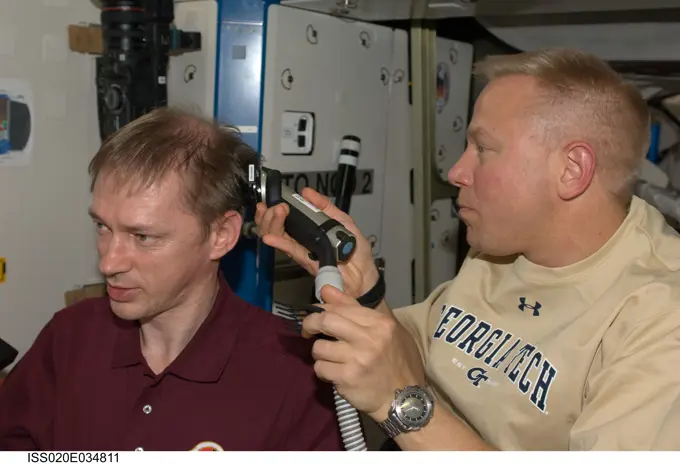
ISS020-E-034811 (9 Aug. 2009) --- NASA astronaut Tim Kopra, Expedition 20 flight engineer, trims European Space Agency astronaut Frank De Winnes hair in the Destiny laboratory of the International Space Station. Kopra used hair clippers fashioned with a vacuum device to garner freshly cut hair.
6145-44671209
ISS014-E-18307 (27 March 2007) --- Astronaut Sunita L. Williams, Expedition 14 flight engineer, talks with students at the International School of Brussels in Belgium during an Amateur Radio on the International Space Station (ARISS) contact in the Zvezda Service Module.
6145-44985017
ISS038-E-011800 (4 Dec. 2013) --- Japan Aerospace Exploration Agency astronaut Koichi Wakata, Expedition 38 flight engineer, works the controls at the robotic workstation in the Cupola of the International Space Station.
6145-44535956
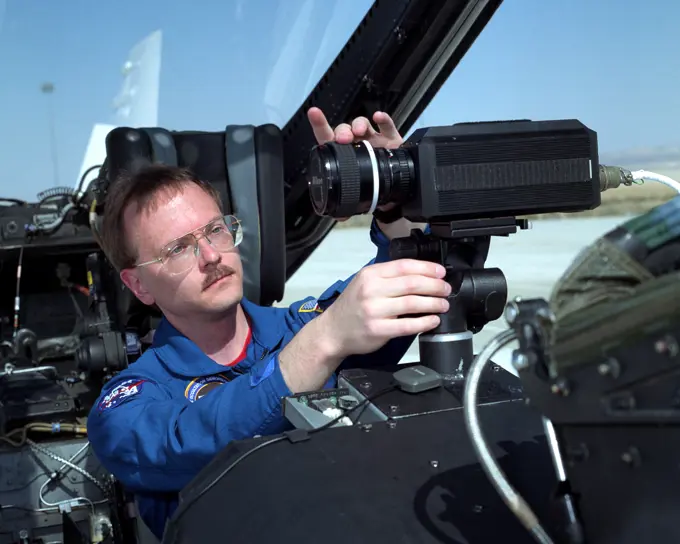
Southwest Research Institute astronomer Dan Durda checks the alignment of the SWUIS-A Xybion digital camera mounted in the rear cockpit of a NASA Dryden F/A-18B before taking off on an astronomy mission.
6145-44978220
NextSafe 2.5 Motion Simulation Experiment Crew evaluation of vision system technologies
6145-44683296
JSC2007-E-41534 (9 Aug. 2007) --- Astronaut Scott E. Parazynski, STS-120 mission specialist, prepares to use virtual reality hardware in the Space Vehicle Mockup Facility at Johnson Space Center to rehearse some of his duties on the upcoming mission to the International Space Station. This type of virtual reality training allows the astronauts to wear special gloves and other gear while looking at computer displays simulating actual movements around the various locations on the station hardware with which they will be working. David J. Homan assisted Parazynski.
6145-44583062
STS112-E-05862 (16 October 2002) --- Astronaut Jeffrey S. Ashby, STS-112 mission commander, occupies the commander’s station on the flight deck of the Space Shuttle Atlantis.
6145-44526570
STS104-E-5029 (14 July 2001) --- Astronaut Steven W. Lindsey, STS-104 mission commander, looks toward theInternational Space Station (ISS) duringrendezvous operations.  A crew mate on Atlantis' flight deck took this picture with a digital still camera.
6145-44760980
ISS019-E-011464 (28 April 2009) --- Japan Aerospace Exploration Agency (JAXA) astronaut Koichi Wakata, Expedition 19/20 flight engineer, performs in-flight maintenance on the waste and hygiene compartment located in the Destiny laboratory of the International Space Station.
6145-44765217
ISS020-E-005050 (29 May 2009) --- Cosmonaut Gennady Padalka (right), Expedition 19/20 commander, welcomes Canadian Space Agency astronaut Robert Thirsk, Expedition 20/21 flight engineer, after Thirsk arrived onboard a Soyuz TMA-15 spacecraft with European Space Agency astronaut Frank De Winne (out of frame) and cosmonaut Roman Romanenko (out of frame), both flight engineers. The crew launched from the Baikonur Cosmodrome in Kazakhstan at 5:34 a.m. (CDT), May 27, 2009, and arrived at the station at 7:34 a.m. (CDT) on May 29, beginning Expedition 20 and six-person crew operations.
6145-44610152
KENNEDY SPACE CENTER, FLA. -  In the SRB Assembly and Refurbishment Facility,  STS-114 Mission Specialist Charles Camarda looks closely at a test design of the bolt catcher insulation.  The STS-114 crew is at KSC for familiarization with Shuttle and mission equipment. The mission is Logistics Flight 1, which is scheduled to deliver supplies and equipment, plus the external stowage platform, to the International Space Station.
6145-44655805
NASA Monsoon Multidisciplinary analysis (NAMMA) deployment, Sal Island, Cape Verde Africia
6145-44818622
ISS023-E-042456 (10 May 2010) --- Russian cosmonaut Oleg Kotov, Expedition 23 commander, poses for a photo with a plant experiment in the Destiny laboratory of the International Space Station.
6145-45061203
European Space Agency astronaut Alexander Gerst,Expedition 40 flight engineer,works with samples and hardware for a combustion experiment known as the Burning and Suppression of Solids (BASS) in the Microgravity Science Glovebox (MSG) in the Destiny laboratory of the International Space Station.
4055-5502
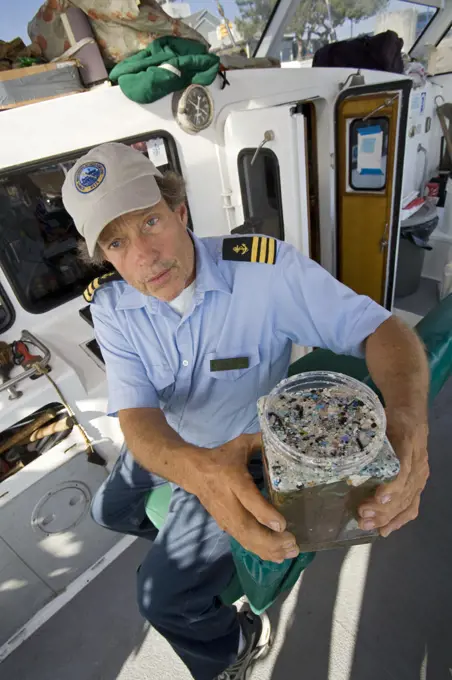
Captain Charles Moore, the man credited for first discovering the plastic soup in the Gyre over 10 years ago, showing plastic samples collected in the North Pacific Gyre.
6145-45130001
jsc2017e038550 (March 30, 2017) --- At the Gagarin Cosmonaut Training Center in Star City, Russia, Expedition 51 crewmember Jack Fischer of NASA is seen inside a Russian segment systems mockup on a TV monitor being viewed by trainers March 30 as he and Fyodor Yurchikhin of the Russian Federal Space Agency (Roscosmos) began two days of final qualification exams. Fischer and Yurchikhin will launch April 20 on the Soyuz MS-04 spacecraft from the Baikonur Cosmodrome in Kazakhstan for a four and a half month mission on the International Space Station.
6145-55975237
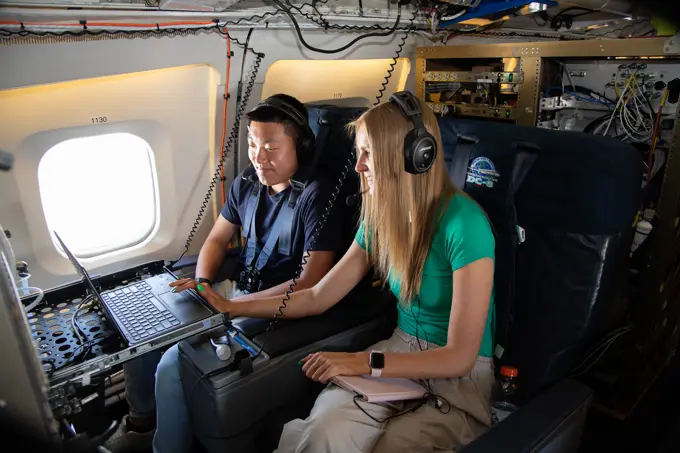
. NASA Armstrongs Student Airborne Research Program celebrates 15 years of success in 2023. An eight-week summer internship program, SARP offers upper-level undergraduate students the opportunity to acquire hands-on research experience as part of a scientific campaign using NASA Airborne Science Program flying science laboratoriesaircraft outfitted specifically for research projects. Students onboard NASAs DC-8 aircraft, the largest flying science laboratory in the world, help scientists from NOAA, the National Oceanic and Atmospheric Administration with a science project investigating air quality and non-vehicular pollution sources called AEROMMA, which measures Atmospheric Emissions and Reactions Observed from Megacities to Marine Areas. In 2023, NASA also introduced a sister program, SARP East to complement the West Coast program.
6145-44656362
NASA Monsoon Multidisciplinary analysis (NAMMA) deployment, Sal Island, Cape Verde Africia
6145-44610946
NASA DC-8 Mission Manager Walter Klein and Chilean Air Force Advisor Captain Saez review maps of the Antarctic Peninsula during an AirSAR 2004 mission. AirSAR 2004 is a three-week expedition in Central and South America by an international team of scientists that is using an all-weather imaging tool, called the Airborne Synthetic Aperture Radar (AirSAR), located onboard NASA's DC-8 airborne laboratory. Scientists from many parts of the world are combining ground research with NASA's AirSAR technology to improve and expand on the quality of research they are able to conduct.These photos are from the DC-8 aircraft while flying an AirSAR mission over Antarctica. The Antarctic Peninsula is more similar to Alaska and Patagonia than to the rest of the Antarctic continent. It is drained by fast glaciers, receives abundant precipitation, and melts significantly in the summer months. In recent decades, the Peninsula has experienced significant atmospheric warming (about 2 degrees C since 1950)
6145-58970859
iss063e077237 (Aug. 21, 2020) --- Roscosmos cosmonaut and Expedition 63 Flight Engineer Anatoly Ivanishin works inside the International Space Station's Zvezda service module preparing for an event commemorating Russian space activities.
6145-45289668
iss064e040580 (March 9, 2021) --- JAXA (Japan Aerospace Exploration Agency) astronaut Soichi Noguchi poses with plants growing inside containers for the Asian Herbs study. The space botany investigation is exploring ways to cultivate fast-growing plants used for traditional medicine and food flavoring.
PREVIOUS
of 4
NEXT
2401 S. Ervay, Suite 206
Dallas, Texas 75215
United States
Get Started
Free ResearchMy BoardsMy Cart
For Creators
How To License Your ContentContributor PortalFrame of Mind
Resources
API accessPricing
Contact
+1 866 236 0087help@viewpictures.co.uk Contact form
©2026 View Pictures. All Rights Reserved. -B
This site is protected by reCAPTCHA and Google Privacy Policy and Terms of Service apply.