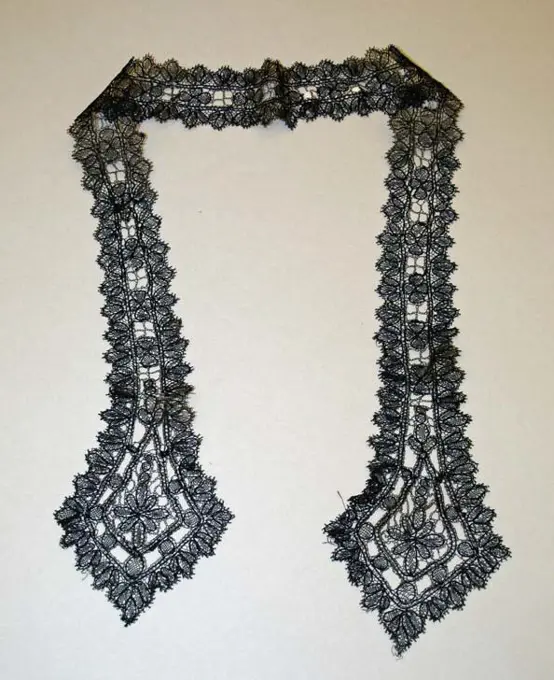
Intricate Lace Designs

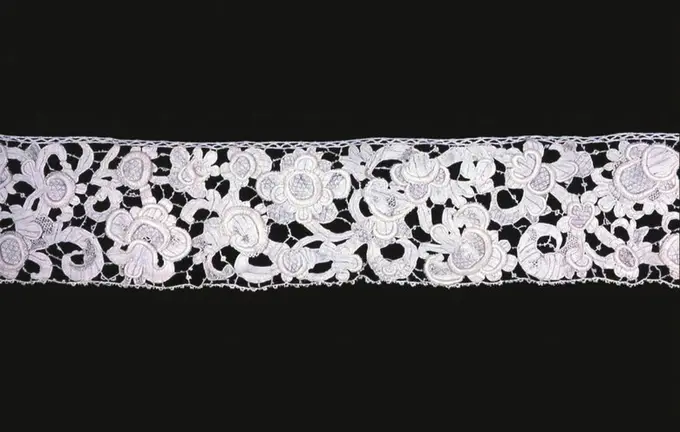
Beautiful examples of historical lace, featuring intricate patterns with floral and leaf motifs. Various styles and techniques from different time periods.

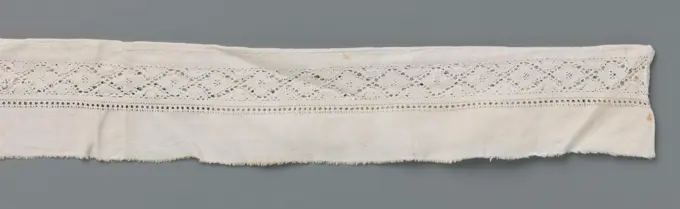
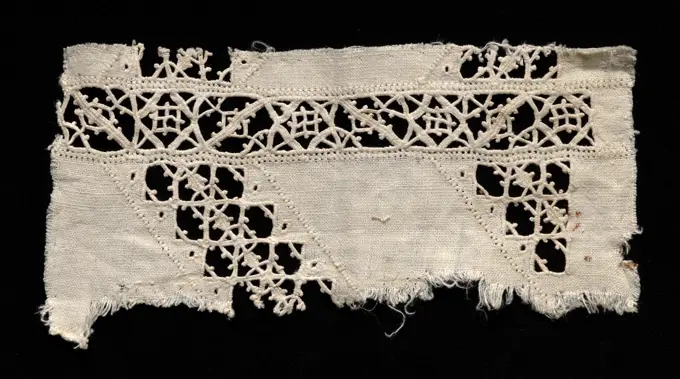
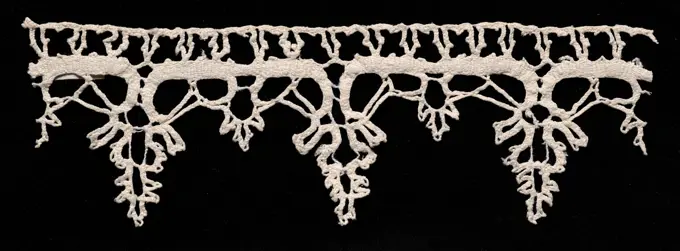
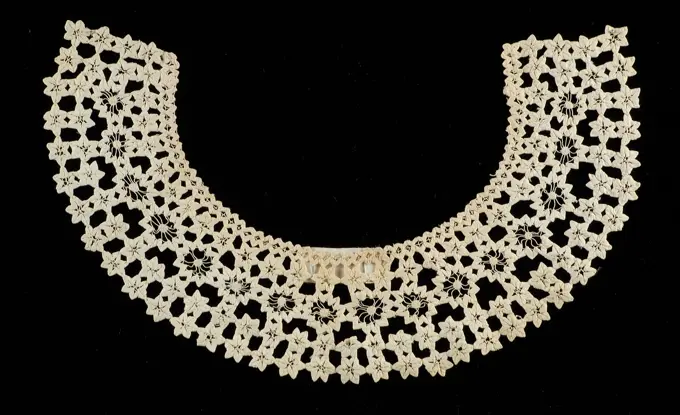
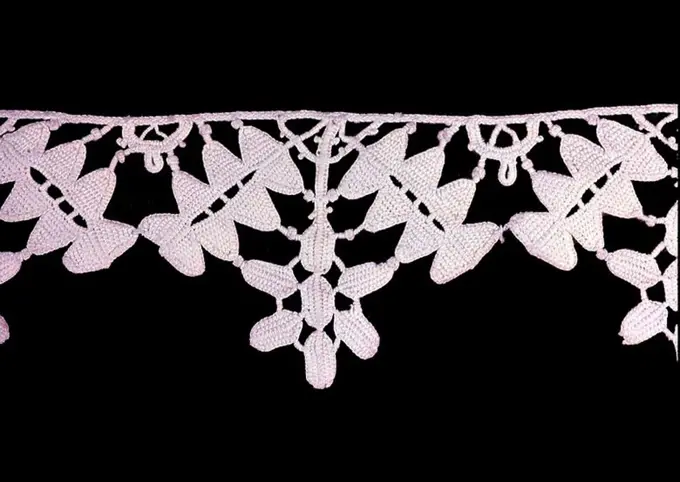
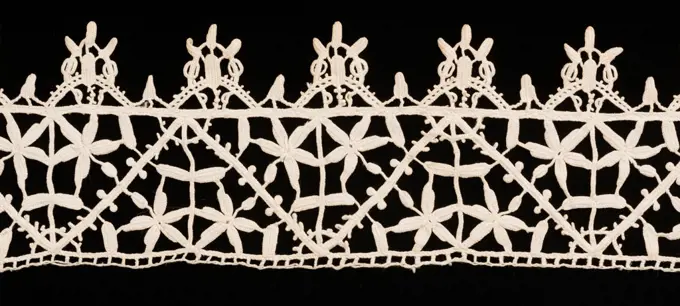
Strip of needle side with incised leaves, anonymous, c. 1900 Walking pattern of incised leaves above a rose and a three -leaf, which together form the sharply toothed outside line. Cross-shaped bars with button (soil of long X-shaped bars with a spider). The Remplis consists of buttonholes and a long distance gazé. German side: 'Carlsbader Points'. Karlsbad (Germany) (possibly) linen (material) Walking pattern of incised leaves above a rose and a three -leaf, which together form the sharply toothed outside line. Cross-shaped bars with button (soil of long X-shaped bars with a spider). The Remplis consists of buttonholes and a long distance gazé. German side: 'Carlsbader Points'. Karlsbad (Germany) (possibly) linen (material)
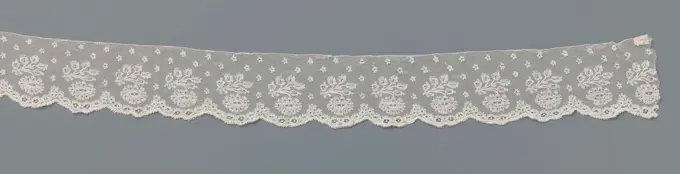
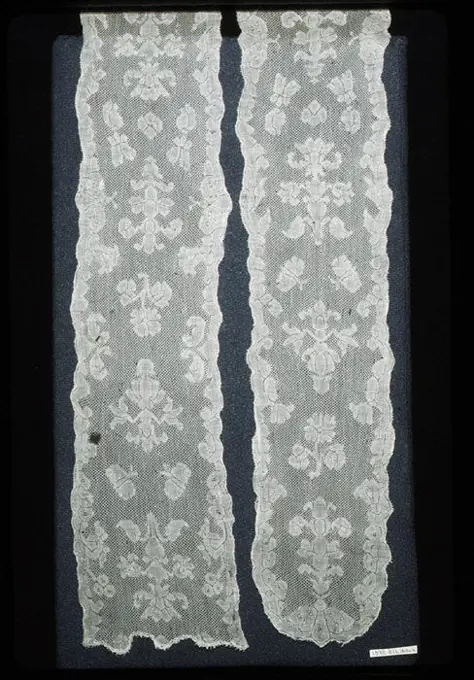
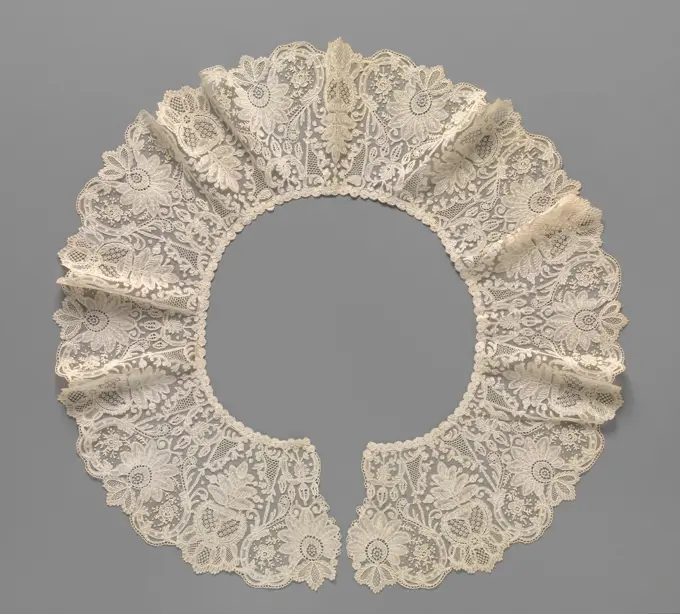
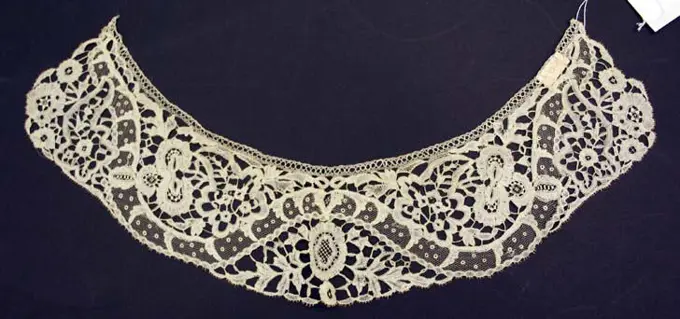
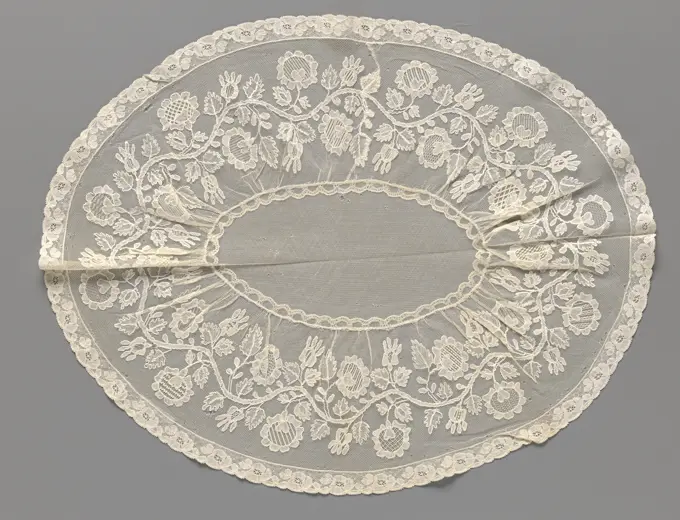
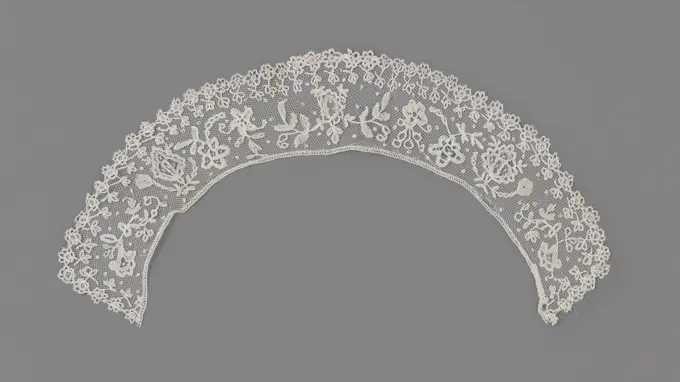
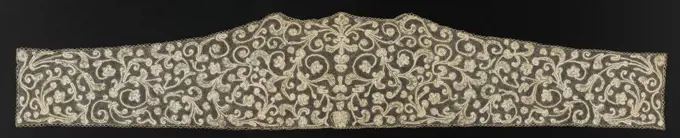
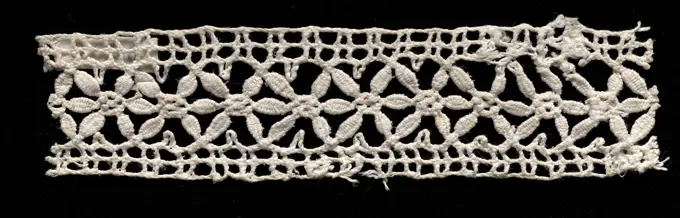
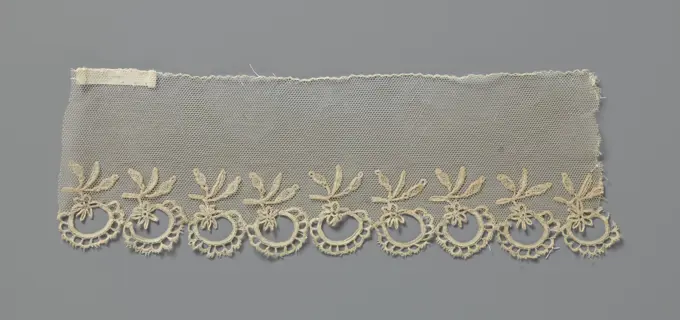
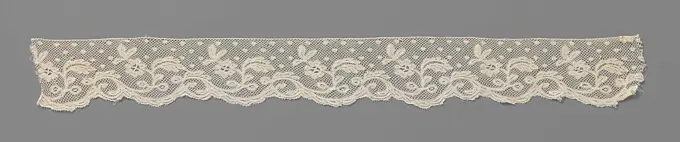
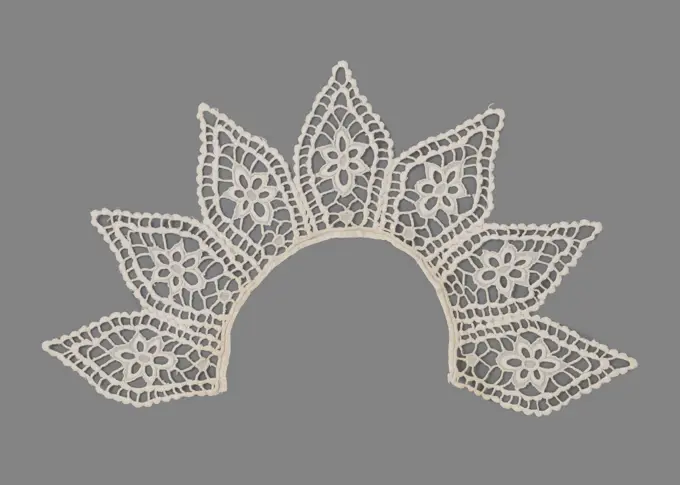
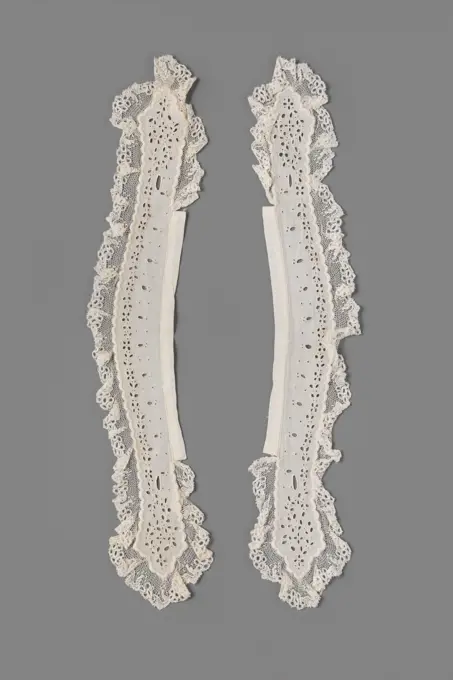
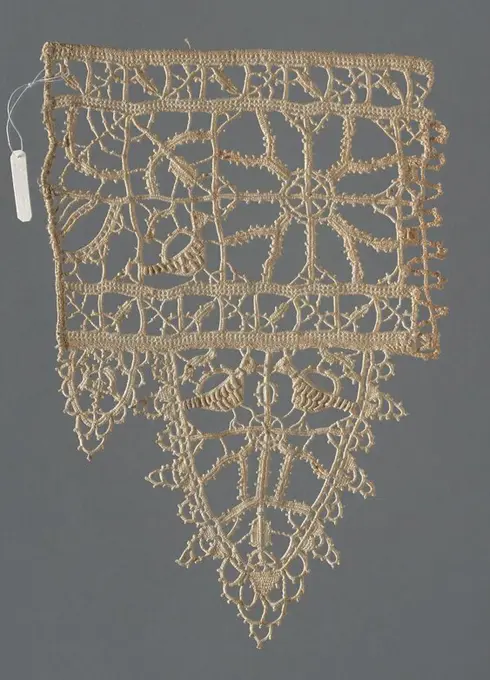
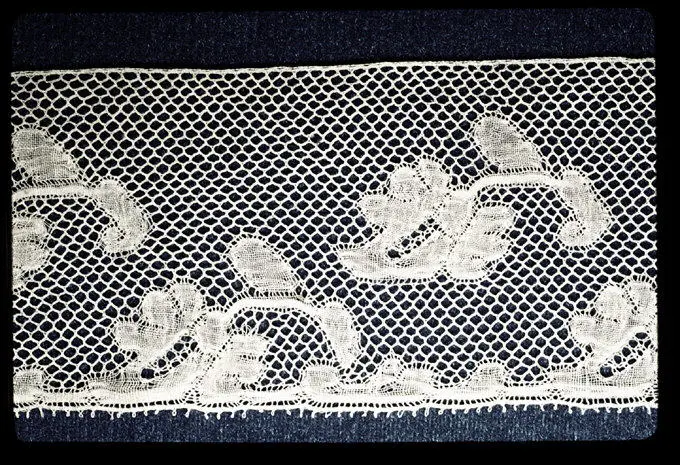
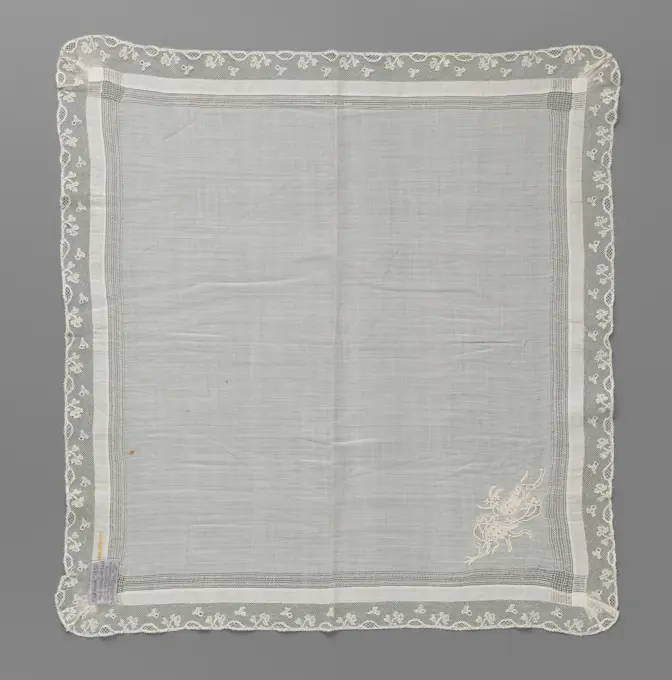
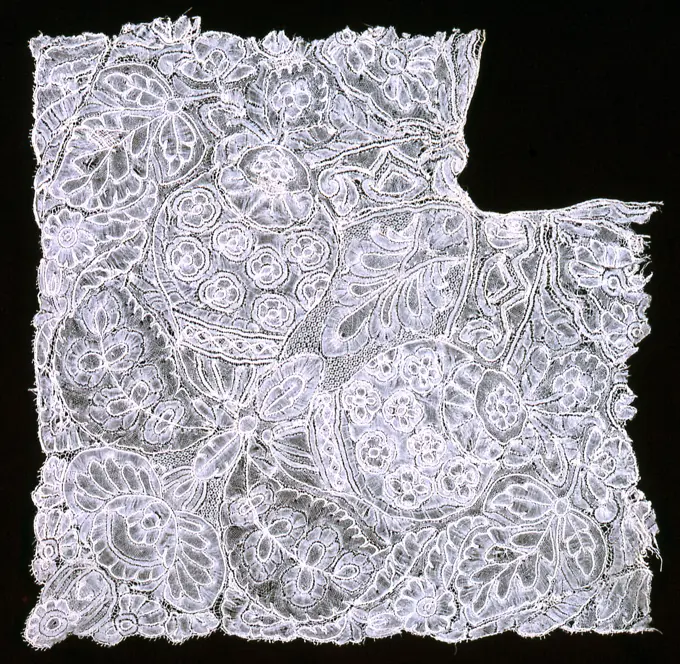
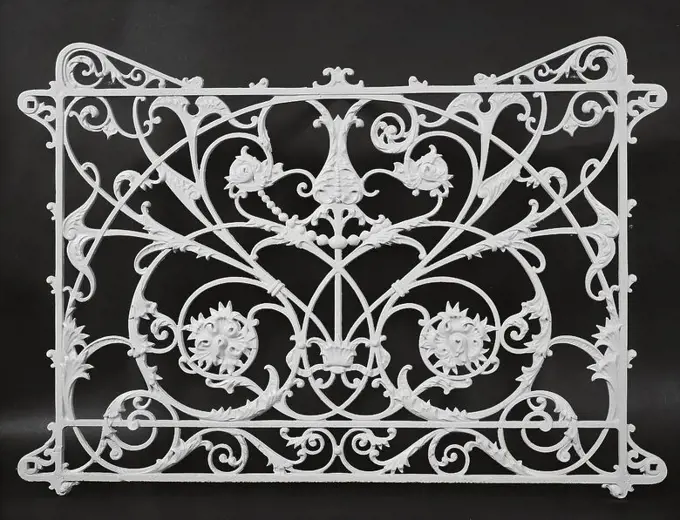
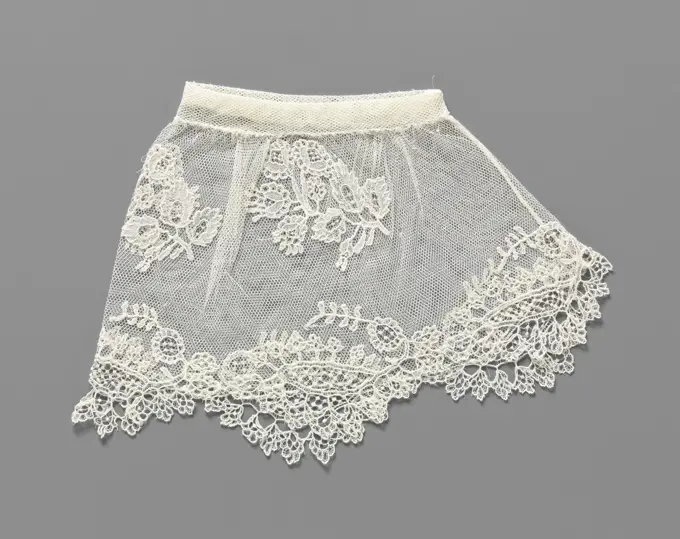
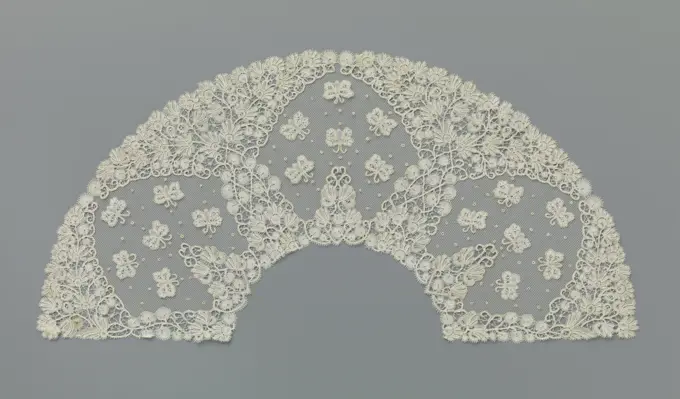
Restant van een kussensloop met tussenzetsels van kloskant met een rij vierlobbige rozetten tussen halve spitsovalen.Inserts of natural colosside in residues of a linen pillowcase. The repeating pattern consists of a center line of co-switched quadruped rosette flowers. Along the top and bottom edge a succession of half spitsavals runs. The motifs are connected by braids, which form the start of a Maas soil. The motifs are made in linen stroke with openwork edges. Along the sides of intersection, a cut-away edge has been made in the linen, work with coiled wires.Fragment, Medium: linen Technique: bobbin lace (Brussels-style), Small fragment of a floral border, slightly scalloped. Widely-spaced floral sprays on 'vrai droschel' ground., Belgium, 1750-1800, lace, FragmentFragment needle side with tilted squares, anonymous, c. 1500 - c. 1599 fragment Fragment natural -colored needle side, sliced work. Pattern with cut out, tilted squares. unknown linen (material)Handkerchief. Belgium, Ghent, second half of the 19th century. Costumes; Accessories. Linen plain weave with cotton embroidery and cotton bobbin lace (Valenciennes de gand)Double collar of climbing side with mountain and dal line. There is a symmetrical pattern at a nice ground ground, a mechelen soil (also known as ice soil). Within a stretched sculpture of lobed leaves and roses, triple flower branches are in either side of a leaf rosette under a 'mountain and dal' line. This limits two halved diamond-shaped medallions with a raster filling of crucifixes. The narrow strip of the collar shows an ongoing pattern of a flower drink between omega-shaped lobby tendrils. Mechelen side.Oval dress of climbing side with shaded medallions. Dress of natural colosside: Duchesse-Side. Oval model with symmetrical pattern. There are two edges with S-ranks and 'buttercups' in a braid soil within flat oval lists. In the middle is a large oval medallion, filled with transverse accels. In the outer edge there are four smaller medallions with arrangements.Collar ca. 1850 American. Collar. American. ca. 1850. CottonFragment of lace. unknown, authorBatist handkerchief with a triple edge embroidery with forget-me-notes, anonymous, c. 1850 - c. 1860 Batist handkerchief with a triple edge embroidery all around: whitework. Square model with highly rounded corners. A flat sculpting edge with small rounded shells runs along a succession of embroidered cvols and forget-me-nietjes. The next edge embroidery consists of a continuous straight line, on which there is a sloping branch with fine leaves above each shell. The repeating embroidery pattern along the inner edge consists of a rosette flower with open flower heart, for which there is a bunch of me-nots in a diamond shape. Between the successive diamond -shaped bunches long feathered leaves. Switzerland linen (material). batiste embroidering Batist handkerchief with a triple edge embroidery all around: whitework. Square model with highly rounded corners. A flat sculpting edge with small rounded shells runs along a succession of embroidered cvols and forget-me-nietjes. The next edge emStrook kloskant met schulpen van rozetjes.On the ground soil, a mechelen soil (also known as ice soil), stands between sprays of twigs, whose heavy daisies depend on. The circle arc shaped are equal and formed by a chain of rosettes. Mechelen side.Batist dress with light pink ribbons between machine embroidery and machine side, anonymous, c. 1915 - c. 1924 Dress of natural-colored batist, square model with rounded corners and trimmed with a border machine side: Valenciennes side. The rug is decorated with three lanes, each of which consists of two intermediate sinks from Valenciennes side and in between mechanical embroidery with notches through which a light pink ribbon is strung. The repeating pattern from the lace edge consists of a V-shaped flower branch with two flowers. The six intermediate branches have a pattern of a regular wavy slender with rose hips or pomegranates. The embroidery consists of always the same openwork round flour, surrounded by round petals. The back of the rug with the decorated jobs is lined. Netherlands Rug and side: Cotton (textile). ribbon and lining: Silk Dress of natural-colored batist, square model with rounded corners and trimmed with a border machine side: Valenciennes side. The rug is decoraCollar, Medium: Technique: needlework on net, Deep round collar of net with an alloever embroidered floral design. Sawtooth scallops and tiny dots powdered over the ground. Initial 'C' embroidered in center back., France, ca. 1845, lace, CollarCollar of needle side with curling tendrils on which some flowers and a bow edge with three -part arches, anonymous, c. 1890 - c. 1899 Collar of natural -colored needle side: Venetian relief side. The symmetrical pattern consists of curling tendrils with some flowers. The flower (or fruit) In the middle is the largest and has an oval center around which seven petals protrude and at the bottom a circle between two volutes and with a three -lobby motif. The motifs are equipped with light relief contours and are connected by a potente land. Decorative lands have been used in the flowers. The collar is finished on the outside with three -part arches with picots. The straight-finished neck/neck line are sewn together, making the collar folded double. It is not clear why they did this. Burano (possibly) linen (material) Venetian raised work Collar of natural -colored needle side: Venetian relief side. The symmetrical pattern consists of curling tendrils with some flowers. The flower (or fruiTwo joined lappets third quarter 18th century Franco-Flemish The Metropolitan Museum's great lace collection was started when the Museum became the first among American museums to organize a permanent collection of lace with the acceptance of the McCallum Collection in 1879 and the bequests of Mrs. John Jacob Astor, Mrs. Robert L. Stuart, Mrs. Augustus Cleveland, and Mrs. A. W. Winters shortly thereafter. In 1893 a loan collection of antique laces shown at the World's Columbian Exposition in Chicago was assembled by a committee of New York women headed by Catharine Augusta Newbold. About 1900 Miss Newbold arranged and labeled an exhibition of laces and linenworks lent to the Metropolitan Museum by Mrs. James Boorman Johnstone and the Misses Johnstone. "Her scholarly knowledge of lace technique enabled the Museum for the first time to offer a comprehensive display of lace illustrating its historical development," wrote Miss Frances Morris, then curator of the textile department. Miss NeBobbin Lace Insertion and Points, mid 16th century. Italy, Venice, mid 16th century. Lace, bobbin; average: 9 x 3.9 cm (3 9/16 x 1 9/16 in.).Embroidery Sample, 16 x 82 1/4 in. (40.64 x 208.92 cm), Cotton, silk; needlework, ChinaFragment of the fabric;  XVII century (1601-00-00-1700-00-00);Dąmbska, Grażyna - collection, Louis XIV, fabric, fabrics, purchase (provenance)Strip 18th century Italian. Strip. Italian. 18th century. Bobbin lace. Textiles-LacesKraag van gemengde kant met rozet gevat in s-lijnen en een vaas met zevenblad.Collar of natural mixed side - climbing side in combination with a coniferous lace - Brussels Duchesse. Round model. The repetitive and radially set pattern exists alternately from a rosette in symmetrical S lines and a vase with a seven leaf. The motifs are clamped in linen stroke and power base. The motifs are partially accentuated by climbed relief contours and the remainder through widely scented wire bundles. Some roses are made of needle side. The motifs are connected to each other by a coniferous lace ground with single scented meshes. There are different needle lace standards applied and ornamental soils with very fine and coarser meshes. The sloping edge along the outer edge consists of large shallow slot and the inner edge consists of co-switched rosettes.Collar 19th century British. Collar 102619Cap Streamers (France); linen, horsehairBobbin Lace Insertion with Fringe, mid 16th century. Italy, Venice, mid 16th century. Lace, bobbin; average: 7.1 x 21 cm (2 13/16 x 8 1/4 in.).Textile Swatches Onondaga Silk Company, Inc. (1925-1981). Textile Swatches, 1948-1959. 72 silk; 28 metal, a-h: 11 x 3 1/2 in. (27.9 x 8.9 cm).    1948-1959Border; 1974-52-46Cap crown, Medium: linen Technique: needle lace with ground of loop and twist with twist return, Cap crown with a pattern of symmetrical floral and foliated forms that are framed by scroll-like bands., Italy, mid-18th century, lace, Cap crownCushion deck made of lace pledger with oval shape and wavy rose branch with oval flowers and rose buttons, anonymous, c. 1840 Cushion deck of natural -colored lace -ups: tuldoor stop work on machine tulle. Oval model. The cushion deck has an empty Middenovaal with a narrow strip with arcs in throughing. A wide edge around this midfield consists of mechanical tulle on which a regularly wavy rose branch is embroidered with oval flowers and rose buttons between leaves in cargo work. Various mechanical decorations have been used in the Bloemharten. The cushion deck is finished all around with a border of machine side with florets (imitation bobbin). Netherlands (possibly) linen (material) Cushion deck of natural -colored lace -ups: tuldoor stop work on machine tulle. Oval model. The cushion deck has an empty Middenovaal with a narrow strip with arcs in throughing. A wide edge around this midfield consists of mechanical tulle on which a regularly wavy rose branch is embroidered with oval flStrip of bobbin with plume flour and star -shaped flour, anonymous, c. 1700 - c. 1749 Strip of natural-colored bobbin, binche side. The repeating and continuous pattern consists of a plume -shaped flour and a star -shaped flower with five pointed petals on curved stems. Between the successive flowers, a wavy leaf cuts the stem of the plume -shaped flour. Under the stem of the star -shaped flour is a thin plume -shaped flour or ear along the bottom edge. The motifs are connected by a fine decorative land, a snowflake land. The motifs are made in linen battle with openwork edges and mains filling under the wavy leaf. The top of the strip is straight finished. The silly scallops along the underside of the strip come from the pattern and are finished with picots. Southern Netherlands linen (material) Bobbi Lace / Binche Lace Strip of natural-colored bobbin, binche side. The repeating and continuous pattern consists of a plume -shaped flour and a star -shaped flower with five pointed petalsCollar of application side with sculpy edge of hanging roses, anonymous, c. 1870 - c. 1890 Collar of natural -colored application side: Kloskant Applicated on Machine Tulle. Round model. The potented edge is decorated with hanging roses that form the sculpts. Above that, the collar is decorated with flowers of branches with leaves and moesjes. Brussels linen (material) Brussels Applied Collar of natural -colored application side: Kloskant Applicated on Machine Tulle. Round model. The potented edge is decorated with hanging roses that form the sculpts. Above that, the collar is decorated with flowers of branches with leaves and moesjes. Brussels linen (material) Brussels AppliedSleeve ruffle , Medium: linen Technique: bobbin lace, discontinuous tape, Design of scrolling stems with leaves and flowers, running to the right and left from central ornament. Ground is of vrai droachel worked in several directions., Spain or Belgium, 18th century, lace, Sleeve ruffle Altar Frontal. Italy. Date: 1601-1700. Dimensions: 373.38 x 76.8 cm (147 x 30 1/4 in.). Origin: Italy. Museum: The Chicago Art Institute, Chicago, USA.Band 17th century Italian. Band 214948Bobbin Lace (Point d'Angleterre) Lappet, 18th century. Belgium, Brussels, 18th century (Louis XV period). Lace, bobbin: linen; average: 119.4 x 13.4 cm (47 x 5 1/4 in.).Kloskant cuff with Margrietjes, Anonymous, c. 1900 - c. 1924 A coarse mesh stock (square Maas) with daisies above scoops of pearls. Valenciennes side. Sluis (Possible) linen (material) Bobbi Lace / Valenciennes Lace A coarse mesh stock (square Maas) with daisies above scoops of pearls. Valenciennes side. Sluis (Possible) linen (material) Bobbi Lace / Valenciennes LaceBobbin Lace (Needlepoint Design) Insertion, 17th century. Italy, Genoa, 17th century. Lace, bobbin; average: 3.2 x 12.8 cm (1 1/4 x 5 1/16 in.).Band (France); linen; Bequest of Marian Hague; 1971-50-465Bonnet 1830s British. Bonnet 98240Strip application side with hanging flowers along the lower edge, anonymous, c. 1825 - c. 1849  Strip natural -colored application side: Kloskant Applicated Applicated on Machine Tulle. A row of continuous, uniform flowers hangs down from the fine hexagonal mesh soil and thus forms the lower edge. The stems with leaves are attached to the tulle, as well as the rosette -shaped heart of the flower. The frame of the Bloemhart consists of an open circular shape, trimmed with picoted arches. The frames are largely separate from the tulle. The top is finished with a straight edge. Brussels cotton (textile)Application side scarf with the open peripheral flowers, anonymous, c. 1880 - c. 1909 Shawl of natural -colored application side, bobbin lacquered on mechanical tulle. Triangular model with a densely scattered pattern of low swinging stems that do not cross anywhere. They end in volutes and sometimes in openwork peripheral flowers. There are a large poppy, a pineapple -shaped fruit and rocailles, all with grid pattern. Furthermore, multifaceted smaller flowers and spindly leaves. Brussels (possibly) linen (material) Shawl of natural -colored application side, bobbin lacquered on mechanical tulle. Triangular model with a densely scattered pattern of low swinging stems that do not cross anywhere. They end in volutes and sometimes in openwork peripheral flowers. There are a large poppy, a pineapple -shaped fruit and rocailles, all with grid pattern. Furthermore, multifaceted smaller flowers and spindly leaves. Brussels (possibly) linen (material)Lace Edging, 18th century. Spain, 18th century. Knitting; average: 6.4 x 15 cm (2 1/2 x 5 7/8 in.).Collar ca. 1850 probably Belgian. Collar 170427Batist handkerchief with an embroidered ribbon in one corner on which 'Julie' stands and around an edge of work with extended threads and an edge bobbin, anonymous, c. 1800 - c. 1849 Natural Batist handkerchief with embroidery - Whitework - and around a border work with pulled threads and a border bobbin: Mechelen side. Square model with rounded corners through the side that is wrinkled on the corners. The embroidery is located in one corner and concerns two leaves and a branch with forget-me-nots, where a decorated ribbon is located. The ribbon says 'Julie'. The work with pulled out threads is like a decorative band along the fairly wide hems along the edges of the batist. This open sewing work shows a dash pattern and a square grid on the corners. With the exception of the corners, the strip side is put smoothly on the handkerchief. The repeating pattern consists of a lying turning stem with a whimsical flower and leaf on it. Between the flowers the stalk forms a trapezoidal cartouchBorder (Italy); linenHandkerchief Made 1825-1875 France. Silk, plain weave; embroidered with silk .Parasol cover French, Chantilly second half 19th centurySample (USA); linenFragment of the lace;  Ok. PO. 18th century (1740-00-00-1760-00-00);Border. Europe. Date: 1650-1700. Dimensions: 11.8 × 63.3 cm (4 5/8 × 24 7/8 in.)Width repeat: 48.2 cm (19 in.). Linen, raised needle lace, based on Italian, Venetian lace prototype. Origin: Europe. Museum: The Chicago Art Institute, Chicago, USA.Shawl collar with border of bastard with zigzag line, anonymous, c. 1900 - c. 1924 Strip of natural -colored bobbin: Parisian side. A rectangular center of mechanical tulle is entirely on three sides, and partially trimmed on a long side with a straight strip of bobbin, which shows a symmetrical pattern on a closed pin stroke ground. A zigzag line with hearts and rosettes is followed by inward sculpts along the straight outside. The motifs are made in linen battle with a thicker and shiny contour thread. A rose soil has been applied as a decorative land. Belgium (possibly) linen (material) bobbin lace / Paris lace Strip of natural -colored bobbin: Parisian side. A rectangular center of mechanical tulle is entirely on three sides, and partially trimmed on a long side with a straight strip of bobbin, which shows a symmetrical pattern on a closed pin stroke ground. A zigzag line with hearts and rosettes is followed by inward sculpts along the straight outside. The motifs are made in linenFragment; linen; L x W: 70 × 78 cm (27 9/16 × 30 11/16 in.); 1897-8-212Fragment (France); silk, metallicStrook kloskant met S-vormig takje en rozetje.On a coarse and meadows meshing (square mesh) there is an S-shaped twig with a rosette and a large leaf over a lobed shutter. Valenciennes side.Strip application side with mimosakjes. Strip natural colored application side, climbing side applicated on machine tulle. The cartridge shows a row of wavy mimosis branches. The strip is sewn from BK-BR-J-255.Mitaine of white knitted cotton with openwork horizontal stripes, scrap edge and hole edge for a driving slipper, anonymous, c. 1800 - c. 1825 Mitaine made of white knitted cotton with openwork horizontal stripes, scoops and hole edge for a row for baby or child. Netherlands whole: Cotton (textile) knitting Mitaine made of white knitted cotton with openwork horizontal stripes, scoops and hole edge for a row for baby or child. Netherlands whole: Cotton (textile) knittingFragment of Needlepoint (Cutwork) Lace, 17th century. Italy, 17th century. Lace, needlepoint: linen; average: 8.3 x 20.4 cm (3 1/4 x 8 1/16 in.).Cotton collar decorated with rich new, anonymous, c. 1900 Cotton collar decorated with a rich new. The round, flat collar consists of seven diamond shapes each with a rosette. West-Europa cotton (textile) Cotton collar decorated with a rich new. The round, flat collar consists of seven diamond shapes each with a rosette. West-Europa cotton (textile)Cotton batist cuff, decorated with English embroidery and a strip of Rijssel side, c. 1875 - c. 1900 Cotton batist cuff that is decorated with English embroidery in the form of leaves. The cuff is trimmed with a scallop. A strip of Lillese side is attached to the sculpin. Netherlands whole: Cotton (textile). strip: Lille lace Cotton batist cuff that is decorated with English embroidery in the form of leaves. The cuff is trimmed with a scallop. A strip of Lillese side is attached to the sculpin. Netherlands whole: Cotton (textile). strip: Lille laceStrip early 18th century Italian. Strip 213373Fragment (Italy); linen; Bequest of Marian Hague; 1971-50-371Fragment (Border). Italy. Date: 1501-1600. Dimensions: 20.2 x 13.4 cm (8 x 5 3/8 in.). Linen, needle lace work on a plain weave cut and drawn threadgrid; glass beads; embroidered in double hem and overcast stitches. Origin: Italy. Museum: The Chicago Art Institute, Chicago, USA.Fragment; 1897-8-332Fragment; linenBobbin Lace Edging of Points, 16th-17th century. Italy, Venice, 16th-17th century. Lace, bobbin; average: 6.4 x 18.5 cm (2 1/2 x 7 5/16 in.).Border; linen; 1933-1-67Collar ca. 1860 Belgian. Collar 168355Edging late 18th century French. Edging 222847Collar mid-19th century probably European. Collar 119028Zakdoek van batist met in één hoek een geborduurd lint waarop 'Julie' staat en rondom een rand werk met uitgetrokken draden en een rand kloskant.Natural batist's handkerchief with embroidery - white work - and around a border work with pulled wires and a border in the chart: Mechelen side. Square model with rounded corners through the side that is wrinkled to the corners is sewn. The embroidery is located in one corner and concerns two leaves and a twig with forget-me-staples, where a decorated ribbon is oming. There is 'Julie' on the ribbon. The work with pulled wires lies like a decorative tire along the fairly wide homs along the edges of the Batist. This open sewing has a dash cartridge and a square grid on the corners. The strip side has been placed smoothly on the handkerchief around the corners. The repeating pattern exists along the underside of the strip from a lying bending stalk with a whimsical flower and leaf on it. Between the flowers, the stem forms a trapezoidal cartoucDoily of linen rosette -shaped with eight lobes and around a border bobbin, anonymous, the Molenwiekje, c. 1925 - c. 1949 Doily of natural linen with a border bobbin all around: Dutch side. Rosette -shaped model with eight semi -circular scallops or lobes. The Doily is sewn with a few stitches to three the same rugs, forming a larger rug. They almost overlap each other half. It is a merger of the rugs with the following object numbers: BK -1970-370 -B, -c, -e and -f. Netherlands linen (material) bobbin lace Doily of natural linen with a border bobbin all around: Dutch side. Rosette -shaped model with eight semi -circular scallops or lobes. The Doily is sewn with a few stitches to three the same rugs, forming a larger rug. They almost overlap each other half. It is a merger of the rugs with the following object numbers: BK -1970-370 -B, -c, -e and -f. Netherlands linen (material) bobbin laceCollar ca. 1855 American. Collar 169257Corner Fragment (Belgium); linen; Bequest of Marian Hague; 1971-50-406Bertha 1825-35 probably French. Bertha. probably French. 1825-35. cottonFragment ca. 1800 British. Fragment 212749Fragment; linenApplication side with five large sculptures between which four smaller ones with a rosette flower, anonymous, c. 1850 - c. 1870 Collar of natural -colored Brussels Application side: mixed side - Needle side in combination with bobbin - Applicated on mechanical tulle. Model: up to a semicircle formed strip. Pattern with five large semi -circular shades, formed by a decorative frame of connected ovals under which elongated ovals hang. These large scales are interspersed by four smaller sculptes, formed by a rosette flower surrounded by leaves. There is a rose branch in the field above each large shell, with one large and three small florets between leaves. Above the other sculpts is a shell motif in the needle side with two C-Voluten above it. Both ends have two more shells. With the exception of the shells made from the needle side, the other motifs are largely clopped in linen battle with shiny contour threads. Wire bundles are used to accentuate leaf rods with relief contours and theyBorder. Italy. Date: 1601-1650. Dimensions: 4.8 x 71 cm (1 7/8 x 28 in.)Width repeat: 6.2 cm (2 3/8 in.). Linen, needle lace worked on a laid and plaited thread grid. Origin: Italy. Museum: The Chicago Art Institute, Chicago, USA.Drawing, Design for necklace; Italy; 1940-86-577Mecca Apartment Building, 34th and State Streets, Chicago, Illinois: Section of Balcony Railing. Architect: Edbrooke and Burnham; Designer: Franklin Pierce Burnham (American, 1853-1909); Artist: Willoughby J. Edbrooke (American, 1843-1896). Date: 1891-1892. Dimensions: 29 3/8 × 41 3/4 in. Painted cast iron. Origin: United States. Museum: The Chicago Art Institute, Chicago, USA.Cape. Probably England. Date: 1855-1865. Dimensions: 105.3 × 153.0 cm (41 1/2 × 60 1/4 in.)Width of shirred bottom panel: 44.6 cm (17 1/2 in.). Silk, Warp frame machine lace edged with straight down machine lace imitation of "Bayeux" bobbin lace. Origin: England. Museum: The Chicago Art Institute, Chicago, USA.Fragment Belgian, Brussels 19th century View more. Fragment. Belgian, Brussels. 19th century. Bobbin lace. Textiles-LacesCurtainCuff of application side with a jet of flowers around Spitsovals that form the scoops and two branches of bunches, anonymous, c. 1835 - c. 1840 Cuff made of natural -colored application side: needle side applied on mechanical tulle. Trapezoidal model with a wrinkled wide strip of decorated tulle on a narrow unadorned board. The cuff is hanging hanging in three -quarters of sleeves, such as Pagodamouwen. The repeating shell pattern consists of a rush -in with a jet wreath of flowers, the flowers at the top easier than the hanging flowers that form the lobes of each shell. On the right side, a curling stem with a rosette flower originates from the Spitsovaal. In the field above, on one side of the cuff is two identical branches with spray ries on the tulle just below the cuff. Brussels cotton (textile). Cuff made of natural -colored application side: needle side applied on mechanical tulle. Trapezoidal model with a wrinkled wide strip of decorated tulle on a narrow unadorned board. The cCollar Belgian, Bruges 19th centurybracelet and brooch isolated on white backgroundFragment; linenWoman's Collar. United States, 1830-1840. Costumes; Accessories. Linen plain weave, cotton embroideryMixed side of mixed side with butterflies, anonymous, c. 1910 Fan leaf of natural-colored mixed side: Kloskant (Duchesse side) with inserts from Application side (Kloskant Applicated on Machine Tulle). Semi -circle -shaped. Symmetrical pattern of three large reserves in shell shape (tulle), on which thrown butterflies are applied. A frame (bobbin) with braid soil shows symmetrical, each other cutting stems with bunches of currants and hand -shaped leaves. Netherlands (possibly) cotton (textile) mixed lace Fan leaf of natural-colored mixed side: Kloskant (Duchesse side) with inserts from Application side (Kloskant Applicated on Machine Tulle). Semi -circle -shaped. Symmetrical pattern of three large reserves in shell shape (tulle), on which thrown butterflies are applied. A frame (bobbin) with braid soil shows symmetrical, each other cutting stems with bunches of currants and hand -shaped leaves. Netherlands (possibly) cotton (textile) mixed laceFringe (Spain); silkBonnet 19th century European. Bonnet 98162Rosace (one of five) 18th century Italian. Rosace (one of five) 218729Fancchon of needle side with a bow with five loops, anonymous, c. 1860 - c. 1880 A two -sided sculpted part that lies on the hairstyle shows a five -pussy bow, which binds a tuild of Roos and Margrietjes. The very narrow, hanging slips end in a widened point. A frame filled with windows is regularly interrupted by a circle. Close continuously seal flowers form the outer edge. Point the Gaze de Bruxelles. Brussels linen (material) A two -sided sculpted part that lies on the hairstyle shows a five -pussy bow, which binds a tuild of Roos and Margrietjes. The very narrow, hanging slips end in a widened point. A frame filled with windows is regularly interrupted by a circle. Close continuously seal flowers form the outer edge. Point the Gaze de Bruxelles. Brussels linen (material)Border, Medium: linen Technique: grid of laid cords with needle lace, reticella style, Strip of reticella insertion and border, made separately and stitched together. Insertion design has zigzag lines setting off triangular areas which have rosettes., Italy, 16th-17th century, lace, BorderCurtainFragment; linen; 1933-1-156Anonymous. Bridal comb. Ivory. Late 19th century. Galliera, fashion museum of the city of Paris. 51784-13 Accessory, woman, ivory, married, female fashion, combBarbe 1870-92 American. Barbe 117588Border, Medium: linen Technique: punto in aria needle lace, Fragment of a border with plant-like tabs in shades of natural linen., probably Italy, 17th century, lace, BorderCable handkerchief;  k. 19th century (1890-00-00-1920-00-00);Batist cuff decorated with whitework in the form of moesjes, feathers and flowers, anonymous, c. 1870 - c. 1880 Batist cuff, decorated with whitework in the form of moes, feathers and flowers. The cuff has been fed and has three buttonholes. Part of a few. Netherlands batiste Batist cuff, decorated with whitework in the form of moes, feathers and flowers. The cuff has been fed and has three buttonholes. Part of a few. Netherlands batisteConcept  fabric dushala shawl stole embroidered wrapper India Copyright: xNirmalaxMishra/DinodiaxPhotoxBedcover. France. Date: 1825-1850. Dimensions: 226.2 × 212.1 cm (89 × 83 1/2 in.). Cotton, plain weave; backed with cotton, plain weave; quilted with cotton in raised areas (trapunto). Origin: France. Museum: The Chicago Art Institute, Chicago, USA.