Intricate Lace Trimmings

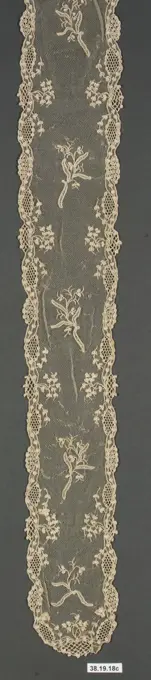
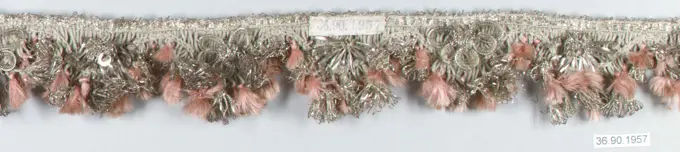
A variety of delicate lace edgings featuring floral motifs and decorative patterns. Perfect for sewing and textile embellishments.

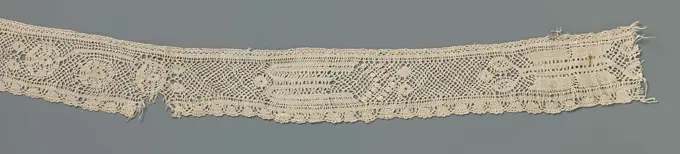
Border, Medium: linen Technique: bobbin lace, discontinuous tape, Border of large-scale floral and foliated forms in a serpentine pattern., Milan, Italy, late 17th century, lace, Border
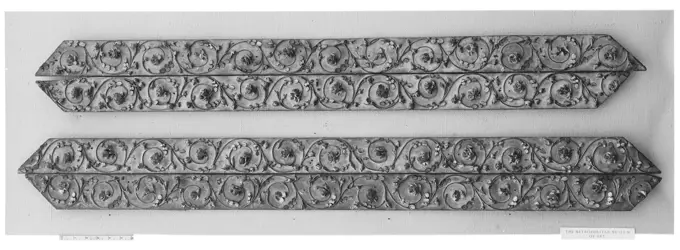
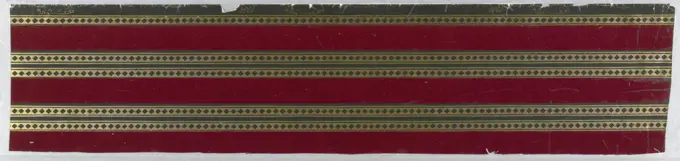
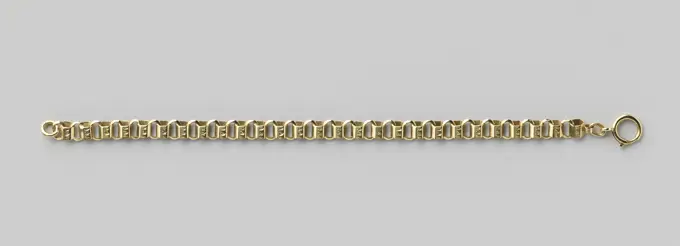
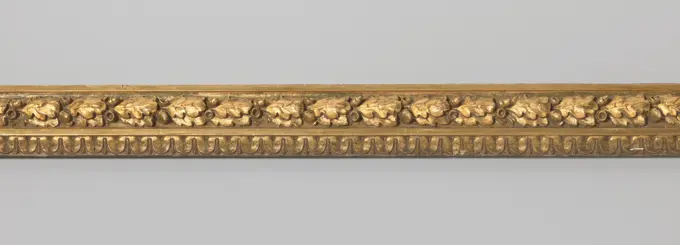
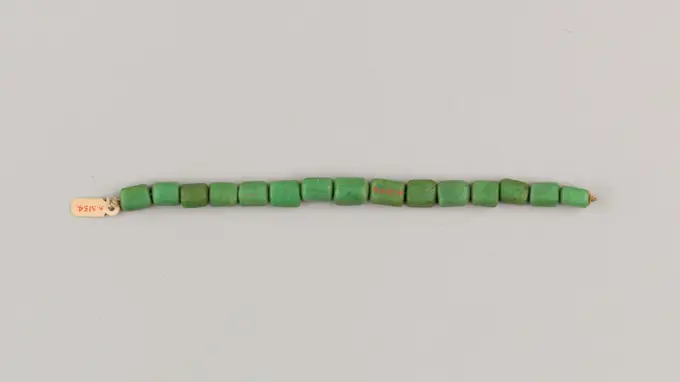
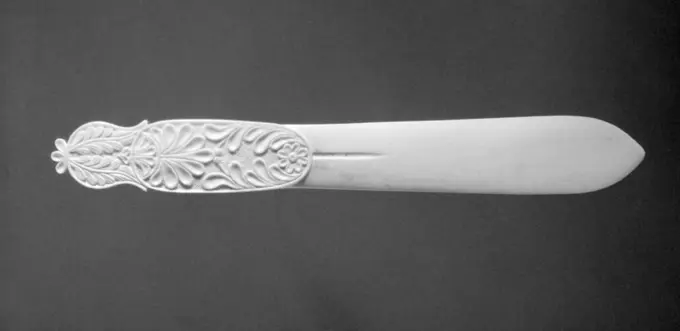
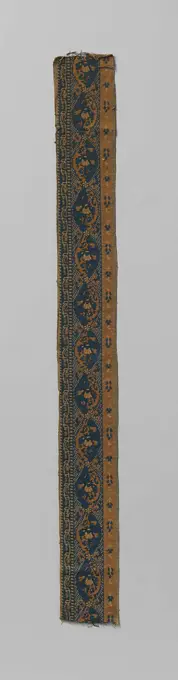
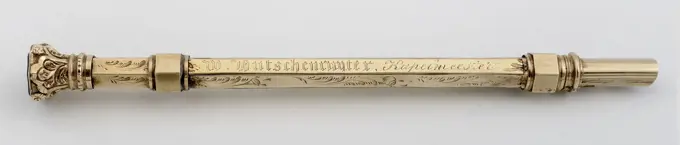
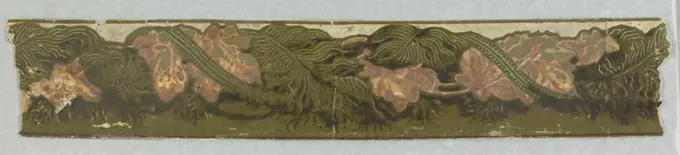
Border, Block-printed and flocked, Feathers and leaves intertwined to form a rope-list twist border., 1840-60, Wallcoverings, BorderTrimming (Italy); silkTextile 13th century German (). Textile 468142Set of frieze panels 18th century French. Set of frieze panels. French. 18th century. Wood, carved and gilt on buff ground. WoodworkPiece possibly French 18th centuryPiece 18th century Japan. Piece 65791Ribbon (USA); silkBorder, Medium: linen Technique: needle lace, Nineteenth century rosepoint in pattern of seventeenth century candelabra type with narrow edging on one side of 'roses.' Worked in ecru thread., Burano, Italy, late 19th century, lace, BorderCarpet fragment Made 1850-1900 China. Solid cut and uncut velvet .Band, Medium: Silk, linen Technique: plain weave and slit tapestry, Geometric design in black and white., 10th-12th century, woven textiles, BandEmbrasse.Embrasse of red-white checkered silk, lined with white linen and with two set of metal hooks and eyes.Border with Double-Headed Birds and Vases with Vines and Flowers, 19th century. Italy, Sardinia, 19th century. Needle lace, filet/lacis (knotted ground and darned in one direction); bleached linen (est.); overall: 23.8 x 244.2 cm (9 3/8 x 96 1/8 in.). Double-headed birds alternating with flowering vases appear on this filet/lacis lace. The pattern repeats horizontally, with organic spirals which burst into the upper and lower registers.Vivatlintje, , 1700 - 1750 ribbon (material) Silver, green and orange ribbon with four times bust of a man in profile to the left with a stick in his right hand, on the left next to his head the horn of abundance. Between these performances in the inscription on Banderol and plant motifs with orange apples. Fringes of silver thread on the edges of the ribbon. Inscription; M.: Vivat. Wch. Friso. (3½ x repeated). Netherlands silk. silver threadCanvas, anonymous, c. 1900 - c. 1920 Cloth for martial or devil -banner rituals, worn by men around their necks. The motif is called Dindingai and represents a braided bamboo wall. Bali cotton (textile) Cloth for martial or devil -banner rituals, worn by men around their necks. The motif is called Dindingai and represents a braided bamboo wall. Bali cotton (textile)Strip bobbin with zigzag line of mousjes and lying oval flower, anonymous, c. 1830 - c. 1849 Strip of natural -colored bobbin: Lille side. Under a zigzag line of square mousjes, the repeating pattern exists along the lower half of the strip from a lying flower stem with two oval petals and an oval flower, all with a whimsical lobbed edge. There are two openwork oval motifs under each flower, with ditto edge and separated by a square mush. The motifs are connected by a fine grid, a tuler land. The sparing fullwork is made in linen battle, with thicker and shiny contour threads. At the top and bottom are straight finished, with the bottom with picots. Belgium linen (material) bobbin lace / Lille lace Strip of natural -colored bobbin: Lille side. Under a zigzag line of square mousjes, the repeating pattern exists along the lower half of the strip from a lying flower stem with two oval petals and an oval flower, all with a whimsical lobbed edge. There are two openwork oval motifs under eacStrip bobbin with Wirwar of buttons around a rectangular piece of linen, anonymous, c. 1700  Strip Kloskant, Old Flemish side, that is sewn around a rectangular piece of linen. The pattern consists of a maze of oval buttons with mostly C-shaped appendices. There is hardly any soil, the motifs merge or are connected by very short braids. The motifs are made in linen battle with openwork edges. The straight upper edge of the strip is sewn along one long and two short sides of the elongated rectangular piece of linen. The linen is finished around all sides with a zoompje. The underside of the edge strip is straight finished and is equipped with picots. It may be intended to be stolen. Flanders linen (material) bobbin lace / old Flemish laceGalloon late 18th-early 19th century European. Galloon. European. late 18th-early 19th century. Silk. Textiles-TrimmingsStrip 17th century French. Strip 213033Galloon 18th century German, Silesia. Galloon 217719Trimming (France); silk, metallic threadPiece 10th century Japan. Piece 71007Border, Block-printed on handmade paper, Decorative architectural molding with a stylized classical motif. Simple acanthus leaf enclosed within tongue-like brackets which end in a rosette. Alternating, daisy-like flower and leaves. Dentilled edging. Printed in yellow, brown, tan, on orange ground., France, 1810-25, Wallcoverings, BorderPen Box 18th-19th century. Pen Box 444616Instrument with Loop Finial. UnknownRibbon 1860 British. Ribbon 222593Fragment (Italy); linenFans of thick paper, in which preformed fan shape, covered with fantasy paper and lined with red paper, c. 1880 Waaierdug made of thick paper, in which preformed fan shape, covered with fantasy paper and lined with red paper. Paper with orange stock on which various colored hexagons interspersed with stars, sometimes dotted. Inside deep fan shape that completely encloses fan. Elongated white label in the middle of the lid. Japan whole: Paper. whole: gouache (paint) painting Waaierdug made of thick paper, in which preformed fan shape, covered with fantasy paper and lined with red paper. Paper with orange stock on which various colored hexagons interspersed with stars, sometimes dotted. Inside deep fan shape that completely encloses fan. Elongated white label in the middle of the lid. Japan whole: Paper. whole: gouache (paint) paintingFan case, Wood, screws, Plain wooden box with top that screws on., China, ca. 1785, costume & accessories, Fan caseSampler 19th century German. Sampler 228397Needle. UnknownBobbin Lace Edging, 17th-18th century. Italy, Abruzzi, 17th-18th century. Lace, bobbin; average: 3.9 x 64.5 cm (1 9/16 x 25 3/8 in.).Sidewall, Machine-printed, gauffre, gilt, flock, Gauffred gold bands decorated with two rows of black diamonds; flanking maroon flocked strips of equal width. On border, in gilt, 1086 and AWPMA in cartouche. (Initials stand for American Wall Paper Manufacturer's Association.), USA, 1880-87, Wallcoverings, SidewallFragment 17th century Dutch. Fragment 212859Woman's Ceremonial Skirt (Tapis) 19th century Lampung. Woman's Ceremonial Skirt (Tapis). Lampung. 19th century. Cotton, gold wrapped thread, mirror fragments, paillettes. Indonesia, Sumatra, Lampung. Textiles-WovenStrook kloskant met drie verschillende langgerekte motieven.Strip natural colosside. The pattern consists of three different elongated motifs with oval details. The motifs are connected to each other by a diamond-shaped grille, a fat gland barrier. The motifs are made in linen stroke with openwork edges. In the middle motif a double V-shaped border has been realized with mates, made in shape stroke. Along the bottom of the strip an edge of co-switched impeller motifs is running. The top is finished with a simple straight decorative edge. One of the short sides is finished with a soil.Plaque 7th-8th century. Plaque 449528Fragment of lace. unknown, authorFragment (Bonnet Trim) Made 1840-1860 Europe. Horsehair, bobbin lace mesh; embroidered with straw and straw yarns in loop and surface satin stitches; knots; appliquÈd with cotton, plain weave with supplementary pile wefts forming cut solid velvet (velveteen); embroidered with straw in back stitches .Trimming (France); silkBand, Medium: linen Technique: bobbin lace, 'Punto avorio' or braid-like peasant lace from the Valle Vogna is of the same type as this from Monferrato., Monferrato, Italy, 17th-18th century, lace, BandA piece of brown blank torn note paperBobbin Lace Edging, 19th century. Belgium, Binche, 19th century. Lace, bobbin: linen; average: 7.4 x 59.7 cm (2 15/16 x 23 1/2 in.).Needlepoint Lace Edging, 18th century. France, Alençon, 18th century. Lace, needlepoint: linen; average: 5.8 x 36.3 cm (2 5/16 x 14 5/16 in.).Fringe, Medium: silk Technique: woven, Red fringe with a plain-woven heading and a skirt of red loops., Italy, 16th century, trimmings, FringePiece 19th century Japan. Piece 67157Gimp probably European 19th centuryEdging 16th century Greek. Edging 212827Left Corner Block of a Cornice. UnknownSupport Bar ca. 1600 French. Support Bar 470654Trimming, Medium: silk Technique: woven, Red and tan trimming fragment in a checkerboard design arranged to form a red stripe between two yellow., France, 18th century, trimmings, TrimmingFragment of a decorative strip in tapestry, anonymous, c. 900 - c. 1199 Linen tissue fragment with woven silk decoration. A brown winding strap forms a cord of large and small ovals through braids. The large fields are in turn blue and red, on which alternating birds or hares are depicted. The intermediate ovals are in red, yellow and blue. The job of medallions has a brown -winding band left and right. In between a small red motif. Left and right tires in red yellow red. Egypt Ketting an element: Linen (material). Entry: Silk tapestry Linen tissue fragment with woven silk decoration. A brown winding strap forms a cord of large and small ovals through braids. The large fields are in turn blue and red, on which alternating birds or hares are depicted. The intermediate ovals are in red, yellow and blue. The job of medallions has a brown -winding band left and right. In between a small red motif. Left and right tires in red yellow red. Egypt Ketting an element: Linen (material). Entry: SiWaist Wrapper (Kumbut Juangga,Cindé)Bailey railing, 1656 - 1657 The object cast as a whole, to which some iron mounting elements are sounded, has a rectangular shape with an openwork decoration, which consists of symmetrical leaf vines, ending in flower and fruit motifs, on either side of two hoses knotted together. On one long side, two iron hinge components were sounded and on both short sides, on the front and back, an iron eye. The function of the object is not known. Amsterdam brass (alloy). iron (metal) casting  Exchange bank. City Hall of Amsterdam (1655-1808) The object cast as a whole, to which some iron mounting elements are sounded, has a rectangular shape with an openwork decoration, which consists of symmetrical leaf vines, ending in flower and fruit motifs, on either side of two hoses knotted together. On one long side, two iron hinge components were sounded and on both short sides, on the front and back, an iron eye. The function of the object is not known. Amsterdam brass (alloy). iron (metal) casting  ExBorder, Medium: linen Technique: Brussels-style bobbin lace, Large-scale flowers and leaves connected with brides., Brussels, Belgium, 19th century, lace, BorderFragment; silk, metallicStrip embroidered linen with between diagonal lines always an openwork Z, anonymous, c. 1585 - c. 1615 Strip of natural linen with embroidery and lace plunge: sliced work. The repeating pattern consists of embroidered diagonal lines, between which an openwork Z stands (with a straight instead of diagonal axis). The Z consists of a succession of cut squares that are tackled with feston stitches and are decorated with a kind of picots. A strip is sewn along the top of the strip that consists of openwork squares with spokes. West-Europa linen (material) embroidering Strip of natural linen with embroidery and lace plunge: sliced work. The repeating pattern consists of embroidered diagonal lines, between which an openwork Z stands (with a straight instead of diagonal axis). The Z consists of a succession of cut squares that are tackled with feston stitches and are decorated with a kind of picots. A strip is sewn along the top of the strip that consists of openwork squares with spokes. West-Belt, Medium: leather, wool felt, silk() Technique: applique, felt, braided, White leather belt, ornamented with felt cut in hearts, ovals and circles and blue, gray, yellow and black silk; bound with red silk braid and lined with red silk., Denmark, late 19th century, costume & accessories, BeltJOYAS DEL TESORO DE ALISEDA - DETALLE DE UN CINTURON DE ORO (CONJ Nº 16276). Location: MUSEO ARQUEOLOGICO NACIONAL-COLECCION. MADRID. SPAIN.Trimming (France); 1909-2-225Trimming, Medium: silk Technique: woven, Yellow trimming fragment in a design of eight-petal flowers alternating with linear motifs; checkerboard borders and picot edges., France, 19th century, trimmings, TrimmingGold switch bracelet with Emmaschakel, c. 1910 - c. 1920 Gold switch bracelet with Emmaschakel. The bracelet closes with a spring ring.  gold (metal) Gold switch bracelet with Emmaschakel. The bracelet closes with a spring ring.  gold (metal)List fragment: Gilded list of pâte ornaments, right style., C. 1700 - c. 1899 frame Gilded list of oak leaves with acorns. List part, right style. With written on the back: 'Right side, no. 1'.  wood (plant material). gold leaf gildingLace laceBelt, 20th century, 41 1/2 x 4 3/8 in. (105.41 x 11.11 cm) (including braids, without ties), Wool, Bolivia, 20th centuryFragment, Medium: silk, metallic thread Technique: cut and uncut voided supplementary warp pile in a satin foundation (pile-on-pile velvet), Very small fragment with incomplete design. Uncut blue ground with large-scale floral and foliate motif in green, blue, salmon, and purple cut and uncut pile. Pink satin ground, shot with silver thread, shows in three minute motifs., France, 1750-1800, woven textiles, FragmentFinger stall ca. 1479-1425 B.C. New Kingdom. Finger stall. ca. 1479-1425 B.C.. Gold. New Kingdom. From Egypt, Upper Egypt, Thebes, Wadi Gabbanat el-Qurud, Wadi D, Tomb of the Three Foreign Wives of Thutmose III. Dynasty 18Greek OrnamentTrimming, Medium: silk Technique: woven, Trimming fragment in a design of crossing ribbons in lavender on a yellow ground with white stripes; picot edges., France, 19th century, trimmings, TrimmingTrimming, Medium: silk Technique: cut supplementary warp pile in a satin ground (velvet), Red and yellow trimming fragment in a Greek fret pattern., France, 19th century, trimmings, TrimmingTrimming, Medium: silk, Trimming fragment in an alternating red and yellow leaf pattern that passes over and under a blue bar on a cream-colored ground., France, 18th century, trimmings, TrimmingSash or Headband 7th century Nasca. Sash or Headband 307959Strip Passement with gold thread, 1800 - 1900 Strip passement of gold thread.  . Strip passement of gold thread.  .Collar of stealed cotton with standing board and two removal points with in whitework corners and ranks, anonymous, c. 1875 - c. 1900 Collar of stealed cotton with standing board and two removal points with in whitework corners and virgles. West-Europa cotton (textile) embroidering Collar of stealed cotton with standing board and two removal points with in whitework corners and virgles. West-Europa cotton (textile) embroideringTrimming, Medium: silk Technique: woven, Yellow and pink trimming fragment in a design of lozenges ornamented with smaller lozenges., France, 19th century, trimmings, TrimmingSleeve Band, 1800s. China, Qing dynasty (1644-1911). Silk, satin weave, embroidery; overall: 94.7 x 8.8 cm (37 5/16 x 3 7/16 in.).Ribbon (possibly USA); Warp x Weft: 77.5 x 7.7 cm (30 1/2 x 3 1/16 in.) Repeat H: 12.5 cm (4 15/16 in.)Border, Medium: linen Technique: needle lace with ground of loop & twist with twist return, Border edged on one side by row of floral blossoms and standalone floral sprays., France, early 19th century, lace, BorderBorder, Medium: silk (cat card 1964) Technique: bobbin lace made in Lille style with heavy outlining thread, Border in a Lille-style pattern that was probably executed in Italy., Spain, late 18th century, lace, BorderPair of lappets (part of a garniture) 1774-93 French. Pair of lappets (part of a garniture). French. 1774-93. Needle lace, point dAlençon. Textiles-LacesTrimming (France); silkStrook naaldkant met driehoekige schulpjes.Strip natural needle side: Punto in Aria or Gothic Venetian side. The strip or slip edge consists of triangular scales made up of arcs and triangles on a narrow straight top.String of 15 hexagonal beads Probably 3rd to 4th Century A.D. Roman Period These hexagonal beads are made of glass and colored to imitate semi-precious stones. Here the opaque green glass may represent beryl.. String of 15 hexagonal beads 570530Letter opener (part of a set) 1848-49 Russian The firm of Nicholls & Plincke was founded by members of the relatively large community of English silversmiths and craftsmen working in Saint Petersburg. After 1840 it was one of the most important retailers of luxury items before Carl Fabergé overshadowed all competitors. Several contemporary Saint Petersburg newspapers praised the high-quality products of the magasin anglais Nicholls & Plincke.According to the donor's family tradition, this rare set with more than fifty items bearing the monogram CMI was "originally made for and used by Colin Macrae Ingersoll 1819-1903, when he accompanied his father, Ralph Isaacs Ingersoll 1788-1872, to the Court of Czar Alexander II of Russia, where the latter served President James Knox Polk 1795-1849 as Minister Plenipotentiary from 1846 to 1848.. The family story has always been that the set and case were made for stagecoach travel in Russia."Plain silver objects—like the ewer and the cup Trimming, Medium: silk Technique: woven, Trimming fragment with a design of diagonal brown bands on a yellow ground; picot edges., France, 19th century, trimmings, TrimmingBand (Italy); linenFragment in kasjmiersjaaltechniek.A fragment of a scarf ().Ornament with plants and flowers, Bernard Willem Wierink, c. 1910 print   paper  plants and herbs. ornaments ~ art. fable of Reynard the FoxFan Holder 18th-19th century China. Fan Holder 68853Dedicative introduction:;  1824 (1824-00-00-1824-00-00);print on fabric, ribbonsBorder, Medium: cotton Technique: printed by engraved roller on plain weave; mordant for red, Long narrow strip of printed fabric used as binding of 1976-30-5A. A small scale leaf pattern in red., Europe, ca. 1840, printed, dyed & painted textiles, BorderRealistic gold glitter paint brush.Fringe 17th century French. Fringe 225038The nummulites of building stone, vintage engraved illustration. Earth before man a 1886.Trimming, Medium: silk Technique: woven, Blue and yellow trimming fragment with a leaf design and conventional forms., France, 19th century, trimmings, TrimmingScarf early 19th century Spanish. Scarf 102613Gold plated pen holder W. Hutschenruijter, holder writing tools metal gold stone h 13.2, gilded W. Hutschenruijter. Kapellmeister 1807 - 50 years Schutterlijken Dienst - 1857 Some enthusiasts from the corps Musicians in Rotterdam Rotterdam conductor music militia militaria Music school Wouter Hutschenruyter jr Wouter Hutschenruyter jr. (1859-1943)Trimming (France); silkPair of Lappets (Joined) Made 1760-1765 Mechlin. Linen, bobbin straight lace of a type known as Mechlin with a Mechlin mesh ground .Swaddling cloth, Medium: cotton Technique: predominantly warp-faced plain weave patterned by warp floats, Italy, late 19th century, woven textiles, Swaddling clothFragment of a Tiraz-Style Textile, 1101 - 1130. Egypt, Fatimid period, probably Caliphate of al-Amir, AH 495-524, 12th Century. Tabby ground with inwoven tapestry ornament; linen and silk; overall: 3.9 x 31.8 cm (1 9/16 x 12 1/2 in.).